





Archive for the 'Film comments' Category
A behemoth from the Dead Zone
DB here:
The first quarter of the year is the biggest slump time for movie theatres. (1) Holiday fatigue, thin budgets, bad weather, the Super Bowl, and the distractions of the awards season depress admissions. If people go to the movies, they tend to catch up on Oscar nominees, and studios don’t want to release high-end films that might suffer from the competition. But screens need fresh product every week, so most of what gets released at this time of the year might charitably be called second-tier.
Ambitious filmmakers fight to keep out of this zone of death. You could argue that the January release slot of Idiocracy told Mike Judge exactly what Fox thought of that ripe exercise in misanthropy. Zodiac, one of the best films of 2007, opened on 1 March, and even ecstatic reviews couldn’t push it toward Oscar nominations. You can imagine what chances for success Columbia has assigned to Vantage Point (a 22 February bow). [But see my 4 Feb. PPPS below.]
Yet this is a flush period for those of us who like to explore low-budget genre pieces. I have to admit I enjoy checking on those quickie action fests and romantic comedies that float up early in the year. They’re today’s equivalent of the old studios’ program pictures, those routine releases that allowed theatres to change bills often. In their budgets, relative to blockbusters, today’s program pix are often the modern equivalent of the studios’ B films.
More important, these winter orphans are often more experimental, imaginative, and peculiar than the summer blockbusters. On low budgets, people take chances. Some examples, not all good but still intriguing, would be Wild Things (1998), Dark City (1998), Romeo Must Die (2000), Reindeer Games (2000), Monkeybone (2001), Equilibrium (2002), Spun (2003), Torque (2004), Butterfly Effect (2004), Constantine (2005), Running Scared (2006), Crank (2006), and Smokin’ Aces (2007). The mutant B can be found in other seasons too—one of my favorites in this vein, Cellular (2004), was released in September—but they’re abundant in the year’s early months.
By all odds, Cloverfield ought to have been another low-end release. A monster movie with unknown players, running a spare 72 minutes sans credits, budgeted at a reputed $25 million, it’s a paradigm of the winter throwaway. Except that it pulled in $46 million over a four-day weekend and became the highest-grossing film (in unadjusted dollars) ever to be released in January. Here the B in “B-movie” stands for Blockbuster.
I enjoyed Cloverfield. It starts with a sharp premise, but as ever, execution is everything. I see it as a nifty digital update of some classic Hollywood conventions. Needless to say, many spoilers loom ahead.
If you find this tape, you probably know more about this than I do
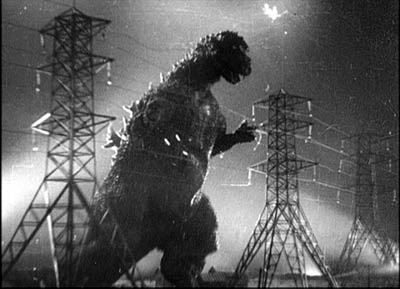
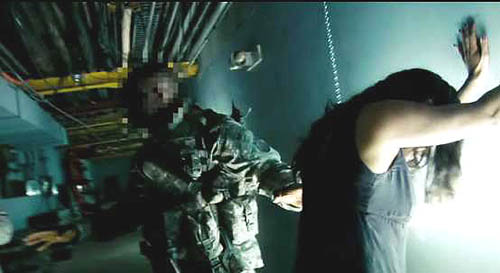
Everybody knows by now that Cloverfield is essentially Godzilla Meets Handicam. A covey of twentysomethings are partying when a monster attacks Manhattan, and they try to escape. One, Rob, gets a phone call from his off-again lover Beth, who’s trapped in a high-rise. He vows to rescue her. He brings along some friends, one of whom documents their search with a video camera. It’s a shooting-gallery plot. One by one, the characters are eliminated until we’re down to two, and then. . . .
Cloverfield exemplifies what narrative theorists call restricted narration. (Kristin and I discuss this in Chapter 3 of Film Art.) In the narrowest case of restricted narration, the film confines the audience’s range of knowledge to what one character knows. Alternatively, as when the characters are clustered in the same space, we’re restricted to what they collectively know. In other words, you deny the viewer a wider-ranging body of story information. By contrast, the usual Godzilla installment is presented from an omniscient perspective, skipping among scenes of scientists, journalists, government officials, Godzilla’s free-range ramblings, and other lines of action. Instead, Cloverfield imagines what Godzilla’s attack would look and feel like on the ground, as observed by one group of victims.
Horror and science fiction films have used both unrestricted and restricted narration. A film like Cat People (1942) crosscuts what happens to Irena (the putative monster) with scenes involving other characters. Jurassic Park and The Host likewise trace out several plot strands among a variety of characters. The advantage of giving the audience so much information is that it can feel apprehension and suspense about what the characters don’t know is happening. Our superior knowledge can make us worry about those poor victims oblivious to their fate.
But these genres have relied on restricted narration as well. Invasion of the Body Snatchers (1956) is a good example; we are at Miles’s side in almost every scene, learning of the gradual takeover of his town as he does. Night of the Living Dead (1968), Signs (2002), and War of the Worlds (2005) do much the same with a confined group, attaching us to one or the other momentarily but never straying from their situation.
The advantages of restricted narration are pretty apparent. You can build up uncertainty and suspense if we know no more than the character(s) being attacked by a monster. You can also delay full revelation of the creature, a big deal in these genres, by giving us only the glimpses of it that our characters get. Arguably as well, by focusing on the characters’ responses to their peril, you have a chance to build audience involvement. We can feel empathy and loss if we’ve come to know the people more intimately than we know the anonymous hordes stomped by Godzilla. Finally, if you need to give more wide-ranging information about what’s happening outside the characters’ immediate situation, you can always have them encounter newspaper reports, radio bulletins, and TV coverage of action occurring elsewhere.
People sometimes think that theoretical distinctions like this overintellectualize things. Do filmmakers really think along these lines? Yes. Matt Reeves, the director of Cloverfield, remarks:
The point of view was so restricted, it felt really fresh. It was one of the things that attracted me [to this project]. You are with this group of people and then this event happens and they do their best to understand it and survive it, and that’s all they know.
For your eyes only
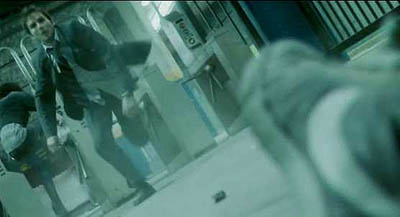
Restricted narration doesn’t demand optical point-of-view shots. There aren’t that many in Invasion of the Body Snatchers or the other examples I’ve indicated. Still, for quite a while and across a range of genres, filmmakers have imagined entire films recording a character’s optical/ auditory experience directly, in “first-person,” so to speak.
Again, it’s useful to recognize two variants of this narrational strategy. One we can call immediate—experiencing the action as if we stood in the character’s shoes. In the late 1920s, the great documentary filmmaker Joris Ivens tried to make what he called his I-film, which would record exactly what a character saw when riding a bike, drinking a glass of beer, and the like. He was dismayed to find that bouncing and swiveling the camera as if it were a human eye ignored the fact that in real life, our perceptual systems correct for the instabilities of sensation. Ivens abandoned the project, but evidently he couldn’t get the notion out of his head; he called his autobiography The Camera and I. (2)
Hollywood’s most strict and most notorious example of directly subjective narration is Robert Montgomery’s Lady in the Lake (1947). Its strangeness reminds us of some inherent challenges in this approach. How do you show the viewer what your protagonist looks like? (Have him pass in front of mirrors.) How do you skip over the boring bits? (Have your hero knocked unconscious from time to time.) How do you hide the inevitable cuts? (Try your best.) Even Montgomery had to treat the subjective sequences as long flashbacks, sandwiched within scenes of the hero in his office in the present telling us what he did next.
Because of these problems, a sustained first-person immediate narration is pretty rare. The best compromise, exploited by Hitchcock in many pictures and especially in Rear Window (1954), is to confine us to a single character’s experience by alternating “objective” shots of the character’s action with optical point-of-view shots of what s/he sees.
What I’m calling immediate optical point of view is just that: sight (and sounds) picked up directly, without a recording mechanism between the story action and the character’s experience. But we can also have mediated first-person point of view. The character uses a recording technology to give us the story events.
In a brilliant essay on the documentary Kon-Tiki (1950), André Bazin shows that our knowledge of how Thor Heyerdahl filmed his raft voyage lends an unparalleled authenticity to the action. Heyerdahl and his crew weren’t experienced photographers and seem to have taken along the 16mm camera as an afterthought, but the very amateurishness of the enterprise guaranteed its realism. Its imperfections, often the result of hazardous conditions, were themselves testimony to the adventure. When the men had to fight storms, they had no time to film; so Bazin is able to argue, with his inimitable sense of paradox, that the absence of footage during the storm is further proof of the event. If we were given such footage, we might wonder if it was staged afterward.
How much more moving is this flotsam, snatched from the tempest, than would have been the faultless and complete report offered by an organized film. . . . The missing documents are the negative imprints of the expedition. (3)
What about fictional events? In the 1960s we started to see fiction films that presented themselves as recordings of the events as the camera operator experienced them. One early example is Stanton Kaye’s Georg (1964). The first shot follows some infantrymen into battle, but then the framing wobbles and the camera falls to earth. We see a tipped angle on a fallen solider and another infantryman approaches.

He bends toward us; the frame starts to wobble and we are lifted up. On the soundtrack we hear, “I found my camera then.”
The emergence of portable equipment and cinema-verite documentary seems to have pushed filmmakers to pursue this narrational mode in fiction. One result was the pseudo-documentary, which usually doesn’t present the story as a single person’s experience but rather as a compilation of first-person observations. Peter Watkins’ The War Game (1967) presents itself as a documentary shot during a nuclear war, and it contains many of the visual devices that would come to be associated with the mediated format—not only the flailing camera but the face-on interview and the chaotic presentation of violent action. There’s also the pseudo-memoir film, pioneered in David Holzman’s Diary (1967). Later examples of the pseudo-documentary are Norman Mailer’s Maidstone (1971) and the combat movie 84 Charlie MoPic (1989). (4)
As lightweight 16mm cameras made filming easier, directors adapted that look and feel to fictional storytelling. The arrival of ultra-portable digital cameras and cellphones has launched a similar cycle. Brian DePalma’s Redacted (2007), yet another war film, has exploited the technology for docudrama. A digital equivalent of David Holzman’s Diary, apart from Webcam and YouTube material, is Christoffer Boe’s Offscreen (2006), which I discussed here.
Interestingly, Orson Welles pioneered both the immediate and the mediated subjective formats. One of his earliest projects for RKO was an adaptation of Heart of Darkness, in which the camera was to represent the narrator Marlowe’s optical perspective throughout. (5) Welles had more success with the mediated alternative, though in audio form. His “War of the Worlds” radio broadcast mimicked the flow of programming and interrupted it with reports of the aliens’ attack. The device was updated for television in the 1983 drama Special Bulletin.
Sticking to the rules
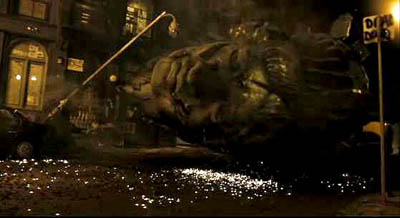
Cloverfield, then, draws on a tradition of using technologically mediated point-of-view to restrict our knowledge. Like The Blair Witch Project (1999), it does this with a horror tale. But it’s also a Hollywood movie, and it follows the norms of that moviemaking mode. So the task of Reeves, producer J. J. Abrams, and the other creators is to fit the premise of video recording to the demands of classical narrative structure and narration. How is this done?
First, exposition. The film is framed as a government SD video card (watermarked DO NOT DUPLICATE), the remains of a tape recovered from an area “formerly known as Central Park.” This is a modern version of the discovered-manuscript convention familiar from the nineteenth-century novel. When the tape starts, showing Rob with Beth in happy times, its read-out date of April plays the role of an omniscient opening title. In the course of the film, the read-outs (which come and go at strategic moments) will tell us when we’re in the earlier phase of their love affair and when we’re seeing the traumatic events of May.
Likewise, the need for exposition about characters and relationships at the start of the film is given through a basic premise. Jason wants to record Rob’s going-away-party and he presses Rob’s friend Hud into service as the cameraman. Off the bat, Hud picks out our main characters in video portraits addressed to Rob. What follows indicates that Hud will be amazingly prescient: His camera dwells on the characters who will be important in the ensuing action.
Next, overall structure. The Cloverfield tape conforms to the overarching principles that Kristin outlines in Storytelling in the New Hollywood and that I restated in The Way Hollywood Tells It. (Another example can be found here.) A 72-minute film won’t have four large-scale parts, most likely two or three. As a first approximation, I think that Cloverfield breaks into:
*A setup lasting about 30 minutes. We are introduced to all the characters before the monster attacks. Our protagonists flee to the bridge, where Jason dies. Near the end of this portion, Rob gets a call from Beth, and he formulates the dual goals of the film: to escape from the creature, and to rescue Beth. Along the way, Hud declares he’s going to record it all: “People are gonna know how it all went down. . . . It’s gonna be important.”
*A development section lasting about 22 minutes. This is principally a series of delays. Rob, Hud, Lily, and Marlena encounter obstacles. Marlena falls by the wayside. They are given a deadline: At 0600 they must meet the last helicopters leaving Manhattan.
*A climax lasting about 20 minutes. The group rescues Beth and meets the choppers, but the one carrying Rob, Hud, and Beth falls afoul of the beast. They crash in Central Park, and Hud is killed, his camera recording his death at the jaws of the monster. Huddled under a bridge, Rob and Beth record a final video testimonial before an explosion cuts them off.
*An epilogue of one shot lasting less than a minute: Rob and Beth in happier times on the Ferris wheel at Coney Island—a shot left over from the earlier use of the tape in April.
Next, local structure and texture. It takes a lot of artifice to make something look this artless. The imagery is rich and vivid, the sharpest home video you ever saw. The sound is pure shock-and-awe, bone-rattling, with a full surround ambience one never finds on a handicam. (6) Moreover, Hud is remarkably lucky in catching the turning points of the action. All the characters’ intimate dramas are captured, and Hud happens to be on hand when the head of Miss Liberty hurtles down the street.
Bazin points out that in fictional films the ellipses are cunning gaps, carefully designed to fulfill narrative ends—not portions left out because of the physical conditions of the shoot. Here the cunning gaps are justified as constrained by the physical circumstances of filming. When Hud doesn’t show something, it’s usually because it’s what the genre considers too gross, so the worst stretches take place in darkness, or offscreen, or strategically shielded by a prop when the camera is set down.
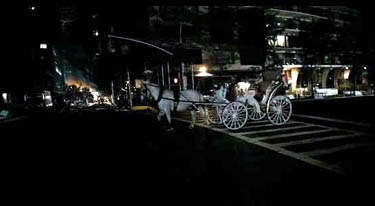
Mostly, though, Hud just shows us the interesting stuff. He turns on the camera just before something big happens, or he captures a disquieting image like that of the empty Central Park carriage.
At least once, the semi-documentary premise does yield something evocative of the Kon-Tiki film. Hud has to leap from one building to another, many stories above the street. He turns the camera on himself: “If this is the last thing you see, then I died.” He hops across, still running the camera, but when a rocket goes off nearby, a sudden cut registers his flinch. For an instant out of sheer reflex, he turned off the camera.
Overall, Hud’s tape respects the flow of classical film style. Unlike the Lady in the Lake approach, the mediated POV format doesn’t have a problem with cuts; any jump or gap is explained as a moment when the operator switched off the camera. Most of Hud’s “in-camera” cuts are conventional ones, skipping over a few inconsequential stretches of time. There are as well plenty of hooks between scenes. (For more on hooks, go here.) Hud says: “I’ll walk in the tunnels.” Cut to characters walking in the tunnels. More interestingly, visible cuts are rare, which again respects the purported conditions of filming. Cloverfield has much longer takes than any recent Hollywood film I know. I counted only about 180 shots, yielding an average of 24 seconds per shot (in a genre in which today’s films average 2-5 seconds per shot).
The digital palimpsest
We could find plenty of other ways in which Cloverfield adapts the handicam premise to the Hollywood storytelling idiom. There are the product placements that just happen to be part of these dim yuppies’ milieu. There are the character types, notably the sultry Marlena and the hero’s weak friend who’s comically a little slow. There’s the developing motif of the to-camera addresses, with Rob and Beth’s final monologues to the camera counterbalancing the party testimonials in the opening. There’s the final romantice exchange: “I love you.” “I love you.” The very last shot even includes a detail that invites us to re-view the entire movie, at the theatre or on DVD. But let me close by noting how some specific features of digital video hardware get used imaginatively.
I’ve already mentioned how the viewfinder date readout allows us to keep the time structure clear. There’s also the use of a night-vision camera feature to light up those spidery parasites shucked off by the big guy. Which scares you more—to glimpse the pinpoint eyes of critters skittering around you in the dark, or to see them up close in a sickly green light?
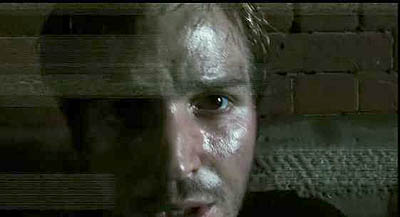
More teasing is the fact, set up in the first part, that this video is being recorded over an old tape of Rob’s. That’s what turns the opening sequence of Rob and Beth in May into a prologue: the tape wasn’t rewound completely for recording the party. Later, at intervals, fragments of that April footage reappear, apparently through Hud’s inadvertently advancing the tape. The snippets functions as flashbacks, showing Rob and Beth going to Coney Island and juxtaposing their enjoyable day with this horrendous night.
Cleverly, on the tape that’s recording the May disaster something always prepares the audience for the shift. For instance, when Jason hands the camera over, we hear Hud say, “I don’t even know how to work this thing.” Cut to an April shot of Beth on the subway, suggesting that he’s advanced fast forward without shooting. Likewise, when Rob says, “I had a tape in there,” we cut to another April shot of Beth. As a final fillip, the footage taken in May halts before the tape ends, so we get the epilogue showing Rob and Beth on the Ferris wheel in April, emerging like figures in a palimpsest.
No less clever, but also a little poignant, is the use of the fallen-camera convention. It appears once when Beth has to be extricated from her bed. Hud sets the camera down by a concrete block in her bedroom, which conceals her agony. More striking is the shot when the camera, dropped from Hud’s hand, lies in the grass, and the autofocus device oscillates endlessly, straining to hold on his lifeless face.
In sum, the filmmakers have found imaginative ways of fulfilling traditional purposes. They show that the look and feel of digital video can refresh genre conventions and storytelling norms. So why not for the sequel show the behemoth’s attack from still other characters’ perspectives? This would mobilize the current conventions of the narrative replay and the companion film (e.g., Eastwood’s Iwo Jima diptych). Reeves says:
The fun of this movie was that it might not have been the only movie being made that night, there might be another movie! In today’s day and age of people filming their lives on their iPhones and Handycams, uploading it to YouTube. . . .
So the Dead Zone of January through March yields another hopeful monster. What about next month’s Vantage Point? The tagline is: 8 Strangers. 8 Points of View. 1 Truth. Hmmm. . . . Combining the network narrative with Rashomon and a presidential assassination. . . . Bet you video recording is involved . . . . See you there?
PS: At my local multiplex, you’re greeted by a sign: WARNING: CLOVERFIELD MAY INDUCE MOTION SICKNESS. I thought this was just the theatre covering itself, but I’ve learned that no recent movie, not even The Bourne Ultimatum, has had more viewers going giddy and losing their lunch. You can read about the phenomenon here, and Dr. Gupta weighs in here. My gorge can rise when a train jolts, but I had no problems with two viewings of Cloverfield, both from third row center.
Anyhow, it will be perfectly easy to watch on your cellphone. But we should expect to see at least one pirate version shot in a theatre by someone who’s fighting back the Technicolor yawn, giving us more Queasicam than we bargained for.
(1) The only period that rivals this slow winter stretch is mid-August to October, when genre fare gets pushed out to pick up on late summer business. [Added 26 January:] There are, I should add, two desirable weekends in the first quarter, those around Martin Luther King’s birthday and Presidents’ Day. Studios typically aim their highest-profile winter releases (e.g., Black Hawk Down, 2001) for those weekends.
(2) Joris Ivens, The Camera and I (New York: International Publishers, 1969), 42.
(3) André Bazin, “Cinema and Exploration,” What Is Cinema? Vol. 1, trans. and ed. Hugh Gray (Berkeley: University of California Press, 1967), 162.
(4) Not all pseudodocumentaries present themselves as records of a person’s observation. Milton Moses Ginsberg’s Coming Apart (1969) presents itself as an objective record, by a hidden camera, of a psychiatrist’s dealings with his patients. Like a surveillance camera, it doesn’t purport to embody anybody’s point of view.
(5) Jonathan Rosenbaum, Discovering Orson Welles (Berkeley: University of California Press, 2007), 28-48.
(6) For Kevin Martin’s informative account of the film’s polished lighting and high-definition video capture, go here (and scroll down a bit). For discussions of contemporary sound practices in this genre, see William Whittington’s Sound Design in Science Fiction (Austin: University of Texas Press, 2007).
PS: Thanks to Corey Creekmur for correcting two slips in my initial post!
PPS 28 January: Lots of Internet buzz about the film since I wrote this. Thanks to everyone who linked to this post, and special thanks for feedback from John Damer and James Fiumara.
Some people have asked me to comment on the social and cultural implications of Cloverfield’s references to 9/11. At this point I think that genre cinema has dealt more honestly and vividly with the traumas and questioning around this horrendous event than the more portentous serious dramas like United 93, World Trade Center, and the TV show The Road to 9/11.
The two most intriguing post-9/11 films I know are by Spielberg. The War of the Worlds gives a really concrete sense of what a hysterical America under attack might be like, warts and all. (It reminded me of a TV show I saw as a kid, Alas, Babylon (1960), a surprisingly brutal account of nuclear-war panic in suburbia.) Spielberg’s underrated The Terminal reminds us, despite its Frank Capra optimism, that the new Security State is run by bureaucrats with fixed agendas and staffed by overworked people of color, some themselves exiles and immigrants.
I think that Cloverfield adds its own dynamic sense of how easily the entitlement culture of upwardly mobile twentysomethings can be shattered. Genre films carry well-established patterns and triggers for feelings, and a shrewd filmmaker can channel them for comment on current events—as we see in the changing face of Westerns and war films in earlier phases of Hollywood history.
On this point, Cinebeats offers some shrewd responses to criticisms of Cloverfield here.
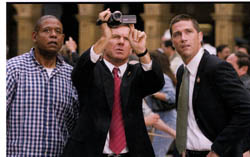 Finally: In the new Creative Screenwriting an informative piece (not available online) indicates that the initial logline for Vantage Point on imdb is misleading. Screenwriter Barry Levy planned to present the assassination from seven points of view, but reduced that to six. As for my speculation that video recording/replay would be involved, a production still seems to offer some evidence. Shall we call it the Cloverfield effect? The same issue of CS has a brief piece on the script for Cloverfield.
PPS 30 January: Shan Ding brings me another story about the making of Cloverfield, and Reeves is already in talks for a sequel, says Variety.
PPPS 4 February: A recent story in The Hollywood Reporter offers a nuanced account of how Hollywood is rethinking its first-quarter strategies. Across the last 4-5 years, a few big releases have done fairly well between January and April; a high-end film looks bigger when there is less competition. The author, Steven Zeitchik, suggests that the heavy packing of the May-August period and the need for a strong first weekend are among the factors that will encourage executives to spread releases through the less-trafficked months. I hope, though, that tonier fare won’t crowd out the more edgy, low-end genre pieces that bring me in.
PPPPS 8 February: How often has a wounded Statue of Liberty featured in the apocalyptic scenarios of comics and the movies? Lots, it turns out. Gerry Canavan explains here.
Manhattan: Symphony of a Great City
DB here:
In December Kristin and I attended a wide-ranging conference at Rome University devoted to “Exploded Narration”—the effects that digital technology has had on storytelling in film and television. As our host Vito Zagarrio put it, the question is one of continuity or rupture. Have new formats like HD, the Internet, and DVD revolutionized media storytelling? Or are they serving traditional approaches?
Many papers explored the “rupture” option, while Kristin and I offered presentations that emphasized continuity. You can find one version of my argument elsewhere on this site. Still, both of us also pointed up some innovations, or what I called “spillover” effects. As so often with such questions, the answer turned out to be complicated.
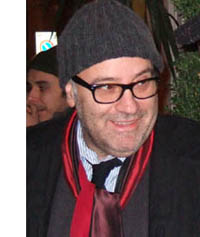 We enjoyed the conference, and one standout aspect was the presence of Amos Poe. Poe is probably best known for his first feature, Alphabet City (1985), and for his 16mm film on the Punk scene, The Blank Generation (1976). His Triple Bogey on a Par Five Hole (1991) has also attracted attention. For three decades Poe has worked as a director, producer, screenwriter, and teacher. The Sundance festival is playing Amy Redford’s The Guitar, which Poe wrote and coproduced.
Amos was great fun. A soft-spoken man with a quick and wicked sense of humor, he enlivened our dinners at various ristoranti. He also spoke extensively about screenwriting, which he teaches at NYU and at NYU’s Florence program. Like many screenwriters, he’s extremely intelligent and articulate about his craft. Three examples:
*How to learn screenwriting? Get a script version of a film you admire. Read the first ten pages, then closely watch the first ten minutes of the movie. Go back and read the next ten pages, and go ahead and watch the corresponding ten minutes. And so on until the end. Do this with three first-rate films, and you will have a concrete, intuitive understanding of how a screenplay works.
*A screenplay, Amos points out, isn’t a short story or novel or play. It’s a movie in words. It must make the reader see and hear an imaginary film, and not only the action, either. Without indicating specific shots, the descriptions should suggest the flow of long-shots and close-ups (”Her lipstick leaves a smear on the cigarette butt”). “The screenwriter is a filmmaker.”
*Write sounds into the background of scenes, setting them up for fuller presence later. If a train becomes important late in the story, mention the wail of a distant train early in the screenplay. This sort of auditory planting quietly strengthens the structure of the story in your reader’s mind.
Amos must be a terrific teacher. I learned a great deal from his descriptions of contemporary film conventions, several of which I hadn’t noticed before. Don’t be surprised to find some of them creeping into future blogs.
Given Amos’ expertise in mainstream storytelling, the film he presented was quite a surprise. It’s called Empire II, and though you don’t normally call a three-hour movie a delight, I can’t think of a better word. After a week of tourism and no films, it was just the sensuous boost that my hungry eyes needed.
Man with a Video Camera
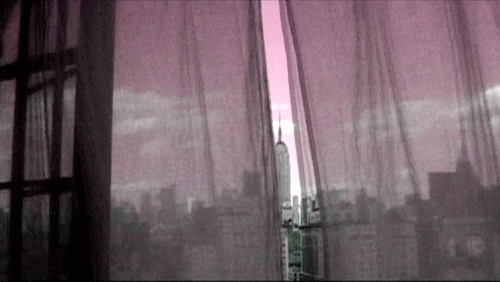
Poe’s apartment on Christopher Street yields a stunning view of the Manhattan skyline—the Chrysler Building, Jefferson clock tower, and of course the Empire State Building. He planted a Sony PD150 video camera at his window for a year, from 1 November 2005 to 31 October 2006, and took time-lapse shots. Through single-framing, he captured a total of 1 or 1 ½ seconds of every thirty seconds of real time. He shot traffic, people, skies, and the horizon. He did not look at the footage until after the year was up.
He wound up with sixty hours of imagery. He then made an absolute gesture. Using Final Cut Pro, he compressed all sixty hours into three. What was already highly elliptical, a string of tiny slices of action, became enormously accelerated.
Poe and his students then spent months blending up to forty tracks of music, spoken verse, and sound effects. It’s a crisp stereo mix, with remarkable audio-visual correspondences: whipping wind and ticking machinery sync up with snow and the tower clock. The music, which ranges from alt-rock to Keith-Jarrettish piano strumming, works sympathetically but not redundantly with the imagery. (No surprise that Poe has made music videos.) Shooting the film cost virtually nothing, but Poe spent about $100,000 for music clearances, though old friends like Patti Smith and Deborah Harry gave him their material for free.
The result is a city symphony, a lyrical tribute to the looks and sounds of New York. It joins the tradition of Walter Ruttmann and Dziga Vertov, as well as Paul Strand’s Manhatta (1921) and Jay Leyda’s Bronx Morning (1931). It also reminds you that Poe has roots in the downtown avant-garde. In 1972-1975, he often watched works by Jonas Mekas, Stan Brakhage, Michael Snow, Bruce Baillie, and Jack Smith at Millennium Film Workshop, and he made films for its Friday night open screenings. As a result, Empire II carries premises of lyrical and Structural cinema into the digital era.
The conditions of production are at once subjected to strict guidelines—a single year, only views from the window, the 20x compression—and open to chance. As with the films of Ernie Gehr, chance becomes more felicitous when set within a rigid frame. “I needed to create a base for accidents to happen.” Poe refused to cut or rearrange what he had (”I don’t edit unless I get paid for it”) and so he was ready to accept what came out. “I had to let go of the result.” That result mixes smoothness and fracture; the moon arcs like a golf ball, but traffic hammers relentlessly in a way recalling the last sequence of Man with a Movie Camera. Every so often there are calm islands of blank frames, provided by Poe’s occasional neglect to set focus or exposure.
Poe’s Book of Hours and Days
The title pays homage to Warhol’s 1964 film, so often discussed and so little seen. In many ways, though, Poe gives us an anti-Empire. Instead of a silent film, sound, both aggressive and immersive. (The stereo tracks shoot noises bouncing across channels, swallowing you up.) Instead of a single night, a year’s time span. Warhol shot Empire at 24 frames per second but insisted on projecting it at 16, slowing up time; Poe’s single-frame sampling and frantic acceleration speed time up. Warhol used for the most part a single camera position and shot in long takes, but Poe presents a flutter of shots. The framing is steady, but what we see flickers and pulsates, creating superimposition effects comparable to Ruttmann’s and Vertov’s slashing diagonals.
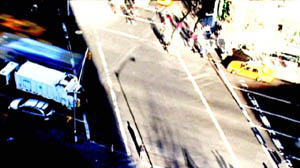
Warhol was withdrawn and impersonal, but Poe turned on the camera when he spotted something that looked interesting. He felt free to focus, reframe, zoom, and shift camera position for different angles on the life beyond his balcony. Likewise, the automaton Warhol (”I’d like to be a machine”) is counterposed to Poe’s more organic sensibility. He never lets us forget the flowers twitching on his windowsill, and their growth and rearrangements become traces of his daily life in the apartment.
The rules are simple and viewer-friendly. We instantly recognize the trappings of city life; we know the cycles of the seasons and the shifts between night and day. This cogent structure throws all our attention on what we see from moment to moment, and how we see it.
The Empire State Building and the skyline around it, along with the flowing clouds, remain stable reference points for a flurry of visual transformations. The taxis and pedestrians we glimpse move in jagged, incomplete rhythms very different from the smooth flow of fast motion in Godfrey Reggio’s films like Koyaanisqatsi.
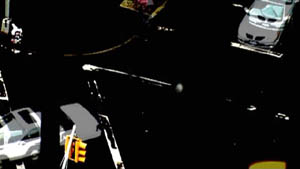
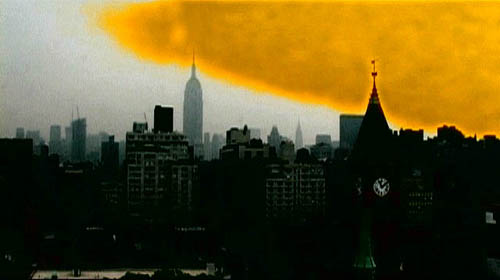
As you see, high angles, plays of focus, and tight framings provide energetic abstraction. Flaring exposure makes the Building look like it’s in flames, triggering echoes of the 9/11 attacks.
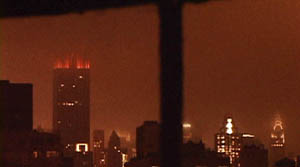
When the weather changes, the light does too. Raindrops become not only a pebbly surface on the windows but tiny filters. As with Warhol’s films, we have to change our conception of what counts as an event. Slight differences of framing and texture become visual epiphanies. Rain can be gray-green, and snow can go pale red. At times, the steeple clock face in the lower right becomes an imperturbable timekeeper, a sort of pictorial timecode, reminiscent of the clock in the corner of the shots of Robert Nelson’s Bleu Shut (1971).
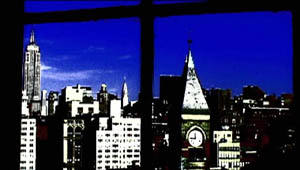
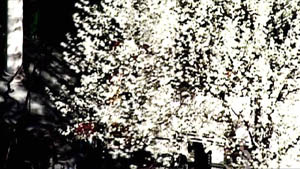
Spring comes about halfway through. It’s as lyrical as you’d expect, but again the colors startle. If snow can be red, then budding trees can be blindingly white.
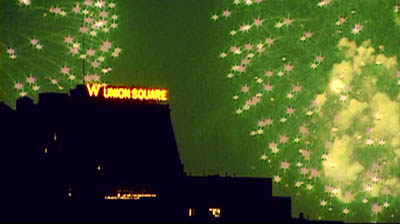
As in Ives’ Holidays Symphony, the festive iconography of Americana is made somewhat dissonant. July Fourth fireworks become splinters, and the slurred, jerky figures in the final Halloween chapter recall Mekas’ Notes on the Circus. Now shooting more continuously, with handheld shots and bumpy pans and zooms, Poe lets his 20x compression turn the parading ghosts, skeletons, nuns, and dark angels into scurrying hallucinations, complete with cellphones.
Empire II is at once exuberant and tranquil. What a pleasure to find a film devoted simply to seeking out beauty in everyday surroundings. “She celebrates the small,” sings Jimmie James while we see snow lashing the sidewalks. So does Poe. He has said that he made the film at a difficult period of his life, but what he has given us, I think, is jubilation.
PS 22 Jan: For more on Empire II, including a trailer, go to amospoe.com.
Your trash, my TREASURE
DB here:
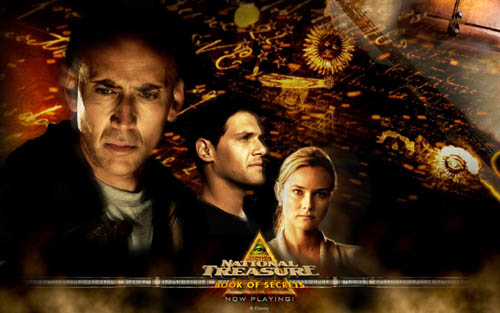
More informative about American history than Fahrenheit 9/11. More brain-teasing, and far more enjoyable, than I’m Not There. Less graphically violent than almost any other movie you’re likely to see. What else could I be talking about but National Treasure: Book of Secrets?
Jerry Bruckheimer is, in my view, the most astute producer now working in Hollywood. I could cite many proofs, but let’s stick just to the first National Treasure. Here’s a movie with no pop music, no cusswords, no naked ladies, no drugs, no screwing, and scarcely any violence. (One bad guy accidentally falls to his death down a deep black hole.) When it came out—you can verify this by asking Kristin—I said that it was the ideal movie for grandparents to take the grandkids to. The man who gave us Bad Boys and CSI has realized that there’s a market niche for the PG-rated action film. So we get an amiable romp that mixes together Freemasons, the Knights Templar, the Rosicrucians, Ben Franklin, and for all I know Judge Crater, Atlantis, and the Lindbergh baby.
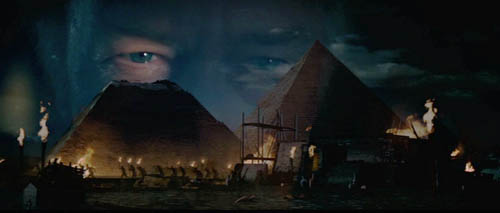
My colleagues, students, and wife think I’m nuts to like National Treasure. In defense I could point to evocative images like the one surmounting today’s entry, the superimposition of Grandpa Gates’ eye on a pyramid as a condensation of the Masonic/ monetary/ paternity motifs swarming through the movie. But I needn’t strain so far. The pleasures are more elemental.
Secret codes, knights, lost treasure, rich sinister Brits, really deep holes filled with cobwebs, and a cipher on the back of the Declaration of Independence—what’s not to like? All of this is pulled together by a hero who is actually intelligent and knowledgeable. He’s a nerdy patriot (another Bruckheimer touch, reminiscent of The Rock) who can turn a priceless hoard over to the US government without a quiver. How often do you find a story whose protagonists are people who know and care about the past? In the DVD supplement, an alternative ending shows schoolboys eyeing the recovered Declaration. One wonders if there’s really a treasure map on the back. The other mutters, “It’s a plot to make us learn history.” What if he is right?
Of course some will say Spielberg/ Lucas/ Kasdan did it already with Raiders. But that was a knowing effort to relive somebody’s phantom vision of B serials. Besides, does anybody believe that Indy knows as much about archaeology as Ben Gates does about nearly everything? If it recycles anything, National Treasure amounts to a revival of the wholesome 1950s Disney adventure movie. What Treasure Island (1950), Davy Crockett (1955), and The Great Locomotive Chase (1956) were for an earlier generation, National Treasure is for today’s twelve-year-olds. It compares favorably with those entries in verve, wit, and speed. (How it gets that speed is a topic I take up in “The Hook,” a new online essay. That piece tries to show that even if you don’t like the movie, its narration provides a nifty tutorial in some strategies of Hollywood storytelling.) My only regret is that in the epilogue NT 1 actually uses, Ben and Abigail are given a mansion and Riley gets a cherry-colored Ferrari. That’s a bit crass. Knowledge, selflessness, and pluck should be their own rewards.
Your correspondent regrets to report that Book of Secrets is not up to its predecessor. It’s still quite entertaining, and it has some transitions as clever as those I talk about in the aforementioned essay. The premise, involving the Lincoln assassination and the besmirched reputation of Ben’s ancestor, is workable and even moving, grounded as it is in parallel father-son reconciliations. The clue-sequences are more ingenious than, say, the simple linear connectives in Bourne Ultimatum. There are a few nifty compositions (e.g., a reflection of Ben in a windshield) and some nicely-timed reaction shots of Riley and Ben’s dad. (Someday, I swear, I will blog about reaction shots, a key to Hollywood storytelling.) I liked the way that the slapped-together family of the first installment—Dad Ben, Mom Abigail, Riley the kid—is expanded to include the old folks. Of course I regard the rekindled affection between Ben’s father and mother as backup for my Grandparents-Grandkids Hypothesis.
Still, the sequel lacks the throwaway byplay between Ben and Riley and the clever misdirection of certain scenes, principally the extended heist at the National Archives reception. The plot is somewhat too stuffed with incident, jerking us abruptly from continent to continent. (Will American filmmakers please give up the informative title card “Paris, France”?) It seemed to me as well that Ben’s reasoning involved not so much high-context inferences as inspired guesswork. The contrived quarrel in Buckingham Palace between Ben and Abigail is nothing like as enjoyable as Ben’s snippy requests for silence after they’ve lifted the Declaration in NT 1. Sequels don’t have to be a step down from the original, as this entry has argued at length, but alas NT 2 is.
Don’t, however, tell me that the thing is preposterous. Friend, the genre is built upon the preposterous. Preposterosity is its middle name. Jules Verne, H. G. Wells, and Edgar Rice Burroughs all spun their yarns out of hopelessly far-fetched premises. There is nothing as nutty in this franchise as the idea that Tarzan could teach himself to read. The task is always to make a crazy logic out of a farrago, and this the new installment does, skipping from pre-Columbian inscriptions to the idea that, as Riley phrases it, “Mount Rushmore was a coverup.” I buy that, and I completely buy the idea that our Chief Executives pass along a book recording all the Big Secrets in US history. The only item I couldn’t swallow was the prospect that America might elect a President who majored in architectural history.
Compensating for the feature’s drawbacks were the hors d’oeuvres at my screening. Now when we go to the multiplex we get Bonus Supplements, just like in the old days of trailers, shorts, and educational featurettes. My extras were a trailer for the upcoming Pixar release Wall*e, a trailer for the new Narnia installment (produced by our old compadre Mark Johnson), and even a Goofy cartoon, How to Hook Up Your Home Theater. Brainwashed by TV ads, the Goof races to the chain store Shiny $tuf to get his gigantoscreen and peripherals, under signs reading: “Obey—Buy!” At home, he has to sweep a faded pic of Uncle Walt off his sideboard to clear space for the new gear, which arrives in a blizzard of styrofoam peanuts. As fast as a Clampett and as silly as a classic Goofy, the cartoon includes his memorable “Wah-yoo-yah!” holler as he is launched into space.
How to Hook Up Your Home Theater even looked hand-drawn. If it’s on the Book of Secrets DVD, I’ll buy that disc. Hell, I probably will anyhow.
PS 7 January Thanks to Greg Thow for calling my attention to a nice background interview on the making of the Goofy short.
PPS 8 January Thumbing through folders–real ones, made of manila–I find that agents use National Treasure as the model of a “four-quadrants” movie.
What does a Water Horse sound like?
Kristin here—
Sentimental Journey
Regular readers of this blog will recall that David and I spent this past May in New Zealand, as Hood Fellows at the University of Auckland.
I did not have much of an excuse to go back to Wellington during our sojourn, but I decided to go for a few days anyway. It’s my favorite city in New Zealand, partly because I have so many memories of exciting events there and partly because it’s an attractive place in itself. Once my lecturing duties in Auckland were done, I took a train, the Overlander, that runs much of the length of the North Island. It’s a 12-hour ride through some very spectacular scenery (including Mount Doom, aka Mount Ngaurhoe; check it out on Google Earth at 39˚ 9’ 25.58” S 175˚ 37’ 57.89” E) and dizzying viaducts over deep gorges.
I was in Wellington for three days, staying where I had stayed on my previous three visits—the Victoria Court Motor Lodge. I originally chose it on the recommendation of Melissa Booth, a publicist on The Lord of the Rings, who had kindly acted as my point person for the first trip. During this year’s stay I had meals with a couple of people I had interviewed who also became friends. Judy Alley was the merchandising coordinator for Rings and King Kong and now works in publicity at Weta Digital. Given my interest in the franchise aspects of Rings, interviews with Judy had explained a lot about the nuts and bolts of coordinating with licensees. Erica Challis, co-founder of TheOneRing.net, had moved to Wellington since I interviewed her in Auckland. We snatched a quick dinner before she went to play French horn in a rehearsal for Swan Lake.
I also finally got to visit Te Papa, the national museum. It’s one of the main destinations for visitors, yet I had never gone through it. I felt it was rude to do that with my cell phone turned on. Sort of like keeping it on in a movie theater. But when I was trying to juggle appointments to interview people, I didn’t dare turn it off. It was worth missing some tourist opportunities, though, since every now and then that phone did ring, sometimes with good news.
For instance, on my first visit in 2003, a week after I had requested permission to watch Peter Jackson supervising the sound mixing on The Return of the King, I got a call at 7:45 pm on a Friday night telling me I could do so the next day. (If you hope to be a director’s or producer’s assistant, be prepared for long hours.) When I showed up, it turned out he and the sound editors were working on the Shelob sequence. Sometimes it pays to sit by the phone.
Park Road Post
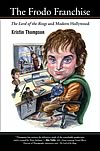
During my Wellington visit, I learned from Barrie Osborne that coincidentally a film he is producing was in the sound-mixing phase, and I was invited to come and sit in for a day. Barrie is an American, but he produced The Matrix in Sydney and spent a long time in New Zealand producing all three parts of Rings. Like so many people who came from abroad to work on the trilogy, Barrie fell in love with the place. Now he lives there part-time and works on a range of Australasian projects, including executive producing The World’s Fastest Indian, a Kiwi film, and Little Fish, an Australian drama. (I saw these back-to-back at the American Film Market in 2005, going from the upbeat crowd-pleaser Indian to Fish, a drama about heroin addicts with great performances from Cate Blanchett and Hugo Weaving—both worth a look if you missed them on their brief American releases.) He also championed The Frodo Franchise from the start, and the book probably wouldn’t exist now without his help.
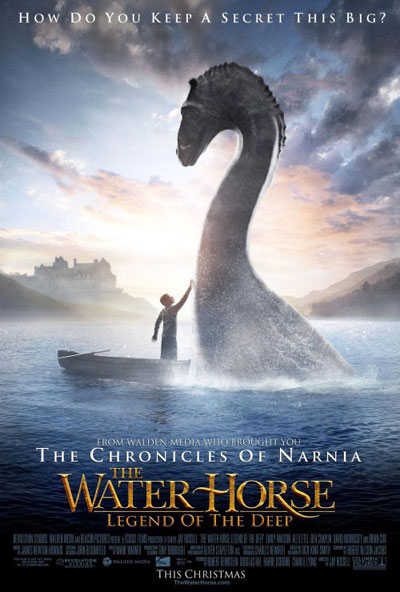
The film he was finishing up was The Water Horse: Legend of the Deep, an adaptation of a popular children’s fantasy novel by Dick King-Smith. It will be released on Christmas Day and has a PG rating.
The mixing was taking place in Studio 2 of Park Road Post, the same place where I had watched Peter supervising the Shelob scene.
Park Road Post (formerly The Film Unit) is a state-of-the-art post-production facility that started moving into its new building gradually, starting in the summer of 2003. At that point only the sound studios and the offices along the corridor outside them were finished. A segment about 19 minutes into the “Soundscapes of Middle-earth” supplement on the extended-version DVD of Return shows the facility as it was then.
My first interview with Barrie was in one of those offices, with considerable construction noise right outside the window. Fortunately my microphone was directional enough that it didn’t overwhelm our conversation. (That office is seen in the “End of All Things” supplement on the same disk.)
By my third visit to Park Road Post, in late 2004, the editing rooms and the huge, beautiful front lobby had been finished, the garden in the center courtyard was being installed, and the processing laboratories were being built. Now the whole thing is finished, with a strange juxtaposition of beautiful modern design in the front and big windowless concrete buildings at the rear.
Park Road itself is a street in the Wellington suburb of Miramar, lined in one section by small houses and then by rows of undistinguished warehouses and small industrial buildings. Next door is the large California Garden Centre, a round, orange building. Gazebos and garden swings are displayed right up against the walls of the sound studios.
Walking from this mundane environment into Park Road Post is a disorienting experience. Suddenly one is in a modern building with a design heavily influenced by Frank Lloyd Wright. Natural wood, fireplaces, stained glass windows, cushy leather sofas. It’s a building that one doesn’t want to leave. It has almost an other-worldly quality, which is perhaps not surprising given that it was designed by Dan Hennah, the art director of Rings and Kong.
Making the place as attractive as possible was part of the brief that Peter and partner Fran Walsh handed Dan. As he told me, “It was partly about getting it technically correct and partly about creating an environment that, while being technically correct, was still human and homely and all those things—the comfort zone. So that you actually felt like getting up and going in there in the morning—rather than thinking, ‘Oh, God, I’ve got to go into that bloody hole again!’”
By now the ironic story has become famous. A 17-year-old Peter Jackson, aspiring to be a filmmaker, left school and applied for a job at the Film Unit back in the late 1980s. He was turned down, so he worked as a photo-engraver at a newspaper instead. Eventually he got enough backing to quit and finish Bad Taste (1987), his long-gestating first feature. A little over ten years later he bought the Film Unit, then housed in what he described to me as “a sort of ‘Soviet bloc’ feeling place.” During my first visit in 2003, the editing and lab facilities were still there, in a dreary-looking industrial complex out in the distant suburb of Lower Hutt.
Tracking The Water Horse
At the Water Horse sound mixing director Jay Russell was present, though he slipped out at intervals for meetings. As I was about to leave, he remarked that watching sound mixing is like watching paint dry. That’s what everyone says about mixing, but I find it fascinating.
Back in the late 1970s when David and I had the opportunity to spend about half an hour watching the great Walter Murch working on a scene for Apocalypse Now, it was a slow process. Mixing was done on film, so every repetition involved a pause for rewinding, threading the projector, and so on. Now, with high quality digital images being projected on the studio screen, mixers can almost instantly go back to the beginning of a segment by sliding a control handle or move to a different scene by typing in a file number. As a result, there may be many repetitions of the same series of shots, but there’s not that much down time.
The repetition isn’t boring, either, since you can listen for the tiny changes that the mixers make between projections of the scene. (See David’s account of his experiences watching James Mangold’s team mixing sound for 3:10 to Yuma.) There may also be pauses, but usually they’re for discussions among the sound team members. Some of this was just too technical for me to grasp, but what I could follow was fascinating.
That particular day came fairly late in the overall process. Jay was there because the work on the sound was close to finished. The team was concentrating on the final mix of reel 1. It was quite a contrast to the footage I had seen being mixed for Return. In that case a lot of unrendered effects shots were still in the edit, and many scenes hadn’t been locked down yet. Shots of Gollum often just showed him as a figure made up of silvery bands against a black background, and in some cases there was only a title describing the nature of the scene—a close-up of Treebeard looking left, for example. (Again, the DVD bonus chapter “The Soundscapes of Middle-earth” shows some vivid examples of the process.) In the case of The Water Horse, all the footage was finished, and the editing had been completed.
A lot of what goes on at this late stage is tweaking individual tracks. Even though there’s a full mix by this point, the team frequently take out all the tracks except one, so that a bustling city street scene may have densely layered traffic sounds and a musical track during one run-through and only a couple of characters’ footsteps in the next.
As with many films, some musical instruments were on separate tracks. Jay could ask for a drum beat to be turned up to provide a more distinct rhythm to a scene or for certain instruments to be favored so as to enhance the atmosphere of the Scottish setting.
Some of the people present had worked on Rings as well, so I knew a few of them already. It was great to see Rose Dority, post-production supervisor, again. Since my book isn’t really a making-of study, I hadn’t interviewed her, but she had been very hospitable. I also recognized Dave Whitehead, the supervising sound editor, who seems to have worked on half the films made in New Zealand over the past 13 years.
At lunch I got talking with Dave, and he told an anecdote about how some of the war chants of the Easterling attackers during the Battle of the Pelennor in The Return of the King were done. The sound department couldn’t use English, of course, and no texts had been provided. One tactic the recorders and mixers resorted to was spelling the names of their children, friends, and colleagues backwards. In fact I had been present the day those chants were being synchronized and remembered vividly how at the time Dave had explained that “Revilo!”—which sounded very aggressive when shouted in unison by male voices—was based on his son’s name, Oliver. Rose got into the mix as well, as “Ésor!” In the final mix, those chants are not really distinguishable as individual words, being parts of a dense mix of battlefield noises. Still, it was fun knowing that they were there.
The Water Horse mixing went on until mid-afternoon, when a group of people came into the studio for a run-through of the first reel. By that point I was pretty familiar with all the footage and could concentrate on the soundtrack rather than figuring out the plot from the scenes shown out of order up to that point.
Once the screening ended, Barrie asked various people if they had noticed anything that might need changing. Rather to my surprise he included me. Fortunately, rather than sitting there saying, “Ummmm … no,” I did have a suggestion about one sound that was slightly too loud and distracting during a suspenseful moment. That got duly noted down with the other comments and fixed during the final changes. That was an unexpected treat!
The Water Horse is a story of a Scottish boy who finds a strange egg that hatches into a little creature that will grow into the Loch Ness Monster. In the reel I saw, the landscapes were beautiful, a smooth mixture of footage shot in Scotland and in New Zealand. With both Weta Workshop and Weta Digital providing special effects, it naturally has high production values–including a carefully mixed soundtrack. It’s a children’s film, but from what I saw of it, parents will enjoy it as well. (The favorable Variety review is here.)
It’s a production by Walden, which specializes in family-friendly projects. The company seems to like New Zealand, given that much of the first Chronicles of Narnia film and part of the second were shot there.