





Archive for the 'Film comments' Category
Hands (and faces) across the table
DB here:
In books and blogs, I’ve expressed the wish that today’s American filmmakers would widen their range of creative choices. From the 1910s to the 1960s (and sometimes beyond), US filmmakers cultivated a range of expressive options—not only cutting and camera movement but other possibilities too. Studio directors were particularly adept at ensemble staging, shifting the actors around the set as the scene develops.
You can still find this technique in movies from Europe and Asia, as I try to show in Figures Traced in Light and elsewhere on this site. But it’s rare to find an American ready to keep the camera still and steady and to let the actors sculpt the action in continuous time, saving the cuts to underscore a pivot or heightening of the drama. Now nearly every American filmmaker is inclined to frame close, cut fast, and track that camera endlessly. I’ve called this stylistic paradigm intensified continuity.
As Los Angeles agent and former editor Larry Mirisch once put it in conversation with me: “They used to move their actors; now they move the camera.” Most of today’s prominent directors prefer kinetic camerawork and machine-gun cutting. This tends to make their staging rather simple and static: we get stand-and-deliver or walk-and-talk (subject of a blog entry here).
The result is a split in contemporary American style. Action scenes are often gracefully and forcefully choreographed (though sometimes the editing fuzzes up character position and overall geography). By contrast, conversation scenes, which could be choreographed as well, are handled either as a Steadicam walk-and-talk or simply as seated actors talking to one another, with cuts breaking up the lines and the camera on the prowl. (I discuss some examples in The Way Hollywood Tells It, pp. 128-173.) (1) You sometimes suspect that today’s directors are most at home shooting lots of people hunched over workstations, making the principal form of suspense a LOADING command.
Don’t get me wrong. Like all styles, intensified continuity isn’t a bankrupt option; many fine directors, from the Coens to Michael Mann, have worked vigorous variants on it. What I’m arguing for is more plurality, more tones in the director’s palette. I’ve revived these cranky ideas in discussing a single shot, this time in Variety. Today’s blog entry expands on that brief piece, so you may want to hop over to it here before reading what follows.
Directing us
One task facing any director is to direct—not only actors but us. The filmmaker must direct our attention to what’s important for responding to the drama at any moment. Since the late 1910s, we’ve known that close-ups and frequent cutting do just that. Tight framings and rapid cuts can steer the audience’s attention through a scene. So the question becomes: How can you direct attention without using close views and fast cutting?
Well, for one thing you can place the main action in the center of the picture format. If there are several points of interest in the shot, which is usually the case, you can arrange them symmetrically around the central zone of the shot—in film, usually an zone just above the geometrical center of the picture format. You can also position your main players so that the most important ones are closer and/or facing toward the camera. By turning a character away from the camera, you can drive the audience’s eye to someone else. There are other pictorial cues worth mentioning (lighting, color combinations, patterns in the set design), but these will hold us for now. Add in movement—characters shifting their position, especially coming closer to the camera—and you have a suite of cues that a film shot can provide.
Apart from these purely compositional factors, you the director can exploit some cues that are part of our social proclivities. When we watch other people, we’re attracted to areas of high information—which, for creatures like us, are faces and hands. Faces send signals about what people are thinking and feeling, with the areas around the eyes and mouth telling us most. Hands are the source of gestures, as well as potential threats. And of course if someone is speaking and others are listening, we are likely, all other things being equal, to look at the speaker.
The crucial fact is that in ensemble staging all these cues, and more, are at work at the same time. The director’s skill is orchestrating them so that they support one another, guiding us to see this or that. (On rare occasions, the director will use them to misguide us, but let’s stick with the default for the moment.) For a long time, filmmakers knew intuitively how to coordinate these cues to create rich and intricate shots; I fear that they no longer know how. (2)
That’s what makes one passage in Paul Thomas Anderson’s There Will Be Blood of interest to me. The scene presents Paul Sunday explaining to Daniel Plainview that there’s oil on his family’s property. Daniel and Paul are bent over a map on a tabletop, with Daniel’s assistant Fletcher Hamilton and Daniel’s son HW watching. The scene is presented in a single shot, with a slight camera movement forward at the start.
The composition could hardly be simpler: four people lined up, three at the edge of the table. The heads cluster around the center of the format, with HW lower and off-center; no surprise that he’s the least important character in the scene (though his question to Paul foreshadows action in the film to come). Paul is explaining where the oil is, and the two men’s faces and hands command our attention as they speak.
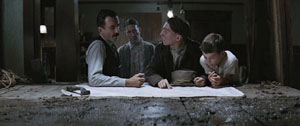
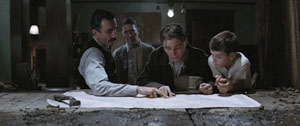
Many directors would have cut in to a close-up of the map, showing us the details of the layout, but that isn’t important for what Anderson is interested in. The actual geography of Plainview’s territorial imperative isn’t explored much in the movie, which is more centrally about physical effort and commercial stratagems.
Questioning Paul about his family, Daniel turns slightly away. This clears a moment for HW to ask about the girls in Paul’s family, and for a moment our attention is steered to the right, to pick up their interchange.
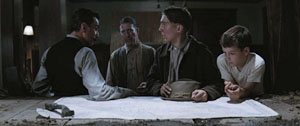
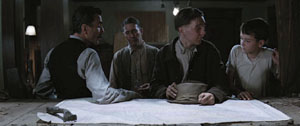
Then Fletcher asks about the farm, and as Paul and Daniel tilt their faces to him, he earns his place in the center of the frame. Before, when we could see the faces of the two men closest to the camera, he was subsidiary, but now he becomes salient. On the left, Daniel shifts away uneasily, turning almost completely away from the camera. In answering Fletcher, Paul turns away in the opposite direction, as if shy or guilty; his awkward gesture of stroking his hat seems to confirm Daniel’s doubts about him.
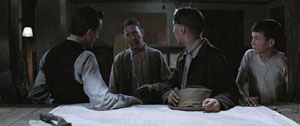
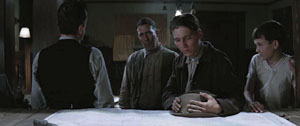
During a pause, Paul turns back to stare directly at Daniel, saying quietly, “The oil is there.” At the same time, Daniel, still turned away, is exchanging a glance with Fletcher. At this point, Anderson’s training of us pays off: we’re ready to detect the slight shift in Fletcher’s eyes, which confirms that Daniel’s looking at him. “Watch their eyes,” as John Ford liked to say.
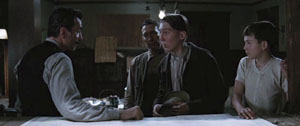
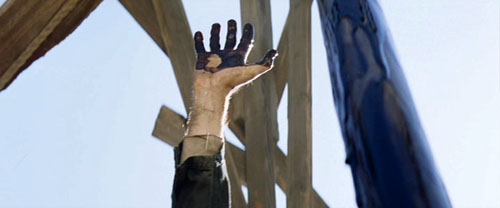
Paul sets out to leave, and he refuses the invitation to stay the night. At this point comes the scene’s biggest gesture. Daniel raises his hand, in the dead center of the frame.
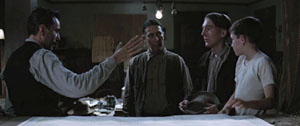
Spreading his long, thin fingers, Daniel commands our attention. He seems at once to be halting the young man and threatening him. But the gesture becomes the prelude to a handshake. Daniel’s characteristic blend of bluff assurance, friendliness, and aggressiveness are packed into this single gesture. (At the climax, other gestures will recall this one.)
Daniel steps closer to Paul, blocking out Fletcher, to make his threat: If he travels so far and doesn’t find oil, he’ll find Paul and “take more than my money back.” Paul agrees and moves away. “Nice luck to you, and God bless.”
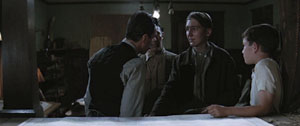
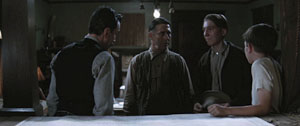
The men watch Paul leave the building. End of scene.
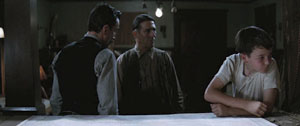
Without any close-ups or cutting, Anderson has skillfully steered us to the main points of the scene, which are carried by the performers. The drama builds through small changes of position, shifts of weight, and facial expressions that accompany the dialogue. (The somber, plaintive music adds an uneasy edge.) Daniel seems more threatening when we don’t see his reaction, and Anderson’s camera forces us to scrutinize Paul’s expressions and body language for signs that this is a scam. It takes confidence to make a raised hand the climax of a scene, but the gesture gains its force by being the most aggressive moment in an arc of quietly accumulating tension.
All the principles involved here—frontality, spacing of figures, slight shifts of compositional focus, actors’ body language—are simple in themselves, but they gain a strong impact by cooperating with one another. The scene’s quiet obliqueness is characteristic of the film, which, at least until the last few minutes, carries us along with hints about where the action might go and what drives its characters.
Yet simplicity shouldn’t imply simplification. Anderson’s willingness to give the shot several points of interest, some more stressed than others, creates an understated tension. The shot’s gravity stems from its conciseness, a quality that Anderson admires in 1940s studio films like The Treasure of the Sierra Madre.
Two more tabletops
The staging strategies Anderson uses aren’t new, as I’ve suggested. They’re part of the history of film as an art form, and many directors have continually relied on them. I don’t think that this is always a matter of influence, although surely filmmakers learned from watching earlier films. Often, directors working within similar constraints intuitively rediscover what other directors have already done.
Consider this scene from Kurosawa Akira’s The Most Beautiful (1944). The setting is a plant where Japanese workers, mostly girls and women, are manufacturing bombsights. The workers have vowed to increase production for the war effort, and they are working to the point of exhaustion. The plant supervisors are worried that the pace will take its toll on the girls.
The scene starts with the eldest supervisor studying the output chart, lying on a table below the frame edge. His colleagues are turned away, at the window. He is the one who must decide how to keep the girls healthy and the output steady. The table and the window will be the two poles of the action, and the actors will oscillate between them. The process starts when the eldest retreats to the window, and one comes forward to study the report.
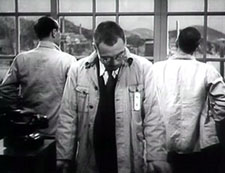
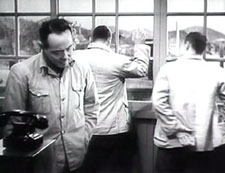
He’s followed by his opposite number, and they echo one other in rubbing their necks. They’re as tired as the assembly-line girls. Their superior turns and says that there’s no point in lowering the quota because the girls are so devoted that they’d push harder anyway.
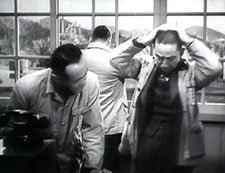
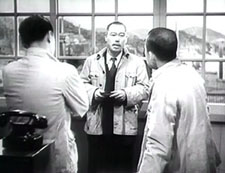
The men have turned to listen to him, driving our attention to his centered, frontal figure. After the elder has turned away again, the man on the right says that this might be the critical juncture. Remarkably, all three men remain turned from us, creating a slight pictorial tension.
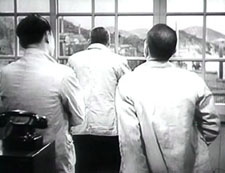
This tension is extended when the supervisor on the left states his confidence in the children, their team leader, and their teacher. This makes the eldest turn around.
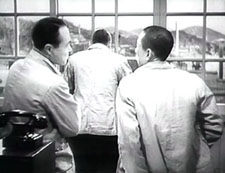
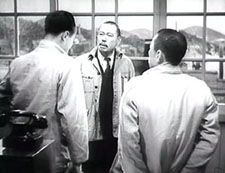
The speaker walks to the window, arguing that the girls will succeed, but the leader turns away again dubiously. He doesn’t offer a decision because an offscreen voice announces that a teacher has come to see them, and they all turn to look.
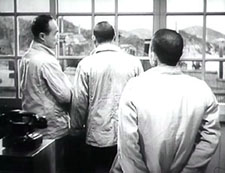
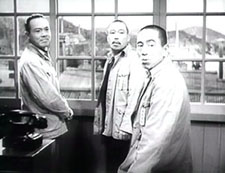
The factory’s problem isn’t solved; the seesawing of the staging has presented that irresolution dynamically. In a single shot, the difficulty of the administrative decision has been expressed in counterweighted movements in and out, by the figures’ frontality and dorsality. Again, it can seem simple, but where a contemporary American director would have given us a prolonged passage of stand and deliver, with intercut close-ups, Kurosawa has created a little ballet out of the men’s uncertainties. Like Daniel’s raised hand, but with even less emphasis, the assistant’s plea on behalf of the girls’ commitment has gained a subtle prominence. Yet all he has done is walk to the window.
I’m not saying, of course, that Anderson took the idea from Kurosawa. Given the initial choice to stage the scene behind a table, and the inclination to present the action in one shot, both directors spontaneously drew on basic staging principles. This is what film directors have always done. So as a finisher, here’s one last tabletop interlude from Cecil B. DeMille’s Kindling (1915). The entire scene is a dense and intricate affair, but let’s pick just one moment. Maggie has become a servant to a rich woman, Mrs. Burke-Smith, and she’s about to be arrested for theft. Detective Rafferty is ready to handcuff her, but Mrs. Burke-Smith changes her mind.
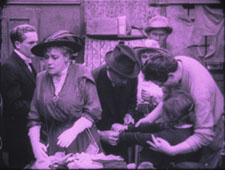
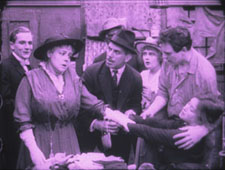
DeMille arranges his actors so that we can’t miss the rich woman’s moment of decision. She is in the foreground, and her face is in the upper center of the frame. The other actors are blocked, so that her expression is the only one we can see clearly at the crucial moment. Her hand gesture, stretching across the central axis of the frame, confirms that she won’t charge Maggie. (For a similar use of “blossoming” actors’ movements in 1910s cinema, go here and look at Figs. 2A10-2A11.) What DeMille knew, Kurosawa discovered afresh, and Anderson hit upon it again.
Strategies of staging, like other principles shaping how films tell stories, lie behind each concrete creative decision the film artist makes. They run as undercurrents through film history, almost never discussed by critics. They form a body of tacit knowledge, flowing across our usual distinctions of period, genre, director, national cinema. We can trace continuities and changes, examining how the strategies are revived, revised, or rejected. They can provide us with subtle but powerful experiences. They constitute a skill set that is available to filmmakers today. . . if any will, like Anderson, seize the chance.
(1) True, Wes Anderson keeps the camera still, but in his frontal, family-portrait framings the cutting and line readings do all the work; dynamic staging isn’t on his menu.
(2) I survey the development of these and other tactics in Chapter 6 of On the History of Film Style. On this site, for one example go here and scroll down to the Bauer material.
I drink your Oscar promo
Kristin here–
A week or so ago, David and I were watching Keith Olbermann’s “Countdown” on MSNBC. As the tagline to one of the stories, Keith quoted, “I drink your milkshake!” David was puzzled and asked why that sentence was suddenly popping up all over the place. I reminded him that Daniel Plainview says that line in the final scene of There Will Be Blood—a film that both of us like very much. That was when I learned that “I drink your milkshake” had entered the buzz of pop culture.
On Saturday, February 9, the new Entertainment Weekly arrived, with a half-page story, “Shake, Shake, Shake,” by Gregory Kirschling, dealing with the milkshake-line phenomenon. (The piece doesn’t seem to be online yet.) Kirschling calls it “one of the strangest exclamations of film history.”
Why so very strange? Odd, maybe, but it makes perfect sense in context. It comes in the film’s final scene, set in the bowling alley of Daniel’s mansion. Naive preacher Eli Sunday has just told Daniel that he should buy a last bit of oil-rich land, whose owner had earlier refused to sell. Daniel replies that he has already extracted the oil from that plot.
The Milkshake Dialogue [Spoilers Ahead!]
Eli brings drinks and sits with Daniel near the bowling lanes, saying, “Mr. Bandy has passed on to the Lord.” He adds that William, Bandy’s grandson, wants to be an actor in Hollywood. Eli offers to help Daniel negotiate with William concerning the land: “Daniel, I’m asking if you’d like to have business with the Church of the Third Revelation in developing this lease on young Bandy’s thousand-acre tract. I’m offering you to drill on one of the great undeveloped fields of Little Boston.”
Daniel replies, “I’d be happy to work with you.” But he adds a condition: Eli must state that he is a false prophet and that God is a superstition. After receiving Daniel’s apparent agreement to financial terms, Eli reluctantly makes these statements over and over as Daniel insists that he speak more forcefully.
After Eli’s declaration, Daniel declares abruptly, “Those areas have been drilled.”
Eli, baffled, murmurs, “What?”
Daniel repeats, “Those areas have been drilled.”
Eli, as before: “No, they haven’t.”
Daniel: “Yes. It’s called drainage, Eli. See, I own everything around it, so, of course, I get what’s underneath it.”
Eli: “But there are no derricks there. This is the Bandy tract. Do you understand?”
Daniel: “Do you understand, Eli? That’s more to the point. Do you understand? I drink you water. I drink it up. Every day, I drink the blood of lamb [or land?] from Bandy’s tract.”
At this point Eli confesses how desperate he is, having sinned and lost his investments. Daniel taunts him viciously, saying that Eli’s twin brother Paul was the chosen one, having taken the $10,000 that Daniel had given him and started a small but successful oil company as a result. (The actual amount handed over in the one scene in which Paul appears was $500.)
Reverting to the subject of the Bandy tract, Daniel continues, “That land has been had. There’s nothing you can do about it. It’s gone. It’s had.”
Eli: “If you would just—“
Daniel, loudly, drooling: “Drainage! Drainage! Eli, you boy. Drained dry. I’m so sorry. If you have a milkshake and I have a milkshake—there it is. [He holds up his index finger]. That’s the straw, you see. [He turns and walks away from Eli] And my straw reaches acrooooooossssss [walking back toward Eli] the room … I … drink … your … milkshake. [He makes a sucking noise] I drink it up!”
Eli: “Don’t bully me, Daniel.”
At this point Daniel throws Eli down, begins hurling bowling balls and pins at him, and finally beats him to death.
The milkshake analogy isn’t all that bizarre. Daniel choses a metaphor for drainage that he thinks Eli can understand.
Beyond that, the milkshake speech is a way of emphasizing Daniel’s delight, not just in making a fortune in the oil business, but in doing so by paying little, or in this case no, money to those whose land he exploits. Stealing someone’s milkshake is a petty form of theft, so Daniel is able to trivialize the removal of oil that Eli has been counting on as his last chance for financial and spiritual salvation. The taunting also allows Daniel to revenge himself for the parallel earlier scene in the church where Eli had forced him repeatedly to confess how he had betrayed his own son. In this final portion of the film, Daniel no longer has any need to put on a friendly face, to pretend to have empathy with others.
Daniel mentions drinking water as well. He’s eating a cold, leftover piece of meat during much of this, and Eli is drinking whiskey. Eating and drinking are common motifs in the film, with elaborate discussions of how the rocky land of the Sundays’ ranch produces no grain but only supports goats. Upon Daniel’s arrival there, the family can offer him no bread but only milk and potatoes.
Thus I don’t think the milkshake line is out of place. That portion of the scene is, however, as Kirschling says, “weird, vaguely hilarious, and unsettling.”
By the way, according to a story in USA Today, director Paul Thomas Anderson derived the dialogue from “a transcript he found of the 1924 congressional hearings over the Teapot Dome scandal.” Sen. Albert Fall described oil drainage thus: “Sir, if you have a milkshake and I have a milkshake and my straw reaches across the room, I’ll end up drinking your milkshake.” He was convicted of taking bribes for oil rights on public lands.
Blenderized by the Internet?
Kirschling points out that the speech has spread far indeed. There’s a YouTube video, “There Will Be Milkshakes,” by Kevin Koonz (spelled Kunze in the EW and USA Today stories). There’s a website, “I Drink Your Milkshake.com,” which started as just a posting of the line and became a forum for discussing the film. The USA Today article declares the line “Hollywood’s Hottest Catchphrase.” There are various designs of T-shirts available on Cafepress and eBay.
It does seem odd that a line from a film that is an art-house favorite, with under $25 million grossed in the U.S. to date, should spread so widely. But these things happen.
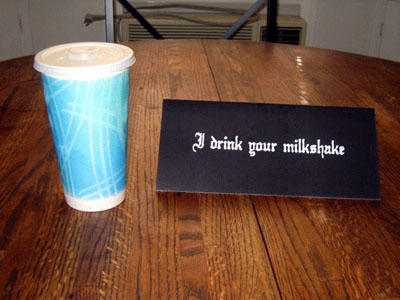
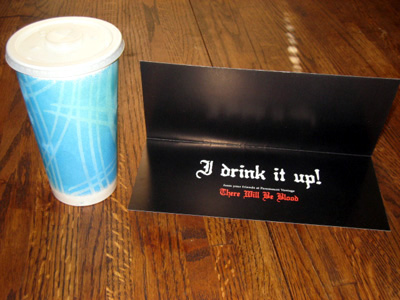
The phenomenon doesn’t stop there, though. On February 8, Variety blogger Kristopher Tapley revealed that he and a friend had received courier-delivered milkshakes with an accompanying promotional flyer for the film. (Presumably Tapley himself is to be credited with the photos above and below. The small print in the lower one reads, “From Your Friends at Paramount Vantage.”)
Upon reading Tapley’s entry, David’s first reaction was, “Where can I get one of those milkshakes?” (I doubt they get delivered here in flyover territory, but the Dairy State can provide its own fine milkshakes.) My first reaction was, “I wonder how soon one of those promo fliers will show up on eBay.” (So far, none has. Just the T-shirts.)
[Added February 12: Apparently there is a hierarchy among the recipients of the Paramount Vantage promo. Tapley specifies that his milkshake came hand-delivered. On February 8, Peter Sciretta posted on the /film site the news that he received the same brochure, but his contained a coupon for a free milkshake (shown in a picture in his entry). He also reveals the brand involved: Cold Stone Creamery.]
Kirschling’s EW piece deplores this sort of thing: “The ironic, Internet-fast catchphrasing of a movie as rich and serious as Blood—and a performance as emotional as Day-Lewis’—is more than a little depressing. It reduces art to a punchline; it puts an epic in a blender and comes out with … a milkshake.”
True, in a sense. But great art has always been subject to humorous treatment and tends to come through unscathed. Marcel Duchamp stuck a mustache on a reproduction of the Mona Lisa and put it in a museum, and the act is considered a daring stroke of avant-garde art. The 1941 comedy Hellzapoppin’ contains a gag about the Rosebud sled from Citizen Kane. There are innumerable examples. The internet has accelerated such of manipulation of artworks and made us more aware of them, but it’s not new—and it is inevitable.
Indeed, the creators of the film don’t seem to be terribly upset. Paramount Vantage obviously seized upon the publicity opportunities, ordering high-quality milkshakes delivered like so many “For your consideration” ads. The USA Today article refers to the director’s reaction: “Not that Anderson minds—or worries that it will undermine the gravitas of the movie, which is up for eight Oscars, including best picture, director and actor. ‘I love the YouTube video,’ he says. ‘It’s completely insane and hilarious. It’s crazy what people latch onto.’”
Anderson is no doubt being polite about the video. It’s a typical hastily made mashup with randomly edited images from a trailer juxtaposed with Kelis’ 2003 song “Milkshake.” As Kirschling remarks, “How original!” But you have to believe that as a result of all the fuss quite a few more people will get intrigued and go to see There Will Be Blood than would have otherwise. They’ll certainly have to sit through the whole thing before reaching the moment they came to savor. And, knowing all of the above, I still was able to re-watch that final scene and find it as chilling as it was the first time through.
Do sell us shorts
Kristin here—
I don’t think I’ve ever seen a single theater playing all five nominees for the best-picture Oscar. It’s happening now at the six-screen Sundance Cinemas here in Madison, plus they’ve got The Diving Bell and the Butterfly (nominated for director, cinematography, adapted screenplay, and editing) and Persepolis (animated-feature nominee). The latter is very impressive, and I think it would win in an ordinary year, but probably not when it’s up against Ratatouille.
[February 9. That outcome seems even more likely now. Last night Ratatouille won nine Annie Awards, prizes given out by the professional animation community. In the 35 years of those awards’ existence, only once has the top animated feature prize not gone to the film that went on to win the best animated film Oscar. Pixar’s accompanying short, Your Friend the Rat, won best short subject. It’s not eligible for an Oscar, since it was a supplement on the Ratatouille DVD and not shown theatrically.]
Films like these get widely seen, obviously. An awful lot of films, though, get nominated for Oscars that far fewer people will see. How many people fill out their office Oscar pool ballots knowing anything about the short animated and live-action films? Some you can track down online or on TV (HBO, Sundance, the IFC, and so on), but viewing them all would be difficult.
For three years now, however, Magnolia Pictures has been packaging the films in those two categories into a single program that goes out to theaters and then onto DVD. Magnolia is a small independent distributor, best known perhaps for its documentaries, including Enron: Smartest Guys in the Room and Capturing the Friedmans and for its imports like Ong Bak and The World’s Fastest Indian.
This year’s program, “The 2007 Academy Award Nominated Shorts,” is listed on the company’s website as playing in 80 theaters, though perhaps that number will rise. Many of the runs (including the one at our Sundance Cinemas) start on February 15, and others are scheduled from then on into April.
Thanks to Sarah Simonds, manager at Sundance, I was able to get an early look at the ten films on the program.
As one might predict, the range of quality is greater in the live-action films than in the animated ones. I’m not sure why that would be predictable, but I have my suspicions. There’s not much of a theatrical market for live-action shorts, which mainly get seen at festivals and on TV. They tend to be portfolio films, made by people trying to attract attention and move up to features. Hence they more often come from beginners. Animators who don’t want to work their way up through big studios—and who stand little chance of ever directing a major animated feature—or who simply value their independence may stick with shorts.
Another factor working in favor of animation is that it’s a medium that demands the detailed planning of literally every frame. No improvisation, no casual shooting in real locales, no direct sound. All in all, I think that if I were an Academy member, I’d have more trouble making a decision in the animated-shorts category.
Real, Live People
In the live-action category there’s no doubt that I would vote for The Tonto Woman, a UK short directed by Daniel Barber from an Elmore Leonard short story. Remarkably, Barber had mainly directed TV commercials before embarking on this, his first 35mm short, as a way of breaking into the film industry. He produced and funded it himself, with a ten-day shoot in Spain using locations and standing sets that had figured in such films as A Fistful of Dollars and The Good, the Bad and the Ugly.
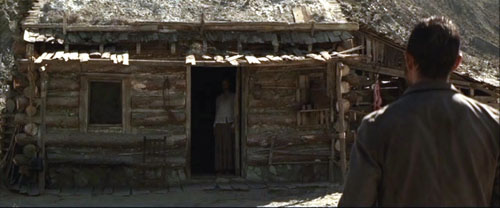
The result might be described as The Piano meets There Will Be Blood. A cattle rustler (well played by Anthony Quinn’s son Francesco) encounters a rich man’s wife (Charlotte Asprey) who is living in enforced seclusion after having been kidnapped and held for eleven years by Mojave Indians (image above). The film has landscapes with the epic quality of both There Will Be Blood and No Country for Old Men, and its drama has the depth of a feature film without feeling rushed in its 35 minutes.
Leonard’s website has a press release giving more details, as well as a profile of Berber. The latter suggests that the director has been contacted by people within the film industry. All I can say is, fund this man immediately. I definitely want to see what he could do at feature length.
David has written quite a bit about the lively contemporary Danish cinema, including two entries on this blog, here and here. The country continues to be on a filmic roll in terms of Oscar nominations, with the short At Night being the one I’d vote if I were an Academy member and weren’t already voting for The Tonto Woman. It’s directed by Christian E. Christiansen and produced by Zentropa with support from the Danish Film Institute.
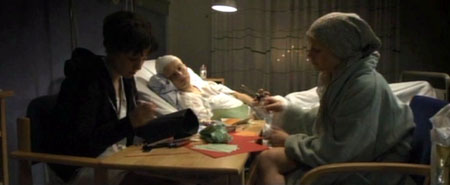
The subject matter sounds like the sort of thing that would ordinarily make me run the other way: three very young women with cancer bonding in the hospital ward they share. But the film avoids the touchy-feely clichés that so easily could sink such a project (except for a conventional Polaroid-photo montage of their little New Year’s party). It’s not just a sick-women’s-solidarity picture. One does come to care about these three and to understand how their illnesses make them better able to communicate with each other than with their families. It manages to pack a considerable emotional impact into forty minutes. Again, here is someone who could probably direct a fine feature film—and, given the current strength of the country’s industry, may well get the chance.
Tanghi Argentini is a charming comedy from Flemish director Guido Thys, dealing with an office worker who asks a colleague to teach him how to tango to impress a woman he has met on the internet. It combines a clever concept with a surprise twist at the end that works so well in both the short-story and short-film format. It’s entertaining but not so unusual or substantial that I would think of it as Oscar-worthy.
The two other films, France’s Le Mozart des Pickpockets (director/writer/actor Philippe Pollet-Villard) and Italy’s The Substitute (director Andrea Jublin), though both amusing, seemed surprisingly lightweight and conventional to have received nominations.
Puppets and Pictures
Trying to decide which of these animated shorts I would vote for is more difficult. Each is well-executed, entertaining, and imaginative. I tried thinking which I would want to watch again, which I would recommend to friends.
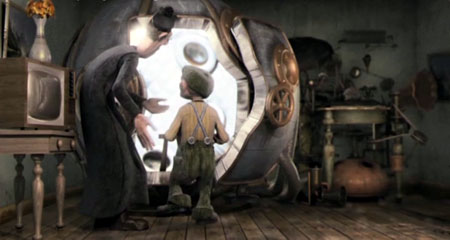
By those standards, there are again two stand-outs for me. I’d ultimately opt for Même les pigeons vont au paradis (Even Pigeons Go to Heaven), a French puppet film by Samuel Tourneux. It’s about a priest who attempts to sell a heaven-simulating machine to a miserly peasant about to be visited by the Grim Reaper. It’s fast-paced, very funny, and beautifully detailed in its depictions of the characters and settings. It’s not claymation, but it has some of the polish and wit of Aardman shorts.
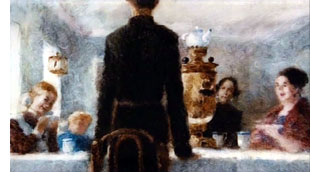 My close second choice would be a very different sort of film, My Love, from Russia, directed by Alexander Petrov. It’s a pretty, lyrical tale of a fifteen-year-old boy’s idealistic yearnings after a pretty servant girl and a more glamorous and mysterious woman who lives next door. The animation is impressionistic and shimmering, with constantly added brushstrokes transforming the compositions. Its visual style is derived from nineteenth-century Russian realist painting, especially that of Ilya Repin.
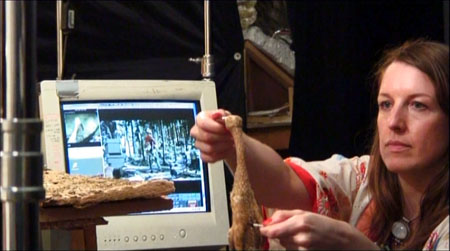
Suzie Templeton animating the Duck for Peter & the Wolf*
I suspect the Oscar winner might well be Peter & the Wolf, a British-Polish co-production that illustrates the classic Sergei Prokofiev tone poem. It was directed by Suzie Templeton and made at the Se-ma-for Studios in Łódź. There’s no doubt that it’s an impressive item, with elaborate miniature studio sets that could pass for real landscapes, precise and amusing puppets, and a mind-boggling frame-by-frame manipulation of furry puppets that leaves nary a ripple in their hair. (The photo above hints at how the latter feat was accomplished.) Still, the appeal of the original music is its evocation of events in our mind’s eye, and for me the literal playing out of those events at times carried a faint air of tedium. It’s the sort of prestige project that one can imagine a lot of Academy members loving.
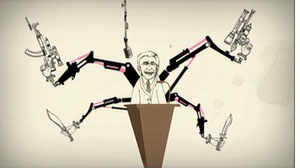 The same cannot be said for the edgier I Met The Walrus, from Canada. It’s derived from an existing soundtrack, a tape-recording made by a 14-year-old Jerry Levitan when he snuck into John Lennon’s hotel room and interviewed him. Now, many years later, director Josh Raskin has created an animated image track to accompany it. It’s a clever idea, but to me the illustrations of Lennon’s words soon became a bit too literal, and I found myself thinking that the animation was Terry Gilliam (in his Monty Python days, that is) meets Yellow Submarine meets Max Ernst collage-novel.
I’m very much of two minds about Madame Tutli Putli, the seemingly inevitable entry from the National Film Board of Canada (directed by Chris Lavis and Maciek Szczerborski). A puppet film four years in production, it is an extraordinary technical accomplishment. It deals with a mousey woman who takes a train journey that confronts her with bizarre and ultimately threatening events. The grim tone and grubby puppets and objects reminded me of Jan Svankmajer’s work.
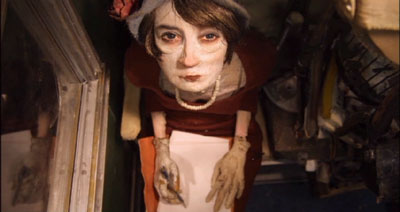
The most disturbing thing about the images, however, is not the subject matter but the creepily realistic eyes. To me it was obvious that real eyes had been superimposed onto the puppets’ faces. Investigating how this had been done, I found this brief making-of demonstration on YouTube, which indeed revealed the main character to be a puppet with blank areas where the eyes would be. Looking further, I learned that the special effects were done by painter/animator Jason Walker, who devised a complicated process to coordinate the photographed eyes with the animation. Some demonstrations of that process are available here, and there is an interview with him here.
There’s no doubt that the technique is unnerving, and yet at the same time it’s distracting (if one notices it). Is it “fair”? Of course people have been combining live action and animation in various ways since the 1910s. Yet superimposing photographed elements in such a way as to make them appear to be part of the animation almost seems like cheating. Here one would be tempted to marvel at how skillfully the animators had simulated human eyes—a notoriously difficult subject to capture realistically. I suppose for many viewers the eyes and the rest of the image would blend seamlessly and not prove distracting. For me, it didn’t quite work.
Overall, the program is undoubtedly worth seeing on the big screen.
As to the previous two programs of Oscar nominees, see here for the list of 2005 shorts and here for the DVD; see here for the 2006 list and here for the DVD.
*The production image from Peter & the Wolf derives from a making-of short on the British release of the German-made DVD (from Arthaus Musik), which now seems to be out of print.
What happens between shots happens between your ears
DB here:
In Number, Please? (1920) Harold Lloyd plays a lovesick boy who’s been jilted by his girl. Moping at an amusement park, he sees her arrive with a new beau.
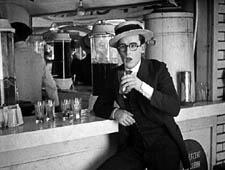
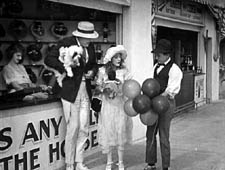
He shifts to another spot to watch them. When she notices him, she scorns him, and he reacts.
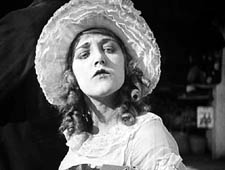
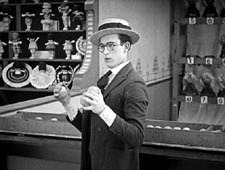
She and the escort stroll past, then she turns and cuddles up to him, making sure Harold notices.
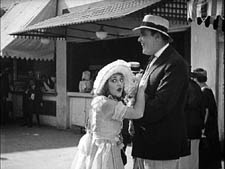
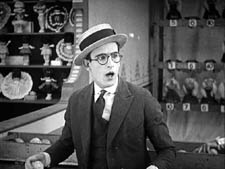
Her flirting precipitates the rest of the action in this very funny short.
In this scene from Number, Please? Harold and the couple aren’t shown in the same frame. The action is built entirely out of singles of Harold and two-shots of the couple, with an especially emphasized close-up of the girl’s snooty reaction. The sequence is rapidly paced and carefully matched in angle; note the shift in eyelines as the girl and her beau walk a little way and then she looks back at Harold.
This approach to building a scene was consolidated in American studio cinema in the late 1910s, as we noted recently, and it soon spread around the world. One of the places it caught on most fervently was Soviet Russia.
Kuleshov glories in the gaps
The great director and theorist Lev Kuleshov always claimed that he and his associates learned the power of editing from American cinema. Russian films were slowly paced, consisting of long tableaus occasionally broken by an inserted closer view of an actor. (For examples, see my Bauer blog entry from the summer.) Kuleshov noted that the Hollywood films brought into Russia grabbed audiences’ interest more intently, and Kuleshov attributed this effect to the fact that the Americans exploited editing more fully, creating the scene out of many shots.
Kuleshov’s example was the formulaic scene of a man sitting at his desk and deciding to commit suicide. The Russians, Kuleshov claimed, would handle this all in one distant framing, with the result that the key actions were just part of the overall view. By contrast, Americans would shoot the scene in a series of close-ups: the man’s face, his hand taking a pistol out of a desk drawer, his finger tightening on the trigger, and so on. This gave the scene a powerful concreteness, and was cheaper to film besides (no need to have a full set).
But most American filmmakers didn’t create the scene wholly out of close-ups. Typically there would be an establishing shot before the action was broken down into detail shots. The process has come to be called analytical editing. (We discuss it in Chapter 6 of Film Art.) As the label implies, the cutting analyzes an orienting view into its important details.
Less commonly, as in our Number, Please? example, American directors could create a scene entirely out of separate areas of space, without ever showing a master framing. This technique, usually called constructive editing, remains common today as well, especially in action scenes.
While praising analytical editing, Kuleshov was particularly taken with constructive editing, because that shows that cinema can call on the spectator’s tacit understanding to assemble the separate shots. Kuleshov realized that we will build a sense of the scene’s space and action out of separate shots without need for the comprehensive view supplied by an establishing shot.
What the Americans developed, the Soviets thought seriously about. Around 1921, Kuleshov and his students mounted some experiments, several of which he discusses in his books and essays. He probably didn’t need to experiment; the American films were full of examples. Indeed, the Number Please? passage is more intricate than any experiment Kuleshov seems to have mounted. But he had a bit of the engineer about him, and he sought to break the technique into its simplest components.
For one thing, constructive editing offered production efficiencies. You could film two actors separately, at different times, and then cut them together. Further, Kuleshov saw that editing could abolish real-world constraints. It created events that existed only on the screen, with an assist from the viewer’s mind.
This is perhaps best seen in his experiment involving an “artificial person.” Evidently it wasn’t a case of constructive editing, because it seems to have begun with an establishing shot. The first shot shows a girl sitting at her vanity table putting on makeup and slippers. A series of close-ups of lips, hands, legs, and the like were derived from different women, and they were edited together to create the impression of a single woman. (Something of this effect survives in the idea of a body double in contemporary films and TV commercials.) But the point is that the woman on screen, made out of different parts, doesn’t exist in the real world.
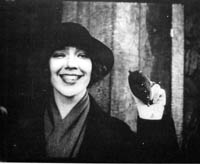
The same possibility could apply to geography, if we delete the establishing shot. As Kuleshov describes his experiment, we initially get a shot of a woman walking along a Moscow street. She stops and waves, looking offscreen. Cut to a man on a street that is in actuality two miles away. He smiles at her and they meet in yet a third location, shaking hands. Then together they look offscreen; cut to the Capitol in Washington DC. Kuleshov saw the potential for imaginary geography as both a useful production procedure and a demonstration that editing could create a purely cinematic space, one not beholden to reality.
Kuleshov’s most famous experiment, the one he identified with the “Kuleshov effect” proper, involves a stock shot of the actor Ivan Mosjoukin, taken from an existing film. In his writing he’s rather vague and laconic about the results.
I alternated the same shot of Mosjoukin with various other shots (a plate of soup, a girl, a child’s coffin), and these shots acquired a different meaning. The discovery stunned me—so convinced was I of the enormous power of montage. (1)
Kuleshov’s pupil the great director V. I. Pudovkin offers a different description of the shots: a plate of soup, a dead woman in a coffin, a little girl playing with a teddy bear. He also goes farther in reporting how the audience responded. People read emotions into the neutral expression on Mosjoukin’s face.
The audience raved about the actor’s refined acting. They pointed out his weighted pensiveness over the forgotten soup. They were touched by the profound sorrow in his eyes as he looked upon the dead woman, and admired the light, happy smile with which he feasted his eyes upon the girl at play. But we knew that in all three cases the face was exactly the same. (2)
Now it isn’t only geography or a human body that has been created by editing; it’s an emotion.
These experiments have been poorly documented, and only a couple have survived. One consists of fragments of the imaginary geography exercise. Here is Alexandra Khokhlova waving, but we don’t have the answering shot of the male actor responding. The two meet at the foot of a statue.
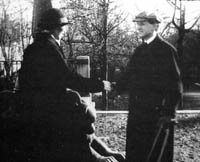
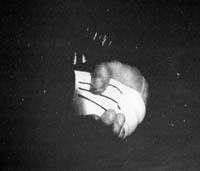
After the two shake hands, they look up and out of the frame, but unfortunately we lack the shot of the Capitol.
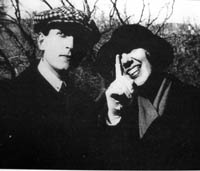
Kristin and other scholars have written more about these surviving fragments, and their essays are published along with Kuleshov’s proposal for funding the experiments and his wife Khokhlova’s memoir of filming them. (3)
It’s worth taking these prototypes of constructive editing apart a little bit. Clearly, there are several cues that prompt us to see the shots as continuous.
One cue is a common background, or at least a consistent one. Kuleshov thought that sometimes a neutral black background worked best, especially for close shots, as you can see with the handshake shot. Another cue is roughly consistent lighting from shot to shot. Yet another is the presumption of temporal continuity; no moments seem to be omitted in the cut from shot A to shot B. It never occurs to us to consider that Kuleshov’s man is looking at something hours or days before the soup is laid on the table in the second shot.
One of the most important cues goes unmentioned by Kuleshov: the very act of looking. Like most commentators, he seems to take it for granted. Yet it’s crucial in prompting us to imagine an overall space in which the actions take place. Knowing the real world as we do, we can infer that if you’re close enough to watch someone, both people are probably in a shared space, such as the arcade strip in the amusement park in Number, Please?
Another cue is facial expression. In his soup/girl/coffin sequence, Kuleshov supposedly picked a shot of Mosjoukin that doesn’t have a clearly identifiable expression. If Mosjoukin was smiling in his interpolated shot, he would presumably seem not grieving but wicked. Normally, though, performers seen in the single shot are expected to express the appropriate emotion more fully, in order to specify what we take the characters’ mental states to be. Our sequence from Number, Please? makes sure we understand the drama by giving the actors unambiguous expressions.
Finally, in the Kuleshov prototypes each shot should be simple. Its action can be stated in a brief sentence. A woman waves. A man responds. A man looks. A plate of soup sits on a table. Even in Number, Please? we can summarize each shot: Harold looks off. His former girlfriend disdains him. That’s to say that the shots are composed to present only one, quickly grasped point of interest.
Filmmakers don’t need to tease apart all these cues; they use them intuitively. Soon after Number, Please?, Hollywood filmmakers were creating amazing passages of eyeline-match editing—the most virtuoso being probably the racetrack sequence in Lubitsch’s Lady Windermere’s Fan (1926). Within a few years of Kuleshov’s experiments, Soviet filmmakers were creating their own masterworks, like Battleship Potemkin (1925) and Kuleshov’s By the Law (1926). Benefiting from a very compressed learning curve, filmmakers took constructive editing to new heights.
Constructive editing, dissolved relationships
Sometimes constructive editing is used to save a scene when production goes astray. When Doug Liman reshot the climax of The Bourne Identity, Julia Stiles couldn’t be on set, so singles of her taken from the first version were wedged in among the retakes, to create the impression that she was watching Jason confront his controller. More positively, a carefully calibrated constructive editing is central to a sequence I analyzed a while back in In the City of Sylvia. For over 100 shots, the spatial relations are built up without an overall establishing shot. (4)
Constructive editing can be used systematically throughout a film. A good example is Alan J. Pakula’s thriller Presumed Innocent (1990). Spoilers coming up!
Harrison Ford plays Rusty Sabitch, a prosecutor in the District Attorney’s office who becomes infatuated with a new woman on the staff. He has a brief affair with her, but after she’s broken it off she’s found brutally murdered. He has to investigate the crime without involving himself, but eventually he becomes the prime suspect.
At the start of the film before Rusty learns of the murder, Rusty and his wife Barbara are shown at breakfast, and establishing shots bring them together.
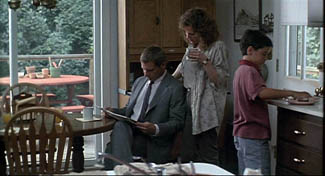
At the office Rusty learns of Carolyn’s death, and after he comes home, the conversation between Rusty and Barbara is treated without an establishing shot. Barbara knows about the past affair, and Rusty is wracked by guilt and shame. The cutting seems to reflect the fact that Carolyn’s death has revived the pain in their marriage.
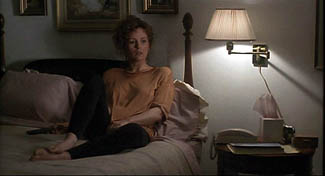
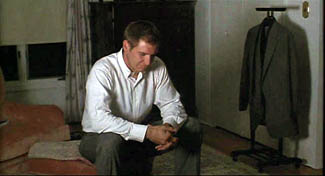
In a series of flashbacks, Rusty relives his affair with Carolyn. Pakula treats their early encounters by means of constructive editing. The common-background cue is especially helpful in this scene in a kindergarten.
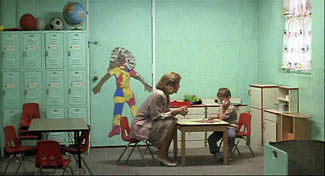
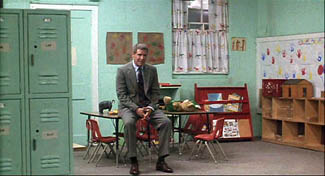
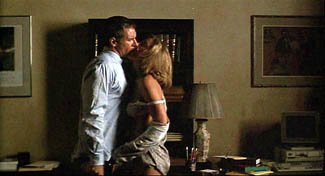
Only after Carolyn and Rusty cooperate and win a child-abuse case does the cutting’s rationale become clear. Pakula has saved the traditional two-shot framing for their moment of passion, as they make furious love in the office.
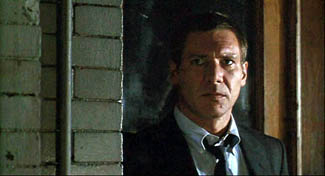
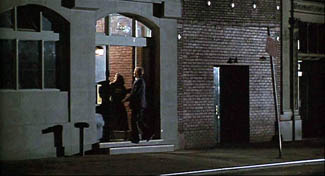
But soon their affair wanes and Rusty is reduced to watching Carolyn from across the street in point-of-view shots.
After the flashbacks end, Rusty is investigated and eventually charged with Carolyn’s murder. In these scenes Pakula often situates Rusty and Barbara in the same frame, as if the threat to him has healed the breach between them.
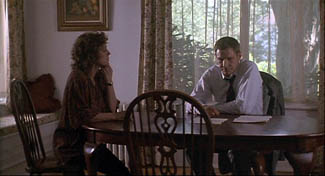
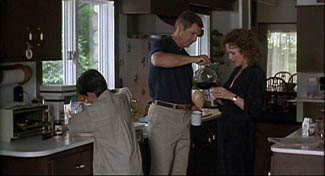
Yet in the film’s climax—and here is the big spoiler—they are pulled apart again. The last scene is a sustained monologue by Barbara. As Rusty listens, across twenty-six shots the two are never shown in an establishing shot.
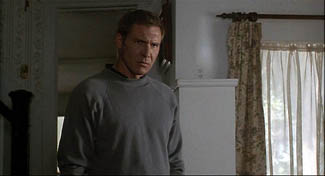
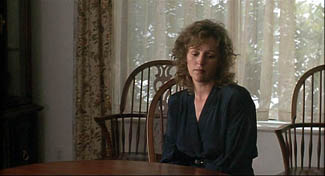
Contrary to the standard Hollywood ending, in which the loving couple embrace in reunion, here they are left divided.
Pakula’s use of constructive editing has effectively traced two arcs: the growth and dissolution of Rusty’s affair, and the reuniting and dissolution of his marriage. In such ways, what might seem a purely local effect, confined to a handful of shots, can create stylistic patterning across a film. The judicious use of constructive editing matches the dramatic development.
Godard of the gaps
Robert Bresson has made more varied and complex uses of constructive editing across a film, as I tried to show in Narration in the Fiction Film and in an Artforum essay. (5) A more radical approach, somewhat in the purely Kuleshovian spirit, can be seen in Godard’s films since the late 1970s. In presenting a scene, Godard often omits an establishing shot, so constructive editing takes over. But he makes the technique quite abrasive and ambivalent.
In watching films like Number, Please? and Presumed Innocent, we fill in the gaps between shots with ease. Godard, however, makes his images and sounds more fragmentary by equivocating about the Kuleshovian cues. The background elements and lighting don’t match entirely; time seems to be skipped over; glances and facial expressions are ambivalent. Adding to these factors, lines of dialogue slip in from offscreen. Godard does present a dramatic scene taking place, but he also creates a sense that images and sounds have been pried loose from their place in an ongoing action, floating somewhat free and functioning as objects of contemplation for their own sake. The cues that Lloyd insists on and that Kuleshov plays with are ones that Godard suppresses or makes ambiguous.
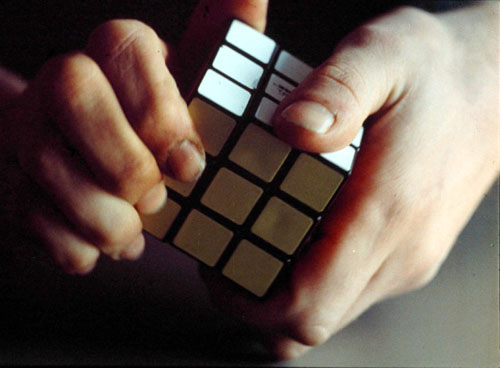
I’ve mentioned this tendency in a recent entry, but to elaborate a little, consider the science lecture in Hail Mary (Je vous salue Marie, 1985). A professor who has emigrated from an Eastern bloc country is explaining his theory that life on earth began and evolved because it was directed by extraterrestrials. No establishing shot of the classroom shows us where he, Eva, and two male students are located, so we have to construct a rough sense of their positions on the basis of a few cues. As Eva, perched on a windowsill, toys with a Rubik’s cube, we hear the professor’s lecture begin to speculate on whether life could have evolved spontaneously. His remarks about sunlight coincide with a burst of sun on her face.
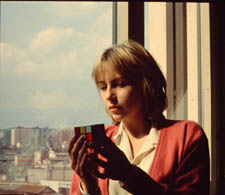
After the Biblical title, “In those days,” we get a series of shots that allow us to apply our mental schema of a classroom lecture: attentive students looking off, a professor at the blackboard.
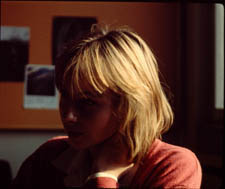
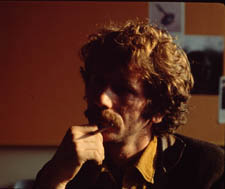
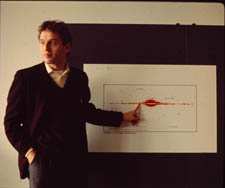
Lacking an establishing shot, we can’t specify how many people are in the class, nor indeed where Eva and her classmate are sitting—since the professor looks off in several directions during his talk.
At the end of his talk he remarks, still scanning the room, that we can presume that life exists in space. “We come from there.” At that point Godard cuts to the head of another student, seen from behind. The sproingy haircut is a little explosion of yellow, and it’s accompanied by a burst of choral music. And as the shot goes on, we start to notice that the professor is pacing in the background, out of focus.
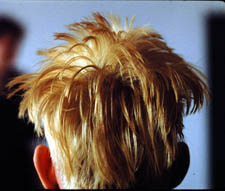
The student, whom we’ll learn is named Pascal, asks a question (at least the slight head movement suggests that it comes from him), and the professor replies. Pascal scratches his head as the professor continues, still out of focus. If I had to choose one shot that condenses Godard’s strategy of suppression in this sequence, this shot would be my candidate.
At the end of the shot, the professor asks Eva to stand behind Pascal. Cut 180 degrees and somewhat farther back to Pascal, now seen from the front. The professor’s hand brings the Rubik’s cube into the shot and Eva comes up behind Pascal as the professor passes.
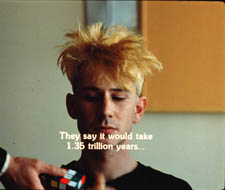
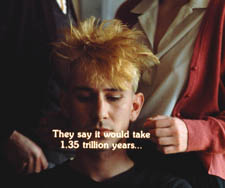
Later she and the prof will become lovers, but Godard lets them meet first as simply two torsos intersecting behind Pascal. The purpose is a demonstration that a “blind” agent can be steered toward a goal through simple yes/no commands. This models the professor’s theory that an alien intelligence could have guided evolution.
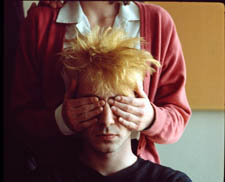
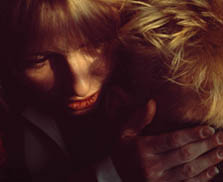
Pascal will twist the facets of the cube under Eva’s hints. Godard makes this a tactile, even erotic exchange, with the close-up of her by his ear and Eva saying, “Yes,” more urgently as Pascal’s hands arrive at a solution, in the close-up surmounting this blog entry.
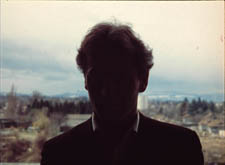
The next two shots of the sequence center on the prof, who has exited frame right from the “three-shot.” Now he’s at the window, recalling the initial shot of Eva; but unlike her he’s little more than a silhouette. As crashing organ music is heard, he seems to be watching the experiment from afar. The second shot, an axial cut-in, coincides with the offscreen voice of a male student: “Were you exiled for these ideas?”
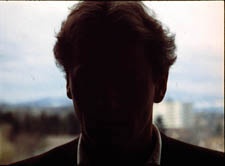
“These ideas, and others,” the prof replies. He says he’ll see the class on Monday, evoking the idea that he’s dismissing the offscreen students, and he turns his head slightly, though we can’t be sure they’re on his right. This shot will be held for some time as students quiz him more about his theory, and Eva asks him if he’d like to come over for a drink some evening. But we don’t see her say it. Godard cuts to a shot of Eva at the window, bathed in sunlight, opening and shutting her eyes as she slightly lifts and lowers her head.
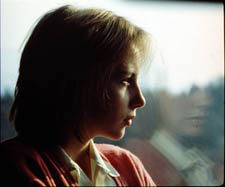
As we see her, we hear the rustling of people leaving (so the class was evidently larger than three). And we hear him reply to her invitation, “That’s another story [scénario].” Are Eva and the prof looking at each other? We’re inclined to say yes, but her closed eyes and tilting head suggests someone lost in contemplation rather than engaged in conversation. Here the classic facial-expression cue is made indeterminate. We have no way of knowing if the prof’s line comes from offscreen, or is displaced from another point in time; maybe he has left the room. Such displaced diegetic sound occurs elsewhere in the film.
We don’t have to decide; our indecision is the point. By pruning away the most reliable cues, Godard wins both ways. We’re kept somewhat oriented to an intelligible action: a prof sets forth his far-fetched theory of human origins and a woman in his class invites him for coffee. This side of the balance allows us to feel that a story, however sketchy, is moving forward.
But the moment-by-moment texture of the scene allows the individual shots, gestures, and sounds to drift somewhat free. Each image takes on a more intrinsic weight, and the juxtaposition of picture and sound acquires a resonance that we usually call poetic. A shot of Eva in the sun playing with the Rubik’s cube, unanchored in time (during class? before class started?), invites us to apply metaphors, especially once we learn her name. Pascal’s thorny hair suggests not only extraterrestrials but the explosion of a nova. The silhouetted prof, detached from the mechanism he has set in motion, hints at an unknown deity watching the game play out according to his rules. Why do Godard films spawn long essays built out of erudite associations? Because the narrative progression relaxes and we can weave our own connotations out of what we see and hear.
If you don’t want to go down the expanding-association route, there’s another one open. When individual moments no longer accumulate ordinary dramatic pressure, we can savor the fugitive pleasures of the separate shots (light on face, lips by ear) and the patterns they form: flipover cuts, yellow hair and yellow facets, bookended shots of Eva at the window.
Those patterns, it should be clear, depend on our sensing a bump at every shot change, looking for a way to skip across the gap that Godard creates. The same belief that meaning and effect are born of gaps impelled Kuleshov too, and perhaps even Lloyd. If we pay attention to those gaps we can feel minds—both the filmmaker’s and ours—at work in them.
(1) Lev Kuleshov, “’50’: In Maloi Gznezdinokovsky Lane,” Kuleshov on Film, trans. and ed, Ronald Levaco (Berkeley: University of California Press, 1974), 200.
(2) V. I. Pudovkin, “The Naturschchik instead of the Actor,” Selected Essays, ed. and trans. Richard Taylor (Oxford: Seagull, 2006), 160.
(3) See Kristin Thompson, Yuri Tsivian, and Ekaterina Khokhlova, “The Rediscovery of a Kuleshov Experiment: A Dossier,” Film History 8, 3 (1996), 357-367.
(4) The sequence does begin with a long shot of the café, but it is so distant, crowded, and brief that it can’t really be said to establish the spatial relationships among the several characters we see.
(5) “Sounds of Silence,” Artforum International (April 2000): 123.