





Archive for the 'Festivals' Category
A many-splendored thing 2: Awards aplenty
Short version:
This year the Hong Kong Entertainment Expo has launched the Asian Film Awards, a celebration of outstanding films and filmmakers created by the HK International Film Festival. Over 700 films were sifted by a jury and a handful of finalists were chosen in several categories. At the ceremony on Tuesday night, Bong Joon-ho’s The Host, which I wrote about at Vancouver’s film festival, won several: best film, best actor (Song Kang-ho, the put-upon father of the family), best cinematographer (Kim Hyung-goo), and best visual effects (The Orphanage). Best director honors went to Jia Zhang-ke for Still Life. Other winners:
Best actress: Miki Nakatani (Memories of Matsuko)
Best screenply: Mani Hagighi (Men at Work)
Best production design: Tim Yip (The Banquet)
Best musical score: Rahayu Supanggah (Opera Jawa)
Best editing: Lee Chatametikool (Syndromes and a Century)
A special award for Outstanding Contribution to Asian Cinema went to the great actress Josephine Siao Fong-Fong, presented by Luc Besson in an eloquent tribute.
I was fortunate enough to be given an award for Excellence in Asian Film Scholarship.
Long version follows.
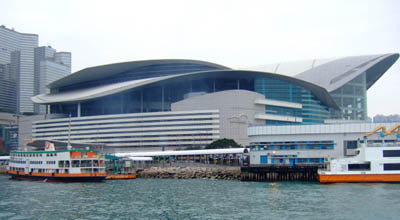
Tuesday morning-early afternoon: The film market, Filmart, is held in the overwhelming Convention Center on the harbor: at least seven floors of steel and glass, shaped like a wingspread gull and full of gigantic auditoria and meeting rooms. Sellers have set up booths to showcase films, TV shows, and the like. There’s also a film financing forum, where directors come to pitch projects to likely funders.
After getting my credentials, I shmoozed with old friend Shelley Kraicer, a Chinese film expert who’s a consultant for several festivals. I also spent time with Ho Yuhang, whose Rain Dogs I’d seen at Vancouver. Ho is a great fan of film noir, and I brought him some DVDs that seemed up his alley. He’s planning a psychological crime drama for his next project, and don’t be surprised if touches of David Goodis and Jim Thompson show up in it.
Late afternoon: After climbing into a suit, back to the Convention Center. At the preshow reception, met Fred Milstein, who works as a completion guarantor at Cine Finance; Fred went to film school, so we had several friends in common.
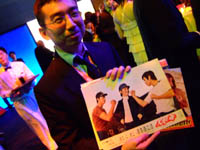
Also reunited with King Wei-chu, a programmer for Montreal’s wonderful Fantasia film fest, and Frédéric Amboisine, passionate adherent of Asian cinema and writer for the lush French magazine Kumite. (King and Frédéric awed me with the memorabilia they tote around, rare posters and books they’ll whip out to show you.)
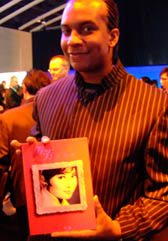
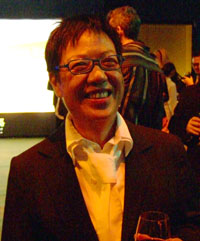
Also ran into director Ann Hui, looking happy and relaxed as usual. Ann, who’s one of Hong Kong’s best filmmakers, visited UW-Madison to show Summer Snow back in the 1990s.
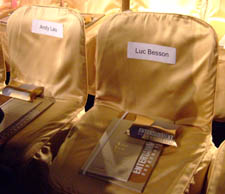
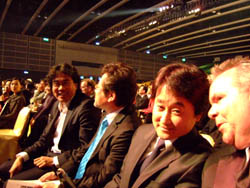
Evening: The ceremony approached. We spilled into the auditorium, with assigned seats. Mine was in the front row, and as I passed the center section I saw plenty of indications of star power.
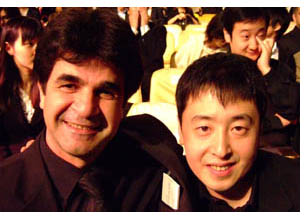
I was lucky enough to be seated beside the remarkable Iranian director Jafar Panahi (The Circle, Offside) and next to him was Jia Zhang-ke, who remembered me from a panel we’d been on together in Shanghai. You can see that they were in good spirits. On my other side sat Vicki Zhou Wei and Song Kang-ho.
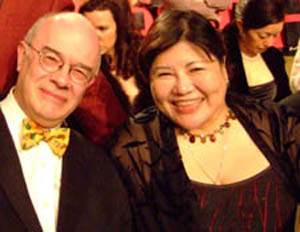
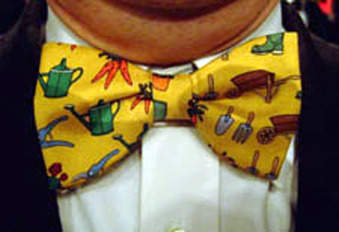
Before the curtain rose, I caught up with Tony Rayns, wearing an amazingly horticultural bow tie, and Peggy Chiao, the godmother of the New Taiwanese Cinema.
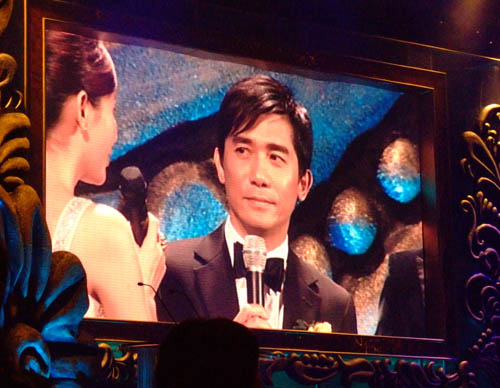
The big noise of the night was the presence of Korean pop star Rain, who brought shrieks from the crowd whenever he turned his head. Still, there was no shortage of fan response for Andy Lau and Tony Leung, the spokesman for Entertainment Expo.
The ceremony was principally in English, from a clever script written by the resourceful Grady Hendrix. Karen Mok started things off in her plummy English accent, but then David Wu showed up with his rapid-fire patter, eventually joined by Fiona Sit.
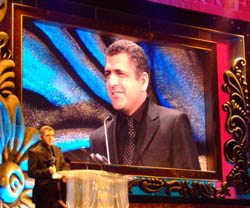
I missed some stretches because I had to go backstage before my award, but here are some pictures before and after. First, Mani Haghighi gets his screenplay award.
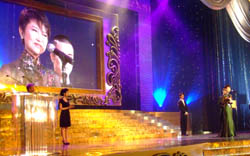
Here’s Siao Fong-Fong getting her special award:
And here’s the Korean contingent as they realize they’re on a roll:
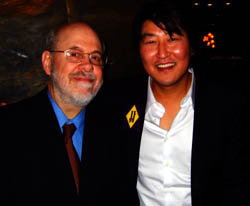
Late evening: At the afterparty, in a bar called JJ’s, I met with Grady, Stuart Levy of Tokyo Pop (who grasped the importance of Asian pop culture before nearly anybody else), his Japanese associate Matsuhashi Masashi, and several other folks—not least the indispensable Athena Tsui, who had worked very hard to make the Awards show a success. On the way out, got my picture taken with the charming Song Kang-ho.
Later evening: Quiet dinner at a great fish restaurant with pals Yuhang and Michele, including Tony Rayns sans bowtie. We had some fine dishes, including pissing prawn (don’t ask).
Finally: Say hello to my lee’l fren’. The awards statuettes were designed by Wong Kar-wai art director William Chang.
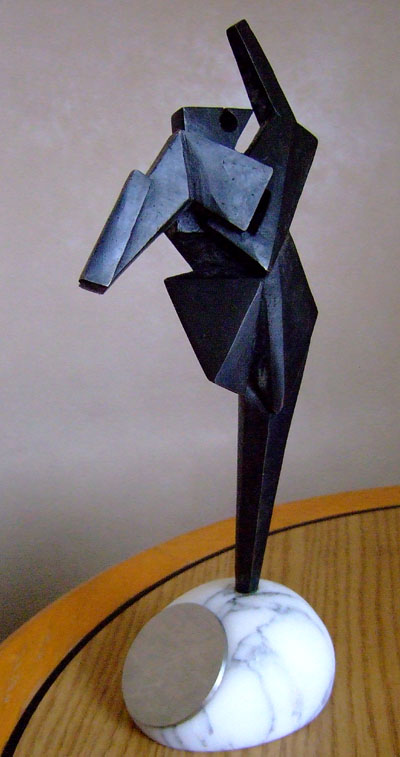
In the spirit of awards ceremonies: Thanks to everyone who’s helped me work on Asian film over the years, especially Tony Rayns, Donald Richie, Komatsu Hiroshi, Li Cheuk-to, Athena Tsui, Shu Kei, Sam Ho, Ding Yuin Shan, Stephen Teo, Doug Gomery, and Gabrielle Claes, along with several archives, festivals, and film distributors. Thanks also to Mr. Johnnie To, who kindly presented me with the award.
A many-splendored thing 1: Academics and premieres
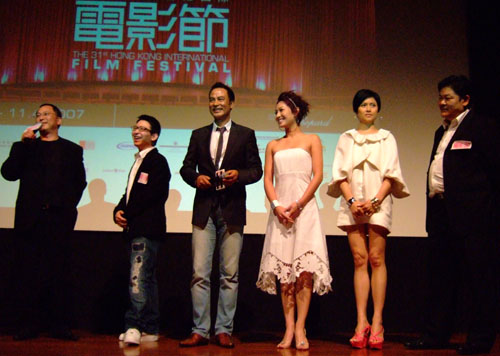
This year’s Hong Kong International Film Festival is mammoth—at 23 days, perhaps the world’s longest. It’s smoothly meshed with the HK Filmart, a trade gathering for buyers and sellers, the Asian Film Awards, and a slew of other events, all under the umbrella of Entertainment Expo. The goal, Timothy Gray points out in a communique in Variety, is to confirm Hong Kong as a regional media hub.
So many things have happened to me since my arrival, and so many impressions pile up, the diary form is for now the best way I can recount my doings. In the course of my stay, I’ll try for less fragmentary reportage.
Saturday 17 March
Back in my favorite city. Plane arrived two hours late around midnight Saturday, and the Internets connection in my room didn’t work. Went to bed, got a surprising 8 hours’ sleep.
Sunday 18 March
Joined my friends Mette Hjort and Paisley Livingston for a shopping expedition with their kids Erik and Siri to Sha Tin, a megamall in the New Territories. That night I stayed with them in their newly renovated home in Sai Kung, with calming views of a park and a bay. Slept 4 ½ hours; read about Alien Autopsy, prepping for a future blog.
Monday 18 March
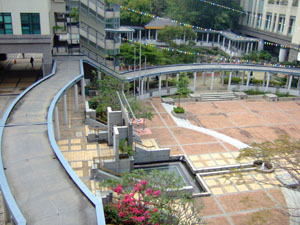
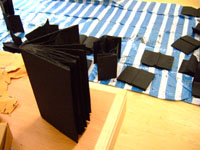
A busy day. Most of it was spent at cozy Lingnan University (one area shown above), where Paisley and Mette teach. I got a little tour and met artist-in-residence Jane Dyer, who’s working on some lovely pieces involving books. She finds ’em, shreds ’em, paints ’em black…and turns them into disquieting sculptures.
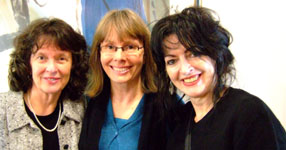
Had an informal sandwich lunch with the students in the Visual Culture program, then a more extended attack on dim sum with Mette (center), Jane (right), and Meaghan Morris, head of Cultural Studies at Lingnan and another fan of HK action cinema.
Late afternoon, I gave my CinemaScope talk, with an addendum on HK cinema’s use of Scope. Good questions afterward.
With Meaghan I rushed off to Wanchai, where she lives and where I was slated to see the new Milkyway film, Eye in the Sky, at the Convention Center. After a comical mishap involving changing taxis, I made it to the Center just as the crowd was gathering. I hovered on the edge, uncertain of what to do next, when Yuin Shan Ding, Johnnie To’s right-hand man, saw me and gestured me in.
So I walked the red carpet, waiting for somebody to stop me. I should have remembered: This is HK, where such events are unbelievably informal.
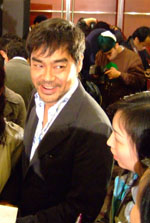
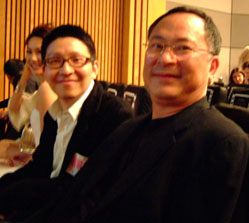
Inside I caught up with Shan and got my ticket. At that moment I met another old friend, Athena Tsui, who was coordinating things in the foyer. Behind her Simon Yam, Lau Ching-wan (above left), Johnnie To, and Yau Nai-hoi were giving press interviews in the glare of TV lights. After snapping some pix, I went in and took my favorite seat, down front and center—where I also found another old Hong Kong friend, Li Cheuk-to, bustling about seeing to a dozen matters. Soon the major players came in too. Above, it’s Yau Nai-hoi, director of Eye in the Sky, on the left and producer Johnnie To on the right.
Then the ceremony started. The principals (To, Yau, Yam, Kate Tsui, Maggie Siu, and Lam Suet) got up on stage and said a few words of introduction. Simon claimed that he gained twenty pounds for his role, while Lam Suet proudly said that he had not.
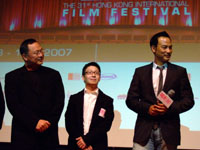
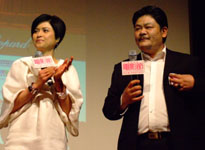
Compared to To’s own directorial efforts, Eye in the Sky is more conventional genre fare. It’s very linear, giving us essentially a ninety-minute pursuit sequence. As a result, we get almost no backstory about the plainclothes cops (Yam and Kate Tsui) who are tailing heistmeister Tony Leung Kar-fai. It does recall other Milkyway films, which are often built around games of chase and disguise. It’s also very much a street film; you see a lot of the Hollywood Road area, and there are nice images of passersby caught unawares.
Here forward momentum is everything, with virtually no pauses for reflection or just catching your breath. Each scene seems caught on the fly, with aggressive smash-and-grab camerawork. Eye contrasts intriguingly with To’s Expect the Unexpected, which exhibits more control of the run-and-gun look and immerses us more thoroughly in the lives of its police protagonists. Still, Yau’s career will be worth watching, not least because Hong Kong needs to replenish its cadre of young directors.
Audience response to Eye was enthusiastic. Darcy Paquet has some quick first thoughts here.
I Am a Cyborg followed, but I have several other chances to catch it, and sleep beckons. Back to the hotel. Tomorrow, Tuesday, is the biggest day of my trip.
Vancouver envoi
A late night Thursday, and a snoozy day of traveling on Friday, kept me from posting ASAP. And now on Saturday morning—I can’t get on to my own blogsite! Apparently others can. So while our web czarina Meg fixes things, I try to wrap things up on my visit to the Vancouver International Film Festival.
Le Petit Lieutenant: A policeman’s lot is never a happy one. From Ed McBain’s 87th Precinct to Ian Rankin’s Rebus series, modern crime novels give an emotional resonance to police procedure by showing the psychological costs of being exposed to cruelty, chicanery, and death. American cop movies have gradually let more of this quality come through (Prince of the City, Heat, Dark Blue), and of course TV, from Hill Street Blues to The Wire, has turned the police procedural into urban melodrama. But the French got here first. For decades, their cop movies have been world-weary psychological dramas shot through with bitter realism. Think of Corneau’s Police Python 357, Pialat’s Police, Tavernier’s L.627, or any of Melville’s policiers.
Le Petit Lieutenant, which I saw on my last day, falls into that sturdy tradition. The premise—a string of attempted murders of bums and passersby—is played out with the usual clue-by-clue plotting, but we also witness the strained lives cops lead. Our two protagonists are the overeager recruit Antoine (Jalil Lespert) and his recovering alcoholic supervisor Carolina (Nathalie Baye in an utterly deglamorized performance). Xavier Beauvoi’s narration shuttles skillfully between their points of view, leading to a good deal of sympathy and suspense and a grim but plausible climax. One of several nice touches: the cops keep movie posters over their desks, and if I’m not mistaken, in some cases the posters serve as hints to the cops’ personalities. The ending leaves you as bereft of certainty as the protagonist.
Do Over (Taiwan): For a finale, I caught this extraordinarily ambitious movie by the twenty-eight-year-old Cheng Yu-chieh. Shot in anamorphic widescreen (very rare in Taiwan over the last twenty years), it belongs to the trend I’ve called “network narratives.” Across New Year’s Eve and New Year’s Day, the lives of several people converge and diverge in the fashion of Short Cuts and Magnolia. Each character’s strand evokes a different genre: gangster movie, romantic drama, twentysomething “relationship” comedy, and the movie about moviemaking. Each strand is also set off by a distinctive photographic style, from misty blue to grainy, blown-out noir.
A network plot often exhibits an interesting mix of realism (in life, strangers’ lives do become tangled) and artifice (chaptering, repeated scenes, and other overt narrational devices). The artifice becomes flagrant at the film’s end, when Do Over‘s title gets literalized and the plot lines are revised to yield alternative endings. The cleverness doesn’t get the upper hand, however, and this remarkable debut leaves you both satisfied and looking forward to Cheng’s next film.
After two trips to Vancouver’s festival, I have yet to go to any tourist destination. I’ve lived within a few square blocks, dashing among hotel, DVD stores, and the Granville Multiplex, with forays to the Pacific Cinematheque and the Vancity Theatre and sushi restaurants and crepe cafes. I’ve lived a film-wonk holiday across eight days and dozens of movies. Thanks to Alan Franey, the Festival Director, for inviting me and extending me so much courtesy. I’m grateful to all the help of his colleagues PoChu Au-yeung, Mark Peranson, Eunhee Cha, Steve Martindale, and Jack Vermee. I wish we’d had more time to talk! Over the last two visits, I’ve made new friends from all over the world, and I’ve enjoyed just sitting among exuberant audiences.
Tony Rayns has been programming Asian films at Vancouver since 1988, and I have to note the melancholy news that he’s stepping down as coordinator of the Dragons and Tigers competition. I’m unhappy as well that I can’t be at Vancouver tonight (Saturday) to see the results of the competition and participate in what will surely be a string of tributes to Tony. So here’s a weak substitute—my own appreciation online.
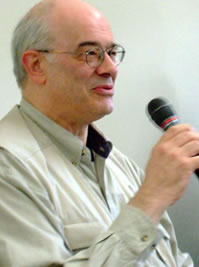
Tony Rayns at VIFF, 2006
In Tony Rayns deep expertise is joined to an unmatched passion and curiosity. His Vancouver programming was crucial in introducing directors like Kitano and Hou to West. He has also made films happen: Without the acclaim of Vancouver audiences and the prestige of the Dragons and Tigers prize, how many distributors would have backed later work by young directors over the last twenty years?Most critics prefer to stroll into screenings to watch films that miraculously appear, thanks to the work of dozens laboring behind the scenes. From the start Tony got his hands dirty. Apart from writing discerning and literate film criticism, he worked for film festivals, wrote presskits and program notes, translated subtitles, and pushed for offbeat films to be available on video and cable. Above all, he programmed films, backing his tastes with an expanding network of allies in the film industry. He helped create a climate of opinion that welcomed the burst of creative accomplishment that Asian film has offered over the last three decades.
Tony’s been a friend since the mid-1970s, and his influence on my tastes and thinking has been immense. I wouldn’t know a lot of what I know without his tireless proselytizing for once-obscure films and filmmakers. He’s sensitive to all a film’s dimensions—its social and artistic implications, its relation to the director’s personality and life experience. A late-night conversation with him, preferably over Asian food, is like being in the liveliest seminar you ever took.
Many of Tony’s contemporaries—I know plenty—have given up on contemporary cinema. Who can blame them, after a trip to a multiplex? Too often, cinema seems over. But this has only made Tony dig deeper, watch more widely, and remind us that this art form is still frisky, unpredictable, and occasionally rapturous. The French have a word for it: animateur, the person who sends a jolt of energy into a culture. Like André Bazin and Henri Langlois, Tony is one of the animateurs of world cinema, and everyone who loves film is in his debt.
Mostly Asian, and why not?
David here:
A correspondent asks: Why am I spending so much time at the Vancouver Film Festival watching Asian movies?
Well, I have dabbled in other regions. Most recently, I enjoyed Eugène Greene’s short Signs, a metronome-and-protractor movie that nonetheless harbors a sharp sting of emotion. More straightforwardly entertaining was Aki Kaurismaki’s Lights in the Dusk. You’ve seen the story’s premise before, both in film noir (femme fatale dooms hero) and in other Kaurismaki films (loser comes stubbornly back for more trouble, and gets it). But it’s as usual filmed in a laconic, Bressonian way, and we get another Kaurismaki protagonist who is blank-faced, obstinate, more than a bit thick, and, despite everything, quixotic.
Still, Asian films have come first for me, as for many others here. Why? The evidence is clear: Since the 1980s, movies from Hong Kong, Taiwan, Japan, Mainland China, South Korea, and more recently Thailand, Malaysia, and the Philippines have offered an almost unrivaled range of accomplishment. (Want names? Tsui Hark, John Woo, Wong Kar-wai, Kitano Takeshi, Kore-eda Hirokazu, Hou Hsiao-hsien, Edward Yang, Jia Zhang-ke, and on and on.) The energy hasn’t flagged, and Vancouver has been in the forefront of supporting this tidal wave of talent. Tony Rayns’ brilliant programming has set an international standard, and the festival’s Dragons and Tigers competition for first features have brought many young filmmakers to world attention.
So herewith some more outstanding Asian revelations from my final Vancouver days:
Hana: Kore-eda keeps surprising us; each film is quite different from the one before. In a downtrodden neighborhood of Edo (the old name for Tokyo), people live in mud and dung, struggling to get by. Some of the loyal 47 ronin wait impatiently to avenge their executed lord, while a young man hangs around trying to find his father’s killer. But the fact that the youth is a fairly inept warrior tips you off to the essentially comic vision underlying this warm movie. Add in a bully who isn’t actually a bad guy and a gallery of low-life neighborhood types, who pass the time rehearsing a play that unwittingly satirizes the samurai ethos. The result is a film that probes the righteousness of vengeance with tact and vulgar humor. Everybody I know wanted to see this again, right away.
My Scary Girl (Korea): The Trouble with Harry meets The Forty-Year-Old Virgin. Dae-Woo has never had a date, but he decides to start with his cute neighbor. He doesn’t know that she’s a Woman with a Past, not to mention a fairly worrisome Present and an ominous Future. Romantic comedy shifts to black comedy, and bowling pins mix with lopped-off fingers. It’s a crowd-pleaser, and Hollywood will probably rush to remake it. But will an American director have the guts to keep the very logical but not wholly happy ending?
I Don’t Want to Sleep Alone: Taiwanese director Tsai Ming-liang has provocative ideas and burnished imagery, but sometimes I’ve thought he’s too clever by half. This movie, his first in his native Malaysia, won me over because it seems to play to all his strengths. Four people intersect around, under, and on a mattress, with an extra character as a kind of comatose sentinel. Tsai’s gorgeous imagery isn’t just pretty for its own sake. Like Tati, he can design compositions which are actually funny, and his long takes give us time to probe the textures and crannies of staircases, a building site, and ordinary streets. The film’s last shot is alone worth the price of admission.
No Mercy for the Rude (Korea): This time the hitman is a mute (or is he?) vowing to kill only the really bad people, and hoping to accumulate enough pay to afford an operation on his “short tongue.” He falls in with a street kid and a hooker, and as the seriocimic plot unfolds we get the very Asian insistence that childhood innocence can be recovered even in the midst of carnage. The film indulges in some flights of fancy—a hitman’s picnic, a hitman who’s a ballet dancer—before coming to its satisfying end in, of all places, a bullring.
Faceless Things: Warnings about gay sadomasochism to the contrary, this doesn’t offer much you can’t see in Warhol or Waters. What it does provide is three shots. The first, nearly 45 minutes long, provides virtually a one-act play about a motel tryst between a businessman and his teenage lover. The second shot shifts us to an anonymous sexual encounter that is admittedly fairly off-putting, but handled with the mix of casual framing and off-kilter suspense we find in, again, Warhol. The very last shot is very brief and puts the other two into a new context. Director Kim Kyong-Mook is only in his early twenties, but his ambition and daring make him a filmmaker to watch.
My last night has come all too soon. So just to make sure that the Europeans are still at work, I’ll check on the French cop movie Le Petit Lieutenant. I’ll end with another Dragons and Tigers entry, the Taiwanese movie Do Over.
Maybe a Chinese dinner afterward. Film isn’t the only thing that Asians do well.