

Archive for 2013
Good, old-fashioned love (i.e., close analysis) of film
Kristin here:
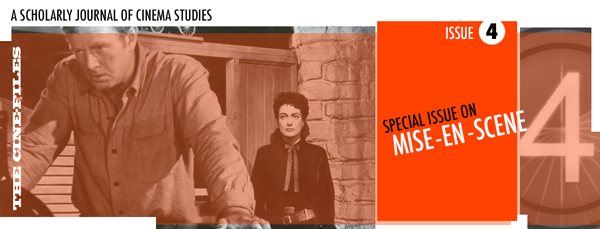
On April 10, I received a message from Tracy Cox-Stanton, the editor of a new online journal, The Cine-Files. This journal is run out of the Cinema Studies department of the Savannah College of Art and Design. The message was an invitation to contribute to the fourth issue of the journal, of which, I must admit, I had been unaware until that time.
The invitation included two options. One was: “Offer a brief (1000-2000 word) reading of a film “moment” that considers how some particular detail of a film’s mise-en-scène (a prop, an actor’s gesture, an aspect of costume, a camera movement, etc.) illuminates the film as a whole, helping us understand the relationship between a film’s details and the overall “work” of cinema. We encourage the use of film stills.”
Having lived for decades in an academic publishing world which tended to discourage the use of film stills, I found this a cordial invitation indeed. Still, my initial thought was, if I had an idea for a study of a film “moment,” I should put it on our blog. We bloggers tend to become selfish about ideas for compact, easy-to-write analyses.
The other option, however, seemed more feasible: to respond to three questions as an online interview. It seemed a simple way of encouraging a promising new journal, and I accepted.
The Cine-Files is an appealing project. In place of the recent focus on cinephilia , which has often encouraged self-absorbed pieces in which film-lovers ponder the nature of their own love of film, “Cine-Files” implies good, hard study, with research resulting in files full of data that can result in informative, meaningful history and analysis.
It reminds me of The Velvet Light Trap in its heyday, though its format is quite different. In 1973, when David and I first arrived at the University of Wisconsin–Madison, graduate students in the young cinema-studies program and coordinators of film societies (showing 16mm prints by the dozen each night) published this extraordinary magazine. It was a combination of auteur worship, studies of studios, and genre analysis. The Velvet Light Trap was a film journal in an era when such things were rare and graduate students could be tastemakers.
The Cine-Files is similarly focused on films in their historical context. It is semi-annual and alternates open-topic and themed issues. Its first themed issue was on the French New Wave. Remarkably for a new journal, it attracted comments from experts such as Dudley Andrew, Geoffrey Nowell-Smith, Jonathan Rosenbaum, and Richard Neupert. The newest issue, to which I contributed, is on Mise-en-scène. The topic for interviews, however, was a bit broader: “close readings.” The new issue, #4, has recently been posted, and my interview is here. There is also a call for papers for the fifth issue, an open-topic one, here.
Tracy has kindly agreed to our re-posting my responses to the three questions about close readings here. We have slightly modified the original post to suit this venue. We thank Tracy for a set of questions that provoked what we hope are interesting responses.
What is at stake in close reading?
To begin with, I don’t use the phrase “close reading.” I prefer “close analysis.” The notion of close reading is presumably a holdover from the 1970s and 1980s, when semiotics was a popular approach in film studies. Cinematic technique was thought to be closely comparable to a language, with coded units and grammar. Although there are some comparisons to be made between the techniques of cinema and a language, I don’t think the similarities can be taken very far.
“Reading” to me implies that interpretation is one’s main goal in looking closely at a film. I usually use interpretation as part of analysis, but it is seldom my main goal. Analysis, loosely speaking, to me means noting patterns in the relationship of the individual devices in a film (devices being techniques of style and form) to each other and figuring out why those patterns are there. What purposes do they serve?

What is at stake in close analysis depends on what sort of analysis one is doing. I’m assuming here that the subject is scholarly or semi-scholarly analysis intended for publication. My own purposes for analysis fall into at least these categories:
1. The simplest reason to analyze a film would be to find out more about it because it’s appealing or intriguing.
I’ve written essays on Jacques Tati’s Les Vacances de M. Hulot and Play Time, in both cases because I admired them and wanted to be able to understand and appreciate them better. I go on the simple assumption that we can only be entertained and moved by films to the degree that we notice things in them. Complex films can’t be thoroughly comprehended on a single viewing or even several viewings. Sometimes you may need to watch them more closely, not in a screening but on a machine, like a flatbed editor or a DVD player, that lets you pause and slow down the image.
2. One might analyze a film in order to answer a question, often to do with the nature of cinema in general.
My essay on “Duplicitous Narration and Stage Fright,” as the title suggests, arose more from my interest in a particular, unusual device, the “lying flashback,” than from a particular admiration for the film.
3. You might want to make a case that a film is significant and suggest why others should pay attention to it.
One example would be the rediscovery over the past few years of Alberto Capellani’s French and Hollywood silent films. On this blog site, I posted two entries, “Capellani ritrovato” and “Capellani trionfante,” analyzing some scenes to support the claim that Capellani was one of the most important stylists and innovators of the era from 1905 to 1914.
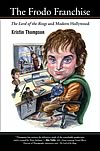
A very different case came with The Lord of the Rings trilogy by Peter Jackson. I had written a book, The Frodo Franchise: The Lord of the Rings and Modern Hollywood (University of California Press, 2007), primarily on the marketing and merchandising surrounding the film and on its many influences. I would not claim Jackson’s film to be a masterpiece, but there was such a great backlash against it, mostly by literary scholars of Tolkien, that I thought it might be worth counterbalancing their opinions. I wanted to make a modest defense of the film as containing some excellent passages and effective decisions concerning the adaptation process. So I wrote two essays based on that argument. (See the codicil to this entry for references.)
4. Close analysis can be vital for writing about film history.
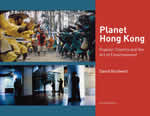
For example, David and I have studied films closely to determine the stylistic and narrative norms of specific times and places. We’re also interested in finding films that were innovative in relation to those norms. Rather than examining a single film closely, such an approach involves analyzing many films to find commonalities and divergences. For example, David has studied the norms and innovations of modern Hong Kong cinema (Planet Hong Kong, Harvard University Press, 2000; second edition available online at Observations on Film Art).
Another such project was my Storytelling in the New Hollywood: Understanding Classical Narrative Technique (Harvard University Press, 1999). There had been many claims in academic and journalistic writings that the norms of Hollywood storytelling had declined after the end of the studio era and that we were now in a post-classical era. Such claims didn’t tally with what I was seeing in the best Hollywood films, the ones held up as models within the industry. I did case studies of ten such films, dating from the late 1970s to the early 1990s, going through each scene by scene. I showed how classical techniques like protagonists’ goals, dangling causes, dialogue hooks, redundant motivation, and other traditional norms were still pervasive in modern Hollywood. I chose the ten films because I liked them, but others would have made my point equally well.
Please tell us about something that couldn’t be understood without a frame-by-frame attention to detail.
I don’t think most close analysis goes to the minute detail of examining a film frame by frame. Sometimes it’s necessary, especially with French and Soviet films of the 1920s or with some experimental work. There can be lots of ways of looking closely at the parts of a film and relating them to other parts.
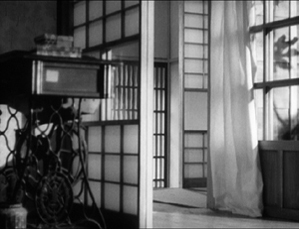
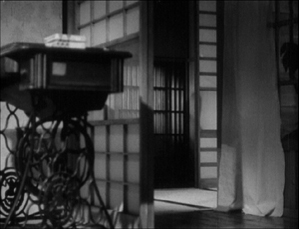
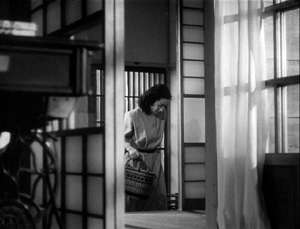
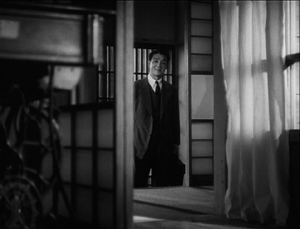
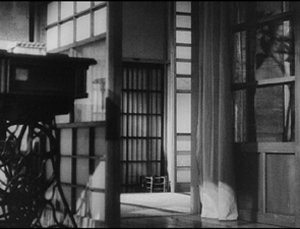
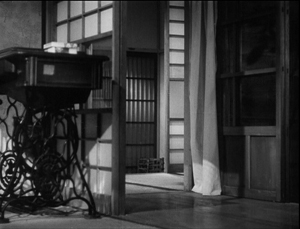
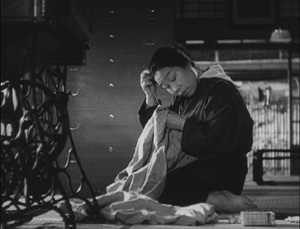
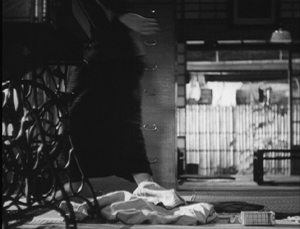
Take a simple example, in my essay on Late Spring, I reproduced eleven shots across the length of the film that include a sewing machine off to one side of the frame–or, in one case, the space where the machine had been. No two of these shots are the same, though they often are only small variations on each other, with the machine closer or further from the camera, sometimes on the left, sometimes the right, and so on. I even missed a couple, the second and third shots immediately below, so there are actually thirteen variants. (DVDs do have their advantages. It’s not so easy going back and forth across a film looking for such repetitions in a 35mm print.)
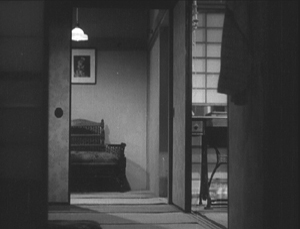
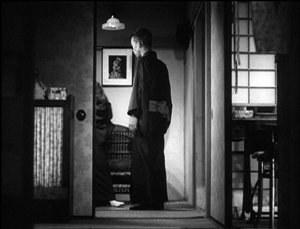
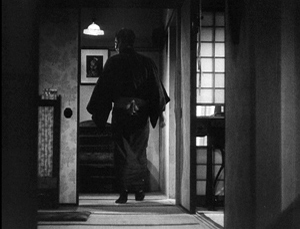
The series culminates late in the film, after the daughter has married and left her widowed father living alone. We see a similar framing along a corridor, and the space formerly occupied by the sewing machine is empty. (See below.)
The daughter doesn’t use this sewing machine in the course of the action, and no one mentions it. Many viewers probably vaguely notice that there is a sewing machine in the house. A few may notice its eventual absence late in the film. But even someone who watches the film over and over and at some point notices that there is a meaningful pattern of the sewing-machine shots would not be able to describe it. I suspected that the sewing-machine shots were small variations on each other, but were there some repetitions? How many were there? I was only able to get a good understanding of how the motif worked by photographing all the shots (or so I thought at the time) and comparing them side by side—and having the luxury to reproduce all eleven frame enlargements in my book.
What point is there in analyzing such a motif in detail? If we admire Claude Monet for taking infinite trouble to capture tiny changes of light on haystacks or lily-ponds, why not devote the same respect to one of the cinema’s greatest directors? To go back to my point at the beginning, we can only appreciate a film to the extent that we notice things about it. I take it that the critic’s job is to notice such things and point them out for the enrichment of others who don’t have the time or inclination to do close analysis.
How do digital technologies allow us to engage in “direct” criticism that bypasses traditional written criticism?
One obvious answer is that digital technologies allow anything that could be published in printed form to be offered online. Whether written for consumption via the internet or already published and then scanned to be posted, online criticism offers some obvious advantages. There is no lag in publication time and no need to hunt for a press. Of course there are disadvantages too: no real guarantee of long-term survival, often no academic reward for publishing through a non-refereed process. David and I have posted many entries involving close analysis on this blog. (I discuss the history and approach of Observations on Film Art in an essay for the first issue of the online journal, Frames Cinema Journal: “Not in Print: Two Film Scholars on the Internet.”)
Perhaps more interesting is the question of what critical tools digital technologies offer for analysis itself. In past decades, David and I had to rig up elaborate camera-and-bellows systems to photograph frames from prints of films—as well as to travel far and depend on the hospitality of archivists to gain access to those prints. Nowadays DVDs and Blu-rays bring hitherto rare films to the critic, and readily available players and apps allow for easy capture of frames for illustration purposes. If the essay or book based on close analysis using such tools is to go online, it also becomes practical to reproduce a great many more frames as illustrations than would be possible in a print publication. David’s e-book edition of Planet Hong Kong permitted him to publish most of the illustrations in color, an option that would have been prohibitive in a university press volume.
The possibility of using short clips as illustrations in an article or book is very promising, especially once electronic textbooks get past the trial stages. I made a modest contribution to the use of clips as examples for introductory students with “Elliptical Editing in Vagabond”; this was done with the cooperation of the Criterion Collection and posted by them on YouTube in 2012. Other extracts appear as proprietary supplements for Film Art: An Introduction. Since then, David has offered three online lectures analyzing editing, the history of film style, and the aesthetics of CinemaScope; see our Videos listing on the left.
Video essays analyzing films are still a new format but show great potential. Their usefulness will depend on how the issue of copyright plays out. At this point, I’m hopeful that showing clips as part of an analytical study will become established as fair use, as clearly it should be. Being able to use moving images complete with sound as well as still frames from films will be an extraordinarily useful tool.
I hope that critics using digital tools will take the trouble to create analyses as complex as one can achieve through description in printed prose. This would mean editing together stills and short segments from across a film, recording voiceover comments, adding graphics where useful, and so on. Close analysis of this type will always be a labor-intensive process.
The analyses mentioned in this article have been published in collections. “Boredom on the Beach: Triviality and Humor in Les vacances de M. Hulot,” “Duplicitous Narration and Stage Fright,” “Play Time: Comedy on the Edge of Perception,” and “Late Spring and Ozu’s Unreasonable Style” appear in Breaking the Glass Armor: Neoformalist Film Analysis (Princeton University Press, 1988). “Stepping out of Blockbuster Mode: The Lighting of the Beacons in The Lord of the Rings: The Return of the King (2003),” was published in Tom Brown and James Walters, eds., Film Moments (British Film Institute, 2010), and “Gollum Talks to Himself: Problems and Solutions in Peter Jackson’s Film Adaptation of The Lord of the Rings” appeared in Janice M. Bogstad and Philip E. Kaveny, eds. Picturing Tolkien: Essays on Peter Jackson’s The Lord of the Rings Film Trilogy (McFarland, 2011).
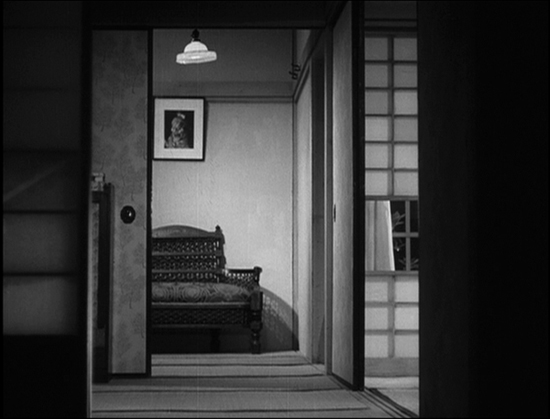
Late Spring (1949).
Sometimes a jump cut…
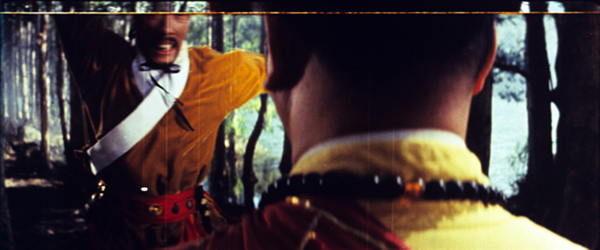
A Touch of Zen (King Hu, 1970).
DB here:
….really is a jump cut.
I had spent a day studying King Hu’s The Valiant Ones at an archive. That night over dinner, my friend asked me what was taking me so long. I answered, “I’m trying to figure out his secrets.” Her brow furrowed, but then she said, “I suppose that’s all right as long as you never tell anyone.”
Reader, I told. Eventually.
The puzzle for me was how King Hu gets the remarkable kinetic effects in his fight scenes. He starts with the conventions of the Chinese wuxia (“martial chivalry”) film. Fighting with or without weapons, the warriors have extraordinary powers of speed and strength. They can sometimes defy gravity with “weightless leaps” that carry them great distances.
Today, digital special effects permit quite dazzling images showing flying warriors in extended long shots, as in Crouching Tiger, Hidden Dragon and Hero. But Hong Kong directors of the 1960s and 1970s had much more meager special effects available.
The alternative was to present these feats through constructive editing. A character leaps in shot A, flies through the air in shot B, and lands in shot C. All much easier to film than a single, faked long shot. From the 1980s on, strong but thin wires would keep the fighters in the air for long shots. Many fine films were made using wirework, but for the most part King Hu couldn’t use it. About his only technological support was a variety of trampolines that could be cunningly hidden in a set.
King Hu’s solution to the problem of flying swordfighters involves a unique approach to film technique. In an article called “Richness through Imperfection: King Hu and the Glimpse,” I argued that he found a way to make his fighters’ prodigious moves register in a percussive but almost subliminal way. It’s not just that if you blink, you miss the action. (Though if you do, you will.) His goal isn’t just to use brief shots (some only three or four frames long) to arrest our attention. More important, King Hu evokes the quasi-supernatural power of his fighters by suggesting that they move too quickly and unpredictably for the camera to catch.
He accomplishes this by reshaping the constructive-editing scheme of launch/leap/landing. He trims each shot to a minimum, provides several intermediate flying shots (each also very short), and makes our eye work by shifting the center of interest from shot to shot. He provides eccentric angles, unexpected cuts, and startlingly empty frames. Characters run, spring up, and soar, but in a flurry of frames, or on the screen edge, or dodging in and out of sight–blocked by bits of the set, or just by a framing that doesn’t adjust quickly enough to their impulsive movements.
A good example is the moment in Dragon Gate Inn (1967) when the eunuch Tsao attacks the group defending the family of General Yu on the roadway. A low angle shows him launching his jump.
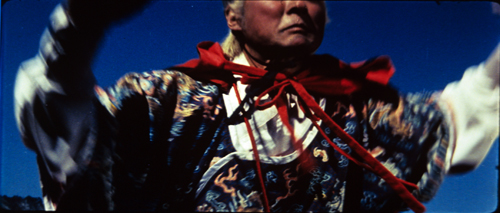
So far, so conventional. But instead of giving us a clear image of Tsao in flight mode, Hu gives us this:
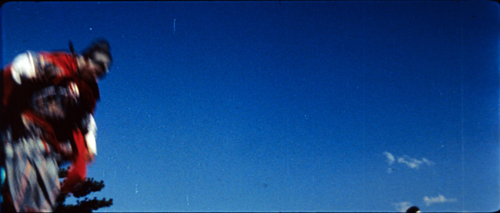
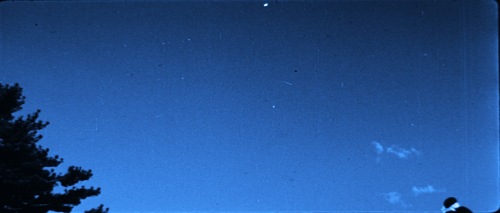
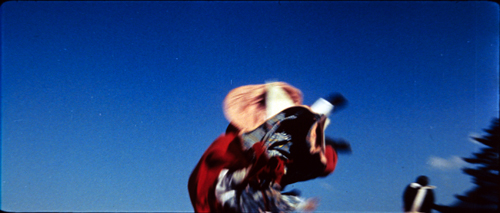
Tsao slides down the left frame edge, vanishes for an instant, then bounces up, already somersaulting, on his way to strike his adversary Hsiao. The framing fails to keep up with him, implying that he’s just too elusive, while his wayward entries into the frame provide percussive accents.
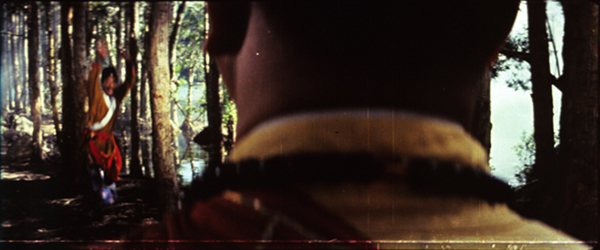
King Hu liked to play with the leap phase of the ABC pattern, as here and in my knockout passage for the day, shown at the top of the entry. In the penultimate confrontation of A Touch of Zen, Commander Hsu attacks the serene Abbot Hui Yan. Hsu leaps a huge distance and comes down directly in front of the monk. But King Hu renders this miraculous feat in two nearly identical framings: one showing the launch, the other the landing. Seen from over the monk’s shoulder, Hsu has been endowed with blinding speed through a sheerly cinematic effect–a bold jump cut.
Please note: This isn’t a clumsy patch job in the particular print. The cut is in the negative, and it’s been in every print I’ve ever seen of Touch of Zen.
“Jump cut” is a term that’s used in different ways. Sometimes it refers to various kinds of mismatches that yield a jolting discontinuity. I’m using the term here to denote an effect that results from excising some frames from a continuous shot. The classic examples have always been the cuts in Godard’s Breathless. The Touch of Zen example is a little less pure because you can see that Shot 2 doesn’t strictly continue Shot 1’s camera setup. King Hu has moved the abbot’s head and shoulder a little further away from us. But the compositions are graphically very close, and the impression on screen is of a single camera take with some frames lopped out.
When we ask, Where did Hsu go from shot to shot?, the answer is: In the cut. Without the advantage of special effects, King Hu has given us a propulsive impression of speed and ferocity.
His secret? Merely a uniquely cinematic imagination.
Some of our techie readers might be curious about the images here, photographed from a 35mm print. Perhaps they’ve noticed that Hu’s cutting has left its physical trace on the film strip.
In classic filmmaking practice, cuts were made with splices–physical joins between one piece of film and another. In film-based formats, splices were made with glue or transparent tape. (Today, of course, they’re largely made digitally and called “edits.”) Most filmmakers hid their splices, but there’s a robust tradition in avant-garde cinema of integrating splices into the image; you can see it, for example, in the work of Stan Brakhage and Paolo Gioli.
Splices are visible as horizontal flashes across the bottom of the screen. In 35mm filmmaking, the final printing phase usually masks those out. But, as Erik Gunneson reminds me, that’s harder when you’re shooting anamorphic scope. There the image is recorded full-frame on the film strip, so traces of the splice may remain visible, especially in older films.
When we look at the physical strip here,we can see that Hu’s negative cutter has simply spliced one shot to another with cement. The illustrations up top show the last frame of Shot A and the first frame of Shot B. You can see the neat splice, a horizontal line running along the bottom of the first frame and the top of the second. The same trace of a splice is visible in the cut involving Yang’s leap.
The odd thing to modern eyes is that there’s a bit of overlap, a thin slice that seems out of whack with both shots. In Shot A, the bottom edge of this thin strip cuts off the abbot’s head weirdly. Let me show you the first frame of the second shot again. Reading from top to bottom, you see a bit of the bottom of Shot A’s last frame, then the true frame line, then the weird little band. The bulk of the image is the frame that starts Shot B.
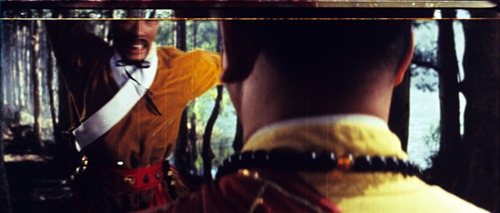
What’s that thin slice between the frame line and the yellow splice line? It’s the top bit of the next frame of the first shot as taken in camera. It shows the trees and the abbot’s head and ears as they appear at the top of Shot A’s composition. Instead of cutting exactly on the frame line of Shot A, the editor has overlapped a tad of the following frame in order to attach the two shots with cement. During a screening, the extra bit may be minimized or eliminated because the projector plate doesn’t show us the entirety of the image on the strip, but it is there.
Splices can be hidden through A/B rolling, which I believe is more common in 16mm than in 35mm production. I don’t believe that Chinese films of Hu’s day made use of this process, but I’d appreciate more information.
The essay on King Hu is in my Poetics of Cinema (Routledge, 2008), 413-430. For more on King Hu and his innovations, see Planet Hong Kong: Popular Cinema and the Art of Entertainment, available elsewhere on this site. Kristin and I discuss jump cuts and graphic matches in Chapter 6 of Film Art: An Introduction. See also the “Film Technique: Editing” category on the right of this page.
This blog entry follows from two others: “Sometimes a shot . . .” and “Sometimes two shots . . .”
I put up this post now because I’ll be giving a talk on Chinese martial arts cinema next Monday, 10 June at the Toronto International Film Festival Bell Lightbox, at 6:30. It’s a part of TIFF’s splendid summer-long celebration of Chinese cinema. On the day before, 9 June, there will be a free screening of Hou Hsiao-Hsien’s Dust in the Wind (1987) at 10:00 AM. After the show, there’ll be a panel featuring Bart Testa, Hou expert Jim Udden (who posted a blog entry with us on Hou’s new project), and me.
This entry is also to congratulate Peter Rist, tireless guardian of the Shaolin Temple, on his birthday.
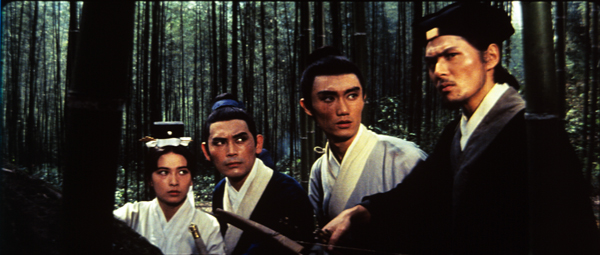
A Touch of Zen.
On the more or less plausible sneakiness of one Preston Sturges
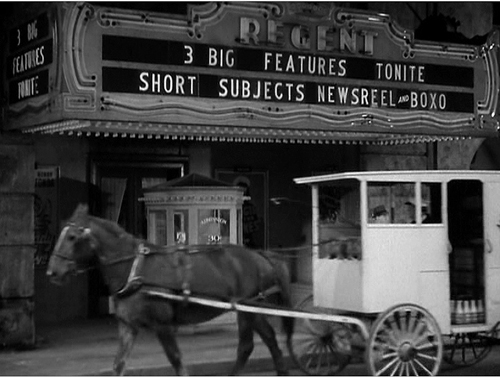
The Miracle of Morgan’s Creek (1944).
DB here:
It’s no news that Preston Sturges occasionally mocked the film industry. Exhibit A is Sullivan’s Travels (1941), in which a director of escapist comedies decides to switch to serious social commentary. Sturges’ movie starts with a parody of a violent Hollywood climax that ends with two men plunging to their death. Next we’re told that Sullivan’s previous triumphs are Hey, Hey in the Hay Loft, Ants in Your Plants of 1939, and So Long, Sarong. At a later point we see a somewhat more somber triple feature:
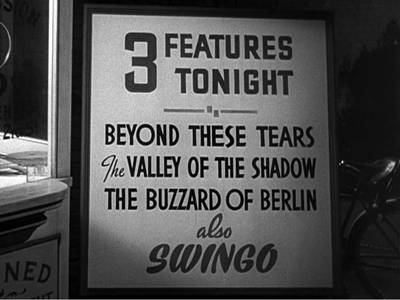
“Swingo” is Sturges’ equivalent of Screeno and other 1930s Bingo-like games designed to lure audiences into theatres.
These gags are pretty straightforward. While working on my book on Hollywood in the 1940s, I found that The Miracle of Morgan’s Creek (1944) offers us something less obvious and more peculiar.
Three big fake features
Norval Jones (Eddie Bracken) has taken Trudy Kockenlocker (Betty Hutton) out on a date. They’ve told her highly combustible father (William Demarest) they’re going to the movies. Actually her plan is to sneak away and celebrate with soldiers about to be sent overseas. She convinces Norval to cover for her and to loan her his car. Trudy is gone all night. Drunk, pregnant, and now married to an elusive Ignatz Ratzkiwatzki, she drives up to find Norval sleeping curled up in the foyer of the movie house. In the two scenes around the Morgan’s Creek Regent theatre, Sturges wedges in some barely noticeable jabs and in-jokes.
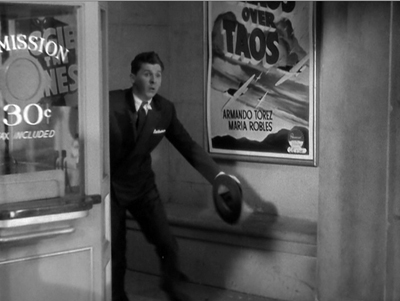
Start with what’s playing. Four posters are in the foyer around the box office. One is sitting on an easel turned largely away from us. The other three are mostly blocked by actors, partially framed, or thrown out of focus. But by freezing the film we can make out the titles of these three fakes.
The most visible film is Chaos over Taos, clearly a Paramount release.
You can also make out The Private and the Public, which also bears the Paramount logo. Its poster is behind Norval. Much harder to discern is the title of the third feature on the program, Maggie of the Marines. It’s barely visible for a few frames, glimpsed over Trudy’s right shoulder.
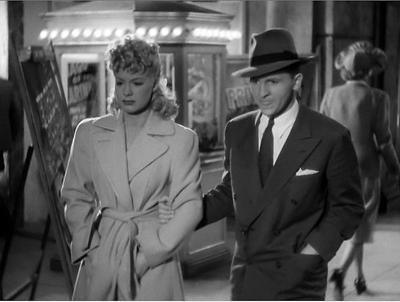
Knowing Sturges’ penchant for playfulness, we can see two of these as parodies of Paramount releases. The Private and the Public seems clearly a reference to The Major and the Minor, directed by Billy Wilder and released in early fall of 1942. Sturges began shooting Morgan’s Creek in October of that year and finished in early 1943, so he would have been well aware of the Wilder film. As an extra fillip, the star of The Private and the Public is listed as Fred McMany, a reference to Paramount star Fred MacMurray.
Then there’s Chaos over Taos. The title is weird enough, relying on an eye-rhyme and being so tough to pronounce that no studio would ever choose it. The star names, Armando Torez and Maria Robles, don’t suggest any Paramount contract players to me, but this was the period when Hispanic and Latino stars began to headline Hollywood movies: Carmen Miranda, Lupé Velez, and Cesar Romero are the most famous. Emphasizing Latin American plots, players, and locations was part of Hollywood’s contribution to Roosevelt’s Good Neighbor policy. The effort was seen most famously in Disney’s wonderful Saludos Amigos cartoon (1942) but also in a series of Fox musicals with cities named in the titles (Down Argentine Way, That Night in Rio, Week-end in Havana). Chaos over Taos could be Sturges’ dig at a then-current trend in political correctness and at another studio’s production cycle. As for the genre, Chaos/Taos is a flyboy movie and Paramount made several of those—three B-films in 1941 alone (Flying Blind, Forced Landing, and Power Dive, all featuring Richard Arlen).
What then of Maggie of the Marines? It’s likely that Sturges grabbed the title from an October 1942 news story about a dog that wandered into a marine camp in the Panama Canal. Details are at the bottom of today’s entry. We can imagine the sort of heart-warming comedy it might have been, as long as Sturges wasn’t at the helm.
Etc., etc., and etc.
Finally, there’s a matter of exhibition. Just as in Sullivan, the theatre in The Miracle of Morgan’s Creek proclaims a very long show: “3 Big Features Tonight, Short Subjects, Newsreel, and Boxo” (another mockery of Screeno). Norval tells Trudy that the whole shebang is scheduled to end at about 1:10.
Unlike the bill of fare in Sullivan’s Travels, the long show at Morgan’s Creek motivates plot action. Trudy uses the pretext of a long triple feature to get her father’s permission to stay out late. But it may not be too much to see in Sturges’ interest in triple features another contemporary reference.
Triple features emerged in the mid-1930s, partly because of high output from the studios and partly because of competition among exhibitors. Dan Goldberg wrote in Variety in 1938:
In a wild scramble for immediate returns without any thought to the outcome, the exhibitors have tried freaks and stunts rather than policy and operation. There have been double features, triple features, bank nite, screeno, keeno, bingo, and giveaways of all kinds, including dishes, flatware, linenware, framed pictures, wall plaques, etc., etc., and etc. There are many houses around here [Chicago] which are getting a 15c and 20c admission and giving away merchandise valued at 11c and more.
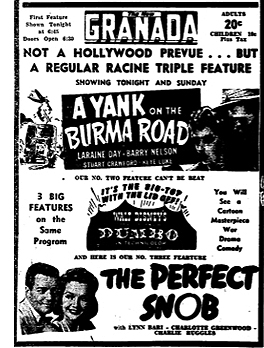 The studios hated double-feature programs but the public, voting its wallet, preferred them. Duals, as they were called, were largely a subsequent-run phenomenon, but because of the vast number of releases and block booking, they crept into first-run venues too. Triple bills were far less common and typically included two or even three B pictures. Most A-grade pictures aimed to come in under 100 minutes, and a B was typically sixty to seventy minutes long, so a triple feature of an A and two Bs wouldn’t be stupendously long. In the Racine triple feature on the right, two Bs flank Dumbo, a 62-minute movie, and the whole program, without shorts, trailers, and intermissions, would last only a little over three hours. Many triple bills seem to have consisted of three Bs. Sometimes the movies weren’t all features: a cartoon or a serial episode might be counted as one of the “Three Big Hits” advertised.
Triples were evidently less popular with audiences than duals. Perhaps people weren’t willing to spare such a big block of time, or they suspected that the lesser items on the bill weren’t worth watching. Jeff Smith suggests to me that adding a B to an A looks like a bonus, but two or three Bs look like a dumping ground. Interestingly, when Trudy tells Norval she plans to skip out on him, he protests: “I won’t do it! I won’t sit through three features all by myself.” Trudy asks plaintively: “Couldn’t you sleep through a couple of ’em?”
While Sturges was preparing Morgan’s Creek, he might well have noticed some Variety stories tracing a controversy about triple bills in the Midwest. A chain in St. Louis had shifted to this policy, and to retaliate a rival chain began four-hour shows consisting of two features and sixty minutes of shorts. In late 1940, a civic group, the Better Films Council of Greater St. Louis, put pressure on exhibitors to oppose long programs. The Council claimed that such bills were “a physical and mental strain on children and young people,” and that family-appropriate films were sometimes accompanied by “adult” ones. Getting no cooperation from the theatre circuits, the Better Film Council announced in early 1941 that it was going to introduce state legislation to ban triple features. This effort evidently came to nothing.
As if in response to bluenose worries about long programs, Sturges gives the lucky Morgan’s Creek patrons a movie banquet that ends in the wee hours. And ironically, Trudy would have suffered less “physical and mental strain” in the days and weeks thereafter if she’d gone to the movies and not kissed the boys goodbye. The Regent’s absurdly inflated program may be Sturges’ dig at both a contemporary trend and those who fretted about it.
Watching me rake these apparently innocuous frames, you may be asking: Is David going all Room-237 on us? Actually, I see today’s entry as in the spirit of an earlier one, which also has an enigmatic Sturges connection. I’m interested in the moments when Hollywood is talking to itself.
We tend to think that the studios made movies to communicate with the public, and that’s surely true. But we tend to forget that filmmakers were sometimes talking to each other. In the Zanuck-produced Hollywood Cavalcade (1939), a romance of silent-era moviemaking, director Don Ameche turns down Rin-Tin-Tin for a project. The obvious joke is that the pooch became a big star, but how many viewers would appreciate the in-joke that Zanuck launched his career at Warners writing scripts for Rinty? Did the public know that Slim and Steve, the nicknames swapped between Bogart and Bacall in To Have and Have Not, were the ones used by Hawks and his wife? Would ordinary moviegoers catch the reference to Archie Leach in His Girl Friday or notice Jed Leland’s column in the newspaper in The Magnificent Ambersons?
Some would have. Moviegoers of the day were better-educated than the populace in general, and the biggest fans went several times every week. But even if the audience missed these bits, the filmmakers’ peers might not. These movies were made by youngish people who liked to have fun–sometimes at each other’s expense—and nothing is more fun than very esoteric in-jokes.
The problem is that these other examples are highlighted in dialogue, but some of Miracle‘s in-jokes are almost completely buried. They’re more akin to the current vogue for Easter Eggs in sets and props. Unlike the recent instances, though, Sturges’s hints are hard to catch during projection, and he couldn’t have counted on viewers mulling over them frame by frame, as our directors can.
Perhaps he intended to show those posters more fully but had to forego that option during filming or cutting. Or perhaps he included them just for his own amusement–that is, not for the general public, nor even for his peers, but merely for the pleasure of putting in things that only he and his team knew about. If that seems implausible, let me ask: If you could do it, wouldn’t you?
The fourth poster, after some fiddling with the Skew and Perspective tools in PhotoShop, reveals itself as another aerial adventure: Eagle something…. Eagle Blood, maybe? For an example of a drama using real film titles in its movie marquees, see this entry.
On duals and triples, see “Triple Features Seen as Nabes’ Salvation,” Variety (22 January 1935), 3; Dan Goldberg, “Chicago Merry-Go-Round,” Variety 24 October 1938, p. 21; “Now It’s Duals, with Vaudeville, At the Loop Oriental,” Variety (25 January 1939), 5; “Single-Billing Idea Up Again But Practically It’s Still NSG,” Variety (26 August 1942), 13. On the St. Louis controversy, see “Better Film Council Queries St. L. Exhibs on Duals and Triples” Variety (23 October 1940), 21, and “St. Louis Group Seeks to Outlaw Triple Features,” Variety (26 February 1941), 21.
The embedded ad for a triple feature comes from The Racine Journal-Times (11 July 1942), 8.
No need to write me about the most obvious in-joke in Morgan’s Creek: the fact that it incorporates two major characters from The Great McGinty (1940) and doesn’t even bother to credit the actors. Cheeky, this Sturges fellow.
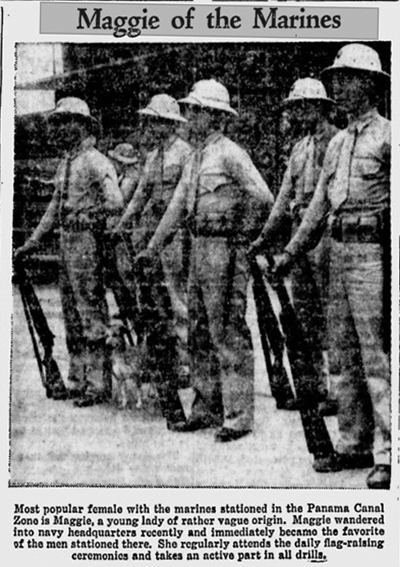
From The Daily Gazette (Berkeley , California, 19 October 1942).
The annals of showmanship: Any popcorn or ammo with your Pepsi?