






Archive for 2013
Hitchcock again: 3.9 steps to s-u-s-p-e-n-s-e
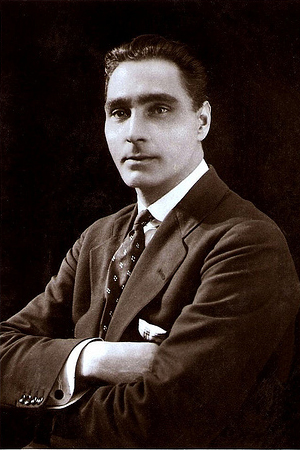
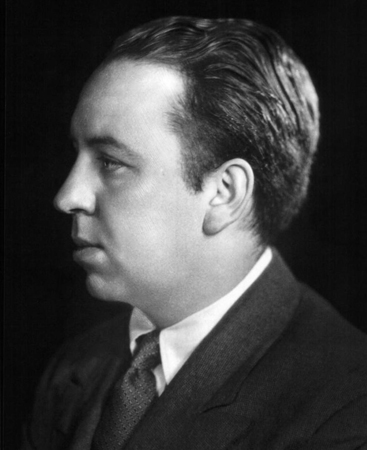
Henry Edwards; Alfred Hitchcock.
DB here:
My previous entry reminded you that Hitchcock was notorious for distinguishing between suspense and surprise. To achieve suspense, he maintained, the audience has to be aware of more than the characters know. Surprise arises when we know as much as the characters, or less. Hitchcock also declared his general preference for suspense, since it provides prolonged tension while surprise produces merely a momentary buzz. The mystery was: Where do this distinction and this preference come from? Are they original with Sir Alfred, or can we find precedents?
The story so far:
Step 1: The distinction itself goes back at least to the eighteenth century and the playwright/theorist Gotthold Ephriam Lessing. Lessing likewise expressed his preference for suspense because it demanded superior craftsmanship and yielded stronger effects on the audience.
Step 2: The distinction and the preference for suspense was still circulating in late nineteenth and early twentieth-century commentaries on theatre. My entry also mentioned a 1922 screen playwriting manual by Howard Dimick that took the same stance.
So we’ve located general conditions for influence. By the early 1920s, the suspense/surprise doublet was still circulating in the worlds of film and theatre, when Hitchcock was starting his career. But influence, like its source-word influenza, requires close contact. It would be good to find the secret agent who might have passed along the idea to the young director.
Step 3: My P.S. to the entry ropes in one candidate: Eliot Stannard. Richard Allen proposed him as a possibility, and Ian Macdonald supplied information that strengthened the suspicion. Stannard was a busy screenwriter of the period, who worked closely with Hitchcock on nearly all his silent pictures, and he even wrote a manual on screenwriting. Although he apparently didn’t talk about suspense and surprise in print, he would have known William Archer and other drama theorists who did. Stannard could well have initiated Hitchcock into the idea.
Step 3.9: But do we have the wrong man? After I posted my P. S., another foreign correspondent weighed in. Charles Barr writes:
A key figure here is Henry Edwards. Director in British cinema 1916-1937, and actor for much longer. His (lost) feature film Lily of the Alley in 1923 made a big point of avoiding intertitles. Whether or not he saw it, Hitchcock must have at least been aware of it, even though later he always said that The Last Laugh was the first such film. And already in 1920 Edwards had spelled out the surprise/suspense distinction: see attachment from the trade paper The Bioscope.
Edwards was indeed a major figure, as producer, actor, and director during the 1910s and 1920s. At the British Film Institute site, Geoff Brown and Briony Dixon provide a lively account of his career. He was clearly in a position to influence younger filmmakers.
The 1920 Bioscope article, cited in the Brown/Dixon overview and supplied to Charles by Ph.D. student Michaela Mikalauski, is a revelation. Edwards writes:
We must so construct our story that suspense is created–suspense is the dread that something may happen, and it is on this that we must build our story.
We must so construct it, that by careful preparation impeding difficulties or dangers are looming up before our characters. We must show the audience these dangers, and keep our characters ignorant of them until the proper moment; and it is the nearing of the danger to the blissfully ignorant character, making us long to cry out and warn him, that give suspense.
Tellingly, Edwards uses an example of an explosion. Imagine that our hero, wandering in the wilderness, has taken shelter in a shack. He sits on a box and lights a cigarette. While he has a leisurely smoke, his match has ignited some dry rubbish by the box. He rises and leaves the shed, just as the box is blown to pieces. Now we realize that it contained dynamite.
Here is a case in which there is expectancy, and never for a moment suspense, because the audience does not know of the impending danger to the character.
Now let us defy the critics who clamour for “surprise” in film construction, and tell the incident in the language of the screen.
Edwards goes on to imagine that we’ve seen quarrymen leave the box of dynamite behind. When the hero ambles in and settles down on the box for a smoke, we’re already apprehensive. Now every gesture he makes prolongs the tension, and we watch anxiously as the discarded match ignites scraps beside the box.
It becomes a question as to which will take the longer, the hero to recover his strength and go, or the box of dynamite to explode. Here is sheer suspense, and when there hero has gone it is no jar to the audience but rather a pleasurable expectancy to see the box explode harmlessly in the air.
After supplying another, more psychological example, Edwards concludes his piece: “The letters of the film alphabet are s-u-s-p-e-n-s-e.”
This article–published the very year that a young and innocent Hitchcock began work for Famous Players-Lasky in Islington–shows that the terms in which Hitchcock understood the suspense/ surprise distinction were already clearly articulated in English film culture. Even the bomb situation that Hitchcock would summon up for Truffaut is there in Edwards’ piece. But of course this information doesn’t sabotage the standing of Stannard, who may have read the Bioscope article and transmitted its lesson to Hitchcock in later years.
I confess I had thought I was done with the thing, but the last few days have brought a small frenzy of emails, and I’m feeling a bit of vertigo. Still, there seems not a shadow of a doubt that Hitchcock was maintaining his faith in a storytelling device that goes back quite far and still had a grip on the formative years of British and American cinema.
Thanks very much to Charles Barr for the information and for sending me the Edwards article. It was published as “The Language of Action,” Bioscope (1 July 1920), supplement p. iv. Thanks also to Michaela Mikalauski for locating the piece, and to Antti Alanen for forwarding some crucial email addresses.
Charles’ revised edition of his Vertigo monograph includes some further comments on the suspense/surprise distinction as it relates to that film. Charles is also completing a new book, with Alain Kerzoncuf, called Hitchcock: Lost and Found. It surveys the little-known films from all periods of Hitchcock’s career. “It devotes some 15,000 words to ‘Before the Pleasure Garden,’ discussing the 21 films Hitchcock was involved with (surviving in whole or part or not at all) and also a bit on the wider context, which is where Edwards comes in. This is all about to go to the publisher (Kentucky) and if all goes well will be out by the end of 2014.”
I’m grateful to all. The little adventure, which I suspect is not quite over, has been rich and strange.
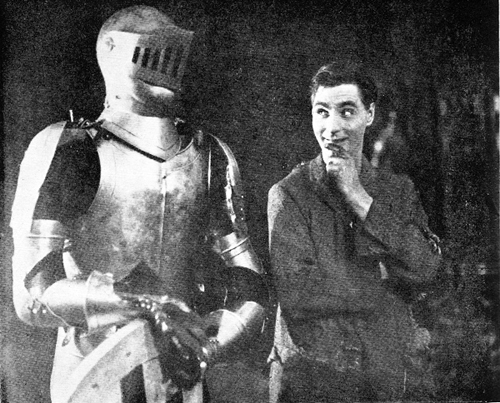
Broken Threads (1918), produced and directed by Henry Edwards, who also starred.
Hitchcock, Lessing, and the bomb under the table
DB here:
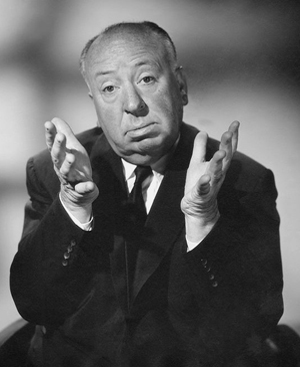
Every good cinephile knows Alfred Hitchcock’s famous distinction between suspense and surprise. In articles and interviews from the 1930s on, he explained that situations are more gripping if the audience has more knowledge than the characters do. His classic example, in conversation with Truffaut, was a bomb under a table.
We are now having a very innocent little chat. Let us suppose that there is a bomb underneath this table between us. Nothing happens, and then all of a sudden, “Boom!” There is an explosion. The public is surprised, but priot to this surprise, it has seen an absolutely ordinary scene, of no special consequence. Now, let us take a suspense situation. The bomb is underneath the table and the public knows it, probably because they have seen the anarchist place it there. The public is aware that the bomb is going to explode at one o’clock, and there is a clock in the decor. The public can see that it is a quarter to one. In these conditions this innocuous conversation becomes fascinating because the public is participating in the scene. The audience is longing to warn the characters on the screen: “You shouldn’t be talking about such trivial matters. There’s a bomb beneath you and it’s about to explode!”
In the first case we have given the public fifteen seconds of surprise at the moment of the explosion. In the second case we have provided them with fifteen minutes of suspense.
In Film Art, we invoke Hitchcock’s example to illuminate how narration can be more or less restricted. You can confine the narration to what only a character knows, or you can expand it to give the viewer story information that a character doesn’t have. By widening the audience’s knowledge somewhat, you can build suspense; by confining it, you can make the audience share the character’s surprise.
After Hitchcock came to the United States, he often invoked this distinction in interviews, and it became part of craft lore among writers of screenplays and genre fiction. I trace the idea’s fortunes a little in the online essay, “Murder Culture.” In practice, though, Hitchcock didn’t always follow through. Rebecca (1940) and Suspicion (1941) confine our knowledge very closely to the protagonist’s, without providing that wider perspective he advocates in his remarks to Truffaut. And surprise is central to some Hitchcock works, notably Psycho.
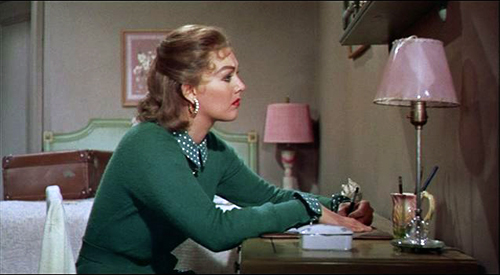
In other films, of course, he did follow his own advice. When Johnny Jones detours to the Tower of London in Foreign Correspondent, we know that the little man steering him there intends to kill him. Shadow of a Doubt lets us see Uncle Charlie in a sinister light before he visits Santa Rosa, and glimpses of his behavior strongly hint that he will menace Young Charlie when she starts to investigate him. And of course The Greatest Film Ever Made (or is it?) tips us off to what’s really going on with Madeleine/ Judy before poor Scottie grasps it.
I’ve wondered: Is this suspense/surprise distinction original with Hitchcock? In the tapes of the original interview with Truffaut, he notes: “You know, there has always been this dispute between suspense and surprise. . . . What I’m saying is not new, I’ve said this many times before.” He then launches into a more expansive account of the bomb-table scenario.
His formulation is ambiguous. Is the distinction “not new” because it’s been around a long while (“always”), or because he’s reiterated it many times? And is his preference for suspense an uncommon opinion? Exact answers may lie in the vast Hitchcock literature, but so far I haven’t found them. Here’s what I came up with.
What enduring disquietude
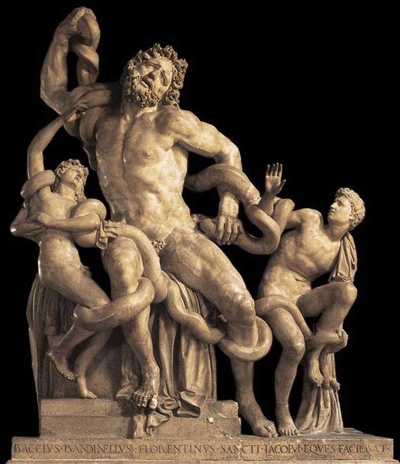
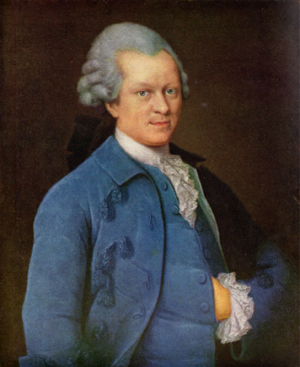
Gotthold Ephriam Lessing was a playwright and drama theorist. His Miss Sarah Sampson (1755) is sometimes considered the first “bourgeois tragedy” in German, and his best-known play is perhaps Nathan the Wise (1779), a classic that was made into a notable silent film. Lessing is also famous for his influential book-length essay Laocoön: An Essay on the Limits of Painting and Poetry (1766), which has been a center of debate in aesthetics ever since.
In that piece he argued for a fundamental distinction between time-based arts (drama, literature) and arts of space (painting, sculpture). From that distinction Lessing inferred a principle of decorum, or expressive fitness, for different media. He claimed that the famous sculpture showing Laocoön and his sons caught in the serpent’s coils could express only a split-second of pain, not the extended agony of their struggle. As a three-dimensional image, the father’s scream is vivid, but it lacks “all the intermediate stages of emotion” that a poem could have rendered as it unfolded in time. The great film theorist Rudolf Arnheim argued that the sound film obliges us to ask whether moving images and recorded dialogue cover different expressive territories, so he called his essay “The New Laocoön.”
Lessing also ruminated on the drama, and his thoughts about playwriting, set down in notes written between 1767 and 1769, contain many intriguing observations. In one passage, he replies to writers who have criticized ancient Greek playwrights for giving away too much in their prologues. These critics have implied that audiences would be more satisfied if big events took them by surprise. So, says Lessing mockingly, let’s simply reedit the plays and chop out all the information that sets up the final reversals.
His serious point is that a surprise yields only a transitory thrill. In the passage below, he uses “poet” and “poem” in a general sense, including storytellers and dramatists, plays and prose fiction.
For one instance where it is useful to conceal from the spectator an important event until it has taken place there are ten and more where interest demands the very contrary. By means of secrecy a poet effects a short surprise, but in what enduring disquietude could he have maintained us if he had made no secret about it! Whoever is struck down in a moment, I can only pity for a moment. But how if I expect the blow, how if I see the storm brewing and threatening for some time about my head or his?. . .
[By not preparing the spectator] the whole poem becomes a collection of little artistic tricks by means of which we effect nothing more than a short surprise. If on the contrary everything that concerns the personages is known, I see in this knowledge the source of the most violent emotions.
Lessing is evidently thinking of classic cases of recognition, plot twists that reveal connections among characters that they were long unaware of. (Oedipus is actually the son of the man he killed!) At another point, Lessing’s English translators find the word Hitchcock uses: “Our participation will be all the more lively and strong the longer and more confidently we have foreseen the issue.” “Foreseeing” here might be too strong, because in Hitchcock’s parable of the bomb we don’t really know the outcome. Will the men at the table escape in time, or halt the bomb, or be blown up? The inevitability of catastrophe that we expect in Greek tragedy produces a different sort of suspense than we experience in modern narratives. Yet it remains suspense nonetheless.
Lessing goes on to suggest that Aristotle valued Euripides most among dramatists not because of the plays’ gruesome endings but at least partly because “the author let the spectators foresee all the misfortunes that were to befall his personages, in order to gain their sympathy.” In other words, we have that sort of unrestricted narration we usually call omniscience. That’s what is at stake in Hitchcock’s bomb example.
Clairvoyant aloofness
It’s a long stretch from the late eighteenth century to Hitchcock’s time. Thanks to Google, and especially its wondrous Ngram software, we can get a rough sense of what happened to the duality of suspense and surprise in those intervening years.
A quick sampling shows that they were conjoined by the late nineteenth century. An anonymous 1884 critic finds that in Tennyson’s plays “the elements of suspense, of surprise, are altogether wanting.” In 1882, J. Brander Matthews, towering authority on theatre history, praises Hugo’s vibrant play Cromwell:
There is the familiar use of moments of surprise and suspense, and of stage-effects appealing to the eye and the ear. In the first act Richard Cromwell drops into the midst of the conspirators against his father,–surprise; he accuses them of treachery in drinking without him,–suspense; suddenly a trumpet sounds, and a crier orders open the doors of the tavern where all are sitting,–suspense again; when the doors are flung wide, we see the populace and a company of soldiers, and the criers on horseback, who reads a proclamation of a general fast, and commands the closing of all taverns,–surprise again. A somewhat similar scene of succeeding suspense and surprise is to be found in the fourth act.
Throughout this period writers fairly often counterpoised suspense and surprise as two essential strategies of plotting. But do the writers recognize the narrational implications they harbor, and do writers display Hitchcock’s preference for suspense? Yes to both.
George Pierce Baker, early twentieth-century drama macher, weighed in with his book Dramatic Technique (1919). He notes that in Shakespeare’s Henry VI, Part I, a revelation of the Countess’s plan yields “a momentary sensation, surprise.” Baker reimagines two versions of the situation: When we know more than one of the antagonists does, and when we know more than both of them do.
Suppose we had been allowed to know the plans of the Countess, and they had seemed very dangerous for Talbot. Then, as she played with him, there would have been more suspense than in Shakespeare’s text, because an audience would have been wondering, not merely “What is the blow Talbot will strike?” but “Can any blow he will strike overcome the seemingly effective plans of the Countess?” Suppose we had been allowed to know the plans of both. Then, as we watched the Countess playing her scheme off against the plan of Talbot, of which she would be unaware, might there not easily be even more suspense? At every turn of their dialogue we should be wondering: “Why does not Talbot strike now? Can he save the situation, if he delays? With all this against him, can he save it in any case?”
Baker concludes that surprise enlivens the situation, but suspense allows for deeper characterization: awaiting an outcome, we must speculate on the characters’ temperaments, motives, and strategies.
Baker has already cited the Lessing passage I’ve mentioned, and he goes on to quote another authority of his period, William Archer. Archer’s Play-Making (1912) became something of a Bible for aspiring playwrights. (Preston Sturges swore by it.) Without explicitly mentioning suspense or surprise, Archer celebrates the pleasures of lording it over the characters.
The essential and abiding pleasure of the theatre lies in foreknowledge. In relation to the characters of the drama, the audience are as gods looking before and after. Sitting in the theatre, we taste, for a moment, the glory of omniscience. With vision unsealed, we watch the gropings of purblind mortals after happiness and smile at their stumblings, their blunders, their futile quests, their misplaced exultations, their groundless panics. To keep a secret from us is to reduce us to their level, and deprive us of our clairvoyant aloofness.
All of these drama theorists are promoting the well-made play as the best model for plot construction. They’re reacting against popular melodrama, with its episodic construction, wild coincidences, and startling twists–a model of what our colleague Lea Jacobs calls “situational” dramaturgy. The preference for suspense is a recognition of the playwright’s adroit shaping of the plot, preparing the later revelations carefully but also creating a steady arc of tension rather than a firecracker string of surprises. Suspense, it’s implied, is just more difficult to achieve than surprise, and a successful passage of suspense testifies to the writer’s skill.
In sum, by the time Hitchcock started his film career, the suspense/surprise couplet was fairly common in discussions of playwriting, and the superiority of suspense was more or less assumed. A 1922 essay concedes, “Whether or not surprise has a legitimate place in the drama is debated by commentators.” But the author, one Delmar Edmundson, suggests that an “entirely unexpected” turn of events in a one-act play can yield a valid thrill, just as in an O. Henry story. Still, the author suggests that even such a twist needs to be subtly prepared for.
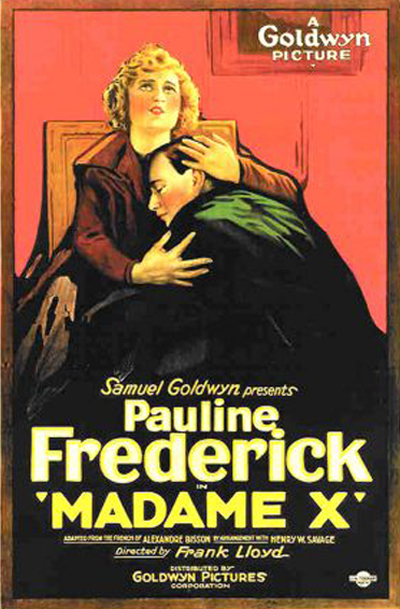
In 1922 as well, Howard T. Dimick’s Modern Photoplay Writing: Its Craftsmanship devotes a whole chapter, “Suspense, Excitement, and Crisis,” to the need to make the viewer “participate” in the action. The melodrama Lady X, then recently adapted to film, affords an example. The attorney defending an older woman is in fact her son, though neither of them knows it. (Shades of ancient Greek theatre.) The result is double suspense: we, like the characters, worry about the outcome of the trial, but we also wonder whether they will discover their kinship. “Had the woman’s identity been kept from the spectators till the end and then ‘sprung’ with explosive suddenness, fully half the emotional effect would have been stripped from the play.” Lessing had already anticipated the power of situations of unknown identity: “None of the personages need know each other if only the spectator knows them all.”
At this point, I can’t say precisely how Hitchcock learned of the distinction between suspense and surprise. Clearly, though, the idea was circulating in the theatrical and cinematic milieu of his early career. It’s entirely possible that he read Archer, Dimick, or some comparable source.
In any event, the distinction isn’t original with him. He is, however, the person who made it central to conversations about filmic construction. Recall that he always denied making detective stories. As the Master of Suspense, he wanted to play down the startling solution to a mystery and instead emphasize slowly building tension. And his continuing reliance on the distinction reminds us that the man always in search of what he thought was “purely cinematic” owed a great deal to the theatre. Some critics complained about divulging Judy/ Madeleine’s secret partway through Vertigo, but here, as in most of his films, Hitchcock was adhering to lessons learned from the well-made play. The result was a “disquietude” that endures.
Hitchcock’s remarks appear in Truffaut, Hitchcock, p. 52 of my 1967 edition. There he somewhat qualifies his position about superior knowledge, adding at the end of the passage I’ve quoted: “The conclusion is that whenever possible the public must be informed. Except when the surprise is a twist, that is, when the unexpected ending is itself the highlight of the story.” I take it that this plot construction is different from that of a mystery plot, which poses questions explicitly (whodunit?). A twist ending, by contrast, catches us by surprise because we didn’t suspect that certain aspects of the situation were in question. Central examples would be Stage Fright, Psycho, and, more recently, The Sixth Sense.
Truffaut’s Hitchcock book (the first hardcover film book I ever owned, I think) is a considerable condensation of the extensive interview. The sessions, punctuated by sounds of cigars being lit and snacks being eaten, are preserved on tape. Thanks to the Internets, they are available here. Hitchcock’s slightly more elaborate version of the bomb scenario occurs in session 4, starting at 17:44.
You can read the books I’ve cited in free digital versions: Lessing’s Laocoon and his essays on theatre; J. Brander Matthews’ French Dramatists of the 19th Century; William Archer’s Play-Making; George Pierce Baker’s Dramatic Technique; and Howard T. Dimick’s Modern Photoplay Writing: Its Craftsmanship. Print editions are also available, of course. Other passages I’ve quoted come from Anon., “New Editions of Tennyson,” The Critic and Good Literature (15 March 1884), 123; and Delmar J. Edmundson, “Writing the One-Act Play VIII: Suspense and Preparation,” The Drama 12, 7 (April 1922), 258. Arnheim’s essay “The New Laocoön” is in Film as Art. For more on situational dramaturgy, see Ben Brewster and Lea Jacobs, Theatre to Cinema (Oxford, 1998).
Thanks to Hitchcock adept Sidney Gottlieb for helpful advice on this entry. Anyone interested in Hitchcock needs to consult Sid’s excellent collections Hitchcock on Hitchcock and Alfred Hitchcock Interviews. The suspense/surprise duality recurs throughout them in varied forms.
Google’s Ngram software is here. It’s a tremendously useful tool for historical research.
I’d be grateful to anyone who can help pin down sources for Hitchcock’s acquaintance with the suspense/surprise couplet. As ever, feel free to correspond and I’ll update the entry as necessary.
P.S. 30 November 2013: Correspondence incoming! Richard Allen, NYU professor, lead guitarist, and Hitchcock expert, suggests in an email: “One suspects that the person who probably introduced Hitchcock to this was Eliot Stannard.” Stannard participated in writing all but one of Hitchcock’s all-silent films, and he published a short manual on screenplay technique, Writing Screen Plays (1920), derived from columns he published in Kine Weekly.
I haven’t been able to determine whether Stannard opined on the suspense/surprise duality, as the manual is extraordinarily rare, and the writing on Stannard that I’ve seen doesn’t explore this aspect of his work. Nonetheless I can recommend Charles Barr, English Hitchcock (Cameron & Hollis, 1999), 22-26; Barr’s article, “Writing Screen Plays: Stannard and Hitchcock,” in Young and Innocent? The Cinema in Britain, 1896-1930 (Exeter University Press, 2002), ed. Andrew Higson, 227-241; and especially Ian W. Macdonald’s chapter, “Hitchcock’s Forgotten Screenwriter: Eliot Stannard,” in his brand-new and enlightening Screenwriting Poetics and the Screen Idea (Palgrave Macmillan, 2013), 132-160. Further information on Stannard, or other sources of Hitchcock’s idea, remains welcome.
P.P.S. 2 December 2013: Ian Macdonald writes: “It’s very difficult, as you know, to trace the development of ideas such as the bomb in the briefcase/suspense-surprise thing. Stannard is surprising in that he clearly thought about how best to tell stories on screen, and came close to insights like Russian montage before those ideas became known in London (as Charles Barr has already pointed out). Unfortunately he did not continue to publish ideas after the early 20s, and his work is of course mixed up with ideas from everyone else in his ‘work group’. My picture of Stannard is built up from scraps, and his manual I have only seen in the British Library. This is tantalisingly aimed at the wannabe, so does not take ideas very far either. However, I’m sure he was aware of the prevailing doxa of play construction through such as William Archer, as others (like Brunel) were, and I’m sure that Hitch hoovered up Stannard’s ideas along with everyone else’s. As an inveterate theatre-goer, Hitch would also have been aware of ideas on suspense also. I will also have another look at my material specifically on this suspense question, for further clues, and let you know.” Thanks to Ian, Richard, and Sid Gottlieb for writing! More as things develop.
P.P.S. 5 December 2013: Oh, boy, have things developed. See the next entry.
P.P.P.S. 12 December 20113: Ashish Mehta has found evidence for the suspense-surprise duality in another eighteenth-century figure. He writes:
“Here’s what Samuel Johnson had to say in essay #3 of The Idler, published April 29, 1758, accessible here:
It has long been the complaint of those who frequent the theater, that all the dramatic art has been long exhausted, and that the vicissitudes of fortune, and accidents of life, have been shewn in every possible combination, till the first scene informs us of the last, and the play no sooner opens, than every auditor knows how it will conclude. When a conspiracy is formed in a tragedy, we guess by whom it will be detected ; when a letter is dropt in a comedy, we can tell by whom it will be found. Nothing is now left for the poet but character and sentiment, which are to make their way as they can, without the soft anxiety of suspense, or the enlivening agitation of surprise. (Emphasis added.)”
Thanks to Ashish for this!
Vertigo (1958).
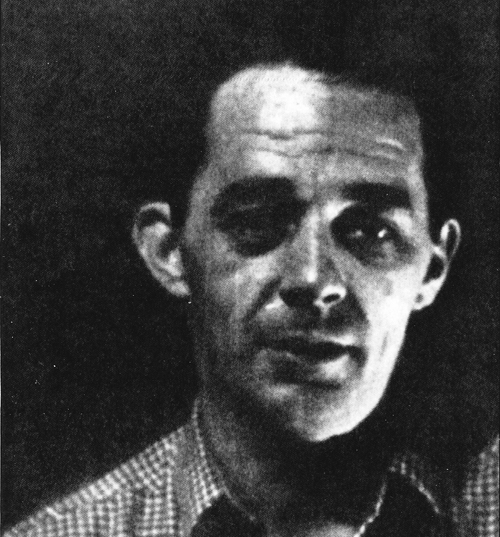
Otis Ferguson and the Way of the Camera
The original entry at this URL, published 20 November 2013, has been removed. Revised and expanded, it forms a chapter in the book The Rhapsodes: How 1940s Critics Changed American Film Culture, to be published by the University of Chicago Press in spring 2016.
I discuss the development of the book in this entry.
You can find more information on the book here and here.
Thank you for your interest!
GRAVITY, Part 2: Thinking inside the Box
Kristin here:
In my previous entry, I described Gravity as an experimental film. I had thought of it that way ever since seeing trailers for it online back in mid-September. I described it as reminding me “of Michael Snow’s brilliant Central Region, but with narrative.”
Last time I developed that notion in more detail and analyzed the narrative structure of the film. Now I’ll analyze the experimental aspects of the film’s style and the dazzling means by which they were created. I don’t have the technical expertise to explain the inventions and ingenuity that went into creating Gravity, so I have sought to pluck out the best quotations from the many interviews and articles on the film and organize them into a coherent layout of how its most striking aspects were achieved.
As in that entry, SPOILER ALERT. This is not a review but an analysis of the film. Gravity does depend crucially upon suspense and surprise, and I would suggest not reading further without having seen the film.
Screaming on the set
I’ve written about Cuarón’s use of long takes, a stylistic device that has drawn a huge amount of attention in the press. Here the editing is so subtly done that even someone like me, who typically notices every cut, missed a lot of them during early viewings. There are bursts of rapid editing, as when the ISS is struck by debris and is destroyed, or more conventional cutting, as when the camera follows the Chinese pod and surrounding remnants of the station as they heat up in the atmosphere.
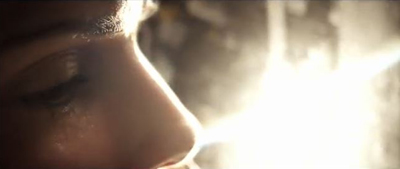
The long takes go beyond what Cuarón has done before. In Variety, Justin Chang describes one major difference: “As the movie continues, the filmmakers even add a new wrinkle, which Lubezki calls ‘elastic shots’: Takes that go from very wide shots to medium closeups, then segue seamlessly into a point-of-view shot, so the viewer is seeing the action through the character’s eyes, right down to the glare and reflections on a helmet visor.” Such moments are rare in Gravity, but one occurs in the “drifting” portion, shortly after the segment laid out above:
As Cuarón has pointed out, his long takes eliminate the need to cut in to closer views: “The language I have been working on with Chivo in these recent films is not one based on close-ups. We include close-ups as part of a longer continuous shot. So this all becomes choreography.” Another point he makes in this and other interviews is the influence of Imax documentaries on Gravity: “My process of exploring long takes fits in with that IMAX documentary notion, because when they capture nature it isn’t like they can go back and pick up the close-up afterward. There isn’t that luxury in space either. So then it falls to us to find a way to deliver that objective view, but then transform it into a more subjective experience.” Hence the “elastic shots.”
The long takes often dictate a refusal to cut in to reveal significant action. There is the moment in the epic opening shot, for example, when Shariff is suddenly killed in the background while in the foreground Kowalski tries to help Stone detach from her mechnical arm and into the shuttle. Did you see the flying piece of debris that struck his head? I didn’t, not until the fourth time I watched the film, knowing that it was coming and determined to spot it. It’s there, a little white dot that flashes through the frame in a split second. Shariff’s abrupt movement to the side, stopped with a jerk by his tether, is what we spot, since his bright white suit moves so suddenly and quickly, ending up against the pitch black of space:

A great deal happens in such moments of action, and we are left to spot what we can.
If these long takes are dazzling on the screen, think what they must have been like to witness being made. Lubezki has suggested how complicated the long takes in Gravity and earlier films were to shoot:
There are very few director/cinematographer teams working today as well known for a certain aspect of filmmaking as you and Alfonso are, which is that long extended take, or the seamlessly edited take. What it is like actually shooting those scenes?
I’m going to tell you something, the reality is that the movie was so new that when we finished a shot we would get so excited people would scream on set—probably me before anybody else. There were moments when we were shooting and Alfonso said ‘cut’ we would all just jump and scream out of happiness because we’d achieved something that we knew was very special.
In Children of Men, we also had moments like that. When we finished the first shot inside that car [the aforementioned ambush scene], the focus puller started crying. There was so much pressure that, when he realized he had done a great job, he just started crying.
There is something breathtaking about the achievement of complex long takes that seems not to arise from any other cinematic technique. I have seen Russian Ark three times now, and each time I feel an inexplicable tension, wondering whether the camera team will make it through the entire one-shot film without a mistake. I’ve already seen it happen, and yet it still seems unbelievable that they did.
In Gravity, of course, the “long takes” were not actual lengthy runs of the camera. Nor were they, as in Children of Men, several camera takes stitched together digitally to create lengthy single shots. Rather, they were created in the special-effects animation, with the faces of the actors being jigsawed into them through a complex combination of rotoscoping and geometry builds. (See this Creative Cow article for an example.)
The choice to present the action in long takes was crucial to the look of the film. Most films set in space rely heavily on editing, since for decades the special effects needed to convey space walking were best handled in a series of shots. In Star Trek Into Darkness, Kirk flies through space toward a spaceship breaking up and surrounded by debris, a situation somewhat comparable to that in Gravity. The sequence is built up of many short shots of Kirk against shots of dark space, point-of-view shots through his helmet, and cutaways to characters inside the Enterprise conversing with him via radio. Here’s a brief sample of four contiguous shots:
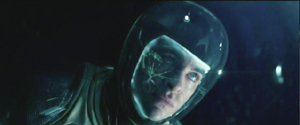
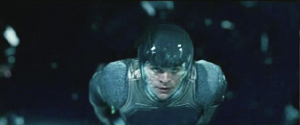
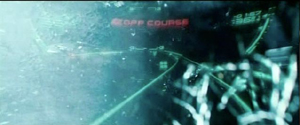
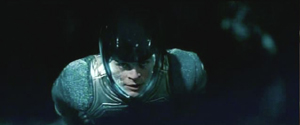
The sequence conveys little sense of weightlessness, partly because the actor adopts a traditional superhero-style flying pose. With no air in space, there would be no need to compact oneself into a streamlined shape. The fast cutting keeps repeating similar compositions, as with frames 2 and 4 above, with the fast editing presumably intended to generate excitement. (Star Trek Into Darkness has at least 2200 shots in a little over two hours, while Gravity has about 200 in 83 minutes.) Gravity‘s success in creating a realistic environment in space is dramatically evident when contrasted with this film’s more traditional outer-space conventions.
But it turns out that the commitment to the long take led Cuarón toward less common choices about editing, staging, and lighting.
Follow the bouncing axis
For much of the film, there is minimal spatial stability for the characters or for our viewpoint into the diegetic world. There is no ground, so we cannot imagine the camera resting on anything. When outside the space vehicles, the camera moves nearly all the time. In an interview with ICG Magazine, director Alfonso Cuarón was asked, “So with the camera and characters in constant motion and changing perspective, how did you figure up from down?” He replied:
There is no point of departure because there is no up or down; nobody is sitting in a chair to orient your eye. It took the animators three months to learn how to think this way. They have been taught to draw based on horizon and weight, and here we stripped them of both.
Undoubtedly many scenes contain an axis of action running between the characters, but it is not of a traditional kind. Unlike in a classically edited film, in Gravity‘s action scenes in space, the axis is in constant, fleeting motion, and any given center line between two characters must in quick succession run not only left and right but also up and down, diagonally, in almost any direction. Any given screen direction set up by the axis is ephemeral and offers little to help orient us spatially. Eyeline directions mean very little, since there are few cuts to things that the characters have seen offscreen. (True, when characters look offscreen, they establish eyelines, and the camera sometimes pans from Stone or Kowalski to some object they have been looking at. But a pan from a person to an object automatically establishes the spatial relations between them, whether or not the character is looking at the object.)
As a result, the spatial cues used in continuity editing system are not so much eliminated as made irrelevant for long stretches. That system is meant, after all, to guide our understanding of the story space across cuts. There are exceptions, such as a brief shot/reverse-shot exchange: Stone, loosely attached to the International Space Station (ISS) by ropes, pleads with Kowalski not to untether himself from her and float away to die in space, and he insists that it is the only way to allow her to live. When Kowalski and Stone, tethered together, travel toward the ISS, he is always at screen left, she at screen right, with the strap joining them stretched out as a sort of visible axis of action; straight cut-ins to close views of each character, and even at one point Kowalski’s point of view, obey the 180-degree rule and create an almost conventional scene. Actions inside the spacecrafts are more oriented as well. In the ISS Stone moves weightlessly through a series of pods, all the while maintaining screen direction. Similarly, inside the vehicles, especially late in the film when Stone is strapped into seats, she is usually upright, her head oriented toward the top of the frame. Some sustained actions in space also keep her right-side up, as when she removes the bolts holding the parachute cords to the Soyuz landing vehicle.
In part because of such orienting devices, we are seldom seriously confused about where the characters are, or at least not for long. Otherwise we would not be able to comprehend the story action. Still, compared to typical classical films, Gravity conveys little sense of spatial stability. The disorienting simulation of weightlessness for characters and camera dominates the scenes outside the vehicles and creates a style that can truly be called experimental.
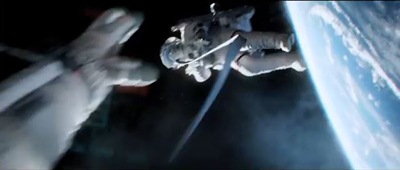
Take the brief segment (about 14 seconds) below, from the 13-minute opening shot. Stone has been standing at the end of a large mechanical arm which gets knocked off the space shuttle by a piece of hurtling debris. It spins rapidly, with the camera framing it from long-shot distance. The camera is not entirely static, reframing slightly, but we can see the earth in the background fairly clearly. Stark sunlight comes from offscreen left, and as Stone’s body whips through space, the shadows move accordingly around her, with the back of her body in deep shadow in the first frame and then her front shadowed in the second:
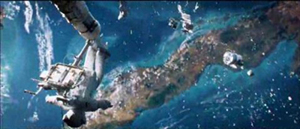
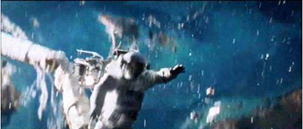
The fact that the light source, the sun, is offscreen left during this spinning segment suggests that the camera and hence our viewpoint are in a stable position. Yet that position is maintained for only a short time. At this point in the shot, the camera is essentially waiting for her to draw near in order for it to execute a change that will govern the penultimate part of the lengthy shot.
That happens when, after she has spun wildly toward and away from us several times, the camera “attaches” to her, so that we are now seeing her in medium shot and spinning with her. Instead of seeing the earth clearly, we see her while the blurred surface of the earth and the blackness of space alternate rapidly. This was the technique that led me, when I first saw the film’s trailers, to compare Gravity to Michael Snow’s Central Region:
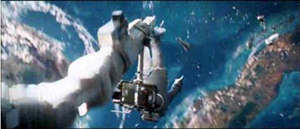
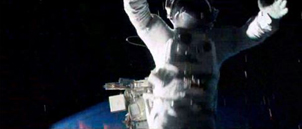
Being closer to Stone, we can see more clearly the shadows coming and going; her face is sometimes illuminated brightly by the sun and sometimes in near darkness:
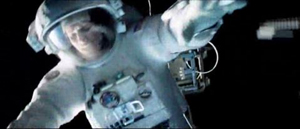
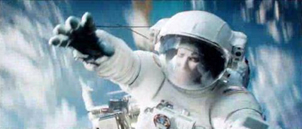
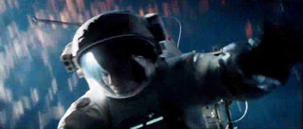
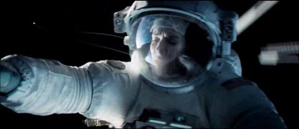
The function of the attachment to Stone, apart from allowing us to see her fear and confusion, is to show us that her hands are working to detach her from the arm, as a tilt down reveals:
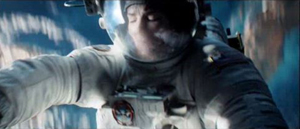
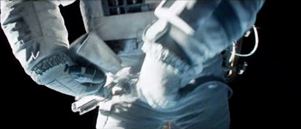
As she soars off the arm and tumbles into the black depths of space, the camera leaves its “attachment” to her, and she spins away from it:
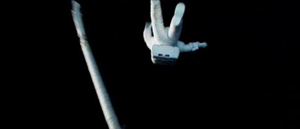
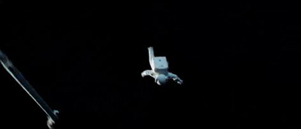
Cuarón’s commitment to the long take thus made him rely more than usual on events taking place within the frame–camera movement and figure movement in particular. Yet these movements had to occur in a microgravity environment radically different from the earthbound surroundings of Children of Men and Harry Potter and the Prisoner of Azkaban. This new constraint led to some technological innovations of remarkable originality.
The LED Light Box
Early on it became clear that moving the actors through space on wires would not create the desired realism of weightlessness, and obviously they could not be whipped about and tumbled in ways that the film ultimately achieved. The actors would have to be relatively static, with the illusion of movement created through other means. One of the main challenges was to have the lighting on their stationery faces support that illusion. And it would have to be done perfectly in order to achieve the photorealistic depiction of space that the filmmakers were after.
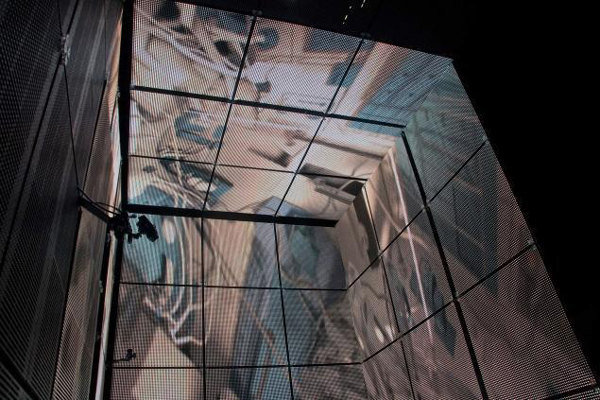
Usually in watching a film heavily dependent on CGI, one notices elements that have been assembled into a single composition but don’t quite match each other. A matte painting that isn’t lit from precisely the same angle as all the other components stands out from the rest (as, it has to be admitted, happens in the best of CGI scenes, including those in The Lord of the Rings). The problem was solved for Gravity using the LED Light Box, a device frequently mentioned in the press coverage of the film but seldom explained. (See image at the top.) The concept is truly revolutionary, although I am not sure to what extent it would work for other films that did not present such peculiar challenges.
In American Cinematographer‘s article on Gravity, “Facing the Void,” cinematographer Emmanuel Lubezki explains why consistency of lighting is crucial and how he came up with his solution:
Lubezki emphasizes that Gravity‘s blending of real faces with virtual environments posed a tremendous challenge. “The biggest conundrum in trying to integrate live action with animation has always been the lighting,” he says. “The actors are often lit differently than the animation, and if the lighting is not right, the composite doesn’t work. It can look eerie and take you to a place animators call ‘the uncanny valley,’ that place where everything is very close to real, but your subconscious knows something is wrong. That takes you out of the movie. The only way to avoid the uncanny valley was to use a naturalistic light on the faces, and to find a way to match the light between the faces and surroundings as closely as possible.”
This challenge led Lubezki to imagine a unique lighting space that was ultimately dubbed the “LED Box.” He recalls, “It was like a revelation. I had the idea to build a set out of LED panels and to light the actors’ faces inside it with the previs animation.” Lubezki conducted extensive LED tests and then turned to [special effects head Tim] Webber and his team to build the 20′ cube and generate footage of the virtual environments, as seen from the actor’s viewpoint, to display inside it. While constructing the LED Box, the crew also solved problems involving LED flicker and inconsistencies.
Inside the LED Box, the CG environment played across the walls and ceiling, simulating the bounce light from Earth on the faces of Clooney or Bullock, and providing the actors with visual references as they pretended to float through space. This elegant solution enabled the real faces to be lit by the very environments into which they would be inserted, ensuring a match between the real and virtual elements in the frame.
This ingenious approach largely did away with traditional three-point lighting in the exteriors. As Lubezki explains in the AC article,
When you put a gel on a 20K or an HMI [Hydrargyrum medium-arc iodide], you’re working with one tone, one color. Because they LEDs were showing our animation, we were projecting light onto the actors’ faces that could have darkness on one side, light on another, a hot spot in the middle and different colors. It was always complex, and that was the reason to have the Box.
The crucial point here is that the lighting was being created by playing the previs animation of the earth, space, the moon, and the large reflecting objects like the space shuttle on the sides of this 20′ by 10′ box. In other words, the moving images from the nearly finished special effects were used to light the faces of the actors, and those faces were later joined to those very same special effects, in a more polished form, to create the final images.
Lubezki gives an excellent description of the Box in his interview with Bryan Abrams, a series of responses which is worth quoting at length. Note that Lubezki refers to the Box as an LED monitor–essentially a giant television screen turned inside out and surrounding the actor:
Can you touch upon some of the pieces of technology and equipment that were created to make Gravity possible?
To make this movie we used many different methodologies. For one of them, we invented this LED box that you’ve probably read about, which is basically this very large LED monitor that is folded into a cube. So all the information and images that you input into this monitor lights the actors, and you can input all of the scenes that were pre-visualized to create the movie—all the environments that we had created—and you can input them into this large cube so space itself is moving around the actors.
So it’s not Sandra Bullock spinning around like crazy, it’s your cameras.
Yes, instead of having Sandra turning in 360s and hanging from cables, what’s happening is she’s standing in the middle of this cube and the environment and the lighting is moving around her. The lighting on the movie is very complex—it’s changing all the time from day to night, all the color temperatures are changing and the contrast is changing. There were a lot of subtleties that you can capture with the box, subtleties that make the integration of the virtual cinematography and the live-action much better than ever before.
The effects of the LED projections are visible in the changes on Stone’s face in the extended example above. Here’s a brief example of changes on Kowalski’s face in the opening shot:
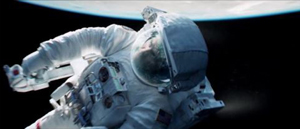
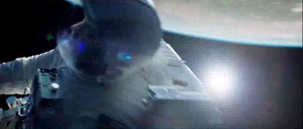
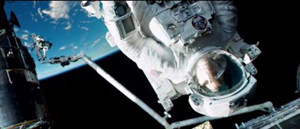
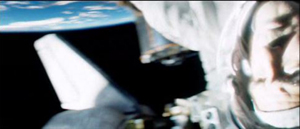
The harsh light in the right frame above is a real lamp. The LEDs could not produce a local, hard light intense enough to simulate the sun. The team placed “a small dolly and jib arm alongside the actors” with a lightweight spotlight. This was moved “according to the progression of the virtual sun.” Such harsh light was necessary because outside the atmosphere there is nothing to filter bright sunlight. Several moments where the actors’ faces and suits are severely overexposed reflect this technique:


The Box also contained a large video monitor, visible to the actor, which displayed the previs animation. Lubezki explains: “This was wonderful in a couple of different ways. The actor sees the environment and how objects are moving in that environment, and at the same time we can see the interaction of that light on the actor. We capture true reflections of the environment in the actor’s eyes, which makes the face sit that much better within the animation.”
Previs as environment
The fact that almost everything in the film was created digitally–including the space suits in which the actors bob and spin in the exteriors–necessitated an extraordinary amount of planning and pre-production. “Pretty much we had to finish post-production before we could even start pre-production, because of all the programming,” Cuarón says. This was one reason why there was such a long gap between Children of Men (2006) and Gravity. Four and a half years were spent in developing the new technology and preparing to shoot.
The team started with geography:
The filmmakers began their prep by charting a precise global trajectory for the characters over the story’s time-frame, so that Webber and his team could start creating the corresponding Earth imagery. Cuarón chose to begin the story with the astronauts above his native Mexico. From there, the precise orbit provided Lubezki with specific lighting and coloring cues. The cinematographer recalls, “I would say, ‘In this scene, Stone is going to be above the African desert when the sun comes out, so the Earth is going to be warm, and the bounce on her face is going to be warm light.’ We were able to use our map to keep changing the lighting.”
Next, the filmmakers defined the camera and character positions throughout the story so that animators at Framestore could create a simple previs animation of the entire movie. [“Facing the Void”]
Lubezki was completely involved in planning the digital lighting. He recalls, “I would wake up at 4 a.m., turn on my computer, I’d say good morning to my gaffer and start working on a scene. I would say, ‘Move the sun 60,000 kilometers to the north.’ That way I could put the lighting anywhere I wanted.”
The reference material for the earth imagery came in part from NASA reference footage and photos. You can get a sense of these from the NASA films posted online, although these are mostly done in fast motion, unlike the ones the filmmakers would have used. One good example is “Earth HD.” There, at 2:25 and again at 2:41, one of the most recognizable locations on earth, the Nile Valley and Delta, are visible:
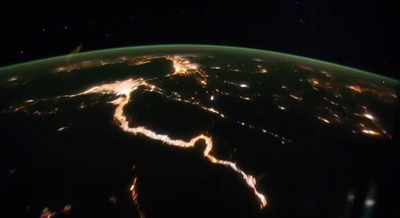
A similar image of the Nile appears on earth as Kowalski and Stone slowly make their way from the space shuttle to the ISS, with him asking her about her hometown and any family she might have waiting for her. (I was also happy to see the area of the site where I work in Egypt, Tell el-Amarna, which lies about midway between the Delta at the upper left and the large bend in the river.)
This geographical plotting included some ellipses. Although commentators have suggested that the film takes place in real time, or nearly so, there are temporal gaps. Shortly after the first pass of the speeding debris field, Kowalski tells Stone to set her watch’s timer for 90 minutes, since he calculates that is when they will encounter the orbiting debris again. That happens when she exits the Soyuz vehicle to detach its parachute. She again sets her timer for 90 minutes, and the debris field shows up at the Chinese station, battering it to the point where it sinks into the atmosphere and breaks up into chunks melting from the friction of reentry. Thus a little over three hours should be passing in the 83 minutes of screen duration.
Cuarón more or less confirms this timetable when he describes the creation of the previs: “The screenplay describes a journey that takes place mostly in real time, with only a couple of time transitions. We travel around Earth three times, so in previs we planned out visuals with specific knowledge of where we’d be in orbit at any given point in the story, whether it was in sunlight or darkness.”
In the film there are very few places where we can assume a significant ellipsis occurs. After Stone enters the ISS, sheds her helmet and suit, and drifts in a fœtal position, there is a gap. It’s probably not long, since she still holds some hope of going to rescue Kowalski, but she pauses to recover after her trying experience. Later, there is a cut from her inside the landing module, not in the suit, to her emerging from the hatch fully suited up–a gap we might assume to be ten minutes or so. Most notably, the cut from the nighttime shot of the earth that includes the aurora borealis at the right to the extreme close-up of frost on the window ellides a longer stretch of time. Stone has become hoarse in the interval as she tries to send a mayday message via radio. In other cases, such as Stone and Kowalski’s slow journey toward the ISS, time seems to be somewhat compressed though not ellided.
Staging without a stage
A lack of depth cues hampered the animators charged with creating the previs. The absence of one major depth cue, aerial perspective (the tendency of layers of space in the distance to turn successively bluer and blurrier due to the filtering quality of the atmosphere), caused problems. Visual-effects supervisor Tim Webber, of the effects house Framestore, remarks:
You can’t rely on aerial perspective because without atmosphere there is no attenuation of image due to distance. And the lack of reference points [in space] can get you into trouble, like not being able to tell if the character is coming toward you or the camera is moving toward him. Even though we played it straight with respect to science and realism, we did put in more stars than you’d be able to see in daylight, just so there’d be some frame of reference to gauge movement.
Presumably Webber is referring here to the movement of the characters and objects through space, not the camera movement. (The lack of any “frame of reference” against which to sense movement is part of what makes the Star Trek scene illustrated above seem so unsophisticated.)
Naturally, since the actors were not standing on a floor or solid ground, the blocking was difficult, but it also had to be planned completely in advance:
Cuarón laughs as he recalls the surprises inherent in blocking characters in a zero-gravity environment. “The complications are really something because you have characters that are spinning. Say you want o start your shot with George’s face and move the camera to Sandra, who is spinning at a different rate. You start moving around her, and then you start to go back to George, only to realize that if you go back to George at that moment, you will be shooting his feet! So then you have to start from scratch. Sometimes you find amazing things accidentally, but sometimes you have to reconceive the whole scene.” [“Facing the Void”]
Finally, after all the planning, the previs animations were made. These had to be refined considerably so that they could adequately serve in the Light Box to illuminate the actors’ faces. According to Bill Desowitz, “The previs was so good, in fact, that the daughter of cinematographer Emmanuel (“Chivo”) Lubezki thought it was the real movie.”
The previs became so sophisticated because it evolved during preproduction. Cuarón recalled that Lubezki’s inspiration to create the LED Light Box changed the planning tactics:
Then that kind of had a ripple effect back into the previz, because originally they were going to just be a model that we could look back at, but we realized that the previz was more than that. That was something that [James] Cameron kept on talking about. He would say “I don’t use previz anymore, I use it as if it is the first painting on a canvas.” In other words it was the stuff that you kept on painting on top of and the thing with that is that it became very clear that in order to use these technologies, we needed to program stuff and the previz was going to have to be precise in terms of camera movements, choreography, timing and light.
As a result, the movie changed very little during principal photography. Senior visual-effects producer Charles Howell told American Cinematographer: “I think there were only about 200 cuts in the previs animation, [whereas] an average film has about 2,000 cuts. Because these shots had to be mapped out from day one, many of the lengthy shots didn’t really change in the three years of shot production. Because we did a virtual prelight of the entire film with, the whole film was essentially locked before we even started shooting.” [“Facing the Void”]
David counted 206 shots in Gravity, not including the two opening titles about life in space being impossible. This suggests that Howell is right, and that the film underwent little revision after the planning phase.
Several years ago I suggested on this blog that animated films, notably those of Pixar and Aardman, were on average better than mainstream live-action films because they had to be planned so carefully and thoughtfully. Gravity, being very close to an animated film, provides more evidence for that claim. Not that thought, time, and money can guarantee quality, but they certainly narrow the odds.
Iris in
The Light Box technology is astonishing enough, but within its confined space there also had to be a way to photograph the actors. In Lubezki’s interview with Bryan Abrams, he explains:
So we built the box, but that wasn’t it. To be able to shoot inside the box, we had to build a special rig that holds the camera and moves with motion control. So we had people build a very narrow, lightweight but sturdy rig to control the camera. If you imagine the big box of LEDs, it has a gap that is almost a foot and a half or two feet wide, and the camera has to go into the box and make all these moves to make the audience believe that Sandra is turning and turning, but it’s really the camera and the environment in the box that is moving. So we built the box, the rig, and then used a company called Bot & Dolly. These guys are from San Francisco, and they use robots from the automotive industry. They redid all the software for us, so we were able to use these robots to move the cameras and the lights around the actors. It was just a big ballet of gadgets and new technology for the film.
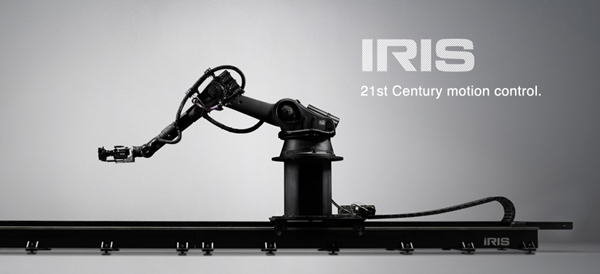
Bot & Dolly is a San Francisco company specializing in robots for the automobile industry. It built or perhaps modified an elaborate rolling, multiply-jointed camera mount called Iris especially for Gravity. It has been used in other features and in ads since then. (See image at the bottom.) An impressive demo film shows the Iris gracefully writhing about, quickly pointing the camera in many directions. (The camera in the film is a Red, though Gravity used an Alexa.) According to ICG Magazine, “The firm devised a Maya-based series of commands that allowed Framestore animators to direct the robots in ways that matched previs action in precise detail.” (Maya is the industry standard computer animation program.)
Typically this camera was inserted through an opening in the Light Box and swooped around the actor, who stood in a gyroscopic basket, seen in the production photo below. The photo shows one side of the Box open, though this would not be the case during shooting:
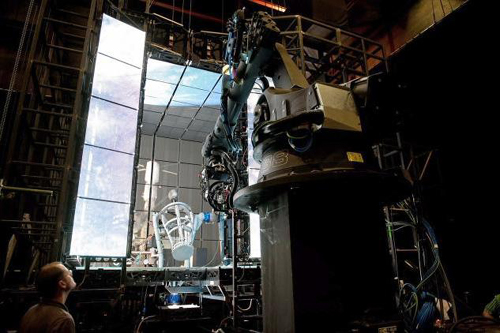
The combination of the Light Box and Iris made it possible to blend the special-effects shots and the live-action photography of the actors so smoothly that there is no “uncanny valley” effect, no sense of an obvious matte painting stuck into the middle of an image. The shots in Gravity are all photorealistic to a degree that is rare, if not unique, in recent effects-heavy films.
Iris brings us back to the comparison with Central Region. Snow built a special camera mount (below) designed to allow his images to rotate freely in almost any direction. During the three-hour film the camera never repeated any of its trajectories. Some images were close views of the pebbles on the ground; others were upside views of the bleak Canadian mountains in the distance. A nighttime segment was completely black except when the moon occasionally swept through the frame. The one area that the camera didn’t survey was the camera support itself, the “central region” of the title.
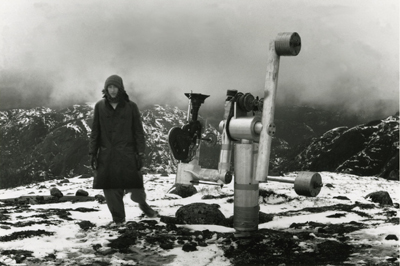
The vital difference between Snow’s machine and Iris is that the new system has no fixed anchor. Not only does it slide on a track, but everything it photographs can be digitally altered to erase any traces of the machine. It moves with entire freedom through a constructed space that has no central region, no fixed point around which everything else revolves.
Puppeteers and eyes
Gravity‘s utterly spherical space, beyond anything we normally find in commercial cinema, placed unusual demands not only on camera movement but also upon the actors’ blocking and performances. Our first entry on Gravity begins with a quotation from Sandra Bullock, which included the statement, “No character was like Stone, no film set was ever like these sets, not one member of this crew had ever done this before.” That may seem an exaggeration until one grasps how Bullock and Cuarón’s team built her character.
We all know from infotainment coverage that Bullock was isolated in the Light Box through entire days and that it was a trying experience. What doesn’t come through in such accounts is that she was often enclosed in the gyroscopic basket, visible in the photo of the Iris rig and Light Box above, as well as in the same setup visible behind Cuarón in this photo:
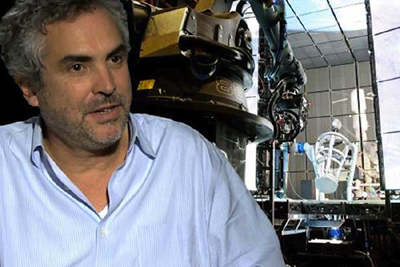
That was only the start of it. Anne Thompson’s interview with Cuarón and producer David Heyman reveals some of the details of blocking a character who is unrestricted by gravity:
AC: The physical aspect, not anybody can do what she did. On the one hand the physical discipline she went through to make this film, the training and the workouts. She also has an amazing capability for abstraction. Those emotional performances, it was as if they were an exercise in abstraction, like she was bonded to very precise cues. And physically that was very difficult: she trained and practiced like crazy, together with the stunt people and special effects. And the puppeteers from “War Horse” were helping her, supporting a leg or an arm, all the floating elements, they were creating approaching objects toward her in perfect timing. Then after she practiced so much her whole concern was only about emotions and performance.
Imagine a ballet dancer with really strict physical discipline in terms of what a body has to do, positions and precise choreography, who goes through months of training for one choreography so when they are performing they have expressiveness and emotion.
What was the most challenging scene to realize?
David Heyman: When Sandy comes into the ISS for the first time. She takes off her suit, then goes into fetal position, all in one shot. It was the most difficult. All the objects, getting the suit off, and into fetal position in such a way that it felt effortless, not as it was–she was sitting on a bicycle with one leg tied down leaning back in a 12-wire rig, with puppeteers. One of the things you forget about Sandy’s performance, which seems so truthful, is all the effort and physical exertion that went into making it, the precision of the technical aspects. She had to move her hands at a third of speed — zero G –while talking. Each shot connects with the next at very precise points where her head began and end and begin and end. She’s on a bicycle stringing uncomfortable with people moving around on 12 wires, through it all, with no gravity. Physically the body must not show the tension, so it looks effortless. What I loved about it is the performance behind the visor shines through, her eyes. You can’t slouch your shoulders to show sadness or weight, it’s just the eyes.
Bullock did all this with four 10′ by 20′ walls of LEDs projecting moving images of the earth and of exploding space stations around her. I think it is safe to say that this was a unique kind of performance.
The sounds of silence
As the film’s ominous opening titles point out, there is no sound in space. In keeping with the overall attempt to duplicate the effects of weightlessness immersively, Cuarón’s team limited the track to two types of sound: diegetic sounds heard by the characters and a non-diegetic, modernist musical track. In an interview with Cuarón, Wired‘s Caitlin Roper pointed out that there was an explosion in one of the trailers. Cuarón replied:
Yes, but that’s just the trailer. I honor silence. The only sound you hear in space in the film is if, say, one of the characters is using a drill. Sandra’s character would hear the drill through the vibrations through her hand. But vibration itself doesn’t transmit in space—you can only hear what our characters are interacting with. I thought about keeping everything in absolute silence. And then I realized I was just going to annoy the audience. I knew we needed music to convey a certain energy, and while I’m sure there would be five people that would love nothingness, I want the film to be enjoyed by the entire audience.
As in other areas of the film, we see the compromise between an experimental technique–an attempt to suggest the silence of space–and the desire to provide something more familiar for the broad audience. In this case, music acquires an expanded role, substituting for sound effects and conveying the rapidly shifting emotions of the scenes.
Sound effects are not entirely eliminated. Many sounds that the astronauts would hear via vibrations of things they come into contact with are included. In some cases these are fairly clear, as with the voices heard within their helmets–their own voices or others’ via radio. Other effects are heard in a distorted fashion. Glenn Freemantle, the supervising sound designer and editor, describes the process:
“When [Bullock] is in the suit, you hear her voice and her breathing, and you hear through her suit when she is in contact with things,” he explains. His team captured sounds by recording with contact mics at car plants and hospitals. “We even recorded through water with a [submerged] guitar,” he recalls.
One obvious example of distortion comes in the opening scene, when Stone is unscrewing bolts and sliding a panel out of the transmitting device she is working on. The sounds of the bolts and the sliding metal are audible but muffled, as though they were recorded under water or electronically manipulated.
Yet other sound effects not heard by the characters were relegated to musical expression. As Angela Watercutter put it in a Wired article based on interviews with Cuarón and composer Steven Price,
Every time there’s a collision in the movie the audience doesn’t hear a bang – they hear a sonic boom. The same goes for the characters’ — and, by extension, the audience’s — feelings of anxiety, claustrophobia, and agoraphobia. Much of what is seen in Gravity is terrifying, and when the audience can’t hear the horror of a space shuttle breaking apart or an airlock flying open, Price had to fill the void with his nerve-wracking score.
Cuarón dictated that one of the rules for the film’s score was the eliminating of percussion, to avoid the “cliché of action scoring.” Watercutter continues:
As a result the score for Gravity serves as more than just musical accompaniment – it also provides the movie’s sound effects. There are some non-music sounds that would be space audible, like the ones transmitted by vibrations characters feel in their spacesuits, but for the most part everything that happens in open space is accompanied only by Price’s music and the voices of Stone and astronaut Matt Kowalski (George Clooney), which “freed up the rest of the frequency spectrum for me,” Price noted.
Price used a mix of organic and electronic sounds to meld the natural world of space with the mechanical world one of the space exploration. There are also moments where he took an analog instrument – a cello, for example, or even a human voice – and ran its notes through a synthesizer or processor in order to create a whole new sound. And for the opening song on the score, “Above Earth,” Price took a track he was already working on and slowed it to about 1/60th its original speed. “Basically,” Price said, “what you’re hearing is the space between the notes.”
In an interview with Rolling Stone, Price discussed some of the aesthetic principles and functions he aimed for with his score:
Really it was all very much led by the character of Ryan. I tried to be with her all the time. The idea was that the music was up there in space and we made it very immersive and used a lot of elements and a lot of layering so that things would move around you all the time. The writing of those elements and what they were, were always influenced by what Ryan was feeling and where she was emotionally in the whole thing. And also where the camera was, where things were moving and what point of view the camera was facing, whether it was looking at them or kind of looking through their eyes. Some of it was melodic and some of it was intended to underscore a kind of emotional journey, and then there were a lot of sounds that were there to express real terror. It was those two extremes, really, expressing the beautiful nature of where they were but also absolutely a massively terrifying situation.
With little expertise in musical analysis, I can simply say that I hear the score as a combination of traditional instrumental music and electronically synthesized instrumental music. Under this, typically in tense passages, there are abrupt or charging percussive emphases, not using percussion instruments but, in some cases, deep string chords. Scenes of damage or tension are sometimes accompanied by sounds like stressed, grinding metal. Other sounds like distorted, high-pitched radio waves (in the “ISS” and “Fire” tracks) are included, reminiscent of electronic music of the 1960s.
Other critics have offered suggestive descriptions. Justin Chang’s review refers to “Steven Price’s richly ominous score, playing like an extension of the jolts and tremors that accompany the action onscreen.” David S. Cohen and Dave McNary’s Venice festival coverage characterizes the track: “Much of the action, even the debris storms, plays out against eerie silence, broken only by the score. The silence is more startling after the score builds to deafening crescendos, then stops abruptly. But during the interior scenes, the rumbles and groans of failing space gear are as frightening as the roars of any classic movie monster — even more so because their source is unseen.”
Price has contributed a remarkable score, one which is highly original and yet completely motivated by the story situation it accompanies.
The space between
The immersive, 360-degree surrounding and sound fields made Gravity a natural for 3D exhibition, but they also posed unique problems. Given the long takes, the need for complex camera movements, the demands of the LED Box, and the complicated acting conditions, it would have been very difficult to shoot the film in 3D. In most scenes, of course, there were no real objects juxtaposed in different layers of depth in front of the camera. Even the actors’ placements in long shots would have be created digitally. So the project had to be converted to 3D. But this forced choice actually yielded strong results.
The press coverage of popular cinema has come to treat films shot in 3D (“native” 3D) as pure and admirable and films converted to 3D after shooting as crass and compromised. But is there all that much difference? Even Avatar, the film made with an intention of promoting the universal use of 3D, had some converted footage. With conversion technology improving, the notion of waiting until after filming to create a movie’s 3D is becoming less onerous. As Variety‘s David S. Cohen pointed out earlier this year, Iron Man 3, Man of Steel, Star Trek into Darkness, and Pacific Rim have been post-converted with little objection from the public or press.
That conversion techniques for generating 3D images are not inferior became much more evident during the early decision-making process for shooting Gravity. Nikki Penny, the film’s executive producer, took some test footage shot by in 3D to Prime Focus World, a conversion house that ended up doing 27 minutes of Gravity. The filmmakers were trying to decide whether to shoot the live action portions in 3D or use conversion. In an article on Creative Cow, Debra Kaufman explains what happened:
The production had done a test shoot in 3D, which involved placing the cumbersome 3D rigs inside the cramped space capsule. When Penny brought the 3D live action footage to Prime Focus World, she asked that they test 3D conversion by utilizing a single eye from the same footage. The results convinced Cuarón and producer David Heyman that conversion would not only look as good as shooting in native 3D, and would be much easier and more efficient to accomplish.
That is, the footage shot by one of the two lenses in the 3D setup was separated out. It was then treated as if it were native 2D footage and put through a conversion process to create a 3D image. The result resulted in 3D that was not inferior to the original native-shot 3D. The lesson, I think, is that the question is not usually whether a film is shot in 2D and converted; it’s whether it was planned to be completed as a 3D film (and has sufficient budgets and skills invested in it) .
Gravity couldn’t be shot in native 3D, since in most scenes there were not real objects juxtaposed in different layers of depth in front of the camera. Also, the camera was too cumbersome to fit into the space-capsule sets. With so much of the characters’ surroundings done as CGI, however, the conversion to 3D could be done concurrently with the filming. Kaufman describes the process at Prime Focus World, one of the firms that handled the conversion:
Unlike the more typical post-production 3D conversion, Gravity involved PFW working on the 3D conversion during production. The work on 3D conversion began with six months of pre-production, during which the production’s Stereo Supervisor Chris Parks worked closely with the PFW team to explain his carefully plotted depth map, which contrasted the vast emptiness of space with the tight, nearly claustrophobic quarters of the space capsules.
From the beginning, the challenge for Prime Focus World would be to make sure that the 3D converted footage integrated seamlessly with the extensive 3D CGI. Both the live action footage and CGI would be 3D, but 3D from two different worlds, conversion and visual effects – and they would both be active or “live” during the production process. At the same time, the PFW team wanted to retain the creative flexibility of its View-D conversion process, while integrating the stereo VFX universe. What made it trickier was that, unlike a completed film, Prime Focus would be working with work-in-progress shots and an open edit.
For more on the technical aspects of the integration of converted footage and CGI, along with an example of the stages that went into creating a single shot, see the Kaufman article.
In an essay on ICG Magazine, Vision3 stereo supervisor Chris Parks describes some of the narrative functions of the film’s 3D:
We had a virtual camera at Framestore that let us control depth functions. When Sandra floated off in space, we separated her slightly from the starfield, using 3D to make her feel very small. At another point we went very deep, when we see her POV as her hands reach out to those of another astronaut coming to camera. At the point when they make contact, we increased the interaxial to five times normal, then scaled it back down as they separate and drift apart.
Parks also comments on the scene where Stone and Kowalski look through the shattered windows of the space shuttle and a crew member’s dead body suddenly falls into the shot:
Alfonso asked how the 3D could make this more powerful, but without just throwing something out into the audience to make them duck. We decided to float a little Marvin the Martian doll out into the audience, which is a kind of fun, lighthearted tension-breaker, and then we whip-pan right off that to the dead astronaut, which makes the emotional revelation more jarring.
In fact the Marvin doll (derived from Chuck Jones’s Warner Bros. cartoons) comes diagonally forward from the depths of the shuttle interior, and the camera pans with it as it moves out of the ship past Stone, who watches it and then turns back to look inside again. The corpse falls into the shot from above left, but not out toward the audience. It bumps Stone’s helmet, and the camera pans to reveal it more fully and continue almost nonchalantly onward to show another dead astronaut further back in the shuttle interior.
Finally, Parks points out an expressionist distortion of space for subjective purposes in the dream sequence where Kowalski joins Stone in the Soyuz landing vehicle:
It’s a dream sequence that doesn’t reveal itself as such right away. To give a subconscious impression that something different was happening, we pushed the top right corner into the set while pulling the bottom left corner ahead, skewing the whole view. That sense of unease represents, to me, how 3D can be expanded beyond just giant VFX movies. It’s a tool that can be most effective in very small spaces, as this one shot reveals.
Outside the dream scene, we see the wall panel of instrument controls at an angle to the camera, with Stone in her seat at the left. During the dream, the panel is suddenly turned so that it is almost straight into depth, so that we are pressed up obliquely against it. Stone’s seat at the left is further away from it. The result is that the space is strangely skewed during the dream.
In all, shooting in long takes, building each shot with CGI yet including complex camera and figure movement, canceling the sense of horizons and ground planes, and enhancing all these choices through 3D, has resulted in a film in which stylistic patterning becomes an object of fascination in its own right.
Despite the occasional joke about a Gravity sequel, it seems unlikely that Cuarón will tackle similar subject matter and formal strategies in his next film. Dealing with space without horizons and characters without weight was a formidable task. At the end of his Wired interview, asked what his next film will be, he replied, “Any movie in which the characters walk on the floor.” Welcome back, axis of action.
Most of the frames used here and in Part 1 were taken from a New York Times article containing a clip from the opening shot with commentary by Cuarón.
Thanks to Stewart Fyfe, who shared links to some of the sources cited in this entry.