





Archive for 2007
The sarcastic laments of Béla Tarr
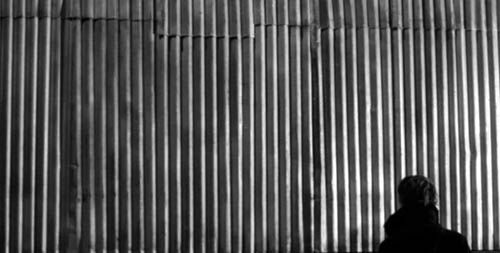
Werckmeister Harmonies.
DB here:
Last weekend, Facets MultiMedia in Chicago held a tribute to Béla Tarr. Milos Stehlik and his colleagues have been long-time champions of Tarr’s work, holding retrospectives and releasing nearly all his features on DVD (with Sátántangó soon to come). Tarr arrived on Saturday, but an emergency sent him back to Hungary sooner than he expected. So instead of discussing his work with a panel, he could only introduce the screening of Werckmeister Harmonies before running off to the airport.
The panel went ahead, with Jonathan Rosenbaum, Scott Foundas, and me chatting with Susan Doll of Facets. It wasn’t as pungent a session as it would have been with Tarr there, but I thought it was still pretty interesting. Jonathan, Scott, and Susan had thoughtful comments, and the questions from the audience were exceptionally good. The whole session was recorded for an online broadcast at some point, so you might want to watch out for that. And I have earlier blog entries on Sátántangó here and here.
In preparation for the panel I spent last week reconsidering Tarr’s work, so I offer a few notions about his films and how we might place them in the history of cinematic form and style. Some of these remarks build on things I said at the session.
Up close and personal
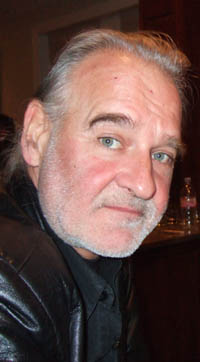 Some directors accommodate critics, accepting or at least tolerating writers’ efforts to probe the work. Not Tarr. Ask about his plots and characters, and he claims that he doesn’t tell stories. Point out what seem allegorical or symbolic touches, and he protests that he doesn’t make allegories and he hates symbols. Mention contemporary cinema, and the reply is abrupt: “For me, when I see something at the cinema it is always full of shit.” And if you tell him that his early films seem quite different from his more recent ones, he vehemently disagrees.
As Scott pointed out in our panel, though, it can be plausible to apply the concept of “period” to filmmakers’ work as we do to painters’ careers. Lars von Trier has been fairly explicit that after mastering a polished style for his work up through Zentropa/ Europa he wanted to try something new, and with The Kingdom he shifted toward a looser, on-the-fly style that pointed toward Dogme 95. Any viewer can be forgiven for thinking that Tarr has moved in the opposite direction of von Trier, from a pseudo-documentary approach toward something much more grave and majestic.
The first three theatrical features focus on the urban working class and their struggles to improve their lot. In Family Nest (1979), a family who can’t afford a flat of their own squeezes in with the husband’s parents. The tight quarters, the ceaseless complaints of the father-in-law, and the husband’s inertia force his wife and child to flee to the streets. The Outsider (1981) follows a young violinist as he drifts among jobs and into a passive marriage before being called up for military service. The family in The Prefab People (1982) has a flat and a decent job, but the wife finds the husband indifferent to her boring routines, and he looks for an escape in a job in another town. The concentration on ordinary people’s lives and the search for drama in the everyday dissatisfactions of city life put the films in the neorealist line of succession.
Stylistically, the films are stripped down in ways that also owe debts to modern traditions. Shot mostly handheld, adjusting the framing to the actors’ performances, they belong to a strain of films from the 1960s on that sought to suggest the immediacy of cinéma-vérité documentary. Unlike many such films, however, Tarr’s buy into a long-take aesthetic. Perhaps surprisingly, these movies’ shots run abnormally long: an average shot length of 32 seconds for Family Nest, 33.5 for The Outsider, 47 seconds for Prefab People. By comparison, Hollywood films of these years were consistently running between 4 and 8 seconds per shot, and comparatively few European and Asian films rely on shots as lengthy as Tarr’s.
Most scenes in these three films are dialogues, and the camera holds intently, if shakily, on faces. This concentration is enhanced by the general absence of establishing shots. A scene opens more or less in the middle of a conversation, and we get a character already challenging another. The visual pattern is that of shot/ reverse-shot, and in most scenes the first face is counterposed to a second one by either a cut or a pan. Shooting on location in cramped rooms, Tarr makes his framings tight; in Family Nest, the jammed frames give us and the characters almost no breathing space.
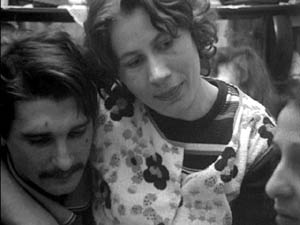
By relying on more or less isolated faces in close-ups, Tarr can absorb us in the intimate drama while sometimes catching us off guard. For instance, when we get a single character without an establishing shot, there is often a momentary uncertainty about where we are, or when the action is taking place. We also can’t be sure of who’s present besides the speaker, so the close view of him or her leaves us hanging: To whom is s/he talking? We’re pushed to pay close attention to what the character is saying, looking for any clues to the dramatic context. Tarr’s tactic also delays the reaction of the listener; he may withhold sight of the conversational partner until s/he speaks. The effect, heightened by the lengthy takes, is to turn many of these scenes into monologues, in which a character pours out his or her reaction to a situation, and we’re forced to take that in more or less pure form.
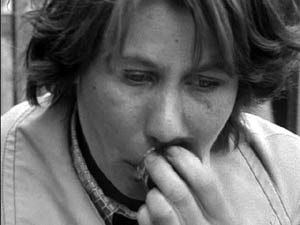
By the end of Family Nest, Tarr is shooting entire scenes concentrated on a single face, and because we don’t know if there is anyone else present, we have to take the talk as virtually a soliloquy.
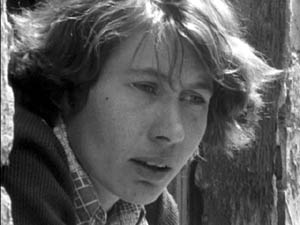
It’s as if Tarr invoked the stylistic schema of shot/ reverse shot and simply postponed or suppressed the reverse shot, leaving only an inexpressive shoulder in the foreground, if that. I’ve discussed the delayed reverse-shot as a convention of European cinema in an earlier blog, and Tarr makes ingenious use of it.
Tarr builds these films out of conversational blocks, punctuated by undramatic routines. The result is that often major plot actions take place offscreen, or rather in between the dialogues. Exposition that other filmmakers would give us up front is long delayed, with bits of information sprinkled through the entire film. In Family Nest, the father claims that he’s seen Iren having an affair with another man. We can’t be sure he’s lying because we haven’t strayed enough out of the household to judge her activities. In The Outsider, one scene ends with the drifter Andras telling Kata, a woman he has recently met, that he has a child by another woman. The scene ends with him smiling in indifference, leaving his sentence unfinished. In the next scene, a band strikes up a tune: Andras and Kata are celebrating their marriage.
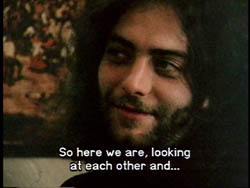
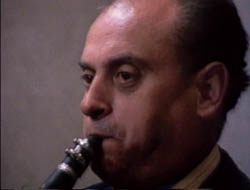
Most filmmakers would show us more of the courtship and a scene of proposal, but Tarr moves directly to the next block, suggesting Andras’ laid-back heedlessness. Agreeing to get married is no big deal. Further, by skipping over the most obviously dramatic incidents, Tarr’s storytelling joins that tradition of ellipsis celebrated by André Bazin in his essays on neorealism. No longer does the filmmaker have to show us every link in the causal chain, and no longer are some scenes peaks and others valleys. By deleting the obviously dramatic moments, the filmmaker forces us to concentrate on more mundane preambles and consequences.
This block construction yields an unusually objective narration. These films lack voice-overs, subjective flashbacks, dreams, and other tactics of psychological penetration. We have to watch the people from the outside, appraising them by what they say and do. It is a behavioral cinema. True, Prefab People opens with a flashback: The husband is packing to leave his wife, and the plot moves back to an anniversary dinner that ends badly. But the flashback to the earlier phase of the marriage isn’t framed as the wife’s memory. When the plot’s chronology brings us back to the moment of the husband’s departure, the replay of the opening allows us to watch the characters with more knowledge of what is driving them apart. Unsurprisingly if you know Tarr’s earlier films, that replay is followed by a long monologue showing the wife expressing her sorrow at his departure, without any visual cues about who, if anyone, is listening.
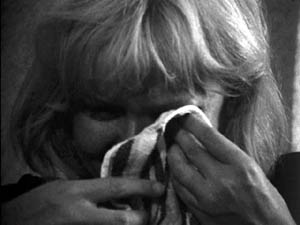
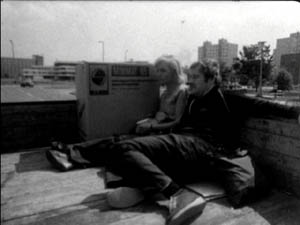
Then, without preparation, we see the couple back together, shopping in an appliance store. How did they reconcile? Have their attitudes changed, or are they simply reconciled to their old life? Like Antonioni and many other modern filmmakers, Tarr doesn’t tell us such things. He simply ends his film on a long take of husband and wife riding expressionless in the back of a truck, as much pieces of cargo as the washing machine beside them.
After the Fall
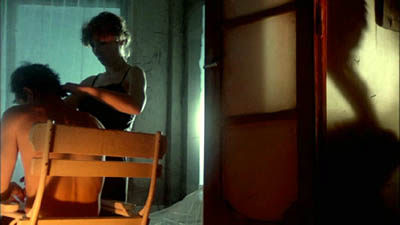
The second-phase films do look and feel rather different. Almanac of Fall (1984), a story of duplicity and spite among people sponging off a well-to-do older woman, offers a wholly elegant mise-en-scene. Characters are often framed from far back, surroundings take on much more importance, the framing is stable—often with windows, doors, and furnishings impeding our view of the action—and the camera moves smoothly, often in arcs around stationary figures. The takes are even longer, averaging just under a minute. The rococo lighting (patches of color seem to follow actors around) and atmosphere of strained upper-class narcissism seem like quite a break from the working-class films. If I had to find an analogy to Almanac of Fall, it would be Fassbinder’s Chinese Roulette (1976), with its camera arabesques and slightly decadent ostentation.
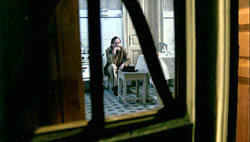
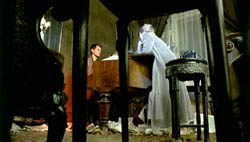
The overripe shots of Almanac of Fall signaled a shift toward a self-consciously formal cinema, but then Tarr stripped his settings and cinematography down. From Damnation (1988) onward, his films feature ruined exteriors, shabby interiors, elaborate chiaroscuro, rhythmic camera movement, and very long takes. (Damnation has an ASL of 2 minutes; Sátántangó, 2 minutes 33 seconds; Werckmeister Harmonies, 3 minutes 48 seconds).
Tarr insisted in conversation with me that there isn’t a sharp break between early and late styles. For one thing, his video piece Macbeth (1982) consists of only two shots across 63 minutes. It was made before The Prefab People, so his shift toward the ambulatory long take was already in the works. Moreover, The Outsider ends with a strained restaurant encounter captured in a virtuoso handheld shot running nearly seven minutes. A nightclub scene in The Prefab People likewise features some sidewinding long takes around a dance floor that wouldn’t be out of place, at least in their repetitive geometry, in Damnation.
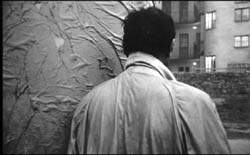
If we’re inclined to look for other continuities, we can find them. In the films from Damnation onward, the deferred reverse shot has been put at the service of attached point of view, so that often when Tarr’s protagonists peer around a corner or out of a window, instead of optical pov cutting we have an over-the-shoulder view that conceals their facial reaction. One scene in Damnation starts as a typically Tarrian scrutiny of texture, with the wrinkling wall echoing Karrer’s topcoat. But then the camera arcs and refocuses, showing what Karrer is watching but not how he responds.
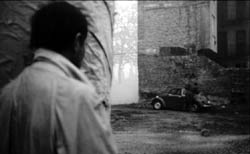
The blocklike construction of scenes in the early films carries on in the later work, but now Tarr minimizes the cuts within a scene, so that it becomes an even more massive hunk of space and time. Tarr refuses as well to use crosscutting, which would show us various characters pursuing their activities at roughly the same time—another strategy that keeps us fastened to one relentlessly unfolding chain of actions and, usually, one character’s range of knowledge. The avoidance of crosscutting will have major structural implications in Sátántangó, which overlaps characters’ individual points of view by replaying certain events and stretches of time.
The long-held facial shots of the early films don’t create a natural arc; the shot will go on as long as the character wants to talk. Similarly, many long takes in the later films don’t present a beginning-middle-end structure. We simply follow a character walking toward or away from us, pushing into a stretch of time whose end isn’t signaled in any way. This becomes especially clear in those extended long shots in which a character walks away toward the horizon and the camera stays put. Traditionally, that signals an end to the scene, but Tarr holds the image, forcing us to watch the character shrink in the distance, until you think that you’ll be waiting forever. Likewise, the diabolical dance shots of Sátántangó, built on a wheezing accordion melody that seems to loop endlessly, are exhausting because no visual rhetoric, such as a track in or out, signals how and when they might conclude. Early and late, Tarr won’t hold out the promise of a visual climax to the shot, as Angelopoulos does; time need not have a stop.
Nonetheless, I do agree with my fellow panelists that the later films have a significantly different look and feel, and it’s on them that Tarr’s place in world film history will chiefly rest. As I indicated at the end of Figures Traced in Light, he stands out as a distinctive creator in a contemporary tradition of ensemble staging. Like Tarkovsky, he shifts our attention from human action toward the touch and smells of the physical world. Like Antonioni and Angelopoulos, he employs “dead time” and landscapes to create a palpable sense of duration and distance. Like Sokurov in Whispering Pages (1993), he takes us into an eerie, Dostoevskian realm where characters are cruel, possessed, mesmerized, humiliated, and prey to false prophets.
Ties to tradition
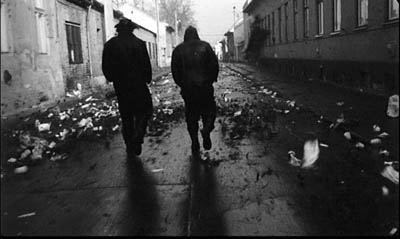
Tarr, however, maintains that his work, early or late, owes little to cinema. He claims not to have been influenced by other directors, and he asserts that he gets his ideas from life, not from films. When pressed, he admits that he knew the films of Miklós Jancsó “and I liked them very much. But I think what he does is absolutely different from what we do.”
It’s not uncommon for strong creators to reject the idea of influence, and many feel that they may sap their originality if they’re exposed to other work. Still, nothing comes from nothing. Any artwork is linked to others through an expanding network of affinity and obligation. Often influence is like influenza; you catch it unawares, despite your efforts to ward it off. And sometimes artists on their own find strategies that other artists have already or simultaneously hit upon.
Whether or not Tarr consciously joined a tradition, his practices do link him to several trends. Tarr has rejected the idea, floated by Jonathan, that his early films are indebted to Cassavetes, but there seems little doubt that by 1979, when Family Nest was released, it contributed to the fictional-vérité tradition, regardless of his intent. Likewise, his late films’ reliance on long takes is part of a broader tendency in European cinema after World War II. The neorealists taught us that you could make a film about a character walking through a city (The Bicycle Thieves, Germany Year Zero), and other directors, such as Resnais in the second half of Hiroshima mon Amour, developed this device. With Antonioni, Dwight Macdonald noted, “the talkies became the walkies.” Jancsó took Antonioni further (acknowledging the influence) in the endless striding and circling figures of The Round-Up, Silence and Cry, and The Red and the White. So even if there wasn’t any direct influence, Antonioni and Jancsó paved the way for Tarr; they made such walkathons as Sátántangó and Werckmeister thinkable as legitimate cinema.
Still more broadly, as Hollywood cinema has become faster-paced, accelerating its action and cutting, art cinema in Asia and Europe has tended toward ever slower rhythms. Visit any festival today, as Scott mentioned in our panel, and you’ll see plenty of films with long takes and fairly static staging. I criticize this fashion a bit in Figures, but it’s undeniably a major option on today’s menu. It’s even been picked up in contemporary American indies, with Gus Van Sant’s work from Elephant on offering prominent examples. He, of course, has been crucially influenced by Tarr, but Hou, Tsai Ming-liang, Sokurov, and other directors haven’t. We seem to have a case of stylistic convergence, with Tarr choosing to explore the long take at the same time others were doing so.
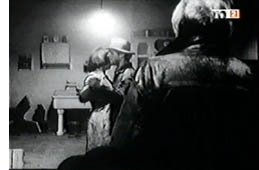 Within recent Hungarian cinema, it would be fruitful to examine Tarr’s relation to his contemporaries. Janós Szasz’s Woyzeck (1994) takes place in a wasteland not unlike those of Damnation and Sátántangó. Even closer to Tarr is the work of György Fehér. I’ve seen only Passion (1998; right) and one scene from Twilight (1990). Here again we get very long takes with a supple camera, grungy settings, and down-at-heel characters wandering in rain and mist or dancing as if possessed by demons. Fehér has worked with Tarr as producer, dialogue writer, and “consultant.” We could also explore Tarr and Fehér’s affinities with Benedek Flieghauf, the younger director of The Forest (2003) and Dealer (2004). Fleghauf builds these films around extensive long takes, and the remarkable Forest carries the idea of the suppressed reverse-shot to an eerie extreme, as characters study mysterious offscreen objects that may never be shown us.
More generally, and more speculatively, we could look to a wider movement in late and post-Soviet art toward mournfulness and lamentation in response to cultural collapse. Tarkovsky’s Nostalghia is one instance, but Larissa Shepitko’s The Ascent (1976) and Elem Klimov’s Come and See (1985) point in this direction too. Vitaly Kanevsky’s Freeze, Die, Come to Life! (1989) offers a rusting, dilapidated world not far from Tarr’s. In the 1970s and 1980s, composers like Arvo Pärt, Henryk Górecki, Giya Kancheli, Vyacheslav Artyomov, and Valentin Silvestrov created austere, threnodic music that sometimes evokes spirituality but just as often suggests a bleak end to everything. The very titles—Symphony of Sorrowful Songs (Górecki), Symphony of Elegies (Artyomov), Postludium (Silvestrov)—evoke something more than the death rattle of Communism. The pieces can be heard as meditations on the ruins of modern history, asking what humankind has accomplished and what can come next. Tarr’s severe parables, grotesque and sarcastic in the manner of Kafka, don’t exude the religiosity we can find in some of this music or filmmaking, but, at least for me, they share the impulse to lament humans’ inability to transcend their brutish ways. “I just think about the quality of human life,” he remarks, “and when I say ‘shit’ I think I’m very close to it.”
I have more ideas about Tarr, especially on Sátántangó and Werckmeister, but I have to stop somewhere. I hope to see his new film The Man from London when I go to the Vancouver International Film Festival next week, and of course I’ll report on it here.
The best piece of writing I know on Tarr’s cinema is András Bálint Kovács’ “The World According to Tarr,” in the catalogue Béla Tarr (Budapest: Filmunio, 2001).
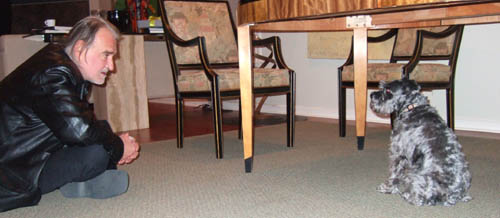
Béla mesmerizes Lola, Chicago 15 September 2007.
Thanks to Milos Stehlik, Susan Doll, Charles Coleman, and Megan Rafferty of Facets, to Béla Tarr for generous conversation, and to András Kovács for enlightening discussions over the years.
PS 20 September: The reports of Tarr’s earlier visit to Minneapolis are emerging; here’s a good link.
The magic number 30, give or take 4
David here–
When I was teaching, students often came to my office hours with variants of this question. “I want to direct Hollywood movies. When should I start trying to get into the industry?”
My answer usually ran this way:
Your prospects are almost nil. It’s tremendously unlikely that you will become a professional director. You may wind up in some other branch of the industry, though. In any case, start now. Aim for summer internships while you’re in school, and try to get a job in LA immediately after graduation—preferably through a friend, a relative, a relative of a friend, or a friend of a relative.
My answer still seems reasonable, but recently I’ve begun to wonder if it holds up across history. Suppose we refocus our goggles on the macro scale. At what ages do most Hollywood directors make their first feature? If we can come up with a solid answer, it would be one instance in which studying film history can have very practical consequences.
No country for old men
In any field, most people would expect to have their careers moving along by the time they hit their early thirties. But aspiring filmmakers may think that there’s a long period of preparation–working in a mailroom, sweating over screenplays–before they finally get to direct. Directing films is a top-of-the-heap role. Who would trust a young first-timer with a multimillion-dollar investment and authority over far more experienced performers and technicians?
Nearly everybody, actually.
Executives tend to be oldish and not fully aware of what the target movie audience likes. A few years ago a friend of mine, consulting for the studios, went to a meeting of suits and was told that all the new digital sampling and mixing software was purely an effort to steal music. He replied that there were legitimate creative uses of that technology. “For example?” one exec asked. My friend said, “Well, there’s Moby.” Nobody at the table knew who Moby was.
So hiring young people in touch with their peers’ tastes makes sense. Indeed, many of today’s top filmmakers started making features quite young. I haven’t made an exhaustive survey, but picking directors more or less at random yields some pretty interesting results.
Note: It’s hard to know how long a movie took to make, so I’ll use the release date as my benchmark. With the exceptions noted at the end, I haven’t checked people’s birthdays against day and month release dates. As a result, the ages of directors that I’ll be giving fall within a year of the releases. That works well enough to establish an approximate age range for a general tendency. And since it takes at least a year to get a project finished and released, we have to remember that most of these people started work on their first feature quite a bit earlier than is indicated by the age I give.
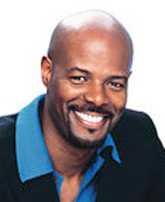
Start with directors who broke through in the 1990s and 2000s. Many were about 30 when their first features came out: Keenen Ivory Wyans (above; I’m Gonna Get You Sucka), Michael Bay (Bad Boys), David Fincher (Alien 3), and Spike Jonze (Being John Malkovich). A tad older at their debuts were Alex Proyas at 31 (The Crow), Cameron Crowe at 32 (Say Anything), James Mangold at 32 (Heavy), Karyn Kusuma at 32 (Girlfight), McG at 32 (Charlie’s Angels), David Koepp at 33 (The Trigger Effect), Allison Anders at 33 (Border Radio), and Mark Neveldine at 33 (Crank).
Actually these are the older entrants. A great many current directors completed their first feature in their twenties. Quentin Tarantino, Reginald Hudlin, Roger Avary, and Joe Carnahan debuted at 29, Sofia Coppola and Brett Ratner at 28, Peter Jackson and F. Gary Gray at 26.
Go a little further past 33 and you’ll find a few big names like Alexander Payne (35), Nicole Holofcenter (36), Simon West (36), and Ang Lee (38). Almost no contemporary directors broke into the game past 40. The most striking case I found is Mimi Leder, who signed The Peacemaker when she was 45.
On the whole, the directors who start old have found fame and power playing other roles. When you’re David Mamet, you can tackle your first feature at 40. (He’s my age; don’t think this doesn’t make me depressed.) If you’re a producer like Bob Shaye or Jon Avnet, you can start directing in your fifties. Actors, especially stars, get a pass at any age. Mel Gibson made his first feature at 37, Steve Buscemi at 39, Barbra Streisand at 41, Anthony Hopkins at 59.
Putting aside such heavyweights, the lesson seems to be this. In today’s Hollywood, a novice director is likely to start making features between ages 26 and 34. It’s also very likely that he or she will have already done professional directing in commercials, music videos, or episodic TV, as many of my samples did.
But what about the Movie Brats?
Is today’s youth boom a new development? The Baby Boomers will yelp, “No! Everybody knows that we invented the director-prodigy.” Look:
*Dementia 13: Francis Ford Coppola, 24. If you don’t want to count that, You’re a Big Boy Now was released when Coppola was 27.
*Who’s That Knocking at My Door?: Martin Scorsese, 25.
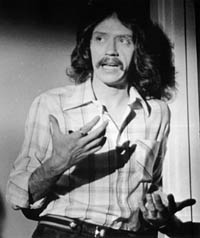
*Dark Star: John Carpenter (above), 26.
*THX 1138: George Lucas, 27.
*Night of the Living Dead: George Romero, 28.
*The Sugarland Express: Steven Spielberg, 28. If you count the TV feature Duel, subtract 2 years.
*Targets: Peter Bogdanovich, 29.
*Dillinger: John Milius, 29.
*Blue Collar: Paul Schrader, 32.
*Good Times (with Sonny and Cher): William Friedkin, 32.
*Easy Rider: Dennis Hopper, 33.
True, the 70s also revved up veterans like Altman and Ashby, but it was the new generation, we’re always told, who made the difference. Hollywood was run by old men who had brought the studio system to the brink of ruin. The twentysomethings smashed the barricades and made a place for young filmmakers.
It might have seemed that way at the time, but the belief was probably due to a quirk of history. The 1960s and early 1970s were in one respect a unique period in the history of American cinema. During those years, the studios had the widest range of age and experience ever assembled. For the first time in history, it looked like a retirement home.
Look at it this way. In the 1960s, films were being made by directors who had started in the 1950s (e.g., Arthur Penn, Sidney Lumet), as you’d expect. But at the same time there were films by directors who had started in the 1940s: Fred Zinneman, Sam Fuller, Robert Aldrich, Anthony Mann, Nicholas Ray, Vincente Minnelli, Robert Rossen, Robert Wise, Mark Robson, and many others. Furthermore, some of the biggest names of the 1960s were directors who had started in the 1930s, like George Cukor, Carol Reed, George Stevens, Otto Preminger, and Joseph Mankiewicz. More remarkably, the 1960s saw the release of films by masters who had begun in the 1920s, notably Hitchcock, Hawks, Capra, and Wyler.
And believe it or not, several directors who had begun in the 1910s were still active nearly fifty years later. John Ford is the most obvious case, but Chaplin, Alan Dwan, Henry King, Fritz Lang, George Marshall, and Raoul Walsh signed films in the 1960s. When Sidney Lumet celebrates a half-century of directing with the upcoming release of Before the Devil Knows You’re Dead, he will be considered a rare bird in today’s cinema; but in a broader historical context he doesn’t stand alone.
Interestingly, the arrival of the Movie Brats and the blockbuster brought nearly all the veterans’ careers to a halt. No matter what decade an old-timer started, by the mid-1970s he was most likely dead, retired, or making flops. Perhaps the Movie Brats’ sense of Hollywood as a haunted house was created in part by the felt presence of six decades of history.
The studio years
But what about those codgers? At what age did they get started? A look at the evidence suggests that the rise of the twentysomething Movie Brats has plenty of precedents.
The Hollywood studios ran a sort of apprentice system. In the 1920s and 1930s, short comedies and dramas were the era’s equivalent of music videos and commercials—ephemeral material that allowed youngsters to learn their craft. For example, George Stevens started as a cameraman, and at age 26 graduated to directing short comedies. Three years later he made his first feature (The Cohens and Kellys in Trouble, 1933).
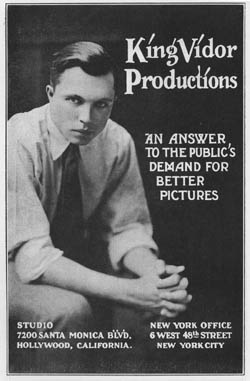
Stevens wasn’t atypical. In the 1920s and 1930s, major directors seem to have started as young as they do now. King Vidor began in features at 25, Rouben Mamoulian at 26. Mervyn LeRoy’s first feature was released when he was 27, the same age that Keaton, Capra, and Sam Taylor entered the field. Byron Haskin and W. S. Van Dyke made their debuts at 28. Hawks started at 30, as did Victor Fleming, Lewis Milestone, and Joseph H. Lewis. Clarence Brown signed his first solo feature at 31, the same age as Jules Dassin and George Cukor at their debuts.
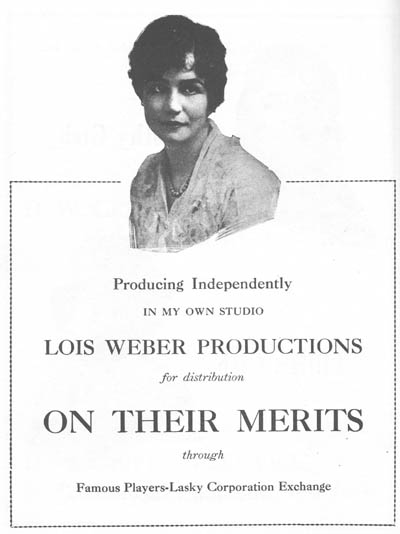
Even more remarkable is what went on during the 1910s. As Hollywood was becoming a film capital, it became a playground for twentysomethings. Lois Weber, Alan Dwan (who may have directed 400 movies), James Cruze, Reginald Barker, George Marshall, George Fitzmaurice, Raoul Walsh, and many others directed their first features before they were thirty. (At this point, a feature film could be around an hour. Kristin explains here.) Cecil B. DeMille was on the senior side, having directed The Squaw Man (1914) at age 33. Griffith was then even older of course, but having started in 1908, somewhat earlier than this generation, his authority waned as theirs rose. And he had started directing within my golden zone, at age 33.
Why so many youngsters? In the 1910s, the industry was growing rapidly and it needed a lot of labor. Few people went to college, so teenagers could take low-level jobs at the studios straight out of high school, or even without a secondary education. Moreover, Kristin reminds me that at this time life expectancy was much lower than today; in 1915 a white male on average would live only 53 years. Beginners hurried to get started, and bosses probably found comparatively few oldsters around.
At the other extreme, the World War II years seem to have been a tough time to break in. Anthony Mann, Nicholas Ray, Don Siegel, Richard Brooks, Robert Aldrich, Robert Rossen, and other gifted directors had to wait until their mid- to late thirties before taking the director’s chair in the second half of the 1940s. The 1950s somewhat put the premium on youth again with fresh blood, especially from the East Coast. The most famous instances are Stanley Kubrick (Hollywood feature debut at 28), John Frankenheimer (debut at 30), and John Cassavetes (Hollywood debut at 32).
In short, Hollywood has always favored fresh-faced novices. It’s not surprising. Young people will work exceptionally hard for little pay. They have reserves of energy to cope with a milieu dominated by deadlines, delays, long hours, and rough justice. They are more or less idealistic, which allows them to be exploited but which also infuses the creative process with some imagination and daring. The executives need wisdom, but the talent needs, as they say, a vision.
Some last questions
Of course in every era a few older hands start directing features comparatively late. Lloyd Bacon, auteur of the masterpiece Footlight Parade, didn’t make a feature (Broken Hearts of Hollywood, 1926) until he was thirty-seven, after dozens of shorts. Daniel Petrie was forty when his 1960 feature The Bramble Bush was released, and Julie Dash was forty when Daughters of the Dust came out. But you have to look hard to find careers starting this late. Most of the evidence I’ve seen indicates that first features skew young.
First question, then: Is the tendency to seize talent young unique to Hollywood, or is it a characteristic of other popular film industries? My hunch is that it has been a worldwide phenomenon. Eisenstein, who was 27 when he made Potemkin, was treated the oldest of his cohort of Soviet directors; at the other end of that scale were Gregori Kozintsev and Leonid Trauberg, who collaborated on their first film when they were 19! In Japan, Ozu, Mizoguchi, and Kurosawa started directing in their twenties. Michael Curtiz was 30 when he made his first feature, which happened to be Hungary’s first as well. The very name of the French New Wave was borrowed from a sociologist’s catchphrase for postwar twentysomethings. Today, in Europe or Asia, most beginning directors are in their mid-to-late twenties or early thirties. I suspect that everywhere the film industry gobbles up youth, both in front of and behind the camera.
Second, a question for further research. Hollywood hires a lot of first-timers, but how many of them build long-lasting careers? It’s sometimes said that it’s easier to get a first feature than a second.
Third, who’s the youngest director to make a Hollywood feature? The most famous candidate for the Early Admissions program is Orson Welles, who was 25 when Citizen Kane premiered. But on this score at least his old rival William Wyler had him beat. Wyler was 24 when he released his first feature. The fact that his mother was a cousin of Carl Laemmle, boss of Universal, doubtless helped him start near the top.
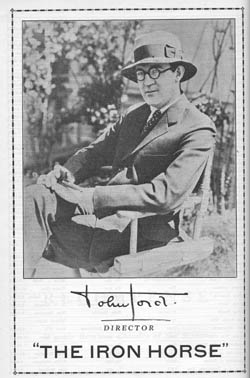
So is Wyler, at 24, the winner? No. John Ford, Ron Howard, and Harmony Korine were 23 when their first features opened. But wait: Leo McCarey was only 22 when his first feature (Society Secrets) was released in 1921. M. Knight Shyamalan’s first first feature, Praying with Anger, achieved a limited release in 1993, when he was 22.
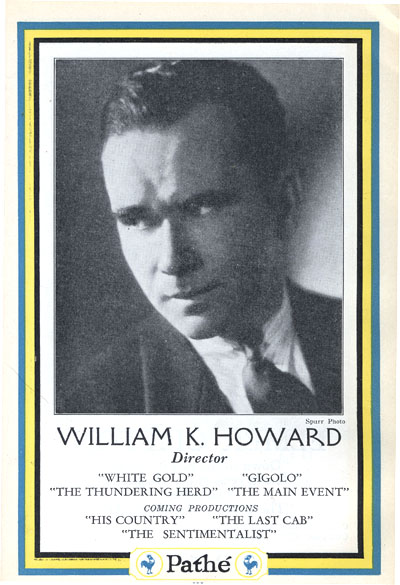
Yet I think that William K. Howard has the edge. Born on 16 June 1899, he signed two features in late 1921, when he was 22, putting him abreast of McCarey and Shyamalan. But Howard also co-directed a feature that was released on 22 May 1921—about three weeks before his twenty-second birthday. Brett and Sofia and PJ, you are so over the hill.
(Once we move out of the US, the clear winner would seem to be Hana Makhmalbaf. When she was ten, she served as AD for her sister Samira on The Apple, and she signed a documentary feature when she was fifteen. “I used to get excited over the words sound, camera, action. There was a strange power in these three words. That’s why I quit elementary school after second grade at age eight.”)
Finally, how does a little knowledge of film history help us steer hopefuls on the road to Hollywood? It gives us a sharper sense of timing and opportunity. My best revised answer would be this.
Start as young as you can, in any capacity. For directing music videos and commercials, the window opens around age 23. For features, the best you can hope for is to start in your late twenties. But the window closes too. If you haven’t directed a feature-length Hollywood picture by the time you’re 35, you probably never will.
Unless your last name is Bruckheimer, Bullock, Kidman, Cruise, or Bale.
PS 16 Sept 2007: Some corrections and updates: I’m not surprised that my more or less random sampling missed some things. So I’m happy to say that we have new contenders in the youth category.
Charles Coleman, Film Program Director at Facets in Chicago, pointed out that Matty Rich was only 19 when Straight Out of Brooklyn was released in 1991. So my candidate, William K. Howard, is second-best at best.
 As for Hana Makhmalbaf, she’s been beaten too. Alert reader Ben Dooley wrote to tell me of Kishan Shrikanth, who was evidently ten years old at the release of his feature, Care of Footpath, a Kannada film featuring several Indian stars. Kishan, a movie actor from the age of four, has been dubbed the world’s youngest feature film director by the Guinness Book of World Records. You can read about him here, and this is an interview.
From Australia, critic Adrian Martin writes to point out that Alex Proyas made features before The Crow. “A clear case of Hollywood/ Americanist bias!! (Just kidding.) Proyas had an extensive career in Australia before the USA, and that includes his first, intriguing feature, Spirits of the Air, Gremlins of the Clouds, in 1989. Which puts him around 27 at the time!”
Finally (but what is final in a discussion like this?) over at Mark Mayerson’s informative animation blog, there’s a discussion about animation directors, who tend to be quite a bit older when they sign their first full-length effort. Mark’s reflections and the comments point up some differences between career opportunities in live-action and animated features.
PPS 27 December 2007: Malcolm Mays, currently 17 years old, is shooting a feature under studio auspices. Read the inspiring story here.
I broke everything new again
DB here:
Today some notes about cinematic storytelling in two trilogies, one long and one lasting only ninety seconds.
Extreme ways are back again
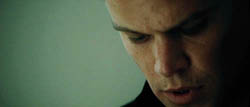

Yes, one more entry on The Bourne Ultimatum, which I thought I was done with. But alert reader Damian Arlyn sent me an email proposing an ingenious explanation for Ultimatum‘s repetition of a scene from The Bourne Supremacy. (Something like his idea is also suggested here and here.)
After yet another viewing, I agree: That scene is the same piece of plot action, replayed in a new context. This makes the film’s structure more interesting than I’d thought in my entries here and here.
Continue at the risk of spoilers.
At the climax of Supremacy, Jason kills Marie’s assassin in a traffic-clogged tunnel. He then visits the daughter of the Russian couple he murdered during his first CIA mission. The epilogue of Supremacy takes place in New York City. Jason calls Pamela Landy while he watches her in her office from an opposite building. Apparently as a token of thanks, Pam tells him his real name and adds his birthdate: “4/15/71.” Supremacy ends with him striding off with a shoulder bag and vanishing into the Manhattan crowd.
The phone conversation is replayed in Ultimatum. Bourne and Pam are in the same clothes, her office furniture is the same, what we hear of the dialogue is identical. But now the sinister Deputy Director Noah Vosen is monitoring the call, so at moments we see the scene refracted through his and his technicians’ eavesdropping. Just as important, Pam’s report of Jason’s birthdate turns out to be inaccurate. She has given him a coded reference: the building where he received his initiation into the assassin’s life is 415 71st Street. He heads there to confront Dr. Albert Hirsch, his Svengali. The script has played fair with us on this: We’ve had opportunities to glimpse Bourne’s real birthdate (9/13/70) on the paperwork Pam flicks through in an earlier scene.
You could argue that this replay dilutes the emotional force of the Supremacy scene. Instead of giving Jason back his identity, a gesture of emotional bonding, Pam presents yet another clue of the sort that has linked Bourne’s quest throughout the film. Feeling, one might say, has been replaced by espionage-movie plot mechanics. But I think that the device is more interesting than that. For one thing, if you’ve seen the first film, there will still be the lingering memory of your sense of Pam’s sincerity and Jason’s gratitude. Just as intriguing are the structural consequences.
If we imagine the second and third installments in the franchise as presenting one long story, the original phone conversation in Supremacy comes after most of the events we see in Ultimatum. Ultimatum begins with Bourne in Moscow, limping as he was upon leaving the daughter’s apartment and still spattered with blood from the tunnel chase. That is, the prologue of this film carries on continuously from the end of the second film’s climax, but long before its epilogue in New York.
After a title announcing, “Six Weeks Later,” Bourne’s European globetrotting in Ultimatum begins. Meanwhile, back at the CIA Pam explains that Jason had gone to Moscow to find the daughter. The bulk of the film carries him to Paris, London, Madrid, and Tangier, all the while trailed by the agency. The final clue brings Bourne to Manhattan. Only then does he visit the building opposite the CIA station and make the call we’ve already, and incompletely, seen at the close of the second film. This new version of the scene initiates the final section of Supremacy, as Bourne sends the agents on a false trail, breaks into Noah’s office to grab incriminating documents (which he tucks into that shoulder bag), and makes his way to 71st Street and his fateful confrontation with Hirsch.
So the two films mesh intriguingly. Most of film 3 takes place just before the end of film 2, making the epilogue of 2 launch the climax of 3. This is a step beyond the more common sort of flashback to founding events in the story chronology, the tactic used at the start of Indiana Jones and the Last Crusade and The Lord of the Rings: The Return of the King. In these films, the jump back in time is more obviously signposted than in the Bourne movies.
The screenwriters Tony Gilroy, Scott Z. Burns, George Nolfi, and Tom Stoppard (uncredited) have made a clever and welcome innovation that I didn’t appreciate at first. I’m happy to finally understand it, though, because it fits into a trend I discussed in The Way Hollywood Tells It and an earlier entry. Some filmmakers today create looping, back-and-fill story lines that tease us into watching the movie over and over on DVD, à la Memento and Donnie Darko. There are still some Bourne questions lingering in my mind, so I guess Universal can sign me up as a DVD customer. . . sigh.
I’ve seen so much in so many places
Speaking of The Way, there I also noted the growth in contemporary cinema of what I call network narratives, or what Variety calls criss-crossers. These are films with several protagonists connected by friendship, kinship, or accident. The characters pursue different goals but as the film develops their actions affect one another. The classic examples are Nashville, Short Cuts, and Magnolia, but in writing about this strategy for my collection Poetics of Cinema, I found over a hundred such movies.
This week I noticed that a trio of TV commercials from Liberty Mutual Insurance seems to be influenced by this format. Each of these “Responsibility” ads compresses network principles into thirty seconds, while also adding a Twilight-Zoneish time warp. You can watch the ads here.
Each commercial begins by showing a woman and a pizza-delivery kid at a street corner. She thrusts out her arm to keep him from striding into the path of a car.
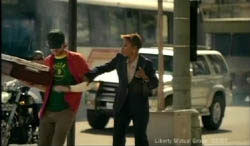
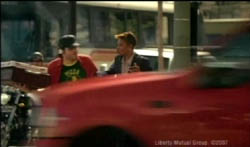
Somebody sees the woman’s act of kindness, and then that person is shown doing something kind. Someone else sees the second person and then is shown being kind, and so on. For example, in one variant a man across the street notices the woman and the delivery boy, and then he helps a lady with a baby get off a bus. He is watched by a man at the bus stop, who then is shown helping someone else. Like a benign contagion, solicitude spreads from person to person.
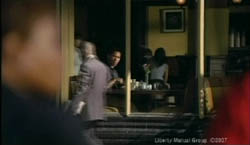
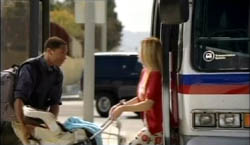
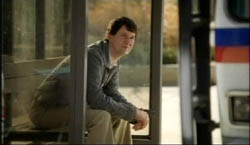
So we have a very slight set of connections: A is seen by B who is seen by C and so on. This patterning seems comparable to the shifting plotlines and viewpoints we find in some network films, with each character connected by accident and spatial proximity. The framings orient us by overlapping bits of space; the pizza boy’s red jacket gives us a landmark in the foreground, as does the bus in the later shot.
More interestingly, all three ads start with the same situation, the woman and the pizza boy, but they move on to different B’s, C’s, etc. In the variant I just mentioned, the man watching is sitting across the street. In another one, the woman’s act of responsibility is observed by the biker behind her, and he becomes B in a new chain of connections, setting out a traffic cone to warn drivers.
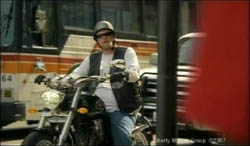
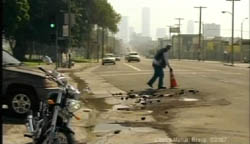
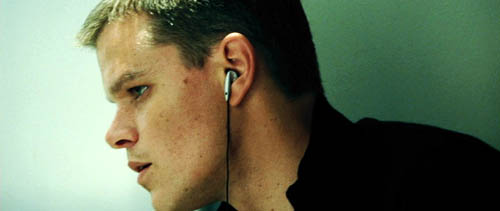
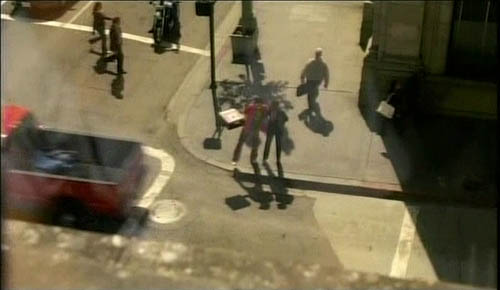
The biker is visible in the first shot of the other ads (see above), but there he plays no role. In the third ad, a man watching from above sees the pizza-boy mishap. (His point-of-view shot is at the top of this post.)
So, as with Jason’s and Pam’s conversation in Bourne, we have a narrative node or pivot that is contextualized differently in another film. What allows this to work, I suggest, is a piece of our social intelligence–our understanding that chance can connect people—plus our cultural experience with storytelling, particularly network narratives. The oddest twist, though, comes at the end of each ad, which like the Bourne trilogy offers an interesting repetition.
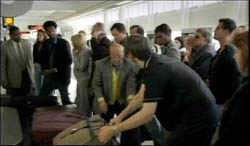
Each string of actions ends with the woman we saw at the beginning observing someone else’s act of kindness. For example, in one ad she sees a man at an airport baggage conveyor help an old man snag his bag.
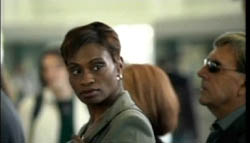
And then once more we see her halt the pizza-delivery kid. So each ad gives us a network something like this: A-B-C-D-…-A. The action moves in a circle, back to the woman as a witness, and then back to her at the pedestrian crossing, once more protecting the delivery boy.
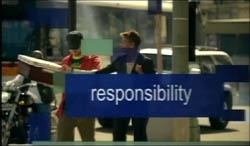
Huh? The ending of the ad suggests that by seeing another person acting responsibly, the woman is more inclined to warn the boy. But that act, with the same boy, was what set off the chain of charity in the first place. In strictly realistic terms, we’ve got a sort of möbius strip (no, not a Moby strip), where the head is glued to the tail and the whole cycle is in a twist.
Well, consider the filmmakers’ problem. How could you end it otherwise? The cascade of charity could go on indefinitely, which is not a plausible scenario for a thirty-second spot. Instead, the swallowing-the-tail tactic brings the pattern to a satisfying conclusion, while providing an event that can be the jumping-off point for another cycle in another ad. The last shot of any of the ads is the first shot of any of the others. You can enjoy the whole cycle as a mini-movie that jumps back in time to the original act of kindness at the corner.
Of course the pattern isn’t meant to be realistic. The message is that small acts can make a difference, and that Liberty Mutual tries to live up to an ideal of responsibility in its business. The themes are presented in an oblique, rather poetic story that suggests that kindness is catching and that even as strangers we are bound to help one another. Significantly, the act that’s presented through multiple replays is the most consequential: the woman is in effect saving the pizza boy’s life.
Both the Bourne movies and “Responsibility” show that studying film narrative is endlessly interesting, and storytellers can be quite creative. There’s always room in life for this.
Is there a blog in this class?
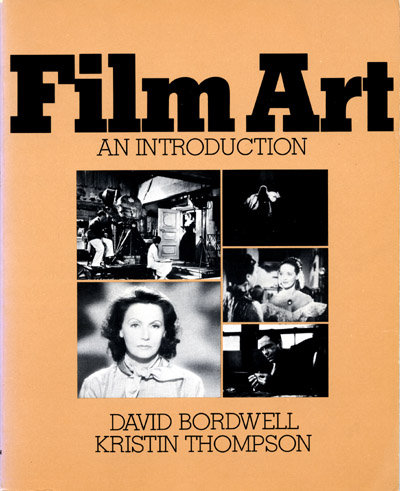
First edition, Addison-Wesley, 1979
Kristin here–
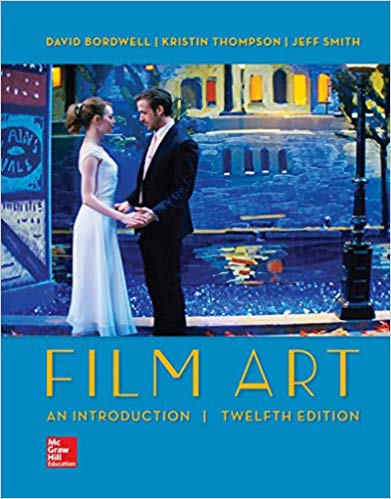
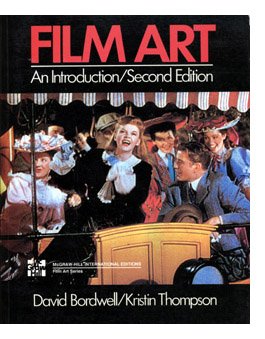
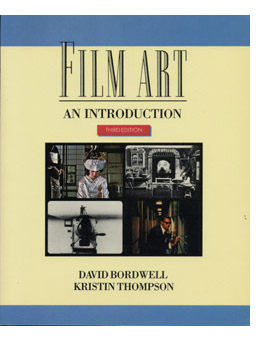
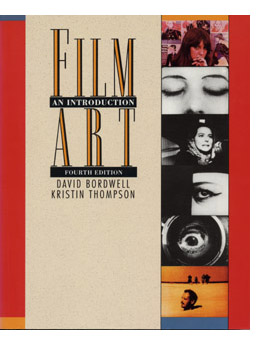
As our blog’s name suggests, we started it partly so we could write about subjects that would be of interest to lovers of cinema. It’s also a resource upon which teachers, students, and general readers using our textbook, Film Art: An Introduction, can draw. For that matter, many entries contain material that is pertinent to Film History: An Introduction as well. The entries are written in a more informal fashion than are the textbooks, but they often extend or elaborate points made in the books.
Now that universities here in the U.S. and in many other countries are beginning their autumn semesters, it seemed a good time for us to suggest some possibilities for using specific blog entries to cast light on topics in our text.
Second edition, Random House, 1986
 First, there are some general entries that might aid the teacher as courses begin. For those who show excerpts from DVDs in classes and are nervous about copyright issues, my piece, “Film educators no longer criminals” will be reassuring. It explains how last year fair-use exemptions covering just that situation were put into effect last year. Create that Powerpoint lecture or bring a DVD into class to analyze with impunity.
Teachers often confront the problem of overcoming students’ resistance to subtitled, black-and-white, and/or silent films. My entry “Subtitles 101” might be of some help in persuading them to be more open to viewing unfamiliar kinds of films. David’s “From Hollywood to Atlanta to us,” on the huge variety of films to be found on Turner Classic Movies, suggests the delights of having access to such a wide range of cinema history. (Also check out Jim Emerson’s recent “Gimme them old-time furrin pictures” on his Scanners blog.)
For students who don’t see a difference between watching films on an iPod and a cinema screen, David ruminates on some of the advantages and disadvantages of the tiny digital image in “Area man lives in fear that attractive woman will ask what’s on his iPod.” Similarly, for those who confidently expect to be able to find anything they need for viewing or researching term papers online, my “The Celestial Multiplex” might prove an eye-opener.
Third edition, McGraw-Hill, 1990
 Chapter 1 begins by briefly introducing film as an art form. David’s entry, “But what kind of art?” could be used to fill out that section, though it is most appropriate for film majors and advanced classes.
The chapter also differentiated between studio and independent filmmaking. David’s “Independent film: how different?” is relevant here. For a discussion of the auteur theory as contested by one prominent Hollywood writer, Joe Eszterhas, see David’s “Who the devil wrote it? (apologies to Peter Bogdanovich).”
These days news sources cover the weekend box-office figures and rank the highest grossing films. The raw figures don’t tell the whole story, though, since they don’t specify how many theaters each title is showing in or how big each film’s production budget was. A film playing in only a few theaters might be low on a list, but if it is making thousands of dollars more per theater, it might ultimately be more successful. A low-budget film doesn’t need to gross as much to become profitable as a costly epic does. My “What won the weekend, or, How to understand box-office figures” adds some nuances to the simple lists reporters give us each Monday.
Chapter 2 includes a section on “Formal Expectations.” One of the effects of creating expectations can be suspense. In “This is your brain on movies, maybe,” David explores why viewers enjoy watching films where they know the outcome, either through having seen the film before or because the story is based on real events—in this case United 93.
Chapter 3 is devoted to cinematic storytelling. A sample analysis of narrative organization can be found outside the blog, in David’s online essay on Mission: Impossible III. On our very first blog entry, back in September 2006, we quoted the director of One Hour Photo explaining how he rethought the film’s original plot structure so as to maximize curiosity. In the same chapter, we include “Openings, Closings, and Patterns of Development” as one of the principles of narrative construction. David’s blog entry “First shots” discusses some of the ways filmmakers have historically used first shots to plant narrative information, introduce motifs, establish tone, and, in recent decades, to lead off with a dense, virtuoso moment to be savored as such.
Fourth edition, McGraw-Hill, 1993
 Recent years have seen sequels, prequels, series, and other forms of extended narratives being used more pervasively in Hollywood cinema. My “Originality and origin stories” discusses the phenomenon of the film that jumps back to an early stage in the life of a character in a previous film. David explores two other current trends, toward narratives involving networks of criss-crossing characters and those that play self-consciously with plot, in “An appetite for artifice.”
Does the increasing consumption of films on DVDs rather than in theaters change the way we watch and understand narratives? Does the remote control encourage us to manipulate what we’re seeing in ways unexpected by the filmmakers? David tackles that question in “New media and old storytelling.”
One of the most popular topics covered in Chapter 4, on Mise en scene, is acting. In “Good actors spell good acting,” I consider how a focus on an impressive performance can sometimes lead a critic to downplay other aspect of a films. An older tradition of ensemble performance in relation to camera position gets some analysis in “Watching movies very, very slowly.”
David’s fascination with modern styles of cinematography (Chapter 5) and editing (Chapter 6) is evident in several entries, most illustrated with many frame enlargements. In “Can they make ‘em like they used to? continued,” he deals with foreground objects and depth of focus. His essay on “Shot-consciousness” examines a specific type of framing that places the characters against a flat background and frontally facing the camera—a technique he terms “planimetric framing.”
In another entry on cinematography, “Funny framings,” David explores how the manner in which the camera frames its subject can create humor. This has been one of our most popular entries, as is evidenced by the number of people who wrote to David with their favorite examples. In “Walk the talk,” David discusses the specific sort of tracking shot that follows characters talking with each other.
Occasionally our blog gets caught up in a topic that has generated controversy among critics. One of these is the use of fast cutting and abnormally fast, out-of-focus camera movements in The Bourne Ultimatum. Nausea-inducing excess or deliberately disorienting style? In two entries, David argues that the hyperactive camera is largely unmotivated and distracting: “Unsteadicam chronicles” and “[insert your favorite Bourne pun here].”
One of our first entries to gain widespread attention was David’s discussion of story structure and editing in “The Departed: no departure.” He discussed the increasing rapidity of Scorsese’s cutting and linked it to a broader trend of intensified continuity in American cinema. That trend is explained further in “Intensified continuity revisited.” In the case of The Good German, a film that claimed to mimic classical Hollywood films of the 1940s and 1950s, David discussed the concept of “coverage” in traditional filming. See his “Cutting remarks on THE GOOD GERMAN, classical style, and the Police Tactical Unit.”
Fifth edition, McGraw-Hill, 1997
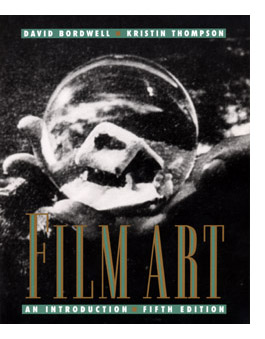 In teaching non-classical approaches to film editing, David’s “Another pebble in your shoe” might be useful. There David discusses how Lars von Trier used multiple cameras to film scenes and a computer to dictate seemingly random cutting in The Boss of It All.
Chapter 6 includes a section on “Rhythmic Relations Between Shot A and Shot B.” There we discuss the number of frames in each shot as a measure of screen duration. David talks about counting frames in film vs. various video formats in “My name is David and I’m a frame-counter.”
In our extended analysis of continuity editing in the opening scene of The Maltese Falcon, we discuss the technique of shot/reverse shot—the basic editing pattern used in conversation scenes in classical films. “Angles and perceptions” discusses this technique and what happens when a scene holds on a shot of one speaker without cutting to the reverse shot. Late in “Walk the Talk,” there’s an analysis of how continuity editing can be coordinated with staging and framing.
When watching a film, we seldom perceive the sound tracks as a blend of many separate recordings. It comes across as a seamless sonic accompaniment to the images. David had the opportunity to sit in on a sound-mixing session for the new film 3:10 to Yuma, directed by James Mangold. He describes that experience in “Christian Bale picks up a rail.” (This could provide an additional example for the section of Chapter 7 entitled, “Selection, Alteration, and Combination,” pp. 268-272.)
In Chapter 8 of Film Art we use Citizen Kane as our summary instance of film style. Some blog entries that deal with style in specific films include: “TANGO marathon” (on Béla Tarr’s epic Sátántangó); “Not back to the future, but ahead to the past” (on Steven Soderbergh’s attempt to mimic 1940s Hollywood style in The Good German); and “Classical cinema lives! New evidence for old norms” (on computer-generated special effects and their narrative functions).
Sixth edition, McGraw-Hill, 2001
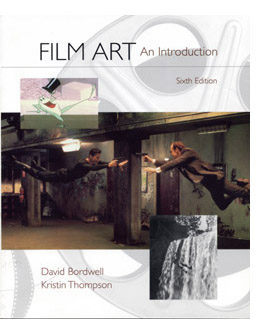 In Chapter 9, we deal with film genres. In “Swords vs. lightsabers,” I talk about the cyclical nature of genres, suggesting that science-fiction films are waning in popularity just as fantasy films are becoming popular.
Chapter 10 examines documentary, experimental, and animated films. Pixar is currently at the forefront of Hollywood animation. I’ve written on Cars in “Reflections on cars,” and David and I have a dialogue on Ratatouille in “Rat rapture.” In “By Annie standards,” I discuss why recent animated films are often better than live-action ones. David offers an appreciation of Disney’s classic features in “Uncle Walt the artist.”
We dicuss experimental filmmakers in “Lewis Klahr, X 3, X 4” (David), “3 notions about CREMASTER 2” (David on Matthew Barney’s cycle of films), and “Len Lye, renaissance Kiwi” (me on New Zealand’s great creator of experimental animation).
Chapter 11 ends with a section on “Writing a Critical Analysis of a Film.” David’s entry, “Watching movies very, very slowly,” gives a vivid demonstration of how we go about the research that goes into a detailed film analysis.
Some of our blog entries could be read in relation to more than one chapter. David’s “Charlie, meet Kentaro,” on the Charlie Chan and Mr. Moto B-film series, deals with film history, style, and ideology.
Seventh edition, McGraw-Hill, 2004
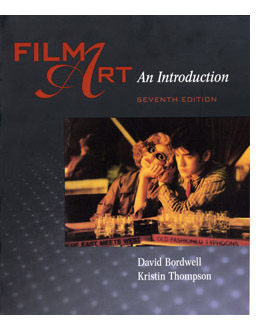 For musings on the relationship of early cinema to Victorian painting, see David’s “Professor sees more parallels between things, other things.”
David’s book, Ozu and the Poetics of Cinema, is now available online. For details, see his “I wrote a book, but …; or, what did the professor forget?”
Some teachers dealing with the classical Hollywood cinema of the 1930s to 1950s may wish to cover the B movie. Grad students and alumni of the University of Wisconsin film-studies program contribute to a dialogue on the subject in “Bs in their bonnets: A three-day conversation well worth the reading.”
We deal with the important institution of film festivals. I review a book on one of the most important of these festivals in “Cannes: Beyond the art, hype, and politics.”
When the second edition of Film History came out, two of the auteurs whose careers we examine in Chapter 19 were still alive. Now Ingmar Bergman and Michelangelo Antonioni have both died, and on the same day. David’s “Bergman, Antonioni, and the stubborn style” could make a coda for our chapter sections on those directors.
For updated information on Asian cinema, check the tags on the right. For recent Danish cinema, see David’s, “My Danish December.”
At intervals we report from film festivals we attend. So far such reports have come from the 2006 Vancouver Film Festival, the 2007 Hong Kong Film Festival, Roger Ebert’s Overlooked Film Festival (aka “Ebertfest,” 2007), and Il Cinema Ritrovato (“Rediscovered cinema,” in Bologna, Italy, 2007). These reports deal with the people we meet there, the films we see, and the institutions that run the festivals. We’ll continue to write such dispatches during our travels. Most of these reports have multiple parts, so be sure to follow the links.
As I said at the outset, our blog can serve as a supplement to our textbooks. We usually don’t, however, write new entries with that in mind. As we see recent films, revisit old ones, read books, and see information posted on the internet, we find inspiration to engage with the cinema in fresh ways. We find ourselves making contact with people we had never met and reconnecting with colleagues we have not heard from in decades. We hope that we are learning as we go along and passing along some of that learning to readers of Film Art and Film History.
Note: Elsewhere on this website there is a section on Film Art. Here you can find a list of corrections for errata in the 8th edition. We also include all of the sample analyses that have been cut from various editions: The Man Who Knew Too Much, Stagecoach, Hannah and Her Sisters, Desperately Seeking Susan, Day of Wrath, Last Year at Marienbad, Innocence Unprotected, Clock Clearners, Tout va bien, High School.
[November 15, 2009: See also the 2008 and 2009 updates on more recent blog entries.]
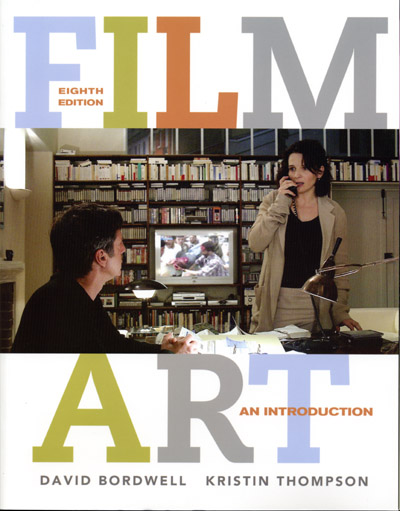
Eighth edition, McGraw-Hill, 2008