





Archive for 2007
Vancouver visions

Drizzle every day can’t dampen audiences’ enthusiasm.
DB again:
More dispatches from the Vancouver International Film Festival.
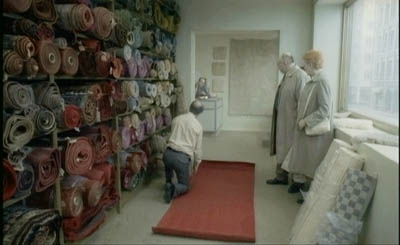
“Be pleased, then, you living one, in your delightfully warmed bed, before Lethe’s ice-cold wave will lick your escaping foot.” As a tram destination, Lethe makes a brief appearance in the Swedish film You, the Living, Roy Andersson’s latest comedy of trivial miseries. The line from Goethe is apt. After ninety minutes of drab apartments and Balthus-like figures, all bathed in sickly greenish light, you’re ready to stay in bed forever.
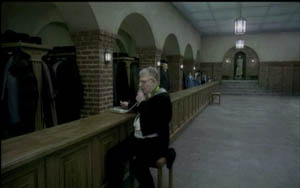
As in Songs from the Second Floor, Andersson gives us a loose network narrative, with barely characterized figures threading their way through urban locales. Long-shot, single-take scenes turn clinics and dining rooms into monumentally desolate spaces. Humans, either bulbous or emaciated, trudge through torrential rain and peer out from distant windows. The bodies may be distorted and careworn, but the spaces are even more so. We get a sort of dystopian Tati, in which gags, near-gags, and anti-gags are swallowed up in the cavities we call home and workplace. A carpet store stretches off into the distance, and a cloakroom seems like a basketball court.
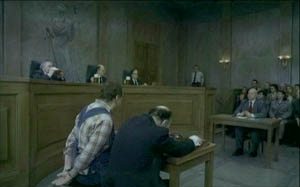
In You, the Living, Andersson’s characters recount their dreams, and these open onto areas only a step beyond our world in their lumpish crowds and eerie vacancy. Judges at a trial are served beer as they condemn the accused. Spectators at an electrocution snack on popcorn from supersized buckets. How can I not like a filmmaker so committed to moving his actors around diagonal spaces, even if the frame is either sparse or uniformly packed, and though he does treat his people like sacks of coal? Don’t look for hope here, only a sardonic eye attracted by banality and pointlessness, images made all the bleaker by an occasional song.
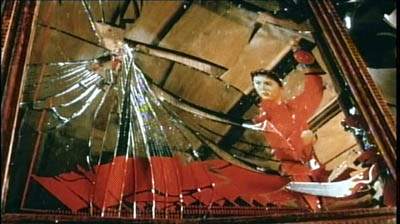
I’m drawn to directors who create a powerful visual and auditory world more or less out of phase with reality as we usually see it (in life and in movies). Andersson is one such director; Jiang Wen is another, whose audacious The Sun Also Rises is one of my favorites of the festival so far. Not doing so well with Mainland Chinese audiences, according to the International Herald Tribune, it hasn’t warmed up a lot of Western critics either. Amazingly, it was declined for competition at Cannes.
It seems impossible to discuss The Sun Also Rises without using the word “magic,” as in magic realism, but I saw it as more of a fairy tale or fable. Set in the Cultural Revolution, it tells two stories in the first two sections. A young boy’s mother goes a little mad on a labor farm; in another village, a teacher is compromised by the passionate love of a nurse and an accusation of sexual misconduct. The two stories intersect in a third section, which leads to a jubilant, if disconcerting, final stretch.
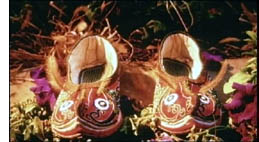 At the center of each plot stands a vivacious, passionate woman who unleashes a cascade of unhappy events. Yet the tone of the film is cheerful, almost giddy, thanks not only to Joe Hisaishi’s buoyant score (he may now be the Nino Rota of Asian cinema) but to Jiang’s fresh, assured technique. The movie starts with tight close-ups—the fish-design shoes the mother wants, her feet and hands, her son’s hands at the abacus—edited at a cracking pace. Staccato movements in and out of the frame give the whole passage a visual snap that launches the movie. Characters lunge through the shots, running this way and that without catching breath, and Jiang’s camera follows them without pausing for the sort of stately scene-setting that audiences may expect. Likewise, the second story opens with hands at play and work, the teacher stroking his guitar strings and a bevy of woman kneading bread dough.
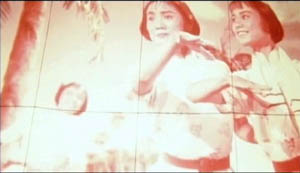
The exuberance of the characters and the style contrasts with the usual presentation of this cruel era of PRC history. Jiang finds real pleasure in Cultural Revolution kitsch, and he links a snapshot of the missing father to an iconic image from The Red Detachment of Women. It’s another knot joining the two plot strands; in the second section, villagers watch a screening of that film. Jiang makes the event a real festivity, with couples courting, the teacher humming along with the tunes, and an old lady feeding fish in a pond. Jiang dares to suggest that the force-fed popular culture of Maoism, so scoffed at now, gave genuine enjoyment
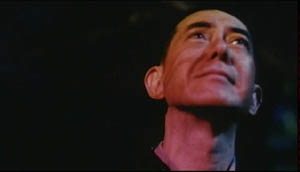
The fairy-tale atmosphere is conjured up by little mysteries, such as a talking bird and the possibility of taking dictation on an abacus, and bigger ones about fatherhood, a stone hut in the forest, and a shadowy figure named Alyosha, whose identity is more or less revealed in the film’s final long sequence. Variety‘s Derek Elley found The Sun Also Rises both rushed and dawdling, but you could say that about 8 ½ too. Like Fellini’s film, Jiang’s shows a filmmaker at the top of his powers inviting us to savor the exhilarating attractions of imagination.
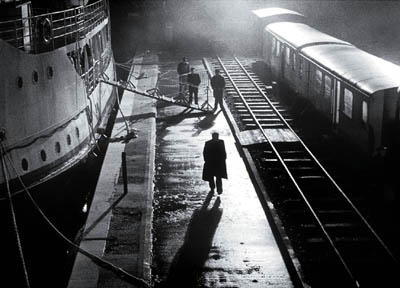
Another world, another vision. The camera frames a rope descending into black water and tilts slowly, really slowly, up to reveal the ship’s prow and the deck, swathed in darkness. Two silhouettes are visible, and one says, “Don’t follow me too soon.” Soon we’re following the transfer of a small suitcase, the disembarking of passengers making their way to a train. This nearly thirteen-minute shot (!) gives way to another long take, in which we see, in the distance, a murder on the quay.
Béla Tarr has called The Man from London a film noir, and he explained that to me by saying, “Not an American film noir. They were done by bad directors. More like the original French film noirs.” Indeed, the opening shot, with its mists and murky waterfront, suggests Quai des brumes. But here the plot action is slight, presented at a distance, and opaque in its motives; 10 % story, we might say, but 90 % atmosphere. The camera coasts across the waterfront town with the same grave deliberation we see in Damnation, Sátántangó, and Werckmeister Harmonies, swallowing up the Simenon situation in Tarr’s fluid way of seeing, a scanning of ever-shifting surfaces and vistas.
With fewer than thirty shots across about 133 minutes, The Man from London is another exercise in long-take virtuosity, but I thought I noticed some fresh departures. For one thing, there are few characters and relatively few locales, and situations are brought out with unusual explicitness (for Tarr). Instead, it seemed to me that Tarr was exploring new possibilities in one of his pet techniques, the over-the-shoulder long shot I mentioned in an earlier entry.
The opening shot, at first an apparently objective survey of the moored ship, turns out to be a view from the tower manned by Maloin. In shooting the wharf, the camera is forever oscillating, within a single shot, between what we can see outside, at a distance, from a high angle, and glimpses of Maloin at his post, his head or shoulder sliding into the foreground. Imagine Rear Window without the reverse shots of Jimmy Stewart watching.
In earlier films, Tarr tended to be quite clear when his foreground character was noticing something in the distance; his chief interest lay in suppressing the character’s reaction. What we get here can be seen as a refinement of the opening shot of Damnation, with its awesome landscape gradually reframed by Karrer looking out his window, or of passages of the doctor at his window in Sótántangó. Several of the tower scenes in The Man from London, are elaborations of that image scheme, but with more ambiguity. The camera, slipping from long-shot background and close-up foreground, coasts along without telling us whether Maloin has seen exactly what we’ve seen. The result is a suspenseful uncertainty not only about what’s happening in the noir plot but also about what Maloin knows.
There are many other points of interest in the new film, and after one viewing I can’t claim to have a grip on them. But I do think critics have overlooked its sheer visual beauty and Tarr’s efforts to turn his style toward a fluid pictorial suspense.
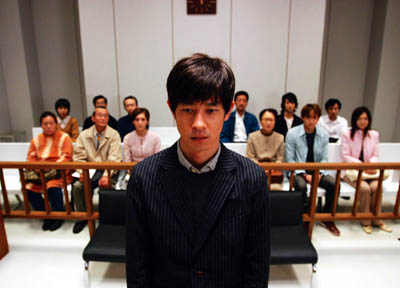
Altogether less flamboyant than any of these was Suo Masayuki’s I Just Didn’t Do It (Japan), which I’d been looking forward to since my February entry. It’s definitely a change of pace for a director known for comedies that satirize youth culture and middle-aged boredom. A young man is accused of groping a schoolgirl on a crowded traincar. The police advise him to confess and pay a fine, but he insists on his innocence. This decision drops him into a judicial mill that grinds slow and altogether too fine.
The script carpentry seems to me excellent. The presentation of each phase of the boy’s case could have been dry, but Suo makes each step hinge on a detail of fact or inference, so small questions keep popping up—including questions about whether the boy really might have done it. The finale, which recalls Kurosawa’s Ikiru in its methodical summing up of everything we have seen, becomes grueling, but in a salutary way. In Japan, the film is a trailblazing critique of the criminal justice system, where most people arrested confess in order to avoid the almost inevitable guilty verdict in a trial. Eliminating a jury, barring defense counsel’s discovery of prosecution evidence, and capriciously replacing one judge by another midway through a case, the system encourages cynical submission.
Suo avoids stylistic pyrotechnics. He plays down his signature mugshot framings (the publicity still above is an exception) and has recourse to handheld camerawork simply to distinguish the train scenes from the rest of the film. Still, his shooting displays a quiet agility. The high point is probably the testimony of the schoolgirl, her identity protected by screens set up around her. Suo finds a remarkable variety of camera setups here, each well-judged to impart a particular piece of information. (In its resourceful changes of viewpoint, the sequence reminded me of Mizoguchi’s courtroom scenes in Taki no Shiraito and Victory of Women.) The title suggests a strident social-problem film, but Suo’s calm plainness of handling yields a quality rare in the genre: tact.
Many more films to report on, including Johnnie To’s latest, but I must rush off to—what else?—another movie. I’ll try for a wrapup on Thursday, while I’m on that highway in the sky.
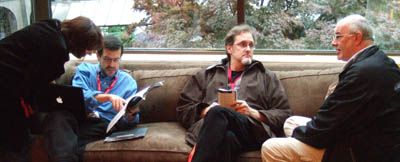
The critics line up: Bérénice Reynaud, Shelly Kraicer, Chuck Stephens, and Tony Rayns.
Back in Vancouver
DB again:
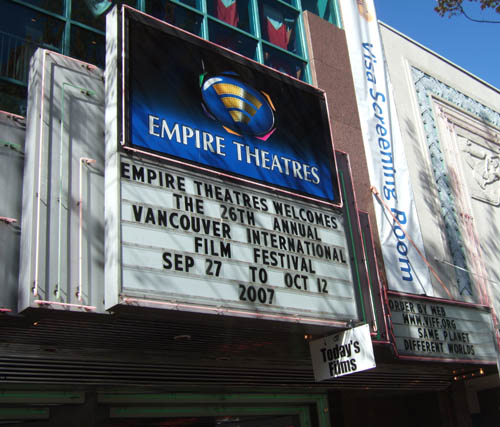
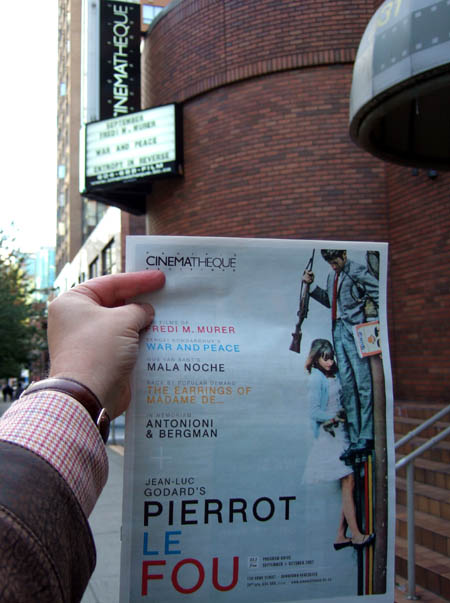
I sang the praises of the Vancouver International Film Festival in my first venture into blogging a year ago, so it’s a pleasure to report that this year’s event is no less captivating. Too many movies to take in, natch, so I’ll concentrate on two of the fest’s great strengths, documentaries and Asian films (programmed this year by both Tony Rayns and Shelly Kraicer). Top and bottom of today’s entry: glimpses of the two venues where I spend the most time: the Empire Granville 7 multiplex and the Pacific Cinémathèque a couple of blocks away, the latter offering ambitious programming to gladden the heart of any cinephile.
Two docus
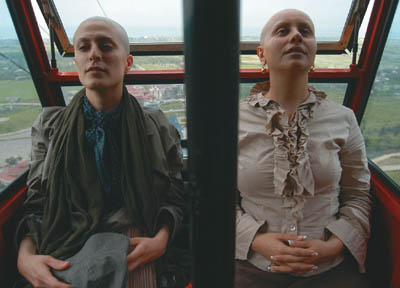
10 + 4 (Iran) provides vignettes of Mania Akbari’s struggle to live with cancer therapy. The fact that she’s also the filmmaker, and that she starts, at Kiarostami’s suggestion, from the visual premise of 10, gives the film extra layers of interest. In fewer than seventy shots, most from within moving vehicles, the film presents a series of dialogues, usually between only two people. Since most major action takes place elsewhere, we watch and listen for signs of characters’ pasts, their relationships, and their states of mind.
We can trace Akbari’s development from cheery pride, going to parties despite her chemotherapy (“Every morning I thank God for make-up”), to anguish as the pain mounts and the treatments intensify. No viewer will forget the scene on a cablecar when she and Behnaz, from 10, reveal their different responses to their illness, and offscreen, examine each others’ mastectomies. In a final scene, Akbari, her hair now regrown, is confronted by another woman who warns her of using cancer as a weapon. The final words, heard under the credits—”I am using it, and I can’t give up the joy of this game”—reveal a psychological insight we rarely find in discussions of the social implications of illness.
Oatmeal-video visuals shot handheld and often out of focus, talking heads, dicey sound, overbusy editing—never mind. My Kid Could Paint That shows that we’ll forgive all sorts of technical faults if the subject, story, and ideas are gripping.
 At one level, Amir Bar-Lev’s film simply traces how four-year-old Marla Olmsted was catapulted to celebrity when her dribbly paintings became collector’s items. Bar-Lev was lucky enough to be around Binghamton from more or less the start of her strange adventure, and he gained the family’s confidence. Soon enough, though, Bar-Lev is asking exactly how these paintings could wriggle into the artworld.
It’s partly because, he shows, experts are pretty evasive when it comes to explaining how to tell good abstract painting from bad. Can’t you tell just by looking, as we can when we appreciate the figurative work of old and new masters? Turns out it’s not so easy. Critic Michael Kimmelman suggests, somewhat vaguely, that even abstract art is about a “story”—if not in the picture, behind the picture. Marla, of course provides a great story, but the question of how to judge her oeuvre remains.
We might insist that an artwork’s goodness is intrinsic, regardless of the circumstances of its making. If we learned on good evidence an eighty-year old woman had composed The Marriage of Figaro, surely it wouldn’t lose its sublimity. But philosophers Arthur Danto and Denis Dutton have suggested that our information about how an artwork came to be is usually relevant to interpreting and judging it. Sure enough, collectors rhapsodized about the work when they thought Marla had done it, but they cooled after a 60 Minutes story suggested that the father had coached her, and perhaps even finished the pieces himself.
That raises another issue, encapsulated by a Binghamton journalist. She explains that if a story is to run long in the media, it has to be given steep ups and downs. Hyped at the start, Marla’s paintings are suddenly called con jobs, and even Bar-Lev starts to get doubtful. How the family tries to regain their credibility, and how Bar-Lev exposes his own hesitations and complicities, makes for a fascinating film.
My Kid Could Paint That touches on other matters, such as the world’s love of a prodigy, the money that drives the gallery scene, and the issue of how much craft, such as skill in drawing, we now demand of our artists. What shines through the intellectual issues is a childhood joy in picture-making. As portrayed here, Marla remains a kid, and she reminds us of the pleasure in gooping up a surface with our fingers. Sony Pictures Classics made a wise move in acquiring this engrossing movie.
Turning Japanese
I try mostly to blog about films I like, passing over the others in silence. Hammer jobs are fun to write and to read, and I confess to having indulged in a couple when I felt that historical or stylistic analysis could cast light on current films that were being overpraised for originality. By and large, though, I prefer what Cahiers du cinéma called the criticism of enthusiasm. Everyone should write about the films she admires, and let history sort them out.
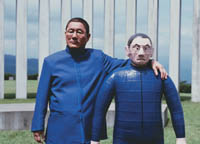 But my admiration for Kitano Takeshi has been so great since I saw Sonatine back in the 1990s that I can’t let Glory to the Filmmaker! pass without a little comment. His previous foray into fake autobiography, Takeshis’, seemed to me pleasant enough in a casual way. Unless I’m missing something, however, Glory to the Filmmaker! is an unmitigated embarrassment. Gone are the surprising compositions and subtly daring cuts; gone too the elliptical narrative that has time for adolescent digressons. Glory! is nothing but adolescent digressions, sketches and skits that either cling to an unfunny premise, like the dummy Kitano that pops up now and then, or abandon their premises halfway through. The pastiches of Ozu and Kurosawa are slapdash and inexact, while the more purely Kitanoesque stretches work at very low wattage.
Kitano is such an important filmmaker that you can’t ignore even something as offhand as this, but we have to hope for more.
Ten Nights of Dreams, a portmanteau feature based on stories by Soseki Natsume, is as uneven as these affairs usually are. The first chapter, a lovely episode by Jissoji Akio, is eerie in a subdued way, with some quietly canted compositions and some cutting reminiscent of the great Page of Madness. I also enjoyed Ichikawa Kon’s entry, a sober monochrome exercise. Most of the others, however, rely on turbocharged CGI and frantic grotesquerie—all justified by the indulgent premise that dreams are really, really weird.
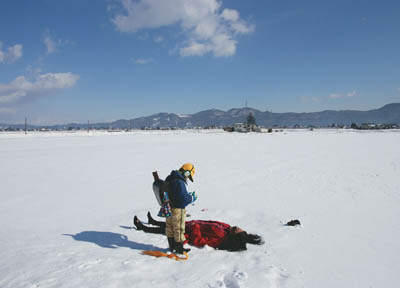
Yamashita Nobohiro’s Matsugane Potshot Affair (2006), however, bowled right down my center lane. A crooked couple comes to a small town and their search for stolen bullion becomes one thread in a tangle of dysfunctional families and grubby sex. My last sentence does the film an injustice, though, because the laconic narration fills in the circumstances and backstory at such a leisurely pace that all your attention is on the grim comic byplay and furtive eroticism of the townfolk. Any movie that starts with a little boy feeling up what appears to be a woman’s corpse on a frozen lake signals its tone pretty straightforwardly.
As in Linda Linda Linda, the only other Yamashita I’ve seen (and mentioned here), the staging and shooting are quietly commanding. The shots average about 23 seconds, but they seem longer because the camera almost never moves. Lovely long takes with layers of depth and pockets of action captured in windows and paper doorways recall the great Japanese tradition of all-over composition. Yamashita provides several shots that could be filed in my gallery of funny framings. When you film this way, you have to know exactly where to put the camera, and several scenes—notably a confrontation among the thieves and the twin brothers—quicken areas of the frame we never normally notice. Movies like this remind you of the pleasure of having time to see everything.
I haven’t yet mentioned the film I enjoyed most, Jiang Wen’s The Sun Also Rises, and today I’m also seeing the new Suo (I Just Didn’t Do It) and some other enticing items. So I turn Chinese, and Japanese again, in my next entry.
For more blogs anchored to the festival offerings, go here.
Our first anniversary, with a note on the unexpected fruits of film piracy
DB here:
This blog started on 26 September 2006. During its first year, it has attracted over 400,000 pageloads, over a quarter of a million visitors, and over 50,000 returning visitors. We currently average about 1000 visitors a day. While this is small potatoes by the standards of mammoth websites, it’s far more than we expected when we started. We’re grateful to all those readers who sought us out or stumbled upon us, who Googled and Yahoo’d us, who linked and listed us, who sent us corrections and extra information. And we’re grateful to our web tsarina Meg Hamel who set this up and keeps things running smoothly.
In the last twelve months, we’ve posted about 200,000 words, or enough for two books. We’ve tried to make most entries as attentive to ideas and information as what we’d write for a print publication—if not a scholarly book, at least a mainstream article. Kristin and I think of our blog as a sort of column, published in a magazine we edit, with no length restrictions, no assigned topics, and as many pictures as we like. It’s been fun to write more informally than we usually do. We’ve also been able to call attention to regional and national cinemas (e.g., Hong Kong, Denmark, New Zealand) we think deserve more attention. We can also pursue topics that we couldn’t fit into larger research projects, like Kristin’s interest in the Lord of the Rings franchise and my curiosity about alien autopsies.
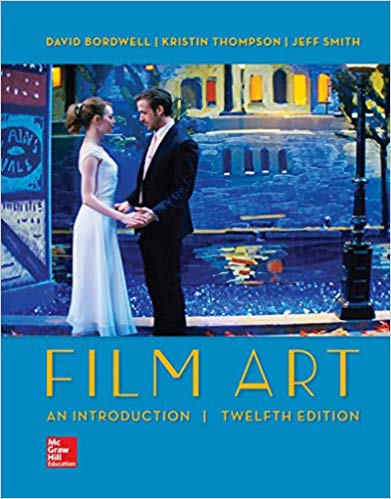
While the blog originally aimed to supplement Film Art: An Introduction, we think that the best way to do that is to keep reminding our readers that the world of film is dazzling in its diversity and unpredictability. One commentator said that our blog was aimed at students and nonspecialists, but we find that many professional film scholars and film journalists check on us. Perhaps that’s because we wander where we like, from very old films to recent films we see at multiplexes and festivals, and we propose ideas that could be considered more closely and researched more exactingly. One correspondent said that many of our entries could be the basis for research articles. Maybe, but we have more ideas than we can ever write up systematically, so off to the blog they have gone. In addition, we’ve sometimes used the blog to extend or supplement things we’ve published in books and articles.
Looking back at what we’ve done, I notice some recurrent themes.
*In keeping with the blog’s title, we emphasize film as an art form. More specifically, we’re especially interested in how structure and technique work together, which few blogs outside the industry do. For instance, most online critics have concentrated on praising or condemining The Brave One, and in rather general terms. If we wrote about it, we’d probably focus on the effects of its alternating points of view, its use of the four-part script structure, and its recourse to oddly rocking camera movements to convey Erica’s disorientation at crucial moments (and trace how those develop in patterned ways across the film). That is, we’d incline toward somewhat finer-grained analysis of cinematic storytelling, even if that means going shot by shot. If we want as well to make an evaluation of the film, as we sometimes do, we then have some concrete evidence to back it up.
*We also treat film art as tied to film commerce—both the mainstream industry and the less-acknowledged form of commerce known as film festivals. We’ve always believed that there isn’t necessarily a battle between film as an art form and “the business.” Much of our published work, including Kristin’s Exporting Entertainment and my work on Hong Kong film and contemporary Hollywood, as well as our collaboration with Janet Staiger on The Classical Hollywood Cinema, tries to trace out ways in which funding affects the look and feel of the finished work. Money matters!
*We’re happy to find that a lot of filmmakers read and link us. One of the purposes of Film Art was to show how artistic expression in cinema is tied to practical decisions made by filmmakers; that’s why we begin the book with an overview of the process of film production. In our academic work as well, we’ve been more inclined than most scholars to interview filmmakers, to read technical journals, and to study how craft practices create artistic effects. We’ve developed friendly relations with Asian filmmakers like Johnnie To and American filmmakers like Mark Johnson and James Mangold. We’ll continue to discuss how technique, technology, and filmmaking traditions interact in cinematic expression.
*We’ve tried to deflate some clichés of mainstream film journalism. Writers of feature articles are pressed to hit deadlines and fill column inches, so they sometimes reiterate ideas that don’t rest on much evidence. Again and again we hear that sequels are crowding out quality films, action movies are terrible, people are no longer going to the movies, the industry is falling on hard times, audiences want escape, New Media are killing traditional media, indie films are worthwhile because they’re edgy, some day all movies will be available on the Internet, and so on. Too many writers fall back on received wisdom. If the coverage of film in the popular press is ever to be as solid as, say, science journalism or even the best arts journalism, writers have to be pushed to think more originally and skeptically.
*There’s the theme we might call the continuing presence of the past. I notice that many of our entries comment on a current event or topic by showing that it has parallels and precedents in earlier periods of film history. This isn’t, I hope, showoffishness or academic point-scoring or a bored conservatism. Often this historical awareness allows us to correct hype and nuance ideas. Yes, today’s cinema experiments with flashbacks and intersecting story lines; but these are formal strategies we find in earlier periods of filmmaking too. So the interesting questions become: How are today’s strategies different? Why do these traditions get reinvented now? What consequences do they yield in our current circumstances? Rather than celebrating apparent innovation, it’s more exciting to see how filmmakers connect to tradition, shaping it in ways that even they might not be aware of doing. We tend to see the present through a narrow window, but historical awareness widens and deepens the view.
We rethink our project from time to time. Regular readers will notice that we’ve just added a roll of Readers’ Favorite Entries, on the right. We’ve also talked about adding a podcast to the site. In any event, we look forward to another year of our little magazine, and we have a folder full of ideas that we hope will tantalize you.
I’m off to Vancouver to cover the festival, as I did a year ago. More information on its wonderful lineup is here. In the meantime, some dessert.
Piracy ahoy
In Shanghai a few years ago I visited a shop selling pirated DVDs. Two illegal titles caught my eye.
According to the Motion Picture Association of America, the trade association of the major Hollywood companies, all pirated editions have their origin in camcorder copies made during screenings. In other words, it’s those outlaw consumers ripping us off.
But a large part of piracy can be traced to people working inside the industry. A common source is the raft of DVD screeners sent out to Academy members during awards season. It has proven impossible to keep these discs from getting into the hands of pirates. Other bootleg copies come from inside the production and distribution companies. Famously, a copy of Bulletproof Monk surfaced in China before the final cut was made; it’s widely believed that an employee leaked it. With so many special-effects houses working on a film in postproduction, it’s not difficult for one keyboard jockey to upload a working copy to the Darknet. Hence all those time-coded versions of the Star Wars saga that made their way into eager fans’ hard drives.
Further evidence of this tendency comes from the first Shanghai DVD I examined, that of The Passion of the Christ, not then available legally anywhere. It was a curious copy. It was an auditorium version, as pirates call movies snagged during a screening. The color and resolution were poor, and the camera zoomed in during the credits to a 1.75 ratio, wrecking the anamorphic compositions and creating closer framings.
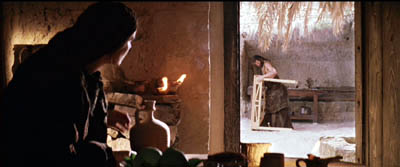
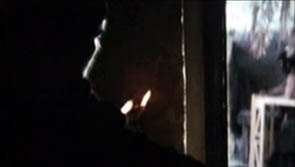
Poor as it was, the bootlegged disc lacked some of the usual problems. The image was stable and centered, with no sign of being filmed from a seat in the house. The sound wasn’t tinny or boomy, as it would be if it came from theatre speakers, but it was plagued with whistles and dropouts.
I concluded that this was a version made by a projectionist in off-hours. He or she had time to set up the camera on a tripod near the back of the house and record the whole film without distraction, using an iffy sound feed. But what was more puzzling was the fact that the print being screened had no subtitles.
So what I was seeing was an early version, before any subtitles had been put on. The projectionist wasn’t your local multiplex employee but someone in the postproduction process. In a way, however, this bootleg copy fulfills Mel’s dream. As the film began shooting Mel claimed:
Obviously, nobody wants to touch something filmed in two dead languages. They think I’m crazy, and maybe I am. But maybe I’m a genius. I want to show the film without subtitles. Hopefully, I’ll be able to transcend language barriers with visual storytelling. If I fail, I’ll put subtitles on it, though I don’t want to.
On the bootleg DVD you could add Chinese titles or barely comprehensible English ones. Of course once the official DVD version came out, you could turn all subs off, but for a moment the bootleg market had given us Mel’s vision pure.
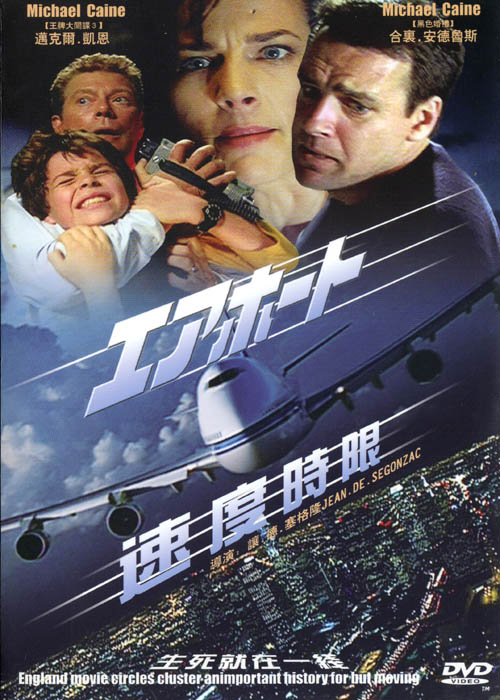
The second DVD that caught my eye points up another unexpected consequence of piracy. The cover of the release is at the very top of today’s entry. What made me investigate was the fact that Michael Caine is listed as being in the movie twice (though with different Chinese characters giving “his” name). Even the eager young researcher of PCU, immersed in the oeuvres of Gene Hackman and Michael Caine, might want to add a paragraph about this movie.
The credits on the back of the package add to the confusion. They are for Disney’s The Kid, and the running time is listed at 2:49. (The Kid is only 104 min.) I later learned that The Kid is a default paste-in on many DVD backsides. Why reproduce several different credit lists when all that matters is the metamessage, “This is an American movie”? But if it’s a Disney film, why does the printing also provide the Universal logo and an R rating?
So I broke down and watched the movie. (Flawless copy, by the way.) It is Code 11-14, a 2001 TV movie by Jean de Segonzac (big clue on the cover). An LA cop is tracking a serial killer. The killer follows the cop and his family onto a passenger jet and terrorizes them. According to Hal Erickson’s All Movie Guide, CBS pulled it from the schedule in the wake of 9/11. It wasn’t broadcast until 2003. Code 11-14 stars David James Elliott, Nanci Chambers et al., but not Michael Caine.
These sorts of mind games are pleasant. It’s fun to be thrown off balance by guessing how the credits got scrambled (PhotoShop set to Random?) and why Mr. Caine is credited doubly. Is he twice as popular in China as any other actor?
But the strongest justification for the existence of this pirate copy seems to me the liner notes.
What you see on the cover above—England movie circles cluster animportant history for but moving—is but a foretaste of what you find on the back. I reproduce it word for word.
This large war movie, empty cluster in the movie circles elite of England but move, for re-appear their motherland atAn important history of the period of World War II but worker harder, the film to record theatrical breeze The space describes the German Nazi in 1910 got empty bomb British intensive metropolis, make England Lose miserably heavy, but also arose England people together enemy spirit to make Germany, in numerous Popular actor inside, exceed the gram. The boon of . The willing to thinks, the shares the drama more, play the cuckoldry of The jade of Susan then expresses romantic, in addition, the Lawrence the brilliant jazz in military tactics with, the plays the plays the heartless condition in hungry clap very sublime and lifelike.
Exactly. I rest my case.
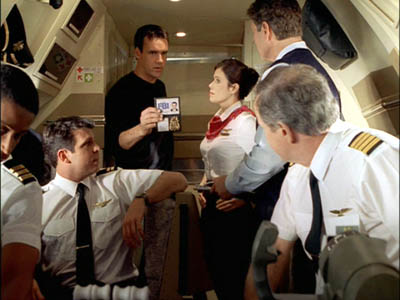
PS 30 Sept: I should’ve realized there’d be a website devoted to maniacal pirate prose and pictures. Thanks to Stuart Ian Burns, I learn that you can find many more at a Flickr group called, logically, crappy DVD bootleg covers.
Beyond praise: DVD supplements that really tell you something
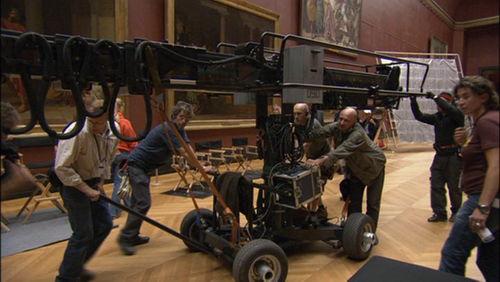
Filming The Da Vinci Code in the Louvre.
Kristin here—
In the 8th edition of Film Art: An Introduction, we added a feature, “Recommended DVD Supplements.” Most chapters end with one of these, which contains information about relevant supplements that might be useful to teachers and students. Filmgoers outside the classroom might find them helpful as well.
As we all know too well, many DVD supplements consist largely of interviews with the main cast and crew members in which they praise each other. (“I don’t know how we could have made this movie without _______. She was perfect for that part.” “We were lucky to be working with a director who’s a genius.”) Not very interesting. We try to sort through and find supplements where the filmmakers actually talk in an informative and entertaining way about how they went about their work.
Obviously many DVDs have come out since we finished our last round of revisions, so we plan to use this blog as a means of occasionally updating our recommendations. Your suggestions about especially informative supplements are welcome.
King Kong (Deluxe Extended Edition, Universal)
In Film Art 8, I recommended the Production Diaries Peter Jackson put together for King Kong, since they cover (albeit briefly) a lot of topics that few supplements tackle. One day’s diary entry is devoted entirely to clapperboards! In the extended King Kong DVD, some of the additional supplements also deal with topics that most DVD’s extras bypass.
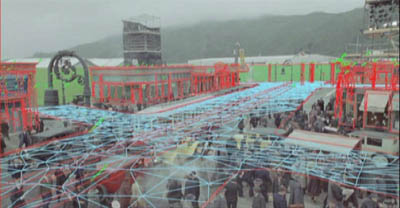
In relation to the section on settings in the Mise-en-scene chapter, for instance, you might look at “New York, New Zealand” (23 minutes). While most descriptions of CGI talk about how it is used to make monsters or crowds, this supplement discusses how the creation of settings can depend on digital imagery (above). During the fairly lengthy (42 minutes) documentary, “Pre-Production: The Return of Kong,” there is a discussion of what a First Assistant Director does during during this phase of production (40 minutes in). How often do you run across that? It could be used in conjunction with our layout of production roles in Chapter 1.
The 30-minute “Return to Skull Island” section goes into miniatures, matte paintings, and green-screen work—things that are often featured in supplements. This one also covers a less familiar technology, digital doubles.
Far from Heaven (Universal)
Supplements that examine a single scene, technique by technique, are pretty rare. One of the supplements on the Far from Heaven DVD does so in a useful way. The track originated as a documentary, “Anatomy of a Scene,” produced by the Sundance Channel (27 minutes). The analysis covers the production design and costumes, cinematography, acting, editing, and music. At the end, the completed scene is shown. The other large supplement on the disc, “The Making of Far from Heaven,” discusses the filmmakers’ attempts to replicate a 1950s look. It’s rather bland, with a little on style, a little on ideology, and a lot of mutual praise.
The Da Vinci Code (Sony; all editions have the supplements)
The DVD of The Da Vinci Code has two useful supplements. “Magical Places” (16 minutes) is an excellent demonstration on the logistics of going on location: permissions needed, technical challenges (such as lighting real interiors), and the substitution of one real building for another. Students will gain an awareness that even in real locales, filming doesn’t mean just going out, aiming a camera, and shooting stuff.
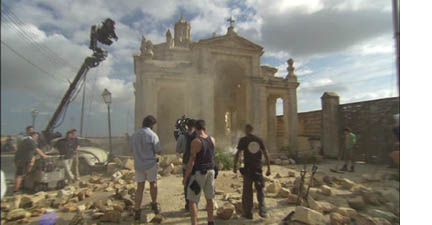
The second, “Filmmakers’ Journey Part One” (24.5 minutes) is not as good but still interesting. It could be used in conjunction with our Chapter 3, “Narrative as a Formal System,” which is rather hard to find relevant supplements for. There is discussion of character, timing, and rhythm. One passage that is particularly good for showing how filmmakers think about the form of films comes in a segment on the introduction of a major new character (Sir Lee Teabing) fully halfway through the film. Moreover, as director Ron Howard says, the Chateau Villette scene in question is a “high-wire act,” with a great deal of exposition suddenly brought into the middle of what has largely been an action-filled chase film. There is also discussion of the film’s series of journeys: “There was this sort of classic structure that we were working with.” It’s a pattern we discuss in Chapter 3. If nothing else, this supplement might convince students that their textbook’s authors are not just making up these terms to bedevil them!
Pirates of the Caribbean: Dead Man’s Chest ( Disney, 2-disc Special Edition)
Unexpectedly, one of the best sets of supplements I’ve seen lately accompanies Pirates of the Caribbean: Dead Man’s Chest. It’s a film that I mildly enjoyed watching, but I liked the making-of documentaries more. For one thing, the style is unusually low-key and lacks the chat about how wonderful everyone and everything was.
“Charting the Return” (about 26 minutes), for example, follows the stages of pre-production not just through interviews but also via a fly-on-the-wall presence of the camera at meetings and discussions. Often the people onscreen are not being interviewed but are actually at work, talking to each other. We see scripting, location scouting, design, and scheduling. Problems with deadlines and budgets are discussed rather than glossed over. The candor makes for a surprisingly entertaining and informative little movie. The same is true for “According to Plan” (60 minutes), which covers principal photography. Crew members delight in the beautiful Caribbean locales–but also complain about the heat, humidity, tides, rocking boats, and roads too small for equipment trucks. It’s one of the few accounts I’ve seen that suggests both the joys and the frustrations of real filmmaking.
Unless you’re really, really interested in costuming—or in ogling Jack Sparrow—the “Captain Jack: From Head to Toe” is frivolous. The “Mastering the Blade” segment can be skipped as well.
“Meet Davy Jones” (about 12 minutes) describes an important development in motion-capture technology for creating CGI characters. “Image-based motion capture” can extract mocap markers from a two-dimensional image (e.g., a shot of an actor performing on a stage) and make it three-dimensional. It can then be manipulated and placed back in the shot. In a discussion of modern special effects, this supplement might usefully be compared with the ones about the creation of Gollum in the Lord of the Rings: The Two Towers extended DVD set. The “Creating the Kraken” film (10 minutes) explains well how practical and CG special-effects are blended.
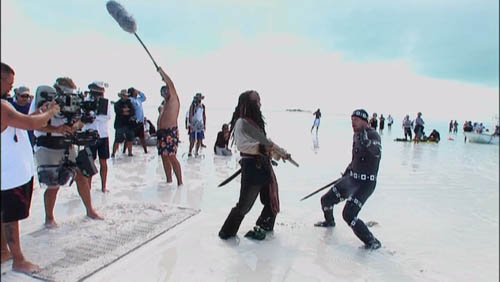
Filming as the tide covers the island used as a location.
You can skip the “Fly on the Set: The Bone Cage” segment, which is a skimpy four minutes on blue-screen special effects and the use of multiple cameras. OK, but this topic is covered more thoroughly on other films’ supplementary discs. Beware of “Jerry Bruckheimer: A Producer’s Photo Diary.” Bruckheimer makes up for all the compliments to director, cast and crew that were left out of the other supplements in this mercifully brief (5 minutes) track.
Unfortunately, some of the best recent films have come out on DVD with no supplements to speak of. When will we see some extras-laden editions of Cars and Zodiac?
[September 24: Film critic Kent Jones tells us that a deluxe DVD edition of Zodiac is coming out in the near future.]