















Archive for the 'Digital cinema' Category
When media become manageable: Streaming, film research, and the Celestial Multiplex
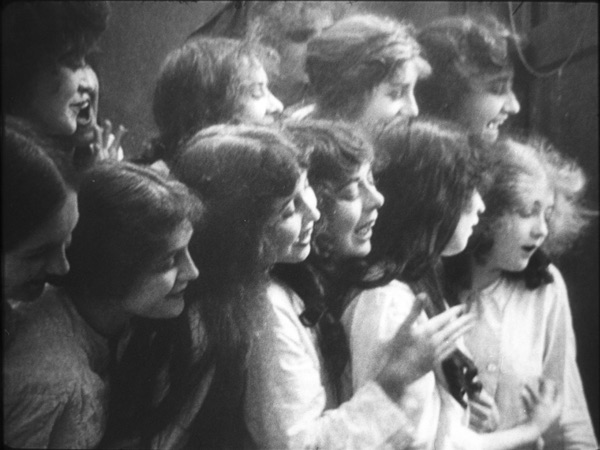
Never coming to the Celestial Multiplex: Liberty Belles (Del Henderson, 1916).
DB here:
A directors’ roundtable in The Hollywood Reporter says a lot in a little.
Fernando Meirelles: This June, The Two Popes was in 35 festivals. Then we were going to have two or three weeks of theaters. And then the [Netflix] platform. I mean, it couldn’t be better.
Martin Scorsese: We are in more than an evolution. We are in a revolution of communication and cinema or movies or whatever you want to call it.
Meirelles casually omits DVDs, at one point the most rapidly adopted format of consumer media. Yeah, what ever happened to discs? And in what follows, I’ll take issue with Scorsese’s claim that streaming has triggered a revolution. It’s more a case of evolution that issued in a sweeping change, like Engels’ transformation of quantity into quality, or Hemingway’s claim that he went broke slowly, then quickly.
More important, I’ll try to assess the impact streaming has had on what Kristin and I and other researchers and teachers try to do–study film as an art form in its historical dimensions.
Managing your time, and your movies
If we’re looking for a revolutionary turning point, I’d suggest the moment that movies no longer became appointment viewing. When they played theaters you had limited access. The film was there for only a while (even The Sound of Music eventually left) and you had to watch it at specified times. On broadcast TV and cable, the same conditions applied. But with the arrival of consumer home videotape in the 1970s, the viewer was given greater control.
Akio Morita of Sony called it “time-shifting.” The phrase, shrewdly positioned as a defense of off-air copying, captures a fundamental appeal of physical media. You could watch a film at home, and whenever you wanted to. Yes, VHS and even Beta yielded shabby images and even worse sound, but (a) theatres were often not much better, and (b) a video rental was cheaper than a movie ticket. Most important was a general rule of media technology: For the mass market, convenience trumps quality.
Videotape swept the world in the 1980s and gave films an aftermarket. Many an indie filmmaker could get financing for a project on anticipated tape sales. The laserdisc gained some attention in the 1990s, becoming a sort of transitional format. It improved quality (better analog picture, digital sound) but had drawbacks too. A movie wouldn’t fit on a single disc side, and a laserdisc was pricier than tape. LD remained a niche format, chiefly for educators and home-theatre enthusiasts.
The laserdisc was superseded by the DVD, introduced in 1996. Journalists claimed that it enjoyed the fastest consumer takeup in electronics history. Discs were more convenient than tapes, and proof of concept had been provided by the success of CDs for music. To compete, cable companies introduced “video on demand,” a time-shifting compromise between scheduled cable delivery and rental of tape or disc. People still use cable VOD, and for some purposes it’s a cheaper alternative to committing to subscription services.
Reviewing The Irishman, a critic suggested that most people will skip seeing it in theatres and watch it on Netflix, where it’s “more manageable.” With tape and disc, either analog or digital, consumers became accustomed to a huge degree of manageability. They could pause, skip ahead or skip back, race fast-forward or –back, play slowly, and above all play the movie over and over. DVDs made all these options quicker and more convenient than tape had. The market boomed. Video stores made discs available for rental, as tapes had been, and retail stores offered them for sale, at increasingly low prices.
But there were problems. In the 2000s there was a glut of DVDs, and consumers began to realize that a few weeks after release many titles would end up in the bargain racks. A brisk secondary market developed thanks to the US “first sale” doctrine, most virtuosically exploited by Redbox. Worse, there was piracy. Pirating analog tapes degraded quality across generations, but with digital discs you could rip perfect clones. Any teenager could hack past region coding and anticopying software.
The Blu-ray disc was an improvement on the first-generation DVDs, and it came along as more people were buying widescreen and high-definition home monitors. Properly mastered, Blu-ray discs looked good, and they had bigger storage capacity. Some consumers got excited, but the improved format couldn’t arrest the headlong decline of disc sales. In addition, the industry’s rationale for Blu-ray was its resistance to rippng, but hackers breached the codes with ludicrous speed.
From this angle, streaming is parallel to digital theatre projection : a new phase in the war against piracy. Likewise, as in theatrical screenings, you’re paying for an experience, not an item. You’re not buying an object you can copy or resell. If a movie is available only on streaming, you’re renting something, not owning it legally. One aspect of manageability—personally possessing a movie—is traded away for convenience and, ultimately, for limited access, as I’ll try to show.
Not so gently down the stream
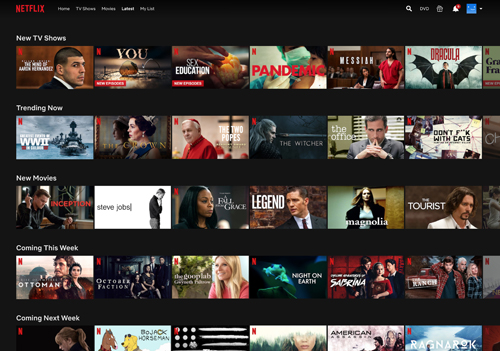
With streaming, the age of appointment viewing seems more or less over. And the infinite vista of the Internet has encouraged tech-heads to imagine something like the Celestial Jukebox, a vast virtual multiplex in which all movies will be available. If iTunes and Spotify did something like this for music, why not cinema?
Let’s consider the pluses and minuses of streaming for ordinary consumers and for filmmakers.
Obviously, there’s convenience. After the monstrous tape cassettes, DVDs looked adorably slim. Now, gathering in slippery stacks, they have their own sinister aura. With streaming, there’s no need to run out to the video store or to buy new shelving to support a bulging library of discs.
There’s also price, compared to either theater tickets or cable fees. From $6.99 per month (Disney+) to $12.99 (Netflix), streaming services promise to provide TV and movies quite cheaply. And there’s the range of choice, which even on second-tier streamers exceeds the capacity of most towns’ video stores back in the day. Finally, there are many obscure films lurking in the corners of most streamers, so the joy of discovery is still there to a degree.
On the minus side, there’s one that gets the most press—the further erosion of “the theatrical experience.” Critics emphasize the pleasures that come from being in an audience, but this always seems to me overrated. More valuable to me are the scale of image and sound you get in a theatre. I like my movies to loom.
Above all, there’s a virtue in the lack of manageability. In the theatre you can’t pause the movie or run back or skip ahead. You can close your eyes, look away, or leave, but at bottom you’re there to turn your sensorium over to the filmmaker, to go through an experience you don’t control. This unshakeable grip on your attention yields some of cinema’s most powerful effects.
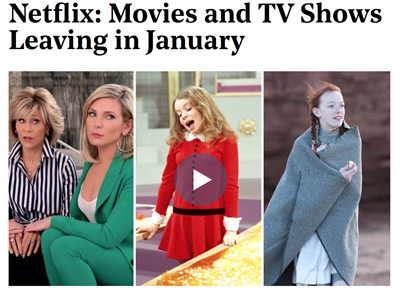
The condition of privatized viewing isn’t unique to streaming, of course. Nor is another drawback, that of the cyclical expiration and refreshing of “content” on streaming platforms. Admittedly, we’re warned. Newspapers and websites run alerts notifying us when a title is leaving a service—perhaps for a little while, perhaps longer, perhaps forever. And this situation is a bit like DVDs’ going out of print. But at least some disc copies exist to be sold second-hand or cloned as files. In working on my book on the 1940s, I was pleasantly surprised to learn that I could track down arcane titles on out-of-print discs, and at fair prices. When something not on disc leaves streaming, how do you access it?
I think there will be some pushback when subscribers learn about the costs that more and more services are tacking on. Yes, with Amazon Prime for $119 per year you get access to many films, along with other services. But for a great many films Amazon demands an extra rental fee and very short-term access. Within Amazon, there are channels (Britbox, HBO Now, Starz, Cinemax et al.), all of which demand further subscription payments. As people start to realize that streamers will have exclusive licenses for titles, they’ll feel pressure to subscribe to many services. Here, as elsewhere, the total streaming price tag starts to look like cable fees. Even the New York Times has noticed.
Another problem won’t bother most consumers, but it does matter. A streamed title will occasionally be in an incorrect aspect ratio. Most commonly, a Scope (2.39 or so) image will be cropped to 1.85. I noted this some years back, relying on a website showing faulty Netflix transfers, but that site seems to have been taken over by … Netflix itself.
Netflix will say, with all “content providers,” that they get the best material they can from their licensors. I don’t watch streaming enough to know how common wrong aspect ratios are, but if you know of examples, I’d like to hear.
Finally, even streaming companies can collapse. Unless Apple buys a studio (Lionsgate? MGM? Columbia?), it must rely on original content, and it could well flop. On the day I’m writing this, one hedge fund manager predicts we have reached peak Netflix. Given greater competition, slower growth, and accelerating cancellations, he maintains that Netflix is on the wane. If it scales back or fails (it currently carries $12.43 billion in debt), what will happen to its licensed material and its original content?
What about creators? Filmmakers, especially screenwriters, have enjoyed boom times. It may be a bubble, with over 500 scripted series available on broadcast, cable, and streaming. Still, it has given everyone a lot of opportunities. Documentary filmmaking in particular has enjoyed a shot in the arm.
And features are still doing quite well, at least on Netflix. Of the streamer’s top 10 releases in 2019, seven were features. But those proportions may change. Aside from big theatrical movies licensed from the studios, the impact of proprietary “event” programming (War Machine, Bird Box) has been fairly ephemeral. (Obviously Roma and The Irishman are exceptions.) The strength of streaming, it seems to me, is the same thing that sustained broadcast TV: serial narratives. Hence the popularity of Friends and The Office, as well as House of Cards and Orange Is the New Black.
Like network TV, a streamer needs a reliable, constant flow of content—not only many shows, but many episodes. The model of the series, if only in six or eight parts, secures the loyalty of the viewer for the long term. Even if all episodes are dumped at once, the promise of continuation after an interval of a year or several months keeps the viewer willing to hang on till the next season.
The pressure on the creators is predictable. Since form follows format, writers and producers will be pushed to come up with series ideas. A friend of mine pitched a feature-length movie to a streaming service. The suits loved the idea but wanted it as a series and were already scanning the script outline for a plot point that could launch a second season. Some of the streaming series I’ve seen, notably Errol Morris’s Wormwood, seemed to me stretched.
If a filmmaker lands a feature film on a streaming platform, other problems could follow. We’re well aware that independent filmmakers gain few royalties from streaming; their big check tends to be the initial acquisition. At the same time, they can’t be sure that people are watching their entire movie. My barber couldn’t stick with The Irishman, even with pee breaks.
Streamers seem to have accepted grazing as basic to the viewing experience. For purposes of measuring total viewership, Netflix counts a “viewing” of a film or program as a minimum of two minutes. In the light of the two-minute rule, we might expect filmmakers to crowd their opening scenes with plenty to grab us. That goes back to TV and TV-influenced films, of course, which tried to have a strong teaser even before the credits. Now, it turns out, streaming pop songs are being crafted with shorter intros and earlier choruses “to get to the good stuff sooner.” Maybe filmmakers will be trying the same thing. Maybe they already are.
Streaming and film research
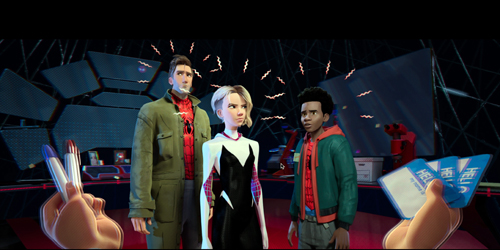
Spider-Man: Into the Spider-Verse (2018).
Finally, what are some consequences of streaming for researchers, educators, and your all-around obsessive cinephile?
I think it’s fair to say that home video, in the form of tape, laserdisc, and digital disc, democratized film study. From the late 1960s on, I traveled to archives and film distributors to watch films for my research. It was troublesome, time-consuming, and costly. As a grad student I took a bus from Iowa City to Chicago to watch 16mm prints of Dreyer and Sontag films. I drove to Eastman House to see films in projection. I stayed in Paris a couple of months to work at the Cinémathèque Française on Marie Epstein’s visionneuse.
As a prof here at Madison I spent hundreds of hours watching prints in our Center for Film and Theater Research. Over the decades I trekked to Denmark for Dreyer and 1910s films, to Japan for silent films, to Paris and Munich and the BFI and MoMA and UCLA and Eastman House and the Library of Congress, and above all Brussels for many, many projects. Collectors, from Manhattan, Tokyo, and Milwaukee helped as well. Kristin and I owe archivists everything.
The terrible quality of films on tape didn’t help me study visual style, but laserdiscs were a big improvement. (Hong Kong films tended not to be in Scope on tape but were on LD.) And one LD format, CAV, was frame-accurate; you could study a shot frame by frame, something not possible with many DVDs. There’s always a trade-off with any technology.
Even after even after DVDs arrived I kept up my travels. I could use discs for bulk background viewing, but often I still had to rely on prints. Sometimes I wanted to count frames (handy in looking at Soviet montage and Hong Kong action). Moreover, looking at film prints revealed that the color palettes on DVDs could be quite different, and soundtracks were often cleaned up for the home market. And of course thousands of films, especially from outside Hollywood or in the first decades of cinema, were never going to be available on consumer video. My most recent extended archive stay, in Washington in 2017 thanks to a Kluge Professorship, showed me the glories of the 1910s in prints that are mostly accessible only to researchers.
What do scholars of an analytical bent need? Entire films that can be paused. Frame stills, made photographically or through software. Clips as evidence for our claims. Stills and clips are our equivalents to quotation for literary scholars and illustrations for art historians.
Apart from convenience and cost savings, the disc revolution yielded something I couldn’t get otherwise. In an archive, it’s impossible to study film-based 3D cinema. But thanks to Blu-ray, I can stop on a 3D frame. (. . . And, for instance, spot the way Hitchcock makes the clock quietly pop out in Dial M for Murder, below). This is a unique benefit—but a waning one, as 3D discs are increasingly hard to find and 3D monitors scarcely exist any more. As I said, trade-offs.
From this standpoint, Netflix and its counterparts offer a step down from DVD and Blu-ray. In terms of choice, many films aren’t currently available on streaming, and many more never will be. You can pull a DVD off a shelf whether you’re online or not, but for streaming you need a good connection. The controls of a streaming view aren’t as precise as those on a DVD player; slow forward and back to study cuts and gestures aren’t feasible, it seems.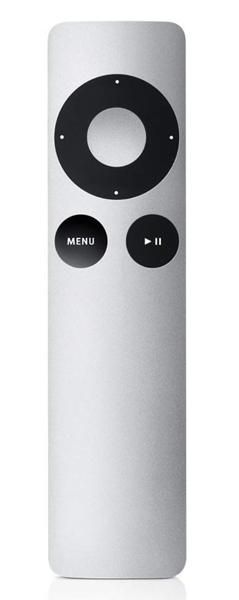
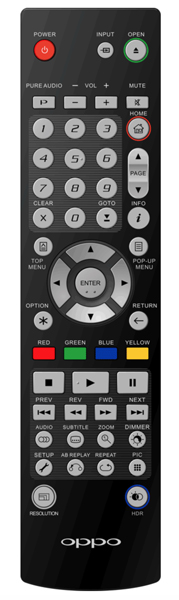
When cable cropped films, as it frequently did, you had recourse to DVDs, perhaps even from foreign sources. But as exclusive licensing increases, only one service will have a title. Frame grabs are possible with some software, but clips are more difficult.
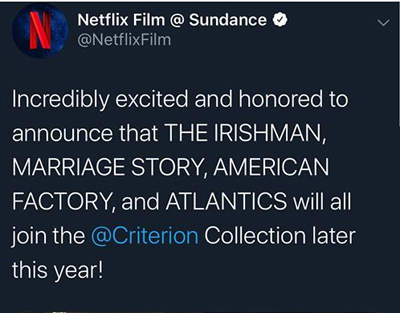
Worst of all, many worthwhile films will apparently never find their way to disc. I first noticed this in 2017 when I wanted to buy a copy of I Don’t Feel at Home in This World Anymore, a Netflix release of a Sundance title. As far as I can tell, it’s not available on DVD. The same fate has befallen one of my favorite films of 2018, The Ballad of Buster Scruggs. Only a few years ago it would be unthinkable for a Coen Brothers film not to find DVD release. Even Roma has had to wait for a Criterion deal to make it to disc. Clearly Netflix, and perhaps other streamers, believe that putting films on disc damages the business plan. So Meirelles doesn’t include DVDs in the lifespan of The Two Popes.
Without DVDs, some cinephiliac consumers are lamenting, rightly, the loss of bonus materials. The Criterion Channel has been exceptionally generous in shifting over its supplements to the streaming platform, but other companies haven’t been. Scholars and teachers rely on the best bonus items, including filmmaker commentaries, to give students behind-the scenes information on the creative process. There are, I understand, rights issues around supplements, and bandwidth is at a premium, but there’s no point in pretending that the loss of disc versions hasn’t been important.
In 2013 Spielberg and Lucas declared that “Internet TV is the future of entertainment.” They predicted that theatrical moviegoing would become something like the Broadway stage or a football game. The multiplexes would host spectacular productions at big ticket prices, while all other films would be sent to homes. Lucas put forth the question debated in the directors’ roundtable I mentioned: “The question will be: ‘Do you want people to see it, or do you want people to see it on a big screen?’”
Still, the big changeover hasn’t happened quite yet. Every year has its failed blockbusters, and films big and middling and little (Blumhouse, for instance) still continue. Arthouse theatres, which rely on midrange items, indie production, and foreign fare, are putting up a vigorous fight, emphasizing live events and community engagement.
Meanwhile, streaming makes film festivals and film archives more important. Festivals may host the few plays that a movie gets (as in the 35 fests which ran The Two Popes), and filmmakers, as Kent Jones remarks, are eager for their films to play on the big screen in those venues. Archives will need not only to preserve films but also make classics and current movies available in theatrical circumstances. Smart film clubs like the Chicago Film Society and our Cinematheque keep film-based screenings alive.
Before home video, few film scholars undertook the scrutiny of form and style. Those who did had to use editing machines like these. (One scholar called my study of Dreyer, not admiringly, the first Steenbeck book.) Ironically, just as an avalanche of films became available for academic study, and as tools for studying them closely became available for everyone, most researchers turned away from cinema’s aesthetic history and a film’s specific design in order to interpret their cultural contexts. There were exceptions, like Yuri Tsivian’s efforts to systematically study patterns of shot length, but they were rare.
Whatever the value of cultural critique, one result was to leave aesthetic film analysis largely to cinephiles and fans. Thankfully, the emergence of the visual essay, in the hands of tech-savvy filmmakers like kogonada and Tony Zhao and Taylor Ramos, eventually attracted academic attention. Film analysis has returned in the vehicle of the video essay, which is a stimulating, teaching-friendly format. Kristin, Jeff Smith, and I have participated in this trend through our work with Criterion and occasional video lectures linked to this site.
All this was made possible through the digital revolution, or evolution, and we should be grateful. Still, streaming filters out a lot of what we want to study. It’s clear that, for all their shortcomings, physical media were our best compromise for keeping alive the heritage of critical and historical analysis of cinema. We’ve largely lost physical motion pictures as a contemporary medium. (How many young scholars, or filmmakers for that matter, have handled a 35mm print?) Now, to lose DVDs and Blu-rays is to lose precious opportunities to understand how films work and work on us.
Thanks to all the archivists, collectors, and fellow researchers who made our research so fruitful and enjoyable in the pre-digital age.
A good overview of the streaming business at this point is “The future of entertainment,” in The Economist.
Kristin discusses the fantasy of the Celestial Multiplex with archivists Schawn Belston and Mike Pogorzelski. For examples of how to watch a film on film slowly, go here. Samples of editing-table discoveries are here and especially in the Library of Congress series that starts here. In another entry, I discuss the use of 3D in Dial M for Murder.
P.S. 24 January 2020: Then there’s this, from Facebook.
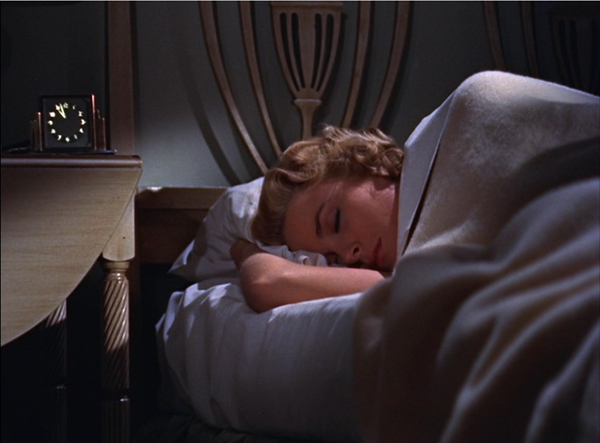
Dial M for Murder (1954).
Barely moving pictures: Kiarostami’s 24 FRAMES
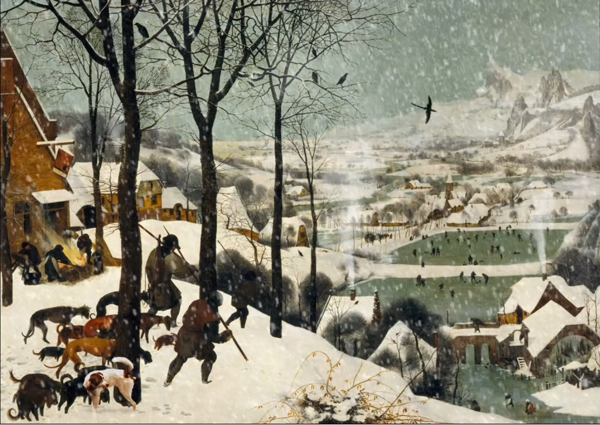
24 Frames (2017).
DB here:
It might seem an act of vandalism. To overwrite one of the world’s most famous paintings, the elder Pieter Bruegel’s Hunters in the Snow, with digital effects could be condemned as vulgar at best and scandalous at worst. In the lower left, we see a dog pissing on a tree. Yet no one ever accused the late Abbas Kiarostami of bad taste. Of weirdness, yes: His Lumière tribute (1995) consisted of a close-up of a frying egg.
Eggs aside, Kiarostami’s experiments mostly have a stubborn stringency. He made a film wholly out of reaction shots, and another out of static takes of landscapes. Yet neither was an arid exercise. Shirin (2008) yielded poignancy as it let us study women responding to a romantic spectacle (film? theatre piece?). The minimalist Five Dedicated to Ozu (2003) was at once meditative and sensuous, speckled with moments of relaxed humor (the parade of the ducks) and building to a curious suspense, as we stare at brackish water trembling in a downpour.
So when the first segment of Kiarostami’s 24 Frames (2017) decorates Bruegel’s masterwork, we ought to expect that something’s up. The explanation offered in the film’s prologue is that the filmmaker is curious about what happens around the instant portrayed in the image.
For 24 Frames I started with famous paintings but then switched to photos I had taken through the years. I included about four and a half minutes of what I imagined might have taken place before or after each image that I had captured.
This declaration, apparently opposed to Cartier-Bresson’s doctrine of the “decisive moment,” leaves creative wiggle room. Kiarostami and his colleagues used digital manipulation to alter his stills, adding layers of figures and movements.
But how do we determine the punctual instant of each of the twenty-four shots? What’s the before or after? Many shots contain several moments of pause that might be the original frozen moment, but Kiarostami doesn’t give them special emphasis. After the Bruegel, we get twenty-three gradually changing natural scenes, nearly all mini-narratives based on stasis, rhythmic cycles, hesitations, and bursts of action. Five showed Kiarostami venturing into the territory of Structural Film, and especially the open-air tendency mastered by James Benning. With 24 Frames we get that monumental impulse recast by photorealistic animation: landscapes teased into little stories by the miracle of rendering, mo-cap, and drag-and-drop.
The birds and the beasts were there
The Bruegel is defaced for a reason. The original painting lays out strategies that the following sequences will pursue. Human bodies will play a subsidiary role; they appear in only two sequences, and, like Bruegel’s hunters, they are mostly turned away from us. We’ll also see snow, birds, dogs, trees, a scraggly bush, and water (the frozen pond). Just as important, Bruegel’s composition warns us how to watch. He draws our eye into the distance, and there lots of tiny figures will grace the scenes ahead.
Kiarostami’s decorations insert more previews. He introduces a herd of cows, blatantly fake falling snow, smoke that prepares us for mist and cloud formations. Dogs and birds are set into motion and given sounds; we’ll spend a lot of time tracking these vagrant creatures, and their cries will help us navigate the frames. The revised painting becomes a matrix of pictorial and auditory motifs that will be combined and varied throughout the movie.
Eventually the landscapes will include a wider menagerie, including lions and horses. At one point a duck seems to size up a possible mate, who approaches from the distance.
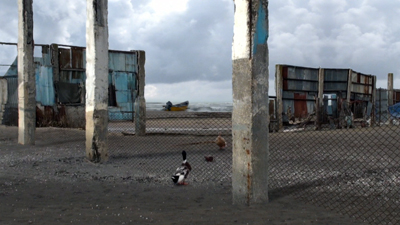
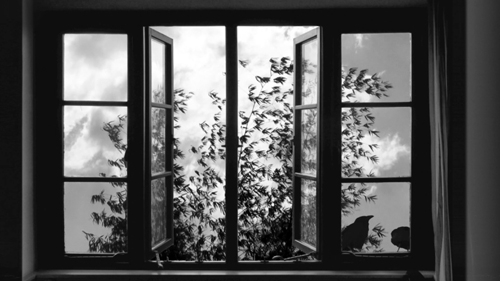
As here, most shots are centered, with the primary action taking place in the central third and sometimes accentuated by an aperture. The apertures often get geometrical. After several open landscape shots, the sixth sequence introduces a major compositional formula–the grid, typically a window, that will striate and cross-hatch our view. It yields a sort of Advent-calendar effect, as we follow birds or beasts hopping from one cell to another.
More variation: Most of the shots are planimetric. The camera is fixed at right angles to a background plane, and figures move horizontally. As the film goes along, though, an oblique angle may show up, as with the duck courtship. Kiarostami applied planimetric framing brilliantly in Through the Olive Trees (1994), but there too it interacted dynamically with less rigid compositions.
Maybe this is Kiarostami’s real Lumière homage. As in the earliest staged films, the single shot is given a simple arc. Figures arrive in the frame, do something, then depart. But sound is tremendously important too. Quiet activity is interrupted by brusque action–too often, a gunshot. More than you might expect, violence provides a spike of action before calm returns.
What holds these crisp, gorgeous shots together? Pairings, for one thing. The creatures we see often become couples. Lions mate, birds scrap with each other, ducks flirt, deer double up, and one gull mourns a fallen companion. Yes, I’m indulging in anthropomorphism. This movie firmly encourages you to try mind-reading Nature’s kingdom.
There’s a trace of surrealism. Some dreamlike images, impossibly hard-edged, are reminiscent of Rousseau. Sheep in a snowstorm huddle while a dog stares out at us and a wolf prowls in the distance. You might think of Paul Delvaux when you see a balustrade that has been built athwart rolling surf, as gulls squat placidly on the poles beyond.

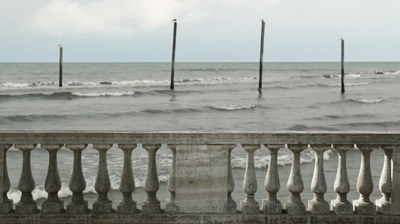
Not least, I think, Kiarostami is responding to one problem of digital cinema–the way that a fixed digital shot makes certain portions of the frame go dead. Photographic film keeps the whole frame nervous, thanks to its teeming granular structure, but image compression simply reiterates “unchanging” information until something moves. When an area doesn’t harbor motion, it looks like a slice of stillness.
Kiarostami exploits this feature of the medium. Again and again, his image seems preternaturally frozen, a nature morte, before it twitches back to life. The effect, to recall his before-and-after idea, is of a still image reanimated. An inert animal seems dead to the world before we detect a breath or a shift of position. The most striking example seems to me the soft silhouette of a bird, a mere lump for seconds on end.
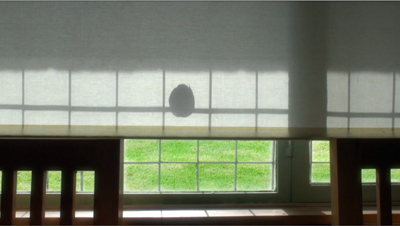
Rudolf Arnheim would have loved the fluid play of Gestalts that this simple composition arouses.
To show you more would spoil the pleasures of this delightful, melancholic, rapturous film. Let’s just say that it ends with a human figure slumped over and turned from us while the wind shakes trees outside a window. Warmth and drowsiness inside, a mild tempest outdoors. But in that same shot, a radiant human face, brought to slow-motion life, turns to us before it surrenders to a kiss. The fact that the face belongs to Teresa Wright, in one of the greatest films of the 1940s, ends Kiarostami’s career on a note of gentle jubilation.
Thanks to Brian Belovarac of Janus Films for help with this entry. Thanks as well to Jim Healy, Mike King, and Ben Reiser of the Wisconsin Cinematheque.
24 Frames is being circulated to theatres and museums; please try to see it on the big screen, where all the little details can pop out at you. Eventually, it will show up on disc and FilmStruck‘s Criterion Channel.
For background on the making of the film, see the Janus press page. Imogen Sara Smith offers a sensitive appreciation in “In Our Time: Abbas Kiarostami’s 24 Frames” on the Film Comment site. For more on Kiarostami, including Certified Copy (2010), see our blog’s tag. I discuss his planimetric approach in Through the Olive Trees in On the History of Film Style, soon to appear on this site in an updated pdf.
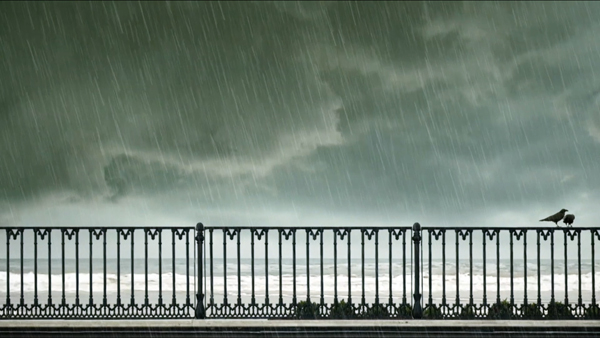
24 Frames.
Weaponized VOD, at $50 a pop
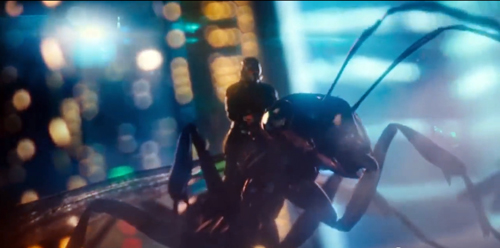
Ant-Man 2: This time it’s personal. Not that it wasn’t before. But now it’s personal and expensive.
DB here:
Sean Parker, the Napster founder who taught everybody that digital piracy means never having to say you’re sorry, has come up with a new killer app. Called The Screening Room, the pitch is catching the eye of an industry that thrives on finding new niches for its product.
Stuff you probably already know
Recall, as background, that Hollywood’s economic model depends on two conditions.
(1) Strong Intellectual Property measures, both technological and legal. (Intellectual is to be taken in a broad sense here. It includes Paul Blart movies.) Encryption is designed to protect DVDs, streaming, and the Digital Cinema Package that plays in your local multiplex. Law enforcement, under the auspices of the Digital Millennium Copyright Act, backs up anti-piracy with fines and jail time.
(2) Price discrimination. The premise of the classic vertically-integrated studio system was that people will pay more to see a movie sooner than other people. Why this is true still mystifies me, but facts are facts. Hence the old system of “runs.” First-run movies demanded top dollar, then second runs were at lower prices, and subsequent runs were still cheaper. When the studios surrendered their theatre ownership, the runs system remained roughly in place, chiefly because most films were platform released, playing the big cities before gradually expanding to the provinces. And network TV was basically the only ancillary market. But wide releases–hundreds or even thousands of copies playing everywhere–became the industry norm as cable, home video, and other technologies came along. The run system was reborn, and price discrimination became much more fine-grained.
Known, confusingly, as “windows,” phases of the film’s life are assigned to various platforms. After the theatrical window, typically 90 days after release, there are windows for airline/hotel access, disc (DVD, Blu-ray), Pay-per-View, streaming, cable, and on down the line. The order of these windows for any one title can vary somewhat, depending on negotiations. Most of them are designed to define price points scaled along a curve: how much it’s worth to somebody to see the movie at intervals after the initial theatrical release. By the time a movie comes to free cable, you’ve pretty much squeezed everything out of it, though the industry relies very extensively on worldwide cable purchases.
The studios depend on the theatrical release, but not because it’s the biggest source of revenue. (For the top films it can yield a lot, of course, but most films don’t recoup their costs in that window.) The theatrical release builds awareness, making it stand out downstream in the ancillaries. Without theatrical release, a film needs a lot of publicity to draw notice. Witness all those films on your Netflix or Hulu menu, all those John Cusack movies you didn’t know existed.
Independent films are increasingly relying on day-and-date release between a mild theatrical run and some form of Video on Demand. Other indie titles, along with foreign ones, are going wholly VOD, and the big players–Netflix, Hulu, and Amazon–are vigorously buying titles and backing new projects against the looming day when the studios will license fewer blockbusters to them.
The studios need the theatre chains as a shop window for their top-tier product. The theatre chains obviously need the studios to keep crowds flowing in. But some parties have flirted with day-and-date theatrical/VOD. Most famously Ted Sarandos of Netflix argued for it in 2013, then had to backtrack a few days later. On the studio end, Universal in 2011 proposed softening the theatrical window by offering Tower Heist on “premium VOD.” The plan was to drastically cut into the theatrical window by making the film available after three weeks of release, for the hefty price of $59.95. Theatre owners threatened to boycott the film, and filmmakers howled in protest. Many feared that it was the thin edge of a wedge that would eventually, through price wars, shorten windows and lower prices–not to mention wreck theatre attendance. The idea was quickly dropped.
No bad idea ever goes away, as we learn from claims that tax cuts create jobs and that we’re just one intervention away from creating peace in the world. Thanks to Parker, we now have Premium VOD in a new guise. That means a new window, with corresponding price discrimination.
Premium VOD, steroidal
Last week, The Screening Room project, sponsored by Parker and entrepreneur Prem Akkaraju, was made public. Brent Lang of Variety outlined the plan circulating among the major players.
Individuals briefed on the plan said Screening Room would charge about $150 for access to the set-top box that transmits the movies and charge $50 per view. Consumers have a 48-hour window to view the film.
To get exhibitors on board, the company proposes cutting them in on a significant percentage of the revenue, as much as $20 of the fee. As an added incentive to theater owners, Screening Room is also offering customers who pay the $50 two free tickets to see the movie at a cinema of their choice. That way, exhibitors would get the added benefit of profiting from concession sales to those moviegoers.
Participating distributors would also get a cut of the $50-per-view proceeds, also believed to be 20%, before Screening Room took its own fee of 10%.
Parker assures all stakeholders that the magic box would assure maximum antipiracy controls.
Since then, developments have been swift. Peter Jackson, Ron Howard, and J.J. Abrams are supporting the plan, while James Cameron is opposing it. The Cinemark and Regal chains, at this point the biggest theatre chains in the country, are against it, but there are hints that AMC, soon to be the biggest chain in the world if it’s allowed to purchase Carmike, might be interested. As for studios, Universal, Sony, and Fox are rumored to be considering the prospect. Once the give-and-take of dealmaking gets under way, there’s no telling what a final arrangement might look like.
What’s transparently clear is the opposition of the art-house sector. Tim League of Alamo Drafthouse issued the first warning on Monday, calling The Screening Room a “half-baked” idea. Today the Art House Convergence, an association of 600 theatres, issued a severe criticism of Parker’s plan. The open letter has been summarized in Variety and The Hollywood Reporter. Indiewire has published it in its entirety, and I do the same, as follows.
The Art House Convergence, a specialty cinema organization representing 600 theaters and allied cinema exhibition businesses, strongly opposes Screening Room, the start-up backed by Napster co-founder Sean Parker and Prem Akkaraju. The proposed model is incongruous with the movie exhibition sector by devaluing the in-theater experience and enabling increased piracy. Furthermore, we seriously question the economics of the proposed revenue-sharing model.
We are not debating the day-and-date aspect of this model, nor are we arguing for the decrease in home entertainment availability for customers – most independent theaters already play alongside VOD and Premium VOD, and as exhibitors, we are acutely aware of patrons who stay home to watch films instead of coming out to our theaters.
Rather, we are focused on the impact this particular model will have on the cinema market as a whole. We strongly believe if the studios, distributors, and major chains adopt this model, we will see a wildfire spread of pirated content, and consequently, a decline in overall film profitability through the cannibalization of theatrical revenue. The theatrical experience is unique and beneficial to maximizing profit for films. A theatrical release contributes to healthy ancillary revenue generation and thus cinema grosses must be protected from the potential erosion effect of piracy.
The exhibition community was required to subscribe to DCI-compliance in a very material way – either by financing through VPF integrators (and those contracts have not yet expired) or by turning to other models which necessitated substantial time and commitment. Those exhibitors who were unable to make the transition were punished by a loss of product. The digital conversion had a substantial cost per theater, upwards of $100,000 per screen, all in the name of piracy eradication and lowering print, storage and delivery costs to benefit the distributors. How will Screening Room prevent piracy? If studios are concerned enough with projectionists and patrons videotaping a film in theaters that they provide security with night-vision goggles for premieres and opening weekends, how do they reason that an at-home viewer won’t set up a $40 HD camera and capture a near-pristine version of the film for immediate upload to torrent sites?
This proposed model would negate DCI-compliance by making first-run titles available to anyone with the set-top device for an incredibly low fee – how will Screening Room prevent the sale of these devices to an apartment complex, a bar owner, or any other individual or company interested in creating their own pop-up exhibition space? We must consider how the existing structures for exhibition will be affected or enforced, including rights fees, VPFs and box office percentages.
A model like this will also have a local economic impact by encouraging traditional moviegoers to stay home, reducing in-theater revenue and making high-quality pirated content readily available. This loss of revenue through box office decline and piracy will result in a loss of jobs, both entry level and long-term, from part time concessions and ticket-takers to full time projectionists and programmers, and will negatively impact local establishments in the restaurant industry and other nearby businesses. How many of today’s filmmakers started their careers at their local moviehouse?
There are many unanswered questions as to how this business model will actually work. The proposed model, as we have read in countless articles, suggests exhibitors will receive $20 for each film purchased. At first glance, an exhibitor may think it represents a small, but potentially steady, additional revenue stream. But how will this actually be divided among the number of theaters playing the purchased title; will exhibitors who open the title receive more than an exhibitor who does not get the title until several weeks later (based on a distributor’s decision); who will audit the revenue to ensure exhibitors are being paid fairly; does this revenue come from Screening Room or from the distributor… these are just a few of the issues yet to be explained.
Similarly, Screening Room promises to give each subscriber two free cinema tickets with each film purchase. Yet to be disclosed is how an exhibitor will recoup the value of those tickets from Screening Room so they can then pay the percentage of box office revenue owed to the distributor of the film. Yet to be explained is who will manage the ticket program details such as location choice, method of purchase, and so on. Will all exhibitors be expected to honor Screening Room free tickets, or will some exhibitors receive preferential treatment over others?
We strongly urge the studios, filmmakers, and exhibitors to truly consider the impact this model could have on the exhibition industry. We as the Art House and independent community have serious concerns regarding the security of an at-home set-top box system as well as the transparency and effectiveness of the revenue-sharing model. Our exhibition sector has always welcomed innovation, disruption and forward-thinking ideas, most especially onscreen through independent film; however, we do not see Screening Room as innovative or forward-thinking in our favor, rather we see it as inviting piracy and significantly decreasing the overall profitability of film releases.
At this time and with the information available to us we strongly encourage all studios to deny all content to this service.
One point of clarification. Some reports have interpreted the paragraph beginning “We are not debating the day-and-date aspect of this model…” as meaning that art-house programmers, managers, and owners are okay with day-and-date VOD. But many Art Housers wish that day-and-date VOD had been strangled in its cradle. For those people, “not debating” doesn’t mean “accepting” or “not disputing.” It means that this is not the occasion for taking issue with that feature of the concept, as the Parker proposal introduces serious problems of its own.
The churn around this proposal is turbulent; stories kept popping up as I was writing the entry. A useful update is here. To keep up to speed, you may want to visit these two summative links, one for Variety and the other for The Hollywood Reporter.
There were, and are, still second-run movie houses. To my joy, Ant-Man, released last summer, has been playing for at least seven months at our second-run house here in Madison. And in 35! Is this a record in modern times? Also, too: My Ant-Man image up top comes from the first film, not the sequel, which doesn’t yet exist. I was just fooling and pretending.
What’s the Art House Convergence? Visit their site here. My visit to their annual confab is recorded here. An updated version is available in Pandora’s Digital Box.
Silent frame rates and DCP: A guest essay by Nicola Mazzanti
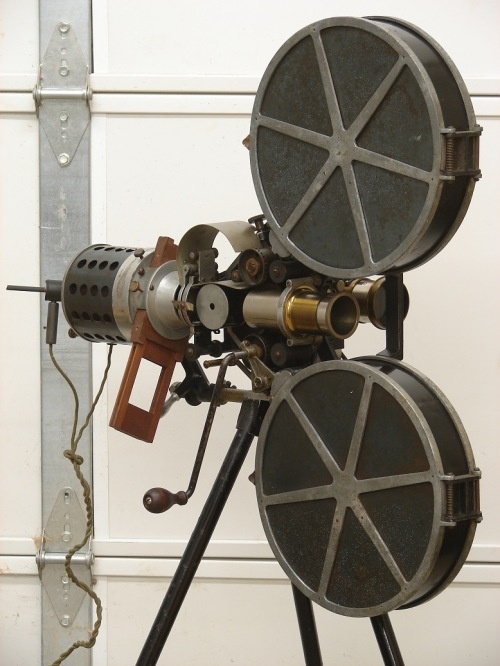
1914 Kinetoscope Victor Model I Silent Film Projector by the Victor Animatograph Co. From Pinterest, identified by Robert Van Dusen.
DB here:
The first thing you learn about silent movies is that they weren’t shown silent. The second thing is that they weren’t shown as fast as we often see them. Screened at 24 frames per second (“sound speed”), many films look rushed and silly. Those were shot at slower frame rates, like 16 fps or 18 fps. By the end of the 1920s, though, some were shot faster than sound, up to 30 fps.
Most archives and some cinémathèques and repertory theatres owned adjustable-rate film projectors, so they could provide a smooth flow of motion for most silent films. But what happened when film projectors were junked and replaced by digital projectors? How could the Digital Cinema Package (DCP), that set of files containing the movie and a host of encryption devices, offer the various “silent speeds”?
I wrote a little about this problem in Pandora’s Digital Box: Films, Files, and the Future of Movies, but afterwards I continued to wonder how archives were coping with the matter once digital conversion was universal. The main problem is that digital projectors don’t currently provide options slower than 24 fps. Both the Hollywood studios that established the digital standard and the manufacturers that implement it simply ignored the history of cinema. Where does that leave archives, which restore, circulate, and show silent films on digital equipment?
So I asked our friend Nicola Mazzanti, Curator of the Cinematek in Brussels, about this problem. Nicola is one of the founders of the Bologna Cinema Ritrovato festival and a major consultant about digital cinema and the preservation of films in the new age. Here’s his typical provocative, pro-active answer.
Why can’t we ever make it simple?
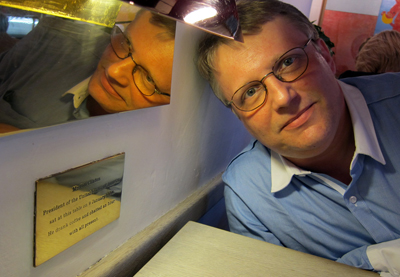
Nicola Mazzanti, Brussels summer 2011. The plaque reads: “Mr. Bill Clinton, President of the United States of America sat at this table on 9 January 1994. He drank coffee and chatted an hour with all present.”
When they try to sell you some new product there is always the sweet thrill that now, finally, all the unpleasantness and the drawbacks, the little things that bothered you in the past, will be gone forever. Then, you realize that the car you bought was a Volkswagen diesel.
With Digital Cinema we were all told that life would be happier once we jumped onto the bandwagon. Distribution of independent films would be easier. All sorts of catalogue titles would flow joyously from the archives to the multiplex. “Alternative content,” including slightly unsharp TV programs and opera with awful close-ups and great sound, would make theatre owners rich.
Many believed the PR. Some of this became true—the usual 10% of it.
Granted, it is easier and cheaper to produce and manage a DCP than a 35mm print. And some classics did find their way to independent or repertoire theatres (the few who survived the digital switch, that is). Several archives, ours included, are enjoying these benefits of the digital switchover. And advertising an 8K or 20K or whatever-K restoration can bring in audiences. But many of us also have tons of perfectly fine 35mm of classics, and they cannot be shown any more. Why not?
*35mm projectors are basically gone.
*Some catalogue owners permit screening only their “restored DCP” (and strictly with English or French subtitles – so much for cultural diversity!).
At the end of the day the number of available classic titles went down, not up.
We could talk about this situation a long time, but let’s home in on one effect of the digital transition. The story I want to tell today is one about those “technical details” that we seem never able to get right. Only the Gods of Cinema know why.
We could talk about screen ratios in this connection, but not today. Today we talk about frame rates.
Toward a standard
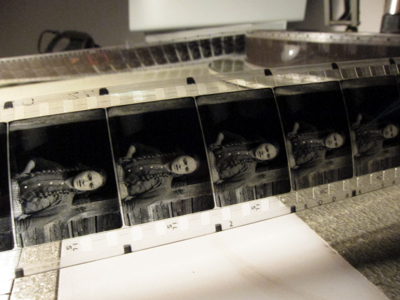
Unlike video files but like a strip of film, a DCP consists of a bunch of individual frames that play nicely one after the other. The number of frames that are played back per second is defined by a simple line of code in an XML file. From the point of view of the technology in the server and the DCP format, there is no reason why we cannot play a film at any rate we like, say, 17fps. (Granted, we can’t really run it at 100fps, because of bandwidth, but you see my point.)
This is not the whole story. First of all, there is a need for a highly standardized system, or we would have the problem of a DCP playing well in one theater and at the wrong speed in the next. Then there are other issues, like the frequency of the projector or the link between the server and the projector. I will not bore you with the details. In sum, technical problems make it impossible to build what I had proposed in the first place: a hand-cranked digital projector. (I was serious.)
Yet all these technical problems could be solved, if we took a rather pragmatic approach. (Here, “pragmatic” is the PC term for “compromise.”) That’s what we archivists did, a few years ago.
At the time of publication, the Digital Cinema Initiative specs described something that did not really exist yet. The technology was only almost there. In the hurry to produce a standard that could work, it was perfectly sensible to start with only two frame rates: 24 and 48 (for 3D).
Some time later though, the issue of expanding the frame rates options came back with a vengeance. The strongest push was coming from European broadcasters who wanted to sneak their boring stuff to the cinema screens and thus called loudly for a 25fps frame rate. Then some filmmakers like Peter Jackson and James Cameron fell in love with the idea of higher rates, like 30fps and 60 for 3D (regardless of how this would balloon production budgets).
Soon the issue became geopolitical, with the Europeans pushing hard for 25fps, mostly because they considered it a victory to impose another standard on the Americans—even though they had lost the digital war as a whole. At the end, the Pandora’s box of frame rates had to be reopened, enthusiastically by some, reluctantly by others.
The Society of Motion Picture and Television Engineers (SMPTE) set up a workgroup where all strong views in favor or against were represented. For the historians among you, it was first called “DC28-10 Ad-hoc Group on Additional Frame Rates” and later “21DC.10 AHG Additional Frame Rates.” We archivists, following our typical model of guerrilla resistance, sneaked onto the panel.
Technically, the archival force was the Technical Commission of the International Federation of Film Archives (FIAF). Actually, it was Torkell Sætervadet and I who were volunteered for this “mission impossible.” Torkell is the world’s greatest expert on projection. He wrote the indispensable handbook for film projection, The Advanced Projection Manual (2006). His FIAF Digital Projection Guide, another must-read, was published in December 2012, the year film projection disappeared.
Torkell and I worked on the frame-rate problem for a couple of years. We mostly revised documents and conducted conference calls late at night (thanks to European time zones). We received some support from the more corporate members of the Workgroup. Many had never heard of lower frame rates, and the concept actually fascinated them. We also benefited from the support of Kommer Kleijn from IMAGO (the European version of the ASC), Paul Collard (then Ascent Media, now Deluxe, a profoundly competent person in the business), and Peter Wilson of High Definition and Digital Cinema Ltd.
The result: We succeeded to a great extent. We convinced the workgroup that silent rates had to be part of digital projection. True, the new standard allows only four other rates: 16, 18, 20, or 22. (To be extra-precise, due to technical issues, 18fps is in fact 18.18181818 and 22 is really 21.8181818.) But four options are quite a lot, and we decided that four were better than none.
So what we called the Archive Frame Rates standard (technically ST 428-21:2011) became part of the SMPTE standards for Digital Cinema. It can be found here. More or less in parallel, other frame rates were allowed: 25, 30, and 60fps. An announcement of this development, with commentary, can be found here.
Hurray! But don’t celebrate yet.
The Archival Frame Rates standard is not a mandatory one. The manufacturers of Digital Cinema projectors never implemented this particular standard in their machines. And archives all over the world never requested it before purchasing a projector. That, today, is the roadblock to proper screening of silent films on adjustable digital projection.
Home-made silent speed
Well, what are the alternatives?
One can produce, for example, a normal DCP at 24fps, and then use a simple piece of software (such as EasyDCP) that allows for different speeds if the DCP is played back from a computer. That feeds directly into the projector, bypassing the projector’s server. It works fine, although you have to try out several frame rates until you find the one that does sit well with the refresh rate of your projector. Otherwise, you might have some artifacts onscreen.
Alternatively, if your film’s chosen silent speed is 16fps you can easily triplicate each frame and create a 48fps DCP which would play in most theatres. 20fps would fit into 60fps, when available. For 18 and 22, however, this is no solution; they are tough frame rates anyway.
The problem with these as hoc solutions is that they are not universal. If an archive ships a DCP to another archive, someone acquainted with that file must be in the booth with a computer. Or you can just send the DCP and hope it works. Either of the two digital solutions can be used safely only in your own theatre, basically.
Hence my interest in pushing for a standardized solution. This is, I’m convinced, the best one for bringing silent films to broader public.
So I haven’t given up hope that one of the manufacturers might realize that the Archival Frame Rates standard would be a nice addition to their option package. Particularly if archives and other potential buyers start asking for it.
Does one speed fit all?
The silent frame rates are more complicated than what I’ve just outlined. Let’s go a little deeper, because it’s interesting.
When we refer to frame rates, we tend to use discrete numbers (16, 18…). But like all things analog, frame rates lay along a continuum. That ranged from 16 (sometimes lower) to 24 (sometimes higher). Anybody who worked as a projectionist knows that even with a modern projector equipped with speed variators, the actual speed can change according to the day of the week and the time of the day, depending on fluctuations on the grid.
The same variations occurred, naturally, with hand-cranked projectors and cameras. And early motor-driven machines used in the silent era also suffered unpredictable variations from moment to moment.
As a result, silent films were shot and screened at different speeds. Even the same film would have fluctuations in frame rates from scene to scene or shot to shot.
The best example I know personally is Murnau’s Faust (1926). When Luciano Berriatua and I were analyzing the existing negatives of the film, we were puzzled when we compared the two negatives from the original production. Each negative was shot with a different camera. As was common in silent film, the filmmakers provided one negative for domestic circulation and one for international distribution. In production the cameras yielded different angles on the scene–sometimes quite similar, sometimes different.
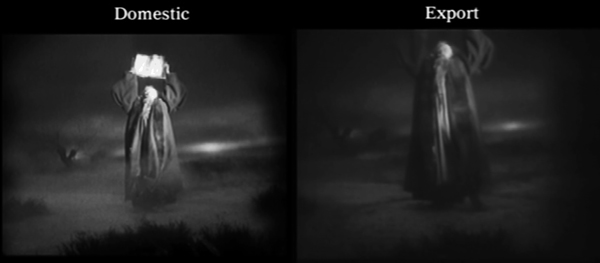
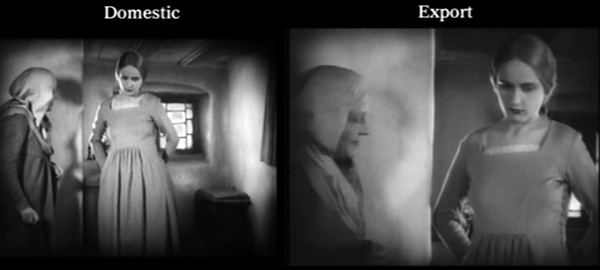
Nevertheless, the action each one captured was identical. The problem is that the two negatives were different in length!
Why? The cameras were operated by two different cameramen, each hand-cranking at a different speed. The assistant cameraman, undoubtedly younger and more enthusiastic, was cranking faster!
Such a disparity was not uncommon. On the contrary, any archivist confronted with the decision about “suggested frame rate” for a given film is confronted with a choice among many different frame rates. What one writes on the cans is always a speed that fits better on average, not necessarily on each individual shot or scene.
And the reality in archives, cinemathques and everywhere else, is this. Most silent film screenings, if not virtually all, are today executed at one speed throughout the whole picture,
There is strong, albeit anecdotal, evidence that projectionists in the silent era were encouraged to crank different sections of a movie at different speeds. Cues in some musical scores suggest that sequences may have been slowed or speeded up. Projectionists may also have chosen to accelerate chases and battles or slow down love scenes. But there’s no way to know to what extent this manipulation was a common practice.
Personally, I think that we are inevitably looking at a silent film with modern eyes. For one thing, we have a completely different approach to continuity. We ask that a restored silent film be perfectly graded, that its tinting and toning be consistent from shot to shot and scene to scene. But when we examine an original print, particularly from the ‘teens, we realize that our modern concept of pictorial continuity did not apply. It seems to have come into play in the late Twenties or later. Our assumptions about continuity make us consider narrative or visual discontinuity a technical error, or at least a trace of a more cavalier attitude towards continuity. I think that discontinuity of technique was often voluntary and sometimes deliberate.
Fun with frame rates
This point applies to frame rates as well. I am convinced that audiences in the silent era were much more relaxed towards something that we now consider so important. Otherwise, it’s difficult to understand why there so many variations in speed within one picture, and between different versions of the same film.
We should remember as well that we cannot really discuss anything “silent” without taking into consideration that it was a long and complex period of fast evolution and change. A film from the early ‘teens and one made ten years later are two different beasts, and different considerations should apply.
So, to return to our main theme: Are frame rates impossible to vary with a DCP? No—in theory.
If you decide to create your DCP at 24 fps, you can easily slow down each scene at a different rate, if you so choose. Alternatively, if the Archive Frame Rates standard were in use, you could apply your four fixed speeds (16. 18. 20. 22) to different sections of the DCP by simply creating separate “reels” and a correct playlist. This would be a bit like a DCP in which certain parts, such as the restoration credits, are actually a separate file to be played before or after the main body of the film.
Have I tried this? No. Could it work? Yes. Is it worth trying? I am not sure. Again, I am afraid we are looking for a precision that was not really part of a film screening in the silent era.
I remain strongly convinced that “old stuff,” including silent film, has an appeal for the public, and not just for few cinephiles. I also strongly believe that an archive like ours in Brussels should offer a wide range of films on DCP for screenings around the world.
In order to show a silent film in the present environment I have to do some nasty things to the images. I have to slow them down by means of software, even if some solutions work well enough to fool some archivists and historians.
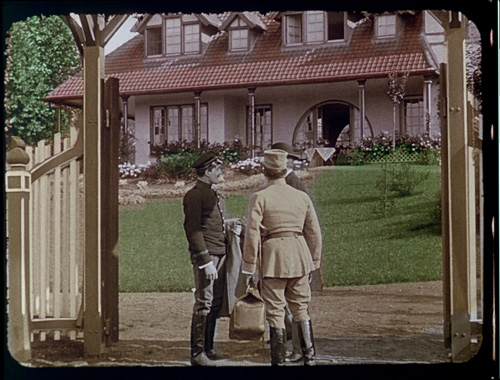
If the alternative is never to show Maudite soit la guerre (Alfred Machin, 1910) to anybody, I’d rather use some tricks to make the screening possible in a modern DCP environment. That’s better than making the film invisible. I am also old enough to remember how horrible it was in the 35mm days when there was really no way to show silent films outside a cinematheque. While we wait for archives and manufacturers to implement the fuller range of options, we must keep our films alive.
So when today a nice audience shows up to see Maudite with a pianist in a multiplex in the middle of Flanders (or Ohio or Nebraska), I admit that I’d be unhappy that I had to trick the speed to 18 fps. Yet I still consider it a victory.
For discussion of silent-film frame rates the standard point of departure is Kevin Brownlow’s 1980 article, “Silent Films: What Was the Right Speed?” Brownlow suggests that many American silent films were intended to be screened at a higher rate than the cameraman had used during filming. See also James Card, Seductive Cinema: The Art of Silent Film (Knopf, 1994), 52-56, and Jon Marquis, “The Speed of Silence” (2011). On the revival of interest in high frame rates, see this 2011 article and Pandora’s Digital Box.
Nicola has written about other aspects of film preservation in the digital age. See his recent contribution to“The Last Picture Show,” a symposium in Artforum (October 2015), 288-291.Tacita Dean and Amy Taubin contribute to this as well.
The magnificent Masters of Cinema DVD set of Faust includes both the domestic German version and the export version, along with a lengthy comparison of them, from which I’ve drawn my illustrations.
Maudite soit la guerre (Alfred Machin, 1910).



