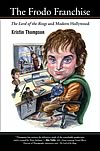
by Kristin Thompson. Berkeley: University of California
Press, 2007.
400 pages, 6 × 9 inches, 12 color illustrations;
36 b/w illustrations.
[go
to Amazon | go to The Frodo Franchise blog]
In our Film Studies program at the University of Wisconsin–Madison, one of our aims is to integrate critical analysis of movies with a study of film history. Sometimes that means researching how conditions in the film industry shape and are shaped by the creative choices made by filmmakers. We also study how filmmakers draw on artistic norms, old or recent, in making new films. This effort to put films into wider historical contexts is something that you don’t get in your usual movie review.
Take, yet again, La La Land. Awards and critical debates continue to swirl around the surprising success of this neo-musical. Two entries on this blog have already considered what the film owes to 1940s innovations in Hollywood storytelling (here) and to more basic norms of movie plot construction and the classic Broadway “song plot” (here). But there’s plenty more to say.
Enter three Madison researchers as guest bloggers. Kelley Conway is an authority on the French musical from the 1930s to the present and author of an excellent book on Agnès Varda (reviewed here). She also gave us an earlier entry on films at the Vancouver Film Festival. Today, in an oblique rebuttal to some complaints about the principals’ singing and dancing in La La Land, she situates Damien Chazelle’s film within a trend toward “unprofessional” musical performance.
Eric Dienstfrey studies developments in acoustic technology and how those have affected the way movies sound. In his contribution, he traces how film’s recording methods shape the auditory texture of the numbers, with special attention to the soft boundary between diegetic (story-world) sound and non-diegetic sound.
Amanda McQueen is a specialist in Hollywood and TV musicals of the last fifty years. Here she considers how La La Land is designed to overcome audiences’ current resistance to “integrated” musicals. She proposes that it offers one way to revive the genre for modern Hollywood.
These experts take the conversation in new directions I think you’ll enjoy. They remind us that a movie coming out today automatically becomes a part of history; it’s just that the history is sometimes hard to discern. Along the way they show the virtues of thinking beyond the talking points put out by the PR machine or circulating endlessly in reviews. In my view, good film criticism involves ideas and information as well as opinions, and all three are on vivid display here.
Amateurism as authenticity
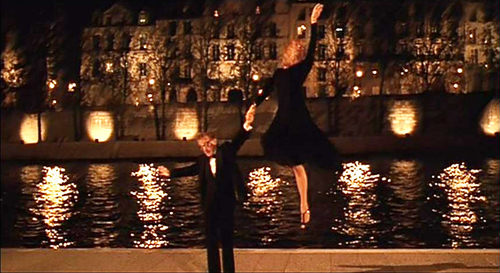
Everyone Says I Love You (Woody Allen, 1998).
Kelley Conway: For me, La La Land‘s references to classical Hollywood musicals and to the films of Jacques Demy provide a major source of its pleasure. (Sara Preciado’s video essay demonstrates the film’s homages) The film’s nods to other traditions remind us of something about the relationship between Hollywood and other national cinemas: mutual influence is the norm.
Directors associated with the French New Wave absorbed and subverted Hollywood genres. Hollywood directors of the late 1960s and ‘70s, in turn, were inspired by the narrative ambiguity and stylistic playfulness of the New Wave. Sometimes, the influence travels full circle in quite a direct way. John Huston’s Asphalt Jungle (1950) directly influenced Jean-Pierre Melville in the making of Bob le flambeur (1956), while Tarantino’s Reservoir Dogs references both Melville’s minimalist gangster films and Hollywood heist films.
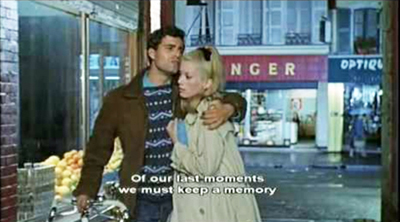
La La Land demonstrates a similarly rich exchange between Hollywood and France. In 1967, Jacques Demy’s Demoiselles de Rochefort paid loving homage to Hollywood films such as Singin’ in the Rain, West Side Story, and Gentlemen Prefer Blondes. Chazelle’s film returns the favor, adopting the dancing pedestrians and location shooting of Demoiselles and the saturated colors, recitative, and downbeat ending of Parapluies de Cherbourg. Chazelle is equally smitten with classical Hollywood; La La Land brims with references to the choreography, costumes, and set design of Shall We Dance (1937), Singin’ in the Rain (1952), The Band Wagon (1953), West Side Story (1961), and many others.
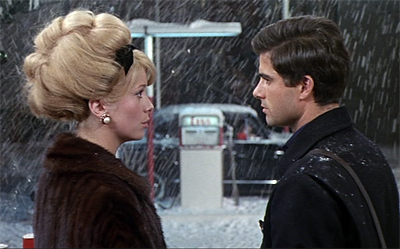
La La Land not only cites the style of other musicals, it also develops and tweaks narrative elements from older musicals in interesting ways. For example, Chazelle’s film, like Demy’s Parapluies de Cherbourg, thwarts the creation of the couple. In Parapluies, the Algerian war initially separates Guy (Nino Castelnuovo) and Geneviève (Catherine Deneuve).
Later, an unplanned pregnancy and her mother’s machinations push Geneviève to marry a wealthy jeweler. At the end of the film, when they run into one another at Guy’s gas station, they exchange only a few perfunctory words; Guy even declines Geneviève’s invitation to meet their daughter. There is neither anger nor the warmth of nostalgia in their exchange; just a delicately drawn emotional distance that leaves viewers feeling wistful.
In contrast, the relationship between Mia and Sebastian fails because they decide to put their romance on hold in order to pursue their dreams. “Where are we?” Mia asks Sebastian after her audition for the film role that will take her to Paris and launch her career. “We’ll just have to wait and see,” he replies. Five years later, he owns a jazz club and she has become an A-list actress, but she is married to someone else and has a child.
When they cross paths at his club, Chazelle supplements Demy’s delicate gas station meet-up with an exuberant fantasy montage, a kind of dream ballet often used in the classical Hollywood musical, in which the couple manages to stay together. The production number is full of invention and energy, combining animation, simulated home movie footage, a trumpet solo, and a tribute to the “Broadway Melody” number of Singin’ in the Rain. As Mia prepares to leave the club, she and Sebastian exchange tender glances and rueful smiles. She departs as he launches into his next song. The love is still there, the film suggests, but Sebastian and Mia chose art over love and they would probably make the same decision today. Different from Demy’s characters, Sebastian and Mia are not victims of implacable destiny, but committed artists. It’s an ending that feels fresh to me.
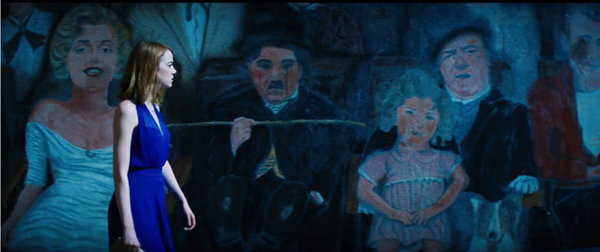
As Amanda McQueen reveals below, La La Land conforms to various trends in the 21st century musical. Consider just one element: song performance. Neither Ryan Gosling nor Emma Stone possesses a powerful, belt-it-out voice. Instead, much of the singing in La La Land is modest, thin, and breathy. Take, for example, the number “The Fools Who Dream,” a climactic moment in the film.
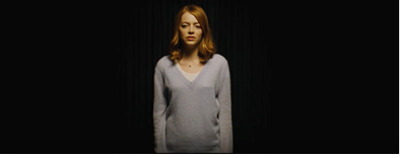
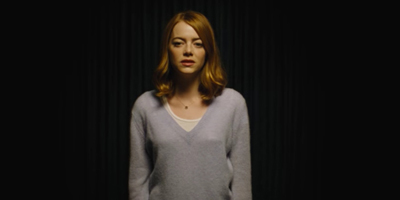
Asked by the casting director to tell a story, Mia begins a poignant monologue (“My aunt used to live in Paris…”) in a quiet speaking voice marked by a bit of vocal fry. She slowly moves into an a capella ballad and, after a few bars, is accompanied by piano. Eventually, the music swells, Mia goes big (“Here’s to the ones who dream…”), and then the song winds back down to the concluding notes, delivered a capella. The staging of the song – black background, circular camera movement, a big swell of emotion, a long take – is reminiscent of the splashy production number in Agnès Varda’s New Wave masterpiece Cléo de 5 à 7. But Stone’s voice reminds me of the wonderfully whispery, intimate singing voices of Birkin, Bardot, and Karina.
As Eric Dienstfrey points out below, the techniques used in the recording of the songs affect our impression of the story world and our sense of the film’s aesthetic achievement. In a Song Exploder podcast about the creation of this song, composer Justin Hurwitz emphasizes the difficulty of shooting this one-shot production number. He explains that Stone performed the song live on set, as opposed to lip-synching it. Hurwitz speaks of his struggle to keep up with Stone while accompanying her on set:
Because I was letting Emma lead the song, I was reacting to her. So a lot of times the piano is a little bit behind the vocal. It sounded like a recital or something where you know the singer is leading it and the piano is there to accompany. That’s what happens when two people make music together; things are not perfectly in sync. That’s why it feels musical and why it feels real and honest.
Directors of many recent film musicals similarly seek to create the impression of aural and emotional authenticity, either through non-professional singing or on-set recording. Woody Allen’s musical Everyone Says I Love You (1996) employs actors who are not professional singers, and Baz Luhrmann’s Moulin Rouge (2001) uses the relatively modest singing talent of Nicole Kidman and Ewan McGregor in a mixture of playback and live recording. Likewise, publicity for Les Misérables (2012) made much of the fact that Anne Hathaway, Hugh Jackman and Russell Crowe performed their songs on the set.
Christophe Honoré also tends to employ singing performances by non-singers. Here, in Dans Paris (2006), a couple breaks up over the phone while singing in a breathy, halting fashion.
For his musical Pas son genre (aka “Not My Type,” 2014), Belgian director Lucas Belvaux cast Emilie Dequenne (of Rosetta fame) as a karaoke-singing hairdresser who woos a philosophy professor. Belvaux insisted that Dequenne avoid taking lessons so as to preserve the imperfect quality of her singing voice. Here, Jennifer (Dequenne) and her pals rehearse the Supremes’ “You Can’t Hurry Love”:
There is, in fact, a broad spectrum of singings styles and capabilities used in contemporary film musicals. In La Captive (2000), Chantal Akerman employs an aria from Mozart’s Così fan tutte. Two women sing to one another flirtatiously from their windows across an apartment courtyard without accompaniment. One woman is a trained opera singer, while the other, the film’s elusive female protagonist (Sylvie Testud), is untutored. The contrast in the women’s voices provides an unexpected pleasure.
The use of the modest singing voice by Chazelle and others to convey emotion and authenticity is quite different, for example, from Alain Resnais’ use of song in On connaît la chanson (aka “Same Old Song,” 1997). Here, fragments of songs spanning the history of twentieth-century popular French chanson are lip-synched by actors. Like Dennis Potter, whose Singing Detective (1986) inspired On connaît la chanson, Resnais foregrounds the artificiality of dubbing. This creative choice works against the traditional commitment in film musicals (and in sound cinema more generally) to the impression of fidelity and authenticity. Here, Josephine Baker’s delicate singing voice is grafted onto the body of a Nazi commander. The humor in non-synchronization loops us right back to Singin’ in the Rain.
Directors of contemporary film musicals did not pioneer the use of the untrained singing voice. As Jeff Smith reminded me recently in an email, “There is a long tradition of celebrating the raw, unpolished singing styles of rock and rollers, dating back at least to the time of Mick Jagger, Bob Dylan and Roger Daltrey, and using those marks of authenticity as a means of distinguishing them from pop performers.” Unlike the musicians of rock and punk, though, Chazelle doesn’t seem particularly interested in denigrating pop music. He clearly loves John Legend’s musical performances in La La Land and those 1980s pop tunes he pretends to mock.
Many have criticized La La Land’s singing, but in fact, Chazelle is operating well within the tradition of employing imperfect vocalization to connote realism and to convey emotional power. The modest singing voices add another dimension to Chazelle’s participation in the ongoing conversation between Hollywood and French cinema.
La La canned vs. La La live
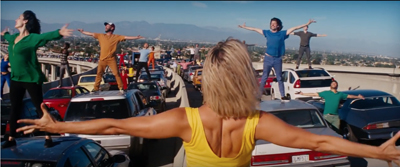
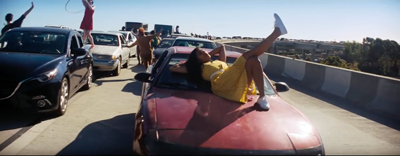
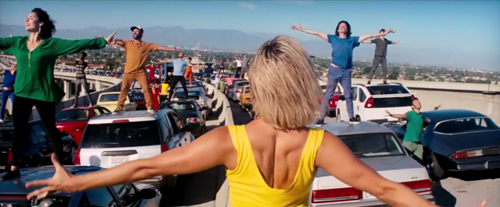
Eric Dienstfrey: I agree with Kelley’s observations about the remarkable number of cinematic references in La La Land. For example, the opening number, “Another Day of Sun,” embeds a host of influences within Chazelle’s mise-en-scène. For me, this exit-ramp romp immediately recalled the ferry ride in Jacques Demy’s Les Demoiselles de Rochefort and the traffic jam in Jean-Luc Godard’s Weekend. Amanda McQueen, below, notes how the scene reminded her of the films of Vincente Minnelli. And as Chazelle himself indicates, one might even see traces of Rouben Mamoulian’s Love Me Tonight and Alfred Hitchcock’s Rear Window.
Thanks to such references, we can consider the significance of La La Land’s numbers as extending well beyond Justin Hurwitz’s melodies and Benj Pasek’s and Justin Paul’s rhymes. The film’s allusion to Rear Window, for instance, may encourage audiences to compare the onscreen chemistry between Emma Stone and Ryan Gosling to that of Grace Kelly and James Stewart. To catch these subtle references, filmgoers need to pay close attention to the camerawork, the staging, the costumes, and even the choreography. Similarly, we can discover new layers of meaning by analyzing its songs and their sound designs.
How many ways are there for sound technicians to record and mix a musical number? Quite a few, it seems. One basic way is to record the vocal performances live on the set. During the earliest years of talking pictures, this technique often required the presence of an on-set orchestra to provide accompaniment from behind the camera. More recent strategies, however, merely ask singers to wear small earpieces that play pre-recorded accompaniment.
Another option is for technicians to record the vocal performances in an acoustically controlled studio and then mix these recordings into the final film. Sometimes technicians will record the studio performance before filming, and then require actors to lip-synch to playback on the set. Other times, technicians will ask the singers to perform the song live on the set, but then use a studio recording in the final mix due to unforeseen circumstances.
In some instances, the set might be too noisy to record a clean vocal performance, or the dance number might be so physically demanding that the actor can’t help but introduce heavy breathing and other vocalized efforts. A live recording may be ideal, but the studio recording is often the more practical solution.
The musical numbers in La La Land display both recording techniques. Some were recorded live—such as “Fools Who Dream,” which Kelley discusses above—and some were recorded in a separate studio—such as “Another Day of Sun.” Steven Morrow, the film’s sound mixer, suggests that each choice was informed by various practical concerns. The acoustics along the exit ramp, for instance, reportedly made it too difficult to record live singing.
Such concerns even led to strange incidents where a single song would contain a mixture of both live and studio recordings. Morrow notes how “Someone in a Crowd” relies upon Emma Stone’s live recordings, while studio recordings were used for the other actresses. This decision to blend together live and studio recordings can become a storytelling device—say, if the director wants to create a contrast between two or more characters—but for most songs, the choice to use either technique is generally determined by shooting conditions and budgetary considerations.
Still, can the acoustical differences between live and studio recordings function beyond practical filmmaking needs? It is worth noting that both techniques parallel another cinematic binary: diegetic sound and non-diegetic sound. Diegetic sound commonly refers to all the dialogue, effects, and music that emanate from sources within the film’s setting, such as radios and footsteps. Non-diegetic sounds are those added to the story world as a form of commentary, such as a moody orchestral score. As many film scholars rightfully argue (here and here), the diegetic/non-diegetic binary is not perfect, but for the vast majority of films the distinction remains a useful initial categorization for sound’s narrative functions.
Musicals are an exception. In his groundbreaking study of Hollywood musicals, theorist Rick Altman argues that the clean distinction between diegetic and non-diegetic sound breaks down during moments when characters burst into song. Specifically, the interaction between diegetic singing and non-diegetic musical accompaniment lifts characters out of the story world toward fantastic settings. Consider Elvis Presley’s performance of “I Can’t Help Falling in Love with You” from Blue Hawaii.
Presley begins the song while accompanied by a small on-screen music box. But during his performance something interesting happens: the sound of the music box fades into the background while the drums and guitars of a non-diegetic orchestra magically appear. For Altman, this audio substitution is critical to understanding how the musical genre operates:
We have slid away from a backyard barbecue in Hawaii to a realm beyond language, beyond space, beyond time. […] We have reached a ‘place’ of transcendence where time stands still, where contingent concerns are stripped away to reveal the essence of things.” (66)
In other words, this dissolve from the music box to the orchestra tells us that Elvis… well… has left the building. He has transcended the purely diegetic universe of the film’s story-world reality, and has temporarily entered a non-existent space that is supra-diegetic fantasy.
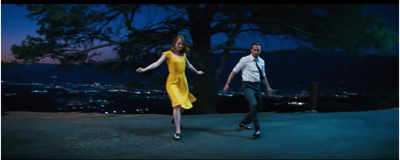
Altman’s observations apply to La La Land as much as they apply to Blue Hawaii. When Mia and Sebastian sing “A Lovely Night” while searching for their cars, the non-diegetic accompaniment fades in and the two characters interact with the music through song and dance. In turn, Mia and Sebastian transcend Los Angeles and enter a supra-diegetic universe. This diegetic boundary crossing is punctuated further by their stroll through Hollywood’s hills, a vantage point which allows Mia and Sebastian to literally look down upon the city as they chart this transcendence.
Yet La La Land is more than just a pastiche of earlier musical traditions. It also demonstrates how different recording techniques can be thematically integrated within the film’s narration. Here we might once again compare the playback of “Another Day of Sun” to the live recording of “Fools Who Dream.” Both numbers are similar in their reliance upon non-diegetic musical accompaniment, yet the production process creates contrasting narrative implications.
“Another Day of Sun” was recorded in a studio, and the acoustical details of this studio environment—namely frequency response, microphone placement, reverberation time, and overall cleanliness of the recording—are remarkably distinct from the those of an outdoor location. These subtle textural differences produce the sense that the performers’ voices have left the diegetic space of the freeway and traveled to an unseen studio for the song’s duration.
“Fools Who Dream” has the opposite effect. It was recorded live, and throughout the scene the acoustical details that shape Stone’s voice never really change. The sonic signature of the room remains audible in her vocals from the time she introduces herself to the casting directors, to the time she finishes singing. As a result, Mia does not transcend the story world; instead, the non-diegetic piano and orchestra seem to materialize inside the room.
These two examples demonstrate how alternative recording techniques offer filmmakers different ways for characters and accompaniment to interact. Studio recordings specifically lift the vocals up toward the space of the non-diegetic accompaniment, whereas live performances can pull traditional musical accompaniment down into the story world. Both techniques defy the norms of realism, yet their production differences render each vocal performance with unique narrative weight. And for La La Land—a musical about two artists who wish to become famous stars while simultaneously remaining pragmatic and down-to-earth—the ways Mia and Sebastian interact with musical accompaniment can reveal if and when the characters are grounded in reality or lost in fantasy.
As criticism surrounding contemporarymusicals would suggest, Hollywood routinely favors live performances over other techniques. Live performances are not only valued for being more authentic, they are harder to record and, thus, a more prestigious cinematic accomplishment. This preference for live recordings, however, need not dictate how all musicals are made. A creative integration of both live and studio recordings can open up storytelling possibilities for the sound technicians and directors who wish to innovate within the musical genre.
Yes, I know: it seems unlikely that many filmmakers will play with these acoustical parameters in their movies. Nonetheless, La La Land’s sound design points to the possibility that at least a few musicals will create rewarding experiences not just for visually minded historians, but for audiophiles as well.
A musical without quotation marks
Amanda McQueen: Much of La La Land’s critical reception has focused on its relationship to film musicals of the past. As Kelley, Eric and David have all noted, much of the film’s meaning derives from its citation and revision of film and stage musical traditions. But what’s the status of La La Land as a musical in the 21st century? How does this shape the film’s approach to the genre’s conventions?
The early 2000s witnessed a minor revival of the Hollywood live-action musical, a genre that had been considered box office poison for several decades. But despite the renewed interest in musicals, producers worried that contemporary audiences no longer accepted one of its key conventions: the integrated number.
Integration commonly refers to those moments when characters spontaneously burst into song to express feelings or advance the plot, usually accompanied by sourceless music, as Eric points out above. Not all musicals have integrated numbers, but many critics and scholars assume that integrated musicals constitute the genre’s core. Audiences, however, were assumed to find this particular break with cinematic realism both antiquated and alienating. Moviegoers would suspend disbelief to accept lightsabers, superheroes, and wizards, but someone walking down the street and singing—no way!
Fear of the integrated number has caused many contemporary musical films and television shows to distance themselves from this convention. Some musicals ensure the song-and-dance numbers are otherwise motivated. In Chicago and Nine (2010), all the songs are figments of the characters’ imaginations, while Dreamgirls (2006) transformed the integrated numbers of the Broadway original into diegetic stage performances.
Other musicals, including Enchanted (2007), The Muppets (2011), Annie (2014), and Pitch Perfect 2 (2015) opt for comic reflexivity, using integrated numbers to comment on their very artifice. The campy medieval musical Galavant (ABC 2015-2016) is perhaps the epitome of this technique. The lyrics of the second season’s opening number, for instance, address the series’ unexpected renewal (“Give into the miracle that no one thought we’d get”); the excessive repetition of the theme song in the previous season (“It’s a new season so we won’t be reprising that tune”); and a perceived lack of motivation for musical performance (“There’s still no reason why we bust into song”). The four-minute ensemble song-and-dance concludes with Galavant (Joshua Sasse) commenting with satisfaction, “See, now that was a number!”
Over the years, concern over audience acceptance of the integrated musical seems to have abated, particularly for Broadway adaptations. But it hasn’t disappeared, as La La Land’s critical reception makes evident. Articles on the film have routinely stressed that musicals are “an extinct genre,” that “some moviegoers may, no doubt, feel a little tentative about the genre,” and that musicals are no guarantee at the box office. Manohla Dargis’ review in The New York Times, aptly titled “‘La La Land’ Makes Musicals Matter Again,” discusses this issue at some length. She explains how “For decades, the genre that helped Hollywood’s golden age glitter has sputtered,” reappearing only in Broadway adaptations or diluted (read, non-integrated) forms, and that as a result, “Musicals have been for kids, for knowing winks and nostalgia.”
What perhaps feels so novel about La La Land is its sincere approach to the “old fashioned” integrated musical form. As writer/director Damien Chazelle told Hollywood Reporter:
On the screen, there is this big gap right now that you have to cross to do a musical. At least an earnest musical, where you’re not immediately putting quotation marks on it.
With its opening number, “Another Day of Sun,” La La Land unabashedly announces that this is an integrated musical, and it never qualifies that position. There are no cheeky winks at the camera, no characters asking why they’re singing to each other, and most of the songs function as pure expressions of thoughts and feelings. Mia and Sebastian are real people in a modern city, who just happen to be singing and dancing and falling in love. For Chazelle, “Another Day of Sun” functions as “a warning sign to people in the audience. If people are not going to be comfortable with it, they’ll leave right away.” La La Land thus almost dares audiences to accept and celebrate this unrealistic cinematic convention, and for a 21st century musical, that’s a somewhat rare approach to take.
Yet La La Land has its own methods of rendering the integrated musical acceptable for contemporary audiences. First, there is its obvious nostalgia. La La Land’s visual style—35mm, CinemaScope, long takes and long-shots scaled to choreography—and its many allusions create a critical distance, an awareness that this type of cinema is a relic of another age. It’s not so much a throwback to studio-era musicals as it is a modern version of the auteurist musicals of 1970s New Hollywood (most of which were also resistant to the traditional integrated number). Indeed, La La Land has been compared to Martin Scorsese’s New York, New York (1977) or Francis Ford Coppola’s One From the Heart (1981).
I think it’s also akin to Ken Russell’s The Boy Friend (1971), which has a lighter tone and takes a similar approach to its citations. Russell updates Busby Berkeley’s kaleidoscopic stagings with color and widescreen, and Chazelle updates Vincente Minnelli’s sequence-shots with a Steadicam. Like The Artist (2011), which tutored modern viewers in the conventions of silent cinema, La La Land is an affectionate lesson in a mode of filmmaking that is not likely to return.
Then there’s the ending, in which Mia and Sebastian find success in their artistic pursuits, but only because they have parted romantically. As Kelley explains, La La Land owes its bittersweet ending to Jacques Demy’s Umbrellas of Cherbourg (1964). This gives the film a melancholy at odds with the studio era Hollywood musicals it so frequently references—films like An American in Paris (1951) and Singin’ in the Rain (1952), in which the couple lives happily ever after. By eschewing the union of its romantic couple, La La Land tempers the artifice of the integrated musical with a more realistic narrative, one that acknowledges that life does not always work out exactly the way we want. Such a conclusion is far more typical of American independent cinema than it is of the classical Hollywood musical.
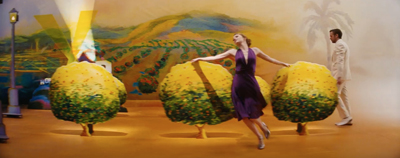
Significantly, La La Land does give us a traditional happy ending, but through the device of the dream ballet. One of the most overtly stylized conventions of stage and screen musicals, dream ballets generally function to convey character subjectivity, and they allow for especially abstract mise-en-scène. La La Land tackles this generic trope with the same sincerity it displays in its handling of integrated numbers.
Set to a medley of the film’s musical themes, the sequence functions much like that in An American in Paris, arguably the most famous cinematic dream ballet. The sequence recaps the characters’ emotional journey and romantic relationship entirely through dance. Yet while the ballet in Paris shows a stylized version of what has actually occurred, La La Land’s presents an alternative reality where Sebastian and Mia stay together while also achieving their artistic goals. As Owen Gleiberman puts it in Variety, this “the very movie we would have been watching had ‘La La Land’ simply been the delectable old-fashioned musical we think, for an hour or so, it is.” In the end, though, the film affirms that Mia and Sebastian’s happily-ever-after is only a fantasy; when the dream ballet ends, the two part ways.
The first time I saw La La Land, I found myself daring Chazelle to subvert my expectations and use the dream ballet as a device to create a happy ending. Instead of concluding the fantasy sequence with a return to reality, I hoped the dream ballet would function to re-write the narrative. To my mind, turning the imagined world of the dream ballet into the characters’ actuality would have been an interesting twist on how this device usually functions. At the same time, it would have more radically embraced the integrated musical tropes the film otherwise celebrates.
Yet I suspect viewers would have found this ending contrived, and it would have been. La La Land’s critical and commercial success, I think, has depended on it keeping the model of the classical Hollywood integrated musical slightly at arm’s length. The film’s unique combination of nostalgia and realism is clearly resonating with modern audiences, but it’s also in keeping with the larger approach to the integrated musical in the contemporary moment. As long as film musicals are considered risky properties, certain forms of the genre will likely have to be relegated firmly to the past.
Kelley Conway is a Professor in our department and winner of a Distinguished Teaching Award. She has written Chanteuse in the City: The Realist Singer in 1930s French Film (University of California Press), Agnès Varda (University of Illinois Press), and essays on classical and contemporary French film. She is currently at work on a book about postwar French film culture.
Eric Dienstfrey is a doctoral candidate in our department. His dissertation traces how theories of acoustical fidelity shaped stereophonic technology from 1930 to 1959. Eric’s research interests include silent film musicians and the cultural history of dictaphones. He recently received the 2017 Katherine Singer Kovács Essay Award from the Society for Cinema and Media Studies.
Amanda McQueen, a Faculty Assistant in our department, finished her Ph.D. in 2016. Her dissertation is titled “After ‘The Golden Age’: An Industrial History of the Hollywood Musical, 1955-1975.” It examines how the breakup of the studio system helped create several musical cycles, each aimed at a niche audience, and each designed to prolong the genre’s viability in the new marketplace. Apart from studying musicals on stage, screen, and TV, Amanda’s interested in media industries, film technologies, and genre theory and history.
Thanks as well to Jeff Smith for his comments on these entries. Watch for his annual blog entry (first two, here and here) analyzing the Oscar-nominated songs and scores.
Dale said, “Right there’s where Donald Trump lives.” Elvin said, “Is that right? Who’s Donald Trump?” Before they ate and were driving around West Palm, Dale had pointed out the building Barnett Bank was in, its shiny black glass rising above old structures around it, and said, “You know what they call that building? Darth Vader.” And Elvin had said, “Who’s Darth Vader?” Dale could see how he might not have heard of Donald Trump in prison, but everybody in the world knew who Darth Vader was. Either one, though, was hard to explain, so Dale let it go. Elvin wasn’t interested anyway.
Elmore Leonard, Maximum Bob (1991)
DB here:
I’ve wrestled with this blog entry for some weeks; at one point it was 15,000 words. I wanted to, once but maybe not for all, get some political thoughts off my chest. But events in Washington, DC, where I’m in residence for the next few months, have rolled along so fast that every day supplied a whole new set of actions to denounce. Yesterday: President Trump™ brings his unique comedy stylings to Black History Month. Today we get letting churches talk politics. Me, I’m in favor of taxing churches and in exchange letting them say anything they want.
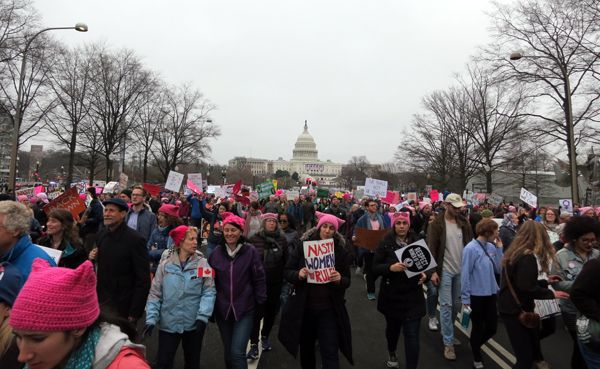
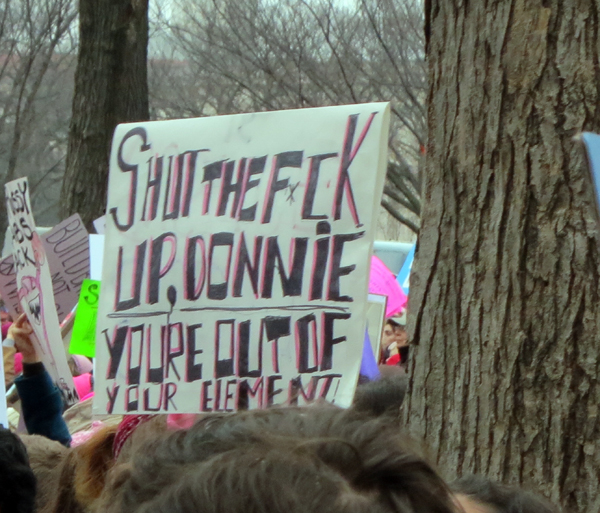
In sum, my mental state matches one placard at the Women’s March: “All my objections to Trump won’t fit on one sign.”
My long-form draft of this entry railed at the crumbling of the Democratic party and its failure in its first duty, to protect us from authoritarianism. It lamented Bill Clinton’s lack of personal honor (erections have consequences), which led him to cling to office rather than resigning, turning things over to Gore, and possibly retaining the White House in 2000. This admittedly somewhat rantish draft pointed out that the Republicans’ unjustified invasion of Iraq led, rather directly, to the rise of Middle Eastern terrorism and the flood of refugees, a turmoil which the Republicans have in turn exploited endlessly for their benefit.
My epic draft noted the spectacle of Republican candidates whom Trump insulted scrambling to do his bidding and waving off conduct that they wouldn’t tolerate from their swaggering teenaged sons. And the saga suggested that the Democrats, for all their weaknesses and equivocations and compromises and corruption, do harbor some number who want to widen the circle of people who deserve to be treated with dignity.
The long version also turned a cold eye toward the recent wave of journalists’ expeditions from the Coasts to report on and empathize with the Forgotten American. Nobody from the boondocks I lived in for eighteen years (an in-depth longitudinal study) ever evinced any curiosity about the ideas of the liberals they despised. Frequent visits back home showed no further stirrings of curiosity about the world, just as today I see no efforts to empathize coming from Trump’s jeering mobs. By contrast, many liberals strive to widen the circle of understanding, and this allows them to be played for suckers again and again.
So I feel that I just have to stop fiddling with the damn thing and boil it down to something digestible and for the moment. In my view, President Trump™ is openly laying the groundwork for a corrupt, authoritarian state. He is doing so with the complicity of both establishment and Tea Party Republicans, who have all long ago given up any vestige of principle. Wholly interested in holding absolute power, they are prepared to back up the most trivial, baldfaced lies and the most outrageous violations of liberty and decency.
Trump has created within the White House a cadre of supplicant–Svengalis who will steer him toward policies I can only regard as despotic. In the first days of his regime, the strategy is clear. He will occupy the forestage, gibbering and gesticulating to grab the news cycle, while behind the scenes a blitzkrieg of intolerance, repression, fear, kleptocracy, and pain will roll across our land. He’s a petty tyrant, but people will be so distracted by the pettiness that they’ll forget he’s a tyrant.
All this has been said, and better, elsewhere. It’s being said every day, in plainer and plainer language. Once H. L. Mencken could write:
A Washington correspondent is one with a special talent for failing to see what is before his eyes. I have beheld a whole herd of them sit through a national convention without once laughing.
That held more or less true until a couple of months ago, when we started to see the press call lies lies. Every morning brings out more writers willing to point to a naked emperor. Most surprising to me is arch Neocon David Frum, with whom I’ve never agreed on anything, writing an eloquent, wide-ranging critique everyone should read.
A president who plausibly owes his office at least in part to a clandestine intervention by a hostile foreign intelligence service? Who uses the bully pulpit to target individual critics? Who creates blind trusts that are not blind, invites his children to commingle private and public business, and somehow gets the unhappy members of his own political party either to endorse his choices or shrug them off? If this were happening in Honduras, we’d know what to call it.
Coup is now the most important four-letter word in American politics. Arguably, the thing began when the Republicans refused to follow custom and launch hearings on Obama’s Supreme Court nominee, Merrick Garland. It intensified during the campaign cycle, crystallized during the election, and began to show itself fully during the first couple weeks of President Trump™.
If anything shows the failure of America’s two-party system, it’s the feeble response to the Republicans’ power grab. (Democrats are relentless only in asking for donations.) The analyses of Thomas Frank and Chris Hayes and Matt Taibbi ring true enough; the Clinton machine took huge swaths of the population for granted and saw its ultimate constituency as the plutocrats and the meritocracy.
Still, the bulk of the blame lies with the voters. Granted that many suffer from the economic inequality created by globalization. It’s not their fault that the US lacks an educational system and a welfare state capable of absorbing the shocks of such massive technological change. But many Trump voters are not disadvantaged. A Gallup poll found that support for Trump was strongest in areas less damaged by globalization. (Racial bias seems to be a stronger correlative.)
Whatever the causes, there’s no blinking the fact. Between a demagogic voluptuary and a candidate whose moral obtuseness was matched by tactical incompetence, sixty-two million American adults chose recklessly. They acted in a way that was demonstrably mischievous, stupid, ignorant, selfish, bigoted, cruel, and hateful.
Some may be having second thoughts, but millions still rejoice in the looming whirlwind. For the rest of us, resistance on every front is the only option.
But you go crazy if you sink into every news cycle. Most of us need time off from anger and marching and signing petitions and calling Congresscritters. Cinema still matters. We’ll be back with film-related conversation soon.
Women’s March (Washington DC, 21 January 2017). Photos by DB.
The formal method is fundamentally simple. It’s the return to craft (masterstvo).
Viktor Shkovsky, 1923
DB here:
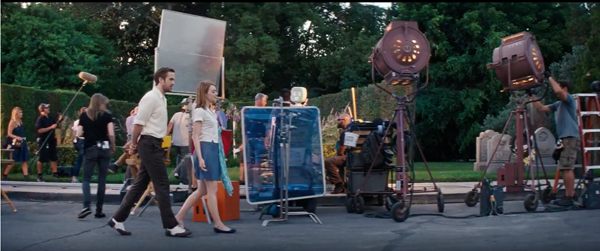
Not how it was made. We’ll get “The Making of La La Land” as a DVD bonus, and there are already behind-the-scenes promos.
No, this is about how it is made.
On this site, we mostly practice a criticism of enthusiasm. We write about what we like, or at least about films that intrigue us from the standpoint of history or aesthetics. Sometimes, what interests us intersects with a current controversy. Take La La Land.
Some of my cinephile friends disapprove of it. It swipes too much, they say, from classic studio musicals and the work of Demy, and it doesn’t live up to either model. But tastes change. I remember when the classic musicals that we venerate were considered fluff, and I recall how Demy’s films, especially Les Demoiselles de Rochefort, were held at arm’s length by many of my 60s pals. “He tries too hard,” a friend remarked. Some say that about Chazelle, and perhaps in a few decades La La Land will be remembered fondly.
In any case, I’m not aiming to denounce this ambitious, agreeable film. I’m more interested in asking how La La Land accords with the craft of studio musicals and Demy’s efforts. I’m also interested in tracing its affinity with a third tradition of song-and-dance: the Broadway show.
Along all three dimensions, I hope to take Shklovsky’s advice and ask about craft. La La Land is both derivative and original. Actually, most movies are, though in various proportions.
The song plot
If we want to understand how film form and style work, we can’t neglect the nuts and bolts of moviemaking. In trying to achieve particular effects, filmmakers have created craft traditions, favored options bounded by loose limits. Mostly these traditions grow up intuitively, as solutions that just feel right. In any case, behind the cluster of preferred practices we can often find principles of design and execution that can be made explicit.
A lot of what Kristin and I have been doing since the 1970s consists of trying to bring to the surface filmmakers’ underlying habits and conventions. Those help shape how viewers respond to films. We aren’t maniacs for systematization—art can’t be utterly systematized—but as analysts we want to discern patterns of story and style, what earlier entries have called schemas. And as historians we want to understand how patterns of story and style get passed down from earlier films, and passed around among contemporaries.
For example, some narrative schemas of American studio cinema are what I aim to lay bare in Reinventing Hollywood: How 1940s Filmmakers Changed Movie Storytelling. Without invoking the big guns of theory, I try to point out how craft traditions of plotting and narration got recast in those crucial years. A recent entry hereabouts tries to show the legacy of those years surfacing in current releases, La La Land included.
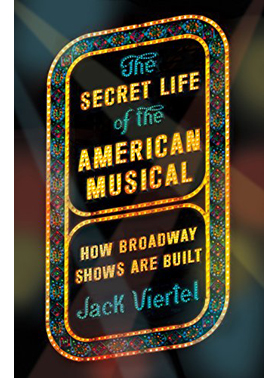
Other researchers work along these lines, and not just in film. Art historians have been doing this sort of research for a long time, as have musicologists. A more recent example in the domain of theatre aesthetics is Jack Viertel’s exhilarating book The Secret Life of the American Musical. Its subtitle, How Broadway Shows Are Built, is a throwback (inadvertent, I suppose) to Shklovsky’s essay “How Don Quixote Is Made.” The impulse is the same: to x-ray an art work, to reveal some fundamental principles of construction, while also doing justice to its revisions of inherited traditions.
What Viertel brings to the table is the “song plot,” a sequence of musical numbers that has become conventional in Broadway shows. Often, of course, many numbers enhance the dramatic action, but sometimes they’re inserted for a change of mood or a burst of energy. The song plot both echoes the action plot and provides its own arc of pleasure, with musical numbers that may be more or less extraneous to the main action.
What makes Viertel’s anatomy of shows interesting is that even the narratively “irrelevant” numbers tend to occur in the same spot from show to show, and they have a common emotional quality. They aren’t just “spectacle interrupting narrative,” to use a film-studies commonplace. As spectacle, they have their own pattern, and that’s gratifying alongside the pleasures of the story. Viertel’s macro-schema is probably known to many insiders and fans, but it was all news to me, and it helps me understand the musical spine of this recent movie.
Hence today’s title, of an entry that is 100% spoiler-filled. I’ll consider La La Land as a classically constructed film. Then I’ll test its “making” against Viertel’s template of a musical. I conclude with some remarks on how analyzing these patterns highlights the movie’s variance from adjacent traditions.
From meet-cute to remeet, and re-remeet
Start with the Hollywood plot structure. Kristin has argued that even though mainstream American screenwriters sometimes claim to be following a three-act plot model, their craft practice often pushes them to a four-part schema. (She has discussed this here, and I’ve given examples here and here.) Specifically, the long second “act” is usefully thought of as two separate parts split by the film’s midpoint.
The conventional plot pattern consists of a Setup in which protagonists define their goals; a Complicating Action that redefines those goals; a Development that muddles, delays, or intensifies the goals; and a Climax that resolves them. These parts typically run 20-30 minutes, and films of varying lengths, long or short, can include more or fewer parts than these four. In most cases there will also be an epilogue or “tag.”
La La Land runs almost exactly 120 minutes, not counting the opening logos or the end credits. The Setup (running 25 minutes) establishes Mia and Sebastian as dual protagonists, caught in the midst of the initial traffic jam.
We then follow Mia through her day as a barista, her failed audition, her return to her apartment, and her agreement to go out to a networking party with her flatmates.
A flashback returns us to the traffic jam, and now we follow Sebastian to his apartment, where in a parallel to Mia’s day he makes coffee, rummages through unpaid bills, and talks with his sister. He goes on to his job as pianist playing Christmas music at a cocktail bar. Mia, who’s come in by accident, stands before him, moved by his switch into improvised jazz. But Sebastian is fired, and disgruntled, he coldly bumps past her.
The Complicating Action starts after Mia fails another audition. She goes to a pool party and sees Sebastian in the ensemble. She teases him, and they leave the party together. Although there’s friction between them, they start a friendship. They confess their dreams: she wants to be an actress and he wants to start a club that hosts classic jazz.
Mia absentmindedly agrees to go to a movie with him on a night she has a date with her boyfriend. But she’s haunted by Sebastian’s music and she finds him at the theatre, watching Rebel without a Cause. They go to the planetarium featured in the film and kiss. At the end of the Complicating Action, about 60 minutes in, Mia resolves to write a one-woman show for herself.
The Development is the stretch where backstory is introduced, obstacles create delays, and subplots intertwine with the main action. Since in La La Land the romance seems solid (there are no love rivals), and there are no secondary characters of consequence, the film is devoted to the other major plotline: the obstacles encountered in our couple’s quest for success. Those in turn affect the romance.
A Development also typically relies on montage sequences, and we get plenty here. Mia works on her show, while Sebastian is offered a chance to join his friend Keith’s combo. To stabilize his life with Mia, he takes the job.
Soon he’s on tour, and the band finds some success, though he’s compromising his principles. “Do you like the music you play?” Mia demands, and he evades answering. The crisis comes when a photo shoot delays his arrival at her premiere, which is a fiasco.
Mia declares: “It’s over”—meaning both her career and their affair. She goes back home. We’re at the 90-minute mark.
We’re ready for the Climax, which is often driven by a deadline. Sebastian takes the call asking Mia to audition, and he rushes her back to it. She gets the part, and the two of them decide to wait and see how their relationship develops.
Five years later, Mia is now a success. This seems an abrupt, even anti-climactic turn of events, coming only eleven minutes after the Climax started. Apparently, despite their declarations of undying love, the couple’s romance was never rekindled. We see Mia visit the café where she was once a barista and return to her hotel and her husband and daughter. Her activities are crosscut with glimpses of Sebastian alone in his apartment. In effect, this passage balances our alternating introduction to the couple during the Setup.
Mia and her husband drop in on a club that turns out to be Sebastian’s. Mia and Sebastian eye each other longingly. Mia watches him play Their Song, and this launches an apparently shared fantasy of an alternate-world climax and resolution.
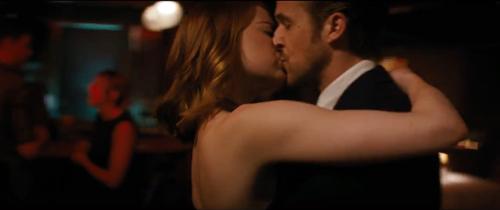
There’s a replay of the two of them at the cocktail bar, but this time Sebastian doesn’t brush past her. They kiss passionately. After this what-if premise, the race to the audition is replayed in stylized form, and the trajectory of Mia’s career—going to Paris, finding screen success, forming a family—is reenacted with Sebastian as her mate. At the end, Sebastian, not her husband, is sitting with her in the club (listening in effect to himself), and they kiss.
This soufflé of flashbacks and fantasies ends the plot on the conventional romantic clinch. But the film’s tag, of course, is their return to reality and the sad smiles shared as she goes off with her husband. In all, this double climax/ resolution turns out to run almost thirty minutes, which would be unusually long for a non-musical.
As is customary in Hollywood narrative, motifs and parallels crisscross the film. The opening song on the freeway lays out hints of what is to come. The sequence alternates a woman singing about a career as a film star (“It called me to be on that screen”) and a man singing about a career honoring old music (“ballads in the bar rooms left by those who came before”). Anticipating the finale, the woman’s song includes mention of a boy seeing her on the screen and remembering that he knew her.
More parallels and rhymes follow. Mia nearly stands up Sebastian on their date; he misses her show. Each encourages the other to keep struggling. Mia’s blockhead boyfriend anticipates her eventual GQ husband, as if she has decided not to go for the edgy type Sebastian is. The motif of Mia’s beloved aunt, who inspired her love of movies and her urge to act, gets dramatized twice, once in her one-woman show and more successfully in her audition song, “Here’s to the Ones Who Dream,” which wins Mia the movie part.
So many things are doubled that it’s not surprising that the Setup parallels each protagonist’s day and establishes the crucial moment at the supper club. That too gets replayed—once in the real world, as she and her husband hear Sebastian’s performance of his tune for her, and once at the start of the fantasy projection of their future, which becomes a replay of her actual life with her husband.
So far, so classical. But—duh, as they say–La La Land is also a musical.
That’s the Broadway melodies
My outline of La La Land‘s construction is fairly hollow, and could be filled in with closer consideration of the moment-by-moment process of conflict and change, or the flow of information as we’re attached to one character or the other. But we get access to another layer of “making” by considering the film as a musical–more specifically, a Broadway musical. (No surprise that the lyricists are stage-based.) Viertel is a big help here. His account of the prototypical song plot fits La La Land fairly well, and the places where it doesn’t are pretty interesting too.
Broadway shows of the Golden Age (roughly 1942-1975) tend to have the double plotline characteristic of Hollywood films. Both shows and movies make romance central, and this permits the action plot and the song plot to fit together. In Broadway shows, as in many films, paired protagonists try to find happiness in both love and work. Intertwined goals are central to getting the action moving, and so goals are ingredient to the song plot.
Director Damien Chazelle apparently hesitated about opening with the freeway-gridlock number, but he and editor Tom Cross decided to announce the film’s song-and-dance premises immediately. I think the pressure of show-biz tradition helped. According to Viertel, the prototypical musical might start with a solo, as with Oklahoma!’s “Oh, What a Beautiful Mornin’.” But it may also start with a “blowout,” and La La Land’s “Another Day of Sun” surely counts as that. It establishes milieu and mood, in somewhat the manner of the bouncy introduction to Damon Runyon’s world in Guys and Dolls, and it announces the central goal of showbiz success.
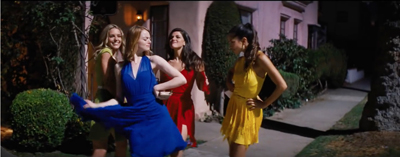
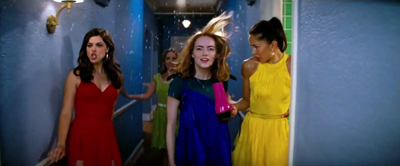
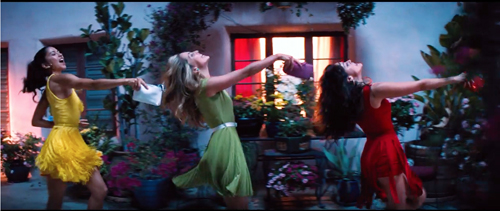
Viertel marks the next number as crucial. It’s the “I Want” song, the initial crystallizing of the protagonist’s goals. In La La Land, that position is occupied by “Someone in the Crowd,” which starts as an ensemble number with Mia’s brassy roommates but devolves into a solo for her. By then, the “someone” she seeks isn’t only a career-enhancing meetup but a love partner.
After the plot moves into the Complicating Action phase, Mia and Sebastian meet cute again at the pool party. He’s playing in a lame retro band and she teases him, in revenge for his brushoff at the piano bar. There follows the next key item in the song plot, what Viertel calls “the conditional love song.” The prototype is “If I Loved You” (Carousel). Essentially it declares how wrong the boy and girl are for each other. It has the function of blocking and deferring the goals of the love plotline, and in non-musical rom-coms, it takes the shape of verbal sparring, quarrels, and competition (as in, say, You’ve Got Mail).
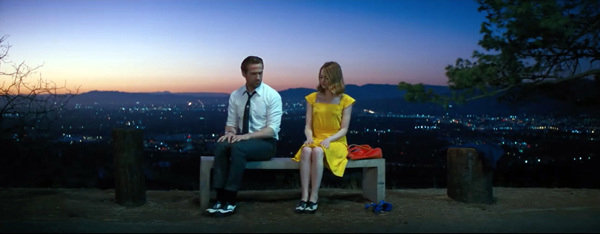
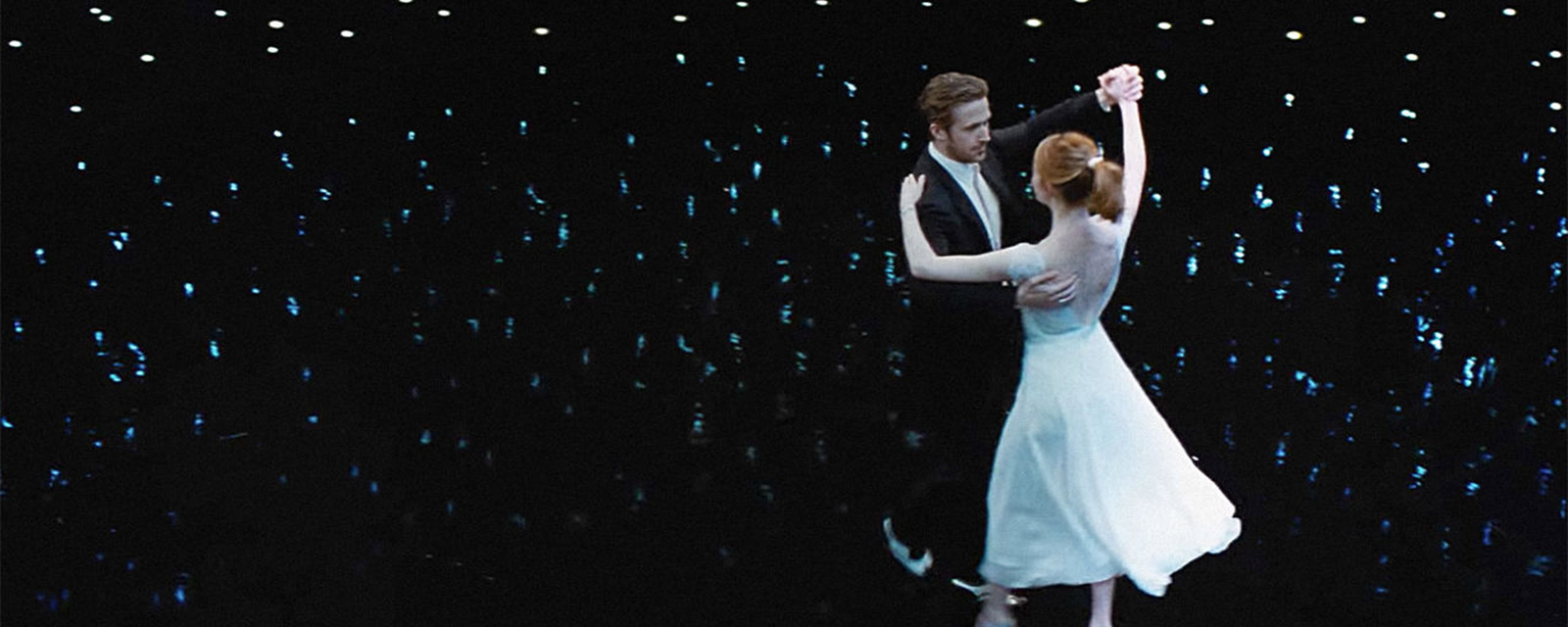
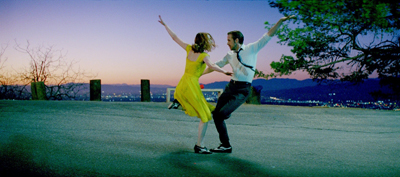
Clearly, “A Lovely Night” is a conditional love song, as Mia and Sebastian remark on how the LA view would be perfect for a couple who were really in love. But as often happens, while the words refuse romance, the music and the choreography show that the two ought to be together.
At this point in the song plot, Viertel suggests, the show needs a burst of energy. In La La Land, what he calls The Noise is delivered by the instrumental number at the jazz club, called in the soundtrack album “Herman’s Habit.” It’s not narratively gratuitous, as it’s an AV demo of the sweet collective creativity Sebastian admires in classic jazz. The number also marks Mia’s growing affection for Sebastian and her belief in his dream.
But now Viertel’s Broadway template diverges from La La Land, and it points up a crucial factor in the film. The conventional song plot typically devotes a number to a second couple or a subplot. Think of the comic couple in The Pajama Game, and the number “I’ll Never Be Jealous Again,” which expresses Hines’s unreasonable fear of losing Gladys. That show also includes the subplot of labor negotiations with the devious Mr. Hasler. But La La Land doesn’t have a subplot involving a second couple, a romantic triangle, or a villain. So no such song appears.
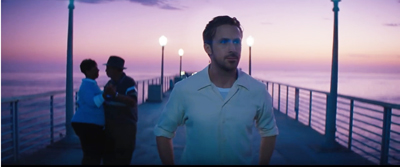
Next on the Viertel template is a star turn, a distinctive number for one of the major players. That function is fulfilled by “City of Stars,” the introspective musing of Sebastian on the pier. Viertel indicates that the following number tends to be a high-energy tentpole that starts the buildup to the first-act curtain. That position is occupied by the airy pas de deux at the Griffith Observatory on their first date.
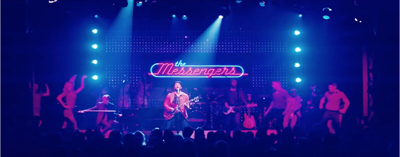
We’re now into the Development section, with Mia working on her one-woman show and Sebastian touring with his friend’s combo. The summer montage sequences offer other numbers, including Sebastian’s performance with the jazz group and the “City of Stars” duet with the couple at the piano. These bits don’t fit easily into Veirtel’s template, but what does is the “curtain song,” the Messengers’ “Start a Fire” number. It’s splashily performed at the concert that makes Mia apprehensive.
The performance functions as a curtain song, I think, because of Viertel’s claim that the close of the first act typically signals dashed hopes. The curtain numbers of Gypsy, Guys and Dolls, Carousel, West Side Story, and other shows announce a failure to achieve goals. “The most typical kind of first act curtain,” Viertel explains, is “the unraveling, in an instant, of everything everyone has planned.” It’s too strong a description of La La Land’s concert, but Sebastian’s cynical keyboard tweaks during the band’s blast of adult contemporary R&B mark him as a sellout. “Do you like the music you play?” He seems to have given up his dream, a failure that becomes the first crack in the couple’s relationship.
There are fewer discrete numbers in the film’s last stretch; it lacks several songs in the Viertel template (the Welcome-Back number, the second star turn, more subplot songs, and the first big showpiece). Owen Glieberman has noted that the film’s second hour is notably less buoyant, and the first full-blown number in the Climax is melancholic.
“The Fools Who Dream” is gently confessional, in contrast to the overheated delivery of Mia’s earlier auditions. It’s what Viertel calls a second-act showpiece, and true to that convention it yields a big plot point: She wins the role.
The resolution of the plot, what Viertel calls the “next-to-last scene,” need not be a number at all. It’s often a “book scene,” and so it is here. After Mia wins the role, she and Sebastian admit both their love and the difficulty of staying together.
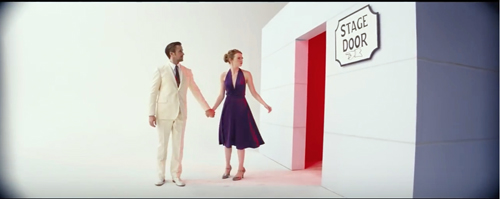
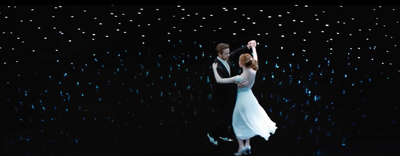
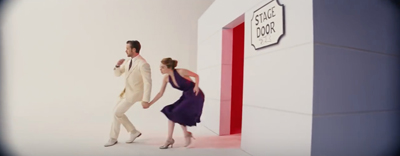
There follows the finale, a bookend to the freeway opening. “The 11:00 scene,” as Viertel points out, is often a wide-ranging reprise. La La Land’s eight-minute sequence presents a synthesis of the musical motifs and a revised, stylized version of Mia’s career.
Oklahoma! is usually credited with popularizing the fantasy ballet interlude, a convention that was picked up in the “Miss Turnstiles” daydream of On the Town, the Girl Hunt of The Band Wagon, and many other what-if sequences in Hollywood musicals. As a stroke of novelty, La La Land saves its fantasy ballet for the end, and makes it a bittersweet contrast to the real resolution.
Reports on the creative process behind La La Land indicate that the filmmakers were constantly weighing their choices about where to put their musical interludes. The fact that they settled on a layout that sticks fairly closely to the Broadway template suggests that Viertel’s song plot has advantages that creators intuitively gravitate towards. Its emotional arc both complements and extends the drama-driven plot.
The long and the short of it
Viertel’s anatomy of the Broadway song plot nicely fills out some patches of classical dramaturgy. It helps us better understand the tacit guidelines that creators follow, and it shows how even movies not drawn from stage shows have absorbed some of their conventions. Yet Viertel’s layout does more than point up the affinities between La La Land and stage musicals. It also helps us see where the film rejects the traditional schema.
The film’s deletions from the song plot omit love triangles (of any consequence), subplots, villains, and parallel couples. Sebastian’s sister is basically an expositional device, while Mia’s roommates are barely characterized and her parents barely seen. The bandleader Keith is mostly a mouthpiece for a musical idiom, and the other members of the combo aren’t individualized. No secondary character is granted a show-stopper like “Sit Down, You’re Rocking the Boat” or “Steam Heat” or “Make ‘Em Laugh.”
In sacrificing subplots and side bits, La La Land forfeits what such devices add: a different range of emotions, thematic contrasts, relief from overexposure of the two lovers, and comic relief. The film gives up accessory pleasures, like the counterpoint romance of Nathan Detroit and Adelaide in Guys and Dolls, or the ballad of the parents at the piano in Meet Me in St. Louis. In a bold genre change, La La Land stands or falls by its two principals.
Strangely, this spare plot consumes two full hours. Compare its Hollywood counterparts. Cover Girl, another showbiz tale, runs fifteen minutes shorter, but has time for a fully-rendered sidekick, a competitor for the heroine Rusty, a nice role for Eve Arden, and a parallel plot (thanks to flashbacks) devoted to Rusty’s grandmother. At 95 minutes, On the Town squeezes in three couples and a New York travelogue. As for the often-invoked Demy, compare the 90-minute Umbrellas of Cherbourg, which manages to deck the plot out with two old ladies and two deftly characterized rivals for the central couple. Better yet, recall Les Demoiselles de Rochefort. Granted, it too runs two hours, but it has to pack in five couples, one triangle, a starstruck café waitress, and for good measure a serial killer.
More broadly, La La Land doesn’t give its protagonists sharply defined goals. They just want to succeed, through rounds of auditions or short-term music gigs. In Cover Girl Rusty is given clear-cut options: To sign on as a model or stay a club dancer? To marry a piano player or a Broadway impresario? And as Viertel points out, there’s often a bigger issue at play—statehood in Oklahoma!, modernizing a country in The King and I, moving a family from St. Louis to New York. Nothing like this hovers over the couple in this rather hermetic movie.
What fills up that extra running time in La La Land? For one thing, the very parallels that I’ve mentioned, notably the extended scenes in the café; but also, I think, the pool party, with its sideswipes at the movie industry, and the planetarium dance, pretty as it is. A older studio-era film would have gotten the romance going sooner, in the Setup, sharpened the choices facing the characters, and fleshed out their milieu with friends, family, and minor players who get a little bit of the spotlight. (Keith would almost certainly have gained a romantic partner, hopefully a wise-cracker.) A Demy film would have added more characters as well, with a crisp geometry of counterparts and substitutions. Everything would be color-coded too.
The slimness of the plot can be taken as a point against the film, but focusing a musical so tightly on the couple was probably worth trying. If anybody cares, I enjoyed the film, and—to invoke the distinction between taste and judgment—I think it’s a solid, sometimes stirring effort. But what matters to me now is the way that thinking about craft traditions, particularly as they affect structure, allows us to plot some ways in which La La Land is both traditional and original. Evaluation is important, but it can be guided by analysis. An essential part of criticism involves studying how things are made.
Thanks to Jeff Smith for advice about the Messengers’ musical idiom, and to Michael Campi and Peter Rist for discussions about the film.
The quotation from Shklovsky at the start comes from the extract from A Sentimental Journey (1923) in Viktor Shklovsky: A Reader, ed. and trans. Alexandra Berlina (Bloomsbury, 2017), 150. For another Shklovskyan foray into contemporary moviemaking, you can try “Pulverizing Plots.” My quotation from Viertel on first-act curtains comes from The Secret Life of the American Musical, p. 152.
More on the making: A fairly detailed account of LLL‘s choreography is provided at the Verge, with more film references than you can shake a stick at. On the authenticity dimension, Glenn Kenny gets on the case of jazz purists.
Kristin’s discussion of four-part structure is at its fullest in Storytelling in the New Hollywood: Analyzing Classic Narrative Structure. I discuss it and apply it to some examples in The Way Hollywood Tells It: Story and Style in Msodern Movies. For more examples, visit our category Narrative Strategies.
P.S. 24 January 2017:LLL has garnered a heap of Oscar nominations this morning. Now this Los Angeles Times story supplies more information on how it was made (financially).
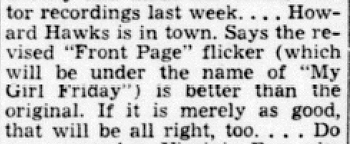
Criterion has just released a fine edition showcasing two classics of American cinema: The Front Page (1930) and His Girl Friday (1940). His Girl Friday is in a new HD restoration, and the earlier film, long crawling around in disgraceful public-domain bootlegs, now has a 4K glow–maybe looking better than it did at the time. The extra fillip is that it’s a version that director Lewis Milestone preferred to the familiar one.
Along with the films comes a host of features: interviews and shorts about Howard Hawks, Rosalind Russell, and the making of HGF, radio adaptations of both the Front Page play and the HGF film, a short about Ben Hecht, trailers, appreciative essays by Michael Sragow and Farran Smith Nehme, and a session with me about HGF.
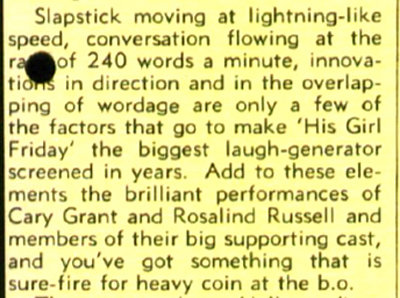
Needless to say, I’d be plugging this release strenuously even if I weren’t involved. Long-time readers of this blog know that an early entry hereabouts talked about the diverse paths HGF took to becoming the classic it’s now recognized to be. I used the film in many courses I taught during my early days at Madison. Kristin and I have been writing about the film since then as well, first in Film Art (it still retains its place from the 1979 edition), then in Narration in the Fiction Film (1985) and On the History of Film Style (1998). Other references sneak into our entries here from time to time. The Criterion edition offered me another chance to rattle on about a movie I still, after nearly fifty years, love inordinately.
What can be left to say? Plenty, but today I’ll mention just two items. First, what is a Girl Friday? And second, how unobtrusively delicate can film style be?
More slop on the hanging
The phrase “girl Friday” comes, ultimately, from Robinson Crusoe, Defoe’s 1719 novel of how the castaway protagonist turned a cannibal prisoner into his servant: his man, Friday. The hapless convert to Christianity gained his name because Crusoe rescued him on a Friday. An 1867 children’s story, “Will Crusoe and His Girl Friday,” shows a little boy and girl planning to reenact Defoe’s tale, adding gender insult to racial and class injury.
“My Girl Friday” was a spicy 1929 play about flappers who drug tycoons at a party and then convince them that the worst has happened. Consisting largely of scenes with chorus girls in bathing suits, it was dubbed by Variety “out and out smut.” Unsurprisingly, it found success on Broadway. During some weeks its BO take rivaled that of The Front Page, on stage at the same time.
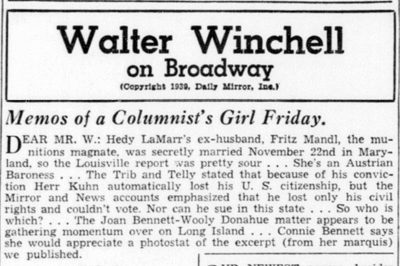
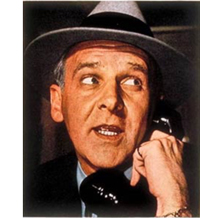
As far as I can tell, the phrase “girl Friday” became more prominent in American slang during the 1930s, thanks chiefly to columnist Walter Winchell (right, from Time 1938). At intervals from 1934 on, Winchell’s daily column carried the title “Memos of a Columnist’s Girl Friday.” The premise was that his secretary was an all-purpose newshound, gathering gossip and tidbits into a weekly memo to her boss. Evidently, Winchell’s secretary Ruth Cambridge (Mrs. Buddy Ebsen) didn’t write it. Under the “Memos” rubric Winchell could boast about his latest triumphs. His Girl Friday could ask innocently if “Mr. W.” saw the new Fortune poll of top columnists (in which he ranked high), or whether he noticed that several more newspapers had signed on to carry the column. Louella Parsons gave Winchell credit for publicizing the Girl Friday phrase.
He started a brief feud when he smelled poaching. In 1937, two aspiring screenwriters sold MGM a story they called “My Girl Friday.” It involved, according to Daily Variety, “adventures of a newspaper circulation rustler.”
With Trumpian self-regard, Winchell asserted that he had popularized many catchphrases that Hollywood had bought as titles: “Blessed Event,” “Orchids to You,” “Is My Face Red?” “Okay, America,” and even “Whoopee.” In addition, he noted that MGM had spent a cool quarter of a million dollars to enhance a scene of The Great Ziegfeld. In the face of such largesse, Winchell felt justified in asking for compensation.
Therefore we think it would be ducky if MGM sent $10,000 to us for the use of “My Girl Friday,” which became better known via this dep’t.
Winchell hastened to add that he would give the money to charity. He pressed his case in several columns and in radio broadcasts. Paramount joined the fray, claiming that it acquired the title when it bought the old play, so MGM couldn’t use it anyway. At which point the Hays Office was consulted.
Using his Girl Friday voice, Winchell responded that he claimed only to have popularized the phrase, and in any case what was $10,000 to Hollywood, especially if the money went to charity? Muttering about how MGM’s song “Your Broadway and Mine” swiped the original title of his column, Winchell subsided, as did the dispute. MGM evidently never adapted the story in question.
Then, on 9 December 1939, Walter ran this.
No hard feelings from Winchell, apparently. He may have benefited from the association with the movie. During production and even after release, the film was sometimes called My Girl Friday. And the linkage of a Girl Friday to the newspaper game, be it gossip or circulation rustling, fitted the movie well, as it evoked Winchell’s rat-a-tat radio delivery and his near-prosthetic adhesion to phone receivers.
Yet Winchell mysteriously dropped the “Memos” rubric from his column in 1941. In the decades to come, many businessmen would claim to have a Girl Friday of their own. Maybe the film ultimately popularized the phrase more successfully than Winchell did.
For the waiter
Daily Variety (5 January 1940), 3.
As a theatrical adaptation, His Girl Friday offers a challenge that Hawks accepted with ease. He had worked on films limited to a few interiors before, as with the train scenes of Twentieth Century (1934) and much of the airport action of Only Angels Have Wings (1939). He knew how to enliven situations unfolding in tightly confined settings.
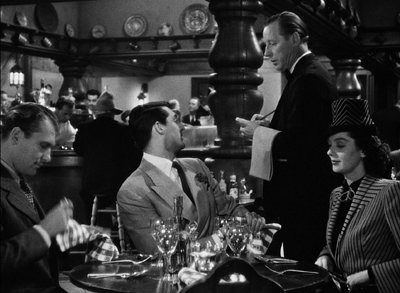
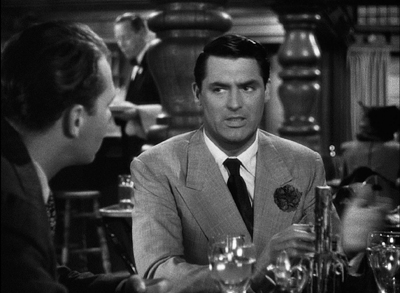
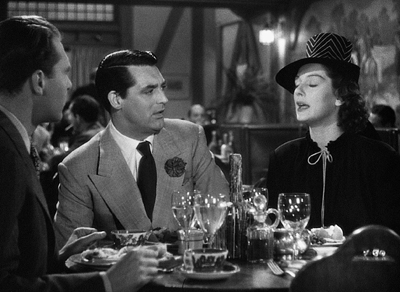
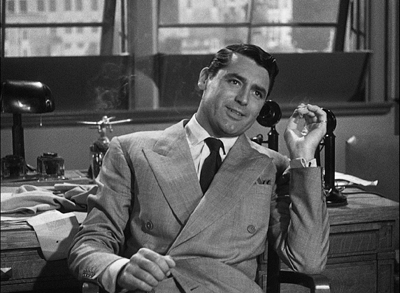
Apart from enjoying the fast-paced comedy, you can learn a lot about film technique from the way Hawks energizes his static, prosaic surroundings. Take his resolutely unflashy staging in depth. It’s most apparent in the pressroom of the Criminal Courts Building, as I suggest in the supplement, but there are plenty of felicities of staging elsewhere. The most apparently unpromising example involves the restaurant where Walter Burns takes his ex-wife Hildy Johnson and her fiancé Bruce Baldwin. What to do with this simple set?
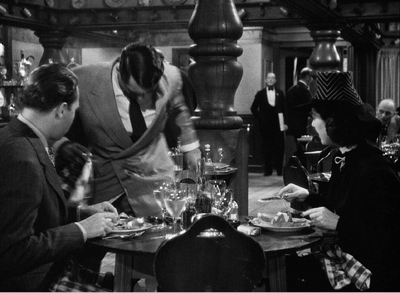
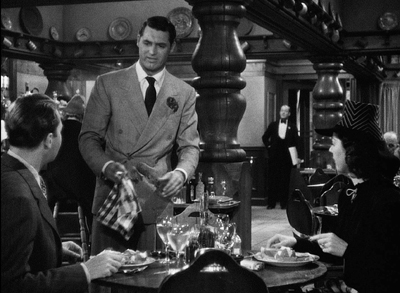
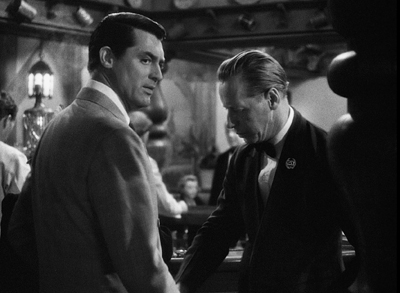
At a late point in the scene Walter will seek the help of the waiter Gus, who’ll call Walter to the phone. It’s a basic problem: How should the director prepare for that phase of the action? Hawks does it by setting up a zone of depth at the start of the scene, priming it quietly throughout, and paying it off when it’s needed.
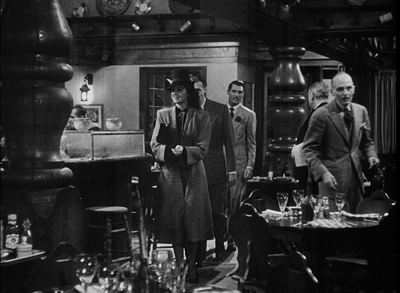
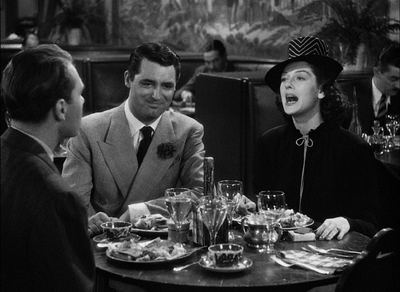
Bruce, Walter, and Hildy enter the restaurant from the background. (Novice directors please note: No need for a sign saying, “Restaurant.”) The group comes to a table in the foreground. After some comic byplay as Walter grabs the chair next to Hildy, the three get seated and chat with Gus.
This framing orients us to the table and the rear area by the bar. We’ll never leave this general orientation on the scene. This commitment, far from being simply “theatrical,” makes for economy as the action develops.
In the course of the scene, Hawks activates the rear zone by having Gus come and go from it. Of course that area isn’t emphasized. Who’s likely to notice Gus giving the sandwich order back there when there’s patter and funny business to watch right in front of us?
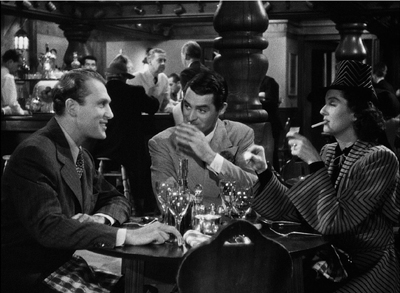
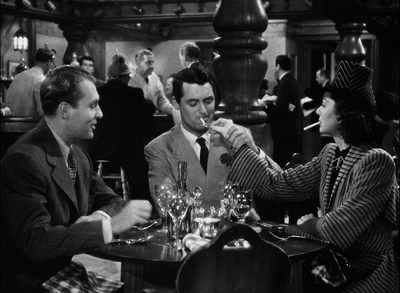
In the course of the scene, Gus will come back to the table, pouring water, delivering sandwiches, and getting kicked in the shin by Hildy, who’s aiming at Walter. Throughout, we’re quietly primed for that alley of space behind Walter to be occupied by Gus.
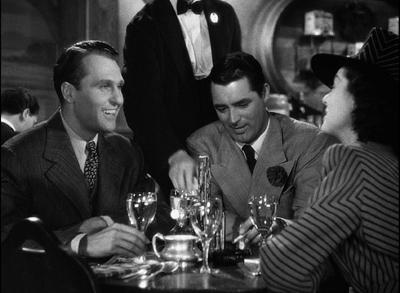
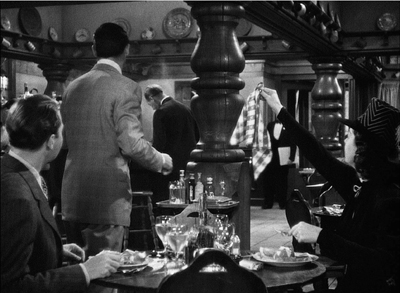
The priming pays off when Walter, realizing that he has to prevent Hildy’s taking the train today, deliberately spills water in his lap.
Walter pivots and heads to Gus, who’s back there in his domain, waiting to be pulled into the plot. He’ll summon Walter to the fake phone call.
No big deal–certainly not as eye-catching as the dazzling comedy around the table. But the care for such little things is the mark of a craftsmanship that uses space compactly, without fuss. No need for camera angles that show the fourth wall (or even walls two and three). No need to build more of the set on the side; this is Columbia, after all. Just let reliable Joe Walker light that background enough to keep us aware of it (out of focus for most of the scene) and then activate it when you need it.
Within the same frame, the director can organize the action so that preparation for what will happen next is seen in the background of what is happening now.
Or as Hawks put it in 1976:
You know which way the men are going to come in, and then you experiment and see where you’re going to have Wayne sitting at a table, and then you see where the girl sits, and then in a few minutes you’ve got it all worked out, and it’s perfectly simple, as far as I am concerned.
The unstated premise is indeed perfectly simple: You don’t need to show more space than the physical action requires. It’s a rare premise today.
How long is it?
This sort of priming fits neatly into a cinema based in continuity–dramatic, spatial, temporal. Hawks is a master of staging action so that it flows unobtrusively. At times, though, it’s fun to spot some discontinuities, and editing is a good place to look.
Ozu is, to my knowledge, the only director who invariably creates perfect match-cuts on action. Even Hawks has to cheat things a bit to make the editing flow. (Hildy’s pitching of her purse is an example I use in the commentary.) But consider how Hawks can get a spark out of a small, mismatched action.
We’re still in the restaurant, and Walter has persuaded Hildy to cover the Earl Williams story in exchange for buying an insurance policy from Bruce. Talking of his upcoming physical, Walter boasts, “Say, I’m as good as I ever was.” Hildy fires back, “That was never anything to brag about,” and Walter reacts and turns his head. As he turns, we get these two shots.
At first Walter is stunned, apparently readying a reply; but at the cut, he’s sporting a grin. It’s partly a grin of triumph, showing that he’s gotten Hildy to do his bidding, but it’s also an appreciation of her wit: a sort of “That’s my girl” pride in her fast comeback. Strictly speaking, the cut’s a mismatch, but the instantaneous switch in reaction gives the scene double value.
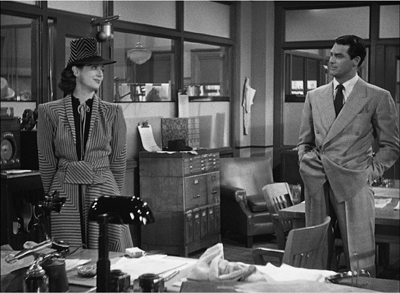
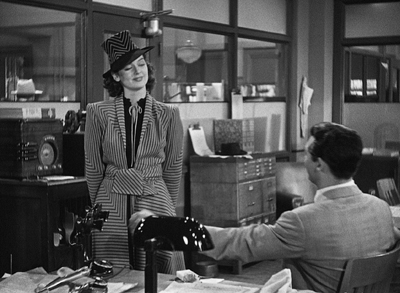
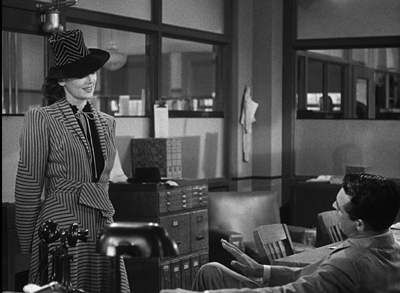
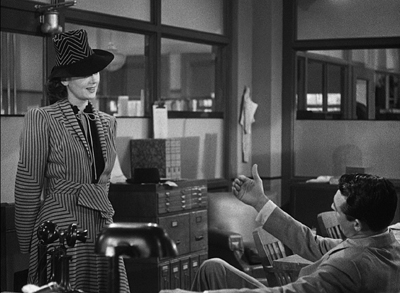
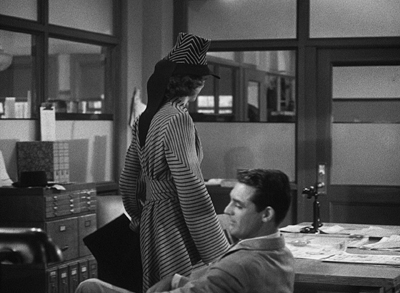
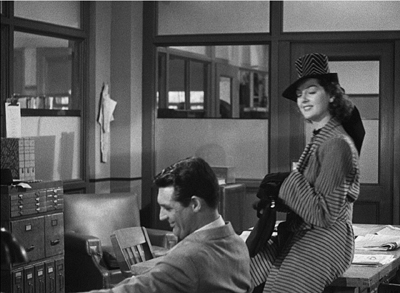
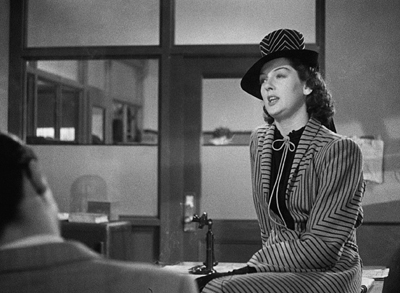
Finally, there’s framing. The rugged outdoor guy Hawks is as delicate as they come when it’s a matter of frame corners and edges, and his sense of pictorial balance is fastidious. Go back to the long opening scene in Walter’s office, when he and Hildy are going through the preliminaries. They size each other up before Walter sits down in his swivel chair.
A slight track forward has planted Walter in the lower corner of the frame. A cut in to Hildy’s reaction (not shown) enables a transition to a slightly different framing. That setup allows Walter to invite her onto his knee, which pokes up from the bottom edge.
Joe Walker has obligingly edge-lit that stretch of pant leg, and it’s about the only thing moving in the shot, so we can’t miss Walter’s come-on.
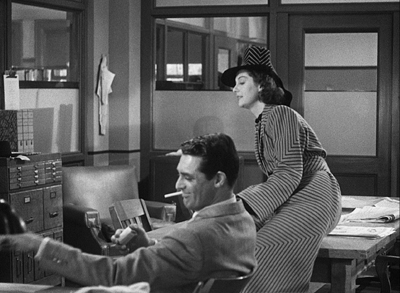
Now Hawks does something very pretty. Hildy moves to the table and perches on it. Hawks reframes with her, but keeps the shot oddly unbalanced, with Walter resolutely facing the area she’s not in.
A sort of spatial suspense develops. Hawks sustains this odd framing while Walter picks up a cigarette, tosses one to Hildy, lights up, and tosses her a match. Fairly deliberately too, in what’s supposed to be Hollywood’s fastest movie.
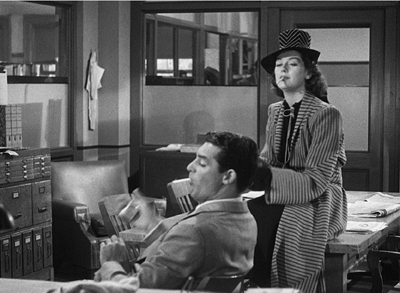
When both are smoking comfortably, Walter swivels his chair to snap his head into the lower left corner, which has been waiting for him all along. The simple movement provides the scene’s new beat, which starts with Walter’s line: “How long is it?” I haven’t yet mentioned that this is a fairly dirty movie, but you knew that.
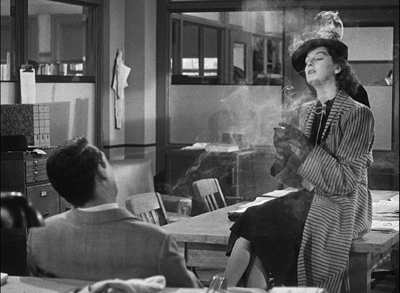
The shot began with the actor’s head in the lower right, developed with that head poised midway in the frame, and now ends with the head cocked in the lower left. What looks like sterile geometry feels, on the screen, perfectly unforced. And lest we misread the “How long is it?” Walter innocently explains, in a medium shot, that he’s just wondering how long it’s been since they’ve seen each other. That in turn calls up an over-the-shoulder reverse angle, and the next phase of the scene is off and running.
At this point in film history, the cinematographer, while shooting, could not see exactly what the lens was taking in. The careful unbalancing and rebalancing of the shot had to be achieved through a mixture of expertise and intuition. The same thing with keeping Gus in reserve back there by the bar, and letting an incompatible take of Grant’s reaction stay in after a cut. It’s all perfectly simple, as far as I’m concerned.
Thanks to Kim Hendrickson, Grant Delin, and Peter Becker of Criterion for inviting me to spend more time with this splendid movie. Hawks’ quotation about keeping it simple comes from my On the History of Film Style (Harvard University Press, 1997), 149.
You can find background here on the restoration of The Front Page, supplied byAcademy archivists Mike Pogorzelski and Heather Linville.
You can get a sampling of Winchell’s radio delivery from the period here, complete with nervous teletype clackings serving as transitions. For more background on HGF, go here. That entry observes the usefulness of the film’s lines in many situations. In this respect it resembles another Hawks film, that repository of worldly wisdom known as Rio Bravo.
Gus the waiter is played by the inimitable Irving Bacon, one of a dozen or so outstanding supporting players. This is another of the film’s triumphs: Regis Toomey, Porter Hall, Gene Lockhart, Abner Biberman, Roscoe Karns, and other memorable character actors all seem to be having fun. And Billy Gilbert as the wayward Pettibone is the friendliest deus ex machina in Hollywood cinema.
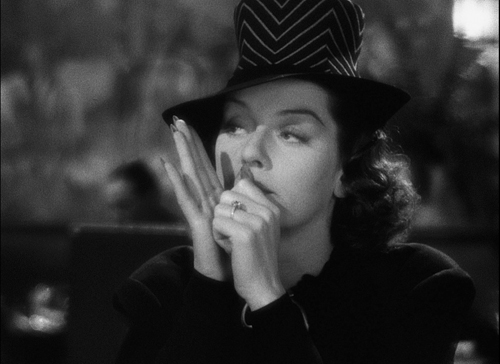
Finally, do audiences today know the meaning of Hildy’s flipped hand in response to one of Walter’s catty remarks? Has nose-thumbing gone out of popular culture? Apparently not.
P.S. 4 February 2017: On the Parallax View site, Sean Axmaker has the most in-depth appreciation of this edition of The Front Page I’ve seen online. And he has plenty to say about HGF too.
P.S. 2 February 2018:His Girl Friday is now streaming on FilmStruck, and among the bonus materials is the video essay I mention.






 open printable version
| No Comments »
open printable version
| No Comments »