Monday | December 3, 2018
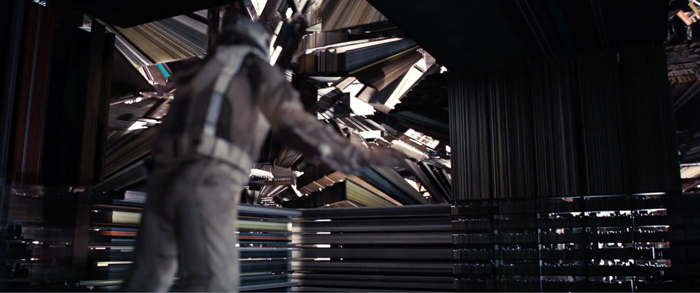
Interstellar (2014).
DB here:
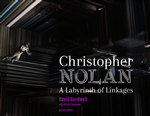
A new edition of our e-book Christopher Nolan: A Labyrinth of Linkages has just gone into production at the hands of our web tsarina Meg Hamel. It updates our discussion of Nolan’s career by including a brand-new chapter on Interstellar and one on Dunkirk that revises and expands our blog entries on the film (here and here).
The book also includes a new chapter surveying Nolan’s approach to filmic storytelling, along with more links and frame enlargements. I wrote the bulk of this second edition, with Kristin contributing portions on exposition in Inception and Dunkirk.
As in the first edition, I try to respond to the objections that some viewers have about Nolan’s work. I grant some problems with his films, chiefly at the level of visual style. But I also try to make a case that Nolan has been exploring film narrative in ways that are significant for film history. I argue that his achievement contributes to storytelling trends of his moment (from the 1990s on) and in art and literature more generally. His work is shaped by what I call a “formal project,” akin to that we find in Alain Resnais and Hong Sangsoo.
Nolan’s detractors are likely to counter that those directors are better than Nolan. But they work in different circumstances. In the context of mass-audience Hollywood cinema, I think Nolan’s work repays scrutiny.
I’m mostly offering analysis, not evaluation. I have to admit, though, that in reworking the book and rewatching the films, I’ve come to extend my admiration for certain projects (The Prestige, Dunkirk) to others, especially Interstellar. Still, even if you don’t share my regard for the films, I think that it’s worth discussing what Nolan’s accomplishment shows about trends in modern cinema and the broader possibilities of filmic storytelling.
Which is to say, yet again, that Christopher Nolan: A Labyrinth of Linkages 2.0 is primarily a venture in film poetics.
We hope to make the new edition available this month or in January. It would be priced higher than the current edition, at $3.99 (i.e., the cost of a Tall Caramel Frappucino). This pays for a new design for the book, one exploiting the horizontal format for widescreen frame enlargements. We won’t be embedding video extracts in the text, as we did last time, but we may set up the clips as online links.
To the hundreds of you who bought copies over the years, thank you. We appreciate your support, and we hope that the new edition will also be worth the attention of the readers who visit this site.
Just to be clear, we’ve also welcomed the narrative explorations of Resnais and Hong Sangsoo on our website, and in our research more generally.
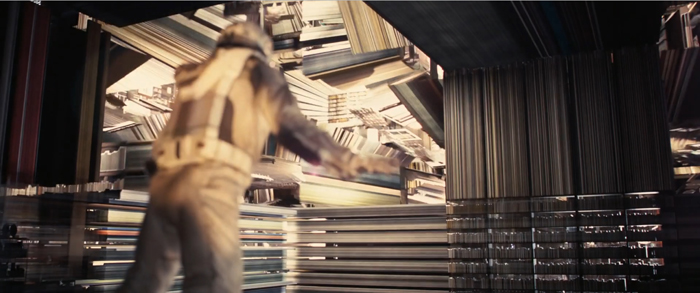
Interstellar (2o14).
Posted in Books, Directors: Hong Sangsoo, Directors: Nolan, Directors: Resnais, Poetics of cinema |  open printable version
| Comments Off on Christopher Nolan: Back into the labyrinth open printable version
| Comments Off on Christopher Nolan: Back into the labyrinth
Sunday | November 18, 2018
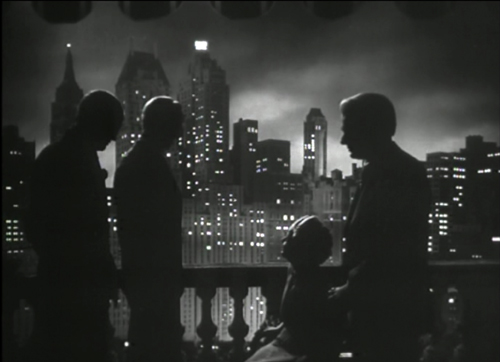
DB here:
In the fading days of FilmStruck, Kristin and Jeff and I are looking forward to continuing our Observations on Film Art series on the new version of the Criterion Channel in the spring. (If you’re in the areas served, US and Canada, you can sign up here. I did already. Quick and easy.)
In the meantime, our final entry on the FilmStruck platform is going live on Monday, 19 November. There I consider Julien Duvivier’s Lydia (1941) as an example of the power of flashback storytelling.
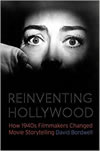
I talked about the film in Reinventing Hollywood as part of the massive 1940s revival of this technique. Critics’ long-standing emphasis on film noir has led us to think that that trend epitomized flashback construction, but actually the technique is almost completely general. In the book, I consider several “women’s pictures” that employ it: Kitty Foyle (1940), The Affairs of Susan (1945), The Locket (1946; also discussed here), and Lydia. The Criterion series allows me to illustrate more concretely how Duvivier and his colleagues tell the story of a woman captured by passion and moving into old age almost (but not completely) disillusioned.
Working on the book and the entry made me better appreciate a director I’d neglected. Like everybody else, I had had a high regard for La Belle Équipe (1936) and Pépé le Moko (1937), and I had seen and liked his Simenon adaptation Panique (1946). A special favorite of mine is his cross-border comedy about switchboard romances, Allo Berlin? Ici Paris! with clever sound work quite advanced for 1931. Beyond Lydia, other Hollywood efforts of his proved important for Reinventing Hollywood. Tales of Manhattan (1942) and Flesh and Fantasy (1943) are adroit instances of the episode film, that format using what I called “block construction.”
Duvivier was sometimes disdained by the younger generation as an old-guard academic, but I’ve come to see him as a rather interesting experimentalist. He tried out a day-in-the-life network narrative (Sous le ciel de Paris, 1951), a charming what-if comedy about screenwriting (La Fête à Henriette, 1952), and a solid Gabin polar (Voici les temps des assassins, 1954). His suspense drama Marie-Octobre (1959), might seem overly theatrical because it has a Rope-like confinement to a single evening, an anniversary dinner for survivors of the Resistance, but it’s actually based on a novel and gains tension from its almost real-time duration. It showcases a range of major stars (Darrieux, Blier, Reggiani, Ventura) and boasts one of the most dazzling parlor sets I’ve seen in a long while.
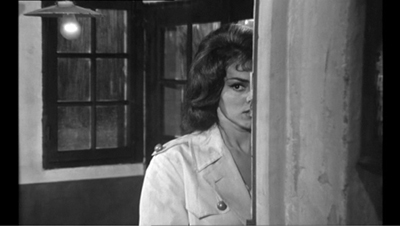
Among his thrillers adapted from English authors there’s the curious Chabrolian exercise, La Chambre ardente (1962), based on a John Dickson Carr novel, and the seedy Chair de poule (aka Highway Pickup, 1963, below) from James Hadley Chase.
I’m sure there are clunkers and potboilers among his dozens of titles, but it’s a pretty distinguished career, running back to the silent cinema and his early classic Poil de carotte (1925). His department-store drama, Au Bonheur des Dames (1930), exemplifies bravura silent-film style at its height. He even remade The Golem (1936).
For me, Lydia encapsulates the ambitions typical of Duvivier and 1940s Hollywood. The film could count as a rewrite of Carnet du bal (1937), his story of a woman who revisits the men who danced with her one night in her youth. That plot might seem to demand a string of flashbacks, but instead it’s all played in the present. Her confrontation with what the dashing young men have become leads to a string of extraordinary encounters enacted by top players of the day (Rosay, Bauer, Fernandel, Raimu, Jouvet, Sylvie). The melancholy tone, involving a mournful devotion to impossible love, is reminiscent of Dreyer’s Gertrud.
Lydia takes the alternative option of actually dramatizing the memories of the heroine and her three lovers as they reflect on the old days. The flashbacks are daringly introduced with straight cuts and curt sound bridges; a couple of scenes use slow-motion for the past, a very unusual choice for the period. The soundtrack is unusually lush, with the brilliant Miklós Rózsa supplying lilting waltzes and even some early electronic effects. For a bold montage merging Lydia’s passion with that of the raging sea, he came up with a fierce piano concerto.
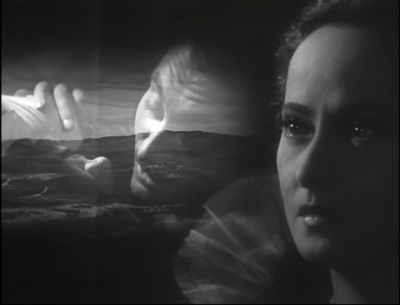
The film plays on the disparities of time and memory in a rather modern way. Flashbacks contradict one another, and what we see doesn’t always match what the voice-over tells us. Lydia in the present seems to whisper advice to the girl we see in the past, as if she’s watching the film along with us. The climax is quietly devastating: the twist was demanded by censorship, but producer Alexander Korda claimed, rightly, that it improved the film. We’re left wondering how much to trust Lydia’s memory of her idealized affair.
One thing that didn’t make it into our entry: Discussion of the peculiar cottage where Lydia and her lover Richard share their passionate idyll. It seems to be built out of the bodies of big naked people. So I share one image with you, below.
Apart from that, I hope you get to play my installment, in the waning days of FilmStruck, or maybe cached on the new Criterion Channel in the spring. You can sign up for that streaming service here, and the sooner you do it, the easier it will be to launch.
We’re grateful as usual to Peter Becker, Kim Hendrickson, Grant Delin, and the whole Criterion team, and to Erik Gunneson of the UW Department of Communication Arts. Special thanks to Daniel Reis, editor of most of our installments, whose adroit cutting strengthened them enormously. (The Lydia entry masterfully stitches together disparate sequences using Lydia’s dialogue as a voice-over.) Other entries were cut by the equally gifted Clyde Folley. Thanks as well to Kelley Conway and Phillip Lopate for conversations about Duvivier.
Criterion has served Duvivier well, offering several of his works on DVD.
A list of our Observations installments to date is here.
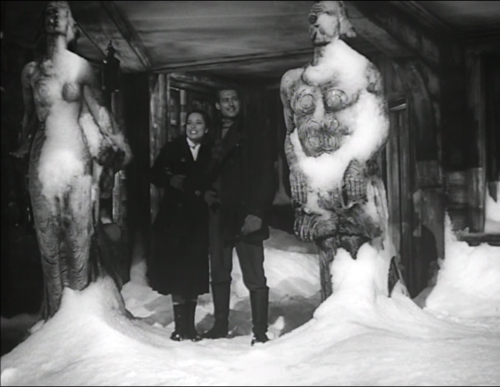
Lydia (1941): A house embellished with ships’ figureheads becomes the lovers’ sanctuary.
Posted in 1940s Hollywood, Criterion Channel, Directors: Duvivier, FilmStruck, National cinemas: France | open printable version
| Comments Off on Lovelorn LYDIA: A new installment on the Criterion Channel
Friday | November 16, 2018

Breaking news! Last month ATT’s acquisition of Time Warner led to the announcement that FilmStruck, and the Criterion Channel thereon, would be discontinued. (Today I got my refund for the rest of my annual subscription.) But many film fans and filmmakers have kicked up a fine fuss. One especially robust bloc wrote directly to Warner Pictures head honcho Toby Emmerich. A second, equally strong letter followed.
Now we learn from Peter Becker of Criterion that the Channel is restarting in spring of 2019.
The Criterion Channel will be picking up where the old service left off, programming director spotlights and actor retrospectives featuring major Hollywood and international classics and hard-to-find discoveries from around the world, complete with special features like commentaries, behind-the-scenes footage, and original documentaries. We will continue with our guest programmer series, Adventures in Moviegoing. Our regular series like Art-House America, Split Screen, and Meet the Filmmakers, and our Ten Minutes or Less section will all live on, along with Tuesday’s Short + Feature and the Friday Night Double Feature, and of course our monthly fifteen-minute film school, Observations on Film Art.
Our library will also be available through WarnerMedia’s new consumer platform when it launches late next year, so once both services are live, Criterion fans will have even more ways to find the films they love.
We will be starting from scratch, with no subscribers, so we will need all the help we can get. The most valuable thing you can do to help now is go to Criterion.com/channel and sign up to be a Charter Subscriber, then tell your friends to sign up too. We need everyone who was a FilmStruck subscriber or who’s been tweeting and signing petitions and writing letters to come out and to sign up for the new service. We can’t do it without you!
Posted in FilmStruck, People we like | open printable version
| Comments Off on The Criterion Channel is coming back!
Sunday | November 11, 2018
DB here:
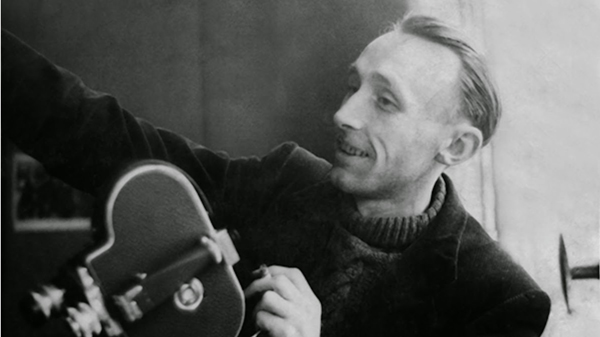
André Bazin was born in 1918 and died on 11 November 1958. In his short life he became, without aiming at it, one of the greatest theorists and critics of cinema.
A central figure in the founding of Cahiers du cinéma, Bazin was also active in building film culture through ciné-clubs and festivals, most notably Cannes and the Festival du film maudit. His writings were poetic, original, and provocative in the gentlest way you can imagine.
As a reviewer he discussed hundreds of releases, and in essay mode he produced subtle reflections on cinema as both medium and art. He wrote about Westerns, pin-ups, Stalinist cinema, documentaries on art and exploration, and of course the commercial storytelling cinemas of France, Italy, and Hollywood. His friendship with two generations of filmmakers–Renoir and Truffaut, among others–gave him a living link to film history. Many would argue that the “young cinemas” of the 1960s, building on both Italian Neorealism and the pictorial styles that crystallized in the 1940s, owe a great deal to the tradition of critical debate he fostered.
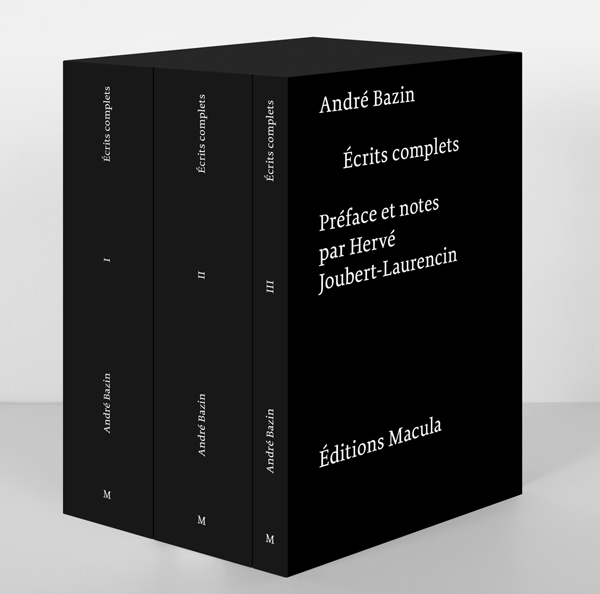
Bazin’s thousands of pieces have now been gathered by Hervé Joubert-Laurencin. A three-volume collection is scheduled to appear this week in a deluxe edition published by Macula of Paris. The press kit, with excerpts, is here.
Beyond reading the work itself, if you want to know more about the man, I think the best place to start is with Dudley Andrew’s biography. It’s a sensitive overview of Bazin’s life and thought, giving particular emphasis to the philosophical and religious influences on him.
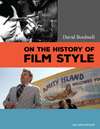
Bazin has shaped my thinking about film history and aesthetics since 1967, when I first read Hugh Gray’s translation of What Is Cinema? I taught his work for decades here at Wisconsin, and in On the History of Film Style, I tried to analyze his pivotal role in our understanding of the “development of film language.” That chapter situates his thinking about technique in the context of the “nouvelle critique” of the 1930s and 1940s, a trend that tried to locate an aesthetic suitable for the sound cinema.
Later, I wrote an essay for the German journal montage a/v, which ran a special 2009 issue devoted to Bazin. The original English text, slightly updated, is now available on this site (here, and on the left). That piece suggests how Bazin’s thinking has shaped my own approach to understanding cinema.
Commentators pledged to labels may wonder how a “formalist” like me can find common cause with a “realist” like Bazin. Actually, in both method and substance, his work offers much to the research program I’ve called a poetics of cinema. To see Bazin as being “for” deep-focus and the long take and “against” montage is an oversimplification, it seems to me. He saw more deeply and more widely than that, not least because he was always aware that filmic expression—in style, in narrative—changes across history.
Film criticism owes Bazin an immense debt; he taught us to look closely at what’s onscreen. Elsewhere on this site, we discuss some examples (for example, here and here and here).
There are many ways of thinking about his work, as you can see from the swelling number of articles, books, and conferences devoted to him. He remains a tremendous figure, blending modesty, tolerance, patient attention, close viewing, and bold speculation. Film studies could scarcely exist without him.
Posted in Books, Critics: Bazin, Film history, Film scholarship, Film theory | open printable version
| Comments Off on André Bazin, man of the cinema
|