Friday | October 27, 2006
Today the Virginia senatorial campaign seems to revolve around whether you reveal yourself to be a bad person if you write a novel with disturbing or naughty scenes. It’s the sort of question routinely considered, more dispassionately, by the members of the American Society for Aesthetics. The Society consists mostly of professors, mostly of philosophy, who try to understand the most basic principles of how art works. I’ve been at their annual conference in Milwaukee since Wednesday night.




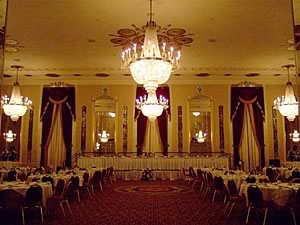
The Milwaukee Hilton Hotel
The event is held in the Hilton, an opulent building finished in 1928 (that is, just before opulence went away for quite a while). It’s an overpowering, somewhat eerie place, a little like the hotel in The Shining. Chandeliers hang from high ceilings. Corridors stretch on forever, silent and empty. Around any corner you may find a painting, a throne, or a signpost pointing you in several directions. You don’t exactly get lost, but the sheer size of the place, along with the occasional touch of Midwestern kitsch, suggests Last Year at Marienbad redecorated to suit the Amberson family. The same aesthetic principles, blown out to a more humungous scale, gave us The House On The Rock, one of Wisconsin’s great contributions to grassroots Dada.
In my first day here, there were intriguing papers and discussions. I couldn’t go to all of them, but I did visit a session on artistic genius. Peter Kivy’s paper, “Mozart’s Skull,” argued that an artist we acclaim as a genius raises some problems for ordinary mortals. Genius disturbs us, especially genius in very young people, like the prodigy Mozart. Genius is also very mysterious; we don’t know how someone like Mozart could produce so much music of such high quality—indeed of perhaps the highest quality in the Western art-music tradition.
Kivy believes, as I understood it, that genius is a real quality that we can’t explain by trends in taste or strategies of careerism. He castigated what he called “political deconstructionists” who want to deny that genius exists. In his account, they try to show that praise for gifted artists is actually PR: the reputation is constructed by historical circumstances and has nothing actual at the center. Kivy insisted that, regardless of how his career was promoted, Mozart was truly gifted by orders of magnitude beyond nearly all composers. So how to explain those gifts?
Kivy suggests that genius is a mystery that we may never be able to solve. He compares his argument to one floated by philosopher Colin McGinn, who suggests that consciousness is the sort of problem that we may never resolve, because it’s just not in the cards for creatures like us. That’s not to say that the explanation would be supernatural, as if, say, Mozart was truly kissed by God. (The play and movie, Amadeus, use his middle name to play with this possibility.) Maybe there are non-supernatural factors that create a genius; but we might not ever be able to detect them.
The questions raised in the discussion period were fascinating, with a couple of people saying that one could study how Mozart’s reputation was constructed through social institutions of the time without denying that the basis of the reputation was the genuine excellence of the music. Another listener pointed out that Mozart’s reputation is something of a special case. He was praised and understood instantly, but the music of the late Beethoven puzzled people who had acclaimed his earlier work; it took later generations to see the “genius” embodied in the Ninth Symphony and the late string quartets. Maybe the standard of genius does indeed change with time.
I began to muse over whether we cinephiles ever talk about great filmmakers as true geniuses. Even the directors that are most admired across film history—Renoir, Ozu, Welles, Hitchcock, Dreyer, Eisenstein, Hitchcock, etc.—don’t usually get called “geniuses.” Perhaps this way of talking about artists is part of a classical-art tradition that film never joined…or came too late to join.
A longer session was devoted to comments on my old friend Paisley Livingston’s book Art and Intention. I’ve mentioned this book elsewhere on this site, and it seems to me a remarkable attempt to show how an idea of intentional action can help explain creative processes in art. For students of film, his ideas about collective artistic creation—several people pooling efforts to make a film or some other work—are particularly interesting. In this panel, several other distinguished philosopher of art analyzed, praised, and criticized the views expressed in the book.
That night, after my own talk on early CinemaScope, we went to a reception at the lovely Milwaukee Institute of Art and Design. (Animator Bill Plympton will be visiting it soon.) Across the evening, I met several people keenly interested in cinema–actually, who isn’t? Our talk about movies went on for a long time, continuing in a pub in the hotel. There was a reunion of former Madison philosophy students, all protégées of Noel Carroll, and it was fun to talk movies with them. I don’t think I convinced them that Tom Cruise and Keanu Reeves are excellent screen actors, though they were more sympathetic to my case for Sandra Bullock.
Next day I skipped the ASA sessions to go book-hunting with Paisley. Among other stops, we visited the Renaissance Bookstore, another Wisconsin monument. Several stories high, the collection of old books and magazines is monumentally daunting. This is where all books go to die, in dust. Still, I found mysteries by my new passion, George V. Higgins. Earlier that day, I picked up Scott McCloud’s Making Comics, which looks like a worthy successor to his superb Understanding Comics and his followup, Reinventing Comics. Film scholars can learn a lot from comic art (graphic novels, comic strips, etc.), and McCloud is the best guide to the aesthetics of comics I know. Come to think of it, he should be invited to the next ASA convention. . . .
Posted in Comic strips and cartoons, Film comments, Film scholarship |  open printable version
| No Comments » open printable version
| No Comments »
Friday | October 27, 2006
Kristin here–
For more than three years, I’ve been immersed in the many aspects of the Lord of the Rings film franchise. One of my favorite parts of the film is its musical track, by the deservedly twice-Oscared Howard Shore. I have no idea how many times I’ve listened to the three soundtrack CDs while I work on The Frodo Franchise. Then there came the complete music from The Fellowship of the Ring, on 3 CDs. This morning I pre-ordered my copy of the complete Two Towers music, due out November 7.
Before this project, Shore was not really on my radar screen. I’m not a big David Cronenberg fan (though I like The Fly, The Dead Zone, and A History of Violence), and Shore has scored more films for his fellow Canadian than for any other director. Once I became enamored of the Rings score, I investigated a bit and realized that this was the same composer who had done the lyrically mournful music for The Silence of the Lambs. I had written a book chapter on that film in Storytelling in the New Hollywood, and I had always enjoyed the soundtrack without noticing who had written the music.
I started listening to some of Shore’s other movie scores. The man excels at portentous music, no doubt, as in Panic Room. Still, he is remarkably versatile and has a gift for weird orchestration. After the Rings tracks, my favorite is Ed Wood (which Danny Elfman was apparently initially supposed to score, as he usually does for Tim Burton films). The Ed Wood music, with its inspired and surrealist combination of theramin and bongos, may be the funniest part of the film. Shore created a mean pastiche of Renaissance music in Looking for Richard, and his music for The Aviator demonstrates yet again how fortunate we are that the late 19th Century/Early 20th Century symphonic tradition lives on in movie music.
I suppose ordering the Two Towers score reminded me of the latest Shore original-soundtrack CD I have acquired and very much enjoyed: Soul of the Ultimate Nation. No, you haven’t somehow overlooked a major new film. SUN, as it has come to be known, is a MMORPG (Massively Multiplayer Online Role-Playing Game), being developed by Korean game company Webzen. Unless you haunt the various gaming websites, you probably don’t know about Shore’s contribution to it.
Fortunately, though, the score has already been released, but only on Sony’s Korean label. For a picture of the cover, you can go to amazon.com, but you will learn that “THIS TITLE IS CURRENTLY NOT AVAILABLE.” To be further tantalized, read Jeff Bond’s review on GameDaily (originally published in The Hollywood Reporter).
Equally fortunately, there are companies that specialize in bringing Asian pop culture to its fans here in the USA. I was able simply to ask David to order me a copy of the CD from one of his regular suppliers, YesAsia, and a few days later the UPS truck dropped it on our doorstep.
Shore’s SUN score is a big, lush orchestral piece, using a theremin as well as organ and chorus. It’s in the tradition of the Rings track, though very different. I think Shore’s fans would find it very appealing, so it’s ironic that so few people are even aware of the existence of such a major composition.
Why is that? As with most MMORPGs, which are hugely complicated and time-consuming to set up compared to PC and console games. (Partly for that reason, there was no MMORPG licensed for the film of Rings, though there is currently one, Shadows of Angmar, in development based on Tolkien’s novel.) The progress of actually getting SUN online has been glacial, and no official release date has been announced. SUN apparently started its beta-testing phase this past spring, but only players in South Korea are participating. As happens with these big on-line games, there has been information on the Internet for a long time, with fans already anticipating SUN’s eventual arrival. Presumably when the full-fledged game becomes available to players worldwide, Shore’s soundtrack will be sold more widely.
I bring up this topic in the context of a film-related blog because there is getting to be more and more of an overlap between the film and game industries. Ten years ago the music for a game might be generated on a Casio electronic keyboard. Now top composers from the world of movies are increasingly moving back and forth. Bond’s article talks about this, and I deal with it in my chapter on the Rings videogames in The Frodo Franchise. It’s part of a general convergence between the two media, as games become more like films and, in some cases at least, films become more like games.
Posted in Film technique: Music, The Frodo Franchise | open printable version
| No Comments »
Tuesday | October 24, 2006
The passionate Tarrians (Tarrophiles?) Gabrielle Claes and Jonathan Rosenbaum have written me after my note on SATANTANGO. Gabrielle points out that the film won the L’age d’or prize, an award given during the Belgian Cinemathèque’s annual Cinedécouvertes festival. In the spirit of Bunuel’s classic, the award is given to films that challenge and disturb accepted notions of cinema. The festival, held the first two weeks of every July, is wonderful as a whole, too. It was here that I saw my first films by Kitano, Kiarostami, Hou, and many other directors I’ve come to love.
Jonathan points out that his essay on Satantango, which I mentioned was published in his book Essential Cinema, is also available online from the Chicago Reader site. This piece contains a lot of ideas and information, including background on the source novel.
Posted in Directors: Tarr, Film comments | open printable version
| No Comments »
Tuesday | October 24, 2006
Kristin here–
There was a time when studying film fans was something sociologists or film-industry marketing people did. Sociologists wanted to find out why fans behaved the way they did because it was interesting and often strange, and the industry wanted to figure out fan behavior so they could sell movies to them more effectively.
Then, a couple of decades ago, a new kind of expert came along: the fans themselves. People who had gone to the university to study film, television, literature, or other aspects of popular culture gradually realized that they could study themselves, their kids, and the people they met at fan conventions and later on the internet.
Prof. Henry Jenkins did not originate the study of fandoms, but he has been perhaps the most influential “aca/fan,” as he terms himself on his blog. (The term “fan academic” also gets used to describe this new field of study.) These days books and articles and web publications about fandoms are proliferating, but just about any of them will cite Henry’s seminal 1992 book, Textual Poachers: Television Fans & Participatory Culture (Routledge).
Henry doesn’t study fans to find out what makes them tick. He knows that. He’s one of them, a participant in fan cons, a player of video games, an explorer of the multimedia sagas like those of Star Trek and The Matrix that have grown up in the age of franchise culture. He received his doctorate here at the University of Wisconsin-Madison, where David was his dissertation advisor, and we have followed his career, as they say, with great interest. Straight out of the gate he was hired by MIT, where he is now the Director of the MIT Comparative Media Studies Program and the Peter de Florez Professor of Humanities. (Read more about his prolific and wide-ranging activities at his blog.)
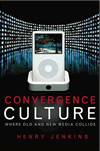
This year two books by Henry appeared: Fans, Bloggers, and Gamers: Exploring Participatory Culture and Convergence Culture: Where Old and New Media Collide (both New York University Press). Given that my The Frodo Franchise has chapters on Lord of the Rings video games and fan culture on the Internet, I thought I’d start with the first. Henry assured me, however, that Convergence Culture represented a more current and probably more relevant overview, so I started with it instead.
This terrific book uses a series of case studies to give an overview of how digital media have expanded the possibilities for participatory fan culture. It also shows how the producers of popular culture have reacted to this new empowerment of the consumers. Only two chapters focus on films: “Searching for the Origami Unicorn: The Matrix and Transmedia Storytelling” and “Quentin Tarantino’s Star Wars? Grassroots Creativity Meets the Media Industry.” In the modern entertainment industry, however, films are increasingly linked to other media, and no one has a better grasp of the overall relationship among popular media than Henry.
Convergence Culture is unusual, perhaps unique, in offering an overview of the entertainment industry from the perspective both of the big corporations that control popular media creations and of the fans, who often appropriate those creations for their own purposes. Much of the book depends on interviews with fans and executives alike. Henry is evenhanded in dealing with both points of view—except when the big firms try to stifle fan creativity through intimidation and the invocation of copyright and trademark control.
Here Henry is firmly on the side of the fans. The chapter on Star Wars mentioned above reviews the love-hate relationship George Lucas has had with fan websites that post innumerable works derived from his saga. Another chapter, “Why Heather Can Write,” details how Warner Bros. attempted to squelch fan creativity based on the Harry Potter series. Henry provides a cogent argument for rewriting fair-use laws to accommodate amateur, not-for-profit activities that utilize characters and situations from copyrighted works.
So am I an aca/fan, too? I wouldn’t exactly describe myself as one, though in this new book I have dabbled in that approach, meeting many fellow Lord of the Rings fans in person and in cyberspace. One has to admire members of the various fandoms and the amount of time and effort they are willing to put into keeping themselves and others informed about the objects of their fascination. They also lovingly create their own works (fanfiction, fanart, machinema, RPGs, and so on) derived from their favorite books, games, movies, TV shows, and comics. Most of the results aren’t masterpieces, of course, but that’s true of “real” artworks created by professionals and aspiring professionals as well. If enough of just about anything gets made, some of it is bound to be good. I’ve found some excellent Lord of the Rings fanfiction among the many conventional, sometimes nearly unreadable tales I have sampled. And Chocolate Cake City’s Brokeback to the Future demonstrates what David likes to describe as “the spontaneous genius of the American people” (usually in reference to the speed with which any significant event generates a body of tasteless jokes, or, in this case, parodies).
For all the attempts to analyze audiences through questionnaires and interviews and other traditional methods, Henry shows that the best way to understand fans is as an insider. The aca/fan approach is spreading as the study of popular media and fandoms gains legitimacy within academe, and it is lucky to have an enthusiastic, intelligent pioneer in Henry Jenkins.
Posted in Fans and fandom, FILM ART (the book), Film scholarship, The Frodo Franchise | open printable version
| No Comments »
|