Saturday | February 17, 2007

DB here:
The week before last brought Matthew Ryle to the UW–Madison campus for a talk and a panel discussion. As Ryle pointed out, it’s hard to decide exactly what he should be called. He has the title of Chief Fabricator at Matthew Barney’s studio, and in Barney’s Cremaster film cycle he serves as Production Designer. He’s been called a Set Designer too, and he assists in the making of sculpture pieces that Barney exhibits in museums. Ryle is an important artifact-maker in his own right, having built the tallest sign in North America.
 Nobody could have been more unpretentious than Matt Ryle, in olive sweatshirt and blue jeans, explaining the whys and wherefores of Barney’s enigmatic art. He gave a concise introduction to Cremaster 2, pointing up its reliance on Mailer’s nonfiction novel about Gary Gilmore, The Executioner’s Song. After the film, Ryle talked about the film’s Mormon and Masonic symbolism and the connections that Barney finds among killer Gilmore, Houdini, and the 1893 International Exposition, which Barney relocates from Chicago to Alberta, Canada. Nobody could have been more unpretentious than Matt Ryle, in olive sweatshirt and blue jeans, explaining the whys and wherefores of Barney’s enigmatic art. He gave a concise introduction to Cremaster 2, pointing up its reliance on Mailer’s nonfiction novel about Gary Gilmore, The Executioner’s Song. After the film, Ryle talked about the film’s Mormon and Masonic symbolism and the connections that Barney finds among killer Gilmore, Houdini, and the 1893 International Exposition, which Barney relocates from Chicago to Alberta, Canada.
Ryle discussed some of Barney’s filming procedures too. Barney shoots plenty of coverage, with many angles to permit inserts and matches on action. He favors delicate and lustrous lighting, both in the exteriors and the interiors, many of which are studio sets. Cremaster 2 cost about $1.7 million, and it looks it. There is ambitious CGI work in the Mormon Tabernacle, and the imagery is often spectacularly beautiful, showing off the landscapes of the Bonneville Salt Flats and Canadian glaciers and enticing props like the glittering mirrored saddle and the shapely furniture that surrounds the players.
The films
For those who haven’t yet heard, Cremaster is a series of five films made between 1994 and 2002. Each one suggests a narrative, but it doesn’t give us a traditional plot. Rich in surreal details, the action presents humans and fantastic creatures, most in fairly static postures or caught in repetitive actions. They exist in vacant spaces, either colossal ones, like a blimp or the Utah landscape, or cramped chambers. Their actions and circumstances work out Barney’s private mythology, which is based on the descent of the testes during the embryo’s development in the womb. (The cremaster is the muscle that controls the contractions of the testes.) As in the paintings of Salvador Dalí (another artist interested in bodily penetration and drippy fluids), the actions we see symbolize public and historical events, but at one remove and filtered through esoteric symbolism.
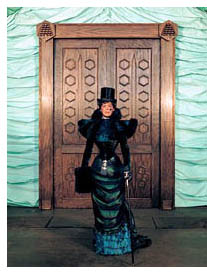 Cremaster 2, which we saw last week, is one of the most accessible installments, but it’s still very opaque. It begins with imagery of stupendous horizons, some tipped vertically. We’re introduced to several figures who’ll recur: an astonishingly wasp-waisted woman, a young man and woman who seem to be consulting her for advice, Harry Houdini being trussed up for an escape, and a desperate man parked at a gas station. There are also some isolated actions, most memorably a man and woman in coitus, with her pinched waist encased in a plastic girdle. There are bees, honey, saddles, cowpokes, and petroleum jelly. The film interweaves these materials around certain emblematic actions. Crucially, the young man in his Mustang (which is coupled by fabric to another Mustang) shoots the station attendant and eventually is executed by means of a rodeo bull-ride. Cremaster 2, which we saw last week, is one of the most accessible installments, but it’s still very opaque. It begins with imagery of stupendous horizons, some tipped vertically. We’re introduced to several figures who’ll recur: an astonishingly wasp-waisted woman, a young man and woman who seem to be consulting her for advice, Harry Houdini being trussed up for an escape, and a desperate man parked at a gas station. There are also some isolated actions, most memorably a man and woman in coitus, with her pinched waist encased in a plastic girdle. There are bees, honey, saddles, cowpokes, and petroleum jelly. The film interweaves these materials around certain emblematic actions. Crucially, the young man in his Mustang (which is coupled by fabric to another Mustang) shoots the station attendant and eventually is executed by means of a rodeo bull-ride.
I saw the Cremaster cycle at the end of summer 2003, when it ran at one of Madison’s art cinemas, the Orpheum. It was a pretty strange venue for this work, since in its heyday the old picture palace once ran Fred and Ginger movies. The Sunday I went, the entire cycle was screened in numerical order. I thought that some installments were very engaging, especially no. 5, a sort of operatic music video set in Budapest. Most of the others offered quite arresting imagery but seemed to me protracted and overbearing in their symbolism. By the end of the day my own cremaster was protesting.
Watching Cremaster 2 last Thursday, I was again absorbed by its imagery and, alas, still resisting the clanking machinery through which every figure, gesture, setting, and surreal juxtaposition called out for some Meaning, however elusive. In a tradition that runs back at least to Ulysses, Barney cooks up an interpretive feast for critics. The monstrous book treating the films and the kindred photographs and objects is, like the movies, at once luxuriant and fearsome. It starts with a ninety-page essay by Nancy Spector that explicates the films’ symbolic dimensions. Here’s a sample, from a discussion of Cremaster 4: machinery through which every figure, gesture, setting, and surreal juxtaposition called out for some Meaning, however elusive. In a tradition that runs back at least to Ulysses, Barney cooks up an interpretive feast for critics. The monstrous book treating the films and the kindred photographs and objects is, like the movies, at once luxuriant and fearsome. It starts with a ninety-page essay by Nancy Spector that explicates the films’ symbolic dimensions. Here’s a sample, from a discussion of Cremaster 4:
The Loughton Ram, with wool dyed red and all four horns decked in ribbons of yellow and blue Manx tartan, stands at this junction—a symbol for the total integration of opposites, the urge for unity that fuels this triple race. But before the three entities—Candidate, Ascending Hack, and Descending Hack—converge, the screen goes white and silent. This blankness bespeaks the annulment of desire. (63)
Just what I’d feared: every little movement has a meaning all its own. In addition, the essay’s prose style is forbidding in its rodomontade.
With his simple diagram of the field emblem Barney libidinizes architectural space and the surrounding environs, which come to represent the externalization or materialization of inner drives (8).
Surrounding environs, as opposed to non-surrounding ones? Inner drives? What would outer drives be? As for the sentence’s meaning, couldn’t one simply say that “The emblem makes erotic drives manifest”?
Three Thoughts
Anyhow, I just wanted to use today’s blog to externalize, or materialize, or maybe even libidinize, three hypotheses about Cremaster 2.
1. It is Big Art, All-Enveloping Art. It wants to meld many systems of meaning: religion (Mormonism, Judaism), science (fetal development, geological change), history (the Columbian exposition, Gilmore’s killing spree), literature (Mailer’s novel), and more. In this it belongs to a tradition of omnivorous artworks, from Ulysses and Finnegans Wake down to Pynchon, Syberberg, and Greenaway. The artist as demiurge, creating a master-scheme whose correspondences radiate out to many cultural systems: Eisenstein may have been the first filmmaker (in his unmade Moscow project) to attempt something on this scale, but he wasn’t the last.
At the same time, Postmodernist art characteristically absorbs these vast systems in an oblique way, through roundabout citation. I think of Robert Wilson’s Theatre of Images and his collaboration with Philip Glass on Einstein on the Beach. In a rarefied arena, obscure or trivial actions are played out, mysteriously referring to historical events or other artworks. If you don’t know the role of trains or violins in Einstein’s life and thought, you’re arrested by the pure juxtaposition. If you catch the cites, or more likely do your outside reading, you’ll discover an associative logic binding the tableau together. The same strategy of obscure allusion is on view in Glass’s theatre piece about Muybridge, The Photographer.
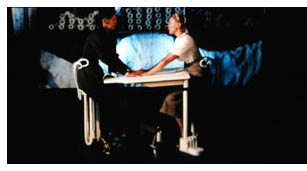 Something similar happens with Cremaster. As Matt Riley pointed out, Barney’s tableaus can tease you into doing research to find connections, however tenuous, among Gary Gilmore and Harry Houdini, or the Mormons and a Sinclair gas station. But to his grand synthesis, Barney has added autobiography. As in the work of Dalí, Cocteau, and Joseph Beuys, veiled references to public history are mixed with wisps from the artist’s life—in this case, an athletic career and modeling in New York. Beuys’ animal fat (recalling his purported plane crash during World War II) finds its equivalent in Barney’s petroleum jelly, used to keep his shoulder pads flexible during a football game. Something similar happens with Cremaster. As Matt Riley pointed out, Barney’s tableaus can tease you into doing research to find connections, however tenuous, among Gary Gilmore and Harry Houdini, or the Mormons and a Sinclair gas station. But to his grand synthesis, Barney has added autobiography. As in the work of Dalí, Cocteau, and Joseph Beuys, veiled references to public history are mixed with wisps from the artist’s life—in this case, an athletic career and modeling in New York. Beuys’ animal fat (recalling his purported plane crash during World War II) finds its equivalent in Barney’s petroleum jelly, used to keep his shoulder pads flexible during a football game.
These films assign you homework. Fortunately we have cheat sheets. Like Joyce and Greenaway, Barney has explicated his work’s public and private mythology. The bare bones are laid out on the cycle’s official website. Since free-associative interpretation is the modus operandi of most academic criticism, highly associative art like this has the effect of playing to commentators’ strengths. The Cremaster book includes not only Spector’s blow-by-blow explication but also an imposing glossary, with entries running from anus-island to zombie, illuminated by snippets from fiction and literary theory. Barney will keep critics very busy for a long time: Some Cremaster scenes are as iconographically dense as a mannerist Annunciation.
2. Stylistically the films go down like milkshakes. There may be less here than meets the eye, but what meets the eye is pretty gorgeous. The installments have the smooth cutting and meticulous compositions of Cocteau’s Orphée. Their limpid camera movements, swooping helicopter shots, and luscious color design could pass muster in a Hollywood production. The films flaunt their production values, and you could argue that this can make them attractive to young people who might find rougher-edged or lower-budget experiments by Ernie Gehr or Lewis Klahr harder to take. Though the shots run moderately long (averaging 9-10 seconds in the films I clocked), the insistence on close-ups, arcing camera, and slow zooms recalls that cluster of current Hollywood techniques I’ve called “intensified continuity,” and this helps contemporary audiences concentrate on the tableaus.
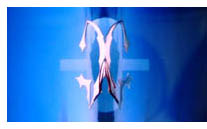 Another user-friendly aspect, touched on in the panel discussion: The echoes of the horror film. We’re on edge from the start of Cremaster 2, with Jonathan Bepler’s rumbling score rising dissonantly as the bleeding logo hurtles out at us, looking like a thorny torture device. The dripping nose and bolted mouth of Baby Fay la Foe, the bees swarming over the thrash-rock musician as he makes a call, and the bloody body of the gas station attendant offer us some fairly pure horror-movie iconography. It could just as easily be called Creepmaster. Another user-friendly aspect, touched on in the panel discussion: The echoes of the horror film. We’re on edge from the start of Cremaster 2, with Jonathan Bepler’s rumbling score rising dissonantly as the bleeding logo hurtles out at us, looking like a thorny torture device. The dripping nose and bolted mouth of Baby Fay la Foe, the bees swarming over the thrash-rock musician as he makes a call, and the bloody body of the gas station attendant offer us some fairly pure horror-movie iconography. It could just as easily be called Creepmaster.
3. Might not this be the Artworld’s parallel to a Hollywood blockbuster franchise? The Cremaster films are designed chronologically, like sequels are. They have spawned fan videos and fan music. They spin off ancillaries, such as the souvenir volume I’ve already mentioned, along with T-shirts, baseball caps, and coffee mugs. Since this is the Artworld, though, the real ancillaries are the photographs, drawings, and sculptures that tour on exhibit. In early 2004 one photo triptych from Cremaster 2 fetched over $186,000. The film has become a precious object in itself. Only ten institutions, we’re told, can acquire prints, and the series won’t be released on DVD.
Those who think that many contemporary museum shows are really about the shop will find strong evidence here. In today’s art market, Cremaster might be the gallery scene’s equivalent of the summer megapicture, the project that by virtue of its monumental scale and production values generates income at many levels indefinitely. Again, the showmanship of that adroit impresario Dalí comes to mind.
From this perspective, Barney becomes the equivalent of an A-list movie producer or director, overseeing a platoon of artisans like Matt Ryle who bring his vision to life. Cremaster reminds us of the ambiguities in the word studio, applied both to moviemaking and the fine arts. For hundreds of years successful painters have in their studios divided the labor of artmaking, planning the overall design and assigning juniors to fill in bits before the supervisor added his distinctive touch. Warhol revived this in ironic mode with his Factory, often by denying he had a touch by leaving all the work to others. But Warhol’s films struck observers as crude and offhand, while Barney has produced something bold, polished, and overwhelming. If Warhol was the Roger Corman of the Artworld, Matthew Barney may be its Jerry Bruckheimer.
PS: In correspondence Professor Jim Kreul has called my attention to an article that anticipates my third point: Alexandra Keller and Frazer Ward, “Matthew Barney and the Paradox of the Neo-Avant-Garde Blockbuster,” Cinema Journal 45, 2 (2006), 3-16. It considers in detail the relationship of Barney to performance art as well.
Posted in Experimental film, Film and other media, Film comments, Hollywood: Artistic traditions |  open printable version
| No Comments » open printable version
| No Comments »
Wednesday | February 14, 2007
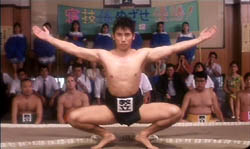 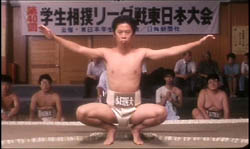
Suo Masayuki, one of Japan’s most ingratiating directors, found an international triumph with Shall We Dance? (1996). He had started his career with an odd little softcore porn film, Abnormal Family (1983), shot as an admiring pastiche of Ozu’s style. His Fancy Dance (1989) was also fun, but he really hit his stride with Sumo Do, Sumo Don’t (1992), which remains a sure-fire crowd pleaser.
Suo worked comic variations on an ingenious theme: How Japanese youth fail to appreciate the beauty of their traditional culture. The garage-band ska singer in Fancy Dance is obliged to retreat to a monastery, where he discovers that Zen is really, really cool. Sumo Do converts sullen college kids to the virtues of ritualized wrestling. Shall We Dance? works in reverse, obliging an uptight salaryman to rekindle his marriage by learning ballroom dance. Suo’s films celebrate pleasurable fusions between Asian and Western cultures.
Suo’s meticulous, understated style is a kind of modern revision of Ozu’s. Fancy Dance and Sumo Do pay homage to the master’s college comedies, and in Shall We Dance? the first tracking shot occurs when the hero takes his first tentative dance steps. In Figures Traced in Light, I mention Suo as part of that trend toward planimetric shooting and compass-point cutting I discussed in an earlier blog. As you see from the opening images, he tries out the precise sort of graphic matching between shots that was a hallmark of Ozu’s style.
 Suo has been very quiet for the last decade, but now he’s back. I Just Didn’t Do It is arousing keen local interest, partly because of its controversial subject matter. Japan is known as a low-crime society, but gradually questions of police brutality have emerged. Suspects can be kept in custody for up to 23 days, and unique among industrial nations, 95% of all people arrested confess! Suo has been very quiet for the last decade, but now he’s back. I Just Didn’t Do It is arousing keen local interest, partly because of its controversial subject matter. Japan is known as a low-crime society, but gradually questions of police brutality have emerged. Suspects can be kept in custody for up to 23 days, and unique among industrial nations, 95% of all people arrested confess!
In Suo’s new film, a young man is accused of groping a schoolgirl in the subway. It’s a daring move for a director known for light comedies. The film stars Kase Ryo, from Letters from Iwo Jima, and veteran Yakusho Koji, seen most recently in Babel. Read more about it here, noting that the Economist’s contents tend to evaporate into the pay-only archive. The film’s official website, in English, is here.
I Just Didn’t Do It, Suo says, is a film “I simply had to make.”
Posted in Asian cinema, Directors: Ozu Yasujiro, Directors: Suo Masayuki, Film comments, Film technique, National cinemas: Japan | open printable version
| No Comments »
Monday | February 12, 2007
Hero.
Kristin here—
Note: This entry was written for Jim Emerson’s Contrarian Blog-a-Thon (III).
When David and I got into film studies in the late 1960s and early 1970s, an era of Hollywood’s history was drawing to a close. Many of the great directors who had defined the classical studio era from the period of World War I to the early age of television were at or approaching retirement. Andrew Sarris’s pivotal book, The American Cinema: Directors and Directions 1929-1968 (1968) came out just in time to elevate their reputations by dubbing them with the fashionable French term auteur.
John Ford and Howard Hawks made their last films in this period (7 Women, 1966, and Rio Lobo, 1970). Alfred Hitchcock, Otto Preminger, and Vincente Minnelli kept driecting into the 1970s, though few would say their late films stacked up to their earlier ones. (Preminger did manage to struggle back after a string of turkeys to make a very creditable final film, The Human Factor, in 1980.) Sam Fuller kept working through the 1980s, but he had to go to France to do it. Billy Wilder’s last film came out in 1981, though most of us wish he had stopped with The Private Life of Sherlock Holmes in 1970.
The decline of these greats coincided with the rise of the New Hollywood generation, whose directors, originally dubbed “the movie brats,” have become the grand old men of the current cinema. It also coincided with the early rumblings of the blockbuster (Jaws, 1975) and franchise (Star Wars, 1977) age that we know today. Definitely a shift took place in the 1970s, but to what?
Many film historians have claimed that the films that have come out of Hollywood since roughly the end of the 1980s are radically different from those of the classical “Golden Age.” Factors like television, videogames, spectacular special effects, moviegoers with short attention spans, the internet, the acquisition of the old studios by multi-national corporations, and the resulting rise of franchises have all putatively given rise to a “post-classical” cinema. This phenomenon is sometimes also referred to as the “post-Hollywood” or “post-modern” era.
I’m suspicious of the “post” terms, vague as they are. Usually stylistic labels describe what something is, not what it follows. Do we speak of “post-silent” or “post black-and-white” cinema?
Post-classical films supposedly jettison the old norms of style and storytelling. Frenetic editing, constant camera movement, product placement, juggled time-schemes—these and other tropes of recent cinema have replaced the continuity system, the carefully structured screenplay, and the character-based storytelling of the classical era. Computer-generated imagery has enabled filmmakers to create action scenes, spectacular settings, and fantastical creatures that hold our attention so thoroughly that the plot ceases to matter.
Or not. David and I have spent much of our professional careers studying the norms of classical filmmaking. We’ve swum against the stream by claiming that, despite many changes in style and technique, the fundamental norms of classical storytelling have remained intact. The classical cinema is with us still, precisely because it enables filmmakers to present us with absorbing plots and characters. It also is a flexible filmmaking approach that can absorb new technologies and new influences from other media and bend them to its own uses.
It’s less seductive to proclaim a long-term stability in Hollywood than to trumpet revolutionary, transformational, epochal changes. Still, some things just work so well that people want to keep them going as is. American films have dominated world screens since 1915. Why tinker with an approach that works so well?
It’s amazing to think of it now, but back in the late 1970s, virtually no one had studied the traditional norms of Hollywood filmmaking. We all knew what the distinctive traits of the great auteurs were, but distinctive as opposed to what? Academics kept saying that someone should figure out just what the cinema of the classical studio era consisted of. What principles guided filmmakers? What assumptions did they share? Not realizing how much material was available on Hollywood cinema, we and our colleague Janet Staiger set out to document the norms of style, technology, and mode of production that composed the “classical Hollywood cinema.”
The result was a much larger tome than we had expected, The Classical Hollywood Cinema: Film Style and Mode of Production to 1960 (1985). After finishing it, David and I dusted off our hands, figuring that we had dealt with that topic. We went back to studying non-classical directors like Ozu, Eisenstein, Tati, Godard, Bresson, and Hou, confident that we had the knowledge to show exactly how and why their work differed from standard filmmaking.
Then claims about post-classical filmmaking started to appear. In our book, we had limited our survey to pre-1960 cinema because the breakdown of the studio structure and the competition from television led to a different situation in Hollywood. We did not, however, say that classical filmmaking died then. Quite the contrary; we said that it had endured through those changes in the industry.
Those favoring the post-classical explanation obviously disagreed with that. Bypassing our claims for the endurance of classical filmmaking, they borrowed our cut-off date of 1960, as if we had intended that year to signal the end of all aspects of the classical cinema—style, storytelling, mode of production, technology, the whole thing.
During the 1990s it became apparent that claims about post-classical cinema were becoming one very common way of dealing with modern Hollywood films. We decided to move well beyond 1960 and show that classical norms still prevail in American mainstream cinema. I wrote Storytelling in the New Hollywood (1999), which analyzes ten successful films of the 1980s and 1990s to show that they use narrative principles that are virtually the same as those that were standard in the 1930s and 1940s. Goal-oriented characters, dangling causes, appointments, double plot-lines, carefully timed turning points, redundancy—all these classical devices are still very much with us. The claim was not that every single film coming out of Hollywood adhered to classical norms, only that the vast majority did.
David went on to make a similar argument in The Way Hollywood Tells It (2006), though he deals with visual style as well as narrative. There he examines some of the new norms of storytelling, showing how they are variants of the older classical system. He discusses, for example, “intensified continuity,” where tighter framings on actors, faster cutting, and prowling camera movements have modified but not replaced the standard continuity approach to presenting a conversation scene.
One of the most persistent claims by proponents of a post-classical era is the spectacle made possible by CGI. With the thrilling fight sequences of The Matrix, the vast battles of The Lord of the Rings, the extensive recreation of historical places of Gladiator, and the fantastical creatures and places of The Chronicles of Narnia: The Lion, the Witch and the Wardrobe, the individual scene supposedly becomes more spellbinding than the story in which it is embedded.
David and I have tried to refute this claim to some extent. I talk about Terminator 2 in the first chapter of Storytelling, showing that it has a tightly constructed, character-based narrative. David has a chapter section called “A Certain Amount of Plot: Tentpoles, Locomotives, Blockbusters, Megapictures, and the Action Movie,” where he examines films like Judge Dredd and The Rock. He demonstrates that they, too, have plots that adhere to traditional Hollywood norms. He puts forth a more detailed analysis in this online essay.
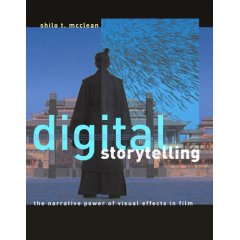 We’ve never really dealt much, however, with the issue of how CGI may or may not have elevated spectacle over narrative interest. Luckily now a new book does that and does it very well. Shilo T. McClean, in her Digital Storytelling: The Narrative Power of Visual Effects in Film (MIT Press, 2007), agrees with much of what we have claimed about the survival of classical filmmaking (though The Way Hollywood Tells It came out too late for her to have seen it). She builds upon our case by examining systematically and imaginatively the question of whether digital special effects support narrative interest. McClean convincingly demonstrates that DVFx (digital visual effects), as she terms them, are used in an enormous variety of ways, and most of these help to tell classically constructed stories. We’ve never really dealt much, however, with the issue of how CGI may or may not have elevated spectacle over narrative interest. Luckily now a new book does that and does it very well. Shilo T. McClean, in her Digital Storytelling: The Narrative Power of Visual Effects in Film (MIT Press, 2007), agrees with much of what we have claimed about the survival of classical filmmaking (though The Way Hollywood Tells It came out too late for her to have seen it). She builds upon our case by examining systematically and imaginatively the question of whether digital special effects support narrative interest. McClean convincingly demonstrates that DVFx (digital visual effects), as she terms them, are used in an enormous variety of ways, and most of these help to tell classically constructed stories.
McClean’s basic points are two. First, DVFx are not used just in the more obvious ways, for big action scenes or elaborate fantasy and science fiction settings. They are applied for a wide range of purposes, from dustbusting (removing dust and other minor flaws from frames) to spectacular scenes. Far from being inevitably spectacular, DVFx are often invisible. (1)
Second, McClean claims that whether modest or spectacular, DVFx usually serve the narrative in some way—and she points out that practitioners in the industry invariably make that same claim.
Digital Storytelling started out as McClean’s dissertation at the University of Technology Sydney. It betrays its origins in a survey of the literature that takes up the first two chapters. There the author is somewhat too conciliatory, for my taste anyway, to a number of theorists’ claims about the breakdown of narrative in the digital-effects age. She tries to find something useful in each writer’s position, even though some of those positions are irreconcilable with the general standpoint she adopts.
Chapter 3 sketches the history of computer graphics and how they came to be used in films. McClean points out that DVFx are perfectly suited to the three criteria for the adoption of new technology that David and Janet formulated in their sections of The Classical Hollywood Cinema: greater efficiency, product differentiation, and support for achieving standards of quality. Like sound and color, DVFx have marked a major technological shift for the film industry, but like them, DVFx have been readily integrated into the existing division of labor. A modern digital studio, as she says, functions in much the same way as a physical one does. Indeed, in watching the credits of a modern film, we see lighting, matte paintings, and so on listed as the specialties for the digital craftspeople.
In these early chapters, McClean points out that in many ways DVFx simply replaces the traditional special effects of the pre-digital age. Most of Citizen Kane’s many effects are not supposed to be noticeable, and indeed for years historians were unaware of just how many it contained. In cases where DVFx create a flashy effect, as in the virtual camera movements through walls in Panic Room, the function is to inform the viewer of the locations of various characters and create suspense. Probably the most vital lesson one could take away from this book is that techniques can serve multiple purposes in a film. Spectacularity, as McClean calls it, and storytelling can co-exist in the same digital images.
The author also explains that, unlike what many writers say about DVFx, they are not simply a post-production technique used to ramp up the visual appeal of a film. Computer imagery is used from the pre-production stages onward, and the mise-en-scene and camera movements must be planned around them.
After this setup, the author systematically explores the factors that might influence the storytelling—or merely spectacular—use of DVFx. As we did in The Classical Hollywood Cinema, McClean samples a large number of films, 500 including shorts. Any film using DVFx, however unobtrusively, qualified.
On this basis, the author has distinguished eight types of DVFx usage. Documentary is one, as in films where computer reconstructions of ancient buildings are shown. Such usage comes into films when information is presented as part of the mise-en-scene, as with the educational film that is screened in Jurassic Park. The second type of DVFx usage, Invisible, is fairly self-explanatory. We are not supposed to notice when buildings are extended, clouds are added to skies, or smudges on actors’ faces disappear.
Seamless DVFx are those we know must be faked, even though the results look photorealistic. The recreation of ancient cities, as with Rome in Gladiator or giant storms, as in Master and Commander, are of this type. Exaggerated effects involves actions or things posited to be real but created in a stylized fashion. McClean cites the comic effects in Steven Chow comedies, and puts wire-erasure for stunts into this category. I assume The Hudsucker Proxy would be another instance.
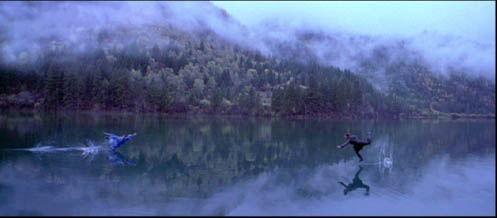
Fantastical DVXs obviously involve impossible beings like dragons, cave trolls, and a wide variety of X-Men. McClean also finds them in non-fantasy, non-sci fic films like Forrest Gump, Big Fish, and Hero. Surrealist uses of effects can include mental representations, as in Eternal Sunshine of the Spotless Mind and American Beauty, or a bizarre but objective world, as in Amélie.
Finally, there are New Traditionalist uses of DVFx, exemplified by Pixar’s films, and HypeRealist ones, like Final Fantasy.
Armed with this typology, McClean studies various approaches to film studies, testing what each one reveals about the use of DVFx. Since classical Hollywood cinema is based on character traits and goals, she begins by showing convincingly how DVFx can “establish, realize, and enhance” character. For example, films often use effects to put the protagonist in greater danger than would be safe to do in reality. The staged fights in Gladiator, the author argues, create a greater emotional engagement with the main character and make plausible the heroism that allows him to defeat his enemy in the end.
Next McClean tests how DVFx can change the impact of a film by analyzing a pre-digital film and its remake in the computer age. (As a method, this is similar to what David does in The Way Hollywood Tells It when he examines framing, editing, and other techniques in the two versions of The Thomas Crown Affair.) The case study chosen is the 1963 Robert Wise version of The Haunting and the Jan De Bont remake (1999). McClean presents considerable evidence that the inferiority of the later film has nothing to do with its expensive DVFx supernatural effects. Instead, she locates the problem partly in the removal of all the creepy ambiguity of the earlier version. De Bont also changes the heroine from a guilt-ridden, virtually suicidal woman (too wimpy in this politically-correct age?) to a strong, determined savior. The result is a conventional super-woman versus evil monster film where the digital effects stand out simply because the original story was stripped of its most intriguing elements.
McClean moves on to genre, an important subject given the apparent concentration of DVFx (the ones we notice, that is) in fantasy and sci-fi films. She rightly points out, “For all the many assertions that special effects are an emerging narrative form, no one has proposed the narrative structure that this new form demonstrates.” The author makes up for that lack herself, concocting an outline of a film based around a string of effects-laden action scenes. Her outline fits the descriptions of films as given by proponents of post-classicism. The result, however, doesn’t resemble any film I’ve ever seen.
In the genre chapter McClean uses an obvious research resource, but one that the post-classicists largely ignore. She has gone through the entire run of the special-effects journal Cinefex, on the assumption that the films it covers are those assumed to be most significant in terms of their DVFx. McClean lists the 291 films by genre, showing that sci-fi films and horror do not have a monopoly on DVFx. For example, thirty-three period and dramatic movies feature in her list.
To gauge the impact of the rise of franchises in modern Hollywood, McClean surveys the four Alien films, which begin in the pre-digital and move into the digital era. As with remakes, the author demonstrates through analysis that the decline in the series after its two first films had to do with a thematic shift and a change in the character of Ripley.
McClean does not overlook the auteur theory, tracing the work of Steven Spielberg during that same transition from pre-digital to digital cinema. Unlike the other effects-oriented giants of Hollywood, George Lucas and James Cameron, Spielberg has worked in many genres. As soon as DVFx became available, he used them in nearly all the ways listed in McClean’s typology, from the Invisible creation of the swooping airplanes in Empire of the Sun to the Exaggerated in the Flesh Fair setting in A.I. to the Fantastical Martians in War of the Worlds. Always in the service of the narrative.
Along the way McClean offers a number of astute observations. One of these is a novel argument against the “DVFx equals non-narrative spectacle” position. She points out that “In many instances technically weak DVFx will be forgiven if they are narratively congruent; it is the strength of the narrative that will carry them, rather than the other way round.” This claim is plausible when we consider how in the pre-digital age we tried to overlook the obvious back-projections and matte-work in Hitchcock films like The Birds and Marnie.
She also suggests some plausible reasons why bad films might be heavy with DVFx. In some cases the effects create a publicity hook that makes up for the lack of other production values. In others, an inexperienced director, carried away with the “cool” possibilities of DVFx, uses them to excess.
And finally someone has come out strongly against the use of the term “cinema of attractions” to describe modern films. Historian Tom Gunning originally coined this phrase in describing very early cinema, where magic acts with stop-motion disappearances and elaborately hand-colored dances were as common as narrative films. For that period, the label worked and was useful. Applying it to later eras just because films have spectacular sequences has rendered the term much less meaningful.
One thing that I particularly like about McClean’s book is that she shows respect for the films she discusses. She actually seems to enjoy both watching and writing about them. McClean asks questions of aesthetic import, and she treats films as artworks—some good, some bad, but all to be taken seriously as evidence for her case.
Her final chapter provides an excellent conclusion: “While DVFx have completely reequipped the storyteller’s toolbox, they have not rewritten the storyteller’s rulebook entirely.” Yes, classical cinema lives, and Digital Storytelling provides vital new evidence to bolster that claim.
(1) In Film Art, we have touched on this range in the section “From Monsters to the Mundane: Computer-Generated Imagery in The Lord of the Rings” (pp.249-251 in the 7th edition, pp. 179-181 in the 8th). McLean treats the topic in far more depth.
Posted in Film comments, Film criticism, Film history, Film technique, Hollywood: Artistic traditions, Narrative strategies, New media: Technology, Special effects and CGI | open printable version
| No Comments »
Friday | February 9, 2007
The Magnificent Ambersons.
“It’s only history,” Jack Valenti is reported to have said when allowing scholars access to MPAA files. (1) After studying Hollywood for over thirty years, I should be used to the ways in which trade journalists (and some critics) forget or ignore historical precedents in moviemaking. But I still get bug-eyed when I encounter something like the Variety piece on TV director Tommy Schlamme (Studio 60 on the Sunset Strip).
The subhead tells us that this DGA nominee is known for his “hallway shots.” That gets my interest.
I lose interest fast. The writer tells us that Schlamme
developed the “walk and talk” on Sports Night and then mastered it on The West Wing.
The shot—which features two or more actors moving from one location to another on the set, often from one office to another via a hallway—has become a Schlamme signature.
The first sentence could be read as saying that Schlamme invented the walk-and-talk. Since I spent a little time studying this technique in The Way Hollywood Tells It, my inner film historian cries out, Aarrgh. Long before Sports Night (aired 1998-2000) and The West Wing (1999-2006), movies were developing such bravura shots.
The oblique view
In the prototypical walk-and-talk, two or more characters advance, and the camera tracks along, keeping them centered as they move through the environment. Such shots are quite uncommon in the silent cinema, but they emerge in 1930s films from many countries.
They were truly “signature shots” for Max Ophuls and the lesser-known Erik Charell. In Charell’s captivating The Congress Dances (1931) Lillian Harvey sings while a carriage takes her through an entire town and into the country, all in flowing tracking shots. Call it a ride-and-sing.
If that’s not as pure an instance as you’d like, we can find nice ones during a street scene of The Thin Man (1934). A more somber example occurs in Mizoguchi Kenji’s Story of the Last Chrysanthemums (1939), with the camera in a river bed angled upward at the couple it follows.
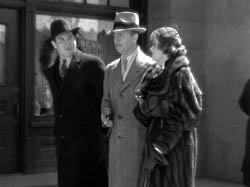 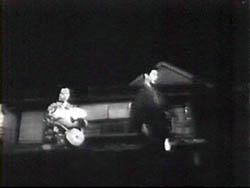
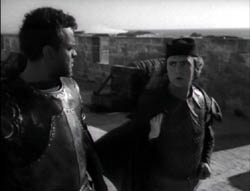
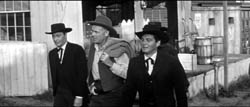
Usually such traveling shots from the 1930s and 1940s are shot obliquely to the actors. That is, the performers are seen in a ¾ view, and they walk along a diagonal path with respect to the frame edges; the camera moves on a similar trajectory. Sound cameras were mounted on dollies that usually ran on tracks. Framing the actors head-on raised problems with this gear. Performers couldn’t walk smoothly if they were stepping within rails, and there was a risk that the rails in the distance might appear in the frame. It was simpler to set the camera at an oblique angle so that actors could walk unimpeded and the tracks wouldn’t be seen. Directors continued to use this framing into the 1950s, as in Welles’ Othello (1952) and Fuller’s Forty Guns (1957). Both are unusually long takes; in the second, poor Gene Barry seems to be panting to keep up with the other men.
Back off
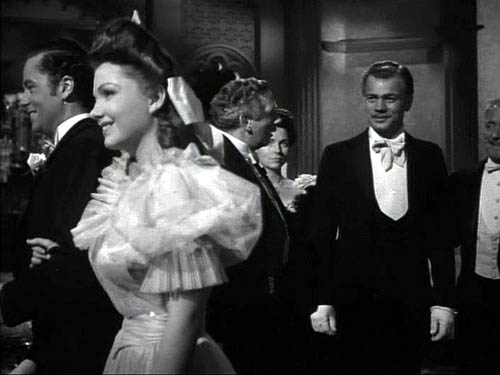
Today’s walk-and-talk is more likely to be a head-on framing, with the camera retreating from the actors. (More rarely, it dogs them from behind.) With a retreating Steadicam, you don’t have to worry about glimpsing the ground or floor behind the actors, in the distance, since there are no track rails to be exposed. Again, though, we have some precedents, most famously the splendid camera movements, evidently executed with a crane, in the ball sequences of The Magnificent Ambersons (1942), when George and Lucy stroll through the party.
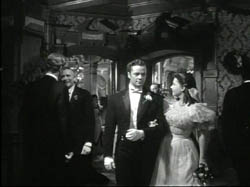 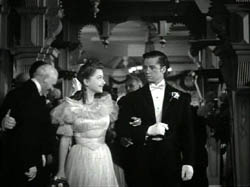
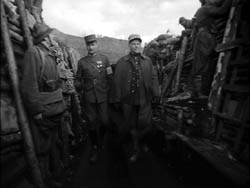
When location shooting became more common in the 1940s and 1950s, cameras could be supported on more versatile dollies that didn’t require track rails, and these reverse-tracking shots become a bit more common. Kubrick, highly influenced by Welles and Ophuls, captured his officers striding through the trenches of Paths of Glory (1957). Vincent LoBrutto’s information-packed book (2) tells us that Kubrick’s dolly rolled backward on the planks that the actors walked on (authentic details, as boards were indeed used in the muddy trenches). Godard’s long traveling through the office lobby in Breathless (1960) was shot from a wheelchair.
 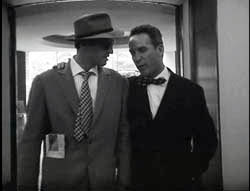
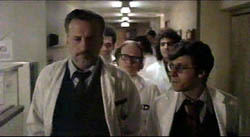
Such head-on (and tails-on) shots can be found in several films well into the 1970s, as in Arthur Hiller’s The Hospital (1970). In fact, hospitals, police stations, and other sprawling institutional spaces seem to invite this approach.
 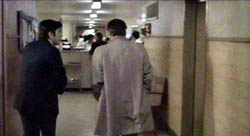
By the 1980s, these shots proliferate in American films largely because the Steadicam makes them easy. One famous example is De Palma’s Bonfire of the Vanities (1990), which follows the drunken Peter Fallow through a hotel as he picks up and drops off many other characters.
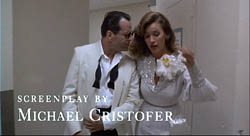 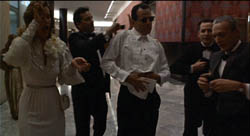
Today such shots are very common in both high- and low-budget films. Schlamme’s “signature” device seems to be in pretty wide circulation. At best it’s a convention, at worst a cliché.
They’re called actors; let them perform action
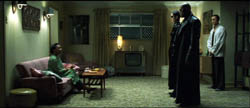
I argue in The Way Hollywood Tells It that walk-and-talk is one of two principal staging techniques of contemporary Hollywood. The other, usually called stand-and-deliver, plants the characters facing one another and simply cuts from one to the other. The scene is built primarily out of singles (shots of only one actor) or over-the-shoulder framings. Here’s a typically static dialogue scene from The Matrix Revolutions (2003).
 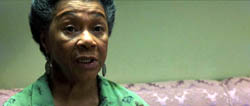
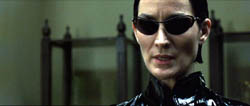 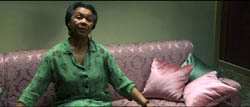
Both stand-and-deliver and walk-and-talk began in the studio era, decades ago, but then there were other options as well. Directors cultivated smooth, unobtrusive blocking tactics that moved characters in ways that reflected the developing scene. The actors had to perform with their whole bodies, and bits of business motivated them to circulate through the setting and turn toward or away from the camera. One example given earlier on this blog is from Mildred Pierce; here’s another, from the program picture Homicide (1949).
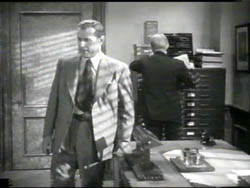
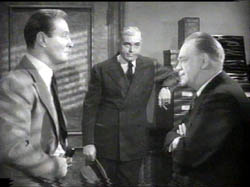
Detective Michael Landers has a hunch that the purported suicide of a former sailor is really murder. He has to persuade Captain Mooney to let him pursue some leads out of his jurisdiction. Today this might be played out in a stand-and-deliver session, with both men seated and shot/ reverse-shot cutting carrying the scene. But the director Felix Jacoves decides to let his actors earn their money through ensemble staging, not merely line readings. Here are just three shots from the middle of the scene that illustrate my point.
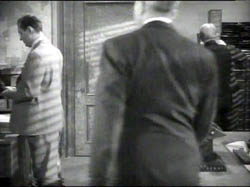
Landers stands at Mooney’s desk and gets a refusal. As he turns away to the left, Mooney walks to the rear files to put the papers away.
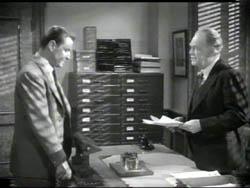 
As they’re retreating to the opposite ends of the screen, Landers’ partner Boylan, who’s been offscreen for this phase of the scene, strides into the center and pauses at the door. The result of this choreography is both a balanced three-point composition and a chance to let us observe Boylan’s skeptical reaction to Landers’ next plea.
 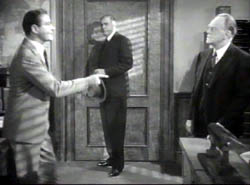
The camera tracks in as Landers approaches Mooney. Boylan shifts closer as well. What seems somewhat stagy as we analyze it doesn’t look obtrusive on the screen, because we’re following Landers’ arguments and watching the older men’s reactions. The closer framing and the position of the men, now face to face rather than separated by a desk, raises the dramatic pressure. As Landers pauses, Mooney folds his arms—a simple piece of body language that lets us know he’s still resisting.
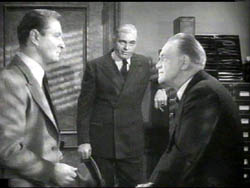 
Now a cut to Mooney, in an OTS framing, stresses his continued resistance as he tells Landers off, and a reverse shot gives Landers’ angry reaction.
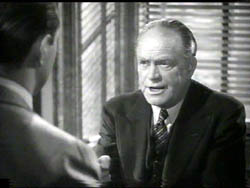 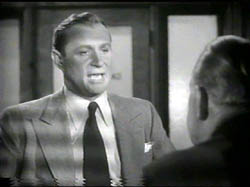
Interrupting the sustained take, the shot/ reverse shot cuts have gained more emphasis than if they were part of a string of OTS shots. Jacoves has saved his cuts and closer views for a moment that raises the stakes visually as well as dramatically.
I’m not claiming that this is a brilliant stretch of cinema. (But you have to like a plot in which the hero defeats the killer by denying him access to insulin.) It’s just that the sequence activates, in a way that directors once took for granted, aspects of film art that we don’t find too often nowadays. Once you didn’t have to choose between Steadicam logistics and static dialogue; there is a very wide middle ground if you’re willing to move actors around the set and give them some body language and prop work. No need for a walk-and-talk here.
Schema and revision
The Variety article explains that Schlamme utilizes his long walk-and-talks to save time and money. But directors in the studio era shot their fully elaborated scenes like that in Homicide to be economical as well. If actors know their lines and hit their marks, playing out pages of dialogue in a few sustained setups can be very efficient; the Homicide full shot consumes 45 seconds. I’d argue that most contemporary directors have never learned to stage scenes this way. It’s a lost skill set. I make the case in more detail in Figures Traced in Light and The Way Hollywood Tells It.
To some extent, however, another skill set has emerged. Some walk-and-talks in The West Wing and other programs have an extra feature that the Variety writer and I haven’t mentioned. Often character A and B are walking toward us down the corridor, then B drifts off and C catches up with A. A and C walk for a while, then A peels off and C picks up somebody else, and so on. This approach is suited to multiple-protagonist dramas. You can show the plotlines crossing and separating.
I’m no TV historian, but I think that this technique showed up on St. Elsewhere (1982-1988), and it’s definitely on display in ER (1994-). Hospitals again. I think we also find this mingling/ separating choreography in contemporary film, but I can’t recall many examples in earlier eras. You could argue that one of the shots in the Ambersons’ ballroom does this, though I don’t think it’s a pure instance. (The principle of overlapping character actions is at work in many Renoir films, most famously in the final party melee in Rules of the Game, but Renoir doesn’t employ what we’re calling a walk-and-talk.) Did movies pick up this intertwined walk-and-talk from TV or vice-versa? I don’t know. If you do, drop me a line!
In On the History of Film Style and Figures Traced in Light, I argue that stylistic change in filmmaking often follows a logic of what art historian E. H. Gombrich calls schema and revision. (3) A pattern or practice becomes standardized, but then creators extend it to new situations or find new possibilities in it, and they modify it.
Camera movements have long been used to link characters. For instance, when Nick Charles circulates drinks in The Thin Man, Van Dyke tracks leftward to follow him from guest to guest.
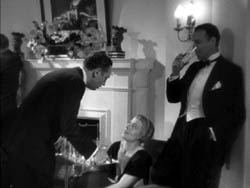 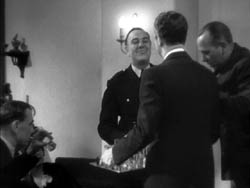
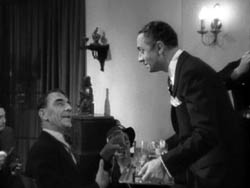 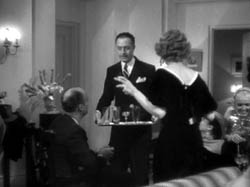
So maybe in the 1980s and 1990s, when ensemble stories had to balance attention among several major characters, directors blended the multiple-interaction aspect of lateral camera movements with the schema of the advancing walk-and-talk. The result makes characters move in and out of each others’ orbits along a single trajectory. Whoever came up with this device, I’d speculate that it arose from the realization that the backing-up walk-and-talk could be repurposed for dramas following the fates of several protagonists.
It’s only history, but it matters if we want to understand stylistic continuity and change.
(1) Thanks to Richard Maltby for passing this along.
(2) Vincent LoBrutto, Stanley Kubrick: A Biography (New York: Fine, 1997), 141-142.
(3) E. H. Gombrich, Art and Illusion: A Study in the Psychology of Pictorial Representation (Princeton, N. J. Princeton University Press, 1960), especially Chapter III.
Posted in 1940s Hollywood, Directors: Godard, Directors: Mizoguchi Kenji, Directors: Welles, FILM ART (the book), Film comments, Film technique, Film technique: Cinematography, Film technique: Editing, Film technique: Staging, Hollywood: Artistic traditions, National cinemas: Japan | open printable version
| No Comments »
|