Friday | August 10, 2007
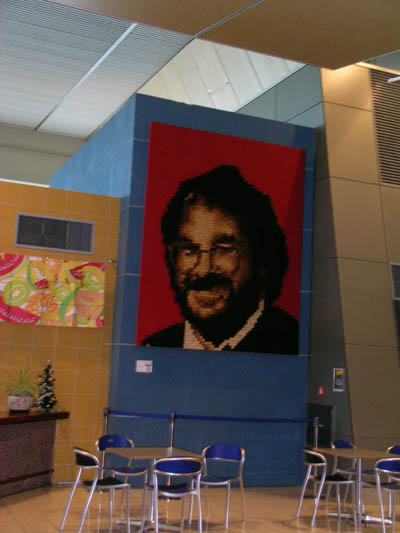
Local hero: Peter Jackson portrayed in toast, Wellington Airport, July 2004
Kristin here—
While the new “Frodo Franchise” website is under construction, I offer here a new set of speculations on the Hobbit project.
In my July 20 entry, I cited a statement by Ian McKellen concerning possible progress in the ongoing legal dispute between Peter Jackson and New Line Cinema. The dispute is the reason given by the studio’s president, Bob Shaye, for Jackson’s not being asked to direct the film adaptation of The Hobbit. There Sir Ian said, “I detect that there is movement and it’s movement in the right direction.” That interview went online July 19.
The Royal Shakespeare Company’s tour then moved on to Australia, and on July 26 an Australian Broadcasting Corporation television interview with McKellen brought up the question again. Here the response is somewhat more specific:
KERRY O’BRIEN: What’s happening with The Hobbit?
SIR IAN MCKELLEN: I talked to one of the Hollywood producers who is in a position to know, who said there seemed to be a little bit of movement and he is a circumspect man so I took that to mean something quite positive and I’ll be seeing Peter Jackson in a couple of weeks when we’re taking The Seagull to Wellington and Auckland.
KERRY O’BRIEN: It would be tragic if it happened without Peter Jackson?
SIR IAN MCKELLEN: It couldn’t happen really, could it? In the way that it ought.
McKellen is currently playing King Lear and, in repertoire, Sorin in The Seagull. The schedule began at Stratford on 24 March and by November will have visited Newcastle-upon-Tyne, Singapore, Melbourne, Wellington, Auckland, New York, Minneapolis, Los Angeles, and London. Currently he is in Wellington, where the engagement that he mentions, including both King Lear and The Seagull, runs August 11 to 13.
This new interview seems to add a little to the one in Singapore that I quoted previously. I don’t want to read too much into McKellen’s statement. Still, I can infer (as usual with the proviso that I have no inside information) a couple of things.
In Singapore, McKellen referred to “detecting” movement in the Hobbit front, but he doesn’t hint as to his source. Here he says he heard this from a producer. Perhaps such a communication would involve said producer sounding him out about the circumstances under which he would be willing to reprise his role as Gandalf. McKellen has made it clear on his website and in interviews, including this new one, that he feels Jackson should direct and has strongly implied that he would not play the wizard under a different director. He has not, however, made a firm public statement to that effect. The fact that in this context he mentions meeting with Jackson, however, suggests that he may have some reason to believe that they could work together on the film.
(Subsequent interviews with McKellen have been published in Australia and New Zealand, but none adds any new information.)
I had the pleasure of interviewing McKellen in early 2005 as part of my research on The Frodo Franchise. He made it perfectly clear that he, like virtually all the cast and crew members that worked on The Lord of the Rings, is intensely loyal to Jackson. I would be very surprised to hear that he had agreed to play Gandalf if someone other than Jackson were at the helm.
Second, these two interviews, one done in Singapore and one in Melbourne, were posted on the internet a week apart. There is no hint that anyone asked McKellen not to say anything more about the Hobbit negotiations. Given the intense interest in this subject, even brief, very general statements like the ones I have quoted can give rise to considerable speculation and discussion—in which I am obviously participating.
As anyone who has read interviews with McKellen knows, he is a very outspoken man. Still, I can’t believe that he would go on making statements about the situation with the Hobbit film if asked not to by the parties involved.
Now I’d like to turn to an issue unrelated to the McKellen interview. One subject that comes up in fan discussions of the Hobbit project on the internet is that of design. Fans point out that if Weta Ltd. does not create the props, costumes, sets, special effects (both digital and physical) and make-up, as they did for The Lord of the Rings, the look of Middle-earth might be noticeably different. Other fans seem to believe that Jackson’s companies own the props, costumes, and sets.
Technically I believe that New Line owns virtually all of the objects made for Rings. Some were given as gifts to the filmmakers, including the full-size Bag End interior which Jackson now has at his country home as a guest house. Some of the actors received their swords, McKellen asked for and got the lizard-shaped door-handles from the Orthanc set, and so on. That’s not a major factor, and the existing objects, which are presumably still in storage in New Zealand, could be re-used for a film of The Hobbit.
Nevertheless, design and execution would remain a big concern. If Weta’s two halves, Weta Digital and Weta Workshop, refused to work on The Hobbit without Jackson directing, New Line and co-producer MGM would have to look elsewhere. (Jackson owns one third of Weta, and the other two-thirds are owned by his long-time friends and colleagues Richard Taylor and Jamie Selkirk.) There are a few CGI facilities in the world that could deliver digital effects on the level of those in Rings—though it’s hard to imagine a Gollum without Andy Serkis’ acting, particularly his voice. But I doubt that there is any company or cluster of companies that could render the physical components of Middle-earth as well as Weta Workshop did for Rings. Tolkien illustrators Alan Lee and John Howe helped give the film’s mise en scene its unified look, and they, too, might not wish to work for a different director.
This is all speculation, and time might prove me to have been completely wrong. Perhaps New Line could successfully assemble a fully new team—director, cast, crew and group of support companies—and start virtually from scratch. Perhaps there is not the solidarity behind Jackson that I have posited here, and some people who worked on Rings might be willing to return for The Hobbit under such circumstances. Perhaps fan opposition would gradually erode once the film went into production.
Unlikely as it may seem now, there was a storm of outrage when Jackson was first announced as directing Rings. Most people had never heard of him. People who knew his comic splatter films were convinced that he would trash Tolkien’s novel. Perhaps a new director could win fans over, as Jackson did so effectively, and make them change their opinions. I have to believe, though, that any new director would face a much harder uphill battle to capture the fans’ hearts and minds.
A recent poll on TheOneRing.net asked whether fans would be likely to go to a film directed by anyone but Jackson. The group saying that they were “very likely” and “likely” not to go was 76.6 %. Those who were “very likely” and “likely” to go totaled 12.9%. Those who said they would wait until they found out who the director would be comprised 10.3%. Many among that 76.6% group would probably grit their teeth and go to the film.
Perhaps the result would be a hit and we shall look back upon the current period as a tempest in a teapot. If so, perhaps the lawsuit will eventually come to court and we’ll get some indications as to the real cost of this dispute.
By the way, Keith Stern, McKellen’s webmaster, has kindly put The Frodo Franchise on the news page of McKellen.com, right next to the announcement of Sir Ian’s nomination for an Emmy for his hilarious guest turn on the British series Extras. I seldom get a chance to think of myself as cool, but that is definitely cool!
IMPORTANT NEWS: Just after posting this entry, I discovered (via the excellent site The Hobbit Movie) a Los Angeles Times story on New Line Cinema. There studio officials finally announce that they are indeed negotiating with Peter Jackson concerning the Hobbit film project:
“Eager to move ahead with ‘The Hobbit,’ New Line has quietly been trying to mend fences with ‘Rings’ filmmaker Peter Jackson, who has sued the company over his share of profits from the first ‘Rings’ films. When asked if it was true that company insiders had been in talks with Jackson’s reps, Shaye replied, “Yes, that’s a fair statement. Notwishstanding our personal quarrels, I really respect and admire Peter and would love for him to be creatively involved in some way in ‘The Hobbit.'”
“Moving ahead with ‘The Hobbit’ would tie in to another pivotal New Line issue: In an era when Hollywood is deluged with equity money, will Shaye and Lynne make a run at buying back New Line from Time Warner? Shaye’s reponse was worthy of a U. N. diplomat: ‘We have not expressed that point of view publicly. And if we ever do, [Time Warner chiefs Dick Parsons and Jeff would be the first to know about it.'”
I don’t know why the Hobbit film is tied to that issue, but it presumably has something to do with the fact that investors would be falling over themselves to help finance such a project. The Lord of the Rings may have strengthened New Line enough that it would be better off being once again a fully independent firm–as it was before being acquired by Turner Broadcasting System in 1993. (TBS was in turn acquired by Time Warner in 1996.)
This announcement confirms that my most general speculation in past entries is correct: New Line has been negotiating with Jackson. Whether the proposition is for Jackson to produce and direct or simply to produce (“creatively involved in some way”) remains to be seen.
[Added on August 10:
In response to the LA Times story, Peter Jackson and Fran Walsh have issued a statement: “Peter and Fran have always wanted to do The Hobbit but whether that happens is yet to be decided.”]
Posted in Directors: Jackson, Film comments, National cinemas: New Zealand, The Frodo Franchise |  open printable version
| No Comments » open printable version
| No Comments »
Wednesday | August 8, 2007
Kristin here—
More on Len Lye
After my recent post on Len Lye, I heard from both Roger Horrocks, Lye’s biographer, and Tyler Cann, Curator of the Len Lye Collecton of the Govett-Brewster Art Gallery in New Plymouth, New Zealand. (Neither with corrections, I am happy to say!) They have filled me in on some activities that should make Lye’s film work more accessible.
First, a DVD of Lye’s films is being prepared. Unfortunately factors like the process of assembling the best surviving prints means that the finished product will not be available in the near future.
Second, the near future will bring a touring program of Lye’s films to North America. Called “Free Radical: The Films of Len Lye,” it has been organized by The New Zealand Film Archive, the Len Lye Foundation, and Anthology Film Archives. (The name was inspired by Lye’s scratched-on-film animated short, Free Radicals, 1958.) Here are the venues and dates:
 Oct 12 Anthology Film Archives, New York Oct 12 Anthology Film Archives, New York
Oct 18 NASCAD (Nova Scotia College of Art and Design) Halifax, Nova Scotia
Oct 23 Pacific Film Archive, Berkeley
Oct. 28 Film Forum, Los Angeles
Oct 30th CALARTS, Los Angeles
Nov 2nd University of Notre Dame, Indiana
Nov. 7th George Eastman House, Rochester
Nov. 26th Harvard Film Archive, Cambridge
Dec 8th Chicago Filmmakers, Chicago
Dec. 15th International House, Philadelphia
Roger tells me that he intends to write a book on Lye’s theory and practice of what he called “the art of motion.” This reminds me that I forgot to mention that there is a collection of Lye’s writings, Figures of Motion: Len Lye Selected Writings, co-published in 1984 by Auckland University Press and Oxford University Press. It was co-edited by Roger and Wystan Curnow and is, alas, long out of print. Another thing to look for in your local library.
The Frodo Franchise
I am happy to report that The Frodo Franchise is now in the process of being rolled out. The University of California Press has been shipping copies for weeks, and it should soon appear on bookstore shelves—and may have already in some places. The copy we pre-ordered from Amazon back in April arrived on July 30.
I have bowed to the inevitable and am in the process of constructing a separate website, “Frodo Franchise,” to deal with matters relating to the book and the films. (That is, Meg, our web czarina, is constructing it.) I don’t want information about the book, comments on the Hobbit film situation, and similar items to overbalance our blog, which they threaten to do. I’ll post a notice when the site is up and running.
In the meantime, Pieter Collins of the Tolkien Library, an excellent reference and news site dedicated to the novels, has interviewed me about my book. You can read the result here. Henry Jenkins has done the same, through his site, Confessions of an Aca-Fan, is more oriented toward popular media and fandom. The interview is in three parts here, here, and here.
Hollywood Blockbusters Doing Pretty Well
On February 28 I posted an entry, “World rejects Hollywood blockbusters?” There I argued against claims in an article by Nathan Gardels, editor of NPQ and Global Viewpoint, and Michael Medavoy, CEO of Phoenix Pictures and producer of, among many others, Miss Potter. They claimed that there were many signs that Hollywood’s big-budget films are being rejected at the box office: “Audience trends for American blockbusters are beginning to show a decline as well, both at home and abroad.”
Since then, of course, Hollywood blockbusters have been cleaning up at home and abroad. We’re all familiar by now with the series of huge international openings, with many blockbusters being released day and date in most major markets. As one example, take Harry Potter and the Order of the Phoenix, which so far has grossed $774,070,000 worldwide. The US and Canada claimed only about one-third ($264 million) of that total (Box Office Mojo, August 4). Overseas, Phoenix has scored $510 million, for 65.9% of its global haul. The Three Threes, Shrek, Pirates, and Spider-man, all cleaned up internationally, as did Transformers. (The fourth Three film, The Bourne Ultimatum, looks set to do the same.) The Simpsons Movie has recently begun its climb to box-office glory.
Leonard Klady, an excellent writer on the international film industry, summed up the situation for 2007 in the 22 June print edition of Screen International: “Worldwide predictions that 2007 would break recent box-office records look to be well founded. The international box office generated $4.5bn in the first four months of 2007. Combined with revenues from the domestic North American marketplace, the global gross for the period was $7.2bn. International theatrical [i.e., markets outside the U.S. and Canada] accounted for 61.6% of the worldwide box office on gross figures that exceeded domestic ticket sales by 60.6%. Based on current viewing trends, global box office could finish the year at a record-breaking $24.6bn.”
Klady points out that much of the rise comes from the factor I discussed in my earlier entry: the expansion of the international market. According to him, “The international market has become increasingly significant in the past decade.” A decade ago, foreign income averaged 45% of Hollywood films’ takings. By 2006 it was around two-thirds.
These facts also bear on Neil Gabler’s February article, “The movie magic is gone,” where he lamented the purported decline in theatrical films’ importance. That there was such a decline, he claimed, was evidenced by the fact that box-office revenues are down, both domestically and abroad. I refuted Gabler’s claims at some length in this March 11 post, and the successful summer that Hollywood is now enjoying adds further evidence to show that his argument was based on false assumptions.
DB here–
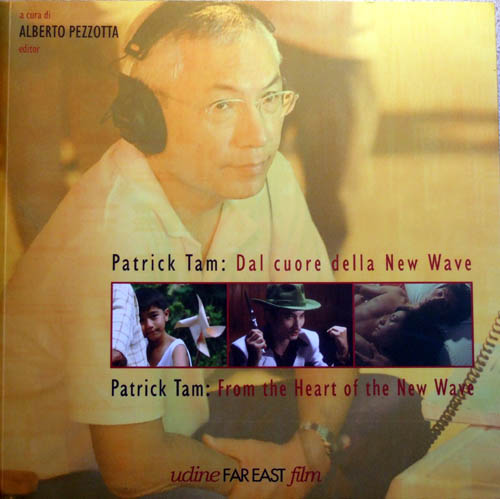
The Udine Far East Film Festival had a tremendous program this year, and just the YouTube promo made you want to book a ticket. But I couldn’t go! Still, the organizers kindly sent me their excellent catalogue Nickelodeon and the real topper, the festival’s thick volume dedicated to Patrick Tam Kar-ming. Editor Alberto Pezzotta, indefatigable researcher into Hong Kong film, organized a vast retrospective of Tam’s key New Wave films, such as Nomad and The Sword, as well as his less-known television work. The book includes critical essays, a detailed filmography, and a long, informative interview. Tam brought a cosmopolitan sensibility to Hong Kong film, thanks to his sensitivity to European directors like Godard and Antonioni. His latest film, the widely acclaimed After This, Our Exile, signals a new phase in his career.
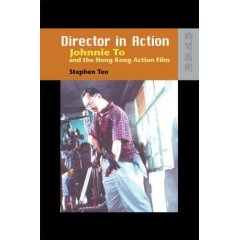 When I was writing Planet Hong Kong between 1997 and 1999, I was often frustrated by a lack of solid information and in-depth critical writing. Tony Rayns’ superb essays and the annual catalogues published by the Hong Kong International Film Festival were about all I could rely on. That situation has improved in recent years, with many well-researched books on Hong Kong film appearing. Outstanding here is Stephen Teo, who has given us two books this year alone: King Hu’s A Touch of Zen and the just-out Director in Action: Johnnie To and the Hong Kong Action Film. This efflorescence of writing comes just when local cinema is in its deepest slump. You won’t find me quoting Hegel often, but in this instance it does seem that the owl of Minerva is flying at dusk. When I was writing Planet Hong Kong between 1997 and 1999, I was often frustrated by a lack of solid information and in-depth critical writing. Tony Rayns’ superb essays and the annual catalogues published by the Hong Kong International Film Festival were about all I could rely on. That situation has improved in recent years, with many well-researched books on Hong Kong film appearing. Outstanding here is Stephen Teo, who has given us two books this year alone: King Hu’s A Touch of Zen and the just-out Director in Action: Johnnie To and the Hong Kong Action Film. This efflorescence of writing comes just when local cinema is in its deepest slump. You won’t find me quoting Hegel often, but in this instance it does seem that the owl of Minerva is flying at dusk.
Posted in Asian cinema, Books, Directors: Jackson, Festivals, Film comments, Film industry, Hollywood: The business, National cinemas: Hong Kong, National cinemas: New Zealand | open printable version
| No Comments »
Saturday | August 4, 2007
A Brighter Summer Day.
DB here:
This summer two major figures in Chinese filmmaking died. One was Edward Yang (Yang Dechang), one of Taiwan’s finest directors, who died on 29 June. But before I pay tribute to him, I want to acknowledge another figure who had a great impact on Asian cinema.
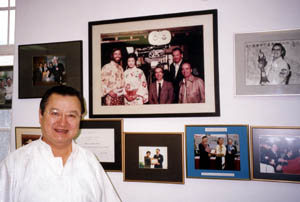
Charles Wang died on 6 July. Along with his brother Fred, Dr. Wang ran Salon Films, the major supplier of film equipment for Hong Kong and a principal one for East Asia and the Pacific Rim. Charles graduated with a degree in chemistry before inheriting the business from his father. As Hong Kong filmmaking grew in sophistication, Salon grew along with it. Most Hong Kong films bear the firm’s brand in their end credits.
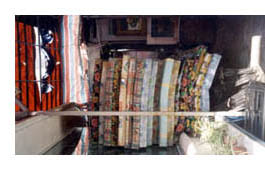 Since 1969 Salon has provided top-flight cameras, lenses, lighting gear and other technical support for both local and visiting productions, such as Mission: Impossible III‘s Shanghai shoot. An early triumph was winning the Panavision franchise for the region. The company even supplies trampolines and landing cushions for martial acrobatics, as this glimpse inside a Salon van shows. Since 1969 Salon has provided top-flight cameras, lenses, lighting gear and other technical support for both local and visiting productions, such as Mission: Impossible III‘s Shanghai shoot. An early triumph was winning the Panavision franchise for the region. The company even supplies trampolines and landing cushions for martial acrobatics, as this glimpse inside a Salon van shows.
When I interviewed Dr. Wang in 2003 he kindly gave me information about the company and the development of film technology in Hong Kong. He showed me his many awards and talked enthusiastically about Salon’s new efforts to assist mainland moviemaking. In recent years, Salon was investing in films such as Zhang Yimou’s Hero. Like most Hong Kong film people, he was very accessible and generous; he even gave me a lift back to my hotel. Charles Wang was a major force in the Hong Kong industry and will certainly be missed.
Laconic cuts and long takes
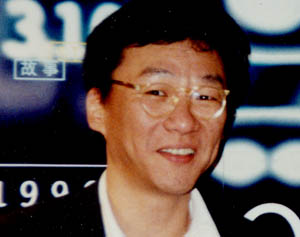
I met Edward Yang twice. First, at a Hong Kong Film Festival reception, we chatted about his film Mahjong (1996), which had screened. I got to know him a little better in fall of 1997, when we were both invited to the Kyoto Film Festival. We ate and watched films together, and we shared baby-boomer nostalgia; it turns out that he and I (and Hou Hsiao-hsien) were all born in the same year.
I found him friendly, thoughtful, and open to appreciating all film traditions. He spoke of enjoying Japanese swordplay movies in his youth, and he admired American films for their gripping stories. Still, his preference for ellipsis and understatement came through. When we met Kitano Takeshi for dinner, Edward praised a crisp transition in Sonatine: to show the gang going from Tokyo to Okinawa, Kitano simply gives us a quick pan of the sky accompanied by the sound of a jet plane.
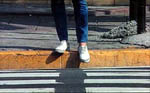
Yang was an accomplished cartoonist, and I thought that this background partly explained his early style, on display in the short film Desires (1982) and in the features That Day, on the Beach (1983), Taipei Story (1985), and The Terrorizers (1986). In these films Yang often breaks his scenes into simple but striking fragments. After the police shootout in The Terrorizers—one of the most enigmatic and elliptical opening sequences in modern cinema—the Eurasian girl staggers out to the street. Yang gives us her collapse in quite abstract, percussive images. Her foot hits the pavement. Cut. She takes a step and falls out of frame; the camera holds on the empty frame. Cut. She’s lying on the crosswalk. I imagine these as forceful, laconic comic-book panels.
 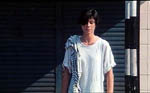 
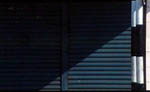 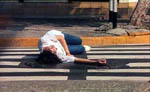
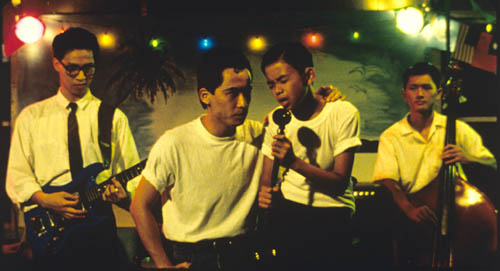
With A Brighter Summer Day (1991), my favorite of his works, Yang tells another gap-filled story but treats the scenes in long, distant, often decentered takes reminiscent of Hou. Now his frames are more dense with figures and furniture, and layers of action extend quite far back. In Figures Traced in Light, I devote a little—too little—analysis to one admirably staged passage. Another of my favorite scenes in A Brighter Summer Day shows the hero Xiao S’ir developing a romantic attachment to Ming, the girlfriend of the absent gang leader Honey. They sit in a brightly decorated café.
Suddenly Ming darts out of the shot, leaving Xiao S’ir and the other boys staring. From their point of view we see that Honey, dressed in a sailor suit, has returned and Ming has gone to meet him.
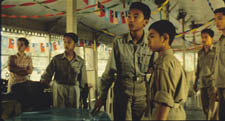 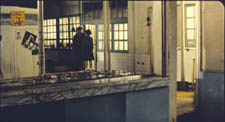
Yang cuts back to the boys as Honey’s gang starts to threaten Xiao S’ir. Abruptly, Ming runs into the shot, past the boys, down the long central aisle, and out of the café. (In a 35mm print you can see her pausing and lingering outdoors.)
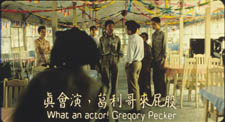 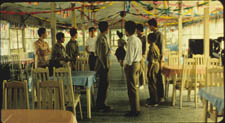
The group closes around Xiao S’ir; only Honey’s entry breaks the tension. He leads the boy into the depth of the shot, the camera following them.
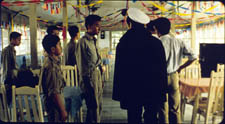 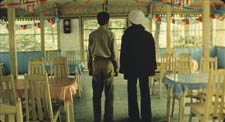
Honey warns Xiao S’ir off, and our hero goes outside, mimicking the path Ming had followed.
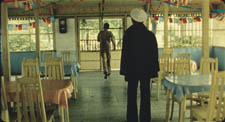
As Honey turns his attention to his gang and an upcoming skirmish with their rivals, he moves back down the aisle, the camera backing up. Once his business is done, Honey drifts back to the rear door.
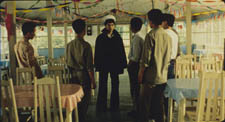 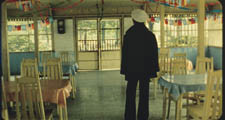
Honey pauses far from us, at the window. Yang cuts to show what he sees: Xiao S’ir, in flagrant violation of the warning, talking to Ming outside.
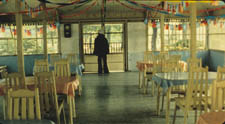 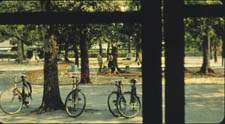
First we got Xiao S’ir’s point of view on Honey and Ming; now, in a reversal, we get Honey’s point of view on Ming and Xiao S’ir. In scenes like this, Yang merges his developing skills in long-take staging with cuts that develop not only the action but story parallels. Very distant framings, characters moving to the rear of the shot and turning their backs: Yang “dedramatizes” the scene. Further, by shifting point of view, he leaves us guessing about story information: What led to Ming’s running away from Honey? What are Xiao S’ir and Ming talking about now? Yang created a laconic visual approach that, I’d argue, invests fairly standard dramatic situations with a tantalizing uncertainty.
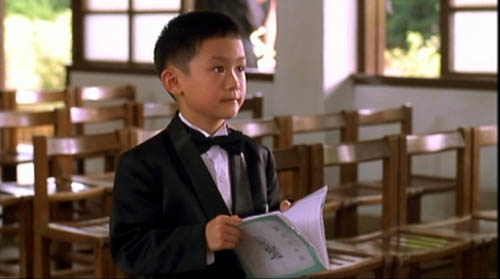
Yang’s best-known film is, of course, Yi Yi (2000), and it won him the wide appreciation that he had long deserved. It’s a warm and gentle work, less innovative than his earlier efforts but utterly typical of his vision of lives pervaded by melancholy routine and abrupt disappointment. People often remarked that the adolescent hero of A Brighter Summer Day resembled Edward himself. Perhaps too in Yi Yi Yang’s enigmatic pictorialism is echoed in the idea of a little boy who makes photographs of people’s heads seen from the rear. Like the director, the boy (named Yang-yang) displays a reticence that respects the mysteries of people’s private lives.
We already have a very useful guide to Yang’s work in one chapter of Emilie Yueh-Yu Yeh and Darrell William Davis’ book, Taiwan Film Directors. And Criterion’s Curtis Tsui has done a wonderful edition of Yi Yi, as Brian Hu shows here. We must hope that Criterion, Eureka, or another gilt-edged DVD publisher will soon bring us Yang’s other works in the pristine editions they deserve.
A Brighter Summer Day (1991)
In 1998, when we screened A Brighter Summer Day at our Cinémathèque, I wrote a program note. I reproduce it, lightly revised, as a quick pointer to one of the great films of the 1990s.
With Taipei Story (1985) and The Terrorizers (1986) Edward Yang established himself as one of the two leaders of the Taiwanese New Wave generation. At first it seemed that he and Hou Hsiao-hsien had agreed to a division of labor in their subjects and styles. Hou tended to concentrate on life in the countryside, or on rural characters transplanted, bewilderingly, to the modern city. Hou was also deeply interested in the history of Taiwan; his most acclaimed film, City of Sadness (1989), is a panoramic survey of Taiwanese society immediately after World War II. Hou’s tranquil style favored a contemplative mood and muted emotion.
Yang, by contrast, tended to focus on the lives of well-to-do urbanites in a contemporary setting, Taiwanese yuppies plagued by anomie and the desperation of love and work. His elliptical editing technique, reminiscent of Resnais, fractured time and space, while his compositions had a painterly starkness. The Terrorizers shuttles kaleidoscopically among characters at its beginning; their relations only gradually settle into intelligible patterns. Whereas Hou tended toward nuance and quiet drama, Yang was unafraid of shocking, inexplicable bursts of bloodshed.
Now it seems evident that this impression of a division of labor was somewhat schematic. Hou’s range of interests has widened, with new emphasis on the violent world of urban crime (Goodbye South Goodbye, 1996), and he has come to rely on quite disorienting transitions between past and present (Good Men, Good Women, 1995). Likewise, with A Brighter Summer Day Yang turned to history and cultivated a more sober style of filming, with lengthier shots and a fixed or barely moving camera. This approach throws down a challenge to the razzle-dazzle of contemporary popular cinema—from Hollywood, Hong Kong, and even the American “independents”—and invites us to scrutinize, moment by moment, the details of action unfolding on the screen.
Three years in the making, A Brighter Summer Day was a triumph of independent production. At a period when the Taiwanese film industry was virtually dead, Yang found money (mostly Japanese) to mount a project of remarkable ambition. Over half the cast and crew had never worked on a film before. At first released in a three-hour version, the film was re-released in a four-hour director’s cut, and this has become the standard version.
The historical event examined in A Brighter Summer Day took place in Taipei in the 1960s, when an adolescent boy about Yang’s age stabbed a young woman. At epic length Yang creates a web of circumstances around the event. He shows the interplay of traditional culture—filial duty, education as an ideal of social advancement—with popular culture, especially the rock n’ roll songs that recur throughout. Yang has said that Americans might not realize the shattering force of rock in other cultures: “These songs made us think of freedom.”
The film has over eighty speaking parts, most filled by nonactors, and it intertwines several characters’ destinies. On first viewing, the film can be somewhat bewildering to a non-Taiwanese audience, so a plot sketch may help. (Skip to the next paragraph if you don’t want to know the action in advance.) At the center is fourteen-year-old Xiao Si’r. He tries to be a dutiful student, but with his friends Cat and Airplane, he lives on the fringes of the Little Park gang of teenage thugs. When Xiao Si’r reports seeing a gang member with another boy’s girlfriend, he triggers a power struggle in the gang. As his friends fall by the wayside and rival gangs fight for control of local turf, Xiao S’ir becomes involved with Ming, a girl who’s attached to Honey, exiled leader of the Little Park gang. A major climax occurs during a gang rumble at a rock n’ roll concert. Interwoven with the juvenile intrigues are political matters; the police pursue and question Xiao S’ir’s father about his Communist friends. Xiao S’ir becomes friendly with Ma, a general’s son, before they start to compete for Ming’s favor. The rivalries build to a tense schoolroom confrontation and a tragic finale in the park. In the final scene and over the credits, a radio transmission broadcasts the names of the students who have passed their school entrance exams.
The plot is even more intricate than my bare-bones summary can indicate; I haven’t discussed the boys’ adventures in a film studio or Cat’s singing career or the slender line of action involving Xiao S’ir’s sister. The breadth of action is extraordinary, and a sense of the contradictory pulls of daily life emerges steadily. No less demanding is Yang’s style—scenes played in darkness, few close-ups, with medium-shots and long-shots keeping us at a distance from the characters. But the result is a dispassionate look at teenaged passions, a deromanticized treatment of young people growing up in a repressive milieu. A Brighter Summer Day (the English title comes from Elvis Presley’s “Are You Lonesome Tonight?”) is an elegy to the ideals and mistakes of youth, an analysis of the vanities of the male ego, and a view of a generation painfully facing the limitations of tradition, the constraints of political oppression, and the demands of the modern world.
Yi Yi.
Posted in Asian cinema, Film comments, Film technique, Film technique: Editing, Film technique: Staging, National cinemas: Hong Kong, National cinemas: Taiwan, People we like | open printable version
| No Comments »
Wednesday | August 1, 2007
Kristin here–
David and I have many pleasant memories from our May visit to New Zealand, where as Hood Fellows we were resident at Auckland University for a month. Among these memories is meeting Roger and Shirley Horrocks. Roger has been a major figure in the development of film studies and culture in New Zealand. He founded the Department of Film, Television and Media Studies at Auckland University and was its head until his retirement in 2004. He co-founded the Auckland International Film Festival and has written on television and film in New Zealand.
Shirley is a producer and director of documentary films, many of them about Kiwi art and culture, made primarily for TVNZ and NZ On Air. In 1984 she founded her own production company, Point of View Films.
Retrieving Len Lye
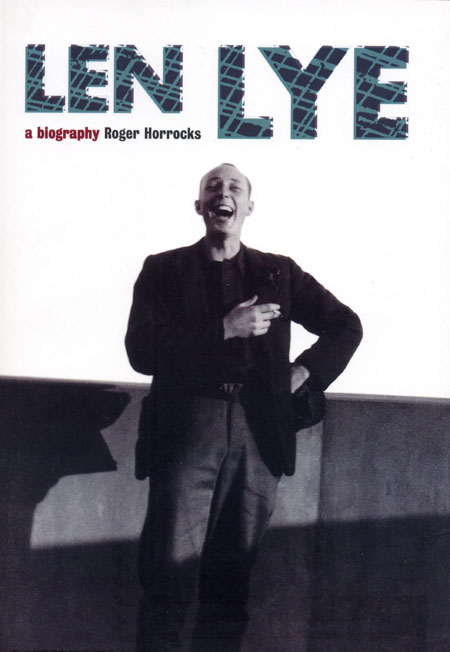
Among the Horrocks’ accomplishments has been to aid in the preservation of the work of filmmaker/ sculptor/ painter/ poet/ theorist Len Lye (1901-1980) and to disseminate information about this undeservedly overlooked figure. Roger generously gave us a copy of his impressive book, Len Lye: A Biography, and Shirley presented us with a DVD of her documentary on Lye, Flip & Two Twisters, named for one of the artist’s sculptures.
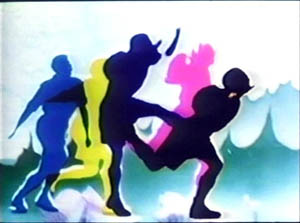
I remember seeing a few Len Lye films long ago and thinking they were delightful and innovative. In working on our textbooks, I had the privilege of sitting in one of the British Film Institute’s refrigerated viewing rooms and seeing a gorgeous nitrate copy of his 1936 film Rainbow Dance. Color frames from it appear in Film Art (8th edition, p. 164) and Film History (2nd edition, p. 321). I had also seen Lye’s strange and evocative first film, Tusalava (1929), an animated film with abstract shapes much influenced by Maori and Australian Aboriginal art (illustrated on p. 176 of Film History).
Lye was born and grew up in New Zealand, lived for stretches in Samoa and Sydney, moved to London as a young man, and moved permanently to New York in 1944. He was extraordinarily attuned to sensory perception and rhythm and was drawn to the indigenous art of the southwest Pacific area. From an early age he studied modern art and especially abstraction.
Lye belonged to a generation of innovative animators who began working in the 1920s and 1930s: Oskar Fischinger in Germany and later the U.S., and Alexandre Alexeïeff and Claire Parker in France and later Canada. Although their styles differed considerably, all sought to find alternatives to Hollywood cel animation and to explore the relationship between music and cinema.
Roger and Shirley’s gifts inspired me to renew my acquaintance with Lye’s work and take a closer look at his career. “I’ll just order a DVD of Lye’s films,” I thought to myself. Back in the late 1980s Pioneer had issued a marvelous though brief series called “Visual Pioneers.” David and I had bought “The World of Oskar Fischinger” and “The World of Alexandre Alexeïeff.” I figured that these had probably been re-issued on DVD, along with the rest of this short-lived series. It turns out, no. Lucky we held onto those laserdiscs!
Unfortunately, there was never a “Visual Pioneers” disc devoted to Lye.
The age of DVDs has not served these filmmakers well, either. One has to be doggedly determined in finding and acquiring their work. The bountiful “Unseen Cinema” set from Image contains Oskar Fischinger’s An Optical Poem (1938), an abstract short film made for MGM (!) after the filmmaker moved from Germany to the U.S. It’s on the disc titled “Viva la Dance: The Beginnings of Ciné-Dance.” Although the set claims to deal with the American avant-garde up to 1941, Alexeïeff and Parker’s 1934 masterpiece Une nuit sur le Mont Chauve (Night on Bald Mountain) is included. I suppose the logic there is that Parker was an American, though she and Alexeïeff (born in Russia) made the film in Paris and worked thereafter in Europe and Canada. (A few other émigré directors’ European works are in the set, though I can’t see why Anémic cinéma by Marcel Duchamp [aka Rrose Sélavy] should be there.)
There is a French region 2 DVD of the pair’s work available. I found it for sale online at fnac and Cinedoc. A DVD of ten Fischinger films is available from the Center for Visual Music’s shop; it actually sells the disc through Amazon, which might make it relatively easy for some to acquire.
The Center’s shop carries a variety of experimental cinema, and there I found a collection of Lye’s films—on VHS. “Rhythms” contains twelve of Lye’s major works, including A Colour Box (1935) and Rainbow Dance. It was brought out by Re: Voir, a major distributor of avant-garde cinema. One can buy it from that company, though in the U.S. the Center is a convenient source. My copy from the latter came quite quickly.
The cassette does not include Tusalava. The only place that seems to be available is on YouTube, and I hesitate to recommend it, given the fuzziness of the image. (Poor copies of some other Lye films are there as well, but since the tape contains far better versions there is no good reason to link to them.) Tusalava survives in beautiful condition, and I hope it eventually could be added to an expanded Lye collection on DVD.
Don’t be misled by the collection “The Experimental Avant-garde Series Number 19–The Serious, the Silly, and the Absurd.” There the short Lambeth Walk Nazi Style is wrongly attributed to Lye–a fairly common mistake. Lye’s short, Swinging the Lambeth Walk (1939), is an abstract film using the same pop song as a soundtrack; it’s on the “Rhythms” tape.
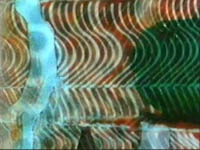 
The Filmmaker
Perhaps one reason why Lye’s films command less attention today than they should is simply because they are so short. All twelve films on the “Rhythms” tape add up to a mere 47 minutes, and even the seven-minute Tusalava would fail to bring the total to one hour.
This paucity of footage results in part from the painstaking labor involved in making them. Some of Lye’s films depended on elaborate painting and scratching directly on 35mm film stock. This kind of animation was Lye’s innovation and not, as is widely assumed, that of Norman McLaren. A Colour Box looks remarkably like a McLaren film. The resemblance is not coincidental. One of the few periods during which Lye had institutional support was when he worked for the GPO Film Unit in London. McLaren was freshly out of art school and working at the same unit. He freely acknowledges his amazement at seeing and hearing A Colour Box and its influence on him: “Apart from the sheer exhilaration of the film, which intrigued me was that it was a kinetic abstraction of the spirit of the music, and that it was painted directly onto the film. On both these counts it was for me like a dream come true.” (pages 144-45 of Len Lye: A Biography.)
An equally revolutionary technique Lye used was no less time-consuming. The new color film stocks of the 1930s fascinated him, especially the three-strip processes. These recorded each of the three primary colors on a separate strip of black-and-white film, with the color of the final film being achieved by adding color dyes to the matrices and combining them. Technicolor is the most famous of these systems, though Lye drew upon European processes, including Gasparcolor. Lye seems to have been alone in his realization that one could use the three-strip technique on film shot originally in black-and-white.
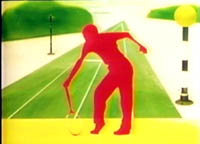 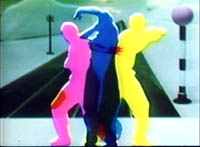
Rainbow Dance was made by shooting, in black-and-white, a human figure leaping, playing tennis, and executing other actions against a white screen and then using the result as a silhouette filled with vivid, saturated colors. Abstract and semi-abstract shapes surrounding the figure, constantly moving and changing, create a dazzling effect. The film ends abruptly with the message, “The Post Office Savings Bank puts a pot of gold at the end of the rainbow.” As advertisements, some of Lye’s films of the 1930s played in theaters, though viewers often perceived them as experimental shorts.
Another reason for the lack of attention paid to Lye is that he was always very much an eccentric loner, working on the periphery of Surrealism, Abstract Expressionism, and kinetic art. Works by him were included in exhibitions devoted to these trends, but Lye always refused the prominence that allegiance with fashionable movements might have given him. He was also highly impractical about money and not adept at explaining his projects to potential grant-bestowing foundations.
The Legacy
Roger Horrocks met Lye late in the artist’s life and worked as his assistant in his final months. Roger and Shirley were involved in setting up the Len Lye Foudation, housed at the Govett-Brewster Art Gallery in New Plymouth, New Zealand. (Its website is the best online source of information on Lye.) The foundation’s collection include extensive unpublished writings by Lye, to which Roger had complete access. He also interviewed a wide range of people who had known Lye in various capacities. The result is not only thorough, but it also gives a lively sense of a profoundly eccentric artist.
As part of Lye’s fascination with the senses, he deliberately cultivated a sort of stream-of-consciousness language, both for speech and writing. The result often suggests someone communicating in poetry rather than prose, and the quotations are not always easy to understand. One note scribbled after Lye had seen a film reads, “The knobbly cast of the star Elliott Gould, bemused, his mouth full of marbles, finally flapping his foot-flippers enrout insouciantly to some horizon or other” (p. 294). Roger, however, has waded through a large, difficult set of notes and journals. As he puts it, “It took my years to find my way round this chaotic collection of fragments and drafts, but ultimately it proved a goldmine.” One early reader of the biography remarked that “the book felt at times more like an autobiography than a biography” (p. 3). This is an astute observation, for Roger has woven many quotations into his own prose and thus given a structure to the chaos. By the end one feels that one understands not just the facts of Lye’s life but also his personality.
(Unfortunately the biography, published by Auckland University Press in 2001, is already out of print. With luck there’s a copy in your local library.)
The Sculptor
For film fans and scholars with at least a passing knowledge of Lye’s shorts, the real news here will be his versatility as an artist. Before he started making films, he was already an accomplished painter. Because painting was a relatively inexpensive activity, Lye often did not promote his own work and simply gave the paintings to friends. He sought buyers and patrons for his kinetic sculpture, though, because he needed funding to build these ambitious projects.
A few museums, like the Museum of Modern Art and the Whitney, own Lye pieces, but on the whole his kinetic sculptures, many of which are large and difficult to maintain in working order, are not widely or continuously displayed. Indeed, much of Lye’s later life was devoted to designing huge pieces, only some of which have been realized even now. The Len Lye Foundation is committed to realizing posthumously the plans he left behind, though no doubt some of his more grandiose schemes will remain too impractical to render.
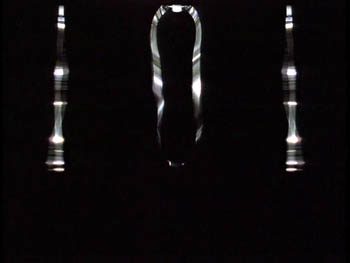
Shirley’s documentary Flip and Two Twisters (1995) helps fill in that side of the artist’s career for those who cannot travel to New Plymouth. Although she sketches Lye’s career and shows clips from some of the films, the real revelation is footage of Lye at work on some of the main pieces, like “Blade” (1954) and “Flip and Two Twisters” (1965). The dates, by the way, are a little misleading, as Lye continued to modify his sculptures after their initial versions were finished—usually making them larger.
“Flip and Two Twisters” is a casual name for a formidable piece, though Lye eventually took to calling it “Trilogy.” The sculpture consists of a large looped ribbon of flexible steel suspended from the ceiling, flanked by two vertical strips of similar steel. Once set in motion, the thrashing and twisting movements of these three elements gradually become quite loud and violent. Onlookers declare that it is frightening to be in the same room with the sculpture, as even just watching it on video makes plausible.
This documentary would be a terrific teaching supplement for a course on avant-garde cinema. Copies are available direct from Point of View Films.
Shirley gave us three of her other documentaries. Kiwiana (1996), as its name suggests, explores some of the icons of New Zealand’s popular culture. Kiwis were beginning to appreciate these neglected everyday objects, which were becoming collectibles in the 1990s: the buzzy-bee, the gumboot, and, yes, the kiwi fruit. Peter Jackson even makes a brief appearance as a talking head. Marti: The passionate eye (2004) chronicles the extraordinary life of Marti Friedlander, who was raised in a Jewish orphanage during the 1930s and 1940s in London. She was trained as a photography laboratory technician but also became a photographer. Emigrating to New Zealand, she worked on a series of Maori portraits and documented such moments of political ferment as the Women’s Movement. Finally, The New Oceania (2005) is a portrait of the Samoan-born writer Albert Wendt and his fostering of a new Pacific culture based on local traditions but embracing modernism. All of these films are available from Point of View.
We are grateful to Roger and Shirley for being among the many who made us feel so welcome in Auckland. I’m particularly grateful for being led to revisit and explore a director who deserves to be far better known.
Posted in Animation, Experimental film, FILM ART (the book), Film technique, National cinemas: New Zealand | open printable version
| No Comments »
|