Monday | November 5, 2007
DB here:
The close-up blogathon launched by Matt Zoller Seitz is over, but it contains enough specimens and analyses for a hefty book. It also inspired Jim Emerson to devote a cine-lyric to the close-up. I missed the deadline, so I suppose that this constitutes my sideways contribution to Matt’s enterprise.
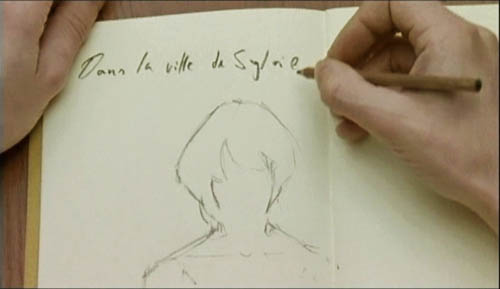
Sideways, because a full-blown analysis of In the City of Sylvia (En la ciudad de Sylvia; Dans la ville de Sylvie) would be a breach of decorum. Most people haven’t heard of this new film by José Luis Guerin, let alone seen it. I saw it at the Vancouver festival in September, and it will make its way through the festival circuit over the coming months and should show up on cable or DVD thereafter. But apart from calling attention to it as a remarkable film, I want to look at one of its most absorbing sequences and suggest some of its originality. Lee Marshall has already pointed out one of Sylvia‘s arresting features:
Guerin seems to have created pure drama without recourse to story. We’re always taught that story is the engine of drama. Not here: somehow Guerin has created an almost plotless film that has the dramatic tension of vintage Hitchcock. (1)
Although the story situation is slight, the tension we feel springs partly from vivid stylistic patterns. In other words: Minimal and uncertain story action is heightened by engaging visual narration. This narration in turn derives its power from one of the most traditional devices of filmic storytelling.
Consider the other person’s point of view
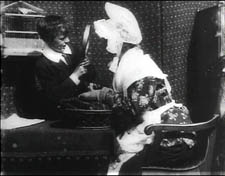
The point-of-view shot is a mainstay of cinematic storytelling, and its history is an intriguing one. Many of the earliest examples we have are motivated as views through optical gadgets. Two films by the Englishman G. A. Smith, both from 1900, handily show the options. Grandma’s Reading Glass justifies the point-of-view image as what the boy sees when he peers at granny through her big magnifier.
 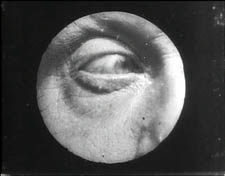
Smith’s As Seen through a Telescope motivates the cut-in POV shot as what our dirty old man in the foreground has an eye for.
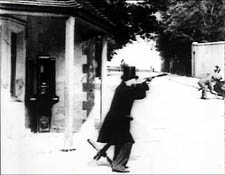 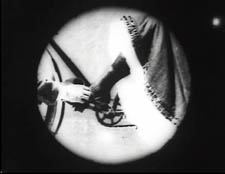
Fairly soon, this use of the magnifying POV shot was mingling with more straightforward ones. In The Birth of a Nation (1915), D. W. Griffith offers a rough-edged example. When the Stoneman brother and sister visit Ford’s Theatre on the night of Lincoln’s assassination, we see Elsie pointing out the famous actor John Wilkes Booth.
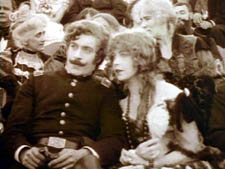 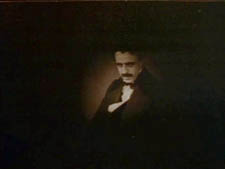
Booth is framed in an iris, which Griffith often uses to underscore an important image. But when Elsie studies Booth through her opera glasses, Griffith, usually not fastidious about such things, supplies the same irised image, now doing duty for the sort of magnifier-masking we get in the Smith films.
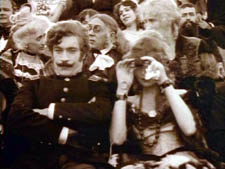 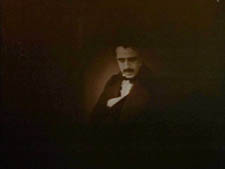
Presumably a more consistent technique would show Booth in long shot first, without the iris, and reserve the optical masking for replicating the view through the opera glasses. This is what happens in Ernst Lubitsch’s Lady Windermere’s Fan (1926), which contains a sequence built entirely around crisscrossed character looks. (1)
The woman of the world Mrs. Erlynne arrives at the racetrack and creates a stir, causing many men to watch her from all over the grandstand.
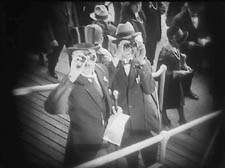 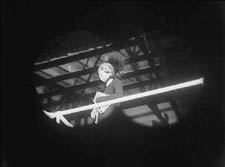
Note that Lubitsch has gone beyond Griffith by fitting the angle of Shot B to the viewer’s orientation, looking up. There are so many POV shots that at one point Lubitsch simply shows her from different angles and deletes the shots of each watching man.
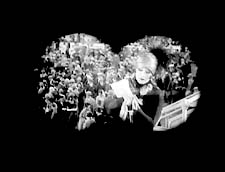 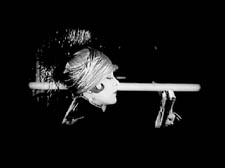
This is a fascinating example of a process we often see in stylistic history. An “overlearned” visual convention can be treated elliptically; the filmmaker can leave out bits and we’ll fill them in. The binocular masking suffices to let us know that Mrs. Erlynne is being studied from afar. Moreover, Lubitsch gets an expressive bonus from being so concise. Now it doesn’t matter who’s watching, just that somebody is—actually, a lot of somebodies.
Later, after much more byplay with people looking at one another and misunderstanding what they see, Mrs. Erlynne sits down. Three gossips have been studying her, but now their view is blocked. So one gossip has to twist around to spy on her, and Lubitsch obligingly gives us a slightly tipped point-of-view framing—a full shot, without masking.
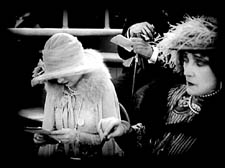 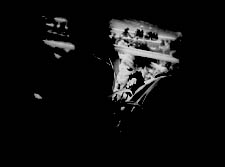
Adjusting her binoculars, the gossip is able to get a bigger view of Mrs. Erlynne, and she racks focus gleefully to catch a gray hair peeping out.
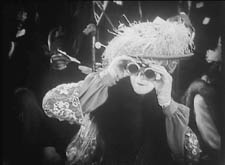 
The visual narration in this sequence, already perfectly modulated, supplies the stylistic premise for Hitchcock’s Rear Window and all of its progeny, most recently Disturbia (2007). What might be overlooked is that by the 1920s the view through a device—field glasses, a microscope, a surveillance camera—had become a special, marked case. From then till now, the default POV pattern is the simple shot of a character looking, followed by an unadorned shot of what that person sees, from more or less the correct standpoint. Lubitsch’s sideways shot of the gossip’s view of Mrs. Erlynne, casually introduced, exemplifies the modern norm for presenting a character’s vision, and it’s so common that we seldom notice it.
POV shots: The basics
In his book Point of View in the Cinema, Edward Branigan itemizes the cues that the filmmaker can manipulate in creating a POV construction. (2) To simplify somewhat: Shot A shows a point in space and a character glance from that point. Shot B is taken from a camera position more or less approximating the point in A, and it shows an object. The shot-change presumes temporal continuity between A and B, and we assume as well that the character is aware of the object shown in B.
This seems like a complicated way of stating the obvious, but by teasing these elements apart, Branigan shows that each one can be manipulated in intriguing ways. For example, you can create a disorienting moment by violating the condition of temporal continuity. Ozu does this in Early Summer (1951), when Noriko and Aya decide to peek in at the man Noriko almost married. The two women tiptoe down a hall toward us as the camera tracks slowly backward. Ozu cuts to a forward-tracking shot that momentarily suggests a reverse angle POV on the corridor.
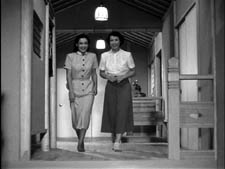 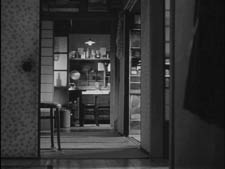
In fact, however, the camera movement is revealed to be the first shot of a new scene, among different characters, and we won’t ever see the man the two women went to spy on.
Here’s another interesting case, not cited by Branigan. In Halloween (1978), John Carpenter shows Laurie looking out a window and seeing Michael Myers in his mask, standing between fluttering washlines.
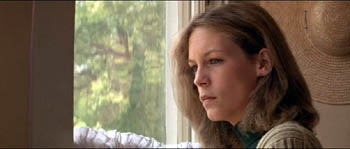
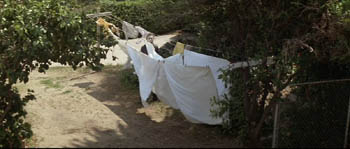
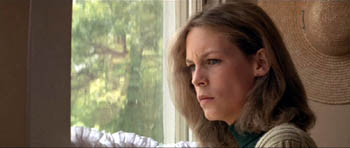
Cut back to Laurie, now frowning slightly.
Cut to a second POV shot; but now Michael has vanished.
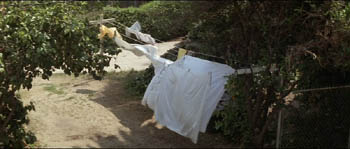
This simple change in shot B’s object, Michael himself, has an uncanny effect. Did Michael just walk away from the washline? If so, this is an odd way to present it. Why not show him walking away? Alternatively, did he just disappear? Surely not; Laurie would be shocked. Carpenter wins twice over. Without obviously violating realism or directly showing that Michael has supernatural powers, he gives Michael the ability to come and go in a ghostly fashion. By the end of the film, when he miraculously disappears after a fall that would kill an ordinary person, we are prepared to believe that he is indeed, as Dr. Sam Loomis says, the Boogyman.
Who is Sylvia? What is she that all the swains commend her?
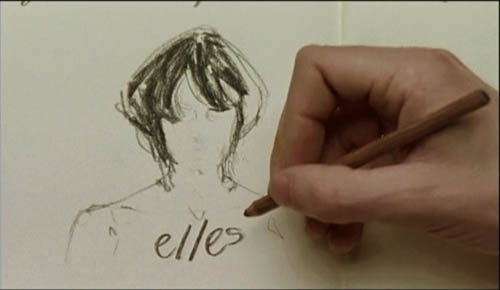
In the City of Sylvia centers on a young man staying at a hotel. We’re given no reason why he’s visiting the city, and no backstory about him. One day he’s sitting at a café. Now, across nearly twenty minutes of screen time he watches women and idly sketches them.
The sequence is a pleasure to watch, partly because of the constant refreshing of the image with faces, nearly all of them gorgeous, most of them female. Either Strasbourg has an extraordinary gene pool, or this café attracts only Ralph Lauren models. Yet the scene builds curiosity and suspense too, thanks to Guerin’s sustained and varied use of optical POV. He gives us an almost dialogue-free exploration of a cinematic space through one character’s optical viewpoint. (Stop reading here if you don’t want to know anything more about the film before you see it.)
The young man, known in Guerin’s companion film Unas fotos en la ciudad del Sylvia as the Dreamer, is almost expressionless as he scans the women’s faces. Slight shifts of his glance are accentuated by his habit of turning his head but keeping his eyes fixed. In over a hundred shots, Guerin uses some ingenious cinematic means to tease us into ever-greater absorption in the Dreamer’s visual grazing.
Fairly far into the sequence, Guerin gives us more or less the orthodox POV construction. The Dreamer looks at one woman at a table, and we see her return his look.
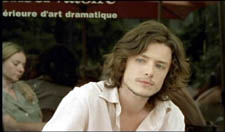 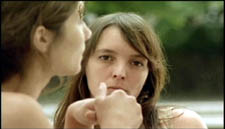
But here shot B isn’t really clean: the hands of the woman on the left sometimes block our view of the principal woman. This obtrusiveness is one of Guerin’s most basic strategies in the sequence. Inevitably, in passages before and after the cut I just showed, what the Dreamer is looking at is partially hidden in layers of faces and body parts.
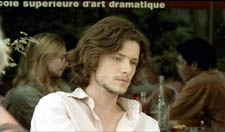 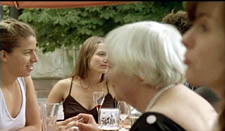
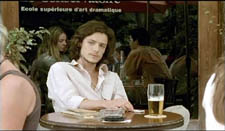 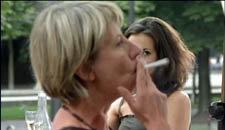
Our prototype of the POV cut presumes a more or less single ‘point’ we are watching in shot B, but throughout this scene Guerin plays with this cue. He tantalizes us with several points to be observed, and he often obscures the most important ones. He also creates some startling juxtapositions. Near the very start we get this shot, which may or may not be the Dreamer’s POV.
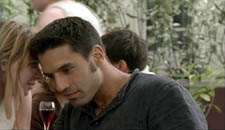 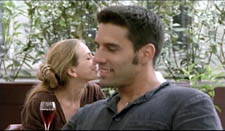
By making the background girl seem to kiss the foreground guy, Guerin, as Eisenstein would say, “christens” his sequence. In effect, the image says: Watch out! Layered space will become important! When I saw this shot, I nearly jumped out of my seat.
The Dreamer is treated no differently, at least at the start. In most movies, the POV construction is set up with a clear, clean framing of our looker in shot A. Here, though, at the start of the scene Guerin peels away layers to get to our man. For the first six shots of the café, we don’t know he’s on the scene. Then he’s shown out of focus, in the background of more prominent action. The woman in the foreground has been primed to be the shot’s subject. At the moment she shifts her gaze and we try to read her expression, a second woman on the distant right shifts aside to reveal the Dreamer behind her.
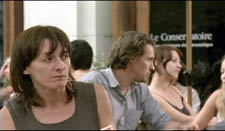 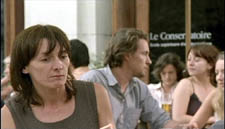
Surely this is the most unemphatic entry of a protagonist we’ve seen in a while! Guerin is able to add planes to block the main ‘point’ of shot B because he’s working with long lenses, a crowded space, and careful choreography. Even focus plays a role, as in this case; our Dreamer is pretty hazy.
One upshot of this strategy is that we’re plunged into a “cubistic” space, in which slightly varied camera angles pick up bits of space we’ve seen in earlier combinations and oblige us to assemble it all in our head. Be thankful for the guy in the blue shirt above, for he plays an anchoring role in several setups that would otherwise float free.
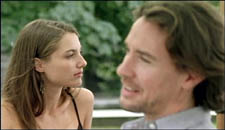 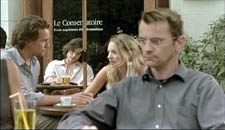
It’s hard to convey in stills how much fascination and frustration that this teasing style creates. Like the Dreamer, we’re given only glimpses of the women, and even though we don’t know his purposes—is he just an artist in search of beauty? a serial killer picking out victims?—the partial views lure us at several levels. We try to complete the faces. We try to infer the women’s state of mind from their expressions and gestures, which are far more animated than our Dreamer’s.
And a search for story plays a part here. We’re primed for some action to start, and we browse through these shots looking for anything that might initiate it. Each face the Dreamer spots promises to kick-start a plot: when the Dreamer gets a full view of one of these women, perhaps things will get going.
Without giving away every detail, I’ll just say that the sequence has a strong visual arc as the Dreamer starts paying more and more attention to certain women. And just as he finally gets a full view of one fabulous face, his attention wanders to . . . another layer, this time one inside the café.
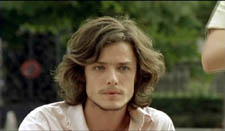 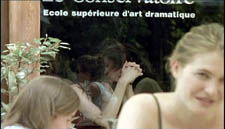
As he gapes at the woman inside, layers pile up, creating a cubistic climax of all the optical obstructions we’ve encountered.
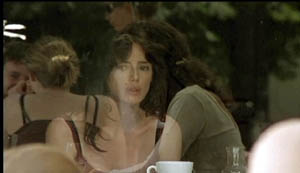
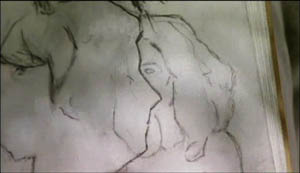
The motif of reflections will take over the rest of the film’s visual design, and eventually we’ll see that some of the Dreamer’s drawings evoke the piled-up and sliced-up faces in the café shots.
Later in the film, the Dreamer will explain why he’s in the city and why he’s scanning women. We’ll have a tram ride that Guerin compares with Sunrise, and a scene in a music club that not only parallels the café sequence but evokes Manet. We’ll also have occasion to compare this film with Bresson’s Four Nights of a Dreamer, a citation signaled from the outset.
All that is to come. Even if the later scenes weren’t as compelling as they are, this café sequence would make Sylvia one of the most adventurous films I’ve seen this year. By revising the simple, long-lived POV schema, Guerin has made it yield fresh feelings and implications. Like Lubitsch’s racetrack scene, this imaginative sequence provokes the jubilation you feel in the presence of calm, precise artistry.
(1) Lee Marshall, “Past Perfect,” Screen International (19 October 2007): 27. The web version is here, but it may require a subscription.
(2) I analyze the visual narration of Lady Windermere, which I think deserves to be ranked with Potemkin and Sunrise, in Narration in the Fiction Film (Madison: University of Wisconsin Press, 1985), 178-186.
(3) Edward R. Branigan, Point of View in the Cinema: A Theory of Narration and Subjectivity in Classical Film (The Hague: Mouton, 1985), 102-121.
Posted in Art cinema, Directors: Griffith, Directors: Guerin, Directors: Lubitsch, Directors: Ozu Yasujiro, FILM ART (the book), Film comments, Film technique, Film technique: Cinematography, Film technique: Editing, Narrative strategies, Silent film |  open printable version
| No Comments » open printable version
| No Comments »
Thursday | November 1, 2007

DB here:
The Motion Picture Association of America is the trade association of the major film production and distribution companies. Founded in 1922, it helped the Hollywood studios maintain their control of the US industry and foster its business abroad. (See Kristin’s book Exporting Entertainment for an explanation of how it worked.) In 1945 the MPAA split off its international efforts and created a subsidiary, the Motion Picture Export Association of America, which helped the majors move in a systematic way into world markets. The current MPAA members are the Big Six: Sony (Columbia), Buena Vista (Disney), Universal, Paramount, Warner Bros., and Twentieth Century Fox.
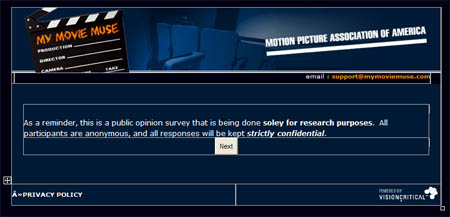
About fifteen months ago, the MPAA created a survey called My Movie Muse. Reading about it in Variety, I eagerly signed up. Every three or four months My Muse contacts me and asks me to answer some questions. At the end of the survey, I’m told that my name has been entered in a drawing for a gift certificate from Amazon.
I’ve never won. I’ve never heard who did. Maybe I won and the MPAA forgot to tell me.
The Movie Muse survey started last year with 7500 participants. You can join us by going to the website.
The initiative, according to MPAA head Dan Glickman, enables moviegoers to tell the industry their concerns.
People want to have input. They want to know that their movie viewing experiences are worth their time and money, and they want to know that our industry is hearing their criticisms and demands. In this age of participatory media, My Movie Muse will give consumers an opportunity to be heard.
Unfortunately, we Musers have little opportunity to say anything that doesn’t fall into a narrow set of multiple-choice queries. Let’s take a little drive through the questions. Beware the speed bump.
Eyes on your own paper, buddy
Every Muse form I’ve filled out is essentially the same, with a few seasonal variants. (What is your favorite Halloween movie?) The Muse announces that some questions will be repeated every few months “so that we can see how your opinions change over time.” You could perhaps make the Muse happy providing different answers at each iteration of the survey.
The Muse’s first clutch of questions involves your opinion of movies in general. Do you like ‘em or dislike ‘em? Do you think they’re better than they were in the 1990s? How do they compare with other forms of entertainment, like TV shows, videogames, and music? Do you like indies, kid movies, dramas, comedies, animation, documentary, whatever? How often do you see movies in theatres, rent DVDs, buy DVDs, or watch a movie online? How do you like the moviegoing experience in your local theatre? And so on. This is all pretty banal and anodyne, though I can imagine a firm using these data to help back up production decisions. (“See? I told you nobody likes Westerns.”)
The Muse proffers the Don’t Know option often, sometimes to puzzling effect. Is Don’t know really an appropriate answer to statements like the following?
Movies are often a topic of conversation among my friends.
I like to watch my favorite movies over and over again.
I use a DVR, iPod, computer CD or DVD burner on a regular basis.
Sometimes the inquiry turns Borgesian. Here’s one statement:
Movie plots are more predictable than they used to be.
If you don’t know, they’re probably not more predictable, at least to you. Another question asks:
Did you know that some movie theaters offer programs for frequent moviegoers, where you can earn free popcorn, sodas, and movie tickets depending on how many times you go to the theater?
The options are: Yes/ No/ Don’t know. Presumably if you don’t know, you’ll answer No. But if you answer Don’t know, does that mean that you don’t know whether you know?
In any case, the speed bump comes up soon enough. Not to scare you, but maybe there’s some serious stuff ahead.
Don’t know what a slide rule is for
We’re eased into the hard questions gradually:
Are you aware of peer-to-peer file-sharing services that allow you to download full-length films or TV shows via the Internet for free?
Again we get Don’t know as an option, which isn’t really viable. Try telling an interrogator allowed to use harsh measures, I don’t know if I’m aware of peer-to-peer file-sharing services. . . But now there’s another option: Prefer not to say. Good choice. Too bad it won’t come up again.
We’re asked how often we download purchased movies and TV shows, download bootleg material, buy bootleg DVDs, copy DVD files to hard drives, and receive CD or DVD copies from a friend. The Muse is also curious about how often you copy such material to disc for a friend, or for your personal use. The permitted answers range from Never to 4 or more times a month. This menu may need revising; I suspect some of my friends pursue these activities 4 or more times an hour.
Anyhow, it seems likely that nearly everybody between the ages of 4 and 50 has done at least one of these things. You’d prefer to say Prefer not to say, but the only evasive tactic is Don’t know.
You recall the Perry Mason trick: After the sweating witness has testified, Perry asks, “Are you aware of the penalties for perjury?” Something similar happens here. Once the Muse establishes that you’ve surely broken the law, with relentless prosecutorial logic it asks if you did so willfully. Getting cozy in a Good Cop way, the Muse acquires a singular personal pronoun:
For each of the following activities, please tell me whether you think they are legal or illegal:
Copy a movie or TV show on a CD or DVD to give to someone else.
Go to a website and download a TV show you paid for.
Go to a website and download a full-length movie you paid for.
Copy files from DVDs onto your hard drive.
Buy a bootleg DVD.
Go to a file-sharing site and download a TV show for free.
Receive a copy of a movie or a TV show on a CD or DVD for your own use—to watch whenever you want.
But the statements are too bald and inexact. These activities aren’t necessarily illegal, according to intellectual property attorney Jim Peterson:
The work might be in the public domain (too old, registration or renewal failure) or it might be a fair use. You could conceivably download a movie as a fair use for your own scholarship without violating the DMCA prohibitions on defeating copy protection or removing copyright management information. The guy who cracked the copy protection on the DVD probably has some Digital Millennium Copyright Act problems, though. Same thing with buying a bootleg DVD. I don’t think buying is illegal; it’s selling that’s the problem.
Since the Muse’s questions don’t allow for such nuances, once more the Don’t know option is looking mighty attractive.
My Muse goes on to ask if any of the following considerations would affect your decision to undertake the illegal activities you’ve already mentioned. Now if you thought that they were all legal, or if you answered Don’t know, then presumably you don’t have to reply to what follows. In any case, imagine Penn Gillette reciting each of these possibilities in his most explosively disrespectful voice, with expletives freely inserted. Would you avoid breaking the law . . .
If official DVDs were $5 cheaper?
If tickets for the movie theater were $2 cheaper?
If a portion of the DVD price was contributed to charity?
If you were concerned that buying and downloading unofficial copies was tied to criminal activities or terrorism?
If friends or somebody in your community were being prosecuted for a similar activity?
If you received a notice warning you that you might be prosecuted?
If you got off with a wrist slap and a threat of future surveillance?
If you were made an example in order to deter other scum?
If specially-made DVDs carried an electrical charge of 50,000 volts to be shot into a user when s/he sought to copy them?
If certain DVDs were sprayed with microbes carrying sexually transmitted diseases?
Granted, I made up some of these, but maybe you can’t tell which ones. Anyhow, the correct answer is Don’t know, said quickly ten times with your hands over your ears.
Suppose you say you don’t download movies illegally. Then My Muse, not one to back off, asks why you don’t break the law. The lengthy set of options includes such noble justifications as I don’t have the time, I don’t know how to do it, I don’t like to watch movies at my computer, It takes too long, and I wouldn’t get the DVD bonus materials. For such freedoms brave men died.
The replies It is illegal and I’m afraid of getting prosecuted and sued come at the very end. Correct answer: Oh, riiight . . . It’s illegal. Sure . . . that’s it . . . Illegal. Of course, if the purpose of the questionnaire is not to find out what we think but to tell us what to think, then these questions come at the right moment. They tacitly say: All of the above-mentioned things you are doing, or are now thinking about doing, can be punished by lawsuits and a stay in the Big House.
The last page offers you a list of legal movie download sites, asking if you recognize or use any of them. I recognized most, but Guba and Vongo were new names to me. I don’t think I could bring myself to use any service, even for roto-rooting purposes, called Guba or Vongo.
Just as you’re ready to pack your toothbrush for the holding tank, the Muse gives a cheery farewell. “That’s it! . . .You’re done!”
When My Muse went online last year, industry observers noticed right away that the survey seemed more about selling people the MPAA’s line on copyright than about getting their responses. Anthony Kaufman, one of the dueling cavaliers of the cineblogosphere, wrote:
The leading questions are clearly part of a larger MPAA struggle to bolster copyright initiatives and crack down on fair use, file sharing and anything that threatens the bottom line of the international conglomerates. Dan Glickman may be the kinder, gentler face of the MPAA in the wake of Jack Valenti’s exit, but if his demeanor is softer, his goals are still just as nefarious.
This is a plausible interpretation. But I don’t want to rule out the possibility that the studios might really listen to my write-in request that they upgrade release prints and stick with 35mm instead of going digital. Or maybe the MPAA is branching out into online entertainment, like those commercials, quizzes, and snack-bar plugs that come up before the trailers. Is My Movie Muse a trial balloon for a new feature, DRM: Be Very Afraid?
Don’t know, Don’t know, Don’t know.
I’m not holding my breath for my Amazon certificate either.
Posted in Film comments, Film industry, Hollywood: The business | open printable version
| No Comments »
Sunday | October 28, 2007
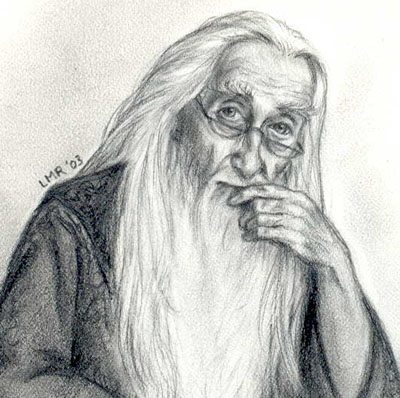
Dumbledore, by Lisa, from
http://www.poudlard.org/fanarts/displayimage.php?album=toprated&cat=6&pos=0
Kristin here–
By now anyone who has not lived in thorough isolation from the media knows that on October 19, during a signing of Harry Potter and the Deathly Hallows at Carnegie Hall, J. K. Rowling revealed that Prof. Albus Percival Wulfric Brian Dumbledore is gay.
At least in her opinion, some might add.
Rowling’s public revelation that she has long considered Dumbledore to be gay came during a question and answer session in which a fan asked, “Did Dumbledore, who believed in the prevailing power of love, ever fall in love himself?” Rowling replied, “My truthful answer to you … I always thought of Dumbledore as gay.” According to mainstream media reports, after a stunned silence the audience burst into a lengthy ovation.
Rowling has made a few additional comments on this subject since then. On October 22 during a press conference in Toronto, she was questioned about how far back her outlook on Dumbledore’s sexual orientation went. She dated it back to the planning stages, “probably before the first book was published” (Harry Potter and the Philospher’s Stone, 1997). She pointed out, “I was writing for seven years before the first book came out.” (The press conference has been posted in two parts on YouTube, here and here. Some stories from reporters covering the event have slightly misquoted Rowling’s statements. My quotations are transcribed from the video.)
Naturally questions about the Dumbledore outing came at regular intervals during the Toronto press session. Initially Rowling commented, “It has certainly never been news to me that a brave and brilliant man could love other men.” Asked about the political ramifications of the outing, Rowling said that she could not comment on that so soon after the fact. “I can’t really answer that. It is what it is. He’s my character, and as my character, I have the right to know what I know about him and say what I say about him.”
But do we want to listen?
Of course, she has the right. The questions that have been raised by many are, should she? If she does, should we accept her statements as true within the universe of the published books?
Whether she should provide additional background for the series is basically a matter of opinion. Some people, many of them children, want more information and think she should.
Salon.com’s Rebecca Traister has posted a thoughtful essay taking the “she shouldn’t” position. She points out one thing that most fevered accounts of the Dumbledore outing have neglected: “Dumbledore’s gayness is one of the pieces of bonus information about her characters that she’s been dispensing steadily since the publication of her magical swan song, ‘Harry Potter and the Deathly Hallows.’”
Certainly at the Carnegie Hall appearance, the Dumbledore question came amidst several that Rowling was asked about the fates or motives of other characters. (The most extensive transcript of that Q&A session is on The Leaky Cauldron.) Nearly all mainstream media reports ignored these in favor of blowing up the gay issue, but just as much information about other characters was revealed, and Rowling has answered similar queries in other Q&A situations.
Traister admits that the fans are the ones asking for such information. “Her abundant generosity with information is surely a response to a vast, insatiable fan base that does not have a high tolerance for never-ending suspense, ambiguity or nuance. As she told the ‘Today’ show’s Meredith Vieira back in July, ‘I’m dealing with a level of obsession in some of my fans that will not rest until they know the middle names of Harry’s great grand-parents.’”
Traister adds, “Rowling naturally wants to provide answers for these heartbroken obsessives who perhaps are too young to know the satisfying pleasures of perpetual yearning and feel that they must must must know how much money Harry makes and whether Luna has kids.” I don’t know about heartbroken, but they certainly are curious.
Traister goes on to argue that Rowling should stop giving out information and ruining readers’ own imaginings about what the author left out. She cites an example of Rowling revealing to a fan what Harry’s Aunt Petunia nearly said to him upon their last parting. According to Rowling, it was “I do know what you’re up against, and I hope it’s OK.” Traister is disappointed: “Oh. That’s too bad. Because in my imagination, Petunia was going to say something much more exciting than that.”
Perhaps in many cases, especially about specific details like this, knowing is less fun than imagining. Still, I’m sure some of Rowling’s revelations are more exciting, or at least more interesting, than what we imagine.
Let’s take one small example, Rowling’s explanation for the name “Dumbledore.” Few readers will imagine anything about it or realize that the word actually means something. I have wondered whether Rowling just liked the sound of the word (which appears in Hardy and Tolkien) or she saw some connection between the headmaster and a bumblebee. She revealed the answer in a radio interview in 1999: “Dumbledore is an old English word meaning bumblebee. Because Albus Dumbledore is very fond of music, I always imagined him as sort of humming to himself a lot.”
That’s charming. I didn’t imagine Dumbledore humming as I read the book. Indeed, I don’t recall any scenes where he is alone (presumably when he hums), given how much of the narration is restricted to Harry’s point-of-view. But I am glad to know this, even if it had to come from the author herself. (In the same interview, by the way, she said, “I kind of see Dumbledore more as a John Gielgud type, you know, quite elderly and – and quite stately.” Perhaps a hint of where the gayness crept in.)
If Rowling were to heed Traister’s plea that she stop dispensing extra-textual information, that would mean we adults, who presumably “know the satisfying pleasures of perpetual yearning,” would get our way and the children wouldn’t. (Of course, not nearly all adults would refrain from asking for more information from Rowling.) I think that’s rather unfair, since these are at bottom children’s books. It was initially surprising how many adults ended up reading them, and there are HP fans of all ages. Still, shouldn’t the target audience take priority?
The video of the Meredith Vieira interview and the transcript of the Carnegie Hall event confirm that many of the questions were requests for more information about the characters. Would we really want the author to refuse each of these? How boring and frustrating for those children if every other answer is, “I really shouldn’t tell you. Just use your imaginations”! They want those “pieces of bonus information about her characters that she’s been dispensing steadily.” As far as I can tell, most or all of the bits of information Rowling has given out have come in response to specific questions from fans. She hasn’t been volunteering them right and left. And apart from the Dumbledore comments, the information she gives out has hardly been flooding the media to such an extent that we can’t avoid it if we wish. Given that Rowling has been answering such questions for months, why did commentators wait until this particular revelation to complain?
Who’s J. K. Rowling to tell us Dumbledore is gay?
Quite apart from there being some people who want this information and others who don’t, there is a more theoretical question. As Jason Mittell puts it in a brief essay on his website, “What does it mean for an author to proclaim such information about a character in an already completed fictional world?”
Mittell would accept that Rowling’s statements about that world would become part of the HP canon as long as the series was still in progress. “But something changes once a series is complete.” He points out that Rowling seems to have known all along that Dumbledore is gay, and yet she never made that explicit. “Does she retain her power to control her fictional world after the books have been closed?”
Does it have to be explicit, or will implicit do? Some, including Rowling, would say that there is a portrayal of Dumbledore’s relationship with Grindelwald that hints at his being gay. At the Toronto press conference, Rowling stated, “It’s in the book. It’s very clear in the book. Absolutely. I think a child will see a friendship, and I think a sensitive adult may well understand that it was an infatuation. I knew it was an infatuation.” I must admit that I didn’t pick up on the clues. Not that I’m insensitive, I hope, but because it would not have occurred to me that a popular mainstream writer would include a prominent gay character. (Associated Press writer Hillel Italie has pointed out a few passages that some may have taken as indications.)
[Added Oct. 29: The November 2 print issue of Entertainment Weekly has the results of an online poll, “Did you suspect Dumbledore was gay? (p. 11). 22% said they did. That’s probably self-selecting, as those who did might be more likely to vote. Still, at least some people did figure it out.]
Putting aside that example, though, much of the other information Rowling has been giving out does concern events that occur after the books’ action or are never referred to in the texts, so Mittell’s question remains.
Mittell contrasts this situation with that of Star Trek, where it has been the fans who “claim their interpretive rights to open up ambiguities and subtext freely,” primarily by writing fanfiction. The situation is different, though, I think, because most fans would not claim that their fics enter into and become part of the canon, even though they may meticulously obey its premises. Rowling seems to be claiming the right to expand the HP canon by her statements as well as by her writing.
(By the way, Rowling also mentioned fanfiction during her answers about Dumbledore at Carnegie Hall. I’ve written on her remarks and that subject on the Frodo Franchise blog.)
One can accept Rowling’s pronouncements about the book series or not. But do those pronouncements carry any greater weight than comments made about the HP world by others?
I am aware that in the 20th Century, the “death of the author” was proclaimed. When I was in graduate school, “intentions” was still sort of a dirty word in analysis. If the work cannot stand entirely by itself, then it has to some degree failed, was the widespread view.
There’s some truth to that, and yet there clearly is a very widespread impulse on the parts of readers and viewers to ask living creators for more. Film scholars read interviews with directors and other filmmakers. Some filmmakers have written about their individual works or their craft in general. David has commented here recently, “Do filmmakers deserve the last word?” As he shows, they can dispense misleading information about their own films. Yet not letting them have the last word doesn’t mean we must ignore all their other words. They often have very interesting things to say.
There are points that could be made in favor of a voluble Rowling.
One could argue that the books are not necessarily closed. Rowling could always write more in this universe. Indeed, she has said she probably will write an encyclopedia on the HP world–though she has cautioned this may not be her next project. A summary of Rowling’s July 24 appearance on the Today Show describes the project, partly in Rowling’s words: “’I suppose I have [started] because the raw material is all in my notes.’ The encyclopedia would include back stories of characters she has already written but had to cut for the sake of the narrative arc (‘I’ve said before that Dean Thomas had a much more interesting history than ever appeared in the books’), as well as details about the characters who survive ‘Deathly Hallows,’ characters who continue to live on in Rowling’s mind in a clearly defined magical world.” Presumably much of the information she has given in answer to questions comes from this mass of material, so it may someday exist in print with her as the author.
In the Toronto press conference Rowling gave further information about possible writing projects within the franchise. She said she would probably not write a prequel for the HP series, though she would not rule it out entirely. Asked about the rumored encyclopedia, she replied that it “would be the way of putting in all the information, the extra information on all these characters.” She adds that the proceeds would go to charity and that “It’s certainly not something I plan on being my next project. I’d like to take a little time from Harry’s world before I go into that.”
Tolkien did something comparable. For nearly two decades after the publication of The Lord of the Rings, he wrote drafts of essays on various characters and events. He seems to have initially intended these as an entire volume of appendices, though later he continued because he just could not seem to stop examining his invented world. The resulting posthumous publications of these texts as edited by his son are not exactly canon—not least because they are unfinished and sometimes contradict each other. But they certainly are treated by scholars and fans as illuminating parts of Tolkien’s created world that are not in the novel. Semi-canon, if you will. Perhaps if Rowling does write down all the nuggets of information that she has been tossing out, publication will anoint them with canonical status at last.
One could also argue that HP is not just a book series but an ongoing franchise or saga. The book series may be finished, but the HP universe is larger than it. Rowling’s outing of Dumbledore and other remarks come when there are two films yet to appear. One of these has already been slightly affected. In the Carnegie Hall Q&A, Rowling related how she scotched a scene in the script where Dumbledore reminiscences romantically about a young lady by passing along a note that the character is gay. Given that the object of Dumbledore’s putative past affections, Grindelwald, will presumably figure in the seventh film, it’s quite possible that Rowling’s statements will affect the portrayal of that relationship. While she is not one of the filmmakers, she scrutinizes the scriptwriting process closely, and whatever makes it into the movies might be considered as canon in some sense.
Finally, one could argue that Rowling’s voice is not simply one among many who might comment on the subject of her books. Setting aside aesthetic theory, for most people in the real world her authority as the author simply is more compelling than anyone else’s. Don’t believe it? What if Stephen King wrote a column announcing that Dumbledore is definitely not gay? (Not that he’s likely to do so.) Would we be inclined to believe him as much as Rowling just because he is also one of the most successful current writers and a fan of the series? I doubt it. What if Pat Robertson preached a sermon stating that Dumbledore is so admirable that he could not possibly be gay? Might we not indignantly counter him by saying, “He is, too. Rowling says so.” It’s the only concrete evidence we have.*
Robertson probably wouldn’t make such a claim. Much of the far right is already up in arms against Rowling. They don’t seem to doubt for a minute her after-the-fact statement that she has written a gay character. They not only believe it but they denounce it as part of some liberal plot to promote homosexuality as normal. For once they’re not far off.
Such claims suggest that we might have political reasons to accept Rowling’s outing of Dumbledore as authoritative—and presumably her remarks about other characters as well. We might want the overall theme of tolerance that is so evident in the series to extend to homosexuality. Clearly Rowling does, too. And she knows what it means. At a signing in Los Angeles a few days before the Carnegie Hall outing, Rowling stated, “I take my inclusion on the banned book list as a massive compliment.”
The Timing of the Revelation
Many comments have been made about the timing of Rowling’s announcement. If she’s so proud of having her books banned, why didn’t she speak up before? Was there a hidden, cynical motive for waiting until all the books were published? Was she trying to avoid losing sales by not revealing Dumbledore’s gayness while the books were still coming out? Was she trying to boost sales of the books after the series’ conclusion by stirring up controversy?
I’ve already argued that the second reason is unlikely. Rowling answered a child’s question on the spur of the moment. (The questions asked by the children in such sessions are pre-screened, but it seems unlikely that the assistants who do the screening convey the questions to Rowling ahead of time.)
How much will sales be boosted now that she has told the public about Dumbledore? This series is such a huge seller that it’s hard to imagine anyone, other than gay men, deciding to buy it solely because Dumbledore has been revealed to be gay. Surely no kids would buy it for that reason. OK, maybe a few liberal parents desiring an uplifting book for their kids might buy it for them.
But we know how many right-wingers there are in this country and how successful they have been at attacking the teaching of science in schools and at demanding that books be removed from library shelves, including the HP series because it “promotes witchcraft.” Surely the outing of Dumbledore in the midst of the series would have cut significantly into the sales for the rest of the books.
I doubt Rowling calculated it that way, but if she did, she was being smart. Possibly, though, her calculations, if any, were as much or more ideological than monetary. She clearly is a liberal, claiming that one major theme of the HP series is tolerance and that another is suspicion of authority.
(For a discussion of these political aspects of the books, see Keith Olbermann’s October 22 Countdown segment on the Dumbledore outing, in transcript or video form.)
Consider what outing Dumbledore after the book series ended implies. There are undoubtedly millions of children in this country whose parents oppose equality for homosexuals. Many of those children now have all seven books lined up on their bedroom shelves, and they may own several HP franchise products, including DVDs. They adore this series. For many the books are probably their favorite cultural artifact in the world. Now picture what would happen if those ultra-conservative parents march in and declare that everything Potter is going in the garbage because it’s immoral, pro-gay propaganda—or less pleasant terms to that effect.
I can imagine three basic reactions.
One, the child will respond, yes, take these terrible books away, they’re bad for me. Ned Flanders’ sons would say that. Maybe a few others would. Such kids are already indoctrinated, and we will just have to hope that they leave home someday and discover more enlightened views.
Two, the child starts crying, arguing, and defending the books. The parents give up and go away. Now this child of ultra-conservative parents has and will likely re-read a book series whose content–at least according to Rowling–runs counter to their parents’ beliefs. A tiny victory for tolerance, repeated in many homes across the land. Perhaps Rowling’s series will help guide such children, if only in a small way, to be less bigoted than their parents. Indeed, there is reason to hope so. Opposition to gay marriage is already less widespread among young evangelicals than among the older generation, with 81% of those above 30 opposed, 76% among those under 30.
Three, the child starts crying, arguing, and defending the books. The parents are adamant and dispose of all the books and paraphernalia. As a result, the child is upset by a homophobic act. Some such children may grow up primed to realize that homophobia is a bad thing. Others will presumably recover and become as intolerant as their parents.
I suppose there might be some way that a child who has already read the books could become even less tolerant of homosexuality as a result of Dumbledore’s turning out to be gay. It’s hard to believe, but maybe it could happen. On the whole, though, Rowling’s revelation creates a win-tie situation. Kids are either influenced for the good or they remain the same. She has smuggled liberal ideas into the heart of the enemy’s camp in a form that will be difficult to eradicate.
How much can a mere book series, along with its attendant films and franchise products, affect society’s attitudes toward something as important as equal rights for homosexuals? It’s hard to say. On rare occasions, books do have a real impact in society. Harriet Beecher Stowe’s 1852 novel Uncle Tom’s Cabin was a major factor in promoting abolitionism, the Civil War, and the freeing of the slaves. Apart from the Bible, it was the best-selling book of the nineteenth century. Perhaps a phenomenally popular liberal author of our own times can use her influence for good as well.
Do pre-teen children really understand what’s going on when Rowling says Dumbledore is gay? Conservatives complain about her choice to do the outing to an audiences of kids. But as Olbermann points out in the segment linked above, the HP books contain death, persecution, betrayal, torture, revenge, and all sorts of dark things that caring parents would likely want to discuss with children as they read the books. In comparison, to complain about having to explain a professor’s sexual preference, particularly when it intrudes only subtly into the plot, seems absurd.
Traister’s Salon.com article contains a cheering anecdote. She says she learned of Rowling’s revelation from a nine-year-old friend at a wedding. The child “exuberantly announced, ‘Dumbledore is gay!'” Traister asked whether she was surprised by this, and the reply was, “Well, I always thought he loved McGonnagall, but I guess he only loved her like a sister.” If only all reactions to the news could be so sensible.
[Added Oct 30: Today’s Star Bulletin (Hawaii) contains an account of three unflappable fans who attended the Carnegie Hall signing and loved it. A photograph taken by the mother of one of them provides the first image I’ve seen of the event.]
*A less prominent figure, John Mark Reynolds, writing on a Christian site, The Scriptorium, makes exactly this claim in his “Dumbledore Is Not Gay: Taking Stories More Seriously Than the Author.” He argues his case in comparable terms to Mittell’s position that the author has no power to affect a book’s content once it has been published.
Posted in Fans and fandom, Film and other media | open printable version
| No Comments »
Friday | October 26, 2007
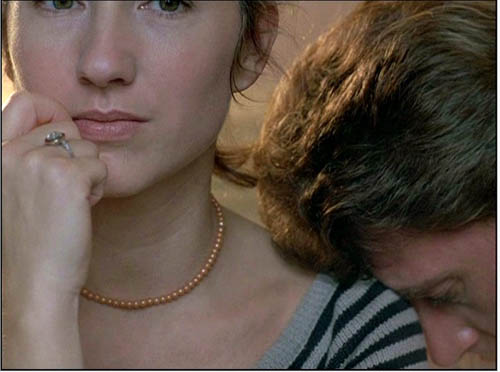
Detective (Godard, 1985).
Another damned, thick, square book! Always scribble, scribble, scribble, eh, Mr. Gibbon?
William Henry, Duke of Gloucester, 1781.
David here:
Kristin kept the blogfires burning while I traveled last week and did UW duties this one. I had a great time at the University of Georgia in Athens (but didn’t see Stipe) and at Emory in Atlanta (but didn’t see Scarlett). At both places I met sharp, energetic students and faculty. I have a couple of blog entries backlogged for posting, but now recent items relating to publications get the pole position.
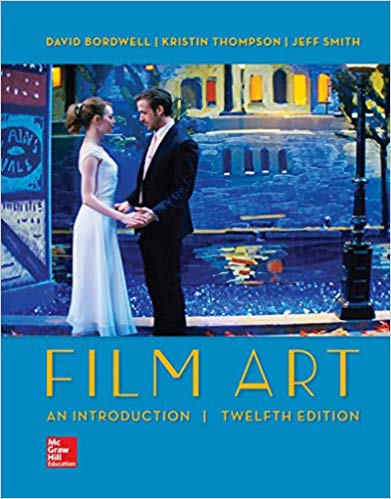
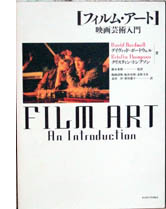 First, a Japanese translation of our Film Art: An Introduction has just appeared. It’s a very handsome version of the seventh edition, rendered by Fujiki Hideaki and Kitamura Hiroshi. We’re grateful to them and to Nagoya University Press for publishing it. First, a Japanese translation of our Film Art: An Introduction has just appeared. It’s a very handsome version of the seventh edition, rendered by Fujiki Hideaki and Kitamura Hiroshi. We’re grateful to them and to Nagoya University Press for publishing it.
Second, the University of California Press is having a big sale on many outstanding media titles, from Richard Abel’s books on French silent cinema and André Bazin’s classics of film theory to Michele Hilmes’ study of NBC television and Mike Barrier’s new Disney biography, The Animated Man. To get the discount you must sign up for an e-newsletter, but it’s not intrusive.
Among the books of mine on sale, the biggest bargain is the hardcover edition of Figures Traced in Light (2005), originally priced at $65, now going for $7.95 plus postage. (No, apparently I don’t get the full-price royalties.) You can find this item here. There are also paperback copies of Figures (going for $12.95) and of The Way Hollywood Tells It ($15.95). If you’re inclined, hurry: the sale ends on 31 October.
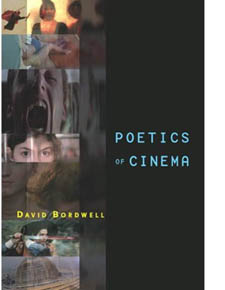 The biggest news, though, is that I just got my author’s copies of Poetics of Cinema, published last week. For a while Amazon was telling some people who pre-ordered it that copies won’t be available until 27 December, but now, despite what it says here, the book seems ready to ship. The biggest news, though, is that I just got my author’s copies of Poetics of Cinema, published last week. For a while Amazon was telling some people who pre-ordered it that copies won’t be available until 27 December, but now, despite what it says here, the book seems ready to ship.
Bad news first. Poetics of Cinema is priced at $45 in paperback, with no sellers I know offering it at discount. Go ahead, say it: Very expensive. If you haven’t published a book, you may not know that authors have no say in the pricing of their work. Publishers would never set a price or price ceiling in a contract, and calculations about pricing are based on many factors, including what comparable books sell for. A high cost isn’t my preference, of course; every writer wants to reach as many readers as possible. But unless you blog or self-publish your work, the publisher sets the price.
There are some good reasons for the cost. Running to 500 fairly dense pages and containing over 500 photographs, Poetics of Cinema was a complicated book to produce. I peddled it to other publishers, but they ruled it out as too whopping an investment for them. So Routledge has priced it along lines of comparable books, reckoning in the size of the likely audience (I hope, more than 118.3 readers). I have to thank Bill Germano, then Publishing Director at Routledge, for taking a chance on this project.
From age fifteen or so I’ve been a compulsive writer. Scribble, scribble, scribble. I’ve been at work on one book or another for over thirty years. I’ve got several projects in mind for my next effort, but I’ve held back committing. Is there any point in publishing more books, at least as books?
I mean this as a serious question. Would it have made any difference to me or my readers if Poetics of Cinema appeared as pdfs, available at a price considerably less than $45? Wouldn’t I find more readers? What about variable pricing? If Radiohead can do it, why can’t I? Somebody in film studies should try putting a digital book for sale online; maybe I will. But for a few years at least, this last baggy monster will be available only in dead-tree format.
Poetics: Some puzzles
Gentlemen Marry Brunettes (Richard Sale, 1955).
If you’ve read this far, you may be interested in what the book is about. Most basically, it’s predicated on the belief that we make progress in research by asking questions. Some questions are too deep to be answered—call them mysteries—but others can be answered with a fair degree of precision and reliability. We can turn mysteries into puzzles and puzzles into plausible answers.
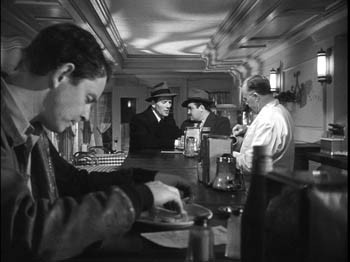
Here’s a fairly common sort of composition in Hollywood cinema of the 1940s. This shot from The Killers (1946) displays the sort of steep depth I’ve talked about at various points on this blog and in my other books.
But now here’s an equally tense confrontation at a counter, from Bad Day at Black Rock (1955), made in early CinemaScope.
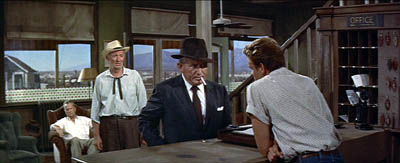
It doesn’t look much like the 1940s shot. The characters stand far from us, and the figure in the foreground doesn’t loom over the background. The shot is more open, the composition more porous. And unlike The Killers, Bad Day doesn’t contain close-ups of the actors in any scenes.
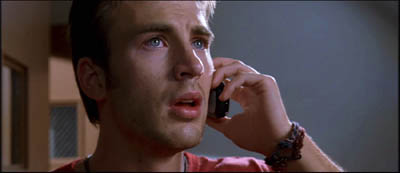
So questions come to mind. Did John Sturges have to stage the scene in Bad Day this way? Did other filmmakers resort to the same choice? What factors created pressures toward this more spacious format? Could more resourceful filmmakers have done something different? And given that such shots are rare today, what changes made it possible for filmmakers in later years to create the tight anamorphic widescreen close-ups we have now (as here in Cellular)?
Despite all that has been written about CinemaScope and other early widescreen processes, no one has explored, shot by shot, what staging options were used by filmmakers. A chapter in Poetics of Cinema called “CinemaScope: The Modern Miracle You See Without Glasses” tries to show how filmmakers used the new format to tell their stories. This led them, I propose, to experiment with some staging strategies that, surprisingly, had precedents as far back as the 1910s.
Take another instance. We’re all familiar with recent films that present alternative futures, like Run Lola Run. A story line runs along and then is interrupted, and we switch to the same characters living a different storyline in a parallel universe. The emergence of such “forking path” movies arouses my curiosity. How do they work? How do they make their alternative-reality stories intelligible to the audience? How is it that we’re able to understand them? (After all, the notion of an infinite number of alternative universes to ours is pretty hard to get your head around.) Are such stories a brand-new innovation, or do they have precedents? (Clue: Remember A Christmas Carol?) Why do we see a cluster of these emerging in recent filmmaking?
I tackle these questions in another essay, called “Film Futures.” There I look at several such movies and try to spell out the tacit rules that filmmakers follow and that audiences pick up on. While this story format probably doesn’t constitute a genre, it does obey certain conventions, and I try to chart those. Some films also make some clever innovations in the format, which I also try to trace. The essay as well suggests how the conventions are handled differently in mass-market films like Sliding Doors and in art films like Kieślowski’s Blind Chance.
These two essays, along with the others in the book, try to explain and illustrate an approach to film studies I call film poetics. At bottom, this is an effort to explain why films are designed the way they are: how filmmakers have made certain choices in order to shape our response to their films. How do movies work? How do movies work on us?
Poetics: The project
Vagabond (Varda, 1985).
As a kind of reverse engineering, film poetics looks at both structure and texture. I argue that we ought to study how films are constructed architecturally, as revealed for instance in plot structure or narration. Poetics also concentrates on stylistic patterning, the way filmmakers organize the techniques available to the medium. Poetics traditionally deals as well with thematics, the subjects and ideas that are mobilized by filmmakers and reworked by large-scale form and cinematic style.
Put it this way: I want to know how filmmakers have confronted problems set by others, or created problems for themselves to solve. I want to know how they draw on the past to borrow or modify or reject creative strategies. I want to know filmmakers’ secrets, including the ones they don’t know they know. And I want to know how all this creative activity is shaped to the uptake of spectators in different times and places.
Some of what I’ve written on this blog could illustrate how the poetics-driven perspective works in particular cases. The book offers more such instances, probed in more detail than is possible here. Using a comparative method, I also trace out some general principles of film form and style as they have developed over history.
The book consists of fifteen essays. Some have been published before; those have been revised for this collection. Other essays are newly written. After a somewhat polemical introduction, the first part concentrates on some theoretical problems. The anchoring essay offers a general introduction to the idea of a film poetics, with several examples. (An earlier version is on pdfs here.) In the same essay, I float a model of how film viewers respond to various aspects of films. I distinguish activities of perception, comprehension, and appropriation, and I suggest that a cognitive perspective sheds light on them.
Part I also contains an essay considering how cinematic conventions work. A poetics-based approach will spend a lot of time on norms, traditions, and received routines, for these are often the basis of filmmakers’ creative choices. This essay argues that some conventions are local and require a lot of cultural knowledge, while others are cross-cultural, compelling us to study why certain cinematic strategies seem to crop up across the world.
The second part of Poetics of Cinema considers narrative, one of the most common ways in which films are organized to affect viewers. I wrote a new essay to launch this section, a wide-ranging study called “Three Dimensions of Film Narrative.” The three dimensions I consider are narration, plot structure, and the narrative world. The essay considers how each of these shapes our understanding of a film’s story. This essay ends with a discussion called “Narrators, Implied Authors, and Other Superfluities.”
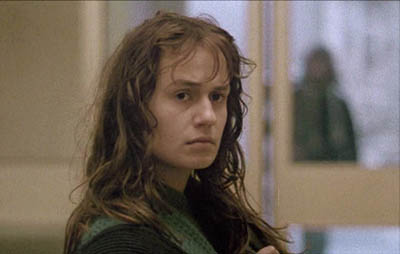
Some more tightly-focused pieces follow. One is devoted to forking-path plots. Another concentrates on an odd question: What role does forgetting play in our watching a film? Cognitive theory can offer some answers, and I take Mildred Pierce as an example. There’s an update of an essay that has been something of a golden oldie in film courses, “The Art Cinema as a Mode of Film Practice.” In a supplement to that piece I suggest some new avenues of inquiry and draw on more examples, notably Varda’s Vagabond (Sans toit ni loi).
The longest piece in Part II is devoted to what I call network narratives. Prototypes of this would be Grand Hotel, Short Cuts, Crash, and Babel. This essay tries to show how a poetics of cinema shed light on this format, currently a very popular one. When I started looking at these movies, I was surprised to discover how many filmmaking traditions work in this vein; I append a filmography with nearly 250 items, and today I could update it with several more. (1) I consider how this option has developed distinctive strategies of narration, plotting, and worldmaking. I also survey some common themes running across network tales, such as the role of chance and fate. The essay finishes with more in-depth analyses of four films: Altman’s Nashville, Iosseliani’s Favoris de la lune, Anderson’s Magnolia, and Jean-Claude Guiget’s Les Passagers.
Poetics: More problems
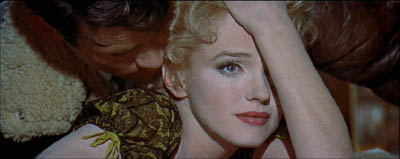
Bus Stop (Logan, 1955).
Part III moves from questions of narrative to questions of film style, no stranger to this blog. The opening essay is a tribute to Andrew Sarris that appraises his role in making readers of my generation style-conscious. It’s the most personal piece in the book. There follows a study of Robert Reinert, a director in the German silent cinema who might have become much better known if his quite demented Nerven and Opium had been as widely seen as Caligari. The essay “Who Blinked First?” considers how our reaction to films is affected by the ways in which actors use their eyes, including how and when they blink. Big deal, huh? Actually, yes.
The monster essay in this section is the CinemaScope piece, of which I’ve given versions in lecture form over the last couple of years. I argue that some directors responded to the new widescreen technology by adapting certain norms of staging and shooting to the new format, while other filmmakers moved in more adventurous directions. The piece uses the model of problem/solution as a way to understand stylistic continuity and change, a framework I’ve floated in On the History of Film Style as well.
The last four studies in Part III are devoted to style in Asian cinema. There are two essays on Japanese film of the 1920s and 1930s, both expanded somewhat from their original versions. There I argue that we can see Japanese directors as building upon, as well as adventurously departing from, stylistic norms shared by most filmmaking countries of the period. This brace of essays fills out some ideas that I fielded in Ozu and the Poetics of Cinema, and they should appeal to that growing body of viewers who have developed a passion for Naruse Mikio and Uchida Tomio. It’s gratifying that several of the films I discuss, which I had to study in archives, are now circulating in touring programs.
Poetics of Cinema concludes with two studies of Hong Kong film, one surveying the stylistic tactics by which that very lively tradition excites its audience, the other analyzing the unique innovations of King Hu. The articles are companion pieces to Planet Hong Kong.
Poetics: The mysteries
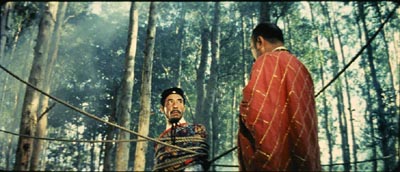
A Touch of Zen (King Hu, 1970).
As an approach to answering questions about cinema, poetics blends history, criticism, and theory. It requires that we do research into the artistic history of film, looking at styles, genres, narrative modes, and other traditions. It asks for close analysis and interpretation of films. At the same time, it asks broader questions about what principles govern narrative, stylistic patterning, and the like. I’d say it obliges a historian to concentrate on aesthetics; it makes criticism more historical and theoretical; it ties theory to concrete historical conditions and the fine-grain workings of individual films.
Kenneth Burke used to say that you could get a sense of a book by looking at its first and last sentences. My book’s first essay opens this way:
Sometimes our routines seem transparent, and we forget that they have a history.
I think that this captures my concern to look closely at familiar things in film and try to make their principles a little more evident. Yet in trying to make filmmakers’ choices explicit and tracing out the principles undergirding how we make sense of movies, I’m sometimes criticized for simply stating common sense. Poetics can look bland alongside the skywriting swoops of most academic film theory. But skywriting is blurry and dissolves while you look at it. By contrast, clearly setting out some basics of filmic construction and comprehension offers a firmer place to start answering questions about how movies work and work on us.
Poetics tries to produce concrete, approximately true claims about cinema. Most film theory operates as an application, borrowing big theories of culture, identity, nationhood, and the like and then mapping them onto films. The results are usually thin. It seems to me that most film theory today is not carefully thought through or persuasively argued. For examples, see my essay in Post-Theory, the last chapter of Figures, and my comments here and here on this site.
In trying to establish reliable knowledge about cinema, we won’t answer every question and we will make false steps, but we can make progress. Film poetics is one way we film enthusiasts can join that tradition of rational and empirical inquiry which remains our most dependable path to knowledge. My introduction, though peppered with some pokes at Big Theory, has the serious purpose of making a plea for film scholars to join that tradition.
The final line of the book concludes the essay on King Hu:
The mainstream [Hong Kong] style has given us many beautiful and stirring films, but Hu’s eccentric explorations evoke something that other directors’ works seldom arouse: a sense that extraordinary physical achievement, if caught through precisely adjusted imperfections, becomes marvelous.
To get the full point you need to read the essay, but what should come through here is my concern to highlight filmmakers’ originality when I find it, and to locate it by means of a comparative method. In addition, I hope that what comes through is an appreciation of the sheer exhilaration we feel when a filmmaker has made the right, bold choice. A poetics-based approach probably can’t fully explain this feeling—it may fall under the heading of mysteries rather than puzzles—but at least it can reveal how some forces contribute to it.
My summary, and the size of the book, may leave the impression that I think that I’ve answered these questions fully. Of course I don’t. I try only to make some progress, realizing that offering answers is also an invitation to disagree, to refine the questions and tackle new ones. Nor do I think that these are the only questions that matter. We’re just starting to understand how films work and work on us, and there are a great many areas we haven’t charted. (Performance, to take a big one.) We have to start somewhere, though. I’d hope that by posing some questions and proposing some answers, Poetics of Cinema offers fruitful points of departure.
(1) Some candidates are 25 Fireman Street (1973, Hungary, István Szabó), Feast of Love (2007, US, Robert Benton), Continental—A Film without Guns (2007, Canada/ Stephane Lafleur), The Edge of Heaven (2007, Germany/ Turkey, Fatih Akin), Unfinished Stories (2007, Iran, Pourya Azarbayjani), God Man Dog (2007, Taiwan, Singing Chen [Chen Hsin-hsuan]), A Century’s End (2000, Korea, Song Neung-han), and Why Did I Get Married? (2007, US Tyler Perry).
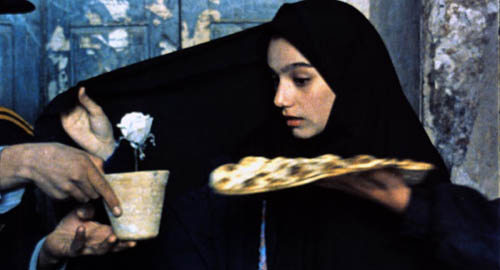
A Moment of Innocence (Mohsen Makhmalbaf, 1996).
Posted in Art cinema, Asian cinema, Books, Film and other media, FILM ART (the book), Film comments, Film industry, Film scholarship, Film technique, Film technique: Cinematography, Film technique: Widescreen, Narrative strategies, National cinemas: Hong Kong | open printable version
| No Comments »
|