Wednesday | January 21, 2009
Jerusalema.
Kristin here–
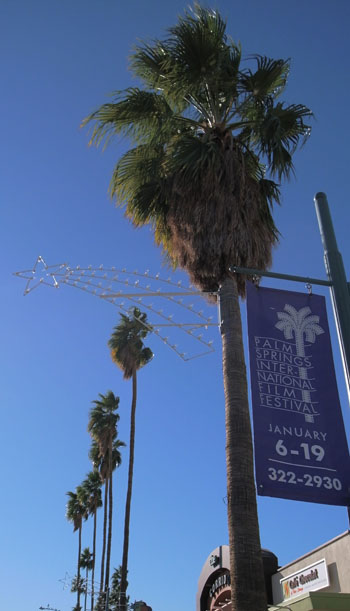
 The Palm Springs International Film Festival has a logo calculated to appeal to those of us who travel from snowy northern climes to attend: a palm tree composed of strips of film. As each film began and a short prologue listed the sponsors, I studied that logo and felt grateful that I was missing the frigid weather that descended upon Madison during our absence. It’s a clever design, also managing to suggest movies springing forth in abundance, which was certainly true of the festival’s offerings. The Palm Springs International Film Festival has a logo calculated to appeal to those of us who travel from snowy northern climes to attend: a palm tree composed of strips of film. As each film began and a short prologue listed the sponsors, I studied that logo and felt grateful that I was missing the frigid weather that descended upon Madison during our absence. It’s a clever design, also managing to suggest movies springing forth in abundance, which was certainly true of the festival’s offerings.
Two from the Antipodes
Most New Zealand films are set in their home country, taking advantage of its magnificent landscapes and local culture. Dean Spanley (Toa Fraser) strikes me as quite different. Based on a Lord Dunsany fantasy novella, My Talks with Dean Spanley (1936), it was mostly filmed in England and is a costume piece set in the Edwardian era. Five years ago co-productions were rare things in New Zealand, but this is a Kiwi-U.K. film with an impressive international cast. There are Englishman Jeremy Northam as the narrator and protagonist, New Zealander Sam Neill in the title role, Australian Bryan Brown (perhaps most widely known as Breaker Morant) in a supporting part, and Peter O’Toole. The latter is spoken of as a possible best supporting actor Oscar nominee, though I fear that the film is too low profile for that.
[Correction, January 26. Bryan Brown appears in Breaker Morant as Lt. Peter Handcock, not in the title role.]
Dean Spanley is a feather-light but well-told tale of Fisk, a middle-aged man who pays a tense visit to his 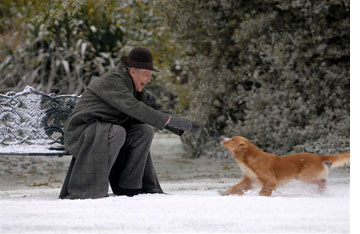 curmudgeon of a father (played by O’Toole) once a week. For something to do, Fisk takes the old man to a lecture on reincarnation, also attended incongruously by the local preacher, Dean Spanley. A friendship develops between Fisk and Spanley as it gradually comes out that Spanley seems to be the reincarnation of the father’s beloved childhood dog. The premise is made plausible by a gradual revelation of the premise, by Neill’s performance, and by some lyrical flashbacks. The whole thing is a surprising film to have come from Fraser, whose first feature, No. 2, was set in Auckland and concerned a family of Fijian descent. Yet it seems a sign of the New Zealand cinema’s health that he could take such an unexpected turn and tackle an English literary adaptation. curmudgeon of a father (played by O’Toole) once a week. For something to do, Fisk takes the old man to a lecture on reincarnation, also attended incongruously by the local preacher, Dean Spanley. A friendship develops between Fisk and Spanley as it gradually comes out that Spanley seems to be the reincarnation of the father’s beloved childhood dog. The premise is made plausible by a gradual revelation of the premise, by Neill’s performance, and by some lyrical flashbacks. The whole thing is a surprising film to have come from Fraser, whose first feature, No. 2, was set in Auckland and concerned a family of Fijian descent. Yet it seems a sign of the New Zealand cinema’s health that he could take such an unexpected turn and tackle an English literary adaptation.
Australian movieThe Black Balloon (Elissa Down) is a contemporary story set in a Sydney suburb. It’s a social-problem film, dealing with a teenage boy, Thomas, torn between his love for his severely autistic brother (a truly remarkable performance by Luke Ford) and his frustration at the effect the brother’s antics have on his own ability to fit in at his new school. The film is apparently aimed primarily at a teen audience (it won the Crystal Bear for “Generation 14plus – Best Feature Film” at the Berlin Film Festival), but the almost exclusively adult audience at Palm Springs seemed entertained and touched by it. Australian stars who have made careers abroad often return to support their native industry by acting in local films, and Toni Collette is impressive as the mother. I found it a bit of a stretch that the one sympathetic, understanding fellow student Thomas finds happens to be a gorgeous girl who also seems to have no friends among their classmates. Apart from that, it’s an entertaining and informative film.
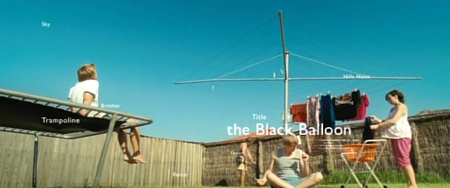
It does have one intriguing device in the pre-credits and credits scenes: several objects in each shot contain superimposed words identifying a number of the objects visible. The idea presumably is to suggest the fact that autistic people have excellent object recognition but difficulty understanding others’ emotions. I would have liked for the labeling to continue through the film, but I suspect most other viewers wouldn’t. Admittedly that would have distracted viewers from the narrative–unless we soon got used to it, which I suspect would have happened. At any rate, it’s a catchy way to introduce the story.
Another Exodus
Watching the Moroccan film Goodbye Mothers (Mohamed Ismail) was a disconcerting experience. At first it struck me as simply old-fashioned filmmaking, with multiple plotlines concerning three Jewish families living in Morocco at a time of increasing racial tensions. The stories are the stuff of melodrama, with a beautiful Jewish girl in love with a Moroccan man, a man debating whether to abandon his long-time friend and business partner to move his family to Israel, and the partner’s childless wife, who would be devastated by the departure of the family’s children, to whom she has been a second mother. In this age of short scenes, the film bases its action largely on extended shot/reverse-shot conversations, without much moving camera or many tight close-ups.
Eventually I realized that the film looks very much as if it had been made around 1960, which is the period of the story’s action.
The similarity can’t be coincidental. As with other Moroccan films I have seen, there is considerable emphasis on the music track, and here two or three scenes use the sweeping theme from Preminger’s Exodus. Indeed, the style is occasionally reminiscent of Preminger’s work of that era, as in shots that position characters precisely across the wide screen.
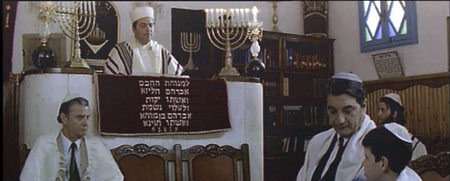
There’s also the sort of depth composition with a head prominent in the foreground that one associates with widescreen 1960s films by Nicholas Ray:
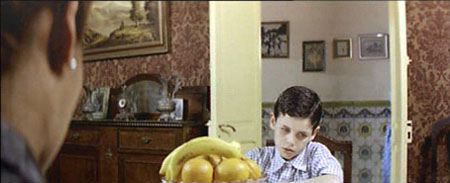
There’s more cutting than Preminger would typically use, but it’s an interesting pastiche that lends some subtle overtones to the film’s action. Despite a wide range of performance styles and a somewhat schematic set of plotlines, the film is an intriguing attempt to use a throwback style to convey the period when the peaceful co-existence of Jews and Muslims in Morocco was breaking down.
The quest film grows up
A few films do not necessarily a pattern make, but I’ve been struck by some echoes among the Middle Eastern films I’ve seen at this and other festivals. When the New Iranian Cinema came to international notice in the 1980s and 1990s, one narrative premise that several films shared led them to be labeled “child quest” movies. These tended to be simple searches or journeys: a boy trying to return his friend’s school notebook (Kiarostami’s Where Is My Friend’s Home?, 1987) or a girl trying to make her way through traffic to get home after school (Panahi’s The Mirror, 1997).
Gradually disasters, natural and manmade, caused the quests to become more serious. They often still involved children, but the just as often the seekers have been adults. Kiarostami’s And Life Goes On (1991) dealt with a film director’s journey into an earthquake-devastated area to find the child actor of Where Is My Friend’s Home?, who happened to live in the worst-hit area.
More recently, though, the disasters that create quests are wars in the region. My Marlon and Brando, the first feature of Turkish director Huseyin Karabey, deals with a actress in Istanbul. She has fallen in love 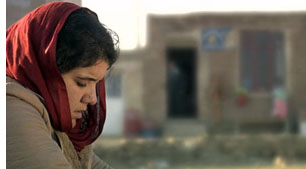 with an Iraqi Kurd, and when the U.S. launches its invasion of Iraq, the two are cut off from each other. Increasingly frustrated and desperate, the heroine sets out to join her lover in his home in northern Iraq, even though the convoluted set of border closings forces her to go by bus via Iran. with an Iraqi Kurd, and when the U.S. launches its invasion of Iraq, the two are cut off from each other. Increasingly frustrated and desperate, the heroine sets out to join her lover in his home in northern Iraq, even though the convoluted set of border closings forces her to go by bus via Iran.
As she meets obstacle after obstacle and finds herself isolated in small villages where she cannot speak the local language, the film risks becoming monotonous. But audience attention is carried in part by a remarkable performance by Ayca Damgaci, who must carry every scene. At intervals we see videotaped messages sent to her by her lover. His effusive professions of love are juxtaposed with clips from the film where they had acted together, and these messages lead one to wonder just how sincere he is. Might he be leading her on through her grueling trek just to find disappointment?
My Marlon and Brando reminded me of Under the Bombs, which I wrote about from the Vancouver Film Festival. (It was also shown at Palm Springs.) There a distraught Lebanese woman travels by cab into the southern area bombed by Israel in 2006, seeking her son. Both films stress the difficulties of ordinary people’s making their way through combat areas or having to detour around them.
Another variant comes in Ramchandi Pakistani (2008), made by Mehreen Jabbar, one of several female 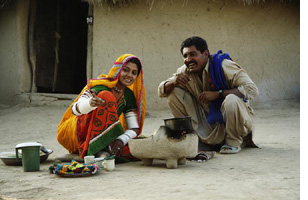 directors who have emerged in the Middle East. The mischievous Pakistani child Ramchandi wanders away from his village in Pakistan. He accidentally crosses the border into India—a border marks only by rows of painted white stones, giving the child no indication of the danger he faces. His father follows in an attempt to find him, and both are thrown into an Indian prison for years, their unregistered status making release highly unlikely. The film then alternates between the plight of the pair and their fellow prisoners and the frantic efforts of Ramchandi’s mother to find out what has happened to them and to eke out a living while hoping for their return. directors who have emerged in the Middle East. The mischievous Pakistani child Ramchandi wanders away from his village in Pakistan. He accidentally crosses the border into India—a border marks only by rows of painted white stones, giving the child no indication of the danger he faces. His father follows in an attempt to find him, and both are thrown into an Indian prison for years, their unregistered status making release highly unlikely. The film then alternates between the plight of the pair and their fellow prisoners and the frantic efforts of Ramchandi’s mother to find out what has happened to them and to eke out a living while hoping for their return.
The three films deal with different conflicts: U.S.-Iraqi, Israeli-Lebanese, and Indian-Pakistani. All three stress the separations of families and lovers by hostilities and the barriers they arbitrarily create for ordinary people.
A small drama far away
In contrast, the Kazak film Tulpan (Sergei Dvortsevoy) presents flat, limitless, arid plains of southern Kazakstan, where borders and conflicts seem so far away as to be irrelevant. Asa, a veteran of the Russian navy, does not go on a quest but has a pair of local goals. He seeks to marry the elusive Tulpan and to establish his own flock of sheep. As he struggles to achieve 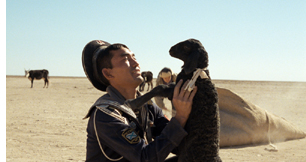 these goals, Asa remains an assistant to his brother-in-law Ondas, a tough, seasoned herdsman who keeps finding his ewes’ newborn lambs mysteriously dead. these goals, Asa remains an assistant to his brother-in-law Ondas, a tough, seasoned herdsman who keeps finding his ewes’ newborn lambs mysteriously dead.
The film is director Dvortsevoy’s first fiction feature after a career as a documentarist, and he skillfully details the lives of Ondas and his family. There are two remarkable, squirm-inducing scenes of the births of lambs, handled in long takes that seem to make trickery impossible. Despite the hardships and disappointments, there are touches of humor, as when the local vet stops by to investigate the dead-lamb problem, accompanied by a bandaged baby camel in the side-car of his motorcycle and followed by its persistent, annoyed mother. A charming film and a crowd-pleaser.
See the film, avoid the city
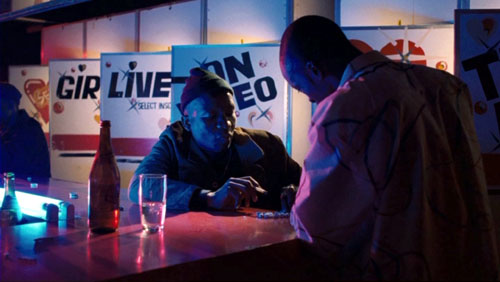
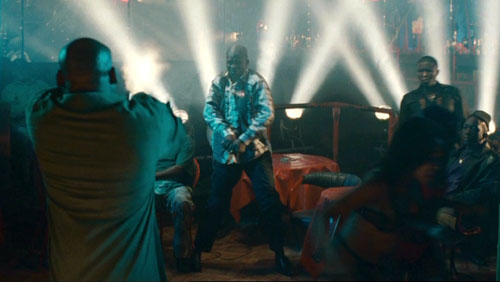
During the Q&A after the screening of Jerusalema that I attended, queries from the audience tended to center around how accurate its depictions of rampant crime and violence are. Director Ralph Ziman assured us that they are quite accurate, and indeed the film is loosely based on a combination of true cases. Johannesburg, he claimed, is the world’s most violent city. Whether that’s strictly true, I don’t know, but Ziman’s film is a polished, gripping depiction of one brilliant young student’s rise and fall (and rise?) as a criminal. The script, with its complex flashback structure, is tight and fast-paced. The cinematography is consistently imaginative and beautiful. (See images at top and bottom.) I can best describe it as Michael Mann shooting a gritty Hong Kong action film, but setting it among Johannesburg gangs. The Mann influence is palpable. At one point the characters watch a scene from Heat to learn how to ambush an armored car, and Mann is among those thanked in the credits.
Jerusalema was South Africa’s submission for a nomination as the Best Foreign Film for the Oscars. Not surprisingly, it didn’t make the shortlist, being an action pic rather than the art-house fare that the Academy members favor. Its language is also a disconcerting melange of the tongues and dialects spoken in South Africa, including English. At times characters switch among languages in mid-sentence. According to Ziman, the script was written in English, and then the cast helped work out how their individual characters would speak the lines.
The basic story is familiar, with a teenager, Lucky, from Soweto accepted into a university but unable to pay his fees and intending to turn to crime temporarily to raise the requisite money. Naturally he tries to quit, only to be lured back. But Lucky uses his intelligence to work out a novel way to twist the law to his advantage, commandeering crime-ridden apartment blocks that have been allowed to slip below legal standards and buying them at bargain prices. It’s the dynamic style, though, that makes this so entertaining. It was one of my favorite films of the festival. Ziman announced that it had recently been sold for American distribution, but he would not reveal the name of the company before an official announcement. I’m not sure whether it would fit better into multiplexes or art theaters. Like so many recent films it seems to fall in between. (The Curious Case of Benjamin Button and Slumdog Millionaire are only the most recent examples that come to mind.) Its subtitles make it unlikely to find a really wide audience, but its violence might be off-putting to the art-house crowd. Wherever it ends up, it’s worth looking out for.
A final thought
During the festival, I was struck a number of times by how well-made films were that came from countries where production has previously been minimal. From South Africa, Kazakstan, Morocco, and Pakistan we see films that give the impression of having been made within a well-established industry. They adeptly use conventions familiar from festival-aimed art films or from classical Hollywood-style cinema. Clearly filmmakers in such countries have been seeing a lot of movies, even if they haven’t been making very many yet. The cliché about the cinema as an international language, almost as old as the medium itself, apparently remains as true as ever.
Note: Variety‘s wrap-up of the Palm Springs International Film Festival, including the prizes awarded, can be found here.
Posted in Art cinema, Directors: Ray, Nicholas, Festivals, Film comments, Film technique: Widescreen, National cinemas: Middle East, National cinemas: New Zealand |  open printable version
| No Comments » open printable version
| No Comments »
Friday | January 16, 2009
Four Nights with Anna.
DB here:
Three high points from the Palm Springs International Film Festival. Soon Kristin will offer some entries.
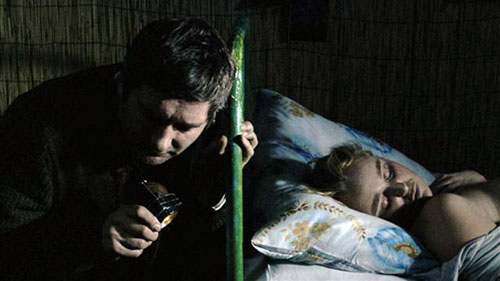
Four Nights with Anna is a GOFAM—a Good Old-Fashioned Art Movie. Set in a muddy Polish town, it follows a loner as he stalks a zaftig nurse. Leon watches her from around corners, studies her through her apartment window, and eventually sneaks sleeping powder into her sugar jar. This puts her out soundly enough to allow him to break into her apartment and watch her at close quarters.
My synopsis, like most retellings of this spare movie, not only spoils the experience but fundamentally changes it. Instead of laying out the premises explicitly, the film’s narration supplies them in tantalizing, equivocal doses. Skolimowski follows the great tradition of distributed exposition, so that we get context only after seeing something that can cut many ways. Early we see Leon buying an axe; soon he fishes a severed hand out of a sack and tosses it into a furnace. Is he a serial killer? No. After a while we learn that he’s the disposal officer for the hospital crematorium. Retrospectively fitting together these data provides a classic art-film pleasure, the equivalent of the curiosity-arousing clue sequences in a mainstream mystery.
The same goes for the ambiguous inserts that suggest a police interrogation. Only halfway through the film do these snippets become lengthy and explicit enough for us to place them in the story’s time sequence. Just as the Nouveau Roman of Robbe-Grillet owed a great deal to the classic detective story, the European art cinema tradition has drawn heavily on the investigation plot, from Les mauvais rencontres (1955) to The Spider’s Stratagem (1970). The premises of the thriller surface as well. The central conceit of Four Nights and of Kim Ki-duk’s 3-Iron, of a stranger who quietly and obsessively prowls around homes, was also explored in Patricia Highsmith’s 1962 novel Cry of the Owl, but not with Skolimowski’s playful indeterminacy about who and what and why.
The trick, then, is in the telling. By accreting details that cohere gradually, Skolimowski’s film not only engages curiosity and suspense, but also allows room for wayward, if dark humor. Leon’s quaking abasement leads to embarrassment, pratfalls, and comically strenuous efforts to melt into his surroundings. Objects take on a precise life, as Leon crushes his grandmother’s sleeping pills to powder and uses plastic silverware to fish a fallen ring from cracks in the floor. We never see Anna apart from Leon; she’s either in the same locale or glimpsed in precisely composed shots of her at her window. The exact, constrained handling of optical point-of-view owes a lot to Rear Window, but Jimmy Stewart never went so far as to install a new window to enhance his peeping.
In its diffuse exposition, its teasing inserts, and its gradually unfolding implications, a GOFAM also asks us to appreciate unresolved uncertainties. During the Q & A, Skolimowski remarked that he liked “to play with a little ambiguity . . . to leave it for the audience to interpret.” The locale? Indefinite, he says. The time period? Deliberately left vague. The mysterious final shot? “A third ambiguity.” For the man who made the kinetic Identification Marks: None (1964), Walkover (1965), Barrier (1966), and Le Départ (1967), film is something of a sporting proposition. It’s good to see him back in the game.
By contrast, The Shaft by Zhang Chi is a NFAAM, a Newfangled Asian Art Movie. That means minimalism. Single-shot scenes are captured by a distant, stable camera. Characters mutely go about their business, or just stand there. Pivotal plot moments take place outside the frame or between two static scenes. Any dramatic climaxes and grand passions are muffled or simply sufffocated.
The proximate sources of this Asian minimalism are probably the late 1980s films of Hou Hsiao-hsien. A European predecessor of the style, I think, is Fassbinder’s Katzelmacher (1969), but its most famous early instance would be Akerman’s Jeanne Dielman (1975).
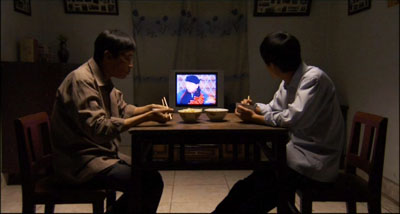
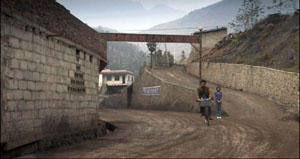
Such a quiet style poses a problem: How to show plot changes and character development without lengthy dialogue? A common solution is to repeat setups in ways that diagram changes in character relationships. Have a young man pedal his bike up to his girlfriend and offer her a ride. Later as their relationship cools, show him in a similar framing riding callously past her.
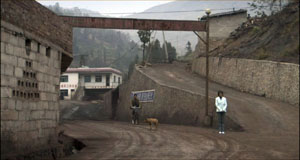 
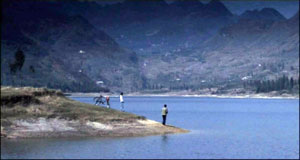
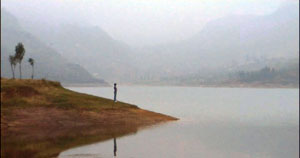
Or show the couple wordlessly visiting a lake, but after they break up, show the girl standing there alone.
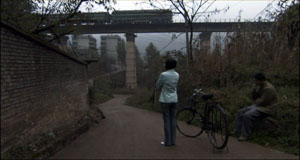
Tableaus can be used to parallel couples. Each pair meet near the village railroad trestle, but the compositions distinguish the couples.
 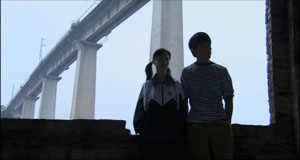
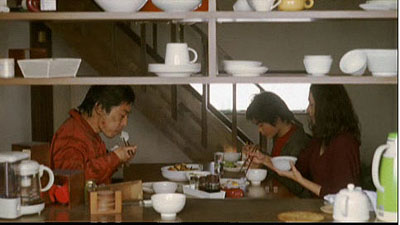
Likewise, the shots showing the central family eating in front of the TV can be recalled through variation. The number of people at the table and their identities can change over the course of time.
The Shaft puts such conventions to solid use. In a rural Chinese town, young people face the choice of going to work in the mine or moving to Beijing. The film is built out of three stories, centering on a daughter, then her brother, and finally their father. At the end, the eventual revelation of what happened to the family’s mother throws the preceding love stories into sharper relief.
Once the innovators have mastered a style through dint of effort, others can glide down the learning curve and pick it up quickly. But then they should try to add something new. Today the rudiments of the minimalist style are comparatively easy to acquire. To go beyond those, you need something else—a more elaborate play with pictorial variations, or more ingenious staging (the Hou solution), or a gift for adjusting to the contours of landscape (the Jia Zhang-ke alternative). The Shaft is well-carpentered. It is measured and poignant (especially in its final story), and it concludes with a stunning trio of shots. Its very modesty, though, suggests the conventions of NFAAM need some renewal, even some shaking up.
Shaking things up is what Kurosawa Kiyoshi’s Tokyo Sonata is all about. A salaryman is downsized, but he can’t bear to tell his family. He pretends to go off to work while he actually tries to find a new job, any job. In the meantime, his sons display more ambition and courage in their limited worlds, than he does, while the mother tries to defuse the emerging tensions.
For an hour or so, this story is engrossing on naturalistic terms, alternating comedy and pathos. It might continue in a vein of gentle realism characteristic of that perennial Japanese genre, the shomin-geki, ending with everyone’s stoic reconciliation to the vagaries of life. But the director of Cure and Charisma will go along with this formula only up to a point. Why not break the form? You can argue that the simple purity of The Shaft plays too cautiously; once you’ve figured out how things will probably unfold, who cares to see the rest? A smooth cup is lovely, but a cracked one possesses its own enigmatic appeal.
So Kurosawa careens his homely tale into grotesque territory. The tone and plot logic that he’s cultivated so carefully are fractured by some violent emotions, implausible coincidences, and unexpected twists. Granted, his technique remains unruffled.Kurosawa follows Japanese traditions of enclosing faces in apertures and arranging people in gridwork patterns that still leave room for natural movement. The beginning of the story’s wild detour is discreetly signaled by a variant of the film’s first shot. But the composure of the handling makes the challenge to our expectations all the more disruptive.
I shouldn’t say much more, except to note that I meant the word fracture to suggest that the film mends its bones eventually. The final moments are taken up with a delicate performance of Debussy’s Clair de lune. Neither GOFAM nor NFAAM, risk-taking and in the end quite moving, Tokyo Sonata attests to the unpredictable innovativeness of Japanese filmmaking.
I may add other thoughts to Kristin’s upcoming dispatch, but for now I just note that Palm Springs is the only festival I know that uses Béla Tarr soundtrack cuts for pre-show music.
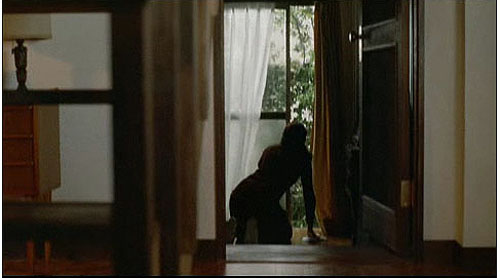
Tokyo Sonata.
Posted in Art cinema, Asian cinema, Festivals, Film technique, Film technique: Staging, National cinemas: China, National cinemas: Eastern Europe, National cinemas: Japan | open printable version
| Comments Off on Three from Palm Springs
Wednesday | January 14, 2009
DB here:
Kristin and I were invited to the Palm Springs International Film Festival for its twentieth-anniversary outing. We didn’t need much persuasion. Single-digit temperatures in Madison provided some motivation, but the first-rate program was the decisive factor. We’re grateful to our old friend (and former student) Alissa Simon, one of the PSIFF’s programmers, for helping arrange our visit, and to Emily Davis and Steve Wilson for being maximally welcoming.
We’ve already seen about a dozen films, and once we get some time in the next few days we’ll be writing up our responses to such extraordinary movies as Tokyo Sonata (Kurosawa Kiyoshi), The Shaft (Zhang Chi), Tulpan (Sergey Dvortsevoy), Four Nights with Anna (Jerzy Skolimowski), and several more. For now, let this snapshot of the lively Skolimowski stand in for the dispatch we will be posting later this week. His return, after a hiatus of fifteen years, is most welcome.

Posted in Festivals, Film comments, National cinemas: Eastern Europe | open printable version
| No Comments »
Wednesday | January 7, 2009
DB here:
One of the many penalties of watching movies on TV is the prevalence of bugs.
This is the nickname adopted by media makers for those little channel logos and watermarks that hop onto your screen. Sometimes these translucent signatures surface at intervals, to minimally satisfy FCC channel identification demands. Others let you know the movie you’re watching, or will be later.
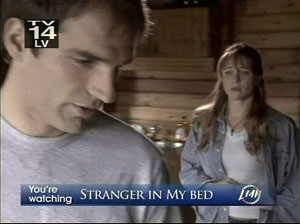
But just as often the bugs just squat in a corner forever, teasing your eye away from the movie. Bugs are to the 2000s what editing and time-compressing were to earlier eras. “Movies, uncut,” boasts the IFC bug. But not unspoiled.
Bugs are bad enough when they are hovering in a black vacuum, made forlorn by letterboxing.
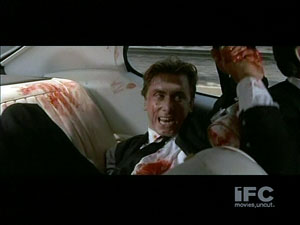
But they really jump into competition when they take up part of the image. How can you watch what actors are doing when there’s something faintly readable floating up from below?
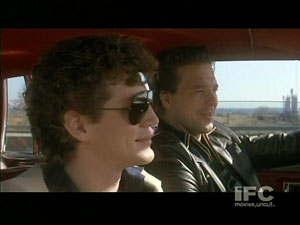
I find it impossible not to look at a bug occasionally. In dark shots, sometimes it’s the most visible thing on the screen. Even in bright shots I stare at it. Maybe I’m hoping that it will be different this time. Yet when it changes, as it does on the Lifetime channel, I watch it more attentively, which only makes me more annoyed.
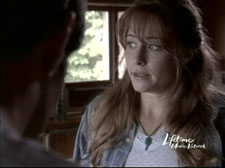 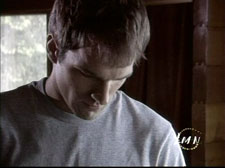
It’s like the mesmeric spell of Time Code, ticking away the movie’s life, and yours.
I’m not the first to complain. An eloquent manifesto, originally called Squash the Bugs, dates back to 2000, when the infestation was starting. Several other souls participated in the movement.
We know why bugs are swarming all over TV. Somebody better dressed than you or me is worried that we will be recording A Christmas Story or Smokey and the Bandit or Stranger in My Bed. We might even try to sell copies, or post a clip online. In principle, the bug is a badge of ownership, warning that we could be prosecuted. In practice, nobody expects to sue every user, so bugs help spread the brand. It’s like putting a designer logo on a shirt, making you a walking ad. Who wouldn’t want their bug, microscopic as it is, all over YouTube (which of course tacks on its own bug)?
But like everything else that we take for granted, bugs aren’t new. In their earlier form, they’re rather likable.
Silent but deadly
Movie bugs go back to the first years of cinema, when producers were no less worried about media piracy than they are today. Between 1895 and 1915, films circulated very freely around the world, and enterprising crooks happily duped originals and passed them off as their own productions. To block this, filmmakers tried to find ways to keep their trademarks on the film.
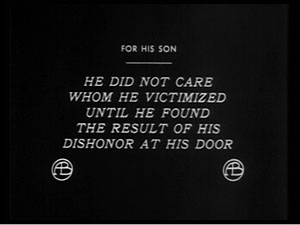
The obvious step was to put the trademark in the intertitles, and many companies did. Here is one for For His Son, a 1912 Griffith film from American Biograph. (What did the protagonist do for his son? He created a soft drink called Dopocoke, which turns the college boy into a hopeless addict.) Note the handsome AB insignia.
But of course a pirate could simply replace such original titles with ones of his own. The next logical step was to incorporate the trademark into the images, which couldn’t be replaced. Without the technology to create near-invisible superimpositions, the filmmakers took the obvious course.
They put the company logo into the set.
The AB circle typically appeared as a wall decoration. Biograph characters loved to furnish their surroundings to highlight this motif, preferring to put it at eye level and frame center. The logo could be found in unexpected places, like movie theatres (Those Awful Hats, 1908), and it could brighten the dreariest hovel (What Shall We Do with Our Old?, 1911).
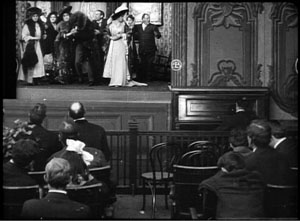 
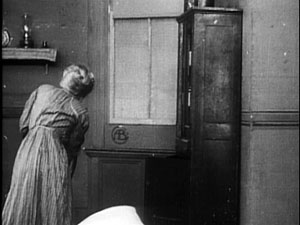 
The plaque’s popularity stretched back to Civil War days (In the Border States, 1910), and even in medieval times a king might mount the stylish AB on a brick wall (The Sealed Room, 1909).
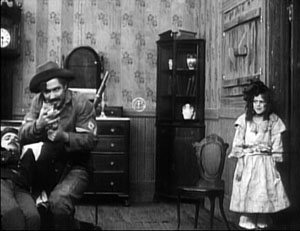 
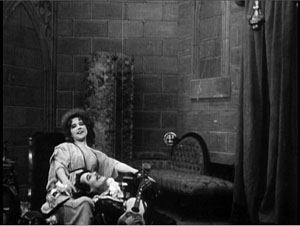 
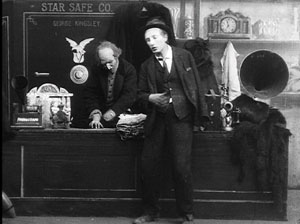
Not to be outdone, Biograph’s competitor, the Vitagraph company, had a beautiful soaring eagle logo, which conveniently furnished a striking V graphic.
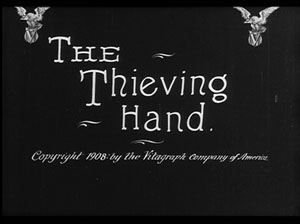
Judging from the evidence of this 1908 film, however, Vitagraph had a sideline in manufacturing safes.
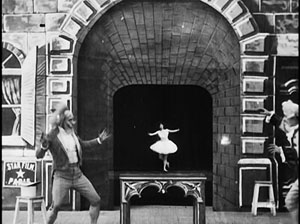
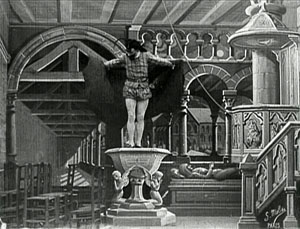
The practice of building the trademark into the mise-en-scene seems to have begun in France. Georges Méliès, whose fantasy films were popular around the world, took measures to counter piracy early. You can see his Star-Film logo on the building stone in the left corner of this frame from La Danseuse microscopique (1902). Shift it to the right corner and we’d have a modern-day bug.
 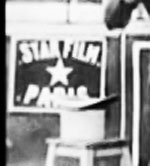
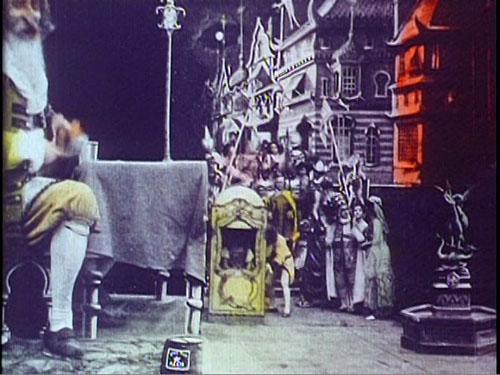
 At the very top of this entry is a frame from Le Voyage de Gulliver à Lilliput et chez les géants (1902). There Méliès attached the Star-Film seal to the barrel sitting just left of center. At the very top of this entry is a frame from Le Voyage de Gulliver à Lilliput et chez les géants (1902). There Méliès attached the Star-Film seal to the barrel sitting just left of center.
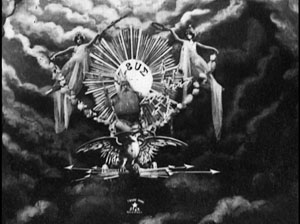
But Méliès didn’t always shove his imprimatur to the edge of the frame. In Le Tonnerre de Jupiter (1903) it sits just below the eagle that Zeus bestrides.
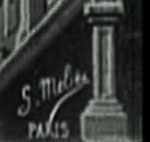
In the earlier Diable au convent (1899), Méliès exercised another option, simply signing his image as if it were a painting. To a large extent, it was.
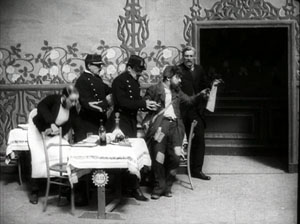
Léon Gaumont had two marques, each enclosed in a chrysanthemum ring. The most famous one is a majestic Gaumont, but an alternative, ELGE (that is, LG), haunts Alice Guy’s Billet de banque (1907). First, in a café, the logo is attached to a table, and later it’s a decorative baseboard in a police station.
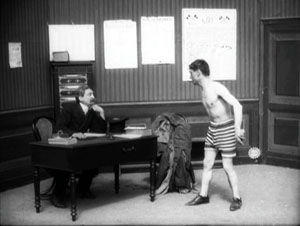 
In Guy’s Le Frotteur (1907), Gaumont simiply stuck its logo to a chair leg.
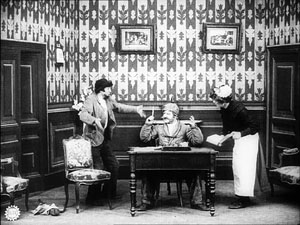 
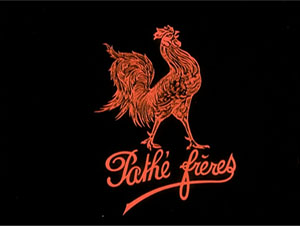
Then there’s the Pathé Frères rooster.
Easy enough to embed that, you’d think. Just have a rooster stroll through a shot now and then—not only barnyard scenes, but ones set in a courtroom or a factory. Still, roosters are pretty accessible to any film pirate, so Pathé went the more ordinary route of weaving its logo into the set.
An insistent example comes in The Physician of the Castle (1907), possibly the source for Griffith’s The Lonely Villa (1908) and Lois Weber/ Phillips Smalley’s Suspense (1913). The plot is sort of a 1907 Panic Room. The logo is initially a plaque in the parlor of the castle, visible just behind the kneeling doctor.
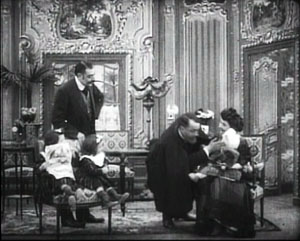
An identical plaque is perched in nearly the same spot on the wall of the doctor’s own parlor, as we can tell when his family is besieged by the invading tramps.
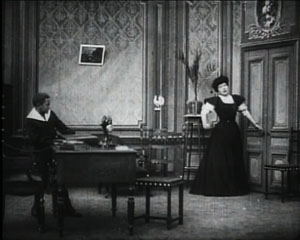
The tramps pass through another room, where the trademark stands proudly on another wall, on screen right.
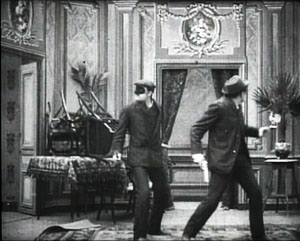
And when the wife tries to phone the husband for help, we get an insert that shows the Pathé cock nearly perched on her shoulder.
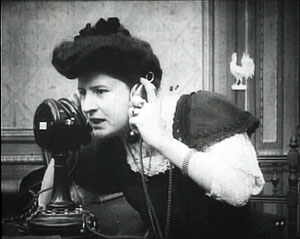
Why do I find the old bugs charming and the new ones annoying? I suppose it’s partly because the old ones were hand-crafted, not the result of keyboard twiddling. They are tangible. They are part of the scene’s space. Hard to see on DVD, the embedded marques are striking in 35mm projection, and spotting them is part of the pleasure of early film. Moreover, the filmmakers intended them to be there, or at least they accepted the need for them. But what director today is happy when the Sundance bug creeps into her compositions?
The old bugs seem to have gone extinct around 1912, but they will cling to their films. They bear witness to filmmaking of a specific time, and they anticipate problems that persist today. In tackling the threat of piracy, the old bugs seem at once naïve and intelligent. I see them as a rational solution to a hard problem, narrative consistency be damned. Today’s bugs, floating on top of the story world, seem more like corporate tattoos or graffiti. They don’t exist within the action, so you could argue that they are less disruptive. But they become a different sort of distraction, hovering halfway between the story world and the space of viewing. Bugs are spectres haunting the film.
On rare occasions, a modern add-on can be appropriate. In a Méliès film on the recent Flicker Alley set, L’Oracle de Delphes (1903), some TV agency has clapped its own digital bug into the lower right corner. It really is about beetle-size, and it dares to be a single eye looking back at you. That icon adds a touch of peculiarity not out of keeping with the Méliès aesthetic.
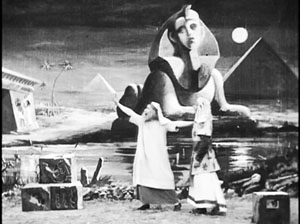 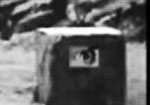
You can argue that this smirch on the image is a minor sacrilege. But I suspect that the Master of Montreuil would have grinned in approval.
For more on bugs, aka DOGS (Digital Onscreen Graphics), see Wikipedia. Thanks to Jason Mittell for helping me name these pests. And all hail Turner Classic Movies for keeping its bugs to a minimum.
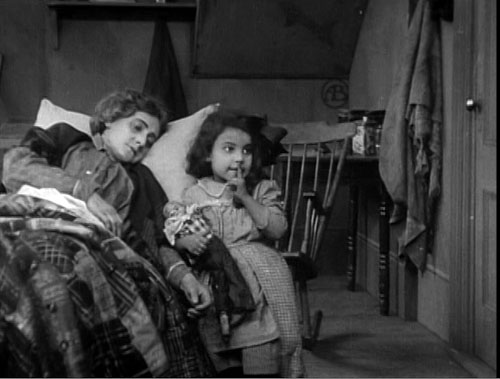
The Sunbeam (Griffith, American Biograph, 1912).
PS 19 January 2009: “Subliminal” bugs: I had hoped to include a frame illustrating the anti-piracy stamp used on current 35mm releases, but couldn’t find one quickly. This mark consists of a tight pattern of dots resembling a character in Braille. The stamp would presumably be copied if someone shot off the screen or ran the film through a telecine. How effective these bugs are at tracing pirate copies I can’t say, but you can detect them, especially in bright scenes; I usually notice one every third reel or so, just left of the center of the frame. I’ll keep looking for a frame and try to add one to this entry.
John Powers alerted me to the fact that even Michael Snow’s Région Centrale got the bug treatment when it was telecast on Italy’s RAI 3 TV. Thanks to John for this scary example.
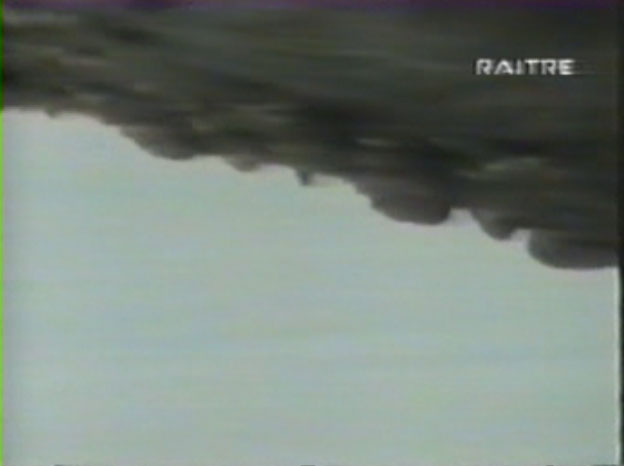
P.P.S. 24 January 2009: On the Internets, ask and ye shall receive. Olli Sulopuisto wrote to link me to the Wikipedia entry explaining the domino dots, known as CAPs. The entry includes an illustration. Olli also contributed to Jim Emerson‘s scanners blog, which contains good commentary on CAPs from Jim and his readers.
P.P.P.S. 29 May 2013: Can anti-piracy bugs be integrated into the movie or TV show? Yes!
Posted in Directors: Griffith, Directors: Méliès, Film comments, Film history, Film industry, Film piracy, Readers' Favorite Entries, Silent film | open printable version
| No Comments »
|