DB here:
In graduate school a professor of mine claimed that one benefit of studying film history was that “you’re never surprised by anything that comes along.”
This isn’t something to tell young people. They want to be surprised, preferably every few hours. So I rejected the professor’s comment, and I still think it’s not a solid rationale for studying film history. But I can’t deny that doing historical research does give you a twinge of déjà vu.
For instance, the film industry’s current efforts to sell Imax and 3-D irresistibly remind me of what happened in the early 1950s, when Hollywood went over to widescreen (Cinerama, CinemaScope, and the like), stereophonic sound, and for a little while 3-D. Then the need was to yank people away from their TV sets and barbecue pits. Now people need to be wooed from videogames and the Net. But the logic is the same: Offer people something they can’t get at home. It’s 1953 once more.
So historians can’t resist the “Here we go again” reflex. But they shouldn’t turn that into a languid “I’ve seen it all before.” Because we can genuinely be surprised. Occasionally, there are really innovative movies that, no matter how much they owe to tradition, constitute milestones. In my view, Kiarostami’s Through the Olive Trees, Hou’s City of Sadness, Wong’s Chungking Express, Tarr’s Satantango, and Tarantino’s Pulp Fiction are among the 1990s examples of strong and original works.
More often, the films we see draw on film history in milder ways than these milestones. But this doesn’t mean that these movies lack significance or impact. We can be agreeably surprised by the ways in which a filmmaker energizes long-standing cinematic traditions by blending them unexpectedly, tweaking them in fresh ways, setting them loose on new material. And the more you know of those traditions and conventions, the more you can appreciate how they’re modified. Admiring genius shouldn’t keep us from savoring ingenuity.
Which brings me to Slumdog Millionaire. I happen to like the film reasonably well. Part of my enjoyment is based on seeing how forms and formulas drawn from across film history have an enduring appeal. Many people whose judgments I respect hate the movie, and they would probably call what follows an ode to clichés. But I mean this set of notes in the same spirit as my comments on The Dark Knight (which I don’t admire). Even if you disagree with my predilections, you may find something intriguing in Slumdog’s ties to tradition. These ties also suggest why the movie is so ingratiating to so many.
Warning: What follows contains plot spoilers, revelatory images, and atrocious puns.

Slumdog and pony show
Adaptation is still king. Almost as soon as movies started telling stories, they were borrowing from other media. Many of this year’s Oscar candidates are based on plays, novels, and graphic novels. Slumdog is a redo of Vikas Swarup’s 2005 novel Q & A. The book provides the basic situation of a poor youth implausibly triumphing on a version of Who Wants to be a Millionaire? The novel also lays down the film’s overall architecture: in the present, the hero narrates his past, tying each flashback to a round of the game and a relevant question. In the novel, the video replays are described, but of course they’re shown in the film.
There are many disparities between novel and movie, but for now I simply note two. First, Swarup’s book has several minor threads of action, but the film concentrates on Jamal’s love of Latika. (The screenwriter Simon Beaufoy has melded two female characters into one.) Correspondingly, the book introduces a romance plot comparatively late, whereas the film initiates Jamal’s love of Latika in their childhoods. Such choices give the film a simpler through-line. Second, whereas Q & A skips back and forth through Jamal’s life, keying story events to the quiz questions, the film’s flashbacks follow the chronology strictly. This is a good example of how screenwriters are inclined to adjust the plasticity of literary time to the fact that, at least in theatrical screenings, audiences can’t stop and go back to check story order. Clarity of chronology is the default in classical film storytelling.
Then there’s the double plotline. The streamlining of Swarup’s novel points up one convention of Hollywood narrative cinema. The assortment of characters and the twists in the original novel are squeezed down to the two sorts of plotlines we find in most studio films: a line of action involving heterosexual romance and a second line of action, sometimes another romance but just as often involving work. The common work/ family tension of contemporary film plotting is to some extent built into the Hollywood system.
Beaufoy has sharpened the plot by giving Jamal a basic goal: to unite with Latika. The quiz episodes form a means to that end: the boy goes on the show because he knows she watches it. If told in chronological order, the quiz-show stretches would have come late in the film and become a fairly monotonous pendant to the romance plot. One of the many effects of the flashback arrangement is to give the subsidiary goal more prominence, creating a parallel track for the entire film to move along and arousing anomalous suspense. (We know the outcome, but how do we get there?)
Q & A. Swarup’s novel begins: “I have been arrested. For winning a quiz show.”
We have to ask: What could make such a thing happen? Soon the police and the show’s producers are wondering something more specific. How could Ram, an ignorant waiter, have gotten the answers right without cheating?
Noël Carroll proposes that narratives engage us by positing questions, either explicitly or implicitly. Stories in popular media, he suggests, induce the reader to ask rather clear-cut ones, and these will get reframed, deferred, toyed with, and in the short or long run answered.
Slumdog accepts this convention, presenting a cascade of questions to link its scenes and enhance our engagement. Will Jamel and Salim get Bachchan’s autograph? Will they survive the anti-Muslim riot? Will they escape the fate of the other captive beggar children? And so on.
More originally, the film cleverly melds the question-based appeal of narrative with the protocols of the game show, so that we are confronted with a multiple-choicer at the very start. (As in narrative itself, the truth comes at the end.) The principal question will be answered in the denouement, in a comparably impersonal register.

Flashbacks are also a long-standing storytelling device, as I was saying here last week. A canonical situation is the police interrogation that frames the past events, as in Mildred Pierce, The Usual Suspects, and Bertolucci’s The Grim Reaper. This narrating frame is comfortable and easy to assimilate, and it guides us in following the time shifts.
But 1960s cinema gave flashbacks a new force. From Hiroshima mon amour (1958) onward, brief and enigmatic flashbacks, interrupting the ongoing present-tense action, became common ways to engage the audience. Such is the case with the glimpse of Latika at the station that pops up during the questioning of Jamal, rendered as almost an eyeline match.


At this point we don’t know who she is, but the image creates curiosity that the story will eventually satisfy. Flashbacks can also remind us of things we’ve seen before, as when Jamal recalls, obsessively, the night he and Salim left Latika behind to Maman’s band. Boyle and company call on these time-honored devices in the assurance that wewill pick up on them immediately, as audiences have for decades.
Flashforwards are trickier, and rarer. The 1960s also saw some experimentation with images from future events interrupting the story’s present action. Unless you posit a character who can see the future, as in Don’t Look Now, flashforwards are usually felt as externally imposed, the traces of a filmmaker teasing us with images that we can’t really assimilate at this point. (See They Shoot Horses, Don’t They?) Such flashforwards pop up during the initial police torture of Jamal.
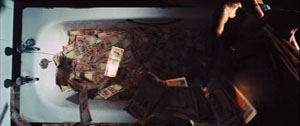
Encountering the bathtub shot so early in the film, we might take it as a flashback, but actually it anticipates a striking image at the climax, after Jamal has been released and returned to the show. I’d argue that the shot functions thematically, as a vivid announcement of the motif of dirty money that runs through the movie and is associated with not only the gangster world but also the corrupt game show.
Slumdog days
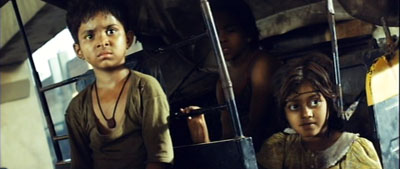
Empathy. One of the most powerful ways to get the audience emotionally involved is to show your protagonist treated unfairly. This happens in spades at the start of Slumdog. A serious-faced boy is subjected to awful torture, then he’s intimidated by unfeeling men in authority. He’s mocked as a chaiwallah by the unctuous host of the show, and laughed at by the audience. Once Jamal’s backstory starts, we see him as a kid (again running up against the law) and suffering a variety of miseries.
To keep Jamal from seeming a passive victim, he is given pluck and purpose. As a boy he resists the teacher, boldly jumps into human manure, shoves through a crowd to get an autograph, and eventually becomes a brazen freelance guide to the Taj Mahal. This is the sort of tenacious, resourceful kid who could get on TV and find Salim in teeming Mumbai. The slumdog is dogged.
Our sympathies spread and divide. Latika is also introduced being treated unfairly. An orphan after the riot, she squats in the rain until Jamal makes her the “Third Musketeer.” By contrast, Salim is introduced as a hard case—making money off access to a toilet, selling Jamal’s Bachchan autograph, resisting bringing Latika into their shelter, and eventually becoming Maman’s “dog” and Latika’s rapist. The double plotline gives us a hero bent on finding and rescuing his beloved; the under-plot gives us a shadier figure who finds redemption by risking his life a final time to help his friends. Jamal emerges ebullient from a sea of shit, but Salim dies drowned in the money he identified with power.
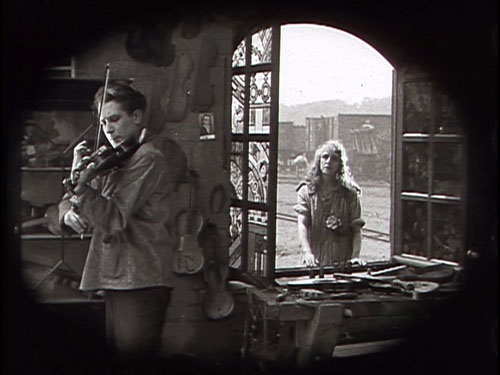
Our three main characters share a childhood, and what happens to them then prefigures what they will do as grownups. This is a long-standing device of classical cinema, stretching back to the silent era. Public Enemy and Angels with Dirty Faces give us the good brother and the bad brother. Wuthering Heights, Kings Row, and It’s a Wonderful Life present romances budding in childhood. These are plenty of less famous examples. Here, for instance, is a synopsis of Sentimental Tommy (1921), a film that may no longer exist.
The people of Thrums ostracize Grizel, a child of 12, and her mother, known as The Painted Lady, until newcomer Tommy Sandys, a highly imaginative boy, comes to the girl’s rescue and they become inseparable friends. Six years later Tommy returns from London, where he has achieved success as an author, and finds that Grizel still loves him. In a sentimental gesture he proposes, but she, realizing that he does not love her, rejects him. In London, Tommy is lionized by Lady Pippinworth, and he follows her to Switzerland. Having lost her mother and believing that Tommy needs her, Grizel comes to him but is overcome by grief to see his love for Lady Pippinworth. Remorseful, Tommy returns home, and after his careful nursing Grizel regains her sanity.
The device isn’t unknown in Indian cinema either; Parinda (1989) motivates the character relationships through actions set in childhood. Somehow, we are drawn to seeing one’s lifetime commitments etched early and fulfilled in adulthood.
This story pattern carries within it one of the great thematic oppositions of the cinema, the tension between destiny and accident. In Slumdog, The Three Musketeers may be introduced casually, but it will somehow provide a template for later events. Lovers are destined to meet, even if by chance, and when chance separates them, they are destined to reunite . . . if only by chance. A plot showing children together assures us that somehow they will re-meet, and their childhood traits and desires will inform what they do as adults. It is written.
This theme reaffirms the psychological consistency prized by classic film dramaturgy as well. Characters are introduced doing something, as we say, “characteristic,” and this first impression becomes all the more ingrained by the sense that things had to be this way. What you choose—say, to pursue the love of your childhood—manifests your character. But then, your character was already defined with special purity in that childhood.
Just another movie conceit? The existence of Classmates.com seems to suggest otherwise.

Chance needs an alibi, however. Hollywood films are filled with coincidences, and the rules of the game suggest that they need some minimal motivation. Not so much at the beginning, perhaps, because in a sense every plot is launched by a coincidence. But surely, our plausibilists ask, how could it happen that an uneducated slumdog would have just the right experiences to win the quiz? A lucky guy!
As Swarup realized, the flashback structure helps the audience by putting past experience and present quiz question in proximity for easy pickup. Yet as Beaufoy indicates in one of the most informative screenwriting interviews I know, the device also softens the impression of an outlandishly lucky contestant. At the start we already know that Jamal has won, so the question for us is not “How did he cheat?” but rather “What life experience does the question tap?” Each of the links is buried in a welter of other details, any one of which could tie into the correct answer. Moreover, sometimes the question asked precedes the relevant flashback, and sometimes it follows the flashback, further camouflaging the neat meshing of past and present.
It’s a diabolical contrivance. If you question Jamal’s luck, you ally with the overbearing authorities who suspect cheating. (You just think the film cheated.) Who wants to side with them? By the end the inevitability granted by the flashback obliges us to accept the inspector’s conclusion: “It is bizarrely plausible.”
The film has an even more devious out. Jamal can reason on his own, arriving at the Cambridge Circus answer. More important, his street smarts have made him such a good judge of character that he realizes that the MC is misleading him about the right answer to the penultimate question. So his winning isn’t entirely coincidence. Life experience has let him suss out the interpersonal dynamics behind the apparently objective game. As for the final answer—a lucky guess? Fate?—it’s a good example of how things can be written (in this case by Alexandre Dumas).
Slumdoggy style

The whole edifice is built on a cinematic technique about a hundred years old: parallel editing. Up to the climax, we alternate between three time frames. The police interrogation takes place in the present, the game show in the recent past (shifting from the video replay to the scenes themselves), and Jamal’s life in the more distant past. Any one of these time streams may be punctuated, as we’ve seen, by brief flashbacks. So the problem is how to manage the transitions between scenes in any one time frame and the transitions among time frames.
Needless to say, our old friend the hook—in dialogue, in imagery—is pressed into service often. A sound bridge may link two periods, with the quiz question echoing over a scene in the past. “How did you manage to get on the show?” Cut to Jamal serving tea in the call center. In a particularly smooth segue, the boys are thrown off the train as kids and roll to the ground as teenagers. There are negative hooks too. At the end of a quarrel with Salim, Jamal walks off saying, “I will never forgive you.” The next scene opens with the two of them sitting on the edge of an uncompleted high-rise building, having come to an uneasy truce.
In the climax, the three time frames all come into sync, creating a single ongoing present. Jamal will return to the show. The double-barreled questions are reformulated. Now we have genuine suspense: Will he win the top prize? Will Latika find him? To pose these engagingly, directors Danny Boyle and Loveleen Tandan create an old-fashioned chase to the rescue.
Each major character gets a line of action, all unwinding simultaneously: Salim prepares to sacrifice himself to the gangster Khan, she flees through traffic, and Jamal enters the contest’s final round. A fourth line of action is added, that of the public intensely following Jamal’s quest for a million. He has become the emblem of the slumdog who makes good.
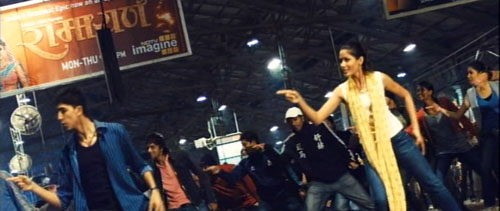
The rescue doesn’t come off; Latika misses Jamal’s phone plea for a lifeline, and he is on his own. Fortunately, he trusts in luck because “Maybe it’s written, no?” The lovers reunite instead at the train station, where Jamal had pledged to wait for Latika every day at 5:00. Fitting, then, that in the epilogue a crowd shows up, standing in for all of Mumbai, singing and dancing to “Jai Ho” (“Victory”). All the remaining lines of action—Jamal, Latika, and the multitudes—assemble and then disperse in a classic ending: lovers turning from the camera and walking into their future, leaving us behind.
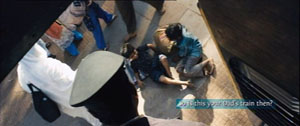
Then there’s the film’s slick technique. The whole thing is presented in a rapid-fire array, with nearly sixty scenes and about 2700 shots bombarding us in less than two hours. Critics both friendly and hostile have commented on the film’s headlong pacing and flamboyant pictorial design. If some of Slumdog’s storytelling strategies reach back to the earliest cinema, its look and feel seems tied to the 1990s and 2000s. We get harsh cuts, distended wide-angle compositions, hurtling camerawork, canted angles, dazzling montage sequences, faces split by the screen edge, zones of colored light, slow motion, fast motion, stepped motion, reverse motion (though seldom no motion). The pounding style, tinged with a certain cheekiness, is already there in most of Danny Boyle’s previous work. Like Baz Luhrmann, he seems to think that we need to see even the simplest action from every conceivable angle.
Yet the stylistic flamboyance isn’t unique to him. He is recombining items on the menu of contemporary cinema, as seen in films as various as Déjà Vu and City of God. (That menu in turn isn’t absolutely new either, but I’ve launched that case in The Way Hollywood Tells It.) More surprisingly, we find strong congruences between this movie’s style and trends in Indian cinema as well.
Over the last twenty years Indian cinema has cultivated its own fairly flashy action cinema, usually in crime films. Boyle has spoken of being influenced by two Ram Gopal Varma films, Satya (1998) and Company (2002). Company‘s thrusting wide angles, overhead shots, and pugilistic jump cuts would be right at home in Slumdog.


It seems, then, that Slumdog’s glazed, frenetic surface testifies to the globalization of one option for modern popular cinema. The film’s style seems to me a personalized variant of what has for better or worse become an international style.
Slumdogma
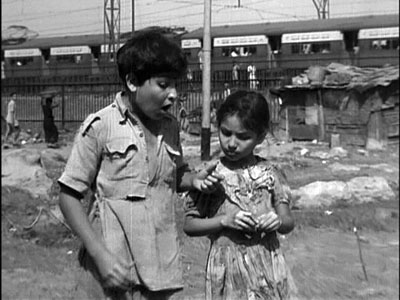
Boot Polish.
I’d like to mention many other ways in which the movie engages viewers, such as running (an index of popular cinema; does anybody run in Antonioni?). But I’ve said enough to suggest that the film is anchored in film history in ways that are likely to promote its appeal to a broad audience. The idea of looking for appeals that cross cultures rather than divide them isn’t popular with film academics right now, but a new generation of scholars is daring to say that there are universals of representation and response. It is these that allow movies to arouse similar emotions across times and places.
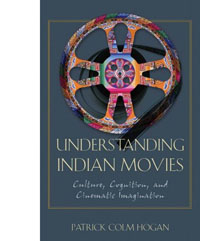
Patrick Hogan has made such a case in his fine new book Understanding Indian Movies: Culture, Cognition, and Cinematic Imagination. There he shows that much of what seems exotic in Indian cinema constitutes a local specification of factors that have a broad reach—certain plot schemes, themes, and visual and auditory techniques. Hogan, an expert in Indian history and culture, is ideally placed to balance universal appeals with matters of local knowledge that require explication for outsiders.
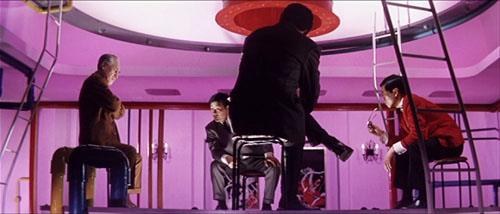
For my part, I’d just mention that a great deal of what seems striking in Slumdog has already been broached in Indian cinema. Take the matter of police brutality. The torture scene at the start might seem a piece of exhibitionism, with an outsider (Boyle? Beaufoy?) twisting local culture to western ideas of uncivilized behavior. But look again at the gangster films I’ve mentioned: they contain brutal scenes of police torture, like this from Company.

Like Hong Kong cinema and American cinema, Indian filmmaking seems to take a jaundiced view of how faithful peace officers are to due process.
More basically, consider the representation of the Mumbai slums. Doubtless the title slants the case from the first; Beaufoy claims to have invented the word “slumdog,” though Ram is called a dog at one point in the novel. The insult, and the portrayal of Mumbai, has made some critics find the film sensationalistic and patronizing. Most frequently quoted is megastar Amitabh Bachchan’s blog entry.
If SM projects India as [a] Third World dirty underbelly developing nation and causes pain and disgust among nationalists and patriots, let it be known that a murky underbelly exists and thrives even in the most developed nations.
Soon Bachchan explained that he was neutrally summarizing the comments of correspondents, not expressing his own view. In the original, he seems to have been suggesting that the poverty shown in Slumdog is not unique to India, and that a film portraying poverty in another country might not be given so much recognition.
It’s an interesting point, although many films from other nations portray urban poverty. More generally, Indian criticisms of the image of poverty in Slumdog remind me of reactions to Italian Neorealism from authorities concerned about Italy’s image abroad. The government undersecretary Giulio Andreotti claimed that films by Rossellini, De Sica, and others were “washing Italy’s dirty linen in public.” Andreotti wrote that De Sica’s Umberto D had rendered “wretched service to his fatherland, which is also the fatherland of . . . progressive social legislation.” Liberal American films of the Cold War period were sometimes castigated by members of Congress for playing into the hands of Soviet propagandists. It seems that there will always be people who consider films portraying social injustice to be too negative and failing to see the bright side of things, a side that can always be found if you look hard enough.
Moreover, Neorealists made a discovery that has resonated throughout festival cinema: feature kids. Along with sex, a child-centered plot is a central convention of non-Hollywood filmmaking, from Shoeshine and Germany Year Zero through Los Olvidados and The 400 Blows up to Salaam Bombay, numerous Iranian films, and Ramchandi Pakistani. Yes, Slumdog simplifies social problems by portraying the underclass through children’s misadventures, but this narrative device is a well-tried way to secure audience understanding. We have all been children.
There is another way to consider the poverty problem. The representation of slum life, either sentimentally or scathingly, can be found in classic Indian films of the 1950s. One of my favorites of Raj Kapoor’s work, Boot Polish (1954), tells a Dickensian tale of a brother and sister living in the slums before being rescued by a rich couple. (Interestingly, the key issue is whether to beg or do humble work.) Another example is Bimal Roy’s Do Bigha Zamin (Two Acres of Land, 1953). Later, shantytown life was more harshly presented in Chakra (1981), shot on location.
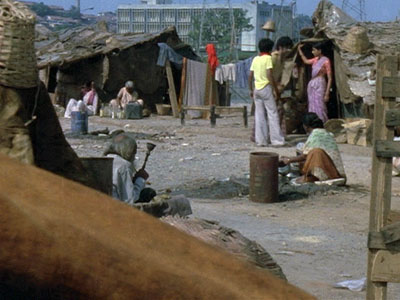
And of course poverty in the countryside has not been overlooked by Indian filmmakers.
Slumdog may have become a flashpoint because more recent Indian cinema has avoided this subject. In an email to me Patrick Hogan (who hasn’t yet seem Slumdog) writes:
There was a strong progressive political orientation in Hindi cinema in the 1940s and 1950s. This declined in the 1960s until it appeared again with some works of parallel cinema. Thus there was a greater concern with the poor in the 1950s–hence the movies by Kapoor and Roy that you mention. There are some powerful works of parallel cinema that treat slum life, but they had relatively limited circulation. On the other hand, that does not mean that urban poverty disappeared entirely from mainstream cinema. At least some sense of social concern seemed to be retained in mainstream Indian culture, thus mainstream cinema, until the late 1980s.
 However, at that time Nehruvian socialism was more or less entirely abandoned and replaced with neo-liberalism. In keeping with this, ideologies changed. Perhaps because the consumers of movies became the new middle classes in India and the Diaspora, there was a striking shift in what classes appeared in Hindi cinema and how classes were depicted. As many people have noted, films of the neoliberal period present images of fabulously wealthy Indians and generally focus on Indians whose standard of living is probably in the top few percentage points. . . . I don’t believe this is simply a celebration of wealth and pandering to the self-image of the nouveau riche–though it is that. I believe it is also a celebration of neoliberal policies. Neoliberal policies have been very good for some people. But they have been very bad for others. . . .
In this neoliberal cinema (sometimes misleadingly referred to as “globalized”), even relatively poor Indians are commonly represented as pretty comfortable. The difference in attitude is neatly represented by two films by Mani Ratnam—Nayakan (1987) and Guru (2007). The former is a representation of the difficulties of the poor in Indian society. The film already suffers from a loss of the socialist perspective of the 1950s films. Basically, it celebrates an “up from nothing” gangster for Robin Hood-like behavior. (This is an oversimplification, but gives you the idea.)
Guru, by contrast, celebrates a corrupt industrialist who liberates all of India by, in effect, following neoliberal policies against the laws of the government. Neither film offers a particularly admirable social vision. But the former shows the urban poor struggling against debilitating conditions. The latter simply shows a sea of happy capitalists and indicates that lingering socialistic views are preventing India from becoming the wealthiest nation in the world. Part of the propaganda for neoliberalism is pretending that poor people don’t exist any longer–or, if they do, they are just a few who haven’t yet received the benefits.
Paradoxically, then, perhaps local complaints against Slumdog arise because the film took up a subject that hasn’t recently appeared on screens very prominently. The same point seems to be made by Indian commentators and by Indian filmmakers who deplore the fact that none of their number had the courage to make such a movie. The subject demands more probing, but perhaps the outsider Boyle has helped revive interest in an important strain of the native tradition!

Finally, the issue of glamorizing the exotic. Some critics call the film “poverty porn,” but I don’t understand the label. It implies that pornography of any sort is vulgar and distressing, but which of these critics would say that it is? Most such critics consider themselves worldly enough not to bat an eye at naughty pictures. Some even like Russ Meyer.
So is the issue that the film, like pornography, prettifies and thereby falsifies its subject? Several Indian films, like Boot Polish, have portrayed poverty in a sunnier light than Slumdog, yet I’ve not heard the term applied to them. Perhaps, then, the argument is that pornography exploits eroticism for money, and Slumdog exploits Indian culture. Of course every commercial film could be said to exploit some subject for profit, which would make Hollywood a vast porn shop. (Some people think it is, but not typically the critics who apply the porn term to Slumdog.) In any case, once any commercial cinema falls under the rubric of porn, then the concept loses all specificity, if it had any to begin with.
The Slumdog project is an effort at crossover, and like all crossovers it can be criticized from either side. And it invites accusations of imperialism. A British director and writer use British and American money to make a film about Mumbai life. The film evokes popular Indian cinema in circumscribed ways. It gets a degree of worldwide theatrical circulation that few mainstream Indian films find. This last circumstance is unfair, I agree; I’ve long lamented that significant work from other nations is often ignored in mainstream US culture (and it’s one reason I do the sort of research I do). But I also believe that creators from one culture can do good work in portraying another one. No one protests that that Milos Forman and Roman Polanski, from Communist societies, made One Flew Over the Cuckoo’s Nest and Chinatown. No one sees anything intrinsically objectionable in the Pang brothers or Kitano Takeshi coming to America to make films. Most of us would have been happy had Kurosawa had a chance to make Runaway Train here. Conversely, Clint Eastwood receives praise for Letters from Iwo Jima.
Just as there is no single and correct “Indian” or “American” or “French” point of view on anything, we shouldn’t deny the possibility that outsiders can present a useful perspective on a culture. This doesn’t make Slumdog automatically a good film. It simply suggests that we shouldn’t dismiss it based on easy labels or the passports of its creators.
Moreover, it isn’t as if Boyle and Tandan have somehow contaminated a pristine tradition. Indian popular films have long been hybrids, borrowing from European and American cinema on many levels. Their mixture of local and international elements has helped the films travel overseas and become objects of adoration to many westerners.
I believe we should examine films for their political presuppositions. But those presuppositions require reflection, not quick labels. If I were to sketch an ideological interpretation of Slumdog, I’d return to the issue of how money is represented in an economy that traffics in maimed children, virgins, and robotic employees. Money is filthy, associated with blood, death, and commercial corruption. The beggar barracks, the brothel, the call center, and the quiz show lie along a continuum. So to stay pure and childlike one must act without concern for cash. The slumdog millionaire doesn’t want the treasure, only the princess, and we never see him collect his ten million rupees. (An American movie loves to see the loser write a check.) To invoke Neorealism again, we seem to have something like Miracle in Milan–realism of local color alongside a plot that is frankly magical.
Perhaps this quality supports the creators’ claims that the film is a fairy tale. As with all fairy tales, and nearly all movies I know, dig deep enough and you’ll find an ideological evasion. Still, that evasion can be more or less artful and engrossing.
So it seems to me enlightening and pleasurable to see every film as suspended in a web, with fibers connecting it to different traditions, many levels and patches of film history. Acknowledging this shows that most traditions aren’t easily exhausted, and that fresh filmmaking tactics can make them live again. Thinking historically need not numb us to surprises.
The amount of Web writing on Slumdog is exploding. Go to GreenCine for a good sampling of commentary from late 2008. The film’s technique is discussed in Stephanie Argy, “Rags to Riches,” American Cinematographer 89, 12 (December 2008), 44-61. Boyle shows his camera to Darren Aronofsky at Slantfilm. Kim Voynar of Movie City News reviews, critically, the Slumdog backlash.
For a more detailed rationale for this entry’s suspension of value judgments for the sake of analysis, try my earlier blog entry here. Noël Carroll discusses question-and-answer structures in narrative in several books, notably The Philosophy of Horror; or, Paradoxes of the Heart (New York: Routledge, 1990), 130-136. On recent Indian action movies, see Lalitha Gopalan, Cinema of Interruptions: Action Genres in Contemporary Indian Cinema (London: British Film Institute, 2002). The quotations from Giulio Andreotti come from P. Adams Sitney, Vital Crises in Italian Cinema: Iconography, Stylistics, Politics (Austin: University of Texas Press, 1995), 107; and Millicent Marcus, Italian Film in the Light of Neorealism (Princeton: Princeton University Press, 1986), 26.
Thanks to Cathy Root, who is at work on a book on Bollywood, for advice and links. Thanks as well to Patrick Colm Hogan and Lalita Pandit for corrections, information, and ideas.

PS 2 Feb: David Chute, expert on Indian cinema, has written a helpful and balanced entry on Slumdog at his Hungry Ghost site.
PPS 14 Feb: From another expert on Indian film, Corey Creekmur, at the University of Iowa, some further ideas and references on the childhood motif:
I would emphasize that establishing a film’s narrative direction through childhood events is a dominant narrative trope in popular Indian cinema, animating many famous “golden age” examples, including Raj Kapoor’s Awara (1951), Mehboob Khan’s Anmol Ghadi (1946), and Bimal Roy’s Devdas (1955), along with a number of the major 1970s films starring Amitabh Bachchan, which often carry childhood traumas into the adult character’s life. The story of brothers growing up on two sides of the law is also a Hindi film staple, central to Bachchan’s emergence as a superstar in Deewar in 1975. It seems to me curious that Slumdog Millionaire’s Western filmmakers draw on these conventions more fully than the source novel [Q & A] by a non-resident Indian does.
I attempt to explain the decades-long cultural function (and eventual waning) of this narrative trope — often achieved through a specific formal device (a dissolve from boy to man) moving from the lives of children to adults (skipping over adolescence) that I call the “maturation dissolve” — in an article “Bombay Boys: Dissolving the Male Child in Popular Hindi Cinema,” in Where the Boys Are: Cinemas of Boyhood, ed. Murray Pomerance and Frances Gateward. (Detroit: Wayne State UP, 2004). In that essay I suggest that some of the Hollywood examples — as well as Citizen Kane — you mention could have inspired the Indian examples, but also suggest certain Indian sources (the childhood love of the god Krishna and his consort Radha, which informs all versions of Devdas) as well. Since I’m citing myself, I’ll also note a recent essay on the “Devdas” phenomenon in Indian cinema: “Remembering, Repeating, and Working Through Devdas,” which appears in Indian Literature and Popular Cinema: Recasting Classics, ed. Heidi R. M. Pauwels (Routledge, 2008). By the way, you might also enjoy a website devoted to popular Hindi cinema by my colleague Philip Lutgendorf (with whom I regularly teach Indian cinema classes). Most of the entries on his site are his, but as you will note, sometimes he lets me put my two cents in there as well: http://www.uiowa.edu/~incinema/
PPPS 21 February: Several scholars comment on the film’s representation of the Dahravi neighborhood and the multilayered significance of Indian protests against Slumdog. See today’s New York Times here and here.