Thursday | March 26, 2009
Kristin here-
In September of 2007 I posted the first “Beyond praise” entry, the idea being that I would recommends DVD supplements that didn’t just contain a lot of participants in the filmmaking process gushing about how wonderful their colleagues were. Such supplements would reveal something about the filmmaking process, and perhaps something about the publicizing and exhibition as well.
I intended to make this a regular feature of the blog, so it’s high time to post a follow-up entry. These comments don’t necessarily deal with very recent releases. Some are a few years old by now. Still, I’ve just caught up with them, and they haven’t lost their interest for film buffs, teachers, and students.
Collateral (“Two-disc Special Edition,” DreamWorks Video)
The making-of, “City of Night: The Making of Collateral,” is short by current standards, at about 39 minutes. It’s dense with information, though. Indeed, David and I were inspired by it, along with the account of the film’s making in American Cinematographer, to add a case study on the film’s production to Film Art. The 9th edition, coming in December, will start with this case study and how the aesthetic decisions made by the filmmakers affected the final film. (One of the book’s users suggested this idea, and we think the result improves the opening chapter.)
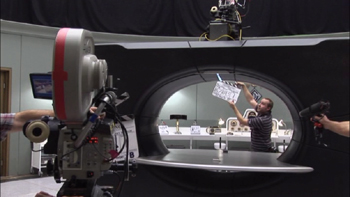
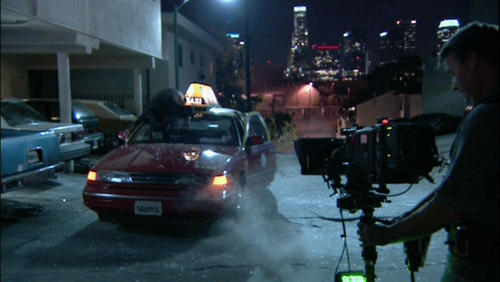
Michael Mann wanted to capture the unique glow of Los Angeles at night, caused by the bright lights of its flat grid being reflected by the atmosphere over the city. To do so, he employed digital cameras for most scenes. The documentary shows how the cameras allowed filming almost entirely with ambient light. (See illustration below.) Fill light was added subtly by innovative flexible panels Velcro-ed onto the interior of the cab that forms a major setting for the action. One suspenseful scene near the end was filmed in a darkened office, with the actors becoming completely black silhouettes against the lights of the city outside the windows. For those who may not be familiar with professional-level digital filming, this making-of offers a succinct introduction. Collateral remains one of the best films shot primarily with digital cameras, and it makes a good case for the new technology for those who may doubt that it can ever be as effective as 35mm film.
“City of Night” also has the best demonstration I’ve seen of the use of multiple cameras to shoot a big action scene, detailing how the spectacular taxi crash was planned and executed. (But see also the 3:10 to Yuma description below.) There’s an interesting segment on the music, where composer James Newton Howard talks about composing the music for the extended climactic chase in “three movements.”
There’re also some rehearsal footage and other minor supplements, but the main documentary is far and away the most informative. It could be quite useful for teaching cinematography.
Hellboy (“2-Disc Special Edition,” Columbia Tristar Home Entertainment) and Hellboy II: The Golden Army (“3-Disc Special Edition,” Universal Studios Home Entertainment)
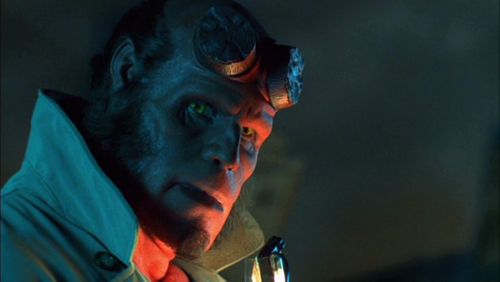
Guillermo del Toro being the geeky fanboy that he is, the supplements for the two Hellboy films are lengthy and full of solid information. The first film was made on a smaller budget, as was its main making-of, “Hellboy: The Seeds of Creation.” Essentially it alternates candid footage captured on working sets, which is really more decorative than informative, with interviews and segments on specific topics. There’s a little of everything one would expect for an effects-heavy film: bits on maquettes, set models, testing of stunts, animatronic figures, and so on. Cinematographer Guillermo Navarro talks briefly about lighting tests for Hellboy, accompanied by such beautiful images as the one above, imitating the vivid, high-contrast look of the original comic.
The making-of contains nice little segments that superimpose a digital double on raw footage (at about 29:30 minutes), a good illustration of building a CG figure by adding musculature to a wire-frame base (70 min.), and a more detailed treatment of ADR than most supplements offer.
The making-of for the sequel, “Hellboy: In Service of the Demon,” is more extensive and was evidently planned 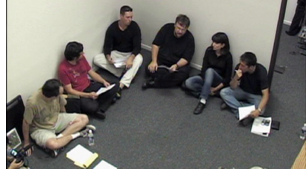 more thoroughly. One early scene has del Toro seated on the floor having a decidedly informal meeting with his design staff. It’s clearly a real, working meeting, not one staged for the camera. The director has some intelligent things to say about the monsters he wants from his team (“No aliens!”), and his voice continues over shots of the designs that the people sitting with him came up with. There’s a great deal of material on the design and construction of the famously large number of demons, 32 in all, as well as on-set demonstrations of how the elaborate costumes are worked by the actors inside them and by remote control. more thoroughly. One early scene has del Toro seated on the floor having a decidedly informal meeting with his design staff. It’s clearly a real, working meeting, not one staged for the camera. The director has some intelligent things to say about the monsters he wants from his team (“No aliens!”), and his voice continues over shots of the designs that the people sitting with him came up with. There’s a great deal of material on the design and construction of the famously large number of demons, 32 in all, as well as on-set demonstrations of how the elaborate costumes are worked by the actors inside them and by remote control.
Highlights: a good explanation of how points of control are added to CGI creatures and function to create the final image; another on how motion-control is used for special effects; a view of a video-assist playback. Particularly impressive is the lengthy scene in which we watch the make-up for the Angel of Death being designed and applied while actor Doug Jones talks intelligently about the make-up and the character.
The supplement is long, about two and a half hours, but I think I’d choose it, or at least big portions of it, if I wanted to teach about special effects to an introductory class. Like Peter Jackson, GDT is a big advocate of using practical effects whenever possible and resorting to CGI only when they aren’t possible. As a result, this making-of demonstrates an unusually wide range of kinds of effects. It’s also entertaining, clear, and has interviews with most of the principals involved in each kind of task.
3:10 to Yuma (Lionsgate)
The supplements for James Mangold’s Western (the sound mixing of which David blogged about here) are less lavish but still of interest. There’s a section on how the four major sets were constructed on location rather than in sound stages. One detailed segment shows a camera rig for moving with a stagecoach and the practical special effects used for the scene in which the coach is 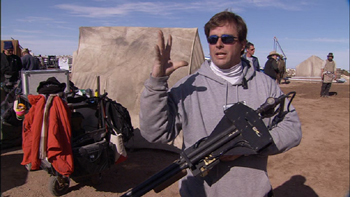 flipped over. I learned, for example, that “crash cam” is the name for the metal cylinder used for the camera most likely to get hit by the flipping vehicle-a device also on view in the Collateral supplements. The crash scene is particularly well done, showing the shooting with multiple cameras and then immediately the crash as edited. flipped over. I learned, for example, that “crash cam” is the name for the metal cylinder used for the camera most likely to get hit by the flipping vehicle-a device also on view in the Collateral supplements. The crash scene is particularly well done, showing the shooting with multiple cameras and then immediately the crash as edited.
There are bits of out-of-the-way but fascinating information here. For example, there are companies that rent old trains for film production. There are also guns that shoot dust capsules (left) into the set to simulate bullet impacts and other bits of flying debris. Apart from the main documentary, there’s a six-minute segment, “An Epic Explored,” where Mangold talks about making a Western in a period when the genre is out of fashion, and a brief history of “Outlaws, Gangs and Posses” that could be useful for background information on Westerns in general.
The Golden Compass (“New Line 2-Disc Platinum Series,” New Line Home Entertainment)
I was interested in The Golden Compass from its inception, since it was New Line’s intended replacement for The Lord of the Rings as the studio’s prestige franchise. That didn’t work, of course. (I wrote about how New Line copied its Rings strategies in promoting The Golden Compass here and about why the film succeeded abroad but not in the U.S. here.)
As an admirer of Philip Pullman’s His Dark Materials trilogy, I was also curious about how well the lengthy, complicated first novel could be adapted for the screen. My impression upon seeing the film was that the first half raced along, presenting essentially a brief summary of each scene and trying to cram in exposition about the huge number of characters and plot points retained from the novel. The second half calmed down and was more successful in its rendering of events.
The Golden Compass was a failure from New Line’s point of view-and that of parent company Time Warner, which used that failure as an excuse to fold the semi-independent studio into Warner Bros. It made about $372 million internationally, but the overseas take was $302 million of that total. That money stayed with the foreign distributors, who had helped finance the film through pre-sales of rights. That and its reported $180 million budget meant that New Line lost a bundle.
The DVD supplements reflect nothing of these problems. They’re distinctly better than the lackluster titles of the individual segments suggest. There’s a nice section on the novel, with Pullman saying some interesting things. “The Adaptation” mostly depends on interviews with director Chris Weitz and producer Mark Ordesky. Throughout the supplements, Weitz, who was relatively inexperienced when he took on the epic production, is not only modest but downright self-deprecating-sort of the opposite of too much praise. (“The fact of the matter is that there have been hundreds of people working on this just as hard as I have, and this is not the kind of film that really fits in with a kind of an auteur theory of filmmaking.”) Perhaps the director will feel more confident on his next project, the sequel to Twilight.
The makers of the supplements chose an effective tactic of choosing one major item in each category to concentrate on, rather than trying to cover every aspect of casting, design, and so on.
“Finding Lyra Belaqua” seemed to promise the usual uninformative gushing about how wonderful Dakota Blue Richards was in the lead role. In fact it’s quite an interesting account of how open casting calls work. The casting team have calls in multiple towns, where enthusiastic little girls in the queues explain their fascination with the project. The casting of Richards must have become pretty likely at some point, since the documentarists followed the young actress and her mother through a string of call-backs and the tense process of whittling the short-list down.
The “Daemons” section spends minimal time on explaining the concepts and instead concentrates on the design, the creation of maquettes for CGI work, and the necessary but rather silly use of stuffed animals on the set to stand in for the daemons. The section on how Freddie Highmore had to dub in Pantalaimon’s dialogue in ADR while watching unrendered computer images of his character is particularly interesting.
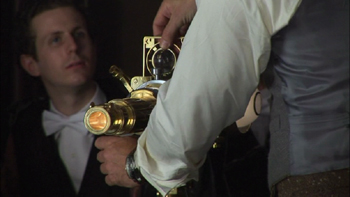
Again, a fairly lengthy session devoted to the design and making of “The Alethiometer” (15 minutes on a single prop) is not simply devoted to explaining what it is. Instead, it gives a real sense of the elaborate process of seeking real-world models, finding experts create for each type of part needed, and making the prototype. The section on production design focuses on the use of conflicting shapes as motifs throughout the film: circles for Oxford, Lyra, and the Alethiometer, ovals for Mrs. Coulter and the Magisterium. These show up in vehicles, sets, and props:
Other segments are similarly clever and informative: on how costumes affected the way the actors had to walk; on the steps used to create the entirely CGI-based armored-bear battle; on the music’s use of exotic instruments to characterize the various imaginary ethnic groups. There’s even a segment on the Cannes press-junket launch, with a brief interview with a junket producer-something I certainly haven’t seen in a supplement before.
I had hoped to be able to recommend the supplements for Across the Universe. Julie Taymor’s musical is so imaginative and appealing that one would expect some clever and original making-ofs as well. Unfortunately most of the five brief documentaries fall into the mutual-praise trap (“Everyone wants to work with her!”). “Stars of Tomorrow” is 27 minutes of guff about how the young actors were cast and how wonderfully they fit their roles. “Moving across the Universe,” on the choreography, is pretty good-but only 9 minutes long. The best things in the supplements are the clips from the film. Watch it, skip the extras.
Posted in Film comments, Film technique |  open printable version
| No Comments » open printable version
| No Comments »
Sunday | March 22, 2009
DB here:
A film academic once complained that I was too preoccupied with “formalistic niceties.” So here I go again. But read no further if you haven’t seen Christopher Nolan’s The Prestige.
Dueling magicians: The film’s premise might be considered high-concept. In turn-of-the-century London, two young conjurers launch their careers with different attitudes toward their craft. Robert Angier favors audacious showmanship, while Alfred Borden is committed to finding a trick that will baffle the experts. Their rivalry is ignited when Alfred accidentally kills Angier’s wife during a dangerous underwater stunt. Their struggle peaks around each one’s supreme trick: transporting himself from one point to another instantaneously.
The item that attracts my attention today is established in the film’s opening sequence. As the voice of Cutter (Michael Caine) explains a magic trick’s three acts, we see a climactic confrontation between the competitors. Hoping to discover Robert’s secret, Alfred watches the Real Transported Man performance from the audience.
As Cutter’s narration mentions “a man,” the camera picks out Alfred in the crowd. Cut to Robert onstage, a shift that establishes the two as our protagonists.
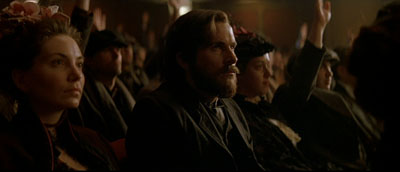
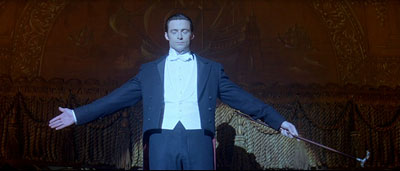
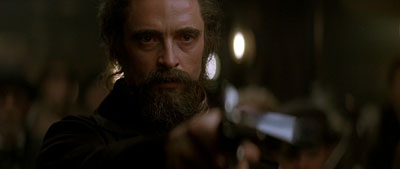
What interests me is the view of the bearded Alfred: a medium-shot framing him nearly in profile facing right. This framing will be repeated, but varied, when Alfred’s voice-over diary entry introduces both him and Robert as apprentices, working as audience shills for another magician:
We were two young men at the start of a great career—two young men devoted to an illusion, who never intended to hurt anyone.
The new shot parallels the introduction of Alfred in the first scene, but varies it. Again we see Alfred in the audience, but now without a beard, and the camera tracks rightward to show Robert in another row.
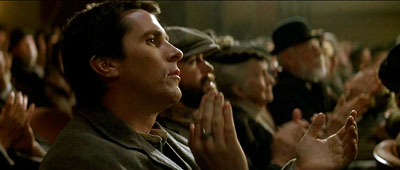
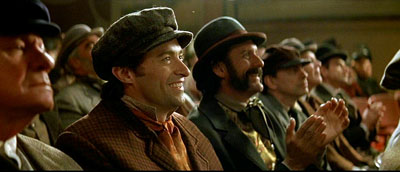
In this sequence, our protagonists are connected by a camera movement rather than the cut employed in the opening. The two men’s reactions—Robert grinning (his wife is onstage), Alfred more pensive—add to the characterizations that we will see played out.
This simple camera motif gets varied further in the course of the film. The disastrous immersion illusion that drowns Robert’s wife is initiated by another tracking shot of the two men in the audience, a variation of the earlier shot.
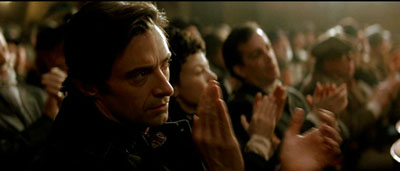
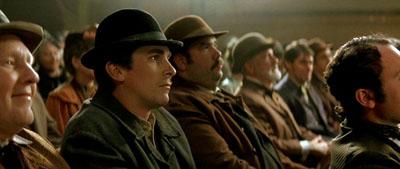
The new combination starts with Robert and ends on Alfred. At this point, not only are the two men linked but they replace one another. If you want to push your luck, you could say that this variant quietly affirms the film’s overall dynamic of substitution (doubles, twins, clones).
Earlier, a contrasting way of showing the men in an audience is given us when they attend a performance of the wizard Chung Ling Soo. Cutter provides a dialogue hook, warning Robert that “the blokes at the ends of row three and four” can see him kissing his wife’s leg.
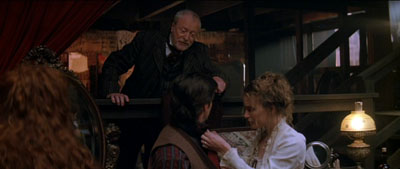
Cut to our protagonists, sitting at the end of a row watching the Chinese magician.
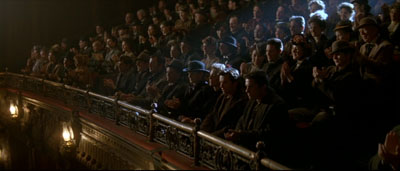
A nicety: Now the men are sitting side by side and facing left rather than right. Just through camera placement and character position, we know we’re in a different performance, one in which our apprentices play no role.
As they study the trick, Nolan gives us another characterizing shot: Robert is amazed, but Alfred grins: He’s worked out Chung’s secret.
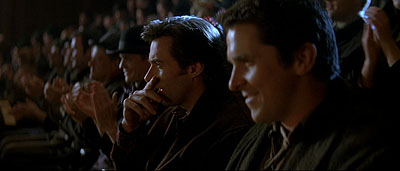
What would have happened if Nolan had framed the men sitting apart and/or facing to the right? For an instant we might have thought we were back in the act they shill for. Simple but reiterated differences assure immediate comprehension: medium shot/ long shot, looking rightward/ looking leftward, men in different rows/ men in the same row. Just as the repeated framings of their own act clarify the situation, so do these little polarities. Call it redundancy, if you like, but it’s also precision and economy.
With Julia’s death, the men become enemies. But each will still slip into the audience of the other’s performances. From now on, the magician is always on the right, the onlooker on the left. Nolan and company could have handled their rivalry in camera setups that exactly mimic the early ones. Instead, a new pattern of parallels comes into play, building on the earlier ones but different enough to heighten the symmetries.
The new pattern is set up by restricting our range of knowledge. First, we are attached to Alfred when he performs his bullet catch in a barroom theatre. Robert, seeking vengeance for Julia’s drowning, steps up to spoil the trick, but we don’t know he’s there until Alfred does, and then it’s too late.
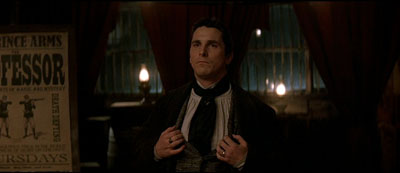
Similarly, we’re restricted to Robert’s range of knowledge when he tries to execute his disappearing dove trick. Only when Alfred is about to trigger the collapsing cage—killing the dove and wounding a lady from the audience—does Robert realize that his adversary has struck back.
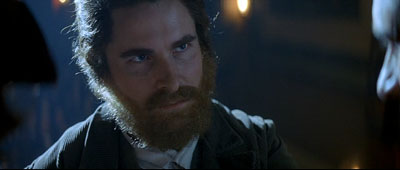
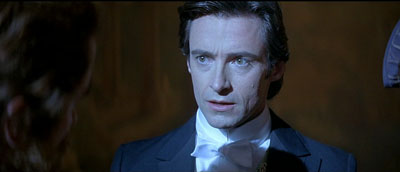
Another nicety: The two shots of each man in similar disguises, seen in 3/4 view, reset the stylistic parameters. But the image of the bearded Alfred is given extra punch through a tilt up from his missing fingers–the result of the parallel, bullet-catch scene before.
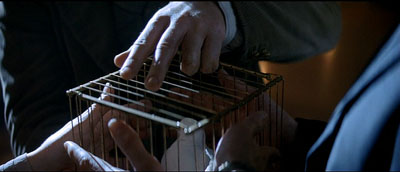
The whole pattern shifts yet again when Robert sneaks in to watch Alfred’s Transported Man illusion. We get a shot of him (in a beard again) that fuses two of the cues from the earlier scenes: He’s in the audience, as in the early sequences, but he’s shown from an angle congruent with that of the earlier beard shots.
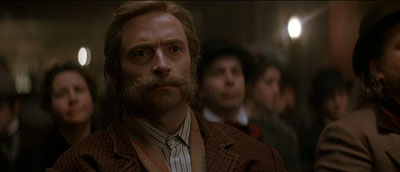
And perhaps we can take the shot of Robert at home, telling of his amazement at Alfred’s illusion, as an echo of the initial prototype: A magician staring intently rightward at a dazzling trick played out offscreen, but now in memory.
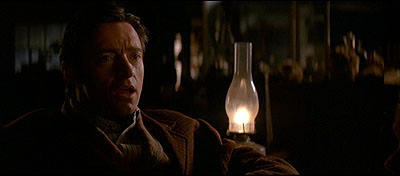
Robert returns from Colorado with the Tesla-designed “Real Transported Man,” and Alfred’s visit to watch the stunt reworks the givens of this pattern yet again. Alfred is seated, minimally disguised, in the standard audience spot looking right, but he is not in profile and the camera position is much closer than before. The answering shot of Robert onstage recalls the gesture we saw at the film’s outset and anticipates what we will see when that opening scene is replayed, with the wicked Alfred climbing onstage.
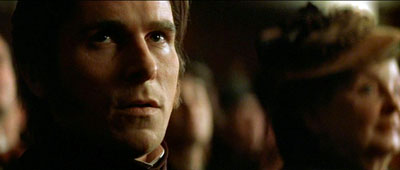
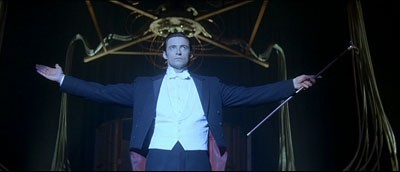
At the close of the trick, yet one more variant: Robert appears in the rear balcony and the crowd all turns to watch him off left.
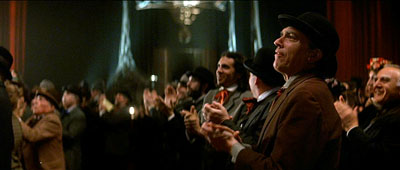
After a glance back, Alfred turns away, looking right–the first time any character has flinched from the performance. His puzzlement is mixed with anger (at last a trick he can’t see through), a less charitable response than we saw in Robert’s stunned fireside recollection of Alfred’s Transported Man.
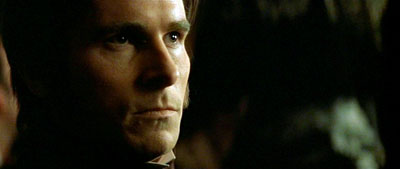
The things held constant, such as camera placement and position in the locale, set off the differences in characters’ disguises and reactions, while this shot carries faint echoes of our very first view of Alfred during Cutter’s voice-over monologue. That view, and its answering shot of Robert in the spotlight, will recur when Robert’s pseudo-death is replayed.
Nolan’s audacious film is built out of more marked parallels than these, but I wanted merely to highlight the ups and downs of one small pattern. Many films work varied repetitions like these into their shot-by-shot texture. Back in the 1930s, Eisenstein saw this possibility clearly, as I try to show in my book on his work. In the 1960s and 1970s, Raymond Bellour called our attention to such patterns in films by Hitchcock, Hawks, and Minnelli. His collection of essays The Analysis of Film includes pioneering studies of how fine-grained such things can become.
I wouldn’t go as far as Bellour does in seeing varied repetition as the motor force of classical filmmaking, but it surely plays an important role. What he takes as a manifestation of pure textual difference I’m inclined to psychologize: these differences help the audience understand, usually without awareness, the ongoing narrative dynamic and have the extra payoff of creating tacit narrative parallels. But from either perspective, object-centered or response-centered, studying such microforms is enlightening. It’s a way to understand films as wholes, dynamic constructions that shift their shapes across the time of their unfolding. Moreover, by examining things this closely, we can try to understand not only how this or that film works, but how this or that film relies on principles distinctive of a filmmaking tradition. Consider this another plug for poetics.
I’d add that such principles neatly fuse two pressures: toward narrative coherence and comprehension on the one hand, and toward production efficiency on the other. It’s cheaper and easier to repeat camera setups if you can. Artistic economy and financial economy can work together, nicely.
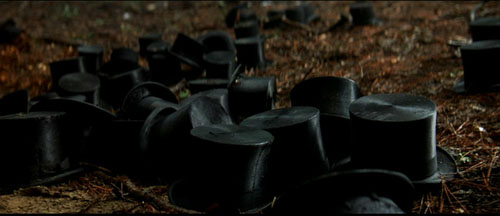
Speaking of repetitions….
Posted in Directors: Nolan, Film comments, Film history, Film technique, Film technique: Editing, Film technique: Performance, Film technique: Staging, Hollywood: Artistic traditions, Narrative strategies, Readers' Favorite Entries | open printable version
| No Comments »
Wednesday | March 18, 2009

DB here:
Last week family affairs took me back to my home area, the Finger Lakes region of New York State. About ten miles from our farm lies the village of Penn Yan (short for Pennsylvania Yankees). When I was growing up there in the 1950s and 1960s, Penn Yan boasted about 3500 people—enough to support one movie theatre. That theatre, the Elmwood on Elm Street, was where I saw most of the movies I didn’t see on TV.
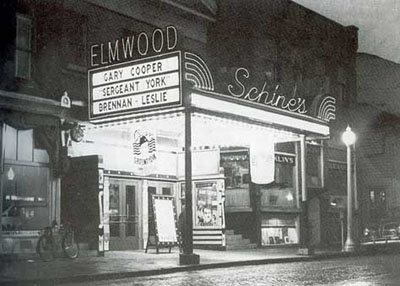
The Elmwood was my introduction to film. When my parents went to town, I was embedded with hundreds of other kids in Saturday afternoon matinees of Tarzan and Lone Ranger movies. On Friday nights, I might catch June Allyson, Donald O’Connor, or Martin and Lewis. When I got older I saw Lawrence of Arabia and From Russia with Love. The Elmwood showed a fair number of art films in the 1960s, including The Servant, The L-Shaped Room, and even 8 ½ (dubbed, I think).
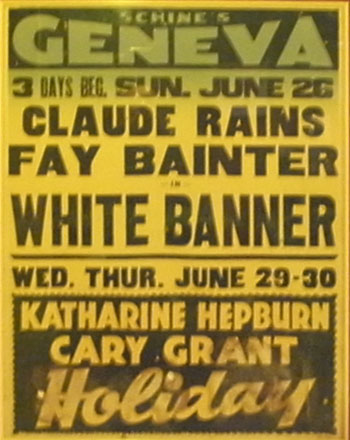
Built in the early 1920s, the Elmwood was acquired by the Schine brothers in 1936. Some towns in our area had two or three Schine theatres. Schine Amusements penetrated Auburn, Bath, Canandaigua, Corning, Cortland, Glens Falls, Gloversville (where it all started), Hamilton, Herkimer, Lockport, Massena, Oneonta, Oswego, Perry, Rochester, Salamanca, Seneca Falls, Syracuse (four houses), Tupper, and Watertown. Clearly, they were leaving the major cities to the big boys. The firm also owned venues in Kentucky and Ohio (none in Cleveland or Cincinnati, but three in Bucyrus). By snapping up screens in the sticks, Meyer and Louie Schine wound up holding nearly a hundred screens in their prime.
Although the brothers went for the smaller markets, they didn’t forget the amenities. They contracted some of the top theatre architects, notably John Eberson, a fantasist with eclectic tastes. The Elmwood didn’t benefit much from the Schines’ largesse as far as I can tell, but it was a sturdy place, with 838 seats, or one for every four people in town.
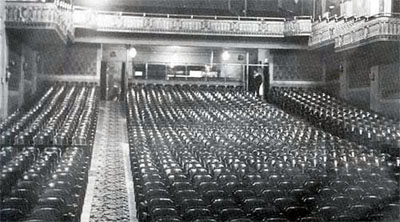
The Elmwood passed out of the Schines’ hands and eventually closed in the early 1970s. For awhile it was an indoor tennis court. The village offices now sit on the site. (Photo: Darlene Bordwell.)

But Penn Yan still has three screens, which I discovered when my sister Diane Verma and I went to Ken Kwapis’ He’s Just Not That Into You. It’s a network narrative like Kwapis’ earlier Sexual Life, and like that (and his Sisterhood of the Traveling Pants) it has some affecting and clever moments. There’s also a nice handling of shot/ reverse-shot when characters are turned away from each other. Mainly, though, I went to see the town’s multiplex, the Lake Street Plaza Theatres.
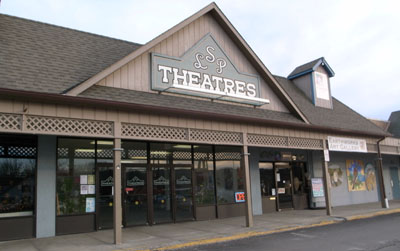
Converted from an exercise club, the LSP houses three screens in a bare-bones design typical of many multiplexes.
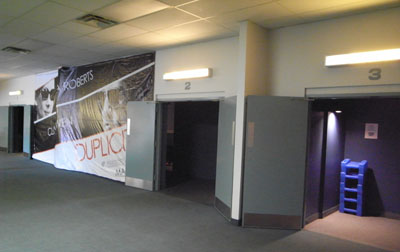
A young man, whose father owned the complex, sold the tickets and ran the projectors. A young woman handled the concession stand. Both were friendly and talkative. Diane and I, two of four people in the house, left happy, although the sugar in the Dots may have helped raise our mood.
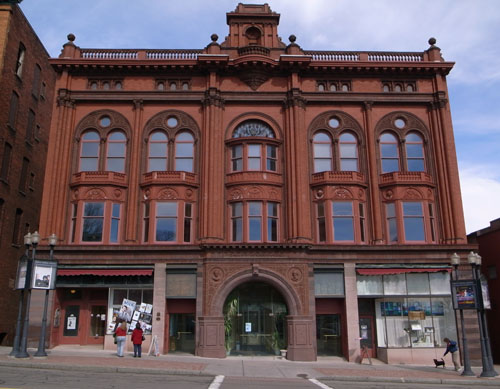
Earlier that day, Diane, my other sister Darlene, and I were driving around our childhood haunts. The towns here are hollowed out by the big-box stores and the recession. Mall parking lots are full, but the main streets are desolate and many storefronts are empty.
Yet in another lake town we came across a surprise. At first I was puzzled. How could the Geneva Theatre have been replaced by a much older and more dignified building, the Smith Opera House?
The door was ajar.
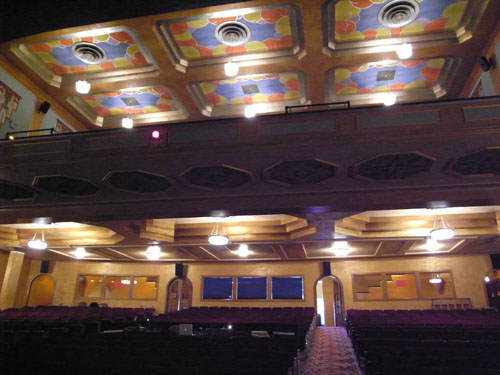
Inside Bruce Purdy, the Technical Director and professional magician, and Sharon Barnes were preparing for a children’s play. They kindly led us on an exploration of this half-hidden jewel. It may have assumed its old name, but the building has regained the delirious splendor that was the Geneva in its heyday.
The Smith Opera House was built in 1894. To its stage came Sousa, Bill Bojangles Robinson, Ellen Terry, and traveling shows mounted by Belasco. The vaudeville programs started including short films during the 1910s, and the Smith was one of thirteen venues in which Edison screened his experiments in talking pictures. The Birth of a Nation played there. Soon the theatre became a movie house, called initially the Strand. It wasn’t the only film theatre in town, and by the late 1920s it had competition. The nearby Regent had already become a picture palace, with about 1000 seats; it screened its first sound picture, John Ford’s Four Sons, in 1928 (presumably in a music-plus-effects version).
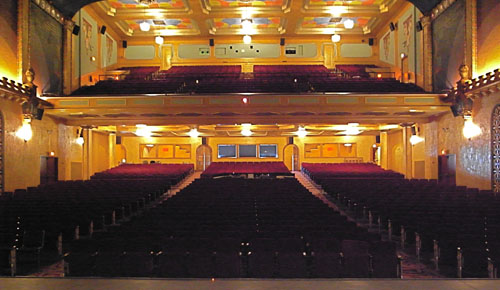
Enter, on cue, the Schines. They bought the Smith, and after playing burlesque there for some months, they decided to revamp it as a picture palace. The process took several years. The interior was stripped; opera seats were sold for a dollar each. What emerged was an “atmospheric,” with the dome displaying shifting clouds that would slowly clear to reveal twinkling stars. The architecture was a fanciful mix of Art Deco, Baroque, Art Nouveau, and Moorish influence. The premise was that you were in a courtyard under the heavens, surrounded by facades of buildings that were implausible but vaguely familiar in their exoticism.
With over 1800 seats, the Geneva Movie Theatre was advertised as the largest movie house in central New York. The first film to play there was Keaton’s Parlor, Bedroom, and Bath in March 1931. The manager, Mr. Gerald Fowler, stayed in charge until 1965.
I didn’t go to the Geneva as often as the Elmwood. Not until I got my Learner’s Permit (a life-changing event to country youth) was I able to drive to Geneva on my own. At the Geneva I saw Mary Poppins, What’s New, Pussycat?, and the CinemaScope version of How the West Was Won. I have no memories of the décor, but by all accounts it was decaying.
Like the Elmwood, the Geneva was closed in the 1970s. Today it looks spanking new. It hosts musical acts (Ani DeFranco is coming up), local and touring stage productions, and on weekends films, “mostly foreign and arthouse,” as Bruce Purdy explained. When we were there the theatre was running a package of Academy Award Best-Picture nominees.
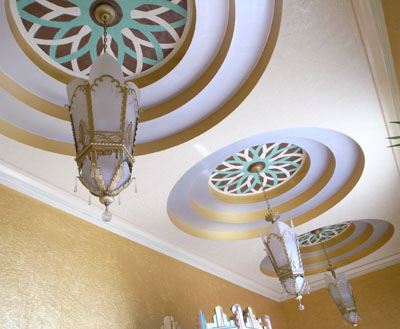
My sisters and I first paused in the lobby, with its fine hanging lamps.
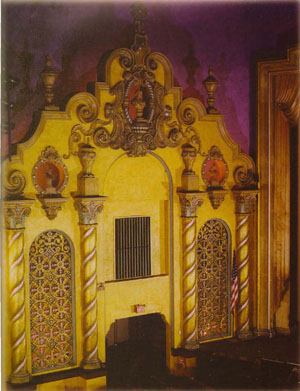
Inside, the auditorium area is of course very impressive, flanked by facades with corkscrew columns.
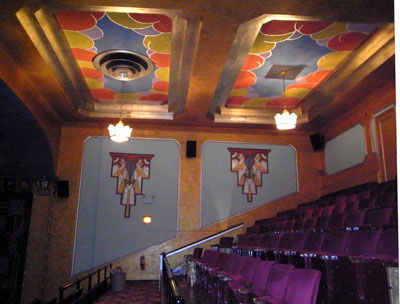
Along the balcony are vaguely ziggurat wall designs.
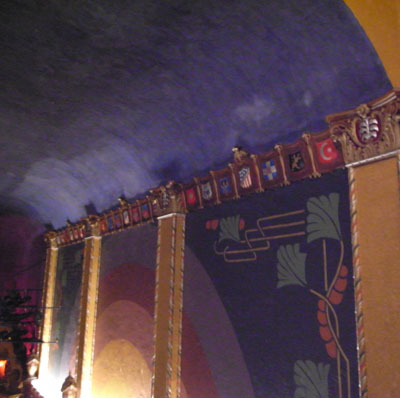
Just in case there was too much empty space, architect Victor Rigamount added some escutcheons.
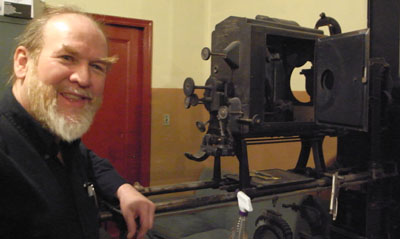
In the projection booth, Bruce showed us the Brenkograph, a marvelous old gadget for projecting lantern slides in dissolving views. The Brenkograph provided the milky clouds cast onto the ceiling: light was pumped through a swirling oil mixture.
In 1946, the year before I was born, US movie attendance reached its peak of about 82 million weekly. The industry had receipts of nearly $1.6 billion. It must have looked like filmgoing would never fall off. But it did, and fast. Enjoying Peter Pan, Moby Dick, and Davy Crockett, I was living through the first major decline in the film industry. By the time I left for college in 1965, weekly US attendance had dropped to 20 million, where it would hover for nearly three decades. Hollywood’s annual box-office receipts were then $927 million (about $657 million in 1947 dollars). In the course of my eighteen years the country had lost 5,000 screens and about 50,000 theatre jobs.
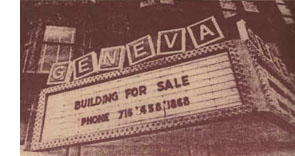 I wish I could go back to see how these old theatres looked then. I wish I could photograph them, inside and out. I wish that I could return to the Elmwood in June 1954 to ask Mr. Norman Williams (unmarried) about the new screen, said to be twenty feet high and 35 feet long—redesigned, of course, for CinemaScope. He was planning to add stereophonic sound, which would, the newspaper story explains, “create the illusion that the sound travels with the movement of actors or objects across the screen.” But until the new system arrived, Mr. Williams said, only Warner Bros’ CinemaScope pictures would be run, because they didn’t require stereo. You mean movies like A Star Is Born and Rebel without a Cause? What wouldn’t I give to see those in their original form, from the front row. I wish I could go back to see how these old theatres looked then. I wish I could photograph them, inside and out. I wish that I could return to the Elmwood in June 1954 to ask Mr. Norman Williams (unmarried) about the new screen, said to be twenty feet high and 35 feet long—redesigned, of course, for CinemaScope. He was planning to add stereophonic sound, which would, the newspaper story explains, “create the illusion that the sound travels with the movement of actors or objects across the screen.” But until the new system arrived, Mr. Williams said, only Warner Bros’ CinemaScope pictures would be run, because they didn’t require stereo. You mean movies like A Star Is Born and Rebel without a Cause? What wouldn’t I give to see those in their original form, from the front row.
Just before I left the area in 1965, I could have quizzed the managers and staff about the old days. After the war, had they suspected what was coming? What was it like to watch your livelihood shrivel year by year? I didn’t know enough to ask. I didn’t understand what had happened.
In the meantime, we haven’t lost everything. On one screen of the Lake Shore Plaza, you could have seen Watchmen on opening weekend. The projection is very good.
My general information about theatres and attendance is culled from back volumes of The Film Daily Yearbook. The Schine family entered history in another way; see here. Information about CinemaScope at the Elmwood comes from the Penn Yan Chronicle-Express of 10 June 1954, p. 1. My account of the Geneva Theatre is largely derived from two publications, The Smith Opera House (Geneva: n.d.) and Charles McNally’s The Revels in Hand: The First Century of the Smith Opera House, October 1894-October 1994 (Geneva: Finger Lakes Regional Arts Council, 1995). Both are available at the theatre; for contact information go here. The Elmwood photos come from wetlandspy. Check out Darlene’s photo page too.
For a panoramic study of American movie exhibition, see Douglas Gomery’s Shared Pleasures: A History of Movie Presentation in the United States. The first time I met Doug, he asked where I was from. I said Penn Yan. He nodded. “Okay, so you went to a Schine theatre.” The man knows his stuff.
Thanks to Bruce Purdy and Sharon Barnes for their hospitality. And thanks to Ryan Kelly for asking me to clarify the situation with Four Sons.
Posted in Film history, Film industry, Movie theatres, People we like | open printable version
| No Comments »
Tuesday | March 10, 2009
Kristin here—
It’s late January as I write this entry, and in about a month, I’m due in Egypt for my annual three weeks of volunteer work on the Amarna Project at Tell el-Amarna, in Middle Egypt. (For the project’s website, see here, and for my part in it, click on “Recent Projects,” then “Material Culture,” and finally “Statuary.”) So as not to leave David with the entire blogging burden during that period, I’m writing this to be posted during my absence.
Given the occasion, I decided to write about a topic that has popped into my mind now and then: a little connection I observed between techniques of ancient Egyptian art and those of continuity film editing. In their reliefs, Egyptian artists were very conscious of the directions of figures’ gazes, and their strove in most cases to match the orientation of the accompanying hieroglyphs to those directions. This topic is not only appropriate, but it gives me a chance to show off my new hieroglyphic font—and to practice composing texts with it.
The connection between eyelines in reliefs and in film editing first occurred to me several years ago when our colleague Noël Carroll was giving a talk in the film-studies colloquium in the Dept. of Communication Arts here at the University of Wisconsin-Madison. He dealt with eyeline matches, or glance/object editing and took a cognitive-studies approach.
Noël’s argument was that such editing is not an arbitrary convention and that it draws upon an “innate perceptual behavior” shared by humans to look not just at other people but also at what those people are looking at. (I’m quoting here from the publication of his talk as “Toward a Theory of Point-of-View Editing: Communication, Emotion, and the Movies,” in his 1996 collection, Theorizing the Moving Image, from Cambridge University Press.) This tendency naturally manifests itself when babies begin at two to three months to follow the directions of their parents’ gazes. He claims that eyeline matching “can function communicatively because it is a representational elaboration of a natural information-gathering behavior” and also that such a link to our everyday perception helps make continuity editing easy to grasp.
If we can find comparable sorts of devices in art of a different era and culture, those devices help support claims about “cultural universals.” These are patterns of perception that all cultures share, though they will manifest themselves in art in different ways. Let’s take a look at a sort of eyeline matching that’s used in Egyptian reliefs. Only here it’s not an eyeline and a seen object being matched. It’s a match between an eyeline and the direction its accompanying hieroglyphs face.
Hieroglyphs and their orientation
First, let me get a pet peeve out of the way. A lot of people these days call hieroglyphs “hieroglyphics.” There is no such word, or shouldn’t be. “Hieroglyphic” is an adjective, as in “hieroglyphic text” or “hieroglyphic inscription.” But don’t just take my word for it; look under Etymology in the Wikipedia entry on hieroglyphs. (I note with annoyance that my spell-checker doesn’t highlight “hieroglyphics,” but it does think “eyeline” is wrong.)
Now, about directions. Egyptian hieroglyphs can be written horizontally or vertically, facing left or right. The default orientation is facing right, to be read right to left. How do you know which direction they’re facing? Even if you can’t read hieroglyphs, just look at the signs representing living things. Birds, people, animals, bugs, with rare exceptions they all face the front of the text.
There are all sorts of complicated exceptions to the rightward orientation. The late Henry George Fischer, curator of Egyptology at the Metropolitan Museum of Art, wrote a large book on the subject: The Orientation of Hieroglyphs, Part 1. Reversals (Alas, he never wrote Part 2.)
As Fischer says at the outset, “It is essential to stress the fact that Egyptian art and writing are interrelated to a degree that is unparalleled in any other culture. For it is from this fact that the orientation of hieroglyphic texts derives its logic.” And Egyptian art, despite its strangeness to many eyes, is intensely logical. Each person, creature, and object portrayed in relief will be shown from its most characteristic, recognizable view, whether that be in profile (such as a person’s face, legs, and stomach) or frontal (that person’s eye and shoulders).
In reliefs, the hieroglyphic texts in reliefs function as labels and descriptions of the things depicted or to quote the words of the people present. Hence, logically, the particular inscription relating to one person, creature, or object depicted will face the same direction as it does.
Two straightforward examples
The image below is a detail from a false door (the entrance and exit for the dead person’s soul in a tomb). It comes from an Old Kingdom tomb at Saqqara (5th Dynasty, roughly 2453 BCE). The relief depicts a husband, Nikaure, and wife, Ihat, along with two of their children.
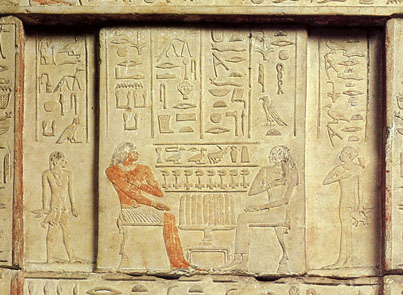
Egyptian Museum, Cairo, inventory CG 1414
The pair sit opposite each other across a table full of offerings: long loaves of bread, portrayed vertically even though they are assumed to lie on the table. The two columns above Nikaure face rightward, as does he. They give his official titles and name. The two above Ihat face left and do the same for her. The son at the left faces right, as does the text above him, and his sister, at the right, faces leftward, as do her hieroglyphs. Despite the fact that this particular door belongs to Ihat, there is a slight male bias here, since the list of offerings above the table face right, as he and his son do—the favored, “stronger” orientation for hieroglyphs and people.
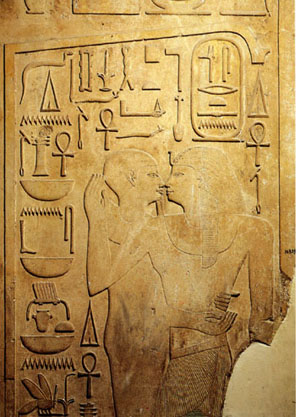 The basic conventions of Egyptian art were amazingly stable for a period of about three thousand years. We find the same principles in the Middle Kingdom. This relief (Egyptian Museum, Cairo, inventory JE 36809) on a column shows Senwosret I (12th Dynasty, reigned 1971-1929 BCE) being embraced by a statue of the god Ptah in its shrine. You wouldn’t think that statues embrace people, but pharaohs were considered divine and could communicate with gods’ statues in temples. The king is at the right, facing left. His name is in the oval cartouche above his head, and the columns of signs at either side of it give some of his titles. All face left. The basic conventions of Egyptian art were amazingly stable for a period of about three thousand years. We find the same principles in the Middle Kingdom. This relief (Egyptian Museum, Cairo, inventory JE 36809) on a column shows Senwosret I (12th Dynasty, reigned 1971-1929 BCE) being embraced by a statue of the god Ptah in its shrine. You wouldn’t think that statues embrace people, but pharaohs were considered divine and could communicate with gods’ statues in temples. The king is at the right, facing left. His name is in the oval cartouche above his head, and the columns of signs at either side of it give some of his titles. All face left.
The rest of the signs face right. They identify Ptah and describe all the things he’s giving the king: life, dominion, stability, health, and happiness. The column at the far left is a direct quotation of the god’s words. As in these two examples, almost any relief where figures are present facing different directions, the orientation of the hieroglyphs will be determined by which one they refer to. Obviously the Egyptians considered this sort of directional consistency very important.
Facing one way, looking the other
Indeed, the directions in which figures’ faces and eyes were turned seems to have been of particular importance. It’s not uncommon for a figure to be facing one way and looking back. In that case, that figure’s hieroglyphs will face backward as well.
The relief below reveals the logic of this device very well. Two gods, Atum at the right and Montu with the falcon head (not all falcon-headed gods are Horus) are leading Rameses III to the king of the gods, Amen. (I copied this from Fischer’s book, and unfortunately he doesn’t specify where this relief is.) As they proceed, Montu turns back to hold the signs for “life” and “dominion” to the king’s face. The five right-most columns of text above refer to Amen and mimic him in facing leftward; they represent his speech to the king. The next five represent Montu’s speech and, because his eyes look leftward, so do the hieroglyphs. But not the little column of text in front of his stomach and kilt. That describes his action of leading the pharaoh to Amen, so those signs, written beside the part of his body facing right, also face right. Charmingly logical.
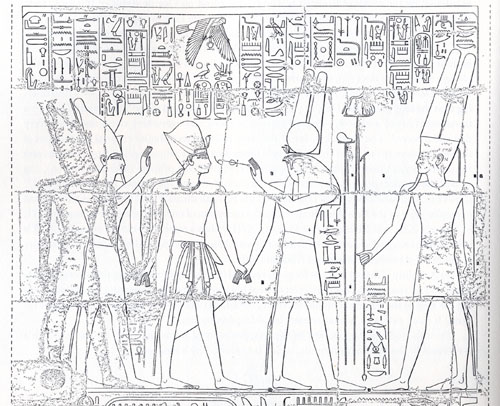
That sort of thing is one small part of what makes Egyptian art so appealing to me. Perhaps it gives you a better feel for why Fischer claimed that Egyptian art integrates writing and pictorial representation more thoroughly than that of any other culture. It also bolsters David’s recent entry about how studying the techniques and conventions of an artform enhances one’s enjoyment of individual artworks.
Amarna examples
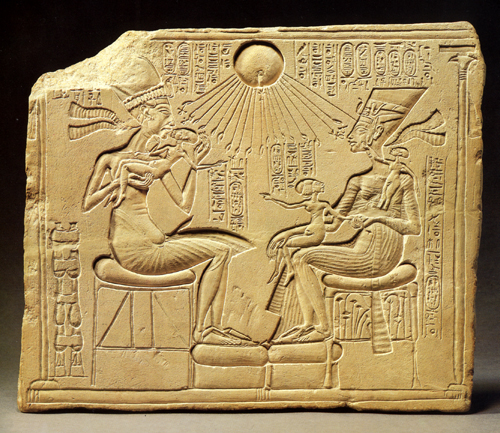
My favorite examples of head-turning reversed hieroglyphs come, not surprisingly, from the period I study, the Amarna era (18th Dynasty, New Kingdom, roughly 1350 BCE). One trait of Amarna art is its relatively casual depiction of the royal family. Previously the king had not been shown “behind the scenes,” playing with his children. Compare the Old Kingdom relief of Nikaure and Ihat, seated stiffly with their children at attention behind them, with the stela at the top of this entry. There the pharaoh Akhenaten lifts his eldest daughter, Meritaten, to kiss her. Opposite him sits his wife Nefertiti, holding the second daughter, Meketaten, on her lap, and balancing her third, Ankhesenpaaten, who stands on her arm or hip, playing with the decoration on Nefertiti’s familiar tall, flat crown. (A repaired crack has destroyed the child’s feet and some other elements of the relief). There’s a similar relief in the Louvre, by the way, where Nefertiti and at least two of the daughters sit on Akhenaten’s lap, but unfortunately only the lower part survives.
This stela is my favorite piece of Amarna art. I must confess that standing back in 1992 in the Ägyptisches Museum in Berlin and studying this sentimental little image (inventory 14145) was what finally suckered me into an obsession with the art of the era. It’s not just the appeal of the family scene, though. There’s an underlying complexity and innovativeness about this piece that makes it unique in the history of Egyptian art. It’s also not just sentimental. Such a stela would have stood in a private chapel in the garden of a rich family. The fecundity and nurturing shown in the image would be seen as indicative of the pharaoh’s protective role toward his country.
As is typical of Egyptian art, each figure has a label identifying him or her. Akhenaten’s and Nefertiti’s names and titles are in the vertical columns at the top, alongside the name and titles of their sole god, the Aten, or globe of the sun, which casts its life-giving rays down upon the group. Literally life-giving, since two of the rays’ little hands hold ankh-signs to the king’s face, and another two do the same for Nefertiti. Each daughter, though, has a label identifying her, all in the very formulaic phrases used on endless reliefs for this purpose.
Here’s a detail of the part of the relief I want to focus on:
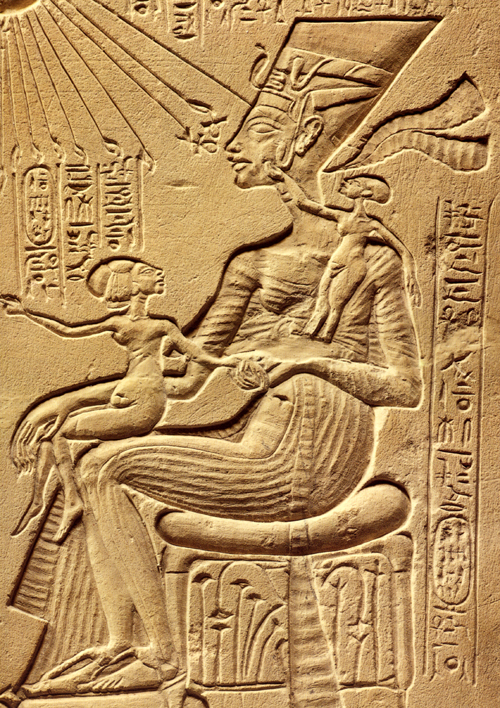

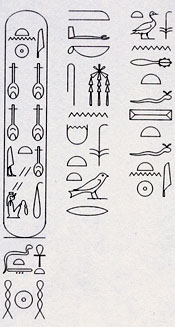
In contrast to the beautiful carving of the figures, the hieroglyphs here are rendered very badly, and it’s partly because they are so formulaic that one can read them all. I’ve used my new font program to lay them out legibly so you can see which way the inscriptions face. (The font couldn’t cram the four nfr-signs that appear side-by-side in Nefertiti’s name into the cartouche, so I settled for putting them on two lines.)
In the text running down the side, the youngest daughter is described: “King’s daughter, Ankhesenpaaten [i.e., “She who lives for the Aten”] of his body [i.e., Akhenaten’s biological offspring], whom he loves, born to the Great Royal Wife, Nefertiti, may she live forever and continuously.” The two other daughters have the same texts with their names substituted.
I’ve analyzed this stela in print, suggesting an interpretation of the brief narrative action that is going on in the scene (“Frontal Shoulders in Amarna Royal Reliefs: Solutions to an Aesthetic Problem,” The Journal of the Society for the Study of Egyptian Antiquities Vol. XXVII [1997, published 2000]: 79-98 and Pls. IV-VII). All I’m concerned with here is the fact that Meketaten has turned her head to look at her mother while pointing across at her father and sister. The short columns of text above her have been reversed accordingly:
There are other Amarna reliefs where a daughter turns her head, including one where the upper part of the princess is missing, and we can only tell she was turning to look at her mother because the few surviving hieroglyphs face the opposite direction from her feet. The reversal isn’t used in every case where a princess turns her head. In more formal offering scenes, where the princesses stand in a group behind their parents, a continuous row of short vertical columns above them gives the name and title for each. With all the rows lined up this way, the reversing of one daughter’s signs would look odd, and so the Egyptian artist kept all the columns facing the same direction. That’s another convention of Egyptian art: keep the graphic layout of the signs neat and pictorially appealing. They’re an important part of the overall image.
Reversed hieroglyphs and eyeline matches
I’m not trying to claim that Egyptian reliefs are just like film because the hieroglyphs are oriented by which was the figures are facing. There’s nothing comparable to an eyeline match in such images, since we see all the figures of a scene present at the same time, always depicted from head to toe. There is no need to match a figure’s eyeline to what he or she is looking at, since that, too, is present in the scene. There is no “offscreen space” in Egyptian reliefs.
Still, the Egyptians matched the orientation of hieroglyphs not just to the general direction a figure was facing but also to the specific eyeline created by head position. There was a logic to this, based on the fact that the direction of the gaze was deemed important and hence could be used to organize important elements of the composition of a scene—a static one in this case rather than one unrolling temporally across separate shots. That a culture so different from our own could come up with an artistic convention reminiscent of a technique in classical filmmaking suggests to me that claims about the naturalistic basis of eyeline matching and shot/reverse shot have merit.
Posted in Film and other media, Film scholarship, Film technique: Editing, Film technique: Staging, Film theory | open printable version
| No Comments »
|