by Kristin Thompson. Berkeley: University of California
Press, 2007.
400 pages, 6 × 9 inches, 12 color illustrations;
36 b/w illustrations.
[go
to Amazon | go to The Frodo Franchise blog]
What remains? Accentuating the positive, I’ll not talk about the disappointing items, some with strong reputations. I hope to blog about others in the months to come, when I’ve had a chance to study DVDs.
In the meantime, Kristin has already touched on Beaches of Agnès, a real charmer. Varda can be whimsical without turning fey; even dressed as a potato she doesn’t seem to be trying to grab attention. The film is a digressive, passionate memoir. The background on her early life is captivating, and her career as a photographer, shooting snaps of Pierre Vilar and Gerard Philippe, furnishes a stab of pathos. A montage of beautiful boys and girls: gone. Soon we get Varda’s straightforward acknowledgment of Demy’s death from AIDS. “All the dead lead me back to Jacques.”
Götz Spielmann’s Revanche, which I’d passed up at other fests, was a very solid psychological thriller. It’s built around two contrasting worlds, the sex trade of Vienna and the placid, churchgoing lifestyle of a village. From the first comes Alex, a man-of-all-work in a brothel. He falls in love with a Ukrainian hooker, and between bouts of cocaine he vows to help her escape the business. In the village live the policeman Robert and his wife Susanne, trying to have a child. Their life is secure and cozy, though Robert is wound a bit tight. The two worlds intersect during a bank robbery, and the rest of the drama plays out in the countryside, with Alex taking refuge on his grandfather’s farm. Alex and Robert become two variants of masculine anxiety, each defined by his way with a pistol, and their decisive confrontation is deftly postponed until the very last moments of the film.
I admire the way that Spielmann uses a spare long-take technique to increase suspense. Each scene usually consists of a single shot, taken from a judiciously chosen angle that unfolds the drama smoothly. There are barely 200 shots in nearly two hours, but the scenes don’t seem stiff because the framing and staging are quietly varied. Shot/ reverse-shot cutting is reserved for two turning points, one in the middle and one at the end. It’s nice to see a movie with no filler material, no passages of people driving in cars or going into the buildings, none of those time-wasting aerial shots of cities.
Some nice sound work too! No Country for Old Men has been rightly praised for its use of offscreen noise, but the Coens look rather showoffish compared to what Spielmann has accomplished here. A shot of Robert and Susanne on their patio is accompanied by the faintest rustle on the right channel: Alex, spying on domestic happiness like a character out of Highsmith or Ruth Rendell, has slipped away.
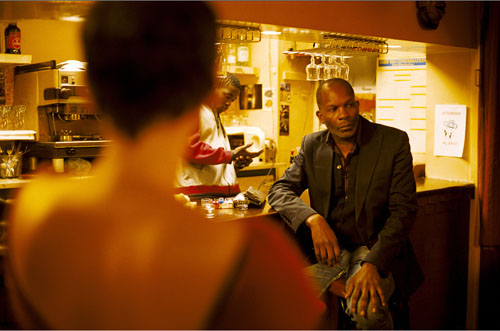
Similarly elegant in its staging and sound work is Claire Denis’ 35 Shots of Rum. The teasing exposition—a man watches commuter trains, a young woman rides one—dares us to imagine scenarios that could involve both. Our speculations turn out to be too wild, since their relationship is the most uncomplicated to be imagined. Based frankly on Ozu’s Late Spring, 35 Shots builds up its drama through daily routines, following its principals and their neighbors in everyday situations until, quite unexpectedly, a quiet crisis blossoms. Soon one scene ends: “We could be like this forever.” Next scene: everything has been overturned, and characters must change their lives. Visually the film is a marvel, with glowing scenes of semidarkness and discreetly out-of-focus details. As in her masterful Beau Travail, Denis supplies a powerful last shot, this time of an object we’ve nearly forgotten.
Two more thoughts: In my discussion of Revanche and 35 Shots, I’ve had to be coy in explaining basic plot situations and character relationships. That’s because these films work elliptically, holding back the sort of expository information that would be given in a concentrated dose early in most classical narratives. This narrational strategy poses no problem for an academic analysis, which tends to assume that the reader has seen the film. But it’s more difficult to handle when you’re writing a review. You don’t want to spoil the viewer’s surprise by explaining a core situation that the filmmaker has chosen to unfold gradually. If reviewers of Hollywood movies can’t give away the ending, the reviewer of an art film probably shouldn’t give away the beginning, or at least the information that it keeps in suspension for some time.
In other respects, though, there isn’t a clear dividing line between the “psychological” drama of international festival cinema and the more “externally driven” action of mainstream entertainment. Popular cinema relies on physical props like clues, souvenirs, messages, and gifts to help drive the plot. So, less obviously, do art films. The two photographs in Revanche deepen the character drama while triggering a major realization. The accidentally discovered letter (a convention of melodrama akin to the overheard conversation) in 35 Shots not only explains past actions but primes us to expect some conflict to come. As Aristotle knew, stories seem to need tokens to drive character revelation and plot reversals. A narrative universal?
Japanorama
Naked of Defenses.
Many of the movies I most enjoyed were Japanese. No surprise there. I know I’m prejudiced in favor, but objectively speaking the Japanese industry has long combined high output with great diversity and depth. I’m inclined to think that across film history, the three most consistently excellent filmmaking nations have been America, France, and Japan.
During Filmart, Yoshizaki Masahiro gave a swift but informative report on the current state of Japan’s “content industry.” It is the currently the world’s second-largest national film market , but it will sooner or later be replaced by China. Currently Japanese films are reclaiming the local audience, sometimes grabbing over half the annual box office.Unfortunately, that audience isn’t growing, and with a plunging birthrate, it’s unlikely to do so. Moreover, Japanese cinema has always been difficult to export, even in Asia. The great exception, of course, is anime, but even that is starting to slump. Anime is largely a television/ video format, yielding about twice in those platforms what it yields in theatrical income. But as advertising dollars have withered in the recession, anime has been cut back.
Despite all this, Japanese companies manage to release a staggering 400 or so films per year. (What counts as a release—theatrical? direct to video?—we leave for another day.) And the variety remains remarkable, judging by what I saw during my stay in Hong Kong.Put another way: Japan makes movies that are sweet, touching, funny, silly, and peculiar to the point of perversity. Not necessarily perversion, but that’s there too. And yes, schoolgirls’ panties are involved.
Not part of the festival, but playing in town was the diverting comedy Happy Flight. Like Airport and Airplane!, it weaves together various characters involved with a single flight. It concentrates almost completely on the professionals, from gate agents and mechanics to pilots and air hostesses. The one passenger depicted in detail rings true: After being allowed to bring an oversized bag into the cabin, he becomes a browbeating jerk.
The film maintains its infectious pacing, adorning the action with minor-key gags like the airport’s “Somkin Room” for smokers. I also liked the moments of teamwork. When the stewardesses need a cake, they concoct one out of various packaged snacks. A young mechanic, constantly berated by his boss, thinks he’s dropped a wrench into the plane’s engine, and the whole ground crew searches the hangar for it. As with Airplane!, the final credits resolve several plotlines and add a few gags. If you like Waterboys and Swing Girls, also directed by Yaguchi Shinobu, you’d probably enjoy this.
Just as light, but a lot more intricate is Nakamura Yoshihiro’s Fish Story. Another network narrative, this one traces how Japan’s purported first punk song changed the course of history. The plot skips among periods from 1953 to 2012, when a comet is about to incinerate the earth. With many pop-culture in-jokes, from Beatles albums to The Karate Kid, this breezy, off-kilter item gets by on sheer adrenaline and on a cascade of puzzles. Why does the Fish Story song make no sense? Why does it contain a one-minute passage of silence? How are all these stories connected? And how can a song save the world? The narration cleverly withholds the basic relationships among the characters until a dizzying montage at the end wraps everything up.
Still further out there on the Nutsometer is Love Exposure, your basic four-hour inquiry into Christianity, cross-dressing, superheroics, and schoolgirl underwear. The story starts with a boy who promises his mother he’ll marry a woman like the Virgin Mary, but thanks to digital photography and an acrobatic approach to filming schoolgirls’ nether regions, he becomes known to his peers as King of the Perverts. Director Sion Sono satirizes cult religions, which seems to include Catholicism (“Your sin is that you can’t remember your own sin”), while devoting some attention to pornographic movies and “Candle in the Wind.” Rambling and digressive, but rapidly paced, Love Exposure proves that nobody beats the Japanese for cheerful dirty fun.
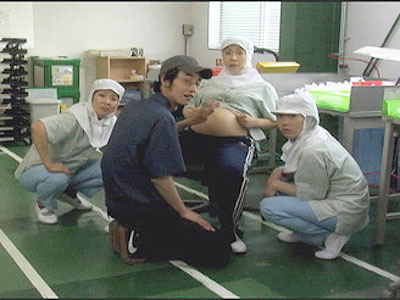
A more straightforward Japanese entry in the Asian Digital competition was Ichii Masahide’s Naked of Defenses (the most awkwardly titled film I saw). Two women work at a factory making plastic parts. Ritsuko, a plain but dogged supervisor, is becoming alienated from her husband after her miscarriage. She envies the pregnant and insouciant new hire Chinatsu, whose marriage is overcoming its problems. Plain and sincere in its technique, Naked of Defenses ends with an astonishing sequence. By all the evidence onscreen, Ichii got a pregnant woman to play Chikatsu and filmed her giving birth. Balancing this powerful ending is the striking performance of Moriya Ayako as a woman sinking into depression but who may be saved by friendship and maternal love.
I took the occasion to catch Departures at a local theatre, since I had missed it at earlier festivals. And I’m happy to report that it’s distributed in the US by Regent Entertainment, run by Wisconsin graduate and old friend Steven Jarchow.
By now you’ve probably seen Departures too. At one level, it’s a good old-fashioned Shochiku movie, mixing tears and good-natured humor. Some decry it as middlebrow sentiment, but I found it a touching, fluent tale. For me, the central attraction is the repertory of gestures. Our two professionals handle the recently deceased tenderly, but that doesn’t preclude a crisp efficiency in flaring out a sleeve. I don’t think I’ll forget the way the undertaker grasps the dead person’s clasped hands and then executes a circular snap. Precise manipulation becomes a sign of respect.
And it isn’t all sunniness. Handling dead bodies is hazardous cultural territory in Japan. It is traditionally a task for the burakumin, a minority group long looked down upon. Although discrimination against the group has apparently diminished, the fact that a big star like Motoki Masahiro could play the role of a corpse-preparer could help dispel a lingering social stigma.
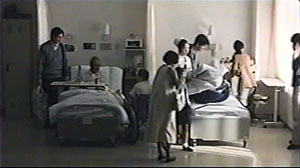
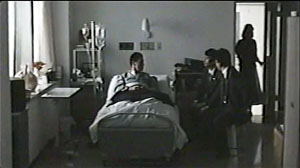
You could almost mount a Japanese film festival about mortality. Some musts would be Ozu’s Brothers and Sisters of the Toda Family and Tokyo Story, Kurosawa’s To Live, and Kore-eda’s After Life. Another required item would be Dying at a Hospital (1993), a rarely seen Ichikawa Jun film screened as part of a tribute to the recently deceased director. It consists of staged episodes showing a few cancer patients in their last months. An elderly husband and wife both have cancer, but must separate and be treated in different hospitals. A widow laments her rotten luck. A lively young man can’t accept the fact that he won’t see his children grow up. A homeless man is brought in, filthy and disoriented, and as he becomes aware of his plight, he still apologizes for accidentally turning up his pocket radio.
These and other cases are accompanied by voice-over narration from the doctor and nurse who treat them.Interspersed with these scenes are rapid documentary montages of people enjoying life—eating, drinking, viewing cherry blossoms, celebrating festivals, just walking down the street. The intimate facial reactions we’re denied in the hospital scenes are supplied in these vérité passages.
Dying at a Hospital is gentle and sympathetic, but its manner of shooting gives it special resonance. The hospital scenes are shot in planimetric fashion, with the camera rigidly facing a row of three beds, or a pair of beds, or only a single one. Everything is played in long shot, with no close-ups or camera movements to enlarge the faces.
Patients, visitors, and hospital staff move through these blocks of space. The lighting effects are particularly subtle, accentuated by very gradual fade-ins and fade-outs, as if dawn were breaking or night were coming on. As the film goes on, Ichikawa introduces variations in scale and new cutting patterns, creating what I called in Narration in the Fiction Film a sparse version of parametric narration. For instance, the spaces become more compact as terminal patients are shifted from a shared room to a private one, which permits nuanced effects of distant depth.
Ichikawa’s dry, physically detached treatment lets the poignancy of each situation emerge without any directorial boosting. The glimpses of daily life outside the hospital, zestful and shot on the fly, generate a powerful contrast: the preciousness of ordinary pleasures, and the dignity that must be accorded everyone about to leave them behind.
For a brief but sensitive appreciation of 35 Shots, see Ryland Walker Knight’s comments here–perhaps best read, for reasons mentioned above, after you’ve seen the film.
Fei Mu is a little-known name in the West, but on the evidence of even a few films, it’s clear that this mainland Chinese filmmaker was one of the finest working anywhere during the 1930s and 1940s. His best-known film, Spring in a Small Town (1948), was considered in the Maoist era an overliterary piece of sympathy for the bourgeoisie. Now things have changed. Many specialists today consider Spring in a Small Town the best Chinese film of all time. It’s an extraordinary work, anticipating Antonioni in its slow unfolding of an erotic situation, treated with a mixture of sympathy and austerity. It’s a great pity that the film isn’t available on good and subtitled DVD copies, though a digitally restored print was made in 2005.
Two other Fei Mu films I’ve seen show the variety and flexibility of his craft. Onstage, Backstage (1936) is a drama of theatre life, and its fluid figure movement in depth recalls Renoir. Very different is the expressionistic allegory Nightmares in Spring Chamber (1937), an episode in the portmanteau film called Lianhua Symphony. Fei presents the Japanese invasion of China as the pursuit of an innocent girl through dark sets by a leering, frock-coated Japanese. Other surviving Fei works, such as Blood on Wolf Mountain (1936), are also held in high regard. After Mao’s revolution, Fei Mu moved to Hong Kong, where he died at the age of 45. He directed no films in the Crown Colony.
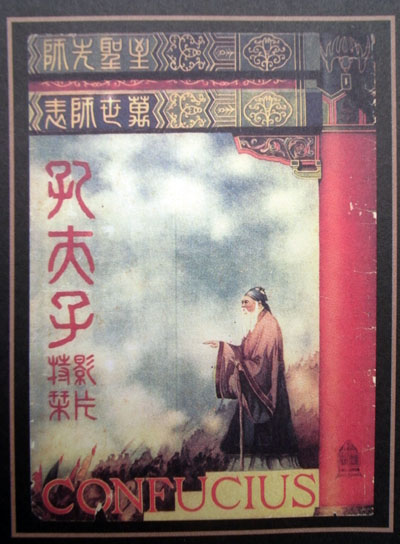
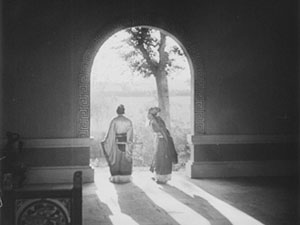
All this makes the discovery of a print of Confucius (1940) an event of capital importance. An anonymous individual donated a print to the Hong Kong Film Archive, which spent years restoring it in collaboration with L’Immagine Ritrovata of Bologna. In the donated print of Confucius, some portions of the soundtrack had liquefied, so some stretches are silent, and there are about nine minutes of fragments that have yet to be integrated.
At the premiere, a very useful booklet on the film’s restoration was given out, and moving introductory speeches were presented by Barbara Fei Ming-yee, the director’s daughter, and Serena Jin, daughter of the producer Jin Xinmin. The screening added electronic subtitles that not only translated the dialogue but identified each speaker—a helpful gesture for a film with many characters and a tangled intrigue.
I can’t comment on it as a representation of Confucius’ thought and life, although experts tell us that it is quite different from the elevated, almost sanctified portrayals that were known before. The plot dramatizes the ineffectuality of the sage’s ideals of civic virtue by showing how power players of his era ignored or undercut his teachings. Scenes from Confucius’ life alternate with scenes of political and military strategy, as warlords and statesmen debate tactics and, not incidentally, calculate how to eliminate Confucius. As Confucius migrates across China, he is unable to halt the continuous warfare among various factions. His disciples leave or die. Just before his death he has only his grandson to care for him. “A great educator, thinker, and philosopher,” Fei Mu writes in an essay, “Confucius was doomed a victim of the politics of his time.”
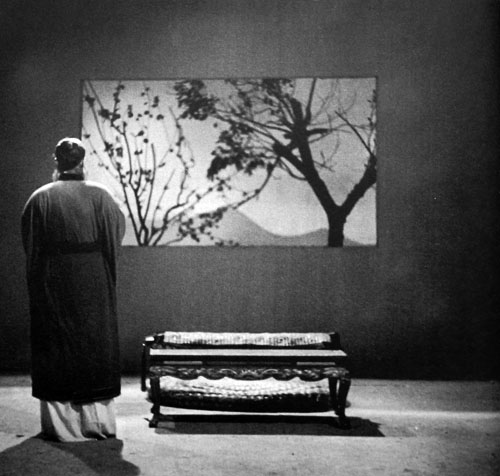
The film is slow-moving and hieratic. Some of the fragments show bits of violence, but the film as a whole relies on dialogue. Although some scenes unfold in natural exteriors, Fei Mu often employs theatrical tableaus, complete with painted landscapes; occasionally the actors cast shadows on the backdrops. The cutting is often axial, simply enlarging a chunk of space as actors declaim their dialogue. The nearly square Movietone frame enhances the symmetry of the compositions, which often feature a window or some other aperture.
Knowing the fluid style of Fei’s 1930s films, we can only regard this rigid, rather ceremonial look as a deliberate artistic choice. In this respect, the film recalls Eisenstein’s Alexander Nevsky and Mizoguchi’s Genroku Chushingura, films of that era aiming to treat a weighty historical subject with solemnity. In Confucius, Fei seems to have been rethinking the relation of cinema to theatre, a quest that preoccupied other directors of the period and that remains important today. Wong Ain-ling’s essay in the booklet aptly notes Rohmer’s Perceval le Gallois as a more recent parallel, and the film likewise has some of the feel of the Straub/ Huillet version of Von heute auf morgen (1997). As often happens, Fei Mu feels like a modern filmmaker.
Confucius was shown across China in 1940 and 1941, and a reedited version was released in 1948. Fei Mu was so upset by the new cut that he took out a newspaper ad denouncing it. Wong Ain-ling, who prepared the documentation for the festival presentation, and Sam Ho, the Archive Programmer, have concluded that this print is likely to have been the re-release version. Sam told me that the archive staff would be spending the next year researching how to integrate the fragments and supply a sense of the original’s design. The Archive is planning to screen that restoration at next year’s festival. Whatever the experts come up with, surely this is a discovery that will be discussed and enjoyed for many years.
Tsui Hark is the mad genius of Hong Kong cinema. The problem comes with assigning proportions. 10 % mad, 90% genius? 50-50? 99 % mad, 1 % genius?
Across a career that’s lasted more than thirty years, Tsui has had more ups and downs than the local economy. On the twenty-fifth anniversary of Film Workshop, the company he founded, the Hong Kong International Film Festival mounted a tribute. That provides an occasion to examine what he did and didn’t accomplish.
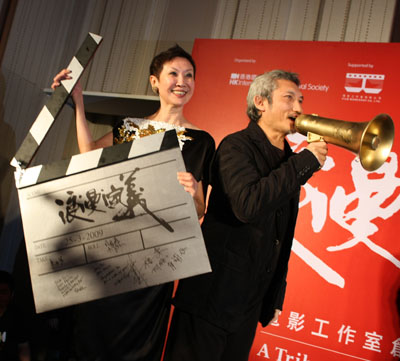
25 years old, but who’s counting?
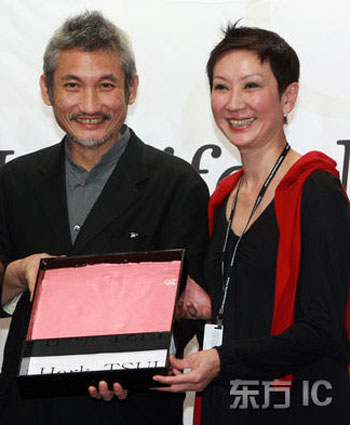
Nansun Shi and Tsui Hark.
At this year’s Asian Film Awards, Film Workshop was given a special prize for outstanding achievement. On another evening there was a party gathering many Workshop alumi, from which the above photo comes. You can see more pictures from that party here. At the agnes b. gallery, a small show featured posters, a looped video documentary, a photocopy of the Better Tomorrow script, and some memorable props.
Nat Olsen has other pictures at his lively Hong Kong Hustle site.
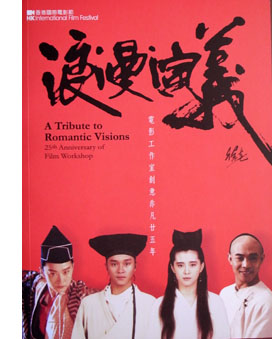
The catalogue, A Tribute to Romantic Visions: 25th Anniversary of Film Workshop, is a must for all aficionados of Hong Kong film. Consisting largely of interviews, it offers many glimpses of creative choices and business strategies governing the company. Nansun Shi, Tsui’s partner and business manager, recalls how they placed films in overseas markets and won critical acclaim in Europe. She also explains matter-of-factly how frantic the midnight-show system was. In those days, Hong Kong filmmakers test-screened a movie to a midnight audience, and then reedited the film based on perceived reaction. Shi explains:
Cinemas often wondered what could be done to a film in the eight hours between the midnight show and the day-time show the next day. I ran some calculation with the technicians: what is the least amount of time for them to do this and that, and then sent them to the cinemas to do the work. If worse comes to worst, they could do the re-editing when the show was running (80).
There isn’t much sugar-coating in the interviews. Collaborators often found Tsui a harsh taskmaster. At peak pressure, he seldom halted shooting for sleep and instead took cat naps on the set. Those who couldn’t keep up his pace, or adjust to his demands, left the company. There are also some comments on production practices. Herman Yau, for instance, notes: “Directors, in general, use most of the shots to tell the story. Tsui prefers images that look good on their own” (121).
Overall, the catalogue confirms that what started as a “workshop” designed to enable directors to realize individual creative visions became a company built around Tsui’s restless ideas about cinema. This was more or less the premise of the panel on Friday afternoon. Two critics, Keeto Lam and Longtin, discussed the Film Workshop enterprise largely as an extension of Tsui’s interests. Keeto had been a screenwriter at the company and shared information about the making of A Chinese Ghost Story 2, while Longtin speculated on Tsui’s interest in transcending polarities, particularly those between human and demon and male and female. Another scriptwriter was in the audience and contributed information as well.
One of Keeto’s points set me thinking. Having characterized Leslie Cheung as the “Golden Boy” of Film Workshop, he asked who the Golden Girl was, and he and audience members discussed candidates for the honor. (My vote, obviously, would go to Brigitte Lin.) But I began to speculate that one of Film Workshop’s main contributions was in star-making. Tsui has mentioned that his early films with gorgeous women tried to create a “comedy of pretty faces” opposed to the “comedy of ugly faces” that ruled in the 1970s and early 1980s. (Think of Michael and Ricky Hui, Karl Maka, Jackie Chan, and Sammo Hung.) By coaxing Brigitte Lin to Hong Kong and by giving Sally Yeh, Leslie Cheung, Chow Yun-fat, and other younger players big roles, Film Workshop created a new generation of glamorous stars.
A better yesterday
This celebration comes at a parlous period in Tsui’s career. Over the last dozen years Tsui directed some weak, even awful movies. Granted, even a bad Tsui movie is bad in a unique way, but that doesn’t make Tri-Star (1996), the Van Damme outings (Double Team, 1997; Knock Off, 1998), and The Legend of Zu (2001) any better. Some films he has produced, like Era of Vampires (2002) and Xanda (2003), are best forgotten. Today, after the only moderate success of Seven Swords (2008) and the disappointments Missing (2008) and All About Women (2008), many local film professionals consider him a spent force.
I’d argue that Tsui and Jackie Chan were the two most ambitious young filmmakers of 1980s Hong Kong. Tsui was the more daring and mercurial; he seemed to be trying a dozen things at once. He made some bad films, but others changed the face of local film: Shanghai Blues (1984), Peking Opera Blues (1986), A Better Tomorrow III (1989), Once Upon a Time in China I and II (1991, 1992), The East Is Red (1993), and The Chinese Feast and The Blade (both 1995). He also produced, and often co-directed, A Chinese Ghost Story and A Better Tomorrow (both 1986), The Big Heat and Gun Men (1988), The Killer (1989), the demented Wicked City (1992), and Iron Monkey (1993). These films had enormous impact locally, and they made Hong Kong film a major force in world cinema.
The problem is the mad-genius thing. Tsui is uneven, not only from film to film but within each one. Tsui can create a fairly unified tone, as The Blade and Seven Swords show. But more likely a Tsui film will contain something brilliant, something banal, something silly, and something just weird. Labored facetiousness is a virus plaguing Hong Kong film generally, but Tsui seems entirely too fond of bursts of dumb comedy. He replies: “Sometimes it’s fun to be stupid.”
Yet the thrown-together quality of many of his movies also means that even a troublesome one is likely to have a passable sequence. More important, his best films use the lurches in tone to create a grotesque, sweeping verve. Things happen so fast you can’t protest; either go with it or walk out.
Tsui’s strategy is based upon a breathless rhythm. He chops off scenes without warning, and he bustles his actors around the set maniacally; the poor things seldom rest long. Almost never do characters simply sit down and talk to one another, as in those bland American indie films. The beginning of Triangle (2007) shows how nervous, even opaque, Tsui’s style becomes when characters have to sit still.
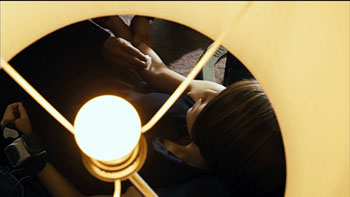
For Tsui, story action is a matter of physical movement, and the film frame becomes a force-field, with actors popping in and out with abandon. He carries the staccato choreography of martial-arts film down to the most straightforward dramatic scene. He’s not alone in this; you can find it in the 1980s martial-arts films too, but Tsui gives it a special force with his pitched angles, his wide-angle lenses, and his love of comic-book-rococo compositions. Try, for instance, this shot of a woman getting an injection in Missing.
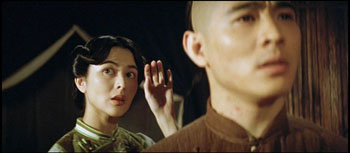
Such images can seem merely cheap flash, but what saves the best ones from preciosity is their constant but disciplined rhythm. In Once Upon a Time in China, Wong Fei-hung is about to be arrested after a clash with local thugs. The shot starts with the police official pointing his pistol to Wong’s head.
Another cop comes in to tell the official that the invaders left something. Any other director would have shown the cop’s face, but why? He’s important only to get the official out of the frame, so he becomes just a red hat poking in from the lower right corner.
The official dodges out, moving rightward across the frame.
There’s a pause, then Wong, now isolated in the shot, snaps his head around to follow what’s happening.
Tsui isn’t usually considered an economical director, but it’s hard to imagine a more crisp way to handle this routine bit of action. The shot takes less than eight seconds.
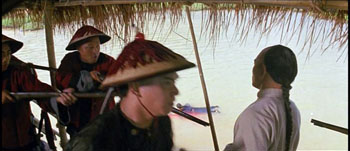
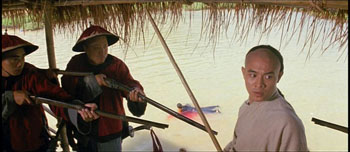
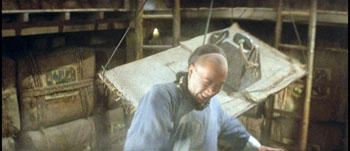
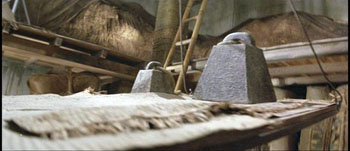
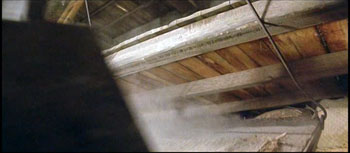
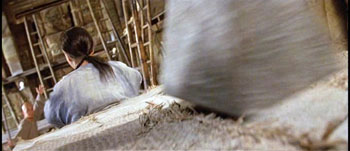
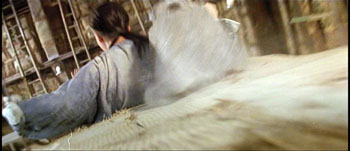
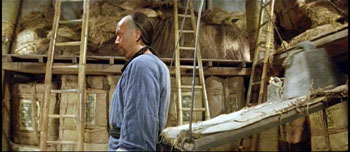
The same restless energy rules Tsui’s cutting, which has a punch and recoil derived, I think, partly from New Hollywood (Spielberg especially; see the Jaws example here) and partly from the local martial arts tradition. (Some proto-Tsui cutting is on display in Lau Kar-leung’s Legendary Weapons of China, 1982.) Watching Once Upon a Time in China at the retrospective, I was reminded that Tsui not only cooks up sequences that you can’t forget (three words: fight on ladders), but he risks audacious cuts on movement that few contemporary directors could bring off. When he wants to emphasize a moment, he channels Eisenstein. During the final combat of Wong and Iron Robe Yim, the iron weight sliding down the platform gets the Potemkin treatment. Four shots stretch out the instant through overlapping movement.
As we might expect, Tsui goes beyond Eisenstein by accentuating major points of impact with swift camera movements forward.
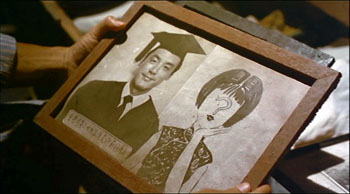
Tsui thinks visually. True, some sound is important—he is a master at merging music and image—but words are a last resort. He has been known to change dialogue in post-production so radically that the dubbing doesn’t match the actors’ lip movements. Shooting without sound gives Tsui, like other Hong Kong directors, a freedom of camera placement that recalls the silent cinema.And like a silent director, he thinks that every story point needs to be pictured. Kenny Bee is looking for the girl he met years ago (Shanghai Blues)? So let’s have an image that dramatizes the problem.
The inclusion of Kenny’s graduation picture might seem superfluous, but it makes the frame an anticipatory wedding picture, and it gives us a sense of his pure, if naïve, romantic impulses.
Motion plus or minus emotion
Shanghai Blues.
If you disapprove of what Spielberg and Lucas did to the American cinema, you will hate Tsui’s love of remakes, sequels, and spinoffs, his frequent confusion of SPFX with imagination, and his efforts to milk franchises to a point that can be considered cynical. Yet historically, he pushed Hong Kong cinema forward.
Before the star-making efforts I’ve already mentioned, indeed before Film Workshop was created, Tsui’s Dangerous Encounters: First Kind (1980) offered a blistering attack on class disparity in Hong Kong. He updated Cantonese fantasy swordplay in Zu: Warriors from the Magic Mountain (1983), and he tried his hand at a local version of low-budget exploitation in We’re Going to Eat You (1980). Keeto’s catalogue essay argues that Film Workshop pioneered six new genres in Hong Kong film, from comic-book adaptations to science-fiction and animation. And there’s more variety than we might expect. Film Workshop directors might have sometimes mimicked his style, but John Woo’s Workshop projects managed to do something quite different. Despite Tsui’s hands-on involvement, the lyrical Iron Monkey and the more hard-edged Gun Men and The Big Heat avoid the eccentricities of his signed work while maintaining his love of flamboyant set-pieces and visual creativity.
Tsui’s scripts often seem like patchwork, granted, but I tried to show in Planet Hong Kong that the episodic, additive plotline is a convention of Hong Kong cinema. Tsui—like Wong Kar-wai, though in a different key—took advantage of this formula to explore the power of the arresting image and an infectious rhythm. (You might say that Wong’s rhythm is that of cool jazz, while Tsui’s is closer to the percussiveness of Chinese opera.) Shanghai Blues and Peking Opera Blues, two of Tsui’s most ingratiating movies, jump smartly from one thrusting scene to the next, shifting emotional registers with dazzling speed. These movies can turn on a dime.
Part of what pulls us along is characters we care about—especially strong women. In the old days, we Hong Kong fans used to love the idea that John Woo, carrying on the Chang Cheh tradition, specialized in the sorrows of masculine obligation, while Tsui was much more interested in women. He gave us the comedy of pretty faces, the wide-eyed innocence of Joey Wong, and the severe beauty of Brigitte Lin who, in the final installment of the Swordsman series, becomes a sheer force of nature. (Her bi-gendered role in Ashes of Time stems from Tsui’s creation of her as such in Swordsman II and The East Is Red.) When Tsui took over the Better Tomorrow franchise, his prequel showed that Woo’s ideal hero Mark (Chow Yun-fat) learned his combat crafts from, of all people, a woman. Even the non-stop testosterone fervor of The Blade, all sweaty torsos and clanking weaponry, may be the hallucination of a madwoman.
These were rousing yarns. Yet at some point, I think, Tsui lost interest in telling a story. This tendency can be detected already in the Van Damme projects; the opening of Knock Off revels in visual effects (microscopic close-ups of the ripping fibers inside running shoes) but doesn’t dwell on what we need to know. Tsui’s task in the collaborative film Triangle was to simply to set up the premises of the action, but dialogue-driven exposition seems to bore him, and the opening scene is a frenzy of eccentric angles and barely registered plot points. His SPFX extravaganza The Legend of Zu has a fairly incomprehensible story to begin with, but by swamping it in explosions and magical transformations, Tsui makes a movie that is, like Spinal Tap’s amplifier knob, permanently set at 11.
With the lack of interest in economical storytelling comes a resistance to emotional engagement. Time and Tide has some virtuoso passages—the tenement sniping, the finale in Kowloon Station (with a woman giving birth during a gun battle)—but the film’s jittery momentum and lack of a coherent point of view sacrifice everything to momentary visceral impact. The death of a little boy caught in the crossfire is not a stab of pathos but the pretext for the visual shock of a ricocheting skateboard.
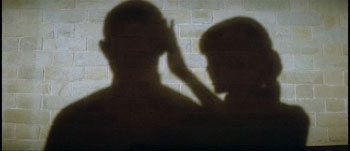
Tsui’s first films often shied away from sustained romantic scenes, a point made by Sylvia Chang in a catalogue interview. Still, he sometimes translated the awkwardness of love into gesture and motion, from the race to the train at the end of Shanghai Blues to the tender exchange of morsels of food between reconciled husband and wife in The Chinese Feast. Even Once Upon a Time in China can pause for a moment to let Aunt Yee reveal her growing affection for Wong Fei-Hong by having her shadow stroke his.
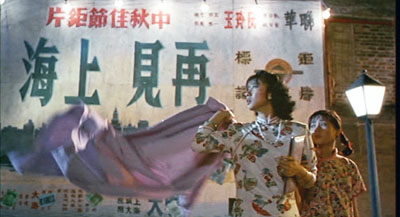
In the early FW films, emotion was translated into movements large or small. Losing her love makes a woman turn abruptly and snap out her cape, underneath a billboard advertising her lover’s song. But more recently Tsui seems to suffocate emotion in a welter of one-off effects. The lustrous HD shots of Missing make it visually striking, but the lacquered technique doesn’t seem to me to serve the story’s core drama of loss.
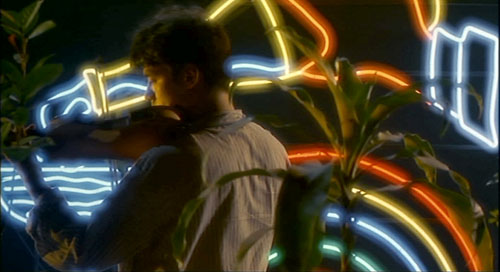
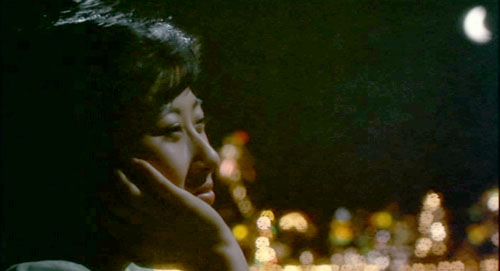
We can’t write Tsui off. He’s not yet sixty, and his new project, the Tang era mystery Detective Dee, sounds promising. Whatever happens next, his many admirers thank him and the FW team for some of the most radiant moments in modern cinema. Everyone who has seen Shanghai Blues needs only the stills at the top and bottom of this entry to conjure up the scene: Kenny plays his violin on the rooftop, we hear the soaring tune “Shanghai Nights,” and as we see Sally listening on another balcony, a chill goes up your spine. A little mad, but mostly genius.
Thanks to Alvin Tse for the illustration from the Film Workshop party.
One director is about as conservative, artistically speaking, as you can get. The other is the long-established wild man of Hong Kong cinema. Both are showcased in retrospectives at this year’s Hong Kong International Film Festival. In a later post, I’ll talk about the outlier; today it’s the Organization Man.
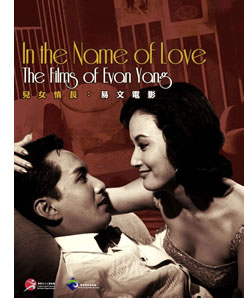
The Hong Kong Film Archive is running a series of works of Evan Yang (Yang Yi Wen). He wrote novels, scripts, song lyrics, and passionate letters to his wife and mistresses, but he’s mostly remembered as a director. Laboring for M. P.& G. I., the Hong Kong studio owned by the Cathay company, Yang established his reputation as a reliable craftsman.
Yang is best remembered for a string of 1950s Mandarin-language movies set in modern Hong Kong; many sequences offer a virtual travelogue of the energetic, sun-drenched colony. Probably Yang’s most famous film is Mambo Girl (1957), starring the effervescent Grace Chang Ge Lan, but local audiences have a fierce sentimental attachment to his two-part historical romance Sun, Moon, and Star (1961). I’ve seen some of these in other thematic retrospectives, but this series is quite thorough. It includes films Yang wrote as well as ones he directed, and it will run through mid-May.
It’s hard to disagree with the severity of the program notes. “His films often suffer from loose structure and sloppy direction. . . Always professional but never a perfectionist. . . . Evan Yang is not a master, nor is he a great film artist. . . .” The impression, not wrongheaded, is of a Hong Kong Charles Walters. But Yang worked hard. In the Archive’s exhibition of his personal papers, you can see his tidy, artisanal dedication. The script pages on display include elaborate notations of shots (ls, cu, diss to…) and markings for repeated setups. It’s evident that Yang took pains to create his smooth, barely noticeable style.
His effort shows on screen. His staging is clean and functional, though he is probably too fond of lining people up in rows. There’s seldom a self-consciously flashy shot or unstable composition. The emphasis is always on straightforward rendering of the melodramatic situations that drive his plots. A doctor falls in love with a patient who’s married (A Little Girl Named Cabbage, 1955). A clerk’s daughter is beautiful but mute, and the family needs money for her operation (The Beauty and the Dumb, 1954). A cat burglar trying to go straight runs afoul of his mercenary wife, who abandons their daughter and then returns to blackmail the family raising her (Blood Will Tell, 1954). Despite the all the adversity, however, things usually turn out well. In Madame Butterfly (1955), Yang updates the opera, making Pinkerton a Hong Kong businessman, and the string of pathetic coincidences swerves into a happy ending.
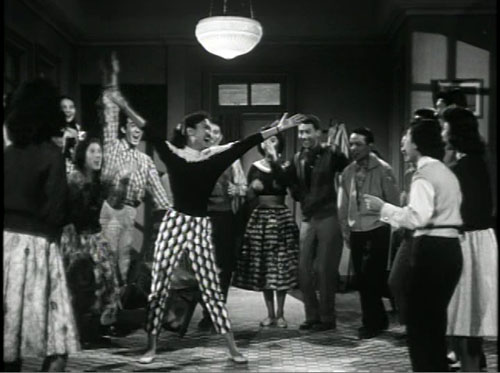
The musicals and comedies, although more light-hearted, still bear streaks of melodrama. What I had remembered about Mambo Girl is its fascination with that dance craze, but the plot actually has a serious basis: Grace learns that she’s adopted and sets out to find her birth mother, who turns out to be a nightclub singer.The breezier college romance Spring Song (1959) takes itself not at all seriously, but there is a persistent class antagonism between Grace and her rich rival.
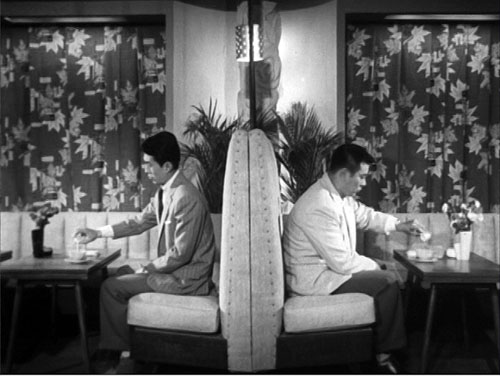
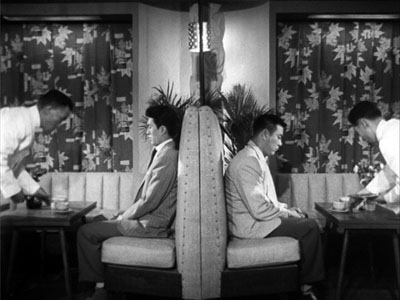
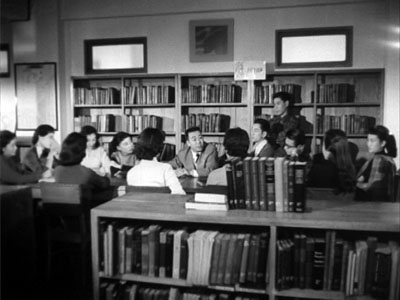
Stylistically, Spring Song shows us Yang in a playful mood. There’s a visual gag during a scene in a coffee shop when our two male leads, Peter Chen Ho and Roy Chiao, wait for their girlfriends. Yang makes them mirror images, even timing the waiters’ arrival to create a funny framing.
Of course when the women arrive and see each other, comic misunderstandings ensue, also played out symmetrically.
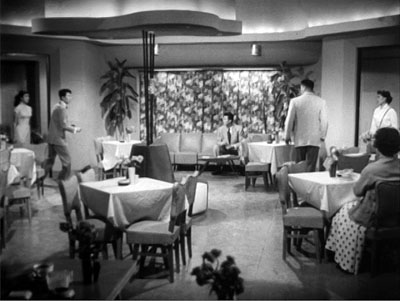
Somewhat more subtly, Yang stages the opposition between Grace and Jeanette Lin Tsui during a meeting of classmates by putting the antagonists at extreme ends of a crowded frame.
The archive has produced a handsome book of Yang’s memoirs, in Chinese only, as well as an informative bilingual pamphlet on the retrospective. I hope to sample other items in the series before I leave next week; you know I won’t miss Yang’s take on spaghetti Westerns, Magnificent Gunfighter (1970).
Even if he weren’t such a solid craftsman, I’d respect his films’ sheer documentary value. When Hong Kong movies of the 1950s venture outside their rather creaky interior sets, they often yield up radiant images of a city on the rise. The scene in The Beauty and the Dumb showing Peter Chen Ho crossing the harbor, sitting happily in his sportscar on the Star Ferry, is enough to brighten your evening.







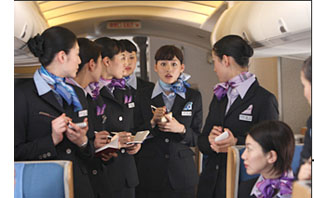 Not part of the festival, but playing in town was the diverting comedy Happy Flight. Like Airport and Airplane!, it weaves together various characters involved with a single flight. It concentrates almost completely on the professionals, from gate agents and mechanics to pilots and air hostesses. The one passenger depicted in detail rings true: After being allowed to bring an oversized bag into the cabin, he becomes a browbeating jerk.
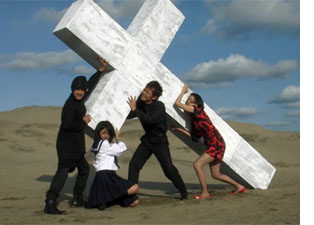 Still further out there on the Nutsometer is Love Exposure, your basic four-hour inquiry into Christianity, cross-dressing, superheroics, and schoolgirl underwear. The story starts with a boy who promises his mother he’ll marry a woman like the Virgin Mary, but thanks to digital photography and an acrobatic approach to filming schoolgirls’ nether regions, he becomes known to his peers as King of the Perverts. Director Sion Sono satirizes cult religions, which seems to include Catholicism (“Your sin is that you can’t remember your own sin”), while devoting some attention to pornographic movies and “Candle in the Wind.” Rambling and digressive, but rapidly paced, Love Exposure proves that nobody beats the Japanese for cheerful dirty fun.