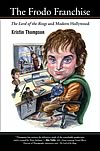
by Kristin Thompson. Berkeley: University of California
Press, 2007.
400 pages, 6 × 9 inches, 12 color illustrations;
36 b/w illustrations.
[go
to Amazon | go to The Frodo Franchise blog]
Coming back from a trip has pleasant and unpleasant consequences. Bills piled up, but so did stacks of packages, books and DVDs we forgot we had ordered or ones sent to us out of the blue.
The intrepid companies that rescue and issue silent films on DVD have been busy. All are past winners of awards in the Cinema Ritrovato festival’s annual ceremony, and obviously they are working hard to keep their standards up. (For a pdf listing all the winners since the awards began in 2004, click here.) Two of my favorite directors are represented.
Much More Méliès!
In 2008, Flicker Alley won “Best Box-Set” for its monumental collection “Georges Méliès: First Wizard of Cinema” (five DVDs with 173 films). Amazingly, 26 more films (or fragments, in one case very short) have been discovered since its issue. These will be released in the U.S. on February 16 on a single disc titled “Georges Méliès Encore.”
One of these, Le Manoir du Diables/The Haunted Castle, from 1896, contains something like 26 cuts, all stop-motion effects. I wouldn’t have thought such an elaborate production would have been possible so early in the history of cinema, but here it is. It’s also interesting for having been shot outdoors, with what looks like a flat gravel “floor.” The lighting changes dramatically at one point, with the sun in a different position after an obvious pause in filming, and for a time the shadow of a tree is visible in the right foreground. The set is also quite elaborate for such an early production. Watch for a moment when the actors bump into the set and cause it to wobble alarmingly.
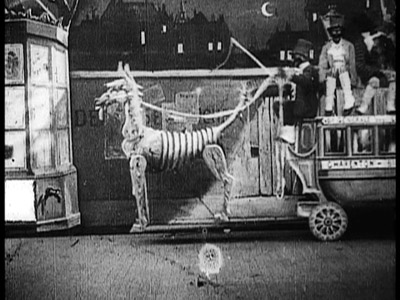
I had long been intrigued by production photos and sketches from a lost Méliès film, L’omnibus des toqués ou Blances et Noirs/Off to Bloomingdale Asylum. (I have no idea why this English title was chosen, since it has nothing to do with the action. “Toqués” would translate roughly as “crazies.”) The thing that intrigued me was a strange, mechanical-looking horse that draws the omnibus of the title. Finally I got to see it, and it was worth the wait. The horse is good, to be sure. It pulls a small coach with five black-face minstrels sitting atop it.
It’s not terribly apparent from the film, but a surviving Méliès sketch makes it obvious that the horse farts, driving the minstrels to jump off. The horse and coach depart, and the four minstrels begin an elaborate game of slapping and kicking each other in rhythm, each blow turning one into a white-clad pierrot figure and then back into a minstrel. It’s another of Méliès’ rapid-fire set of stop-motion substitutions, with the positions of the figures matched with astonishing precision. A tiny masterpiece in one minute and four seconds, counting the title card.
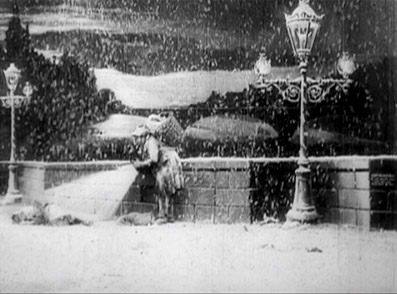
There’s a wide range of genres represented on the disc, including staging of news events, as in Éruption volcanique à la Martinique/ Eruption of Mount Pele (1902); chase films, like Le mariage de Victoire/ How Bridget’s Lover Escaped (1907); and even tear-jerking melodrama, like Détresse et charité/ The Christmas Angel (1904). The latter has an interesting stop-motion effect to add a white-painted stream of light as a rag-picker turns on his lantern to see the little beggar-girl asleep in the snow.
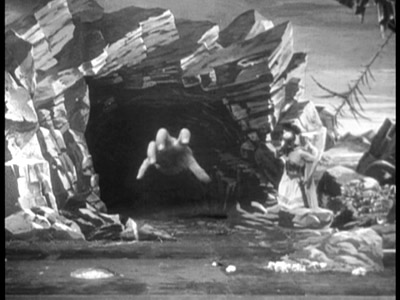
An otherwise surprisingly pedestrian 1905 film, L’ile de Calypso/ The Mysterious Island has one impressive moment, when a giant hand (Polyphemus having been transferred to Calypso’s island) emerges from the dark of a cave to threaten Ulysses (who is a bit hard to see, standing against the rocks at the right of the cave).
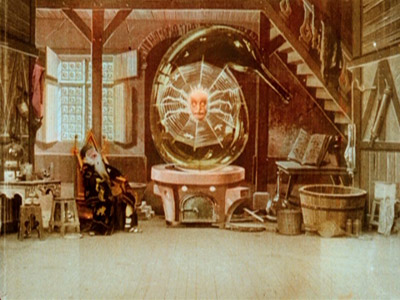
Was Méliès the first filmmaker to realize that leaving a large dark patch in part of set allowed things to be superimposed in that area without looking translucent? The best-known film to use the device is L’Homme à la tête en caoutchouc/ The Man with the Rubber Head (1902), but many other films use it, including some on this disc. A few of the films have hand-coloring, including the early L’hallucination de l’alchimiste/An Hallucinated Alchemist, where the alchemist of the title dreams of a giant spider.
The state of preservation naturally varies enormously. One nearly pristine print is the amusing Satan en prison/Satan in Prison (1907). The title is vital, since the bulk of the action consists of a well-dressed man magically producing a series of items to furnish a bare room, culminating in his summoning up a charming lady to share his meal. Hearing the guards approaching, the man reverses the process, ending with a bare room when the two men enter. Finally he is revealed as one of Méliès’ favorite characters, Satan! (See frame surmounting this entry.)
I suppose we shall never have all of Méliès’ films, but there are now more than twice as many known to survive as when I was in graduate school. I look forward to a second encore.
Lubitsch, Lubitsch, Lubitsch
Another pleasant surprise among the heap of packages was Eureka!’s new boxed set of Ernst Lubitsch films from the years 1918-1921. If that sounds a bit familiar, that’s because this is the third such set to appear in just over three years. I’m not going to make a point-by-point comparison, but I’ll sketch some basic differences.
The German set, confusingly titled in English the “Ernst Lubitsch Collection,” came out in November, 2006 and is PAL, region-2 encoded. It contains five Lubitsch silents: Ich mochte kein Mann sein (1918), Die Austernprinzessin (1919), Sumurun (1920), Anna Boleyn (1921), and Die Bergkatze (1921). Its main bonus is a feature-length documentary, Ernst Lubitsch in Berlin—Von der Schönhauser Allee nach Hollywood. None is subtitled. The set won the Cinema Ritrovato’s prize as Best DVD of 2008.
The set was issued by the Munich company Transit Film, a government-owned 35mm distributor with a library of about 600 titles, drawn from across the history of German cinema. We’ve brought some of their prints to Madison for Cinematheque screenings. The sources of the films are primarily the Friedrich-Wilhelm-Murnau-Foundation and the Bundesarchiv-Filmarchiv. It also produces documentaries like the one on Lubitsch. (The website offers German, English, and French language options.) It has also put out several DVDs under the name “Transit Classics.”
In the U.S., from late 2006 into 2007, Kino Video brought these five titles out as four individual DVDs (pairing Die Austernprinzessin and Ich mochte kein Mannsein on one disc). Apparently, although Transit’s set didn’t include the 1919 comedy Die Puppe, it made it available, and in December 2007, Kino brought it out on a disc with the Ernst Lubitsch in Berlin documentary—and at the same time issued a boxed set of all six features plus the documentary on five DVDs, called “Lubitsch in Berlin.” (All Kino discs are NTSC region 1; given that they were transferred from PAL versions, they probably run about 4% faster than the Transit versions.)
Eureka!’s set is also entitled “Lubitsch in Berlin.” It contains the same set of films, including the documentary, all also licensed from Transit. These are here arranged over six DVDs. Its unique material is relatively slight, consisting mainly of short original sets of liner notes and an original score for Die Puppe. One advantage is that Eureka!, as usual, has retained the German intertitles and added subtitles to them. (The Kino versions, in contrast, replace the original intertitles with English ones, which has been their practice on some, if not all, of their other DVDs.) Some or all of these intertitles may have been replaced, perhaps reconstructed on the basis of censorship records, as is often the case with restorations. Still, many viewers would want access to the German text as well as the English versions. The Eureka! set is PAL, and it doesn’t seem to have region coding.
For those unfamiliar with Lubitsch’s German films, these are a good introduction. The four comedies all hold up well today. The first three are built around Ossi Oswalda, a boisterous blonde comic who seems to have inspired Lubitsch to move away from broad slapstick to a more stylized, eccentric approach. Pola Negri, after acting such roles as Carmen and Madame Dubarry in the director’s costume pictures, revealed her comic talents in Die Bergkatze, his last German comedy.
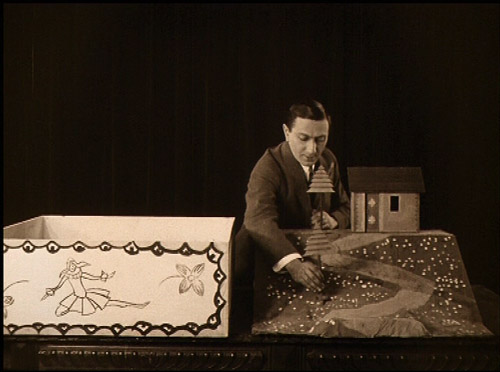
Overall my favorite of the group is Die Puppe, so I’m very glad it’s been added. Some might prefer Die Austernprinzessin, which is indeed hilarious. But it mainly has the wealthy heroine’s home as its comic milieu. Die Puppe seems denser, with more characters and three comedy-generating settings: the rich uncle’s home, the art-nouveau cartoon doll shop, and the monastery where the hero takes refuge. Plus there’s the famous prologue, where Lubitsch himself sets up the premise that the characters themselves are simply dolls brought to life. (See below.)
I chose Ich möchte kein Mann sein as one of the best films of 1918. See here for a brief description and a frame at the bottom of the entry.
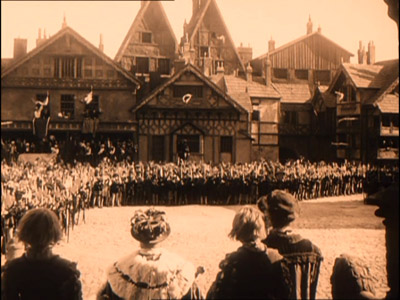
The conspicuous absence from this set is Madame Dubarry, the 1919 historical epic that made Lubitsch famous worldwide. Perhaps it’s not an ingratiating film at first viewing, but I found that it grew on me in repeated screenings. (I talk about some of its best scenes including one impressive long-take scene, in my book Herr Lubitsch Goes to Hollywood.) Anna Boleyn took on British history in an attempt to replicate the success of Madame Dubarry, but I have never been able to warm up to it. That’s probably partly because Henny Porten simply did not bring the vibrancy to the title role that Negri had in Madame Dubarry and perhaps partly because the increased budget let to an overemphasis on huge sets and crowds of extras (above). The characters in Madame Dubarry seem comfortable in their period costumes; the ones in Anna Boleyn don’t.
I chose Die Puppe as one of the best films of 1919. See here for a frame from it, and one that demonstrates why I admire Madame Dubarry. Perhaps restoration work on the latter is going on at this moment, so that another DVD will someday join these on the shelf.
The other film in the collection, Sumurun, is a quasi-Arabian-Nights tale, starring Pola Negri as a seductive member of a traveling troupe of entertainers. Lubitsch plays his last film role as the hunchback clown who dotes hopelessly on her. The performance isn’t all that different from some of his earlier ones, but perhaps seeing his rather exaggerated acting style in the context of a non-comic film led Lubitsch to doubt his own abilities. Given that he was far better as a director than as an actor, his decision to stay behind the camera was a boon to future generations. To me, Sumurun is fascinating because it shows the first real signs of Lubitsch’s awareness of Hollywood continuity editing, a set of techniques he would thoroughly master over the course of his next half-dozen films.
It can’t have been easy to put together a 109-minute documentary on Lubitsch’s life before his move to Hollywood. In working on my book, I discovered how surprisingly few photographs of him at work onset survive. The studios where he worked don’t survive, though there are shots of the giant Ufa Tempelhof sound stages that now stand where those studios were.
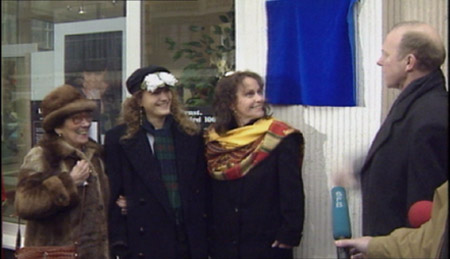
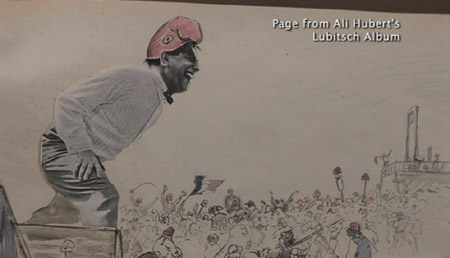
Several prominent historians are interviewed, including archivist Enno Patalas and historian Hans Helmut Prinzler, co-editors of Lubitsch (an extremely useful book, published by the Verlag C. J. Bucher i 1984) and archivist Jan-Christopher Horak (whose master’s thesis was on Lubitsch’s relation to Ufa). Lubitsch’s surviving family members, seen above at the unveiling of a “Lubitsch lived here” plaque, were interviewed: his niece Evy Bettelheim-Bentley (left), granddaughter Amanda Goodpaster (center), and daughter Nicola (right). Lubitsch’s theatrical career is well covered, and generous clips from the pre-1918 era demonstrate his move into comic acting for films. Audio interviews with Henny Porten and Emil Jannings include a charming anecdote she tells about how apologetic Jannings was after the scene in Kohlhiesels Töchter in which his character jerks a bench out from under her–an incident that left her with a bruised rump. In between scenes, directors who have been awarded the Ernst Lubitsch prize, such as Tom Tykwer, discuss the master. Perhaps the most interesting artifact shown is an album Lubitsch’s regular costume designer and friend Ali Hubert made for him, combining drawings with photos of Lubitsch and little poems; below he depicts Lubitsch directing Madame Dubarry. Ultimately Hubert gave it to the director as a gift.
The documentary feels a trifle thin at times, and it makes no real attempt to cover Lubitsch’s Hollywood career, presumably because of the difficulty of getting permission to use clips. But it certainly would be a useful teaching tool for introducing students to Lubitsch’s life before Hollywood.
(Thanks to Ben Brewster for helping determine some of the differences among these three Lubitsch boxes.)
The Man with a Movie Camera before The Man with a Movie Camera
In 2007, the Cinema Ritrovato awarded the “Edition Filmmuseum” series from the Filmmuseum Munchen its DVD award for “Best Series.” We’ve mentioned this series before, in relation to its Walter Ruttmann disc and its DVD of Robert Reinhert’s Nerven.
Now the Filmmuseum has issued a two-disc set offering two of Dziga Vertov’s silent feature documentaries, A Sixth Part of the World (1926) and The Eleventh Year (1928). The former is a poetic look at the various and farflung ethnic groups within the U.S.S.R., the population of which made up one sixth of the world. It was the first of Vertov’s films to be strongly praised, seeming to justify his theory of the Kino-Eye.
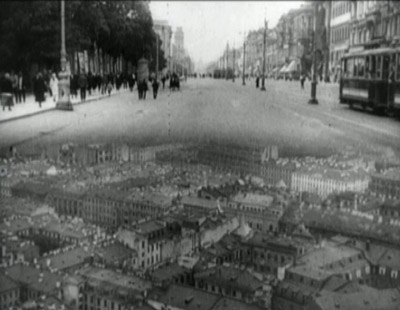
Those expecting anything as experimental as Man with a Movie Camera might be disappointed. There are some of the familiar camera tricks, such as split-screen effects:
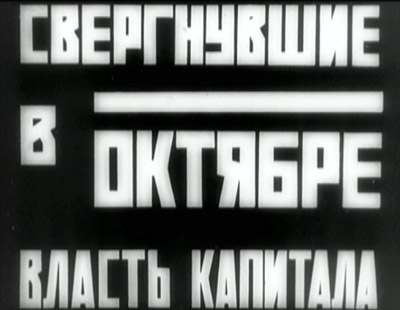
The typography of the intertitles reflects the constructivist style of the 1920s:
The discs have optional English subtitles.
Having seen these films during my research, I haven’t watched the discs in their entirety. The quality looks as good as can be expected. Michael Nyman’s music is certainly not authentic to the period, but what I heard of it sounded strangely appropriate to the images and effective as accompaniment.
The discs also include an interesting bonus, a German propaganda short, Im Schatten der Maschine, by Albrecht Viktor Blum, which used footage from The Eleventh Year to make a film critical of the technical progress which Vertov was praising in his own movie. (Since The Eleventh Year had not yet appeared in Germany, Vertov was actually accused of plagiarizing from Blum rather than the other way round.)
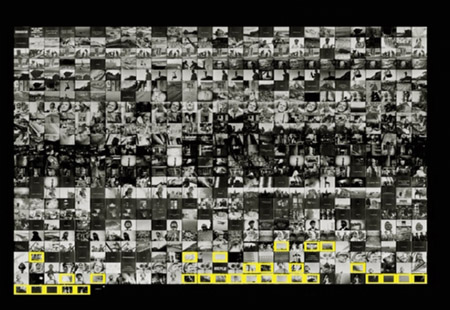
Another bonus is a 14-minute documentary, Vertov in Blum: An Investigation (optional German or English narration). This fascinating short begins by demonstrating that Vertov himself and possibly others almost certainly cannibalized footage from The Eleventh Year for Man with a Movie Camera and other films. It goes on to hypothesize that the final montage in Im Schatten der Maschine may consist of footage that Vertov later removed from The Eleventh Year‘s negative. Side by side comparison of prints using Final Cut Pro revealed matching shots between the two films, highlighted in yellow here:
Blum’s film culls shots and even edited passages primarily from late in Vertov’s film, but it continues beyond the end of the surviving version of The Eleventh Year. Some of those shots have been traced to other, later Vertov films, and the archival sleuths are still comparing prints and looking for the rest. They may have found the missing ending from The Eleventh Year; at least, the evidence makes that idea very plausible. Whether they are right or not, though, the short demonstrates the painstaking work often necessary in the restoration of films.
These companies and archives have certainly not been resting on their laurels. It will be exciting to see what the upcoming Cinema Ritrovato’s awards will highlight.
What do we see when we look around us? A world teeming with creatures and things. We tend to ignore what enables us to see all that: light. To a great extent, that bias is wired into our perceptual systems. An orange looks the same color to us in sunshine and in shade. But photograph it, and you’ll see that actually it throws off very different wavelengths in the two situations. We evolved, it seems, to mute all the variations in light we encounter. Psychologists call this “the primacy of object perception.”
It takes an artist to shift from the what to the how, to notice how different patterns of illumination can alter the shape and texture of an object. A painter, a photographer, and a cinematographer must learn to see light itself.
This was the core message of Steven Poster, an outstanding Director of Photography who came to visit Madison last weekend. Steven is probably most famous for working with Richard Kelly on Donnie Darko, Southland Tales, and The Box, but he has shot dozens of feature films, shorts, television movies, and pilots. He also has several Madison connections; he hung around the campus in his college years, saw Jules and Jim for the first time in the Memorial Union, and built a production house in Chicago with Mik Derks, who now works for Wisconsin Public Television.
Steven gave a workshop on cinematography that bristled with energy (five hours with only a brief break) and followed that with a screening of The Box, accompanied by a Q & A. Across a single packed Saturday, he took students and faculty on an adventure in seeing.
Seeing the light
Steven started as a still photographer at about age ten, and his ideas of visual design are very much allied with classic image-making. (He carried a Leica with him on his visit, and a display of his photos is currently mounted in a campus gallery.) He has a modernist bent too. He credits his years as a student at Southern Illinois University with introducing him to the ideas of the Bauhaus. He plunged more deeply into Bauhaus ideas at the Illinois Institute of Technology, where Mies van der Rohe and Moholy-Nagy taught.
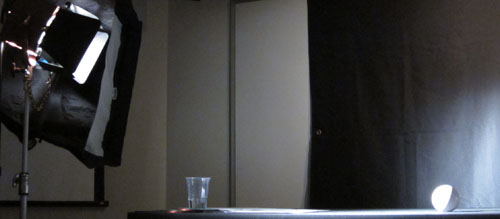
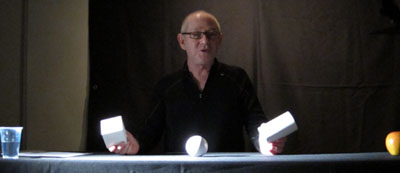
Later in his career, he studied at the Los Angeles Art Center College of Design. A turning point in his understanding came in Charles Potts’ photography course, when Potts began the semester by announcing softly, “Light is a law.” Steven’s talk for us, he explained modestly, was a “profoundly simple subset” of Potts’ course. Put it another way: In the Bauhaus spirit, he showed how simple principles yield subtle results. Armed with only a white ball, a white cube, and a white cylinder, he gave us a tutorial in the delicate modulations of vision.
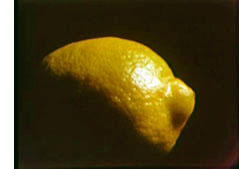
There are, Steven suggested, basically only two kinds of light: direct and indirect (or diffuse). Sunshine yields direct light; a cloudy day yields diffuse light. And when light falls on an object, the encounter has five components. The object gains a highlight, the bright region that suggests the direction of the light source. The object also acquires a shadow area. Between the highlight and the shadow is the boundary, or core—an important hint about the quality of the source light. (If the core has a crisp edge, the light is hard; if the core is a mild transition, the light is softer.) The fourth component is the shadow that the object casts on another surface. Finally, there is the specular or incident highlight, a spot of reflected light within the lit region. A specular highlight is a cue for texture as well as shape and light source. As Steven spoke, I kept thinking about Hollis Frampton’s Lemon (1969), a masterfully simple demonstration of many of these principles: slightly changing light reveals a prototypical shape (what other things have the outline of a lemon?) and a surface that is both shiny and bumpy.
By varying the type of light (direct or indirect) and the angle and distance of the source, Steven showed how these five components can be manipulated to bring out expressive qualities of the object. The cube, for example, can gain sharper contours through sidelong lighting, and illuminating the background can bring out its volume. Likewise, an object’s shadow area can be controlled through fill light—though Steven warned about over-filling, which can work against the precision provided by the key light. Another example is the way in which shooting glass or metal with pinpoint sources yields a scatter of specular reflections. If those aren’t wanted, as in some car commercials, the DP can use broad, diffuse illumination. This “liquid light” brings out contours through a softer gleam.
Of course a shot typically combines many objects, so the task of controlling how light hits them, and how they are arranged in relation to each other, becomes much more complicated. The shapes, textures, and emotional qualities of the elements have to be harmonized. “Elegant” was a word Steven used frequently: the composition, like the light, should be clear and well-defined. Needless to say, the result on screen can be grasped at a glance, but achieving such clarity needs painstaking control.
So seeing the light involves grasping everything around you, from landscapes and furniture to people’s faces and clothing, within the framework of highlights, shadow, core, and the like. This alone is enough to change your visual habits. But there’s more. By and large Steven made his adjustments without checking the monitor displaying what the camera was taking in. Standing almost anywhere, he could shift the light, tune the fill, and “wrap” the object, and on the monitor we could see the effect click into place. That skill demands more than a change in how to look at things. It’s an eye-body coordination that takes years of expert practice, an acquiescence to the law of light.
Behind the scenes
The discussion following this demo ranged across many aspects of cinematography, and Steven filled in abstract points with examples from his experience. My notes run to eleven pages, but this sampling should give you an idea of his stimulating presence.
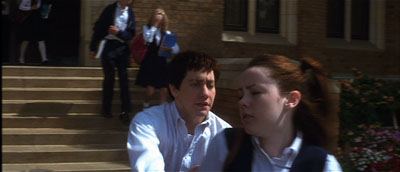
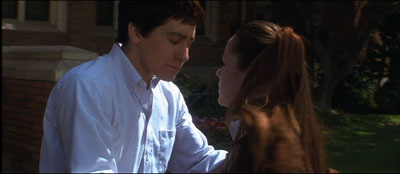
*A problem-solution dynamic emerged in one shot in Donnie Darko, above. We need to see Donnie’s face when he catches up with Gretchen, but the day was sunny and at first the faces display somewhat harsh shadows. But when the couple move toward a kiss, the solution came from their clothes: Donnie’s shirt and Gretchen’s blouse provide softer bounce light on his face.
*Steven stressed the need for complete trust and frankness between director and DP. “I won’t take a job if the director won’t look me in the eye.” Once that bond is established, the DP’s job is to protect the director and work to fulfill his or her vision. “My job is to protect the director.”
*Filmmaking is an intensely physical job, and so two concerns have to be paramount: safety and health. “No film is worth getting somebody hurt,” Steven remarked, so he insists that every crew member is a safety officer, looking out for everyone’s well-being. At the same time, filmmaking demands stamina, discipline, and a clear head, so everyone needs to have a healthy regimen and cultivate a certain “inner life” that keeps job pressures in perspective.
*Steven had much to say about the video assist. He suggested that it has led to directors using more close views, because such shots read better on small monitors. (I made a similar suggestion in The Way Hollywood Tells It.) Steven fights what he calls the “loss of scope” on video displays by presenting the digital dailies in full-size projection, as in the film-based days. “It reminds everybody that we’re making a big movie,” and it encourages directors not to overuse close-ups.
*Steven is happy with the digital intermediate process. As a cinematographer who wants to control all aspects of the image, he welcomes all the adjustments he can make in postproduction, especially thanks to the Lustre grading program. “It’s like being back in the darkroom again.”
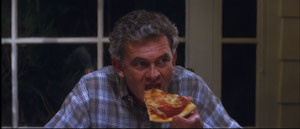
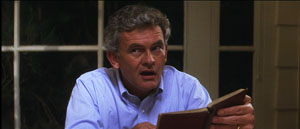
*On Donnie, a low-budget film, Kelly and Steven were forced to shoot the family dinner scenes in a single night. To save time, they used “block shooting.” For each actor, a basic setup was established and all the actor’s lines from both scenes were taken at one time. It was faster to have the actor change clothes for the later scene than to shift the camera position and relight the setups.
*Speaking of table scenes, they pose a lot of problems. Even Steven finds such scenes “the hardest.” “Where’s the [180-degree] line in this situation? I’ve seen fights break out on sets about it.”
*At one point Steven talked about prominent objects in a scene, such as candelabra and ketchup bottles. If you use symmetrical reverse shots, those objects can jump distractingly from one side of the screen to the other. Steven tries to make sure that such eye-catchers appear in only one of the setups, not both. The coffee cup in this scene of Southland Tales is hidden in the reverse angles.
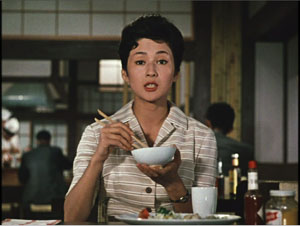
Steven’s point reminded me that Ozu breaks this rule of thumb and playfully lets his objects jump around the frame from cut to cut. Indeed, he often rearranged the props to heighten this peripheral dance. In one scene of Late Autumn, the tabasco sauce bottle pivots consistently, but the French’s mustard jar changes position.
*Steven thinks that 3-D will succeed this time, chiefly because of the push for 3-D television. The technique probably won’t work for all stories, and the format poses some technical problems. But the software is getting better, and filmmakers, such as Cameron in Avatar, are starting to avoid the gimmick of obects thrusting out of the screen. It’s better, Steven thinks, to let the depth recede into the movie’s world, making the screen a window. I recalled that this was the strategy used in Coraline, Up, and other films of last year, so perhaps this will become the dominant way that 3-D will be used.
*Steven urged students to get broad general educations and not become movie nerds. They should study history, political science, art, and literature. He pointed out that Werner Herzog, his friend and neighbor, insists in his Rogue Film School that literary classics are the basis of a film education.
*Steven has long been an advocate of unionization. As President of Local 600 of the International Cinematographers Guild, he explained how the Guild now welcomes members, especially women and people of color. I thought it was salutary to give students a taste of the practicalities of professional life by explaining what the Guild had accomplished.
*Steven did additional photography on Blade Runner, and he learned a great deal while gaining deep respect for Jordan Cronenweth, DP on the movie. Steven rewatches the film often, and each time he finds something new. On the last pass, he saw that in the search of Kowalski’s apartment, flickering streaks of light coming from inside the desk drawer call attention to the newspaper that Deckard finds there.
Back in 1980-1982, when Kristin and I were doing research on The Classical Hollywood Cinema, we found that Charles G. Clarke, Linwood Dunn, William Hornbeck, Stanley Cortez, and other professionals whom we interviewed were intellectuals, eager to explain the ideas informing their creative decisions. Steven Poster’s career is another outstanding example of how theory and practice work together, often unobtrusively, to conjure up the enthralling world on screen. I can’t imagine a film researcher, or just a movie lover, not wanting to know filmmakers’ craft and the principles informing it. Once you’ve visit the kitchen, movies gain a whole new flavor.
This blog has intersected with primary Bauhaus shapes before. I discuss “the dinner-table conundrum” in the first few pages of Figures Traced in Light. One of the best analyses I’ve read on illumination in the visual arts is E. H. Gombrich’s “Light, Form and Texture in Fifteenth-Century Painting North and South of the Alps,” in The Heritage of Apelles: Studies in the Art of the Renaissance (Ithaca: Cornell University Pres, 1976), 19-35. For more on Ozu’s penchant for letting brightly lit objects jump around the composition, see this chapter of my Ozu and the Poetics of Cinema. The Lustre program was devised for The Lord of the Rings, and Kristin discusses its origins and influence in The Frodo Franchise, pp. 280-281.
Special thanks to Steven for his visit, the Wisconsin Union Directorate for arranging it, and Erik Gunneson, Joel Ninmann, Justin Daering, and J. J. Murphy for setting up the workshop.
Our trip to Europe has come to an end, and so we finish with a post scanning some highlights.
The magic lantern learns new tricks
DB here:
What am I seeing? Many avant-garde films pose this question. Mainstream fiction film and documentary cinema have mostly relied on the idea that the image should be recognizable as “what it is.” But one strain of experimental film has worked to delay or even prevent us from making out what’s in front of the camera.
Sometimes we lose our bearings only briefly, as when we eventually identify pot lids in Ballet Mécanique or bits of sunlit linoleum in Brakhage films. Sometimes language points out what’s really there. The titles of Joris Ivens’ Rain and the Eames’ Blacktop: The Washing of a School Play Yard allow us to enjoy the ways that ordinary sights can yield unexpected abstraction. Sometimes we toggle back and forth, as when in Ken Jacobs’ Tom, Tom, the Piper’s Son recognizable human figures, however grainy, jump into sheer blotchiness and then back into something like legibility. But other times we can’t ever tell what we’re seeing. Brakhage’s Fire of Waters offers one of the best examples I know, with its jagged bursts of light in a smoky void.
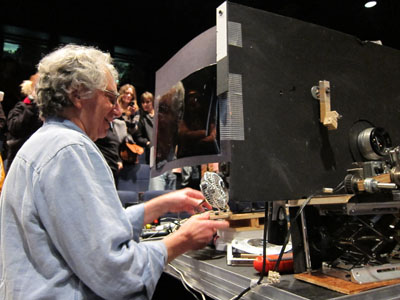
What am I seeing? The uncertainty was doubled during my visit to Ken Jacobs’ Nervous Magic Lantern performance at the Cinémathèque Française. I say “doubled” because at least with Fire of Waters and Tom, Tom I knew I was watching a film. With this display, What am I seeing? started as a question about the format itself. Was it a film, a video, or something else?
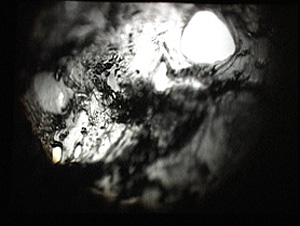
Then the question became the customary one. Off-white textures—pebbly, dribbly, stalagmite-like—swim in and out of focus. Some are viscous and globular, some are like tangled foliage. They seem to spiral, but actually (I put up a finger to measure) they barely move. The effect of movement is given by pulsations of pure black, breaking the lyrical effect of the surfaces with a harshness that becomes aggressive. Aggressive as well is the soundtrack, blocks of sound from subway platforms and traffic and kitsch Latin percussion, all played at high volume. The surfaces just keep shifting and not shifting, sort of rotating while jabbing out at us, lovely and anxiety-inducing at the same time.
At the end of the performance, people crowded around the cardboard booth in the middle of the theatre. As Ken and Flo Jacobs packed up, they showed how they had generated the effects. What had I been seeing? Neither a film nor a video but a true magic-lantern display, assembled on the spot. But what had I been seeing? Something created with home-made equipment of a startling simplicity. (Strapping tape was involved.) Our magicians explained their tricks, like magic-lantern operators of earlier centuries explaining the science behind their shows. But I think it’s best that you not know until after you have a chance to see what they create.
In earlier entries (here and here) Kristin and I have praised Jacobs’ films for showing how very slight adjustments in technique or technology can create disturbing cinematic illusions. In this vein, the first item on the Cinémathèque program, a video called Gift of Fire, turned Louis Le Prince’s brief 1888 street scene into a 3D movie. (The homage was appropriate because Le Prince experimented with multiple-lens cameras.) The Nervous Magic Lantern performance generated a different sort of illusion, one conjuring up micro-landscapes and otherworldly vortices. In all, Jacobs makes us realize how many evocative effects are still to be discovered by tinkering with images thrown on a screen.
Detour to Berlin
KT here:
As David mentioned in last week’s entry, I took a week in the middle of our visit to Europe for research at the Ägyptisches Museum in Berlin. The staff there welcomed me into their storerooms, and I spent the days looking at fragments and the records of their discovery and the nights downloading and backing up my photos. No time for filmgoing. The most I managed was a trip to the well-stocked arts bookshop Bücherbogen, which has one of the best selections of film books to be found in Germany. Our old friend, experimental filmmaker Carlos Bustamente, met me there, and we had a quick cup of tea–most welcome on a cold morning when the results of the biggest snowfall in decades were still blanketing many sidewalks and roads.
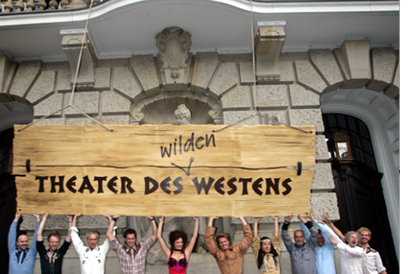
I did note one film-related phenomenon, however. Every day I took the S-Bahn from Savignyplatz to Friedrichstrasse. The tracks pass directly across the street from the Theater des Westens (that is, the western part of Berlin). It was playing Der Schuh des Manitu, a musical version of the highly successful 2001 German film of the same name. (I hope the publicity photo at the left was taken in warmer weather than I experienced.) I mentioned the film here, in reference to the fact that every major producing country, and some minor ones as well, turn out their own local comedies, films that don’t travel well but are very popular locally.
By now it’s a familiar phenomenon in the U.S. for successful Hollywood films to be turned into stage musicals. It wasn’t always so. Back in the 1950s and 1960s, films were made of popular musicals, sometimes successfully, as with My Fair Lady, and sometimes not, as with Mame. But now the trend is the other way, with everything from Shrek to Hairspray getting the Broadway treatment.
It’s interesting to know that the same thing goes on abroad, though I’m not sure how prevalent such adaptations are. Der Schuh des Manitu, directed by Michael “Bully” Herbig, remains the highest grossing German film. Herbig doesn’t act in the stage play, as he did in the film, but he served as a creative advisor. The musical is a hit, having premiered on December 7, 2008 and it is expected to continue until at least the autumn of this year. There are several clips from both the film and the musical on YouTube. This one, at 8 minutes, gives a generous dose of the show. There are no subtitles.
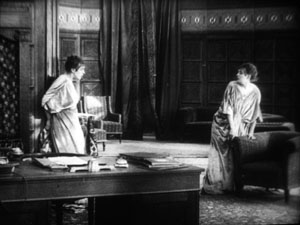
I had only a couple of days back in Paris before we headed for Brussels for the final week of our trip. The German theme continued, since a few of the 1910s films David needed to see at the Cinematek here were German. The one I most wanted to see was Edmund Edel’s 1916 feature, Doktor Satansohn. Its main claim to fame is probably the fact that Ernst Lubitsch plays the title role. My book with Lubitsch started with his 1918 move to features, when he began to concentrate more on directing and less on acting. By 1920, with Sumurun, he appeared onscreen for the last time; being discontented with his performance as the tragic clown, he decided it was time to move behind the camera for good.
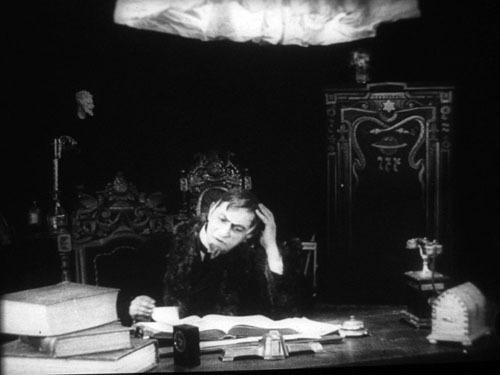
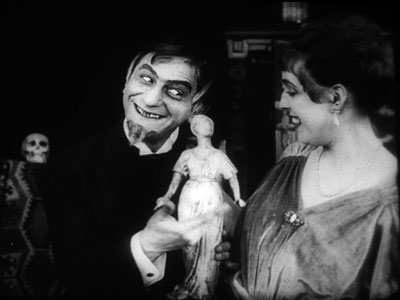
In the short films he starred in before 1918, Lubitsch often played a brash, ambitious Jewish youth, as in Der Stoltz der Firma (“The Pride of the Firm,” 1914). In Doktor Satansohn he’s a physician with a magical machine that transforms older women into beautiful young ones. We’re first introduced to a couple and the wife’s mother. When the latter makes a pass at her son-in-law and is rejected, she seeks the doctor’s help. His machine works by capturing the wife’s essence in a statuette and making the mother look like her daughter. Problem is, every time she’s about to kiss the husband, the doctor pops up with his devilish leer, visible only to the “wife.” David and I decided that the film is a comedy, though perhaps one only Germans of the day would find truly amusing. For one thing, the title character is clearly a Jewish caricature, one played to the hilt by Lubitsch. He decorates his machine with the Star of David and a Hebrew inscription (not to mention vipers and an image of Saturn).
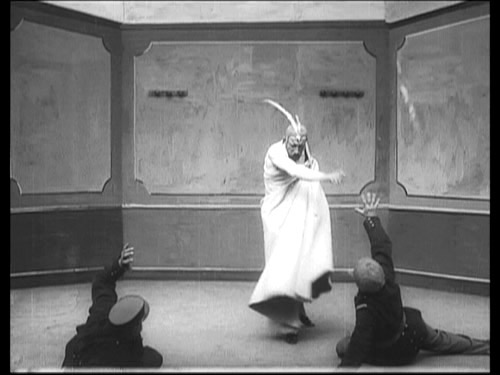
Stylistically it’s a fairly conventional film for its day, though the black background of the doctor’s office, with its stylized youth machine and satyr-like bust, gives a hint of Expressionism to come. (See our topmost image.) Inevitably near the end there comes the moment beloved of historians of pre-World War II German cinema. The real daughter, released from her imprisonment in the statuette, confronts her double in the doctor’s waiting room. The Doppelgänger motif strikes again.
I wonder if German films actually have more Doppelgängers in them than appear in other national cinemas. Do they really reflect the disturbed soul of the nation? Or did the possibilities of filmic special effects draw moviemakers to try and multiply single figures? Georges Méliès and Buster Keaton used in-camera techniques to multiple their own figures in virtuoso displays. I recall being impressed by The Parent Trap‘s duplication of Hayley Mills when I saw it as a kid, and the whole notion of a single actor playing twins and other lookalike relations is a common enough convention. In Doktor Satanssohn, the doubled figure appears only in this one shot, and it’s the leering Lubitsch, delighted with his own nastiness, who walks off with the picture.
The 1910s, again, and still
DB again:
We saw Doktor Satansohn while I was studying staging and cutting strategies of the 1910s, thanks to the remarkable holdings of the Royal Film Archive of Belgium, also known as the Cinematek. My comments on last summer’s visit are here.
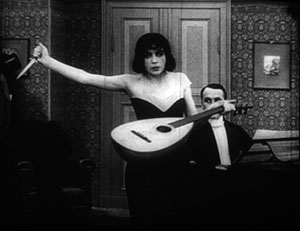
Another German film, in a choppy Russian print, vouchsafed a new glimpse of Asta Nielsen. In Totentanz (Urban Gad, 1912), she plays a guitarist-dancer who must take to the stage to support her infirm husband. She attracts the devotion of a composer, and soon she feels attracted to him. Torn between desire and duty, she snaps during a rehearsal of his latest piece, “Totentanz.” In a chilling gesture, she uses his dagger to slice her lute strings.
Soon the two are locked in a violent erotic struggle, and a stabbing ensues. In all, melodrama as ripe as one could want.
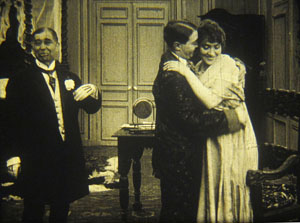
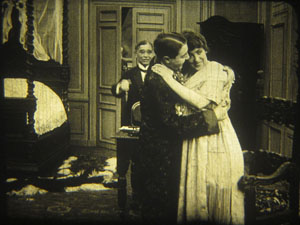
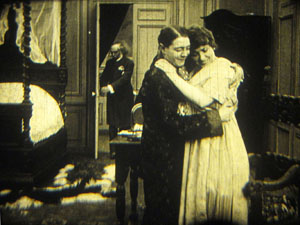
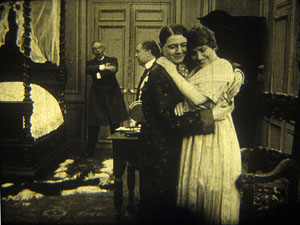
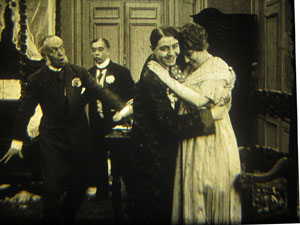
As ever, I was happy to have my hypotheses about tableau staging confirmed by several of the titles I saw. A minor French bedroom farce, Le Paradis (M. G. Leprieur, 1914 or 1915), had a brief passage of the sort of blocking and revealing we find in many films of the period. The painter Raphael Delacroix (no kidding) is pretending to be the lover of Claire Taupin to deflect the advances of randy M. Pontbichot. But Claire is actually the mistress of M. Grésillon. . . .
First, very frontal staging strings out Pontbichot, Raphael, and Claire. The older man relents in his pursuit of her.
In the vivid depth characteristic of the tableau tradition, Pontbichot withdraws. But his position accentuates that central door, which starts to open.
Most remarkably, Pontbichot ducks almost entirely behind the couple, giving pride of place to M. Grésillon’s arrival in the center of the shot.
Pontbichot slides out in time to register Grésillon’s outraged reaction to finding his mistress in another man’s arms.
Grésillon rushes to the frontal plane, furious. As ever, a thrust to the foreground creates a major spatial/ dramatic event.
Although the Le Paradis passage is ABC compared to the emotionally powerful patterns of staging we find in Ingeborg Holm (1913), it illustrates how even average films could resort to the blocking/ revealing tactic within the deep-space geometry of the tableau.
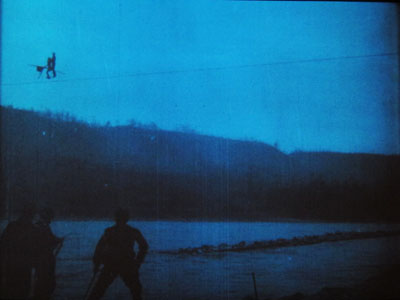
More flamboyant was Il Jockey della Morte (1915), an Italian circus film made by the Dane Alfred Lind. Its bold lighting and varied angles on the Big Top recalled the Danish films of a few years before. Halfway through, Lind launches a dazzling chase that features leaps from a tall bridge and bicycling stunts on a cable stretched across a river.
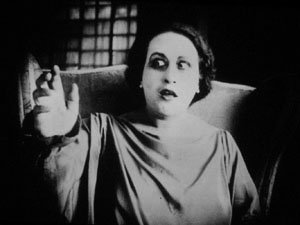
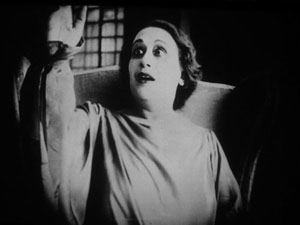
Another Italian film, this time a diva vehicle, suggests that by 1917 1923 (see below) the tableau style was already giving way had given way to scenes organized around close shots. (See below.) L’Ombra (Mario Almirante) starred Italia Almirante Manzini as a lively, trusting wife who becomes paralyzed. While her husband betrays her with her younger protégée, she gradually recovers bodily movement. Yes, a paralyzed diva seems a contradiction in terms, but one small-scale scene shows a remarkable range of emotions. Berta’s hands start twitching, one lifts up, and she stares wildly, as if it were an alien being.
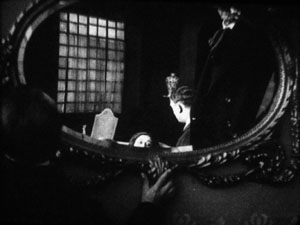
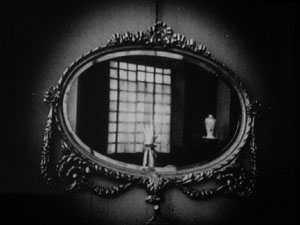
In an earlier scene, Berta had asked that a mirror facing her be tipped upward so that she would never see herself sitting immobile. This shot pays off now, when the hand ascends almost magically into the bit of reflection she can see.
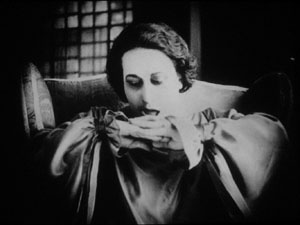
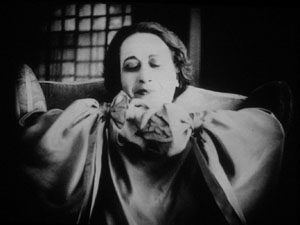
When the hand descends, her astonishment turns into joy. She experimentally shoves the hands together, as if asserting her control.
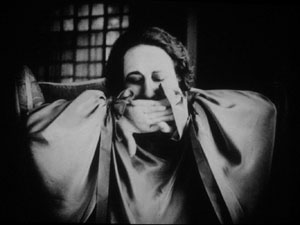
In the end, she kisses her hands as if they were pampered children.
Manzini runs through many more micro-emotions than I’ve indicated here, but this sample is typical of the ways in which L’Ombra avoides the long-shot choreography of only a few years before and builds a performance out of face, body, and arms in a close framing. The mirror-shot motif shows that fairly careful filmic construction was emerging at this point too.
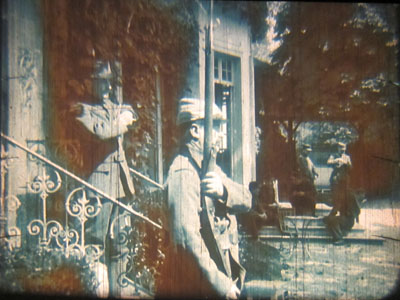
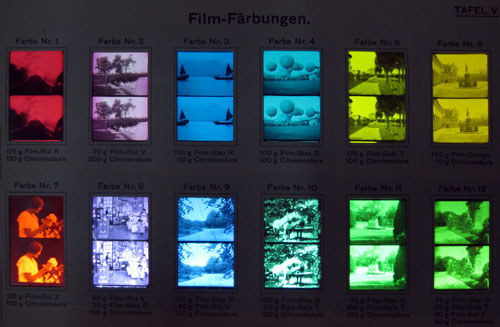
During my stay, I learned more about tinting and toning from the ever-helpful Noël Desmet. On the seldom-seen World War I drama L’Empreinte de la patrie (M. Dumeny, 1915), some images had curious oscillating patches of rusty brown. Noël explained that when Prussian Blue toning was combined with rose tinting, the chemicals eventually reacted to alter the pink cast. An example is shown at the top of this section, though the blue is more saturated in the original.
Once we get back to Madison, I’ll have to sort out all that I’ve learned from these movies. Onward and upward with the 1910s!
For more on Jacobs’ Nervous Magic Lantern, see Scott Foundas’ interview here. The Youtube clip doesn’t do the spectacle justice. If you must know something of Jacobs’ tools, the Dailymotion video from the performance I saw offers some clues. My notions about 1910s staging are laid out in On the History of Film Style and Figures Traced in Light. You can also find several discussions in earlier entries on this site. Just execute a search on tableau.
Now is a good time to thank Noël Desmet and Marianne Winderickx, both of whom are retiring from the archive in March. The research that Kristin and I have done over the years owes an enormous lot to them, and of course to the Director of the Cinematek Gabrielle Claes.
P.S. 15 November 2013:Ivo Blom has pointed out that the version of L’Ombra I saw wasn’t from 1917 but rather from 1923. Hence the corrections above. Thanks very much to Ivo! Go here for his blog and information about his newest publication on silent Italian cinema.
A tinting and toning sample card from the early 1920s. Courtesy Noël Desmet.
“There is really no such thing as Art. There are only artists.” I tend to interpret the disarming opening of Ernst Gombrich’s Story of Art as a protest against the idea that art has an essence that unfolds through history. Those of us in film studies can spot the heritage of this Hegelian idea in one standard story that is told about how editing came to be a dominant technique. According to the formula, editing is “essentially cinematic,” but this essence didn’t reveal itself immediately. It emerged in phases, thanks to the insights of brilliant creators (Méliès, Porter, Griffith, the Russians). Understanding cinema’s history, according to this view, means tracking how film revealed its inherent nature.
In saying that Art doesn’t exist, Gombrich isn’t trying for an elaborate philosophical argument. He’s suggesting a way of understanding art history. His abrupt two sentences suggest that the historian shouldn’t presume that any art has an essence, a secret core that dictates how its history unfolds. He proposes seeing continuity and change in what we call the arts as springing from concrete activities of individuals and groups. Cinema’s history then becomes an account of the creative decisions of filmmakers faced with particular demands and problems. Some of those decisions can converge across the community. The results are trends, such as the increased use of editing, which have real consequences but which are aren’t the result of some secret, essential process.
Once we try to analyze art in terms of what creative communities have sought and achieved, we can ask how artists tend to behave. Across his career, Gombrich stressed that artists are sensitive to their circumstances. What tasks are assigned to the artists? What are the traditions and current fashions? What are the tastes of patrons? What constraints are put on the art-maker? How is art taught? How can the ambitious artist achieve distinction? (“What is there for me to do?”) What are the tricks of the trade at any moment? How do artists borrow from one another? And how might they compete with one another?
We often underrate competition as a stimulus to creativity. Gombrich notes that “the Dutch masters vied with each other, trying to outdo their rivals in certain accomplishments.”
Stressing the relevance of traditions not only implies an attention to the way art feeds on art; it should also make us aware of the cumulative nature of any such skill. What happens in such a hothouse atmosphere is that ambition leads to competition and frequently also to specialization, as it notoriously did in Holland.
In cinema, we might profitably consider competition as one source of the diversity within a tradition. I suspect that the great Soviet directors of the 1920s not only shared ideas but also competed by testing ever farther-out ideas about cutting. They also specialized in the manner Gombrich suggests by cultivating particular effects or genres: Pudovkin’s character-driven pathos, Eisenstein’s dynamic crowd effects, Kuleshov’s exploration of popular genres, Dovzhenko’s boldly elliptical storytelling. I’ve often thought that the Warner Bros. cartoonists probably walked out of the first screenings of Disney’s Snow White and the Seven Dwarfs (1937) with heavy hearts. How could they match that? They didn’t try. Instead, they cultivated something quite different: raucous, cynical, high-speed farce. And today, doesn’t it seem likely that Avatar took its final form as an effort to go beyond the CGI efforts of earlier directors—to prove that the director of Terminator II and The Abyss was still the King of the World of SPFX?
Boys and their long-take toys
One of the most visible arenas of cinematic competition is the sustained tracking shot following several characters. It requires a sort of virtuosity, or at least logistical skill, in coordinating everything—the speed and consistency of the movement, the passage of people in and out of the shot, the consistency of framing and focus, the timing of new information. Once somebody has executed such a shot, the challenge is thrown down to others. Can you make yours longer or fancier?
In The Way Hollywood Tells It, I noted that Brian De Palma saw just such a challenge in Raging Bull’s famous tracking shot from the dressing room to the prizefight ring. “I thought I was pretty good at doing those kind of shots, but when I saw that I said, ‘Whoa!’ And that’s when I started using those very complicated shots with the Steadicam.” This sort of schoolyard one-upsmanship is probably what Christine Vachon had in mind when she called the single-take scene a “macho” choice.
There are some longer-term trends as well. Elaborate takes used at the start of a film can be found in the 1930s and 1940s (e.g., Ride the Pink Horse, 1947), but Welles laid down a clear marker in the opening of Touch of Evil (1957). Thereafter, starting a movie with an intricate, sustained camera movement became something of an emblem of directorial ambition.
Already, however, Dreyer, Ophuls, and Mizoguchi had used long takes, usually with camera movement, as building blocks of a film’s overall design. With Rope (1948) Hitchcock raised the possibility of making an entire film out of even fewer such shots, an initiative continued by the Hungarian Miklós Jancsó, who developed the choreography of such shots to a new level by incorporating crowds, zooms, and rack-focus passages. Béla Tarr and Gus van Sant have been modern exponents of the technique.
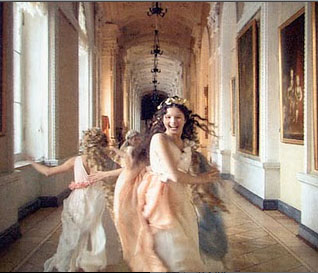
It was probably inevitable that somebody would try to make a feature-length film consisting of a single moving shot. Josh Becker’s Running Time (1997) renders a heist in what purports to be one take; there are cuts, but they’re pretty well disguised. Sokurov’s Russian Ark (2002; above) uses video technology to create a feature out of one genuine take, “a single breath” as he called it. At the same time, Sokurov added the condition that the shot would be an exploration of a labyrinthine space, in this case the Hermitage, and a trip through different eras of Russian history.
My lipdub can lick your lipdub
Perhaps it was Russian Ark, or maybe just TV walk-and-talks, that inspired the recent cycle of single-take video lipdubs. In these the camera moves through a locale and picks up one person after another, all lip-synching the soundtrack. September’s massively popular lipdub from l’Université de Quebec à Montréal may have furnished the prototype. In the US, a pair of current examples neatly illustrates how borrowing and competition among moviemakers can yield intriguing results.
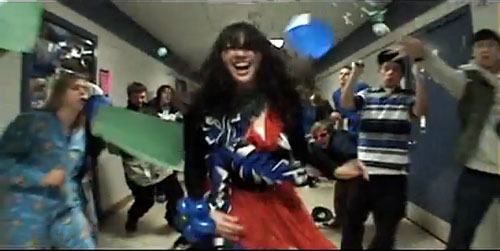
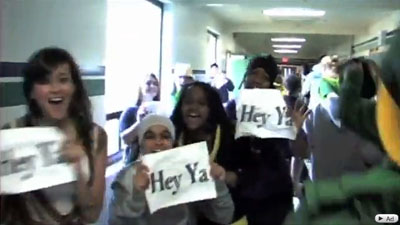
As you probably know, Shorecrest High School in Shoreline, Washington, mounted a very complicated lipdub—one take coasting through the school, picking up dozens of teens lipsynching to Outkast’s “Hey Ya!” before they all assemble in a theatre for a final shout-out. There are some somersaults too, which make any movie better. It is here.
But high school rivalries resurfaced. Shorewood High School, traditionally at odds with Shorecrest in sports and band, struck back with a lipdub of Hall and Oates’ “You Make My Dreams Come True.” The new entry raised the stakes by shooting the action backward, somersaults included. Here it is.
There’s no shortage of backwards videos, but the Shorewood clip plays in clever ways with our biases in perceiving movement. Because we’re wired to grasp motion as advancing in time, we can’t easily reconstruct the actual movement that the figures executed. After seeing the film many times, I still found it hard to visualize the actual progression of the shoot, starting from the assembled crowd and ending on the young woman running backward to the vehicle that pulls away. (A forward version is here.) Moreover, both forward and backward motion have an uncanny symmetry, so that it’s hard to detect the latter except through subtle cues like the way garments fall or a gait with a special snap. Even the moments that flaunt the reverse-motion device, such as things originally tossed down into the frame, seem instead to fly up and into the hands of bystanders.
The stakes have been raised. What will Shorecrest come up with? A radical change of angle? (An entire lipdub done from a very high or low vantage point?) Or maybe a more demanding location? (With spring coming, I’d vote for a miniature-golf course.) Anyhow, my imagination is more limited than the filmmakers’. All that matters for my purposes is that the very fact of competition gave birth to a pair of ingenious and sprightly movies.
If you’re thinking that I wrote this simply to give everyone who Googles “Gombrich lipdup” at least one result, you miss my point. Just as Gombrich was never shy about using advertising imagery and children’s drawings to illustrate some basic principles of visual psychology, so we ought to notice any examples that vividly show how artists strategize in order to create something new within a tradition. Which is to say: Yes, I consider the young filmmakers of Shorecrest and Shorewood artists. Why not?
Gombrich’s essay on Dutch painting first appeared as “Mysteries of Dutch Painting,” New York Review of Books 30, 17 (10 November 1983), 13-17. It is reprinted in his Reflections on the History of Art (London: Phaidon, 1987). Shorewood has supplied a sort of making-of bonus here, with some more challenges to Shorecrest thrown in. To see the genre coopted by politicians (who apparently can’t get all their cohorts together in the same space), go here (thanks to Camilla Lugan). Maybe US politicos could get some more support if they tried bopping like this? They could hardly look sillier than they do already.
PPS 1 February: Yogesh Raut writes that another historical precedent for the dueling lipdubs would be one older than the Quebec one I cited.
In your recent entry on lipdub videos you cite a video made in 2009 by students in Quebec as “the prototype.” I think a more likely candidate is this video made by a company called Connected Ventures and first uploaded in April 2007:
While there have obviously been a ton of similar videos made since then, I think the folks at CV (who I have no connection with) probably deserve a little hat tip as innovators. Of course, it’s possible that they were copying someone else, but in general they seem to be recognized as the starters of the craze (see here, for example).
It’s good to learn this. There are probably other precedents as well. I’d just say that a prototype need not be the first work in a genre tradition; rather, it’s a fully developed, typical instance. We take Little Caesar as a prototypical gangster film, but it’s not the first. The Connected Ventures project is indeed a single take, and it follows various people lip-synching. But it doesn’t explore a building in a targeted way, making the revelation of new space add visual variety, and the walking characters seldom pass us from group to group in tight choreography (it relies more on loose pans). Like other early efforts in a genre, it seems simpler and rougher than later entries. I suppose that supports my point that competition can spur filmmakers to surpass their peers; it seems that later lipdub adepts took up the challenge to make the single take more intricate. Still, I should probably have called the Canadian video “a prototype” rather than “the prototype.” Many thanks to Yogesh for calling my attention to a particularly early work in the genre.
2 May 2010: Tonight’s Simpsons episode, “To Surveille, with Love,” opens with a single-take lipdub pastiche/ parody showing Springfield’s citizens moving to Ke$ha’s Tik Tok video. Next morning:It’s here.