David Bordwell's website on cinema   click for CV

Home

Blog

Books

Perplexing Plots: Popular Storytelling and the Poetics of Murder

On the History of Film Style pdf online

Reinventing Hollywood: How 1940s Filmmakers Changed Movie Storytelling

Film Art: An Introduction

Christopher Nolan: A Labyrinth of Linkages pdf online

Pandora’s Digital Box: Films, Files, and the Future of Movies pdf online

Planet Hong Kong, second edition pdf online

The Way Hollywood Tells It pdf online

Poetics of Cinema pdf online

Figures Traced In Light

Ozu and the Poetics of Cinema pdf online

Exporting Entertainment: America in the World Film Market 1907–1934 pdf online

Video

Hou Hsiao-hsien: A new video lecture!

CinemaScope: The Modern Miracle You See Without Glasses

How Motion Pictures Became the Movies

Constructive editing in Pickpocket: A video essay

Essays

Rex Stout: Logomachizing

Lessons with Bazin: Six Paths to a Poetics

A Celestial Cinémathèque? or, Film Archives and Me: A Semi-Personal History

Shklovsky and His “Monument to a Scientific Error”

Murder Culture: Adventures in 1940s Suspense

The Viewer’s Share: Models of Mind in Explaining Film

Common Sense + Film Theory = Common-Sense Film Theory?

Mad Detective: Doubling Down

The Classical Hollywood Cinema Twenty-Five Years Along

Nordisk and the Tableau Aesthetic

William Cameron Menzies: One Forceful, Impressive Idea

Another Shaw Production: Anamorphic Adventures in Hong Kong

Paolo Gioli’s Vertical Cinema

(Re)Discovering Charles Dekeukeleire

Doing Film History

The Hook: Scene Transitions in Classical Cinema

Anatomy of the Action Picture

Hearing Voices

Preface, Croatian edition, On the History of Film Style

Slavoj Žižek: Say Anything

Film and the Historical Return

Studying Cinema

Articles

Book Reports

Observations on film art

“I don’t hate anybody, not even my interrogators”

Tuesday | December 21, 2010

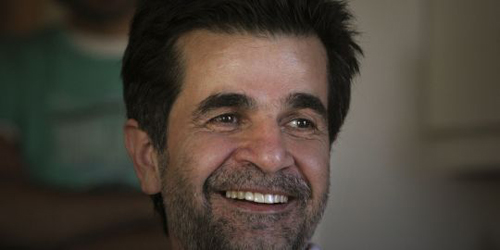
Jafar Panahi, May 2010.

DB here:

From Tehran comes the shocking news that Jafar Panahi, one of the finest of Iranian filmmakers, has been sentenced to six years in prison. The sentence also bans him from filmmaking for twenty years, forbids him to leave the country, and forbids him from giving interviews to the press, foreign or domestic. Panahi’s collaborator Muhammad Rasoulof was also sentenced to six years in jail.

This is the next step in a series of confrontations between Panahi and the government. He was earlier arrested for attending the funeral of Neda Agha-Soltan, the young woman shot in the 2009 protests. His passport was later seized. Before his most recent arrest he was forbidden to leave the country to attend the Berlin and Cannes festivals. Between March and May of this year he was in prison, during which he undertook a hunger strike. In May he was released on bail.

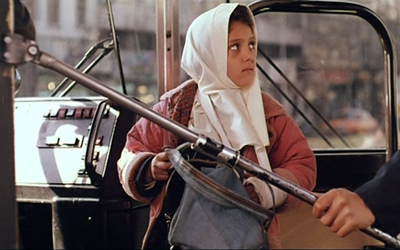
Since the mid-1990s Panahi has directed several extraordinary films, all explicitly or tacitly critical of aspects of Iranian society. Like his mentor Abbas Kiarostami, he attracted attention with films centering on children, notably The White Balloon (1995) and The Mirror (1997). The latter is a fine example of how Iranian directors have merged social realism, unexpected character psychology, and experimental storytelling strategies. The first half shows a stubborn little girl trying to get home from school. On a bus, she gets tired of pretending to be in a film and goes off on her own, with her microphone still attached. The crew tries to track her down, and much of the rest of the action takes place on the soundtrack, as we hear her encounters with street life and the crew’s commentary on what they manage to shoot. Sometimes the sound drops out entirely.

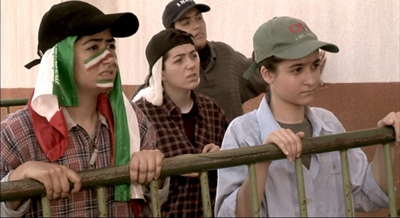
The Circle (2000) shifts to the adult world, illuminating critical moments in the lives of several women as they traverse the streets. Crimson Gold (2003), from a script by Kiarostami, shifts from presenting a crime-thriller situation to providing an unusual view of Tehran’s prosperous upper class. Offside (2006) won attention for its exuberant portraitsof women who disguise themselves as men to watch a soccer match. Panahi remarked drily to the court: “The space given to Jafar Panahi’s festival awards in Tehran’s Museum of Cinema is much larger than his cell in prison.”

The charges and the replies

The Mirror.

The oppression of filmmakers isn’t new, of course. Authoritarian political regimes across film history have banned films and punished their creators. In recent times, the Turkish actor-director Yilmaz Güney was imprisoned several times; while incarcerated, he wrote scripts to be filmed by others. After Devils on the Doorstep (2000), Jiang Wen was banned by Chinese authorities from film activities for some years, as was actress Tang Wei for appearing in Lust, Caution (2007).

But Güney was convicted of civil crimes, although of a political nature; his films were not, as I understand it, explicitly part of the charges. And although Jiang and Tang were punished for their film work, that punishment didn’t include jail time.

Panahi is in an unusually vulnerable situation. He is set to be imprisoned for preparing a film.

The official charges are “assembly and colluding with the intention to commit crimes against the country’s national security” and “propaganda against the Islamic Republic.” The authorities charge that he and his colleague Rasoulof were “preparing an anti-government film bearing on the post-electoral events” of June 2009, when thousands of Iranians protested the disputed reelection of President Ahmadinejad. “You are putting me on trial for making a film that at the time of our arrest was only thirty percent shot.” Panahi was shooting his film in his home, and government authorities seized the footage.

Other accusations sought to bolster the case. Panahi’s household, according to the prosecution, held “obscene films.” In his defense statement last month, he replied that these were film classics that have inspired him. He was charged with participating in demonstrations, but he replied that he was there to observe, and this was within his rights. He notes as well that he shot no footage of the demonstrations, acknowledging that filming was forbidden. As you know, on-the-spot reportage leaked out through Facebook, Twitter, and YouTube.

Panahi was accused of making his film without permission, but he responded that there is no legal requirement that a filmmaker obtain permission. He was accused of organizing protests at the opening of the Montreal Film Festival, but there he served simply as the head of the jury. He was charged with giving interviews to foreign media, but he pointed out that there are no laws forbidding someone from being interviewed. He was even accused of not giving scripts to his actors! He explained that he works with non-professional actors, and it’s common for Iranian filmmakers to simply explain what the actor must do and say.

The charges may be simply a pretext for silencing a prominent figure critical of current Iranian society. Panahi’s films do not circulate legally there, and he is widely believed to be in sympathy with liberal forces. The government has sought to eradicate the most visible of these factions, the Green Party. Even Islamic clerics have been swept up in the crackdown. A parallel case to Panahi’s is the attack on Mohammad Taqi Khalaji, a dissident cleric. Last January he was arrested and his computer and papers were seized. He too was incarcerated in Evin prison before being released on bail. Yet he was not formally charged with anything. His personal papers, including his passport, were not returned to him.

You can get some grim satisfaction for knowing that movies still matter in some parts of the world. Films have the power to shock bureaucrats and threaten authoritarian regimes. Instead of being simply “assets” or “content” to be extruded across platforms and shoved through release windows, cinema is in some places taken seriously as political critique.

Panahi’s case, his lawyer asserts, will be appealed.

Out of bounds

Offside.

Lest we Americans savor our superior virtue, consider this: Four months before 9/11, Panahi was traveling between Hong Kong and Argentina and stopped over in New York. He had been told he did not need a transit visa, but he was detained by American authorities at JFK Airport for lacking one. Here is Stephen Teo’s account in Senses of Cinema:

On his way to the Buenos Aires International Festival of Independent Cinema on 15 April, 2001, after having attended the Hong Kong International Film Festival, Panahi was arrested in JFK Airport, New York City, for not possessing a transit visa. Refusing to submit to a fingerprinting process (apparently required under U.S. law), the director was handcuffed and leg-chained after much protestations to US immigration officers over his bona fides, and finally led to a plane that took him back to Hong Kong. As far as is known, this incident was not reported in any major US newspaper, even though The Circle was being shown in the United States at the time (another irony: for that film, Panahi was awarded the “Freedom of Expression Award” by the US National Board of Review of Motion Pictures).

We are in the season in which critics are likely to use the word courage casually, as in “Natalie Portman gives a courageous performance in Black Swan.” The ongoing struggle of Panahi and thousands of his fellow Iranians remind us what real courage, in the world outside the movie theatre, looks like.


A petition addressed to Iran’s leaders in regard to Panahi and Rasoulof’’s case can be signed here. For one proposal for how world film culture could respond, go here.

A fairly detailed chronology of events around Panahi’s imprisonment can be found on Wikipedia. Panahi’s counter to the official charges, as well as the source of this entry’s title quotation, can be found here.

I have so far found no U.S. coverage of Panahi’s treatment in America in spring 2001. A report here from Australia suggests that he was detained but not arrested. Senses of Cinema has published Panahi’s letter to the Board of Review protesting his treatment on that occasion.

The case of Mohammad Taqi Khalaji is discussed here and here.

P.S. 22 December 2010: Yesterday Jonathan Rosenbaum posted his June 2001 review of The Circle. It’s an excellent piece, providing both in-depth analysis and broader context, and it does make reference to Panahi’s detention upon arriving in the U. S.

P.P.S. 22 December 2010: Thanks to Shelly Kraicer for a name correction.

P.P.P.S. 26 December 2010: Director Rafi Pitts has published an open letter to President Ahmadinejad about Panahi and Rasoulof’s sentence. Read it here at mubi.

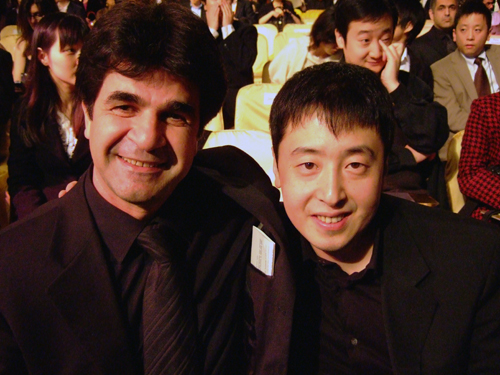
Jafar Panahi and Jia Zhang-ke, Asian Film Awards 2007. Photo by DB.

Three minutes of “Three Brothers”

Monday | December 20, 2010

Harry Potter and the Deathly Hallows Part 1

Kristin here:

Last wee I went to see Harry Potter and the Deathly Hallows Part 1. Behind the pack, of course, since it had been out nearly a month. But I dislike watching films in a crowd. My ideal is to be alone in the theater, which David and I managed last week with Megamind. In this case I picked the first matinee on a school day and saw the film at our local Sundance multiplex. (Yes, even Sundance runs some popular films to help support the less successful art films.) I figured that noisy youngsters, even if they skipped school to see DH1, wouldn’t go to Sundance. I was right. Four or five adults were sitting about ten rows behind me. I never heard a peep or crackling candy wrapper out of them. The film was really film, too, 35mm.

I had been curious about how the filmmakers would deal with some of the stranger aspects of J. K. Rowling’s seventh and final book. Breaking it into two parts seemed an obvious and smart move, and it does have less of a rushed feeling than the previous adaptations had. But Deathly Hallows the book has some very unconventional aspects.

For a start, Rowling reveals dark, indeed downright nasty things alleged about Albus Dumbledore, who up to this point has been your standard-issue comic-but-wise, twinkly-eyed mentor figure. I wondered if the film would dare to do the same. It does, but so far only as a very minor side issue. In the first part, at least, Harry is obviously distinctly miffed that Dumbledore hasn’t left him more information about how to deal with horcruxes, but he doesn’t seem to feel that his hero had feet of clay.

Second, it seems downright perverse on Rowling’s part that in a long series which has come to focus on the search for horcruxes and should just be working up its climax, she throws another set of mysterious, lost objects, the three Deathly Hallows, at us. Let’s see, six horcruxes, three hallows. What’s the difference? Which should the characters be seeking, and why? Is Voldemort after them, too? In the book, Harry becomes obsessed with finding the hallows, even though the horcruxes are the main point. That last premise, Harry’s obsession, hasn’t shown up in the film, so far anyway, but otherwise the hallows are fully treated in the film.

Finally, Rowling gives us a very long portion of the book where Harry, Hermione, and, for a time, Ron, are fugitives moving from place to place, camping out each night as they try to figure out where the remaining horcruxes are—and not having much luck either with that or with destroying the one they have obtained. I personally think this is a rather daring move. Given that for this long section we are confined entirely to Harry’s point of view, we get little sense of what is happening in the outer world. Naturally the film can’t spend quite as much of its length on this period of nomadic existence. Still, it does devote an unexpectedly long time to portraying it.

Some critics have complained that the action stalls during this portion. Others have noted that the slow-down allows for us at last to linger over the psychological states of the three main characters, who are being worn down by fear, frustration, and the horcrux’s presence. This stretch also displays some beautifully bleak locations, well filmed. Plus, as Rowling no doubt intended, this part of the narrative conveys a real sense of the characters’ seemingly hopeless position: They are in great danger and without any apparent clue as to where to look next.

One minor obstacle that I remember noting when I first read the book is that the hallows are introduced by having Hermione read aloud a fairy tale from the book Dumbledore has bequeathed to her, The Tales of Beedle the Bard. The tale, “The Tale of the Three Brothers,” occupies only about two pages, but having someone read that much text aloud in a film can be deadly.

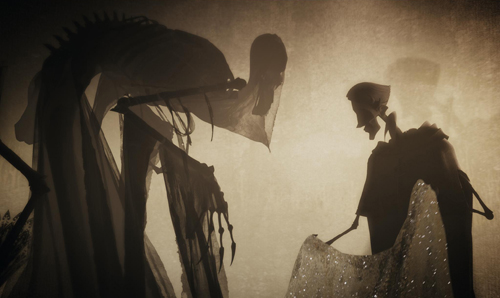
The filmmakers came up with a solution that is both inspired and extremely well executed. As Hermione reads, we see a roughly three-minute animated sequence that illustrates her words. The filmmakers have acknowledged that their model was Lotte Reiniger’s technique of silhouette animation, which she developed in the 1920s and used for such classics as The Adventures of Prince Achmed (1926). For DH1, similar silhouette effects are achieved with 3D digital animation.
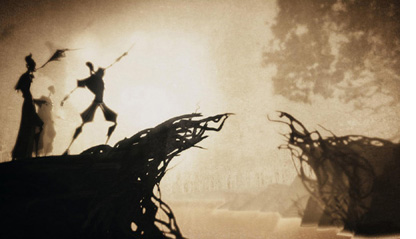
I wondered who had designed and animated this little sequence and determined to watch for references to it in the credits. As is typical with effects-heavy films these days, several companies were listed and the credits rolled by too quickly for me to catch much. Still, I don’t think that the little film-within-a-film was mentioned specifically or its creator named as having been attached to it. Even Variety‘s review, which refers in passing to the sequence, doesn’t mention its maker.

A lot of other viewers were impressed enough to try and find out who was responsible. DH1 was released in the US on November 19, and by the next day, Cartoon Brew posted a story on the subject: “A number of readers have written to ask who animated the shadow puppet-inspired ‘Tale of the Three Brothers’ sequence in the new Harry Potter film Harry Potter and the Deathly Hallows. It was directed and designed by Ben Hibon who produced it in association with Framestore.” Surprisingly, it also turns out that the section of Framestore that normally makes commercials did the “Three Brothers” scene.

I spent some time tracking Hibon down, finding some good-quality frames to display here, and locating clips. There are a few interviews with Hibon, plenty of clips and entire shorts, and filmographies. The video quality of some of these clips is dreadful, though, and a lot of the stories one finds via Google are short, repetitive pieces.

Most of this material is not all that easy to find, so herewith a guide to where you can most usefully find information on someone who seems to be an up-and-coming talent.

Hibon has designed video games, made music videos and commercials, done a short “screen” for MTV, and directed a few shorts and a trailer for a feature, A.D., which seems still to be in progress. The fullest filmography is the official one on the website for Hibon’s own company, Stateless Films.

Animation and effects expert Bill Desowitz has interviewed Hibon for Animation World Network. That’s recent, December 3, and deals exclusively with the DH1 scene. On November 23, fxguide posted an interview with Dale Newton, the sequence supervisor for the piece. An older, undated interview with Hibon on It’s Art Magazine concerns the series of five two-minute shorts collectively known as “Heavenly Sword.” These relate to a video game of the same name that Hibon designed. This series is visually quite distinctive, but it’s a far more conventional work than the “Three Brothers” short, being heavily influenced by anime.

Also on November 23, indiewire posted a short background article on Hibon, with several videos. With one exception, which I’ll get to shortly, don’t watch these films here or on YouTube. Why? Because the Stateless Films site has most of them and more. Hibon’s clips are larger and better quality than anything else I checked, plus they’re displayed with a black screen and far fewer distracting graphics than on YouTube. Click on the Archives link to see older works, including samples of Hibon’s work on videogames.

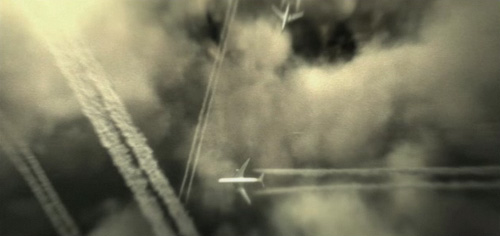
His site is the only place where I found a full version of his ad for the French bank, Crédit Agricole. The point of the ad is that this is the first green bank. It’s a gorgeous piece, full of images of pollution and decay gradually giving way to scenes of places restored to their pristine state and new, clean technology in place. Here are some images, from a vertical descent downward through a series of jet-trails (at bottom), a shot in which a wall of identical canned goods suddenly flies away to reveal a street market with fresh produce on sale, and windmills replacing old factory chimneys that fly apart:
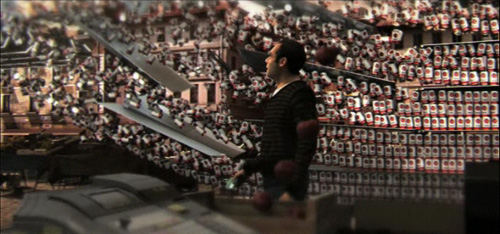
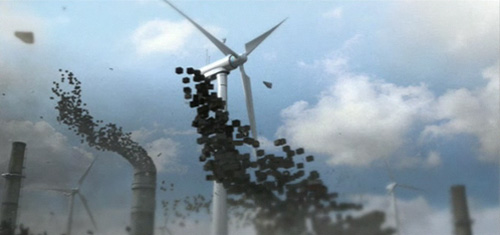
There’s a dream-like quality to the whole thing, with a lot of shots, many with rapid movement, juxtaposed with slow, stately music.

The indiewire clips linked above include two shortened, English-language versions of this ad, with Sean Connery appearing to make the message explicit. There are also some Crédit Agricole ads made by more conventional filmmakers. Watch one or two of those, and you’ll find the contrast dramatic.

None of these sites and others with Hibon clips or shorts has the “Three Brothers” sequence, not surprisingly. That is, YouTube has some horrendous, out-of-focus subtitled auditorium videos, made in perhaps a South American or Spanish theater. Avoid like the plague.

Framestore’s site has some information on Hibon’s sequence, and the only clip from it that I could find. It’s very small and too dark to render the subtleties of the visuals, but there it is. Framestore also animated the two house-elves, Dobby and Kreatur, and there’s some information on that part of the project as well.

The January, 2011 issue of Cinefex has a story on DH1 that will undoubtedly include a section on the “Three Brothers” animation, but I haven’t seen that yet.

One reason that there are so many short pieces on Hibon on the internet is that at almost exactly the same time, on November 22, Variety announced that the filmmaker had been signed to direct a long-dormant New Line project, Pan. It’s a variation on the Peter Pan story, with the roles of villain and hero being switched; here Captain Hook is a detective on the trail of a certain child-kidnapper. The studio acquired the project in 1996, and for a while it looked as though Guillermo del Toro would direct. This time the film might get made, since the Variety story reports that it’s being cast and should start shooting next fall.
Ratio-cination

Sunday | December 19, 2010

Beyond a Reasonable Doubt.

DB here:

Good timing. Just as I was about to enable more aspect-ratio fetishism, I got news of the publication of Widescreen Worldwide, from John Libbey. Edited by John Belton, Sheldon Hall, and Steve Neale, it has its distant origins in a 2003 conference at the National Media Museum in Bradford, England. Widescreen Worldwide will be a very useful volume, with material on little-studied U. S. systems and a lot of information on formats in Japan, France, Italy, and Russia, even Norway. Most studies of widescreen technology seldom discuss the creative uses to which it was put. But this collection features several essays focusing on the artistry of the wide formats, emphasizing the work of Preminger, Peckinpah, Okamoto, Suzuki, et al. As the publisher’s blurb puts it:

The book documents how the aesthetic strategies explored during the first wave of American widescreen films underwent revision in Europe and Asia as filmmakers brought their own idiolect to the language of widescreen mise-en-scène, editing, and sound practices. As a global phenomenon, widescreen cinema thus presents the opportunity to examine how different cultures appropriate the technology to advance extremely different cultural and aesthetic agendas.

I have an essay included on the Shaw Brothers directors, and I’m happy to be in such distinguished company in this major publication. My essay is available on this site. The paper I gave at the conference, on Hou Hsiao-hsien’s early anamorphic films, is also posted here.

Speaking of widescreen: Today, we go back to While the City Sleeps and SuperScope, thanks to some correspondents and further fooling around on my part.

Ratio decidendi

The story so far: SuperScope was a widescreen system devised by Irving and Joseph Tushinsky for RKO . It extracted a wide image from the 1.37 standard frame and printed it as a squeezed anamorphic frame, to be unsqueezed at a ratio of 2.0 to 1. (A later version allowed for a 2.35 stretch.) In principle, it’s an early version of what Super 35 does now. Some RKO films, notably Invasion of the Body Snatchers (1956), were shot in knowledge that they would be given the SuperScope treatment; others were SuperScoped after the fact.

The question before the jury was: Do SuperScope prints of Lang’s While the City Sleep (1956) faithfully reflect his intentions? The answer I settled on was: Probably not. A Variety story indicated that the SuperScope prints were made for European distribution, though perhaps some sneaked into the US theatrical market or the 16mm aftermarket.

Now for a little more on Lang’s compositions. Several viewers have commented on all the headroom visible in the full frame. The ‘Scope print I examined displayed some as well, but not as much, as my illustrations for the earlier entry indicate. More likely the film was masked in the US to something like 1.66 or 1.75. I reproduced some frames from a 1.75 laserdisc version, and they look reasonably good. Overall, I suggested that City’s fairly open compositions suggest that Lang was expecting the film to be masked somewhat in projection, but not to the full 2.0:1 ratio we get with SuperScope.

Although for most of its length, While the City Sleeps seems quite okay at 2.0, I found one shot that would be quite awkward in full SuperScope. Alas, I didn’t photograph it from the 35mm European print I examined, but I’ve used my stills from the print to guide my cropping of the 1.37 frame in this instance. The results are, as the lawyers say, probative.

The scene is mundane: Walter Kyle gets a phone call from his errant wife Dorothy. She’s carrying on an affair with Harry, the art director of the newspaper Walter runs. Walter talks with her, and Lang cuts to her responding. I show you the 1.75 versions.

When Lang cuts back to Walter, he provides a new camera setup featuring the butler Steven. This is to prepare us for a joke: Walter says he’ll have Steven meet Dorothy at the front door in his underwear. Steven reacts with embarrassment. Given that a lot of the film plays on the sexual rapacity of men, the humor is a shade sick.

A narrative convention: The stuffy, puritanical butler. But notice that in the 1.75 frame, Steven’s full face is quite visible. Of course it’s even more visible in the full-frame version. (Fussy Lang, or fussy somebody, seems to have aligned the face with the swoop of the ceiling.)

But the composition would look more awkward if chopped in the SuperScope 2.0:1 version. Here’s one framing, using the cropping points typical of other anamorphic shots in the European 35mm print.

In addition, since the crop slices more off the bottom region than the top, Walter’s body is also lost in the anamorphic version. But this is still probably the best compromise. Some frames in the 35mm S’Scope version favor the lower region of the original shot. But in this shot that option would be disastrous.

It’s hard to imagine that the director of the painstakingly composed Moonfleet (1955) would have wanted to saw Steven’s skull in half.

Mors ultima ratio

So Lang didn’t shoot the film expecting it to be SuperScoped. Nevertheless, things that escape directors’ intentions can have their own impact on viewers. In the codicil to the earlier blog entry, I wondered if French critics’ admiration for While the City Sleeps might have been based on their seeing wider prints than Americans did—in effect, gathering Lang into the cohort of skilled anamorphic filmmakers that included Ray, Preminger, Minnelli, et al. Samuel Bréan wrote to tell me that one critic, Jacques Lourcelles, raised this issue explicitly. Lourcelles writes:

For both this film and Lang’s next film, Beyond a Reasonable Doubt, the format poses a thorny problem that can be resolved only by considering aesthetic matters. The film, not shot in CinemaScope, was exhibited in Superscope (a wide format used at RKO and created through laboratory processes), and then in a normal format. Which is better? In my opinion, the wider one. Only there, for instance, do the camera movements and the newspaper-office set have their true impact. Even if the Superscope version was “manufactured” in the lab, Lang knew that the film would be seen on the wide screen and his direction was conceived as a function of that. The same goes for Beyond a Reasonable Doubt; to cite just one instance, the first sequence showing the condemned man walking toward the electric chair is obviously conceived for the wider format.

This does lead to some intriguing speculation on how “misreadings” of films can have positive consequences. The French celebration of Lang’s 1950s films led American and British critics to reevaluate them.

The case of Beyond a Reasonable Doubt is quite parallel to that of While the City Sleeps. Released in September 1956, it too was reviewed in Variety as a non-anamorphic picture. Its U. S. publicity makes no reference to a widescreen format. But its overseas posters claim that it is in “RKO-Scope.” Huh?

By the end of 1956, the Tushinskys had split from RKO and were selling SuperScope generally. So in November 1956 RKO simply announced that it had developed “a new widescreen, anamorphic process” that would carry a ratio of 2.0:1. Historians of widescreen have assumed that this is SuperScope by another name. The same publicity announced that soon all the studio’s films would be in RKO-Scope. But RKO ceased making movies on 1 January 1957. Universal took over distributing the remaining pictures.

Again, on the basis of the posters and Lourcelles’ comments we can be confident that Beyond a Reasonable Doubt was shown in a 2.0:1 aspect ratio in some overseas markets. As airless a movie as Lang ever made, with disconcertingly generic sets and severe framings and camera movements, it engendered a fascination in French critics. The story itself is a model of Langian guilty conscience. A reporter looking for a new book to write agrees to a hoax that will attack capital punishment. He’ll plant clues indicating that he’s a murderer in order to prove that an innocent man can be convicted. Lang’s narration offers his customary feints and ellipses. Smooth hooks, verbal and visual, carry us across scenes. Casual details are dropped in, or a sudden cutaway appears, and we’re misled into thinking we’re ahead of the plot. We are in fact behind it. Crucial story information is skipped over, but we’re not aware of what has been deleted until much later. We should have noticed.

Appearing in the same year as Around the World in 80 Days, The King and I, Lust for Life, Giant, Anastasia, War and Peace, and other sweeping spectacles, Beyond a Reasonable Doubt was a bare-bones programmer. Lang’s last American film doesn’t waste its energy on the pictorial flourishes of budget-strapped directors like Siegel or Fuller. Other B-films could whip up visual flair with chiaroscuro, close-ups, and fast cutting, but Lang’s images seem disconcertingly banal; yet their simplicity gives them an odd purity. In an influential review, Jacques Rivette declared that Lang was, in effect, filming concepts.

I don’t find any shots in Beyond with a vertical bias comparable to the shot featuring Steven the butler in City. The 1.37 frame shots are very empty up top. So here’s an experiment in reconstructing an approximation of what Europeans saw.

Dux vitae ratio

As I suggested in the earlier blog, for decades Lang composed his frames carefully, balancing figures in dynamic patterns and sometimes putting important elements along the sides or in a corner. Here are some examples from one of his most beautiful films, The Ministry of Fear. He likes triangular compositions that tuck heads into corners, as well as camera angles that let foreground items anchor the faces and bodies.

When the frame is unbalanced, it’s for a reason, such as purse-rifling.

A director so committed (like Ozu) to putting heads high in the shot must have felt annoyed when he had to hang inexpressive space over his players, as in the shot at the very top of today’s entry. When he left headroom in earlier films, it served an exacting compositional purpose, as you see below. Those wedge-formations of tapers, backing up threatening cobras, look back to the decor of his German films.

I suspect that it pained him to accept the more open framing demanded by non-anamorphic ratios. In CinemaScope you could count, more or less, on the proportions of your image being respected. But shooting flat, could you really be sure what would stay in the shot? Projectionists could mask it to 1.66, 1.75, 1.85, and even wider. These ratios were so imprecise, and this is one precise director. Lang “shot to protect,” as they say, but he couldn’t protect what was already gone: his compact, quietly masterful compositions.


John Belton wrote to me to echo the idea that Lang would probably have realized that While the City Sleeps would be cropped to as much as 1.75.

Certainly every director after 1954 composed for wide screen projection. As for SuperScope, why didn’t they just project it flat with a 2:1 matte in the aperture?  It certainly would have looked sharper.  Maybe the answer lies in the relative abundance of CinemaScope installations overseas?

Good question for further research. Another interesting sidelight: Who was the SuperScope representative for Europe? For a time, apparently none other than Edgar G. Ulmer! Ulmer is identified as a SuperScope representative in “Tushinsky’s Teuton Deal,” Variety, 7 September 1956, p. 5. Michael Campi wrote to inform me that in Australia he too saw a 2.0:1 print of While the City Sleeps.

RKO’s announcement of RKO-Scope can be found in “And Now–RKO-Scope,” Variety, 30 November 1956, p. 1. More background on the winding down of the studio is provided in Richard B. Jewell and Vernon Harbin, The RKO Story (London: Octopus, 1982), pp. 242-245.

The Jacques Lourcelles comment appears in his Dictionnaire du cinéma vol. 3 (Paris: Laffont, 1992), p. 294. I’m grateful to Samuel Bréan for calling my attention to it. Rivette’s 1957 essay on Beyond a Reasonable Doubt, “The Hand,” is available in Cahiers du cinéma: The 1950s: Neo-Realism, Hollywood, New Wave, ed. Jim Hillier (Cambridge: Harvard University Press, 1985), pp. 140-144. It has been included in a site devoted to Jacques Rivette, Order of the Exile. (The hand Rivette refers to is that in the shot of the warrant above; had Rivette not seen the RKO-Scope print, he might have had to title the essay, “The Hands.”) The poster images for Beyond a Reasonable Doubt come from the ever-generous DVD Beaver, and its review of a Spanish disc.

The Ministry of Fear.

Back to the vaults, and over the edge

Wednesday | December 15, 2010

Unstoppable? Not really. The Juggernaut (1915).

DB here:

A few weeks ago, I praised Variety for making its back issues available digitally. The result is a magnificent vault of information. I also expressed frustration that the recent makeover of The Hollywood Reporter neglected to offer access to its original online archive, which indexed issues across the last twenty years. On the last point, some news.

First, my inquiry to the address listed on the HR website eventually yielded this blue note.

Good Morning,

We apologize for the delayed response.

I do not think there is a way to go back to prior to the changeover.

You would need to contact the publisher about that, as we do not handle the website directly.

Here is a phone number for you  323-525-2150.

Thank you.

I called the number, which handles only subscriptions, and the person answering had no idea what I was asking about.

But all is not lost. My first efforts to access the archive turned up very little for 2010, but shortly afterward I was able to access items from most of this year. Now, if you type a search term into the Search box of the HR site, it brings up items from as far back as 2008. This is an improvement over earlier attempts I made. It seems that THR is gradually adding old material to their archive, in reverse order.

Unfortunately, the search mechanism is quite indiscriminate. Searching “Johnnie To,” with and without quotation marks, yielded 290 hits, but I could find no articles about Johnnie To. Instead, the items with highest relevancy concerned Johnny Depp, Johnny English, John McCain, and the new Narnia movie.

The best news of all came from alert reader David Fristrom of Boston University. He advises me that the old HR archives are still available through LexisNexis. So I tried there with Johnnie To, and I got 338 references, stretching back to 1992. The ones at the top of the relevancy scale were indeed about Mr. To, including a Cannes piece called “Fest’s Red Carpet Flows with Blood.”

Accessing the archive isn’t straightforward, but you don’t need a subscription to HR if your library has purchased access to LexisNexis. I append David’s instructions at the end of this entry. Thanks to him for sorting this out for me.

Now, back into the Variety vaults.

This one’s a real train wreck

On 12 March 1915, Variety reviewed The Birth of a Nation. Alongside that review sits one of The Juggernaut, a Vitagraph feature directed by Ralph Ince. The reviewer, “Simc.,” dwells almost entirely on what he calls “the train-through-the-bridge thing.” The producers bought an old locomotive and some passenger cars, built a flimsy bridge, and ran their train off into what appeared to be a river.

The review exhibits some Variety touches that are still with us. Take the (quite reasonable) idea that nearly every movie is too long. “If this five-reeler were cut down to three reels, which could easily be done, the Vitagraph would have a real thriller.” There’s also the notion that people who come to the see the movie should be aware of its main attraction. “If the audience knows a train will go through a bridge at the finish, it won’t mind the fiddling about in the first four reels before that scene is reached. But if the audience doesn’t know what is to come, there may be many walk-outs.” At the beginning of Unstoppable we’ll sit through all the union and non-union wrangling and alpha-male preening if we’re sure we’re going to see a train that is certifiably unstoppable, except that it’s likely to be stopped by our heroes.

The Juggernaut does give us a pretty spectacular train wreck, as you see above. The entire film may not survive, but we have a version of the last reel (perhaps because a collector thought it worth saving). Train or no train, the film is of interest in showing what Griffith’s rivals were up to.

The plot centers on a crooked railroad magnate, Philip Hardin, and his college friend John Ballard. In the reel we have, Hardin’s daughter Louise, who loves John, sets out on an errand. When her car stalls she boards an express train. A track-walker finds worn ties on a bridge and warns the company, but too late. As Hardin races to stop Louise’s train, it arrives at the bridge and he watches it topple into the water. The sight kills him on the spot. John arrives and swims out to rescue Louise.

That’s when things get dicey. According to the Variety review and other sources, Louise dies in the wreck. Simc again:

The leading woman of the film, Anita Stewart, is discovered dead, lying against one of the windows, with particular pains taken that her features shall be clearly visible. . .  . Anita is carried to shore and lain alongside of her father, who had died of heart failure (on land) a few moments before.

In the version available on DVD, John does bring her body ashore, but she revives, lifts herself up, and embraces him. The print ends there. Why the varying ending? Perhaps this is a version made at the time for a different market or in response to censorship, or it might be a rerelease using alternative footage. Or perhaps the press reviews were based on a synopsis supplied by Vitagraph, and the studio made modifications in the print before release.

The Juggernaut is also intriguing stylistically. By this point, crosscutting and scene analysis were common techniques in U. S. films. To set up the perilous situation, the cutting alternates shots of the track-walker, of Hardin, and of Louise. Once Hardin discovers that Louise is on the train headed for the dilapidated trestle, we are set up for a last-minute rescue–which fails. A particularly interesting series of shots shows Hardin’s trajectory converging with the train’s path. Riding in a power boat, Hardin looks back and we get a shot of the train in the distance, suggesting that he can see it.

From this we cut to a shot of Louise, confirming that she’s on board and showing her innocent lack of awareness. Then we get a repeated framing of the train rushing toward the bridge.

After another long shot of the train, we get a shot of Hardin in his powerboat with the train whizzing by in the background. This confirms that he was indeed watching it approach off screen left in the earlier shot, and it shows that he isn’t likely to catch up.

Once the train has toppled into the stream, there are some striking shots of people trapped inside or scrambling to escape. We see Louise raise one hand and then freeze, as if dying.

Earlier, there’s some emphatic “classical” cutting when Hardin learns that Louise is in danger. An enlarged framing (via an axial cut) underscores his reaction to the telegram.

Most striking is a series of shots of the dead-or-not Louise; the abrupt enlargement of her face has something of the force that Kurosawa would channel in his axial cuts.

Soon Ralph Ince cuts back along the same camera axis, and inward again as the couple embrace.

I can’t recall a comparable stretch of “concertina” cutting in the intimate scenes of Birth, and no such tight views of faces either. Griffith sometimes gives us “close-ups within medium-shots” by means of irising and vignetting.

Other directors (e.g., Dreyer) liked to use the serrated surround to highlight faces, but the American norm eventually became the unadorned closer view, as in the shot of Louise in The Juggernaut. Such shots probably saved production time as well. We’re confronted with the familiar situation that sometimes non-Griffith films from 1915 (e.g., The Cheat, Regeneration) look somewhat more “modern” than does Birth.

Going back to the train-through-the-bridge thing, the staging of the scene in late September 1914 elicited a lot of publicity. For one thing, the cost was played up; I’ve seen stories claiming $20,000, $30,000, and $50,000. The New York Times wrote up the shoot twice; the second of these could well be a publicity release from Vitagraph. According to the Times, the “river” was actually a flooded quarry. Before the shoot, buzz leaked out and crowds reported as numbering thousands showed up to watch. The crew spent hours herding them out of camera range. Actors were freezing in the water by the time cameramen got to take their shots. The Times also claims that the crash was filmed by fifteen (or twenty-five) cameras, a stupendously implausible number, especially in light of the footage we have. Worse, according to the second NYT story, Ince decided that the first pass didn’t work and they would have to start all over with a new train! A retake is not mentioned in Variety’s coverage, which does report some studio rivalry:

The ink on the New York dailies telling of the Vita’s big wreck stunt in the cameraing of “The Juggernaut” had hardly dried when the Universal sent over camera men posthaste Sunday to take views of what was left of the wreck. [Vitagraph studio manager Victor Smith], getting a hunch, got on the ground ahead of them and with a sturdy band of Vita “protectors” nipped the U’s little scheme in the bud.

One can only imagine how the “protectors” dealt with the Universal boys. Once more, the Variety Vault gives us the flavor, and perhaps sometimes the facts, of heroic times.


How to access the Hollywood Reporter archive, courtesy David Fristrom:

Once you are in LexisNexis, it can be a little tricky to search in The Hollywood Reporter (for some reason it doesn’t show up if you type “Hollywood Reporter” into the “Source Title” box), but you can follow these steps:


1. Click on “Power Search” in the upper-left corner.
2. On the “Power Search” page, find the “Select Source” box (near the bottom) and click on the “Find Sources” link.
3. On the “Find Sources” page, type “Hollywood Reporter” into the “Keyword” box and press enter.
4. At the top of the results should be “The Hollywood Reporter.”
Check the box next to it, then click on the “Ok-Continue” button that appears in the upper right corner.
5. You are now ready to search in the Hollywood Reporter archives –just type your search terms into the search box.

Thanks again to David!

The Variety review of The Juggernaut appears in the issue of 12 March 1915, p. 23. The story about Universal staff trying to shoot the wreckage is “Vita Putting It Over,” Variety, 10 October 1914, p. 23. The New York Times articles are “Film Train Wreck Almost a Tragedy,” NYT, 28 September 1914, p. 13, and “Tossing Dollars Around As If They Were Pennies,” NYT, 18 October 1914, p. X7. For more on Vitagraph, see Anthony Slide, The Big V: A History of the Vitagraph Company, rev. ed. (Metuchen: Scarecrow, 1987); Tony provides some production background on The Juggernaut on pp. 64-65.

The Juggernaut excerpt is available on Nickelodia 2, a DVD collection from Unknown Video. Oddly, the snapcase doesn’t list the reel as included on the disc, nor does the product information on the Unknown Video site or Amazon. I’d welcome more information about The Juggernaut‘s plot resolution if anybody out there has any.

The Juggernaut (1915).

David Bordwell
top of page

have comments about the state of this website? go here