by Kristin Thompson. Berkeley: University of California
Press, 2007.
400 pages, 6 × 9 inches, 12 color illustrations;
36 b/w illustrations.
[go
to Amazon | go to The Frodo Franchise blog]
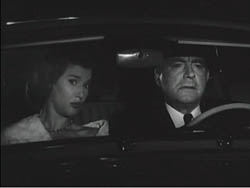
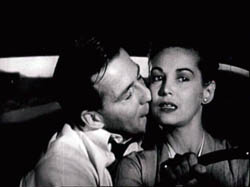
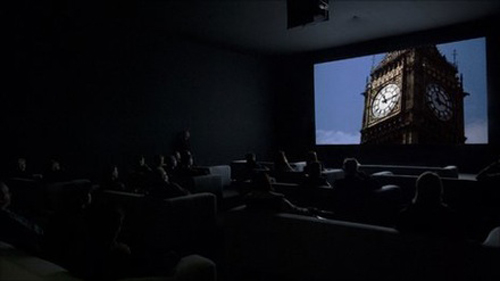
Normally I wouldn’t comment on a movie after seeing only 10.4 % of it, but there are always exceptions. The Clock, which played at the Paula Cooper Gallery during our stay in Manhattan, runs 24 hours. It’s a compilation of over 3000 film clips, mostly from Hollywood but also from Europe and Asia. Some of the footage is easily recognized, but a lot of it I couldn’t identify.
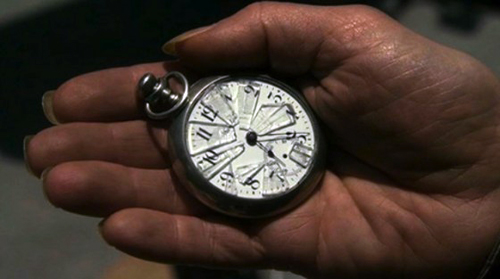
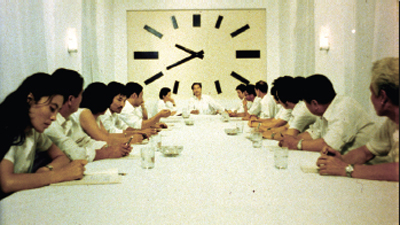
The premise, or gimmick, is that every snippet of a scene is purportedly connected in some way to the passing of time measured on a clock. Characters check their watches, or the camera shows a wall clock or digital alarm clock or countdown device. There are tiny clocks and gigantic ones. If the whole thing has a star, it might be Big Ben, who reappears surprisingly often.
A nice idea, but why stretch it over twenty-four hours? So that the creator Christian Marclay can assemble scenes that synchronize perfectly with the passage of time in projection. A shot shows a watch at 11:55 AM; you look at your watch; it’s 11:55 AM. Wherever the piece is screened, it must start precisely at the corresponding local time. The Clock isn’t just about clocks; it is a clock.
The project teases you into lame puns, which I’ve been unable to resist. But my visits set me thinking about what makes The Clock unique and pleasant. Maybe it’s a little too pleasant.
Collage without closure
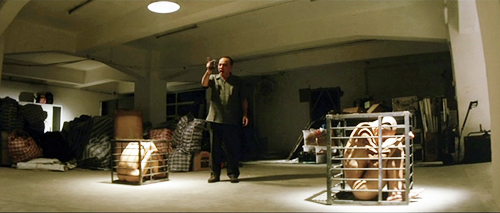
The Black Cannon Incident (1986).
In its collage of compiled material, what The Clock does is quite familiar to cinephiles. For a long time, experimental filmmakers have built works out of footage from mainstream movies. One of the most famous, Joseph Cornell’s Rose Hobart (1935), powerfully illustrates how the collage principle can pry images from their narrative context and call attention to their poetic or graphic qualities. The assemblage artist Bruce Conner did something similar in A Movie (1958), which creates anassociational form out of newsreels and old Hollywood sequences. Although both Rose Hobart and A Movie still evoke vague narrative expectations, Craig Baldwin whipped together found footage to create a hallucinatory narrative in Tribulation 99: Alien Anomalies under America (1991). An urgent, hard-bitten voice-over tells of CIA conspiracies and interplanetary conquest while we see images scavenged from cheap science-fiction films.
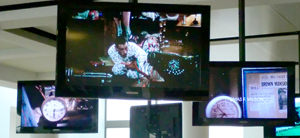
Nowadays plenty of filmmakers, especially on the Web, have snipped footage from old films to develop a theme. Jim Emerson has done it with close-ups, and Matt Zoller Seitz, Aaron Aridillas, and Steven Santos have created a video essay around guns in American film. Last summer, at the new facility of the Cinematek in Brussels, I found thematic loops running on their video monitors. Sometimes there was an interplay among them, so that characters one screen seemed to be looking at those in another. Some of the Cinematek loops in fact centered on clocks.
So the principle of compilation collage didn’t seem new to me. But Marclay refreshes it by the other central premise of The Clock: its time structure, which syncs moments indicated onscreen with moments of viewing.
Some fiction films (e.g., Cleo from 5 to 7, Nick of Time) and TV shows (e.g., 24) have played with the conceit of making the duration of the piece (“real time”) correspond to the amount of time covered in the plot. (Usually, however, the film fudges it.) But in The Clock, there’s no overarching plot, so the duration of that action can’t be determined. Marclay gives us real time with a vengeance, in the relentless correspondence between screen clocks and audience clocks.
Without this exact synchronization, The Clock would be an enjoyable but unexceptional found-footage movie. The onscreen clocks check the flow of the images like centers of magnetic force. They form nodes around which each set of shots revolves, like a musical key that a melody can drift from and return to.
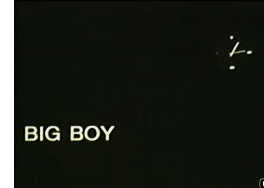
This patterning too has parallels in the experimental film tradition, I think. What P. Adams Sitney famously called Structural film was a 1960s-1970s trend that often built the awareness of time into a film’s overall pattern. A simple example is Robert Nelson’s Bleu Shut (1970). A clock runs in the right corner of the frame to measure the time consumed by a film that is, we’re promised by a woman’s breathless voice-over, “exactly thirty minutes long.” (She lies.)
A less explicit instance is Hollis Frampton’s Zorns Lemma (1970). In its central section, one by one a string of images replaces one-second shots of signs marking the letters of the Latin alphabet. The shot-changes set up a steady beat, and the pattern locks in a sense of momentum. Although we’re surprised by what images replace the letters, our expectations get focused on the inevitability of all the alphabet shots being deleted. There’s no literal clock, but we can sense this event slowly fulfilling itself. In addition, some of the replacement images show processes moving toward completion, such as dried beans steadily filling up a container. I’m tempted to say that in many Structural films, an actual or tacit clock tracing the film’s movement toward closure becomes a sort of non-narrative equivalent of a deadline in a storytelling movie.
The Clock doesn’t provide exactly that sense of closure, since it has no end point. It’s on a loop and, like a real clock, can be reset according to the time zone of the venue. But the nodal clock images make us aware of the film’s relentless unfolding, and its sync principle has affinities with the Structural tradition’s commitment to a precise time-based architecture. That tradition had its own sources, of course, including the experiments of the Fluxus movement, a trend that also influenced Marclay.
Top-down time
Tracing parallels shouldn’t lead us away from the unique qualities that make The Clock so appealing. For one thing, the fact that there isn’t a continually running readout, as in Bleu Shut or in an iPod slider, enables the film to test our feeling for passing time. Not every shot shows a clock; indeed, most shots in the portions I saw don’t. As we get captivated by clock-less images and follow their development within a scene, the arrival of a timepiece reminds us of the structuring principle. The appearance of a clock creates something like a punchline, while also letting us realize how loose our sense of duration in a movie usually is.
This test-like quality of the film, an important aspect of Structural film that Sitney points out, is reinforced by Marclay’s central idea. We are primed to scan the shots for clocks. Indeed, the search for the clock can reshift our sense of what is important about the scene. In an earlier entry, I discussed how Alfred Yarbus’ experiments in tracking eye movements assigned people tasks, such as estimating the social status of people in a painting. This created “top-down,” concept-driven search behavior. The Clock does the same thing, with the only explicit instruction being the title and our background knowledge of the piece’s procedures.
The result of our top-down search that we pay attention to clocks in the corners of shots or out of focus in the background, in scenes in which time isn’t really at stake. Normally we probably wouldn’t notice these items, but spotting them gives us a reward and allows us to admire Marclay’s cleverness. Some scenes seem to lack clocks altogether, but that doesn’t make them filler; a stretch of clockless footage only sharpens the fun when one shows up.
With shots pried free of narrative demands, you start to discriminate details, like the designs of numerals and brand identities. As you see the names Bulova, GE, Tissot, Hamilton Beach, and all the rest, you realize that it isn’t only James Bond films that use watches for product placement.
I’ve said that the film isn’t narrative in the same way that Craig Baldwin’s fantasy collages are. Yet it does tease us with some narrative expectations. If you recognize the footage, then you can summon up your memory of the story. If you don’t recognize the footage, you might still recognize the generic situation (investigation, pursuit, lovers’ confrontation, awakening in the morning). And the whole shebang does get you thinking about the role of time in narrative.
In this regard, the film makes an almost didactic point: Stories, at least those we’ve become used to, need clocks. They set the story world in motion, they measure its changes, and above all they provide deadlines that generate suspense, surprise, and satisfaction. The Clock makes deadlines especially apparent as we approach noon, when we get not only images from High Noon but also a flurry of other 12:00 PM shots (Titanic, for one). Noon is a really important moment in Central Standard Movie Time. I didn’t see the midnight stretch of The Clock, but I bet it’s a hell of a show.
Perfect timing
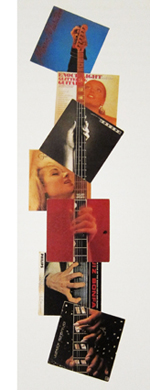
Like the compilation filmmakers, Marclay wants crosstalk among his bits, but the stretches of The Clock I saw don’t create much friction. There’s a lot of continuity from shot to shot: One character in one movie walks out a door, and we cut to another character from another movie entering a new locale. Music links scenes smoothly. Although Marclay was influenced by the diffuse, chance organizations promoted by John Cage, some of his earlier work emphasized through-line linkages and blending as well. Marclay’s famous record-album collages allow a unified figure to emerge as a gestalt binding together disparate images. On the right, you can see this happening in Guitar Neck (1992), which virtually diagrams the sort of smooth juxtapositions we get in The Clock.
The result has a fairly slick texture. It goes down easily. I admire the way that Marclay and his assistants have rummaged through a vast archive and pulled together a majestic, utterly entertaining assembly. But emotionally it’s mostly cold. The year-end obituary tributes on Turner Classic Movies, reminding us that the perfect faces and bodies gliding past us are definitively gone, are more throat-catching than anything I saw here. Along another dimension, so are Conner’s A Movie and his dissection of the JFK assassination, Report (1963-67). Just as important, none of what I saw seemed to me particularly challenging or discordant, and in this regard The Clock parts company with the comparable film traditions.
Structural film was notoriously demanding, ruffling viewers’ perceptions and trying their patience. And experimental compilations were often seeking to shake us up, sometimes in absurd ways. An earlier blog entry of ours illustrates how Baldwin’s Mock Up on Mu (2008) builds disconcerting scenes out of bits taken from other movies. A man and woman constantly shift their identities and positions while their conversation continues without missing a beat.
Crucial to the classic compilation films is the central innovation of collage: the fragments do not blend into a smooth whole. There are clashes between one shot or clutch of shots and the next. There’s also a sense of material differences. Each piece of scuffed or distressed footage retains something of its own integrity. In his sound work, Marclay too claimed an interest in the “sound patina” of vinyl LPs:
When a record skips or pops or we hear the surface noise, we try very hard to make an abstraction of it so it doesn’t disrupt the musical flow. I try to make people aware of these imperfections and accept them as music; the recording is a sort of illusion, while the scratch on the record is more real.
But the shots in The Clock are mostly scrubbed clean of imperfections, presenting a sleek surface that facilitates the flow across shots. The movie is a pure product of the DVD era, with all those gleaming images so easily appropriated. At times Marclay manages to match weather conditions, with rain in one scene carrying over into the next. This tactic creates an intriguing sense that the two movies are set in a shared world, but it makes the gaps between the images even narrower.
For about twenty years there has been a controversy in the gallery world about whether the burgeoning tradition of “artists’ films” owes anything to avant-garde film traditions. It’s often summarized as the difference between the white cube of the gallery and the black box of the movie theatre. By setting The Clock alongside collage compilation films, am I guilty of comparing apples and oranges? For instance, the films have fixed beginnings and endings, whereas The Clock is an installation that can be entered at any point. It’s not a film but rather, to use a current phrase, a “time-based audiovisual work.” Moreover, some will argue that Marclay’s lineage doesn’t consist of Cornell, Conner, Baldwin, and Structural Film but rather Fluxus, Minimalism, Punk, and Scratch-and-Mix. (Marclay has devised a turntable he can play like a guitar.)
All of which carries some weight, but I see enough common features between the two traditions to make my main point: Based on what I sampled, this is an ingratiating work, virtuosic in a Postmodernist way. But it doesn’t risk the roughness, the boring patches, and the confusions of the film traditions I’ve invoked. Perhaps the most condemnatory thing you can say about The Clock is that it runs like clockwork.
But maybe things get more disruptive in the 89.6 % I wasn’t able to see.
This entry was written fairly early in The Clock‘s Manhattan run. (Thanks to James Schamus for tipping me to it.) I had no trouble getting in at 10:40 AM and staying until about 1:15. But it quickly became a sensation. A friend and I tried to visit on a chilly Friday night and confronted a long line. I heard from others that the line was just as forbidding at 5:00 AM. The problem, of course, is that you could wait a very long time, since there’s no set point when many are likely to leave. (Nobody will say, “This is where we came in.”) This New York Times article traces the rise of the Clock cult. The article also confirms that midnight is a high point of the video.
Yet another Times piece discusses The Clock as akin to recorded music, making some points related to mine above. Here is a loving account by Jerry Saltz, who logged nineteen hours on duty. Easy to enjoy and admire, Marclay’s piece probably deserves to be added to Christian Lander’s list of Stuff White People Like.
A good overview of the artist’s earlier work can be found in Jennifer Gonzalez et al., Christian Marclay (London: Phaidon, 2005). My quotation comes from p. 33.
Thanks to Jim Kreul and Jonathan Walley for guidance in the controversy about artworld and filmworld traditions. Jonathan’s essay “Modes of Film Practice in the Avant-Garde,” in Tanya Leighton’s collection Art and the Moving Image: A Critical Reader, is a useful guide to these and other trends. I advance some notions about the user-friendliness of another artist’s film project in this entry on Matthew Barney’s Cremaster cycle. Kristin and I have written about associational form in Conner’s A Movie in our book Film Art: An Introduction.
Today’s entry is our first guest blog. It follows naturally from the last entry on how our eyes scan and sample images. Tim Smith is a psychological researcher particularly interested in how movie viewers watch. You can follow his work on his blog Continuity Boy and his research site.
I asked Tim to develop some of his ideas for our readers, and he obliged by providing an experiment that takes off from my analysis of staging in one scene of There Will Be Blood, posted here back in 2008. The result is almost unprecedented in film studies, I think: an effort to test a critic’s analysis against measurable effects of a movie. What follows may well change the way you think about visual storytelling.
Tim’s colorful findings also suggest how research into art can benefit from merging humanistic and social-scientific inquiry. Kristin and I thank Tim for his willingness to share his work.
Tim Smith writes:
David’s previous post provided a nice introduction to eye tracking and its possible significance for understanding film viewing. Now it is my job to show you what we can do with it.
Continuity errors: How they escape us
Knowing where a viewer is looking is critical to beginning to understand how a viewer experiences a film. Only the visual information at the centre of attention can be perceived in detail and encoded in memory. Peripheral information is processed in much less detail and mostly contributes to our perception of space, movement and general categorisation and layout of a scene.
The incredibly reductive nature of visual attention explains why large changes can occur in a visual scene without our noticing. Clear examples of this are the glaring continuity errors found in some films. Lighting that changes throughout a scene, cigarettes that never burn down, and drinks that instantly refill plague films and television but we rarely notice them except on repeated or more deliberate viewing. In my PhD thesis I created a taxonomy of continuity errors in feature films and related them to various failings during pre-production, filming, and post-production.
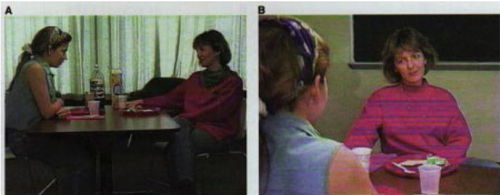
Our inability to detect continuity errors was elegantly demonstrated in a study by Dan Levin and Dan Simons. In their study continuity errors were purposefully introduced into a film sequence of two women conversing across a dinner table. If you haven’t seen it before, watch the video here before continuing, and see how many continuity errors you can spot.
Two frames from the clip used by Levin and Simons (1997). Continuity errors were deliberately inserted across cuts (e.g., the disappearing scarf), and viewers were asked after watching the video whether they noticed any.
The short clip contained nine continuity errors, such as a scarf that changed colour, then disappeared, plates that changed colour and hands that changed position. During the first viewing, viewers were told to pay close attention but were not informed about the continuity errors. When asked afterwards if they noticed anything change, only one participant reported seeing anything and that was a vague sense that the posture of the actors changed. Even during a second viewing in which they were instructed to detect changes, viewers only detected an average of 2 out of the 9 changes and tended to notice changes closest to the actors’ faces such as the scarf.
Although Levin and Simons did not record viewer eye movements, my own experiments investigating gaze behaviour during film viewing indicate that our eyes will mostly be focussed on faces and spend virtually no time on peripheral details. If you as a viewer don’t fixate a peripheral object such as the plate, you are unable to represent the colour of the plate in memory and can, therefore not detect the change in colour when you later refixate it.
Tracking gaze
To see how reductive and tightly focused our gaze is whilst watching a film, consider Paul Thomas Anderson’s There Will Be Blood (TWBB; 2007). In an earlier post, David used a scene from this film as an example of how staging can be used to direct viewer attention without the need for editing.
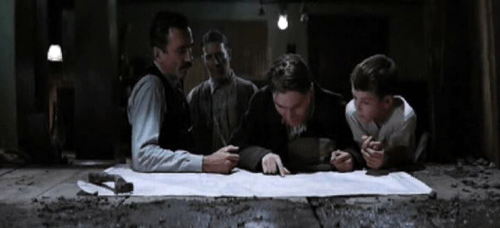
The scene depicts Paul Sunday describing the location of his family farm on a map to Daniel Plainview, his partner Fletcher Hamilton, and his son H.W. The entire scene is treated in a long, static shot (with a slight movement in at the beginning). Most modern film and television productions would use rapid editing and close-up shots to shift attention between the map and the characters within this scene. This frenetic style of filmmaking–which David termed intensified continuity in his book The Way Hollywood Tells It (2006)–breaks a scene down into a succession of many viewpoints, rapidly and forcefully presented to the viewer.
Intensified continuity is in stark contrast to the long-take style used in this scene from TWBB. The long-take style, which was common in the 1910s and recurred at intervals after that period, relies more on staging and compositional techniques to guide viewer attention within a prolonged shot. For example, lighting, colour, and focal depth can guide viewer attention within the frame, prioritising certain parts of the scene over others. However, even without such compositional techniques, the director can still influence viewer attention by co-opting natural biases in our attention: our sensitivity to faces, hands, and movement.
In order to see these biases in action during TWBB we need to record viewer eye movements. In a small pilot study, I recorded the eye movements of 11 adults using an Eyelink 1000 (SR Research) eyetracker. This eyetracker uses an infrared camera to accurately track the viewer’s pupil every millisecond. The movements of the pupil are then analysed to identify fixations, when the eyes are relatively still and visual processing happens; saccadic eye movements (saccades), when the eyes quickly move between locations and visual processing shuts down; smooth pursuit movements, when we process a moving object; and blinks.
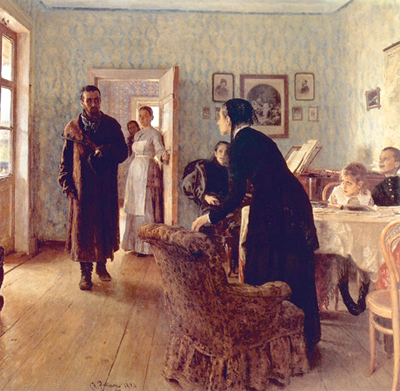
Eye movements on their own can be interesting for drawing inferences about cognitive processing, but when thinking about film viewing, where a viewer looks is of most interest. As David demonstrated in his last post, analysing where a viewer looks whilst viewing a static scene, such as Repin’s painting An Unexpected Visitor,is relatively simple. The gaze of a viewer can be plotted on to the static image and the time spent looking at each region, such as a characters face or an object in the scene can be measured.
However, when the scene is moving, it is much more difficult to relate the gaze of a viewer on the screen to objects in the scene. To overcome this difficulty, my colleagues and I developed new visualisation techniques and analysis tools. These efforts were part of a large project investigating eye movement behaviour during film and TV viewing (Dynamic Images and Eye Movements, what we call the DIEM project). These techniques allow us to capture the dynamics of gaze during film viewing and display it in all its fascinating, frenetic glory.
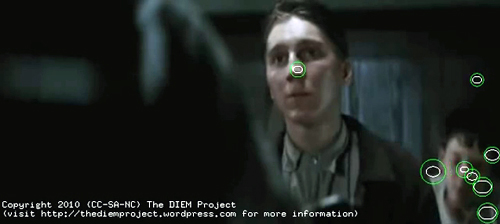
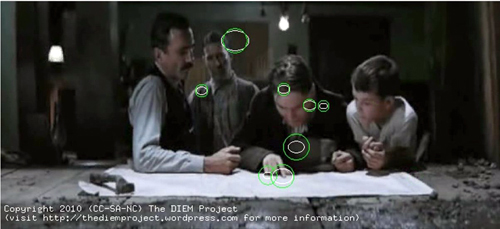
To begin, the gaze location of each viewer is placed as a point on the corresponding frame of the movie. The point is represented as a circle with the size of the circle denoting how long the eyes have remained in the same location, i.e. fixated that location. We then add the gaze location of all viewers on to the same frame. Although the viewers watched the clip at different times, plotting all viewers together allows us to look for similarities and differences between where people look and when they look there. This figure shows the gaze location of 8 viewers at one moment in the scene. (The remaining 3 viewers are blinking at this moment.)
A snapshot of gaze locations of 8 viewers whilst watching the “map” sequence from There Will Be Blood (2007). Each green circle represents the gaze location of one participant, with the size of the circle indicating how long the eyes have been in fixation (bigger equals longer).
You have a roving eye
Plotting static gaze points onto a single frame of the movie allows us to see what viewers were looking at in a particular frame, but we don’t get a true sense of how we watch movies until we animate the gaze on top of the movie as it plays back. Here is a video of the entire sequence from TWBB with superimposed gaze of 11 viewers.
You can also see it here. The main table-top map sequence we are interested begins at 3 minutes, 37 seconds.
The most striking feature of the gaze behaviour when it is animated in this way is the very fast pace at which we shift our eyes around the screen. On average, each fixation is about 300 milliseconds in duration. (A millisecond is a thousandth of a second.) Amazingly, that means that each fixation of the fovea lasts only about 1/3 of a second. These fixations are separated by even briefer saccadic eye movements, taking between 15 and 30 milliseconds!
Looking at these patterns, our gaze may appear unusually busy and erratic, but we’re moving our eyes like this every moment of our waking lives. We are not aware of the frenetic pace of our attention because we are effectively blind every time we saccade between locations. This process is known as saccadic suppression. Our visual system automatically stitches together the information encoded during each fixation to effortlessly create the perception of a constant, stable scene.
In other experiments with static scenes, my colleagues and I have shown that even if the overall scene is hidden 150milliseconds into every fixation, we are still able to move our eyes around and find a desired object. Our visual system is built to deal with such disruptions and perceive a coherent world from fragments of information encoded during each fixation.
The second most striking observation you may have about the video is how coordinated the gaze of multiple viewers is. Most of the time, all viewers are looking in a similar place. This is a phenomenon I have termed Attentional Synchrony. If several viewers examine a static scene like the Repin painting discussed in David’s last post, they will look in similar places, but not at the same time. Yet as soon as the image moves, we get a high degree of attentional synchrony. Something about the dynamics of a moving scene leads to all viewers looking at the same place, at the same time.
The main factors influencing gaze can be divided into bottom-up involuntary control by the visual scene and top-down voluntary control by the viewer’s intentions, desires, and prior experience. As part of the DIEM project we were able to identify the influence of bottom-up factors on gaze during film viewing using computer vision techniques. These techniques allowed us to dissect a sequence of film into its visual constituents such as colour, brightness, edges, and motion. We found that moments of attentional synchrony can be predicted by points of motion within an otherwise static scene (i.e. motion contrast).
You can see this for yourself when you watch the gaze video. Viewers’ gazes are attracted by the sudden appearance of objects, moving hands, heads, and bodies. The greater the motion contrast between the point of motion and the static background, the more likely viewers will look at it. If there is only one point of motion at a particular moment, then all viewers will look at the motion, creating attentional synchrony.
This is a powerful technique for guiding attention through a film. But it’s of course not unique to film. Noticing points of motion is a natural bias which we have evolved by living in the real world. If we were not sensitive to peripheral motion, then the tiger in the bushes might have killed our ancestors before they had chance to pass their genes down to us.
But points of motion do not exist in film without an object executing the movement. This brings us to David’s earlier analysis of the staging of this sequence from TWBB. This might be a good time to go back and read David’s analysis before we begin testing his hypotheses with eyetracking. Is David right in predicting that, even in the absence of other compositional techniques such as lighting, camera movement, and editing, viewer attention during this sequence is tightly controlled by staging?
All together now
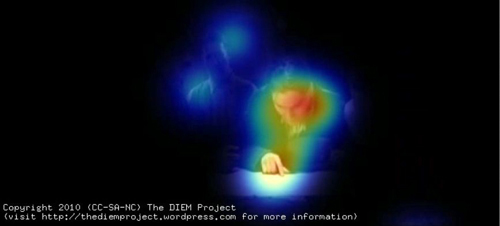
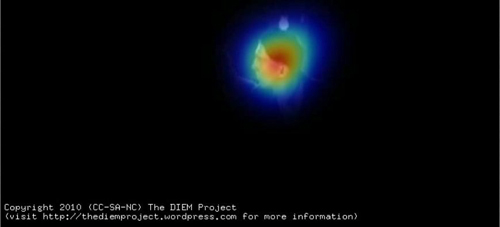
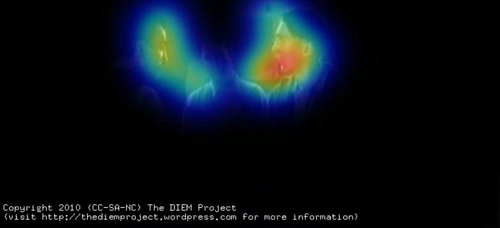
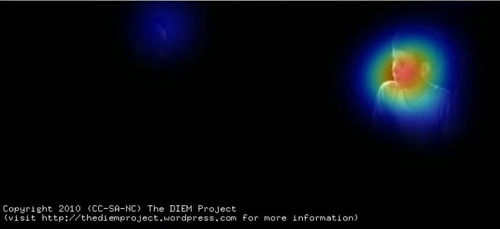
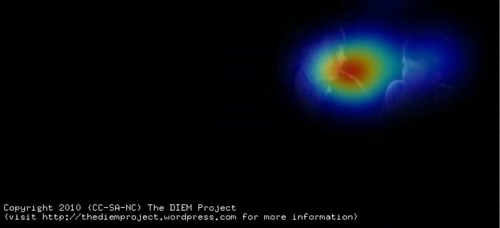
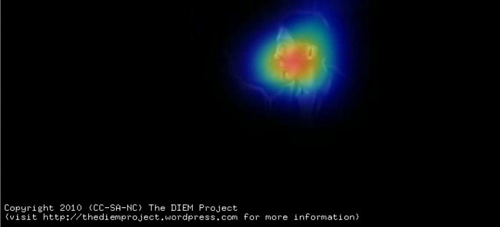
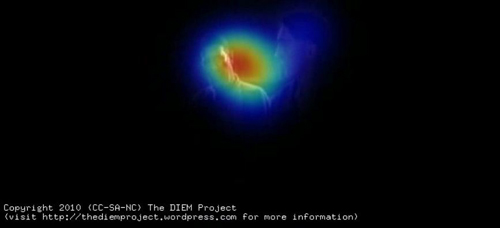
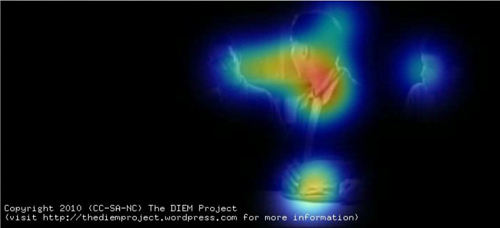
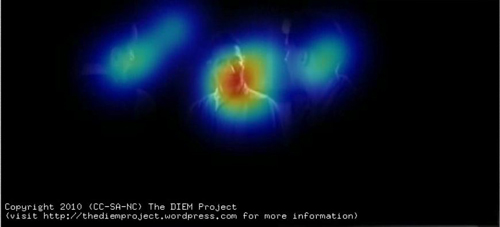
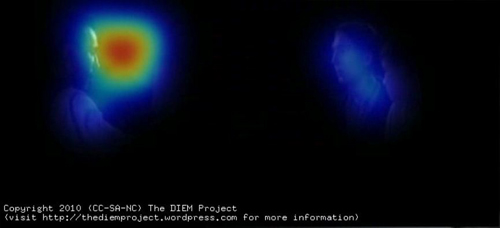
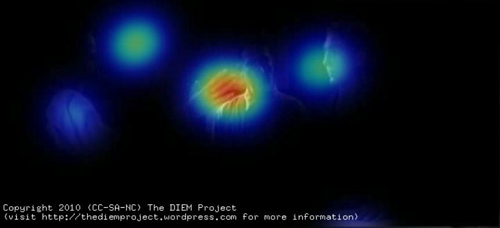
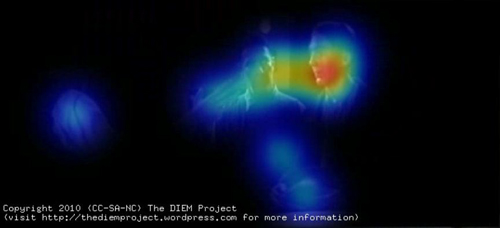
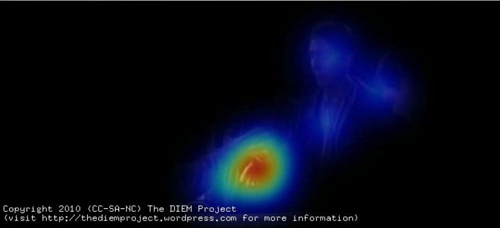
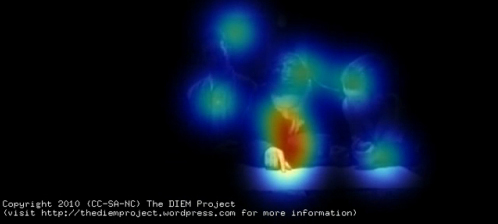
To help us test David’s hypotheses I am going to perform a little visualisation trick. Making sense of where people are looking by observing a swarm of gaze points can often be very tricky. To simplify things we can create a “peekthrough” heatmap. A virtual spotlight is cast around each gaze point. This spotlight casts a cold, blue light on the area around the gaze point. If the gazes of multiple viewers are in the same location their spotlights combine and create a hotter/redder heatmap. Areas of the frame that are unattended remain black. By then removing the gaze points but leaving the heatmap we get a “peekthrough” to the movie which allows us to clearly see which parts of the frame are at the centre of attention, which are ignored and how coordinated viewer gaze is.
Here is the resulting peekthrough video; also available here. The map sequence begins at 3:38.
Here is the image of gaze location I showed above, now matched to the same frame of the peekthrough video.
The gaze data from multiple viewers is used to create a “peekthrough” heatmap in which each gaze location shines a virtual spotlight on the film frame. Any part of the frame not attended is black, and the more viewers look in the same location, the hotter the color.
David’s first hypothesis about the map sequence is that the faces and hands of the actors command our attention. This is immediately apparent from the peekthrough video. Most gaze is focused on faces, shifting between them as the conversation switches from one character to another.
The map receives a few brief fixations at the beginning of the scene but the viewers quickly realise that it is devoid of information and spend the remainder of the scene looking at faces. The only time the map is fixated is when one of the characters gestures towards it (as above).
We can see the effect of turn-taking in the conversation on viewer attention by analyzing a few exchanges. The sequence begins with Paul pointing at the map and describing the location of his family farm to Daniel. Most viewers’ gazes are focused on Paul’s face as he talks, with some glances to other faces and the rest of the scene. When Paul points to the map, our gaze is channeled between his face and what he is gazing/pointing at.
Such gaze prompting and gesturing are powerful social cues for attention, directing attention along a person’s sightline to the target of their gaze or gesture. Gaze cues form the basis of a lot of editing conventions such as the match an action, shot/reverse-shot dialogue pairings, and point-of-view shots. However, in this scene gaze cuing is used in its more natural form to cue viewer attention within a single shot rather than across cuts.
As Paul finishes giving directions, Daniel asks him a question which immediately results in all viewers shifting the gaze to Daniel’s face. Gaze then alternates between Daniel and Paul as the conversation passes between them. The viewers are both watching the speaker to see what he is saying and also monitoring the listener’s responses in the form of facial expressions and body movement.
Daniel turns his back to the camera, creating a conflict between where the viewer wants to look (Daniel’s face) and what they can see (the back of his head). As David rightly predicted, by removing the current target of our attention the probability that we attend to other parts of the scene is increased, such as H. W., who up until this point has not played a role in the interaction. Viewers begin glancing towards HW and then quickly shift their gaze to him when he asks Paul how many sisters he has.
Gaze returns to Paul as he responds.
Gaze shifts from Paul to Daniel as he asks a short question, and then moves to Fletcher as he joins the conversation.
The quick exchanges of dialogue ensure that viewers only have enough time to shift their gaze to the speaker and then shift to the respondent. When gaze dwells longer on a speaker, such as during the exchange between Fletcher and Paul, there is an increase in glances away from the speaker to other parts of the scene such as the other silent faces or objects.
An object that receives more fixations as the scene develops is Paul’s hat, which he nervously fiddles with. At one point, when responding to Fletcher’s question about what they grow on the farm, Paul glances down at his hat. This triggers a large shift of viewer gaze, which slides down to the hat. Likewise, a subtle turn of the head creates a highly significant cue for viewers, steering them towards what Paul is looking at while also conveying his uneasiness.
The most subtle gesture of the scene comes soon after as Fletcher asks about water at the farm. Paul states that the water is generally salty and as he speaks Fletcher shifts his eyes slightly in the direction of Daniel. This subtle movement is enough to cue three of the viewers to shift their gaze to Daniel, registering their silent exchange.
This small piece of information seems critical to Daniel and Fletcher’s decision to follow up Paul’s lead, but its significance can be registered by viewers only if they happened to be fixating Fletcher at the time he glanced at Daniel. The majority of viewers are looking at Paul as he speaks and they miss the gesture. For these viewers, the significance of the statement may be lost, or they may have to deduce the significance either from their own understanding of oil prospecting or other information exchanged during the scene.
The final and most significant gesture of the scene is Daniel’s threatening raised hand. As Paul goes to leave, Daniel stalls him by raising his hand centre frame in a confusing gesture hovering midway between a menacing attack and a friendly handshake. In David’s earlier post he predicted that the hand would “command our attention.” Viewer gaze data confirm this prediction. Daniel draws all gazes to him as he abruptly states “Listen….Paul,” and lifts his hand.
Gaze then shifts quickly; the raised hand becomes a stopping off point on the way to Paul’s face. . .
. . . finally following Daniel’s hand down as he grasps Paul’s in a handshake.
We like to watch
The rapid sequence of actions clearly guide our attention around the scene: Daniel – Hand -Paul – Hand. David’s analysis of how the staging in this scene tightly controls viewer attention was spot-on and can be confirmed by eyetracking. At any one moment in the scene there is a principal action signified either by dialogue or motion. By minimising background distractions and staging the scene in a clear sequential manner using basic principles of visual attention, P. T. Anderson has created a scene which commands viewer attention as precisely as a rapidly edited sequence of close-up shots.
The benefit of using a single long shot is the illusion of volition. Viewers think they are free to look where they want but, due to the subtle influence of the director and actors, where they want to look is also where the director wants them to look. A single static long shot also creates a sense of space, clear relationship between the characters, and a calm, slow pace which is critical for the rest of the film. The same scene edited into close-ups would have left the viewer with a completely different interpretation of the scene.
I hope I’ve shown how some questions about film form, style, practice, and spectatorship can be informed by borrowing theory and methods from cognitive psychology. The techniques I have utilised in recording viewer gaze and relating it to the visual content of a film are the same methods I would use if I was conducting an experiment on a seemingly unrelated topic such as visual search. (See this paper for an example.)
The key difference is that the present analysis is exploratory and simply describes the viewing behaviour during an existing clip. What we cannot conclude from such a study is which aspects of the scene are critical for the gaze behaviour we observe. For instance, how important is the dialogue for guiding attention? To investigate the contribution of individual factors such as dialogue we need to manipulate the film and test how gaze behaviour changes when we add or remove a factor. This type of empirical manipulation is critical to furthering our understanding of film cognition and employing all of the tools cognitive psychology has to offer.
But I expect an objection. Isn’t this sort of empirical inquiry too reductive to capture the complexities of film viewing? In some respects, yes. This is what we do. Reducing complex processes down to simple, manageable, and controllable chunks is the main principle of empirical psychology. Understanding a psychological process begins with formalizing what it and its constituent parts are, and then systematically manipulating and testing their effect. If we are to understand something as complex as how we experience film we must apply the same techniques.
As in all empirical psychology the danger is always that we lose sight of the forest whilst measuring the trees. This is why the partnership between film theorists and empiricists like myself is critical. The decades of film theory, analysis, practice and intuition provide the framework and “Big Picture” to which we empiricists contribute. By sharing forces and combining perspectives, we can aid each other’s understanding of the film experience without losing sight of the majesty that drew us to cinema in the first place.
On the importance of foveal detail for memory encoding, see J. M. Findlay, Eye scanning and visual search, in The Interface of Language, Vision, and Action: Eye movements and the visual world, ed. J.M. Henderson and F. Ferreira (New York: Psychology Press, 2004), pp. 134-159. Levin and Simons’ continuity-error experiment is explained in D. T. Levin and D. J. Simons, “Failure to detect changes to attended objects in motion pictures,” Psychonomic Bulletin and Review4 (1997), pp. 501-506.
A note about our equipment and experimental procedure. We presented the film on a 21 inch CRT monitor at a distance of 90cm and a resolution of 720×328, 25fps. Eye movements were recorded using an Eyelink 1000 eyetracker and a chinrest to keep the viewer’s head still. This eye tracker consists of a bank of infrared LEDs used to illuminate the participant’s face and a high-speed infrared camera filming the face. The infrared light reflects of the face but not the pupil, creating a dark spot that the eyetracker follows. The eyetracker also detects the infrared reflecting off the outside of the eye (the cornea) which appears as a “glint”. By analysing how the glint and the centre of the pupil move as the viewer looks around the screen the eyetracker is able to calculate where the viewer is looking every millisecond.
As for the heatmaps, the greater the number of viewers, the more consistent the heatmaps. The present pilot study used gaze from only 11 viewers, which introduces a lot of noise into the visualisations. Compare the scattered nature of the gaze in the TWBB video to a similar scene visualised with the gaze of 48 viewers. We would probably see the same degree of coordination in the TWBB clip if we had used more viewers.
For a comprehensive discussion of attentional synchrony and its cause, see Mital, P.K., Smith, T. J., Hill, R. and Henderson, J. M., “Clustering of gaze during dynamic scene viewing is predicted by motion,” Cognitive Computation (in press). Social cues for attention, like shared looks, are discussed in Langton, S. R. H., Watt, R. J., & Bruce, V., “Do the eyes have it? Cues to the direction of social attention,” Trends in Cognitive Sciences 4, 2, pp. 50-59. For more on our inability to detect small discontinuities, see Smith, T. J. and Henderson, J. M., “Edit Blindness: The relationship between attention and global change blindness in dynamic scenes,” Journal of Eye Movement Research (2008) 2 (2), 6, pp. 1-17.
For further information on the Dynamic Images and Eye Movement project (DIEM) please visit http://thediemproject.wordpress.com/. This research was funded by the Leverhulme Trust (Grant Ref F/00-158/BZ) and the ESRC (RES 062-23-1092). To view more visualisations from the project visit this site. The DIEM project partners are myself, Prof. John M Henderson, Parag Mital, and Dr. Robin Hill. Gaze data and visualisation tools (CARPE: Computational and Algorithmic Representation and Processing of Eye-Movements) can also be downloaded from the website. When using or referring to any of the work from DIEM, please reference the Cognitive Computation paper cited above.
Wonderful work in this area has already been conducted by Dan Levin (Vanderbilt), Gery d’Ydewalle (Leuven), Stephan Schwan (KMRC, Tübingen), and the grandfather of the recent revival in empirical cognitive film theory, Julian Hochberg. I am indebted to their pioneering work and excited about taking this research area forward.
Finally, I would like to thank David and Kristin for inviting me to describe some of my work on their wonderful blog. I have been an avid follower of their work for years and David has been a great supporter of my research.
DB PS 26 February: The response to Tim’s blog has been astonishing and gratifying. Tens of thousands of visitors have read his essay here, and his videos have been viewed over 700,000 times on sites across the Web. I’m very happy that so many non-psychologists–scholars, critics, and filmmakers–have found something of value here. The extended discussion on Jim Emerson’s scanners site, in which I participated a little, is especially worth reading. For more comments and replies from Tim and his team, go to Tim’s Continuity Boy blogpage and the DIEM team’s Vimeo page. At Continuity Boy, Tim will post more videos based on his group’s experimental efforts.
DB PS 18 October: Tim has posted a new, equally interesting experiment on tracking non-visible (!) movement on his blogsite.
Sasha Archibald, after Alfred Yarbus, after Ilya Repin, They Did Not Expect Him (aka An Unexpected Visitor, 1884).
DB here again:
One blog about eyes deserves another–actually a couple more. These entries, however, won’t be about actors’ or characters’ eyes. They’re about yours and mine.
We use them when we watch movies, but there’s been surprisingly little talk about how we do it. Even film theorists who talk about the Gaze or Visual Culture have not devoted much time to studying how we actually see movies. The whole business is pretty complicated, I grant. But if you’re willing to start by thinking about how we use our eyes in getting through the world, and then move to thinking about how we look at pictures, we can pretty quickly gain some understanding about how we watch films. That’s the business of this entry and the next one.
Bottom-up or top-down?
Unless you’re reading this in a cyclotron or on a roller coaster (always a possibility in these days of mobile media), your surroundings seem pretty stable, no? Look up from your screen and you’ll register the continuous space of a room, or a city vista, or a landscape. What’s remarkable is that this sense of a visual environment that’s all of a piece is composed of thousands of probes. Our eyes sample our surroundings, and the pieces that we snatch somehow melt into a solid, coherent world.
Surprisingly, our eyes have a very limited ability to focus precisely. The fovea, that compact scoop of cells that registers fine detail, is very tiny (about a millimenter in diameter) and has an angular coverage of less than two degrees. Yet it’s a key conduit of information. About 50% of visual nerve fibers are dedicated to the fovea, and acuity falls off very fast beyond it. Other areas of the eye can detect grosser changes in the environment, but in order to see anything clearly, we must constantly shift our eyes to bring the fovea to bear on it. When we follow a moving object, our eyes execute what are called smooth pursuit movements. In viewing a more or less static visual array, we execute saccades, very fast jumps from one fixation to another. Vision is a matter of saccades and fixations, scanning and sampling. A striking fact about saccades is that from one fixation to the next we are mostly blind to what’s happening in the visual field.
But what guides that scanning and sampling? We usually think it’s a matter of attention, and that’s probably not far off. It’s hard to pay visual attention to something that isn’t the target of foveal fixation. When we examine something in detail, we’re clearly devoting mental resources to it, whether it’s a streaky tulip or a misplaced comma. But what triggers our attention, and thus our foveal activity, in the first place?
Commonly we say that something catches our eye, cries out to be noticed, grabs our attention. That is, something out there becomes salient, so we send a saccade to it and fixate on it to get information. This is what psychologists call a bottom-up account. A stimulus triggers our visual system, which in turn recruits our mind to make sense of what has popped out.
An example: Looking straight ahead, you’re starting to cross a street. Something registered on the periphery of your vision seems to be suddenly bearing down on you. You turn your head and look: a car isn’t slowing down for the stoplight and you involuntarily jerk yourself back out of harm’s way. The errant car was salient, your visual system kicked in, and your body obeyed—all in a flash. You might not even be able to identify the car or driver as it runs the light, and you might say: “I didn’t even have time to think about it.” This is bottom-up, stimulus-driven seeing and acting.
Contrast another way to use your eyes. You’ve parked your car outside the Mall of America. Hours later you come out, a little uncertain about where the car is. Once you get to the general vicinity you recall, you use your knowledge of the vehicle to search it out. Let’s see, silvery Toyota sedan. Hell, too many Toyata sedans, all silvery. Wait, mine has a faded Obama-Biden sticker on the bumper and a rabbit with glowing eyes in the back window. Aha, there it is. This is a mode of looking guided by ideas and prior knowledge. Here perception is top-down, idea-driven; vision is informed by what you expect, recall, or believe about the world.
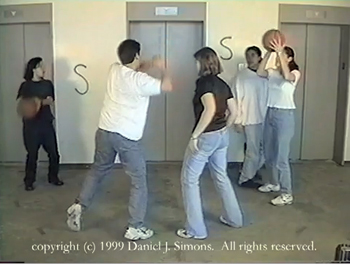
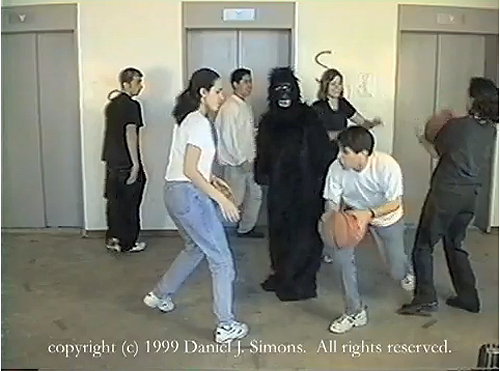
Top-down perception can focus our attention so drastically that we miss some glaringly obvious things. Consider Dan Simons and Chris Chabris’s famous basketball video experiment. If you’re not aware of this demonstration, proceed immediately to this page and take the test yourself.
Using a video of several players passing basketballs to one another, Simons and Chabris asked volunteers to silently count the passes made by players in white. But what Simons and Chabris were really testing was the extent to which people display “inattentional blindness.” About half the viewers were so preoccupied with the task assigned that they missed a rather salient item in the display: a gorilla that walks onto the court, thumps its chest, and walks off.
Simons and Chabris weren’t concerned with tracking eye movements (though later researchers have tried with the video; see the end of this piece). What the gorilla experiment indicates, however, is that top-down control has the drawback of narrowing our attentive focus so drastically that we miss the obvious. The curious phenomenon of inattentional blindness has become a robust area of research in cognitive psychology.
They did not expect…what?
We might think that visual search like the one demanded by the gorilla experiment is a special case. Isn’t most looking, including those saccades we execute all the time, bottom-up? After all, we are fairly passive, and we must take what we’re given by the world around us. Our attention is drawn to what pops out. There are a lot of features of the world that seem salient—bright colors, movement, strong contrasts, things coming toward us, and so on.
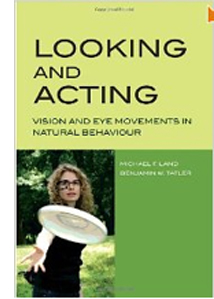
There’s another school of thought, though, and it’s articulated carefully in Michael F. Land and Benjamin W. Tatler’s Looking and Acting: Vision and Eye Movements in Natural Behavior (Oxford University Press, 2009). In ordinary life, they argue, we don’t just float though the world. We’re taken up with tasks. We walk, read, and make sandwiches. The tasks we undertake tacitly shape how and where we look and what we see. Land and Tatler want us to remember the top-down guidance of vision—the mind in the eye, so to speak.
Their central chapters trace how our acts of looking serve two basic functions: “finding and identifying the objects needed for the various tasks and guiding the actions that make use of these objects” (p. 59). In reading and drawing, or even walking or hitting a ball, the authors show, our eyes serve our brain’s sense of what must be done moment by moment. Wearing a nifty lightweight eyepiece or pair of spectacles, the experimental subject can act quite naturally and allow her point of gaze to be tracked and recorded to video. The results show that the tasks we launch, from crossing a street to reading a piece of music, create a series of phases that our eyes recognize and help us through, all without much conscious effort.
What about pictures? We aren’t interacting with them in the way we interact with teacups and steering wheels; we can’t affect their unfolding. Do our eyes behave as they do in our ordinary activities? In 1965 the Russian psychologist Alfred Yarbus reported the results of experiments that tracked eye movements. In some of them, he used Ilya Repin’s classic painting They Did Not Expect Him (aka An Unexpected Visitor, 1884). The dramatic image depicts a hollow-eyed man, gaunt and wrapped in a patchy coat, striding into a comfortable middle-class parlor.
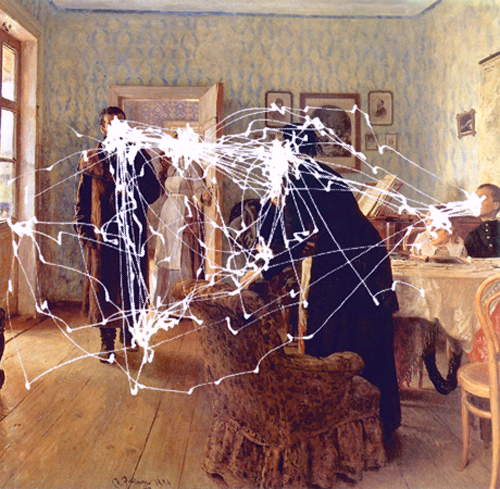
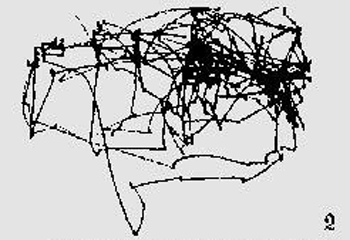
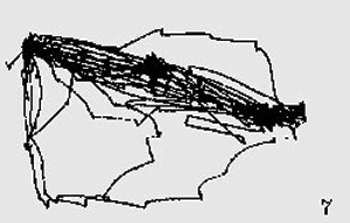
First Yarbus simply let his subjects view the picture without any instructions from him. Their saccadic patterns were typified by this subject’s result.
Each line represents the fast movement of the eyes from one location to another (saccades) and clusters of lines are the traces of fixations. The denser the lines, the longer and more often a point was fixated. Sasha Archibald’s reconstruction at the top of this entry superimposes this pattern on the original picture.
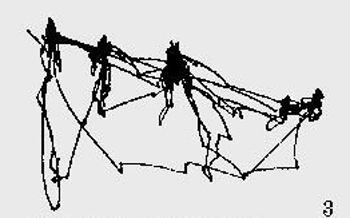
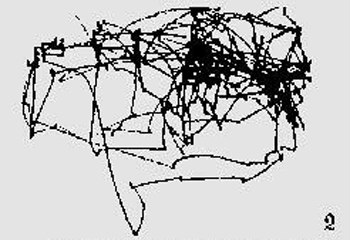
Then Yarbus tried asking his subjects questions about the image. Here is the result of his asking one subject to estimate the material circumstances of the family.
A very different trajectory of attention emerges. Now the scanning was more purposeful, and it focused on the areas most likely to fulfill the task of identifying the family’s social class–clothes, the piano, the children, and other items. Moreover, when given more time to examine the picture, subjects did not roam around every cranny of the frame but returned constantly to the areas they had already examined, the ones that were most relevant to the task. Hence the blotchy areas, which are nodes where the eyes fixated very often.
Artists often claim that color, composition, and other features attract a viewer’s attention. But Yarbus concluded that while some sorts of visual material, chiefly faces and bodies, were targeted during the undirected scanning, many other features, such as color, edges, light or dark regions, and so on were not. “The character of the eye movements is either completely independent of or only very slightly dependent on the material of the picture and how it was made. . . . Depending on the task in which a person is engaged, i.e., depending on the character of the information which he must obtain, the distribution of the points of fixation on an object will vary correspondingly” (pp. 190, 192).
Your mission in watching a movie
Generally speaking, in blocking and framing a shot, the most important thing is to make sure the audience is looking where you want them to look.
Robert Zemeckis
Like painters, film directors talk of guiding our attention, isolating this actor, throwing one plane out of focus in order to emphasize another one. And we commonly say that the movie is designed to grab our eyes and guide them through each shot. As Zemeckis’ remark suggests, directors direct actors but they also direct us; they direct our attention, and they do it by making certain things salient in each shot.
Or so we think. If Yarbus and Land and Tatler are right, are we deeply wrong about how movies work? I don’t think so, but convincing you requires that I unpack some assumptions.
First, the world doesn’t come to us in a frame. A film shot, like a still photo or a painting, is bounded by edges, and as Rudolf Arnheim and Jean Mitry have pointed out, the very existence of the frame inevitably organizes what is put inside it. It makes little sense to say that something is in the center of your visual environment—that depends on where you’re looking—but everyone will agree what is in the center of a picture. And we are very likely to look at that central area of a frame or screen; Land and Tatler call it a “bias” (p. 39).
Repin took advantage of this bias by composing the primary action around a central region. It’s not the geometrical center of the image, which falls on a fairly innocuous patch of gray near the elbow of the woman seated at the piano. But there is a cluster of heads and shoulders just above that center. Fans of the “rule of thirds” will point out the glances of the man, the women in the background, the woman at the piano, and the rising woman lie along a line marking off the top third of the picture. The frame, by being a certain shape, creates lines of force within the image, and these can attract our scrutiny.
Second, human faces are a special case. We are sublimely sensitive to them. Faces are recognized even in low-resolution images, they are detected faster than other configurations, and we readily project them into ambiguous patterns. Hence we see the Man in the Moon and the Savior on a Cheeto. Naturally, artists realize the power of faces and gestures to attract our attention. Repin’s compositional design facilitates our pickup of the human drama he presents.
Filmmakers follow suit. Knowing that faces and movements are zones of high information, directors light, frame, compose, and edit their shots so that these zones get highlighted. Indeed, we might say that today’s “intensified continuity” style of filmmaking, emphasizing singles and facial close-ups, goes with the flow, giving us a full dose of what we’d look for anyway.
Yarbus stresses the all-over quality of undirected vision, at least when compared with more specific tasks. But I’d say that the scanpaths we find in his free version line up pretty well with Repin’s compositional pattern and the pictorial roles he gave to faces, bodies, and gestures. True, there is a lot of visual search in unrewarding areas. Nonetheless, that high, slightly sloping area above the geometrical center attracts heavy traffic, as does the daringly edge-centered children on the far right. It is simply the line of least resistance, at least when all other considerations are equal.
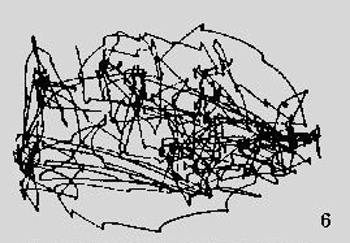
Yarbus made other things unequal. He asked questions, which created more guided paths. Still, regardless of what task they were assigned, Yarbus’ informants seem largely to have followed the compositional path Repin laid down. Asked to estimate the ages of the people in the picture, viewers gave a tighter, simplified version of the default, undirected path. To determine ages, face and height matter; the left window and furniture didn’t have to be explored much. Here is one subject’s pattern of scanning for signs of age.
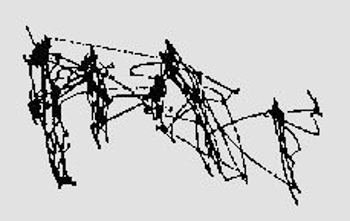
Asked to memorize the costumes, the subjects also stuck to the program, with more searching of the body areas. Here is one example.
And asked to estimate how long the visitor had been away from the family, another viewer’s gaze traces a comparably tight slope, dwelling especially on the children at the far right.
In short, Yarbus’s questions about age, clothing, and years of separation were best answered by the faces and bodies on display–exactly the areas highlighted by Repin’s composition, color, and ensemble staging. Unsurprisingly, however, if your task is to estimate the family’s wealth, you’ll probably roam to the periphery of the action, as one subject did.
And if you’re told to memorize the spatial layout–a very unusual task that you’d seldom impose on yourself–you will spread your net quite widely, as one viewer did.
Yarbus’ results suggest to me that representational pictures elicit a set of default strategies: Start from the approximate center of the format. Watch for faces and gestures and an exchange of looks. Then launch further exploration of the picture space, anchoring that to the main compositional vectors and human signals. And of course take the title into account. The “they” of They Did Not Expect Him (virtually a literal translation of the original Russian title) prompts us to look for the reactions of onlookers.
With film, of course, we have additional pointers: sound, especially dialogue; camera movement, which is constantly redirecting our attention; and figure movement, which is a powerful eye-catcher. All things being equal, these channels of information will usually work in tandem with composition and the human signal patterns at work in a scene. Most films can be thought of as massively redundant systems for drawing our visual attention to certain items in the frame, second by second.
Story as task
One more point. Most of the factors I’ve mentioned involve bottom-up cueing. If in ordinary life our saccadic probes are governed by top-down task assignment, what about still images or moving pictures? Are there no task dictates at work? I think there are.
Recall most of the questions that Yarbus asked his viewers: the figures’ ages and clothing, their activities before the man entered, the family’s material circumstances. These are relevant to the tale the painting tells. It’s what we call a narrative painting, and most of Yarbus’ pointers are addressed to filling out the story.
The story may not be obvious to us today, but most commentators seem to agree that image represents a political exile returning from a labor camp to his family. The woman rising in the foreground is his mother, while his wife can be seen stirring from her place at the piano. His children are on the right, and many commentators interpret the somewhat fearful or puzzled expression on the little girl to indicate that she is too young to remember him. The image developed out of Repin’s sympathy for Russian radical movements of the time, and it was widely circulated by the later Bolshevik regime. Very likely Yarbus’s subjects would have seen the picture before and known the story behind it.
The point I want to make is that we do take on tasks when we watch a film image. Perhaps the most basic one is maintaining our interest, seeking out something that will keep our attention engaged at a basic level. But one major way to achieve interest is to make an effort to grasp how what’s happening onscreen develops the story.
Once the movie has started, we know who the main characters are and thus whom to watch most closely in ensuing scenes. We know something of their minds and motives, and we are sensitive to anything that impinges on those matters. So our top-down hypotheses about what’s going on and what will happen next shape what we look at and when we look at it.
Since story comprehension is one of our primary tasks in watching a mainstream movie, we will tend to ignore other things. We will miss changes in objects’ position across cuts (“cheats”) and disparities of lighting from shot to shot (e.g., the opening office scenes of The Godfather). These would seem to provide equivalents for the invisible-gorilla effect, although bottom-up factors are at play in such cases as well. Alternatively, when we don’t have any narrative expectations, as when we’re confronted with a lyrical avant-garde film by Stan Brakhage or Nathaniel Dorsky, perhaps we will let our eyes roam around the images more freely. Confronted by a film that denies us a narrative, we attend to composition, color, and other qualities that we may not notice in most storytelling cinema.
I’m convinced that research into vision is important to understanding film, but I’m a duffer at this. Next time, we hear from Tim Smith, a sort of modern-day Yarbus who monitors how we watch movies. An early example of his work is here, but next time we’ll catch up with his recent efforts.
Yarbus’s book is Eye Movements and Vision (New York: Plenum, 1967). It is rare and expensive, but a pdf is available online here. Google “Yarbus” and “Repin” together and you will find a great many research articles on eye movements and imagery. I’m grateful to amonseuldesir’s sitefor providing sharper diagrams of Yarbus’ result than I could squeeze out of my copy of his book.
Sasha Archibald has made a valiant effort to map Yarbus’ reported results onto the painting, as indicated in the image at the top of this entry. I thank Cabinet magazine for permission to reprint her schema. Thanks as well to Maria Belodubrovskaya for confirming the correct translation of the painting’s title. She recalls that in school she and other children were asked to discuss the reactions of the family portrayed in the painting.
For more on Dan Simons and Chris Chabris’ work, see The Invisible Gorilla and Other Ways Our Intuitions Deceive Us. Daniel Memmert has performed eye-tracking experiments with children watching the gorilla video. (See “The Effects of Eye Movements, Age, and Expertise on Inattentional Blindness,” Consciousness and Cognition 15 [2006], pp. 620-627.) Surprisingly, Memmert found that many subjects who fixated on the gorilla during the video still didn’t claim to notice it! Simons and Chabris use this finding to suggest that even fixations don’t guarantee awareness. It seems that fixation is a necessary but not sufficient condition for noticing something; once more, the task at hand can block out even things that we can see clearly.
Related to inattentional blindness is “change blindness.” As I mentioned in an earlier blog, Dan Levin, who worked with Simons, has explored how our inability to detect changes in images or in the real world can affect our understanding of edited scenes in films. Tim Smith has further studied “edit-blindness” as a cinematic parallel to change blindness.
Robert Zemeckis’ remark about guiding the viewer’s eye is quoted in Jay Holben, “Sole Survivor,” American Cinematographer 82, 1 (January 2001), p. 40. For more on that idea, see the opening chapter of my Figures Traced in Light: On Cinematic Staging. More broadly, I discuss cinematic experience, and especially story comprehension, as an interaction of top-down and bottom-up factors in Narration in the Fiction Film and the first chapter of Poetics of Cinema.
On Saturday 19 February, at 2:30, the Museum of Chinese in America will host a conversation with me. Ken Smith, the Asian arts critic for the Financial Times, and I will talk about Hong Kong film and my new online edition of Planet Hong Kong.
You can read more about the event here; you can find more background to PHK 2 on my blog entries of a couple weeks ago (starting here). The first edition’s preface, along with ordering information, can be found here.
I’d be happy to talk with any readers, HK fans or not, who follow our blog. Thanks to Ken, Joanna Lee, and the MoCA coordinators for arranging this event!
Coming up early next week: More about eyes and movies.
NB: An earlier draft of this post claimed, erroneously, that the session would take place on 19 March. Sorry for the lapse!








 This patterning too has parallels in the experimental film tradition, I think. What P. Adams Sitney famously called Structural film was a 1960s-1970s trend that often built the awareness of time into a film’s overall pattern. A simple example is Robert Nelson’s Bleu Shut (1970). A clock runs in the right corner of the frame to measure the time consumed by a film that is, we’re promised by a woman’s breathless voice-over, “exactly thirty minutes long.” (She lies.)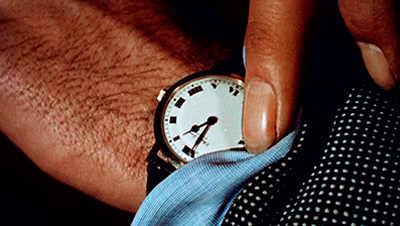
 Like the compilation filmmakers, Marclay wants crosstalk among his bits, but the stretches of The Clock I saw don’t create much friction. There’s a lot of continuity from shot to shot: One character in one movie walks out a door, and we cut to another character from another movie entering a new locale. Music links scenes smoothly. Although Marclay was influenced by the diffuse, chance organizations promoted by John Cage, some of his earlier work emphasized through-line linkages and blending as well. Marclay’s famous record-album collages allow a unified figure to emerge as a gestalt binding together disparate images. On the right, you can see this happening in Guitar Neck (1992), which virtually diagrams the sort of smooth juxtapositions we get in The Clock.