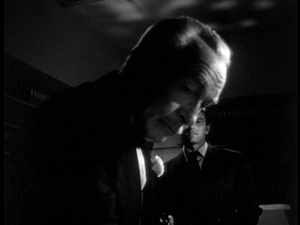
by Kristin Thompson. Berkeley: University of California
Press, 2007.
400 pages, 6 × 9 inches, 12 color illustrations;
36 b/w illustrations.
[go
to Amazon | go to The Frodo Franchise blog]
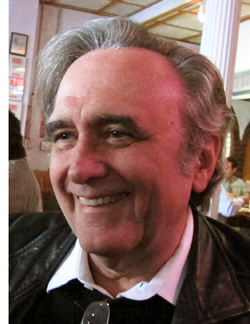
When will we baby boomers relax our chokehold on popular culture? Never, if the enthusiastic response to Joe Dante’s visit to Madison last weekend is any indication. A showing of Gremlins (1984) packed the house. A screening of his Twilight Zone: The Movie episode brought fans forward with DVD slipcases to sign. College kids reminisced about watching The ‘burbs with their dads and Explorers with their buddies (all on video, of course).
Although steeped in classical Hollywood, intimately acquainted with the most obscure output of the studios, Dante hasn’t abandoned the present. He shoots TV shows, webisodes, and the 3D feature The Hole (still awaiting a US release). He hosts a website, Trailers from Hell, in which directors comment on other directors’ works using a trailer as a point of departure.
His films, from Piranha (1978) and The Howling (1981) to the present, by way of Amazon Women on the Moon (1987) and Matinee (1993), combine the gonzo spirit of the 1960s with a good-natured reverence for the past. Particularly movies. Particularly crazed, tasteless movies. Like Spielberg and Peter Jackson, he’s a fanboy. “Most filmmakers are kids at heart,” he says. “And all actors are.”
Unlike Spielberg and Jackson, though, Dante keeps politics close to the surface. His films sustain the baby-boomer hope that you can squeeze cultural critique into a genre project. Everybody knows that the Gremlins movies are subversive trips into the shadows of bourgeois normalcy. Has a shiny kitchen blender ever been used more efficiently?
The Gremlins pictures and The ‘burbs are valentines compared to Homecoming, Dante’s installment in the series Masters of Horror. This asks a simple question: Suppose that all the soldiers killed in combat were able to come back and vote? Is that a powerful lobbying group or what? When resurrected vets of Iraq start stalking to the polls, an Ann Coulter lookalike tries to stop them. Run on cable in 2005, this left-wing zombie movie slashes to ribbons pious platitudes about war’s costs. It’s required viewing for all 2012 presidential candidates.
Don’t crowd me, Joe
Dante began his career as a collagist. That’s not too fancy a name for a man who, with his friend Jon Davison, collected the ephemera of the great age of 16mm. TV shows, ads, and movie trailers swept out of local stations went into their archives. In time these and other glories of late-night TV found a new life, like a monster stitched together out of morgue remains. The strategy was simple. Dante and Davison rented five or six 16mm sub-B features and projected stretches of them, in rough order but jumbled together. The movies were interspersed with reels of clips.
The Movie Orgy played college campuses in the late 1960s and early 1970s. The Orgy lasted about seven hours, and its auteurs urged viewers to drift in and out. “Go get a pizza whenever you want. You won’t miss a thing.” Eventually Schlitz hired them to take it around the country and sold beer at the screenings.
When Dante began working for Roger Corman’s company—cutting trailers, thereby tapping his skills as a collage-maker—The Orgy was suspended. But some years ago the footage that he could find was transferred to digital and played at the New Beverly. It found a new success. Dennis Cozzallo has a lively tribute from 2008 here. Needless to say, we had to have The Orgy for Dante’s visit to Madison.
Affection for the detritus of the media takes many forms. After watching too many campus simpletons (both students and profs) laugh mockingly at Fritz Lang and John Woo movies, I’m opposed to condescension. I suspect Camp in its disdainful form. I don’t like people demonstrating their sense of superiority to the trash their parents and grandparents enjoyed. Knowingness leaves you with nothing.
But The Movie Orgy is different. It offers another take on subpar product: The pleasure of sheer unpredictability. How will common sense be violated? How will demands of craftsmanship be dodged or bungled? How will canons of taste be overturned? How will things that were once stupid, and remain stupid, and will be stupid forever, still communicate a certain cynical earnestness? A foolish idea carried off with obstinate conviction will always deserve respect, so Earth vs. The Flying Saucers and Beginning of the End wind up having a touching desperation, like the badly-tied noose in a suicide hanging.
Moreover, in sequence after sequence, there’s a quality of astonishment that doesn’t make us feel superior. Take one exemplary moment of dépaysment. If you and I tried to be naive or trashy, we couldn’t come up with this.
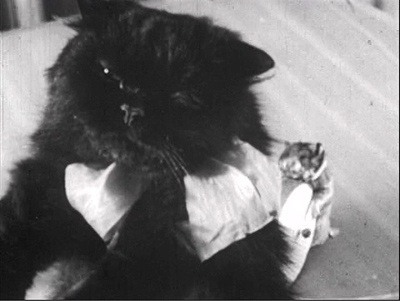
Andy Devine hosted a kiddie TV show, Andy’s Gang, which featured Froggy the Gremlin (Plunk your magic twanger, Froggie!), the cat Midnight, and Squeeky the mouse (played by a hamster). About an hour into The Orgy, Andy induces Midnight to play a miniature pipe organ while Squeeky accompanies him. Cut to a deep-focus shot of what seems to be a slightly drugged cat locked in place and rhythmically pawing the offscreen keyboard. In the background Squeeky, apparently clamped within a mechanical mouse body, bangs a tiny bass drum. Andy sings along tunelessly. The song is “Jesus Loves Me.”
You don’t laugh, you gape. It’s like one of our local attractions, The House on the Rock: What’s disturbing is not that it’s done poorly, but that somebody thought of doing it at all.
The form of The Orgy—and it does have a form, of sorts—is to open with openings and end with endings. Several of the movies get started in the first half hour (Dante and Davison love opening credits) and we’re given enough of the plots to become curious. Most prominent are Attack of the 50-Foot Woman and Speed Crazy, the latter receiving a loving dissection highlighting, and repeating to the point of obsession the heel protagonist’s tagline, “Don’t crowd me, Joe.” Eventually the guy and his flashy sports car wind up crowded, all right–crowded into a ravine.
More TV episodes and movies get added as the hours roll by, and by the end we’re facing Armageddon. Los Angeles, Las Vegas, Chicago, New York, DC—every major city is under attack by some alien or giant monster. Sky King has to dump dynamite for some reason, Superman has to save Lois from a pistolero. A sort of amphetamine Intolerance, The Movie Orgy cuts together all these climaxes, which include The End titles that are far, far from signaling the end.
The clip from Andy’s Gang reminds us that the piece is somewhat misnamed. It’s a Movies And TV Orgy. More specifically, it’s a Movies On TV orgy. The structure of the whole shebang imitates a long stretch of television ca. 1955-1960. Over lunch Dante recalled watching Million Dollar Movie as a kid in New Jersey, seeing a feature shoehorned into a ninety-minute slot and chopped up by commercials. The Orgy replicates the jagged tempo of switching among three or four channels, glimpsing variant commercials for Colgate toothpaste or Raleigh cigarettes, catching a bit of this movie and then a bit of that one. With all its kid shows from my youth (The Lone Ranger, Lassie, Mighty Mouse, etc.) in endless eruption and interruption, it’s a baby-boomer time capsule. Puncturing this evocation of childhood are the clips scavenged from teenpix and Dick Clark’s dance show, Vietnam, Nixon’s Checkers speech, and film-society icons like the Marx Brothers, Fields, and Abbott and Costello. The late sixties counterculture breathes more fully in some clever fake ad spots. In one, a crucifix starts to wobble as the carved Jesus struggles to free his hands.
Dante claims that he and Davison were inspired to find out about the popular culture that shaped their parents’ generation. But nearly everything we see filled the airwaves during our younger days as well. The Movie Orgy in its current form seems to me a zestful celebration of the world our generation saw when we flopped on our bellies, propped our chins in our hands, and stared at the tumultuous world inside a black-and-white (not color) TV (not video) set (not monitor).
We cartoon characters can have a wonderful life
Dante the collagist leaves his fingerprints all over another film he screened here. When Spielberg launched his Amblin company, he hunted for directors who could make family entertainment in a genre format. Dante, who had already started Gremlins, was invited onto the omnibus Twilight Zone project. After the fatal accident on the Landis set, the studio backed off and it become “a movie they wanted to make but didn’t want anything to do with.” This gave Dante wide latitude and made him think, mistakenly, that studio suits always leave directors alone.
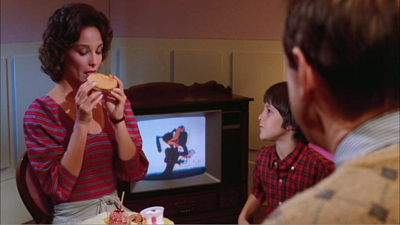
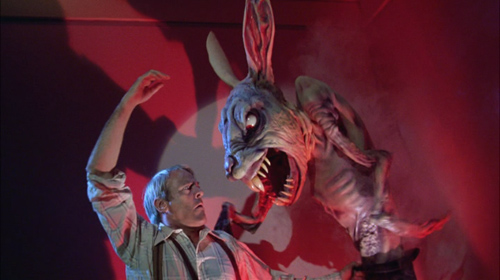
For this episode, Dante wanted to do an original story but Warners insisted that it had to be based on an episode of the TV series. He went back to the original Jerome Bixby story, which Dante and Richard Matheson reworked to add cartoons as a running gloss to the comic horror. The pseudo-family of demonic little Anthony inhabits a house that is half cartoonland, half-PoMo-Caligari. Saturated colors, occasionally striped with noir shadows, provide another Dante caricature of family domesticity, but now cartoons comment on the action. When Helen steels herself to eat, the dog on the screen behind her is doing the same.
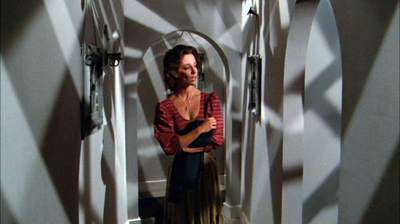
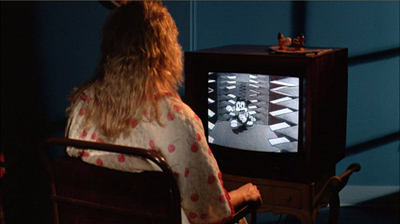
The crisscrossed shadows of the corridors are replayed in the sawtooth walls pursuing Bimbo.
The collage principle gets developed further in Dante’s use of the soundtrack. The Movie Orgy uses no new sound work; the clips are just spliced together. But for the Twilight Zone episode, let loose in Warners’ classic archive, Dante could weave in Carl Stalling music (reorchestrated for stereo by Jerry Goldsmith) and a rich mélange of daffy sound effects.
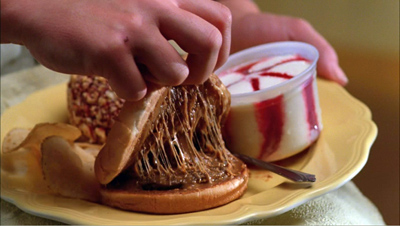
The TV is incessantly on. The cartoons running in the background supply whizzes, boinks, and thuds that jarringly punctuate the conversation between puzzled teacher Helen Foley and the family that Anthony holds in his magical grip. “This is Helen,” says Anthony, introducing her to Uncle Walt and his sister, as we hear a smash from the TV set. The cartoon tracks comment on the action too. As the family settle down in front of the tube, the elders dote on Helen and we hear a Stalling rendition of “Ain’t She Sweet?” Dinner is served to the tune of “The Teddy Bears’ Picnic.” And when Helen discovers her burger has been slathered with peanut butter, the visceral image is underscored by warbling winds that rise when she lifts the bun. Eisenstein, for reasons given here, would have loved the moment. The whole sequence plays out as live-action animation, with naturalistic dialogue and effects given a creepy overlay by the cartoon track. Is Helen Foley’s last name part of the gag?
Dante, impresario of the comic grotesque, finds his inspiration in popular culture, the more wacko and inept the better. The comedy may come from childhood silliness, the grotesque from childhood fears. They say we baby boomers will always be just big kids, and Dante accepts this with a grin and a darkly cheerful eye.
Many thanks to the resourceful Jim Healy for arranging his friend Joe Dante’s trip to Madison. Thanks as well to the Cinematheque, the Marquee, and the Chazen Museum of Art for hosting the screenings.
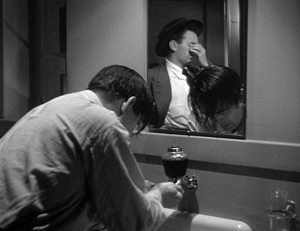
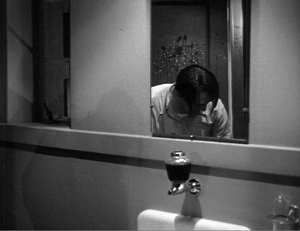
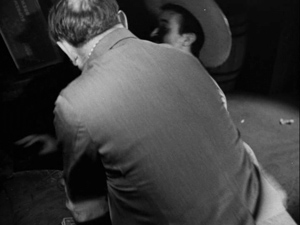
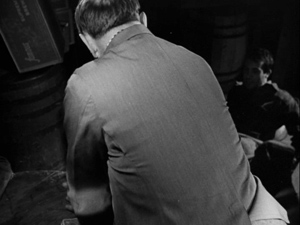
The mobster Joseph Rico is in protective custody; tomorrow he testifies against the big boss. But Rico fears reprisals, so he decides to escape. While a sleepy cop guards him in the washroom, he bends over the sink and rinses his face.
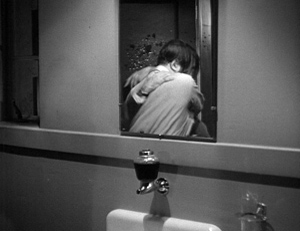
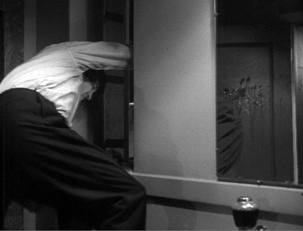
Turning so suddenly that water spatters on the mirror, he grabs the cop in an armlock and slams his head against the sink, just below the frameline.
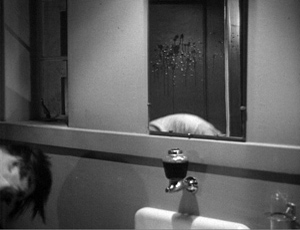
Rico turns to the window to make his escape.
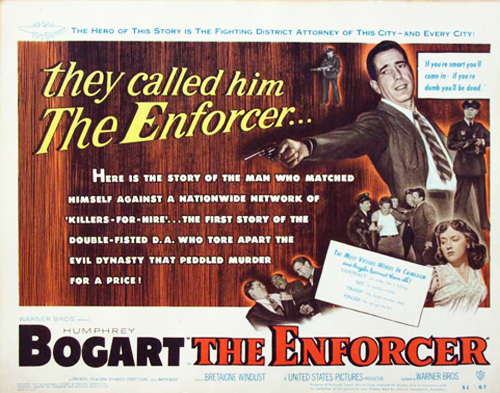
What interests me in this passage from The Enforcer (1951) is not just what happens in the mirror but also what happens on it. While Rico belabors the cop’s head, we’re given a chance to notice the splash of water that hit the mirror when Rico whirled to the attack. While the action is moving forward, we’re reminded of what had triggered it.
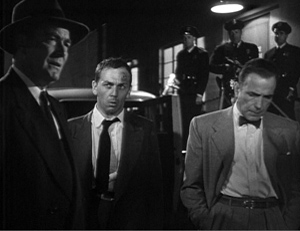
We get a sort of parallel reminder in the next scene, when we see the wounded cop again. He’s sporting a big bruise on his left temple, a souvenir of Rico’s assault.
Pfui. Details, you might say. Or you might (correctly) instance this as another case of Charles Barr’s enlightening notion of gradation of emphasis. But it’s worth getting a little more specific, because even this simple scene (by non-auteur director Bretaigne Windust) offers us something to think about, and something for today’s filmmakers to try.
Most films today don’t fully exploit the visual dimension of cinema. True, we have dazzling CGI and fancy camera moves. But when it comes to less flamboyant scenes, directors have limited their options by relying too much on stand-and-deliver and walk-and-talk. There are other aspects of visual storytelling that today’s filmmakers neglect. One aspect is the possibility of gracefully moving actors around the set in a sustained fixed shot. A specific tactic I’ve mentioned before is the Cross, and another involves ways to get people into a room. The option I’m going to sermonize about today is what I’ll call scenic density.
By scenic density I mean an approach to staging, shooting, and cutting in which selected details or areas change their status in the course of the action. I don’t count the bustle of background business, all that street traffic that is so much pictorial excelsior in our movies. Nor do I refer to stuffing the setting with desk and kitchen flotsam, allusive pop-culture posters, and the other distinctive “assets” that will be exploited when the film’s world gets transposed to a videogame. I mean something more expressive and intriguing.
Using it up
Go back to the Enforcer scene. The shot’s composition creates a delimited zone of action. The guard cop is framed tightly in the mirror. When the fight breaks out, it’s initially framed in that mirror–a narrowing of visual importance. Moreover, the shot is designed to highlight the spatter on the mirror. It’s fairly prominent, stuck near the center and, providentially, in the spot that the cop’s head initially occupied. The lighting picks out the drips, and in a shot where the figures move in and out of frame, there isn’t an equally constant center of interest. We’re probably concentrating on Rico’s punishing of the cop, but the dribbles of water remain prominent enough to claim our interest, especially when Rico passes out of frame.
So here’s my first condition for scenic density: the shot keeps several items of dramatic significance salient in the composition.
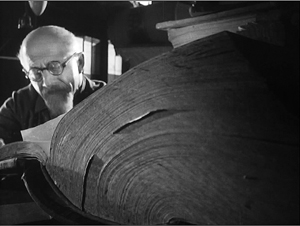
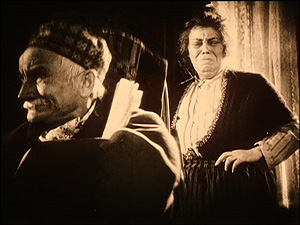
This technical choice asks the filmmaker to think of the frame as a field of dynamic masses and forces. Such an idea was part of the aesthetic of “advanced” European and Japanese silent cinema of the 1920s. Many directors explored this dynamism, often aided by low angles and wide-angle lenses. Here are examples from Eisenstein’s Old and New and Murnau’s Tartuffe.
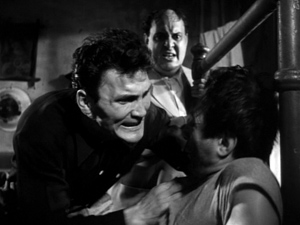
This pictorial density became especially prominent in American cinema during the 1940s, when low angles, wide-angle lenses, and locations and smaller sets encouraged cinematographers to pack their compositions snugly, as in this shot from Panic in the Streets.
Boris Kaufman, cinematographer for Jean Vigo and Elia Kazan, summed up the principle:
The space within the frame should be entirely used in the composition.
Since cinema is a time-bound art, however, the salient elements in the shot could and should change. But if the frame space is wholly “used,” what room is there for change? The only options are to have the using-up elements shift position, or to reveal that the frame isn’t used up.
Vivid instances, also from the 1940s, can be seen in Anthony Mann’s work, both with and without John Alton. Generally, Mann used the new fashion for depth composition, especially big foreground elements, to heighten scenes of violence. Physical action becomes more aggressive if people rush the camera and halt in tight close-up, especially because wide-angle lenses tend to accelerate movement to the foreground. Mann thrusts violence abruptly to the camera with an almost comic-book effect, as when the club owner is shot in Railroaded, or a man is flung to the floor in Raw Deal.
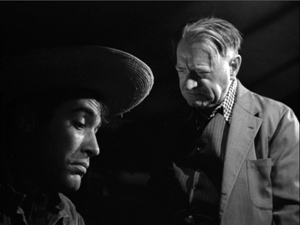
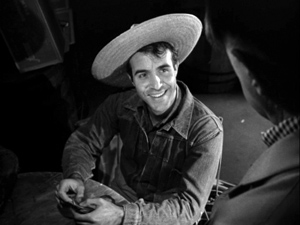
Even when this in-your-face tactic isn’t employed, the Mann films find ingenious ways to develop what seem to be completely locked depth compositions. In Border Incident, Ulrich confronts the Mexican government agent Pablo, disguised as a Bracero. A looming depth shot is followed by a reverse shot displaying a compact composition.
Is the frame space fully used? The second shot above is opened up when Ulrich leans forward to sock Pablo, creating a vacant spot on the far right for Pablo to fall into. The shot is emptied and re-filled, dense once more.
Memories, memories
Aha, you may be saying. Density just refers to squinchy, fussy shots from an era that favored cheap flash. No. The Enforcer shot isn’t all that cramped. Of course the blank, unchanging walls serve to highlight the mirror-reflected fight and the water dribbling down the glass, but you can imagine how much more jammed and skewed Mann’s treatment of Rico’s escape would be. As for the flashier depth, I just needed some clear-cut cases of density, examples in which details and spatial zones become starkly salient. Now I want to suggest that scenic density can be achieved in something more spacious, even monumental. That has to do with time and memory.
Part of what gives the Enforcer shot its interest is the superimposition of two moments of action in a single space: Rico’s diversionary turn from the washstand, recorded in the splash he made on the mirror, and the struggle taking place a few seconds later. A further trace of that struggle and that splash is visible in the bruise on the cop’s head in the next scene.
That dripping spatter can stand in for the second quality of spatial density I want to highlight: Its capacity to coax us to recall earlier action in the locale. Characters leave their marks and spoors in the space, and those get activated as memories. Unlike the slick surfaces of today’s settings, in classic films the settings can bear the impress of human transit, leading us to recall bits of behavior and emotional states. Let me illustrate from Lang’s Hangmen Also Die (1943).
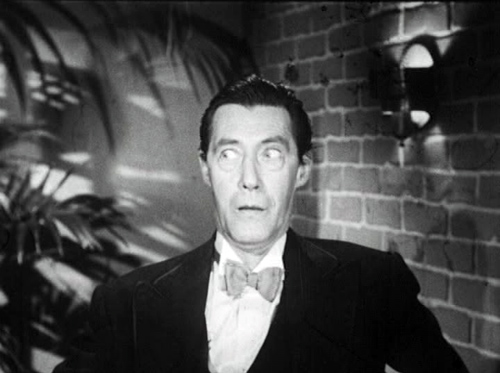
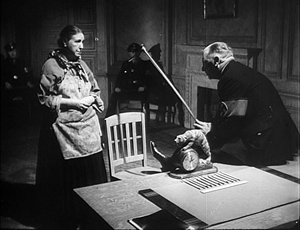
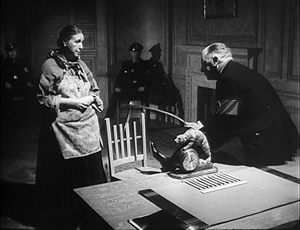
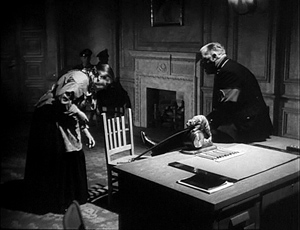
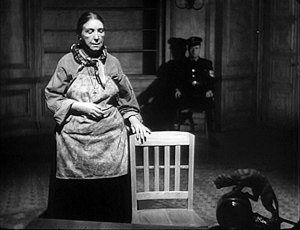
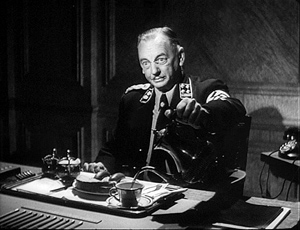
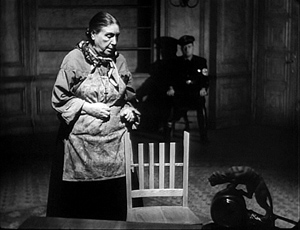
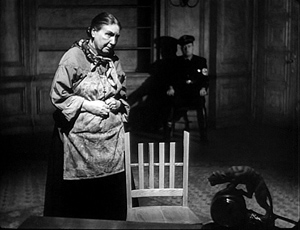
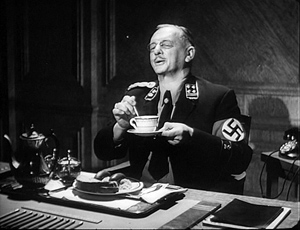
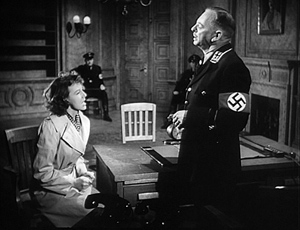
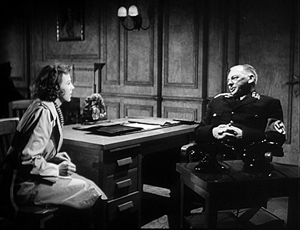
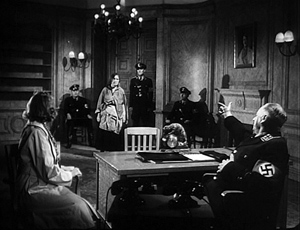
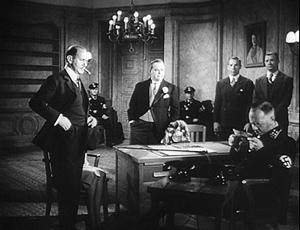
It’s Nazi-occupied Czechoslovakia, and Gestapo Inspector Ritter is questioning Mrs. Dvorak, the vegetable seller who could identify the woman who misled the officers pursuing an assassin. Torture, or at least what we think of as torture, hasn’t started. She is simply standing in front of his desk as he brandishes his riding crop in the manner of a good movie Nazi.
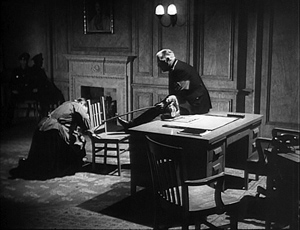
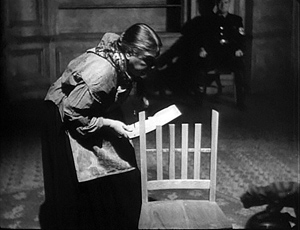
When Mrs. Dvorak denies knowing the woman, Ritter taps the back-rest of the chair. It simply falls off, and we realize it’s not fastened to the chair.
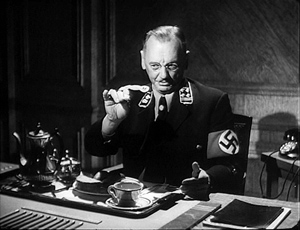
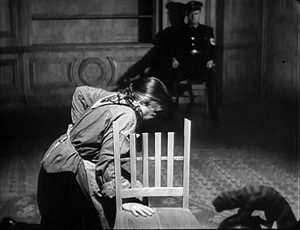
Ritter says, “Pick it up again.” Now we realize that intimidation has been applied for some while; Ritter has made the woman stoop to replace the back-rest many times. She does so again as the camera tracks back. This is nicely detailed too. She starts to pick it up by bending over, finds the effort too painful, and then goes to her knees to pick it up–just as Ritter taps his riding crop against her hand, a teacher gently chiding a slow pupil.
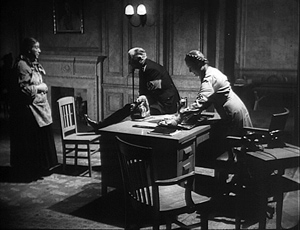
As Mrs. Dvorak rises to put the piece back in place, the camera pans slightly right to pick up the woman bringing in a tray. Happily Ritter sniffs the coffee jug and resumes questioning the old woman.
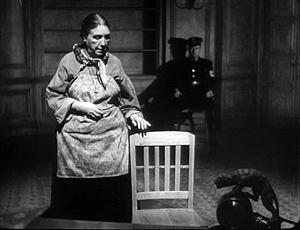
Cut to a shot of her by the chair. “Let’s start from the beginning,” says Ritter, offscreen. Unthinkingly Mrs Dvorak starts to rest her hand on the loose slat, forgetting that the top slat is unattached. It’s a natural response. She’s been standing there for a long time and would like something to rest on, and the chair is temptingly close. (Presumably, that’s its purpose, to taunt the unwary prisoner forced to stand a long time.) Remembering just in time, she yanks her hand away. If she knocks the back-rest off, she’ll just have to pick it up again.
Cut to Ritter. “Don’t be nervous, Mrs. Dvorak. I’m prepared to—”
Cut to Mrs. Dvorak. As he continues, “–devote to you all of tonight,” she forgets herself again and relaxes her hand, this time on the back-rest. It falls off, making her start.
She looks up as Ritter says, offscreen: “Even longer if necessary.” Cut to Ritter, gesturing with a piece of sausage and saying, coaxingly, “Well?”
Slowly she goes to her knees again as the camera tracks in on her.
Back to Ritter: “That’s the girl.” Back to her, rising in pain to replace the back-rest.
The scene concludes with Ritter reminding Mrs. Dvorak that she’s in Gestapo headquarters. She acknowledges that she doesn’t expect to leave without giving information. He starts his questioning all over again as the scene fades out.
This quietly suspenseful scene establishes a bit of furniture as a key prop. Once the faulty back-rest is marked for our notice, we’re expected to remember that it’s a means of intimidation–something that Mrs. Dvorak, in her anxiety about refusing to aid the Nazis, twice forgets. Lang’s shots, simple and uncrowded, makes the chair, like the spattered mirror in The Enforcer, preserve the trace of human activity. Yet it’s more acutely integrated into the scene’s drama than the mirror, and remembering how it was used earlier makes us wait tensely to see how it will be used again.
Long-term density
Several scenes later, the Nazis threaten to kill four hundred Czech hostages if the assassin isn’t turned over to them. Mascha Novotny has set out for Gestapo headquarters to denounce the man she helped, but she changes her mind and decides not to betray her country. She will only plead for her father’s life. Once more we’re in Ritter’s office.
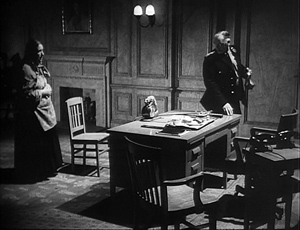
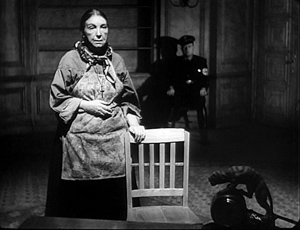
Centered in the frame, standing out as a pale oblong against the grayer background, the fateful chair is made salient during Mascha’s conversation with Gruber. I suspect there’s a sort of spatial suspense here–will she move to the chair and dislodge the precarious piece of wood?–but more important, I think, is the fact that the chair ineluctably reminds us of Mrs. Dvorak and her quiet resistance to pressure.
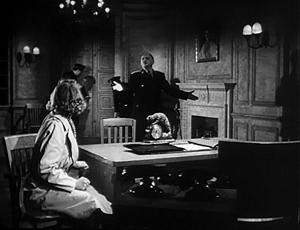
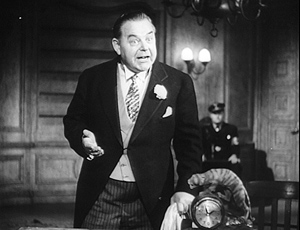
Ritter leaves to consult his superiors. When he comes back, a new composition keeps the chair prominent and lends a new centrality to the clock on Ritter’s desk, surmounted by a snarling cat or something like it. (It’s visible in shadow in the earlier scene with Mrs. Dvorak.) But now the camera arcs to minimize the Dvorak chair and show the beast and Ritter targeting Mascha.
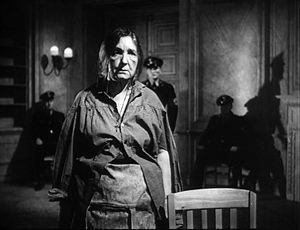
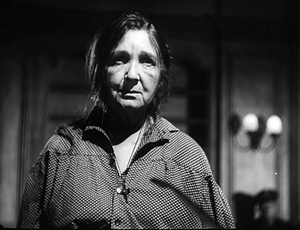
Soon enough, as if to make sure we remember, Mrs. Dvorak is brought back in, having undergone serious torture. The camera positions reactivate our memories of the earlier scene.
As she continues to lie to protect Mascha, Mrs. Dvorak never touches the chair. Although she has been tortured, she seems wearily defiant, as if her refusal to aid the Nazis has given her some strength: no need to lean on the chair now. As a final cue to our memories, Lang has Ritter play once more with his riding crop, letting its shadow fall on her heart.
The threat is clear: For lying, the old woman will pay with her life.
The chair reappears in a later scene, but I’d argue that then it serves more as a pointer to another prop. The resistance movement fights back by framing Czaka, a beer baron sympathetic to the Nazis, as the assassin. Lang could have explicitly recalled the questioning of Mrs. Dvorak by having Czaka lean on the slat and knock it off. Instead, the composition makes Ritter’s clock more important than it was in earlier shots. As Czaka tries to defend himself, the framing blocks our view of the chair but emphasizes the snarling catlike creature on top of the clock. And the chair has shifted a little off and become a bit darker; it’s no longer as salient.
This cluster of scenes from Hangmen Also Die illustrates how scenic density can add layers to a film. One scene recalls another not only by similarity of situation and locale but by tangible marks left on it by earlier action. Having seen Mrs. Dvorak subjected to Ritter’s oily intimidation, we generally expect something like it to be applied to Anna. This conventional situation is given a rich, concrete presentation by the repeated camera positions and the simple chair that, unmoving, enters into the drama.
Of course as a Hollywood director, Lang was pressured to reuse sets and camera setups. That saved money and time. But he turned such repetitions to his advantage by letting certain objects come forward at crucial moments. They not only become part of the drama but prime us to remember them, and what they revealed, in ensuing scenes. And even though Lang never pursued the aggressive, packed deep-focus of other directors working in the 1940s, he shows how roomier, less pressurized compositions could still be charged with echoes of earlier bits of behavior.
Is this sort of visual-dramatic economy, calling on precise memories of concrete actions, lost in today’s American cinema? I suspect it is.
In studying Hangmen Also Die, I was curious about a perennial problem. Was the byplay with the chair a Lang invention on the set, or was it some version of the script, or in the original story by Lang and Bertolt Brecht?
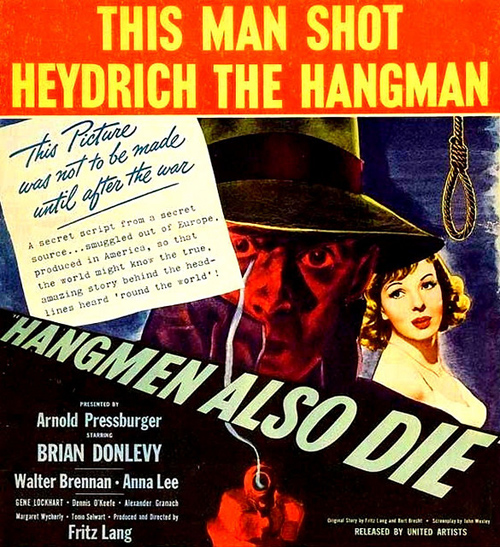
The film didn’t have a secret script, as the poster says, but the sources do remain a bit obscure. A draft of the original story signed by Lang and Brecht, in that order, exists. It indicates only that the greengrocer, called Frau Blaschke, is subjected to eight hours of “the usual Gestapo brutality” and refuses to identify the girl. There were other drafts of the screenplay, but I don’t have access to them, if they exist, and standard sources on Brecht in Hollywood don’t mention this scene’s details.
Somewhere along the line, though, the chair-back business was concocted. I found the shooting script signed only by John Wexley (Brecht claimed that he was robbed of credit) and annotated in pencil, perhaps by Lang. That script indicates that Ritter’s room contains “a vacant chair with its seat close against desk.” and Mrs. Dvorak is standing beside it as the scene begins. Much of the dialogue is the same , with some slight changes notated in pencil, possibly by Lang. But the camera movements indicated are different from those in the final film, and more importantly so are the actions. After Mrs. Dvorak claims that she doesn’t know the woman who helped the assassin, we read the following. I indicate pencil notations with {}.
In her fatigue, she places hand on back-rest of chair. But its dowels are loose and back-rest clatters to the floor.
RITTER (saccharine): Pick it up, Mrs. Dvorak.
CAMERA MOVES IN CLOSE as she obeys, stooping with painful fatigue–she has done this many times tonight.
RITTER: Now put it back in place, Mrs. Dvorak.
(She does so)
As Ritter questions her:
MED. SHOT – MRS. DVORAK. Without thinking, she is about to place hand again on loose back-rest–when she remembers and jerks back.
RITTER’S VOICE: Now don’t be nervous, Mrs. Dvorak…I’m prepared to devote to you all of tonight–and even longer, if necessary.
Mrs. Dvorak, unconsciously reacting to this, once more rests hand on chair. {She jerks back but} The piece of wood clatters to the floor.
MED. SHOT – RITTER. Ritter waits patiently; when she doesn’t move, inquires:
RITTER: Well…?
CAMERA PULLS BACK to INCLUDE Mrs. Dvorak, who stoops to repeat painful routine. Ritter smiles approvingly.
RITTER: That’s the girl.
Nothing here is indicated about Ritter’s riding crop, nor does he initially knock the back-rest off the chair. Mrs. Dvorak does it herself, accidentally. And the scripted line is “Pick it up, Mrs. Dvorak,” not, as in the finished film, “Pick it up again, Mrs. Dvorak.” The film version makes it clear that the byplay with the backrest is part of Ritter’s softening-up technique, something indicated in the script but not spelled out.
The later scenes in the film show other differences, mostly additions of things not mentioned in the shooting script. For instance, the script doesn’t mention the shadow of Ritter’s riding-crop. But the excerpt shows that the shooting script points toward some of the detailing we find in the finished film. It provides the sort of nudges that a director, especially one as oriented to gesture as Lang was, could elaborate on the set.
The Lang/ Brecht story has been published as “437!! Ein Seiselfilm,” in The Brecht Yearbook vol. 28: Friends, Colleagues, Collaborators, ed. Stephen Brockmann (2003), 9-30. The passage I mention, kindly translated for me by Ben Brewster, is on p. 16. Broader background on Brecht’s adventures in Hollywood can be found in James K. Lyon, Bertolt Brecht in America (Princeton University Press, 1980). Chapter 14 of Patrick McGilligan’s Fritz Lang: The Nature of the Beast (St. Martin’s, 1997) offers an account, mostly relying on Brecht’s viewpoint, of the making of Hangmen Also Die. The shooting script is in the John Wexley collection of the Wisconsin Center for Film and Theater Research and the State Historical Society here in Madison. Thanks also to Marc Silberman, renowned Brecht expert, for advice.
Sometimes your audience gets what you’re saying faster than you do. Years ago, after I gave a lecture in a class at Columbia University, a grad student came up and said: “What you’re doing is looking for the conventional side of unconventional films and the unconventional side of conventional films.” I’d say it’s not all I try to do, but the student’s chiasmus does capture a lot of what interests me.
It’s especially on target for Hollywood cinema. I don’t understand criticisms of Hollywood for not being realistic. It’s a highly stylized, artificial cinema, only a few notches above ballet or commedia dell’arte. Some of our best critics, like Parker Tyler and Manny Farber and Geoffrey O’Brien, have understood this. All the artifice will demand plenty of conventions, yes, but there are always filmmakers ready to treat them in fresh ways. And the churn is swift. American studio cinema is constantly finding new variations on its traditional forms, formats, and formulas.
Do-overs are allowed
Sleep, My Love
Take replays. The repeated sequence has become so common in our movies that nobody much notices it any more. We’re quite used to seeing an earlier action revisited. Often the replay simply serves to remind you of what happened, as when clues to a mystery are given in fragmentary flashbacks. The replay may also aim to get you absorbed in a character’s mental life. John, the hitman in John Woo’s The Killer, is traumatized by the fact that he blinded an innocent woman during a contract hit, and the moment of her wounding haunts him.
Sometimes, however, we get multiple-draft replays, in which the second version significantly alters the first. A common gambit is to have the second version show more of what happened, as in the money drop in Jackie Brown. Other cases show contradictions, as when conflicting testimony is dramatized in flashbacks. The most recent version I’ve seen occurs in The Debt, when the central 1966 section of the film concludes by showing what really happened when Dr. Vogel slashed Rachel and fled. In such cases the replay becomes less a true repetition and more of a revision, a new version questioning or canceling what we’ve seen before.
The idea isn’t new. You can find the replay in various forms in trial films of the 1930s, as I’ve discussed here. But the replay really came into its own during the 1940s. Directors and screenwriters experimented with the device as part of a broader initiative, burrowing into new niches in the ecosystem of classical narrative.
In those films, it’s common for replayed scenes to show an incident haunting the protagonist, as when the tormented bride of The Locket is assailed by memories as she walks down the aisle. Sometimes a flashback fills in information that was cunningly omitted from the earlier version, as in Mildred Pierce. And we also have competing accounts of what happened, as variant replays furnish multiple drafts. The most famous example is probably Crossfire.
By 1950, Joseph Mankiewicz could dream up one of the most daring experiments of the period, one that anticipated the repeated scene in Persona. For All about Eve, Mankiewicz planned to present Eve’s memorable monologue about the power of theatre twice: first through the sympathetic eyes of Karen (Celeste Holm), then from the perspective of the bitter Margo Channing (Bette Davis). What would viewers and other filmmakers have made of it? But Fox studio head Darryl F. Zanuck ordered the replay dropped, for reasons I speculate about in this entry’s codicil.
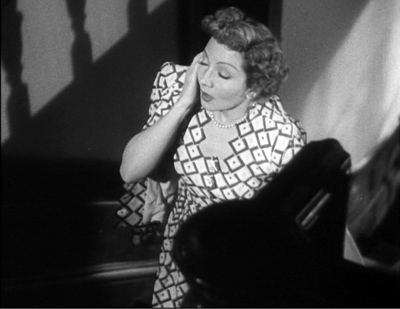
Mankiewicz’s unseen experiment with Eve’s “Audience Aria” reminds us that replays affect the soundtrack too. The most common use of replays is probably auditory, that line of dialogue that flits through a character’s consciousness—an auditory flashback, in effect. “Who knows what you may do the next time?” asks the sinister voice of the psychiatrist as Alison (Claudette Colbert) totters up the stairs in Sleep, My Love (1949). Several snatches of dialogue can flow together to recall a host of earlier scenes. In The Hard Way (1943), on another staircase, Katie (Joan Leslie) becomes distraught as bits of dialogue spoken by several characters flash through her mind.
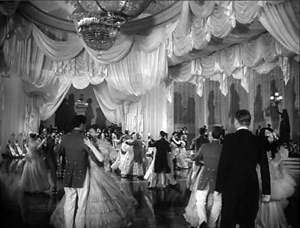
More unusual is the audio replay in Duvivier’s wonderfully stylized Lydia (1941). A flashback to a ball is introduced by Lydia’s voice-over, recalling the splendid ballroom with its mirrorlike floors and the “divine aggregation of musicians, hundred of them, I think.”
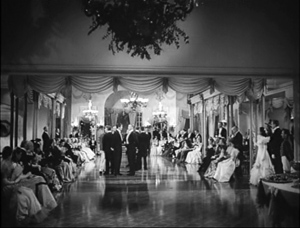
But then her old lover corrects her memory and we get a flashback showing a more modest ballroom with a small ensemble.
Over these later shots, however, we hear bits of Lydia’s earlier description of the big ballroom and troops of musicians, in contrast to what we see. The sound flashback functions as a wry narrational commentary on Lydia’s stubborn romanticism.
Purely auditory replays tend to be subjective, but could we have an objective one? And can it promote surprise and suspense? As we say in Wisconsin, you bet. (Not you betcha.)
The replay machine
A lighthearted instance appears in The Pajama Game (1957). Sid Sorokin (John Raitt) , the new superintendant at the Sleeptite Pajama Factory, is falling in love with Babe Williams (Doris Day), the no-nonsense head of the labor union’s Grievance Committee. He sings into his Dictaphone about her in the song, “Hey, There (You with the Stars in Your Eyes).”
At the end of the song’s first section, he plays it back and then comments sourly on the lines he’s just sung. By the end, he’s joining himself in a duet, harmonizing nicely.
This instant playback wasn’t a cinematic invention, though. The same number, including the Dictaphone gimmick, was employed in the original Broadway production.
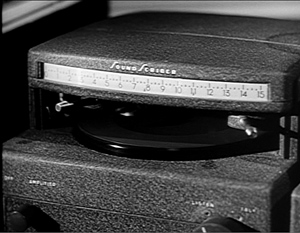
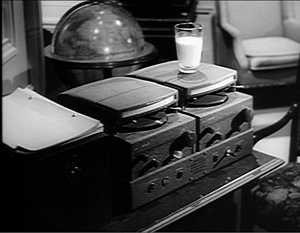
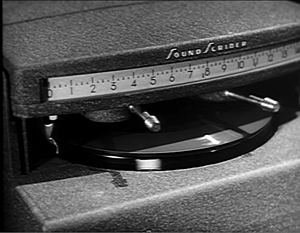
The Dictaphone, which used both wax cylinders and plastic belts for recording, was a popular device for businesses. Erle Stanley Gardner employed it for dictating many of his novels. A competitor to the Dictaphone was the SoundScriber, a late 1940s device using vinyl phonographic discs. The SoundScriber figures in a more sustained and suspenseful replay scene a few years before The Pajama Game.
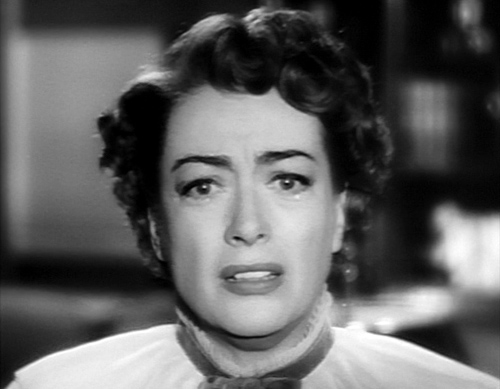
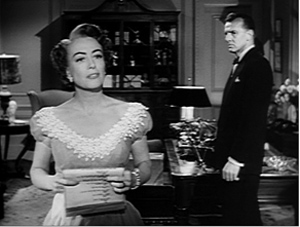
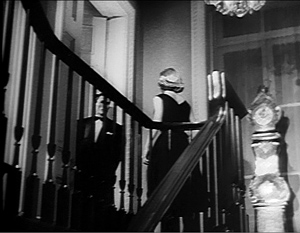
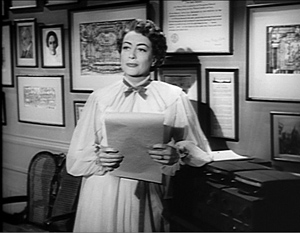
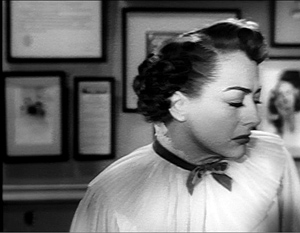
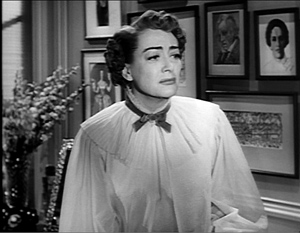
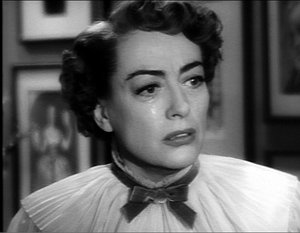
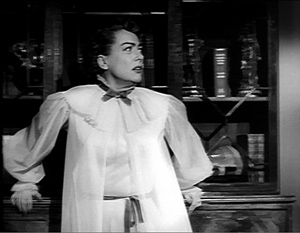
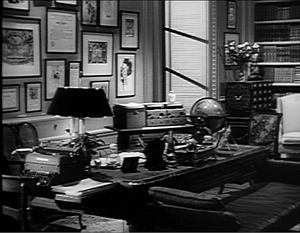
In Sudden Fear (1952), Myra Hudson (Joan Crawford) is a prosperous playwright who has outfitted her office with a SoundScriber. She uses it for dictating plays and correspondence. One evening before a party, euphoric after her new marriage to the handsome actor Lester Blaine, she meets with her attorney to prepare a new will. He proffers a draft that assigns a modest sum to Lester, but she considers it insulting. She switches on the SoundScriber and dictates a new will, one leaving all her estate to Lester.
But we’ve had our suspicions about Lester, since he’s played by Jack Palance, an actor with more juts to his facial planes than a Giacometti bust. Our fears are confirmed after Lester hooks up with his old girlfriend Irene (Gloria Grahame). When they learn that Myra is making a new will, they believe she’s going to give the bulk of her estate to a foundation.
On the evening of the party, as she starts dictating her new will, the guests arrive and she descends to meet them. Irene and Lester slip away and meet in Myra’s study. Fade out on Lester closing the door.
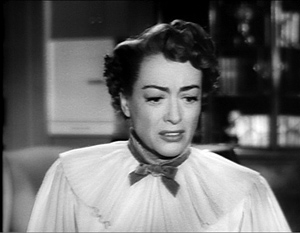
Next morning, Myra return to her study and discovers she left her SoundScriber on all night. She hits replay and listens to herself bequeathing all her money to Lester. This is the replay that launches the big action. As she’s about to switch off the machine, she hears the conversation starting between Lester and Irene. The microphone, left on accidentally, has picked up their plotting.
The couple is still under the false impression that the new will leaves Lester penniless. We hear him declare his contempt for Myra while caressing and embracing Irene. They start planning to kill her before she can sign the new will.
The SoundScriber scene gives us two plot developments, past and present, simultaneously. The recording fills in the gap left by the fade-out: Now we know what happened behind those closed doors. On the visual track, we can watch Myra’s developing anxiety about the couple’s murder plot but, more piercingly, we register her realization that Lester has never loved her.
Across seven minutes, Joan Crawford executes a carefully modulated solo performance, for the most part with no accompanying score. Meanwhile, Palance and Grahame get to act viva voce. And David Miller’s direction scales and times things nicely. I won’t try to analyze the very end of the scene, let alone its frenzied aftermath. I just want to trace the dynamics of the double-layered time scheme the replay machine gives us.
Joanie, more than shoulders
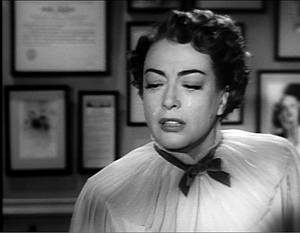
The recorded scene develops from the lovers’ frustration with keeping up a false front, then to their suspicion that Irene will cut Lester out of her will, then to the mistaken belief that she’s just done so, and finally to their decision to kill her. Myra’s playback scene proceeds, I think, in four stages as well. Myra starts out placid and almost giddy in her love for Lester. She’s abruptly shocked and disenchanted when she learns he doesn’t love her; her stomach churns. A third phase consists of her discovery that Lester and Irene intend to kill her, and she devolves into sheer panic. The last phase, of which I’ll show only a bit, initiates a search for a way to defend herself.
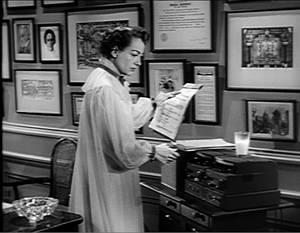
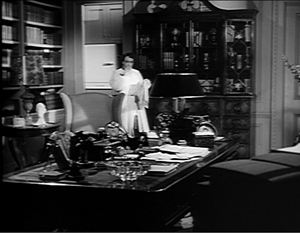
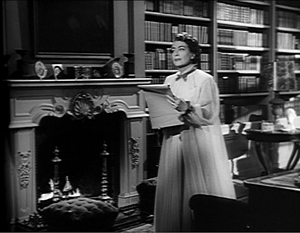
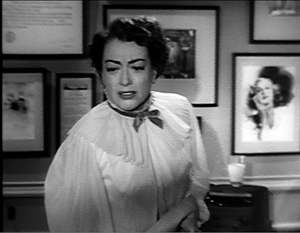
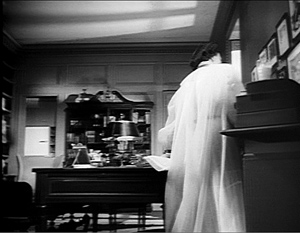
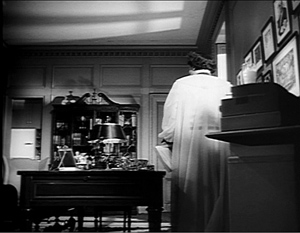
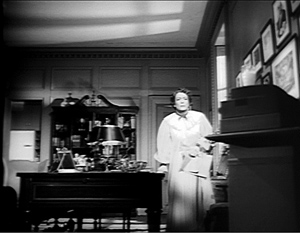
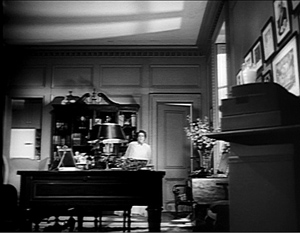
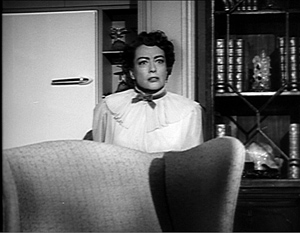
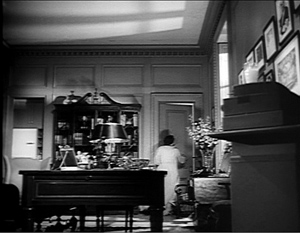
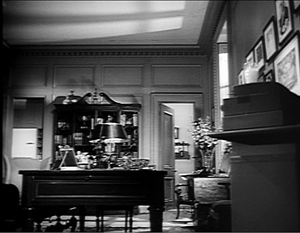
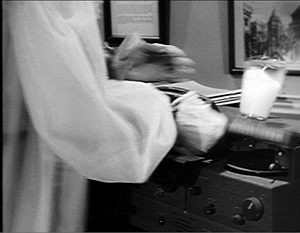
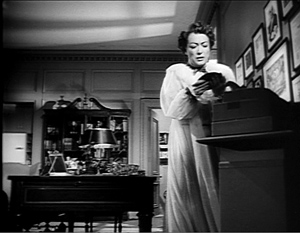
Myra comes in euphoric. As she replays her dictation of the night before, she strolls around her study, going far back to the distant refrigerator for a glass of milk and then coming forward. She seems to savor hearing again her own declaration of her devotion to Lester.
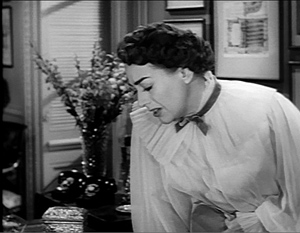
Myra’s circuit around her study isn’t just filler: it etablishes the rear area for use later. But now, as she’s about to turn off the recording, she hears Lester’s voice: “What’s up?” She backs up a little, bumping the desk as she realizes that there’s more on the disc. This recoil, as a performance decision, will get magnified in the course of the scene. Then Miller cuts to a reaction shot.
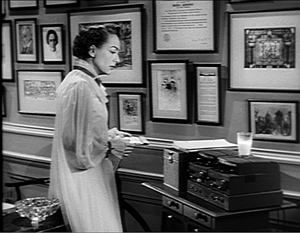
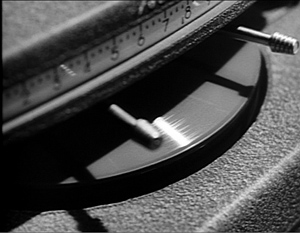
The first of several optical point-of-view shots gives us a close view of the twin SoundScriber units (good for product placement too). Myra has set the milk down on the console.
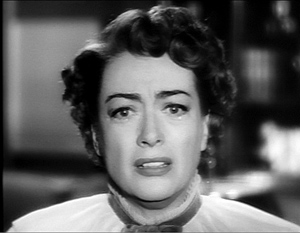
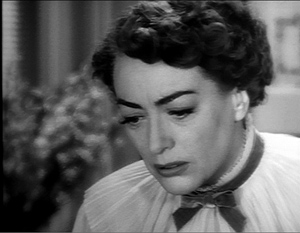
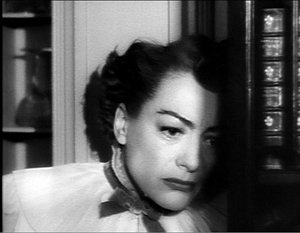
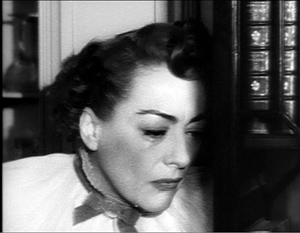
As we hear Lester venting his contempt for her, Myra’s eyes fill with tears. Worse, he adds that he’d like to tell her he never loved her for a moment. “I’d like to see her face.” He can’t, but we can; in the closest shot yet, she looks right at us. Hollywood can be brutal.
She turns away and, seen from a new angle by the desk, she advances toward us. On the track, Lester is pitching woo to Irene. Myra realizes that he lusts for this other woman. She sighs. Listen closely and you can hear her emit a soft whimper as well.
Another cut to the SoundScriber as Lester says he dreams of holding Irene: “I don’t know how I stand it, not being with you.” On these last few words, cut to Irene, turning away in shame.
She rushes back, having heard enough. A low angle shows her about to switch off the horrible recording when Irene is heard noticing the attorney’s draft of the will on the desk. “It’s the will!” Myra freezes, accentuating the line, and then starts to turn when Lester begins to read the draft.
Having hidden her face from us for a little while, Miller’s direction makes the next close view all the more powerful. (Note the eyebrow work.) Lester’s reaction to the will proves it’s been about the money all along. As he curses Myra, she doubles over grabbing her stomach. This, I take it, is the high point of the scene’s second phase–a sheerly physical reaction to Lester’s cynical betrayal of her love.
Phase three starts, I think, when Irene is heard purring, “Suppose she isn’t able to sign it on Monday.” The line is heard over a shot of the machine, and not a POV at that. The visual narration cunningly delays, by just a few seconds, Myra’s reaction to Irene’s hint. The cut shows her listening, stunned. Lester agrees with Irene. “I’d get it all! Why not?”
Myra turns, as if in disbelief, and a closer view of SoundScriber underscores Irene’s response: “Lester, I have a gun.”
This triggers the scene’s big movement: Myra’s retreat from the recording. Back to the extreme long shot, low angle, as she hurls herself toward the rear wall and sidles along toward the refrigerator, taking refuge behind the chair. The lovers discuss how to arrange an apparent accident, all the while kissing and declaring their love. Lester exclaims, “I’m crazy about you! I could break your bones!” as only Jack Palance could say it.
Again we get an optical POV shot, but now from Myra’s position across the room as Lester muses on “a nice little accident.” And in the cut back to Myra, we hear Irene say, “We’ll work something out. I know a way.” The recording needle is stuck in a groove, and we hear her say it again: “I know a way.” Music comes up for the first time, shifting the action to a new pitch.
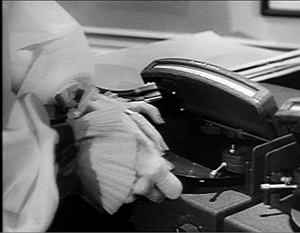
I know a way. This mechanical glitch, I think, pushes fear into panic. The tightest close-up yet of the spinning disc is a sort of mental subjectivity: It’s not what Myra sees exactly, but an expression of her being riveted by insistent, maniacal repetition of Irene’s assurance: I know a way. Myra rushes out of the shot and hurls herself into the bathroom to vomit. All the while we hear, again and again: I know a way.
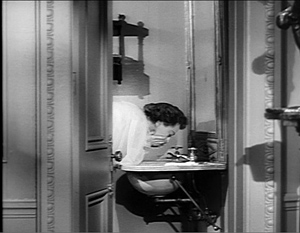
The couple’s plotting has driven Myra out of the room, as the music rises and nearly suppresses Irene’s “I know a way.” In a closer view of the bathroom, Myra staggers to the sink and splashes water on her face, while the record still spins and Irene’s voice taunts her.
But now we get the start of a new phase, with Myra trying to seize the initiative. In a burst of anger she rushes back to the machine, switches it off, and fumblingly takes out the disc. By the time she does so, we’ve heard Irene’s “I know a way” thirty-one times. Talk about hammering the audience.
Myra grips the disc, proof of the criminal conversation, and….
…But my analysis has gone on too long. It’s reasonable, although mean, to stop with the end of the replay. The rest of the sequence builds on what we’ve heard and seen, developing Myra’s efforts to defend herself.
I should note, though, that there follows a hallucinatory sequence in which we get not only perceptual subjectivity, like the POV shots, but also mental imagery and sounds as well. That sequence also includes auditory flashbacks of the usual sort, Myra’s anxious memories of things that Lester and Irene said on the SoundScriber recording. They’re replays of a replay, if you want to get fancy about it.
Conventioneering
In a way this scene is just a variant of a common storytelling convention: Someone accidentally overhears a key piece of information, in an adjacent room or over the phone. But the sequence shrewdly recasts this convention in ways that pay off on many dimensions. We get the suspense attached to the lovers’ mistaken belief that Myra will cut Lester out, and we get Myra’s reaction to it. That reaction is compounded of her sense of betrayal, her disillusion, and her realization that she’s in danger. Had she been eavesdropping on their conversation, she could have burst in on them and denounced their misreading of her will. As it is, she must helplessly listen to them unfold their plans.
After more than a decade of female Gothics–aka”woman in peril” movies, aka I-think-my-husband’s-trying-to-kill-me movies–from Suspicion and Gaslight to Woman in Hiding, Miller and his colleagues found a fresh way to put a lady in a cage. Schema and revision, a key process in the history of any art form, allows ingenious artists to remake what tradition hands them. Twenty years later, Francis Ford Coppola and Walter Murch would build an entire movie, The Conversation, around the audio replay and its possibilities for objectivity and subjectivity. Over and over, the unconventional burrows inside the conventional.
After this film, Joan Crawford became a spokesperson for SoundScriber. (See below.) Who would know better than she the advantages of the gadget? Perhaps Joan even had a stake in the firm. Such fruitful synergy wouldn’t be unknown in Hollywood. Jack Webb found the Teleprompter so useful in shooting Dragnet episodes that he invested in the company.
On All About Eve and Zanuck’s purging of the replay of Eve’s monologue: I suspect that it was a forced byproduct of another decision Zanuck had taken. The film consists largely of flashbacks, and Mankiewicz had intended to move through them by shifting from one character to another. At the awards dinner the flashbacks begin with Karen, and then another block of them, grounded in Margo’s memories, was to take up later episodes in Eve’s ascent to stardom.
But the film ran very long, so Zanuck cut the framing portion at the dinner that would have introduced Margo’s flashbacks. The result is that in Karen’s flashback, we occasionally hear Margo’s narration of certain episodes Karen didn’t witness. But once we’ve lost Margo’s narrating frame, then it becomes quite difficult to justify re-hearing Eve’s ruminations on theatre from anything approximating her point of view. I suspect that consistency of this sort played a role in Zanuck’s cutting Eve’s monologue. Plus it was a pretty daring move on Mankiewicz’s part. And the film is already pretty long. The fullest account of the changes, though still not as specific as I’d like, is in Sam Staggs’ All About All About Eve(St. Martin’s Griffin, 2001), 170-172. As Staggs points out, Mankiewicz did work differential-viewpoint flashbacks into The Barefoot Contessa (1954).
The interplay between film and fiction in the 1940s is fascinating, and we can sometimes find rough equivalents between techniques. Here is a stream of auditory flashbacks in Steve Fisher’s novel I Wake Up Screaming (1941), ending with the protagonist’s inner monologue.
I’d remember Lanny Craig saying: “They crucified me . . . it was because of Vicky Lynn!” And the night Robin Ray said: “She’d laugh, see, and it was like Guy Lombardo’s band playing.” And Hurd Evans: “I only get two hundred and fifty a week.” Tick-tock, the faceless clock on Sunset. “It’s possible to build a case out of nothing,” the assistant district attorney said. Where was Harry Williams? If he’d been murdered, where was his body?
By the end of the thirties, of course, such montages were already heard in radio programs as well.
Joan Crawford was also a spokeswoman for Pepsi-Cola, having married the man who became the company’s CEO. This image comes from a nifty survey of her endorsements available here.
After several entries (they start here), time for a wrapup.
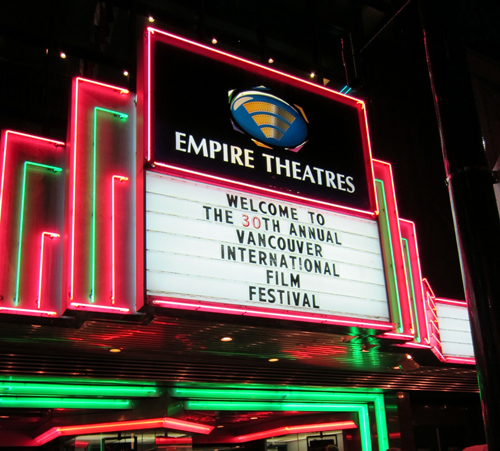
It was a record-breaking year for the Vancouver International Film Festival: over 150,000 admissions, 386 films, and many awards. Go here for the stats. But linger here for glimpses of friends old and new.
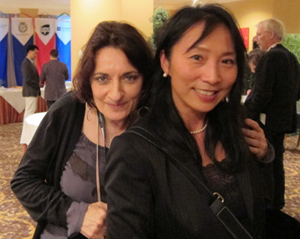
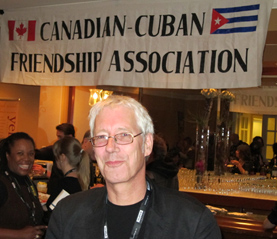
Every night there’s a little, sometimes not so little, reception for filmmakers, guests, the press, et al. in the Hospitality Suite. Sort of like a college mixer, except with better food and everybody talking about movies. On the left we find critic/professor/festival scout Bérénice Reynaud and PoChu AuYeung, VIFF Program Manager and Senior Programmer. On the right, Jack Vermee, Eurocinema expert and Programming Consultant.
More VIFFers at work: Below left, Alan Franey, dynamic Festival Director, with Programming Associate Mark Peranson in the background. With his colleague Jessica Bradford, Justin Mah curates the all-important VIFF videothèque. Below right, Justin (also on the Programming Committee) gets in the holiday mood.
One of the wondrous things about the festival is the access you have to filmmakers. Here’s Kristin with Ann Hui, director of A Simple Life, and Ben Rivers, director of Two Years at Sea.
More fun with filmmakers: Raymond Phatanavirangoon, producer of Headshot, and Charliebebs Gohetia (The Natural Phenomenon of Madness); and Saul Landau (Will the Real Terrorist Please Stand Up?).
Programmers powwow over waffles: Shelly Kraicer, Dragons & Tigers Programmer, and Alissa Simon, Program Consultant for VIFF and Programmer for the Palm Springs Film Festival.
It’s not just for my camera; everybody here grins all the time. On left, Oz festival consultant Geoff Gardner poses with Bruce, while Bruce’s owner Eunhee Cha Brown, Hospitality Suite Manager and all-round organizer, looks on. On right, Tony Rayns, Dragons & Tigers Programmer, reflects on a figure in world film culture who, he reports, “insinuated himself ferretlike into the anus of every major world dictator.”
Other critics get jolly too, not to mention hungry. On the left, Sean Axmaker, proprietor of the excellent Parallax View website (which houses VIFF reports from him and his colleagues Kathleen Murphy and Richard Jameson). On the right, Peter Rist, professor at Montreal’s Concordia University and critic for another fine site, Offscreen. Although my pictures of long-time critical comrade Jim Emerson turned out lousy, you should imagine one embedded here and proceed to his magisterial Scanners site for more VIFF coverage.
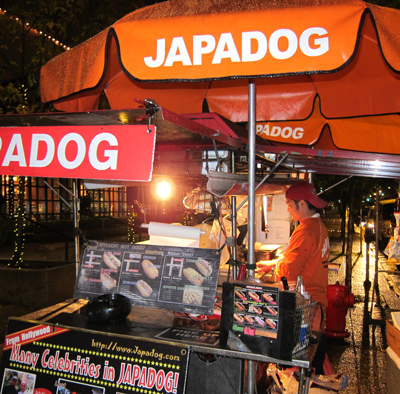
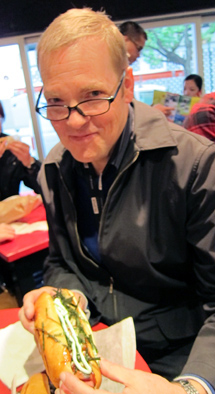
Loyal readers of our VIFF missives over the years know that JPG does not stand for Jpeg but rather Japadog. (2009 and 2010 pix here and here). This enterprise is as important as any festival sidebar. Below, a nighttime glimpse of the Japadog wagon conveniently planted outside our hotel. On the right, Professor Jim Udden of Gettysburg College and author of a superlative book on Hou Hsiao-hsien, seated at Japadog Command and Control Center on Robson Street, contemplates the luscious deliciousness that awaits him.
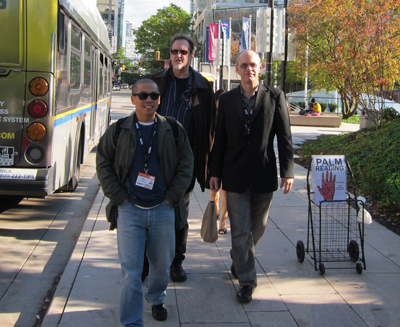
Director Ho Yuhang, critics Chuck Stephens and Robert Koehler, after a JPG feast: From the cut of their strut you know they’re auditioning for Reservoir Japadogs. (Thanks, Chuck.)
Too many more pictures (over 450), lots more to say, many new ideas; but not enough time. (See? Not even time for subjects and verbs.) Suffice it that once more we had a splendid time at this friendly, low-pressure but high-quality festival. You should come next year.
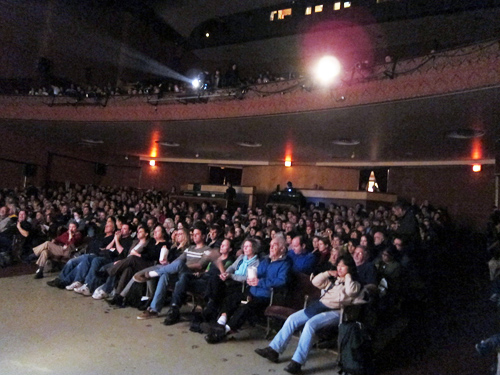
A packed house at The Vogue, a 1941 theatre that had become a music venue in recent years. It was brought into festival service after some years off-duty. Prettier interior shots are here. To see another Granville Street mainstay in its heyday, go here.








 But The Movie Orgy is different. It offers another take on subpar product: The pleasure of sheer unpredictability. How will common sense be violated? How will demands of craftsmanship be dodged or bungled? How will canons of taste be overturned? How will things that were once stupid, and remain stupid, and will be stupid forever, still communicate a certain cynical earnestness? A foolish idea carried off with obstinate conviction will always deserve respect, so Earth vs. The Flying Saucers and Beginning of the End wind up having a touching desperation, like the badly-tied noose in a suicide hanging.