Monday | November 28, 2011
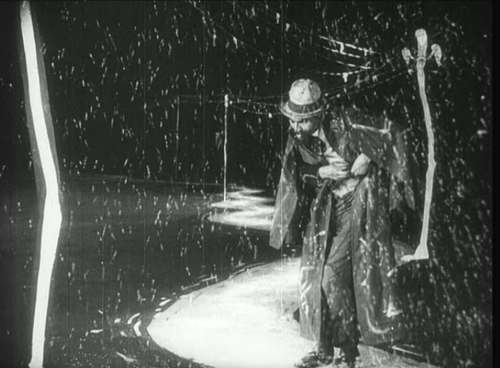
Von Morgens bis Mitternachts
Kristin here:
The year 2011 has been a good year for silent cinema on DVD. In time for the holiday shopping season, here’s an overview of some of the highlights.
One-stop shopping for the latest restorations
In the past we have recommended films released on DVD through the Munich Film Museum’s Edition Filmmuseum. We haven’t really emphasized enough, however, what a major resource this site is for film enthusiasts interested in restorations of older films and new editions of hard-to-see modern films (like the work of James Benning). Edition Filmmuseum sells not only its own impressive series of releases but also DVD editions of restorations by other major national European archives. Its website is available in German and English versions, and it is as easy to sign up and order DVDs there as it is through Amazon. The DVDs on offer can be browsed via a number of different categories, such as “Silent films,” “German movies,” and “Danish classics.” Releases from Lobster Films and Flicker Alley are also available through Edition Filmmuseum. Have a look at its forthcoming releases here. North American educational institutions seeking public performance rights for many of these and other titles should contact Gartenberg Media Entertainment.
Scandinavia comes on strong
Danish and Swedish films show up fairly regularly on DVD these days, but Norwegian films are rarities. This year, though, there are two of them.
The Danish Film Institute continues to release the films of Carl Theodor Dreyer. This time it’s a pairing of Elsker Hverandre (Love One Another, 1922) and Glomdalsbruden (The Bride of Glomdal, 1926), also available in Blu-ray. (See below.) I have to admit that these are not among my favorite Dreyer films, and I don’t think many would put them alongside his best works. Still, Dreyer is one of the great masters of world cinema, and anyone seriously interested in film history will want to see these. Back when David was working on his book on Dreyer, we went to Copenhagen and saw these at the Film Institute. They were incredibly rare, and it was a privilege to see them. Now, they’re available to all. Check out the Institute’s entire list of restored Danish classics on DVD here.
[Dec. 16: Archivist Jan-Christopher Horak has recently blogged about Elsker Hverandre.]
The Bride of Glomdal is the first of our two Norwegian features. Dreyer worked outside Denmark a number of times. In the summer of 1925 he shot this film in Norway. His next film was to be La Passion de Jeanne d’Arc.
The second is Laila, a 1929 Norwegian feature, also with a Dreyer connection. Its director, George Schéevoigt, had been Dreyer’s 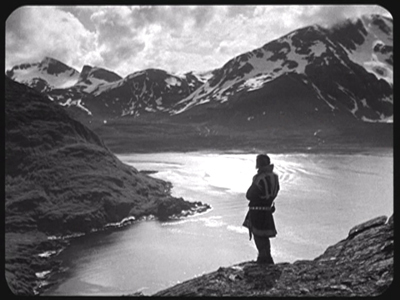 cinematographer for some of his early films: Leaves from Satan’s Book, The Parson’s Widow, Once Upon a Time, and Master of the House. Laila bears no sign of Dreyer’s influence, but its images, shot in the snowy mountains and valleys of the arctic regions of Norway, are gorgeous. cinematographer for some of his early films: Leaves from Satan’s Book, The Parson’s Widow, Once Upon a Time, and Master of the House. Laila bears no sign of Dreyer’s influence, but its images, shot in the snowy mountains and valleys of the arctic regions of Norway, are gorgeous.
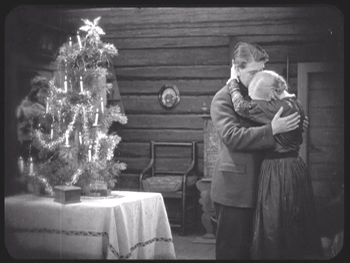
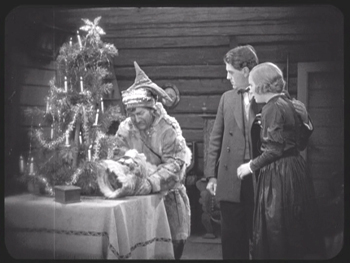
Like many features made in countries with no real established film industry (Laila’s footage had to be processed and edited in Copenhagen), Laila exploits both national literature and landscapes to distinguish itself from the Hollywood films that dominated European theaters. It was based on an 1881 novel by J. A Friis, Fra Minmarken, Skildringer. Friis strove to promote the rights of the indigenous Sami people (sometimes known as Lapps). The story follows the heroine, Laila, from infancy to adulthood. The first half of the film succeeds in giving a distinctly non-classical feel to the story. Laila is lost in the snowy wastes when wolves attack her family as they travel on sleds. She is found and nurtured by a childless Sami couple who come to love her but return her to her parents when they learn her background. The scene of the return is handled in a subtle and moving fashion. As the grieving parents console each other on Christmas Eve, Aslag, the baby’s foster father, enters at the left, with the tree blocking the door. He crosses to appear at the center and puts the child beside the presents under the tree:
A cut-in to Aslag shows him struggling with his emotions before turning to the parents and declaring, “Tonight all should be happy.” The mystified parents stare at him uncomprehendingly before he explains that he had found their daughter:
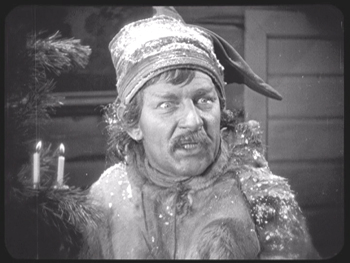 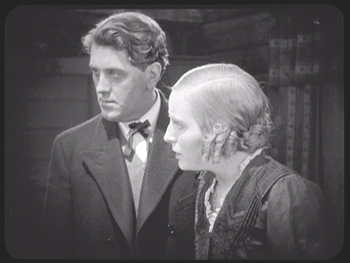
Once Laila grows up, the film turns into the more typical romantic triangle. Still, its epic landscapes and focus on a little-known ethnic group make it quite appealing, and the print itself is gorgeous. Flicker Alley has provided a rare opportunity to step outside the more familiar filmmaking countries and explore a bit. Our friend, the fine Danish film historian Casper Tyberg, has provided a helpful text in the accompanying booklet.
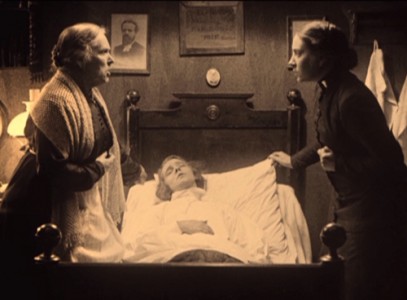
Casper also provides a commentary for The Criterion Collection’s release of the restored version of Victor Sjöström’s The Phantom Chariot. (It’s number 579 for you Criterion completists–but you already know about this disc anyway.) I won’t say much about it, since it will inevitably show up in our year-end list of the ten best films of 1921. Here I’ll just note that it’s also a beautiful print, with impeccable tinting and toning that don’t darken the images to the point where the composition is obscured–something I’ve seen too often in recent DVD releases of silent films. The frame above shows the opening scene, with its masterful control of lighting. I was disappointed that the supplements stress Sjöström’s influence on Ingmar Bergman. It may sound heretical, but Sjöström seems to me the better director, and I wish there had been more on his career.
One of the most obscure of German Expressionist films
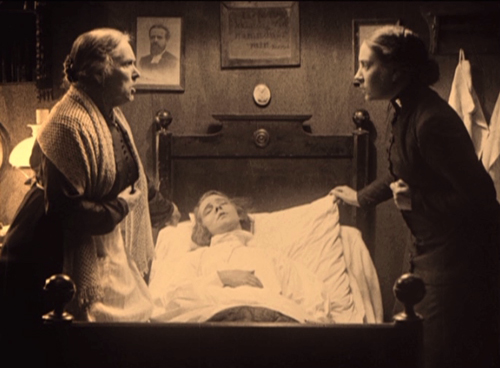
Von Morgens bis Mitternachts (“From Morning to Midnight”) is an early Expressionist film. It came out the same year as Das Cabinet des Dr. Caligari. It’s based on a play by one of the major Expressionist dramatists, Georg Kaiser, and directed by one of the major Expressionist stage directors, Karlheinz Martin. The problem is, it never got released in Germany.
Most of the classic Expressionist films are, like Caligari, horror films that motivate their stylization through genre. Von Morgens bis Mitternachts adheres to the subject matter of Expressionist theater, which was vehemently critical of modern society. It centers around a downtrodden bank clerk who suddenly rebels against his apparently happy family life and good job, stealing a huge sum from the bank and trying to run off with a glamorous rich woman who visits the bank. Rejected by her, he wanders away to spend the money in frivolous pursuits.
It’s no wonder that German distribution companies shied away from releasing the film. Its only known theatrical screenings were in Japan, where one nitrate positive print survived. I saw an archival copy years ago. It was an impressive film, more extreme in its stylization than Caligari or even Robert Wiene’s second Expressionist film, Genuine. (All three films were released in 1920.) Unfortunately it had no intertitles, which made it seem all the more radical.
In 1987 censorship records were discovered that allowed the Munich Filmmuseum to reconstruct the intertitles and create the restored version that now has been released on DVD. It’s a significant film, not only as an artistic achievement but as a record of stage 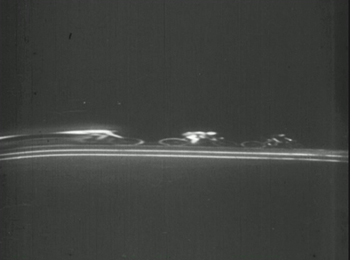 Expressionism of the 1910s. Few plays of the era were filmed, most importantly this one and Jeopold Jessner’s 1923 film Erdgeist, adapted from the play by Frank Wedekind and starring Asta Nielsen and Albert Bassermann. (The play was adapted again by G. W. Pabst as Pandora’s Box, starring Louise Brooks, in 1929; wonderful though that version is, it retains little of the radical Expressionism of the original.) Expressionism of the 1910s. Few plays of the era were filmed, most importantly this one and Jeopold Jessner’s 1923 film Erdgeist, adapted from the play by Frank Wedekind and starring Asta Nielsen and Albert Bassermann. (The play was adapted again by G. W. Pabst as Pandora’s Box, starring Louise Brooks, in 1929; wonderful though that version is, it retains little of the radical Expressionism of the original.)
Von Morgens bis Mitternachts has some of the most avant-garde set designs of the era. Jagged white sets are smeared across back voids, as in the scene at the top where the protagonist flees down an endlessly winding road after being rebuffed by the woman for whom he impetuously stole money. It records another performance by one of the leading Expressionist actors of the era, Ernst Deutsch, whom I mentioned in my entry on Der Golem. Apart from its jagged sets, the film features a remarkable scene at a bicycle race, with the contestants being filmed in a distorting mirror. It was a technique that the French Impressionists would soon popularize, but Martin may have used it first (see left).
Despite the film’s lack of impact at the time it was made, it belongs squarely within the German Expressionist movement. This release at last allows it to take its place. (The forthcoming issue of the restored Expressionist science-fiction film Algol, also from 1920, will give an even broader picture of the movement.)
Eureka! Ford is found
The British company Eureka! continues to bring out classic films of all sorts. Its “Masters of Cinema” series has released John Ford’s 1924 western, 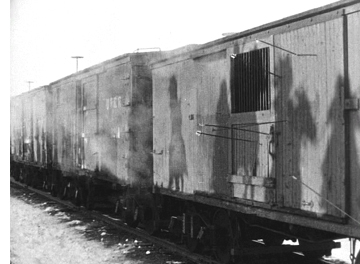 The Iron Horse. By this point in his career, Ford has made many western features, only a few of which survive. They were lively low-budget films, but by the early 1920s the western became a prestige genre with the success of James Cruze’s The Covered Wagon in 1923. The Iron Horse was Ford’s move into the high-budget western, and what it lacks in high-spirited energy it makes up for in impressive landscapes and careful dramatic staging. The Indian attack on the train, revealed by shadows (right) is one of the film’s high points. The Iron Horse. By this point in his career, Ford has made many western features, only a few of which survive. They were lively low-budget films, but by the early 1920s the western became a prestige genre with the success of James Cruze’s The Covered Wagon in 1923. The Iron Horse was Ford’s move into the high-budget western, and what it lacks in high-spirited energy it makes up for in impressive landscapes and careful dramatic staging. The Indian attack on the train, revealed by shadows (right) is one of the film’s high points.
This Eureka! release is the same version and has the same extras as the DVD in the American series “Ford at Fox.” The two-disc set includes both the 150-minute version released in the U.S. and a 133-minute version, with alternate takes, distributed abroad. Anyone in European Region 2 area who doesn’t want to buy the immense “Ford at Fox” set of 21 discs might want instead to pick up The Iron Horse, one of its highlights, separately. It has plenty of extras as well.
I’ll sneak in an early sound film by recommending another Eureka! release of just about a year ago, Max Ophuls’ La signora di tutti (Everybody’s Lady). Made in italy in 1934, it was Ophuls’ first film after fleeing the Nazi regime. It’s a flashback tale, with the heroine recalling her life after a failed suicide attempt. It’s a new transfer and comes with a video essay by Tag Gallagher and a booklet.
Do yourself, your family, and your friends a favor
The 1994 edition of the “Giornate del Cinema Muto” in Pordenone, Italy, was as memorable as usual. There was the magical presentation of all the surviving Indian films (apart from a few short scraps), accompanied by a delightful and inventive chamber group of three Indian musicians. There were the silent westerns of William Wyler and the sophisticated 1920s features of Monte Bell. The main thread, though, was “Forgotten Laughter,” a celebration of known, little known, and unknown comedians. Their films were mainly shorts, and they provided us with a great deal of laughter.
Then came Wednesday, October 12, when we all witnessed history. A program entitled “Max Davidson” unspooled five two-reelers starring a short, middle-aged guy doing a beleaguered-Jewish-father shtick as well as such a thing has ever been done. We enjoyed four films before the program culminated with the immortal Pass the Gravy. I don’t think I’ve ever heard an audience laugh so loudly and continuously. Don’t assume this is anti-Jewish humor. This is pure Jewish humor, injected for just a few years into mainstream American slapstick filmmaking.
For some reason that year there was a poll taken to determine a film which would be encored at the end of the final evening. Pass the Gravy inevitably won, and we laughed just as hard the second time through. Mere words cannot convey why this film is so funny. It involves Max’s 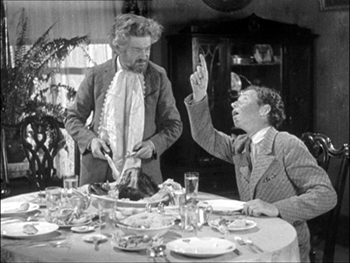 daughter being engaged to a young man who lives next door with his father, proud owner of a prize rooster which ends up the main dish in a meal shared by both families. The running gag involves the young people trying to convey to Max what has happened without the young man’s father realizing what has happened. But no, you have to see it for yourself, preferably with friends and family about you. Like so many comedies, this one works best with an audience. daughter being engaged to a young man who lives next door with his father, proud owner of a prize rooster which ends up the main dish in a meal shared by both families. The running gag involves the young people trying to convey to Max what has happened without the young man’s father realizing what has happened. But no, you have to see it for yourself, preferably with friends and family about you. Like so many comedies, this one works best with an audience.
It has taken 18 years for the surviving Max Davidson shorts, most of them supervised by Leo McCarey, to appear on video, a two-disc set, “Max Davidson Comedies.” Fortunately the job has been done well. The Munich Filmmuseum has assembled 13 shorts, 12 silent and one sound. Not all are as funny as Pass the Gravy, and Max plays only a supporting role in the earliest one. (The less said of the sound short, the better.) A booklet, in German and English, includes historical background and complete credits, including descriptions of the lost films. Davidson, by the way, had a long career playing bit parts, often uncredited. Often he played tailors, as in The Idle Class and The Extra Girl; during the sound era he appeared in The Plainsman and The Great Dictator, among many others. But for a short stretch at the Hal Roach studios he was the star.
At this year’s Il Cinema Ritrovato festival, “Max Davidson Comedies” shared the DVD prize for “Best Rediscovery of a Forgotten Film” with a parallel set put out by the Filmmuseum, “Female Comedy Teams.” The latter included more films shown in Pordenone in 1994.
Of course, the Davidson films were not forgotten by those of us lucky enough to have been in the Cinema Verdi in 1994. Two of them, including Pass the Gravy, were shown on Turner Classic Movies at 6 am a few years later, and we long treasured our VHS tape of that. But now everyone can share in this rediscovery.
A modestly pioneering early American film company
The Kalem company was one of those firms that cropped up during the early years of the American film industry, made shorts and short features for less than ten years, and disappeared without growing into one of the important Hollywood studios. Today it is perhaps best remembered for its 1913 biblical feature, From the Manger to the Cross, which was shot in Egypt and “the Holy Lands” at a time when filming abroad was unusual for 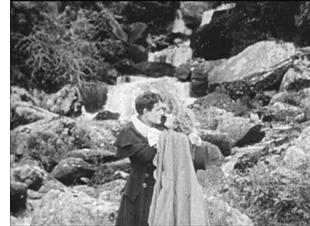 American film companies. American film companies.
Kalem had pioneered the tactic of filming abroad earlier, however. Its series of films shot in Ireland, beginning with The Lad from Old Ireland (1910), are claimed to be the first American films shot outside North America. Eight of these survive, though often with missing sections. The Irish Film Institute has released a two-disc set including all of them, along with a feature-length documentary, Blazing the Trail: The O’Kalems in Ireland, directed by Peter Flynn.
The films were shot in the region of the Lakes of Killarney, taking advantage of famous locales like the Gap of Dunloe and Torc Waterfall (seen in Rory O’More, right). Intertitles include passages emphasizing that the scenes were shot in the very places where their historical and literary sources were set.
Unfortunately even the surviving films are not in good condition. Some are lacking their endings, and all are worn. The transfer has unfortunately cropped the edges, even though the accompanying documentary stresses that director Sidney Olcott’s main strength was his eye for compositions. Still, this set of films provides a rare example of fairly standard American films of the transitional period between the primitive and classical eras. Most classes in cinema history represent this transitional period mainly through the Biograph shorts of D. W. Griffith. This DVD provides a chance to show the more mainstream filmmaking of the early 1910s.
The accompanying documentary, Blazing the Trail, takes its title from the memoirs of Gene Gauntier, Kalem’s main scenario-writer and leading lady in its early period, including most of the Irish-based films. The film is perhaps a bit over-long for the topic, but it provides a rare in-depth look at a small company of the early era. The DVD set is available only from the Irish Film Institute’s website.

Posted in Directors: Dreyer, Directors: Ford, Directors: Sjöström, DVDs, Silent film |  open printable version
| No Comments » open printable version
| No Comments »
Wednesday | November 16, 2011
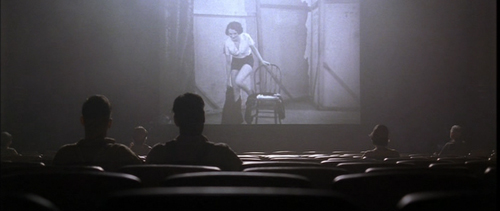
O Brother, Where Art Thou?
There is one hypothesis that I find interesting because it is so minimal, yet sufficient. This is that nobody cares where he sits, as long as it’s not in the very front.
—Thomas Schelling, 1978
DB here:
Where do you like to sit in a movie theatre? If you’re like most people, you sit fairly far back, maybe all the way in the back row.
Sitting in the rear is the default for public gatherings, it seems. Thomas Schelling famously offered seven hypotheses about why people don’t fill up the front of an auditorium as fast as they fill up the back. His reflections were occasioned by his giving a lecture to 800 people, none of whom would sit in the first dozen rows. I know the feeling, though on a smaller scale. Seeing all your audience huddled so far away, you suspect you have cooties.
Schelling didn’t, so far as I can tell, offer a definitive answer, and his charitable reflections on people’s motives don’t keep me from finding the migration to the rear disquieting. In lectures, those distant auditors send off an air of foreboding. They seem poised to flee at the moment the talk reveals its fully catastrophic dimensions.
There’s a debate about whether students who sit in the rear get worse grades than those who sit close. (See below.) Speaking from experience, I’d be inclined to say that professors tend to give better grades to students sitting close because those distant, blurred ranks tend to give off an aura of desperate yearning to be anywhere but there. The folks up front at least seem to be trying to be part of things. The back-row brigade have not learned the great lesson of social life: Feign interest.
As this lead-in suggests, I’m a front-zone sitter. But that predilection comes at a cost.
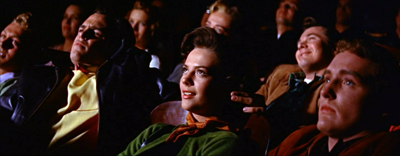
Rebel without a Cause.
For lectures I always try to get a front-row seat, close to the speaker if possible, or centered if there’s to be a big visual presentation. This vantage point is great. If there’s flop sweat, you see it. If not, you get to enjoy consummate performance up close. I’ve sat in the front row for fine speakers like Chomsky, Pinker, and Bruner (to stay just with the Boston brain trust).
When a filmmaker does a Q & A, the front row is a must: you get a good chance at an autograph. The only time I regretted my prime front seat for a live event was for a concert—a John Zorn one. Within five minutes I expected my eardrums to bleed. After that overture I don’t think I heard anything else.
I saw back-row bias in the movies demonstrated dramatically in Madrid, where Tom Gunning and I went to a movie together. I forget the name of the theatre, but the film was Welcome to Veraz (1991), a Euroduction featuring, inevitably, Richard Bohringer and, less predictably, Kirk Douglas. Once we got inside, we found that our tickets were for specific seats. The cashier had assigned us, and all other patrons, to the same row—in the back, naturally. The absurdity of a dozen of us sitting side by side in a vast theatre was lost on the staff. Tom and I moved to the front, but everybody else piously stayed in the same pew.
You can study a less extreme case in graphic form in those remaining venues, mostly European and Asian, that still ask you to choose your seat on a chart. A glance shows you that everyone has piled into retreat mode, leaving lots of nice seats for you. Problem is, those overhead diagrams of the venue aren’t to scale, and so you don’t really know how close you are to the screen when you’re picking your seat.
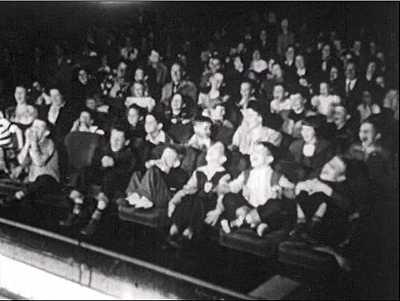
When you were little, you didn’t mind sitting up by the screen. You sometimes fought to do it. But as we age, we seem to gravitate toward the rear. We’re even told that we should sit a prescribed distance back, usually the dead center of the auditorium. A distance of 2-3 times the screen height is a common recommendation. But Kristin and I are front-zone people. Speaking for myself, I like scanning the frame in great saccadic sweeps and even sometimes turning my head to follow the action. CinemaScope and Cinerama give your eyeballs a real workout.
I know that most people find this sheer madness. When the picture comes looming up, you do feel a little disconcerted and overwhelmed. But I find that I adapt in a minute or two. Even the keystoned angle isn’t a problem, partly because of our old friend perceptual constancy.
Note that I said front-zone. Not every theatre favors front-row sitting. Kristin and I once went to a screening of An Autumn Afternoon in a tiny Parisian house, one of those that seem to have been carved out of a loading dock. We sat in the front row, but that was a mistake. We could put our feet up against the wall housing the screen, and we reckon we watched the movie at something like a 45-degree angle.
Something a little more peculiar happened when we went to a Fan Preview of Scott Pilgrim vs. the World. Firmly ensconced front and center, we were packed in by comic geeks, nerds, dorks, wonks and other damned souls, all determined to enjoy this movie. So we had the strange experience of hearing a line of dialogue and then, because its eloquence had a rich bouquet, hearing yelps of appreciation rolling back behind us, as row after row (a) heard it, (b) laughed, and (c) did an instant commentary on it. I can’t judge this movie objectively to this day.
So sometimes the front row isn’t ideal. Through experience, we know our local venues and favorite festival sites. In some theatres, such as most of our local Sundance screens, we sit 2-5 rows back, with C being a common choice. Still, the ticket seller usually does a double take and reminds us where the screen is. Then we get a shrug and something on the order of “Well, you won’t be crowded down there.”
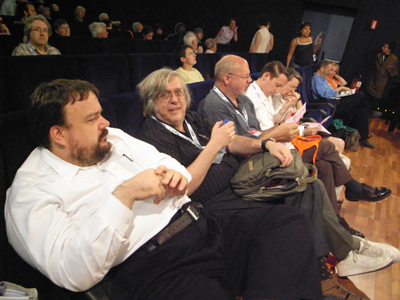
Bologna Cinema Ritrovato 2008: Olaf Möller, Jonathan Rosenbaum, Don Crafton, Haden Guest, Kristin Thompson.
But in many venues the front row is perfect. Sitting there is hard-core moviegoing. I started aiming for it about forty years ago, when I began taking notes on every film I saw. If you sit too far back, how can you see your pad? You can’t be one of those idiots brandishing a lightbulb pen (even though I have some of those). The screen casts a little light that makes scribbling easier.
But even those who don’t write notes see the advantage of the front row. Nobody’s head looms in front of you. You’re less disturbed by latecomers. You have more leg room, and it’s easier to stretch out for a snooze. And should you wish to leave, the front row is the only one that lets you sneak out easily from any seat.
That last advantage, I should mention, can lead to trouble. Once at VIFF I was firmly planted in the front row, nose in book, as the auditorium filled. But I began to realize that these didn’t seem to be my tribe. There were more beards, nicer clothes, better hygiene, more sensitive faces. The place filled, and someone came forward to thank the sponsors for bringing a film about the efforts to save remote wetlands. I was in the wrong auditorium. To glares and mocking comments I slunk out in search of some obscure art movie I’ve forgotten.
Like everything else you do, front-row sitting sends a message. What message? For one thing, that signal of interest I mentioned in my classroom example. Somehow the front-row sitter seems to be more engaged, more eager to be swept up in the magic. You probably know the urban legend that the Cahiers du cinéma writers sat devoutly in the front row at Langlois’ Cinémathèque. We belong to a noble tradition, and we flaunt it. Chevaliers of cinéphilie, we risk eyestrain, neckache, back pain, and leg cramps for the art of cinema, or so we like to think.
Speaking of the Cinémathèque, back in 1970 I went to the Chaillot venue for a screening of Liebelei, to be attended by Luise Ullrich, one of the principal players. The place was full, but I had nabbed a nice spot up front. Before the film started, though, a Cinémathèque functionary started going along the front row asking every patron there a question. Everyone asked said no. I couldn’t hear the question at a distance, and perhaps might not have understood it if I had. So when the staff member came to me, I scarcely let him finish before declining. If non was good enough for other front-row denizens, it was good enough for me.
After the lights came down, Henri Langlois stepped onstage with Mme Ulrich. After a brief introduction, they descended. Only then did two people on the aisle surrender their seats for them. Then I realized all the French guys sharing the front row with me wouldn’t give up their seats even for the guest and the boss of it all. You see why I say front-row people are hard-core?
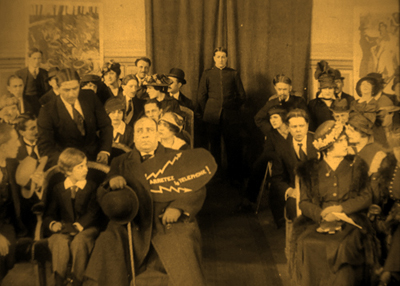
Le Pied qui étreint 1: Le Micro bafouilleur sans fil (1916).
I must report, however, that front-row sitting sends other signals too. Theatres in film archives have their regulars, and these folks, like me, believe that there’s only one good seat in any theatre, and they must occupy it. Fortunately, they mostly don’t agree on what that seat is. I’m always befuddled when the first person in the queue makes a dive for a seat far back and in the corner.
Alas, though, so many regulars have aimed at my target that every cinematheque has a coterie of front-row fans. And they’re perceived as, well, strange. I remember going to London’s National Film Theatre during a visit and getting in early enough to nab a prime front seat. Many regulars shuffled in to join me, and one seemed a bit miffed after the rank had filled. My neighbor told me apologetically that I was sitting in his friend’s seat. Of course I moved. Local loyalists have privileges. On another occasion a BFI staff member said that she worried that one of her friends might become “one of those sad front-row people at the NFT.” They didn’t seem unusually unhappy to me, but then they wouldn’t, for I am one of them.
My strangest contretemps with a front-row devotee came during a visit to the Munich archive. They were running Get Carter and I was the first entrant. I secured my front-row center post and settled down to read. (Front-row people show up early enough to finish substantial portions of Dostoevsky novels before the lights go down.) Suddenly an aged German lady, fortunately not Luise Ullrich, stood before me.
Seeing I was reading a book in English, she said, “Pardon me, you’re in my seat.”
I looked around and saw that we were the only people in the theatre.
“I always sit here,” she said. “I come every night.”
Nerdesse oblige. I relocated to the seat behind her. Moved by my gallantry, she twisted around to talk with me. I asked if she really came every night.
“Well, not every night. Not if they’re showing a Jap movie.” She looked severe. “I don’t like Japs.”
Comments about disloyalty to old friends leaped to my tongue, but I kept quiet.
Soon Get Carter started. The old bat immediately fell asleep.
She slept through the whole movie. I wanted to knock her upside the head. When I left, she was still out, snoring in my seat.
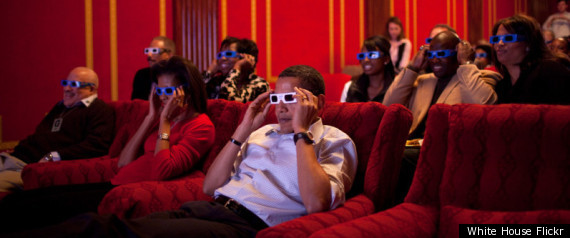
There are other drawbacks to the avant-garde spot in the movie theatre. Most people are bothered by handheld shots and 3D if they sit close, but I don’t find myself affected. Granted, I probably miss some of the surround-sound effects, which are apparently designed for a sweet spot far behind my territory. If it’s any compensation, the left/ right channels are really vivid for me.
The biggest drawback, though, is that you don’t have eyes in the back of your head. During Q & A sessions, you can’t track the conversation without twisting around in your seat. So I sit there as if I were listening to the radio. Worse, sitting close can render you oblivious to things going on behind you. If a fistfight broke out in that heavily populated rear section, you’d be in a poor position to watch it. Occasionally being in the front row makes me miss an outburst that was probably pretty entertaining but leaves me feeling like the guy in Pompeii who wondered why everybody was running past him just before a couple of tons of ash buried him.
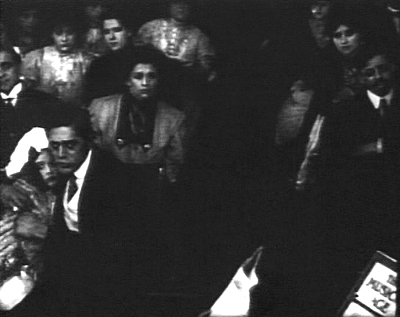
A Drunkard’s Reformation (1909).
On the obliviousness scale, my most memorable front-row experience came during another overseas festival. A visiting actress of consequence had directed some feature-length films, and the festival had arranged a screening of one. This entailed setting up a video projector and preparing, far in advance, electronic subtitles in the local language. When the director saw me planted in the pole position she said, “You shouldn’t sit so close. This movie is like Dancer in the Dark.”
No problem, I assured her; I’d seen that from the front row too.
No one joined me in the front. But there was a sizeable audience. Once people had settled down, her introduction explained five things, each one adding to a litany of doom.
(1) She played the protagonist.
(2) The film was improvised.
(3) It was shot handheld.
(4) The actors were her friends.
(5) It was a satire on the superficiality of Los Angeles life.
She wished us a good screening and said she’d see us afterward for a discussion.
The film was as dire as I’d feared. When the lights came up I noticed that nobody was setting up the microphone on stage. I turned around. The technicians were putting away the projection equipment. I was the only viewer who’d hung on to the end. Needless to say, there was no auteur and no Q & A.
Despite all the drawbacks of front-zone sitting, I feel vindicated by a recent revelation. A review quotes James Wolcott’s acount of Pauline Kael’s preferred viewing station.
We take up mortar position in the back row. Pauline nearly always sits in the back, often right beneath the projectionist’s portholes, flanked by fellow critics on her squad. . . . (The auteurists — those ardent members of Andrew Sarris’s Raccoon Lodge — tended to huddle closer to the screen, as if to meld mind and image into a blissful, shimmering mirage of Kim Novak with her lips parted.)
I rest my case.
Thomas Schelling’s reflections on lecture-hall seating open his classic Micromotives and Macrobehavior. Among his more entertaining speculations on why people sit in the back is this one:
A fourth possibility is that everybody likes to watch the audience come in, as people do at weddings.
For some research on whether students sitting up front get higher grades, go here (abstracts only) and here. Jonathan Cohen provides a nice analysis of the research on perceptual constancy here. 3D has rekindled debates about where to sit; for one exchange among cinematographers, go here.
Le Pied qui étreint is discussed in more detail here.
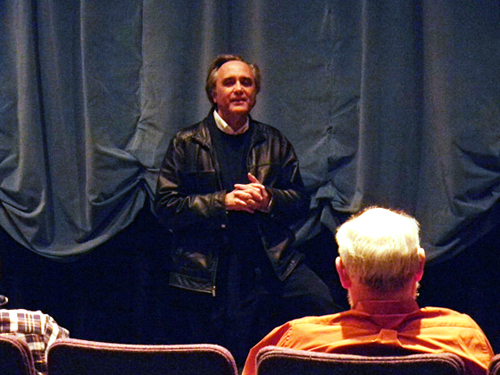
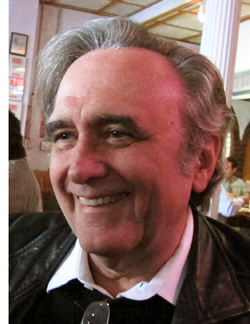
Joe Dante at University of Wisconsin–Madison, November 2011. Photo by Jeff Kuykendall. For more on Dante’s visit, go to this earlier entry and to Jeff’s coverage here.
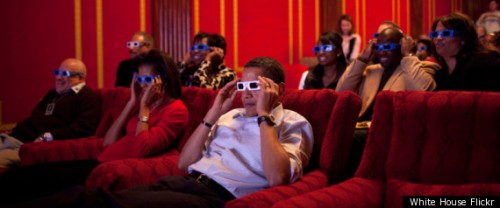
PS 23 January 2012: Please note that another couple likes to sit in the front row (from here).
Posted in Festivals, Film archives, Movie theatres, Readers' Favorite Entries | open printable version
| No Comments »
Wednesday | November 9, 2011
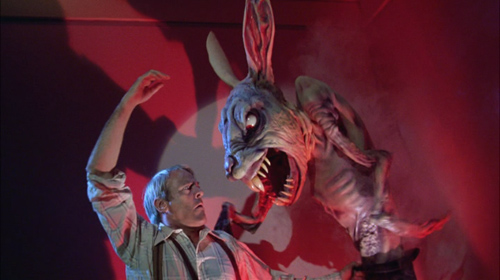
Twilight Zone: The Movie.
DB here:
When will we baby boomers relax our chokehold on popular culture? Never, if the enthusiastic response to Joe Dante’s visit to Madison last weekend is any indication. A showing of Gremlins (1984) packed the house. A screening of his Twilight Zone: The Movie episode brought fans forward with DVD slipcases to sign. College kids reminisced about watching The ‘burbs with their dads and Explorers with their buddies (all on video, of course).
Although steeped in classical Hollywood, intimately acquainted with the most obscure output of the studios, Dante hasn’t abandoned the present. He shoots TV shows, webisodes, and the 3D feature The Hole (still awaiting a US release). He hosts a website, Trailers from Hell, in which directors comment on other directors’ works using a trailer as a point of departure.
His films, from Piranha (1978) and The Howling (1981) to the present, by way of Amazon Women on the Moon (1987) and Matinee (1993), combine the gonzo spirit of the 1960s with a good-natured reverence for the past. Particularly movies. Particularly crazed, tasteless movies. Like Spielberg and Peter Jackson, he’s a fanboy. “Most filmmakers are kids at heart,” he says. “And all actors are.”
Unlike Spielberg and Jackson, though, Dante keeps politics close to the surface. His films sustain the baby-boomer hope that you can squeeze cultural critique into a genre project. Everybody knows that the Gremlins movies are subversive trips into the shadows of bourgeois normalcy. Has a shiny kitchen blender ever been used more efficiently?
The Gremlins pictures and The ‘burbs are valentines compared to Homecoming, Dante’s installment in the series Masters of Horror. This asks a simple question: Suppose that all the soldiers killed in combat were able to come back and vote? Is that a powerful lobbying group or what? When resurrected vets of Iraq start stalking to the polls, an Ann Coulter lookalike tries to stop them. Run on cable in 2005, this left-wing zombie movie slashes to ribbons pious platitudes about war’s costs. It’s required viewing for all 2012 presidential candidates.
Don’t crowd me, Joe
Dante began his career as a collagist. That’s not too fancy a name for a man who, with his friend Jon Davison, collected the ephemera of the great age of 16mm. TV shows, ads, and movie trailers swept out of local stations went into their archives. In time these and other glories of late-night TV found a new life, like a monster stitched together out of morgue remains. The strategy was simple. Dante and Davison rented five or six 16mm sub-B features and projected stretches of them, in rough order but jumbled together. The movies were interspersed with reels of clips.
The Movie Orgy played college campuses in the late 1960s and early 1970s. The Orgy lasted about seven hours, and its auteurs urged viewers to drift in and out. “Go get a pizza whenever you want. You won’t miss a thing.” Eventually Schlitz hired them to take it around the country and sold beer at the screenings.
When Dante began working for Roger Corman’s company—cutting trailers, thereby tapping his skills as a collage-maker—The Orgy was suspended. But some years ago the footage that he could find was transferred to digital and played at the New Beverly. It found a new success. Dennis Cozzallo has a lively tribute from 2008 here. Needless to say, we had to have The Orgy for Dante’s visit to Madison.
Affection for the detritus of the media takes many forms. After watching too many campus simpletons (both students and profs) laugh mockingly at Fritz Lang and John Woo movies, I’m opposed to condescension. I suspect Camp in its disdainful form. I don’t like people demonstrating their sense of superiority to the trash their parents and grandparents enjoyed. Knowingness leaves you with nothing.
 But The Movie Orgy is different. It offers another take on subpar product: The pleasure of sheer unpredictability. How will common sense be violated? How will demands of craftsmanship be dodged or bungled? How will canons of taste be overturned? How will things that were once stupid, and remain stupid, and will be stupid forever, still communicate a certain cynical earnestness? A foolish idea carried off with obstinate conviction will always deserve respect, so Earth vs. The Flying Saucers and Beginning of the End wind up having a touching desperation, like the badly-tied noose in a suicide hanging. But The Movie Orgy is different. It offers another take on subpar product: The pleasure of sheer unpredictability. How will common sense be violated? How will demands of craftsmanship be dodged or bungled? How will canons of taste be overturned? How will things that were once stupid, and remain stupid, and will be stupid forever, still communicate a certain cynical earnestness? A foolish idea carried off with obstinate conviction will always deserve respect, so Earth vs. The Flying Saucers and Beginning of the End wind up having a touching desperation, like the badly-tied noose in a suicide hanging.
Moreover, in sequence after sequence, there’s a quality of astonishment that doesn’t make us feel superior. Take one exemplary moment of dépaysment. If you and I tried to be naive or trashy, we couldn’t come up with this.
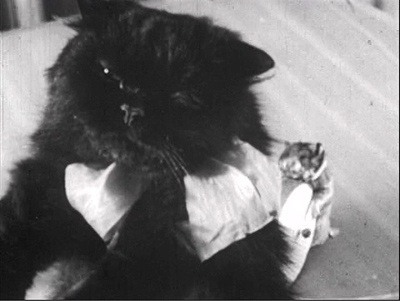
Andy Devine hosted a kiddie TV show, Andy’s Gang, which featured Froggy the Gremlin (Plunk your magic twanger, Froggie!), the cat Midnight, and Squeeky the mouse (played by a hamster). About an hour into The Orgy, Andy induces Midnight to play a miniature pipe organ while Squeeky accompanies him. Cut to a deep-focus shot of what seems to be a slightly drugged cat locked in place and rhythmically pawing the offscreen keyboard. In the background Squeeky, apparently clamped within a mechanical mouse body, bangs a tiny bass drum. Andy sings along tunelessly. The song is “Jesus Loves Me.”
You don’t laugh, you gape. It’s like one of our local attractions, The House on the Rock: What’s disturbing is not that it’s done poorly, but that somebody thought of doing it at all.
The form of The Orgy—and it does have a form, of sorts—is to open with openings and end with endings. Several of the movies get started in the first half hour (Dante and Davison love opening credits) and we’re given enough of the plots to become curious. Most prominent are Attack of the 50-Foot Woman and Speed Crazy, the latter receiving a loving dissection highlighting, and repeating to the point of obsession the heel protagonist’s tagline, “Don’t crowd me, Joe.” Eventually the guy and his flashy sports car wind up crowded, all right–crowded into a ravine.
More TV episodes and movies get added as the hours roll by, and by the end we’re facing Armageddon. Los Angeles, Las Vegas, Chicago, New York, DC—every major city is under attack by some alien or giant monster. Sky King has to dump dynamite for some reason, Superman has to save Lois from a pistolero. A sort of amphetamine Intolerance, The Movie Orgy cuts together all these climaxes, which include The End titles that are far, far from signaling the end.
The clip from Andy’s Gang reminds us that the piece is somewhat misnamed. It’s a Movies And TV Orgy. More specifically, it’s a Movies On TV orgy. The structure of the whole shebang imitates a long stretch of television ca. 1955-1960. Over lunch Dante recalled watching Million Dollar Movie as a kid in New Jersey, seeing a feature shoehorned into a ninety-minute slot and chopped up by commercials. The Orgy replicates the jagged tempo of switching among three or four channels, glimpsing variant commercials for Colgate toothpaste or Raleigh cigarettes, catching a bit of this movie and then a bit of that one. With all its kid shows from my youth (The Lone Ranger, Lassie, Mighty Mouse, etc.) in endless eruption and interruption, it’s a baby-boomer time capsule. Puncturing this evocation of childhood are the clips scavenged from teenpix and Dick Clark’s dance show, Vietnam, Nixon’s Checkers speech, and film-society icons like the Marx Brothers, Fields, and Abbott and Costello. The late sixties counterculture breathes more fully in some clever fake ad spots. In one, a crucifix starts to wobble as the carved Jesus struggles to free his hands.
Dante claims that he and Davison were inspired to find out about the popular culture that shaped their parents’ generation. But nearly everything we see filled the airwaves during our younger days as well. The Movie Orgy in its current form seems to me a zestful celebration of the world our generation saw when we flopped on our bellies, propped our chins in our hands, and stared at the tumultuous world inside a black-and-white (not color) TV (not video) set (not monitor).
We cartoon characters can have a wonderful life
Dante the collagist leaves his fingerprints all over another film he screened here. When Spielberg launched his Amblin company, he hunted for directors who could make family entertainment in a genre format. Dante, who had already started Gremlins, was invited onto the omnibus Twilight Zone project. After the fatal accident on the Landis set, the studio backed off and it become “a movie they wanted to make but didn’t want anything to do with.” This gave Dante wide latitude and made him think, mistakenly, that studio suits always leave directors alone.
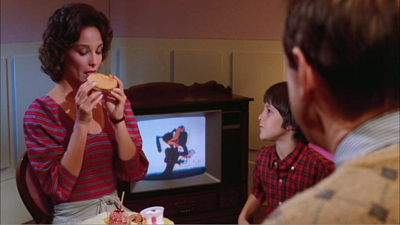
For this episode, Dante wanted to do an original story but Warners insisted that it had to be based on an episode of the TV series. He went back to the original Jerome Bixby story, which Dante and Richard Matheson reworked to add cartoons as a running gloss to the comic horror. The pseudo-family of demonic little Anthony inhabits a house that is half cartoonland, half-PoMo-Caligari. Saturated colors, occasionally striped with noir shadows, provide another Dante caricature of family domesticity, but now cartoons comment on the action. When Helen steels herself to eat, the dog on the screen behind her is doing the same.
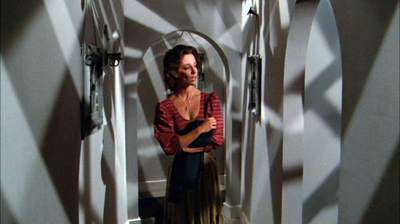
The crisscrossed shadows of the corridors are replayed in the sawtooth walls pursuing Bimbo.
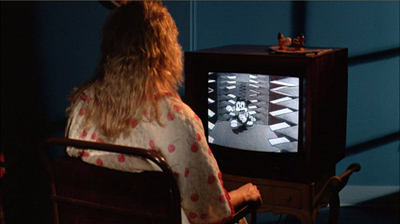
The collage principle gets developed further in Dante’s use of the soundtrack. The Movie Orgy uses no new sound work; the clips are just spliced together. But for the Twilight Zone episode, let loose in Warners’ classic archive, Dante could weave in Carl Stalling music (reorchestrated for stereo by Jerry Goldsmith) and a rich mélange of daffy sound effects.
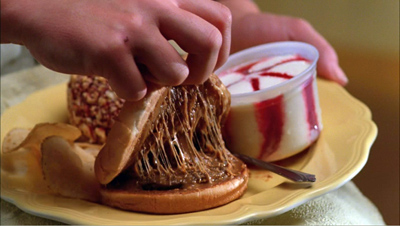
The TV is incessantly on. The cartoons running in the background supply whizzes, boinks, and thuds that jarringly punctuate the conversation between puzzled teacher Helen Foley and the family that Anthony holds in his magical grip. “This is Helen,” says Anthony, introducing her to Uncle Walt and his sister, as we hear a smash from the TV set. The cartoon tracks comment on the action too. As the family settle down in front of the tube, the elders dote on Helen and we hear a Stalling rendition of “Ain’t She Sweet?” Dinner is served to the tune of “The Teddy Bears’ Picnic.” And when Helen discovers her burger has been slathered with peanut butter, the visceral image is underscored by warbling winds that rise when she lifts the bun. Eisenstein, for reasons given here, would have loved the moment. The whole sequence plays out as live-action animation, with naturalistic dialogue and effects given a creepy overlay by the cartoon track. Is Helen Foley’s last name part of the gag?
Dante, impresario of the comic grotesque, finds his inspiration in popular culture, the more wacko and inept the better. The comedy may come from childhood silliness, the grotesque from childhood fears. They say we baby boomers will always be just big kids, and Dante accepts this with a grin and a darkly cheerful eye.
Many thanks to the resourceful Jim Healy for arranging his friend Joe Dante’s trip to Madison. Thanks as well to the Cinematheque, the Marquee, and the Chazen Museum of Art for hosting the screenings.
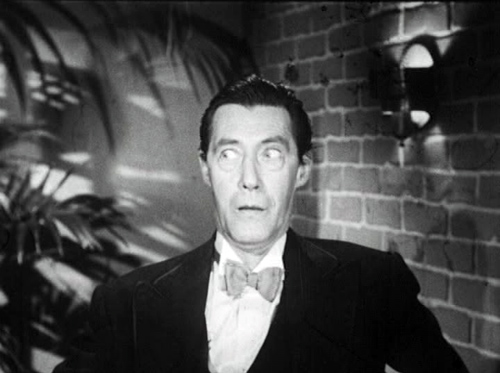
John Carradine in The Movie Orgy.
Posted in Animation, Film genres, Hollywood: Artistic traditions, People we like, UW Film Studies | open printable version
| No Comments »
Tuesday | November 1, 2011
DB here:
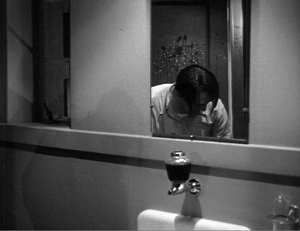
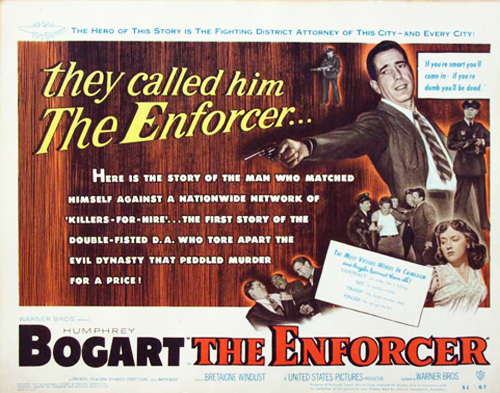
The mobster Joseph Rico is in protective custody; tomorrow he testifies against the big boss. But Rico fears reprisals, so he decides to escape. While a sleepy cop guards him in the washroom, he bends over the sink and rinses his face.
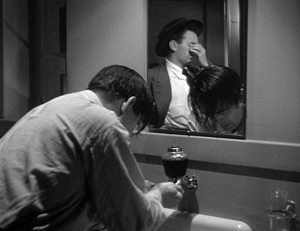
Turning so suddenly that water spatters on the mirror, he grabs the cop in an armlock and slams his head against the sink, just below the frameline.
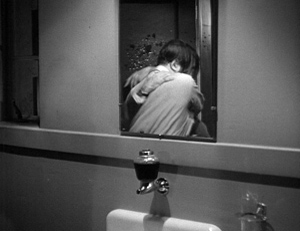 
Rico turns to the window to make his escape.
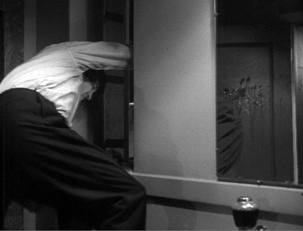
What interests me in this passage from The Enforcer (1951) is not just what happens in the mirror but also what happens on it. While Rico belabors the cop’s head, we’re given a chance to notice the splash of water that hit the mirror when Rico whirled to the attack. While the action is moving forward, we’re reminded of what had triggered it.
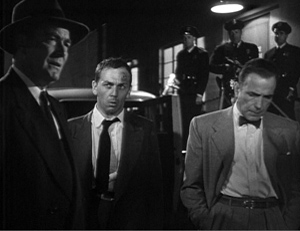
We get a sort of parallel reminder in the next scene, when we see the wounded cop again. He’s sporting a big bruise on his left temple, a souvenir of Rico’s assault.
Pfui. Details, you might say. Or you might (correctly) instance this as another case of Charles Barr’s enlightening notion of gradation of emphasis. But it’s worth getting a little more specific, because even this simple scene (by non-auteur director Bretaigne Windust) offers us something to think about, and something for today’s filmmakers to try.
Most films today don’t fully exploit the visual dimension of cinema. True, we have dazzling CGI and fancy camera moves. But when it comes to less flamboyant scenes, directors have limited their options by relying too much on stand-and-deliver and walk-and-talk. There are other aspects of visual storytelling that today’s filmmakers neglect. One aspect is the possibility of gracefully moving actors around the set in a sustained fixed shot. A specific tactic I’ve mentioned before is the Cross, and another involves ways to get people into a room. The option I’m going to sermonize about today is what I’ll call scenic density.
By scenic density I mean an approach to staging, shooting, and cutting in which selected details or areas change their status in the course of the action. I don’t count the bustle of background business, all that street traffic that is so much pictorial excelsior in our movies. Nor do I refer to stuffing the setting with desk and kitchen flotsam, allusive pop-culture posters, and the other distinctive “assets” that will be exploited when the film’s world gets transposed to a videogame. I mean something more expressive and intriguing.
Using it up
Go back to the Enforcer scene. The shot’s composition creates a delimited zone of action. The guard cop is framed tightly in the mirror. When the fight breaks out, it’s initially framed in that mirror–a narrowing of visual importance. Moreover, the shot is designed to highlight the spatter on the mirror. It’s fairly prominent, stuck near the center and, providentially, in the spot that the cop’s head initially occupied. The lighting picks out the drips, and in a shot where the figures move in and out of frame, there isn’t an equally constant center of interest. We’re probably concentrating on Rico’s punishing of the cop, but the dribbles of water remain prominent enough to claim our interest, especially when Rico passes out of frame.
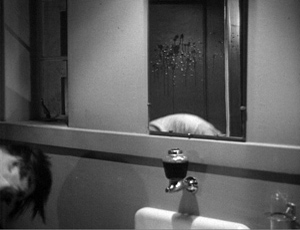
So here’s my first condition for scenic density: the shot keeps several items of dramatic significance salient in the composition.
This technical choice asks the filmmaker to think of the frame as a field of dynamic masses and forces. Such an idea was part of the aesthetic of “advanced” European and Japanese silent cinema of the 1920s. Many directors explored this dynamism, often aided by low angles and wide-angle lenses. Here are examples from Eisenstein’s Old and New and Murnau’s Tartuffe.
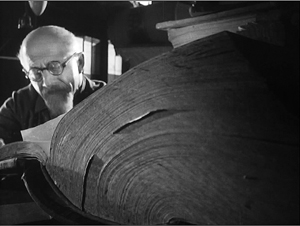 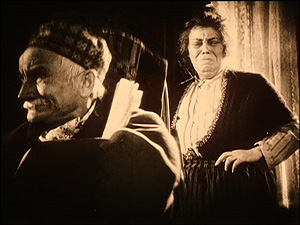
This pictorial density became especially prominent in American cinema during the 1940s, when low angles, wide-angle lenses, and locations and smaller sets encouraged cinematographers to pack their compositions snugly, as in this shot from Panic in the Streets.
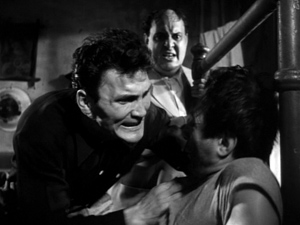
Boris Kaufman, cinematographer for Jean Vigo and Elia Kazan, summed up the principle:
The space within the frame should be entirely used in the composition.
Since cinema is a time-bound art, however, the salient elements in the shot could and should change. But if the frame space is wholly “used,” what room is there for change? The only options are to have the using-up elements shift position, or to reveal that the frame isn’t used up.
Vivid instances, also from the 1940s, can be seen in Anthony Mann’s work, both with and without John Alton. Generally, Mann used the new fashion for depth composition, especially big foreground elements, to heighten scenes of violence. Physical action becomes more aggressive if people rush the camera and halt in tight close-up, especially because wide-angle lenses tend to accelerate movement to the foreground. Mann thrusts violence abruptly to the camera with an almost comic-book effect, as when the club owner is shot in Railroaded, or a man is flung to the floor in Raw Deal.
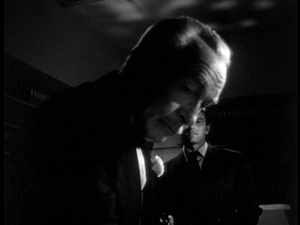 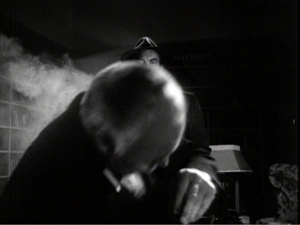
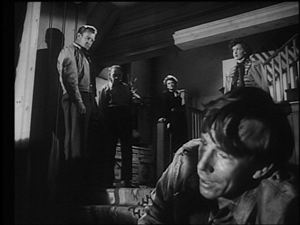
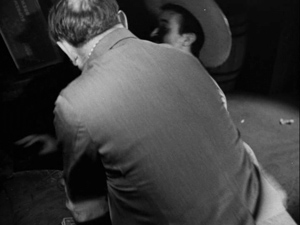
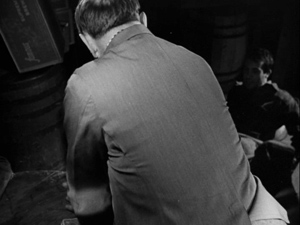
Even when this in-your-face tactic isn’t employed, the Mann films find ingenious ways to develop what seem to be completely locked depth compositions. In Border Incident, Ulrich confronts the Mexican government agent Pablo, disguised as a Bracero. A looming depth shot is followed by a reverse shot displaying a compact composition.
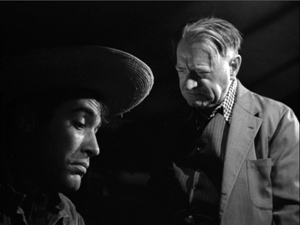 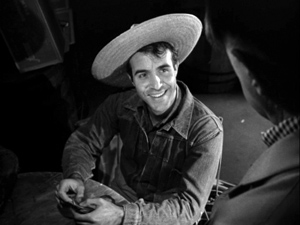
Is the frame space fully used? The second shot above is opened up when Ulrich leans forward to sock Pablo, creating a vacant spot on the far right for Pablo to fall into. The shot is emptied and re-filled, dense once more.
Memories, memories
Aha, you may be saying. Density just refers to squinchy, fussy shots from an era that favored cheap flash. No. The Enforcer shot isn’t all that cramped. Of course the blank, unchanging walls serve to highlight the mirror-reflected fight and the water dribbling down the glass, but you can imagine how much more jammed and skewed Mann’s treatment of Rico’s escape would be. As for the flashier depth, I just needed some clear-cut cases of density, examples in which details and spatial zones become starkly salient. Now I want to suggest that scenic density can be achieved in something more spacious, even monumental. That has to do with time and memory.
Part of what gives the Enforcer shot its interest is the superimposition of two moments of action in a single space: Rico’s diversionary turn from the washstand, recorded in the splash he made on the mirror, and the struggle taking place a few seconds later. A further trace of that struggle and that splash is visible in the bruise on the cop’s head in the next scene.
That dripping spatter can stand in for the second quality of spatial density I want to highlight: Its capacity to coax us to recall earlier action in the locale. Characters leave their marks and spoors in the space, and those get activated as memories. Unlike the slick surfaces of today’s settings, in classic films the settings can bear the impress of human transit, leading us to recall bits of behavior and emotional states. Let me illustrate from Lang’s Hangmen Also Die (1943).
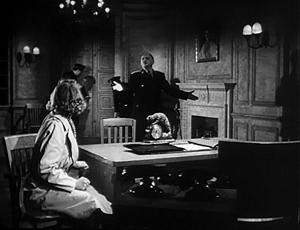
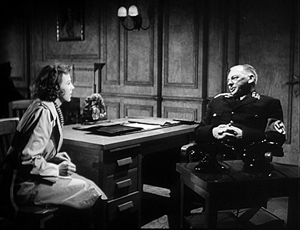
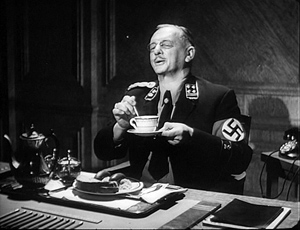
It’s Nazi-occupied Czechoslovakia, and Gestapo Inspector Ritter is questioning Mrs. Dvorak, the vegetable seller who could identify the woman who misled the officers pursuing an assassin. Torture, or at least what we think of as torture, hasn’t started. She is simply standing in front of his desk as he brandishes his riding crop in the manner of a good movie Nazi.
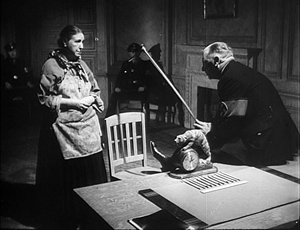
When Mrs. Dvorak denies knowing the woman, Ritter taps the back-rest of the chair. It simply falls off, and we realize it’s not fastened to the chair.
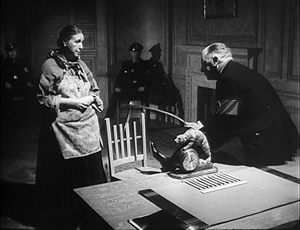
Ritter says, “Pick it up again.” Now we realize that intimidation has been applied for some while; Ritter has made the woman stoop to replace the back-rest many times. She does so again as the camera tracks back. This is nicely detailed too. She starts to pick it up by bending over, finds the effort too painful, and then goes to her knees to pick it up–just as Ritter taps his riding crop against her hand, a teacher gently chiding a slow pupil.
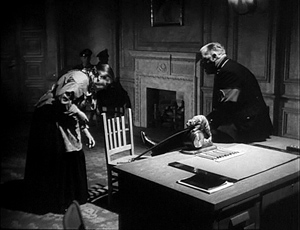 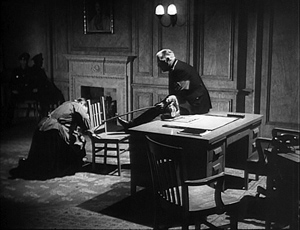
As Mrs. Dvorak rises to put the piece back in place, the camera pans slightly right to pick up the woman bringing in a tray. Happily Ritter sniffs the coffee jug and resumes questioning the old woman.
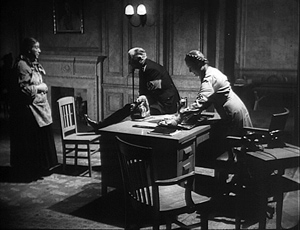 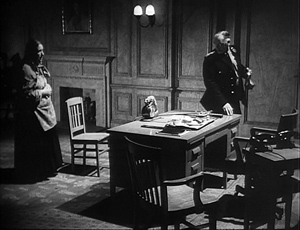
Cut to a shot of her by the chair. “Let’s start from the beginning,” says Ritter, offscreen. Unthinkingly Mrs Dvorak starts to rest her hand on the loose slat, forgetting that the top slat is unattached. It’s a natural response. She’s been standing there for a long time and would like something to rest on, and the chair is temptingly close. (Presumably, that’s its purpose, to taunt the unwary prisoner forced to stand a long time.) Remembering just in time, she yanks her hand away. If she knocks the back-rest off, she’ll just have to pick it up again.
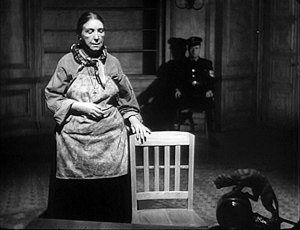 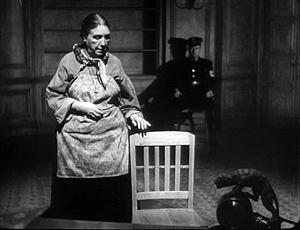
Cut to Ritter. “Don’t be nervous, Mrs. Dvorak. I’m prepared to—”
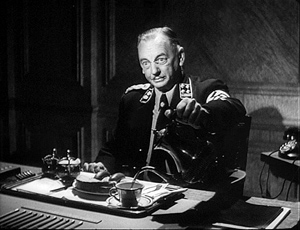
Cut to Mrs. Dvorak. As he continues, “–devote to you all of tonight,” she forgets herself again and relaxes her hand, this time on the back-rest. It falls off, making her start.
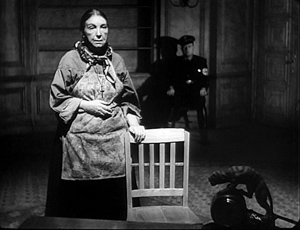 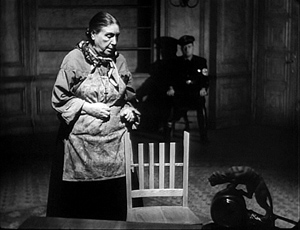
She looks up as Ritter says, offscreen: “Even longer if necessary.” Cut to Ritter, gesturing with a piece of sausage and saying, coaxingly, “Well?”
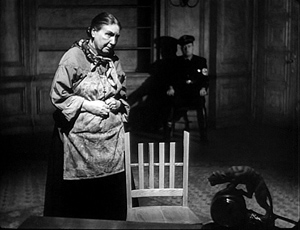 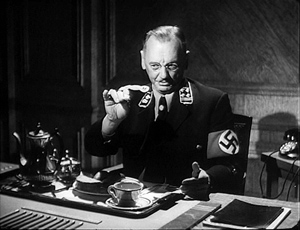
Slowly she goes to her knees again as the camera tracks in on her.
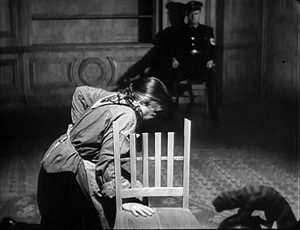
Back to Ritter: “That’s the girl.” Back to her, rising in pain to replace the back-rest.
 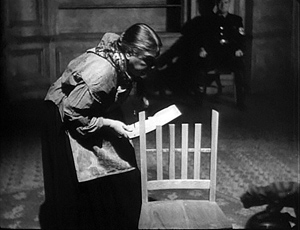
The scene concludes with Ritter reminding Mrs. Dvorak that she’s in Gestapo headquarters. She acknowledges that she doesn’t expect to leave without giving information. He starts his questioning all over again as the scene fades out.
This quietly suspenseful scene establishes a bit of furniture as a key prop. Once the faulty back-rest is marked for our notice, we’re expected to remember that it’s a means of intimidation–something that Mrs. Dvorak, in her anxiety about refusing to aid the Nazis, twice forgets. Lang’s shots, simple and uncrowded, makes the chair, like the spattered mirror in The Enforcer, preserve the trace of human activity. Yet it’s more acutely integrated into the scene’s drama than the mirror, and remembering how it was used earlier makes us wait tensely to see how it will be used again.
Long-term density
Several scenes later, the Nazis threaten to kill four hundred Czech hostages if the assassin isn’t turned over to them. Mascha Novotny has set out for Gestapo headquarters to denounce the man she helped, but she changes her mind and decides not to betray her country. She will only plead for her father’s life. Once more we’re in Ritter’s office.
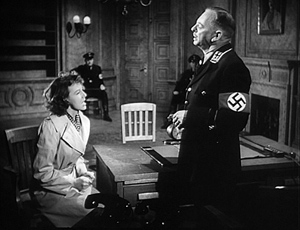
Centered in the frame, standing out as a pale oblong against the grayer background, the fateful chair is made salient during Mascha’s conversation with Gruber. I suspect there’s a sort of spatial suspense here–will she move to the chair and dislodge the precarious piece of wood?–but more important, I think, is the fact that the chair ineluctably reminds us of Mrs. Dvorak and her quiet resistance to pressure.
Ritter leaves to consult his superiors. When he comes back, a new composition keeps the chair prominent and lends a new centrality to the clock on Ritter’s desk, surmounted by a snarling cat or something like it. (It’s visible in shadow in the earlier scene with Mrs. Dvorak.) But now the camera arcs to minimize the Dvorak chair and show the beast and Ritter targeting Mascha.
Soon enough, as if to make sure we remember, Mrs. Dvorak is brought back in, having undergone serious torture. The camera positions reactivate our memories of the earlier scene.
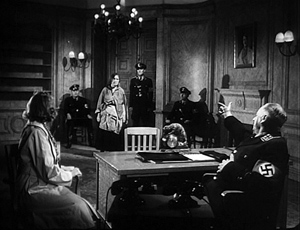 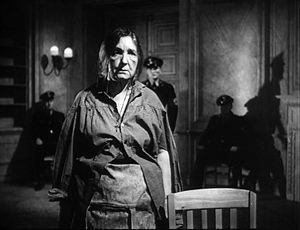
As she continues to lie to protect Mascha, Mrs. Dvorak never touches the chair. Although she has been tortured, she seems wearily defiant, as if her refusal to aid the Nazis has given her some strength: no need to lean on the chair now. As a final cue to our memories, Lang has Ritter play once more with his riding crop, letting its shadow fall on her heart.
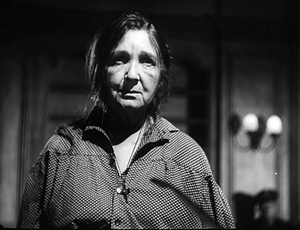
The threat is clear: For lying, the old woman will pay with her life.
The chair reappears in a later scene, but I’d argue that then it serves more as a pointer to another prop. The resistance movement fights back by framing Czaka, a beer baron sympathetic to the Nazis, as the assassin. Lang could have explicitly recalled the questioning of Mrs. Dvorak by having Czaka lean on the slat and knock it off. Instead, the composition makes Ritter’s clock more important than it was in earlier shots. As Czaka tries to defend himself, the framing blocks our view of the chair but emphasizes the snarling catlike creature on top of the clock. And the chair has shifted a little off and become a bit darker; it’s no longer as salient.
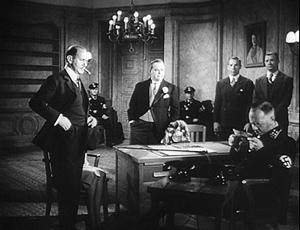 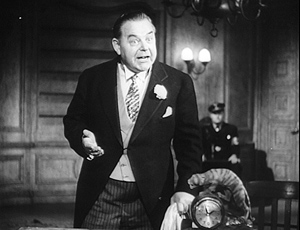
This cluster of scenes from Hangmen Also Die illustrates how scenic density can add layers to a film. One scene recalls another not only by similarity of situation and locale but by tangible marks left on it by earlier action. Having seen Mrs. Dvorak subjected to Ritter’s oily intimidation, we generally expect something like it to be applied to Anna. This conventional situation is given a rich, concrete presentation by the repeated camera positions and the simple chair that, unmoving, enters into the drama.
Of course as a Hollywood director, Lang was pressured to reuse sets and camera setups. That saved money and time. But he turned such repetitions to his advantage by letting certain objects come forward at crucial moments. They not only become part of the drama but prime us to remember them, and what they revealed, in ensuing scenes. And even though Lang never pursued the aggressive, packed deep-focus of other directors working in the 1940s, he shows how roomier, less pressurized compositions could still be charged with echoes of earlier bits of behavior.
Is this sort of visual-dramatic economy, calling on precise memories of concrete actions, lost in today’s American cinema? I suspect it is.
In studying Hangmen Also Die, I was curious about a perennial problem. Was the byplay with the chair a Lang invention on the set, or was it some version of the script, or in the original story by Lang and Bertolt Brecht?
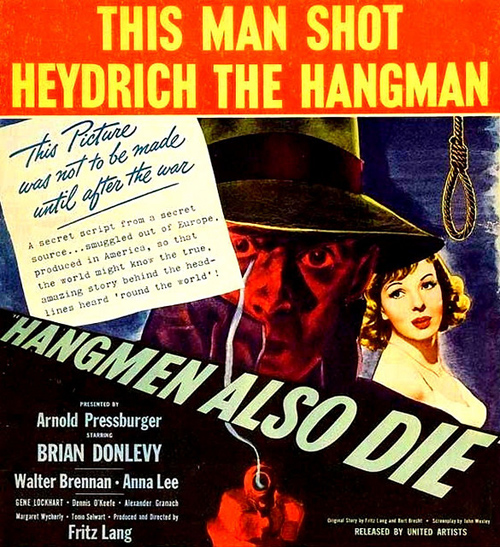
The film didn’t have a secret script, as the poster says, but the sources do remain a bit obscure. A draft of the original story signed by Lang and Brecht, in that order, exists. It indicates only that the greengrocer, called Frau Blaschke, is subjected to eight hours of “the usual Gestapo brutality” and refuses to identify the girl. There were other drafts of the screenplay, but I don’t have access to them, if they exist, and standard sources on Brecht in Hollywood don’t mention this scene’s details.
Somewhere along the line, though, the chair-back business was concocted. I found the shooting script signed only by John Wexley (Brecht claimed that he was robbed of credit) and annotated in pencil, perhaps by Lang. That script indicates that Ritter’s room contains “a vacant chair with its seat close against desk.” and Mrs. Dvorak is standing beside it as the scene begins. Much of the dialogue is the same , with some slight changes notated in pencil, possibly by Lang. But the camera movements indicated are different from those in the final film, and more importantly so are the actions. After Mrs. Dvorak claims that she doesn’t know the woman who helped the assassin, we read the following. I indicate pencil notations with {}.
In her fatigue, she places hand on back-rest of chair. But its dowels are loose and back-rest clatters to the floor.
RITTER (saccharine): Pick it up, Mrs. Dvorak.
CAMERA MOVES IN CLOSE as she obeys, stooping with painful fatigue–she has done this many times tonight.
RITTER: Now put it back in place, Mrs. Dvorak.
(She does so)
As Ritter questions her:
MED. SHOT – MRS. DVORAK. Without thinking, she is about to place hand again on loose back-rest–when she remembers and jerks back.
RITTER’S VOICE: Now don’t be nervous, Mrs. Dvorak…I’m prepared to devote to you all of tonight–and even longer, if necessary.
Mrs. Dvorak, unconsciously reacting to this, once more rests hand on chair. {She jerks back but} The piece of wood clatters to the floor.
MED. SHOT – RITTER. Ritter waits patiently; when she doesn’t move, inquires:
RITTER: Well…?
CAMERA PULLS BACK to INCLUDE Mrs. Dvorak, who stoops to repeat painful routine. Ritter smiles approvingly.
RITTER: That’s the girl.
Nothing here is indicated about Ritter’s riding crop, nor does he initially knock the back-rest off the chair. Mrs. Dvorak does it herself, accidentally. And the scripted line is “Pick it up, Mrs. Dvorak,” not, as in the finished film, “Pick it up again, Mrs. Dvorak.” The film version makes it clear that the byplay with the backrest is part of Ritter’s softening-up technique, something indicated in the script but not spelled out.
The later scenes in the film show other differences, mostly additions of things not mentioned in the shooting script. For instance, the script doesn’t mention the shadow of Ritter’s riding-crop. But the excerpt shows that the shooting script points toward some of the detailing we find in the finished film. It provides the sort of nudges that a director, especially one as oriented to gesture as Lang was, could elaborate on the set.
The Lang/ Brecht story has been published as “437!! Ein Seiselfilm,” in The Brecht Yearbook vol. 28: Friends, Colleagues, Collaborators, ed. Stephen Brockmann (2003), 9-30. The passage I mention, kindly translated for me by Ben Brewster, is on p. 16. Broader background on Brecht’s adventures in Hollywood can be found in James K. Lyon, Bertolt Brecht in America (Princeton University Press, 1980). Chapter 14 of Patrick McGilligan’s Fritz Lang: The Nature of the Beast (St. Martin’s, 1997) offers an account, mostly relying on Brecht’s viewpoint, of the making of Hangmen Also Die. The shooting script is in the John Wexley collection of the Wisconsin Center for Film and Theater Research and the State Historical Society here in Madison. Thanks also to Marc Silberman, renowned Brecht expert, for advice.
Posted in 1940s Hollywood, Directors: Eisenstein, Directors: Lang, Directors: Mann, Film technique: Cinematography, Film technique: Staging, Readers' Favorite Entries | open printable version
| No Comments »
|