by Kristin Thompson. Berkeley: University of California
Press, 2007.
400 pages, 6 × 9 inches, 12 color illustrations;
36 b/w illustrations.
[go
to Amazon | go to The Frodo Franchise blog]
Janet Frobisher, mystery writer, has murdered her husband. Naturally, she telephones her lover and asks him to come over. But before he arrives, Janet finds that the runaway George Bates has come calling. George has been her husband’s partner in bank fraud, and now they’ve gone further. They robbed the bank at gunpoint, and a policeman was shot. George faces Janet and demands to know where her husband is.
Nobody is likely to call Another Man’s Poison (1952) a masterpiece, or an undiscovered auteur gem. (Irving Rapper has, however, signed some better-than-average pictures.) Like many ordinary movies, though, it can tell us some interesting things about cinema if we look closely. Especially when that look takes in Bette Davis.
I had to restrain myself from adding a soundtrack link for this entry. You know the one. The earworm may be at work already. But having you listen while you read would probably only distract from my point.
Eyeball to eyeball
That point is one I’ve made before. We humans are very good at watching each others’ eyes. Evolutionary psychologists debate how that skill might have evolved, but there’s little doubt that we can “mind-read” on the basis of others’ gaze direction and other eye-related cues. Of all the arts, cinema probably has the most powerful ability to galvanize and channel our reactions solely through the way people use their eyes.
But what’s an eye? I argued in an earlier entry on The Social Network that eyeballs as such aren’t very expressive, despite poets’ claims to see the soul there. Dilations are about all you get. The real expressive work gets done by gaze direction, the brows, and the lids. Blinks help too. Lately, watching films from the 1940s and early 1950s for a book I’m planning, I was struck by how the great divas of that era used their eyes.
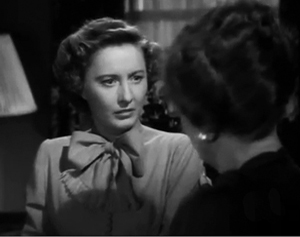
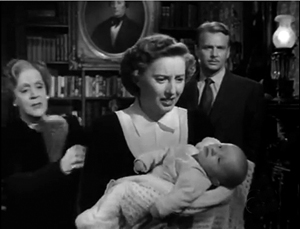
Consider for example Barbara Stanwyck in the Mitchell Leisen weeper No Man of Her Own (1951). Helen Ferguson has innocently assumed the identity of the dead daughter-in-law of a wealthy family, and she’s torn between revealing her lie and protecting her baby. So in most scenes her look is intent and direct. She uses the screen actor’s usual tactics of steady gaze and motivated blinks, with brows and mouth carrying the emotional impact (below, shocked anxiety; then distress).
Even when she’s thinking, her eyeline remains steady and she doesn’t play much with her eyelids.
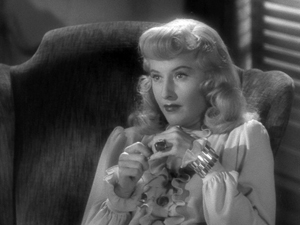
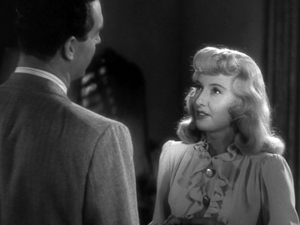
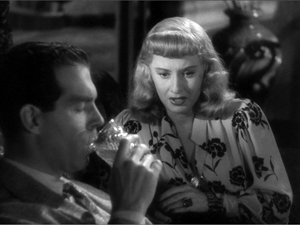
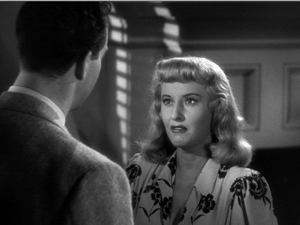
What about when Stanwyck is much less innocent, as in Double Indemnity (1944)? Devious as she is, Phyllis Dietrichson meets Walter Neff’s eyes squarely. “There’s a speed limit in this state, Mr. Neff.”
When Phillis isn’t looking straight at Neff, it’s when she’s pretending to be demure and concerned about her husband’s safety—and acting as coy as Brigid O’Shaughnessy in The Maltese Falcon. But once Neff sees through her effort to insure her husband, she glares at him unwaveringly.
Part of Stanwyck’s star persona is the bold woman who responds frankly to whatever is put before her. When it comes to evasive maneuvers, though, there’s Bette.
Putting a lid on it
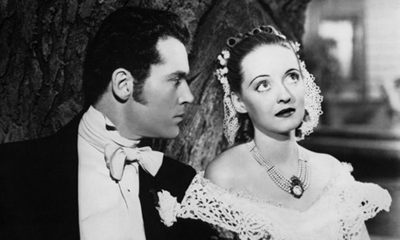
Publicity photo for Jezebel.
Her eyes are big and can be quite round, of course. They also sit remarkably centrally on her face, thanks to her high forehead; this quality is accentuated when her hair is brushed back, as it often is. What especially interests me today, though, is her eyelids. If Bette rolls her eyes at us in those Warners publicity shots, she can also create hooded eyes that suggest she’s harboring secrets.
Bette has remarkable control of those eyelids; she can close them to a very exact degree. In performance, the slight drooping of the upper lid, combined with a small shift in her gaze and a turn of her head, can shade the line or word she speaks. Add that sullen mouth and her vocal tone and rhythm, and you get a nuanced suite of micro-emotions.
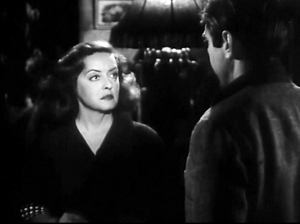
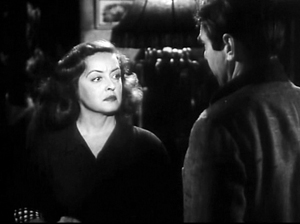
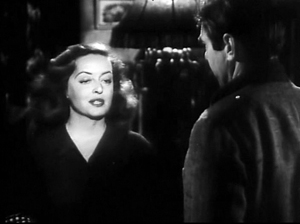
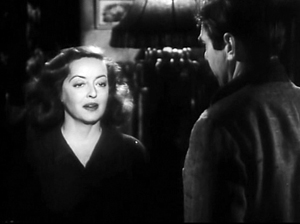
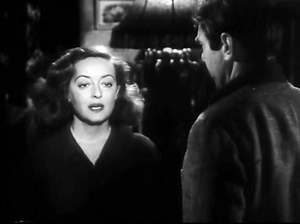
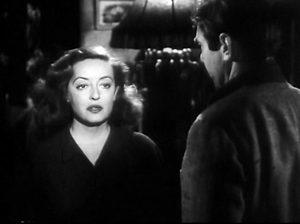
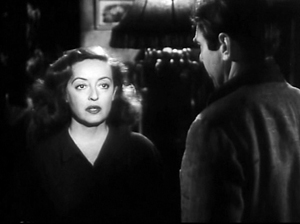
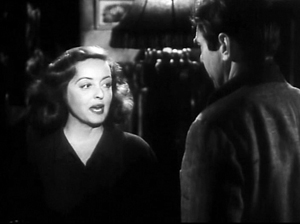
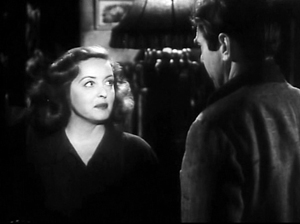
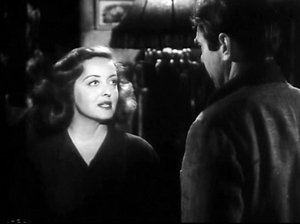
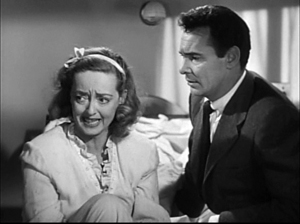
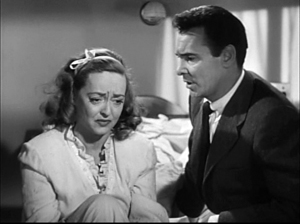
Take the moment in Another Man’s Poison after Janet Frobisher tells George that she’s killed her husband. She rushes into a two shot favoring her as George says: “You could’ve divorced him.” Her reaction is an eye-flick, evading his look but still radiating defiance.
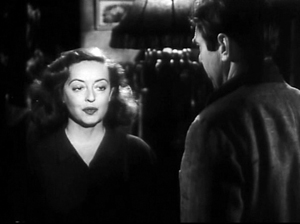
Now begins a series of micro-movements that shift Janet’s reaction away from George. She explains how her husband kept her tied to him. “He/ was/clever”: On each word, her expression, eyelines, and eyelids change minutely. Then she pauses.
“He saw/ to that/ too” gets mapped onto three more changes, with traces of a smirk accompanying an eye-shift on the word “too.”
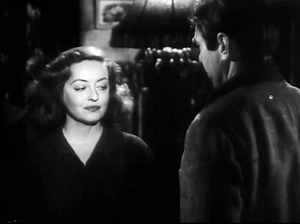
But Janet isn’t looking straight at George yet. She’s got more to say by way of explaining why divorce wouldn’t work: She and her husband continued to have sex. She puts it more indirectly: “He paid me”—pause when she lifts her eyes to look back at George—“visits.”
This instant of looking sharply back at George, as she had at the start of the shot, drives the point home and becomes the climax of this phase of the exchange. Eyelids, brows, chin, mouth, and gaze have all cooperated in creating an emotional detour away from and back to her questioner. Bette’s tiny side-glances show us a woman thinking and reacting to what she’s thinking, relishing what she’s going to say and then watching the effect of what she says. It all takes eight seconds.
Don’t be the wide-eyed ingenue
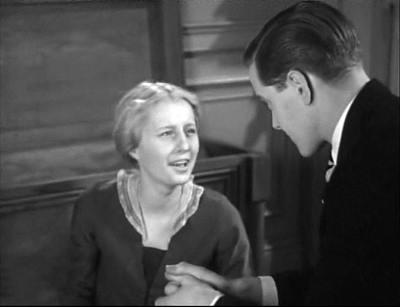
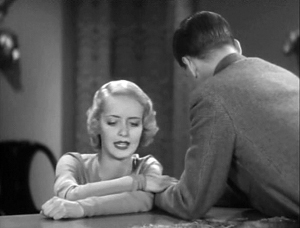
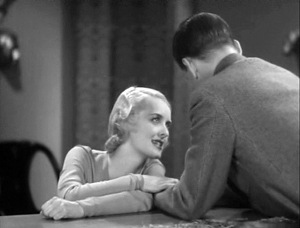
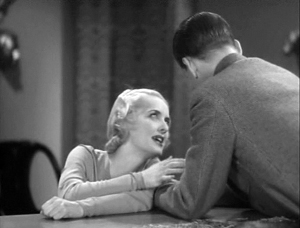
You can see the two stars’ technique operating very early in their careers. Stanwyck is the name star of So Big! (1932) and Davis is fifth-billed. Above, we find Stanwyck, playing the nobly suffering mother Selina, using her direct-gaze strategy (though as she ages, the eyes get a little pinched). By contrast, we have Davis as the saucy young illustrator Dallas O’Mara. Selina’s son Dirk asks Dallas why she doesn’t love him. When she answers, William Wellman’s staging gives Davis a little aria of face-time at the piano.
Dallas explains that she’s attracted to men who have confronted the rough side of life. I can provide only excerpts of what is a forty-second shot, full of shifts of head position, facial expressions, and eye movements, complete with finely calibrated eyelid work. The passage reminds us that Davis’ dynamic expressions and eye movements are often motivated by her playing characters full of jittery pep, talking fast and thinking faster. She will even deliver phrases with her eyes closed—here, speaking of men with hands scarred from work and struggle.
As she says, “You haven’t a mark on you, Dirk,” Dallas reaches across to grip his forearm. A new phase of the scene begins, but still with the suite of slight head turns and eyelid action.
Dallas says that if he’d kept on as an architect instead of taking refuge in a safe business job, his face would show it. As in Another Man’s Poison, Davis concludes her monologue by turning to face the man and deliver the final line directly. From early in the scene, however, Dirk has turned his face aside in shame.
Where would his marks of character show? “In your eyes, in your whole being.” She peers up at him, her face closer than at any other point in the scene, and her hand lifts from his arm to accentuate her frank but brutal blow to his pride.
Which makes our last view of her all the more arresting. In the final scene, Dallas meets Dirk’s mother and imagines her as an ideal subject for a portrait. Now the flighty young artist is riveted on the steady, serene gaze of the older woman.
In this climax, Dallas becomes what Dirk has called her—“a wide-eyed ingenue”—but in her rapt admiration she proves herself worthy to be Selina’s daughter-in-law.
Bette, eyeballing us
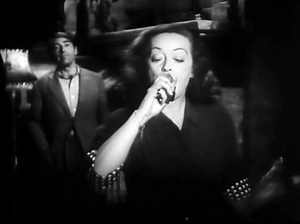
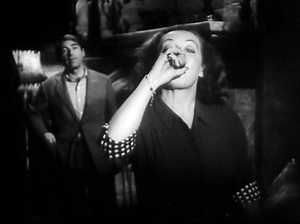
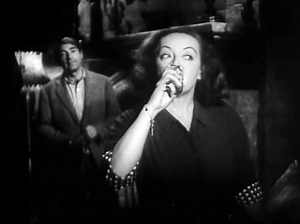
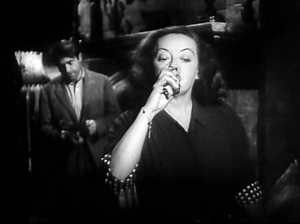
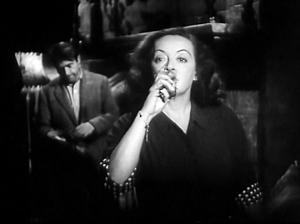
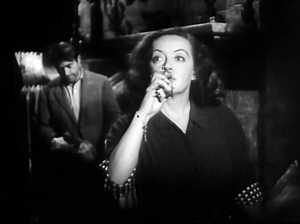
Now that we know the role Bette’s upper eyelids play, we can appreciate other moments when she milks their effects virtuosically. Go back to Another Man’s Poison. George tells Janet that he has the weapon used in the bank robbery—the pistol that bears her husband’s fingerprints. As George starts his line, she’s taking a drink in the foreground. Lifting the glass, she tips her head back too so that her eyes are just visible under her lids—and they’re looking out at us.
George says, “I’ve got the gun.” Janet lowers the glass, but she keeps it poised. Now her lids and eyelines present her reaction to George’s information that the pistol bears the husband’s fingerprints. You see her thinking about evasive action.
This moment in effect spotlights Davis’ use of her eyes; she’s frozen in place, and they’re the only things that move.
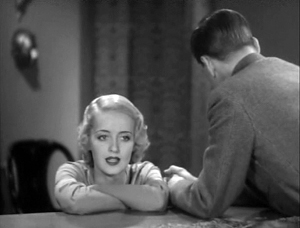
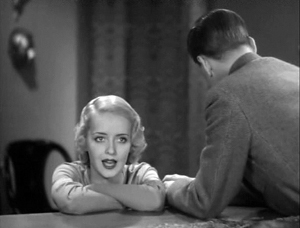
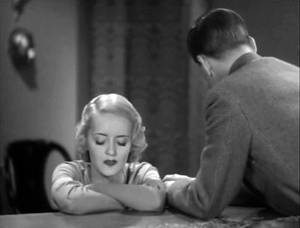
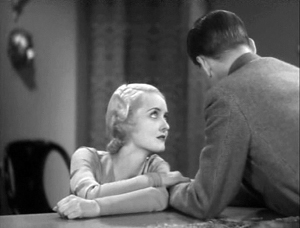
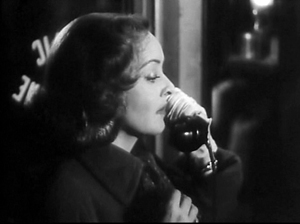
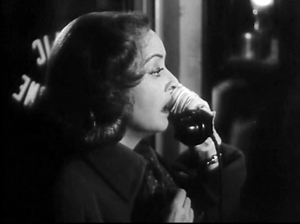
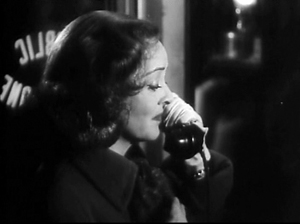
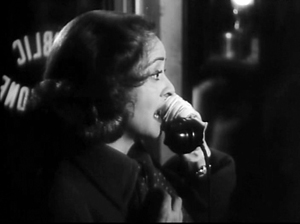
Early in the film, we’re given a sort of primer that trains us to watch Janet/ Bette’s eyelids. The first scene shows Janet making her call to her lover from a phone booth. It’s staged with her in profile, so that her brows and mouth are relatively unmoving and the eyelids, centered in the frame, become quite salient. I won’t try to follow all their tiny fluctuations, in coordination with the chin’s angle and the mouth, but these samples should give you the flavor. (Note the very slight difference between the first and the third image, and the second and the fourth).
A more frontal view of La Davis would have been a more characteristic star introduction, but it’s as if the film is saving her full-face firepower for later scenes.
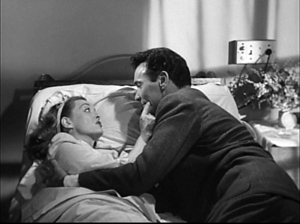
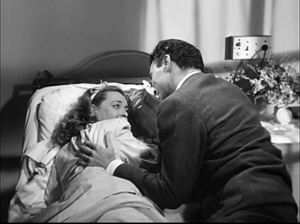
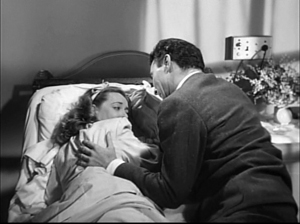
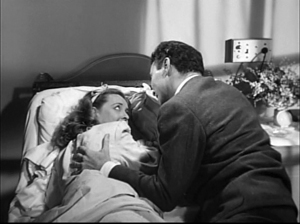
There’s other evidence that Bette was considered to be able to hold a scene by an eyelash. In Payment on Demand (1951), flashbacks from Joyce and David’s miserable marriage take us to happier days. One scene shows the couple embracing on a hospital bed after Joyce has given birth to their second child.
Joyce learns of David’s plans to move out of town, but she resists and sits upright. This brings her distraught reaction home to us with the now familiar coordination of eyeline, eyebrows, and eyelids with the mouth and shakes of the head—another suite of micro-behaviors I can merely sample here.
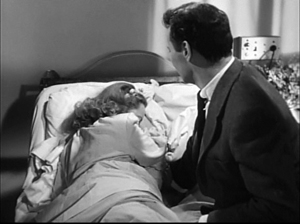
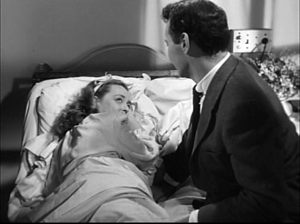
But then Joyce relaxes and falls back, hiding her face as the camera cranes up slightly.
Director Curtis Bernhardt has reframed the shot so that as Joyce curls up on the pillow, one eye peeps out. We don’t see her mouth replying to David’s lines, but we get the customary fractional eyelid changes, as in the phone booth scene above.
Eventually Davis moves her shoulder and reveals Joyce’s mouth, but for several seconds we’ve been obliged to follow the small movements of her lids as the only clue to her calming down—and getting her way with David. This is, needless to say, all done without a close-up.
Hollywood cinema is a highly formal cinema, as conventional in some ways as commedia dell’arte. Yet that doesn’t mean it must trade only in gross effects. Admittedly, much of today’s cinema has sacrificed nuance for brute force. All the better, then, that returning to even minor films from the studio era can remind us of how many opportunities the medium affords.
Bette Davis isn’t the only virtuoso performer, of course, and many of her contemporaries show the same kind of gifts, sometimes put to different ends. She offers a convenient illustration of how film actors can cultivate meticulous control over facial regions we don’t normally think about. She makes up for being short and rather slight by playing her face like a chamber ensemble, with every “voice,” eyelids included, contributing to the restless dramatic flow.
Okay, I know: The song was running through your head all the way through. You deserve a break. Go ahead, but you might as well watch something too.
On the evolutionary implications of our eye behavior, see Michael Tomasello et al., Why We Cooperate (Cambridge: MIT Press, 2009). Tomasello argues that the need for social cooperation favored signals of shared attention; to work together, we need to notice things that other people are looking at. He also points out:
All 200-plus species of nonhuman primates have basically dark eyes, with the sclera—commonly called the “white of the eye”—barely visible. The sclera of humans (i.e., the visible part) is about thee times larger, making the direction of human gaze much more easily detectable by others. A recent experiment showed that in following the gaze direction of others, chimpanzees rely almost exclusively on head direction—they follow an experimenter’s head direction up even if the experimenter’s eyes are closed—whereas human infants rely mainly on eye direction—they follow an experimenter’s eyes, even if the head stays stationary (pp. 75-76).
But tracking my eye direction helps you, not me; how could it have evolved? Tomasello hypothesizes that making eye direction salient developed in a cooperative social environment. It’s part of social intelligence, in which mind-reading works to everyone’s benefit in shared tasks.
An earlier blog entry here reflects on the performance of another sacred diva of the period, Joan Crawford. If you’re interested in a wider account that fits such matters into a broader theoretical perspective, including folk psychology, try this essay.
Every year at about this time, I trumpet the upcoming convening of the Society for Cognitive Studies of the Moving Image. This year’s powwow is held at picturesque Sarah Lawrence College, under the auspices of Professor Malcolm Turvey, no stranger to this blog. The final day of it will take place at NYU’s Cinema Studies Department. I had to miss last year’s conference for health reasons, but I’ll be there this year with a paper on 1940s Hollywood narrative.
Some earlier blog entries sketch out my take on what’s interesting about the group’s work. You can find treatment of the 2008 Madison gathering here and here; the 2009 Copenhagen event here and here with an epilogue about Lars von Trier and Asta Nielsen; and afterthoughts on the 2010 Roanoke meeting here. Last year, because I couldn’t go, I offered a web essay, here. This discusses my current thinking about the cognitive research framework.
This year, although I’m going, I’m again offering a new web essay. It’s about how models of mind (Gestalt, psychoanalytic, cognitive, etc.) have shown up in film theory and criticism. The piece is organized chronologically, and it tries to tie ideas about the psychology of cinema to a history of filmmaking: the theories I discuss emerge as responses to changes in form, style, and theme. The essay will eventually be reprinted in Art Shimamura’s anthology, Psychocinematics: Exploring Cognition at the Movies, forthcoming from Oxford University Press. Art’s collection gathers many cutting-edge essays from SCSMI members.
A sideways note: I learned recently that my old book, Narration in the Fiction Film (1985), sold 470-some copies last year. That’s a lot for an old academic study, especially one with many used copies in circulation. I infer from this (good cognitivists make inferences) that some instructors are using it in courses. I’m grateful, naturally, but I want to signal that I’ve altered some of the views I expressed in that book. If a professor is using my book to exemplify the cognitive perspective on narrative, I’d urge him or her to consider as well the web essay I already mentioned, “Common Sense + Film Theory = Common-Sense Film Theory?” In addition, my most recent answers to questions about filmic storytelling, in which narration is treated as one aspect of a larger process, can be found in “Three Dimensions of Film Narrative,” in the collection Poetics of Cinema. In other words: I hope I’ve learned something since 1985.
The week following the SCSMI gathering, UCLA is hosting Visual Narrative: An Interdisciplinary Workshop on 20-22 June. This very promising event hosts presentations and commentaries from linguists, philosophers, and a couple of SCSMI star psychologists. Dan Levin has already made appearances in this blog (notably here), and Tim Smith, Continuity Boy, has contributed our perennially popular guest entry, “Watching You Watch THERE WILL BE BLOOD.” The distinguished philosopher of art George Wilson, author of Narration in Light, will also be there. Thanks to Rory Kelly, one of the Workshop’s organizers, for tipping me off.
After SCSMI (from which, or about which, I hope to blog), we’re off to Bologna, so expect more of our usual reportage from Cinema Ritrovato, that frenzy of movies and movie lovers. Coming up next, though, there’s Bette Davis to reckon with.
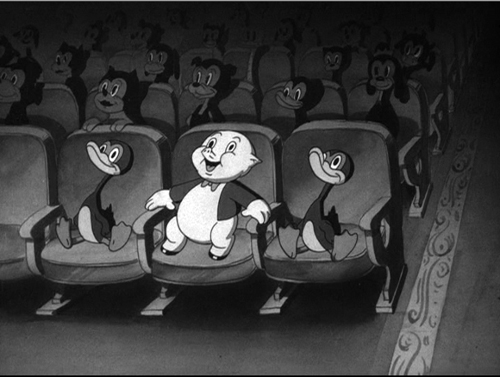
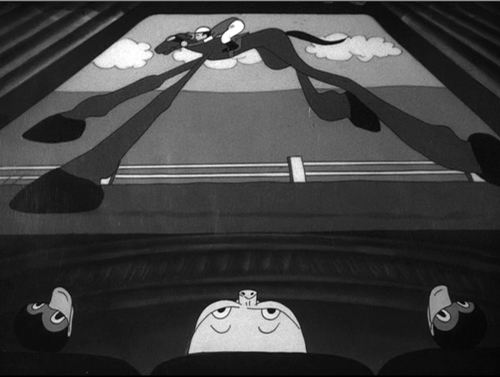
Cognition is important, but so is perception, as every front-row sitter knows. From The Film Fan (1939, Warner Bros., Bob Clampett).
The Cannes Film Festival continues even as I type. Much of the wheeling and dealing at the market that accompanies the festival is being driven by two franchises that few people outside the film industry think of as independent films: the Twilight and Hunger Games series. Indie blockbuster franchises aren’t common. In fact, there had previously been only one, but its parallels to these contemporary franchises reflect a recent major shift in international independent distribution.
True or false, The Lord of the Rings is an indie film
In May of 2001, I, as a Tolkien fan since high school, was resolutely ignoring the production of a film adaptation of The Lord of the Rings, going on in New Zealand. The first part of the trilogy was to be released in December, and there was widespread skepticism in the press, both popular and trade, and among fans and industry insiders concerning the possibility of the film’s being a success. Another fantasy adaptation, Harry Potter and the Sorcerer’s Stone, looked likely to be the hit of the Christmas season, eclipsing New Line Cinema’s expensive gamble.
Then came New Line’s Cannes event of 2001. Over a three-day weekend, the studio presented an elaborate program to reveal the film. On Friday night there was a screening of a 26-minute preview of footage from all three films, with an extended portion of the Mines of Moria scene in nearly completed form as its centerpiece. Even cast and crew members present, as well as top New Line officials, had not yet seen any of the film’s finished footage until that screening, and they were overwhelmed. Jaded reporters cheered and asked to have the preview re-run. Extra screenings had to be arranged. A series of press interviews were held, and a lavish party complete with sets and props from the film was held in a chateau. Suddenly the popular press was full of infotainment pieces predicting that the trilogy would be a blockbuster hit. Fan webmasters invited to the event posted enthusiastic, even ecstatic reports.
Variety’s report of the preview screening is the first article about the film that I remember reading. It began:
It’s hard to imagine a more relieved group of distribs gathered into one place than the collection who’d just finished watching a 26-minute film from New Zealand that cost $270 million.
The enthusiastic response from distribs, exhibs and worldwide press to the screening of footage from New Line’s “Lord of the Rings” at Cannes Olympia theater means that foreign companies that bet the farm on the three-year franchise now have cause for confidence they’ll recoup their investment–with coin to spare. […]
In marketing meetings after the screenings, NL execs told distribs that the target is for all of them to outdo the previous top grosser in their territory. In some countries, that’s going to mean spending as much again on P&A [prints and advertising] as they did to buy the films in the first place, but at least now that seems more like an opportunity than a terrifying risk.
Rolf Mittweg, at the time head of New Line’s international marketing and distribution, noted: “My Japanese distributor said he had a knot in his stomach for the whole year, and now it has dissolved.” [Adam Dawtrey, “Will ‘Lord’ ring New Line’s bell?” 21-27 May 2001, pp. 1, 66.]
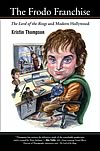
This considerably intrigued me, and it was probably the first step in the long path that ended with me writing The Frodo Franchise: The Lord of the Rings and Modern Hollywood.
What Variety was referring to, it turned out, was the twenty-six independent distributors from various territories around the world who were forced by New Line, if they wanted LOTR, to pay large sums up front for the film, sight unseen. That in itself wasn’t odd, since independent films were commonly financed in part by pre-sales to international distributors, often on the basis of a script or a star attached to the project. The difference here was that the chosen twenty-six had to pay a lot (as much as $8 million for the larger European territories) for all three feature-length parts of the film. If the first one flopped, the second and third would be almost worthless. Small wonder they were nervous going into the Cannes event.
As everyone knows, LOTR went on to enormous success, with the third installment becoming only the second film to cross a billion dollars in worldwide grosses (the first having been Titanic in 1997).
Many people would be surprised to learn, however, that LOTR was not the product of one of the major Hollywood studios. It came from an independent company, New Line. True, New Line was at that point owned by Time Warner, but it operated as an independent film producer-distributor. That is, it didn’t receive financing for its films from its parent company but through pre-sales–pretty much the definition of an indie establishment. It was also a studio that thrived in part because it stressed franchises, notably the Nightmare on Elm Street, Teenage Mutant Ninja Turtles, Rush Hour, and Austin Powers films. Successful though these were, LOTR was a step up for New Line, both in terms of prestige and budget. It was perhaps the first indie blockbuster franchise.
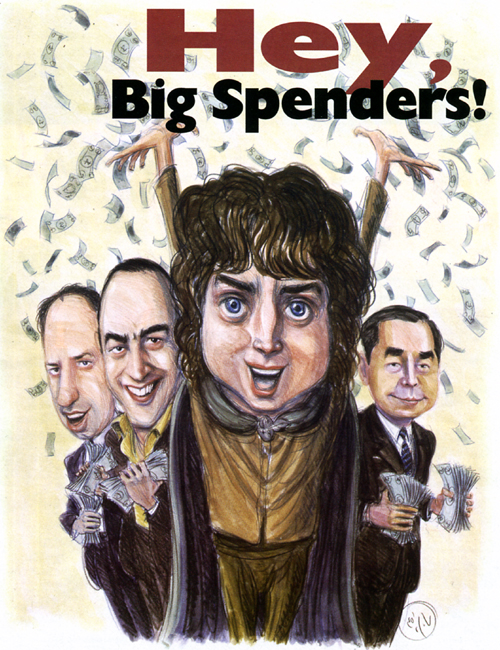
It was such a blockbuster, in fact, that LOTR helped pull the international independent and foreign-language film market out of a major slump that had begun in mid-2000 in the wake of over-production in the late 1990s. The crises in the Brazilian and Argentinian economies in 1999, the bursting of the dotcom bubble in mid-2000, and the 9/11 attacks in 2001 worsened the decline. I won’t go into detail here. (You can read a more thorough account in Chapter 9 of my book.) Suffice to say that the crisis happened to be at its worst when The Fellowship of the Ring came out in mid-December, 2001. During the first half of 2002, there were slight signs of a recovery, but the accumulating income from the film and also from the summer release of the DVD strengthened it considerably. By the time of the American Film Market in early 2003, The Hollywood Reporter ran the caricature above and declared, “With his quest to save Middle-earth from the Dark Lord, the intrepid hobbit might have helped rescue the annual event from the clutches of a global recession.”
As a result, the lucky 26 distributors were able to buy more at the AFM and other important indie sales venues. Reporting from Cannes, Variety declared, “The global bonanzas of ‘Lord of the Rings’ is playing its part in driving big-budget pre-sales.” Screen International said New Line was “buoying the indie market with The Lord of the Rings.” Sales and pre-sales of indie films were up. Small companies could afford to buy more desirable films than in the past. For example, SF Film in Denmark (a branch of Sweden’s AB Svenska Filmindustri) was able to acquire Million-Dollar Baby, a film that previously would have been beyond its means. A few of these companies also used their LOTR money to produce local films or to open art-house cinemas.
The problem was, the film had only three parts. New Line’s next attempt at a blockbuster franchise would knock the biggest supplier of indie films to foreign distributors entirely out of the market.
The New Line void
On December 7, 2007, The Golden Compass was released, the first in an intended trilogy based on the “His Dark Materials,” a trio of prize-winning books by another English author, Philip Pullman. With a reported production budget of $180 million, the film grossed about $70 domestically, though it managed $372 million worldwide.
On March 28, 2008, four years and four weeks after The Return of the King won eleven Oscars, Time Warner announced that New Line would be absorbed into Warner Bros. Entertainment as a genre unit. Its domestic distribution and international sales activities would be dissolved. The top executives of the international sales wing, Rolf Mittweg and Camela Galano, who had helped put together the enormously complex group of foreign distributors who largely financed LOTR, would soon be out of jobs. The fact that the change came less than two months before the Cannes Film Festival led trade papers to assess New Line’s importance as a supplier to the international independent market and to speculate on what companies might step into the void left by its departure.
(For my own analysis of what the loss of New Line product would mean for the indie market, see “Filling the New Line gap,” from November 6, 2008.)
Shortly after the March announcement, Screen International editor Mike Goodridge looked back at the impact of Peter Jackson’s trilogy on the distributors who released it abroad:
The success of the three films for the international partners cannot be overestimated. Nor can the fact they, more than anybody involved, took a huge risk on the trilogy. The risk paid off. The Greens at Entertainment [UK distributor], the Hadidas at Metropolitan [French distributor] and others genuinely shared in the profits of one of the box-office phenomenons of of the last 20 years. It was the international buyers’ dream. Instead of losing money on studio cast-offs, they had a hefty piece of a trilogy which grossed nearly $2bn outside North America. [“The End of the Line,” 7 March 2008, p. 6.]
Goodridge points out that although The Golden Compass, New Line’s intended first entry in the “His Dark Materials” trilogy, had not done well in North America, its box-office abroad was likely to hit in the region of $300 and speculated that if it did, “Warner Bros. will be hard-pressed to deny production to a sequel.” [p. 8]
This optimistic view generously assumes that Warners would want to reward New Line’s old customers abroad by making the two remaining films in the trilogy despite a possible repeat of the first installment’s lackluster domestic gross. Instead, Jeff Bewkes had no interest in keeping up alliances with those loyal distributors, since by investing in the production of films up front, those distributors got to keep most of the box-office takings in their respective countries. As Bewkes said, “With the growing importance of international revenues, it makes sense for New Line to retain its international film rights and to exploit them through Warner Bros.’ global distribution infrastructure.” (For more on the international implications of the absorption of New Line, see this piece on my Frodo Franchise blog.)
Goodridge quotes San Fu Maltha, head of Dutch distributor A-Film (which had the LOTR trilogy for the Netherlands): “New Line was one of the supplier of major films. For [the distributors,] it was, if not a lifeline, an important source.” New Line films from 2007 that had done well abroad included Hairspray, Rush Hour 3, and The Golden Compass. Earlier hits had been entries in the franchises that had traditionally driven New Line’s success: the Austin Powers series, the Nightmare on Elm Street series, and so on. Goodridge concluded that Summit and Overture would be major sources of quality films for the foreign market.
In early May, 2008, with Cannes looming, Variety ran a story about the opportunities opened by New Line’s departure from the market. The subtitle suggests how big the change was perceived to be: “Opportunities Rock: Fresh contenders eager to join international indie scene’s new world order.” The story speculated on the various independent sales groups that will be at Cannes and which ones might be strong enough to replace New Line: QED, with W, District 9, and A Perfect Getaway; Essential Entertainment, with My One and Only; The Film Department’s Law Abiding Citizen and The Rebound.
Swart also noted changes in two major suppliers to the indie market. Summit was growing, having opened its own domestic distribution wing. It “is chasing studio ambitions, which seems to have taken the main emphasis off foreign sales.” Mandate (notable for Juno and the Harold and Kumar sequels) had been acquired by Lionsgate in September, 2007.
Cannes also provided the occasion for a second in-depth analysis of the New Line void by Screen International. Author John Hazelton suggested that New Line’s regular supply of six to eight films to its regular distributors overseas benefited international indies as a whole:
Many sales executives, in fact, go further and suggest that by boosting the fortunes of the distributor partners with which it had ongoing output or package deals—companies including the UK’s Entertainment, France’s Metropolitan, Australia’s Village Roadshow and Spain’s Tri Pictures—New Line effectively elevated the independent international industry as a whole. Other sellers benefited, for example, when the New Line distributors reinvested profits from The Lord Of The Rings and Rush Hour movies—or from last Christmas’ The Golden Compass—in the acquisition of non-New Line films.
Hazelton quotes Steve Bickel, president of The Film Department’s international wing: “New Line provided a great service to all of us because they helped make strong companies that we’re now able to sell to.” The author also presciently singles out Summit and the newly merged Lionsgate and Mandate as “leading the field of remaining big picture suppliers,” noting that both companies had recently expanded into domestic distribution and were signing output deals in some foreign countries.
The article refers to The Weinstein Company and The Film Department as promising new players. Relativity, having produced Atonement, Evan Almighty, Baby Mama and Pineapple Express, was moving for the first time into international sales at Cannes. Other companies are mentioned as possibilities. Hazelton concludes:
On its own, Relativity probably will not fill the gap created by the disappearance of New Line from the business that A Nightmare On Elm Street, The Mask and The Lord of the Rings helped build. And neither will any of the other sales companies or producers now eyeing the fresh demand for upscale product from international buyers. But between them, the new entrants, growing boutiques and established players will be trying fill the New Line-shaped void appearing on the international sales landscape.
Reporting that autumn on the American Film Market, Screen International noted that The Weinstein Company had sold five films to Entertainment, formerly supplied by New Line. These included The Reader, Zack And Miri Make a Porno, and Piranha 3-D. Relativity had closed multi-year output deals with several overseas distributors, including former New Line customers Village Roadshow (Australia, New Zealand, and Greece) and Alliance Films (Canada). Neither company, however, would be the one to release the second indie blockbuster franchise.
From New Line to New Moon
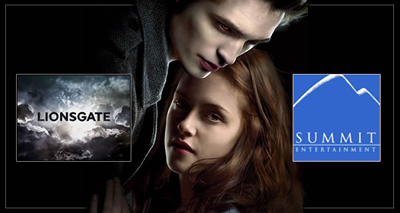
In 2008, the world was in a global recession brought on by the financial crisis of 2007. But even as the trade press was speculating on which company or companies would replace New Line, help was on the way. Summit’s release of Twilight came in November of the same year, and although it did not make as much as the three following films in the franchise so far released, it grossed nearly $393 million internationally, $200 million of that outside North America. A healthy take for a film reportedly budgeted at $37 million.
The modest title did not indicate that Twilight was the launch of a franchise, though obviously Summit was hoping that it would be. The subsequent entries were more forthright and more lucrative: The Twilight Saga: New Moon (November, 2009, nearly $710 million worldwide), The Twilight Saga: Eclipse (June, 2010, about $700 million), and The Twilight Saga: Breaking Dawn Part 1 (November, 2011, just over $705 million), with the final installment due out in November of this year.
On the occasion of the second film’s release, Mike Goodridge of Screen International noted that the franchise’s success echoed that of a certain earlier series:
Distributed in major territories by companies which had signed to output deals with Summit Entertainment for its in-house productions, the first film, Twilight, was a sensation buyers were hardly anticipating when they made the initial deals. [….] Seeing E1 Films take nearly $20m in the UK, SND in France scoring $17m, Eagle in Italy $14.3m and Aurum in Spain $13.7m last weekend brought back the heady days of The Lord of the Rings openings.
Goodridge also pointed out:
What The Lord of the Rings proved and the Twilight Saga reaffirms is that this kind of independent success is good for everybody. The Twilight distributors will have more money to invest in financing and acquisitions, benefiting other independent productions, while sales companies struggling to get films off the ground in a turgid distribution world will hopefully encounter a renewed buoyancy in the international markets.
He concluded, “For independents, the loss of New Line wasn’t as damaging as first imagined.” [“New Moon’s new line of success,” ScreenDaily.com, 26 November 2009.] It should be pointed out, though, that the gap between the third LOTR film and the first Twilight one was six years.
The Lionsgate share
On January 13, 2012, Lionsgate finalized its deal to buy Summit, thus acquiring the Twilight series. On March 23, Lionsgate released The Hunger Games, with an opening weekend of over $152 million domestically and a worldwide gross of $637 million after 9 weeks in release. Within less than three months, the company came to control the two largest indie franchises since LOTR. In late March, a financial analysis of Lionsgate by The Hollywood Reporter remarked, “The rest of the Hunger Games movies will now bring in significantly higher returns.” [Alex Ben Block, “How ‘Hunger Games’ Box Office Haul Impacts Lionsgate’s Bottom Line,” The Hollywood Reporter, 3 March 2012.] The reference was to the sales of foreign distribution rights, not higher box-office grosses.
Given how recent these events are, it happens that only two international distributors control both the Twilight series and The Hunger Games for their respective territories: Paris Filmes, of Brazil, and Nordisk Films, Denmark. Peter Philipsen, general manager for independent films at the latter told Variety that such series are rare: “There are not a lot of franchises in this business that really work, let along in the independent market,” Philipsen notes. “The last one before ‘Twilight’ was ‘Lord of the Rings,’ which was huge and gave a really big boost to the business as a whole.” [Diana Lodderhose and Adam Dawtrey, “International buyers eye bigger pics,” Variety.com, 5 May 2012.]
If Twilight helped ease the pain of the global recession for many indie distributors worldwide, by Cannes, 2012, the accumulating impact of its franchise and the addition of The Hunger Games led to greater prosperity. Those films and other successful non-franchise movies (some presumably bought with money from the Twilight franchise) led foreign distributors at this year’s Cannes festival to look for bigger films. Diana Lodderhose and Adam Dawtrey reported in Variety:
Sales agents brought a number of well-received big-budget projects to market last year, notably “Cloud Atlas,” “Pompeii” and “Enders Game.” But this year, with the indie sector stronger theatrically than it has been in years, and with international distributors flush with success from pics like the “Twilight” franchise and “The Hunger Games,” as well as “The Iron Lady,” “The Woman in Black,” “The Artist” and “Midnight in Paris” all having performed well territorially, there’s a feeling among buyers that bigger is better.”
A large number of new indie companies have emerged, many of them started by executives formerly at Summit, Lionsgate, and New Line. Among those represented at Cannes for the first time this year is Speranz13 Media, headed by Camela Galano, mentioned above as having helped arrange pre-sales for LOTR at New Line. Variety commented:
Pre-Cannes, a raft of new sales outfits headed by esteemed execs […], coupled with more money in the pockets of indie distribs who had successful runs with such pics as the latest “Twilight” installment, “The Hunger Games” and “The Intouchables,” suggested that this would be a market with greater liquidity.
And it has been.
“Many indie buyers have money now and they know what they want, which is studio-level movies,” said Foresight’s Tama Stuparich de la Barra, whose projects “Lone Survivor” and “Motor City” sold out at the market. [Diana Lodderhose and Dave McNary, “Cannes market totes up solid business,” 21 May, 2012.]
One notable aspect of all this is a return to pre-sales for financing big independent films. A few years ago, pre-sales were declared dead, partly because distributors couldn’t afford to invest in unmade projects. Lionsgate, however, financed about 60% of The Hunger Games through the sales of individual foreign sales rights. Production rebates from North Carolina kept the film’s budget at a relatively modest $80 million, limiting the studio’s risk on the film. These strategies are similar to what New Line tried while making LOTR.
I have yet to see coverage of Cannes that explicitly dubs Lionsgate the successor to New Line, the new indie “mini-major” that will supply a steady stream of films to foreign distributors with which it has output deals. Still, the conclusion seems all but made. At Cannes it began pre-sales for Catching Fire, the sequel to The Hunger Games. On May 23 it announced a long-term renewal of its partnership with the powerful French producer-distributor StudioCanal, including a deal for StudioCanal to distribute Catching Fire in German-speaking regions. Under this partnership Lionsgate has certain distribution rights to StudioCanal’s huge library of film and television titles, the third largest in the world, including titles ranging from Grand Illusion and The Discreet Charm of the Bourgeoisie to Terminator 2 and The Deer Hunter. [Dave McNary, “Lionsgate, Studiocanal extend pact,” Variety.com, 23 May 2012] On May 24, Screen International summed how various sales for various companies at Cannes were going:
Patrick Wachsberger and Helen Lee Kim reported a roaring trade on the Lionsgage slate, especially the Dirty Dancing remake. “It has been a strong market for us and the team has been seamless,” Wachsberger said of the post-merger infrastructure. [Jeremy Kay, “Market buoyed by sellouts,” 24 May 2012, p. 1.]
No doubt at some point Lionsgate will face a financial crisis and lose its central status, but with two big indie franchises in progress, it seems settled for the foreseeable future and beyond.
Ironically, the blockbuster franchise that started it all will resume this year, but not in the indie sector. The two parts of The Hobbit, due to be released in December of this year and 2013 as prequels to LOTR, are being produced by New Line. They are not being financed by pre-sales to indie distributors around the world. Instead Warner Bros. is providing funding, and it will also distribute.
I have linked to stories when I could find them online, but some articles I quoted are either behind paywalls or simply not online. They are taken from issues of the trade papers mentioned in the text.
The illustration at the top of the entry topped an article called “Hey, Big Spenders,” cited above. It appeared in The Hollywood Reporter (February 2003), pp. 1, 4, 8, 12. The piece dealt with the American Film Market, which at that time still happened in the spring. Naturally the caricature of Frodo tossing money around caught my eye. (The distributors flush with LOTR cash are, left to right, Joel Pearlman of Roadshow Films, Australia (?); Trevor Green of Entertainment Film Distributors, UK; and Hiromitsu Kurukawa, Nippon Herald Pictures, Japan.) This was one of the few articles I found in the trade press that dealt with the considerable impact that LOTR had on the international indie and foreign-language film market. I used the caricature as an illustration in Chapter 9 of my book. After all, how do you illustrate the concept of a film helping pull the indie business out of a global slump? That picture was ready-made for such a topic. I contacted the artist, Victor Juhasz, for permission to reprint the image, which he kindly gave. It occurred to me that he would be the ideal person to provide an image for the cover of the book as well. Again, how do you illustrate the general concept of a franchise based on The Lord of the Rings? Have a character surrounded by licensed products based on that character, I figured. Fortunately the University of California Press agreed. Based on photos, an action figure, a polystone collectible bust, and a video-game strategy book that I sent him, Victor produced exactly what I had in mind. A small image of that cover illustration appears up at the right, beside the Hollywood Reporter caricature.
Looking back at Kristin’s and my ventures online, I see a gradually expanding series of experiments. Step by step, maybe too cautiously, we’ve moved toward what you might call “para-academic” film writing–a way of getting ideas, information, and opinions out to a film-enthusiast readership whom we hadn’t reached with our earlier work. (Although we’re happy when academics take note of what we do.)
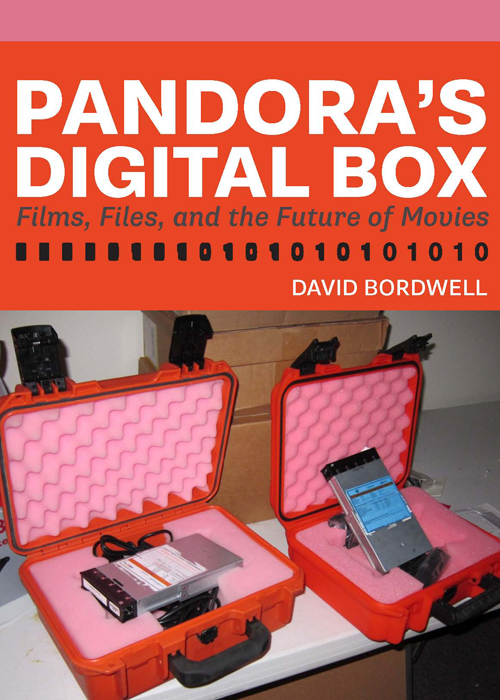
Today we have a new experiment to try. Pandora’s Digital Box: Films, Files, and the Future of Movies is now available here. Backstory follows.
Baby steps, then longer ones
To take another metaphor, we’ve been gradually exploring various niches in the online ecosystem. At first, back in 2000, knowing almost nothing about cyberculture, I dumped my vitae and a little essay onto my brand-new Geocities site. Later I saw the site mainly as a supplement to print publication, a way to add and correct things I’d written in my books Figures Traced in Light (2004) and The Way Hollywood Tells It (2005), along with material we’d included in our textbooks Film Art and Film History. By then I had retired from teaching.
I started to write more online. I began posting long, stand-alone pieces that I couldn’t imagine any journal or anthology publishing. (They’re in the list on the left-hand column of this page.) Somewhere around 2007, after finishing the collection Poetics of Cinema, I made Web publishing my primary expressive vehicle. So when I was asked to write pieces for various occasions, I tried to secure permission to publish them here as well. They too have wound up in the line-up on the left– a little essay on Paolo Gioli, one on Shaw Brothers’ widescreen cinema, and a liner note about The Mad Detective for the Masters of Cinema DVD line. There are more to come in this vein, including a historical survey of how film theorists have drawn ideas from psychological research.
While moving to fill the essayistic niche, we saw archival and revival opportunities as well. Thanks to Markus Nornes, I was able to republish the out-of-print Ozu and the Poetics of Cinema in a downloadable pdf version, with color illustrations. That’s on the University of Michigan Press site. Vito Adiraensens, who made a pdf of Kristin’s Exporting Entertainment, allowed us to post that on our site.
At this point, whole books we’ve done were available online. But those were straight reprints. The next logical step was to offer a revised edition. After the rights to Planet Hong Kong (2000) reverted to me, I decided to update and expand it and add color illustrations. I also decided to ask for money, making PHK 2.0 the only item on the site that wasn’t free. That was an experiment too, to see if the year I spent reshaping it might yield some payback. It did; so far, the sales have covered the costs of design and yielded me a little for my efforts.
Meanwhile we’ve explored the blog niche. Started in 2006, refreshed once or twice a week, our blog has become greatly satisfying to us. This entry is number 499. We’ve treated the blog wing of the site as a sort of magazine, with each entry as a feature or column or festival report or book notes. We write about anything cinematic, old or new, that interests us. The freedom is exhilarating, and we don’t lack ideas. I have a desk drawer’s worth of folders on topics I want to explore.
Nearly all of these are long-form endeavors. Some run to 6000 words. Even our festival reports, which could have been emitted in a flurry of communiqués, are blended into spacious pieces that permit us to compare films or develop a common theme. At a time when everyone declares that attention spans have shrunk to pinpoints, readers have been very patient with us. People still visit our blog, recommend it to others, and even Facebook and Tweet about it. Roger Ebert has been an especially generous supporter. Thanks to the efforts of Rodney Powell of the University of Chicago Press, we gathered some of our entries into a book, a “real” one called Minding Movies, and I’d hope that the length and contextual depth of the pieces gave them some bookish solidity.
Another niche coming up: As virtual books have found a public, I’ve made a book designed primarily for an e-reader.
Not bloviation, blogiation
Last fall, after realizing the scope of the digital conversion of movie theatres, I decided to write a series of blogs about it. I had no fixed number in mind, but I didn’t expect it to run as long as it did. I kept learning more, so the series, called Pandora’s Digital Box, stretched from December through March. I was encouraged by people who praised it in blogs and on social media. I decided to try to build a book out of the pieces.
Some people think that this is silly. One reviewer of our blog book, Minding Movies, wondered why anyone would buy something that’s available for free. More alert reviewers, like Scott Foundas of Film Comment (May/June 2011), understood that some readers don’t like to read long-form prose online, or don’t like zigzagging through the labyrinth that is our site, or want some guidance in selecting what to pay attention to. Moreover, by gathering items topically, the book suggested recurring themes and an overall frame of reference governing what we do. The broad aims of our enterprise aren’t apparent in a daily skim of each entry.
Still, Minding Movies was a varied mixture. Pandora was from the start a more focused series. And we added no new essays for our collection, but I had quite a bit more to say about the digital conversion. So I cooked up new rules for my latest experiment.
1. The original entries wouldn’t be taken down. As with Minding Movies, the entries will remain available online.
2. The book wouldn’t be simply a blog sandwich. I’ve rewritten, rearranged, and merged entries for smoother reading. The topics are more logically ordered, and the whole thing hangs together organically. The blogs formed a kaleidoscope; the book is a narrative.
3. The book would have lots of new material. It includes things I didn’t know when I wrote the blog, ideas that have come to me since, and as much background and context as I could supply. The original blogs amounted to about 35,000 words (enough for a Kindle single). The finished book runs over 57,000 words.
4. It wouldn’t be an academic book. It’s written in the same conversational tenor as the blog. I try not to make anybody’s head hurt. No footnotes, but….
5. The book would exploit online access. The text is unsullied by links, to promote continuity of reading. But a section of references in the back contains citations and hyperlinks to documents, interviews, sources, and sites of interest. This section tells you where I got my information and, if that information is online, takes you there.
6. The book would have to be for sale… Part of this experiment is to see whether I can make back what I’ve spent on the project. I reckon that my travel to theatres and events like the Art House Convergence in Utah, along with other expenses like paying our Web tsarina Meg to polish up my self-designed Word book, comes to about $1200. In addition, I’d like something for my extra time and effort.
7. …but not cost too much.Planet Hong Kong 2.0 runs $15, which I think is a fair price given the cost of designing a book with hundreds of color pictures. But Pandora is a lot simpler and has only a few stills. So I’m offering it for much less: $3.99.
Another Whatsit, but only $3.99
Pandora’s Digital Box: Films, Files, and the Future of Movies traces how the digital conversion came about, how it affects different sorts of theatres, how it shapes the tasks of film archives, and what it portends for film culture, especially the culture of moviegoing.
A key concern was trying to go beyond what I’d already written. For one thing, I try to answer questions I didn’t pursue in the blog entries. How did the major distributors orchestrate the transition? How did they reconcile the interests of the various stakeholders—filmmakers, theatre owners, manufacturers? By 2005, the specifications for digital cinema were established, but the real uptake came five to six years later. What led to the delay? How was digital cinema deployed outside the US? And so on.
Second, I provide background and context for areas I surveyed quickly online. For example, instead of sketching how a movie file gets projected, I take you into a booth and we follow the process step by step. The chapter on small-town cinemas reviews the role of single-screen theatres in the industry. The chapter on art-house cinemas goes back to the 1920s and shows remarkable continuity of taste and business tactics up to the present. Throughout, I consider how the US exhibition system has worked since the rise of multiplexes.
Third, there are unexpected tidbits. How did celebrity directors like Lucas, Cameron, and Jackson spearhead the shift to digital and later innovations? (I touched on that in a couple of recent entries here and here, but there’s more in the book.) Who invented multiplexes? Cup holders? When did those annoying preshow displays start, and more important, who controls them? How do distributors decide whether to release a movie wide or to let it “platform”? Why do art-house theatres serve coffee? There are even a couple of jokes (maybe more unintentional ones).
I think it has worked out well. I’ve tested the text on Kindle, Nook, and the iPad, and it fits very snugly. You just have to import it as a pdf from your computer. On the iPad, it seems to work particularly well with the app GoodReader, which permits smooth searches, easy bookmarking, and quick shifts back and forth.
As I mentioned above, you can go here to order the book. On the same page you can examine the Table of Contents and a bit of the Introduction.
It’s possible that some people might want to make a bulk purchase. Pandora might be used in a class, or given to staff members working at a film festival, or presented to members or patrons of an art house. For such worthy purposes, I can make the bulk price quite low. If you’re interested, please write to me at the email address above.
Self-publication is a risk for both author and reader. If you decide to buy the book, I thank you.
The next logical steps? A new ecological niche? A completely original book online, maybe. Or PowerPoint lectures with voice-over. Who knows? As Jack Ryan says at the end of The Hunt for Red October: Welcome to the new world.
Thanks as usual to our Web tsarina Meg Hamel, who did her usual superb job turning Pandora the Blog into Pandora the Book, and who has set up the payment process to be quick and easy. Earlier helpmates were Vera Crowell and Jonathan Frome, whose efforts in creating this site are remembered and appreciated.
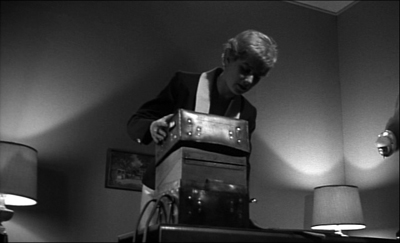
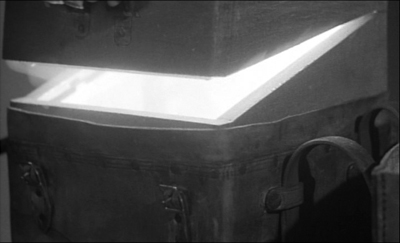
The illustrations are from Kiss Me Deadly and Pandora and the Flying Dutchman, but you knew that. Thanks to Jim Emerson for his suggestions.