by Kristin Thompson. Berkeley: University of California
Press, 2007.
400 pages, 6 × 9 inches, 12 color illustrations;
36 b/w illustrations.
[go
to Amazon | go to The Frodo Franchise blog]
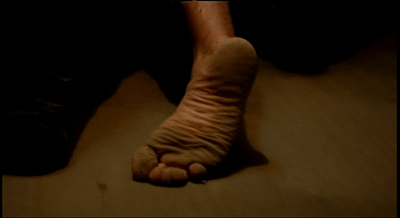
It’s the editor’s job to think about coverage, and mistakes at this stage can have a very high price. Without that shot of the murderous feet walking slowly down the stairs, it’s impossible to build suspense. Inexperienced directors are often drawn to shooting important dramatic scenes in a single take—a “macho” style that leaves no way of changing pacing or helping unsteady performances.
Christine Vachon
DB here:
Go to any ambitious film festival, such as the Vancouver one Kristin and I are attending at the moment, and you’ll see several films made up of unusually sustained shots. Some Asian and European films may even be made entirely of long takes; in a few instances, none of the scenes may employ any editing at all. Movies made wholly of one-take scenes, or sequence-shots (plans-séquences) are probably more common today than they have been since 1920.
Why so many long takes? In the 1990s, when Vachon was writing, imitation and competition probably did come into play. The Movie Brats were sometimes up-front about their boy-on-boy rivalry. Here’s De Palma after seeing the shots following Jake into the ring in Raging Bull:
I thought I was pretty good at doing those kind of shots, but when I saw that I said, “Whoa!” And that’s when I started using those very complicated shots with the Steadicam.
Something similar may have been going on in earlier times. It seems to me that in 1940s Hollywood, directors came to a new consciousness of the long take. Preminger, Ophuls, Sturges, and Welles became famous for their sustained shots, and even Hitchcock, a long-time proponent of editing, switched sides, making some of the longest-take films of the era. Sometimes an action scene might be played out in one flamboyant take, as in The Killers and Gun Crazy. It does seem that these big boys appearing to compete to see how long they could hold their shots and how complicated they could make them. One scene in Welles’ Macbeth runs a full camera reel, or about ten minutes; Hitchcock’s Rope contains only eleven shots.
Yet I don’t think that macho showoffishness or competition can completely explain the urge to shoot long takes. Watching the Vancouver Dragons and Tigers series leads me to consider some other options.
Long view of the long take
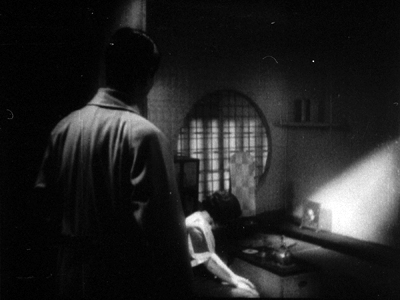
Naniwa Elegy (1936).
Of course there were single-take movies at the beginning of cinema, as in Lumière’s documentary shorts. And in the period 1908-1920, as I’ve argued in many entries on this site, some great films were made relying on single-shot scenes. They operated with a staging-driven aesthetic that’s come to be known as the “tableau” style.
But with the rise of American cinema to international prominence, and worldwide directors’ willingness to create scenes in the process of editing, the long take became relatively uncommon. In the 1920s, a rapidly-cut film might make occasional use of a long take, often as a fairly intricate traveling shot, as in Murnau’s Sunrise and Vidor’s The Crowd. Early talkies sometimes began with a long tracking shot (e.g., Sunny Side Up, Scarface) before settling into a more editing-driven style. And a few directors in Western cinema, like Max Ophuls, Jean Renoir, and John Stahl, handled extended dialogue passages in a single shot. A long-take approach was somewhat more common in Japanese cinema, with of course Mizoguchi Kenji being a prime exponent in films like Naniwa Elegy, Sisters of Gion, and Genroku Chushingura.
Citizen Kane probably helped popularize the long take in the 1940s, but so did the development of new camera supports. Dollies that could move through a set in tight turns encouraged directors to try out more sustained shots. For such reasons, most long takes of the period involved camera movement. Although Welles had his share of flashy tracking shots, he was one of the few directors who also let the camera stay fixed in place throughout a scene, in both Citizen Kane (Toland emphasized its “single, non-dollying” shots) and the extraordinary kitchen scene of The Magnificent Ambersons.
Occasional long-take shots have been with us ever since, some of them highlighting balletic camera-actor staging, as in Antonioni’s bridge encounter in Story of a Love Affair and many interior shots of Le amiche. By the 1960s, and 1970s, some directors became identified with long takes and even single-shot sequences: Tarkovsky most famously, but also Straub and Huillet, Miklós Jancsó, and Theo Angelopoulos. Fassbinder tried it out occasionally (Katzelmacher) as did Wenders (Kings of the Road). And of course in the avant-garde, devastating half-hour shots marked some works by Andy Warhol, not your most macho filmmaker.
There are still long-take films being made in the mainstream—not only those motivated as scavenged recordings like Cloverfield or Paranormal Activity, but also ambitious experiments like Children of Men. On the whole, however, long-take technique has become a hallmark of festival cinema. As commercial directors (not just in Hollywood) has embraced ever-faster cutting, other filmmakers have pushed toward ever-longer takes. It’s as if the rise of what I’ve called intensified continuity has provoked filmmakers to go to the other extreme. This impulse is thrown into still sharper relief by the fact that many of these festival films use little camera movement. And today’s shooting on video lets you hold shots a lot longer than shooting on camera reels.
But what does long-take cinema buy you?
Dragons, tigers, and stillness
A Mere Life (2012).
This year’s Dragons and Tigers series, the festival’s panorama of recent Asian cinema, had its usual quota of young people’s films about young people, not unlike America’s Mumblecore. The kids hang out, smoke, drink, flirt, berate each other, sometimes humiliate one another, occasionally come to a crisis in their lives. Other films were a bit more unusual. Several of all types, though, pointed up the virtues and limitations of current approaches to long-take shooting.
Most low-budget directors employing long takes don’t do so out of bravado or competitiveness. The reasons are more mundane: the tactic saves time and money. If you have rehearsed your actors, or if you want spontaneity and improvisation, you can get through a lot of your film more efficiently if you simply record the action. Editing in post-production comes down to choosing your best takes and finding the best arrangement of them.
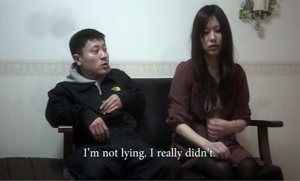
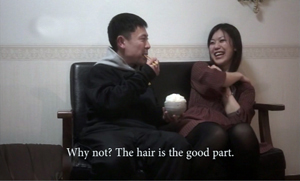
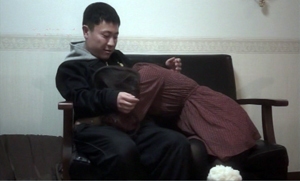
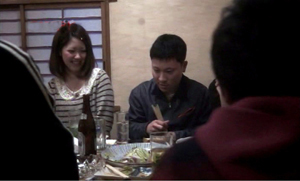
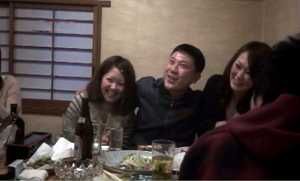
For instance, Ninomiya Ryutaro’s The Charm of Othershas about fifty shots in its eight-five minutes. Most scenes consist of only one or two shots. One seven-minute shot shows a young layabout Sakata trying to jolly his girlfriend out of dumping him. She’s seen him with another girl and tells him, “Eat first, then we’re through.” Instead, he pokes and tickles her, makes faces and jokes about liking to eat hair, and eventually wins her back. It’s a nice little examination of how men turn boyish, even babyish, when they’re trying to avoid a woman’s wrath.
Ninomiya, who plays Sakata, explains that although he had each scene’s core action fully scripted, he let actors improvise a fair amount during shooting. (Some specific words, however, had to be used.) The girlfriend scene was shot four times, the first three developing one approach to the action and the fourth take trying a totally different approach. Ninomiya wound up using the third take.
The Charm of Others is shot in a loose handheld style, with panning and tracking to follow its characters. This “free camera” technique is probably the most common way off-Hollywood directors employ the long take. The approach was on display as well in Mine Goichi’s The Kumamoto Dormitory. The plot follows a pair of slackers who want to work in films but lack ambition and anything approaching realistic expectations. More editing-driven, and somewhat more slickly made than The Charm of Others, it still averaged about eleven seconds per shot, a far cry from contemporary Hollywood’s average of five seconds or less.
For the most part, The Kumamoto Dormitory uses long takes in traditional ways–to record a scene’s interactions, and sometimes to create parallel story situations. In the beginning a lengthy shot drifts along dorm corridors as kids are moving in. One later in the semester shows boys in each room masturbating, playing mahjongg or computer games, and otherwise goofing off. Near the end another traveling shot shows the boys packing to leave as we hear an admistrator’s public speech describing how dorm life brings beginning students and graduating ones closer together. His inspiring line, “You were brought into the world because you were needed,” becomes ironic in the light of the dead-end hopes of a would-be movie director and his pal, an aspiring stunt man.
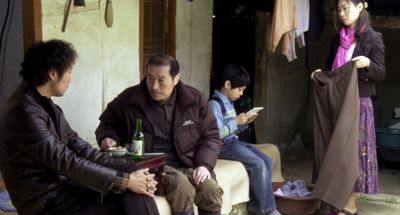
More rarely, the camera can be locked off during the long take, creating a static setup that may be refreshed by slight pans and reframings. Two of the films I’ve discussed earlier, Romance Joe and In Another Country, exemplify this approach; the former has fewer than 200 shots, the latter fewer than seventy. A similar approach, with a little more emphasis on dramatic compositions, is taken in Park Sanghun’s A Mere Life, a movie not about twentysomething crises but about the failure of a man to provide security for his wife and child. In a somewhat Mizoguchian tale of misery, most scenes are covered in only one or two fixed shots. There’s a striking scene in a café which obliges us to scan the background when a con artist bilks the husband and flees with his money. At another point, the camera’s refusal to budge and the director’s refusal to cut create considerable tension. Soon after the husband has lost the family’s savings, walls block our view of his desperate attempt to kill his wife and child.
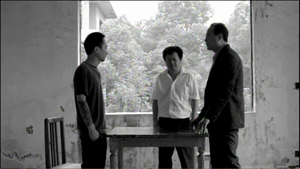
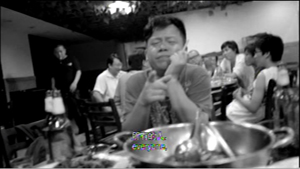
The static long take is used in a more transparent way in Luo Li’s Emperor Visits the Hell, the winner of the Dragons and Tigers competition. The curious premise is that characters in present-day China are reenacting an episode in the classic saga Journey to the West. The reenactment, moreover, isn’t an affair of costumes or combat. It’s more abstract. For instance, the Dragon King is decapitated in the original story, but the Triadish character playing him in this film strolls around with his head firmly in place.
There are few single-take scenes, but the starkness of the décor and the fact that characters tend to be planted in a single spot give the film a sense of ceremonial gravity enhanced by the precise choices of camera position. Only in an epilogue, during the production’s wrap party in a restaurant, do the cast and crew assume their everyday identities. Then the camera goes handheld and roams bumpily around the table.
By the end Emperor Visits the Hell becomes a collection of contemporary long-take options: fixed versus moving, rock-solid framing versus shakycam.
Time on our hands
The long take has, we’re often told, another purpose: to capture real duration. Editing, it’s said, fragments not only space but also time. Whenever you cut, you have the opportunity to skip over dead moments. With a long take, especially a static one, the filmmaker is in effect asking us to register all the dead time between more important gestures, expressions, or lines of dialogue. This happens again and again in The Charm of Others, The Kumamoto Dormitory, and most of the movies I’ve already mentioned.
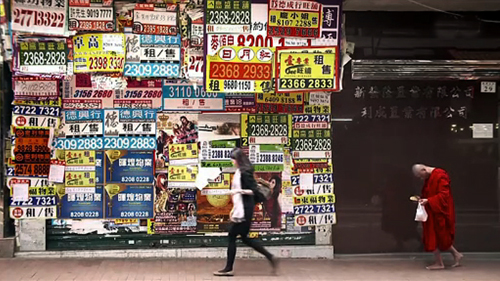
But the assumption of that “real time” flows through the shot can be questioned. The most common counterexample is slow- or fast-motion, which doesn’t respect the actual duration of the action the camera records. A rarer instance is offered by Tsai Ming-liang’s episode Walker in the portmanteau project Beautiful 2012, sponsored by the Hong Kong International Film Festival Society.
The action is bare-bones: A Buddhist monk walks through Hong Kong bearing a crinkly plastic bag in one hand and a sweet bun in the other. Across twenty-four minutes, twenty-one shots trace his progress through the city. In most the camera never movies, capturing the monk’s movement in static, sometimes abstract compositions. The catch is that the monk, played by Tsai regular Lee Kang-sheng, is advancing with preternatural slowness.
Sometimes we have to play a sort of Where’s-Waldo game with the compositions, searching for his stooped head or brilliant red robe or bare feet in a crowded shot. Most often, the emphasis falls simply on the monk’s movement. Hands lifted, head bent, he makes his way as if walking underwater. We watch each foot lift, shift weight, and descend in excruciatingly small changes of position. The movement proceeds not from camera trickery or CGI gimmicks; Lee’s performance presents a “temporal close-up” of humble, unstoppable walking. Meanwhile traffic, passersby, and other parts of his surroundings bustle along as usual. This is really stretching the shot–making the long take seem even longer.
One effect of these shots is to unroll an image of pure spiritual discipline, a sort of Zen exercise showing how microscopically an adept can control his body. Pedestrian yoga, you might say. Another effect Tsai creates is to summon up two times in one shot: that of normal activity and that of a spiritual tempo nestled within, but also opposed to, ordinary life. Eventually, when the monk bites into the bun, even that is rendered with the clarity of stop-motion photography. Here the long take exercises an almost scientific force, letting us see a simple act pulverized, as if a Muybridge image were translated into live action.
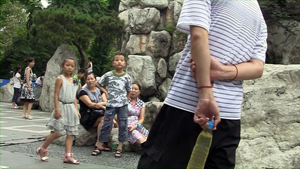
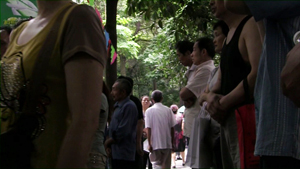
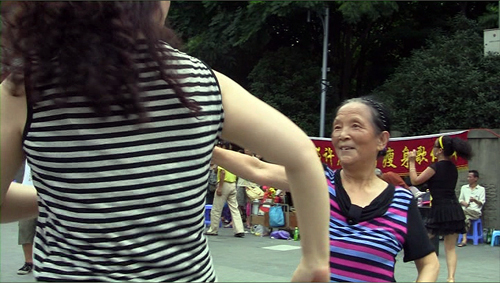
At the opposite extreme is the action-packed long take, running about seventy-five minutes, that comprises J. P. Sniadecki and Libbie D. Cohn’s People’s Park. The filmmakers had the good idea of taking us through a day’s pleasure in the city park of Chengdu, China, by means of a single traveling shot. A modern version of People on Sunday, the film unrolls a pageant of the everyday. People snack, trot past, make cellphone calls, rest on benches, sketch calligraphy on the paving stones, and above all make music. We see band concerts, karaoke performances, traditional opera, and spontaneous dancing to pop beats. The film starts with couples dancing and ends with an exuberant display of bouncy soloists who, we learned from Libbie Cohn after the screening, come often to perform for the sheer fun of it.
Just as important, instead of shooting at eye level, Sniadecki and Cohn filmed from a wheelchair. The lower-than-normal framing emphasizes kids, fills the frame with torsos, and yields unexpected revelations of figures in depth. We also get to watch a choreography of politeness as people subtly adjust to the camera as it squeezes through crowds or sidles among couples on a dance floor. Far from being the weightless, invisible camera of most Hollywood films, this camera and its carriage occupy actual space as the whole unit carves a sinuous path through the park. How, we sometimes wonder, will it get through here?
Many of the most famous long takes in film history are, we might say, teleological: They build toward a climax. Think of the tracking shot that opens Touch of Evil, beginning with a bomb set ticking and ending with an explosion. In a quieter way, the tableau aesthetic of the 1910s often gave the shot a distinct curve of interest, building to an expressive peak. (See here and here.)
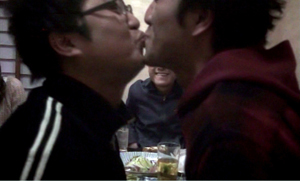
And occasionally in today’s cinema, a shot that seems casual will subtly prepare us for a payoff. In The Charm of Others, a drinking game allows Sakata to tell others around the table what they must do. He orders two boys to kiss, and the girls join him in chanting, “Kiss! Kiss!” Those boys have already been present from the start of the shot, but now they become more than a pair of framing shoulders. Their obeying the order close to us furnishes an enjoyable topper for the take.
One problem facing the makers of People’s Park was the need to provide such a climax. As in Russian Ark, a single-shot feature film can’t simply stop; it needs to draw to a close, preferably on a striking note. In my view, Sniadecki and Cohn manage it. It would be unfair to tip you off–can there be such a thing as a stylistic spoiler?–but let’s just say it’s a moment of abrupt change within what is otherwise continuous, evenly-paced unfolding. Yes, dancing is involved.
In certain contexts, a long-take trend can, as Vachon mentions, exude a certain bragadoccio. Competition among artists, though, even with some bravado, isn’t necessarily a bad thing, as 1940s and 1980s Hollywood suggests. Sometimes as well the long take is an exigency demanded by time and money. It can yield artistic advantages, too, by building suspense (as in A Mere Life) or surprise (as in The Charm of Others) or both (as in People’s Park). It can also be a mark of virtuosity, a quality prized in most artistic traditions. A well-done long take can be like a sustained aria in an opera; its confident audacity can make you smile.
The epigraph quotation is from Christine Vachon’s Shooting to Kill (Morrow, 1998); the passage is available here. My quotation from Brian De Palma comes from “Emotion Pictures: Quentin Tarantino Talks to Brian De Palma,” in Brian De Palma Interviews, ed. Lawrence F. Knapp (Jackson: University Press of Mississippi, 2003), 148. I discuss stylistic competition in contemporary American film in The Way Hollywood Tells It.
I consider Mizoguchi’s use of the long take in Chapter 3 of Figures Traced in Light. Some elaboration of that chapter is on this site.
Toland’s explanation for avoiding cutting is explained in his essay “Realism for Citizen Kane,” available here. For more on his decision-making, see our book, The Classical Hollywood Cinema: Film Style and Mode of Production to 1960, as well as this blog entry. For more on 1940s “fluid camera” technique, go here.
The segments of the film Beautiful 2012 began life as online videos. They are linked at Hong Kong Cinemagic. They play rather jerkily on my laptop, but the motion in projection is completely smooth.
My thanks to Tony Rayns and Shelly Kraicer, programmers of the Dragons and Tigers series, for their acumen and assistance.
The Vancouver International Film Festival always provides a host of intriguing experiments with narrative form. This year the Dragons and Tigers series, devoted as usual to new films from Asia, offers such a neat pairing of a veteran director and a newcomer that I can’t resist spending some time on them. Both, it turns out, are interested in memory–not just as a theme, but rather as a process involved in how we watch movies.
Passion for pattern
When we analyze a film, we usually notice patterns—an arc of character development, repeated imagery or musical motifs, recurring framings or lines of dialogue. Filmmakers use these elements of patterning to give elements special significance.
Sometimes the patterns we pick out are noticeable on our first viewing of a movie. Indeed, the film’s effect relies on our seeing later elements as completing a pattern.
Remember “You complete me” from Jerry Maguire? The reason you do, I think, is partly because its first appearance is very salient. It occurs when Jerry and Dorothy are riding in an elevator with a mute couple. Dorothy’s explanation of the couple’s signing highlights it (while characterizing her as a sympathetic person who learned ASL to communicate with a relative). When Jerry restates it in Dorothy’s living room, we recall that it’s a simple declaration of love—a straightforward statement from a man who is habitually slick and evasive. The fact that the phrase stuck in Jerry’s mind from the elevator encounter also offers further proof that he’s not as superficial as he seems. He remembered it, and now we do too.
Sometimes, though, we may find patterns that a viewer may not have noticed on first pass. That’s one of the appeals of doing analysis. As we get to know the film more intimately, we see patterns of coherence that probably many viewers didn’t notice before. In classically made films, for instance, a scene is likely to start with a long shot, proceed to two-shots or over-the-shoulder framings, and then toward tighter close-ups. This stylistic patterning follows the rising drama of the scene’s action. Most viewers probably don’t notice these patterns, but directors, cinematographers, editors, and film students are more likely to catch them. When we analyze a film’s style, we may be surprised to find how often these “hidden” patterns emerge.
Very occasionally a filmmaker gives us something in between obvious patterns and buried ones. A film might repeat something in such a way that (a) you recognize it as a repetition on first pass but (b) you can’t recall exactly what it harks back to. In other words, the filmmaker deliberately organized the movie so that the things that come back are difficult to place in the film as a whole.
The best-known example is perhaps Last Year at Marienbad, where the drifting, dreamlike succession of scenes doesn’t supply standard plot progression. The result is that the images, music, and lines of dialogue are felt as echoes of earlier scenes, but most viewers can’t pinpoint exactly where they first appeared. Another instance would be Buñuel’s Discreet Charm of the Bourgeoisie. Here we get scenes that start more or less realistically, and then devolve into absurdity—at which point one of the people in the scene bolts awake in bed. What we’ve just seen is a dream, but we can’t be sure exactly when the dream started because Buñuel and screenwriter Jean-Claude Carrière didn’t supply a scene that shows the character going to bed. One effect is that the movie seems like a daisy-chain of overlapping dreams, with no sure point at which we can declare that this or that moment is real.
Both Marienbad and Discreet Charm rely on a fact of cinema: It unrolls in time. So do novels, of course, in the act of reading anyhow. But when you’re reading a book you can stop and page back to check where you went off-track. Since the arrival of videotape viewing, we can in principle do the same thing, and we’d want to replay moments if we’re undertaking an analysis. But the normal conditions of viewing, in both theatres and at consumer command, bias us toward forward momentum. Intent on what happens next, we have a surprisingly hazy recall of what preceded the scene we’re watching now. Halfway through a movie, try to come up with an accurate scene-by-scene list of what you’ve just watched.
The diffuse memory we have of the prior action, and the difficulty of going back to check, is one reason that films need some explicit patterning, their marked repetitions, their constant restatement of the story’s premises. Redundancy of information compensates for the time-bound nature of viewing. Films that don’t supply this, as in my recent example of Sueño y silencio, demand a second viewing—and risk frustrating audiences.
In another country, at other times
Hong Sang-soo has long been a master of the half-hidden pattern. Each film, usually devoted to the comic deflation of male pretension, is built on a unique armature of repetitions. Most critical commentary simply ignores those, trying to summarize the plots straightforwardly and taking the result as comments on contemporary life—an urban milieu in which intellectuals eat, drink too much, smoke endless cigarettes, and make clumsy attempts at romance and sex. “People tell me that I make films about reality,” Hong remarks. “They’re wrong. I make films based on structures that I have thought up.” It’s the structures, I think, that engage us, and partly by asking us to test our memories of what we saw only an hour or less before.
For instance, The Virgin Stripped Bare by Her Bachelors (2000) at first seems a straightforward he-said/ she-said plot. Initally, scenes showing us a love affair’s progress are organized around one character. Then the affair is replayed, but centering on another character. Many scenes show us each character apart, but when they’re together, that scene gets repeated in the second character’s story. The problem is that some significant details are different in the two versions. We’re asked to wonder whether we’re getting the same story as each character remembers it, or two alternative universes in which the stories differ slightly. Moreover, it’s not easy to recall whether this or that prop or line of dialogue was precisely the same in the first presentation. The strain on our memory is part of the film’s fascination.
Hong has been a regular in the Dragons and Tigers sidebar over the years. He’s reliably prolific: two of his best films, both made in 2010, were in that year’s program. This year brought us another Hong brain-teaser and funnybone-tickler, In Another Country. It’s a measure of Hong’s growing international reputation that Isabelle Huppert is recruited to play three roles in another mazelike plot.
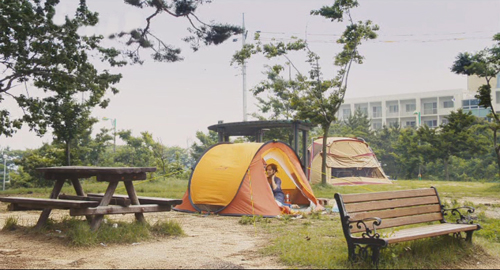
Yonju, staying with her mother in a coastal hotel and beset by family problems, tries writing film scripts. In the first, Anne, a French filmmaker, is vacationing with a South Korean director and his pregnant wife. As Anne gets involved with a hunky, good-natured lifeguard, the director is also making a play for her. Cut back to Yonju, trying another draft. In this one, Anne is a rich housewife from Seoul having an affair with a married man—again a director, but played by a different actor. As she waits for him to join her at the hotel, she meets the same lifeguard and romantic complications ensue. Back to Yonju trying another draft. Now Anne is accompanied by another woman, an older professor. They meet the first director, pregnant wife again in tow, while Anne has become preoccupied with getting life advice from a monk. Once more, needless to say, the lifeguard plays a central role.
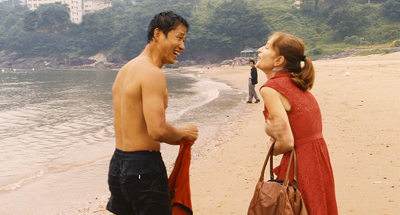
As you’d expect with a multiple-draft narrative, the changes are accompanied by some constants—an evening barbeque, the lifeguard emerging from the sea, an encounter between him and Anne in his tent. There are even repeated ellipses, bits that are skipped over in each mini-story. For instance, in all three drafts Yonju, acting as hostess, starts to take Anne on a shopping trip and promises to show her something interesting. But then we cut to Anne alone, wandering through town. Why did the women separate? Is this Anne on a different occasion?
Most to the point of memory tricks, we’ll see something in a late scene that may result from something we saw in an earlier draft. When a bottle of liquor breaks on the beach late in the film, you might remember that a previous scene showed the bottle there already broken—but which scene, in what point, in what story? It’s as if Yonju’s different versions have contaminated one another, with scenes from one draft taken for granted in a different version. In the third draft, what Yonju promised was so interesting seems to be the lighthouse. We may forget that in the earlier versions, we never knew why Anne was searching for the lighthouse. Still, we’re unlikely to forget the parallel framings.
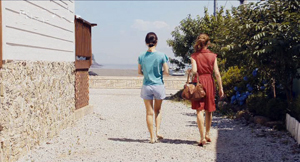
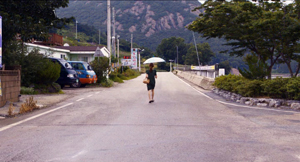
This sort of play with our memory can bring the movie to a satisfying, if enigmatic, conclusion. An umbrella, a casual and forgettable prop in one version, provides a kind of minuscule climax in the last. And the final shot of Anne walking into the distance becomes a variant of the film’s first one.
In Another Country provides plenty of social comedy. Hong’s customary satire of Korean males’ awkward sexual aggressiveness is now accompanied by digs at westerners’ search for mystic Asian enlightenment. But the narrative structure is amusing in itself. Hong cajoles us into enjoying the surprising but inevitable recycling of situations, lines, and camera setups. Few filmmakers can make audiences laugh at the mere appearance of a shot and tease us to expect a replay of or departure from what we’ve already seen. Even if we couldn’t say precisely when we saw that image before, we recognize it and participate in a light-hearted game—the game of form.
Wristcutters share their stories
Romance Joe (2011) was made by Lee Kwangkuk, Hong Sangsoo’s assistant director on many projects. No surprise, then, that his debut relies on parallels and variants. Yet it’s much more explicitly about storytelling than In Another Country. Hong uses Yonju’s script drafts as a peg to hang his variations on, but he doesn’t suggest he’s exploring the very nature of narrating. Lee puts fiction-making at the center of his game.
It would be misleading to summarize the plot, since the film aims to put any firm sense of what really happened into question. The core, we might be tempted to say, is the story of a schoolgirl, Cho-hee, who is shunned because she has had sex with an unnamed man. A boy in her class takes pity on her, and when he finds that she has slashed her wrists in a forest glade, he rescues her. They tentatively fall in love and flee to Seoul. On their first night there, he takes fright and returns home. Left alone, she turns to prostitution, and years later, when the boy is now in Seoul in film school, she agrees to participate in a student film he’s crewing. He doesn’t recognize her. More years pass, and the boy is now a film director. He returns to the village, recalls their runaway romance, and in despair attempts suicide. Meanwhile, Cho-hee’s son, whom she has left with her grandparents, comes to the village in search of his mother.
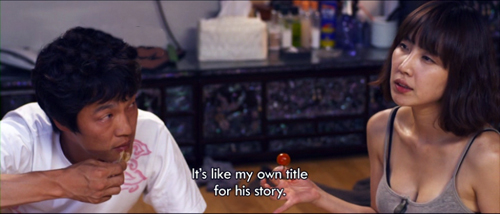
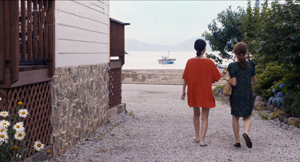
I think it’s fair to say that even this bare-bones anatomy of Romance Joe isn’t fully registered on a first viewing. And in any case, my synopsis is misleading. Why? Because many of these actions are presented as intersecting tales told by two characters who don’t know one another. A Seoul screenwriter recounts the story of the boy’s search for his mother as a purely fictitious one, an idea he has for a script. Alongside that tale, but not precisely inside it, we see Lee, another writer who’s blocked on a story and visits a village to compose a film. There he spends a long night with a tea lady-hooker, Rei-ji, who takes over storytelling duties. Like Scheherazade, she regales him with another story (see our top still). Her tale focuses on the suicidal screenwriter she calls “Romance Joe”–who turns out to be a filmmaker who has gone missing.
So we have one character telling the story of another character who’s hearing a story presented by Rei-ji–a story about yet a third filmmaker, the despairing director, and one that includes his own memories. More confusingly, Rei-ji’s story not only overlaps with the boy’s quest; she becomes a character in the first screenwriter’s imaginary plot. To add to the intricacy, the film employs only partial framing situations, so we might get a scene establishing one tale’s telling, then the embedded tale, and then another situation of telling, as if what we’ve just seen was launched by one storyteller but picked up by another. Instead of a Chinese-box or Russian-doll structure, with one tale neatly enclosed in another, we get something like a cut-and-shuffle mix. And like In Another Country, this film doesn’t wrap things up by a return to the narrating frame; we’re left with something more ambivalent–a question about the very status of the whole assemblage of stories.
It sounds choppy, but it all flows. As one scene slips into another, with abrupt reminders that we’re seeing events told by someone or other, we’re confronted with a cascade like that in Discreet Charm of the Bourgeoisie. We’d be unlikely to recall the precise moment when one story melted into another. Storytelling is linked to rumor and gossip, chiefly by the fact that the trigger for Lee’s initial writer’s block is the suicide of a major actress, supposedly hounded by innuendo. The chief parallel is to Cho-hee, driven to suicide by malicious classmates, but other characters sport the scars of slashed wrists. In this context, the motifs of rumor and suicide tie together the stories conjured up by each of the narrators–again, apparently operating in some predetermined harmony.
Throughout, our uncertainty is increased by some tantalizing misdirections. Might Rei-ji, not Cho-yee, actually be the boy’s mother? Has Lee, after hearing Rei-ji’s story, created the very film we have watched? Finally, the possibility that Rei-ji is no less a fictioneer than the professional writers is broached when she returns to the teahouse and tells the younger hooker that you can make more money through talk than through sex. “Everyone wants a different story. Put some thought into what clients want.” In telling one screenwriter a story about another one, she’s just suiting the service to the customer.
When we study narrative we naturally emphasize the main plot points, the twists and climaxes that claim our attention, the hints that pay off: the gun in the first act that goes off in the last. But films like In Another Country and Romance Joe remind us, as Roland Barthes put it, that “reading is forgetting.” By planting items that will become important later, filmmakers keep us focused on what’s to come and eventually mobilize memory to make all the pieces fit. But filmmakers can also seed their plots with small things that we barely register, then bring them back as half-recalled items. Films like Hong’s and Lee’s are more than puzzle movies; they induce our imaginations to grapple with the limited capacity of our memories. Those limitations in turn affect how we judge characters and the truths of the tales they bear. And in films like theirs, as often in life, our judgments have to remain in tense suspension.
I discuss problems of viewers’ memory in “Cognition and Comprehension: Viewing and Forgetting in Mildred Pierce,” in Poetics of Cinema. I consider Jerry Maguire‘s narrative organization in The Way Hollywood Tells It. For previous VIFF entries that examine complex narration and plot structure, go here and here.
P.S. 5 Oct 2012: Sean Axmaker, with whom we spent many lively hours at VIFF, has posted reviews of several Asian films, including Romance Joe, at Parallax View.
My title exaggerates. There are other venues for the Vancouver International Film Festival besides the Empire Granville multiplex. There is the Pacific Cinematheque, often used for more avant-garde items; the Vancity Theatre, which screens art films and hosts industry events year-round; and the gorgeous old picture palace, the Vogue, a multiple-use venue that hosts both big screenings and gala events. But frequently we find ourselves wandering for a whole day among the Granville’s seven screens, circling the globe cinematically.
The Middle East
Four years ago we blogged about Captain Abu Raed(2007), the first Jordanian feature film in decades. This year there is The Last Friday(2011, Yahya Alabdallah), and by now the fact of a Jordanian film appearing at festivals is no longer notable. Production has now been systematized. The Last Friday was financed (for around $100,000) by the Royal Film Commission of Jordan’s Educational Feature Film Program.
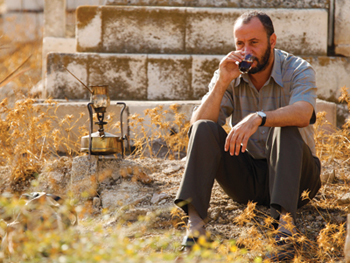
The basic plotline is simple, with protagonist Youssef, a handsome, hard-working middle-aged man, divorced and reduced to driving a taxi prone to breakdowns, struggling to earn money for a serious operation. The cinematography was done using a Red One camera, and the resulting images are impressive. (Alabdallah often resorts, with good effect, to what David has termed planimetric compositions, those shot directly toward a flat background.) There is little dialogue, and Youssef’s struggles are conveyed by small details, visual and aural. The fact that he has tampered with his apartment block’s switch boxes to steal electricity is established early on, but by-play with the fuses he has transferred or hidden becomes an unnecessary but entertaining motif.
Perhaps the “educational” part of the film comes from Youssef’s son, a teenage wastrel who hangs out at his father’s apartment. It eventually comes out that he has stopped going to school, and Youssef has the additional burden of confronting his ex-wife to thrash out a method for dealing with their errant son.
The Last Friday treads that risky line so many independent filmmakers on small budgets take, singling out a character with a problem and showing him or her doggedly dealing with it. It takes a sure touch and an interesting character to make this work, and Alabdallah manages both, helped by Ali Suliman’s performance in the lead role.
So far undoubtedly the biggest unexpected gem this year has been the Iranian family melodrama/thriller A Respectable Family (2012). The film is the first fiction feature by documentarist Massoud Bakhshi; it was shown in the Directors’ Fortnight series at Cannes and gained generally favorable reviews.
The plot concerns Arash, a professor who has lived in Paris for decades and, as a guest post at the university in his hometown of Shiraz winds down, seeks in vain for the return of his passport to allow him to return home. At the same time, a lawyer informs him and his mother that a sizable sum of money has been left to them by his estranged, abusive father. The family drama that plays out depends for effect on an extraordinarily complex and tight script with numerous abrupt turns and surprises that keep the audience as busy as in any recent Hollywood thriller. In particular, Bakhshi’s use of switches in point of view and flashbacks to the period of Arash’s youth are masterful.
Here I pass along the same advice I have given friends here at the festival in recommending the film: don’t read reviews or program notes about this film before seeing it. Everything I have read about the film gives away key pieces of information that should be kept secret.
The tone of the film, with its implicit but obvious criticism of the Iran-Iraq war and the regime that fostered it, plus the ending’s evident support for student demonstrators, make it amazing that the film could be made within Iran. It apparently has not been released within its home country and most likely won’t be. Yet the Iranian press reported calmly on its favorable reception at Cannes, as the press there usually does when national films gain prestige abroad. A story in the Teheran Times remarked: “It was a great surprise that non-Iranian filmgoers were able to relate to the Sacred Defense (1980-1988 Iran-Iraq war) and the concept of martyrdom, which are themes of the film, Mohammad Afarideh [the film’s producer] told the Persian service of the Mehr New Agency.” Afarideh added, “The film has an Iranian storyline, but the structure Bakhshi has chosen for the dialogue helps attract foreign audiences as well.”
Many in Iran and elsewhere were also surprised that A Separation could connect with western audiences in the way it did. It’s a pity that A Respectable Family is unlikely to gain such a widespread audience, but it is worth seeking out. It plays once more here in Vancouver, on October 3 at 6:45 pm in the Empire Granville 2.
Latin America
Una noche (2012) is listed in the program as a Cuban/UK/USA co-production. The Cuban contribution comes primarily from the setting and the cast–and the cooperation of the government. (Certainly it makes setting out to try and escape to the USA an unattractive prospect.) It was entirely shot in Havana and environs, and three young first-time actors play the principal roles. The director is Lucy Mulloy, making her feature debut. It is otherwise largely New York based, having been at least partially supported by the Independent Filmmaker project in its “Narrative Independent Filmmaker Lab,” which funds films with budgets of under a million dollars. Post-production seems mainly to have been done at the Tisch School of the Arts at NYU.
Perhaps as a result of such mixed origins, Una noche manages to create a strong, Hollywood-style plot with plenty of local color. The opening shows a blonde tourist in a car, but the heroine’s voice declares that this will not be this girl’s story but her own. Quick but effective characterization sets up the close relationship between twin brother and sister. They’re poor kids from the barrio scratching a living, with Lila working as a dance-hall girl and Elio serving as a cook. Yet we are away from Lila for long stretches, becoming aware, as she is not, that Elio is gay and has a crush a fellow cook. But Raul is an obviously straight young thug, and he has talked Elio into making an attempt to cross to the USA on a raft.
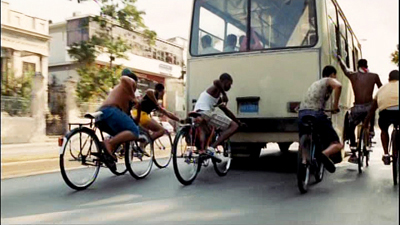
Their preparations, gathering the materials and supplies they need, take us through the poverty-stricken neighborhoods, with Elio’s shiftless friends catcalling at girls and joyriding on their bikes by clinging to buses. Raul visits a dealer to buy medicine for his AIDS-stricken mother, a gaunt former beauty still turning tricks to support herself.
The action escalates as Raul accidentally injures a tourist and Lila discovers that Elio is planning to leave her and go with Raul. Mulloy deliberately downplays the ending, flashing a dedication on the screen to give us the impression that the film is over. Almost as an afterthought mixed in with the beginning of the credits, she presents brief shots showing us of the fates of the characters, filmed from a distance and without Lila’s voiceover. The Variety reviewer found the ending abrupt and “somewhat inadequately foreshadowed,” yet it seemed appropriate to me, and indeed was one of the most original touches in the film.
The North American rights to Una Noche were picked up earlier this year by Sundance Selects after the film proved a hit at the Tribeca Film Festival, winning Best New Narrative Director, Best Cinematography, and Best Actors (shared between its two male leads). Ironically, two of the young lead actors used the Tribeca festival as an occasion to request asylum in the USA.
The Antipodes
There is something comforting about the fact that, after all the success of the Lord of the Rings trilogy and the prospect of a series of Avatar films being made there into the indefinite future, the New Zealand Film Commission is still funding the same sorts of low-budget genre movies that were made before the country became Middle-earth and Pandora. Robert Sarkies, veteran Kiwi director, has followed up his gripping, headline-based thriller Out of the Blue (20o6) with a return to Scarfies (1999) territory, albeit on a more grotesque level.
Two Little Boys (2012) is based on the old getting-rid-of-an-incriminating-corpse premise, with wimpy Nige (Bret Mackenzie, left) accidentally killing a Scandinavian sports star with his car. Despite a recent quarrel, Deano (Hamish Blake), his best friend from childhood, agrees to help him out and hatches more and more devious and grisly methods for disposing of the body–and later of Nige’s roommate, pudgy, clueless Maori roommate Gav, who adds a touch of sweetness with his persistent obliviousness to the pair’s fiendish doings.
It’s a feather-weight film, but one with many funny moments. It also shows off some parts of New Zealand seldom used in films, starting off in the southernmost and westernmost city, Invercargill, and the bleakly beautiful Catlins, on the southeast coast.
Europe
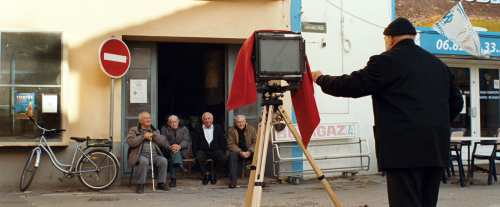
From the ridiculous to the sublime. Journal de France (2012) presents a sort of professional autobiography of the great French photographer and filmmaker Raymond Depardon. The framing situation is a journey through France that Depardon takes (supposedly alone, though there is someone there to film him), photographing landscapes and villages with his big view camera (bottom). There’s a charmingly chatty scene of him photographing four aged men who had posed for him in the same spot earlier (top).
Interspersed is footage from throughout Depardon’s career. This is presented in voiceover by co-director Claudine Nougaret, the filmmaker’s partner in private life and his long-time sound recordist. Much of this footage didn’t make it into the finished documentaries, including practice shots from when Depardon was learning the trade and amazing footage of many of the major events of the late twentieth century. Depardon travelled widely, often going into war-torn areas of Africa, such as Biafra in the late 1960s. His candid footage of people in the streets of Prague during its invasion by Russian tanks in 1968 is astonishing. Also memorable is a shot of Nelson Mandela quietly sitting in a chair. Depardon asked him to sit for a minute without speaking. Without a watch, Mandela timed it to the second. He learned the trick while in prison.
One comes away with a sense of not just a man with a keen eye and a great deal of patience. Depardon’s bravery and political conscience allowed him to leave behind a legacy of images with an immediacy that brings half-forgotten historical moments to vivid life.
Now I’m off to the Granville again, to see a Japanese film and then a South Korea one. David will blog about these in a future dispatch.
Two slumbering potential giants stirred in the last months of 1952, and as 1953 got underway the motion picture industry was faced with the greatest upheaval since sound films revolutionized the industry nearly 26 years ago.
Winfield Andrus, “3-D Finding Its Place,” The 1953 Film Daily Yearbook (New York 1953), 147.
Andrus was referring to 3D and to Cinerama, two technical marvels that promised to revive American filmgoing in the postwar era. In the short term, that didn’t happen. 3D died quickly, and Cinerama remained a novelty before expiring in 1962. But eventually 3D became viable, as the last decade has shown. Moreover, Cinerama’s impact was felt throughout the 1950s. Studios competed with it by introducing other widescreen formats, stereophonic sound, and extravagant roadshow productions. Cinerama, people are starting to point out, was a prototype of what Imax has become. Just as we’re now more interested in classic 3D (see my entry on the reissued Dial M for Murder), we ought to take another look at Cinerama in its more or less pure state.
Devoted aficionados like John Harvey of the New Neon Cinema in Dayton have kept Cinerama alive in theatres, and the challenge has been taken up by other venues. One of the most passionate advocates has been David Frohmaier, whose documentaryCinerama Adventure graced our Wisconsin Film Festival some years back. That documentary showed up on the 2008 DVD release of How the West Was Won, and it’s an essential, affectionate introduction to this most ungainly of film formats.
Now Frohmaier has brought us the 1952 film that started it all. This Is Cinerama has just been released by Flicker Alley, one of our most exacting and adventurous DVD publishers. The whole meticulous package–the film itself, presented in Frohmaier’s Smilebox display, along with an abundance of extras—offers a good chance to think about what Cinerama amounted to.
Cinerama had its ups and downs over a decade. Control of the technology and the venues shifted unpredictably, as did the revenues and profits. But I think that Cinerama’s unique accomplishment lies partly in its unintended consequences. Seeking to become the most realistic form of cinema yet known, Cinerama demonstrates how enjoyably un-realistic, even surrealistic, movies can be.
One hell of a demo
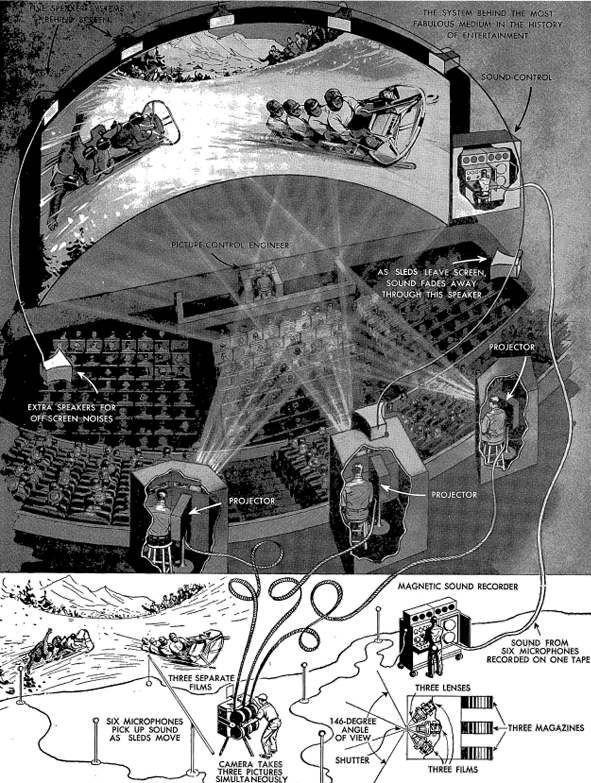
When This Is Cinerama opened at the Broadway Theatre in Manhattan on 30 September 1952, it presented itself as the ultimate package of new entertainment technologies. It was of course in color, which was still something of a rarity in motion pictures. It used stereophonic sound, with five speakers behind the screen and two in the auditorium. The screen itself was a wonder: it was seventy-five feet wide and about 23 feet high, bent in a 146-degree arc. That made the display span fifty feet. Later, some screens would be nearly a hundred feet long and over thirty feet high.
All who saw the film felt that this was an immersive experience. The goal, claimed Cinerama’s inventor Fred Waller, was to approximate what our eyes take in, including peripheral vision. Indeed, Waller claimed that our sense of depth in the world and an image depended on peripheral information. Anyone who has been in a wraparound theme-park attraction can attest to the fact that an image stretching to the edges of sight can provide a pretty compelling illusion, especially if the images carry us forward. You can undergo this illusion in Disney’s Circle-Vision 360°.
Cinerama’s colossal screen size and deep curve dictated a new approach to image-making. No standard 35mm frame could fill such a wide display without losing resolution. The scale of the show demanded three projectors, each trained on one-third of the screen. The image became a triptych, with thin overlaps or “blend lines” demarcating the panels. Naturally, all three had to be exactly aligned and kept in strict synchronization. If one film reel lost frames through a mishap, for future shows projectionists snipped the corresponding frames out of the other two reels.
The projectors were initially housed in separate booths, with a projectionist in charge of each. A fourth booth was given to the sound mixer (off to the right side in the above diagram), who oversaw the multiple track playback at each performance. Yet another staff member was in charge of monitoring the whole performance. Interestingly, the projectors were said to be placed level with the screen, in order to avoid any keystoning distortions of the display. But the diagram above, along with the Cinerama displays I’ve seen, position the projectors fairly high in the auditorium.
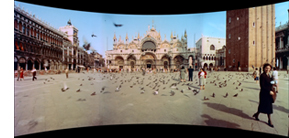
The image looked something like the still on the right. Even in this tiny image you can see slight differences between the panels and vignetting along the joins. Projectionists had to ensure that the three panels yielded comparable illumination and color temperature. Each projector’s gate had a little gadget known as a “jiggolo” that ran rapidly along the edges of the frame to blur the blend lines.
To gain resolution, each frame on the film strip used about twice the image area of conventional film. Surprisingly, the image area wasn’t much wider than normal film but it was 1 1/2 times the normal height (that is, 6 perforations high rather than the usual 4). To allow more frame space, the soundtrack was played on a separate magnetic film reel. The resulting images yielded very high resolution.
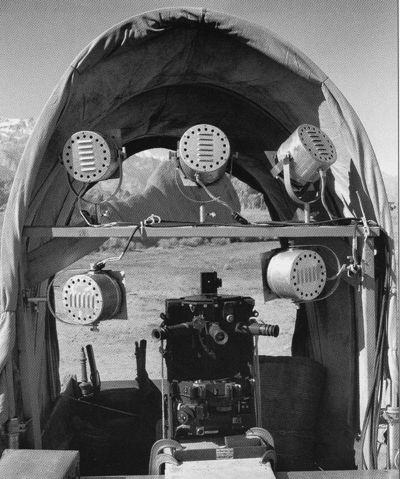
These sprawling images came from three cameras interlocked into a single bulky unit. The lenses were angled at 48 degrees to one another, turned inward to cross at a precise focal point. The camera lenses, all purpose-made, had a focal length of 27mm–another factor that would yield some striking pictorial effects. All three lenses shared a common shutter and had interlocked diaphragms to ensure comparable exposure. Because flicker would be disturbing on such a wide display, particularly on the edge panels, the film ran at 26 frames per second rather than the usual 24. The aspect ratio varied between 2.6:1 and 2.77:1.
This Is Cinerama was what we’d today call a demo. Lowell Thomas, one of the backers of the process, noted that if they’d told a story with actors, the emphasis would be taken off Cinerama itself, which was “a major event in the history of entertainment.” “The logical thing,” Thomas remarked, “was to make Cinerama the hero.”
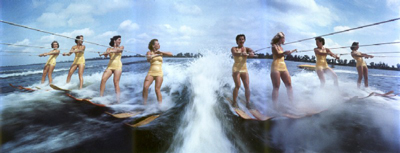
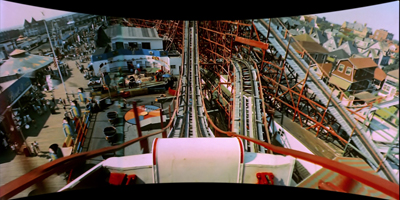
The result was a travelogue (a word Thomas hated). After Thomas’ prologue, the film proper opens with the famous ride on a plunging rollercoaster. Then come episodes devoted to the canals of Venice, some church choral music, Scottish pipers, Viennese boy choristers, Spanish dancers, and an excerpt from Aida performed at La Scala. During the intermission Thomas inserts another demo, this time of the surround-sound effects. (We have to remember that stereophonic sound was a big novelty at that point; stereo LPs came later.) The bulk of the second part is spent at the Cypress Gardens leisure park, providing images of handsome men and women at play and climaxing in some exciting water-skiing. This is sort of double product placement–not only promoting the park but also water skis, another Fred Waller invention. The film ends with an awe-inspiring flight crisscrossing America, from New York and the Pentagon to the Golden Gate Bridge, and back to the rugged terrain of the West and Southwest.
In an essay for Cahiers du cinéma, the late Chris Marker pointed out that the film amounts to a religious-popular spectacle. For all the globe-trotting of the first part, the last half is a paean to the splendor that is the postwar USA. The last word spoken, or rather sung, in the film is “America.” Indeed, as many have pointed out, the word Cinerama is an anagram for American. I’ve sometimes wondered about the logo, that peculiarly zigzagged string of letters. It suggests a crumpled snippet of film, with squarish frames like our vertical panels, and its bumpiness evokes the ups and downs of a roller coaster. But there’s no mistaking the logo’s recurring color scheme of red, white, and blue.
Party like it’s 1952
As a novelty, This Is Cinerama succeeded, running for over two years in New York. The system was installed in big-city theatres around the country. At a time when the average price of a movie ticket was $.46, the high-end seats for a Cinerama feature cost $2.80, or $24.34 in today’s currency. The Cinerama organization produced four more episodic travel-centered pictures: Cinerama Holiday (1955), The Seven Wonders of the World (1956), Search for Paradise (1957), and Cinerama South Sea Adventure (1958). Another picture made in a rival three-panel technology, Windjammer (1958), wound up in Cinerama venues as well. By 1957, Variety announced, the first three releases had grossed $60 million worldwide.
The problem was that on those grosses, profits came to only $6 million. Eighty percent of the box office take was used up in operation of the theatres.Morever, the complexity and cost of a Cinerama system meant that very few venues existed; by 1959, there were about twenty screens in the US and another eight or ten abroad, and not all were operating. In addition, overall US movie attendance was dropping, from about 47 million weekly in 1954 to 32 million in 1959.
New management succeeded in opening many more Cinerama theatres on a franchise basis, but the company needed fresh product as well. A coproduction deal was struck with MGM to use the process on fictional features. The results were The Wonderful World of the Brothers Grimm (1962) and How the West Was Won (London premiere, 1962; US release, 1963). To expand the audience, these films were also released in anamorphic widescreen to non-Cinerama venues.
Both films won large audiences, but they failed to make a profit. Soon the company’s theatres began exhibiting 70mm film releases under the Cinerama brand. The films were shown on curved screens, but with single-lens projection. The first of these releases was It’s a Mad, Mad, Mad, Mad World (1963); eventually even 2001: A Space Odyssey (1967) would be exhibited in “Cinerama.” In the course of these years, the company was acquired by Pacific Theatres, where it still resides. Classic triptych Cinerama was gone.
I never saw it in its prime.
I did see How the West in its original anamorphic release, and that has stayed with me for a couple of reasons. First, I was moved by it. It’s kitsch in many ways, but there are several exciting and touching scenes. Moreover, even as a squeaky-voiced teen I recognized something genuinely weird about the way it looked. Its imagery haunted me, though I didn’t have ways to understand them. Many years later, writing portions of a book that became The Classical Hollywood Cinema, I couldn’t watch any of the Cinerama travelogues in archives. I had to content myself with watching pink, cropped 16mm anamorphic copies of How the West Was Won. In all, it was very hard to get a sense of what the thing looked like (let alone sounded like).
Not until 2003 did I see both This Is Cinerama and How the West Was Won in the three-panel format, during a conference on widescreen cinema held at the National Media Museum in Bradford, England. That experience was wonderful, and it left me wanting to study the films more closely.
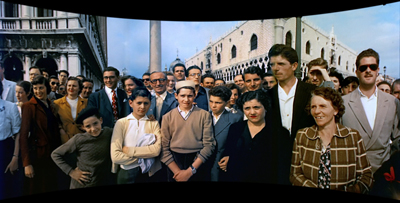
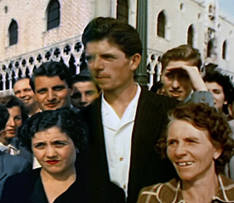
Now I can, and you can too. David Strohmaier has devised a transformation that captures the shape of a Cinerama projection. He calls it the Smilebox. The Flicker Alley DVD of This Is Cinerama is in Smilebox, as you see from my Venetian image above. Warner Bros’ 2008 Blu-ray release of How the West Was Won provides both a Smilebox version and a wider-than-CinemaScope letterbox version.
Through painstaking restoration by Greg Kimble and others, the films look clean and bright. Digital cleanup has regularized the color values from panel to panel and nearly eliminated the blend lines. The result conforms to what the makers would surely have preferred–a greater sense of uniform tonality, light, and space across the frame than surviving Cinerama images have.
For anybody interested in the history of American cinema, the Flicker Alley DVD is essential. It provides a long-missing chapter in the development of widescreen filmmaking. This Is Cinerama is a documentary that is also a document of postwar American pride, of film technology, and of the movie business. But I think it represents even more. For the most part neither Smilebox nor digital restoration has removed the peculiarities that, perhaps perversely, fascinate me about this unique format.
Nice big image you got here. Be a shame if anything happened to it.
Cinerama camera in a mock covered wagon for How the West Was Won.
Like any picture-making process, Cinerama captures the three-dimensional world on a two-dimensional surface. Unusually in the history of cinema, it does it with a semicircular array of cameras. The images from those cameras are projected on a corresponding semicircular surface, in the hope that they will simulate not only the spatial layout in front of those three lenses but also the way the world looks to us.
Fred Waller thought that his invention provided greater realism, because our vision subtends a horizontal arc wider than that of conventional camera lenses. Fred fell a few degrees short, though. Claiming that we take in about 160 degrees, he thought that 146 degrees was a good approximation, but our visual field is actually a bit wider than 180 degrees. (Without turning our head, we can roll our eyes.) More important, though, is the assumption that a faithful image of the world should try to capture the curvature of the image as it passes through the cornea to the retina. We see a bowed world, many have claimed, so our pictures should present the way things look.
Yet there’s a difference between visual sensation and visual perception. Even if the light from the world hits our photoreceptors in a partial or distorted way, what we see is regular and unified. On our retinas, near things loom large and distant things look tiny, but we’ve evolved to adjust to the distortions in early stages of vision and see things in normal size. A person ten feet away is twice as large on our retina as somebody twenty feet off, but that’s not the way they look. We don’t see our retinal image, any more than we see the wildly misshapen image of the world projected to brain areas. The eye is a part of the brain, and the brain reworks the stimulus–cleans it, enhances it, corrects it, straightens it out, and gives it a stability that isn’t there in the raw input.
For the most part, normal camera lenses approximate the way the world looks to us after our brain has processed visual signals. Most images show straight-edged walls and sidewalks, railroad tracks meeting at the horizon, proportional human beings. When Cinerama or other nonstandard image-making technologies present distortions to our eyes, we take them for what they are: not “what we really see” but rather pictorial displays creating distinct effects of their own.
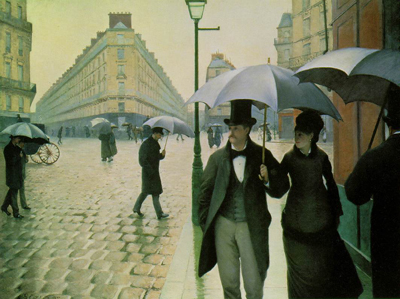
Hence the irregular appeals of Cinerama. Suppose we’re not interested in seeing the world as it registers on our sensory system. Suppose we’re interested in exploring uncommon pictorial effects. If we suppose all that, we can have the sort of fun watching Cinerama that we get from this 1877 picture by Caillebotte (Paris Street, Rainy Day), a virtuoso reworking of geometric space.
Take image sharpness. In the 2003 Bradford shows, I was overwhelmed by just how precisely distant objects registered. This was partly due to the greater resolution of a bigger image area, partly to the use of wide-angle lenses with breathtaking depth of field in brilliant sunlight. I can’t illustrate some of the most dazzling effects here, including the sight of a very distant bathing beauty racing through a crowd and up to the foreground in the Cypress Garden sequence of This Is Cinerama. But if you have a large home theatre monitor or projected display, you might be able to spot her. Here I’ll just mention how the farthest stretches of the famous roller-coaster stand out crisply, and in big-screen projection, the people in the far distance do too.
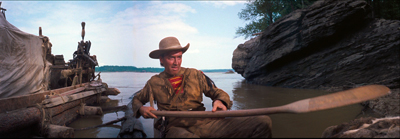
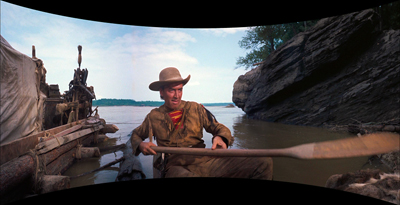
Such short-focal-length lenses distort the visual field in predictable ways. For one thing, they make horizontal lines bow upward or downward. For this reason, Cinerama DPs were at pains to keep the horizon near the center of the shot and to avoid or cover contours parallel to the horizon. Linus Rawling’s canoe oar bends disconcertingly in the central panel even before it hits the blend line and shoots off on its own.
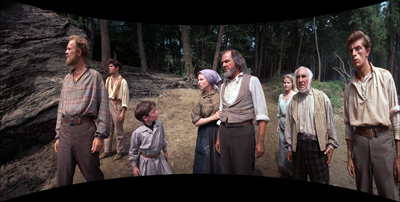
Verticals can get distorted as well. On the edges of each panel, human figures can look bulged, pinched, or oddly torqued.
Cinerama’s triptych format complicates perspective effects by welding three wide-angle images together. When presenting built environments, often each panel displays its own distinct vanishing point–sometimes central, sometimes angular, sometimes both. The results recall the Caillebotte picture, all acute angles and avenues flung out to left and right.
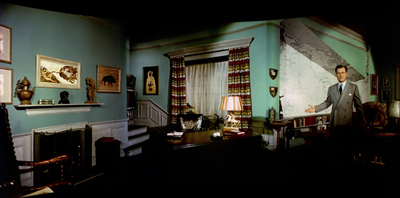
One cinematographer tells us that “special sets had to be built with curves and bends to rectify the false perspective inherent in three-camera systems.” But often we get contorted interiors. Dr. Caligari might feel at home in Lowell Thomas’ office.
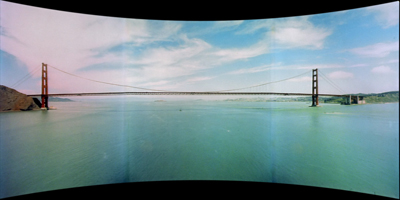
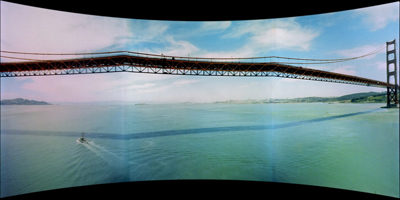
The blend lines add their own constraints. From a distance, the Golden Gate looks very planar, but as our plane swoops nearer, the horizon remains flat while the bridge develops a couple of kinks.
For staged action, veteran cinematographer William Daniels warned that “We invariably consider the blend lines first, then plot and stage the action to suit the camera setup.” Most obviously, directors had to keep people away from the panel joins. We can see the unfortunate result in this image from This Is Cinerama. The gent on the far right is at once pinched and bulged, and the building in the B and C panels gets the Caillebotte treatment. Worse, a young Venetian man’s head on the blend line undergoes an unfortunate warping.
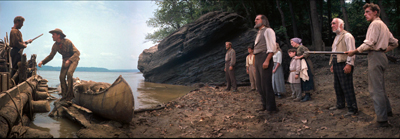
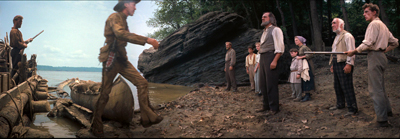
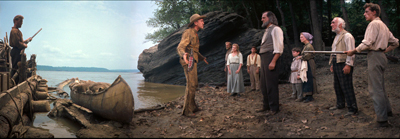
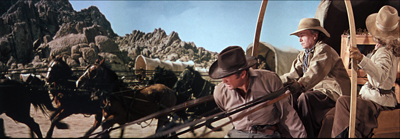
When a figure moves from panel to panel, the wide-angle distortions combine with the panel edges to create a faceted, almost cubistic space. Here’s the first anomaly I spotted when watching How the West Was Won as a kid in 1963.
As Linus is walking toward Mr. Prescott, James Stewart seems to stride diagonally forward a bit (in the A panel). After he pivots, he grows very large as he starts to walk straight (the B panel). , then stride diagonally into depth (the third panel). Each wide-angle lens makes people swell or shrink as they come to or from the camera, and with the creases supplied by the blend lines, scenes like this become attractively odd. With the panels ironed out, we see people taking strangely roundabout paths to one another.
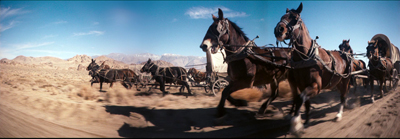
The effect is even more noticeable in big action scenes, when horizontal movements that are really parallel seem to peel off from one another. During the Indian chase, the wagons are fleeing alongside one another, as a back-projection shows. But the more dynamic angle on the wagon teams creates an image that hits you like a cold shower.
To the audience in front of a curved screen, the movement in the second shot would have looked somewhat (but not entirely, I think) more linear. For us, we see a perspective we’ve never seen before, with wagons diverging from one another but neither getting smaller or larger. And how about the dizzy swerve that the pathway in panel C takes when it reappears in panel A?
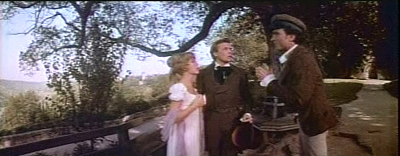
The angled-triptych format obliged actors to adjust their performances in counterintuitive ways. “An actor in a side panel,” wrote Daniels, “cannot look directly at one in the center panel when speaking to him, but must cheat a little–direct his eyes a little behind the one in the center.” Here’s an example from The Wonderful World of the Brothers Grimm that stands out when seen in the flat format. Wilhelm is speaking to Greta from the C panel, but it seems that Laurence Harvey didn’t cheat his body quite enough. He seems to be speaking past her, an effect not helped by the disproportionate size of his body.
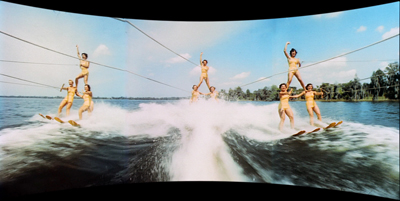
This Is Cinerama is obsessed with centering its action, but sometimes the center seems strangely off-kilter. With the water-skiing women shown earlier, the three cameras create a sort of hollow viewing station. Why do the flanking skiiers seem to be moving at angles to the central trio? Why do the ropes of the central skiiers fly off (jaggedly) to one side, rather than expand directly towards us, like train tracks?
As with the wagon teams, you have to imagine diagonal actions as rotated inward to parallel one another during projection. What you see is not what you’d get in the theatre. But also, what you see is something you’ve never seen in a movie before.
Most of these effects are heightened by the inability of the three-eyed monster to record close-ups. Because of the short focal length, the camera unit sat very near the actors: for a shot from the waist up, the central lens was between one-and-a-half and three feet away. Putting the camera so close necessitated lights being attached to the camera unit. But normally close-ups were avoided, so the human figures never dominate their locales. These movies are, more than most, about space–however buckled and bizarre that space might be.
Because of the panels, panning shots were to be avoided, but certain kinds of camera movement forward were welcomed. The signature Cinerama shot is the shot plunging toward the vanishing point–a boat rushing through the water, an aerial view banking toward the horizon. Even though the blend lines made shapes and edges wrinkle, this gigantic, embracing image streaming toward viewers gave a compelling illusion that they were hurtling forward.
The distortions are less visible from a perfect vantage point in a Cinerama auditorium–presumably, as close as you can get. Distortions on the display edges would be minimized by peripheral vision, which isn’t good at registering detail. Presumably some of the curvilinear shapes, like Linus’ oar, and those kinks across the blend lines, would be less egregious if viewed straight on. Watching from the front row in Bradford, I recall seeing these distortions, but they didn’t seem as vivid.
Naturally, not everybody in the auditorium has a perfect vantage point. In the original screenings, people who had sat on the sides complained that movement on the nearest flanking panel seemed to flow upward. Smilebox, which respects the overall geometry of the display, still yields disparities. Linus’ oar still curves, though not as pronouncedly.
My images here, and yours on your home screen, are unavoidably mapping a curved display onto a flat surface, so there will still be anomalies. If you want to try cutting down on them, sit close to the Smilebox display. I prefer to sit back and enjoy their weirdness.
They’re features, not bugs
What about the films themselves? Arguably no great film was made in the format, but all the releases probably have some admirers. I want to end by talking about the two I find most appealing.
Cinerama’s travelogues were episodic, designed to show off features of the process in different filming situations. The two fiction features had to highlight the process and tell a coherent, engaging story. They too tend toward the episodic, but they handle that option in different ways. And stylistically, both work against the official “rules” of the new format.
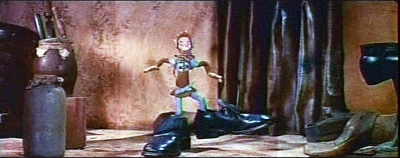
The Wonderful World of the Brothers Grimm, an entertaining family film, employs a frame story. The brothers are assigned to write the family history of the local Duke. Jacob, an expert linguist, does his job dutifully, but Wilhelm plays hooky to find and write up fairy tales he hears. His zeal to collect stories leads to the loss of their commissioned manuscript, and he falls ill, during which several fairy-tale characters come to visit him. Eventually Jacob is honored by the Royal Academy, but it’s Wilhelm who gets enduring glory by being swarmed over by hordes of children anxious to hear his latest tale. Within this overarching plot, three of the stories are enacted using various special effects, including puppet animation. Some of these shots appear to have been shot in a non-Cinerama format and “paneled” afterward.)
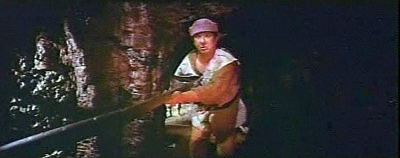
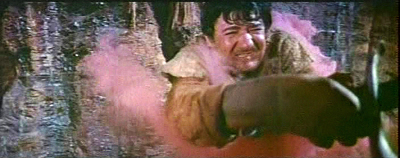
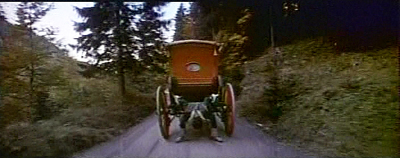
It’s tempting to ascribe the frame story’s direction to Hollywood veteran Henry Levin and the embedded fantasies to co-director George Pal. To the connoisseur of Cinerama, those fantasy passages offer some delights. If anybody told Pal about the rules for shooting in the format, he ignored them. The fairy tales give us whirling camera movements, bumpy subjective shots, and frequent assaults on the audience in the manner of 3D. During a wild coach ride, the coachman hurls himself to and from the camera. Later, a knight’s bumbling servant slays a dragon in lunging close-up.
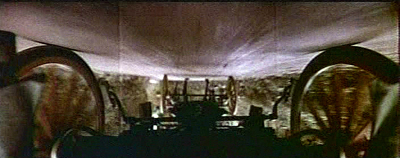
You can even take certain passages as sly parodies of the brand. The Woodsman in the first tale has hitched a ride on the back of the coach, and he stoops to look underneath. Cut to his point-of-view: an upside-down version of a signature Cinerama shot.
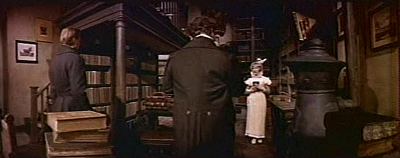
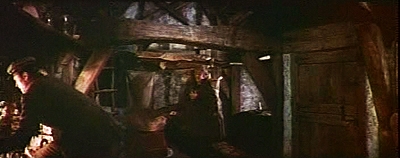
Whoever directed the frame story scenes, however, was fairly bold too, moving his actors in zigzag patterns more flamboyant than the blocking of How the West Was Won. And instead of the small, high sets recommended for the format, Wonderful World shoots in throne rooms and palace salons that seem to stretch on forever. In smaller sets, like the brothers’ cottage, their friend’s bookshop, and especially the lair of a witch, the compositions take advantage of crannies and oddly angled planes that enhance the exaggerated distances.
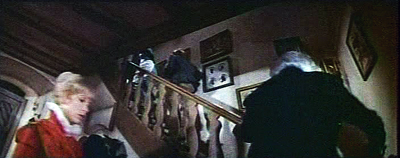
As in German Expressionist cinema, the distortions seem to suit an atmosphere of fantasy. There’s even a massive violation of one of the basic rules of Cinerama: avoid tilting the camera. High and low angles were likely to exaggerate any distortions in the panels. Yet Levin, or Pal, or both occasionally throw in expressive angles, most strikingly a low angle showing Wilhelm’s family and friends ascending to his sickroom.
The Wonderful World of the Brothers Grimm solves the problem of the episode film by giving us a frame story. How the West Was Won solves it by a more threaded structure. A family saga creates branching stories that show three generations of kin participating in the winning of the frontier. The story acknowledges, briefly, the conquest of indigenous peoples–the “liberal Westerns” of the 1950s haven’t been ignored–but slavery doesn’t play a significant role. This is a story of white people.
The Prescott clan sets out on the Erie Canal, but on the rivers all but two of them lose their lives. The warm, slightly romantic Eve settles with the trapper Linus Rawlings on a farm in Ohio, while her sister Lilith ventures west. Eve’s son Zeb joins the Union forces in Civil War and later moves west with the railroad, eventually becoming a marshall. Lilith joins a wagon train, takes up with a gambler, inherits a worthless mine in California, and reunites with her lover on a riverboat. They become entrepreneurs investing in the railroad system. Near the end of the century, Lilith loses her fortune and joins Zeb, now retired, and his wife and children. But before they can settle down on Lilith’s inherited Arizona ranch, Zeb has to settle a score with a bandit who intends to rob a train. The film falls into sections specified in the credits–The Rivers, The Plains, and so on–but not in the film, though the parts usually end with fades.
Marker might note that How the West Was Won revives the piety and chauvinism on display in This Is Cinerama. The Prescott women found a kind of holy family, bound, as one song puts it, “for the Promised Land.” Some writers thumb through the phone book to get names for their characters, but screenwriter James R. Webb seems to have favored the Old Testament. Eve, living up to the positive side of her name, becomes the first woman of the new land. In forcing Linus to become a farmer, she helps turn the wilderness into a garden. Lilith, whose name associates her with sexuality and demonic possession, becomes a dance-hall girl and eventually a millionairess, but she has no children. At the end she returns to her nephew, Zebulon, named for her father; in the Old Testament he is the founder of a tribe. And Zeb has named his daughter Eve. The family abides in an endless cycle, its members replacing one another and its history intertwined with the full flowering of the United States.
The film ends with the sort of God’s-eye views that conclude This Is Cinerama, but emphasizing the modern West, with its dams, roads, cities, even whorls of traffic. Interestingly, in the place of the forward rush of the earlier film, these aerial shots pull us backward, the classic mark of the end of a story. But the finale of the epilogue carries us forward once more, under the Golden Gate Bridge and into a sunburst over the Pacific. Since women have played a central role, no surprise that the final lyrics of the choral accompaniment celebrate heroes as “every mother’s son.” This country has reached its natural limit; beyond is heaven, and the chorus tells us, here at last is the Promised Land.
Most scenes are handled briskly, but with little nuance beyond what the actors bring to the story. The spectacle remains appealing, the music infectious, and the imagery always impressive–especially when it’s a little whacked out, as in my examples above and many other scenes of the film. Like The Wonderful World of the Brothers Grimm, this has shown that Cinerama can be edited rapidly. This Is Cinerama has only a little more than two hundred shots, but Wonderful World has a thousand, and How the West Was Won has over eleven hundred. The chapters of the latter yield some striking results: most average between eight and nine seconds, but John Ford’s Civil War segment averages nearly fifteen seconds, while the climactic Outlaws segment averages about five seconds.
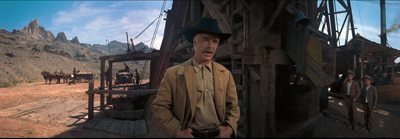
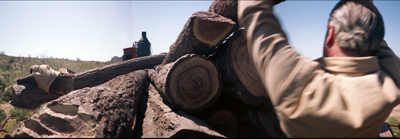
That climactic sequence, directed like most of the film, by Henry Hathaway, makes splendid and varied use of the format. Despite a heavy reliance on back projection and several shots that seem not to have been made in the three-camera process, this monumental remake of The Great Train Robbery is a showcase for how Cinerama could create exciting action through staging and editing. To the advantages of Cinerama–forward drive, looming landscapes, and immersive sound–Hathaway and editor Harold Kress add percussive cuts of logs sliding this way and that, along with painful stunts, including one showing a man flung off a train and into a cactus.
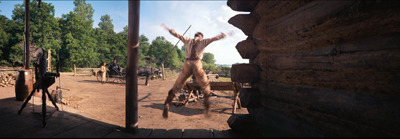
By contrast, the Civil War sequence shows how a director can triumph over an inflexible format by relying on expressive stasis. Ford the pictorialist will carve striking compositions out of the constraints of Cinerama. He exploits the depth of the 27mm lenses, sometimes stationing all his figures in the central zone, as if he’s trying to preserve the 1.37 aspect ratio. At other moments he confines the action to a single flanking panel.
Sometimes Ford simply ignores the triptych format in order to split the frame in half or, say, two-fifths. He also gives his actors postures, props, and gestures that allow them to underplay. With Ford, even fresh-minted junior stars like Carroll Baker and George Peppard can give performances of gravity.
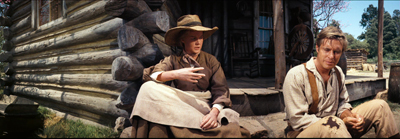
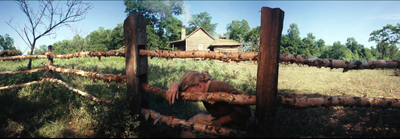
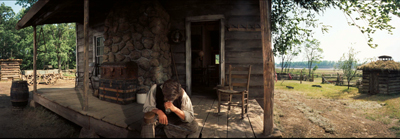
Ford’s creative choices stand out most strongly in two scenes set on the farm. In the first, Linus Rawlings has gone off to battle, and his son Zeb is itching to follow. Eve, now old, accepts with weary sadness that he will have his way. There’s a Griffithian two shot of Eve and Zeb on the porch, her arms dangling wearily and her right hand rising and falling as she asks Zeb about whether he’ll get a uniform. The hell with Cinerama, Pappy seems to say: Just fill up half the frame with the cabin to keep us fastened on the couple.
After a quick embrace, Eve dashes into the house. A porch shot that is virtually a Fordian doorway framing shows Zeb leaping with joy before he turns, sees something in the house, and halts in his tracks. Ford needn’t show us Eve’s grief. This is the most tactful shot in the whole film.
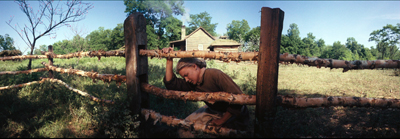
Soon enough Ford will recall this scene. Zeb has left for the war. Eve, kneeling at the family plot, prays to her father before slipping behind the rail. Her face is hidden, but her hands again express her resignation, and prefigure her death. She was never the same, her other son will say, after Zeb left.
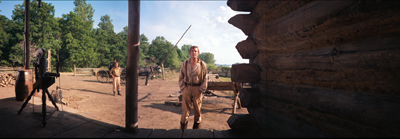
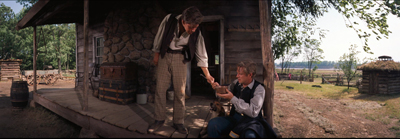
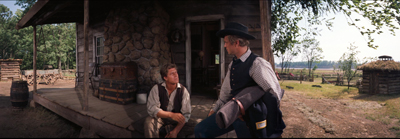
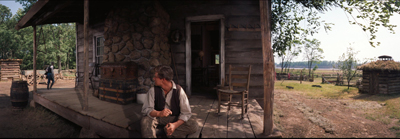
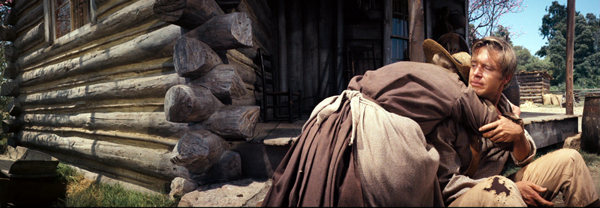
These homestead passages are echoed by a scene at the end of the Civil War segment. Back from the war, Zeb learns of his mother’s death from his brother Jeremiah. The two sit on the porch sharing a dipper of water and recalling their father. Zeb rises to go, they shake hands, and we get another muted Fordian moment. Why move your actors when you can pose them?
Now the old director, a master of depth since the 1910s, bends this newfangled format to his own ends. Zeb leaves the frame, comes back in the far distance, and is finally blocked by the farmhouse, leaving Jeremiah quietly weeping.
That’s how you handle this busy, noisy new contraption, Ford seems to say. Dwell on moments of stillness and pathos. Use handshakes, embraces, a drooping black shawl. Keep the action in a well-defined zone. And treat this as a silent movie.
The most comprehensive account of Cinerama’s development is Thomas Erffmaier’s 1985 Northwestern Ph. D. thesis, The History of Cinerama: A Study of Technological Innovation and Industrial Management. Also invaluable are John Belton’s Widescreen Cinema (Harvard University Press, 1992) and Robert E. Carr and R. M. Hayes’ Wide Screen Movies (McFarland, 1988), usefully supplemented by Daniel J. Sherlock’s emendations here. A good older work is Michael Z. Wysotsky, Wide-Screen Cinema and Stereophonic Sound (Focal Press, 1971). Sheldon Hall and Steve Neale put This Is Cinerama into the context of postwar blockbusters in Epics, Spectacles, and Blockbusters: A Hollywood History (Wayne State University Press, 2010), Chapter 7. On the Web, restorer and cinematographer Greg Kimble provides a thorough and well-illustrated account of Cinerama at In 70mm.
Chris Marker’s “Le Cinérama” appeared in Cahiers du cinéma no. 27 (October 1953): 34-37.
Cinerama grew out of Fred Waller’s experiments with gunnery-training displays during World War II, as Strohmaier documents in Cinerama Adventure. Waller discusses this work in “Cinerama Goes to War,” New Screen Techniques, ed. Martin Quigley, jr. (Quigley, 1953), 119-126. This collection includes other pieces of value on Cinerama, 3D, CinemaScope, and other new technologies. It would be interesting to know if Waller’s efforts influenced, or were influenced by, psychologist J. J. Gibson’s comparable wartime experiments with aerial training films. Gibson’s ideas about how we grasp space through “optical flow” and centered perspective have obvious parallels with the Cinerama process. Waller was said to have been influenced by another psychologist, Adelbert Ames, Jr., one of the founders of 1950s “New Look” psychology. Waller’s belief that our peripheral vision was more important than stereopsis in determining depth echoes Ames’ hypothesis that convergence and binocular disparity were overrated as depth cues.
Greg Kimble provides a thorough overview of the making of How the West Was Won in a 1983 article for American Cinematographer, available here. I’ve drawn as well on William Daniels’ article “Cinerama Goes Dramatic,” American Cinematographer 43, 1 (January 1962): 28-29, 50-54. Also useful was Darrin Scott, “Panavision’s Progress,” American Cinematographer 41, 5 (May 1960): 302, 304, 320-322, 324. My quotation about readjusted sets comes from Scott’s piece.
Simultaneously with This Is Cinerama, Flicker Alley has published a lavish Smilebox version of Windjammer, also prepared by David Strohmaier. That’s a whole other story.
P.S. 5 October: You never can tell. Jim Emerson forwards me this Indiewire report by Len Maltin on a new short made in three-panel Cinerama.