David Bordwell's website on cinema   click for CV

Home

Blog

Books

Perplexing Plots: Popular Storytelling and the Poetics of Murder

On the History of Film Style pdf online

Reinventing Hollywood: How 1940s Filmmakers Changed Movie Storytelling

Film Art: An Introduction

Christopher Nolan: A Labyrinth of Linkages pdf online

Pandora’s Digital Box: Films, Files, and the Future of Movies pdf online

Planet Hong Kong, second edition pdf online

The Way Hollywood Tells It pdf online

Poetics of Cinema pdf online

Figures Traced In Light

Ozu and the Poetics of Cinema pdf online

Exporting Entertainment: America in the World Film Market 1907–1934 pdf online

Video

Hou Hsiao-hsien: A new video lecture!

CinemaScope: The Modern Miracle You See Without Glasses

How Motion Pictures Became the Movies

Constructive editing in Pickpocket: A video essay

Essays

Rex Stout: Logomachizing

Lessons with Bazin: Six Paths to a Poetics

A Celestial Cinémathèque? or, Film Archives and Me: A Semi-Personal History

Shklovsky and His “Monument to a Scientific Error”

Murder Culture: Adventures in 1940s Suspense

The Viewer’s Share: Models of Mind in Explaining Film

Common Sense + Film Theory = Common-Sense Film Theory?

Mad Detective: Doubling Down

The Classical Hollywood Cinema Twenty-Five Years Along

Nordisk and the Tableau Aesthetic

William Cameron Menzies: One Forceful, Impressive Idea

Another Shaw Production: Anamorphic Adventures in Hong Kong

Paolo Gioli’s Vertical Cinema

(Re)Discovering Charles Dekeukeleire

Doing Film History

The Hook: Scene Transitions in Classical Cinema

Anatomy of the Action Picture

Hearing Voices

Preface, Croatian edition, On the History of Film Style

Slavoj Žižek: Say Anything

Film and the Historical Return

Studying Cinema

Articles

Book Reports

Observations on film art

You and me and every frog we know

Sunday | September 20, 2015

Frog tv 500

Frog TV (2014, N. Joe Myers).

DB here:

Be patient, the frogs are coming. But first, a bit of film theory.


Movies in code

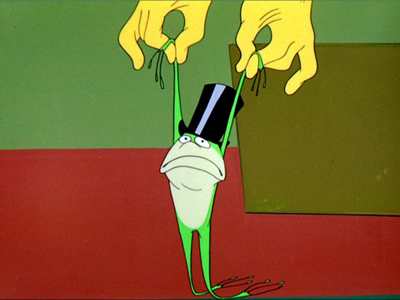
Froggy 1 400

Once many film scholars were captivated by the idea that our responses to a movie were coded, we might say, all the way down.

Here, code means something like a way of assigning meaning that is both arbitrary and relative to time and place. The code is arbitrary in that it might just as easily have been otherwise. A code is relative because in different circumstances it might vary.

One prototype for the early semiologists was the code regulating traffic. In a traffic light, there is no natural or necessary connection between green and “Go!” or red and “Stop!” We’ve just agreed on these meanings. We could have assigned red to “Go!” and green to “Stop!” And indeed other cultures might do just that. A gesture may mean something friendly in one culture and something naughty in another.

The presumption is that because a code is both arbitrary and relative, it has to be learned. You need to live in a culture to understand the traffic code and the code of gestures. Through either observation or training (such as learning the codes of written language) you master the codes of your culture.

Clearly, movies include many codes. A film can show us traffic lights or hand gestures. Films include language as well, which is coded to a high degree. The crucial question is: How much in our responses to film is coded?

Almost everything, some said. There was a wing of semiology ca. 1970 that suggested that both what’s represented in film and the ways things are represented are arbitrary and culturally variable in the extreme. Some theorists suggested that just recognizing an object in a shot relies not on natural perception but rather on a code. Indeed, the argument was made that “natural” perception is itself coded. A favorite corollary of this was that language was such a powerful code that it reshaped perception. Put bluntly, if your culture’s language doesn’t distinguish red from green, you won’t see the traffic light’s top and bottom lamps as different colors.


I resemble that remark; or do I?

Froggy 2 400

Surely, somebody will say, many film images resemble the things they portray. A shot of a man and a woman looks, in certain relevant respects, like a man and a woman. We’re able to recognize them as such. Yet 70s semiology held that there was nothing natural about this. The image-object resemblance, often called “analogy,” and “iconicity,” was considered to be coded.

Here, for instance, is Umberto Eco in 1967:

We know that it is necessary to be trained to recognize the photographic image. . . . Even if there is a causal link with the real phenomena, the graphic images formed can be considered as wholly arbitrary.

Christian Metz brings out the cultural variability of recognition in a 1970 essay:

The apprehension of a resemblance implies an entire construction whose modalities vary notably down through history, or from one society to another. In this sense the analogy is, itself, codified.

Here is Dudley Andrew commenting on this line of thought in 1984:

The discovery that resemblance is coded and therefore learned was a tremendous and hard-won victory for semiotics over those upholding a notion of naive perception in cinema.

The semiological tradition pointed out, correctly I believe, that the parallel between the image and the thing it represents lies not in some relation between the two but in the comparable ways in which we understand each one. But can this process be considered both arbitrary and relative?

Can we, for instance, imagine a culture in which recognition was fundamentally arbitrary—where a picture of a bunch of bananas depicts, by cultural fiat, a clutch of cherries? More exactly, where a picture of a bunch of bananas is seen as a clutch of cherries?

We can imagine a very capricious filmmaker who set up a code with an introductory credit:

Every time I show you a shot of bananas, see cherries.

But you couldn’t see cherries. At best, the result would involve imagination, not perception. Even cooperative spectators would recognize the bananas as bananas, though they would go on to think of cherries.

The distinction between perception and thought seems to have been blurred in semiological theory. Perhaps the 70s arguments traded on the various meanings of “perception”, such as “I perceive that he’s unhappy today” or “I want to change your perception of Rosicrucianism.” The same would go for various senses of “recognition”: “I recognize the father’s face in the son,” “He had aged so much I didn’t recognize him.” These senses of the word bring in matters of conception and attitude, not just visual input.


Perception and evolution

Froggy 3 400

Not that perception is easy to define. When the semiologists were writing, they may have been influenced by psychological theories that assigned a big role to concepts in perception—“top-down” models that claimed perception to be “cognitively penetrable.” It’s fair to say that there’s now good evidence that the perceptual activities involved in visual recognition are largely fast, automatic, fairly dumb, and cognitively impenetrable.

Another error, it seems to me, was also the product of the period: the ignoral of evolution. The 1970s advocates of sociobiology seem to have been simply ignored, perhaps because they seemed to be naïvely attempting to see culture as nature. Yet I think that J. J. Gibson was right (also in the 1970s) in proposing that evolutionary theories could help explain why perceptual recognition is so swift and efficient.

Creatures evolved in an environment that selected for accurate perception, including very very very fast recognition of predators, prey, and mates. Evolution, we might say, provided long-term survival training in recognition, weeding out any creatures who didn’t register salient features of their world. A hominid who needed explicit teaching to recognize a tiger wouldn’t last as long as one who came to the task with senses pre-tuned. As with learning spoken language, all that would be needed is some exposure to the regularities of the ancestral environment. The baby born into our world is bombarded with redundant information that is non-arbitrary and non-relative; she quickly grasps that a face is more informative than a knee. It will take her quite a bit more time, along with some tutelage, to learn traffic signals and even more to learn to read.

Cinema taps some of our most fundamental capacities. Film images aren’t reality, but they present certain salient triggers for us to recognize what they represent. Indeed, the very perception of motion in movies is an illusion—a glitch in our visual system that cannot be arbitrary or culturally relative. Nobody in any time or place sees movies for what they are, a succession of still images. There are enough cues for movement to fool everybody’s visual system. And films preserve enough other features of the world to trigger automatic recognition processes. Perceptual recognition of something in the image is on the whole neither arbitrary nor culturally variable.

The likeliest conclusion is that we share with other creatures some native propensities which, given the right early exposure to the physical and social world, will be exercised in comparable ways. Of course there are differences. Minnows can’t enjoy Matisse, and we can’t smell as well as dogs can. Still, sensory systems overlap among many species.

So consider the frogs of the field: they toil not, neither do they spin.


Frogs like the front row too

We know quite a bit about how frogs see the world. A classic paper in animal neurology, “What the Frog’s Eye Tells the Frog’s Brain,” was crucial in suggesting the highly specialized nature of nerve fibers feeding information to the visual system. Those data streams—about edges, movement, and variable illumination—get reintegrated, but not necessarily thanks to high-level mental activity. “Early vision,” in frogs and in us, involves not some some brainy entity interpreting the image on the retina but rather several specialized, quite stupid systems that pool information before thought ever enters the picture. No codes necessary. What came to be called “distributed processing” does a large share of the job.

Though untrained in the codes of our culture, these frogs appear to recognize what matters to them, even on the mini-movie screen. (Sorry the video embed no longer works.)

If pigeons can quickly learn to interpret human faces in pictures, and female jumping spiders react to video images of males as if they were real, we shouldn’t be surprised that frogs can respond very—ah—actively on first exposure to movies showing things they really care about.


Of course a lot of our activity isn’t as data-driven and mandatory as recognition. Higher-level concepts do all sorts of work when we watch movies, from understanding who the protagonist is to grasping a film’s theme or point. And of course all manner of conventions in films require sophisticated cultural knowledge. My point is just that some aspects of our response are very basic. I hazard that our responses to cinema mix together all kinds of skills, abilities, biases, and proclivities. A movie is a package of appeals, a buffet with something for all our visual and auditory appetites.


First, thanks must go to N. Joe Myers, who posted this neat experiment in natural perception a year ago. (Has the filmmaker tried it with an iPad or a computer monitor that would make the worms look huge? Would that induce large-scale frog panic?) For vastly more frog-related information, go to N. Joe’s page here.

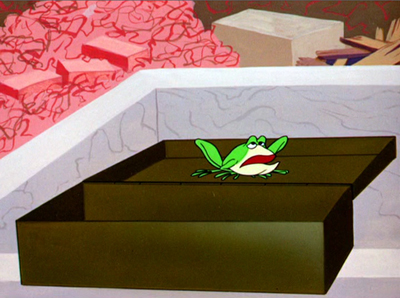
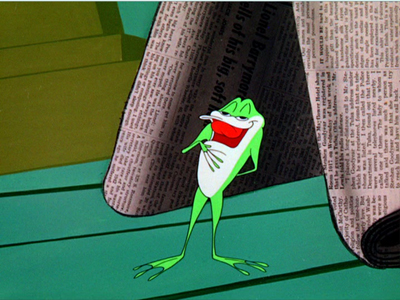
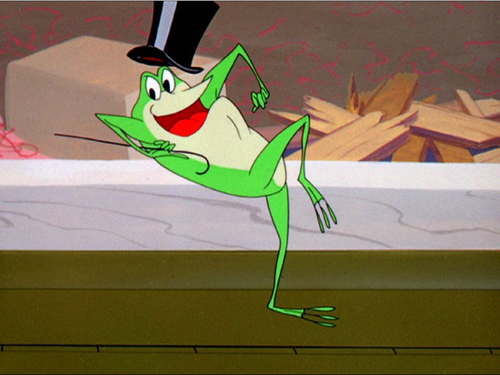
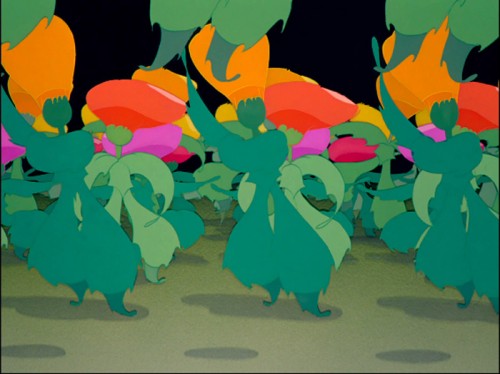
Thanks also to Darlene Bordwell, who called the piece to my attention, and Barb Anderson who pointed me to the spider studies. The illustrations are of course from Chuck Jones’ Warner Bros. cartoon One Froggy Evening (1955).

My quotations are from Umberto Eco, “Articulations of the Cinematic Code,” and Christian Metz, “On the Notion of Cinematographic Language,” both in in Movies and Methods, ed. Bill Nichols (University of California Press, 1976), 594 and 584; and Dudley Andrew, Concepts in Film Theory (Oxford University Press, 1984), 25. See also Metz, “Au-delà de l’analogie, l’image (1969),” Essais sur la signification au cinéma, vol. II (Klincksieck, 1972): “Resemblance itself is codified, because it makes appeal to a judgment of resemblance: the judgment of an image’s degree of resemblance will vary according to the time and place” (154).

J. J. Gibson’s writings mounted a strong case for what he called “direct perception” in The Ecological Approach to Visual Perception (Houghton Mifflin, 1979). His ideas were developed by Claire F. Michaels and Claudia Carello in Direct Perception (Prentice-Hall, 1981) and, more critically, by James Cutting in Perception with an Eye for Motion (MIT Press, 1986); pdf. Joseph Anderson’s The Reality of Illusion: An Ecological Approach to Cognitive Film Theory (University of Southern Illinois Press, 1998) is the trailblazing application of Gibson’s ideas to cinema. More generally, Paul Messaris’ Visual Literacy: Image, Mind and Reality (Westview, 1994) reviews the empirical findings that show virtually no cultural variability in perceiving line drawings and photographic images as depictions of recognizable persons, places, and things.

At some point in discussions of the cultural variability of perception, someone is likely to mention Eskimo cultures’ purported range of words for snow. But this is a long-standing error. See Geoffrey K. Pullum’s The Great Eskimo Vocabulary Hoax and Other Irreverent Essays on the Study of Language (University of Chicago Press, 1991) and John H. McWhorter’s The Language Hoax: Why the World Looks the Same in Any Language (Oxford, 2014).

What happened to these 1970s beliefs about the film image’s coded nature? It seems to me that when semiology as a research perspective waned, academics mostly stopped talking about the issue of resemblance and recognition. Researchers retained a general sense that films are coded, but they concentrated on less controversial conventions, like social stereotyping, representations of power, and so on. I’ve been told that the level of perception is merely a matter of “physiology” (wrong word) and thus of no consequence for the important issues that scholars should be studying. But of course filmmakers shape our response chiefly by controlling our perception, and if we want a comprehensive account of how films work and work on us, we can’t ignore this level of the viewer’s activity. I consider this problem in the title essay of Poetics of Cinema.

For a more developed argument about how films bundle a range of appeals, from sensory triggors to high-level concepts, see my essay, “Convention, Construction, and Cinematic Vision” in Poetics of Cinema. Online, I discuss these matters here and here and here (under “Representational Relativism,” which involves not frogs but our ancient ancestors).

P.S. 21 September 2015: Apes appear to remember episodes after watching movies. Thanks to Bill Evans.

Froggy 4 500

One Froggy Evening.

Vertov, sound technology, and 3D: Recent Blu-ray releases

Monday | September 14, 2015

Man w the Movie Camera poster and cameraman

The Man with a Movie Camera.

Kristin here:

Every now and then we accumulate a few new DVDs and Blu-ray discs and write up a summary of each. This entry is the first time when all the discs discussed are Blu-ray. In fact, none of these releases is available in the DVD format.


Vertov and more Vertov

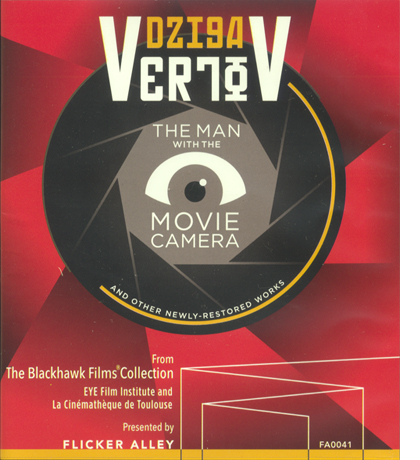
Soviet director Dziga Vertov is known primarily for The Man with a Movie Camera (1929), one of the most revered silent films. It is a documentary, an experimental film, a city symphony, and a witness to Soviet society in the late 1920s, all in one. Flicker Alley has done great service to silent Soviet cinema with its Landmarks of Early Soviet Cinema and the serial Miss Mend by Boris Barnet and Fedor Ozep. Now it has brought out a Blu-ray disc of a remarkable 2014 restoration of The Man with the Movie Camera.

This version is based largely on a print struck from the original negative and left by Vertov with the Filmliga of Amsterdam, an early cine-club. It subsequently passed to the Nederlands Filmmuseum. The restoration added clips culled from other archival prints to fill in gaps in this copy, producing an edition that will be a revelation to many who are used to the scratchy, contrasty, and cropped prints that have circulated for decades.

For one thing, seeing that missing left side of the frame makes a big difference. A booklet includedMan with the Movie Camera cover with the disc points out that modern versions are usually taken from sound prints of the film, which required that the left portion of the frame be reserved for the sound track. As a result, that area of the image was cropped out. This new release restores the full-frame original, and the result is dramatically different from earlier versions. Its visual quality is also impressive (see top).

Yet Flicker Alley has been too modest in emphasizing this as a release simply of The Man with a Movie Camera. The full title of the release is “Dziga Vertov: The Man with the Movie Camera and other Newly-Restored Works.” Yet the “Other Newly-Restored Works,” featured in very small print on the cover, are hardly incidental. They include features that many researchers and cinephiles have long wished that they could view in good prints–or any prints at all.

These other works include most of Vertov’s famous features of the 1920s and early 1930s: Kino-Eye (1924), his first feature; Enthusiasm: Symphony of the Donbass (1931), his first sound feature; and Three Songs about Lenin (1934), a celebration of the tenth anniversary of the death of Lenin.

I don’t think any of these films is as important as The Man with the Movie Camera. For me, Kino-Eye is the most charming, with candid depictions of peasant festivals and the like. It was Vertov’s first opportunity to stretch his ambitions after years of work in newsreels and documentaries. It has a spontaneity that perhaps disappeared in the later features.

The disc includes an informative booklet that discusses both the films and their restorations. As an extra, there is the 1925 Kino-Pravda newsreel episode that Vertov made to commemorate the first anniversary of Lenin’s death. It incorporates rare newsreel footage of Lenin, cutting it together in ways that look like modern gifs.

The visual quality is inevitably variable, with the earlier films looking contrasty, but these are no doubt the best versions that we are likely ever to have. This Man with a Movie Camera supersedes the one from the BFI (in the UK) and from Kino (in the USA), though many will want to have the latter for its lovely score by Michael Nyman. The Flicker Alley version has a very different, but highly appropriate, score by the Alloy Orchestra.

Not all of Vertov’s early features are included. For those who want more, Edition Filmmuseum’s release of A Sixth Part of the World (1926), The Eleventh Year (1928), both with a Michael Nyman score, and one shorter film plus a documentary on Vertov, remains a necessity.


3D curiosities

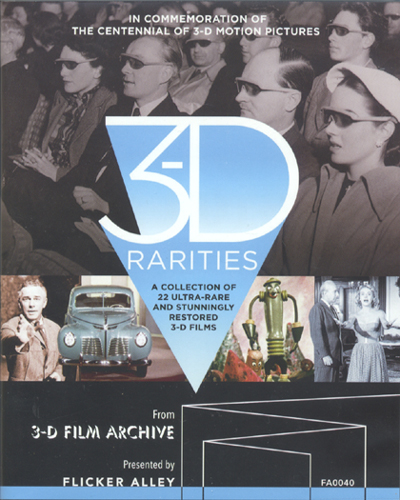
Flicker Alley has also developed a specialty in releasing DVDs and Blu-rays exploring film formats.  The company has paid particular attention to Cinerama (This Is Cinerama, Cinerama Holiday, South Seas Adventure, Windjammer, Seven Wonders of the World, and Search for Paradise). Now, in celebration of the centennial of 3D exhibition , it branches out into 3D with 3-D Rarities, described as “A Collection of 22 3D Rarities coverUltra-rare and Stunningly Restored 3-D Films.” (Since we cannot reproduce 3D frame enlargements, the images below are taken from the Flicker Alley webpage just linked.)

This BD brings together a thoroughly heterogeneous collection of short items, assembled into two programs. The first, “The Dawn of Stereoscopic Cinematography,” covers the years from 1922 to 1952, with short films made outside mainstream Hollywood. Some test footage by Edwin S. Porter and William E. Waddell shown in 1915 no longer survives, so the earliest films on the program are “Kelley’s Plasticon Pictures” (1922-23), including Thru’ the Trees, a travelogue of Washington, D. C. featuring shots of famous buildings framed primarily by foreground tree branches to create planes in depth.

The items that follow range from promotional films to animated shorts to a burlesque comedy featuring two fairly tame striptease segments and two fairly unfunny comedians. A Now Is the Time, McLarenpromotional film for Chrysler shown at the New York World’s Fair (New Dimensions, 1940) traces the assembly of a new Plymouth in great detail and with impressive animation, with the parts hopping around and sliding into place on their own.

For many the highlights of this first program will be four shorts from the National Film Board of Canada, two of them by Norman McLaren. The first, Now Is the Time (1951), uses the filmmaker’s familiar drawn-on-film style (right), while the second, Around Is Around (1951), employs an oscilloscope to create more abstract patterns.

Films by two of McLaren’s colleagues are also included: O Canada (1952) by Evelyn Lambart and Twirligig (1952) by Gretta Ekman. These films are among the only ones on the whole program where objects are not thrust or thrown “out” at the audience.

The first program ends with an advertisement, Bolex Stereo (1952), a camera which supposedly was going to bring 16mm 3D home-movies into people’s living rooms. The complicated technology demonstrated shows why the idea did not catch on.

The second program, “Hollywood Enters the Third-Dimension,” consists mainly of trailers interspersed with a few shorts. The trailers include It Came from Outer Space and Miss Sadie Thompson (both 1953). One fascinating film is Rocky Marciano vs. Jersey Joe Walcott (1953), and I say this as one who has no interest in boxing. This 16-minute black-and-white film starts at the training camps of the two opponents and moves on to the match itself, in which Marciano famously knocked out Walcott in less than two minutes. The in-ring controversy over the call occupies the last part of the film, giving the whole thing a distinct dramatic shape. Multiple-camera filming and 3D add visual interest.

Stardust in Your Eyes (1953), a comedy short starring comic and impersonator Slick Slavin (aka Slaven in the credits), is said in the program notes to have been “a big hit at 3-D festivals. Judge for yourselves, but I advise keeping a finger on the next-chapter button for this one.

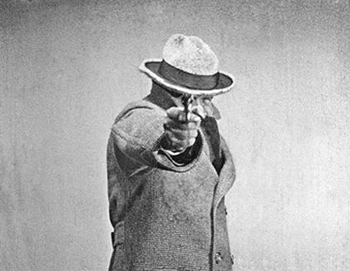
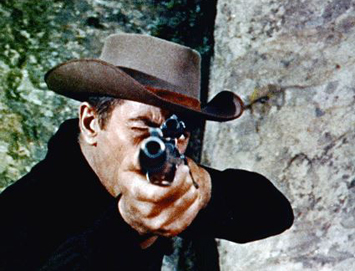
Few of these shorts can be said to be important classics of the 3D repertoire, but overall one gains a sense of the surprising range of films made with the process. One also learns that thrusting guns, spears, swords, and even sling-shots toward the audience, as well as throwing stones and other missiles at them, never grow old as far as the makers of these films are concerned. We have a pistol aimed at us in one of the “Kelley’s Plasticon Pictures” from 1922 (below left) and a rifle in the trailer for Hannah Lee (1953, right).

Kelley's Plasticon Pictures gun to camera     Hannah Lee, rifle into camera

At least we now have the 3D version of Mad Max: Fury Road to recharge this particular visual trope in highly original ways.


Sound marches on

Way back in 2008, when this blog was a mere two years old, I reported on the first volume of a two-disc set of DVDs inaugurating the highly ambitious project, A Century of Sound: The History of Sound in Motion Pictures. That first volume covered the period to 1932. This one is entitled “The Sound of Movies: 1933-1975.” There was of course a lot more recorded sound in that period, and the new set stretches to four Blu-ray discs, for a total of over twelve hours of running time.

I can’t claim to have watched all those hours, but every section I sampled boasted extraordinary amounts of information. Robert Gitt, who originated the project with a 1992 lecture, again narrates. The coverage includes a huge number of rare diagrams, photographs, documents, and demo reels. In addition, many of the chapters add clips from films that contained the most innovative sound techniques of their day. The Garden of Allah, Okhlahoma!, Medium Cool, and many other titles are excerpted in superb copies.

The set as a whole is a gold mine for specialist researchers and technology buffs. The discs include long and detailed passages on such topics as push-pull recording and noise reduction, the latter a crucial challenge to the sound-recording industry for decades. Teachers who searched assiduously could find many clips suitable for classroom use.

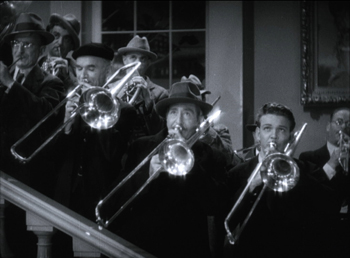
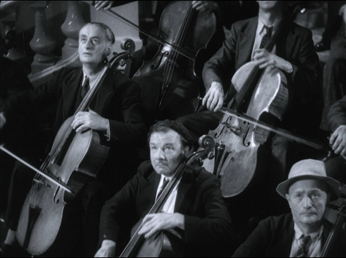
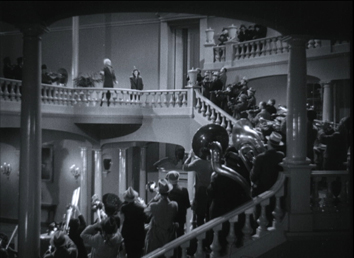
A fair amount of the material ought to be interesting to nonspecialists too. For example, the third disc includes a history of early multi-channel and directional sound. The section on early stereophonic systems is fascinating, with its coverage of Leopold Stokowski’s participation in the two most important early films to introduce this new technology to a popular audience: 100 Men and a Girl (1937) and Fantasia (1940). We get generous clips from each. From 100 Men and a Girl, we see most of the famous scene in which an orchestra plays on different levels of Stokowski’s house and multiple channels allow sonic “close-ups” of each type of instrument over close views of that section of the orchestra:

100 Men shot 1     100 Men shot 2     100 Men shot 3

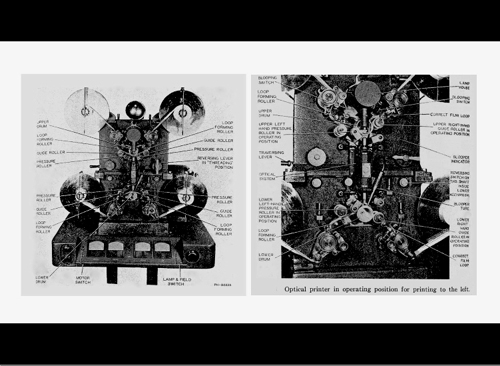
A thorough history of Fantasia includes the image below, typical of the sorts of material The Century of Sound presents: the Fantasound optical printer invented in order to print the multiple optical tracks used for the film’s stereo.

Fantasia Fantasound optical printer

And someone obviously could not resist including a goodly dose of the short dances from the Nutcracker Suite section of the film (see bottom).

The Century of Sound is not for sale commercially. It “is available free of charge to educational, archival and research institutions and to qualified individual educators, researchers and scholars as a not-for-profit educational resource.” There is a modest fee for shipping. For information on ordering, write to CenturyofSound@cinema.ucla.edu.


Flicker Alley’s release of This Is Cinerama provoked David to a survey of Cinerama aesthetics in an earlier entry.

Fantasia dance

Fantasia.


Sometimes a reframing…

Tuesday | September 1, 2015

Axe 500

Side Street (1949).

DB here:

…just knocks you out.

“It can only be fully recommended to those who have a deep and morbid interest in crime.” Snooty judgments like this made Bosley Crowther the critical joke of generations. Today film lovers wear their deep and morbid interest in crime as a badge of honor. Especially when the crime is covered by Anthony Mann.

In Side Street (1949), Joe Norson has lost his business and works part-time as a postman while he and his wife await their first child. Having come back from war and wanting to give Ellen a good life, Joe is tempted to steal money he’s seen lying around the office of a crooked attorney. He grabs a folder containing what he thinks is a couple of hundred dollars; instead, it holds $30,000 of blackmail money. The woman who chiseled the money out of a businessman turns up dead, and the police are investigating. When Joe naively loses the money and sets out to recover it, he’s drawn into the murder, tracked by the gang, and targeted as a prime suspect by the police.

Variety and Crowther chided the screenwriters for a sketchy plot, and the complaint is somewhat fair. Joe is an unusually weak protagonist. He botches both his theft and his cover-up, leaving a trail that’s easy for the killer and the cops to trace. Because Joe is fairly passive and on the run, and he has to follow his clues in a fairly linear manner, and his schemes to fight back come to almost nothing, the action is filled out by scenes of the gang and the police tracking him.

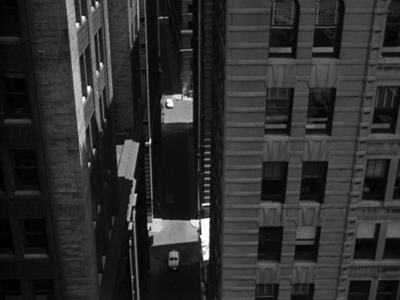
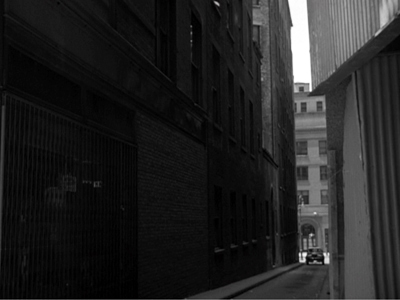
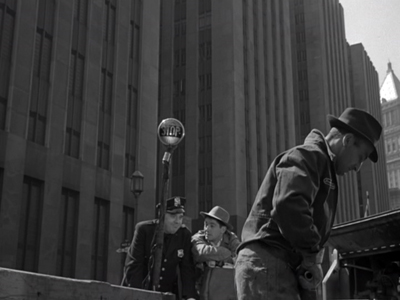
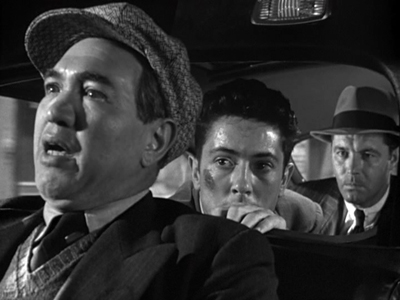
What partly compensates for the plot’s problems is the bold location shooting. As part of the semi-documentary trend of the period (the film opens and closes with worldly-wise voice-over narration from the Homicide Captain), Side Street presents itself as a story rooted in urban reality. And indeed it is a triumph of location shooting. The characters visit a bank, Greenwich Village, Bellevue Hospital, and many neighborhoods. The final chase, with Joe trapped in a taxi with the killer and pursued by three cop cars, is a tour de force of geometrical shot designs that make city canyons part of the drama.

Buildings 3 400     Buildings 1 400

Mann has long been praised for integrating the forces of nature into the action of his Westerns, but this film shows his flair for cityscapes too.

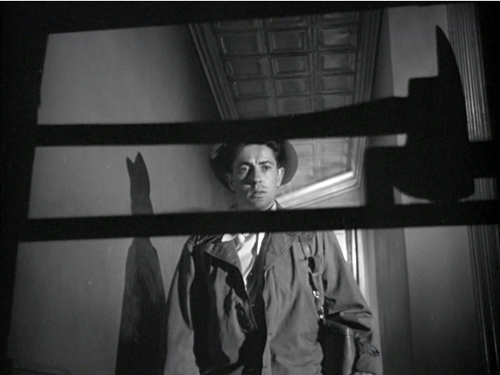
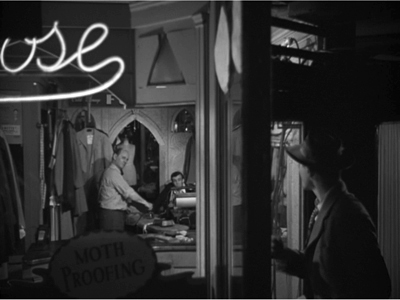
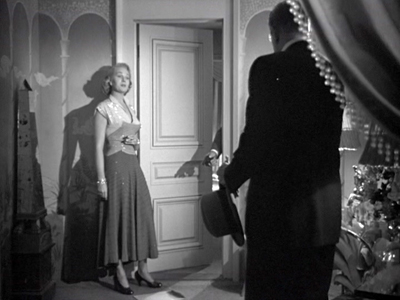
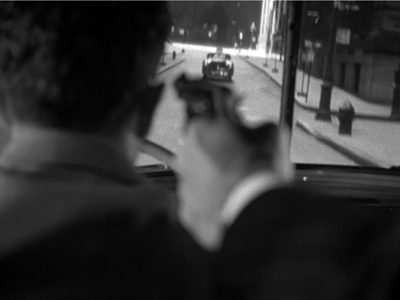
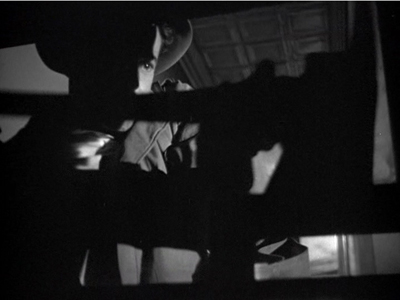
Given the constraints of location filming, the freedom of Mann’s camera is all the more arresting. This time he’s not working with John Alton, the cinematographer most in tune with his baroque sense of light and framing. But Mann still gets punchy results from ace DP Joseph Ruttenberg. There is nothing quite so staggering as Alton’s framing of Claire Trevor and the cabin clock in Raw Deal, let alone the Grand Guignol imagery of Reign of Terror, but Ruttenberg does give us plenty of nicely dense compositions, exploiting the verticals and apertures available on location. There’s also a neatly discreet shot of a revolver peeking out from behind a door in distant long-shot; the shadow supplies the telltale shape.

Shop 400     Revolver 400

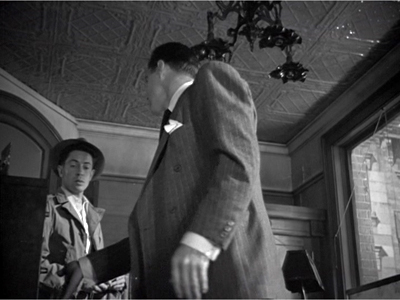
Mann is a post-Kane filmmaker. Like nearly every Forties director of dramas, he learned from Toland and Welles that it’s fun to shove the action into the viewer’s face. The high angles of the city are counterbalanced by steep, low setups both inside and outside. Mann never met a “Russian angle,” or a ceiling, he didn’t like.

Digging 400     Ceiling 400

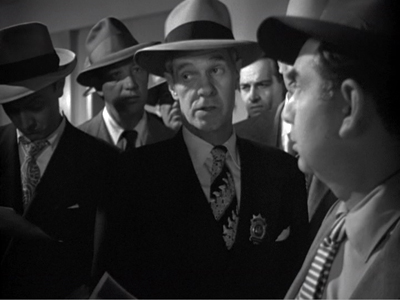
When the lens is more or less straight on, the frame can be tight and actors’ heads are packed into the frame like cantaloupes in a supermarket display.

Cops 400

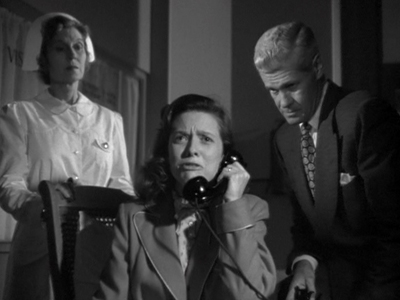
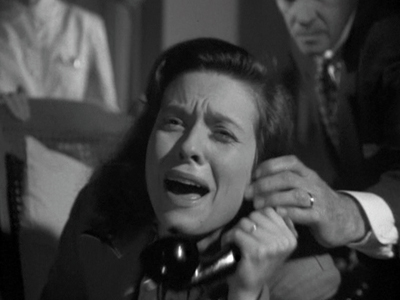
In motion, the camera isn’t safe. Actors rush past the lens or thrust themselves straight at it.

Phone 1 400     Phone 2 400

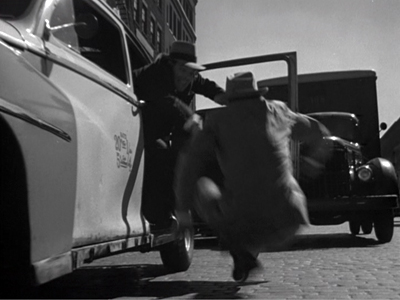
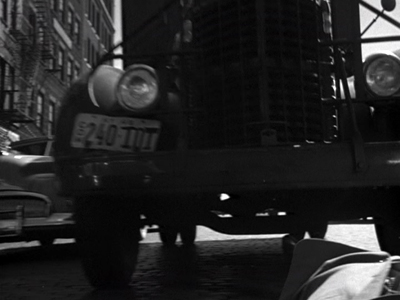
When Joe flings himself out of a car, prepare to find yourself in the middle of traffic, with a truck rushing at you (a stunt done in real space, not against a back-projection).

Taxi 1 300     Taxi 2

Yet even studio-shot back-projections retain vigorous, immersive depth.

Taxi process 1 400     Taxi 2 400

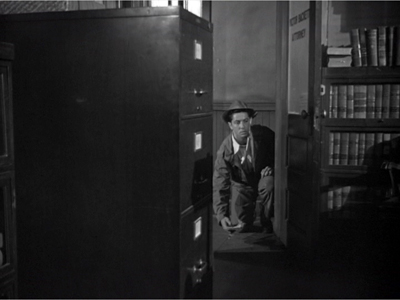
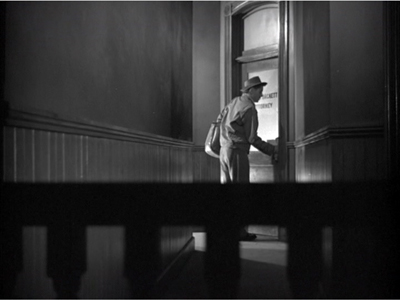
Mann’s visual dynamism, complete with aggressive foreground and distant depth, hits a high point in the dialogue-free scene that’s the topic of today’s sermonette. Joe hasn’t planned to steal the money, but circumstances lure him on. The lawyer’s out of his office, and the door has been left ajar. Joe earlier saw the money put into a file drawer, and as Joe prepares to slide the mail under the door, the cabinet stands temptingly in the foreground.

Cabinet 400

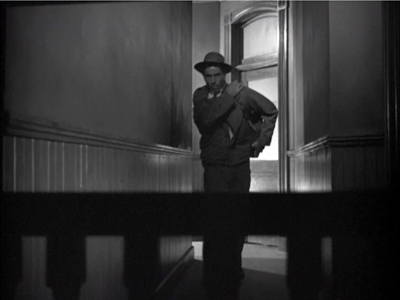
He impulsively heads for the cabinet, pauses before it, and then—thanks to an abrasive cut—grabs the handle violently. The drawer is locked. He recovers himself, almost grateful that he’s blocked, and he lurches out the door. No theft today, apparently.

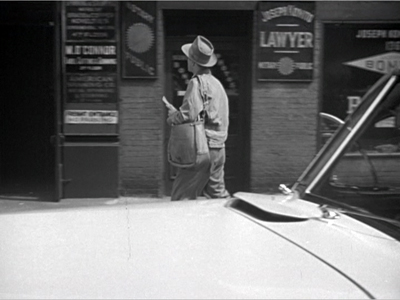
Outside, Joe seems to be going on his way, but the long shot shows a barrier, like a railing in the foreground. It seems about as innocuous as the car hood we saw when Joe went in the building.

Corridor 1 400     St outside 400

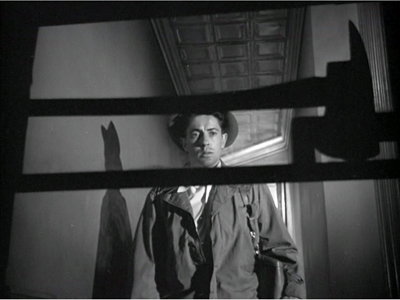
As Joe approaches, the camera tilts up to follow him and he stops, staring. He’s framed  before what’s now revealed as a fire axe.

Corridor 2 400     Axe 400

Another director—Hitchcock, perhaps—would have handled this with a medium-shot of Joe leaving and looking off, followed by an optical POV shot of the axe. Or you could show him leaving in the foreground, with the axe mounted in the distance; he glances back, sees it, and decides to go fetch it.

By contrast, Mann’s approach yields a sharp one-two snap: Joe approaches/ he stops. We see the axe, but almost by accident; the reframing is just following Joe’s movement. And we don’t need to see any more of the thing but its distinctive shape—its pure axe-ness given in silhouette. Rudolf Arnheim, who always advocated pictorial simplicity, would be pleased.

After a beat, in an abrupt cut, Joe grabs the thing.

Joe and axe 400

He lunges down the corridor back to the office and starts to break into the cabinet. Now his violent adventure begins.


Crime I’m not so sure of, but with bodacious filmmaking like this, who wouldn’t acquire a deep and morbid interest in cinema?


It’s been too long since our last “Sometimes…” entry. For the others see:  “Sometimes a shot . . .” and “Sometimes two shots . . .” and “Sometimes a jump cut…”

Bosley Crowther’s review of Side Street is “The Screen: New Crime Story,” New York Times (24 March 1950), p. 29.The Variety reviews, more or less identical, are in Daily Variety (22 December 1949), p. 3, and Variety (28 December 1949), p. 6. The Times covers the shooting of the climactic chase in “Taxi Acrobatics in Wall Street” (8 May 1949), X5.

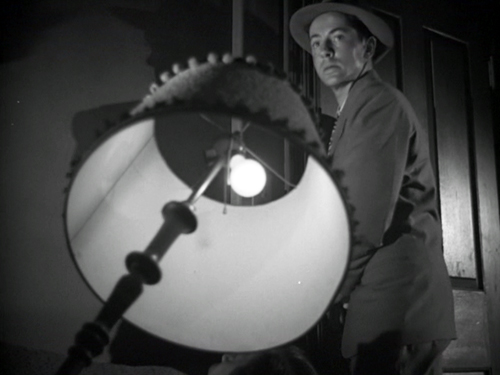
For more on the postwar cinema’s love affair with vigorous depth staging and depth of field, see this entry on Bergman and Antonioni, this entry on Toland and depth of field, this entry on Manny Farber’s objections to Huston, this entry on dense staging, and this entry on Wyler’s staging in The Little Foxes. For much more see Parts Three and Four of our Film History: An Introduction,  Chapter 27 of The Classical Hollywood Cinema, and Chapter 6 of On the History of Film Style.

Lamp 500

Side Street.

Dead man talking

Monday | August 24, 2015

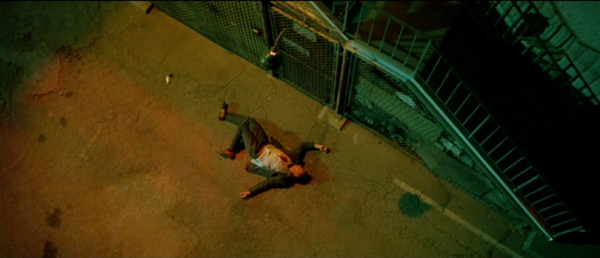
Confidence opening 600

Confidence (2003).

DB here:

“So I’m dead.”

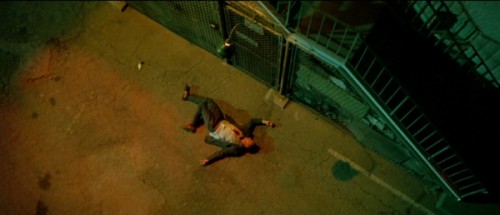
At the start of Confidence we hear Jake Vig’s voice as we see him lying bloodied on a pavement.  As the protagonist of a neo-noir, Jake recalls the classic start of Billy Wilder’s Sunset Boulevard (1950). There Joe Gillis (an echo of gigolo?), floating face-down in a swimming pool, begins to recount his stay as a kept man of faded film star Norma Desmond. That opening has become a touchstone for the grim fatalism of film noir, as well as a mark of daring screenwriting. The guy telling the story is dead! How cool is that?

Anybody interested in how films tell stories has to be interested in narrators, those figures—either mere voices or tangible characters—who recount, recall, or replay the story action. And anybody interested in Hollywood film knows that such narrators are hallmarks of a giddy period of cinematic innovation, as recognizably “1940s” as flashbacks, moody subjective sequences, and twisty plots. In that era we find narrators well outside that terrain known as noir. Romantic dramas, family sagas, comedies, Gothics, musicals, and other genres made ample use of voice-over commentary, and it didn’t always suggest a doom-laden atmosphere.

Still, dead narrators seem to be pushing things. They flout realism (How can a dead person tell anything?) and they raise problems of logic (To whom is this person speaking?). Is it a chatty corpse (Wilder originally wanted a morgue opening introducing Gillis) or an ethereal spirit divorced from the dead body?

Dead narrators turn up surprisingly often in the 1940s. During this period, as I’ve argued on this site and in the book I’m working on, many storytelling techniques we take for granted coalesced. There emerged a rough menu for handling them, and ambitious filmmakers played with several possibilities. That play didn’t stop in the Forties; we still have new versions of flashbacks, subjectivity, and the like. So let’s look at posthumous narrators in the Forties, with some glances at a trio of more recent efforts.

As a non-dead and highly reliable narrator, I must warn you of spoilers ahead.


Guiding spirits
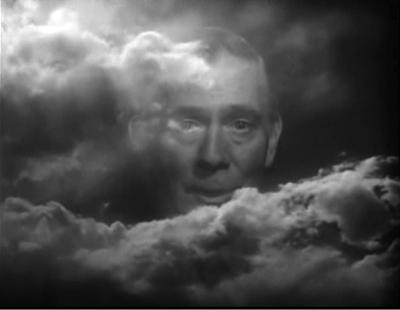
Matthew clouds 400

The Human Comedy (1943).

Most simply, posthumous narration can be motivated as letters (Letter from an Unknown Woman) or diary entries (Thatcher’s journal in Citizen Kane). Similarly, Heaven Can Wait (1943) gives us a dead man explaining episodes from his life to an inquisitive official in the afterlife. The more flagrant cases, however, involve dead narrators who recount the entire film we see in voice-over, as in our prototype Sunset Boulevard. Knowing that the protagonist is dead at the start shifts our attention to how he or she will die.

Posthumous narrators go back a fair bit. In literature, Edgar Lee Masters’ Spoon River Anthology (1915) presents the ruminations of the town dead, in the manner of the cemetery climax of Our Town (1938 play, 1940 film). Wilfred Owen’s poetic monologue “Strange Meeting” (1918) presents soldiers reuniting in Hell, ending with the poignant line, “Let us sleep now….” Addie Bundren, the dead mother of Faulkner’s As I Lay Dying (1930), narrates portions of the novel from her coffin. In a pulpish pastiche of Faulkner, Kenneth Fearing’s mystery novel Dagger of the Mind (1941) includes a chapter narrated by a man who’s been murdered. Radio drama also included voices from the beyond. Examples include “Ghost Ship” (1940), with a victim recounting his own murder, and Norman Corwin’s “Untitled” (1944), which reveals the narrator to be a dead soldier.

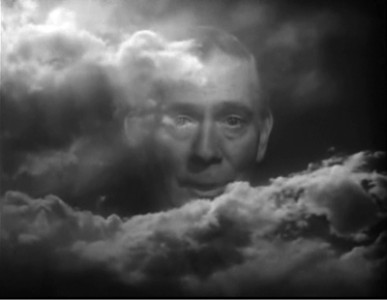
In film, World War II brings forth the prospect of dead servicemen returning to tell their tales. “I am Matthew Macauley,” says a face superimposed over imagery of radiant clouds. “I have been dead for two years. But so much of me is still living that I know now that the end is only the beginning.” This is indeed a beginning, of The Human Comedy (1943). Having died in the war, Matthew will guide us back to his hometown and his household’s daily routines.

Matthew’s voice-over goes on to introduce his family members, including son Marcus on duty in the army. After a scene in which a spectral Matthew joins his wife at her work, his voice discreetly retires. It recurs only twice before he and his now-dead soldier son faintly enter to watch the family welcome their new member, Marcus’s pal Toby.
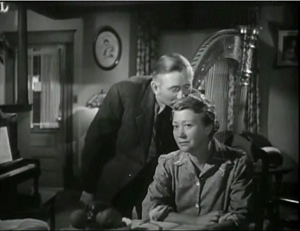
Matthew and wife 300     Matthew and Marcus 300

“You see, Marcus, the ending is only the beginning.” Matthew’s address to us has become piece of fatherly advice.

The dead narrator of The Human Comedy never intervenes in the action on earth, but an all-seeing intelligence exercises more authority in The Seventh Cross (1944). Seven prisoners escape from a concentration camp, and Ernst Wallau’s narration launches the film. During the escape sequence he rapidly introduces each of his comrades.

Fairly soon all but one are captured and executed on crosses planted in the prison yard. The first man to be crucified is Wallau, our narrator. After he is killed, his voice-over continues: “I was dead. I could see.”

Wallau’s commentary chiefly follows his friend George Heisler, who manages to elude the Gestapo while the other escapees are found and killed. Wallau’s narration continues through the film, chronicling not only the fates of the other men but probing Heisler’s state of mind. Wallau tells us what Heisler is thinking, guides us into his memory, notes things that Heisler has forgotten, and even informs us what other characters will do in the future. Confronted with this numb, almost mute character, we need the continual commentary of Wallau to give access to his inner life.

Wallau is that rare voice-over narrator who flaunts his omniscience. Being dead, he has total access to our world and can witness anything happening there. Despite Wallau’s godlike power, in good Hollywood tradition his narration attaches itself chiefly to Heisler. But here that restriction reflects simply Wallau’s foreknowledge, signaled at the start, that only Heisler will survive. The question becomes: How?

The answer comes through Wallau’s goading Heisler to find faith in others. At the start, Heisler is close to despair, and his flight stems from sheer instinctual survival. At the film’s midpoint, all his comrades have been killed, and Wallau’s long-term escape plan has failed. Heisler can’t any longer mechanically follow his mentor’s instructions. He must forge a new goal, seize the initiative, and learn to trust people. He must learn what Wallau told him from the start: there remain traces of humanity in Germany.

As Heisler’s hopes grow and his network of allies expands, Wallau’s prodding voice-over subsides. It reappears near the end, at the moment Heisler realizes how much he owes others. Heisler speaks of his debts, and Wallau murmurs in antiphony the names of those who have helped him, including some Heisler has never met.

Now that Heisler has joined the struggle with full commitment, Wallau can vanish. “Goodbye, George Heisler. I can leave you now.”

Ghostly narrators like Wallau and Matthew Macauley call to mind the nosy angels and spooks of so many 40s films. Those have their counterparts in radio dramas like “Good Ghost” (1948) and the parodic mystery novel Dead to the World (1947), with a dead detective narrating his efforts to solve a case.

As usual, a lot depends on timing of information. If we learn that the narrator is dead at the start, as in the films just mentioned and in Scared to Death (1947), a certain amount of the action can seem foreordained. Alternatively, there can be a surprise. Radio plays, it seems, tended to reveal their dead narrators as a twist ending. With less fanfare, a film can simply seem to forget the opening commentary. The Gangster (1947) is initially narrated, without a frame situation, by the crooked protagonist. As a result, we expect him to survive. Yet he dies in the course of the action. The filmmakers faced a problem: To return to the narration at the end or not? To revive his voice-over might suggest that he endures in some supernatural realm. Instead, an impersonal external voice takes over to balance the opening.

With the convention of the dead narrator in place, a film could flirt with the possibility that the initial voice we hear has no living source. The opening credits of Woman in Hiding (1950) strongly suggest that a betrayed wife, racing down a hillside at night before crashing over an embankment into a river, has been killed. Her commentary rises up during a scene of the police dragging the river, and she seems to be mocking her husband from beyond the grave.

Is this a female variant of Joe Gillis’ voice-over? Watch the whole movie to find out.

In the same year as Woman in Hiding, Sunset Boulevard gave us another voice from the Beyond. If the film’s technique seems less original coming after a string of dead narrators, at least it can be credited with making the narrator the protagonist (unlike The Human Comedy and The Seventh Cross) and for using the device in a full-blown A picture (unlike Scared to Death and The Gangster).

In sum, the dead-narrator technique became a schema, a pattern which filmmakers could simply copy, as in Scared to Death, or tweak, as in the apparently dead narrator of Woman in Hiding. Wilder offered his own variant on the schema. We tend to remember his as the prime example, maybe even as the first one. But it often happens in the 1940s that the originality of a noteworthy film stems from a revision of a schema that was already in circulation, not only in film but in other media.


The weekend Laura died
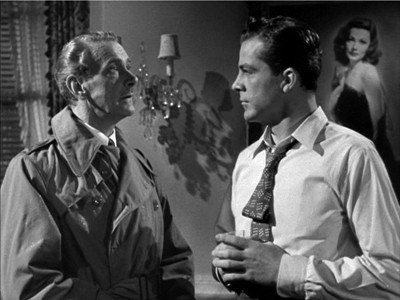
Waldo McPh Laura 300

Occasionally, the variety of options at the period sets up more dissonant relations. Laura (1944) is probably the most famous example.

Vera Caspary’s original book is divided principally into first-person blocks recounted by bon vivant Waldo Lydecker, detective Mark McPherson, and magazine editor Laura Hunt. Early versions of the screenplay attempted to capture multiple-viewpoint narration through flashbacks and voice-overs. What happened to this structure, however, reveals a process we’ll encounter elsewhere: fiddling with the film in post-production yielded some startling, perhaps unintended novelties.

Laura Hunt has apparently been murdered by a shotgun blast to the face. When the film starts, McPherson is calling on her mentor Waldo Lydecker, an effete columnist and radio commentator. McPherson lets Waldo accompany him on his inquiries before the two retire for a dinner at the restaurant Laura loved. There, via flashbacks and voice-overs, Lydecker recounts Laura’s rise to prominence. (In a scene cut from the final film, there’s an indication that Waldo’s tale is partly false—an early instance of a lying flashback.) The other characters’ flashbacks and voice-overs were abandoned in production, so the rest of the film is rendered objectively.

We later learn that the original victim was not Laura, which makes Laura either a new suspect or a target for the killer’s second try. At the climax, it’s revealed that Waldo is the culprit; he concealed the gun in an antique clock that he had given Laura. While his pre-recorded program is broadcast, he returns to her apartment and tries to kill her. Laura eludes him and as he wildly fires his gun, he is shot by McPherson’s team.

What makes the finale curious is the film’s framing device. The first scene starts with Waldo’s voice-over: “I shall never forget the weekend Laura died.”

This appears to cast the entire film as a flashback, starting with McPherson’s visit to Waldo. Within that flashback to the weekend, we have further flashbacks–that is, Waldo’s dinner-table explanations to McPherson. Such Russian-doll embedding is found elsewhere during the 1940s. At the end of the evening, when Waldo leaves, the camera lingers on McPherson and we become attached to him for nearly all that follows.
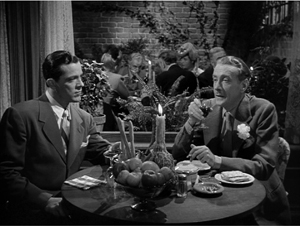
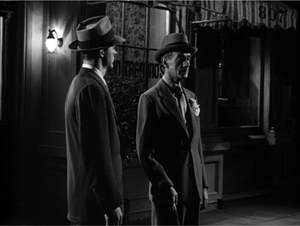
McPh and Waldo at table 300     McPh and Waldo on st 300     McPh cu 300

In screenplay drafts, this last shot would have initiated Mark’s voice-over narration, which would constitute a chunk parallel to Waldo’s. This is further evidence that Waldo’s string of flashbacks, including his opening voice-over, functions to write finis to “his” section of the film. But in the finished film, without McPherson’s voice-over block, Waldo’s initial voice-over hangs there, apparently framing the whole film. It would have been easy simply to cut that commentary and retain the opening camera movement revealing McPherson browsing among Waldo’s treasures, perhaps with some more nondiegetic music. Then Waldo’s offscreen admonition would bring in his voice for the first time. After this, Waldo’s later flashbacks and his voice-over narration would become neatly nested and perfectly conventional.

Clearly, decision-makers wanted to retain Waldo’s ripe commentary to open the film; it has expository value, and it introduces a very intriguing character. But we don’t hear that enveloping voice again, so for the rest of the film we might take Waldo’s remarks as akin to those that open Rebecca (1940) or Flamingo Road (1949). In these films and many others, a reminiscing character voice introduces the story action from an unspecified point in time and space. And the plot’s shift to McPherson’s activities seems to suggest that the whole opening stretch, including Waldo’s initial recounting, should be taken as a unit, “his” section of the film. So when Waldo is shot down and starts to die, we might have a situation like that of The Gangster, where the narrator is killed in the course of the action he introduced, and the film forgets what started it all.

Instead, Laura takes the option that The Gangster avoided: it brings back the dead man’s voice. After Waldo collapses, there’s a cut to McPherson and Laura leaving the frame. As the camera moves in on the shattered clock face, we hear, “Goodbye, Laura. Goodbye, my love.”

The line might be taken as Waldo’s dying words spoken offscreen, except that the line is miked far more closely than his speech earlier in the scene, when he’s actually closer to he camera. In its acoustic texture, this unsituated sign-off formally balances the unsituated opening. But it also raises the possibility that the dead Waldo has launched the whole story and now bids Laura farewell from that realm wherein defunct narrators dwell.

The opening does hint that something otherworldly is going on. A tart, suave voice wells up from sheer darkness, perhaps a noir equivalent to the sunny eternity from which Matthew Macauley speaks in The Human Comedy. Yet for a dead narrator, Waldo is either ill-informed or misleading. He speaks of “the weekend Laura died.” But if he lived through the events of the film, he knows that she did not die. Of course, his fib helps the film mislead us; the first half presupposes that Laura was the victim. If we remember that an unused scene was going to reveal that his flashback tales to McPherson contained lies, we may conclude that  Waldo is as unreliable in death as he was in life.

Some of these inconsistencies apparently spring from late decisions in production. The original ending, as scripted and shot, lets Waldo survive. As he’s led off, he says, “Thank you for everything, my dear. . . You’re all I’ll be thinking of—till Time stands still—for me. Goodbye, Laura.” The speech is heard offscreen as the camera pans and holds on the clock.

Fox production head Darryl F. Zanuck was dissatisfied with many aspects of this conclusion and so a new version was filmed. In that version, Waldo is shot and dying. We see him speak the same lines, and only then does the camera pan to the clock. The release version, with Waldo’s simpler, closely miked farewell over the shot of the clock, was evidently decided on still later.

For what it’s worth, both the original shooting script and the revision distinguish between lines marked as “WALDO (narrating)” and “WALDO’s voice” for offscreen delivery. In neither version are Waldo’s dying lines marked as “narrating.” And in neither do we get an indication of the final camera movement that lets Laura and McPherson leave the shot in order to target the shattered clock face. Yet we do have a sonic texture in the last lines that is closer to a narrator’s voice.

In sum, while presenting a haunting conclusion—the clock was Waldo’s gift to Laura, and the shattered face recalls his first victim—the soundtrack firmly reminds us of the opening. Do we have a dead narrator? Some cues are there, but they’re sketchier than those in other films of the era. (For one thing, in those films, the narrator tells us he or she is dead.)

The unexplained return of Waldo’s voice, now gentle, has a surprising poignancy. Because of its loose ends, the final moments become more evocative, and more poetically enticing, than the tidy, explicit wrapup of Sunset Boulevard. In such ways, Laura’s final moments provide an eccentric revision of the dead-narrator schema. The result may have encouraged filmmakers who followed to risk inconsistency for the sake of powerful immediate effects.

In an earlier entry, I traced how studio pressures made the narration of Preston Sturges’ The Great Moment oddly off-balance. Evidently something like this happened with Laura. In the pressure to get a film finished and out the door, to retain striking bits that may ultimately not make sense when put together, Hollywood filmmakers can innovate by accident.


Dead men tell no tales
Bob in bed 400

Auto Focus (2002).

Once the dead-narrator schema was available, Forties filmmakers were able to tweak it in various ways. And the changes didn’t end then. To see how the same process of schema and revision has continued, consider three much more recent examples.

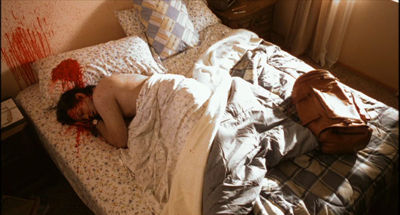
Paul Schrader’s Auto Focus is a straightforward case. Bob Crane’s voice-over appears early in the film, though not at the very start, and recurs six times before the final scene. The brief comments punctuate Crane’s career decline and his descent into sex addiction. As happens with The Seventh Cross and other films using voice-over narrators, the second half employs the device less intensively than does the first. It’s as if in a film’s Development section we’re expected to be absorbed enough in the action not to need explanation, and we’re sufficiently primed to know what the important issues are.

When Crane’s head is bashed in by his companion in sexual buccaneering, we have a case comparable to The Gangster: the narrator doesn’t survive. Crane’s voice has been silent for 28 minutes, so we might assume that we’ve lost his voice-over. But it returns over his bloody body, recounting in an offhand way the aftermath of his death. His voice remains as perky as it has been early in the film, in both his commentary and his explanations to his wives. “I’m a normal guy,” he has insisted, and his bland wrapup shows him insouciantly unaware of the implications of living and dying as he did. He can’t condemn his killer. “He was a cool guy in his way. . . . Men gotta have fun.”
Casino 400

Martin Scorsese’s Casino (1995) reworks the dead-narrator schema in more complicated ways, in the process borrowing other 40s conventions. During that period, multiple-narrator films became quite common. Again we have a prototype—Citizen Kane (1941)—but again it wasn’t alone. Trial films featuring flashbacks that dramatize testimony had become fairly common in the 1930s, and a couple of detective films (e.g., Affairs of a Gentleman, 1934; Thru Different Eyes, 1942) used flashbacks to present different witnesses’ versions of events. It would become a staple of crime films like The Killers (1946). Julien Duvivier’s Lydia (1941) transposed the multiple-narrator technique to the melodrama, while The Affairs of Susan (1945) applied it to romantic comedy. Mankiewicz, who seems quite obsessed with the strategy, deployed it in A Letter to Three Wives (1949), All about Eve (1950), and The Barefoot Contessa (1954).

A less common 1940s convention is the replay—the passage that repeats a scene, usually in flashback and usually including information not shown in the first pass. The most famous example is Mildred Pierce (1945), which I’ve fretted at for years (in this entry and this video). We can find less crucial replays in, again, Kane (Susan’s opera debut) and in more obscure films like Beyond Glory (1948).

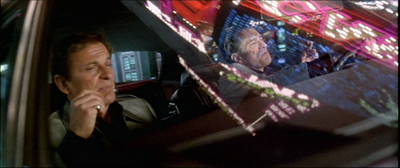
Casino draws on the replay and the multiple-narrator format and blends them with the dead-narrator one. The film innovates in a couple of striking ways. First, in 1940s multiple-narrator films, the individual narrations are presented in blocks; a solid chunk from one voice, another from another. True, we see some leakage in All about Eve, but basically the narrators’ tales are kept distinct. Scorsese and Nicholas Pileggi’s script for Casino hops between two principal narrators, Ace Rothstein (Robert de Niro) and Nicky Santoro (Joe Pesci).

Ace and Nicky’s voice-overs are mostly very brief, tagging a cascade of episodes tracing each man’s rise in Vegas, with equally fleeting flashbacks to their origins. The first twenty minutes toggles ten times between the two men’s clipped commentaries. This stretch constitutes a sort of training session, preparing us for the rapid switches in viewpoint that will dominate the film. Again, though, the voice-overs will subside for stretches in the middle, when the scenes become more fully developed. As a momentary, almost twitchy variant we get one extra voice-over—that of a go-between who, in a freeze frame, decides not to tell the mob boss about Nicky’s betrayal of Ace. Significantly, the film’s third major character, Ginger McKenna (Sharon Stone), is allotted no voice-overs.

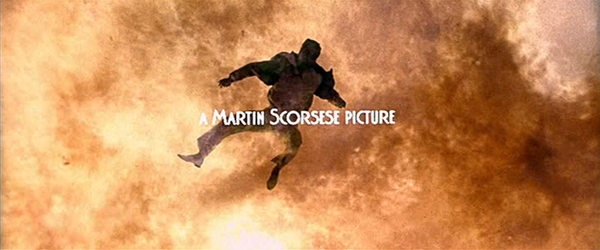
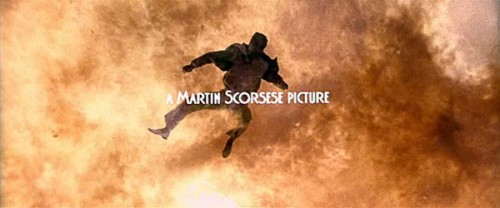
So Scorsese and Pileggi have fractured the 1940s voice-over schema. But the to-and-fro commentaries I’ve mentioned come after an opening sequence that seems to announce that one of these wise guys is already dead. The first scene shows Ace being blasted out of his car by a bomb. A sprawling body, as if ejected from the explosion, floats through the opening credits. And Ace’s next voice-over launches the film’s cascade of flashbacks by saying they come from the period “before I got myself blown up.” We seem to be in the full-fledged presence of a dead narrator.

We are, but it’s not Ace. At the film’s climax, it will be Nicky who dies at the hands of his own crew. In replays of the car explosion, it’s revealed that Ace actually survived the blast. By 1995 Scorsese and Pileggi could revise the 1940s schema by splitting the narrators and misdirecting our expectations: the apparently living narrator is the one who will die.

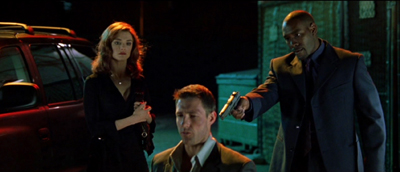
What, finally, of Confidence? Jake’s admission that he’s dead fits snugly into the tradition we’re considering, especially since it’s a voice-over initiating a flashback. That flashback takes us to the moments before his execution at the hand of the triggerman Travis.
Confidence 400

In those moments Jake explains how his team of grifters accidentally took money belonging to a gang boss and how they proposed to repay him with an even bigger con job. That central story action, itself peppered with backstory exposition, is interrupted by returns to the opening execution situation. Jake’s first voice-over, apparently addressed to us, is differentiated by sonic texture from his explanations to Travis, but when his voice leads us to the past, it has the same degree of auditory presence. In effect, it’s the same confusion of narrating levels that’s promoted in the first long stretch of Laura.

At the climax of Confidence, we see Jake shot not by Travis but by the moll Lily. Travis flees, and so does she. Now we’re back to the opening situation, and a replay of Jake’s opening line, “So, I’m dead.” He seems to sign off. But now more flashbacks reveal that Jake and Lily have staged her gunplay and that the whole scheme has been a very long con. The team reunites and goes off with their millions. Confidence has appealed to our knowledge of the dead-narrator convention to fake us out: the story action won’t end with his death because he’s stage-managed it.

Jake lied about being dead. But so did Ace when he referred to being “blown up.” So did Waldo, maybe. And so do those films that don’t signal that the protagonist has fallen into a dream or a reverie. Actually, narratives are incorrigibly deceptive and full of secrets. You can’t even trust dead guys.


As ever, we’re reminded that modern filmmakers inherit a vast tradition of narrative schemas. Those can be reiterated or revised in unpredictable ways. The tradition is kept alive and engaging, as long as novelty is balanced with familiarity, innovation with redundancy. (Let the narrators explain, throw in some replays,) The way Hollywoood tells it is always indebted to the ways Hollywood told it.


For more examples of dead narrators see the Wikipedia entry and TV Tropes. Long as they are, these lists tilt heavily toward contemporary examples, where posthumous narration seems very common. One reason I posted this entry was to acknowledge older instances of this convention.

Ray Collins was a well-known radio voice as well as a Welles Mercury player. As both Matthew Macauley and Wallau, he seems to have been the go-to man for reliable supernatural voice-over. He had a long Hollywood career, but most baby boomers remember him best as Lieutenant Tragg in the Perry Mason TV show.

I’m indebted to Neil Verma for information about the posthumous narrator in radio plays. Neil also mentions “The Hitch-Hiker” (1942), and these episodes of Quiet, Please: “Inquest” (1947), “In Memory of Bernadine” (1947),  “Anonymous” (1948), and “I Always Marry Juliet” (1948). (Listen to any of these here.) Filmgoers probably encountered more dead narrators on radio than on film. Neil’s book, Theater of the Mind, is an excellent account of 1930s and 1940s radio narrative.

The shooting script of Laura is available here.  The revised ending is included as well. See also the detailed comparison of the two endings by Despina Veneti at Preminger Noir. The first analysis of the different versions was, I believe, carried out by Jacques Lourcelles in “Laura: Scénario d’un scenario,” L’Avant-scène du cinéma no 211/212 (July-September 1978), 5-11. This publication includes a French-language transcript of the film as we have it, along with cut portions. A detailed account of Laura’s production is provided by Chris Fujiwara in The World and Its Double: The Life and Work of Otto Preminger (Faber and Faber, 2008), pp. 36-48. I’m grateful to Jeff Smith for his advice about the sonic texture of Waldo’s voice-over.

The narrational issues raised by Laura go beyond the deceased Waldo’s voice. In the film’s most famous scene, McPherson is becoming obsessed with the dead Laura and, after drinking heavily, he falls asleep in her apartment. The camera tracks slowly in on him as he drops off. There’s the noise of a door from offscreen, and Laura walks in. McPherson is astonished. Laura, released the same week as The Woman in the Window, might seem to be hinting that Laura has been revived in McPherson’s dream.

Kristin has traced the numerous dialogue motifs that reinforce this possibility. Yet most films of the 1940s mark a dream sequence very explicitly (e.g., wavy superimposed lines, dissonant music) or at the least with a dissolve and a close-up or track-in reinforcing the shift to subjectivity. Laura provides only two cues, the sleeping character and the track-in. But as Kristin indicates, these and other factors keep the dream option a possibility for a first-time viewer. See “Closure within a Dream? Point of View in Laura,” Breaking the Glass Armor: Neoformalist Film Analysis (Princeton University Press, 1988), 162-194. Kristin’s essay also offers a comprehensive discussion of the shifts in Waldo’s narration.

The presence of dead narrators would seem to pose a problem for those scholars who believe that in a movie every narrator must have a narratee on the same logical level. For these theorists, film narrators are part of a symmetrical system of communication among personified entities. Those entities are either embodied in the text (McPherson is Waldo’s narratee in the restaurant) or implicit in the very logic of narrative itself. No narrator without a narratee! According to this line of argument, there must be a narratee as dead as Waldo listening to his opening voice-over, but being very, very quiet.

In contrast, I’ve argued that films, and possibly all narratives, are freewheeling and illogical in their use of markers of communication. Films may mimic only parts of a communicative circuit in order to achieve specific effects. In provoking experiences in readers, films seem to me to rely on psychology, not ontology. I float this argument in this chapter of Poetics of Cinema. See also this blog entry.

Earlier entries have touches on the schema-and-revision dynamic of style and story in Hollywood. See for examples my discussion of 1913 films, a consideration of 1940s style, some remarks on walk and talk,  a piece on high-school lipdubs, a discussion of replays, and the entry on Gone Girl. Searching “schema” will bring up more. A roundup of entries on peculiar 1940s narratives is here. I analyze narration in All about Eve here. For more on the debt of modern film to 1940s innovations, see The Way Hollywood Tells It.
Casino credit 600

Casino.

David Bordwell
top of page

have comments about the state of this website? go here