







Archive for the 'Readers’ Favorite Entries' Category
But what kind of art?
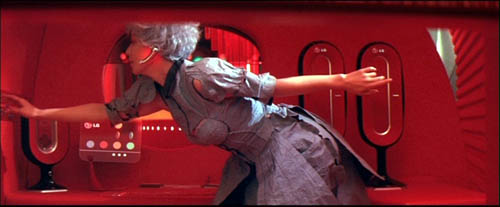
2046.
From DB:
We don’t have to think of film as an art form. A historian can treat a movie as a document of its time and place. A war buff could scrutinize Eastwood’s Iwo Jima movies for their accuracy, and a chess expert could sieve through Looking for Bobby Fischer to discover, move by move, what matches were dramatized. But most of the time we assume that cinema is an art of some sort.
Not necessarily high art. Cinema is often a popular art, or in Noël Carroll’s phrase, a mass art. From this angle, there’s no split between art and entertainment. Popular songs are undeniably music, and best-selling novels are instances of literature. Similarly, megaplex movies are as much a part of the art of film as are the most esoteric experiments. Whether those movies, or the experiments, are good cinema is another story, but cinema they remain.
So, at least, is our position in Film Art: An Introduction. We draw our examples from documentaries, animated films, avant-garde films, mainstream entertainment vehicles, and films aimed at narrower audiences. In other writing, Kristin has done research on high-art movements like German Expressionism and Soviet Montage (she wrote her dissertation on Ivan the Terrible), but she’s also written about popular cinema from Doug Fairbanks to The Lord of the Rings. I’ve indulged my admiration for Hou and Dreyer but also I’ve tried to tease out the aesthetics of Hong Kong action pictures and contemporary Hollywood blockbusters. Ozu gives us the best of both worlds: one of cinema’s most accomplished artists, he was also a popular commercial filmmaker.
Still, people who look upon cinema as an art don’t necessarily share the same conceptions of what kind of art it is. We have different conceptions of cinema’s artistic dimensions, and we won’t find unanimity of opinion among filmmakers, critics, academics, or audiences.
When we study film theory, this sort of question comes to the fore, and so today’s blog will be a bit more theoretical than most. Don’t let that scare you off, though; I’m trying for clarity, not murk.
Dimensions
People have tended to think of cinema as an art by means of rough analogies to the other arts. After all, film came along at a point when virtually all the other arts had been around for milennia. It’s commonly said that film is the only artform whose historical origins we can determine. So it’s been natural for people to compare this new medium with older arts.
Here are the dimensions that come to my mind:
*Film is a photographic art.
*Film is a narrative art.
*Film is a performing art.
*Film is a pictorial art.
*Film is an audiovisual art.
Let me say off the bat that I think that film is a synthetic medium, in the sense that all these features and more can be found in it. It’s like opera, which is at once narrative, performative, musical, and even pictorial. I mark out these dimensions simply to show some emphases in people’s thinking about cinema. As we’ll see, these ideas can be mixed together in various ways.
Film as a photographic art.
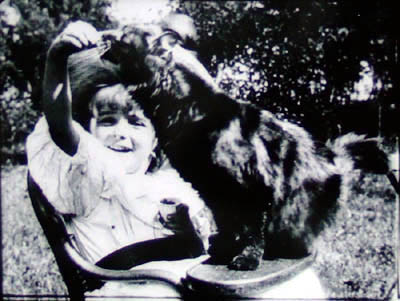
La petite fille et son chat (1900).
For many early filmmakers, such as the Lumière brothers (above), cinema was a means of capturing reality, documenting the visible world. Movies were moving photographs. Naturally, this conception of cinema leads us to treat documentary as the central mode of filmmaking.
It’s an appealing idea. G.W. Bush reading “My Pet Goat” wouldn’t be as revelatory presented as a painting or a theatre performance. On film we can see the event as it occurred and judge it as if we were in the same room. Even in fictional cinema, you can argue, the physicality of the actors, the tangibility of the setting, and the details–a train’s pistons, wind rustling through grass–could not be rendered, or even imagined, so powerfully in a non-photographic medium. In addition, consider Jackie Chan. His stunts are astonishing partly because we know he really did them and the camera photographed them. In an animated film, or a CGI-based one, a character’s acrobatics or brushes with death aren’t so thrilling.
The great film theorist André Bazin claimed that cinema’s photographic basis made it very different from the more traditional arts. By recording the world in all its immediacy, giving us slices of actual space and true duration, film puts us in a position to discover our link to primordial experience. Other arts rely on conventions, Bazin thought, but cinema goes beyond convention to reacquaint us with the concrete reality that surrounds us but that we seldom notice.
I think that Bazin’s idea lies behind our sense that long takes and a static camera are putting us in touch with reality and inviting us to notice details that we usually overlook in everyday life. (I try out this line of argument in relation to the tactility of Sátántangó here.) Moreover, you can argue that in treating cinema as a photographic art the filmmaker surrenders a degree of control over what we see and how we see it. Bazin made this claim about the Italian neorealists and Jean Renoir: creation becomes a matter of an existential collaboration between humans and the concrete world around us.
An example I used in my book Figures Traced in Light pertains to a moment in Hou Hsiao-hsien’s Summer at Grandfather’s, when a tiny toy fan falls between railroad tracks as a locomotive roars past. The fan’s blades stop, then spin in the opposite direction as the train thunders over it. The blades reverse again when the train has gone. (This detail might not be visible on video.) Did Hou know how the fan would behave? Isn’t it just as likely he simply discovered it after the fact, making his shot a kind of experiment in the behavior of things? Conceived as a species of photography, cinema can yield visual discoveries that no other art can.
Interestingly, cinema didn’t have to be photographic. Many early experiments with moving images were made with strips of drawings, such as the Belgian Émile Reynaud’s Praxinoscope. You can argue that recording glimpses of the world photographically simply proved to be the easiest way to obtain a long string of slightly different images that could generate the illusion of movement. Some filmmakers, such as George Lucas, hold that filmmakers are no longer tied to photography, and that the digital revolution will allow cinema to finally realize itself as a painterly art. More on that below.
Film as a narrative art.
Rope.
This is at the core of Hollywood’s explicit concerns. Producers, directors, crew, and of course screenwriters will agree that Without a good story, the movie fails. Our Indie and Indiewood filmmakers say they’re trying to find fresh stories, the ones that “haven’t been told yet.” Overseas filmmakers dominated by Hollywood tell us, “We have our own stories to tell.” Even the most celebrated arthouse filmmakers often say they’re interested in character as revealed through action. Resnais, Rivette, Fassbinder, Haneke, and all the rest may have told unusual stories, but still they told ’em.
Likewise, many viewers will say that they go to the movies to experience a story. Reviewers online and in the popular press, if they do nothing else, are obliged to sketch out the film’s plot, though they mustn’t give away the ending. Even in academia, most discussions of films focus on what happens in the narrative.
When we consider film genres, we’re usually concentrating on the narrative aspects of them. Most genres display typical characters and plot patterns. The backstage musical features aging stars and young hopefuls, caught up in the process of putting on a show. The horror film typically centers on a monster’s attack on humans, who must fight back. One type of science fiction shows us an overweening scientist striving to go beyond “what is proper for humans to know.” Both fans and scholars discuss other aspects of genre films, but narrative is often central to their concerns.
Historians have traced in great detail how filmmakers employed cinema as a narrative art, but we’re making more discoveries all the time. How, for instance, have films signaled flashbacks? How do they let us know we’re in a character’s mind, or attached to his or her optical point of view? How have they structured their plots? Can we pick out distinct approaches to narrative–in various periods, or genres, or national cinemas? How have narrative conventions changed over the years? Some of the answers Kristin and I have proposed can be found elsewhere on this site, and in our books and articles.
Film as a performing art.
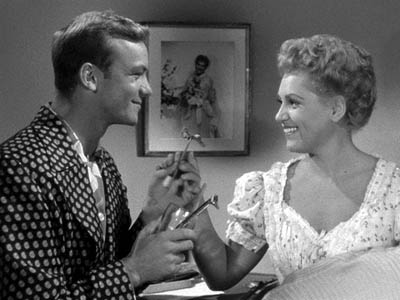
The Marrying Kind.
In the West, since Plato and Aristotle we’ve distinguished between verbal storytelling and dramatic presentation, or performance. Films may be stories, but they’re not exactly told: they’re enacted. At Oscar time, we’re especially conscious of this analogy, for the Actor/ Actress nominees usually garner the most public attention.
Hollywood acknowledged cinema as a performing art in the 1910s, when it created the star system. The Star reminds us that film acting isn’t exactly the same as theatre acting, since an elusive charisma puts the performance across. John Wayne, Marilyn Monroe, Keanu Reeves, and many other “axioms of the cinema” aren’t good actors by stagebound standards, but once they show up on screen, you can’t take your eyes off them. This notion intersects with the photographic premise: we say that the camera seems to love them.
You can argue that Andy Warhol revamped this idea. His superstars weren’t photogenic by ordinary standards but their almost clinical narcissism and exhibitionism, captured by the camera, made them as mesmerizing as any matinee idols. Warhol films like Paul Swann create rather disturbing emotions by putting us in the presence of an awkward performer.
Reviewers place a premium on a movie’s performance dimension. After they’ve told us a bit of the plot , they appraise the job the actors did. Some ambitious critics have written wonderful appreciative essays on acting, as in Andrew Sarris’s “You Ain’t Heard Nothin’ Yet” and the collection OK You Mugs. See also the two collections of articles by Gary Giddins, which I discuss in an earlier blog.
Academic film studies has been slow to study acting systematically, partly because of a bias against considering cinema as a theatrical art, and partly because acting is very hard to analyze. But Charles Affron, Jim Naremore, Roberta Pearson, and Ben Brewster and Lea Jacobs have greatly helped us understand performance practices. They show, among other things, that it isn’t just a matter of the face or the voice: a fluttered hand or a willowy stance can be as powerful as a frown or a line reading.
Film as a pictorial art.
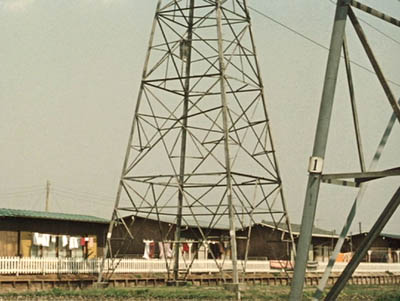
Ohayu (Good Morning).
Progressive opinion in the silent era tended to deny that film was a performing art, since that would make it a form of theatre. No, film had unique capacities. Cinema was essentially moving pictures.
It was a visual art that unfolded in time, so a movie was neither quite the same as a painting (frozen in time) or as a stage play (not pictures but three-dimensional reality). The coming of sound somewhat reduced the appeal of this line of argument, but to a very great extent, students of film technique still emphasize cinema as a visual art.
Theorists argued that the film frame was a pictorial field, not a proscenium stage. Action unfolded in the frame in ways that dynamized space. The choice of angle, camera distance, camera movement, and the like created a visual fluidity that had no equivalent on stage or in other graphic arts. Even cinematic staging was quite different from blocking in a theatrical space. Add to this the ability to join one strip of pictures to another via editing, and we have a unique pictorial artform.
The theorists of the silent era, like Rudolf Arnheim and the Russian montagists, gave us a vocabulary and an orientation to studying visual style, but their legacy hasn’t been fully developed. Journalistic reviewers typically don’t pay that much attention to the way movies look. Nor, surprisingly, do academics. Film studies departments seldom pursue research into visual style and structure.
Here the professors are out of sync with the people whose work they study. Manuals and film schools teach composition, lighting, cutting, camera placement and the like. Professional filmmakers all over the world often think in pictures; they prepare shot lists and storyboards and care very much about the color values and editing patterns of the finished work. We can see their interest in visuals in DVD commentaries and supplements, and as viewers start to absorb bonus materials, perhaps their interest will be whetted too.
Needless to say, a number of avant-garde filmmakers, from Viking Eggeling and Walter Ruttmann to Deren, Brakhage, Ernie Gehr, James Benning, and Nathaniel Dorsky, have also thought of cinema as having the power to refresh, even redeem, our vision. But many of the most important directors aiming at broader audiences are also renowned for their visual styles. To mention just a few: Griffith, Feuillade, Sjostrom, Keaton, De Mille, Murnau, Lang, Dreyer, Lubitsch, and Dovzhenko; Ford, Hitchcock, and von Sternberg; Renoir, Ozu (above), Mizoguchi, and Ophuls; early Bergman, Antonioni, Jancsó, Resnais, Angelopoulos, Tarr, Tarkovsky, Kieślowski, Kiarostami, and Makhmalbaf; Scorsese, Spielberg, Michael Mann, and Tim Burton. Some, like Oshima, Sokurov, and Johnnie To, have been polystylistic, exploring many different visual pathways.
Film as an audiovisual art.
In the 1920s, many theorists feared the coming of synchronized sound, since that would thrust film back toward theatre. The “talkies” would sacrifice visual artistry to Broadway dialogue. This worry was mistaken, but I can sympathize. Probably the mandatory silence of early film pushed filmmakers to find means of visual expression. Would we have Chaplin and the other clowns if they could have spoken at the start?
Yet a great deal of sound cinema wasn’t canned theatre. Film became a synthetic medium blending imagery, the spoken word, sound effects, and music into something that was neither painting nor theatre nor illustrated radio.
Though he’s thought of as the premiere theorist of editing, Eisenstein actually developed this idea of audio-visual synthesis. He was fascinated by the ways in which images and music worked together, creating an idea or feeling that couldn’t be expressed by either one. If shot A followed by shot B gave us something that wasn’t present in either one, then why couldn’t shot A and sound B yield the same results? He believed that Disney’s 1930s films were the strongest efforts in this direction, as when a peacock fanned out his tail to a rippling melody. Eisenstein called it “synchronization of senses.”
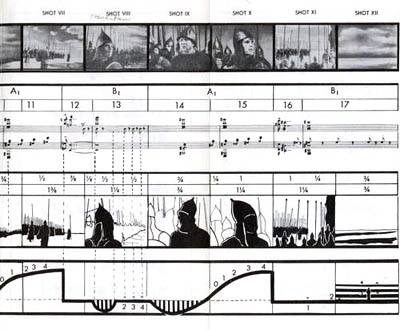
Eisenstein sometimes pushed this idea pretty far. His remarkable analysis of one sequence in Alexander Nevsky (sample above) tried to show how the movement of the viewer’s eye across a suite of shots actually mimicked the movement of the music. He made the case tough for himself because the shots contain almost no movement within them: Eisenstein claimed that we read the compositions from left to right, in time with the musical chords!
Not only Disney but many filmmakers of the 1930s experimented with audiovisual fusion–Kozintsev and Trauberg in Alone, Pudovkin in Deserter, Mamoulian in Love Me Tonight, Renoir in the final danse macabre of Rules of the Game, and Busby Berkeley’s Warners and MGM musicals. Welles made Citizen Kane a feast of audio-visual echoes, as when the wobbly descent of Susan’s singing voice is matched by the flickering of a stage light that finally goes out.
With magnetic and multichannel recording in the 1940s and 1950s, filmmakers could compose very complex sound mixes, and later improvements offered still more possibilities. After Star Wars and Close Encounters of the Third Kind, we expected a movie to be an immersive audiovisual experience, like the light show at a rock concert. Scorsese, especially in Raging Bull and Goodfellas, created powerful mergers of music, sound effects, camera movement, and character movement. So did the Hong Kong kung-fu films of the 1970s and early 1980s. The spellbinding languor of Wong Kar-wai’s films stems largely, I think, from their synchronization of color, slow motion, drifting camerawork, and evocative music.
The avant-garde has pursued more elusive synchronizations of sense modes.The idea of synthesis was floated in the silent era, when experimenters like Oskar Fischinger used musical pieces to anchor their abstract imagery. This tendency has resurfaced in music videos, some of which (Michel Gondry’s in particular) have clear links to the experimental tradition. So too do the shorts and features of Peter Greenaway, especially in his collaborations with composer Michael Nyman. In a film like Prospero’s Books, Greenaway seems to follow Eisenstein in imagining a Wagnerian synthesis of writing, image, and sound.
By contrast, Godard explores all manner of unpredictable junctures between image and sound, with the tracks teasing us but always avoiding a complete coordination. Somewhat similar are the disjunctive image/sound juxtapositions in Peter Kubelka’s Unsere Afrikareise and Bruce Connor’s Report, or the inverse and retrograde organizations of Structural Film soundtracks like Michael Snow’s Wavelength and J. J. Murphy’s Print Generation.
Film academics have begun to analyze image/ sound juxtapositions, studying the development of early talkies and more recent Dolby technology. Arguably, film researchers now pay more attention to music than they pay to imagery. By contrast, most journalistic critics ignore a film’s soundtrack, except occasionally to comment on line readings and pop tunes. As for ordinary audiences, perhaps DVD and home theatre technology have made people more aware of how movies can saturate our senses with audiovisual correspondences.
Three waivers
1. Once I floated these distinctions in a seminar discussion, and a participant mentioned that cinema was also an emotional art. I’d agree that a lot of cinema aims at arousing feelings, but this idea can be found in all the dimensions I traced. Each conception of film favors different means of stirring up emotion.
For example, the photographic approach holds that recording and revealing the world is the most effective way to move spectators, while the narrative approach favors stories as the means to that end. The performance-based approach trusts that we’ll react empathetically to the emotional states displayed by our fellow humans, but the visual-art approach says that cinema can arouse feeling by manipulating pictures in time and space, perhaps even pictures that don’t show any people at all. Eisenstein argued that synchronization of senses was the most powerful form of emotional stimulation, creating in the viewer an “ecstasy” comparable to religious fervor. Beyond these general considerations, it would be worthwhile to tease out the different sorts of emotion that each perspective tends to emphasize.
2. Someone else might ask: What about other analogies? Filmmakers and critics have sometimes compared cinema to music or poetry. Shouldn’t those arts be added to the list?
I think that these comparisons show up principally within the broad idea of film as a pictorial art. The French Impressionist directors of the silent era thought that they were making “visual music,” and Brakhage and Deren’s conceptions of the “film lyric” were mainly pictorial. (See girishshambu for thoughts on the latter.) I’d suggest that filmmakers in the pictorial-art camp have looked to these adjacent arts for models of patterning (meter, rhythm, motif development) and imagery (metaphor and subjective states in lyric verse). Filmmakers are also attracted to the idea that music and poetry tend to be suggestive rather than explicit, conveying powerful feelings in elusive and open-ended ways.
Polemically, filmmakers often conjure up these musical and literary analogies to counter the mainstream cinema’s emphasis on narrative and performance. If we think of film as lyric or rhapsody, story seems less important. The same thing goes, I think, for thinking of film as moving architecture or kinetic sculpture; the analogy again targets film’s pictorial dimension and its non-narrative potential.
3. To think of film as having an affinity with another art form isn’t to say that they’re identical. Thinking of cinema as a performance-based art, for example, doesn’t commit you to saying that film acting is the same as theatrical acting. Instead, thinking along these lines seems to create a first approximation, an initial comparison that lets you move on to notice differences. Once you consider film as a pictorial art, you can then ask in what ways it differs from other pictorial arts, or in what ways this particular movie transforms or reworks the techniques of painting. Ballet Mécanique, which we analyze in Film Art (pp. 358-366), owes a lot to cubism, but its imagery isn’t identical to what Picasso, Braque, and Gris came up with on canvas. All of these analogies seem to work best as frameworks for sensitizing us to both similarities and differences between film and other arts.
And . . . so?
Twin Peaks: Fire Walk with Me.
Each conception of film art harbors a good portion of truth. Each may fail to cover all of cinema, but for certain types of film, or particular movies, some are likely to be more helpful than others.
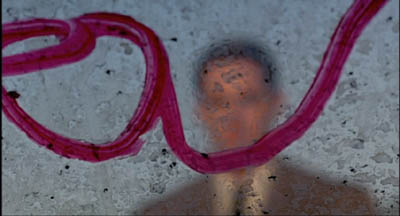
For example, it’s useful to consider David Lynch as making audiovisual works, in which blinking lights or grooves in pine planks seem uncannily synchronized with throbs and hums and Julee Cruise vibrato. Very often story and acting seem to precipitate out of an enveloping pictorial/auditory atmosphere. This isn’t to say that you couldn’t study narrative or performance in Lynch films; it’s just that taking up the audiovisual-mix perspective will throw certain aspects into sharper relief.
You could also argue that the Hollywood studio era blended many of these appeals into a single strong tradition. Story was important, but so was performance. Visual style was often striking, but so too was an expressive soundtrack that went beyond simply recording the dialogue. Sound effects, musical scores, and verbal hooks between scenes created imaginative resonances with the image track. Contrariwise, we can see some avant-garde traditions as taking a purist tack. In several of his films, Brakhage reduces narrative, purges performance, and bans sound: we have to engage wholly and solely with a pictorial experience.
Just as we can distinguish film traditions along these dimensions, we can contrast writers and thinkers. Some critics are very good in pinning down performance qualities, others excel at plot dissection or visual analysis. Arnheim is sensitive to pictorial values but he has little to contribute to understanding storytelling.
Bazin and Eisenstein are attuned to several of the dimensions I’ve traced out. Bazin’s interest in cinema’s photographic basis also alerted him to pictorial possibilities, like deep-focus and camera movement. Eisenstein, famous for his ideas on cinema’s visual dimension, was as I’ve said interested in sound as well. He was no less concerned with film performance, which he conceived as expressive movement (to be synchronized with properties of the image and the soundtrack). But he voiced almost no interest in narrative or photography.
I warned you that this blog would be theoretical, but I hope the takeaway message is clear. Cinema is teeming with artistic possibilities, and each of these frameworks can illuminate certain areas of choice and control. We don’t need to pick a single creed to live by, but we deepen our understanding of film by being sensitive to as many as we can manage.
The Celestial Multiplex
Kristin here—
The Internet is mind-bogglingly huge, and a lot of people seem to think that most of the texts and images and sound-recordings ever created are now available on it—or will be soon. In relation to music downloading, the idea got termed “The Celestial Jukebox,” and a lot of people believe in it. University libraries are noticeably emptier than they were in my graduate-school days, since students assume they can find all the research materials they need by Googling comfortably in their own rooms.
A lot depends what you’re working on. For The Frodo Franchise, studying the ongoing Lord of the Rings phenomenon would have been impossible without the Internet. A big portion of its endnotes are citations to URLs. On the other hand, my previous book, Herr Lubitsch Goes to Hollywood, a monograph on the stylistic and technical aspects of Ernst Lubitsch’s silent features, has not a single Internet reference. Lubitsch can only be investigated in archives and libraries, where one finds the films and the old books and periodicals vital to such a project.
Vast though it is, the Internet is tiny in comparison with the real world. Only a minuscule fraction of all the books, paintings, music, photographs, etc. is online. Belief in a Celestial Jukebox usually works only because people tend to think about the types of texts and images and sounds that they know about and want access to. Yes, more is being put into digital form at a great rate, but more new stuff is being made and old stuff being discovered. There will never come a time when everything is available.
Even so, every now and then someone proclaims that in the not too distant future all the movies ever made will be downloadable for a small fee, a sort of Celestial Multiplex. A. O. Scott declared this in “The Shape of Cinema, Transformed at the Click of a Mouse” (New York Times, March 18): “It is now possible to imagine—to expect—that before too long the entire surviving history of movies will be open for browsing and sampling at the click of a mouse for a few PayPal dollars.”
Not only that, but Scott goes on, “This aspect of the online viewing experience is not, in itself, especially revolutionary.” He’s more interested in the idea that online distribution will allow filmmakers to sell their creations directly to viewers. That would be significant, no doubt, but as a film historian, I’m still gaping at that line about “the entire surviving history of movies.” Such availability would not only be “revolutionary,” it would be downright miraculous. It’s impossible. It just isn’t going to happen.
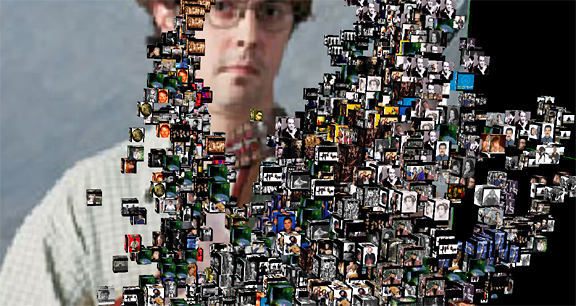
(The image above was generated to publicize the “Search inside the Music” program that is an important part of the Celestial Jukebox. Imagine movie screens with actors’ faces in those little boxes, and you’ve got the Celestial Multiplex.)
I will give Scott credit for specifying “surviving” films. Other pundits tend to say “all films,” ignoring the sad fact that great swathes of our cinematic heritage, especially in hot, humid climates like that of India, have deteriorated and are irretrievably lost.
Dave Kehr has already briefly pointed out some of the problems with Scott’s claims, mainly the overwhelming financial support that would be needed: “Tony Scott’s optimism struck me as, well, a little optimistic.” On the line about “the entire surviving history of movies,” Kehr suggests, “That’s reckoning without the cost of preparing a film for digital distribution — the same mistake made by the author of the recent vogue book ‘The Long Tail’ — which, depending on how much restoration is necessary, can run up to $50,000 a title. None of the studios is likely to pay that much money to put anything other than the most popular titles in their libraries on line.” As Kehr says, the numbers of films awaiting restoration and scanning isn’t in the hundreds, as Scott casually says. No, it’s in the tens of thousands even if we just count features. It’s more like hundreds of thousands or more likely millions if we count all the surviving shorts, instructional films, ads, porn, everything made in every country of the world. To see how elaborate the preservation of even one short medical teaching film can be, go here.
Putting aside the need for restoration, newer films present a daunting prospect. To help put the situation in perspective, let’s glance over the total number of feature films produced worldwide during some representative years from recent decades (culled from Screen Digest‘s “World Film Production/Distribution” reports, which it publishes each June): 1970, 3,512; 1980, 3710; 1990, 4,645; 2000, 3,782; and 2005, 4,603. For me the numbers conjure up the last shot of Raiders of the Lost Ark, only with just stack upon stack, row upon row of film cans.
Scott isn’t the first commentator to prophesy that all films will eventually be on the Internet. It’s an idea that crops up now and then, and it would be useful to look more closely at why it’s a wild exaggeration. It’s not just the money or the huge volume of film involved, though either of those factors would be prohibitive in itself. There are all sorts of other reasons why the advent of practical digital downloading of films will never come close to providing us with the entire history of cinema.
Coincidentally, two experts on this subject, Michael Pogorzelski, Director of the Film Archive of the Academy of Motion Picture Arts and Sciences, and Schawn Belston, Vice President, Film Preservation and Asset Management for Twentieth Century Fox, visited Madison this past week. Mike got his MA here in the Dept. of Communication Arts and now returns about once a year to show off the latest restored print that he has worked on. Schawn isn’t an alum, but he has also visited often enough that most students probably think he is. The two brought us the superb new print of Leave Her to Heaven that Fox and the Academy have recently collaborated on.
I figured it would be very enlightening to sit down with these two and talk about why the Internet is never going to allow us to watch just anything our hearts desire. They kindly agreed, and with my trusty recorder in tow we went for burgers—and fried cheese curds, a commodity not available in Los Angeles—at the Plaza Tavern. I’m grateful for the fascinating insights they provided into some of the less obvious obstacles to putting films on the Internet en masse.
No Coordinating Body
Before we launch in, though, one point needs to be made: there is no single leader or group or entity out there organizing some giant program to systematically put all surviving movies on the Internet. There isn’t a set of guidelines or principles. There’s no list of all surviving films. How would we even know if the goal of putting them all up had been achieved? When the last archivist to leave turned out the light, locked the door, and went looking for a new line of work?
Most of the physical prints that would be the basis for such transfers are sitting in the libraries of the studios that own them or in the collections of public and private archives (including many individuals). The studios would make films available online for profit. The archives might be non-profit organizations, but they still would need to fund their online projects in some fashion, either by government support, from private grants, or by charging a fee for downloads. Most archives are more concerned about getting the money to conserve or restore aging, unique prints than about making them widely available. Preservation is an urgent matter, and making the resulting copies universally available for public entertainment or education is decidedly a secondary consideration.
Mike works for a non-profit archive, Schawn for a studio, so together they provide a good overview of some key problems facing the creation of an ideal, comprehensive collection of movies for download.
Money
People who claim that all surviving films could simply be put on the Internet don’t go into the technology and expenses of how that could be done.
Of course, Schawn says, studios want to “digitize the library.” That phrase is highly imprecise, however. He specifies, “For the purposes of this idea of media being online, available, downloadable, streamable, whatever, that’s something that we’re dealing with now using existing video masters. So there isn’t an extra cost to quote, unquote digitize. But there is a cost to make the compression master, what we’re calling at Fox a ‘mezzanine file,’ which is basically a 50 megabit file. That’s the highest-quality ‘low’ quality version of the content from which you can derive all of the different flavors of compression for the various websites that have downloadable media.
“There’s a huge problem with this, in that Amazon, iTunes, and Google all have a slightly different technical specification of how they need the files delivered to them. If you don’t have this kind of mezzanine file, you have to make a different compressed version for each one of these, which costs something, certainly. It’s not incredibly expensive, but it’s not free.
“So why? What’s the motivation to us to compress at Fox the entire library? I don’t know. Are we going to sell enough copies of Lucky Nick Cain [a 1951 George Raft film] compressed on iTunes to cover the costs of making the compression? I don’t think so.”
Compatibility and the Onrush of Technology
Schawn’s mention of the variety of files needed by the big download services raises the problem of compatibility. It’s not just a matter of supplying the files and then forgetting about the whole thing, assuming that the film is available to anybody forever. What about new standards and formats?
Shawn: “Just as with consumer video, the standard changes, so what used to be acceptable yesterday isn’t acceptable now in terms of technical quality.” As time passes, plug-ins make access faster and cheaper, and eventually the original files don’t look good enough. He points out that currently iTunes can’t download HD. If it becomes possible later, “If you want to get 24 in HD, what Fox will have to do is go and re-deliver all the files in HD.” And presumably re-deliver again when the next big format revolution occurs.
Mike explains further, “Using the mezzanine file, you would just have to continue to reformat it to whatever the players demand. The lowest of the low quality will keep going up as people have broadband and can handle larger chunks of data faster.”
What about the film you’ve already downloaded? You acquire films using plug-ins, which change. Think how often you’re told that an update is now available. If you go ahead and keep updating, the changes accumulate. Eventually you may not be able to play the download you paid for. Quicktime will have moved way beyond what the technology was when you made your purchase.
Schawn and Mike both point out that at this stage in the history of downloading, the level of quality is still pretty bad in comparison with prints of films in theaters or on DVDs. It would be nice to think that the virtual film archive could provide sounds and images worthy of the movies themselves, but that will take a long, long time–not the “before too long” that Scott envisions.
Copyright
I raised another matter: “But what about copyright? Every time I hear something about restoration or bringing something out on DVD, it’s, ‘Well, there are rights problems.’ And some of those rights problems don’t get resolved. I assume that quite a few films that they blithely believe can be slapped up for downloading can’t be slapped up.”
Schawn: “Sure, and there are often not any kinds of provisions in the contract about Internet distribution—obviously! So you’re right, how do you deal with that?”
He pointed to Viva Zapata as a film that Fox has restored but can’t make available due to rights issues. The potential sales are not thought to warrant paying to resolve those issues. “I’m sure there are lots of titles in everybody’s libraries that you can’t just pop up on the Internet and start selling.”
The copyright barrier is worse for archives, which seldom own the exhibition or distribution rights to the films they protect. Usually—though not invariably–the studios do not object to archives owning and preserving prints. Making money through showing them or selling copies would be quite another matter.
Mike described the online presence of archival prints. “On a much smaller scale, this is being attempted in the archive world already, like on Rick Prelinger’s site [Prelinger Archives] or on the Library of Congress’s site, where they’ve put up dozens of moving-image files. True, it’s not independent cinema and it’s mostly commercials and the paper prints that have recently been restored. On Prelinger’s site it’s all the industrial films that he’s collected over the years. That has seen a good amount of traffic, but it hasn’t created new audiences for these films, I would argue. At least, not on a huge scale.”
Prelinger’s site contains only public-domain items, including the ever-popular Duck and Cover, allowing him to avoid the problem of copyright. Similarly, the Library of Congress gives access primarily to films in the pre-1915 era.
Suppose an archive and a film studio both have good-quality prints of a minor American film made in the 1940s. The archive does not have the legal right to put it online, and if the studio decides that it does not have the financial incentive to do so, that film will not be made available for downloading. A private collector might possibly create a file and make it available, but he or she would risk being threatened by the copyright-holder.
Piracy
We briefly discussed the methods used to prevent pirated copies being made from downloaded films. Like DVDs, downloads can be pirated, with people sending copies to their friends or even offering downloads for a fee in competition with the copyright holder. Copy-protection codes might make it necessary for a purchaser to keep a downloaded copy only on a hard-drive without being able to burn it onto a DVD. Another type of code could erase the file once the film had been viewed once or twice. That’s not exactly conducive to the ideal archive of world cinema, where we would hope to be able to study a film in detail if we so choose.
One might think that piracy protection mainly applies to studios, with their need to make money. Mike points out, though, that the need for such protection “even applies to the archival model, too. For films that you mention that have gone out of copyright, there’s still the same costs associated with putting a silent film that no one owns–digitizing it, creating the compressed master that goes on the Web—and they aren’t the kinds of subjects that people are going to get rich on at all, so there isn’t a lot of piracy. You don’t hear many archivists complaining, ‘Hey, you took my 1911 Lubin film, damn you! You can’t put that on your Website. That belongs on the archive’s Website.’ But that scenario becomes more of a likelihood for more popular titles. The obscure 1911 Lubin film is on one extreme, but Birth of a Nation, a well-known silent film a lot more people would like to see, is on the other. Let’s say the highest-quality copy is on the Museum of Modern Art’s Website and can be easily lifted and posted on your own site. And even if you just say, ‘Oh, I’ll charge 99 cents or I’ll charge 50 cents to stream it,’ it’s still going to be someone taking over something that the archive put all of the high-end effort and money into doing. Frankly, I think unless it’s an archive with a national mandate and a little bit higher budget to digitize and to put the contents of their archives online, there’s not going to be any motivation to make that high-end investment up front.”
Thus an archive may simply not bother to put a film on the internet because it can’t guarantee recouping the costs that would be generated.
Language and Cultural Barriers
Scott’s notion of easy access to all of surviving world cinema implicitly depends on an idea that all these films are either English-language or already subtitled or dubbed for English-speaking users.
That’s not true for a start, so there would remain a great deal of work to translate films that have never been released in English-language markets. That’s another huge, expensive task.
Then there’s the opposite side of that coin. For truly complete access, everyone in the world, whatever language they speak, would be able to download and appreciate every film. Of course, there are billions of people without computers or Internet access, and it looks unlikely that being able to go online will become universal anytime soon. (For figures on numbers of people with internet access, check here; percentages can be calculated by clicking on each country and finding the total population. In Tajikistan, for example, .07% of the population was online in 2005. One has to assume that a lot of connections in some of those countries are dial-up, so downloading films would be virtually impossible. [June 21, 2010: In 2008, Tajikistan’s online population has grown to .08%.])
So let’s just say that for the foreseeable future downloadable films would “only” need to be subtitled in the languages of countries or regions where significant numbers of people subscribe to PayPal.
In our conversation, Schawn pointed out that digital compression files mean that there can be huge numbers of versions, with different soundtracks dubbed in or different subtitles added. Technically it’s possible to do all that translation. Still, “it’s very complicated. So for worldwide distribution of anything, like you’re talking about your silent film. If you’re in Pakistan, do you get the American version of the movie or do you get the version of the movie with the intertitles appropriate to wherever it is that you’re showing it? If so, that quickly compounds the amount of stuff that’s digitized.”
I responded, “Yeah, or a 1930s Japanese film put on the Internet for downloading, subtitled in every language where there are people that can pay for it. The more you think about it, the more absurd it becomes.”
Scott must be implying as well that there is some single “original” version of a film and that that version would be the one available in this ideal collection in cyberspace. Yet any archivist or film historian knows that multiple versions of a given film are typically made, depending partly on the censorship laws of the different countries where it is originally shown. In making downloadable files available, does a studio or archive use only the original version of a film made for its country of origin and thus risk having it include material offensive to viewers in some places where it might be downloaded? Or does a whole slew of different versions, one acceptable in, say, Iran, another inoffensive to the Danes, and still another compatible with Senegalese social mores, get put online? How could one even gather all such versions and digitize them? National film archives tend to have government mandates to concentrate primarily on preserving their own countries’ films. Not every version of every film gets saved.
The Bottom Line
For all the reasons noted here and others as well, film availability for download will follow pretty much the same economic principles that have governed film sales in other media. Mike’s opinion is, “Whether they’re from an archive or a studio, I think things’ll start going online in the same pace that they came onto DVD, in an eight to ten-year cycle. And there still will be large gaps.”
Schawn interjects, “Just as there are on DVD.”
Mike concludes, “There’s stuff that will never go online. Yeah, just as on DVD.”
*
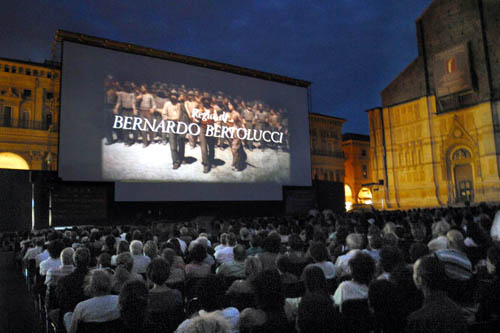
A truly celestial screening: a restored 35mm print of Bertolucci’s 1900 projected free, under the stars in the Piazza Maggiore, Bologna, summer of 2006
Film forgery
DB here:
In early July 1947, about two weeks before I was born, an alien spacecraft crashed near Roswell, New Mexico. Local ranchers found scattered debris, and soon the US government had cordoned off the area. At the crash site was a flying saucer.
Around it lay several alien creatures. They were small and slender, with large heads, dark slanted eyes, and only four fingers. They were clutching small, flat control boxes. One creature was still alive, and it was taken to an Air Force base in Texas, where it lived for a few more years. The dead bodies were autopsied, and at least one autopsy was filmed.
The US government tried to keep the Roswell incident a secret, but dogged researchers have brought to light eyewitness testimony, official documents, and leaks. There is but one conclusion to draw. We have encountered beings from another planet.
Everything I have just said is almost certainly untrue, except for that part about my being born.
Artistic crimes
Although I’ve been interested in UFOs since I was a kid, what triggered this blog was the recent scandal around pianist Joyce Hatto. Her husband has confessed that her many CD performances of classical pieces were actually digital copies of other pianists’ releases. Critics who praised her virtuosity now have red faces. Denis Dutton, a philosopher of art specializing in what he calls “artistic crimes,” has written a lively essay about the mess.
Summing up what is now a pretty well-established position in aesthetics, Dutton writes that our full understanding of an artwork depends on a general sense of how the work came to be what it is. We may say that all that matters are the words on the page or the paint on the canvas or the sounds in our ear. But our understanding of those sensory features depends upon assumptions about the origins and authenticity of the work.
Here’s Dutton:
The Joyce Hatto episode is a stern reminder of the importance of framing and background in criticism. Music isn’t just about sound; it is about achievement in a larger human sense. If you think an interpretation is by a 74-year-old pianist at the end of her life, it won’t sound quite the same to you as if you think it’s by a 24-year-old piano-competition winner who is just starting out. Beyond all the pretty notes, we want creative engagement and communication from music; we want music to be a bridge to another personality. Otherwise, we might as well feed Chopin scores into a computer.
Dutton has written many subtle and enjoyable pieces on what he calls aesthetic crimes—plagiarism, forgery, and the like. (See his website for many of these, along with continuing updates on his Hatto comments.)
Both plagiarism and forgery present a false history of how a work came into being. You commit plagiarism when you claim as your own something that somebody else created. The Hatto case is plagiarism, just as much as if one college student submits a paper that her roommate has already submitted for another course. A forgery is in a way the reverse: You make the artwork but claim that it was actually created by somebody else, typically somebody famous.
It’s interesting to speculate about what a plagiarized film would be. You can plagiarize somebody’s script by passing it off as your own. Periodically there are lawsuits from aspiring screenwriters claiming that producers ripped off spec scripts. But can you plagiarize a movie itself?
I suppose you can try, but it would be very hard to pull off. I might swipe a finished film’s negative from the lab and then make new credit sequences that replace the director’s name with mine. But I could hardly expect to get away with it, since nearly everybody involved would notice. Perhaps I could find an old forgotten film and then stick my name in there somewhere. Again, though, I’d have to explain how I could have been around to make that 1930s Monogram musical or 1960s Taiwanese kung-fu film. As Dutton points out, I’d have to tell a plausible story about how the work came to be.
What if I just swipe bits? Recall that a plagiarism can be partial or total. Even if you pluck just a paragraph or two from your roommate’s term paper and write the rest of yours unaided, that still counts as plagiarism. But if your roommate makes a film, and you lift a sequence from it for your own, the case for plagiarism seems to me less clear—especially if she gives you the same sort of permission she might grant for a paper.
Does Bruce Conner’s use of stock footage in A Movie constitute plagiarism? We assume that he didn’t shoot all this material, yet he doesn’t give credit to any of his sources. Indeed, as he once wrote to Kristin and me, “Only the splices are mine.”
We’d now be inclined to say that Conner appropriated the shots, something a great deal of contemporary art does. Rappers, samplers, and electronic artists like Moby are clearly seizing work without acknowledgment. Perhaps entertainment companies are in effect complaining that YouTube downloads and Web mashups are plagiarism. Yet there’s no intent to deceive the viewer about the source, so plagiarism doesn’t seem the right concept for these instances.
What about cases in which one director replaces another on a film project and assimilates material that the first one shot? Did Richard Lester plagiarize Richard Donner’s footage for Superman II? It sounds weird to say that; Lester just used parts of what Donner left.
Literary plagiarism can involve stealing not only exact wording but also original ideas. This is a fuzzy area, obviously, since ideas can’t be copyrighted. But it’s even fuzzier in filmmaking, where such swiping is pretty common. All those copies and unauthorized remakes of Hollywood films, like Hong Kong Pretty Woman and Kaante, the Bollywood version of Reservoir Dogs, might count as plagiarism. (The producer of Kaante calls it an homage.) Still, my inclination is to say that plagiarism is a difficult concept to transfer to the visual/moving image arts; its core application may be literary and, as the Hatto case reveals, musical performance.
Anyhow, today I’m interested in the other major aesthetic crime, forgery. The question is: Can you forge a film?
Forgery and pastiche
Nowadays, especially after Forrest Gump, we’re accustomed to seeing simulated documentary footage in fictional films. The earliest example I can recall is Citizen Kane, in which the newsreel fakes old footage showing Kane campaigning with Teddy Roosevelt or standing beside Hitler.
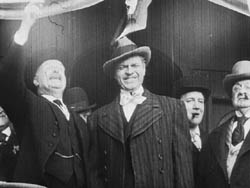
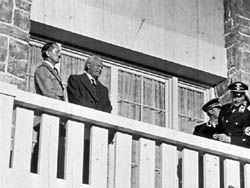
Such shots don’t claim to be factual. No matter how realistic the shot looks, the presence of the protagonist tells us that it’s functioning within a fictional tale. There is, in other words, no question of deceit. It’s a case of artistic license, somewhat like dressing contemporary actors in period costume. Had Welles claimed that he had discovered old newsreel clips containing a mysterious man who resembled him, that would be a different story.
I’d suggest that such frank efforts to mimic the look and feel of older footage fall into the category of pastiche. Pastiche is the acknowledged copying of techniques of recognized art styles. In Stravinsky’s neoclassical period, he composed Pulcinella, an overt pastiche of Pergolesi.
It’s a separate but interesting question about how accurate a filmic pastiche is. The Good German, I suggested in previous posts, tries to be a pastiche, but it isn’t very skilful. Indeed, most aren’t. Bergman’s TV film The Last Scream (1995) includes a pastiche of the great 1910s filmmaker Georg af Klercker, but it’s not faithful to af Klercker’s style. (The mock silent film in Prison and Persona is somewhat better.) Welles’ pastiche of old footage in Kane‘s “News on the March” segment is more carefully done, especially for its time. The movement is convincingly jerky for silent film shown at sound speed, and Welles cleverly scratched and mis-exposed some of the staged footage, anticipating a technique often used today.
The most convincing film pastiche I know since Kane comes in the Japanese film To Sleep so as to Dream (Yume miruyoni nemuritai, 1986). The plot involves two detectives trying to find a lost silent film, and at intervals we see clips of it, a swordplay movie (chambara). The shooting style is very close to the flashy technique we see in films from the era; obviously the director Hayashi Kaizo studied surviving chambara carefully. In one scene, a swordfighter pauses in a doorway, and we see him over the shoulder of his adversary (first image below). As the fighter makes a hurling movement, we cut in a bit closer. Suddenly the foreground figure’s arm jerks up, revealing a dagger jabbed into his wrist (second image below).
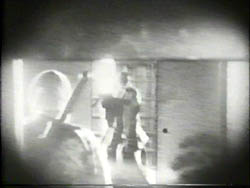
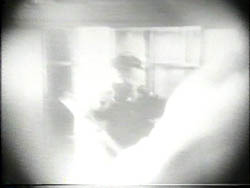
Hayashi has also faded and flared the imagery, as if our print had degraded through duping and ill use.
Pastiches aren’t forgeries because there’s no intent to deceive. Just as important, the history of their production tells us that they aren’t genuine. As Dutton points out, it’s not enough for a forgery to look like an old artwork; to succeed, it needs a provenance, a false history of creation and subsequent ownership. I can think of two well-known films that can be considered forgeries to some degree.
With typical Scottish pragmatism
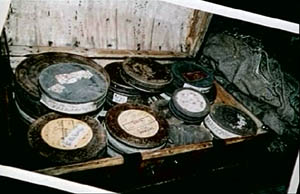
Peter Jackson and Costa Botes’ Forgotten Silver (1995) tells the story of the neglected New Zealand filmmaker Colin McKenzie. McKenzie started making films around the turn of the century, and in the course of his career he built his own camera, manufactured his own film stock, invented talking pictures and color cinematography, shot the first close-up, and erected a gigantic set in the New Zealand bush. Many experts, including Leonard Maltin and various archivists, attest to McKenzie as a visionary filmmaker on a par with D. W. Griffith.
Of course he never existed. But in the straight-faced manner of This is Spinal Tap, Forgotten Silver pretends that he did. The result is a brilliant parody of the filmmaker documentary as practiced above all by Kevin Brownlow. We get the talking-heads experts, the search for lost footage and locations, the pan-and-zoom coverage of old stills, and the terse journalistic voice-over. (“With typical Scottish pragmatism he built his farm the hard way.”) The film makes fun of nationalistic film history (we did it before the others) and the biographical convention that treats the artist as a rebellious, suffering soul.
The silliness of the enterprise is pretty apparent. The resourceful McKenzie is a one-man film industry. He devises a projector driven by steam power, he manufactures film emulsion from eggs, he builds his Salome city single-handed, and a Russian woman named Alexandra Nevsky tells us about Stalin’s interest in our hero. To anybody who knows Harvey Weinstein’s tendency to slice up the films he distributes, his remark about taking an hour out of McKenzie’s masterwork gives the whole game away.
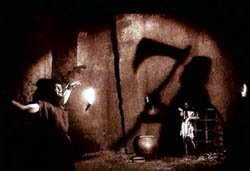
There are clips as well. The passages from McKenzie’s Griffithian feature Salome are fair approximations of 1920s international style, a bit à la Guy Maddin, while the oldest shots look remarkably accurate.
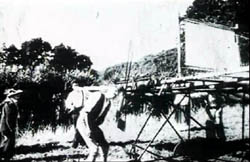
But Jackson and Botes decided to go Spinal Tap one better. Before Forgotten Silver aired on Kiwi television, they let a journalist publish a story suggesting that McKenzie really existed. The mockumentary was taken for truth, and McKenzie immediately became a new national hero. Startled, the filmmakers quickly confessed their chicanery. Some people enjoyed the laugh, but others felt cheated and muttered about artists who fool around at the taxpayers’ expense. The fullest account I know is in Brian Sibley’s biography Peter Jackson: A Film-Maker’s Journey (Hammersmith: HarperCollins, 2006), 280-302. On the web, have a look here.
Because of the Jackson/Botes hoax concerning the “rediscovered” footage, the faked McKenzie scenes became forgeries, at least for a little while. When the mischief was discovered, the clips stood revealed as parodies or pastiches of silent film. If we have reason to believe that the footage is authentic, we think of McKenzie as a pioneer filmmaker. If we’re told it’s all faked, we congratulate our adept contemporaries.
In the spirit of Forgotten Silver are other nonexistent but rediscovered filmmakers. Most recently we have J. X. Williams, conjured up by Craig Baldwin and Noel Lawrence. Williams’ Peep Show was presented as an authentic 1965 movie, although many had their doubts when they saw footage lifted from The Man with the Golden Arm and other pictures. Lawrence insists that Williams existed and has set up a website dedicated to him, but one has to believe that it’s less an effort to deceive than a PoMo performance exercise.
The Gray’s anatomy
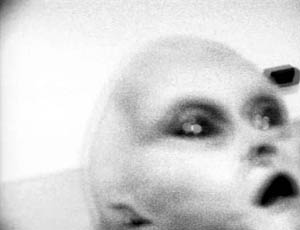
The grandest film forgery I know is Alien Autopsy. This has been a favorite of mine since I saw the Fox TV program, Alien Autopsy: Fact or Fiction?, broadcast in the summer of 1995. Kristin and I were especially pleased to see our old friend Paolo Cherchi Usai, then of Eastman House, as a talking head in it. I got the movie on laserdisc, hoping to use it in a film theory class. I never did, but now I get a chance to blog about it! The show is available on DVD, including the full “original” footage. A useful Wikipedia overview is here.
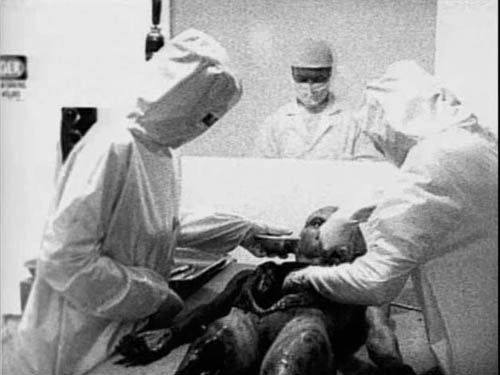
The film shows an autopsy performed on one of the saucer creatures, known in UFO parlance as a Gray. The grainy black-and-white footage presented to the public runs about 16 minutes, but it’s supposedly drawn from much more material. There seem to me three central issues in establishing its authenticity: what we are shown, how we are shown it, and when it was made.
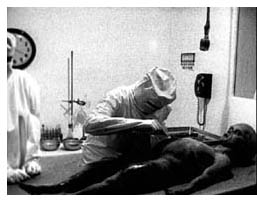 What we see is a sterile white room with a stiff Gray stretched out on a lab table. Two figures in decontamination suits move around the table, cut into the body, and remove various organs. A third, rather creepy figure can occasionally be glimpsed in a window watching. The furnishings are pretty sparse, but you can see a clock, a wall phone, a microphone, and an instrument tray.
As you can imagine, what we see has been intently scrutinized. Is the Gray an organic body or a dummy? Do the surgeons follow proper autopsy procedures? Are the clothes and furnishings faithful to the period around 1947? Special-effects experts have talked about how difficult it would be to design a fake creature, physicians have assessed the surgical techniques, and researchers have tried to establish when wall phones with coiled cords came into use. The Fox special includes some of these debates.
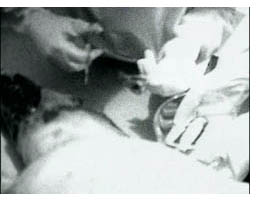 How we’re shown the autopsy has also become a matter of controversy. The film was shot with a handheld 16mm camera, and the cinematographer constantly shifts position. The camera stays quite close, circling the surgeons and moving toward and away from the corpse. As the camera draws closer to the body, the shot often goes out of focus.
Some experts on combat cinematography have claimed that this is a plausible way to cover the action. The camera weaves around because the operator is trying to stay out of the way of the doctors, and the fixed-focus lenses can’t sustain focus in the natural light of the room. Other experts have said that the authorities would have handled this momentous event in a far more careful way, employing several fixed cameras, color film, and brilliant lighting. Skeptics point out that the monochrome imagery, bobbing camerawork, and loss of focus on details all conveniently make the event harder to see.
So it’s rather hard to determine the autopsy’s authenticity just by looking at the footage. We need external information about its provenance.
Funny thing . . . that’s just what’s lacking.
When was the film made? Well, does it employ 1947 film stock? Answer: Not clear. Eastman Kodak representatives have verified that the pieces of film they were shown could have come from 1947, or from 1927, or 1967. But were the pieces of film that the experts examined taken from the footage showing the dead Gray? Not clear. Moreover, the owner of the footage steadfastly refused to submit the film to a chemical analysis that would determine its age. Big problem here.
Further, what was the chain of custody for the footage? Again, not clear.
Roswell Incident eyewitnesses tend to hang onto physical evidence for decades. One man who nabbed a debris fragment kept it on top of his TV set. But when inquiring minds ask to have a look, the artifacts suddenly go missing.
That makes it remarkable that a former military photographer identified as Jack B. came forward claiming to hold several hundred reels of autopsy footage. In the early 1990s Jack offered to sell the material to TV producer Ray Santilli. But Jack didn’t want his real name divulged. That yields another problem with establishing provenance.
Things get wilder. Michael Hesemann and Philip Mantle, in Beyond Roswell (1997), argue that the creature on the table isn’t a Roswell victim at all but a corpse recovered from one of many other crashes that took place at the time. Hesemann and Mantle have also deciphered the markings on the debris shown in Santilli’s film. The text turns out to be similar to ancient Hebrew, classical Greek, and other ancient languages. Did the Grays teach our ancestors their culture? To read this literature is truly to plunge down the rabbit hole. (That’s why I like it.)
So the when question seems to be as murky as the others.
Skeptics have torn into this movie along all three dimensions. The most convincing demolitions of it seem to me the very early piece by Joe Nickell, in the Skeptical Inquirer of November/ December 1995 and Joe Longo’s 1997 dissection on the Society of Operating Cameramen’s website. Longo, president of the International Combat Camera Association, offers a detailed critique of the case. For what it’s worth, many who believe in UFOs also immediately took the film to be bogus.
So is Alien Autopsy a forgery? Yes. Last spring Santilli admitted faking the film, but he offered a new explanation. He maintains that there was a genuine autopsy film, but after he bought it, he found that 95% of it had “oxidized,” whatever that means. So he staged and shot a film that would replicate what the mysterious Jack B. had originally shown him. Santilli explained: “It’s no different from someone restoring a work of art like the Mona Lisa or the Sistine Chapel.”
A special-effects specialist has acknowledged making the dummy Gray. Santilli also faked the inscribed debris shown in the film. At this point Philip Mantle, who had written yet another book claiming that the film might be genuine, denounced the entire affair as a hoax.
In sum, we have the intent to deceive coupled with the wrong provenance. As Dutton would point out, we see the film differently when we know what sort of achievement it is: a middling piece of fakery.
In a remarkable piece of timing, a British feature film was released just as Rick Santilli admitted his duplicity. It was called Alien Autopsy, and it shows two lads setting out to film a faked Gray autopsy. Santilli was credited as a producer. I leave it to you to decide if that movie is an adaptation, a forgery, a plagiarism, a pastiche, or just the extension of a brand.
Thanks to Paisley Livingston, Mette Hjort, and Bérénice Reynaud for discussing many of these matters with me. Paisley in particular gave me helpful pointers and showed me the af Klercker pastiche by Bergman. Thanks also to George Thomas for a factual correction.
P.S. 27 March 2007: Nate Dorward writes to remind me of First on the Moon, a 2005 mockumentary that was taken by the press as a faithful record of Russia’s space program. I haven’t seen it, but it sounds like a Forgotten Silver case: a pastiche or parody that became, inadvertently, a forgery.
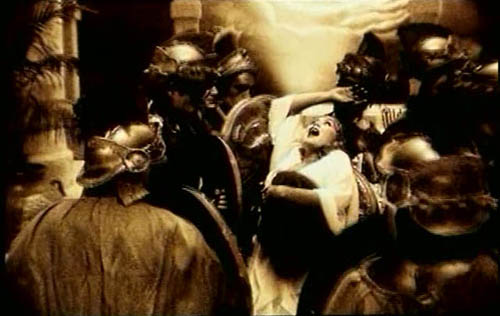
Salome crushed by the guards’ shields in Colin McKenzie’s 1920s epic Salome.
Movies still matter
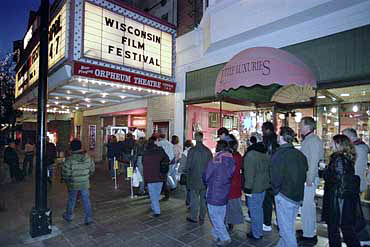
Kristin here—
I don’t know whether I should be grateful or not when I read the film trade journals or major newspapers and run across columns bemoaning the decline of the cinema. On the one hand, these give me plenty of fodder for blogging. On the other, they promote a false impression that the movie industry and the art form in general are in far worse shape than they really are.
One recent case in point is Neil Gabler’s “The movie magic is gone,” from February 25, where he says that movies have lost their previous importance in American society and are less and less relevant to our lives.
Gabler makes some sweeping claims. Movie attendance is down because movies have lost the importance they once had in our culture. Our obsession with stars and celebrities has replaced our interest in the movies that create them. Niche marketing has replaced the old “communal appeal” of movies. The internet intensifies that division of audiences into tiny groups and fosters a growing narcissism among consumers of popular culture. Audiences have become less passive, creating their own movies for outlets like YouTube. In videogames, people’s avatars make them stars in their own right, and the narratives of games replace those of movies.
Films will survive, Gabler concludes, but they face “a challenge to the basic psychological satisfactions that the movies have traditionally provided. Where the movies once supplied plots, there are alternative plots everywhere.” This epochal challenge, he says, “may be a matter of metaphysics.”
All this is news to me, and I think I have been paying fairly close attention to what has been going on in the moviemaking sphere over the past ten years—the period over which Gabler claims all this has been happening. Evidence suggests that all of his points are invalid.
1. Gabler states that “the American film industry has been in a slow downward spiral.” Based on figures from Exhibitors Relations, a box-office tracking firm, attendance at theaters fell from 2005 (a particularly down year) to 2006. A Zogby survey found that 45% of Americans had decreased their movie-going over the past five years, especially including the key 18-24-year-old audience. “Foreign receipts have been down, too, and even DVD sales are plateauing.” Such a broad decline “suggests that something has fundamentally changed in our relationship to the movies.”
Turning to a March 6 Variety article by Ian Mohr, “Box office, admissions rise in 2006,” we read a very different account of recent trends. According to the Motion Picture Association of America, admissions rose, “with 1.45 billion tickets sold in 2006—ending a three-year downward trend.” Foreign markets improved as well, “where international box office set a record of $16.33 billion as it jumped 14% from the 2005 total.” Within the U.S., grosses rose 5.5% over 2005.
We should keep in mind that part of the perception of a recent decline comes from the fact that 2002 was a huge year for box-office totals, mainly stemming from the coincidence of releases of entries in what were then the four biggest franchises going: Spider-man, The Lord of the Rings, Harry Potter, and Star Wars. There was almost bound to be a decline after that. Such films make so much money that the fluctuations in annual box-office receipts in part reflect the number of mega-blockbusters that appear in a given year.
Looking at the longer terms, though, the biggest decline in U.S. movie-going was in the 1950s, as television and other competing leisure activities chipped away at audiences. Even so, the movies survived and from 1960 onward annual attendance hovered at just under a billion people. From 1992 on, a slow rise occurred, until by 1998 it reached roughly 1.5 billion and has hovered around that figure ever since, with a peak in 2002 at 1.63 billion. Variety’s figure of 1.45 billion for 2006 fits the pattern perfectly. In short, there has been no significant fall-off since the 1950s. (See the appendix in David’s The Way Hollywood Tells It for a year-by-year breakdown.) The article also states that industry observers expect 2007 to be especially high, given the Harry Potter, Spider-man, and Pirates of the Caribbean entries due out this year. About a year from now, expect pundits to be seeking reasons within the culture why movie-going is up. I suspect they will find that we are looking for escapism. Safe enough. When aren’t we?
Apart from theatrical attendance figures, let’s not forget that more people are watching the same movies on DVDs and on bootleg copies that don’t get into the official statistics.
2. Gabler claims that movies are no longer “the democratic art” that they were in the 20th Century. During that century, even faced with the introduction of TV, “the movies still managed to occupy the center of American life….A Pauline Kael review in the New Yorker could once ignite an intellectual firestorm … People don’t talk about movies the way they once did.”
Maybe the occasional Kael review created debate, as when she claimed that Last Tango in Paris was the “Rite of Spring” of the cinema. I think we all know by now that she was wrong. A lot of us even knew it at the time, and it’s no wonder that people argued with her. I doubt that attempts to refute her claims there or in other reviews reflected much about the health of the general population’s enthusiasm for movies.
More crucially, however, people do still talk about the movies, and lively debates go on. It’s just that now much of the discussion happens on the internet, on blogs and specialized movie sites, and in Yahoo! groups. (Who would have thought that David’s entry on Sátántango would be popular, and yet there turn out to be quite a few people out there passionately interested in Tarr’s film.)
Some would see the health of movie fandom on the internet as a sign that the cinema has become more democratic than ever. Now it’s not just casual water-cooler talk or a group of critics arguing among themselves. Anyone can get involved. The results range from vapid to insightful, but there’s an immense amount of discussion going on.
3. Interest in movies has eroded in part due to what Gabler has termed “knowingness.” By this he means the delight people take in knowing the latest gossip about celebrities. Movies have declined in importance because they exist now in part to feed tabloids and entertainment magazines.
“Knowingness” is basically a taste for infotainment. Infotainment had been around in a small way since before World War I in the form of fan magazines and gossip columns. It really took off beginning in the 1970s, with the rise of cable and the growth of big media companies that could promote their products—like movies—across multiple platforms. (I trace the rise of infotainment in Chapter 4 of The Frodo Franchise.) It’s not clear why one should assume that a greater consumption of infotainment leads to less interest in going to movies.
People in the film industry seem to assume the opposite. Studio publicity departments and stars’ personal publicity managers feed the gossip outlets, in part to control what sorts of information get out but mainly because those outlets provide great swathes of free publicity. With the rise of new media, there are more infotainment outlets appearing all the time. Naturally this trend is obvious even to those of us who don’t care about Britney’s latest escapade. But I doubt that watching Britney coverage actually makes people less inclined to go to, say, The Devil Wears Prada, one of the mid-range surprise successes that helped boost 2006’s box-office figures.
4. Movies have lost their “communal appeal” in part because the public has splintered into smaller groups, and the industry targets more specialized niche markets. According to Gabler, “the conservative impulse of our politics that has promoted the individual rather than the community has helped undermine movies’ communitarian appeal.”
Let’s put aside the idea that conservative politics erode the desire for community. The extreme right wing has certainly put enough stress on community and has banded together all too effectively to promote their own mutual interests lately. But is the industry truly marketing primarily to niche audiences?
Of course there are genre films. There always have been. Some appeal to limited audiences, as with the teen-oriented slasher movie. Yet despite the continued production of low-budget horror films, comedies, romances, and so on, Hollywood makes movies aimed at the “family” market because so many moviegoers fit into that category. Most of the successful blockbusters of recent years have consistently been rated PG or PG-13. According to Variety, 85% of the top 20 films of 2006 carried these ratings. Pirates of the Caribbean, Spider-man, Harry Potter—these are not niche pictures, though distributors typically devise a series of marketing strategies for each film, with some appealing to teen-age girls, others to older couples, and so on.
(An important essay by Peter Krämer discusses blockbusters with broad appeal: “Would you take your child to see this film? The cultural and social work of the family-adventure movie,” in Steve Neale and Murray Smith’s anthology, Contemporary Hollywood Cinema, published by Routledge in 1998.)
The result is that, despite the fact that niche-oriented films appear and draw in a limited demographic, there are certain “event” pictures every year that nearly everyone who goes to movies at all will see—more so than was probably the case in the classic studio era. Those films saturate our culture, however briefly, and surely they “enter the nation’s conversation,” as Gabler claims “older” films like The Godfather, Titanic, and The Lord of the Rings did. By the way, the last installment of The Lord of the Rings came out only a little over three years ago. Surely the vast cultural upheaval that the author posits can’t have happened that quickly.
5. The internet exacerbates this niche effect by dividing users into tiny groups and creates a “narcissism” that “undermines the movies.”
See number 2 above. I don’t know why participating in small group discussions on the internet should breed narcissism any more than would a bunch of people standing around an office talking about the same thing. In fact, there are thousands of people on the internet spending a lot of their own time and effort, many of them not getting paid for it, providing information and striving to interest others in the movies they admire.
The internet allows likeminded people to find each other with blinding speed. Often fans will stress the fact that what they form are communities. They delight in knowing that many share their taste and want to interact with them. Some of these people no doubt have big egos and are showing off to whomever will pay attention. Narcissism, however, implies a solitary self-absorption that seems rare in online communities.
A great many of these communities form around interest in movies. In this way, the internet has made movies more important in these people’s lives, not less.
6. Audiences have become active, creating their own entertainment for outlets like YouTube, and are hence less interested in passive movie viewing. These are situations “in which the user is effectively made into a star and in which content is democratized.”
No doubt more people are writing, composing, filming, and otherwise being creative because of the internet. Some of this creativity and the consumption of it by internet users takes up time they could be using watching movies.
Yet anyone who visits YouTube knows that a huge number of the clips and shorts posted there are movie scenes, trailers, music videos based on movie scenes, little films re-edited out of shots taken from existing movies, and so on. In some cases the makers of these films have pored over the original and lovingly re-crafted it in very clever ways. A lot of the creativity Gabler notes actually is inspired by movies. Some people post their films on YouTube because they are aspiring movie-makers hoping to get noticed. The movie industry as a whole is not at odds with YouTube and other sites of fan activity, despite the occasional removal of items deemed to constitute piracy.
7. New media allow these active, narcissistic spectators to star in their own “alternative lives.” “Who needs Brad Pitt if you can be your own hero on a video game, make your own video on YouTube or feature yourself on Facebook?”
In discussing videogames, Gabler perpetuates the myth that “video games generate more income than movies.” This is far from being true, and hence his claim that videogames are superseding movies is shaky. (I debunk this myth in Chapter 8 of The Frodo Franchise.)
Even the spread of videogames does not necessarily mean that fans are deserting movies. On the contrary, there is evidence that people who consume new media also consume the old medium of cinema. Mohr’s Variety article reports on a recent study by Nielsen Entertainment/NRG: “Somewhat surprisingly, the same study revealed that the more home entertainment technology an American owns, the higher his rate of theater attendance outside the home. People with households containing four or more high-tech components or entertainment delivery systems—from DVD players to Netflix subscriptions, digital cable, videogame systems or high-def TV—see an average of three more films per year in theaters than people with less technology available in their homes.”
Apart from the shaky factual basis of the column, what does the end-of-cinema genre tell us about how trends get interpreted by commentators?
As I pointed out in my March 9 entry, some commentators explain perceived trends in film by generalizing about the content of the movies themselves. “As soon as some trend or apparent trend is spotted, the commentator turns to the content of the films to explain the change. If foreign or indie films dominate the awards season, it must be because blockbusters have finally outworn their welcome. If foreign or indie films decline, it must be because audiences want to retreat from reality into fantasy. It’s an easy way to generate copy that sounds like it’s saying something and will be easily comprehensible to the general reader.”
Gabler is arguing for something different—something that, if it were true would be more depressing for those who love movies. He’s not positing that movies have failed to cater to the national psyche. He’s claiming that other forces, largely involving new media, have changed that national psyche in a way which moviemakers could never really cope with. Cinema as an art form cannot provide what these other media can, and spectators caught up in the options those media offer will never go back to loving movies, no matter what stories or stars Hollywood comes up with. By his lights, the movies are apparently doomed to a long, irreversible decline.
Hollywood has what I think is a more sensible view of new media. Games, cell phones, websites, and all the platforms to come are ways of selling variants of the same material. Film plots are valuable not just as the basis for movies but because they are intellectual property that can be sold on DVD, pay-per-view, and soon, over the internet. They can be adapted into video games, music videos, and even old media products like graphic novels and board games.
Not only Hollywood but the new media industries have already analyzed the changing situation and come up with new approaches to dealing it. Check out IBM’s new Navigating the media divide: Innovating and enabling new business models. Those models include “Walled communities,” “Traditional media,” “New platform aggregation,” and “Content hyper-syndication,” which, the authors predict, “will likely coexist for the mid term.”
In other words, traditional media like the cinema aren’t dying out. No art form that has been devised across the history of humanity has disappeared. Movies didn’t kill theater, and TV didn’t kill movies. It’s highly significant that the main components of new media—computers, gaming consoles, and the internet—have all added features that allow us to watch movies on them.
The big movies still get more press coverage than the big videogames partly because they usually are the source of the whole string of products. If a movie doesn’t sell well, it’s likely that its videogame and its DVD and all its other ancillaries won’t either. That is a key word, for many of the new media that Gabler mentions produce the ancillaries revolving around a movie. So far, very few movies are themselves ancillary to anything generated with new media. If you doubt that, check out Box Office Mojo’s chart of films based on videogames, which contains all of 22 entries made since 1989.
One final point. Film festivals are springing up like weeds around the world. Enthusiasts travel long distances to attend them. That’s devotion to movies. From last year’s Wisconsin Film Festival, add 26,000 tickets sold to that 1.5 billion attendance figure.
Movies still matter enormously to many people. New media have given them new ways to reach us, and us new ways to explore why they matter.