







Archive for the 'Narrative strategies' Category
PRINCIPLE, with interest
DB here, still at the Vancouver International Film Festival:
The Milkyway films of Johnnie To Kei-fung have resisted some of the fancier tactics of contemporary cinema, such as self-correcting flashbacks and forays into what-if universes. It’s true that he has played a little with disorienting subjectivity (The Mad Detective), and his intricate plotting in films like The Mission have something of the feel of converging-fates stories. But his chief devices, I tried to argue in Planet Hong Kong and occasionally on this site, have been laconicism and ellipsis.
Hollywood dramaturgy tells you something important three times, but To’s films often just mention a key story point in passing. If you miss it, you’ll have to try to recall it later, even after the film is over. Likewise, in Hollywood films, any time periods that are skipped over are assumed to be irrelevant to the plot. But To’s films (like Lang’s) omit showing us intervals that later prove to be quite important. Taken together, the laconic and elliptical approaches to storytelling make The Mission, Running Out of Time, The Longest Nite, The Mad Detective, and the last episode of Triangle into narrative games–games of wits among the characters, but also between the filmic narration and the audience.
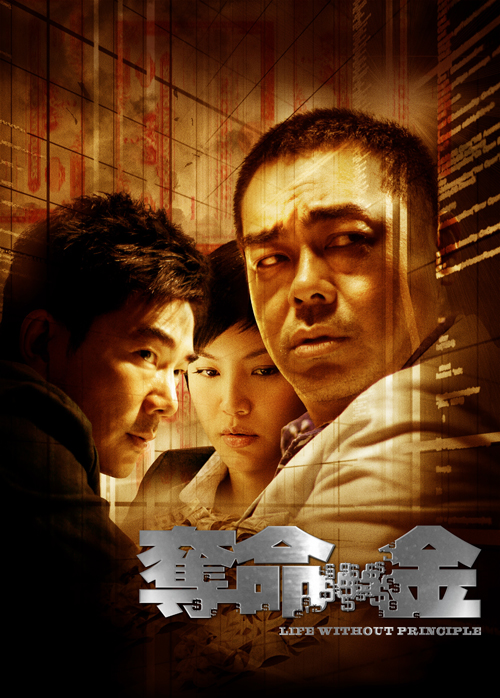
With Life without Principle, fresh from screenings at Venice and Toronto, To embarks on a full-blown network narrative. The film follows three clusters of characters across three days, with the last day showing the collapse in world stock markets caused by the Greek debt crisis. All the characters are tied to this macro-event. Police officer Cheung and his wife Connie are about to buy an apartment, the bank investment advisor Teresa sees her customers lose thousands, and the triad Panther partners with his old friend Lung just before Lung’s market maneuvers crash.
Each character has more personal concerns as well. Cheung has learned that his dying father has taken a Mainland mistress, and he and Connie must decide whether to adopt the woman’s child. Teresa’s sales record is poor, and she’ll lose her job if she doesn’t generate more business. Panther needs money to bail out an errant triad colleague. Tying together all three strands is the gloating moneylender Yuen, who scoffs at the stock market and points out that he offers better terms than credit-card companies.
Designing a network plot offers you essentially two options. You can intercut all the strands as the protagonists move through time together (as in Nashville) or you can segregate the plotlines into blocks, as in the “chapters” of Pulp Fiction or the character-tagged chunks of Go. In the block pattern, some chronological fiddling will be necessary. We follow one character or group through story events and then hop back to an earlier period in order to follow another strand.
Mild spoilers start here.
Life without Principle takes the block option. A prologue shows Cheung investigating a murder and Connie trying to buy an apartment for them. The bulk of the film starts by following Teresa through the days leading up to the financial crisis. The narration then glides back to the evening of the first day and we meet Panther, an obsequious but loyal triad working for a self-centered boss. Panther eventually joins his pal Lung in an internet stock swindle. The two plotlines converge at a murder in the bank’s parking ramp, involving HK $10 million in cash. In its final stretch the film starts crosscutting among Teresa, Panther, Lung, Cheung, and Connie. Each line of action comes to a distinct climax, only tangentially related to the others but still tied together by the fluctuations of the stock market.
Still, Johnnie To offers a network narrative on his own terms. Where a Hollywood film is careful to tell us when it skips back in time, usually by use of titles, To’s playfully laconic narration eliminates titles. Instead, the transitional marker is a rightward tracking shot of Hong Kong Island accompanied by jaunty a capella music in Swingle Singer style. More generally, To doesn’t mark the three days overtly within Teresa’s and Panther’s tales. To is more interested in creating a flow across each story rather than that sense of modular architecture we get with modern day-by-day plotting.
Moreover, the tonal shifts that we find in many Milkyway films help keep the stories distinct. Teresa’s and officer Cheung’s plots are straightforwardly dramatic and suspenseful, while Panther’s is grotesquely comic—a quality underscored by Lau Ching-wan’s blinking portrayal of a dense but compulsively earnest company man. The spaces are at variance too. Teresa is never seen outside the bank building (until the last shot), and so the action in her story is built around enclosure and small details, especially a crucial key. Panther’s story is expansive, roaming from a triad banquet to the streets and cafes of Kowloon.
The film relieson classic suspense techniques to an unusual degree , especially the passages in Teresa’s office. Moreover, we always like a drama that forces sympathetic characters to make bad decisions. Cheung, who impassively does his duty as a good cop, ponders disowning the half-sister he never knew he had. Panther, abused by his boss and his pals, remains naively loyal to them.
Our keenest investment, I think, is in Teresa’s situation. Rapacious bank policies make her sell chancy investments to people who can’t understand them. Her scenes with the aged Hi Kun, blindly buying into a high-risk fund, consume an agonizing ten minutes, and throughout you sense Teresa’s qualms about the scam she’s pulling. When she goes to fetch Hi Kun coffee, she pauses meditatively over the cup: laconic To again. Later, when Teresa is confronted by massive temptation, all our instincts urge her to succumb, even though it would be a crime.
Will these basically decent people come through the financial crisis unscathed? The Milkyway universe can be harsh and capricious. Expect the unexpected.

So Hang-shuen, Denise Ho, and Johnnie To on the set of Life without Principle.
Son of seduced by structure
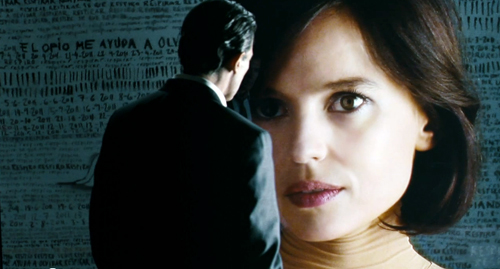
The Skin I Live In.
DB here:
Contemporary Hollywood films can play prettily with time, parallels, and point-of-view, at least within certain boundaries. (We’ve talked about this with Source Code, Inception here and here, and other titles further back.) But if you want to see filmmakers coloring outside the lines, a film festival provides a wider sampling of ingenious storytelling strategies.
Last year, in “Seduced by structure,” I wrote about films that worked ingratiatingly with flashbacks, stories within stories, and the like. I’m still a sucker for these things, and several of the offerings at the Vancouver International Film Festival have enticed me. Since these are rather new films, I’ll try to avoid spoilers.
Flashbackhand
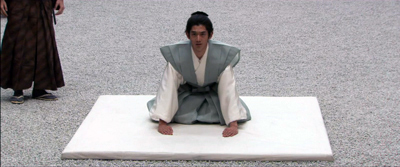
Harakiri.
Perhaps the simplest case I’ve encountered so far is Miike Takeshi’s 3-D Harakiri: Death of a Samurai. It’s seventeenth-century Japan, and penniless samurai are eking out survival through the “suicide bluff.” They arrive at a noble house and ask to commit seppuku on the premises. Because the family won’t risky sullying the family name, the ronin are paid to go away. But the head retainer of the house of Ii is done with the game. The suicide bluff, he maintains, dishonors the samurai code.
A severe-looking ronin appears and asks to die in the Ii compound. The retainer explains to him that recently they had a similar request.
Thus begins the first of two flashbacks. It’s confined to the visit of a very young samurai making the suicide petition, with harsh and grisly results. We return to the narrating frame, and we find that the original petitioner isn’t dissuaded. Why not? And why are the three swordsmen most implicated in the young man’s visit missing today?
A second flashback, more or less from the standpoint of the older petitioner, goes far back in time to fill in the youth’s identity and background. This structural choice shows several worthy things that a flashback can do. It can flesh out things that were merely hinted at earlier, in both the present-time sequences and the first flashback. The flashback can create mysteries by virtue of its placement, as indicated earlier. It can build its own narrative momentum: Even though we know vaguely how things are likely to go, we get to see the gaps filled in with unexpected details.
The flashback pattern also creates two layers of response. We know the young man’s fate, so everything in the leadup gains an extra pathos. Meanwhile, as we recall the present-time situation, the older petitioner’s action remains suspended and we want to return to it to see how it develops. A bonus is that arranging the film in flashbacks allows an intense, arresting scene to appear at the film’s beginning, with the young ronin’s petition, and then assign a cluster of swordplay fights at the end. Arranged in linear story order, the scenes would have created a slow-burning opening and a crowded conclusion, with several violent scenes close together.
A more audacious play with flashbacks is found in Pedro Amodóvar’s elegant, decadent The Skin I Live In. As with Harakiri, we begin far along the story’s development. A beautiful young woman is imprisoned in a postmodern equivalent of the mad scientist’s lair, a designer house filled with sumptuous furniture and high-tech gadgetry, including a close-circuit video system that lets the doctor keep an eye on his prey. Already there are plenty of questions, particularly when the young woman, Vera, asks to stay with Robert forever.
We quickly asume that she is the object of the doctor’s experiment in creating unblemished, fire-resistant, and snugly fitted human skin. (Almodóvar used a digital intermediate chiefly for the purpose of making the actress’s skin perfect) But more questions arise when a horrendous jewel robber named Zeca, dressed in a tiger skin (it’s the carnival season), breaks into Vera’s sanctuary.
Melodramatic twists come thick and fast, and the first flashback, sponsored by the maid Marilia, tells us of how Robert’s first wife was burned in a car crash. His daughter Norma saw her mother commit suicide and became deeply disturbed thereafter.
The family history gets even more tangled with two later flashbacks. One, initiated by Robert as he sleeps (though it seems more “objective” than a dream) takes us back six years and fills in more of Norma’s sad history. The second, more peculiar, return to the past is obliquely introduced by Vera. The narration seems pretty reliable, and it replays some of the events presented in Robert’s flashback. The curious thing is Vera doesn’t appear in any of the scenes. Shouldn’t she be present for at least some of the action she is “recalling”?
The question is answered with the sort of shocking finesse that Almodovar summons up effortlessly. The flashbacks in Harakiri fill in and flesh out what we’ve seen, while the flashbacks in The Skin I Live In reveal layers of shocking discoveries about what’s really going on in the present-time situation. The flashback structure doesn’t fulfill the film’s opening so much as yank the bottom out from it. Perverted story action summons up perverse narration.
I wish I could say more about these formal arabesques, but secrets must be respected. Suffice it say that Miike provides us a sober, dignified jidai-geki making modest use of 3D and lacking the outlandish gore that he’s come to be identified with. It’s not even as action-oriented as last year’s 13 Assassins. Harakiri ‘s most striking moments are quiet ones. A woman picks splinters out of her dead husband’s bloody hand. Earlier the same poverty-stricken man, having dropped a pair of eggs on the pavement, stoops and licks up their contents.
As for The Skin I Live in: Almodovar’s eye for fashion is still teasing; the credits list is a pageant of brand names like Gucci and Prada. He can also plant nifty little motifs, as when the tidy graffiti with which Vera has filled her cell are echoed by the window display in a dress shop.
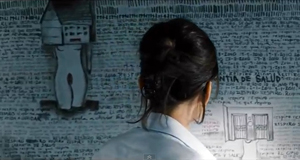

As usual, the story of revenge and unspeakable desire, or rather revenge as unspeakable desire, is wrapped in smooth technique, wondrous music, and eye-gratifying palettes. The flashbacks help too.
She said, he said
Split plot structures have become more common in recent years. Hong Sang-soo provided one of the most striking versions in The Power of Kangwon Province (1998); a recent instance is Apichatpang Weerasethakul’s Syndromes and a Century (2006). In the most common case, the film is split into two long sections, with each line of action following a different character or presenting alternative possibilities. Sometimes the lines present successive lines of action, as in Chungking Express. Sometimes the lines are more or less simultaneous, suggesting different viewpoints on the same events. Often the two lines intersect, so we get scenes replayed from different viewpoints or suggesting alternative versions of events–even parallel universes.
This sort of cleft plot patterning is exploited engagingly in The Natural Phenomenon of Madness, a Filipino film by Charliebebs Gohetia. A brief prologue sets up the situation. A man and a woman, friends since childhood, are having sex, and suddenly it turns rough. Both will later think of his action as a rape. He leaves in the morning, she chops off most of her hair, and they proceed to live their lives separately, sometimes converging, usually not.
The first long chapter, called She, follows her days wandering the city, signing up for a medical study, visiting a grave, inducing a miscarriage, and pursuing Him, whom she loves more than anyone. The second section, “He,” traces his efforts to induce another woman to marry him, to assuage his guilt about the rape, and to get Her to help him with his bone-marrow transplant. Both lines are taking place at roughly the same time and pace. The woman’s autobiographical monologues addressed to offscreen medical personnel are paralleled by the man’s increasingly sorrowful confessions to a priest. She’s a Bohemian artist, He’s a store owner wracked by Catholic guilt. At times, we see them doing things alone that suggest a sort of spiritual synchronization: She stands at a bridge and shouts, and later we see Him doing the same thing.
He and She meet occasionally, and then we get the same scene twice. Or do we? Every repetition is played out in symmetrically varied ways. For instance, early in the She chapter, He is already seated by a wall playing with an origami (of the sort my grade school used to call a Cootie Catcher). She joins him.
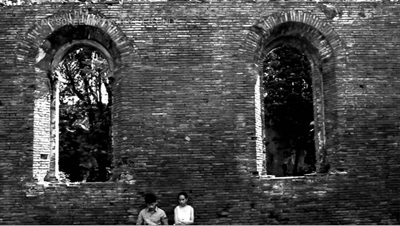
In His story’s version, she’s already there, playing with the origami, and He comes to join her.
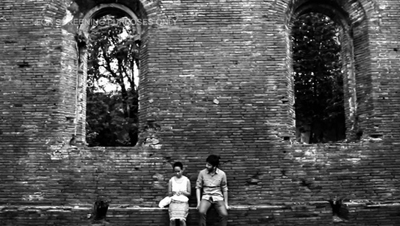
Moreover, the conversation isn’t the same each time. So are the apparently iterated scenes completely different meetings, taking place in the same locale and filmed in similar fashion? Some cues suggest that the tandem sequences represent only one occasion. For instance, both of these wall scenes purportedly show their first meeting since She cut her hair. As we’re watching, we might be forgiven if we’re not sure of the variations: The repetition comes about 67 minutes later than the original scene. We’re left with meetings that are partly repetitions, partly variations: alternative universes embedded in one, perhaps.
One effect of the parallel plotting is to heighten the differences between the two protagonists. As Gohetia suggested in the Q & A after the VIFF screening, She actively chooses ways of living her life, while He clings passively to his situation, hoping that the other woman will marry him, that somebody will donate bone marrow, and that the Church may offer help. Both have unrequited love: She wants him, He wants another girl. There are plenty of abstract parallels, such as that between the medical establishment and the clerisy, but the precise, locked-down shots help us notice physical differences too, such as the walk through Manila streets with distinct gaits. And the final convergence of the couple nicely echoes the prologue. The Natural Phenomenon of Madness shows that once a new narrative strategy enters the public domain, filmmakers can play with its components, twisting them like facets of a Rubik’s cube to engage us in fresh ways.
The Skin I Live In will be released in the US by Sony Pictures Classics on 14 October. The American Cinematographer story on the making of the film may be read here.
P.S. 6 October 2011: Thanks to Philippe Mathieu for correcting an erroneous film title!
P. S. 14 August 2012: Thanks to Marvin Ortiz for correcting two characters’ names in my account of The Skin I Live In.

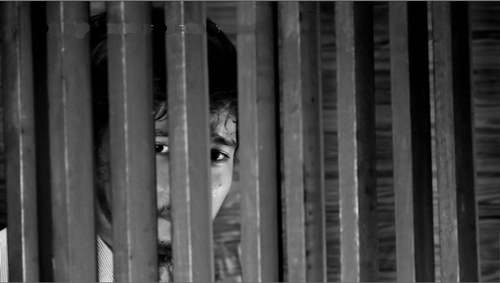
The Natural Phenomenon of Madness.
Ruiz in memoriam: Rules and ruses
Of Great Events and Ordinary People.
DB here:
Last week, Raúl Ruiz died. His death is an enormous loss to world film culture, not least because his penultimate work, Mysteries of Lisbon, brought him a prominence he had been denied throughout his forty-year career. More important, we lost a modest, kindly, and zestful man.
From the mid-1960s through 1975, it seems to me, there emerged an interesting in-between group of filmmakers. By then film festivals had canonized an official art cinema typified by Fellini, Bergman, Wajda, and the New Wave. Now there appeared a more capricious clutch of directors, of varying ages, who pushed in a more avant-garde direction. Many made outstanding short films, like Wenders’ Same Player Shoots Again, or the Straub/ Huillet Not Reconciled, or Akerman’s Hotel Monterey, or the peculiar early efforts of Peter Greenaway.
When they turned to features, this group of directors produced films like October à Madrid (Marcel Hanoun), The Chronicle of Anna Magdalena Bach (Straub/ Huillet), Fata Morgana (Herzog), Katzelmacher (Fassbinder), and Jeanne Dielmann (Chantal Akerman)—more rigorous and forbidding than anything attempted by the older generation. In later years some of these talents moved comfortably into the festival niches vacated by senior directors, but for many years most were little known outside a small circle.
If they were marginal to most moviegoers, Ruiz was marginal to them. Exiled from Chile, where he made his first features in his twenties, he moved to France in 1973. There he proceeded to direct over a hundred films, often financed by television, while staging plays and running the Maison de la Culture in Le Havre.
His films’ repute was in inverse proportion to their availability. He was celebrated by critics in France (Cahiers du cinéma took up his cause) and England (particularly by London’s Afterimage group). Ruiz had his fans in North America too, notably Jim Hoberman and David Ehrenstein. But the films were chiefly seen at festivals, and none of his productions of this period, so far as I can tell, found stable distribution, theatrical or nontheatrical, in the United States. In 1989-1990, while Ruiz was teaching at Harvard, a batch of his films was circulated here by the quixotic International Film Circuit.
What set him apart from the other marginals was a devotion to esoterica (philosophical, literary, ecclesiastical), pursued with a sly humor. He remarked that during one screening, he was the only person laughing at his movie. Although like most of his contemporaries his sympathies lay on the left, he didn’t seem to take himself seriously, and this put him at a disadvantage in 1970s-1980s world film culture. True, Herzog had a comic side, and in The Falls Greenaway offered whimsy, though of a relentless, almost oppressive variety. Most other directors, though, were somber as well as severe. But Ruiz enjoyed intellectual lampoon, pastiche, clever cross-references, and straight-faced absurdity; the Chris Marker of Letter from Siberia (1957) is perhaps a predecessor, though Marker himself didn’t escape Ruizian parody.
Ruses
Of Great Events and Ordinary People.
Having seen about ten percent of the Ruiz oeuvre, and a lot of it quite long ago, I can’t offer a comprehensive appraisal. (Visit the bottom of the page for some more assured threads through the maze.) For reasons that will be understandable to regular readers of this page, however, I feel obliged to write something in his memory. I merely offer some observations on aspects of his work.
Ruiz often based a film on a striking formal premise, what Henry James might call a donnée. Socialist Realism (Considered as One of the Fine Arts) (1973) began, Ruiz tells us, from the idea of
having two stories that would never meet (like in Faulkner’s Wild Palms), separated by a poem. The link would be made through this lyrical element placed at the centre – the element I eventually decided to throw out. These two stories would touch each other for a single moment, accidentally, and this moment would be secondary in relation to the totality of the film.
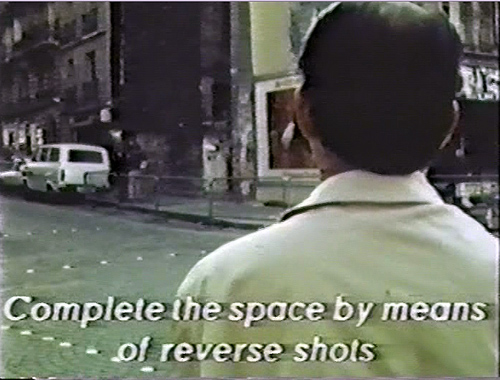
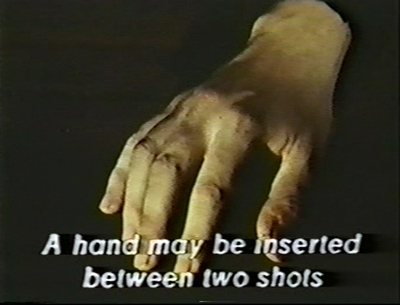
Imagine another sort of intersection: two films in one, not a film-within-a-film but two distinct movies, one incomplete, the other filling the gaps but revising and correcting the first (The Suspended Vocation, 1977). Or imagine making an art-history documentary that speculates on the possibility of a missing link in the output of an imaginary, mediocre artist (The Hypothesis of the Stolen Painting, 1979). How about dismantling the conventions of TV election coverage, to the point where one can no longer discern what candidate won (Of Great Events and Ordinary People, 1979)? Or what if a man assigned to memorize the names of 15,000 political resisters becomes absorbed in recalling visiting a movie house as a child (Life Is a Dream, 1986)? Or perhaps a single actor could play different characters (Three Lives and Only One Death, 1996)?
In their working out, however, these givens often fret and fall away. They are overtaken, or nowadays we might say overwritten, by digressions, anecdotes, accidents, interruptions, abstruse commentary, coincidences, free associations, labyrinthine plot twists (often driven by conspiracies and secret pacts), and Surrealist juxtapositions. The movie house of Life Is a Dream has a toy train running through it. Ruiz’s affinities with Borges and Góngora and Chesterton point to an almost academic fascination with schematic systems, as well as the desire to push them toward absurdity. It’s telling that the poem that was to knot the two strands of Socialist Realism was clipped from the movie.
Narrative binds, but narrative also loosens. It can be a robust oak, but it can also be kudzu. Ruiz understood that what keeps us listening, reading, watching is the promise of a surprise that in retrospect will seem inevitable. The best tragic plot, Aristotle says, is one that makes unexpected things happen within a cogent chain of causality. Ruiz knew our inclinations, but what he gave us were plots of the sort that Aristotle calls episodic–perhaps we should say fragmentary. His plots exfoliate, in both senses of the word: they spread out from a kernel, and they peel off in flakes.
In this respect he turns out to be the realist, and Aristotle the fabulist. Ruiz understood that real-world stories breed like rabbits. Listen to yourself and a friend in conversation, and you’ll find one story calling up another, with yet a third crowding from at a tangent before the first one is finished. In plotting our fictions, we can multiply tales neatly, staking them out in parallel lines or coiling them inside Chinese boxes. But if we take the pressure off, the stories can burst out of control, intertwining or doubling back or sprawling out or just dying off. Feuillade and his contemporaries understood this: A serial could go on forever, because we could plop in a fresh character and create a further adventure. The same thing happens with news on the Internet, spreading and splintering, each version of a story torn apart but also expanded by rehash and critique.
Perhaps we can take some of Ruiz’s abrupt deep-focus shots, blowing up an action or a bit of the set that would otherwise be minor background detail, as a pictorial reminder of the centrifugal impulse of narrative. Anything looming in the foreground hints at the possibility of a new character with a new story. In Three Crowns of the Sailor, while the sailor listens to a tale told by the Blind Man, we are distracted by grotesque glimpses of what unseen others are up to in the bar.
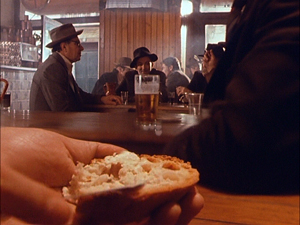
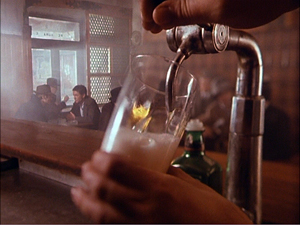
Stories have to end, but nothing at the end can match the arousal of a beginning. Endings usually disappoint. The explanation of an puzzling situation–say, footprints on the ceiling–will inevitably be more prosaic than the premise that sets our imaginations on a wanton chase. (Hence the perfunctory, even arbitrary, resolutions of detective stories.) By contrast, openings refresh us and, as the name implies, “open” things up to crazy possibilities. So why not use the prospect of endless beginnings, perpetual change of situation, to sustain the magic?
What becomes inevitable isn’t a logical resolution, which has to be more or less imposed by tradition. What’s inevitable is a perpetual spawning of characters, plots, and situations. So an apparently stable, albeit fantastic, narrative situation posited at the start may be undermined. Again and again the film seems to start over; the rules keep changing. Ruiz made shaggy-dog stories for cinephiles. He was a formalist who liked unraveling forms.
On the whole I was more an admirer than an enthusiast. I thought Ruiz’s films were imaginative and risky in ways that opened up new horizons. I tried to do justice to his importance in the survey of film history that Kristin and I composed.
Yet here we confront the difference between critical judgment and personal taste. I tended to find each Ruiz film intriguing on an intellectual level, but dry and scattershot as well. For all the prodigious invention, and given his bias toward free-range story breeding, I sometimes thought that the données were underdeveloped. He had wondrous ideas, but I wasn’t sure that he did enough with them. And of course some stretches of his yarns were downright opaque to me.
Still, artists have a way of teaching us how to watch, and rewatch, their work. Maybe now, after having been absorbed by Mysteries of Lisbon for reasons sketched here, I’m better prepared to appreciate the legacy of a unique sensibility–one that has already given us the adjective Ruizian. It is a term of praise.
No filmmaker had more zealous proselytizers. His admirers have shown how to blend analytical precision with brio. They make you want to see the films pronto. The Ruiz initiate can start with Adrian Martin’s homage at girish’s site. You won’t read a more sensitive piece of film criticism this year. Next savor James Schamus’ memoir at Filmmaker, where he recalls working with Ruiz on his first US film. Proceed to Jonathan Rosenbaum’s posting of one of his classic studies of Ruiz, which includes links to other essays.
Now you’re ready for the heady experience of the annotated filmography (complete up to 2004) in the journal Rouge. Both Adrian and Jonathan participated. My quotation about Socialist Realism comes from there. By now you should be on to the films, and perhaps the writings collected in volumes one and two of Ruiz’s Poetics of Cinema.
By chance I commented on Ruiz just a little while ago. And thanks to B. Kite for the note about Ruiz and Harry Stephen Keeler, obviously kindred spirits. Mr. Kite sent Ruiz some Keeleriana, which may have influenced what Ruiz says here.
Apologies for my tongue-twisting title, which is offered in the spirit of Tres Tristes Tigres.
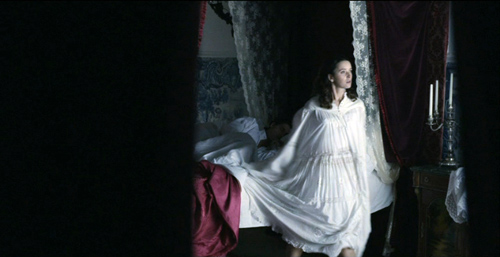
Mysteries of Lisbon.
Ruiz, realism, and…me?
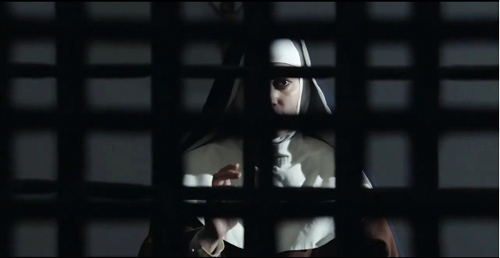
Mysteries of Lisbon (2010).
DB here:
Once Fassbinder said something to this effect: “One is always misunderstood. If you spend time clearing up misunderstandings, you’re dead.” Usually I think this is good advice. Now, though, a filmmaker whom I admire has, in publicity for a film that I admire, misunderstood me. So I’m squawking, mildly.
I met Raúl Ruiz only once, many years ago during his visit to our university here in Madison. We’d programmed At the Top of the Whale and Life Is a Dream. One afternoon we were sitting in the Student Union looking out over majestic Lake Mendota, and he started to muse. “I see a boat on the lake. Three men are in the boat. One is planning to kill the other two, but we don’t know which one it is.”
This was only one of many forking paths our conversation took. Over dinner that night Ruiz was at pains to explain that there was nothing new in Postmodernism that we couldn’t already find in the Spanish Baroque. That was pretty persuasive. He talked as well about his two production courses at Harvard. “In one, we shoot a drama as if it were a TV quiz show. In the other, we shoot a quiz show as if it were a drama.” In sum, typical Ruiz ebullience and passion for rethinking forms.
Earlier this year my name got linked to his in an unexpected way. In an interview, Ruiz mentioned that a Swiss magazine had claimed that Mysteries of Lisbon didn’t conform to “Bordwell’s Paradigm,” and he agreed. Alerted to this interview by Adrian Martin, I shook my head and thought, I don’t know what Bordwell’s Paradigm is, so how can anybody else? I suspect the label has to do with my characterization of classical Hollywood cinema, but who knows?
Since then Ruiz has signed a discussion of Mysteries of Lisbon that expands on the same theme. You can read it here. It starts off with a bang:
The American professor David Bordwell considered that all narrative strategies that can be applied to modern films are based on a certain notion of verisimilitude (or narrative evidence).
Thanks to them, the most unbridled fictions are acceptable and accepted. And this very verisimilitude, it is said, is averse to any straying from a guiding line (what is commonly called the action’s guiding arrow), with its variations in intensity and its turbulent twists and turns.
This theory, which depends on a certain number of rules often abusively attributed to Aristotle, finally became what purists hastened to naively call “Bordwell’s paradigm”–the whole of narrative strategies that stem from impulse, from the presumption of verisimilitude.
What is called “modern drama” or “bourgeois drama,” or even “the Ibsen Shaw postulate” has given rise to this superstition. In modern drama, structure and construction dominate, even beyond the poetic incoherence or the irrelevant facts it supposes. The author is an architect who builds shelters for fictions, various events which, and only because they are protected from the rain of the improbable, become credible and relevant.
Each of these fictions, of these mobile structures, is guided by a narrative arrow. But beware, only one per fiction: William Tell is a well-told story because only one arrow cuts in two only one apple, but the battle of Azincourt is not because Robin Hood and his people’s swarm of arrows does not enable one to read the time on the narrative clock, veiled as it is by clouds of arrows, each guided by its independent little intrigue. “Clouds and not clocks” would say Karl Popper.
In modern drama, the proliferation of truncated facts is not acceptable because it makes us stray from the notion of causality which is inherent to that of verisimilitude, and without which there would be no story.
Promoting a film by citing an American professor may not be the height of shrewd marketing, but put that aside. Peering through the haze of this rather awkward translation, I’m inclined to say that Ruiz mistakes my claims. I’ve said in several places that narrative, prototypically, requires causality. But that isn’t the same thing as claiming that such causality is realistic in nature, or that causality is the main attraction of narrative. Mainstream cinema, including Hollywood, often uses certain kinds of verisimilitude as an alibi for formal experimentation. And I’ve celebrated filmmakers like Eisenstein and Ozu who break away from narrative causality.
It’s ironic that on the same day I post a blog entry arguing that realism gets short shrift in studio cinema of the 1940s, I find Ruiz claiming that realism is my guiding light. If I disapproved of the “disparate, truncated, labyrinthine and baroque” aspects of narrative, I wouldn’t have said this about Mysteries of Lisbon:
This being a Ruiz film, there is as well a tangible pleasure in the artifice of storytelling. The film acknowledges that all the handy coincidences, buried pasts, multiple identities, and revelations of kinship are there for our delectation. . . .
This recounted history is only the first of a cascade of flashbacks, issuing from several characters, and these gradually show deep connections among persons tied to Pedro’s past. Secondary characters in one story become protagonists of another. The young hero is gradually displaced as the center of the action by war, secret romances, rivalries, duels, and infidelities. Like Pasolini in his Trilogy of Life, Ruiz is happiest when opening up a plot detour that will eventually become a new main road.
You can read my whole account, from last year’s Vancouver International Film Festival, here.
I think that Ruiz and I might disagree about how much Mysteries owes to psychological causation, and about whether labyrinthine trails can converge, let alone become highways. Both of us use metaphors of linearity, so maybe our disagreements are basically about whether the detours and paths are truly dead ends. Maybe I think his plotting is tighter than he does. Still, I expect that we’d agree that much of the pleasure of the film is its delight in apparently capricious digression.
Anyhow, my squawk is mild because it’s a pleasure to be misunderstood by a grand filmmaker. What Fassbinder didn’t say was that artists’ misunderstandings can be productive, leading to the creation of new artworks, and perhaps ideas about them.
If my remarks on Mysteries of Lisbon don’t make you thirst to see it, Manohla Dargis’ review surely will.