




Archive for the 'Narrative strategies' Category
Innovation by accident
DB here:
The old drama is being reenacted before our eyes, and as often happens, Harvey Weinstein plays the villain. The American release version of Wong Kar-wai’s The Grandmaster, which has cut and changed the original, is being decried as a travesty, the dilution of an artist’s original conception in the name of what somebody thinks will sell.
I take up The Grandmaster in another entry. For now, I just want to point out the archetype goes back long before Harvey came on the scene. A screenwriter or director comes up with a fresh approach to telling the story. But a producer rules it out as something the audience won’t buy, or even understand. Moral: In Hollywood, the creative force is stifled by a money person who insists on doing things as usual.
The 1940s in Hollywood was an era of narrative innovation. It gave us weird dream sequences and insane protagonists and subjective point of view and byzantine flashbacks and talking houses and complicated replays of action we thought we understood. While working on a book on this era, I’ve begun to wonder what the limits of innovation might be. What could make the boss tell the filmmaker that a particular narrative choice just went too far?
Fasten your seatbelts, it’s going to be a bumpy production
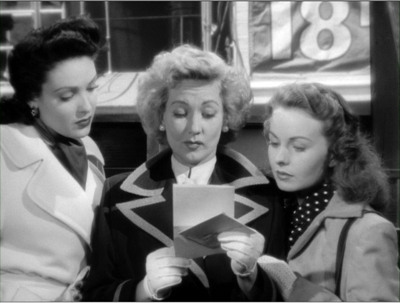
A Letter to Three Wives (1949).
One example I found was purely anecdotal, but nifty nonetheless. In preparing the screenplay for Out of the Past (1947; aka Build My Gallows High), screenwriter Daniel Mainwaring wanted to have the story told by a deaf-mute boy. Apart from the fact that the boy plays a minor role in the opening of the film as it was finished, the idea of someone who cannot hear or speak serving as narrator proved to be something of a stretch for the time. Mainwaring reports that the idea was rejected.
That’s the kind of thing I wanted to find. Yet my searches sometimes came up with cases where the producer’s notes actually resulted in improvements. Take A Letter to Three Wives (1949), justly praised as one of the best films of the 1940s.
John Klempner’s original novella (published in 1945) and novel (1946), both titled A Letter to Five Wives, obviously involved two more couples. After some other writers had drafted versions, Vera Caspary was assigned to prepare a treatment. Probably with the input of producer Sol Siegel, she eliminated one couple. Her adaptation already contains much of what is distinctive about the movie as we have it. Instead of the many distributed flashbacks in the originals, the treatment consolidated them into three lengthy ones. At Siegel’s suggestion, Caspary brought the three women together on the boat. To Fox studio chief Darryl F. Zanuck we apparently owe the idea that one woman, Deborah, would be the primary vehicle of our sympathy and would initiate and resolve the mystery of whose husband has defected. Above all, Caspary’s treatment includes the unforgettable voice-over of the never-seen Addie Ross.
When director Joseph L. Mankiewicz saw Caspary’s final adaptation, in effect “A Letter to Four Wives,” he declared he “looked upon the Promised Land” and quickly turned it into a screenplay. After reading Mankiewicz’s screenplay, Zanuck intervened again , demanding that another wife be lopped off. Mankieiwicz called this “an almost bloodless operation.”
It’s probably irrelevant that A Letter to Three Wives won that year’s Academy Awards for best screenplay and best direction. Even if it hadn’t been honored, after reading the original tales and Caspary’s adaptation, I have to conclude that the film is the best version of the lot. I suppose it partly goes to show the old rule that bad or so-so books can make very good movies. (Exibit A: The Birth of a Nation; Exhibit B: The Magnificent Ambersons; Exhibit C: The Godfather. Defense rests.) But clearly, the cuts and changes demanded by Siegel and Zanuck improved the property. The “creatives”–Klempner, Caspary, Mankiewicz–were by force majeure steered toward good results.
You can argue, though, that no written version of the film tried to be innovative, except perhaps for the device of Addie’s spectral presence. And Mankiewicz declared himself happy to make the adjustments. What about cases in which genuinely bold ideas were curtailed by the powers above? So I looked into two titles that, when released in the producers’ cuts, were denounced by their writer-directors.
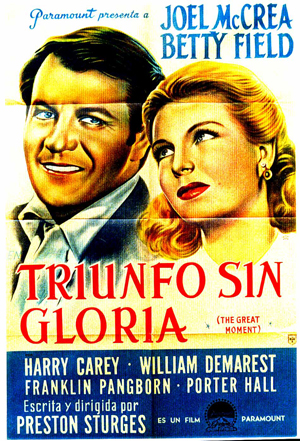
Two years after Preston Sturges finished and cut his film about the discovery of ether anesthesia, Paramount producer B. G. “Buddy” DeSylva supervised and released a reedited version called The Great Moment (1944). Sturges noted of the film:
It is coming out in its present form over my dead body. The decision to cut this picture for comedy and leave out the bitter side was the beginning of my rupture with Paramount. . . The dignity, the mood, the important parts of the picture are in the ash can.
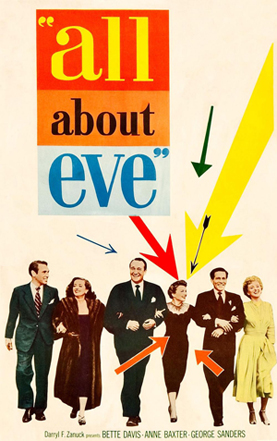
A second example is a more famous release, Twentieth Century-Fox’s All About Eve (1950). After the success of A Letter to Three Wives, Zanuck allowed Joseph L. Mankiewicz to film his three-hour screenplay as a “shooting draft.” When Zanuck saw the result, he insisted on cutting it to 138 minutes.
Throughout his life Mankiewicz was an angry man. His interviews and writings excoriate mothers, film festivals, doctors and nurses, Michelangelo Antonioni, television, the American male, theatre operators, Graham Greene, the AFI, PBS, Richard Nixon, Dennis Hopper, The Untouchables (film version), British craft unions, and other malefactors. High on the list was Darryl F. Zanuck. Long before the Cleopatra debacle, Mankiewicz was already carrying a grudge because Zanuck removed a replayed scene from All About Eve. He definitely didn’t consider that a bloodless operation.
Zanuck had final cut and he got bored with the same scene shot from different points of view.
Here, I thought, were sterling examples of creators bumping up against what was impermissible. Yet the more I looked, the more I found that the situation couldn’t be reduced to the daring director versus the philistine producer. I was forced to consider the possibility that the producers’ changes yielded not timid conformity but instead some unpredictable results–things that were themselves novel, in intriguing ways. The suits hadn’t intended to do something bold, yet in revising and patching up the films shot by two venturesome directors, they actually found themselves pulled in new directions.
Call it inadvertent innovation. Not surprisingly (this is the 1940s), it involved flashbacks.
Which great moment?
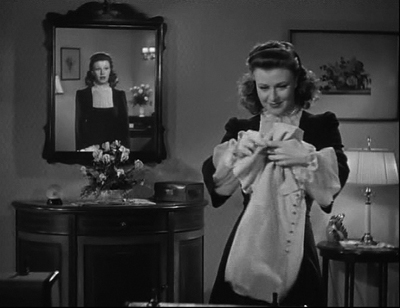
Kitty Foyle (1940).
By the early 1940s, movie flashbacks adhered to several conventions that we still recognize. Typically, we’re given a situation, the narrative Now, in which a character is recounting or simply remembering past events. We then move to those events, a shift often signaled by a track-in, a musical cue, a dissolve or other optical effect, and/or sounds from the next sequence mingling with the spoken transition. We may hear the voice-over remarks of the lead-in character at times during the action we see. Once the flashback action is complete, we return to the present, with the character who launched the flashback finishing the testimony or closing off the memory. And if the film includes several flashbacks, they are typically presented chronologically, so that the earliest events from the past are shown before later ones.
Kitty Foyle (1940) offers a clear example. In the present, Kitty recalls her romances. As they develop, we return to the present at key moments to gauge her reactions. For the sake of clarity, the romances themselves are shown to us in 1-2-3 order, tracing the events that lead up to the crisis that launched her memory journey.
Not all flashbacks respect chronology, though. Citizen Kane’s first flashback traces Kane’s career as the banker Thatcher knew it. His recollections show us Kane as a child, a young man, and then a much older man forced to sell his newspaper empire. The next flashback, as recounted by Kane’s business manager Bernstein, takes us back to show Kane as a young man assuming control of his first newspaper. Several years before Kane, Sturges had composed a script based on similarly shuffled chronology. The Power and the Glory (1933), directed by William K. Howard, presents an old man recalling episodes in the life of tycoon Thomas Garner, and those are presented out of 1-2-3 order. (I analyze that film here.)
Sturges was confronted by the problem of order in preparing Triumph over Pain. This project would tell the story of Dr. W. T. G. Morton, the popularizer of surgical anesthetic. Biographical films about scientists and inventors had become a successful cycle in the late 1930s, but Sturges wanted to stay fairly close to the facts. The problem was that Morton’s story couldn’t lead easily to a triumphant finale. Sturges noted dryly:
Dr. Morton’s life, as lived, was a very bad piece of dramatic construction. He had a few months of excitement ending in triumph and twenty years of disillusionment, boredom, and increasing bitterness. . . . To have a play you must have a climax and it is better not to have the climax right at the beginning.
Accordingly, Sturges had somehow to rearrange portions of Morton’s life.
Since [the writer] cannot change the chronology of events, he can only change the order of their presentation.
The title Sturges gave to his final version, Great without Glory, indicates its tone. A quasi-documentary prologue hails the modern benefits of anesthesia. We move to the late 1800s, when Morton’s friend Eben Frost finds a medal given to Morton now sitting in a pawnshop. He brings the medal to Morton’s widow Elizabeth, and as they sit in her parlor, the film’s first long flashback starts. It presents the public celebration of Morton’s triumph, as he and Eben are driven through the crowded streets.
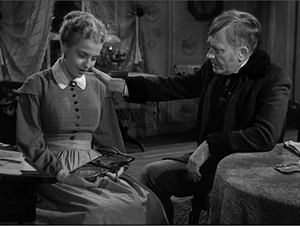
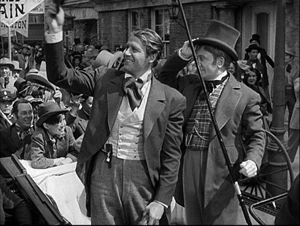
The ensuing scenes trace the aftermath of his discovery—the fact that he could not patent it, his efforts to build a business on sale of ether bottles, a bout of illness, and then his receiving the medal while he is plowing on his farm.
Sturges’ version returns to the narrating frame, as Eben examines some more personal memoirs that Elizabeth has written. The second flashback initiates the play with chronology. It traces events leading up to the action we saw completed at the start of the first one. The plot takes us back to the couple’s courtship, the first years of Morton’s dentistry practice, and his arduous experiments with ether. He finds prosperity using it on his patients. Challenged to demonstrate his invention in a public surgical operation, he realizes that his demonstration will show his rivals his trade secret. He is about to leave the operating theatre when he sees the patient: a girl about to have her leg amputated. Unable to let her face agony, he turns back to reveal his discovery to his peers.
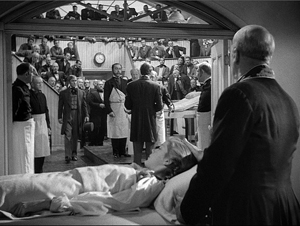
The plot’s true climax is Morton’s gesture of sacrifice. Sturges encourages us to see it as a contrast to the way the press and his profession vilified him. During the first flashback, a newspaper cartoon shows Morton preying on innocent patients, as typified by a girl on a gurney.
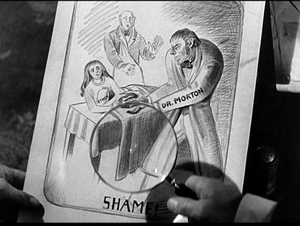
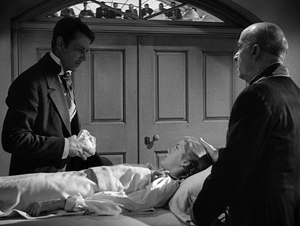
Sturges expected us, I think, to recall this image when Morton decides to help the girl. In his life, the cartoon came later, but showing it early in the film lets Morton’s gesture serve as a rebuke to those who are going to hound him.
After revealing Morton’s sacrifice, Great without Glory provides a bitter epilogue. The film ends with a return to the framing situation in Elizabeth’s parlor. Eben rises sadly, leaving Elizabeth alone.
Sturges could simply have built his film around Morton’s early life and his successful discovery, ending before the decades of poverty that followed. Instead, by focusing his biopic around our failure to appreciate and reward selfless research, he wanted to praise a man who achieved greatness but not the long-lived veneration accorded Edison or Pasteur. Yet showing Morton’s fall from grace after the crowd’s acclaim meant that the high point of a science biopic would be accomplished far too early in the plot. What we today call the “darkest moment”—Morton’s rejection by his public and his poverty—would come too soon. When Sturges showed his cut to his friend John Seitz, a great cinematographer, Seitz asked: “Why did you end the picture in the second act?”
According to Sturges, Buddy DeSylva said the same thing. He was already hostile to Sturges, and after some mixed preview results he set about reshaping the picture. The result is a good example, I think, of unintended innovation.
DeSylva did, as Sturges indicated, “leave out the bitter side” in certain respects. He lopped off the final scene showing the mourning of Eben and Elizabeth. The Great Moment doesn’t return to the narrating frame set up from the start of the picture. This is a little disconcerting structurally, but it wasn’t unknown at the period. Guest in the House (1944), Dillinger (1945), and other films “forget” the fact that they began with a character recalling the past.
Nor did DeSylva start the plot with Sturges’ prologue and narrating frame. He offered something immediately upbeat: Morton and Eben descending to the cheering crowd and riding through the streets to acclaim. This action, surprisingly, takes place during the credit sequence.
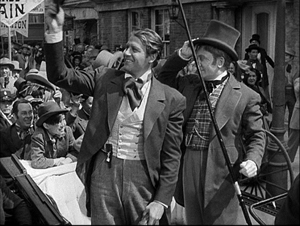
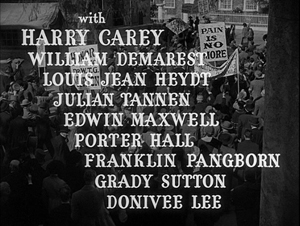
By inserting the moment of Morton’s triumph at the very start of the movie, before we have even seen a flashback to it, or indeed even know who these people are, DeSylva seems to illustrate the film’s title. Our first impression is that Morton’s great moment is the public recognition of what the crowds’ placards announce is his conquest of pain.
Only after this “flashforward” does the release version settle down to something roughly like Sturges’ structure. Eben discovers the medal, brings it to Elizabeth, and elicits her recollections. Some of the scenes are rearranged from Sturges’ version; the placement of one, showing Morton sick in bed, seems calculated to lead in to his death (as it doesn’t in the Sturges cut). The newspaper cartoon is there, ready to form a parallel with the climax. As in the Sturges version, a return to the narrating frame shows Eben and Elizabeth in the present launching the second big flashback. With other alterations, we go through the couple’s romance and marriage, culminating in the discovery of ether and the prosperity of Morton’s practice.
DeSylva retains Sturges’ climax: the scene when Morton must choose whether or not to reveal his trade secret to his competitors in the public demonstration. Seeing the girl praying on the gurney, he decides to do it. The film ends with him striding into the operating theatre, about to share his discovery. It is here that DeSylva halts the film, without, as we’ve seen, returning to the frame featuring Eben and Elizabeth.
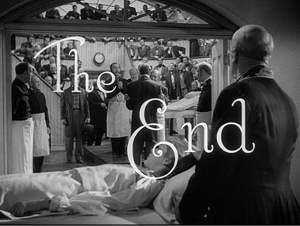
Both locally and more broadly, the effect is curious. Now Morton’s great moment is revealed, as Sturges wished, as the moment of his self-sacrifice, not the moment of his celebrity. But more strangely, without the final frame situation, the film ends just before the opening credits sequence. We could easily imagine the credits as an epilogue, with Morton’s entry to his colleagues dissolving to the parade in his honor before the final fade-out. Instead, the film halts and wraps back around itself like a Möbius strip: the last thing we see immediately precedes the first thing we saw.
I’m not trying to make this movie Memento or Primer, but there is something uncanny about the release cut’s looped structure. Sturges created a story that was depressing but tidy (prologue, carefully framed flashbacks, epilogue). DeSylva, unable to rewrite Morton’s history and apparently reluctant to junk the project, made the story more upbeat but also more untidy. Trapped by Sturges’ design, he re-carved it in a uniquely peculiar shape.
Sturges’ bold stroke was to switch the two chronological blocks of Morton’s life and to make us sense the injustice of Morton’s fleeting fame. DeSylva wanted to avoid the grim epilogue in the present and end on an upbeat note. But he did retain the split chronology, so that the contrast between obscurity and fame remains. He inadvertently innovated by making the opening credits preview a scene far ahead in the plot, and then letting the ending twist back to it. By playing the title over the parade, the release version shifts us across two moments, and meanings, of greatness: celebrity and self-sacrifice.
Did Buddy set out to be daring? I don’t think so. He faced constrained solutions whichever way he turned, just like us most of the time. More on this matter at the end.
As easy as C-A-C-B-C-B-C
As I mentioned, flashbacks usually sit comfortably in a frame, a well-established present situation that we depart from and return to. The shifts in and out of the past can be eased by various devices, one of which is a voice-over representing the character. The voice-over may be objective, as when a trial witness is testifying, or subjective, representing the “inner voice” of the person remembering what we have in the flashback.
Again, however, a film built out of flashbacks has many options. Coming to direction in the mid-1940s, Joseph L. Mankiewicz was in a position to try his own riffs on current experiments in storytelling.
So, for instance, in House of Strangers (1949), he frames a flashback without a voice-over. The camera coasts up a stairway to a window at night; dissolve to the window in daytime, and pull away to reveal the earlier scene. Our understanding of the time shift is aided by the comparison on the musical track: a phonograph record of a passage from the opera Martha fades out, and in the flashback, the Monetti family patriarch, now alive, is singing it.
Similarly, A Letter to Three Wives (1949) supplies the symmetrical structure in shifting from Deborah to her anxious memories and then back again.
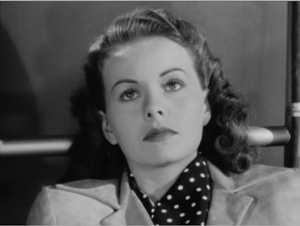
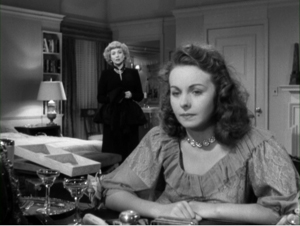
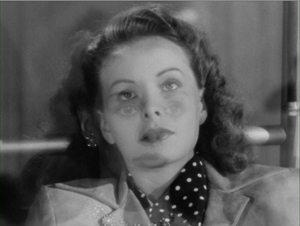
But the voice-over varies from the usual. Instead of hearing her voice asking herself, “Is it Brad?” we hear the voice of Addie Joss, who also narrates the film. The suburban wives’ obsession with their rival, who may have run off with one husband, has allowed her to burrow into each woman’s consciousness. (In addition, her voice merges with the chugging of the ship to create distortions courtesy of Sonovox.)
House of Strangers is built around one long flashback; A Letter to Three Wives gives us three parallel ones. All About Eve yields yet another variant. Three characters at a banquet recall their experiences with Eve, the dazzling young actress to be given an award. There will be several flashbacks following Eve’s career chronologically and skipping from one remembering character to another. Given this plan, Mankiewicz’s long version planned for one moderate experiment and one fairly daring one.
The moderate experiment was to eventually eliminate the visual anchoring of the frames. He had planned to start with very clear bookends around the flashbacks and then gradually discard framing scenes. For instance, after Addison DeWitt’s voice-over introduces the other characters, including Margo and Karen sitting at his table, Karen’s voice-over intervenes. We leave the banquet to flash back to her meeting Eve.
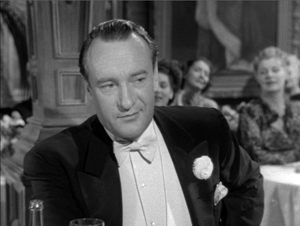
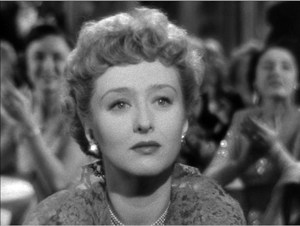
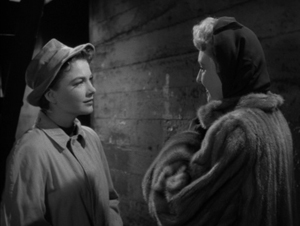
In Mankiewicz’s “shooting draft” of the film, we then return to the banquet in the standard bookend fashion. Karen looks over at Margo much as Addison had looked at her. We hear Margo’s voice-over, and then her flashback is launched. Mankiewicz planned, in all, three of these base-touching intervals in the banquet. The later flashbacks are simply signaled by voice-overs only, interweaving the memories of Karen, Margo, and Addison as Eve rises in the theatre world. In short, Mankiewicz wanted to replace block flashbacks with “polyphonic” ones, but only after careful preparation.
The more daring experiment, and the one whose loss rankled for years, was the idea of replaying Eve’s famous “applause” monologue. We’re at Margo’s party, and several characters are perched informally on the staircase. Addison and Bill, Eve’s fiancé, have argued about the nature of the theatre. Then Eve launches on a brief but impassioned ode to the joys of acting. Applause amounts to “waves of love coming across the footlights and wrapping you up.” Mankiewicz wanted this to follow a scene between Karen and Eve in Margo’s bedroom. Introduced by Karen’s voice-over, this scene shows Eve pressing Karen to help her become Margo’s understudy. Following this, Eve’s monologue can be seen as a warm testimony to her dedication to the theatre—a confession that Karen watches dotingly from a higher step.
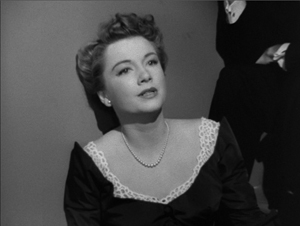
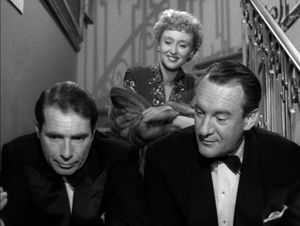
At this point, Margo enters from the kitchen and confronts Eve before insulting the other guests and flouncing off to bed.
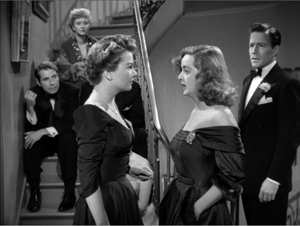
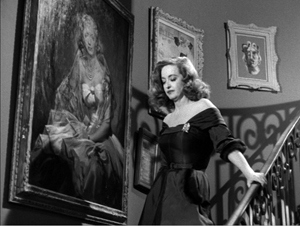
Instead of showing this scene’s aftermath, Mankiewicz wanted to break chronology and skip back to the beginning of the party, with Margo’s voice-over now introducing things. After some scenes showing her efforts to get Eve out of her life, she was to stalk out of the kitchen and hear in the hallway the end of Eve’s monologue.
They [Margo and Lloyd] exit into the dining room. As they open the swinging door, the CAMERA REMAINS in the doorway. Margo and Lloyd walk toward the stairs. In the b.g., Eve is talking to the group.
How much she says is dependent on how long it takes Margo and Lloyd to reach her.
EVE (in the b.g.): Imagine,,, to know, every night, that different hundreds of people love you… They smile, their eyes shine—you’ve pleased them, they want you, you belong. Anything’s worth that.
Just as before, she becomes aware of Margo’s approach with Lloyd. She scrambles to her feet….
MARGO: Don’t get up. And please stop acting as if I were the queen mother.
And as Margo speaks—or before—we FADE OUT.
By following Margo’s efforts to cast Eve out, the effect of hearing part of the monologue is to confirm Margo’s suspicions that Eve’s demure obedience conceals her desire to compete on the stage.
What Mankiewicz wanted, it seems, was to use a replay for a new purpose. In Mildred Pierce and other 1940s films, the replaying of an action fills in missing material, usually with the purpose of dispelling a mystery or providing a surprise. Here the replay contrasts two characters’ reactions: Karen finds Eve’s speech touching, Margo finds it threatening. Most replays enhanced plot, whereas this emphasized characterization (which in turn advanced the plot).
Or might have. Zanuck, as we saw, cut it out. The incisions left some little scars, as you can see from the discontinuities in the final version. Eve, her trance broken, glances up and sets her expression into standard Alert-and-Deferential Eve mode, as if Margo were coming right at her. Then she gets to her feet. All this apparently happens well before Margo rounds the corner of the doorway.
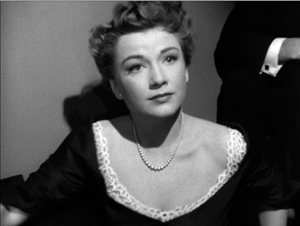
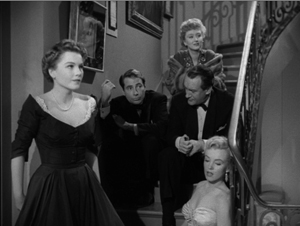
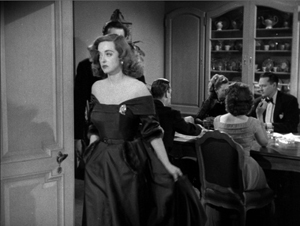
So Zanuck eliminated Mankiewicz’s boldest step. But, in a reciprocal movement, he found Mankiewicz’s flashback anchorings over-cautious. Zanuck’s version simply cut out all the returns to the banquet except for the very last one.
One consequence is to give greater saliency to the final portion of the banquet ceremony, which has been halted, as if by magic, during Addison’s address to us. Other effects of Zanuck’s excisions waft through the whole film. The floating voice-overs that Mankiewicz had painstakingly prepared (according to the Rule of Three) now emerge at the very start. Voices slip in and out of scenes, more or less tied to what each speaker could have known at that point but never given the sharp boundaries of the standard blocked-and-framed flashbacks.
These floating voice-overs point ahead to the freedom our filmmakers have enjoyed since the 1990s. We no longer demand that explanatory voice-overs be anchored in any Now; they can braid together as ongoing commentaries on the action. From Hollywood to Wong Kar-wai, filmmakers take for granted that they can discard bookended narration in the way Zanuck did. Mankiewicz objected to Zanuck’s habit of cutting scenes “from peak to peak to peak.” But the boss, who always liked his movies fast-paced, explained: “I am way ahead of you and so will the audience be.”
The choice cascade
There’s a lot more to be said about these films and filmmakers, and I hope to develop some of those ideas in my book. For now, there are some interesting lessons.
First, in filmmaking, once you’ve made certain choices, others follow and some become forced on you. What historians of technology call “path dependence” comes into play. Just as computers use fundamentally the same QWERTY keyboard that came into being with early typewriters, initial choices about a project set limits to what you can do. A trajectory makes certain outcomes more likely than others, and it’s hard to reverse.
Once Paramount committed to releasing some version of Sturges’ Pain project, DeSylva had to work with the split chronology somehow. But Hollywood tradition demanded an uplifting ending, so one had to be salvaged, even if that meant snipping off the return to the frame story. Similarly, once Mankiewicz commits to presenting Eve’s ascent from the perspective of three outside observers, certain narrational processes didn’t need as much redundancy as he loaded in. Likewise, Mankiewicz’s prized replay didn’t create path dependency. It was a branch off the main line and could, as Zanuck saw, be lopped off.
Second, in a routinized film industry, we ought to expect that conflicting demands and changes of plan will yield not only well-wrought plots and narration, but also partial, fractured, even discordant narrative patterns. Snafus and compromises are part of the process.
Finally, film techniques seem innovative only in relation to the norms of a period. Most of the narrative strategies employed by Sturges, DeSylva, Mankiewicz, and Zanuck would have probably seemed startling in the 1930s. By the 1940s, such experiments seemed fresh but comfortable additions to a growing repertoire of storytelling techniques. The studios’ solutions were feasible because some flexibility had already emerged in handling frame stories and voice-over transitions.
The history of film forms springs from creative choices made by individuals within institutions. Those decisions have consequences, intended or not. Sometimes the producers don’t suffocate new things; sometimes they create them. If only by accident.
Don’t worry, though. I won’t be making such arguments about The Magnificent Ambersons.
Daniel Mainwaring mentions his plans for Out of the Past in Backstory 2: Interviews with Screenwriters of the 1940s and 1950s, ed. Patrick McGilligan (University of California Press, 1988), 199.
On A Letter to Three Wives, my comparison of Caspary’s adaptation with Mankiewicz’s shooting script was enabled by the Caspary collection at the Wisconsin State Historical Society. Thanks to Mary Huelsbeck and the staff of the SHS for helping me access Caspary’s papers. Mankiewicz’s remarks about the process and Zanuck’s request to delete one wife are quoted from Robert Coughlan, “15 Authors in Search of a Character Named Joseph L. Mankiewicz,” a 1951 Life magazine article available in Joseph Mankiewicz Interviews, ed. Brian Daugh (University Press, of Mississippi Press, 2003), 17. Caspary was inclined toward modular plotting, as is shown in detail in A. B. Emrys’ Wilkie Collins, Vera Caspary and the Evolution of the Casebook Novel (McFarland, 2011).
Brian Henderson provides painstaking comparisons among various versions of Sturges’ scripts and the final version of The Great Moment in Four More Screenplays by Preston Sturges (University of California Press, 1995), 241-360. My quotations from Sturges come from James Curtis, Between Flops: A Biography of Preston Sturges (Harcourt Brace Jovanovich, 1982), pp. 171-172. Another robust biography is Diane Jacobs, Christmas in July: The Life and Art of Preston Sturges (University of California Press, 1994). Essential as well is the autobiography Preston Sturges by Preston Sturges, ed. Sandy Sturges (Simon & Schuster, 1990).
Mankiewicz’s “shooting draft” of All About Eve has never, to my knowledge, been published. It is available on the Internet, God knows how, here. My extract is from p. 74. A screenplay closer to the finished film was published in 1951 by Random House. It is reprinted in More About All About Eve: A Colloquy by Gary Carey with Joseph L. Mankiewicz (Random House, 1972). Mankiewicz’s regrets over Zanuck’s deleting the replay are expressed in Andrew Sarris, “Mankiewicz of the Movies [1970],” in Dauth’s Mankiewicz Interviews, 31. The characterization of Zanuck’s “peak to peak to peak” cutting can be found in Sam Stagg, All About “All About Eve” (St. Martin’s, 2001), 171. Zanuck’s remarks about being ahead of his director’s screenplay are quoted in Mel Gussow, “The Lasting Allure of ‘All About Eve,'” New York Times (1 October 2000), AR13.
Two lively and careful critical studies are Kenneth L. Geist, Pictures Will Talk: The Life and Films of Joseph L. Mankiewicz (Scribners, 1978) and Bernard F. Dick, Joseph L. Mankiewicz (Twayne, 1983). Charyl Bray Lower and R. Barton Palmer’s Joseph L. Mankiewicz (McFarland, 2001) is an indispensable guide to the director’s work and writings about it. Both Sturges and Mankiewicz are discussed with polemical relish in Richard Corliss, Talking Pictures:Screenwriters in the American Cinema (Penguin, 1995).
I’m grateful to Laura Russo and particularly John C. Johnson of the Howard Gotlieb Archival Research Center of Boston University. Mr. Johnson kindly supplied valuable information about the version of the All About Eve screenplay held in the Bette Davis collection there.
Another case of the suits’ laying down demands to which a director responds creatively involves the final shot in Bill Forsyth’s wonderful Local Hero. Details here.
Finally, this entry is one in a series of spinoffs of my ongoing work on narrative in 1940s and early 1950s Hollywood. A gathering point for related blog entries is here, and a relevant web essay is here. As a coda to these 1940s films, it’s worth noting that in The Barefoot Contessa (1954) Mankiewicz did get to mount a replayed flashback scene, and in the 1960s he prepared a screenplay of Lawrence Durrell’s Alexandria Quartet that would have presented several characters’ perspectives on the central action.
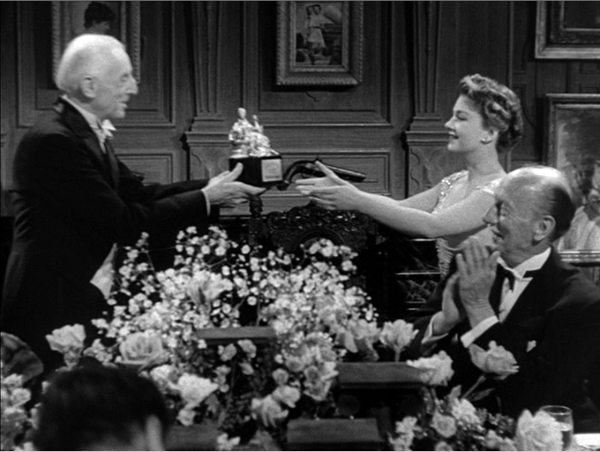
All About Eve.
Mixing business with pleasure: Johnnie To’s DRUG WAR
Drug War (2012).
DB here:
At first glance, Drug War (2012) seems an unusual film for Johnnie To Kei-fung and his Milkyway Image company to make. For one thing, this Mainland production lacks the surface sheen of To’s Hong Kong projects. Shot in wintry Jinhai, a northern port city, and in the central city of Erzhou, it presents stretches of industrial wasteland and bleak superhighways. As a result, To’s characteristic audacious stylization gives way to a bare-bones look. The saturated palette of The Longest Nite (1998) and A Hero Never Dies (1998) is gone, replaced by metallic grays and frosty blues. Hong Kong heartthrob Louis Koo, rapidly becoming To’s jeune premier, is bluntly deglamorized—first glimpsed spewing foam as he tries to steer his car, then moving through the film with a blistered face and a bandaged nose. The noir-flavored Exiled (2006) made its steamy Macau locales seem exquisitely somber and menacing, but Drug War’s early scenes in a hospital have a mundane, documentary quality. Little in To’s earlier work prepares us for the grubby scene of drug mules groaning as they shit out plastic pods of dope.
Of course it’s a crime story, the genre in which To and his writer-producer collaborator Wai Ka-fai have gained most acclaim. More specifically, it’s a police procedural, a mode they have worked skillfully with Expect the Unexpected (1999) and Mad Detective (2007). Those, like most cop movies, thread the personal lives of the investigators into the cases they’re running. Drug War, though, gives us no glimpse of the cops off-duty. The result presents our officers as strictly business: no wives, kids, or civilian pals distract them from their mission. In this respect, the film’s closest analogue is probably PTU (2003), but even that showed its patrolling cops in more camaraderie and clashes than we get here.
True, there are brief moments of comradeship, as when Yang offers money to help the cops from Erzhou, and her colleagues chip in. A marvelous shot juxtaposes one cop’s cash with the video stream of the burning bills in the ceremony honoring Timmy’s dead wife and her brothers.
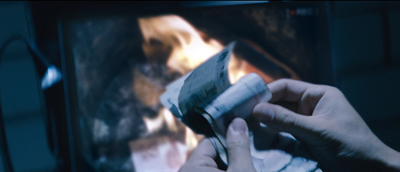
Yet the result humanizes the crooks more than the cops. Timmy mourns his family; we don’t know if Captain Zhang has one.
The concentration on routine and tactics is due partly to the action’s compressed time frame: the seventy-two hour pursuit of the drug gang permits no rest. In addition, made chiefly for the Mainland audience (with Mainland funding), Drug War was subject to censorship that’s more stringent than that in Hong Kong. It may be that To, Wai, and their screenwriting team were cautious about integrating personal lives into their plot. Exploring the officers’ off-duty frailties and failures might have made censors fret. And of course the emphasis on selfless officers sacrificing their personal lives sends a positive ideological message.
I think that the film benefits in other ways from skipping what Ross Chen calls “cop soap opera” and focusing relentlessly on the central cat-and-mouse game. Zhang’s investigation becomes engaging for us thanks to well-honed Milkyway narrative maneuvers: a focus on suspenseful strategies and unexpected countermeasures, the weaving together of various destinies, a fascination with doubling and mirroring, surprising genre tweaks, and unusually laconic signaling of story information. Beneath its drab, almost generic surface and its apparently prosaic account of police procedure, Drug War offers a typically engrossing, off-center Milkyway experience.
And yes, gunfights are involved. But even those are not quite business as usual.
Live or die, I’ll be with you
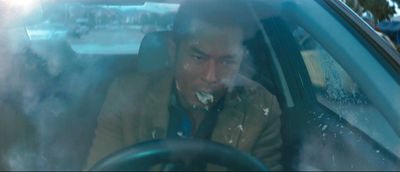
After a prologue in which a vomiting Timmy Choi Tin-ming crashes his car into a restaurant, we see several lines of action converging at a highway tollbooth. A truck driven by two drug-addled men pulls through, followed by two more men in a muddy red sedan. Soon an overheating bus pulls up. Panicking, the drug traffickers inside make a run for it before they’re brought down by highway officers and Captain Zhang Lei, who has been working undercover on the bus. The mules are taken to a hospital—the second convergence point—and there Captain Zhang notices that Timmy, borne by on a gurney, has burns typical of a drug explosion. Zhang and female officer Yang Xiaobei visit the site of Timmy’s crash, where they find his cellphone. Its mysterious call queue launches their investigation.
If you haven’t yet seen the film, I hope that the preceding has whetted your interest. From now on, I’m afraid I must indulge in what we in the trade call spoilers.
The tollbooth confrontation, it turns out, is a sting operation by which Zhang can nab the traffickers he has infiltrated. The truckers who pass through at the same time are bringing ingredients for Timmy Choi’s local meth factory, and the red sedan is carrying cops who’ve been tracking them. When Zhang and Yang find Timmy’s cellphone, they find dozens of missed calls from the truck drivers, and this enables them to connect Timmy with the shipment. His lab has exploded, killing his wife and her brothers. He escaped but suffered the burns and nausea we saw at the outset.
To escape the death penalty Timmy offers to turn snitch. The rest of the film will intercut among various lines of action: the truckers and their pursuers, the cops using CCTV cameras to track the crooks, and Zhang’s efforts to use Timmy to infiltrate the ring. Zhang’s strategy takes him up the chain of command. There is the laughing Jinhai smuggler HaHa and his wife, who are trying to become drug distributors by means of the port they control. They are wooing the cokehead Li Suchang, his superior Uncle Bill Li, and the real bosses, a Hong Kong gang headed by Fatso (Milkyway regular Lam Suet). Timmy, who knows them all, is positioned as go-between. As with many Hong Kong films, a hierarchy of villains permits a cascade of meetings, showdowns, chases, and chance encounters. Through it all, the question persists: Can Zhang trust Timmy to stay bought?
The first third of the film centers on Zhang’s daring scheme to penetrate the gang. Since HaHa and Li Suchang (called Chang in the English subtitles) have never seen one another, he forces Timmy to set up two meetings. The meetings are timed so that Zhang can impersonate Li in the first meeting and then play HaHa in the second. The result is a pair of virtuoso scenes I’ll go into shortly.
The central chunk of the film follows Timmy’s efforts to get a fresh load of dope for Zhang’s deal. His source is another of his factories, this one staffed by a family of deaf-mutes (a typically perverse Milkyway genre tweak). This section culminates in two intercut police raids: one, a painless seizure of HaHa and his wife, the other a bloody shootout in the factory. The two mutes in charge escape through a hidden passageway, a ploy that renews Zhang’s distrust of Timmy. Timmy vows that he didn’t know about the escape hatch.
The film’s final third introduces the Hong Kong gang directing Uncle Bill from behind the scenes. The film’s first two sections have emphasized the cops’ ability to track the gang with public surveillance cameras and minicams secreted in hotel suites and in the meth warehouse. Now we learn that the gang has its own technology. Hidden microphones and wireless recorders allow gang members to listen to conversations. Fatso feeds dialogue to Uncle Bill in his negotations with Zhang/HaHa. In their final rendezvous at a nightclub, Zhang discovers the ruse and uses it as an excuse to finalize the deal. But when the Hong Kongers demand a night out just for themselves, Captain Zhang must let Timmy go off with them and trust him to deliver them to him the next day.
Timmy betrays everyone. At the climax all the forces in play converge once more, this time outside a primary school. Cars bearing police surround the vehicles carrying the gang. Even the truckers are summoned by Timmy, and eventually the deaf-mutes show up too. Timmy tears off the wire he’s wearing, tells the gang that it’s an ambush, and launches an all-out firefight. While cops and crooks blast each other, Timmy slips into a school bus to hide from the barrage.
The gang is cut down, but so too are the police, including Yang. Even our protagonist Zhang is fatally wounded. Hong Kong aficionados will find here echoes of the pitiless climax of another Milkyway policier I probably should not specify.
The film’s epilogue, like the prologue, centers on Timmy in extremis. In prison he’s strapped down for lethal injection while he babbles the name of every dealer he knows, hoping somehow to save himself from execution. He fails.
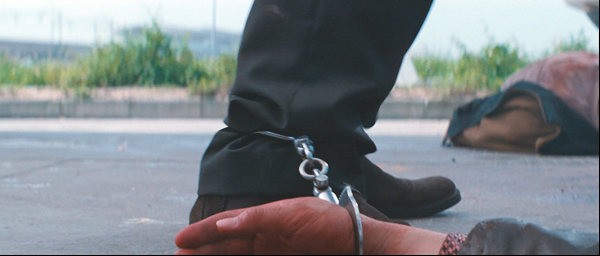
Perhaps the most memorable image in the film’s final moments comes a bit earlier, at the end of the gun battle. Timmy brutally finishes off Captain Zhang, only to discover that Zhang has handcuffed his wrist to Timmy’s ankle. Timmy is captured frantically dragging Zhang’s corpse around the street, fulfilling Zhang’s warning after the ill-fated factory raid: “Live or die, I’ll be with you.”
Playing parts
Within this broad movement toward giving Timmy his punishment, at horrendous cost to the forces of law, To and Wai have built fine-grained scenes that swerve the conventions of cop movies in typical Milkway directions. The chief example involves large-scale repetition. During the first section, Zhang goes undercover, pretending to be a gang member. The subterfuge is given a twist: Zhang impersonates Li Suchang in his meeting with HaHa, then he impersonates HaHa in his meeting with Suchang. Once more a Milkyway film finds tricky drama in symmetry and doubling.
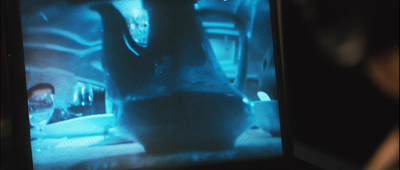
The first impersonation goes more easily, but it gets a healthy dose of suspense. Zhang plays Li Suchang as a cold, impassive negotiator. He barely speaks in response to HaHa, who lives up to his name by supplying a stream of chatter and guffaws. He’s not as dense as he might appear, but Zhang has little trouble intimidating him. The problem is that the mini video camera hidden in Zhang/Li’s cigar case is first blocked by food on the table and then arouses the curiosity of HaHa. The tension rises as HaHa examines the case, but Timmy nonchalantly rescues it. His intervention reinforces our sense, in this stretch of the film, that he is cooperating smoothly with the police sting.
Once the charade is over, the film’s narration increases the suspense by the tight timing of the next meeting, which takes place only minutes after the first. Zhang and Yang, who will be playing HaHa’s wife, must change clothes swiftly and prepare cameras to record the deal. The real Li Suchang goes upstairs with Zhang and Timmy just as the real HaHa and wife saunter out of the other elevator: The shot sums up the charade Zhang has engineered, as well as the plot’s mirror structure.
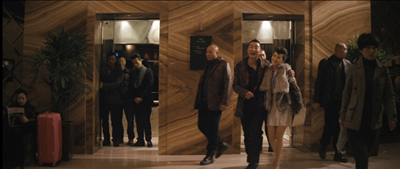
The second encounter ratchets up the tension. Zhang and Yang imitate HaHa and his wife, whom they’ve watched moments earlier; they even repeat lines spoken by the real couple in the previous scene. But Li Suchang is a more aggressive bargainer than HaHa and offers Zhang/HaHa some cocaine. The real HaHa claimed never to have touched the drug, so Zhang/HaHa declines. But Li insists, so the policeman must snort a line. This induces a good deal of uneasiness, which is upped when Li insists he take another hit. Zhang/HaHa obliges and becomes woozy. When Li demands that he snort a third line, Timmy again intervenes and asks that they proceed with the deal. Li relents and they make an appointment with Uncle Bill.
After Li Suchang leaves, there follows a chilling scene in which Zhang goes into drug shock, collapsing to the floor and twitching frantically. Timmy explains what the other cops must do to save him, and by following his commands they revive Zhang. Again Timmy seems firmly on the side of the police. But Zhang still wonders: Did Timmy secretly signal to Li? His mistrust will expand when the deaf-mute factory workers elude the police through an exit that Timmy didn’t mention.
The motif of doubling, a To/Wai staple, runs through the movie: two truckers, two cops tailing them, two deaf-mute killers, two raids, two traffic encounters with the gang, two times that Zhang must trust Tommy and release him. Even the climax consists of not one but two gun battles, the first in front of the school, the second in a nearby street. But the scenes in which Zhang plays both parties in a drug deal serve as the most audacious instance, and a fine example of Milkyway’s gift for reimagining basic conventions of the crime film.
Milkyway’s rule of one
In Planet Hong Kong 2.0, as well as in my discussion of Mad Detective on this site, I suggest that despite all this obsessive doubling, Milkyway films tend to refuse the redundancy that crime movies usually demand.
One instance is the gradual revelation that in the opening, the bus overheating at the toll booth is part of a police trap. Not only is Zhang aboard (sporting a Stetson), but the ticket taker is Officer Yang and the driver (merely glimpsed) is one of Zhang’s men. Since the incident isn’t referred to as a sting afterward, we must realize on our own that this sequence furnishes an abrupt introduction to the police unit’s efficiency and farsightedness.
Another instance is a little less cryptic but has longer-term consequences. The police are preparing for the double masquerade, and Zhang lets Timmy pick out appropriate outfits for them to wear. In a scene lasting only forty-five seconds and ten shots, the emphasis is on Timmy’s careful selection of suits—presented, as we might expect, in imagery of pairing.
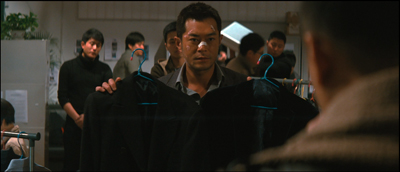
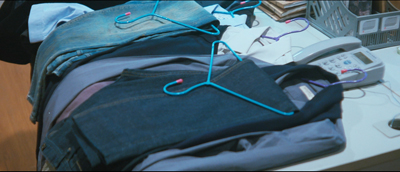
While this preparation is going forward, To inserts a shot of hands crushing aspirin tablets into powder.
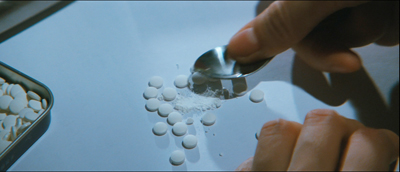
Later we see that Officer Yang is filling a flask with the powdered aspirin.
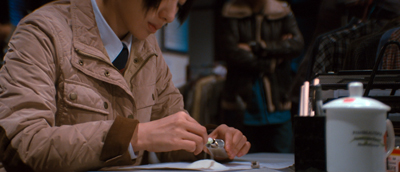
What’s going on here? Another sort of film would have inserted dialogue something like this: HaHa hasn’t met Li Suchang, but he’s probably heard that he’s a druggie. He’ll expect me to use coke. If he offers, I’ll tell him that I use only my own. We’ll prepare some fake stuff for me to bring in a flask. And this would have been a clear setup for what will in fact happen in the first meeting. But we don’t get such a setup. Moreover, at this point Yang’s action is even more cryptic because we don’t yet know about Suchang’s addiction, which Zhang is planning to mimic. Yang is preparing a protective measure against a threat we will only learn of later.
The Milkyway writing team often treats story points in this peremptory way. If the Hollywood rule is “Tell the audience every major point three times,” To and Wai often assume that one mention is enough, and even that can come before we’re in a position to appreciate it. Indeed, Zhang’s scam depends completely on the fact that HaHa and Suchang have never met, but that premise is told us on only one occasion, and it’s not given much emphasis.
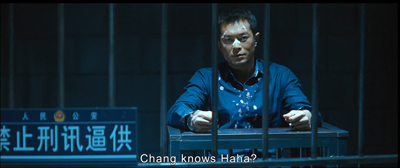
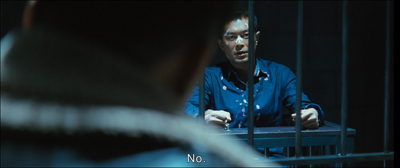
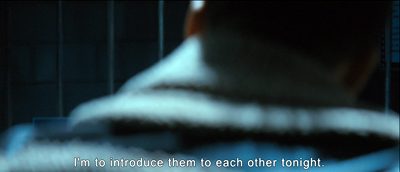
Again, we could play Hollywood scriptwriters and let Zhang and Yang huddle to explain how they will exploit the fact that the two gangsters can’t recognize each other. But the Milkyway team skips all that. The plan is devised offscreen. We next see Zhang and Timmy picking their wardrobe and Yang preparing the phony cocaine.
In the prologue, we have gotten another roundabout piece of foreshadowing. As Timmy’s car careens down the street, a single shot is presented as the view of a surveillance camera.
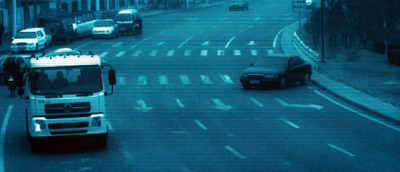
A more orthodox film would then cut to a Network Operations Center where concerned officials are watching traffic. But To simply cuts back to the car, where Timmy’s cellphone falls to the floor. Only after Timmy becomes a person of interest to the police do we see investigators re-running CCTV footage of the car. The one video shot has been a hint about how the police will build up their knowledge of Timmy. More broadly, it prefigures the importance of police video surveillance of the gang throughout the film.
Most laconic of all, I think, is the rather complicated scene taking place at a traffic light. The transfer of an important valise, containing money or drugs, is one of the most hoary conventions of the cop thriller. Director To makes it the occasion of a crisscrossing geometry and barely noticeable hints about Timmy’s ultimate aims.
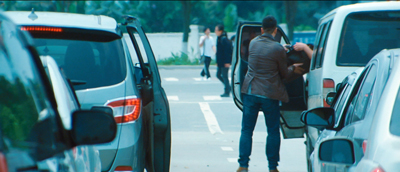
Waiting at the light on the way to a meeting, Zhang as HaHa gets a call from Suchang and Uncle Bill, in a Mercedes sedan waiting behind them. There’ll be no meeting; a deal will be done right here. Zhang’s team is spread out in other vehicles backed up at the light.
But when Zhang as HaHa picks up a parcel to deliver to a white van further along the line of cars, To’s camera coasts rightward to show a dark van waiting in the next lane. We aren’t shown who’s in it. Soon, as Zhang transfers the bag to the van, we see yet another vehicle at the front of the line, and over his shoulder we see a woman inside.
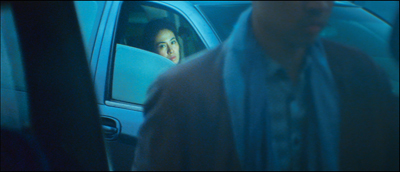
Cut to inside that vehicle, where the woman, the driver, and a fat man in the back seat sit impassively.
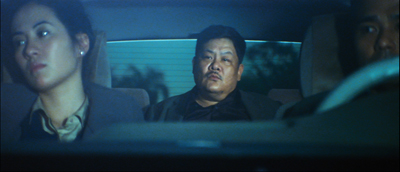
Within the plot, the scene functions as Bill Li’s effort to determine whether he’s being set up. The transfer turns out to be a fake, aiming to confirm that Timmy has not turned snitch. If his associates are undercover cops, they are likely to reveal themselves here in order to make a bust. That would fail, because the bag Zhang ends up with carries only imported cigars.
Beyond its function as a test, the traffic stop plays a crucial narrational role. Through mere glimpses and without anything being prepared for, we’re introduced to the Hong Kong gang that will play a commanding role in the last third of the film. The subterfuge is that we haven’t yet been told that there is such a gang; at this point, they are simply oddly emphasized passengers in adjacent vehicles. A more traditional plot would have included an earlier scene in which the police identify the Hong Kong suspects and provide their backstory. Then, seeing them at the intersection would satisfy us that we were putting the story together. Instead, working with almost no dialogue, using the traffic backup as another convergence point, To and Wai have evoked a strange uneasiness. Who are these people, and why are we seeing them?
Immediately after these shots of adjacent vehicles, another dark van opens and a passenger sets a carrying case on the street. Yang in her guise of HaHa’s wife fetches that case. Then, in a slippery set of POV shots, Timmy turns and looks back at other men in vehicles, and then at Uncle Bill and Li Suchang, who seem to evade his stare.
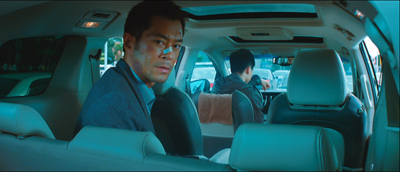
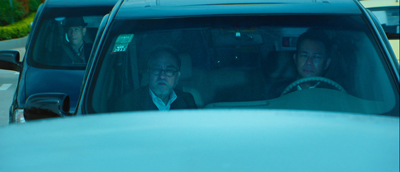
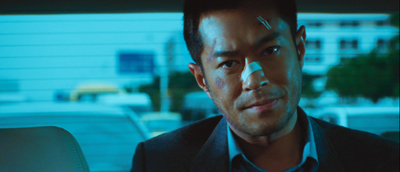
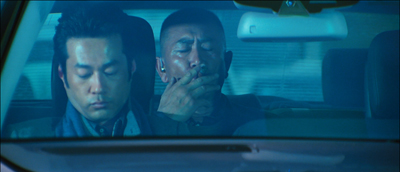
Why dwell on Timmy at the height of the scene? For the first time we can study his reactions when his captors aren’t watching him. His calculating stare suggests that he knows, well before the police do, that the deal is a sham. He realizes that if the cops do take the bait and reveal themselves, only he will pay the price. Now he knows that he can’t count on the gang and that he’s on his own. At the climax he’ll take his revenge on both sides by halting the motorcade before it reaches the port, where cops are poised to arrest the gang. That will provoke the final shootout—which, like this scene, involves all the principals confronting one another in vehicles on the street.
This is a lot to load onto a brief, silent exchange of looks, but it’s typical of To and Wai’s glancing exposition. Another director would have provided stronger clues to what’s going on in Timmy’s mind, perhaps through flashbacks or voice-over. Yet that tactic would depend on our knowing who the people in the other cars are. Only later, before the meeting at HaHa’s port, will Timmy identify them. He will spill this information very quickly. And just once.
Since its founding in 1996, Milkyway Image has responded adroitly to changes in the regional film industry. For their local audience, To and Wai have created popular comedies, off-kilter thrillers, and unclassifiable items like Running on Karma (2003) and Throw Down (2004). They have occasionally completed coproductions with Europe (Vengeance, 2009) and an Asian branch of Hollywood (Turn Left, Turn Right, 2003). They have adjusted to the soaring Mainland market, even revising Breaking News (2004) to suit the censors. Just as a string of Milkyway romantic comedies yielded some financial stability in the 2000s Hong Kong market, more recent efforts like Don’t Go Breaking My Heart (2011) and Romancing in Thin Air (2012) have given the company a foothold in the PRC.
Yet Milkyway takes chances too. Election 2 (2006) surprised everyone with its bold acknowledgement of Triad networks on the Mainland; neither it nor its predecessor was shown theatrically there. Drug War has attracted notice among international critics for its frank treatment of the PRC underworld. To and Wai seem to find unusual opportunities in every project. Here, making Hong Kong gangsters the ultimate villains suggests that the pestilence comes primarily from elsewhere. At the same time, giving Timmy and the Hong Kong gang such prominence permits casting some of the Milkyway repertory company, familiar actors not only in Hong Kong and the Mainland but also in the international market.
Johnnie To, it seems, can zigzag his way to creative achievement in different circumstances. He and Wai are keeping Hong Kong cinema alive in unpromising times and finding new narrative resources in a genre that often seems played out. Their latest, Blind Detective (2013), is receiving pretty unfavorable notices, but this long, preposterous semi-comedy is, I expect, another symptom of the sidewinding strategy that characterizes their work.
With Milkyway, adventurous exploration of cinema is also a business plan. Catch them if you can.
Thanks to Geoff Gardner, Athena Tsui, Li Cheuk-to, To Kei-chi of Milkyway Image, and Crystal Decker of Well Go USA for their assistance in preparing this entry.
For a sensitive discussion of the film’s treatment of China, see Kozo’s review at LoveHKFilm.
Drug War performed sturdily at the Hong Kong box office (over US $600,000) but did really well in China, garnering upward of $23 million during its April release. Well Go and Variance open Drug War on 26 July for a US theatrical run. Before that it’s playing several festivals, including the mammoth TIFF Chinese series on 14 July. Mr. To will introduce the TIFF screening. The day before, 13 July, he will be present for a conversation.
Milkyway plots often rely on converging destinies, of character trajectories intersecting through chance. This principle is less pronounced in Drug War, except for the moments when the two truckers and the two deaf-mutes unexpectedly hook into the main plotline. Accidental convergence, often pointing up parallels among the characters, is clearer in A Hero Never Dies (1998) and Life without Principle (2011). I discuss the first film in Planet Hong Kong 2.0, the other in this entry.
P.S. later 8 June: Today you get double value. Grady Hendrix, Hong Kong film expert and one force behind Subway Cinema, writes with this thoughtful interpretation of Drug War–which makes it seem as daring thematically as it is in its narrative strategies.
For me, the most interesting element is the long game that I think To and Wai are playing and what I see as the secret heart of the movie. I think that the meaning of the film isn’t conveyed so much by the narrative as by the tools used to create the narrative: the actors. All of the cops are Mainland actors, most of the drug dealers are Hong Kong actors. What are drug dealers besides capitalism run amuck, completely unregulated? What are cops but authoritarian impulses, completely unregulated? The two groups have similar goals: make money at all costs; catch the criminals at all costs.
The cops in the film are China personified: they have unlimited resources, massive numbers, infinite organization, but they are heartless towards outsiders, unforgiving, and they don’t trust anyone. The criminals are all the stereotypes of Hong Kong-ers: they are family, they are stylish and chic, they eat meals together (Hong Kong people love to eat, after all) but they are only interested in money. They will save themselves and leave their wives to die, they will betray anyone (including their uncle and godfather), to make a buck. Both groups use the same tools, but they are opposites: unregulated capitalism vs. unregulated authoritarianism; the unstoppable object and the immovable force.
The fact that when put into conflict these two forces destroy each other is, I think, a critique of both Hong Kong and the Mainland, and I think To and Wai want to show how each has gone too far and both have become merciless and inhuman. Of course, in the end, China wins out and Hong Kong’s biggest pop star is on a table whimpering as China slips in the needle (which is weird, since I don’t think China uses lethal injection to execute people, but then again it’s an instance of Chinese drugs beating Hong Kong’s drugs).
Thanks to Grady for opening up this aspect of the film! And I’m sure the packed house that greeted Drug War during its screening at the New York Asian Film Festival thank him and his colleagues too.
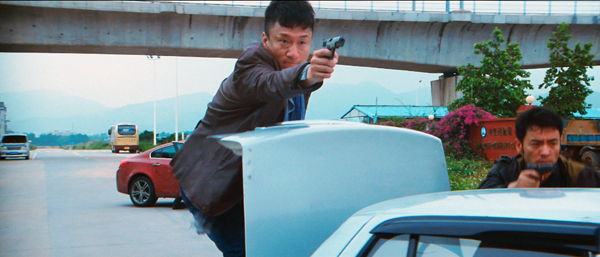
Drug War, with Sun Honglei as Captain Zhang Lei.
Twice-told tales: MILDRED PIERCE
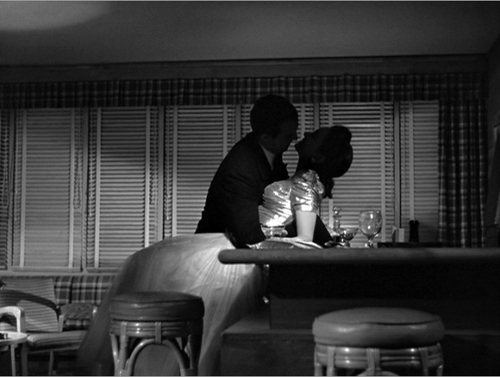
Mildred Pierce (1945).
DB here:
At the climax of Now You See Me, a barrage of brief shots skips back in time to show how our quartet of magicians pulled off the complicated illusion we’ve just seen. (A very, very complicated illusion, in fact. You and I should be so lucky.) Soon our Four Horsemen come to realize that a puppetmaster behind the scenes has been steering them, and this awareness comes in another flurry of flashbacks.
Today’s movies are constantly using fragmentary flashbacks to fill in elements left out of earlier scenes. I recently considered how Safe Haven and Side Effects use the convention, but lots of other films will furnish examples. Crucial to this technique is an illusion created by cinematic narration. The first time through a scene, we think we’re seeing everything. But the replay shows us bits and pieces that were left out, or that we didn’t notice, or that we’ve forgotten about.
Back in 1992 I wrote an essay about this technique. “Cognition and Comprehension: Viewing and Forgetting in Mildred Pierce” focuses on the murder of Monte Beragon in the 1945 film. A revised version of the essay appears in Poetics of Cinema and is now available on this website. The piece tries to show that a cognitive approach to comprehension and recollection can explain how a film shapes viewers’ responses—in this case, creating mystery while making viewers forget certain things they’ve seen.
Today I’m going to consider Mildred again, but by doing something I couldn’t do in print. The wonders of the Internetz let me use video extracts to show concretely how clever this replay is. I frame my case here differently than in the earlier piece, although there are ideas and examples common to both. Perhaps what I do here will tease you into reading the more technical essay.
And of course there are spoilers—most thoroughly in reference to Mildred, more mildly in reference to Side Effects and The Unfaithful (1947).
Hiding murder
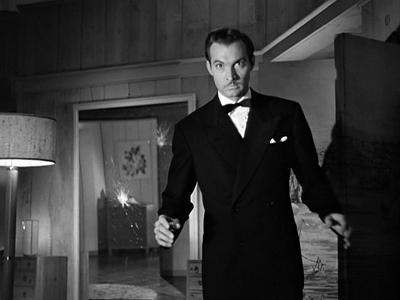
At the start of Mildred Pierce we see Monte shot down in a beach house, but we don’t see who did it. At the climax of the film, we’ll see a flashback replay the murder, filling in elements that were suppressed in the earlier version. In these sequences, director Michael Curtiz and the film’s screenwriters make choices about at least three narrative conventions.
How do you present the original scene? How do you handle the flashback? How do you present the replay?
These choices confront every screenwriter or director who wants the Aha! effect of dramatically revealing what was really happening in an earlier sequence.
The filmmakers’ decisions will be shaped by the urge to make the audience’s pickup fast and effortless. The filmmakers know that we tend to want to cut to the core of a story situation, to grab its gist and move on, and we trust that the film’s unfolding will help us do that. But this very speed can work against us. By counting on our knowledge of conventions, filmmmakers can encourage us to jump to conclusions that will turn out to be inaccurate.
Start with the handling of the original scene. Your choices are basically these: We can see the action fully, or we can see it only partially, with some aspects suppressed. Consider the opening of The Letter (1940). Leslie Crosbie strides out of a cottage, blasting away at a man who tries to crawl away from her.
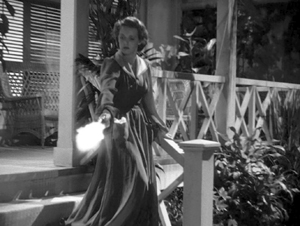
We see the crime fully, so the mystery involves circumstances. What led up to this murder? The rest of the film’s plot will concentrate on that.
Alternatively, some element of the initial scene can be omitted. This is what we get in the shooting of Miles Archer near the start of The Maltese Falcon (1941).
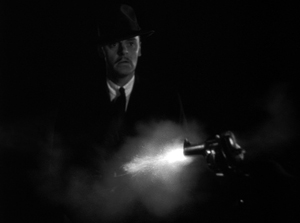
It’s familiar territory. The film’s narration conceals the identity of the killer by framing him or her out of the shot. The question of who killed Archer will propel part of the action to come.
The crucial action can be suppressed even more thoroughly. In The Accused (1947), a woman is followed into her home. We already know her as a wealthy wife waiting for her husband to come home, but we aren’t shown the identity of the shadowy male figure who grabs her and forces his way into the house.
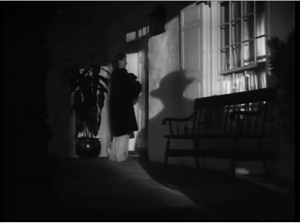
And the camera stays obstinately outside while someone is shot in the house.
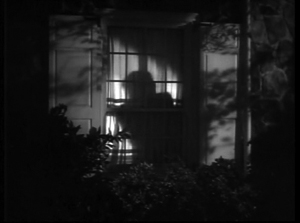
Only later will we find out who the victim is, and the entire film will slowly reveal what really happened inside, and what led up to it.
I’ll have some things to say about Mildred’s initial murder scene shortly, but now let’s consider the second key convention: the flashback device itself. What is a flashback? Most basically, it involves presenting earlier story events in the midst of later ones. It’s often motivated as a memory, as when a woman recalls her childhood. But there doesn’t have to be a memory motivation; the film’s narration can directly show us bits of action that occurred in the past (as in the “objective” flashbacks in Kubrick’s The Killing).
Mildred Pierce is built on three flashbacks. Two long ones explain the course of her life with her family, and a final one dramatizes Mildred’s explanation of what happened during Monte’s murder.
What, then is a replay, the third convention I’m considering? I don’t think critics and filmmakers have a very stringent sense of this device. (See the codicil for further comments.) I’d suggest that basically a replay is a flashback that revisits scenes we’ve already seen. When our heroine recalls her childhood in scenes we didn’t see before, we have a flashback. But if later in the film we see those childhood scenes again, I’d call it a replay. Centrally, a replay revisits scenes we’ve already witnessed, or at least glimpsed.
So not all flashbacks are replays. Are all replays flashbacks? Some would say yes, but I’m more cautious. I’m inclined to say that a mechanical recording of a scene shown earlier could count as a replay without being a flashback. In Rebecca the newly-married couple watches home movies of their honeymoon. This scene fulfills the function of a flashback, but the action we see remains in the present: the couple are screening the film. The footage doesn’t show scenes we’ve already seen, but if it had, I’d call the screening of the movies a replay, but not a flashback—since, again, the action framing it is visible in the present.
This sort of mechanical recording/ replay is very common in modern films, reflecting the ubiquity of surveillance cameras, cellphones, and the like. In an earlier blog entry I talked about a purely auditory replay in Sudden Fear that’s made possible by an audio recording device. It would be odd to call the home movies or the SoundScriber playback flashbacks.
So some replays are flashbacks, and some aren’t. When they’re flashbacks, replays are often used subjectively, as when a character remembers an earlier action. Recall all those dream sequences that present, often with distorted imagery or sound, action we’ve seen previously in the film. But a replay may also supply new information about actions we already witnessed and thought we understood. We thought we grasped an earlier scene because nothing signaled to us that pieces of information were missing.
This possibility goes to another creative option. Sometimes the film tells us that something has been omitted. In my Maltese Falcon and Unfaithful examples, the narration is openly suppressive: It announces that it’s not telling us certain things. This of course adds mystery to the plot.
Alternatively, the presentation of the initial scene might be covertly suppressive; it hides things and doesn’t tell us it’s hiding them. In Side Effects, we see the heroine commit murder and then go to bed. Later the murder scene is replayed, but with extra shots showing actions we didn’t see or surmise before. The idea of replaying to fill in previously suppressed information is quite old; you can see it at work in Griffith’s Romance of Happy Valley and Ford’s Man Who Shot Liberty Valance. In modern cinema, we sometimes revisit an earlier scene several times, with each pass yielding new information (e.g., Go). You might want to call these “multiple-draft replays.”
Gunplay and replay
We start with two establishing views of the beach house, with a car outside. Over the second, gunshots are heard. Shot by an unknown assassin, Monte staggers forward and falls back onto the carpet. A close shot shows him saying, “Mildred” as he dies.
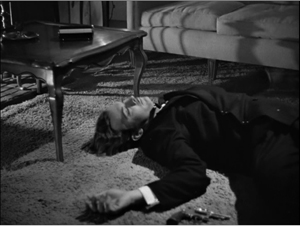
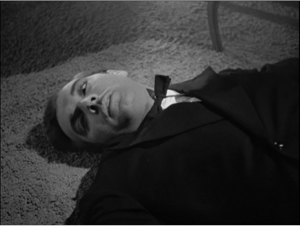
The camera tracks to the bullet-riddled mirror and we hear the sound of a a door. A new shot lingers on Monte’s corpse. We then see the car drive off.
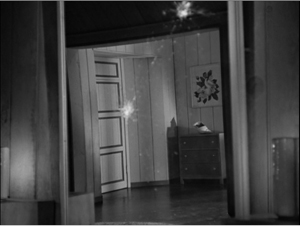
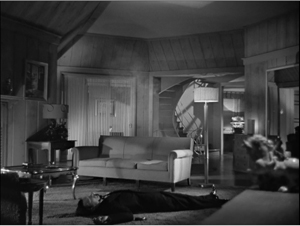
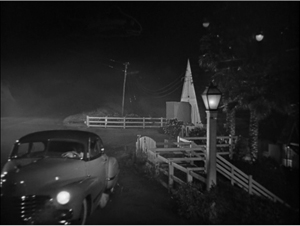
The next scene shows Mildred pacing nervously on the pier.
I think that this opening lays out two options, one for the trusting viewer and one for a more skeptical one. The trusting viewer assumes that Mildred killed Monte. He seems to glance at her as he speaks her name, and the shot of the car pulling away leads smoothly to the sequence showing Mildred on the pier.
Not so fast, says the skeptical viewer. If Mildred did it, why doesn’t the film show her doing it, as the Letter scene does? The absence of a reverse shot of the killer resembles the missing reverse shot in the Maltese Falcon scene. So the scene leaves some doubt about whether Mildred is guilty.
The film rushes us along, so we aren’t obliged to decide one way or the other. Eventually we can reconcile the opening with either possibility. If Mildred turns out to be innocent, we can say the film played fair by not showing the killer. If she turns out to be guilty, the missing reverse shot will be seen as simply a device to postpone telling us.
She certainly acts guilty enough in what follows. On the pier, she seems to consider leaping into the surf, only to be put off by a cop on a beat. The lubricious Wally lures her into his tavern, where she stares coldly at him before suggesting they go to the beach house. There, she locks him in, and he discovers Monte’s corpse.
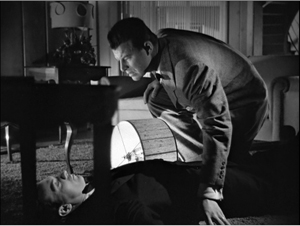
Passing policemen in a patrol car see Wally break out of the house and arrest him on the beach. Mildred’s daughter Veda is briefly introduced at their home, when two policemen come to take Mildred in for questioning. She seems to feign ignorance of Monte’s death, still trying to frame Wally.
At the headquarters, the police inspector announces that they have the killer—not Wally but Mildred’s first husband Bert. Distraught, she claims Bert is innocent and to exonerate him she tells her story, taking us through her two marriages and her successful career.
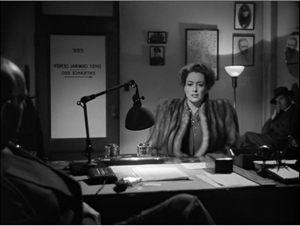
At the climax of Mildred’s second flashback, she realizes that Monte’s free-spending ways have enabled Wally to cheat her out of her restaurant chain. She fetches a pistol and drives to the beach house, in a framing that reminds the first-time viewer of the film’s opening shots.
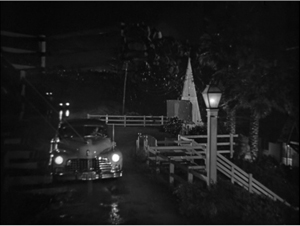
We see her walk through the house, but then the flashback breaks off. We’re taken back to the present, with her talking to the chief detective. “Monte was alone, and I killed him.” The detective replies that she’s lying; someone else was in the house. Who? Not Bert but Veda, brought in by the cops who have grabbed her when she tried to leave town.
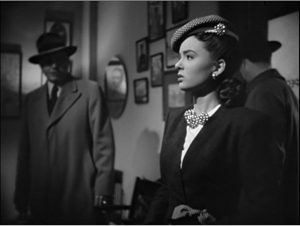
Before Mildred can hush her, Veda snaps out, “You promised not to tell! You promised! You said you’d help me get away!” Veda became increasingly important to the plot as the years went by in Mildred’s flashbacks, but her almost total absence from the opening minutes blocks our thinking of her as a candidate for the killer’s role. Soon we’ll see the pains the narration took to make sure we didn’t spot her at the crime scene.
Mildred breaks down and launches the final flashback.
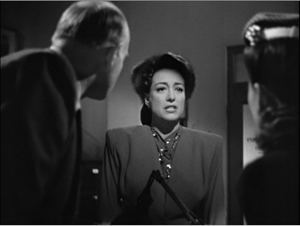
She says that she found Veda with Monte, and they admitted to being lovers. Then Veda told her that she and Monte would be married. Mildred reached for the pistol but was halted by Monte and dropped the gun. She left, just before Monte told Veda he had no intention of marrying her. “You don’t really think I could be in love with a rotten little tramp like you, do you?”
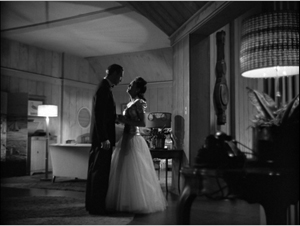
The flashback crosscuts between Mildred in the car and what’s happening inside, bringing us back to the opening situation. Now the skeptical viewer’s hunch is borne out. The replay starts as a faithful version of what we originally saw, providing the reverse shot of Veda that was missing in the opening.
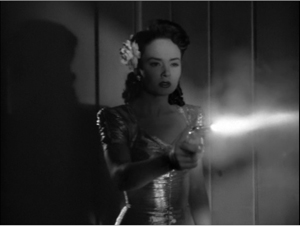
This time we don’t see Monte hit (that action is covered by the shot of Veda), but he crumples and staggers forward as before. He dies, still murmuring Mildred’s name. Mildred hurries in, finds her daughter standing over Monte’s body, and succumbs to Veda’s demand that she cover for her.
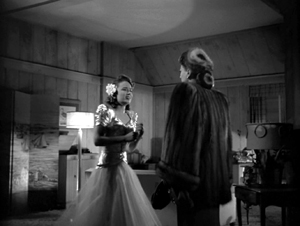
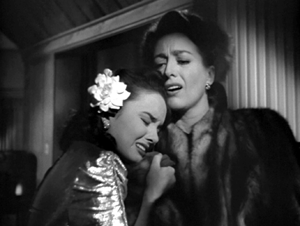
The replay explains why Mildred contemplated drowning herself afterward: She was in despair at the couple’s treachery and the crime that Veda committed. When suicide was blocked, Mildred tried to frame Wally for the murder in order to protect Veda. And the replay suggests that it’s not Mildred but Veda who drives off from beach house, leaving Mildred to drift down to the pier.
All together now
At least, that’s what most viewers would remember as happening. My essay argues that it’s just this broad effect that the movie aims for: we recall the gist of the murder situation, and we assume that the only gap in it is the identity of the killer. However, when we look more closely at the two sequences, we see that Curtiz and his colleagues have covertly concealed a lot more.
To get a sense of it, you can run the two sequences separately, then the two of them jigsawed together side by side. In the following clip, the opening is labeled scene A, the flashback replay is scene B. The shots in each passage are numbered. (In the original essay, they’re laid out in a chart.)
There’s a lot of sleight-of-hand here. The extreme long shot of the beach house and driveway (A-1) seems to set the stage. The car appears empty. By the time of the gunshots (first heard in A-2), though, based on what we know from the second flashback, Mildred must be in the car already. So you could argue that the dissolve to the long-shot of the car (A-2) conceals Mildred’s departure from the house and her efforts to start the ignition (B-1). I’ve wedged that later shot into the synthesized version to show the possibility. Otherwise we must assume that the initial shot of the whole landscape (A-1) follows her going into the car (B-1). Yet in that shot or the one that follows (A-2), we don’t hear or see the driver trying to turn over the engine. In either possibility, these opening shots display the sort of subterfuges that the film will execute more significantly soon.
The presentation of the action inside the beach house misleads us from the start. After Monte is shot, over the image of the bullet-pocked mirror (A-4), we hear a door, apparently closing. Because we don’t see anyone, and we assume that a murderer flees the scene of the crime, we infer that it’s the sound of someone hurrying out. In the replay, the door’s sound is linked to Mildred coming in (B-5), not leaving.
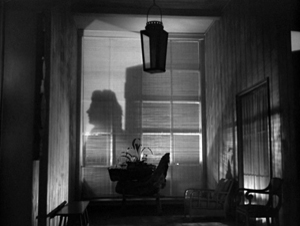
A little extra touch: When Mildred is shown entering (B-5) we hear the door make two sounds—opening and closing. Scene A, of course, doesn’t include both, so we quickly take the one door sound we hear as signaling the killer’s departure. (To my ears, Scene A includes the sound of closing; if that’s right, A’s narration has simply omitted the sound of the door opening.)
Moreover, the filmmakers have played with the duration of the first scene to an almost criminal extreme. After the shot of the mirror and the sound of “departure,” a straight cut takes us to a peaceful but ominous long shot of Monte’s corpse in the parlor (A-5). But this shot doesn’t reflect what happened right after the murder (B-5 through B-10). When the door opened and shut, Mildred came in and immediately started talking with Veda.
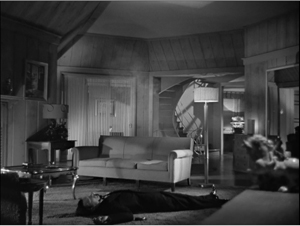
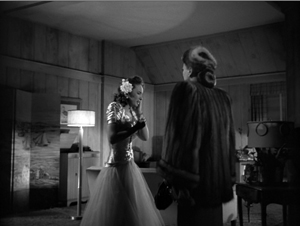
The shot of Monte’s corpse, if it has any place in the chronology of the scene, belongs later, evidently after Veda and Mildred have left the parlor but before Veda has driven off (A-6). In other words, version A has presented a big ellipsis—unmarked—between the mirror shot (A-4) and the shot of the dead Monte (A-5). All the drama between mother and daughter played out in the B version has been skipped over, without any hint that it was suppressed.
The sequence proceeds by degrees of sneakiness: First, the misleading presentation of the car and the beach house, then the teasing offscreen sound of the door, then the more forcible skipping-over of the conversation. Now consider something even more flagrant. When Monte says, “Mildred,” he says it in two different ways in the two sequences, and thus creates two different effects.
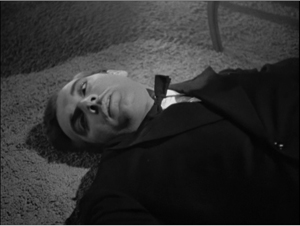
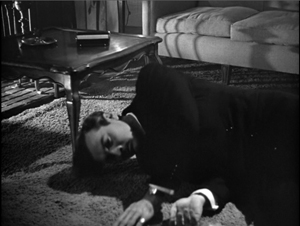
In the opening scene, an abrupt medium shot (A-4) stresses the line as the dying man’s last word. We know (especially after Citizen Kane) that last words are important, and Zachary Scott dwells on it, lolling his head from side to side glancing leftward, as if he were naming his offscreen killer. But in the replay, when Monte falls (B-4), he simply slumps to one side, head down, and mutters, “Mildred,” before flopping over on his back. Nor does Curtiz provide a closer shot. Now the line is tossed off, as if Monte were simply remembering his wife in his final moments.
In sum, the replay not only fills in missing information; it corrects the inferences we made during the first scene. Of course, the film’s narration had encouraged us—at moments, forced us—to make those inferences, all with the purpose of creating a false impression about who was in the house when Monte died.
You might object that these “rewritings” of the opening show less skill than we expect today. Films like Go (1999), One Night at McCool’s (2001), and Vantage Point (2008), let alone Now You See Me and Side Effects, strive to make the fragmented replays of an event dovetail neatly. But those films have been made in an era when people had the ability, on DVD, to rewatch films closely, and persnickety viewers can check for disparities. 1945 viewers couldn’t undertake the random-access probes into Mildred that we can. Moreover, as complex flashback storytelling became more widespread in the 1990s and 2000s, I suspect that there was a certain professional pride in making the sequence of events watertight.
More generally, Curtiz and company could be confident that very few members of their audience would recall the fine detail of a scene shown a hundred minutes earlier. I argue in the essay that as the film unrolls, the rapid pace of the action and our inability to stop and go back allows the filmmakers to juggle time, space, and the sequence of actions played out.
The filmmakers count on our inability to recall fine detail. How fine? If the replay had shown Monty falling face down rather than rolling on his back, I suspect that we would have noticed the disparity. But even trained critics, as I show in my essay, at the time and afterward, didn’t notice the smaller details that deviate from the initial scene, especially the point at which Monte says, “Mildred.” Curtiz and his screenwriters have worked comfortably in a zone of fuzzy recall.
The differences between the initial scene and the replay can’t be put down to clumsiness or accident. All the disparities in the opening nudge us to draw the wrong conclusions, whether we play the trusting viewer or the skeptical one. The omission of the reverse shot, the most obvious mark that Mildred might be innocent, is a convention, as we’ve seen; but the other tactics pursued by Curtiz and company are more innovative. The filmmakers have exploited our tendency to jump to conclusions and to ignore details, always in our search for the gist of the story.
In other words, filmic storytelling often takes advantage of mistakes we make in normal thinking. It even encourages us to make them.
Thanks to Erik Gunneson for preparing the extracts for this blog entry and to web tsarina Meg Hamel for posting the essay.
The misleading narration of Mildred Pierce has its parallel in crime fiction, particularly the thrillers of the 1940s. See this entry on the site for more background. A Ruth Rendell novel, Wolf to the Slaughter (1967), contains a boldly misleading opening that is somewhat similar to what happens in our film.
Some details in the presentation suggest that Curtiz has played fair. In A-6, the woman driving off seems to have a light-colored coat, not Mildred’s heavy fur one. A viewer seeing Mildred on the pier might doubt that she took the car. Still, I don’t think everything here is perfect. Close examination of a 35mm print seems to reveal a figure in the passenger seat of the car ducking down in A-2. And does Monte, falling to the floor in A-3, move his lips slightly? Did the scene as shot have him speak the line “Mildred” at that point, as he said it in the flashback? If so, did someone decide later on the insert (A-4) that underscores his last word?
For more on the planning of this scene and the overall production of the film, see the screenplay Mildred Pierce, ed. Albert J. LaValley (University of Wisconsin Press, 1980). You can sample some of LaValley’s enlightening introduction here. The opening scene of the screenplay is quite different from that of the film, but it does retain the false clue of Monte seeming to name Mildred in his death throes.
The narrational maneuvers on display here have counterparts throughout the 1940s, which is one reason I’m interested in that era. For more examples, see this synoptic entry. The critic Parker Tyler has some provocative observations on the film in Magic and Myth of the Movies (Secker & Warburg, orig. 1947), 193-205. His comments suggest how difficult it was for audiences of the time to recall exactly what had been shown: he speaks of “the sequence of camera shots in which we see the outside of the house, the woman’s figure (or was it two figures, separately?) leaving it, her ride in the auto, her walk on the bridge, her impulse to leap over…” (195). This is a good example of the constructive tendency of memory: We fill in and seem to remember things that didn’t happen.
A more theoretical point: Some people might say that it’s unhelpful to use the term “replay” to cover both one type of flashback and the mechanical capture of earlier action. Maybe we want to call these mechanical recordings “rerun” or “playback” scenes and reserve the term “replay” just for flashbacks, the dramatized renditions of the scene’s images and/or sounds. Perhaps a close look at The Conversation would allow us to sort these concepts more exactly.
In addition, I’ve used the term “replay” to refer to those do-over plots that we find in fantasy and science-fiction films like Groundhog Day, Déjà vu, and Source Code. Yet you could argue that given the parallel-universe premise of these films, each event is shown in its singularity, in a distinct time frame. The scenes we see aren’t revisitings of a single event, but rather different events. They merely seem like replays because they repeat certain features of events that have occurred in other dimensions. I guess we need some new terms!”Reset” or “reboot” plots?
Speaking of terms, narrative theorists will recognize in Mildred’s replayed flashback what Gérard Genette calls a paralipsis. Here the narration “sidesteps” an element during the initial presentation and later revisits the situation and fills in the information. See his Narrative Discourse (Cornell University Press, 1983), 51-52.
A last musing: Might viewers exposed to publicity come into the film expecting Mildred to be the culprit? (On Mildred‘s marketing, see Mary Beth Haralovich, “Selling Mildred Pierce: A Case Study in Movie Promotion,” in Thomas Schatz, Boom and Bust: American Cinema in the 1940s (Scribners, 1997), 196-202.) The French poster below seems to put her in a doorway with a smoking gun. Or is that Veda in the doorway? Perhaps the uncertainty of the narration is prefigured by this advertisement.
David Koepp: Making the world movie-sized
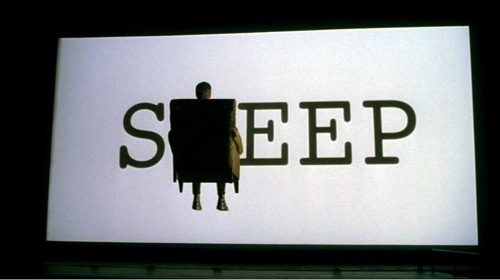
Stir of Echoes (1999).
DB here:
For a long time, Hollywood movies have fed off other Hollywood movies. We’ve had sequels and remakes since the 1910s. Studios of the Golden Era relied on “swipes” or “switches,” in which an earlier film was ripped off without acknowledgment. Vincent Sherman talks about pulling the switch at Warners with Crime School (1938), which fused Mayor of Hell (1933) and San Quentin (1937). Films referred to other films too, sometimes quite obliquely (as seen in this recent entry).
People who knock Hollywood will say that this constant borrowing shows a bankruptcy of imagination. True, there can be mindless mimicry. But any artistic tradition houses copycats. A viable tradition provides a varied number of points of departure for ambitious future work. Nothing comes from nothing; influences, borrowings, even refusals–all depend on awareness of what went before. The tradition sparks to life when filmmakers push us to see new possibilities in it.
From this angle, the references littering the 1960s-70s Movie Brats’ pictures aren’t just showing off their film-school knowledge. Often the citations simply acknowledge the power of a tradition. When Bonnie, Clyde, and C. W. Moss hide out in a movie theatre during the “We’re in the Money” sequence from Gold Diggers of 1933, the scene offers an ironic sideswipe at their bungled bank job, and a recollection of Warner Bros. gangster classics. When a shot in Paper Moon shows a marquee announcing Steamboat Round the Bend, it evokes a parallel with Ford’s story about an older man and a girl. Even those who despised the tradition, like Altman, were obliged to invoke it, as in the parodic reappearances of the main musical theme throughout The Long Goodbye.
But tradition is additive. As the New Hollywood wing of the Brats—Lucas, Spielberg, De Palma, Carpenter, and others—revived the genres of classic studio filmmaking, they created modern classics. The Godfather, Jaws, Star Wars, Carrie, Raiders of the Lost Ark, and others weren’t only updated versions of the gangster films, horror movies, thrillers, science-fiction sagas, and adventure tales that Hollywood had turned out for years. They formed a new canon for younger filmmakers. Accordingly, the next wave of the 1980s and 1990s referenced the studio tradition, but it also played off the New Hollywood. For “New New Hollywood” directors like Robert Zemeckis and James Cameron, their tradition included the breakthroughs of filmmakers only a few years older than themselves.
So today’s young filmmaker working in Hollywood faces a task. How to sustain and refresh this multifaceted tradition? One filmmaker who writes screenplays and occasionally directs them has found some lively solutions.
From the ’40s to the ’10s
The Trigger Effect (1996).
David Koepp was fourteen when he saw Star Wars and eighteen when he saw Raiders. By the time he was twenty-nine he was writing the screenplay for Jurassic Park. Later he would provide Spielberg with War of the Worlds (2005) and Indiana Jones and the Kingdom of the Crystal Skull (2008). Across the same period he worked with De Palma (Carlito’s Way, 1993; Mission: Impossible, 1996; Snake Eyes, 1998), and Ron Howard (The Paper, 1994), as well as younger directors like Zemeckis (Death Becomes Her, 1992), Raimi (Spider-Man, 2002), and Fincher (Panic Room, 2002). The young man from Pewaukee, Wisconsin who grew up with the New Hollywood became central to the New New Hollywood, and what has come after.
He spent two years at UW–Madison, mostly working in the Theatre Department but also hopping among the many campus film societies. He spent two years after that at UCLA, enraptured by archival prints screened in legendary Melnitz Hall. The result was a wide-ranging taste for powerful narrative cinema. He came to admire 1970s and 1980s classics like Annie Hall, The Shining, and Tootsie. As a director, Koepp resembles Polanski in his efficient classical technique; his favorite movie is Rosemary’s Baby, and one inspiration for Apartment Zero (1988) and Secret Window was The Tenant. You can imagine Koepp directing a project like Frantic or The Ghost Writer.
Old Hollywood is no less important to Koepp. Among his favorites are Double Indemnity, Mildred Pierce, and Sorry, Wrong Number. In conversation he tosses off dozens of film references, from specifically recalled shots and scenes to one-liners pulled from classics, like the “But with a little sex” refrain from Sullivan’s Travels.
It’s not mere geek quotation-spotting, either. The classical influence shows up in the very architecture of his work. He creates ghost movies both comic and dramatic, gangster pictures, psychological thrillers, and spy sagas. The Paper revives the machine-gun gabfests of His Girl Friday, while Premium Rush gives us a sunny update of the noir plot centered on a man pursued through the city by both cops and crooks.
One of the greatest compliments I ever got (well, it seemed like a compliment to me, anyway) was when Mr. Spielberg told me I’d missed my era as a screenwriter–that I would have had a ball in the 40s.
Like his contemporary Soderbergh, Koepp sustains the American tradition of tight, crisp storytelling. He also thinks a lot about his craft, and he explains his ideas vividly. His interviews and commentary tracks offer us a vein of practical wisdom that repays mining. It was with that in mind that I visited him in his Manhattan office to dig a little deeper.
Humanizing the Gizmo
Today, the challenge is the tentpole, the big movie full of special effects. A tentpole picture needs what Koepp calls its Gizmo, its overriding premise, “the outlandish thing that makes the big movie possible.” The Gizmo in in Jurassic Park is preserved DNA; the Gizmo in Back to the Future is the flux capacitor. “The more outlandish the Gizmo, the harder it is to write everybody around it.” The problem is to counterbalance scale with intimacy. “You need to offset what’s ‘up there’ [Koepp raises his arm] with things that are ‘down here’ [he lowers it].” This involves, for one thing, humanizing the characters. A good example, I think, is what he did with Jurassic Park.
Crichton’s original novel has a lot going for it: two powerful premises (reviving dinosaurs and building a theme park around them), intriguing scientific speculation, and a solid adventure framework. But the characterizations are pallid, the scientific monologues clunky, and the succession of chases and narrow escapes too protracted.
The film is more tightly focused. In the novel, Dr. Grant is an older widower and has no romantic relation to Ellie; here they’re a couple. In the original, Grant enjoys children; in the film, he dislikes them. Accordingly, Koepp and Spielberg supply the traditional second plotline of classic Hollywood cinema. Alongside the dinosaur plot there’s an arc of personal growth, as Grant becomes a warmer father-figure and he and Ellie become short-term surrogate parents for Tim and Alexa.
Similarly, Crichton’s hard-nosed Hammond turns into a benevolent grandfather; in the film, his defensive attitude toward the park’s project collapses when his children are in danger. Even Ian Malcolm, mordantly played by Jeff Goldblum (stroking some of the most unpredictable line-readings in modern cinema), can be seen as the wiseacre uncle rather than the smug egomaniac of the novel.
Crichton’s tale of scientific overreach becomes a family adventure. Koepp’s consistent interest in the crises facing a family meshes nicely with the same aspect of Spielberg’s work, and it gives the film an appeal for a broad audience. In the original, Tim is a boy wonder, well-informed about dinosaurs and skilled at the computer. Koepp’s screenplay shares out these areas of expertise, making Lex the hacker and letting her save the day by rebooting the park’s defense system. There’s a model of courage and intelligence for everybody who sees the movie.
While giving Crichton’s novel a narrative drive centered on the surrogate family, Koepp also creates a more compressed plot. For one thing, he slices out the chunks of scientific explanation that riddle the novel. The main solution came, Koepp says, when Spielberg pointed out that modern theme parks have video presentations to orient the visitors. Koepp and Spielberg created a short narrated by “Mr. DNA,” in an echo of the middle-school educational short “Hemo the Magnificent.” The result provides an entertaining bit of exposition that condenses many scenes in the book. Why Mr. DNA has a southern accent, however, Koepp can’t recall.
Compression like this allows Koepp to lay the film out in a well-tuned structure. Most of his work fits the four-part model discussed by Kristin and me so often (as here). In Storytelling in the New Hollywood, she shows how Jurassic displays the familiar pattern of goals formulated (part one), recast (part two), blocked (part three), and resolved (part four). When I visited Koepp, he was laying out 4 x 6 cards for his screenplay for Brilliance, seen above. He remarked that the array fell into four parts, with a midpoint and an accelerating climax.
For a smaller-scale example of compression, consider a classic convention of heist movies: the planning session. In Mission: Impossible, Ethan Hunt reviews his plan for accessing the computer files at CIA headquarters. As he starts, the reactions of the two men he’s recruiting foreshadow what they’ll do during the break-in: the sinister calculation of Krieger (Jean Reno), in particular, is emphasized by De Palma’s direction. Ethan’s explanation of the security devices shifts to voice-over and we leave the train compartment to follow an ineffectual bureaucrat making his way into the secured room. (The room and the gadgets were wholly made up for the film; the Langley originals were far more drab and low-tech.)
Everything that will matter later, including the heat-sensitive floor and the drop of moisture that can set off the alarms, is laid out visually with Ethan’s explanation serving as exposition. Like the Mr. DNA short, this set-piece, extravagant in the De Palma mode, serves to specify how things in this story will work. Here, however, the task involves what Koepp calls “baiting the suspense hook. “ Each detail is a security obstacle that Hunt’s team will have to overcome.
The world is too big
Panic Room.
The overriding problem, Koepp says, is that the world is too big for a movie. There are too many story lines a plot might pursue; there are too many ways to structure a scene; there are too many places you might put the camera. You need to filter out nearly everything that might work in order to arrive at what’s necessary.
At the level of the whole film, Koepp prefers to lay down constraints. He likes “bottles,” plots that depend on severely limited time or space or both. The Paper ’s action takes 24 hours; Premium Rush’s action covers three. Stir of Echoes confines its action almost completely to a neighborhood, while Secret Window mostly takes place in a cabin and the area around it. Even those plots based on journeys, like The Trigger Effect and War of the Worlds, develop under the pressure of time.
Panic Room is the most extreme instance of Koepp’s urge for concentration. He wanted to have everything unfold in the house during a single night and show nothing that happened outside. (He even thought about eliminating nearly all dialogue, but gave that up as implausible: surely the home invaders would at least whisper.) As it worked out, the action in the house is bracketed by an opening scene and closing scene, both taking place outdoors, but now he thinks that these throw the confinement of the main section into even sharper relief. The result is a tour de force of interiority—not even flashbacks break us out of the immense gloom of the place—and in the tradition of chamber cinema it gives a vivid sense of the overall layout of the premises.
Panic Room, like Premium Rush, relies on crosscutting to shift us among the characters and compare points of view on the action. But another way to solve the world-is-too-big problem is to restrict us to what only one characters sees, hears, and knows. This is what Polanski does in Rosemary’s Baby, which derives so much of its rising tension from showing only what Rosemary experiences, never the plotting against her. Koepp followed the same strategy in War of the Worlds. Most Armageddon films offer a global panorama and a panoply of characters whose lives are intercut. But Koepp and Spielberg decided to show no destroyed monuments or worldwide panics, not even via TV broadcasts. Instead, we adhere again to the fate of one family, and we’re as much in the dark as Ray Ferrier and his kids are. Even when Ray’s teenage son runs off to join the military assault, we learn his fate only when Ray does.
Less stringent but no less significant is the way the comedy Ghost Town follows misanthropic dentist Bertram Pincus (Ricky Gervais). After a prologue showing the death of the exploitative exec played by Greg Kinnear, we stay pretty much with Pincus, who discovers that he can see all the ghosts haunting New York. Limiting us to what he knows enhances the mystery of why these spirits are hanging around and plaguing him.
Yet sticking to a character’s range of knowledge can create new problems. In Stir of Echoes, Koepp’s decision to stay with the experience of Tom Witzky (Kevin Bacon) meant that the film would give up one of the big attractions of any hypnosis scene—seeing, from the outside, how the patient behaves in the trance. Koepp was happy to avoid this cliché and followed Richard Matheson’s original novel by presenting what the trance felt like from Tom’s viewpoint.
The premise of Secret Window, laid down in Stephen King’s original story, obliged Koepp to stay closely tied to Mort Rainey’s range of knowledge. In his director’s commentary, Koepp points out that this constraint sacrifices some suspense, as during the scene when Mort (Johnny Depp) thinks someone else is sneaking around his cabin. We can know only what he sees, as when he glimpses a slightly moving shoulder in the bathroom mirror.
Having nothing to cut away to, Koepp says, didn’t allow him to build maximum tension. Still, the film does shift away from Mort occasionally, using a little crosscutting during phone conversations and at the climax. During the big revelation, Koepp switches viewpoint as Mort’s wife arrives at the cabin; but this seems necessary to make sure the audience realizes that the denouement is objective and not in Mort’s head.
Once you’ve organized your plot around a restrictive viewpoint, breaking it can be risky. About halfway through Snake Eyes, Koepp’s screenplay shifts our attachment from the slimeball cop Rick Santoro (Nicolas Cage) to his friend Kevin (Gary Sinese). We see Kevin covering up the assassination. In the manner of Vertigo, we’re let in on a scheme that the protagonist isn’t aware of. This runs the risk of dissipating the mystery that pulls the viewer through the plot. Sealing the deal, Snake Eyes then gives us a flashback to the assassination attempt. Not only does this sequence confirm Kevin’s complicity, it turns an earlier flashback, recounted by Kevin to Rick, into a lie. Although lying flashbacks have appeared in other films, Koepp recalls that the preview audience rejected this twist. The lying flashback stayed in the film because the plot’s second half depended on the early revelation of Kevin’s betrayal.
Because the world is too big, you need to ask how to narrow down options for each scene as well as the whole plot. Fiction writers speak of asking, “Whose scene is it?” and advise you to maintain attachment to that character throughout the scene. The same question comes up with cinema.
Say the husband is already in the kitchen when the wife comes in. If you follow the wife from the car, down the corridor, and into the kitchen, we’re with her; we’ll discover that hubby is there when she does. If instead we start by showing hubby taking a Dr. Pepper out of the refrigerator and turning as the wife comes in, it’s his scene. Note that this doesn’t involve any great degree of subjectivity; no POV shot or mental access is required. It’s just that our entry point into the scene comes via our attachment to one character rather than another.
Here’s a moment of such a directorial choice in Stir of Echoes. Maggie comes home to find her husband Tom, driven by demands from their domestic ghost, digging up the back yard. Koepp could have gotten a really nice depth composition by showing us a wide-angle shot of Tom and his son tearing up the yard, with Maggie emerging through the doorway in the background. That way, we would have known about the mess before she did.
Instead, Koepp reveals that Tom’s mind has gone off the rails by showing Maggie coming out onto the back porch and staring. We hear digging sounds. “Oh…kay…” she sighs.
She walks slowly across the yard, passing their son and eventually confronting Tom, who’s so absorbed he doesn’t hear her speak to him.
Once you’ve made a choice, though, other decisions follow. So Maggie provides our pathway into the scene, but how do we present that? Koepp asks on his commentary track:
What do you think? Is it better to do what I did here, which is pull back across the yard and slowly reveal the mess he’s made, or should I have cut to her point of view of the big messy yard right in the doorway? I went for lingering tension rather than the sudden cut to what she sees. You might have done it differently.
Sticking with a central character throughout a scene can have practical benefits too. Koepp points out that his choice for the Stir of Echoes shot was affected by the need to finish as the afternoon light was waning. Similarly, in the forthcoming Jack Ryan, Koepp includes an action scene showing an assault on a helicopter carrying the hero. Koepp’s script keeps us inside the chopper as a door is blown off and Ryan is pinned under it. Rather than including long shots of the attack, it was easier and less costly to composite in partial CGI effects as bits of action glimpsed in the background, all seen from within the chopper.
Saving it, scaling it, buttoning it
Ghost Town.
Because the world is too big, you can put the camera anywhere. Why here rather than there?
Standard practice is to handle the scene with coverage: You film one master shot playing through the entire scene, then you take singles, two-shots, over-the-shoulders, and so on. Actors may speak their lines a dozen times for different camera setups, and the editor always has some shot to cut to. Alternatively, the director may speed up coverage by shooting with many cameras at once. Some of the dialogues in Gladiator were filmed by as many as seven cameras. “I was thinking,” said the cinematographer, “somebody has to be getting something good.”
Koepp opposes both mechanical and shotgun coverage. Whenever he can, he seizes on a chance to handle several pages of dialogue in a single take (a “one-er”). “There’s a great feeling when you find the master and can let it run.” Sustained shots work especially well in comedy because they allow the actors to get into a smooth verbal rhythm. The hilariously cramped three-shot in Ghost Town (shown above) could play out in a one-er because Koepp and Kamps meticulously prepared its rapid-fire dialogue exchange.
When cutting is necessary, Koepp favors building scenes through subtle gradations of scale, saving certain framings for key moments. He walked me through a striking example, a five-minute scene in Panic Room.
Meg Altman and her daughter Sarah have been besieged by home invaders. Meg has managed to flee from their sealed safety room, but Sarah is trapped there and is slipping into a diabetic coma while the two attackers hold her captive. Now two policemen, summoned by Meg’s husband, come calling. The criminals are watching what’s happening on the CC monitor. Meg must drive the cops away without arousing suspicion, or the invaders will let Sarah die.
Koepp’s scene weaves two strands of suspense, the peril of the girl and Meg’s tactics of dealing with the cops. One cop is ready to leave her alone, but another is solicitous. Meg offers various excuses for why her husband called them—she was drunk, she wanted sex—but the concerned cop persists. The scene develops through good old shot/ reverse-shot analytical editing, with variations in scale serving to emphasize certain lines and facial reactions.
At the climax, the concerned officer says that if there’s anything she wants to tell them but cannot say explicitly, she could blink her eyes as a signal. When he asks this, Fincher cuts in to the tightest shot yet on him. The next shot of Meg reveals her decision. She refuses to blink.
Fincher saved his big shot of the cop for the scene’s high point. The cop’s line of dialogue motivates the next shot, one that keeps the audience in suspense about how Meg will respond. What I love about this shot is that everybody in the theatre is watching the same thing: her eyes. Will she blink?
Building up a scene, then, involves holding something back and saving it for when it will be more powerful. An extreme case occurs in Rosemary’s Baby. I asked Koepp about a scene that had long puzzled me. Rosemary and Guy have joined their slightly dotty older neighbors, the Castevets, for drinks and dinner. Having poured them all some sherry, Castavet settles into a chair far from the sofa area, where the other three are seated.
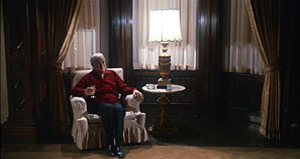
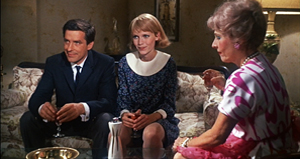
Mr. Castevet continues to talk with them from this chair, still framed in a strikingly distant shot.
Koepp agreed that virtually no director today would film the old man from so far back. Can’t you just see the tight close-up that would hint at something sinister in his demeanor?
We found the justification in the next scene, the dinner. This is filmed with one of those arcing tracks so common today when people gather at a table, but here it has a purpose. The shot’s opening gives us another instance of the Castevets’ social backwardness, as Rosemary saws away at her steak. (You’d think people in league with Satan could afford a better cut of meat.)
Mr. Castevet proceeds to denounce organized religion and to flatter Guy’s stage performance in Luther. As the camera moves on, the fulcrum of the image becomes the old man, now seen head-on from a nearer position.
“He was saving it,” said Koepp. “He was making us wait to see this guy more closely—and even here, he’s postponing a big close-up.”
Yet having given with one hand, Polanski takes away with the other. Next Rosemary is doing the dishes with Mrs. Castevet while the men share cigarettes in the parlor. Because we’re restricted to Rosemary’s range of knowledge, we see what she sees: nothing but wisps of smoke in the doorway.
We’ll later realize that this offscreen conversation between Roman and Guy seals the deal over Rosemary’s first-born.
Empty doorways form a motif in the film (the major instance has been much commented on), and they too point up Polanski’s stinginess—or rather, his economy. He doles his effects out piece by piece, and the result is a mix of mystery and tension that will pay off gradually. Koepp likewise exploits the sustained empty frame, most notably at the end of Ghost Town.
Building up scenes in this way encourages the director to give each shot a coherence and a point. Koepp recalls De Palma’s advice: “For every shot, ask: What value does it yield?” Spielberg comes to the set with clear ideas about the shots he wants, and when scouting or rehearsing he’s trying to assure that the set design, the lighting, and the blocking will let him make them. As Koepp puts it, Spielberg is saying: “This is my shot. If I can’t do X, I don’t have a shot.”
Compared to the swirling choppiness on display in much modern cinema–say, at the moment, Leterrier’s Now You See Me–Koepp’s style is sober and concentrated. For him, the director should strive to turn a shot into a cinematic statement that develops from beginning to end. The slow track rightward in Stir of Echoes has its own little arc, following Maggie leaving the porch, moving past their son, concluding on Tom as she speaks to him and he suddenly turns to her (at the cut).
Accordingly a shot can end with a little bump, a “button” that’s the logical culmination of the action. Something as simple as Rosemary turning her head to look sidewise is a soft bump, impelling the POV shot of the doorway. Something more forceful comes in Stir of Echoes, when the people at the party chatter about hypnosis and the camera slowly coasts in on Tom, gradually eliminating everybody else until in close-up he says cockily, “Do me.”
Shooting all the conversational snippets among various characters would have required lots of coverage, and it was cleaner to keep them offscreen as the camera drew in on Tom. With the suspense raised by the track-in (a move suggested by De Palma), Koepp could treat Tom’s line as a dramatic turning point and the payoff for the shot.
In a comic register, the button can yield a character-based gag. Bertram Pincus is warming to the Egyptologist Gwen; he’s even bought a new shirt to impress her. They discuss how his knowledge of abcessed teeth can help her research into the death of a Pharaoh. A series of gags involves Pincus’ discomfiture around the mummy, with Gwen making him touch and smell it. The two-shot, Koepp says, is still the heart of dialogue cinema, especially in comedy.
Bertram offers Gwen a “sugar-free treat” and shyly turns away. The gesture reveals that he’s forgotten to take the price tag off his shirt.
This buttons up the shot with an image that reveals the characters’ attitudes. Pincus’s error undercuts his self-important explanation of the pharoah’s oral hygiene. Yet it’s a little endearing; he was in such a hurry to make a good impression he forgot to pull the tag. At the same, having Gwen see the tag shows her sudden awareness that Bertram’s offensiveness masks his social awkwardness. As Koepp puts it: “He bought a new shirt for their meeting, she realizes it, and she finds it sweet.” She’s starting to like him, as is suggested when she turns and matches his posture.
Koepp gives the whole scene its button by cutting back to a long shot as Pincus murmurs, “Surprisingly delightful.” Is he referring to his candy, or his growing enjoyment of Gwen’s company? Both, probably: He’s becoming more human.
Like the Movie Brats and the New New Hollywood filmmakers, Koepp is inspired by other films. And as with them, his usage isn’t derivative in a narrow sense. He treats a genre convention, a situation, an earlier Gizmo, or a fondly-remembered shot as a prod to come up with something new. Borrowing from other films isn’t unoriginal; in mainstream filmmaking, originality usually means revising tradition in fresh, personal ways.
There’s a lot more to be learned about screenwriting and directing from the work of David Koepp. He told me much I can’t squeeze in here, about the Manhattan logistics of shooting Premium Rush and about the newsroom ethnography behind The Paper, written with his brother Stephen. What I can say is this: He really should write a book about his craft. I expect that it would be as good-natured as his lopsided grin and quick wit. It would illuminate for us the range of the creative choices available in the New Hollywood, the New New Hollywood, and the Newest Hollywood.
Thanks to David for giving me so much of his time. We initially came into contact when he wrote to me after my blog post on Premium Rush, which now contains a P.S. extracted from his email. We had never met, and I’m glad we finally caught up with each other.
I’ve supplemented my conversation with David with ideas drawn from his DVD commentaries for Stir of Echoes, Secret Window, and Ghost Town. Soderbergh provides intriguing observations on the commentary track for Apartment Zero. I’ve also found useful comments in these published interviews: “David Koepp: Sincerity,” in Patrick McGilligan, ed., Backstory 5: Interviews with Screenwriters of the 1990s (University of California Press, 2010), 71-89; Joshua Klein “Writer’s Block, [1999],” at The Onion A.V. Club; Steve Biodrowski, “Stir of Echoes: David Koepp Interviewed [2000]” at Mania; Josh Horowitz, “The Inner View–David Koepp [2004]” at A Site Called Fred; “Interview: David Koepp (War of the Worlds)[2005]” at Chud.com; Ian Freer, “David Koepp on War of the Worlds [2006],” at Empire Online; “Peter N. Chumo III, “Watch the Skies: David Koepp on War of the Worlds,” Creative Screenwriting 12, 3 (May/June 2005), 50-55; E. A. Puck, “So What Do You Do, David Koepp? [2007]” at Mediabistro; Nell Alk, “David Koepp, John Kamps Talk Premium Rush, Joseph Gordon-Levitt’s Fearlessness and Pedestrian ‘Scum’ [2012]” at Movieline; and Fred Topel, “Bike-O-Vision: David Koepp on Premium Rush and Jack Ryan [2012]” at Crave Online.
Vincent Sherman discusses screenplay switching in People Will Talk, ed. John Kobal (Knopf, 1986), 549-550. My quotation from Gladiator‘s DP comes from The Way Hollywood Tells It, p. 159. For more on David Fincher’s way with characters’ eyes, see this entry on The Social Network.