















Archive for the 'Film technique' Category
But what kind of art?
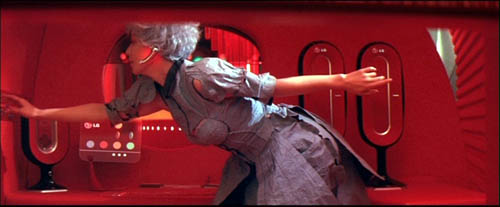
2046.
From DB:
We don’t have to think of film as an art form. A historian can treat a movie as a document of its time and place. A war buff could scrutinize Eastwood’s Iwo Jima movies for their accuracy, and a chess expert could sieve through Looking for Bobby Fischer to discover, move by move, what matches were dramatized. But most of the time we assume that cinema is an art of some sort.
Not necessarily high art. Cinema is often a popular art, or in Noël Carroll’s phrase, a mass art. From this angle, there’s no split between art and entertainment. Popular songs are undeniably music, and best-selling novels are instances of literature. Similarly, megaplex movies are as much a part of the art of film as are the most esoteric experiments. Whether those movies, or the experiments, are good cinema is another story, but cinema they remain.
So, at least, is our position in Film Art: An Introduction. We draw our examples from documentaries, animated films, avant-garde films, mainstream entertainment vehicles, and films aimed at narrower audiences. In other writing, Kristin has done research on high-art movements like German Expressionism and Soviet Montage (she wrote her dissertation on Ivan the Terrible), but she’s also written about popular cinema from Doug Fairbanks to The Lord of the Rings. I’ve indulged my admiration for Hou and Dreyer but also I’ve tried to tease out the aesthetics of Hong Kong action pictures and contemporary Hollywood blockbusters. Ozu gives us the best of both worlds: one of cinema’s most accomplished artists, he was also a popular commercial filmmaker.
Still, people who look upon cinema as an art don’t necessarily share the same conceptions of what kind of art it is. We have different conceptions of cinema’s artistic dimensions, and we won’t find unanimity of opinion among filmmakers, critics, academics, or audiences.
When we study film theory, this sort of question comes to the fore, and so today’s blog will be a bit more theoretical than most. Don’t let that scare you off, though; I’m trying for clarity, not murk.
Dimensions
People have tended to think of cinema as an art by means of rough analogies to the other arts. After all, film came along at a point when virtually all the other arts had been around for milennia. It’s commonly said that film is the only artform whose historical origins we can determine. So it’s been natural for people to compare this new medium with older arts.
Here are the dimensions that come to my mind:
*Film is a photographic art.
*Film is a narrative art.
*Film is a performing art.
*Film is a pictorial art.
*Film is an audiovisual art.
Let me say off the bat that I think that film is a synthetic medium, in the sense that all these features and more can be found in it. It’s like opera, which is at once narrative, performative, musical, and even pictorial. I mark out these dimensions simply to show some emphases in people’s thinking about cinema. As we’ll see, these ideas can be mixed together in various ways.
Film as a photographic art.
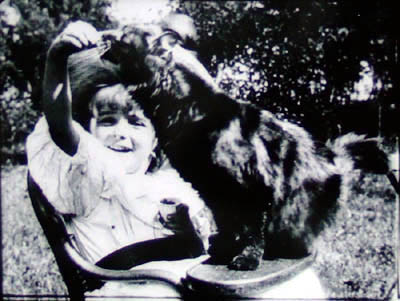
La petite fille et son chat (1900).
For many early filmmakers, such as the Lumière brothers (above), cinema was a means of capturing reality, documenting the visible world. Movies were moving photographs. Naturally, this conception of cinema leads us to treat documentary as the central mode of filmmaking.
It’s an appealing idea. G.W. Bush reading “My Pet Goat” wouldn’t be as revelatory presented as a painting or a theatre performance. On film we can see the event as it occurred and judge it as if we were in the same room. Even in fictional cinema, you can argue, the physicality of the actors, the tangibility of the setting, and the details–a train’s pistons, wind rustling through grass–could not be rendered, or even imagined, so powerfully in a non-photographic medium. In addition, consider Jackie Chan. His stunts are astonishing partly because we know he really did them and the camera photographed them. In an animated film, or a CGI-based one, a character’s acrobatics or brushes with death aren’t so thrilling.
The great film theorist André Bazin claimed that cinema’s photographic basis made it very different from the more traditional arts. By recording the world in all its immediacy, giving us slices of actual space and true duration, film puts us in a position to discover our link to primordial experience. Other arts rely on conventions, Bazin thought, but cinema goes beyond convention to reacquaint us with the concrete reality that surrounds us but that we seldom notice.
I think that Bazin’s idea lies behind our sense that long takes and a static camera are putting us in touch with reality and inviting us to notice details that we usually overlook in everyday life. (I try out this line of argument in relation to the tactility of Sátántangó here.) Moreover, you can argue that in treating cinema as a photographic art the filmmaker surrenders a degree of control over what we see and how we see it. Bazin made this claim about the Italian neorealists and Jean Renoir: creation becomes a matter of an existential collaboration between humans and the concrete world around us.
An example I used in my book Figures Traced in Light pertains to a moment in Hou Hsiao-hsien’s Summer at Grandfather’s, when a tiny toy fan falls between railroad tracks as a locomotive roars past. The fan’s blades stop, then spin in the opposite direction as the train thunders over it. The blades reverse again when the train has gone. (This detail might not be visible on video.) Did Hou know how the fan would behave? Isn’t it just as likely he simply discovered it after the fact, making his shot a kind of experiment in the behavior of things? Conceived as a species of photography, cinema can yield visual discoveries that no other art can.
Interestingly, cinema didn’t have to be photographic. Many early experiments with moving images were made with strips of drawings, such as the Belgian Émile Reynaud’s Praxinoscope. You can argue that recording glimpses of the world photographically simply proved to be the easiest way to obtain a long string of slightly different images that could generate the illusion of movement. Some filmmakers, such as George Lucas, hold that filmmakers are no longer tied to photography, and that the digital revolution will allow cinema to finally realize itself as a painterly art. More on that below.
Film as a narrative art.
Rope.
This is at the core of Hollywood’s explicit concerns. Producers, directors, crew, and of course screenwriters will agree that Without a good story, the movie fails. Our Indie and Indiewood filmmakers say they’re trying to find fresh stories, the ones that “haven’t been told yet.” Overseas filmmakers dominated by Hollywood tell us, “We have our own stories to tell.” Even the most celebrated arthouse filmmakers often say they’re interested in character as revealed through action. Resnais, Rivette, Fassbinder, Haneke, and all the rest may have told unusual stories, but still they told ’em.
Likewise, many viewers will say that they go to the movies to experience a story. Reviewers online and in the popular press, if they do nothing else, are obliged to sketch out the film’s plot, though they mustn’t give away the ending. Even in academia, most discussions of films focus on what happens in the narrative.
When we consider film genres, we’re usually concentrating on the narrative aspects of them. Most genres display typical characters and plot patterns. The backstage musical features aging stars and young hopefuls, caught up in the process of putting on a show. The horror film typically centers on a monster’s attack on humans, who must fight back. One type of science fiction shows us an overweening scientist striving to go beyond “what is proper for humans to know.” Both fans and scholars discuss other aspects of genre films, but narrative is often central to their concerns.
Historians have traced in great detail how filmmakers employed cinema as a narrative art, but we’re making more discoveries all the time. How, for instance, have films signaled flashbacks? How do they let us know we’re in a character’s mind, or attached to his or her optical point of view? How have they structured their plots? Can we pick out distinct approaches to narrative–in various periods, or genres, or national cinemas? How have narrative conventions changed over the years? Some of the answers Kristin and I have proposed can be found elsewhere on this site, and in our books and articles.
Film as a performing art.
The Marrying Kind.
In the West, since Plato and Aristotle we’ve distinguished between verbal storytelling and dramatic presentation, or performance. Films may be stories, but they’re not exactly told: they’re enacted. At Oscar time, we’re especially conscious of this analogy, for the Actor/ Actress nominees usually garner the most public attention.
Hollywood acknowledged cinema as a performing art in the 1910s, when it created the star system. The Star reminds us that film acting isn’t exactly the same as theatre acting, since an elusive charisma puts the performance across. John Wayne, Marilyn Monroe, Keanu Reeves, and many other “axioms of the cinema” aren’t good actors by stagebound standards, but once they show up on screen, you can’t take your eyes off them. This notion intersects with the photographic premise: we say that the camera seems to love them.
You can argue that Andy Warhol revamped this idea. His superstars weren’t photogenic by ordinary standards but their almost clinical narcissism and exhibitionism, captured by the camera, made them as mesmerizing as any matinee idols. Warhol films like Paul Swann create rather disturbing emotions by putting us in the presence of an awkward performer.
Reviewers place a premium on a movie’s performance dimension. After they’ve told us a bit of the plot , they appraise the job the actors did. Some ambitious critics have written wonderful appreciative essays on acting, as in Andrew Sarris’s “You Ain’t Heard Nothin’ Yet” and the collection OK You Mugs. See also the two collections of articles by Gary Giddins, which I discuss in an earlier blog.
Academic film studies has been slow to study acting systematically, partly because of a bias against considering cinema as a theatrical art, and partly because acting is very hard to analyze. But Charles Affron, Jim Naremore, Roberta Pearson, and Ben Brewster and Lea Jacobs have greatly helped us understand performance practices. They show, among other things, that it isn’t just a matter of the face or the voice: a fluttered hand or a willowy stance can be as powerful as a frown or a line reading.
Film as a pictorial art.
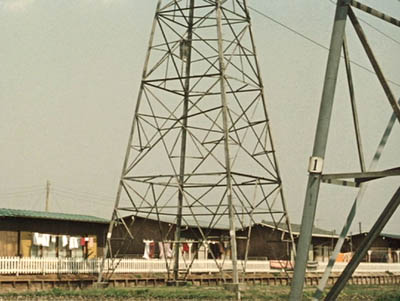
Ohayu (Good Morning).
Progressive opinion in the silent era tended to deny that film was a performing art, since that would make it a form of theatre. No, film had unique capacities. Cinema was essentially moving pictures.
It was a visual art that unfolded in time, so a movie was neither quite the same as a painting (frozen in time) or as a stage play (not pictures but three-dimensional reality). The coming of sound somewhat reduced the appeal of this line of argument, but to a very great extent, students of film technique still emphasize cinema as a visual art.
Theorists argued that the film frame was a pictorial field, not a proscenium stage. Action unfolded in the frame in ways that dynamized space. The choice of angle, camera distance, camera movement, and the like created a visual fluidity that had no equivalent on stage or in other graphic arts. Even cinematic staging was quite different from blocking in a theatrical space. Add to this the ability to join one strip of pictures to another via editing, and we have a unique pictorial artform.
The theorists of the silent era, like Rudolf Arnheim and the Russian montagists, gave us a vocabulary and an orientation to studying visual style, but their legacy hasn’t been fully developed. Journalistic reviewers typically don’t pay that much attention to the way movies look. Nor, surprisingly, do academics. Film studies departments seldom pursue research into visual style and structure.
Here the professors are out of sync with the people whose work they study. Manuals and film schools teach composition, lighting, cutting, camera placement and the like. Professional filmmakers all over the world often think in pictures; they prepare shot lists and storyboards and care very much about the color values and editing patterns of the finished work. We can see their interest in visuals in DVD commentaries and supplements, and as viewers start to absorb bonus materials, perhaps their interest will be whetted too.
Needless to say, a number of avant-garde filmmakers, from Viking Eggeling and Walter Ruttmann to Deren, Brakhage, Ernie Gehr, James Benning, and Nathaniel Dorsky, have also thought of cinema as having the power to refresh, even redeem, our vision. But many of the most important directors aiming at broader audiences are also renowned for their visual styles. To mention just a few: Griffith, Feuillade, Sjostrom, Keaton, De Mille, Murnau, Lang, Dreyer, Lubitsch, and Dovzhenko; Ford, Hitchcock, and von Sternberg; Renoir, Ozu (above), Mizoguchi, and Ophuls; early Bergman, Antonioni, Jancsó, Resnais, Angelopoulos, Tarr, Tarkovsky, Kieślowski, Kiarostami, and Makhmalbaf; Scorsese, Spielberg, Michael Mann, and Tim Burton. Some, like Oshima, Sokurov, and Johnnie To, have been polystylistic, exploring many different visual pathways.
Film as an audiovisual art.
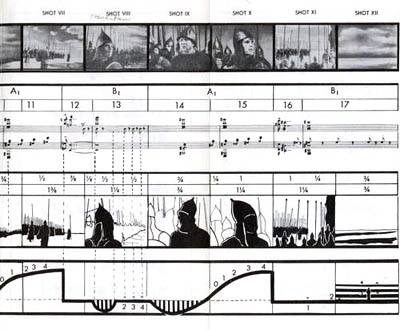
In the 1920s, many theorists feared the coming of synchronized sound, since that would thrust film back toward theatre. The “talkies” would sacrifice visual artistry to Broadway dialogue. This worry was mistaken, but I can sympathize. Probably the mandatory silence of early film pushed filmmakers to find means of visual expression. Would we have Chaplin and the other clowns if they could have spoken at the start?
Yet a great deal of sound cinema wasn’t canned theatre. Film became a synthetic medium blending imagery, the spoken word, sound effects, and music into something that was neither painting nor theatre nor illustrated radio.
Though he’s thought of as the premiere theorist of editing, Eisenstein actually developed this idea of audio-visual synthesis. He was fascinated by the ways in which images and music worked together, creating an idea or feeling that couldn’t be expressed by either one. If shot A followed by shot B gave us something that wasn’t present in either one, then why couldn’t shot A and sound B yield the same results? He believed that Disney’s 1930s films were the strongest efforts in this direction, as when a peacock fanned out his tail to a rippling melody. Eisenstein called it “synchronization of senses.”
Eisenstein sometimes pushed this idea pretty far. His remarkable analysis of one sequence in Alexander Nevsky (sample above) tried to show how the movement of the viewer’s eye across a suite of shots actually mimicked the movement of the music. He made the case tough for himself because the shots contain almost no movement within them: Eisenstein claimed that we read the compositions from left to right, in time with the musical chords!
Not only Disney but many filmmakers of the 1930s experimented with audiovisual fusion–Kozintsev and Trauberg in Alone, Pudovkin in Deserter, Mamoulian in Love Me Tonight, Renoir in the final danse macabre of Rules of the Game, and Busby Berkeley’s Warners and MGM musicals. Welles made Citizen Kane a feast of audio-visual echoes, as when the wobbly descent of Susan’s singing voice is matched by the flickering of a stage light that finally goes out.
With magnetic and multichannel recording in the 1940s and 1950s, filmmakers could compose very complex sound mixes, and later improvements offered still more possibilities. After Star Wars and Close Encounters of the Third Kind, we expected a movie to be an immersive audiovisual experience, like the light show at a rock concert. Scorsese, especially in Raging Bull and Goodfellas, created powerful mergers of music, sound effects, camera movement, and character movement. So did the Hong Kong kung-fu films of the 1970s and early 1980s. The spellbinding languor of Wong Kar-wai’s films stems largely, I think, from their synchronization of color, slow motion, drifting camerawork, and evocative music.
The avant-garde has pursued more elusive synchronizations of sense modes.The idea of synthesis was floated in the silent era, when experimenters like Oskar Fischinger used musical pieces to anchor their abstract imagery. This tendency has resurfaced in music videos, some of which (Michel Gondry’s in particular) have clear links to the experimental tradition. So too do the shorts and features of Peter Greenaway, especially in his collaborations with composer Michael Nyman. In a film like Prospero’s Books, Greenaway seems to follow Eisenstein in imagining a Wagnerian synthesis of writing, image, and sound.
By contrast, Godard explores all manner of unpredictable junctures between image and sound, with the tracks teasing us but always avoiding a complete coordination. Somewhat similar are the disjunctive image/sound juxtapositions in Peter Kubelka’s Unsere Afrikareise and Bruce Connor’s Report, or the inverse and retrograde organizations of Structural Film soundtracks like Michael Snow’s Wavelength and J. J. Murphy’s Print Generation.
Film academics have begun to analyze image/ sound juxtapositions, studying the development of early talkies and more recent Dolby technology. Arguably, film researchers now pay more attention to music than they pay to imagery. By contrast, most journalistic critics ignore a film’s soundtrack, except occasionally to comment on line readings and pop tunes. As for ordinary audiences, perhaps DVD and home theatre technology have made people more aware of how movies can saturate our senses with audiovisual correspondences.
Three waivers
1. Once I floated these distinctions in a seminar discussion, and a participant mentioned that cinema was also an emotional art. I’d agree that a lot of cinema aims at arousing feelings, but this idea can be found in all the dimensions I traced. Each conception of film favors different means of stirring up emotion.
For example, the photographic approach holds that recording and revealing the world is the most effective way to move spectators, while the narrative approach favors stories as the means to that end. The performance-based approach trusts that we’ll react empathetically to the emotional states displayed by our fellow humans, but the visual-art approach says that cinema can arouse feeling by manipulating pictures in time and space, perhaps even pictures that don’t show any people at all. Eisenstein argued that synchronization of senses was the most powerful form of emotional stimulation, creating in the viewer an “ecstasy” comparable to religious fervor. Beyond these general considerations, it would be worthwhile to tease out the different sorts of emotion that each perspective tends to emphasize.
2. Someone else might ask: What about other analogies? Filmmakers and critics have sometimes compared cinema to music or poetry. Shouldn’t those arts be added to the list?
I think that these comparisons show up principally within the broad idea of film as a pictorial art. The French Impressionist directors of the silent era thought that they were making “visual music,” and Brakhage and Deren’s conceptions of the “film lyric” were mainly pictorial. (See girishshambu for thoughts on the latter.) I’d suggest that filmmakers in the pictorial-art camp have looked to these adjacent arts for models of patterning (meter, rhythm, motif development) and imagery (metaphor and subjective states in lyric verse). Filmmakers are also attracted to the idea that music and poetry tend to be suggestive rather than explicit, conveying powerful feelings in elusive and open-ended ways.
Polemically, filmmakers often conjure up these musical and literary analogies to counter the mainstream cinema’s emphasis on narrative and performance. If we think of film as lyric or rhapsody, story seems less important. The same thing goes, I think, for thinking of film as moving architecture or kinetic sculpture; the analogy again targets film’s pictorial dimension and its non-narrative potential.
3. To think of film as having an affinity with another art form isn’t to say that they’re identical. Thinking of cinema as a performance-based art, for example, doesn’t commit you to saying that film acting is the same as theatrical acting. Instead, thinking along these lines seems to create a first approximation, an initial comparison that lets you move on to notice differences. Once you consider film as a pictorial art, you can then ask in what ways it differs from other pictorial arts, or in what ways this particular movie transforms or reworks the techniques of painting. Ballet Mécanique, which we analyze in Film Art (pp. 358-366), owes a lot to cubism, but its imagery isn’t identical to what Picasso, Braque, and Gris came up with on canvas. All of these analogies seem to work best as frameworks for sensitizing us to both similarities and differences between film and other arts.
And . . . so?
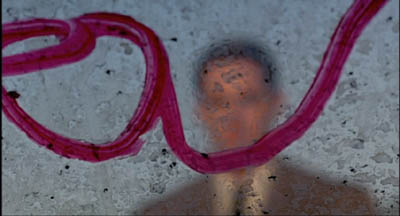
Twin Peaks: Fire Walk with Me.
Each conception of film art harbors a good portion of truth. Each may fail to cover all of cinema, but for certain types of film, or particular movies, some are likely to be more helpful than others.
For example, it’s useful to consider David Lynch as making audiovisual works, in which blinking lights or grooves in pine planks seem uncannily synchronized with throbs and hums and Julee Cruise vibrato. Very often story and acting seem to precipitate out of an enveloping pictorial/auditory atmosphere. This isn’t to say that you couldn’t study narrative or performance in Lynch films; it’s just that taking up the audiovisual-mix perspective will throw certain aspects into sharper relief.
You could also argue that the Hollywood studio era blended many of these appeals into a single strong tradition. Story was important, but so was performance. Visual style was often striking, but so too was an expressive soundtrack that went beyond simply recording the dialogue. Sound effects, musical scores, and verbal hooks between scenes created imaginative resonances with the image track. Contrariwise, we can see some avant-garde traditions as taking a purist tack. In several of his films, Brakhage reduces narrative, purges performance, and bans sound: we have to engage wholly and solely with a pictorial experience.
Just as we can distinguish film traditions along these dimensions, we can contrast writers and thinkers. Some critics are very good in pinning down performance qualities, others excel at plot dissection or visual analysis. Arnheim is sensitive to pictorial values but he has little to contribute to understanding storytelling.
Bazin and Eisenstein are attuned to several of the dimensions I’ve traced out. Bazin’s interest in cinema’s photographic basis also alerted him to pictorial possibilities, like deep-focus and camera movement. Eisenstein, famous for his ideas on cinema’s visual dimension, was as I’ve said interested in sound as well. He was no less concerned with film performance, which he conceived as expressive movement (to be synchronized with properties of the image and the soundtrack). But he voiced almost no interest in narrative or photography.
I warned you that this blog would be theoretical, but I hope the takeaway message is clear. Cinema is teeming with artistic possibilities, and each of these frameworks can illuminate certain areas of choice and control. We don’t need to pick a single creed to live by, but we deepen our understanding of film by being sensitive to as many as we can manage.
Angles and perceptions; with a note on Thai censorship
Hide your face
“Angles alter perceptions,” notes a recent Newsweek story. You bet, as we say in Wisconsin. But intriguing evidence emerges from new research into videotaped confessions.
Over 500 jurisdictions now record confessions on video, we’re told. In virtually all instances, there’s only one camera, and it shows only the accused. That means, in movie terms, there are no reverse shots of the questioner.
What difference does it make? Quite a lot, it seems.
In Newsweek‘s words, “When a camera shows only a suspect’s face, studies show, potential jurors are more likely to believe the confession was voluntary and the suspect guilty than when it shows the faces of both suspect and interrogator.” The problem may also infect judges. Experiments conducted by G. Daniel Lassiter at Ohio University found that a sample of 21 judges appraised the confessions as more voluntary when the camera framed only the confessor and didn’t show the police officer.
The obvious worry is that we can’t be sure that the confession is voluntary if we don’t get any sight of the questioner. To take an extreme, but not fanciful, possibility, maybe the person offscreen is holding a weapon. But even if the questioner isn’t threatening the confessor, his or her facial expression will help us appraise the whole situation more fully. Is s/he reacting with sympathy, anger, or neutrality? Do the questioner’s facial expressions set a context for the questions asked? We can’t know, and this absence of knowledge may encourage us, by default, to side with authority and presume that the confession is genuine.
In fiction films, sometimes the camera doesn’t give us the reverse angle. It may simply dwell on one character, often when she or he is delivering a monologue. A close analog to the videotaped confession occurs in Truffaut’s 400 Blows when an offscreen therapist questions the boy Antoine about his life.
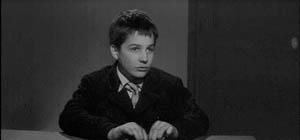
Several effects flow from Truffaut’s choice of this technique. The handling suggests a quasi-documentary objectivity in recording Antoine’s replies. Making the questioner unseen suggests that she won’t become a significant character, rather a voice that typifies the impersonal authority of the detention facility. The fact that the questioner is a woman reminds us of Antoine’s relation to his mother, an important topic in the interview. In all, this strategy concentrates on Antoine, letting us see new sides of his past and his mind.
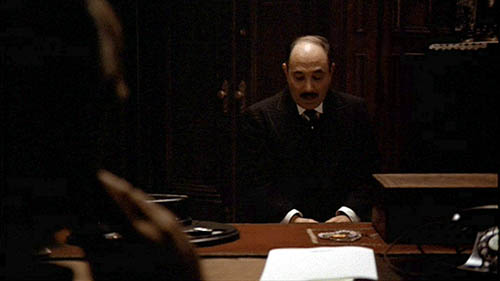
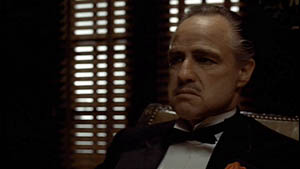
In other scenes, I’ve noticed that suppressing the reverse angle not only showcased the character we see but also rendered the scene’s action more suspenseful or ambiguous. Recall the famous first shot of The Godfather, which concentrates on the mortician and refuses to supply the reactions of Don Vito.
The shot gives full sway to Bonasera’s monologue. At the same time, by slowly zooming back, the shot creates a growing suspense. To whom is he speaking? What is the listener’s reaction? Only at the end of Bonasera’s plea, when he rises to whisper in Vito’s ear, does Coppola supply the view of Don Vito—a big theatrical entrance for this character and the actor playing him.
Less operatic is an early scene in Sauvage Innocence (2001), by Philippe Garrel. The filmmaker François is going over his dead wife’s belongings, which his friend has preserved. Garrel gives us an establishing shot of the action, then, as the friend continues to talk, the camera concentrates on Francois’s reaction to the letters, poems, and photographs. Although his expressions are somewhat ambivalent, at least we can see them.
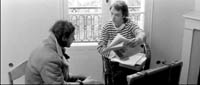
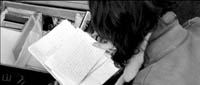
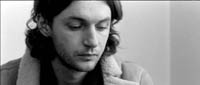
But in the next scene, a single shot lasting about seventy-five seconds, Garrel withholds the reverse angles that we’d normally get when his protagonist speaks. The camera favors the friend, a minor character, who asks questions about François’s new film while feeding a baby. François replies that he’s having trouble finding a producer, and if this last opportunity fails, the project will be over.
Garrel doesn’t choose to reveal François’s expression as he reports this critical state of affairs: no reverse shots. We must infer his emotional state from his voice, his pauses and sighs, and his postures as he replies, rises, and sits down.
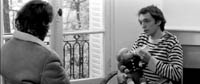
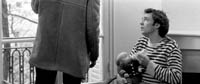
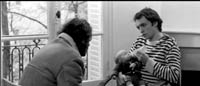
At most we can assume that he’s dispirited, perhaps because of his film’s slim prospects and the reminder of his dead wife.
In the scene, there’s one glimpse of his face, as he turns slightly, and—Tim Smith might be able to confirm this—I’d bet that most viewers zero in on him at that moment. (The movement is centered in the frame as well.) But that view is pretty brief and uninformative.
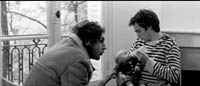
Overall, we have to infer François’s attitude from other cues than his expressions, and the results aren’t clear-cut. It seems to me that Garrel’s choices here are typical of one strain of “art cinema.” This storytelling tradition aims to make scenes somewhat indefinite in their meaning and to leave considerable room for spectators to play with various implications of the action.
Cutting and Social Intelligence
Some years ago I developed some ideas about the importance of shot/ reverse shot cutting in an essay called “Convention, Construction, and Cinematic Vision.” (1)
One school of thought in film studies holds that cinematic conventions are wholly arbitrary social constructions. This implies that we have to learn to watch movies, just as we have to learn any arbitrary sign system, like Morse code or written languages. My essay argued that cinema, like painting, offers a continuum of conventions: some require a lot of exposure to learn, while others require much less. The easiest ones rely on regularities of everyday experience. I tried to show that shot/ reverse shot is a fairly easy convention to learn because it mimics the alternation between speaker and listener that we find in the turn-taking of ordinary conversation.
As my examples suggest, even if person A is doing all the talking, we don’t fully understand the scene if we can’t also monitor the reactions of B. By contrast, the shot/ reverse-shot patern keeps a running tab of the dynamics of the conversation. When a director wants to suppress information about B’s response, deleting the reaction shot can create uncertainty or suspense.
Confessions aren’t fictional films; we don’t assume that they use much staging. I’d argue that in videotaped interrogations any uncertainty about the listener’s reactions is quelled by our assumption that the officer is neutral or that any emotion she expresses has no effect on the confession. In other words, during a videotaped confession, any reaction on the part of B is presumed, perhaps wrongly, to be irrelevant. But in watching a fiction film, we tacitly assume that the director has suppressed B’s reaction in order to shape our experience in a particular way. The use of shot/ reverse shot, then, has a narrational function, governing the flow of story information.
We might posit this maxim of social intelligence: We understand an interchange more fully when we can see both participants’ responses to it, moment by moment. This notion underpins our old friend shot/ reverse shot, a convention that requires no specialized learning beyond watching and participating in conversations in real life. The absence of the reverse shot in videotaped confessions forces us to fill in one side of the conversation, and what we fill in may not be warranted.
Lassiter suggests a subtler effect of single-shot confessions. He has specialized in what psychologists call “illusory causation,” as explained in a 2002 press piece.
Criminal interrogations are customarily videotaped with the camera lens zeroed in on the suspect. Psychological research has shown that objects that are the focus of attention, are “more likely than less conspicuous objects to be judged the originators of a physical event, even when there is no objective basis for such a conclusion,” said G. Daniel Lassiter, author of the study. This phenomenon is referred to as “illusory causation.”
So by concentrating wholly on the suspect, the framing attributes a greater causal power to him or her than would a shot/ reverse-shot sequence.
I can’t at the moment see how this might come into play in a fiction film. In both of my major examples here, Bonasera and the baby-feeding friend have less causal power than the character whose response is suppressed. I suspect that the story context of film scenes provides our main sense of who has the causal power, which film style can reiterate or undercut.
Censoring Syndromes
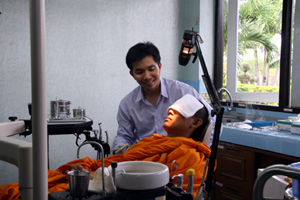
Apichatpong Weerasethakul’s Syndromes and a Century was one of the best new films I saw last year. It has played at Venice, Vancouver (my quick remarks are here), Hong Kong, and other major festivals. It also won the best editing award at the Asian Film Awards. You can read the Variety review here. Jeff Reichert’s exhilarating appreciation appears, in keeping with the theme of the above entry, at Reverse Shot.
But now Apichatpong has withdrawn the film from theatres because local censors have demanded cuts. The objectionable portions include shots of monks playing with toys and a doctor kissing his girlfriend in a hospital. Details are available at Variety and Limitless Cinema. According to Screen Daily (not available free online):
Apichatpong questions why many other Thai and foreign films which contain excessive violence, nudity, coarse language, crude jokes on other ethnic groups, and monks doing stupid things did not suffer the same fate.
Below I reprint Apichatpong’s most recent statement and information about a petition that’s available online.
Free Thai Cinema Movement Petition
Statement by Apichatpong Weerasethakul with Bioscope, the Thai Film Foundation, Thai Film Director’s
Association, and Alliances.
I am saddened by what has happened to my film. However, this is not the venue to try to make SYNDROMES AND A CENTURY shown in Thai theaters. It is not my intention to use this opportunity to promote my work.
But, it is time to seriously think about what is going on with our censorship laws, so that the next generation of filmmakers will not face the same problems as us, and so that the Thai audiences can truly achieve a freedom of choice.
It is time we discuss whether all films, before being released, should be seen by the Buddhist council, doctors council, teachers council, labor council, the army, pet lovers group, taxi union, representatives from other foreign countries etc? Or, is it easier to turn our nation into a Fascist state so that we can live in harmony and don¹t have to waste time talking about democracy?
The system of the Thai Board of Censors needs to be evaluated. Their members’ relevancy and efficiency needs to be questioned, and we should decide whether the laws should be changed.
I would like to ask you to reflect on the censorship practices in our country and to provide us with advice at
http://www.petitiononline.com/nocut/petition.html
Later on, this Petition will be submitted to the Thai government. Your support will be a great contribution to our fight for one of our most basic rights – that of freedom.
I am grateful for your time and your participation. Thank you very much.
Warmest Regards,
Apichatpong Weerasethakul
KICK THE MACHINE FILMS Co., Ltd.
(1) It’s not available online; it was published in Post-Theory and will be reprinted in my forthcoming Poetics of Cinema collection.
A many-splendored thing 10: Li Han-hsiang, cont’d
Li and his legend
The Li Han-hsiang retrospective rolls on here at the Hong Kong International Film Fest. For my initial blog on the subject, along with relevant links, go here.
Li is chiefly known for his costume pictures, though he reveals a talent for more intimate fare, as seen in The Winter (1969), which I commented on earlier. His early HK films, like Lady in Distress (1957) and A Mellow Spring (1957), are fairly typical Mandarin-language melodramas, with comparatively high production values and centering on suffering heroines (played in both of these by Linda Lin Dai). The first is a rural romance, with some attractive landscape locations and night-for-night shooting. A Mellow Spring, an instance of the “tenement film” characteristic of 1940s-1950s Hong Kong cinema, takes place over a single day and moves among several families in an apartment bulding.
Li’s direction here is simple and traditional. He uses fairly distant staging, presenting shot/ reverse-shot breakdown of dialogues and camera movements that adjust to the characters’ movements. A moment of tension will be underscored by rapid cutting. There are occasional depth shots, but nothing that would be considered unusual for the 1950s in other national cinemas.
Perhaps the most unusual aspect to western eyes is a habit that Li relies on throughout his career. After a cut, a character may pop into the frame from left, right, or below, usually in close-up. Directors of martial arts films use this tactic in the 1960s and thereafter, but I was surprised to see it in the context of straight drama. It will recur in the Taiwanese films Li directed or supervised. I can’t say if it’s original with him or if he and his subordinate directors took it from another source, but it certainly tends to accentuate the reaction shot. In other directors’ action pictures these abrupt frame entrances becomes part of a captivating overall rhythm of cutting and figure movement.
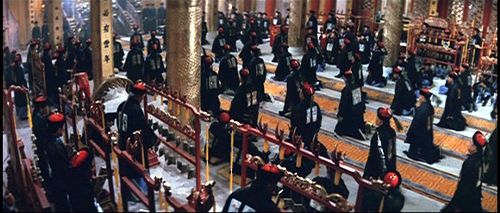
In 1963 Li moved to Taiwan and founded the Grand studio. As he attests in the archive’s indispensable book, he was a poor businessman and Grand folded in a few years. His most acclaimed achievement there was Beauty of Beauties (1965), a spectacular historical saga. I’d seen it before, but the archive screening offered an opportunity to look more closely. Unfortunately, the original two-part release is unavailable, so a 155-minute version was shown.
It’s certainly an awesome achievement. Two or three exterior sets are enormous and crowded with soldiers, chariots, and masses of commoners. Clearly Beauty of Beauties was an effort to rival the behemoth pageants of Hollywood. The central plot, however, isn’t very visible in the shorter version. King Fu Chai has conquered the kingdom of Yueh, so Yueh’s king sends Hsih Shi, a beautiful village girl, to Fu’s court to seduce him. She succeeds in weakening the influence of his counselors, and after seventeen years (!) Yueh’s king gains the strength to rebel against the oppressors. The problem is that in making the short release version, the editors played up the scenes of crowd spectacle and took out most of the palace intrigue. The result is choppy, with some scenes interrupted midway and little effort to trace Hsih Shi’s growing sway over Fu.
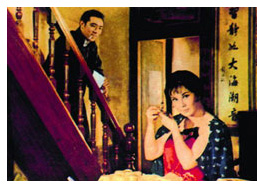 More satisfying, in a lowbrow way, were Grand items like Storm over the Yangtse River (1971), a thriller in which Chinese guerrillas fight the Japanese occupation in the 1930s. Lots of spy-vs.-spy trailing, double-dealing, and bluffing are at the center here. The most Wellesian of the Li films I saw, this is full of steep angles and shock cuts. A good visual idea was the towering inn set, which allows Li to show action on different staircase landings simultaneously. Clearly he could direct unpretentious entertainment when he wanted to.
Li and his league
Just as interesting as Li’s own Taiwanese pictures are those he supervised. Of the ones I saw, three were directed by Yeung So, and they offered instructive early examples of the contemporary melodrama called chiungyao films.
Chiung Yiao (Qiong Yao) was a popular writer of romance novels, and she gave her name to an entire genre of fiction and film. Probably the most famous chiungyao movie is Outside the Window (1973), starring Brigitte Lin Ching-hsia and centering on the forbidden love between a teacher and his student. Other chiungyao films I’ve seen center on cross-class romances or the miseries of the well-to-do. The rich young people listen to rock and roll and drive Vespas, and they live in modernistic houses with well-stocked bars and doily-covered armchairs. Chiung Yao’s work helped Taiwanese cinema attracted a new generation of viewers while showcasing a self-consciously modern Taipei culture.
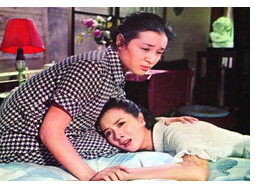 Yeung So’s Many Enchanting Nights (1966), for Grand, was an early Chiung Yao adaptation. At first it seems to be about a high-school girl from a struggling family who falls in love with a rich man’s nephew. Gradually the narration shifts toward her parents and their domestic tensions, which revolve around the wife’s youthful love affair with the wealthy man. A long flashback fills us in on the backstory, and the weight of the film falls on the mother, who suffers not only abandonment by her lover (through a misunderstanding) but merciless attack by her self-destructive husband. Released in two parts, Many Enchanting Nights is a deliberately paced but always enjoyable exercise in suffering, miscommunication, flashes of lurid teen sexuality, impotent male rage, and female fortitude. There are many accessory pleasures as well. When our young lovers visit a bar, the theme from Johnny Guitar is rendered on electric guitar.
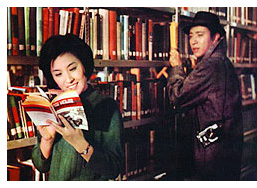 The flirtation with incest in Many Enchanting Nights comes out with force in another Chiung Yao adaptation, Yeung So’s The Stranger (1969). A college girl is shadowed by a mysterious older man, and after he introduces himself she starts to fall in something like love with him. But flashbacks reveal to us that this attraction is, to say the least, misplaced. One odd aspect of this movie is the fact that until the climax we never see the face of the girl’s mother; her back is to us, she’s in shadow, or she doesn’t get a reverse-shot. Did Wong Kar-wai borrow this for his oblique portrayal of the spouses in In the Mood for Love? Like Many Enchanting Nights, The Stranger shows a flair for striking ‘scope compositions and saturated color design. And again we get those pop-in and pop-up frame entrances.
The most renowned Grand film that Li Han-hsiang supervised is At Dawn (1968), by Song Cunshou. It’s a restrained but shocking attack on Chinese trial procedures. A young man goes off to his first day as a bailiff and is appalled by the fact that torture is used to extract confessions. Will he accept this for the sake of keeping a job, or will he quit? Unusually subdued, set mostly at night and in darkened interiors, At Dawn is a remarkable study of weakness and bad faith, and it deserves its fame as a Taiwanese classic.
Li and his lens
At the beginning of the 1970s, when he returned to Hong Kong, Li Han-hsiang was apparently settling into the style that would characterize his work for many more years. He was cutting faster. Lady in Distress and A Mellow Spring are shot in leisurely fashion, averaging, respectively, 10.4 seconds and 16.1 seconds per shot. In the late 1960s, The Winter comes in at 6.5 seconds, Storm over the Yangtse River runs 4.7 seconds average, and Li’s episode of Four Moods (1970) averages 4.6 seconds per shot. Of the late films I’ve seen in the retrospective, the averages run from about five seconds down to less than three (in Passing Flickers, 1982). These shot lengths are comparable to the quick cutting in the kung-fu films of the period.
As often happens with accelerated cutting, close-ups of the actors now predominate. Li likes to treat conversations in enormous facial views (not always in focus), quickly intercut on lines of dialogue. We still get the sudden frame-entrance cuts. And he really, really likes zooms.
Li’s reliance on zooms has often been condemned as laziness or opportunism, and there’s some evidence for this judgment. He astonished everyone by the speed with which he worked, churning out erotic tales, gambling comedies, and costume pictures. He recruited Lam Chiu-ha as cinematographer because Lam could finish 100 shots in a day. The zoom facilitated quick work, and Li evidently didn’t see it as looking tackier than a tracking movement. On one shot he asked Lam, “Why did you use a dolly? Wouldn’t a zoom-in be sufficient?” (1)
Nowadays the zoom is flourishing, serving to provide pastiche (Tarantino in Kill Bill) (2) or add “energy” to a scene. But in the 1970s it was associated with cheap and/or incompetent filmmaking. That wasn’t entirely fair: Truffaut and Rossellini had made good use of it in the 1960s, and Visconti, Fellini, Bergman, Satayajit Ray, and other major directors were relying on the zoom at about the time that Li was. So were most Shaw directors, notably Chang Cheh. I argued in Planet Hong Kong that martial arts directors like Chang integrated the zoom into the staccato rhythm of combat scenes. No technique is inherently cheesy or superb; everything depends on how it’s used. Does Li do creative things with his zoom?
Not as far as I can see. Sometimes he just zooms in to capture his beloved close-ups, or to create an explosive punctuation (as in kung-fu films). At other times, he uses the zoom, along with panning movements, to break down or reestablish the dramatic space, in the manner of Rossellini’s Rise to Power of Louis XIV (1966). In The Empress Dowager (1975), the young eunuch Kuo (David Chiang) acknowledges that he’s been sent to spy on the emperor (Ti Lung). As the emperor dismisses him, we zoom back.
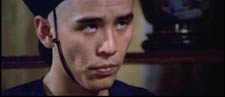
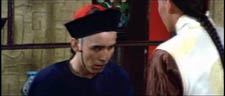
Kuo leaves, and the emperor looks after him as the camera zooms to an even fuller framing.
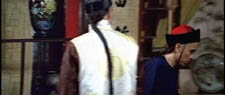
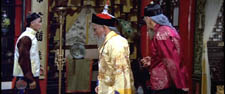
The emperor turns away and walks to the right, the camera panning to follow.
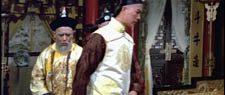
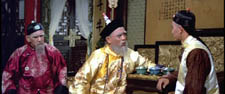
Once the characters are settled into a new arrangement, Li zooms in on one advisor as he talks with the emperor.
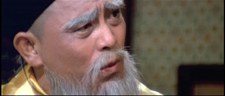
Played out in a single shot, the passage uses the zoom to substitute for cut-in close-ups. To get fresh angles on his players Li doesn’t change the camera setup but rather makes them shift position. The pan-and-zoom combination can be found in many 1970s films, from Hong Kong and elsewhere.
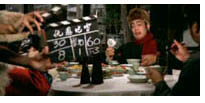 Most commentators have considered Li’s erotic comedies of the 1970s and 1980s an embarrassment, but the Archive retrospective has unabashedly included several of them. It has also run the peculiar Passing Flickers (1982), a collection of comic and erotic scenes set in a film studio. Based on a column Li wrote for local newspapers, the film can’t be called good, but it does have fun revealing the bumbling and egotism of mass movie production.
For Hong Kong fans, it offers rare glimpses of the Shaw film factory’s work routines. We see Mitchell cameras, and we learn that the staff stored each actor’s period makeup and whiskers in a labeled box for quick access. We see the Hair Man fix coiffures, glue on beards, and occasionally manicure pubic regions. There’s also satire of local movie celebs, including a portrait of the sneaky independent producer Zhao (= Golden Harvest chief Raymond Chow?).
Tedious and mostly unfunny, Passing Flickers suggests that Li relaxed into an attitude of simply enjoying what he could get away with. Of his quickies, he remarked: “I made those film with my heart and soul. They may look like crap to you, but they’re gems to me.” Even in his hack days, Li remained a central figure in Hong Kong film.
(1) I take this information from Wong Ain-ling, ed. Li Han-hsiang, Storyteller (HK Film Archive, 2007), p. 214. My final Li quotation is from p. 166.
(2) The script for Kill Bill includes the instruction, “We do a quick Shaw Brothers zoom into her eyes.”
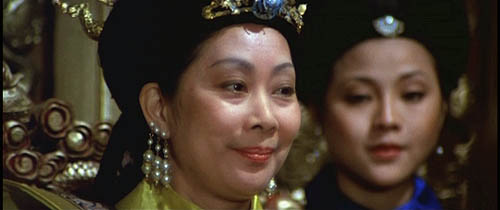
Lisa Lu in The Empress Dowager.
A many-splendored thing 4: Triangulating
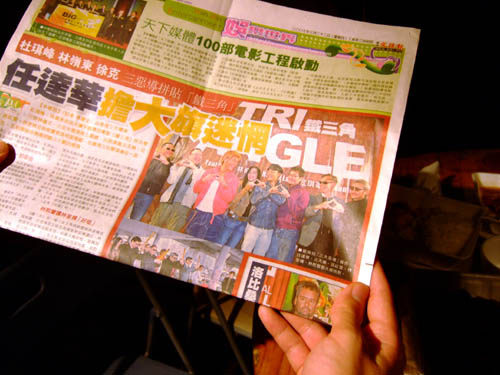
DB, still in Hong Kong:
Three directors of renown collaborate on a single film. Each is responsible for one part. But unlike your ‘portmanteau film,’ which tells separate stories (e.g., RoGoPaG or Paris je t’aime), in this project the same plot and characters are followed throughout. To make things interesting, the director of part one doesn’t tell the others what he’s planning; he simply presents a finished third. The second director has to take that further, and the man at the end has to wrap things up.
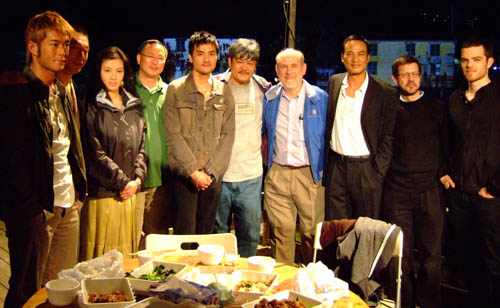
Hong Kong director Johnnie To came up with the idea for Triangle, and it’s nearing completion. Tsui Hark has finished the first section, Ringo Lam the second. Now To is shooting the conclusion, and he kindly invited Shelly Kraicer (Chinese movie expert), Todd Brown (of Twitchfilm.net), Antoine Thirion (of Cahiers du cinéma), and your obedient servant to a late-night shoot on Thursday. Milkyway mainstay Shan Ding was our guide.
I don’t have to tell you it was fun.
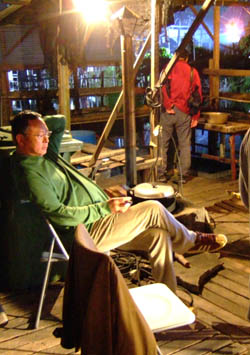
The setting is a rundown cafe perched on a swampy pond in the New Territories. The location is near the forest where the armored-car shootout takes place in Exiled. We saw To shoot a scene with Lam Suet, Louis Koo, and other actors meeting in the café. In this portion, Lam is sprawled on the floor.
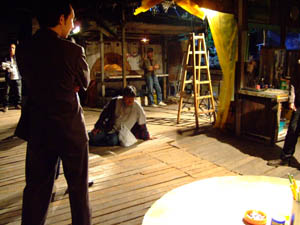
The scene climaxes with one actor dangling from a hole in the roof. You can see Mr. To in the lower right foreground watching the shot on his video assist, a monitor that shows what the camera sees. Maybe you can glimpse the shadowy assistant on the rooftop helping the actor hold on.
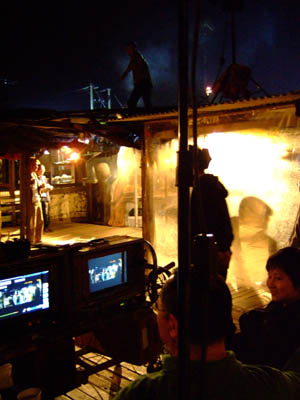
Meanwhile, the camera is shooting off on the right. It was a good opportunity to watch how To uses camera movement (constant in his films). Here you can see the camera dolly and the rail tracks it coasts along.
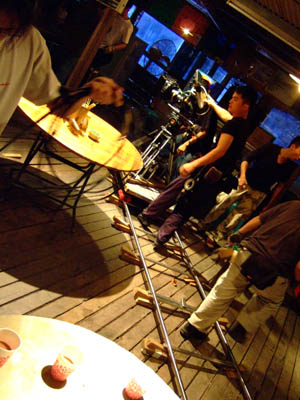
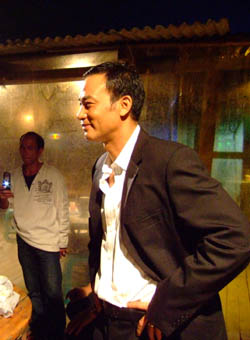
Louis Koo was also there, but not too visible. Simon Yam showed up for another scene, this one in the forest. Simon exudes charm and is warm and unpretentious. I first met him in 1995 at the Hong Kong Film Awards banquet, and he looks as handsome and mischievous as ever.
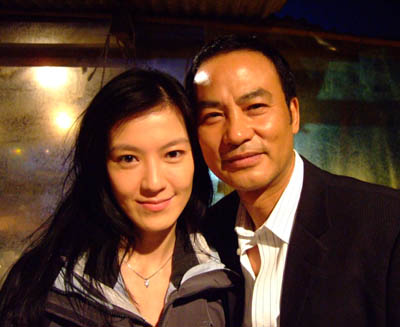
Kelly Lin arrived soon afterward. Another charmer, she told me she grew up in Santa Barbara and went to UC-Irvine. She’s been in a lot of recent HK movies.
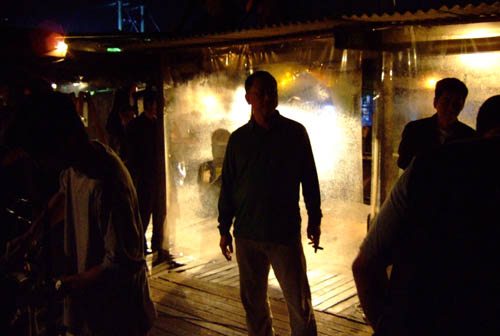
Later, shooting in the forest, the Milkyway team worked efficiently. We guests were parked on a little pier to watch from a distance.
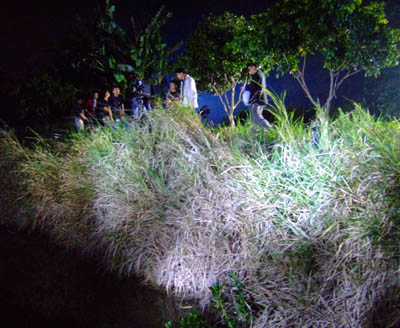
A crew member rustled a big sheet of plastic to create the impression of reflections from the water.
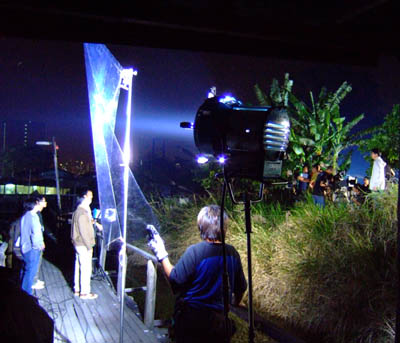
I’ve visited other Milkyway shoots, and each time I’ve been impressed by the sheer speed with which the work gets done. Everybody knows his/her job, and the staff changes camera and lighting setups very quickly. It also helps that HK films are almost always shot with no sound recording; everything is postdubbed. That yields the visual freedom, as well as the speed of production, of silent-era moviemaking.
In another echo of old production methods, To’s films sometimes use rooftop sets. Last year the set for the hotel in Exiled was erected on the top of the Milkyway building. Its Demy-like pastels looked very artificial in daylight.
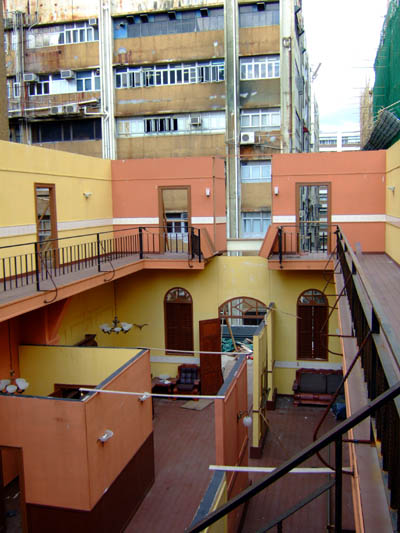
But check out the results on film, shot at night.
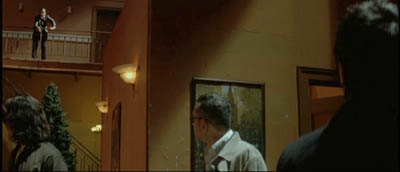
To’s art is furthered by his craftsmanship in shot composition. Composing in anamorphic (2.35:1), nearly always putting the camera on a tripod or dolly, he gets precise results with few lighting units. When I complained that all the new films I saw at Filmart were shot shakycam, Shan Ding reported a neat saying that HK DPs have. The handheld camera covers 3 mistakes: Bad acting, bad set design, and bad directing.
Unlike Hollywood filmmakers, who fiddle with the film by pushing and pulling and bleach bypassing and digital fixing in postproduction, Mr To just lets the film do its rich photochemical work. Expose it correctly, anchor the camera, and 35mm film stock can look gorgeous. His films show that we already have a high-definition moving-image medium, using not pixels but molecules. Motto: Let the emulsion be your friend.
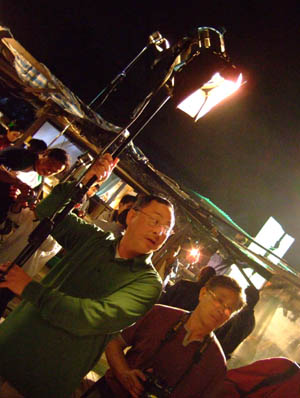
Shan also told me that the anamorphic format used by Milkyway is Technovision, an Italian system from the 1970s. These lenses yield lovely images with good depth of field, and To likes to fill up the wide frame with complicated blocking. Here’s an example from Exiled.
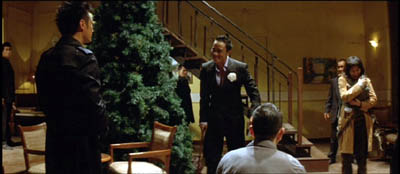
According to Rick Mitchell, Vittorio Storaro used Technovision lenses on Apocalypse Now and other pictures. It’s another way in which To is maintaining a heritage of quality—while also being economical. Milkyway owns the lenses, so no need to rent from local supply houses.
Mr To, Shan Ding, and the rest of the crew were very kind to us, even providing snacks and suggesting a group picture. Who could resist an offer like that?
Later in my stay, I hope to report on another upcoming Milkyway film, the Simon/ Kelly pickpocket movie called The Sparrow.
PS 24 March: I was told that Johnnie To came up with the idea for Triangle, but Vicki Rothrock reports for Variety that it was Tsui’s concept originally. Thanks to D. W. Hudson of GreenCine Daily for the link.
PPS 27 March: For Todd’s coverage of our set visit , go to Twitchfilm here.
PPPS 14 May: Per Variety, Triangle is a late addition to Cannes.
PPPPS 4 December 2010: Correction: The original entry claimed, inaccurately, that Mr. To used Techniscope, a two-perforation non-anamorphic format. The process being used is in fact Technovision, an anamorphic format. My apologies for the error.



