Archive for the 'Film technique' Category
Professor sees more parallels between things, other things
An Onion report brought to my attention by Stew Fyfe celebrates the comparative method (“Professor Sees Parallels between Things, Other Things”). I confess myself an admirer of this approach. We can learn a lot by setting two things alongside one another. It’s even better if we have a reason to do so.
I thought about this when Kristin and I visited the Auckland Art Gallery in May. Their modern wing was hosting an intriguing Triennial show called Turbulence, an array of contemporary work, but I was more drawn to the Museum’s traditional collection. I saw a very nice Brueghel (he’s one of my favorites) and an arresting Adoration of the infant Jesus, painted by the rather minor Francisco Antolinez y Sarabia (1644-1700).
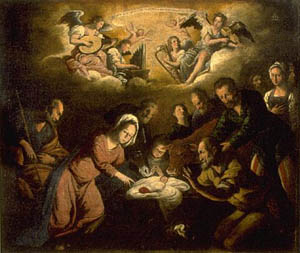
Though indifferently painted, it reminds me of El Greco in its tipped, piled-up figures. I enjoyed the acrobatic Madonna: Is she crouching, leaping, or tripping? It recalls Eisenstein’s point that much classic art creates impossible contortions which suggest various stages of movement, a point I discussed in a blog last year.
To get to those parallels: We wandered through the Gallery’s sturdy collection of British art and I was once again captivated by narrative painting of the late nineteenth century. Paintings have long been assigned the task of telling stories, but usually those stories were already well-known to the viewers, drawn as they were from history or mythology. In what’s come to be called “narrative painting,” the stories seem to be taken from life, although they’re really invoking our knowledge of prototypical situations.
Without the advantage of easily recognized religious or mythological tales, such pictures usually rely on a title to coax us fill in the story. The title specifies the context for the concrete action we see. For example, two prosperous young women are sitting in a garden. One is reading from a sheet of paper. What’s going on?
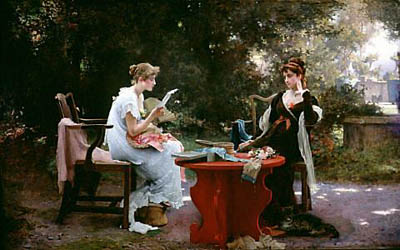
The title, Her First Love Letter, helps us zero in on specific aspects of the action and fill in the situation. The girl on the left, bathed in light, leaning forward eagerly and wearing the pale frilly dress, can be seen as the more inexperienced of the pair, caught up in the anticipation of the young man’s ardor. The more worldly woman sits relaxed, perhaps a little skeptical but also tolerant of the ways of young love. You can’t see it in reproduction, but the flower in the darker woman’s bosom is a mere spatter of paint, the brightest bit of red in the picture. The painting is by Marcus Stone and dates from 1889.
Narrative paintings like this are evidently one source of early cinema’s approach to staging and composition. This “full shot” somewhat recalls the sort of thing we see throughout European filmmaking of the first twenty years. Staging the action on more or less the same plane, viewing from a distance characters grouped around a table, is very common at the time.
Another picture can teach us a bit about acting.
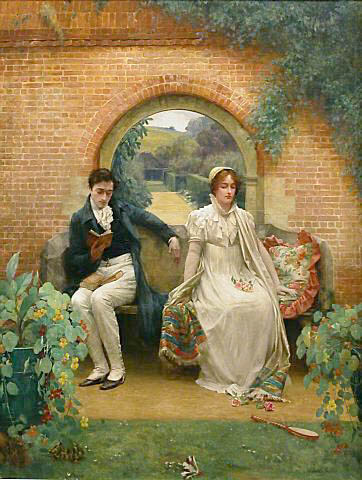
Here the body language and facial expressions yield hints. The man sits casually, the woman more rigid, and his arm is not quite brushing hers. Absorbed in his book, he seems unaware she’s there. She sits stiffly, with downcast eyes and an expression that seems stoic. You can even take her slight unfolding of the colorful shawl as an invitation to the touch that he doesn’t offer.
This painting, by Walter Sadler, is called Married (undated but presumably turn of the century). Once the title tells us that the couple are husband and wife, we can infer that their passion has subsided, largely through the husband’s self-absorbed inattention. Did he really need to take three books into the garden? The single-word title also lets us see certain elements as iconographic clues. The woman’s white dress and bouquet recall the wedding, and the fallen badminton birdie and racket suggest an earlier time when they played together. Kristin sees sexual symbolism in the flowers in her lap and the books in his. The gallery’s caption suggests that the turtle is going off to hibernate and that the blocked-off back garden suggests no future for the relationship.
Putting aside the symbolic connotations, though, the strong cues supplied by the figures’ postures and expressions point us toward the sort of slight changes in body language provided by acting in early cinema. Some viewers think that early film acting was expansive and overblown, but that’s not always the case. Here is an instance from Evgenii Bauer’s Twilight of a Woman’s Soul (1913), in which Vera starts to confess an indiscretion to her admirer Prince Bol’skii. She raises her hands , an obvious indication of her anxiety, but more subtle is what’s going on below. At first her legs are turned toward him, but as she lifts her hands they shift a bit further away from him. Her small adjustment of her torso is a kind of accompaniment of the hand gesture, like a harmonic change accompanying a melody.
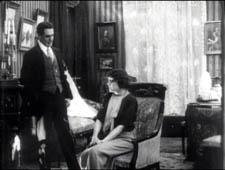
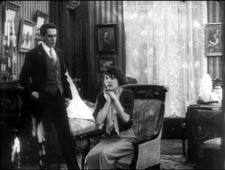
Both Her First Love Letter and Married lay their figures out along a line perpendicular to the viewer, a common strategy in early film. I discuss this in Figures Traced in Light; for other examples, see figs. 2A.7-11 here. The alternative is to arrange figures in depth, and one of the jewels of the Auckland collection illustrates this nicely. The title is more allusive than our others: For of Such Is the Kingdom of Heaven (1891), a reference to Jesus’s admonition to let children come to him (Matthew 19:14). The painter is Frank Bramley.
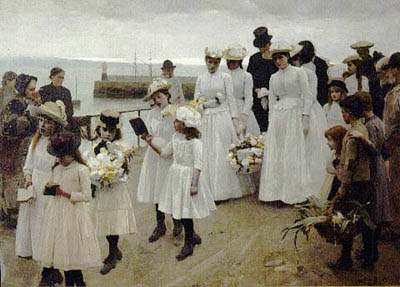
We are watching the funeral of a child, with the family carrying the almost weightless casket, swathed in flowers. In the picture’s suggestion of solemn movement, we might be tempted to say, we find early cinema before cinema. More to my point, though, is the way in which a diagonal layout creates a play between strong composition and rich ancillary effects.
The picture is composed along two lines, with the adult mourners grouped at the point where the procession intersects with the horizon. That horizon is given a widening sliver of light, a rolling wave that accentuates the heads of the two women right of center. The central bright patch of grays, whites and pastels is set off against the earth tones of the docks and the robust but respectful working-class onlookers. At the peak of the picture, the crowning moment of the angle formed by horizon and pier, is the bowed black head of the father.
The depth composition also guides our visual search, allowing us to discover a great variety of postures and facial views. The little girls in the center stride and sing from their hymnals dutifully, while the girl in the straw boater, bearing a huge bouquet, is staring at us—a disturbing effect, since her face is unhealthily gray. Will she be another victim?
In the years after 1908 or so, many filmmakers adopted the diagonal layout as a dynamic way to play out scenes. Here’s an instance from Bauer’s Twilight of a Woman’s Soul. Vera is calling on a men’s club where they practice fencing and pistol shooting. They put on a show for her.
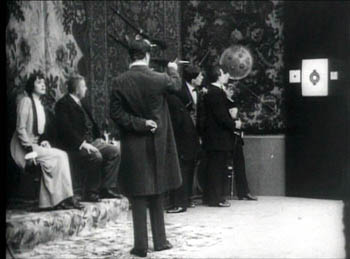
The diagonal draws our attention to the target, but Vera’s contrasting bright costume and her tilted face are further accented by putting her at the opposite end of the vector. All these factors make sure we note that her eye is on the handsome marksman, Prince Bol’skii. Receding compositions like this offered 1910s filmmakers a way to guide visual search in ways similar to Bramley’s painting.
Even more intriguing to me in For of Such Is the Kingdom of Heaven is the figure who’s evidently the dead child’s mother. She is bowed and tucked away to the right of the husband and behind two pallbearers. Bramley has taken advantage of the diagonal view to mask her off, as if viewing her grief would be too great for us to bear. This device has a parallel in cinema too.
A film scene unfolds in time, unlike a painting’s action. So filmmakers can block certain parts of the action and then, at the proper moment, reveal it. If Bramley were working in film, he could arrange his cortege so that the mother’s face came gradually into view as the group advanced, creating both a dramatic and pictorial climax. This blocking-and-revealing tactic is common in the choreographed staging we find in 1910s films, and again Bauer’s Twilight of a Woman’s Soul offers a nice illustration.
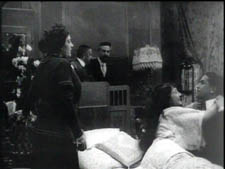
Vera, now ill, is visited by her suitor Prince Dol’skii. Her parents object, but she begs her father to let him in, and he reluctantly agrees. As the action starts, she clutches her father as the doctor looks on. The men’s bodies mask a doorway in the background, and as a servant comes through it, they pivot, revealing him.
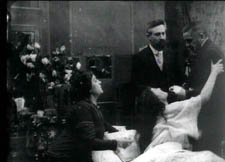
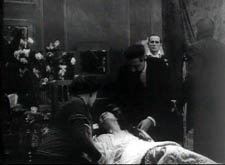
I’d argue that the servant’s entrance primes this area of the shot for the dramatically important entrance, that of Dol’skii. The father, the doctor, and the servant withdraw toward the back wall. After a pause, the Prince enters and advances.
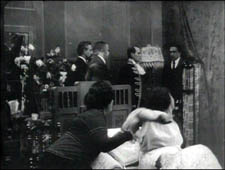
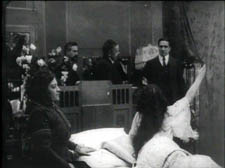
Vera greets him warmly as he takes the father’s place in the shot.
I’m not arguing that these particular paintings influenced filmmakers, only that the principles that the painters employed were picked up by directors. The more general point is that in understanding film aesthetics, we can usefully compare movies to other movies, and movies to other arts. By doing this, we sharpen our sense of what various media can do. The professor in the Onion story wisely notes, “It’s not just similarities that are important, though—the differences between things are also worth exploring at length.”
All paintings shown here are in the permanent collection of the Auckland Art Gallery. Bauer’s film is available on a Milestone DVD. I hope to blog more about his work later this summer.
Simplicity, clarity, balance: A tribute to Rudolf Arnheim
DB here:
On Monday, at age 102, Rudolf Arnheim died. You can read his obituary here, and this is a lovely website devoted to his work. He was one of the most important theorists of the visual arts of the last century, and he had enormous impact on how people, including Kristin and me, think about film.
A good Gestalt
In parallel with E. H. Gombrich, who died in 2001, Arnheim brought modern psychological concepts into the study of visual art. His most famous work, Art and Visual Perception (1954, new version 1974) has the sort of magisterial presence that very few books in any era achieve. Arnheim delighted in the fact when, visiting a painter’s studio, he would find a spattered copy on the workbench. Of the revised edition, entirely rewritten, he noted:
All in all, I can only hope that the blue book with Arp’s black eye on the cover will continue to lie dog-eared, annotated, and stained with pigment and plaster on the tables and desks of those actively concerned with the theory and practice of the arts, and that even in its tidier garb it will continue to be admitted to the kind of shoptalk the visual arts need in order to do their silent work (new ed., x).
He aimed at theory that actively participates in the way artists do their job. The chapter titles of Art and Visual Perception deal with the nuts and bolts of picture-making: Balance, Shape, Form, Growth, Space, Light, Color, Movement, Dynamics, and Expression. No puns, slashes, dashes, or parentheses. What academic theorist today would so boldly announce their concern with the craft of creating images?
The book is subtitled, A Psychology of the Creative Eye, and the chapters’ subsection titles explain why. The hidden structure of a square . . . Vision as active exploration . . . Perceptual concepts . . . What good does overlapping do? . . . Why do children draw that way? . . . Gradients create depth . . . Visible motor forces . . . The priority of expression. Arnheim’s principal achievement in art theory was to integrate the Gestalt theory of perception with the traditional concerns of picture-making. He sought to show how perceptual laws discovered in the psychological laboratories of Berlin were intuitively applied by classic and modern artists.
As he put it, he was at the university at around age twenty:
My teachers Max Wertheimer and Wolfgang Köhler were laying the theoretical and practical foundations of gestalt theory at the Psychological Institute of the University of Berlin, and I found myself fastening on to what may be called a Kantian turn of the new doctrine, according to which even the most elementary processes of vision do not produce mechanical recordings of the outer world but organize the sensory raw material according to principles of simplicity, regularity, and balance, which govern the receptor mechanism.
This discovery of the gestalt school fitted the notion that the work of art, too, is not simply an imitation or selective duplication of reality but a translation of observed characteristics into the forms of a given medium (Film as Art, 3).
The Gestalters thought that these principles–figure/ground, completeness, good continuation, and the like–were fundamental to all human perception, across times and cultures. Art and Visual Perception makes a powerful case for this view. Today this position is so unfashionable that Arnheim’s calm confidence in it is quite stunning. For many scholars today, all that matters is what divides and differentiates us. But for eighty-plus years Arnheim emphasized ways in which we share a common experience of the world and of art.
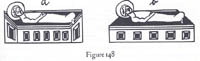 It’s often said that Arnheim favored modernist styles, like Cubism and expressionism, and that his emphasis on art as going beyond mere copying reflects modern artists’ will to distorted form. But he saw a deep continuity between classic art and modern art. Both traditions explored the perceptual force of form. Amazingly, he argues that the cockeyed creche in Fig. a conveys a stronger sense of three-dimensionality than the correct perspective presented in b. The “inverted” perspective encloses baby Jesus’ head fully, just a hollow cradle would.
Arnheim saw the same form-giving activity at work in “primitive” art, the art of children, and even the art of the mentally ill. It turns out that the “universalism” of Gestalt theory underwrites diversity no less vigorously than the most ardent postmodernism.
Flexible striving
Arnheim made another contribution to our thinking about art, one that I think is rarely recognized. In a bold stroke, he extended the Gestalt conception of form beyond its concern with geometrical qualities and argued that form was inherently expressive. A triangle resting on its base wasn’t just balanced; it was weighty. We see the weeping willow as not just curved but sad; a skyscraper isn’t just tall, it’s aggressively thrusting upward. Every shape or movement we apprehend has a distinctive flavor and feeling. Indeed, he writes, “expression can be described as the primary content of vision”!
We have been trained to think of perception as the recording of shapes, distances, hues, motions. The awareness of these measurable characteristics is really a fairly late accomplishment of the human mind. Even in the Western man of the twentieth century it presupposes special conditions. It is the attitude of the scientist and the engineer or of the salesman who estimates the size of a customer’s waist, the shade of a lipstick, the weight of a suitcase. But if I sit in front of a fireplace and watch the flames, I do not normally register certain shades of red, various degrees of brightness, geometrically defined shapes moving at such and such a speed. I see the graceful play of aggressive tongues, flexible striving, lively color. The face of a person is more readily perceived and remembered as being alert, tense, concentrated rather than being triangularly shaped, having slanted eyebrows, straight lips, and so on (Art and Visual Perception, first ed., 430).
Arnheim found feeling in his forms.
Moving pictures
Arnheim wrote about many artforms, including mass media in his 1936 monograph on radio. His book on cinema, Film als Kunst (1932), was quickly translated into English as Film (1933). Always in search of greater clarity and point, Arnheim rewrote it in 1957. Oddly, he didn’t update it: You’ll search in vain for examples from the 1930s, 1940s, or 1950s. The touchstones remain Chaplin, Keaton, von Sternberg, and the Soviets. Arnheim held that cinema was essentially a pictorial art (see my earlier blog on this question) and that synchronized sound added very little; in fact, it might even inhibit visual experimentation. It was so easy to convey a story point with dialogue that lazy filmmakers would simply create photographed stage plays.
As a result, Arnheim is usually taken to be the summation of a certain strain of 1920s film theory. Like many earlier thinkers, Arnheim emphasized how film technique reshapes what is filmed. Close-ups, shot design, camera angles, and cutting make cinema no simple medium of reproduction. Film form transforms the world that is photographed. This position, commonplace today, was a real advance in the silent era and gave cinema artistic respectability, a subject that Arnheim reflected on thoughtfully in the 1933 edition of Film.
Again, Arnheim did more than synthesize current ideas. Theorists’ hunches that film stylized reality could now be grounded in Gestalt ideas about medium and form. In effect, Arnheim rewrote Film in the light of Art and Visual Perception, and the result was Film as Art. Here is the most famous passage:
Not until film began to become an art was the interest moved from mere subject matter to aspects of form. What had hitherto been merely the urge to record certain actual events, now became the aim to represent objects by special means exclusive to film. These means obtrude themselves, show themselves able to do more than simple reproduce the required object; they sharpen it, impose a style upon it, point out special features, make it vivid and decorative. Art begins where mechanical reproduction leaves off, where the conditions of reproduction serve in some way to mold the object (Film as Art, 57).
This, you might say, is Arnheim’s reply to Walter Benjamin’s theory of cinema as mechanical reproduction: no less than other artists, filmmakers use their medium, a photographic one, to create perceptually vivid effects akin to those in other arts.
Still, Arnheim held that film, like photography, has more limits than other arts. Tied to recording, film and photography can never achieve the range of expressive form we find in painting. I don’t believe this for a moment, but Arnheim clung to this opinion, I suspect, because of his deep love for creative freedom he found in other visual arts. And I sometimes think that for him, a painting harbored enough pushes, pulls, twists and torques. Movies just made explicit what was tactfully implied in still images.
Envoi
Kristin and I first saw Arnheim when we were graduate students at the University of Iowa, March 1972. He gave a lecture that stuck to his principles of 1933:
*Every art medium has a ceiling, beyond which it cannot effectively pass. The ceiling is somewhat low for the reproductive arts. Photography is more limited in what it can do than painting, and so is film.
*Films should be in black and white, the better to stylize reality. Are there no worthwhile color films? Pause. Red Desert, perhaps.
*Do you see many contemporary films? No.
Around 1980, I lined him up for a visiting lecture at UW. But he had to cancel; he had slipped on ice and broken his hip. He was then about seventy-five.
Later in the 1980s I visited Ann Arbor and had lunch with him. It was wonderful. By then I had read enough to ask him about Gombrich–an old friend and courtly opponent of his. (Read one of his reviews of Gombrich’s books to see what genuinely respectful disagreement looks like.) He saw pretty quickly that I was a Gombrichian and he gave a shrewd analysis of the dividing line: Gestalt psychology vs. ‘New Look’ cognitivism, illusions vs. expressive percepts, brain fields vs. schemas. He asked me to send me copies of my publications, which I did on and off during the decade. I never heard what he thought about my favorite fancy-pants sentence in Narration in the Fiction Film, when I contrasted J. J. Gibson’s theory of optical realism with Arnheim’s idea of expressiveness: “Gibson likes likeness, Arnheim loves liveliness.”
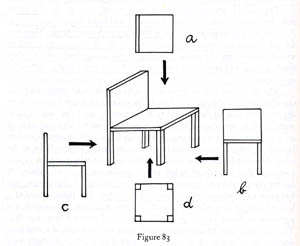
I thought of him often as I read more perceptual psychology. Gestalt work had once seemed to me a dead-end, but with David Marr’s theory of visual perception, a prototype of computational perceptual psychology, Gestaltism came roaring back. The “3D model representation” that Marr claimed operated in early vision uncannily echoes Arnheim’s discussion of our perception’s reliance on “characteristic aspects.” (Arnheim illustrates the idea with the various views of the chair, above. Which one is instantly recognizable as a chair?) And with contemporary interest in the relation between emotion and cognition, Arnheim’s theory of the expressive side of perception is creeping back too. Nothing worthwhile is forgotten, nothing goes away.
When we ran a book series at the University of Wisconsin Press, we were eager to publish an anthology of Arnheim’s film criticism, a collection originally published in German in 1977. Brenda Benthien, a close friend of Arnheim and his wife Mary, executed a lively translation and Arnheim supplied a touching introduction. A refugee of the Hitler years, an émigré across Europe and America, Arnheim summoned up the failure of the Weimar republic:
Even now I keep as a sort of talisman a bullet which in the days of the 1918 revolution, when I was fourteen, flew over the neighboring houses, bored a little hole through the windowpane, and fell inert on the carpet before my bed. Thus it began (Film Essays and Criticism, 3).
In the same introduction, Arnheim deplores the current state of cinema (“my basic objection to the talking film as a mongrel seems to me just as valid today as then”) and he warns against the cheapening of our vision:
Without the flourishing of visual expression no culture can function productively (5).
Aspiring film critics, and especially bloggers, should go back and read Arnheim on Keaton, Eisenstein, Gance, Pudovkin, Chaplin, von Sternberg, and other greats, as well as the essays “Style and monotony in film,” “Epic and dramatic film,” and especially “The Film Critic of Tomorrow.”
Scarcely a month goes by when I don’t have some idea that can be traced, however circuitously, to my reading of Arnheim. For instance, my blog on funny framings, posted a couple months ago, starts with his discussion of Chaplin’s The Immigrant. Arnheim’s theory of expression goes a long way toward explaining how composition can trigger laughter. I doubt that I’d be so alert to the possibilities of two-dimensional design in film shots if I hadn’t been tutored by Film as Art, Art and Visual Perception, The Power of the Center (1982, rev. 1988), his 1962 monograph on Picasso’s creative process in painting Guernica, and the essays in Toward a Psychology of Art (1966)–one of which is a skeptical review of Gombrich’s Art and Illusion. In preparing this entry, I found that my pleas that we probe the norms that guide filmmakers’ craft practices is just a clumsier restatement of this, which I discovered marked in Art and Visual Perception, the New Version:
Good art theory must smell of the studio, although its language should differ from the household talk of painters and sculptors (4).
Three years ago, after the Society for Cognitive Studies of the Moving Image convention in Grand Rapids, several of us from Madison–Ben Singer, Jen Chung, and Jonathan Frome–detoured back by way of Ann Arbor in order to call on Arnheim. He had just turned 100. He resided in an assisted-living facility, and his room was bright and clean, packed with books, remarkable drawings and paintings (Feininger, Köllwitz), a microfilm reader, and a worktable with a gigantic magnifying lens on an articulated arm. Conversation was difficult for him, but he seemed to understand everything we were saying. His smile was quick and his eyes were bright. When I showed him the first German edition of Film als Kunst I’d brought along, he turned it over in his hands as if he hadn’t seen one in years. He signed it, then shook his head apologetically at the shaky writing.
Now that Benjamin and Kracauer have become the prototypical Weimar intellectuals, it’s a pity that so many media students and professors are unaware of the importance of Arnheim’s work. His Leonardo-like interest in merging art and science is discouraged in a climate that posits the cultural construction of everything. He also writes with a grace and clarity that’s all too rare. In an unfashionable way, he exemplifies the passion, rigor, and dignity that interwar German intellectuals brought to the study of the arts. A lot of what he believed remains–what’s the word I want? Oh, yes–true.
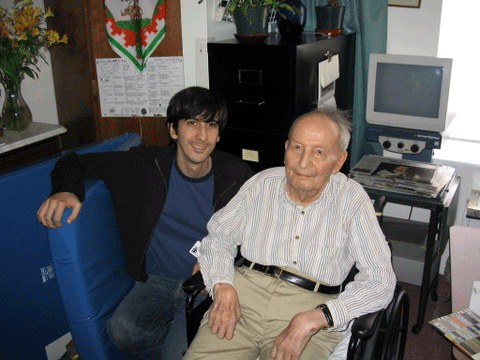
Rudolf Arnheim, with Jonathan Frome, July 2004.
Line illustrations come from Art and Visual Perception.
Movies on the radio
DB here:
There’s no shortage of podcast film reviews, but I confess that I’ve listened to only a few. I’m just not that interested in following a movie review at the pace of a speaking voice; I prefer skimming print to pluck out the good parts. And I’m on the lookout for ideas and information, not only opinions. I want to learn new stuff. So my iPod favors shows that center on interviews with directors, writers, and moguls. The two programs that I like best are produced by the extraordinary KCRW in Santa Monica and are also available from iTunes.
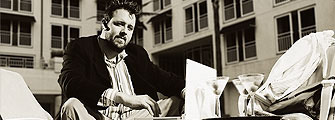
 One is The Business, hosted by Claude Brodesser-Akner (above top). Armed with solid research and snappy patter, he comes across as sharp and a little insolent, a quality always welcome in an interviewer. After a disrespectful roundup called The Hollywood News Caravan, Brodesser-Akner devotes most of the rest of a show to a major topic. You can survey several programs here.
A recent installment focused on the latest cycle of teenage horror, with input from Eli Roth, director of the Hostel films, and Oren Koules, producer of the Saw series. They talk about marketing directly to the fan sites and avoiding the expensive TV ads that studios bombard the public with. Putting banners and flashing ads on the horror sites, Roth says, attracts the same eyeballs as an ad on Lost, but for a fraction of the price. Koules:
Playing [an ad] on a Friends rerun doesn’t help anyone.
Likewise for budgets overall. Roth:
The scare is the star. . . .Nobody wants to see a $50 million version of Saw II. . . . People aren’t paying for big special effects. They’re paying to be scared.
In one of the most interesting stretches of the interview, Roth and Koules explain how they negotiate with the MPAA ratings board. According to the filmmakers, the board completely understands what they want to give the audience and the board is willing to cooperate. Koules:
We’re very respectful of the process. . . . And they know that we kind of know the market.
The fact that the films are designed for an R rating makes the task easier, of course, but sexual violence remains the most sensitive area. Roth:
They’re reflecting what the parents of America are going to say. . . . Just look at the culture. We have violence on television, people watch it—no problem. The stuff that I did in Hostel 1 is now on 24. [But] Janet Jackson shows her nipple and Congress is in session meeting about it and there’re all sorts of fines. So [the raters] really are just reflecting the temperature of the culture.
More proof that the MPAA and the ratings board find it easier to accept the excesses of genre filmmaking than to support the naughty indie material Kirby Dick surveys in This Film Is Not Yet Rated. Why should bathing in blood rate an R while boinking, boffing, and the Wild Mambo get threatened with an NC-17?
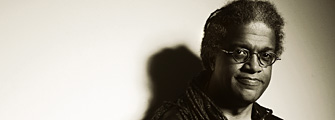
 I’ve been following The Business for a year or so, but in May while traveling in New Zealand I started listening to The Treatment, hosted by Elvis Mitchell (above, bottom). For all the superstar press he gets, he comes across as soft-spoken, thoughtful, and probing. It’s very unusual for a journalist-critic to pose questions about film craft and aesthetics, but Mitchell wades right in.
He asks Robert Rodriguez, for instance, how music shapes a film’s editing rhythms. After acknowledging that he plays music for actors on the set (as Wong Kar-wai does), Rodriguez adds:
I’ll be doing music all the way through the process of making a movie. And then I’ll usually just start editing first. Then I’ll put the edit into my music system, write the music for it, and if I like how the music is driving the scene and if the edits don’t match, I’ll go and adjust the edits. So I tell other composers—they’re probably very jealous—that I’m the composer who can tell the editor to go back and make the picture fit the music.
Another example: A while back, I posted a blog entry on how framing and the choice of lenses can create comic effects. I illustrated with an instance from Shaun of the Dead. Serendipitously, last week I discovered Mitchell’s recent interview with Shaun‘s director Edgar Wright, who acknowledged that the idea was central to his filmmaking.
The thing I’ve been trying to do in Spaced and Shaun and Hot Fuzz is the camera almost becomes a personality. Not only is the script funny and the performances are funny, but the compositions are funny—the framing of the shots is funny. . . . I remember seeing Raising Arizona and thinking, “Oh, why isn’t all comedy shot like this? It’s amazing.” . . . You get the actors to think of the camera as another performer that they’re blocking with.
The entire conversation seems to me mandatory for students of film. Coaxed by Mitchell, Wright supplies specifics about planning a shoot, varying camera setups, and the “epileptic” style of the contemporary action films that Hot Fuzz is satirizing. Wright even seems to like Domino, which shows that he can see virtues in extravagance.
So I recommend both The Business and The Treatment to anyone who wants to get filmmakers’ thoughts about current trends in movie tradecraft.
Intensified continuity revisited
DB here:
We’re just beginning to understand the history of film forms, but some trends in Hollywood already seem clear. During the late 1910s American filmmakers synthesized an approach to cinematic storytelling that relied on continuity editing, the practice of breaking a scene into matched shots in order to highlight character action and reaction. In the years that followed, this editing strategy became the dominant approach to mass-market filmmaking across the world. Many historians and theorists believed that editing was the essence of cinema itself.
When sound arrived in the late 1920s, the technology was difficult to master and consumed a lot of production time. It would have been easy for American filmmakers to shoot every scene from a single position, but instead they used multiple cameras to cover the action, much as three-camera TV handles sitcoms now. This made filming cumbersome and limited the lighting choices, but filmmakers wanted to preserve the option of cutting to closer views and fresh angles as the scene developed. Continuity editing continued through the 1930s and well beyond, with filmmakers refining it in various ways.
The strategy has proven remarkably robust. Today’s mass-audience films, from all over the world, adhere to the principles and particulars of continuity editing. Not many artistic styles, in any medium, have had such a long run.
These ideas are developed in more detail in things that Kristin and I have written. (1) Most recently my book The Way Hollywood Tells It tries to track shorter-term changes in the continuity style. I found that one handy way to do this was to look at remakes. Remakes allow us to keep story factors somewhat constant and focus on differences in visual technique. Today’s blog looks at parallel scenes from two films, an original and a remake, in order to illustrate what I’ve called “intensified continuity”—the editing style that comes to dominate American films after 1960 or thereabouts.
Dear friend….
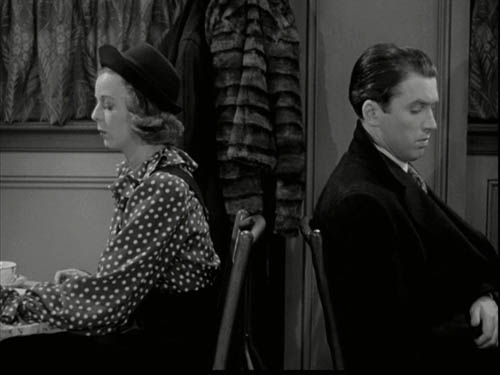
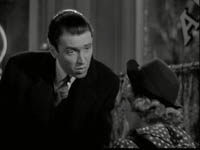
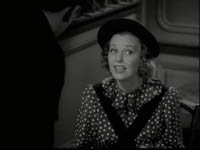
In Ernst Lubitsch’s wonderful Shop around the Corner (1940) Kralik (James Stewart) works in a Budapest gift shop with Klara (Margaret Sullivan). They quarrel constantly. But each has an anonymous pen pal, and the relationship is growing into love. Unfortunately, we learn early on, they’re writing to each other.
On the day they’ve agreed to meet face to face, Kralik is fired. He and another salesman Pirovitch (Felix Bressart) trudge to the café where Kralik is to meet his secret friend. Kralik can’t bear to face her now that he has no job, so he wants Pirovitch to deliver a note saying he can’t come. Still, his curiosity makes him ask Pirovitch to look in the window and describe her. Pirovitch tries to soften the blow, but he has to admit that the young woman waiting with a copy of Anna Karenina and a red carnation is Klara.
Angry, Kralik takes back the note and decides to let her wait. But after Pirovitch is gone, he returns to the café and meets her—not divulging his identity, but trying some conciliatory moves.
In the silent era, Lubitsch was one of the greatest exponents of continuity editing. You need only look at The Marriage Circle or Lady Windermere’s Fan to see his quiet virtuosity. (Kristin’s Herr Lubitsch Goes to Hollywood devotes a chapter to his cutting.) But in Shop around the Corner Lubitsch uses only two shots to present Kralik’s and Pirovitch’s conversation outside the café. A fairly distant tracking shot follows the two men to the window, then we get a very lengthy shot of the two men outside. It starts with Kralik instructing Pirovitch to check on what his correspondent looks like.
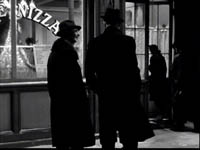
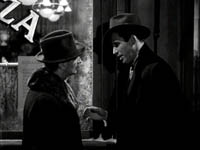
Another director would have given us point-of-view shots showing what Pirovitch sees, along with his reactions. Instead, Lubitsch keeps the emphasis on Kralik, who’s responding to Pirovitch’s reports. Consequently, Kralik’s reactions aren’t given in cut-in close-ups but rather in the prolonged two shot.
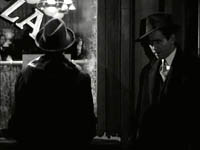
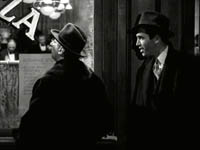
This allows both performers to act with their bodies. Bessart’s shoulders relax, for instance, when he spots Klara, as if he’s slightly recoiling. Stewart’s reactions are more varied; he leans forward eagerly and nods as Pirovitch finds the woman. He slumps, then tugs his hat when Pirovitch mentions Klara.
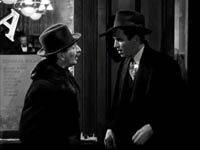
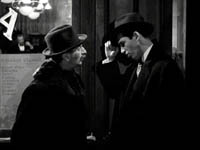
Kralik looks in to see for himself, and collapses a bit. He eventually relaxes when he wryly accepts the fact that his pen pal is his quarrelsome coworker.
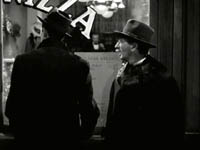
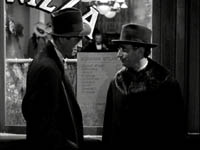
Visually, it’s a simple scene, but it shows the power of the unvarnished two-shot.
After the two men separate, Lubitsch shifts the scene inside and gives us another sustained shot as the anxious Klara talks with a waiter. Instead of crosscutting to Kralik returning outside, Lubitsch creates a humorous shot by letting his head drift into the window behind Klara.
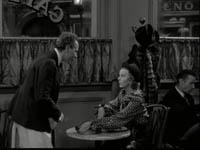
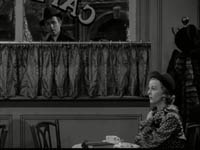
When Kralik goes in to meet Klara, he doesn’t tell her that he’s her pen pal, so narrationally speaking, the knowledge is unbalanced. He and we know more than Klara does, which makes her unhappiness more pathetic. It’s a wonderfully textured scene, partly because we know that each one’s annoyance with the other masks disappointment and anxiety. As the action develops, there’s somewhat more cutting, but even Lubitsch’s closer views often keep both in the frame. He saves his closest shots for the most intense exchange, when Klara mockingly refuses Kralik’s efforts at friendship. The scene will end on a painful note, with each wounding the other with hurtful remarks.
AOL buddies
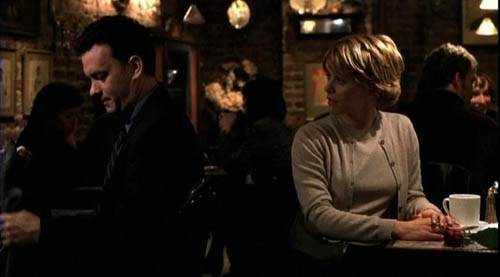
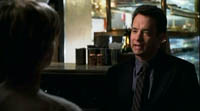
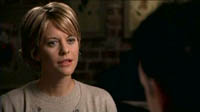
As you probably know, The Shop around the Corner was remade as You’ve Got Mail. There are some important story differences. The two protagonists have other partners, and Joe Fox owns a bookstore chain that is crushing the children’s bookstore owned by Kathleen Kelly (Meg Ryan). But the parallel scene in You’ve Got Mail is remarkably similar to the one we’ve just been examining.
The sequence starts with Joe and his assistant Kevin (Dave Chappelle) approaching the coffee shop, and Joe is apprehensive—not because like Kralik he’s out of a job but because of the upheaval that meeting his email correspondent could cause in his personal life. Like Kralik, he asks his friend to peer in the window to check her out.
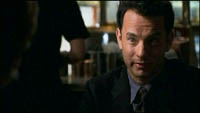
But Nora Ephron handles the scene quite differently than Lubitsch did. She breaks all the dialogue into several shots, mostly favoring one actor (either over-the-shoulder shots or what are called singles). The process starts during the men’s approach to the café.
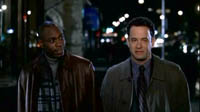
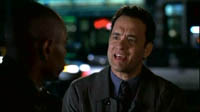
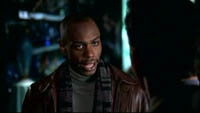
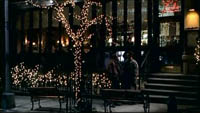
Once they arrive, the staging stations Joe at the foot of a flight of stairs and Kevin at the top, so a sustained two-shot isn’t really in the cards. The pattern is that Kevin reports what he sees, and in reaction shots we see Joe’s response.
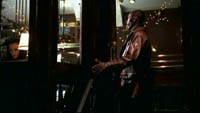
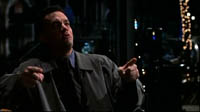
When each man looks inside, unlike Lubitsch Ephron supplies point-of-view shots of Kathleen.
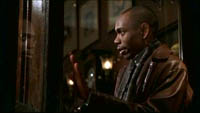
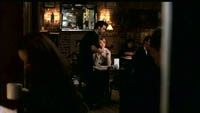
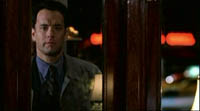
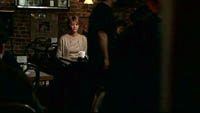
Joe reacts vindictively when he learns his email correspondent is his adversary, and he returns to punish her, but not before we’re taken inside the café and watch Kathleen wait for her correspondent. Even her encounter with another customer, somewhat similar to Klara’s chat with the waiter, is broken into three shots.
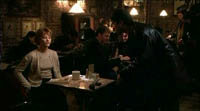
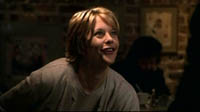
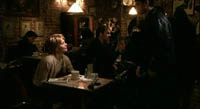
When Joe arrives, his conversation with Kathleen is handled in variations of shot-reverse shot, often in fairly tight framings. Again, the closer framings accentuate the bitter insults the characters exchange.
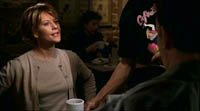
You’ve got cutting
Both scenes run almost exactly the same length: 8:48 in Shop, 8:42 in You’ve Got. But the initial portion, showing the two men on the sidewalk, consumes only two shots in the Lubitsch and 41 shots in the Ephron. That means that Lubitsch’s average shot in the scene runs about 82 seconds, while Ephron’s runs about 4.1 seconds!
The same disparity arises in the section of the scene taking place in the café. In Shop, 14 shots treat the action inside, but in You’ve Got there are 84! Lubitsch’s shots in this portion average about 21 seconds, still very lengthy, while Ephron’s are almost exactly the same as in the earlier portion, coming in at 4.3 seconds. We tend to think that only high-octane action sequences are cut quickly, but today’s dialogue scenes are cut fast too.
In both films, actors’ line readings are very important, but in Shop, the performances include sustained passages of body language. In You’ve Got, actors act mostly with their faces. Whereas Ephron gives us singles from the start (Kevin and Joe’s approach), Lubitsch saves his close shots for the encounter between his squabbling romantic couple. There’s an effect of gradation, with the cutting building the scene visually toward a high point, that isn’t provided by Ephron.
Oddly, the modern film is less subtle than the older one. Lubitsch uses no nondiegetic music in the scene, but Ephron inserts conventionally comic music as Kevin and Joe approach and we get sorrowful music when Kathleen leaves the café in tears. Although many people think that old movies are hammy and overplayed, here it’s just the opposite. Stewart performs subtly, but Hanks, whom many take as today’s Jimmy Stewart, plays broadly, gesturing in extremis and at one point shaking the brownstone’s railing. The Lubitsch scene also makes use of dramatic pauses to a greater extent than Ephron does.
The redundancy is seen as well in Ephron’s reliance on cutting and singles. Nearly every line or reaction in the You’ve Got sequence gets a shot to itself. This isn’t unique to this film; every remake I’ve examined is cut faster than its original. Fast cutting, down to 2 or 3 seconds per shot on average, and a reliance on OTS’s and singles typify today’s intensified brand of continuity.
Silent films were cut quite fast—in America, around five seconds per shot was common—but the arrival of sound slowed down the editing pace. The good people at Cinemetrics are building a database tracking this trend, among others. But since the 1960s, things picked up in American cinema, and today it isn’t uncommon to find films with average shot lengths of 2-4 seconds….and not just action movies. Likewise, such cutting operates in conversation scenes, making it more likely that the shots are singles rather than two-shots or ensemble framings.
This “intensification” of traditional continuity tactics, I’d argue, dominates mainstream moviemaking today, and not just in the US. Such cutting can sometimes be found in the 1930s and 1940s too, but then it was one possibility within a broader range. The Lubitsch example adheres to the principles of continuity editing, but it allows for more variety of camera distance and pacing.
I don’t denounce intensified continuity as such; some films, most recently David Fincher’s fine Zodiac, make intelligent use of it. Still, with this as the dominant approach, the director’s range of choice has narrowed. When contemporary directors lengthen a take, it’s usually to create a virtuoso traveling shot. A simple framing like the one outside the cafe in Shop is very unusual nowadays. The sustained two shot is practically an endangered species.
Why? What led to these changes between the studio era and contemporary cinema? A cynic would say that, contrary to Steven Johnson, audiences have gotten dumber and need more emphasis on character action and reaction to follow what’s going on. But in The Way Hollywood Tells It I suggest that there are many factors at work in this stylistic change. The book also provides more details of other techniques characteristic of today’s intensified continuity.
(1) In particular Kristin’s Breaking the Glass Armor: Neoformalist Film Analysis, our sections of The Classical Hollywood Cinema: Film Style and Mode of Production to 1960 (written with Janet Staiger), and our Film Art: An Introduction.