
Archive for the 'Film comments' Category
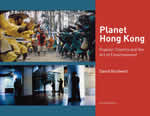
PLANET HONG KONG: Directors reframed
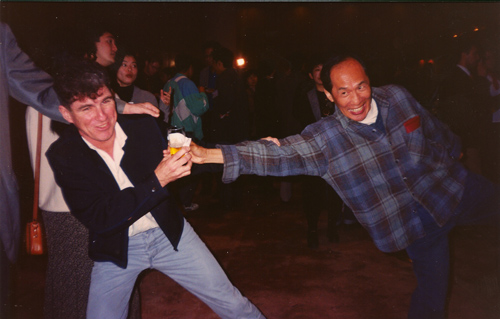
Your beer kung-fu is pretty good: Christopher Doyle and Po Chi Leung (Jumping Ash, He Lives by Night, etc.). Hong Kong Film Festival, 1996. Photo by DB.
DB here:
Planet Hong Kong, in a second edition, is now available as a pdf file. It can be ordered on this page, which gives more information about the new version and reprints the 2000 Preface. I take this opportunity to thank Meg Hamel, who edited and designed the book and put it online.
As a sort of celebration, for a short while I’ll run daily entries about Hong Kong cinema. These go beyond the book in dealing with things I didn’t have time or inclination to raise in the text. The first one, listing around 25 HK classics, is here. The second, a quick overview of the decline of the industry, is here. The third discusses principles of HK action cinema here. A fourth, a portfolio of photos of Hong Kong stars, is here. That was followed by a tribute to western Hong Kong fans. The final entry is concerned with the role of film festivals and a short list of other favorite films. Thanks to Kristin for stepping aside and postponing her entry on 3D.
When Andrew Sarris formulated an American version of the politique des auteurs, he used directorial “personality” as an index of true directorial creativity. Later, theorists and academics tried to define this elusive quality, and many concluded that auteur directors had recurring themes, a stylistic signature, and what we might call storytelling manner. To sketch an example: Welles can be thought of as concerned with the relation of power to love, and the loss of both. He favored aggressive depth compositions, long takes, and unusual uses of sound. In narrative terms, he was fond of stories featuring a larger-than-life man, turning on a puzzle or a crime, and presented in some time-shifting ways (e.g., flashbacks). This is a unsubtle characterization, but my point is simply that crtiics thought that recurring qualities like these offered a strong case for directorial authorship.
Yet a mass-market cinema makes “pure” authorship difficult, since directors may not freely choose their projects and their artistic preferences may be overridden by budgets, weather, producer rulings, censorship and the like. Creativity in a film industry, we’re usually told, requires collaboration. That’s true, but of course many other art forms do as well, notably theatre, dance, and song composition. A director may not explore favorite thematic concerns every time out (Look: stick to the script!), or may be thwarted in certain technical choices (We can’t afford long tracking shots!) or storytelling strategies (We’re adding a voice-over to clarify the backstory).
As with most high-output cinemas, the appeal of many Hong Kong films can be traced not to directorial flair but to the genre and other components (stars, scripts, studio resources). I wouldn’t say that many of the Jackie Chan-Sammo Hung-Yuen Biao outings like Winners and Sinners (1983), Wheels on Meals (this is not a typo; 1984), and My Lucky Stars (1985) exhibit much directorial personality, but they are skillfully made and pretty entertaining. Every industry needs its artisans, its steady hands on the tiller; it’s no mean feat to turn out a solid movie. Even the most distinctive directors in an industry need craft competence; as Sarris once remarked, “A great director has to be a good director.” Much of Planet Hong Kong is about the collective norms of local filmmaking, the tricks of the trade and the professional practices that shape the artistry of non-auteur movies.
But are there true Hong Kong auteurs? I think so, to various degrees. Ones discussed in PHK 2.0 are King Hu, Chang Cheh, Lau Kar-leung, Tsui Hark, Wong Kar-wai, and Johnnie To Kei-fung. John Woo, I argue, is one in a special, almost meta-sense: He understood the idea of authorship and crafted his public image, as well as his films, around certain themes (Christianity, heroic self-sacrifice) and stylistic choices (most visibly, flying pistoleros).
Wong Jing is a bit meta- too, in the way that Mel Brooks is a parodic auteur. Wong Jing’s farcical cinema carries to an extreme the vulgar potential always lurking in his territory’s cinema. He can provide quite precise mockery of other (better) directors, as when the arthouse filmmaker in Whatever You Want (1994) turns out a pretentious effort suspiciously similar to Ashes of Time. The evocative, fragmentary shots of Carina Lau Ka-ling clutching at her horse are replaced by one of Law Kar-ying caressing a cow.
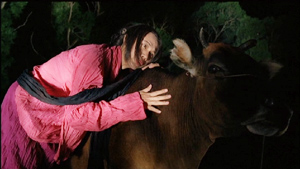
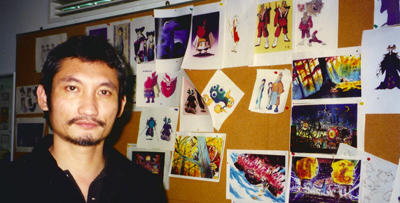
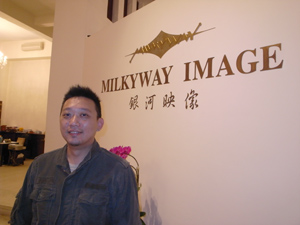
So it was in hope of learning both about craft norms and directorial temperament that between 1995 and the present I’ve visited and talked with various filmmakers. The results are in the book, but here are some photos commemorating the encounters.
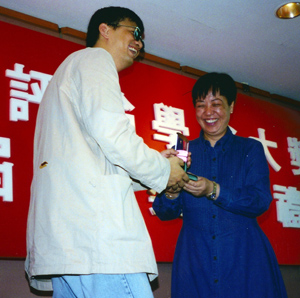
Here Ann Hui On-wah presents Wong Kar-wai with the best screenplay award (for Ashes of Time) at the first annual Hong Kong Film Critics Society Awards, 1995. She looks as happy as he is. The film also won Best Film, Best Director, and Best Actor (for Leslie Cheung Kwok-wing, who wasn’t present). For a further note on Wong, check the bottom of this entry.
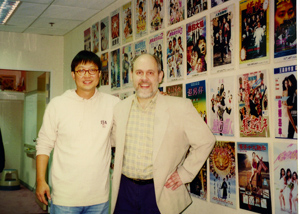
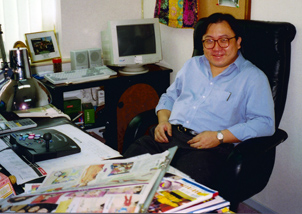
My longest stay in Hong Kong was during the spring of 1997. Doing research for PHK, I interviewed several people. One of my top stops was BoB & Partners, then the latest incarnation of Wong Jing’s entrepreneurship. (On the wall in the left still you see posters for Naked Killer, 1992, and other genre classics.) BoB stood for “Best of the Best,” and one of the partners was Andrew Lau Wai-keung, top-flight cinematographer who had become famous as a director with the Young and Dangerous series. Soon he was to go on to Storm Riders (1998) and eventually to the Infernal Affairs trilogy (2002-2003). Next door, Wong Jing also talked with me. He had several TV screens facing him, one with video games, and you can see his console front and center on his desk.
Another busy man, Peter Chan Ho-sun, had become an important director of contemporary comedies and dramas (e.g., He’s a Woman, She’s a Man, 1994; Comrades, Almost a Love Story, 1996). I met him in 1997 and brought him to Madison in 1999; below, a photo from 2008. Even more prolific, and less easy to categorize, is Herman Yau Lai-to–DP, rock-and-roller, and director of everything from grossout horror (The Ebola Syndrome, 1996) to harsh social critique (From the Queen to the Chief Executive, 2001; Whispers and Moans, 2007). How could you not learn a lot about filmmaking craft from a guy who had directed over fifty movies and been DP on thirty-five more? I wrote about Herman’s On the Edge here.
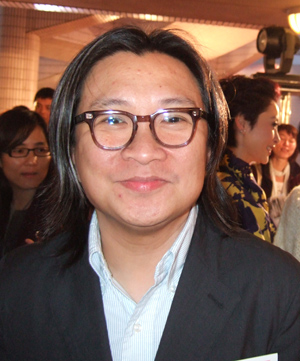
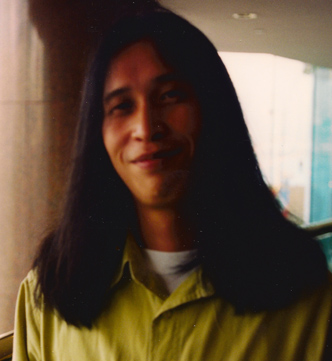
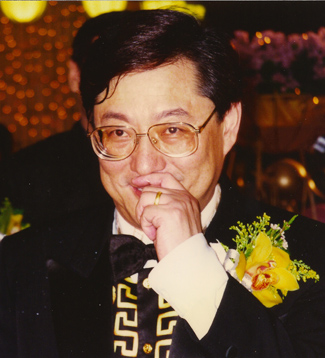
I met some directors from the older generation too. There was Yuen Woo-ping (aka Yuen Wo-ping), one of the great fight choreographers (The Matrix, Kill Bill) but also a lively director in exhilarating films like Legend of a Fighter (1982), Dance of the Drunk Mantis (1979), Iron Monkey (1993), and Tai-chi Master (1993). And there was Ng See-yuen, another local legend. He directed some sturdy kung-fu films like The Secret Rivals (1976) and The Invincible Armour (1977). He’s also an iconoclastic producer, backing Jackie Chan’s breakthrough film Snake in the Eagle’s Shadow (directed by Yuen Woo-ping), Tsui Hark’s Butterfly Murders (1979) and We’re Going to Eat You (1980), and several of the Once Upon a Time in China entries. Here Ng is at the 1997 Hong Kong Film Awards.
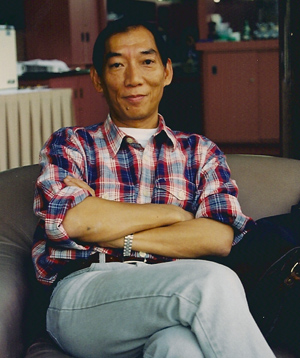
Two of the high points were my interviews with major figures of the Hong Kong New Wave of the 1980s, both still going strong in 1997. Ann Hui was warm and generous with her time; she visited Madison that year with Summer Snow (1995) and other films. The picture below is from 2005.

Then there was my several-hour talk with Tsui Hark at the Film Workshop headquarters. Good thing I taped it; I couldn’t keep up with him in my note-taking. He was planning Knock-Off and the animated version of Chinese Ghost Story.
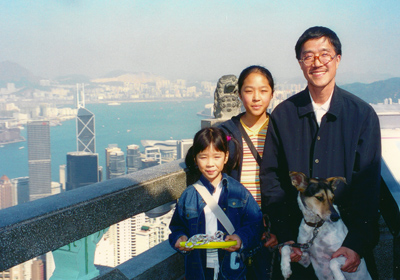
After 1997, I looked in on some other filmmakers. I was invited to visit the Academy for the Performing Arts in 2001 under the guidance of Professor Lau Shing-hon, another early New Waver (House of the Lute, 1980; The Final Night of the Royal Hong Kong Police, 2002). Here he is with his family on the Peak.
Since I started blogging, I have put my best (or rather the least amateurish) shots online. So for more snaps, you can rummage through the category, Festivals: Hong Kong. But I can’t resist two final ones. Here are Johnnie To and the younger director Soi Cheang Pou-soi (Love Battlefield, 2004; Dog Bite Dog, 2006; Accident, 2009), in shots from 2005 and 2009 respectively.

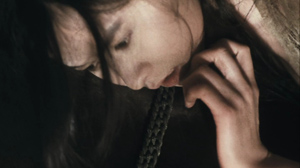
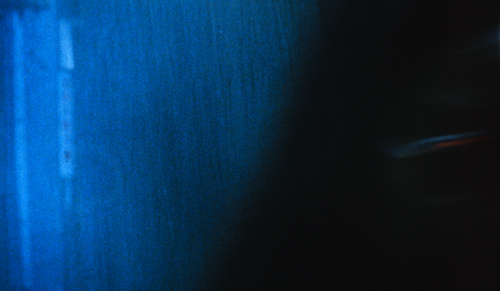
And now for something not quite completely different. In both print and e-book editions of Planet Hong Kong, I wrote about our last view of the Brigitte Lin Ching-hsia’s character in Chungking Express. Wong Kar-wai presents a jerky slow-motion shot of her leaving the crime scene and dodging out of the frame. It freezes on her, at a moment that yields a perversely unreadable image.
A shot of this frame would have been mud in the black-and-white pages of the book and probably not much better in the color pdf. I couldn’t imagine catching the faint reddish glint of the woman’s sunglasses. (Actually, the e-book’s quality turned out well enough that we might have tried for it.) So I picked the most legible image I could find from the shot, and that’s what’s in the print book and the digital copy (Fig. 9.13).
In any case, for obsessives like me, I reproduce the frozen frame here. This still comes from a 35mm print of the movie, and it is, of course, a lot more poetic than my snapshots, partly because it teases you about what’s in the frame.
PLANET HONG KONG: The little industry that could. . . . then couldn’t


DB here:
Planet Hong Kong, in a second edition, is now available as a pdf file. It can be ordered on this page, which gives more information about the new version and reprints the 2000 Preface. I take this opportunity to thank Meg Hamel, who edited and designed the book and put it online.
As a sort of celebration, for a short while I’ll run a daily string of entries about Hong Kong cinema. These go beyond the book in dealing with things I didn’t have a chance to raise in the text. This is the second one. The first, a list of about 25 Hong Kong classics, is here. The third, on principles of HK action cinema, is here. The fourth, a photo portfolio of HK stars, is here. The next installments focus on western HK fandom, on director snapshots, and on film festivals, the last including a list of some personal favorites. Thanks to Kristin for stepping aside and postponing her entry on 3D.
Seldom do historians get to write finis to the tales they tell. Who can tell when a process is played out? Yet sometimes you can’t avoid the sense that things have definitively ended.
That’s the case with Hong Kong cinema. Good, even great, films will still be made there, but that’s true of any territory. What made Hong Kong turn out so much lively cinema for so long was its large, robust film industry. Not exactly the Hollywood of the East, as Planet Hong Kong tries to show; it was erratic and seat-of-the-pants, less a large-scale enterprise than a cottage industry. Yet its scale did help it achieve a unique place in film history. Today there can be little doubt that the glory days of that cottage industry are gone. They started to go, in fact, about fifteen years ago.
Not 1997, 1994
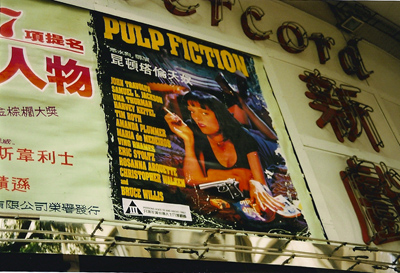
Silvercord Cinema, March 1995.
From the 1960s to the mid-1990s, the Hong Kong film industry ruled the East Asian market. Confronted with a small population in the Crown Colony (still under British control), filmmakers turned toward the much larger regional audience. They succeeded, wildly. In an era when most Asian nations couldn’t afford to import American films, the Hong Kong product boasted higher production values than films from other countries in the region (except Japan, of course). The films catered to the Chinese diaspora, a prosperous segment of most neighboring countries. Moreover, the industry offered major stars: the Shaws and Cathay stables at first, then Bruce Lee, Jackie Chan, Jet Li, and innumerable crossover faces from TV and pop music.
But things changed. Wasn’t the year 1997 the breaking point? After all, that was when the colony was handed over to Mainland China. Actually, PHK argued back in 2000, the slump started in 1993-1994. Thanks to overproduction, the exodus of talent, the rise of video piracy, and many other factors, the industry was in trouble well before the handover. Its problems were exacerbated by the Asian financial crisis of 1997, the 2002-2003 SARS outbreak, Internet piracy, the increasing success of South Korean cinema (and popular culture generally), and a powerful shift of investment and talent to the Mainland.
The new edition of the book gives details, but the dimensions of decline can be summarized.
*In most years between 1977 and 2002, between 100 and 234 films were released annually. (There was a significant drop in the years 1996-1998, an immediate reflection of the waning market.) After 2002, the number dropped steadily to about fifty releases per year. In 2010, Patrick Frater reports, there were 54 Hong Kong releases out of a total of 286 theatrical releases.
*Local movie attendance waned accordingly. In 1990, fifty million tickets were sold. In 1995, only 28 million were. Throughout the 1990s, ticket sales wobbled between about 17 million and 22 million. Recently, the number has been about 20 million.
*What proportion of local box-office receipts are claimed by local films? Again, 1994 proves a watershed. Before that, local films won between two-thirds and three-quarters of the market. But from 1995 on, the percentage shrank drastically. By the mid-2000s, Hong Kong productions were claiming less than a quarter of receipts. In 2009, 20.7 % of receipts went to local films—about US$31 million. The rest went to foreign imports, chiefly Hollywood movies.
*Before 1996, each year’s top ten box-office winners included between eight and ten local productions. It’s sad to trace the steep decline; by 2005 through 2008, only two films a year made it into the winner’s circle. In 2009 there was only one local film in the top ten. Last year there were two, and number ten was Gulliver’s Travels; how sad is that? America wins again.
*But Hong Kong’s market was chiefly a regional one. So how did the films do overseas? After 1994, not so well. The multiplexing of the world (one of the most important developments in global cinema history) gave Hollywood a strong entrée to places it had previously ignored. As Asian consumers became wealthier, they were drawn to the well-appointed theatres showing American movies like Jurassic Park (1993) and Speed (1994). Hollywood responded with blockbusters aimed at young and middle-class viewers in all countries, and soon its overseas receipts surpassed those from the United States. American films shoved Hong Kong films off both domestic and regional screens.
*Finally, what about China? Some locals thought that after 1997, Hong Kong would become China’s Hollywood. After all, the Mainland industry was backward, and Hong Kong had the money, the facilities, the skill sets, and the talent—especially stars that were household names in China. Sooner or later the PRC would need Hong Kong. Things did not work out that way, as I’ll discuss below.
The 2000 edition of PHK pointed to some of these factors, but an extra decade yields a longer view, and that lets us fill in more interesting detail. The old historians’ adage holds good: You really do need a stretch of time to see things more clearly. Of course you don’t have to go as far as Zhou Enlai. Asked about the effects of the French revolution, he is said to have replied: “Too soon to tell.”
Not a long time
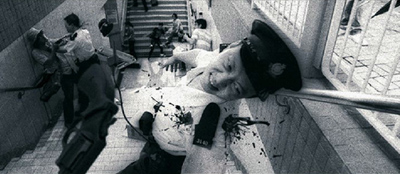
Fire of Conscience (2010).
Speaking of Zhou, one thing I couldn’t foresee when I was writing PHK in 1997-1999 was the emergence of China as a filmmaking power. The mainland cinema was in pretty bad shape when Kristin and I visited the PRC in 1988, and things got worse in the next decade. For example, the number of cinema screens fell from about 140,000 in 1991 to 65,000 in 2001.
Again, though, things were changing. The PRC steadily stabilized the decline of its industry. It semi-privatized production, distribution, and exhibition. It let in American films and encouraged international investment to build up an infrastructure. The bureaucracy blocked a free flow of Hong Kong films into their market until 2003, at which point local exhibition was on the road to maturity. The audience grew but remained comparatively small: 115 million in 2000, 263 million in 2009. But receipts skyrocketed.
China’s cities were growing fast, and newly-prosperous urbanites turned to the new multiplexes built with Japanese, Korean, and Hong Kong investment. In 2001, box-office revenues were reported as US$77 million–about the same as tiny Denmark the same year. By the end of 2010, according to this Variety article, total box office looked to be about $1.5 billion—ahead of the 2009 receipts from the United Kingdom. (The UK is the second-biggest box-office territory in the EU.) The same Variety article quotes the head of China Film Group saying that he expected the figure to exceed $3 billion, which would easily make China the most lucrative market outside the United States.
Clearly China’s growth came at Hong Kong’s expense. A quota kept nearly most Hong Kong films out of China for nearly a decade. Now producers could enter only on the Mainland’s terms, with coproductions and joint ventures the primary options. Producers were eager to partner with what was likely the fastest-growing film market in history. After 2003 more and more Hong Kong films would have some PRC involvement—financing, location shooting, postproduction, technical staff, and of course stars. The Chinese market was so vigorous that producers began assuming they could make their films principally for the Mainland, not for their home audience. Only the most modestly budgeted film, a teen romance or slapstick comedy, could retain some local tang.
Planet Hong Kong traces this process in more detail, outlining some of the chief creative choices facing Hong Kong filmmakers in the 2000s and since. The Mainland is involved in nearly all of them, not just financially but ideologically. A historical action movie like Bodyguards and Assassins (2009) wins favor by focusing on the heroic efforts of a cross-section of Chinese to defend Sun Yat-sen during his stopover in Hong Kong. The academic, patriotic costume picture perfected by Zhang Yimou has been taken up by Peter Chan Ho-sun (The Warlords, 2007) and John Woo (Red Cliff, 2008-2009).
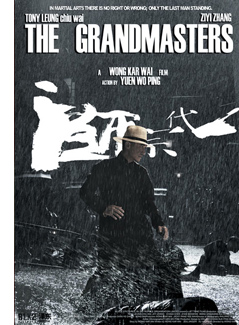 There is another, riskier option: Make films that can sell in the West. This has been Wong Kar-wai’s strategy as he has risen to the top of the festival and arthouse circuit. But after his venture into American indie cinema, My Blueberry Nights (2007), he too has shifted toward the Mainland, reviving the Ip Man project he announced several years ago, now known as The Grandmasters. (Ironically, so great is the power of American distribution that My Blueberry Nights was probably his best-performing film in theatrical release.) Johnnie To Kei-fung has pursued several avenues at once: while making films for Hong Kong, China, and the region he has also developed audiences in festivals and in limited theatrical/ video releases in Europe and the U. S.
To the extent that the Hong Kong industry recovers, I’m happy to see it come back. I want it to succeed. Yet to the extent that it is obliged to serve the Mainland market and government policy, I feel a loss. Hong Kong films have become more “professional.” Scripts are getting tighter, and while this leads to strong entries like Hooked on You (2007) and Beast Stalker (2008), the old audacity seems rare. The success of slick, restrained items like Infernal Affairs (2002-2003) and Initial D (2005) may signal that most films will lack the galvanic unpredictability of the old days. CGI has made stunts more outlandish but also less convincing; Jackie Chan’s successors need no longer risk breaking a collarbone. A bravado bit of spfx technique, like the sculptured freeze-frame opening Dante Lam Chiu-yin’s Fire of Conscience (2010), has replaced the sort of open-throttle curtain-raiser that hurled you into the movie’s world.
In the prime days, the scale of production and the heedless rush to make movies to satisfy a market, to surpass your competitor, to make a killing before 1997—all that fostered a frantic, unpredictable churn. Fans found there the audacious conviction of the hell-for-leather outlaw. But entertaining as today’s movies can still be, the edge has blunted. Cellular (2004) became Connected (2008). Both are lively items, but did you ever think you’d see the day that Hong Kong turned out an authorized remake of an American movie? (Warner Bros. coproduced it.) Even English titles have become distressingly tasteful and cogent. Kung Fu vs. Acrobatic (1990), Love Amoeba Style (1997), Killing Me Hardly (1997), and Horrible High Heels (1996): those titles and dozens more teased us toward the sweet brink of nonsense. Divergence and Invisible Target and Wait Till You’re Older just don’t do the job.
Plastic boobs were involved
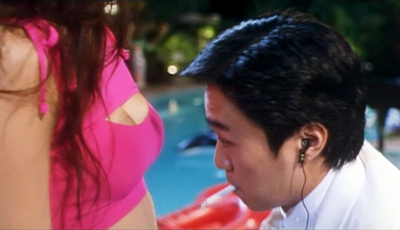
From Beijing with Love (Stephen Chow/ Lee Lik-chi, 1994).
Yet all signs of life haven’t been muffled. In the current restrictive climate, Johnnie To can make eccentric, occasionally shocking films like Running on Karma (2003) and Throw Down (2004). I take comfort in learning just last weekend what terminated Stephen Chow’s directorship of The Green Hornet. According to one report he proposed to plant a microchip in the hero’s brain and have Kato control him with a joystick. In an Entertainment Weekly article not online, director Michel Gondry claims that Chow’s plans were too far out. “Really, really crazy ideas that you would not dare bring to a studio. AIDS was involved. Plastic boobs were involved too.” That Gondry, one of Hollywood’s approved Wild Things, can find something Chow proposed over the top gives you hope.
A couple of months before the handover, I was in Kowloon talking with a cab driver. He told me confidently, “Chinese people are born capitalists. We know very well how to make money. We will never accept Communism.”
“But,” I said, “the Mainland has had a Communist government for forty years.”
He shrugged. “Forty years is not a long time.”
Now that is really taking the long perspective. Maybe I shouldn’t write finis. The prospects of Hong Kong cinema? Too soon to tell. Ask me in forty years.
Many of the statistics cited here and in Planet Hong Kong come from the Hong Kong Motion Picture Industry Association and from that invaluable source on world film trends, Screen Digest. We discuss the importance of multiplexing in the process of globalizing cinema in Chapter 29 of Film History: An Introduction. For an example of the ideological finger-wagging practiced by China’s officialdom, go here. (Thanks to Shelly Kraicer for the link.) The Michel Gondry quotation comes from Benjamin Svetkey, “Hornet’s Buzz Gets Better,” Entertainment Weekly (14 January 2011), p. 25.
PS 24 January: Soon after this entry was published, Luo Jin wrote me with some comments. I’m sorry about the delay in posting them, but I wanted to recheck my sources and dig up new ones.
I just read your latest blog entry. Some numbers are different from my knowledge, so I provide them below. I hope they are helpful.
“The number of cinema screens fell from about 140,000 in 1991 to 65,000 in 2001.”
In general the screen number in China refers to the screens in large and medium-sized cities, excluding small cities and rural areas. That is because in most small cities or counties (like Jia Zhangke’s hometown Fenyang), there is no film theater at all. And in the rural areas, only mobile screens are available. Tickets are free, so there are no B.O. receipts. In all, an accurate number of screens is hard to count. I checked the official report, and the number of cinema screens in 2002 is given as 1,581, increasing annually to 6,223 in 2010. If I am not wrong, the number in the United States is around 40,000, so it couldn’t be that much in 1991 to 2001 in China, even taking the rural mobile screens into consideration. Reportedly the rural mobile screens numbered about 40,000 in 2010.
“In 2001, box-office revenues were reported as US$77 million”
In the official report, the domestic B.O. revenue in 2001 is 890 millions RMB, equal to US$108 million by 2001 exchange rate.
My sources for Chinese exhibition statistics, as indicated above, were the annual reports in Screen Digest, which I have always found reliable in relation to other countries. I assume that the SD sources counted the rural mobile screens in the total, but otherwise I don’t know how to explain the discrepancy. Similarly, the differences in reported box office revenue may need to be checked against indigenous sources. The most recent Screen Digest annual exhibition report (November 2010) cites for 2009 34,233 screens in China (again suggesting that mobile screens are counted) and a box-office take of 6109 billion yuan, or US$906 million. The latter figure corresponds to other reports in Western sources. On screen counts, other sources suggest numbers closer to Jin’s. A 2008 Variety article mentioned that there were currently only 3000 screens in the country, while a mid-2010 Variety piece claims 5000 by 2009. If my claims prove unfounded on these points, I regret the errors.
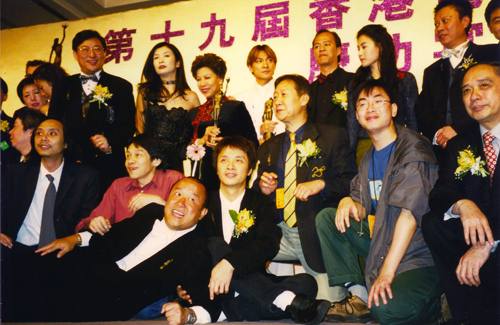
Hong Kong Film Award winners, 2000. Among them, top row, from left: Ng See-yuen (with orchid), Carrie Ng Ka-lai, Law Lan, Andy Lau Tak-wah (white suit), Ti Lung, Cecelia Cheung Pak-chi, and Arthur Wong Ngok-tai. Bottom row: Manfred Wong Man-chun (in profile), Gordon Chan Ka-seung, Teddy Robin Kwan, Eric Tsang Chi-wai, Tung Wai, Cheung Tung Cho, Lam Kee-to (in spectacles). Thanks to Athena Tsui and Luo Jin for help in identification.
Welcome, 2011
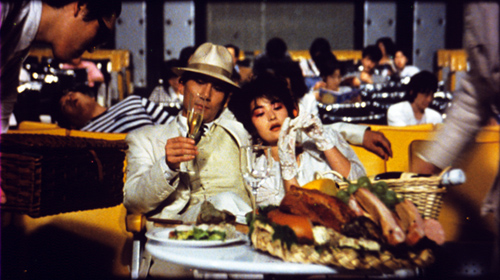
Tampopo, 1985.
May your every trip to the movies be a feast!
Kristin and David
Three minutes of “Three Brothers”
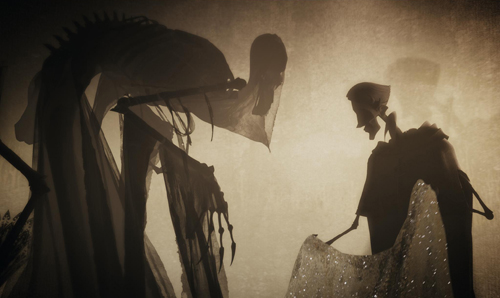
Harry Potter and the Deathly Hallows Part 1
Kristin here:
Last wee I went to see Harry Potter and the Deathly Hallows Part 1. Behind the pack, of course, since it had been out nearly a month. But I dislike watching films in a crowd. My ideal is to be alone in the theater, which David and I managed last week with Megamind. In this case I picked the first matinee on a school day and saw the film at our local Sundance multiplex. (Yes, even Sundance runs some popular films to help support the less successful art films.) I figured that noisy youngsters, even if they skipped school to see DH1, wouldn’t go to Sundance. I was right. Four or five adults were sitting about ten rows behind me. I never heard a peep or crackling candy wrapper out of them. The film was really film, too, 35mm.
I had been curious about how the filmmakers would deal with some of the stranger aspects of J. K. Rowling’s seventh and final book. Breaking it into two parts seemed an obvious and smart move, and it does have less of a rushed feeling than the previous adaptations had. But Deathly Hallows the book has some very unconventional aspects.
For a start, Rowling reveals dark, indeed downright nasty things alleged about Albus Dumbledore, who up to this point has been your standard-issue comic-but-wise, twinkly-eyed mentor figure. I wondered if the film would dare to do the same. It does, but so far only as a very minor side issue. In the first part, at least, Harry is obviously distinctly miffed that Dumbledore hasn’t left him more information about how to deal with horcruxes, but he doesn’t seem to feel that his hero had feet of clay.
Second, it seems downright perverse on Rowling’s part that in a long series which has come to focus on the search for horcruxes and should just be working up its climax, she throws another set of mysterious, lost objects, the three Deathly Hallows, at us. Let’s see, six horcruxes, three hallows. What’s the difference? Which should the characters be seeking, and why? Is Voldemort after them, too? In the book, Harry becomes obsessed with finding the hallows, even though the horcruxes are the main point. That last premise, Harry’s obsession, hasn’t shown up in the film, so far anyway, but otherwise the hallows are fully treated in the film.
Finally, Rowling gives us a very long portion of the book where Harry, Hermione, and, for a time, Ron, are fugitives moving from place to place, camping out each night as they try to figure out where the remaining horcruxes are—and not having much luck either with that or with destroying the one they have obtained. I personally think this is a rather daring move. Given that for this long section we are confined entirely to Harry’s point of view, we get little sense of what is happening in the outer world. Naturally the film can’t spend quite as much of its length on this period of nomadic existence. Still, it does devote an unexpectedly long time to portraying it.
Some critics have complained that the action stalls during this portion. Others have noted that the slow-down allows for us at last to linger over the psychological states of the three main characters, who are being worn down by fear, frustration, and the horcrux’s presence. This stretch also displays some beautifully bleak locations, well filmed. Plus, as Rowling no doubt intended, this part of the narrative conveys a real sense of the characters’ seemingly hopeless position: They are in great danger and without any apparent clue as to where to look next.
One minor obstacle that I remember noting when I first read the book is that the hallows are introduced by having Hermione read aloud a fairy tale from the book Dumbledore has bequeathed to her, The Tales of Beedle the Bard. The tale, “The Tale of the Three Brothers,” occupies only about two pages, but having someone read that much text aloud in a film can be deadly.
The filmmakers came up with a solution that is both inspired and extremely well executed. As Hermione reads, we see a roughly three-minute animated sequence that illustrates her words. 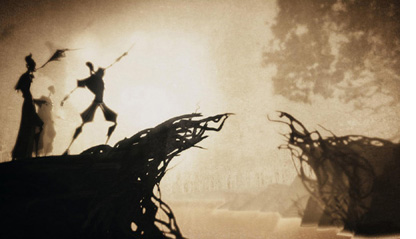 The filmmakers have acknowledged that their model was Lotte Reiniger’s technique of silhouette animation, which she developed in the 1920s and used for such classics as The Adventures of Prince Achmed (1926). For DH1, similar silhouette effects are achieved with 3D digital animation.
I wondered who had designed and animated this little sequence and determined to watch for references to it in the credits. As is typical with effects-heavy films these days, several companies were listed and the credits rolled by too quickly for me to catch much. Still, I don’t think that the little film-within-a-film was mentioned specifically or its creator named as having been attached to it. Even Variety‘s review, which refers in passing to the sequence, doesn’t mention its maker.
A lot of other viewers were impressed enough to try and find out who was responsible. DH1 was released in the US on November 19, and by the next day, Cartoon Brew posted a story on the subject: “A number of readers have written to ask who animated the shadow puppet-inspired ‘Tale of the Three Brothers’ sequence in the new Harry Potter film Harry Potter and the Deathly Hallows. It was directed and designed by Ben Hibon who produced it in association with Framestore.” Surprisingly, it also turns out that the section of Framestore that normally makes commercials did the “Three Brothers” scene.
I spent some time tracking Hibon down, finding some good-quality frames to display here, and locating clips. There are a few interviews with Hibon, plenty of clips and entire shorts, and filmographies. The video quality of some of these clips is dreadful, though, and a lot of the stories one finds via Google are short, repetitive pieces.
Most of this material is not all that easy to find, so herewith a guide to where you can most usefully find information on someone who seems to be an up-and-coming talent.
Hibon has designed video games, made music videos and commercials, done a short “screen” for MTV, and directed a few shorts and a trailer for a feature, A.D., which seems still to be in progress. The fullest filmography is the official one on the website for Hibon’s own company, Stateless Films.
Animation and effects expert Bill Desowitz has interviewed Hibon for Animation World Network. That’s recent, December 3, and deals exclusively with the DH1 scene. On November 23, fxguide posted an interview with Dale Newton, the sequence supervisor for the piece. An older, undated interview with Hibon on It’s Art Magazine concerns the series of five two-minute shorts collectively known as “Heavenly Sword.” These relate to a video game of the same name that Hibon designed. This series is visually quite distinctive, but it’s a far more conventional work than the “Three Brothers” short, being heavily influenced by anime.
Also on November 23, indiewire posted a short background article on Hibon, with several videos. With one exception, which I’ll get to shortly, don’t watch these films here or on YouTube. Why? Because the Stateless Films site has most of them and more. Hibon’s clips are larger and better quality than anything else I checked, plus they’re displayed with a black screen and far fewer distracting graphics than on YouTube. Click on the Archives link to see older works, including samples of Hibon’s work on videogames.
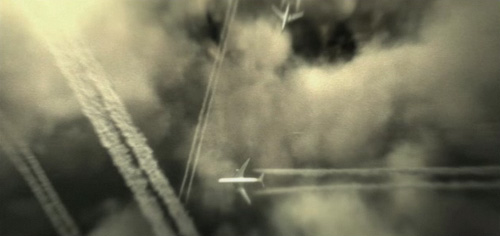
His site is the only place where I found a full version of his ad for the French bank, Crédit Agricole. The point of the ad is that this is the first green bank. It’s a gorgeous piece, full of images of pollution and decay gradually giving way to scenes of places restored to their pristine state and new, clean technology in place. Here are some images, from a vertical descent downward through a series of jet-trails (at bottom), a shot in which a wall of identical canned goods suddenly flies away to reveal a street market with fresh produce on sale, and windmills replacing old factory chimneys that fly apart:
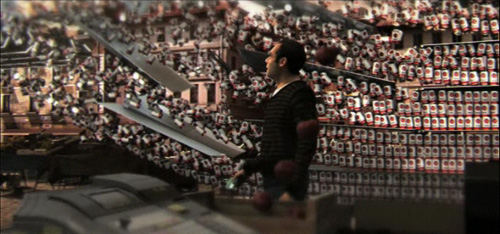
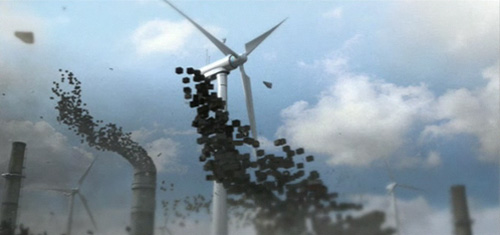
There’s a dream-like quality to the whole thing, with a lot of shots, many with rapid movement, juxtaposed with slow, stately music.
The indiewire clips linked above include two shortened, English-language versions of this ad, with Sean Connery appearing to make the message explicit. There are also some Crédit Agricole ads made by more conventional filmmakers. Watch one or two of those, and you’ll find the contrast dramatic.
None of these sites and others with Hibon clips or shorts has the “Three Brothers” sequence, not surprisingly. That is, YouTube has some horrendous, out-of-focus subtitled auditorium videos, made in perhaps a South American or Spanish theater. Avoid like the plague.
Framestore’s site has some information on Hibon’s sequence, and the only clip from it that I could find. It’s very small and too dark to render the subtleties of the visuals, but there it is. Framestore also animated the two house-elves, Dobby and Kreatur, and there’s some information on that part of the project as well.
The January, 2011 issue of Cinefex has a story on DH1 that will undoubtedly include a section on the “Three Brothers” animation, but I haven’t seen that yet.
One reason that there are so many short pieces on Hibon on the internet is that at almost exactly the same time, on November 22, Variety announced that the filmmaker had been signed to direct a long-dormant New Line project, Pan. It’s a variation on the Peter Pan story, with the roles of villain and hero being switched; here Captain Hook is a detective on the trail of a certain child-kidnapper. The studio acquired the project in 1996, and for a while it looked as though Guillermo del Toro would direct. This time the film might get made, since the Variety story reports that it’s being cast and should start shooting next fall.