






Archive for the 'Film comments' Category
ARRIVAL: When is Now?
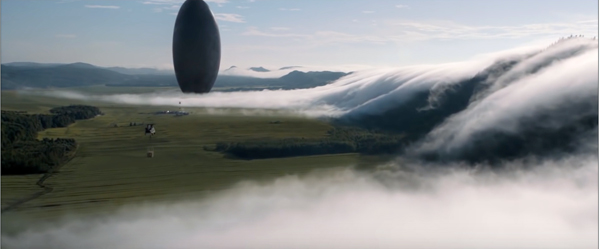
Arrival (2016).
DB here:
A lot of today’s movie storytelling is nonlinear. Filmmakers rely on flashbacks, replays, and voice-overs in order to shape our experience, sometimes in fairly daring ways. In Hollywood these strategies got consolidated in the 1940s. Or so I argue in my Reinventing Hollywood, now in copy-editing (or as the University of Chicago Press calls it, copy editing).
The question today is the same as back then: How do ambitious filmmakers handle these conventions? I think the ambitious writer or director faces at least three tasks.
How do I innovate—that is, how do I treat time shifts in a fresh way?
How do I motivate the shifts—that is, justify the scrambling of chronology?
How do I make the new version clear enough for audiences to follow?
Novelty, motivation, and clarity seem to me essential considerations for a filmmaker who wants to play with time and the viewpoint shifts that often come with it.
I’m not alone in thinking that Arrival succeeds in creating its particular engagement with the audience by tackling my three tasks. Director Denis Villeneuve and screenwriter Eric Heisserer innovate in handling time, and they in turn carefully motivate the device and find ways to make it clear to the audience. Today I want to consider how this all works. I have to assume you’ve seen the film, so of course there are spoilers.
Back to what future?
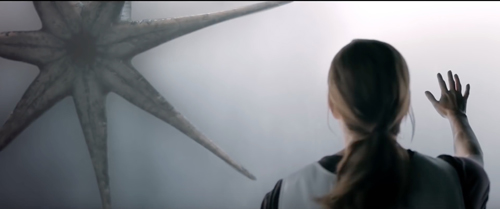
Cinema didn’t invent broken timelines; they’ve been used in literature for centuries. The Odyssey has blocks of flashbacks. Literature benefits from the fact that language has simple and direct ways to signal jumps in time.
For example, the writer working in English can make flashbacks clear though time tags and verb tense. Take this passage from John Le Carré’s novel Our Kind of Traitor. We’re told that on Sunday morning an anxious Perry Makepiece is climbing into a chauffeur-driven Mercedes. Then:
Last night, returning to the Deux Anges from their supper party, Perry had caught Madame Mère’s boot-button eyes peering at him from her den behind the reception desk.
“Last night” tells us we’re in an earlier period, and that information is reinforced by the past perfect tense of “had caught.” Page layout helps too: the entire flashback to the previous night is blocked out within extra spaces separated by a centered ★.
After recounting what happened when Perry returned to his hotel last night, Le Carré returns to the present time, the narrative Now, with a turn to the simple past tense:
The Mercedes stank of foul tobacco smoke.
Apart from the change of tense, the Mercedes mention reminds us of Perry’s morning trip. In addition, the shift back to the present opens a new section marked by ★.
On my three dimensions: There’s nothing innovative about this instance, though Le Carré will try some unusual things elsewhere in the book. The flashback is motivated by Perry’s remembering last night, and it’s made clear to the reader through repetition of several cues.
But what do we do with this passage?
I remember the scenario of your origin you’ll suggest when you’re twelve.
The tenses are out of whack, thanks to that “you’ll.” Then there’s the very meaning of the word “remember.” (Replacing the phrase with “I imagine.”) How can you remember something that has yet to happen? This isn’t just a casual slip. The speaker goes on to report an entire conversation that uses the future tense: “you’ll say bitterly,” “I’ll say,” “That will be in the house on Belmont Street,” and so on.
This passage comes near the start of Ted Chiang’s “Story of Your Life,” the source of Arrival. The story is what literary scholars call an apostrophe, a discourse addressed to an absent person. Louise Banks explains how her daughter came into existence. The story begins with Louise’s husband asking one evening, “”Do you want to make a baby?” It’s this point in time that’s marked as the present (and is rendered in present tense), but the bulk of the story shuttles between the past and the future. From the benchmark moment we get, in other words, flashbacks alternating with flashforwards.
On my three-dimensional scale, Chiang gets credit for innovation. Stories told in the future tense are pretty rare, especially when the events are presented as memories. And he makes the narrational premise clear. After a few pages, it’s established that Louise purports to know things yet to happen. The tenses cooperate: Present for the baby-making moment, past tense for the past events, future for the future ones.
We’re used to characters who know their past, but how can one know her future? For the story-maker that reduces to: How to motivate Louise’s knowing the future?
The answer is aliens. In the past, Louise met her husband when floating seven-legged creatures came to earth. As a linguist, she was assigned to learn the Heptapods’ language. Gradually she discovered that they had a mentality that refused causality and sequence in favor of a holistic view of time. Their language, to put it crudely, gave them access to past, present, and future.
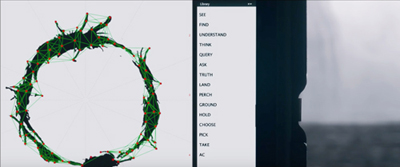
By learning their language Louise absorbed, to some extent, their world-view. (Yes, the untenable Sapir-Whorf hypothesis is invoked.) Her precognition allows her to know, moments before she and her husband conceive the girl, what her daughter will do from her childhood right up to her early death. Louise also knows that she and her husband will divorce and find new partners. For us, these episodes are rendered as flashforwards from the Now, even though for Louise they are, paradoxically, memories (of things yet to happen).
Chiang’s story explores the emotional effects of knowing the future and deciding not to try to change it. For all I know, this may be another innovation in the realm of speculative fiction. Most time-travelers seek to alter the past or the future, but Louise is aware of the paradoxes of time travel. If you know the future, you can freely decide to alter it by choosing differently at crucial junctures. Marry somebody else, and you’ll change what happens afterward, so you didn’t really know the future. But Louise comes to believe that free will is a part of linear, causal thinking, the sort that the Heptapods have given up.
The existence of free will meant that we couldn’t know the future. And we knew free will still existed because we had direct experience of it. Volition was an intrinsic part of consciousness.
Or was it? What if the experience of knowing the future changed a person? What if it evoked a sense of urgency, a sense of obligation to act precisely as she knew she would?
The Heptapods know that they will need help from Earth in 3000 years, and they presumably know that they’ll get it, but to fulfill that future they need to ask. The story’s analogy is to the daughter’s wanting to re-hear a story she knows by heart. As a story reader replays a known tale, the aliens perform the incidents that make things inevitable.
So Louise accepts her role in playing out whatever future is predetermined. For this reason she can address her (future) daughter with foreknowledge of the pains and delights that are coming, accepting them as part of a seamless whole.
Image + sound + time
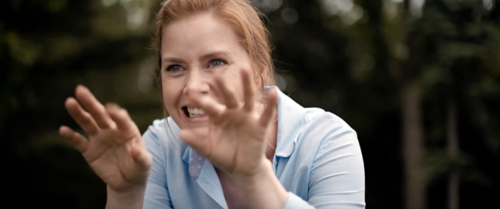
Lacking a tense system like language, cinema has devised other time signals. In the classic flashback we get a combination of them. We’re presented with a speaking or remembering character, a track-in to her, perhaps some music, a hint in the dialogue that we’re going into the past, a dissolve, perhaps a voice-over indication, and then a scene obviously situated in an earlier period. Filmmakers have discovered ways of altering some cues (cuts replace dissolves, tight close-ups replace track-ins) and deleting others (music and voice-over seem fairly optional now). Other cues are added for clarity, such as a different color palette for scenes in the past, or perhaps slow-motion imagery, or sound from the past that leaks in over imagery in the present.
Of course films use written and spoken language too, and so they can deploy tenses and time tags. Sometimes that can help us understand the time status of the scenes we’re seeing.
Voice-over is very helpful here. Take another Le Carré example, this time from Fred Schepisi and Tom Stoppard’s adaptation of The Russia House. Play the clip below and you’ll see what I mean.
Katya’s delivery of the covert manuscript, given on the image track, seems at first to be in the present. But the voice-over office conversation, only gradually shown through intercutting, is later than the Moscow incidents we see. So the present, the opening Now, is established on the soundtrack, while the image is in the past. As in fiction, the twin cues of verbal tense (“she visited”) and a time tag (“a week ago”) confirm the status of the Bookfair scene. The innovation comes when Stoppard and Schepisi don’t frame the Moscow scene by offering us the present-time office conversation before we see Katya–in effect, establishing the Now before showing us the Then. It’s an economical tactic of exposition, an elliptical revision of the phone conversations about the police investigations in M.
A voice-over can be in same time period as the images, of course, if it’s an inner monologue, a report on what a character is thinking at the moment. But voice-over commentary is often positioned as in the present with the images assumed to be in the past.
The voice-over present can be specified, usually through a lead-in scene showing the speaker recounting or recalling things at a particular time. Or the voice can be in a vague present, a zone we take as simply “after the events of the story.” It’s this no-man’s-land Now that leads us astray in Laura and other tricky films from the 1940s onward. Uncertainty about who’s speaking from when can be a source of interest in its own right. In Road Warrior, the revelation of the source of the opening voice-over provides the final surprise of the film.
So Heisserer and Villeneuve had an opportunity to follow Chiang in using the future tense in the voice-over for Arrival. It would surely have been an innovative move for a film. But they don’t do it. Why?
From premise to twist
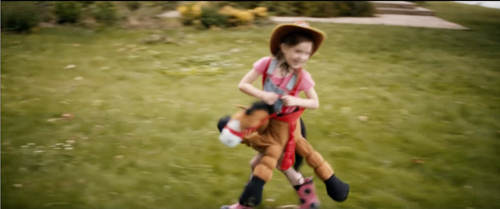
Flashbacks are temperamental little buggers. Hard to know when and how to use them.
Eric Heisserer, 150 Screenwriting Challenges
Heisserer was a keen fan of Chiang’s story and spent years trying to get backing for a film version. He recounts various difficulties in online interviews (here and here, for example), but I want to focus on a couple of other problems he faced.
In a general way, the film respects the thrust of the story. At the close, you realize that Louise has gained the ability to anticipate the future, thanks to learning Heptapod. But on a fine-grained basis, the film doesn’t spell out her ability as frankly or as early as the story does.
The first image, a view out onto the patio and the lake, shows no people, just a table with a wine bottle and a couple of glasses. Louise’s voice-over does address someone absent: “I used to think this was the beginning of your story.” But the point in time and the person addressed are far less specific than in the literary version. Then we get a quick burst of images of a baby, then a little girl playing with Louise, and soon a young woman lying dead in a hospital bed. This cascade of impressions ends with a shot of Louise walking mournfully down a hospital corridor, followed by a fade-out. Fade up on her striding into a campus building and attending her lecture. Over this we hear her voice-over.
But now I’m not so sure I believe in beginnings and endings. There are things that define your story beyond your life. Like the day they arrived.
And then we’re confronted by the Heptapods, as broadcast on worldwide TV, and Louise’s getting the assignment to talk with them.
The first shot, of the patio, is enigmatic, but fairly soon we get the sense that Louise is addressing her dead daughter. We seem to have a classic prologue. (Compare the opening death of Starlord’s mother in Guardians of the Galaxy.) Across three minutes, we see a mother loving and losing her daughter. Our default assumption is that after the daughter’s death, she has become solitary and emotionally numb. She doesn’t interact with people on her way to her classroom, and when she goes home alone she watches TV reports with a kind of blank anxiety.
The film sets up a schema: The grieving mother needs to get out of herself, and the assignment to communicate with the aliens would seem to do that. Eventually she finds love with the physicist Ian Donnelly as well. This redemption schema is probably reinforced for some viewers by memories of Gravity (2013), another movie about a withdrawn mother who channels her sorrow into heroic action.
As the alien encounters unfold, the film’s narration starts to sprinkle in more images of the lost daughter at different ages. But the images show up rather late. At about 48 minutes, there’s a brief, out-of-focus image of a baby; at about 51:00, a glimpse of the little girl wading. Not until about halfway through the film (57:00) is there a fairly sustained scene between mother and child, when the girl shows Louise a picture of her imaginary TV show. That’s when we learn that the father isn’t with them any more. Later shots of the daughter are salted through the scenes of the increasingly tense confrontation with the Heptapods.
Just as we’re encouraged to take the daughter’s birth, childhood, and death as a prologue that precedes the alien investigation, we’re inclined to take these interruptive shots of the girl as flashbacks. Louise seems to be remembering her daughter.
At about 82 minutes something happens that challenges our basic assumption. In another household scene, the daughter asks about the “science-y” term for a win/win situation, and Louise is stumped. The narration shifts us back to the tent at the site, Ian mentions the term “non-zero-sum game.” Then we’re whisked back to the scene with the daughter, and Louise repeats that.
I felt a bump there. If the scene with Ian’s use of the term comes after the death of the daughter, during the alien encounter, how can Louise “remember” it to relay it to the daughter? For many viewers (probably not all), this opens the possibility that the “prologue” tracing the daughter’s childhood takes place after the alien adventure, not before. The reinforcement for this, visible to me only on second viewing, is that the earlier glimpses of the girl’s growing up are always triggered by scenes showing Louise learning the Heptapod’s language.
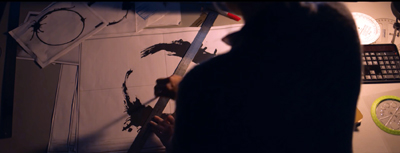
The filmic narration creates a sort of duck/rabbit Gestalt switch. Things we thought were past are future, things we thought were present are past. If the patio shot is the benchmark Now, the growth and death of the girl are the future and the Heptapods’ visit becomes a sustained flashback.
Now we see why Louise’s introductory voice-over lacks the future-tense sentences that are so startling in the novella. Including those would have been too strong a hint about the status of the mother-daughter shots. Instead, the opening voice-over uses only the past tense (“I used to think”) and the present (“But now I’m not so sure”). Another moment in the voice-over tilts us toward thinking of the image bursts later as flashbacks: we hear Louise murmur over the dead girl. “Come back to me.” Her yearning to reconnect to her daughter inclines us even more to consider the visions of the girl later as flashbacks.
Redundancy is your friend
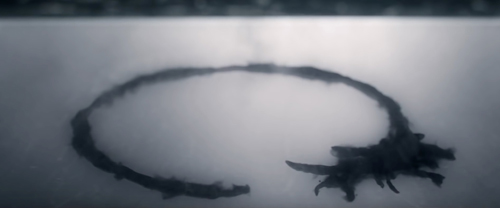
Okay, pretty innovative—and an interesting departure from Chiang’s story. Instead of telling us at the outset that Louise has precognition, the film holds that as a surprise, and makes us think that her anticipations are actually memories. And we have motivation: as in the story, it’s the alien encounter that endows Louise with precognition. But what about my third consideration, clarity?
I said that not everybody will probably catch the echo of Ian’s “non-zero-sum game.” The last half-hour of the film devotes itself partly to reiterating the news that Louise can discern the future.
Her impulsive visit to the Heptapods late in the film explains why they dropped by. They know they’ll need humans’ help in the future, so they come to make that future happen. At the ninety-minute mark, one speaks, and we get a big old subtitle: “Louise sees future.” If you doubt the Heptapod’s insight, another flashforward soon shows Louise explaining to her daughter why her dad left. Louise “made a mistake” by telling him about a rare disease—presumably the one that would kill their daughter. We’re left to understand that after she told him that she knew their child was fated to die young, he couldn’t take it. The delayed exposition, judiciously repeated, lets the pieces fall into place. We may even start to surmise that Ian is to be that husband, earlier identified as a scientist.
Like the aliens’ sentences, the film is circular. Heisserer told Vox:
When I completed the first draft and the bookends of the first three pages and the final three pages, it felt like I was drawing a narrative circle and I just closed the loop. That felt right.
The narration buckles the film shut by returning to the view of the patio, which is intercut with Louise and Ian embracing. Ian proposes that tonight they make a baby. The fact that Heisserer’s script displaces to the very end what was the opening of Chiang’s story is a fair index of the transformation he has wrought. What was a premise of the novella becomes a reveal in the film.
But the motivation is the same. Flashforwards aren’t exactly parallel to flashbacks, as far as viewer psychology is concerned. Flashbacks are assumed to be veridical unless there’s reason to doubt them (as in trial and investigation films, where people give differing versions of events). The default is that flashbacks really happened, unless there are contrary indications.
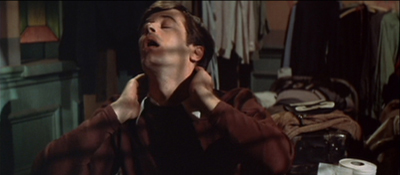
Flashforwards, on the other hand, can be of two types. They might proceed from the film’s external narration. In Easy Rider, Petulia, and They Shoot Horses, Don’t They? we get glimpses of future events that no character can know. In such cases, the images are usually enigmatic enough that we can’t be sure about the import of what we’re seeing. Flaming motorcycles, the protagonist tossing a bouquet into the water, a brief cutaway to a man in a police wagon (below, from They Shoot Horses): these are teases, not fully informative scenes, and they interrupt the main present-time action.
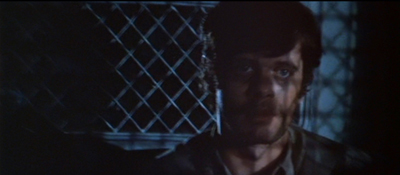
Alternatively, more identifiable flashforwards are usually motivated as a character’s precognition. They aren’t necessarily reliable. Flashbacks normally represent “actual” pasts, but flashforwards coming from mediums, psychics, or possessed children are only possible futures. Indeed, one task in such films is to prevent the apparent future from coming to pass, as in Minority Report and It Happened Tomorrow. The past is closed, but in subjective flashforwards, the future is usually open.
How, then, do we motivate trustworthy flashforwards? Here. by having infallible aliens certify them. Like “Story of Your Life,” Arrival assures us that Louise’s premonitions are accurate. It’s just that Chiang’s story proposes that early on and then shows how she achieved them. The film is trickier. It misleads us into thinking she has memories of the past when she is actually learning to see the future. She learns more quickly than we do, though eventually we catch up with her.
We’ve also learned that flashforwards can masquerade as flashbacks—if they’re deployed carefully enough.
Adding the ride

Explaining, very clearly, that Louise is knowing her future is only one task of the last stretch of the film. Another task is preventing a military attack on the aliens.
In Chiang’s story, the creatures simply leave. But Heisserer has explained that he felt the plot needed more conflict, so he added the prospect of brass hats eager to confront the visitors. The Heptapods, Louise suggests, have landed at various places around the world to induce nations to forget their differences in a common purpose. The Americans are suspicious, and General Shang of China breaks away from the alliance and takes steps to attack the ship near Shanghai.
Of the civil turmoil and military threat that fill out the plot, Heisserer noted in the same Vox interview:
The story doesn’t really have any conflict of that nature. It doesn’t need to. It’s a lovely literary conceit in its own right and works without that drama.
However, our early attempts a building this narrative without that conflict added felt very flat, and felt like there were no stakes. There was no ride. The more we played with it, the more Denis and I both realized that if aliens did land on earth and the public didn’t get immediate answers as to what their purpose was, the more everybody would freak out.
In building this climax, the film varies crucially from Chiang’s premise. Now Louise seems to alter the future. She apparently summons the will to induce General Shang, at a future celebration of the successful mission, to give her his private cellphone number and tell her his wife’s dying words. Back in the past, Louise uses this new knowledge to induce the General to hold his fire. All this is presented in a classical ticking-clock drama of suspense and pursuit.
The device is a bit awkward; instead of visiting an actual future, Louise seems present at one where the General, against all plausibility, tells her things she supposedly already knows. And how she induces him to spill all this is unclear, at least to me. The climax also breaks with the original story’s idea that Louise doesn’t exercise free will but accepts her role in the course of time.
More often than one might expect, classically constructed films break some of their self-imposed rules in the rush to a climax. Invasion of the Body Snatchers (1956) is one of my favorite examples, in which the climax violates the story’s method of pod-cloning. Sometimes an exciting denouement or a shocking twist tends to make us forget not only plausibility but also the premises that have operated over the previous ninety minutes.
An unsympathetic critic could object to the injection of a chase, a deadline, and a last-minute salvation of the mission, as well as the one-world moral of the movie. But to enjoy Hollywood, as with enjoying friends and other aspects of life, you have to accept, and even come to enjoy, the flaws too. The center of the film remains our transmutation of sympathy for a grieving mother into sympathy for a woman who knows she will be grieving for a child yet unborn, and yet embraces her destiny. The formal strategies serve to vividly convey this reversal of feeling, in the process ennobling a character reconciled to the transient joys of life.
Kenneth Burke once characterized literary form as “the psychology of the audience.” Filmmakers, like all artists, have recognized this from almost the beginning, but it may seem that today’s creative community is more self-conscious than ever before. If “form is the new content,” as I’ve suggested before, it’s a welcome development. Filmmakers are exploring lots of possibilities for engaging our minds and emotions, while still striving to keep their stories understandable to a large audience. Arrival could not have been made in my sacred 1940s, but its deft innovations build upon a foundation that was laid then.
Thanks to conversations with Jeff Smith and Kristin about Arrival. Thanks also to Merijoy Endrizzi-Ray and Jacob Rust at Madison’s Sundance Theater.
Jeff Goldsmith has an enlightening interview with Eric Hisserer at Screencraft. Ted Chiang’s novella is in the collection Stories of Your Life and Others. Burke’s discussion is in the essay, “Psychology and Form.”
The first quarter of Le Carré’s Our Kind of Traitor consists of an “intercut” sequence between past events and present interrogation that, in its free use of tenses, time tags, and other devices, seems to aim at a literary equivalent of the Russia House film opening. A pity that the recent film of Our Kind of Traitor didn’t try for a cinematic equivalent.
For more on modern treatments of narration and plot structure, try here. For further discussions of 1940s treatments of time-juggling, here are some blog entries.
P.S. 3 December 2016: The original entry didn’t use Minority Report or It Happened Tomorrow as examples of averting the future. They’re corrections to my original mention of Don’t Look Now, which was not an accurate example. David Cairns wrote to remind me of that, and to point out that the glimpse of the future we get in that film is in an interesting way akin to what we get in Arrival, and I hadn’t noticed that. For those who haven’t seen Don’t Look Now, I won’t add to an already spoiler-heavy entry. I’ll simply thank David, whose exemplary blogsite Shadowplay (currently hosting a blogathon under the rubric of The Late Show) is a must for every film lover. His new film, The Northleach Horror, is nearing completion; details here.
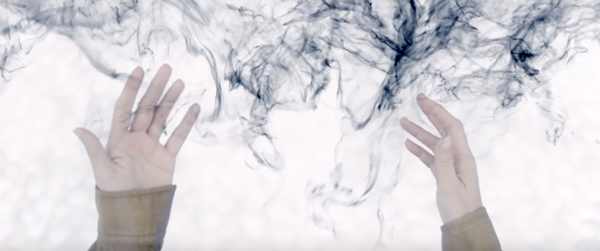
Arrival (2016).
Silents nights: Stocking-stuffers for those long winter evenings, the sequel
Kristin here:
A welcome translation, long awaited
From 1991 to 2003, the University of Wisconsin Press published an even dozen books of cinema history in the series Wisconsin Studies in Film. The editorial board consisted of David Bordwell, Donald Crafton, and Vance Kepley, with me as supervising editor. In a little over a decade, we accomplished our simple goal of fostering excellent historical studies in an era when it was far less easy to get such books published than it is now.
Among the dozen was Film Essays and Criticism, a volume of previously untranslated reviews and essays by Rudolf Arnheim (1997). That volume was made possible by the dedication of Brenda Benthien, its translator. Now Brenda has pursued a project she and I discussed long ago. She has brought to fruition a translation of the important classic book, Rudolf Kurtz’s 1926 Expressionismus und Film.
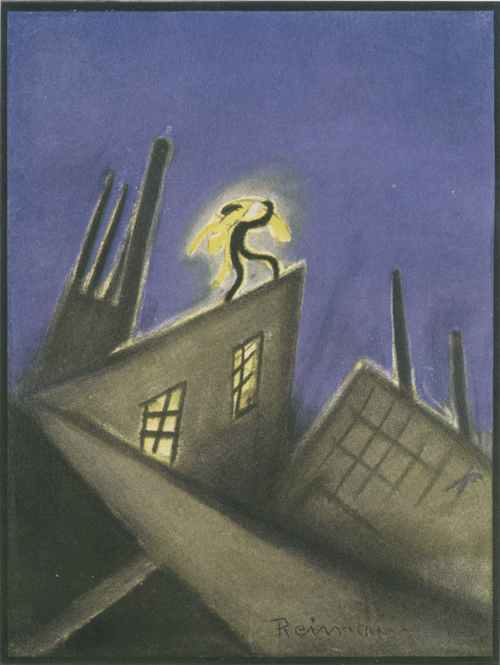
Kurtz’s book has been important enough to warrant two reprint editions in German, one in 1965 by Verlag Hans Rohr, with the illustrations all in black and white and the original cover painting by Paul Leni not used, and another in 2007 by Taschen, edited and with a lengthy essay by Christian Kiening and Ulrich Johannes Beil, as well as the original color illustrations and cover. The English translation, published earlier this year by John Libbey, essentially replicates the 2007 edition, including the cover design and the Kiening/Beil essay. The color illustrations, such as the frontispiece, a design by Walter Reimann for Das Cabinet des Dr. Caligari (top), are also reproduced.
Kiening and Beil are listed as editors here as well. As they point out in their brief introduction to the English edition, there had already been translations into French and Italian, but without the illustrations. Our English version may be late, but it comes much closer to replicating Kurtz’s original.
Kurtz’s title sums up his approach. He defines Expressionism in relation to the other arts of the era, particularly painting and theatre, and discusses the style of six films. Of these, The Cabinet of Dr. Caligari and Waxworks are familiar; From Morn to Midnight, Genuine, and Raskolnikow less so; and The House on the Moon is still, as far as I know, completely lost. (An excellent DVD of Von Morgens bis Mitternacht is available from the FilmMuseum via the link. The Alpha editions of Genuine and Raskonikow are, by report, American cut-down versions with poor visuals.)
One benefit of consulting the original or Benthien’s translation is to reveal that Siegfried Kracauer distorted the famous quotation from designer Hermann Warm that he includes in From Caligari to Hitler: “Films must be drawings brought to life” (p. 68). The original, “Das Filmbild muss Graphik werden” (p. 66 of Expressionismus und Film) is more accurately rendered by Benthien as “The filmed image must become graphic art” (p. 68). “Graphic art,” after all, includes far more than drawings.
The Kiening and Beil essay mentioned above is included in the translation. It is a substantial piece, taking up 75 pages of the book’s total of 214. The authors explain Kurtz’s background in the art world and film industry of the era, as well as discussing conceptions of Expressionism in the years leading up to the release of Caligari. They cite many contemporary theorists’ and critics’s views of of Expressionism in the cinema. Kiening and Beil flesh out Kurtz’s work by pointing out several Expressionist or semi-Expressionist films that Kurtz doesn’t mention. They explain how From Caligari to Hitler and (slightly later) Lotte Eisner’s The Haunted Screen became popular as explications of Expressionist cinema, leaving Kurtz in relative obscurity until recent decades. In short, the essay, entitled simply “Afterword,” is an erudite and invaluable addition to this edition of Kurtz’s book.
Cinematic after all
Way back in 1969, when I was taking my first film class, I saw The Cabinet of Dr. Caligari and became fascinated with German silent cinema, especially the Expressionist movement. I still retain a surprising willingness to sit through German films of the era–even mediocre ones–with their slow pace and heavy acting. Back in those early days, I tried to see the German classics, many of which were available in poor 8mm and 16mm copies.
I vaguely remember being disappointed by my first viewing of The Student of Prague. At the time of that viewing, film studies were still in their early days, and just about everyone assumed that a film was “cinematic” if it had quite a bit of editing and camera movement. The Student of Prague, like many films of its era, was short on both. Its long-take opening shot, with no cut-ins or tracking camera, seemed the epitome of stagy cinema.
I don’t know which version of the film I saw, but it wasn’t the original 1913 one. The film has a complicated history of re-editing and re-release, both theatrically and for home video. This history is recounted in the booklet accompanying the Munich Filmmuseum’s new DVD release of a reconstructed version approximating the 1913 release print, as well as the much shorter American release print. The original version was sold to a producer, Robert Glombeck, who exploited the occasion of the 1926 remake to release the original, highly reworked, including the addition of 107 intertitles. (The original had deliberately been made using a minimal number of intertitles.) Although shortened American and Japanese release prints of the 1913 version survived, the original German one did not.
The new reconstruction has been made from the Glombeck negative, as well as the other release prints, a script, and the incomplete censor’s record. While it cannot claim to be an exact replica of the original, it is far closer than we have had up to now. The excessive intertitles have been removed and a prologue shot showing scriptwriter Hanns Heinz Ewers and lead actor Paul Wegener looking up at Prague Castle restored. (It survived only in the American print.)
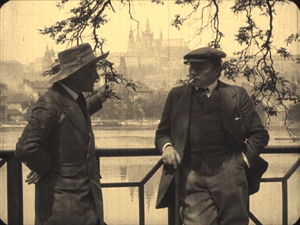
Even before this new release, I had gained a far greater respect for this supposedly uncinematic film. My first viewing came before academic interest in early film blossomed with events like The Brighton Project in 1978, trends like the spread of film archives and the rediscovery of many lost prints, and a general recognition of the historical, entertainment, and aesthetic value of early films, even among the general public. Gradually historians had realized that editing and camera movement were not the only techniques that exploited the techniques of the medium. There were long takes and intricate staging. There was the compositional exploitation of depth and the surprises of offscreen space. During the period 1992 to 1998, Yuri Tsivian, Lea Jacobs and Ben Brewster, David, and I explored various techniques that cinema of the 1910s used for expressive purposes. (See the codicil for citations.)
In 1993 I gave a keynote address at the fifteenth IAMHIST conference, “The International Exploration of Cinematic Expressivity, 1913-1919,” at the University of Amsterdam. In it I discussed a wide range techniques of framing, staging, acting, and unusual editing that were innovated in films made in many countries, all tending to enhance expressivity. Among my examples was that opening scene of The Student of Prague. I said, “This seems to me a case that could be dismissed as primitive. Yet it could also be described as a complexly staged scene that sets up the basic narrative situation and uses depth and unexpected appearances from off-screen to heighten the impact of the action.”
Now that we have something approximating the original version, we can look again at that first shot. There are two presentations of the reconstruction in this set, one with a piano rendition of the original score, which survives only in a printed piano score, and one with an orchestration of that score. The piano version runs distinctly shorter, and it looks to be projected at about the right rate. In this presentation, the first shot runs 3 minutes 40 seconds. It contains only two intertitles. After an establishing shot of a beer-garden, our hero enters, and the students hail him as the best fencer among them. This is information that we could only learn through speech. The title also provides his name, Balduin.
He sits glumly, largely ignoring the action behind him as Lydushka (apparently secretly in love with Balduin) enters and the students lift her onto a table for a dance. As this ends, a coach suddenly drives in from the left, and as it blocks most of the background, the students swiftly exit.
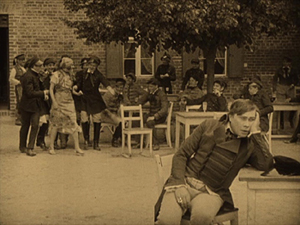
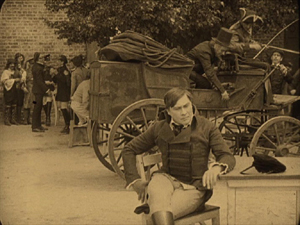
Scapinelli gets out of the coach and joins Balduin, tapping him slyly on the shoulder as Lydushka watches, growing anxious as the two start a conversation. The second intertitle provides crucial plot information, as Balduin announces that he is ruined and needs either a winning lottery ticket or a rich heiress. Scapinelli leads him out, the camera reframing slightly with them and with Lydusha, who moves forward to watch them. Soon Scapinelli will appear in Balduin’s room and make the fateful bargain, providing riches and the heiress in exchange for his mirror image.
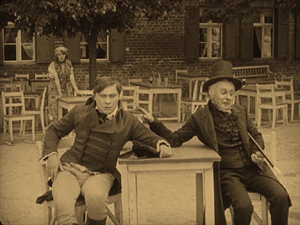
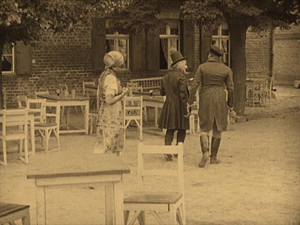
There is nothing quite like this shot in the rest of the film, but there are some very impressive depth shots. These typically involve a character in the foreground or background looking at other characters. Such shots substitute for eyeline-match cutting, which was not yet a convention of German cinema. In the shot at the bottom of this entry, Lydushka spies on a romantic scene between Balduin and Countess Margit. Below, Balduin realizes that his Doppelganger has killed Margit’s fiancé in a duel, thereby disgracing him.
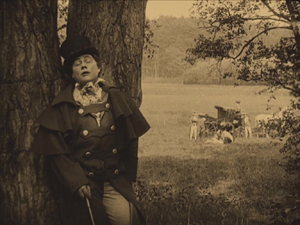
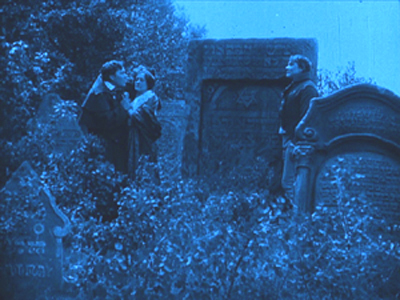
And there are, of course, the extraordinary shots of Balduin together with his Doppelgänger , achieved by the great German cinematographer, Guido Seeber. When the double, on the right, confronts the lovers in the old Jewish cemetery, the careful staging and double exposure allow Balduin to cross behind the large tombstone and enter the space where his nemesis has been moments before (see the top of this section).
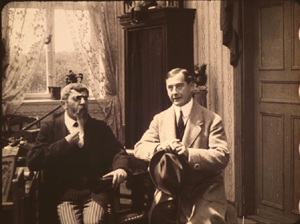
Apart from the different versions of The Student of Prague, the DVD set contains a 1913 short, Die ideale Gattin (“The Ideal Wife”), also “made by” Hanns Heinz Ewers. (The edition treats Ewers as the main creator of The Student of Prague, though most sources credit Stellan Rye as the director. It is true that at the time the scriptwriter was considered the creator of a film, but there’s no clarification of this in the notes.)
This is a charming little comedy starring Paul Biensfeldt as the hero oppressed by his strict, humorless female relatives and in search of a perpetually-smiling wife. Biensfeldt is a familiar face if not name, having played roles in several of Lubitsch’s German features, such as Menon in Das Weib des Pharao. Lubitsch himself plays a small role here, appearing as the matchmaker in only one scene. He is unrecognizable under a wig and beard and has nothing little to do.
The DVDs can be ordered directly from the Edition Filmmuseum shop. I note that Filmmuseum editions are now being sold on Amazon.de as well.
No buffalo were harmed in the making of this film

In March we praised the rescue of a major documentary, Strange Victory, released by Amy Heller and Dennis Doros’ Milestone Film & Video. The company has since brought out a film long thought to be lost, The Daughter of Dawn, one of a handful of fiction features from the decade that used casts entirely made up of Native Americans. (Notable others are Hiawatha [1913], In the Land of the Headhunters [1914], The Vanishing Race [1917], and Before the White Man Came [1920].)
As often happens in such cases, the director of The Daughter of Dawn, Norbert A. Myles, was a white man. He had started as an actor in 1913, directed three features in the 1920s, and went on to a long career working as a makeup artist (usually uncredited) on many of the most famous films of the 1930s and 1940s–most notably Ray Bolger’s makeup as the Scarecrow in The Wizard of Oz.
And as also often happens, the scenario avoids analyzing the culture of the ethnic group in question. The film largely falls back on a very conventional central premise. The film centers around a love rectangle, with the heroine, a Kiowa chief’s daughter nicknamed Daughter of Dawn, in love with the stalwart hunter White Eagle. Black Wolf, a rich brave seeking to become the new chief, spurns the devoted Red Wing and seeks permission to marry Daughter of the Dawn.
There are some action scenes, notably a chase after a herd of buffalo early on. We don’t see any actual killing of buffalo, and although the hunters return to their village announcing success, there is no glimpse of carcasses. Whether this was due to budgetary factors or legal or safety restrictions is unclear. A later battle scene between the Kiowas and some raiding Comanches is more successful. Myles wisely keeps his camera at a distance from most of the action, which creates a sense of genuine combat, unlike the effect of fake-looking close shots of two actors struggling hand to hand.
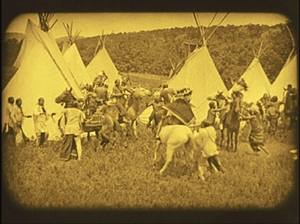
Still, most of the scenes are devoted to the romance plot, which is rather a pity.
The attraction of the film, though, is its authenticity. Not only did hundreds of Kiowas and Comanches perform for the camera, but they brought their own tipis, costumes, and accessories. They were by this point living on reservations but not so long that they had lost touch with their traditions. The period when the action is set is never specified, but there is no sign of white encroachment, no visible roads, and no mention of the threat of westward-moving pioneers or military. It is as close a look into this vanished past as we are ever likely to have. The Native Americans seem to have been happy to display their heirlooms for the camera, as in this scene where the heroine converses with her father in their tipi.
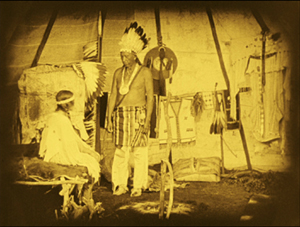
The performances of most of the cast are predictably rather stiff, with most of them primarily standing or moving where told to by the director. Dialogue titles rather than pantomime handle most of the story information. Myles successfully cast two more natural performers for his leads. Esther Le Barre and White Parker were Comanches (the tribe cast as the villains in the story) but played Kiowas, no doubt because they were both expressive and attractive–though to the filmmakers’ credit, they made no attempt to glamorize the pair.
In short, The Daughter of Dawn is an extraordinary historical document. For more information on the film’s making, rediscovery, and modern release, see the site of the institution that found the surviving print, the Oklahoma Historical Society. Its museum, by the way, has on display the historic tipi used in the film as the heroine’s dwelling. In 2013, after the film was preserved, the Library of Congress added it to the National Film Registry.
I discuss The Student of Prague‘s seminal role in establishing fantasy and horror as key genres that would remain important and culminate in the Expressionist films in “Im Amfang war … : Some Links between Germany Fantasy Films of the Teens and the Twenties,” Before Caligari: German Cinema, 1895-1920, Paolo Cherchi Usai and Lorenzo Codelli, eds. (Edizioni Biblioteca dell’Immagine, 1990): 138-148.
Yuri Tsivian concentrated on the introduction of mirrors into 1910s cinema to create a new way, nontheatrical way of presenting space to the spectator. See his “Portraits, Mirrors, Death: On Some Decadent Clichés in Early Russian Films,” Iris nos. 14-15 (Autumn 1992): 67-83. My 1993 keynote address quoted above was published as “The International Exploration of Cinematic Expressivity,” in Film and the First World War, Karel Dibbets and Bert Hogenkamp, eds. (Amsterdam: Amsterdam University Press, 1995): 65-85. Ben Brewster and Lea Jacobs focused on acting and staging in dept in their Theatre to Cinema (Oxford University Press, 1998). The revised edition is available online.
David began discussing tableau staging and compositions in depth in Chapter 6 of his On the History Film Style (Harvard University Press, 1997) and continued the exploration in the Feuillade chapter of Figures Traced in Light: On Cinematic Staging (University of California Press, 2005). For entries relevant to German Expressionism, check our Ten Best lists and our entries on Homunculus, on Sappho and others, on INRI and others, and on Murnau before Nosferatu.
[November 22: Brenda informs me that she also did the intertitles for FilmMuseum DVD of The Student of Prague.]
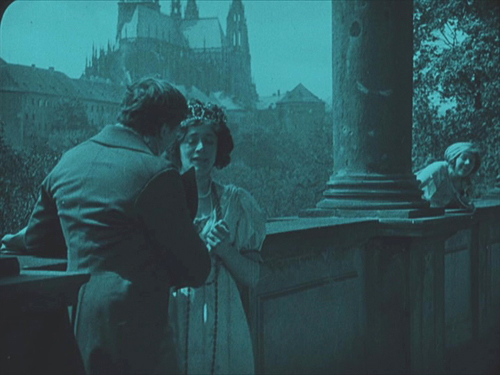
The Student of Prague.
More from VIFF 2016
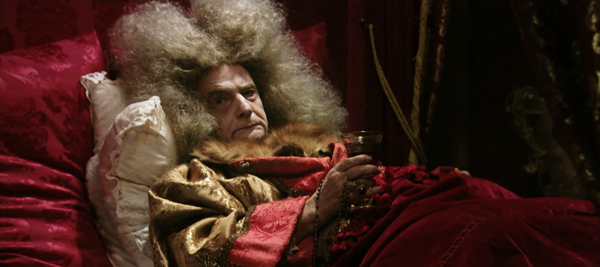
The Death of Louis XIV (Albert Serra, 2016).
The Vancouver International Film Festival ended yesterday, but the films and the pleasures they yielded linger on. Our first two entries are by Kristin, the last two by David.
Smog over Tehran
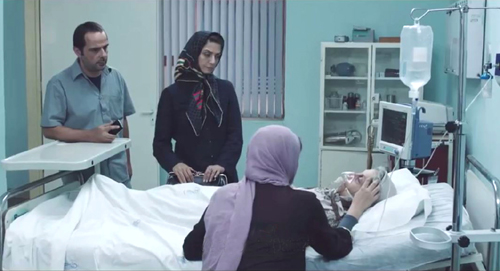
Iranian film and television director Behnam Behzadi is not well-known outside his native country. Inversion, which was shown in the Un Certain Regard section of Cannes this year, suggests that he deserves to have more international exposure for his work.
The title refers to the meteorological phenomenon that can cause dense pollution to form at ground level. The film opens with shots of Tehran streets seen dimly through a thick haze. The pollution has a causal role to play, since the heroine’s elderly mother ends up in a hospital as a result of breathing problems. More metaphorically, however, the title refers to a sudden reversal in Niloofar’s situation.
Initially she seems to be in a relatively strong position for a Iranian woman. Still unmarried in her 30s, she runs a small, prosperous garments factory and begins to date an amiable man whom she clearly likes. Her mother’s sudden health crisis, however, leads a doctor to insist that she be moved to the healthier northern part of the country, where Niloofar’s sister and brother-in-law happen to own a small villa. Niloofar, with no spouse or children, is pushed by the couple and her brother into agreeing to go along and take care of her mother. She hopes to keep the factory going, but the brother selfishly rents out the premises to pay off his own debts. Niloofar resists going with her mother, but as her siblings ignore her wishes and she discovers that the man she may be considering marrying has kept an unpleasant secret from her, she realizes how little power she has over her own life.
As in Farhadi’s films, a seemingly ordinary situation suddenly deteriorates from a simple cause. But Farhadi tends to gain complexity by avoiding making his characters into villains. In his films, as in Renoir’s, “everyone has his reasons.” In Inversion, however, the brother is straightforwardly in the wrong, refusing to consider Niloofar’s desires and even threatening her with violence during one argument. Overall the film is entertaining, with Niloofar an engaging figure who gives an insight into the situation of women in contemporary Iran.
Mistakes were made
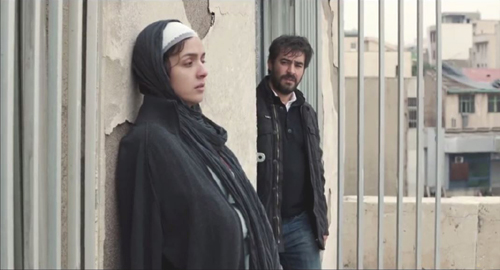
Asghar Farhadi is best known for A Separation (2011), the first Iranian film to win an Oscar for best foreign-language film. His earlier masterpieces, About Elly (2009) and my own favorite, Fireworks Wednesday (2006), are slowly coming to be known in the West, largely via home video. After the slightly disappointing The Past (2013), Farhadi is back on track with The Salesman.
The film opens with a tense, dramatic scene in which a Tehran apartment building threatens to collapse and its inhabitants frantically struggle to evacuate. The result is that the central characters, Emad and his wife Rana, must quickly find a temporary apartment (see bottom) while they also prepare to star in a production of Arthur Miller’s Death of a Salesman.
They seem to be coping until Rana mistakenly opens the door of their new apartment, assuming that her husband has come home. The shot holds on the door, standing ajar, as Rana moves off to take a shower and the scene ends. Later we learn that an unknown assailant has entered the apartment. Whether he raped Rana or simply startled her so that she fell and cut herself on broken glass is never revealed, but she is traumatized and unable to proceed, either with her everyday life or her role as Linda Loman in the play. Emad tries to be supportive, but he becomes obsessed with tracking down the intruder.
The mystery gradually unravels as the shady background of the apartment’s former tenant emerges, and revelation of the identity of the intruder undermines the question of revenge. As in Farhadi’s other films, characters’ mistakes, honest or otherwise, compound each other. Ultimately, absolute blame is hard to assign.
The Salesman won two prizes at Cannes: best screenplay for Farhadi and best actor for Shahab Hosseini as Emad. Amazon Studios and Cohen Media will release it in the US on 9 December.
The King is (nearly) dead
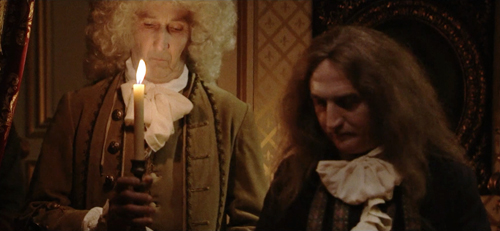
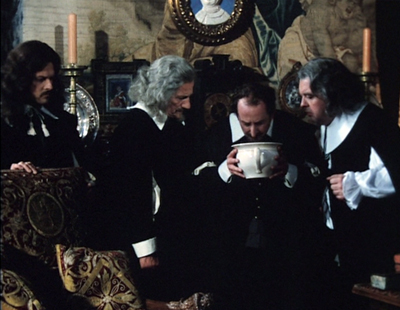
Early on in Roberto Rossellini’s Taking of Power by Louis XIV (1966), we find Cardinal Mazarin on his deathbed. Mazarin’s doctors decide to bleed him; a priest advises him on the disposal of his wealth; finance minister Colbert briefs him on intrigues at the king’s court. The shots are lengthy, following the men around the chamber.
This remarkably deliberate sequence was considered quite striking at the time. In a story centered on Louis XIV, Rossellini devotes thirteen minutes to Mazarin. His impending death creates exposition about the ensuing power struggles and initiates a somber pace rather different from that of the standard historical film. The scene also reminds us that historical events have a tangibly material side, as when doctors confer gravely over the stools in His Eminence’s chamber pot.
Rossellini, who’s interested in the tactics by which Louis tames the nobility, doesn’t show us the King’s final hours. That morbid task is taken up by Albert Serra’s The Death of Louis XIV. Unlike Rossellini’s film, which is filmed in radiant high-key and shows sumptuous detail of fabrics and flooring, Serra’s treatment relies on chiaroscuro, with shadow areas broken by trembling candlelight. And while Rossellini’s PanCinor lens swivels and zooms around these apartments, Serra cuts among close views of faces, hands, and a steadily blackening gangrenous royal foot.
In the process Serra expands the physicality of the Mazarin sequence to the length of an entire film. Louis seems to linger for days, but we’re given no distinct sense of how much time passes; in only two shots do we glimpse the outdoors, in bleary light that might be dawn, drab afternoon, or dusk. The time is filled out by court rituals, such as the King’s doffing his hat to his entourage, and by the steady decline of his powers. He can’t swallow food and can barely take water or wine. Through it all, Louis feebly issues his final orders about matters of state and the disposition of his body. A long scene of the last rites is punctuated by a barely discernible fart. This is a movie centrally about a degenerating body.
Even more than Rossellini did, Serra probes the shaky state of medical science of the time. (Louis died in 1715, just as the Enlightenment was beginning.) When Louis’s leg contracts gangrene, the learned doctors debate whether to amputate it. A quack shows up with an elixir made of bull sperm and other recherché ingredients. At the end, the principal physician takes the blame for the king’s death and makes a remarkable apology directly to the camera. Before that, though, Serra has given us a three-minute shot of His Highness reproachfully staring at us (up top) while we hear a Kyrie Eleison somewhere offscreen. Another echo of film history: Louis is played by Jean-Pierre Léaud, who looked out apprehensively at us many years ago, in the seashore ending of The 400 Blows. It’s glib to say that cinema films death at work, but here the cliché gains some meaning.
Master of the weepie
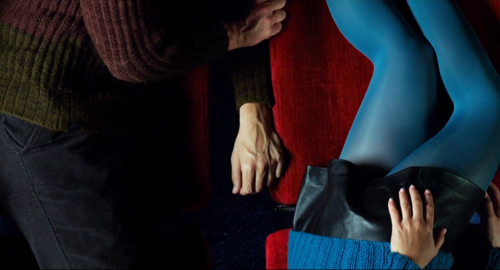
Is any filmmaker more unfairly taken for granted than Pedro Almodóvar? For over thirty years, he has created sparkling, handsome entertainments that combine cinematic intelligence with outrageous eroticism and insidious emotional punch. His films revel in plot complications and edgy humor. Along the way he effortlessly deploys the techniques that make modern cinema modern, from flashbacks and voice-overs to subjective sequences and abrupt replays that fill in gaps.
He makes it all look easy, and gorgeous. After the drab grays and browns of Hollywood fare, what a pleasure to see a film packed with saturated primaries and bold designs. He proves that you can go as dark as you like in plotting and still make things look delightful.
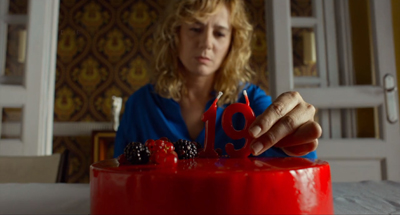

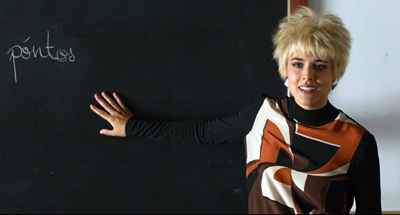
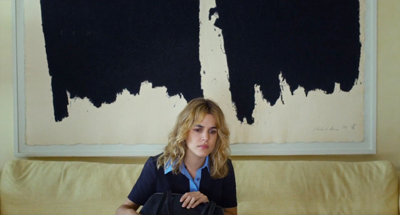
His characters are clothes horses, I grant you, but not the least of his debts to Old Hollywood is the belief that we want to see presentable people in pretty costumes and settings. The world is ugly enough, he seems to say; why add to it? Seeing The Girl on the Train reminded me how glum American movies are determined to look. An Almodóvar apple looks good enough to eat, and a housekeeper’s roseate apron seems the height of chic. In this world, even refrigerator magnets evoke a Calder mobile.
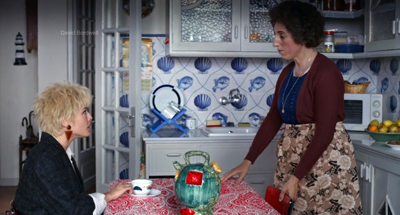
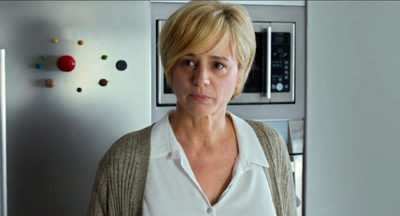
These elegantly voluptuous tales make unabashed appeal to Hollywood genres: the screwball comedy (Women on the Verge of a Nervous Breakdown, I’m So Excited), the illicit romance (Law of Desire, The Flower of My Secret), the twisty thriller (Live Flesh, The Skin I Live In), even the ghost story (Volver), and above all the melodrama—medical (Talk to Her) and maternal (High Heels, All about My Mother). He rolls Lubitsch, Sirk, and Siodmak into a nifty package, tied up with a ribbon bow of pansexuality.
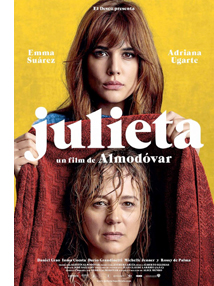 Julieta (from which all my images come) revisits the maternal melodrama, specifically the mother-daughter nexus. Our heroine, beginning as a spiky-haired classics teacher, seems to have an idyllic life married to a fisherman, but soon infidelity, misunderstandings, and a tempestuous storm shatter it. All the paraphernalia of melodrama—raging seas, unhappy coincidences, ingratitude, and dark secrets—threaten Julieta’s efforts to save her marriage and protect her daughter. Told in flashbacks, chiefly through a letter she writes her daughter Antia, the two major phases of Julieta’s life get intercut in surprising and gratifying ways. With his usual cleverness, Almódovar has Julieta played by two female performers, with a surprise match-on-action linking them in one scene. A beautiful purple towel helps, as the poster sneakily suggests.
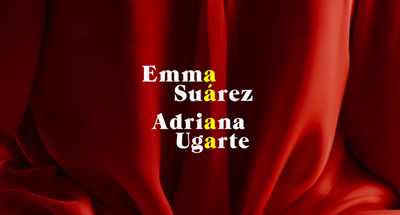
It’s all about guilt, passed from husband to wife and mistress and then to daughter and even daughter’s pal, with the obligatory recriminations and tearful confessions. The plot is continually surprising, yet every scene snicks into place. Neat parallels among couples develop quietly, and tiny hints planted in the beginning pay off. As usual with Almodóvar, the opening credits guarantee that you’re in assured hands. They also tease us with motifs. Here the film’s dual structure (two phases of life, two actresses) is suggested through lemon-yellow letters sliding into alignment.
The two women on my left started crying halfway through the movie. I tell you, this director is a credit to the species.
Special thanks to Michael Barker and Greg Compton of Sony Pictures Classics. Sony will release Julieta in the US on 21 December.
We have earlier entries on Farhadi’s About Elly, on A Separation, and on The Past. We discuss Serra’s ingratiating Birdsong here, and Almodóvar’s cunning The Skin I Live In here.
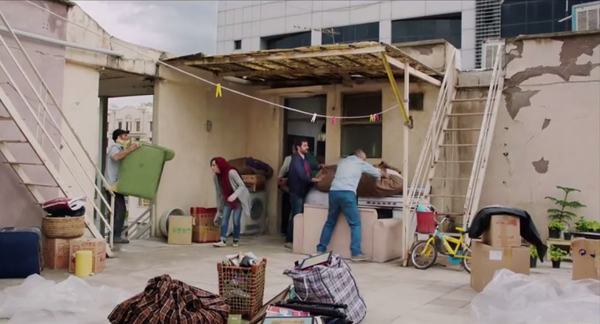
The Salesman.
Long live French cinema at VIFF: A guest post by Kelley Conway
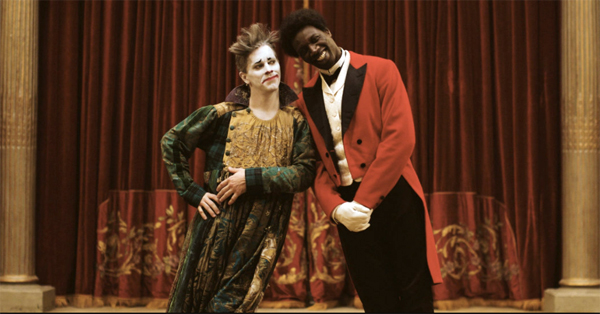
Chocolat (2016).
Kelley Conway, one of our colleagues here at UW–Madison, is an expert on French film; we talked about her latest book, a study of Agnès Varda, here. We invited her to contribute to our blog, and here’s the result.
David and Kristin introduced me to the pleasures of Vancouver and its superb festival, VIFF. Hats off to Alan Franey and the other programmers who created a strong and varied lineup of films. I saw excellent works from Romania (Sieranevada), Poland (The Last Family), Canada (Maliglutit), and Iran (The Salesman), but here I will address some of the strongest selections from France.
Shopping till she drops
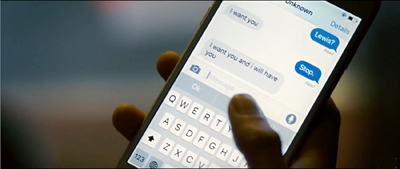
Now and then, the French make films that marry the conventions of art cinema and popular genres. François Ozon’s postmodern pastiche 8 Women evokes both the musical and the thriller. Claire Denis’s art-horror hybrid Trouble Every Day is contemplative and painterly, but also bloody and scary. Olivier Assayas continues the tradition by combining the traits of art cinema and Gothic horror in Personal Shopper, his second film featuring Kristen Stewart as a loyal assistant to a famous woman. While The Clouds of Sils Maria (2014) turns on the intense, shifting relationship between Stewart and an aging theater actress (Juliette Binoche), Personal Shopper is about a grieving young woman with little emotional connection to her celebrity boss (Nora von Waldstätten).
By day, Maureen (Stewart) makes the rounds of Chanel and Cartier, shopping for her employer; by night, she attempts to communicate with her recently departed twin, Lewis. The film’s links to the Gothic are established early on, when Maureen spends the night in a big, drafty house, awaiting a sign from her brother. Shutters bang, wind blows, and spectral figures attack. The supernatural is juxtaposed with the everyday; like so many twentysomethings, Maureen works in a job she hates in order to pay her rent.
Interestingly, she’s really good at this job. Wearing jeans and sneakers, she strides into exclusive boutiques, expertly chooses belts, bags, and baubles worth thousands, and transports them across Paris, skillfully navigating traffic on her scooter. At one point, she makes a quick trip to London to pick up a few dresses. Maureen tracks her employer’s movements via celebrity journalism on the internet and notes with satisfaction when the fashion maven wears the items she has chosen. But this is as close as Maureen gets to the rarefied world of high fashion; she is explicitly forbidden from trying on the beautiful things she covets. When she eventually breaks this rule, she must contend with the consequences.
Personal Shopper divided critics; the film’s Cannes premiere apparently elicited both hisses and a standing ovation. Stewart’s tendency to mumble here can indeed irritate. But the film’s conclusion offers a satisfying mix of suspenseful communication with the dead and art-house ambiguity.
Rape, violent videogames, and other breaches of Parisian decorum
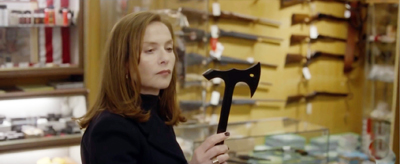
Like Personal Shopper, Elle (Paul Verhoeven) plays with genre conventions. The film opens with a black screen and the offscreen sounds of moaning that could signify pleasure or pain. It’s pain, as it turns out: Michèle (Isabelle Huppert) is being raped on her living room floor by a masked intruder. Later, she calmly cleans up broken glass and soaks in the bathtub. When a circle of blood emerges from between her legs, staining the bubbles, she sweeps it away. She tells her close friends about the rape, invests in pepper spray and an ax, and takes a shooting lesson.
Are we in for a rape-revenge film? Or perhaps a poignant drama about a woman who finds the strength to rebuild her life after a traumatic event? Not exactly. The film references rape revenge and melodrama, only to veer away from these traditions toward an uneasy pairing of satiric comedy and thriller. The film is filled with events typical of a French film about middle aged Parisians in a bourgeois milieu: well dressed people get together for dinner in excellent restaurants, the successful completion of a project at work is celebrated with an elegant party; Michèle loses her mother to a stroke, but gains a grandchild.
But Michèle also runs a company that makes violent and misogynistic video games, is hated by her employees, and mocks her admittedly ridiculous mother and son in public. The film’s revelation of a traumatic event in Michèle’s childhood might have been used to motivate her cynicism, but traditional narrative causality is not on here. Peoples’ reactions to events in Elle are always somehow “off.” The film’s upbeat conclusion is particularly confounding: key characters appear to have changed for the better, but we don’t know why.
Is the film an allegorical treatment of the toxic relationships between men and women? Perhaps. Michèle exhibits behavior often attributed to men. In a reversal of Laura Mulvey’s classic analysis of voyeurism, she spies on a neighbor she finds attractive, holding binoculars in one hand and masturbating with the other. She mechanically performs sexual acts without even pretending to be interested in her partner. She sexually humiliates an employee and sleeps with a friend’s husband because she “felt like getting laid.”
Elle hangs tenuously by its manicured fingernails to European art cinema. The film was directed by Dutch filmmaker Paul Verhoeven, better known for his Hollywood films Robocop (1987), Total Recall (1990), and Basic Instinct (1992) than for his work in Europe. Elle is a hybrid of Tie Me Up, Tie Me Down (1989) and The Piano Teacher (2001), borrowing Almodovar’s rape victim fascinated with her rapist and Haneke’s masochistic ice queen, also played by Huppert. Elle will intrigue and amuse some viewers and disgust others.
The film has been submitted to the Academy as France’s entry for Best Foreign Film. Huppert herself has never been nominated for an Oscar and she certainly deserved a “best actress” award for any number of the films she has made with Godard, Chabrol, Haneke, and Denis. This may be her year: her intriguing cipher in Elle and her subtle performance as a philosophy teacher in Mia Hansen-Løve’s Things to Come (2016), also playing at VIFF, both merit recognition.
Race under the big top
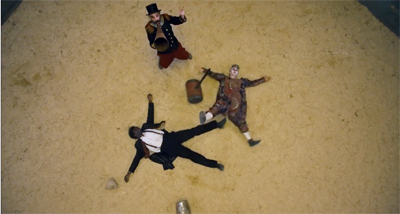
French superstar Omar Sy stars in Chocolat (released as Monsieur Chocolat), a Gaumont biopic about Rafael Padilla. Padilla was an Afro-Cuban who escaped abject poverty to become a famous clown in Belle Époque Paris. The film recounts the early period of Padilla’s career in a provincial circus, where he masquerades as a cannibal. The clown George Footit, played by James Thierrée (a grandson of Charlie Chaplin), sees his potential and they form a duo. Discovered by impresario Joseph Oller, they become “Footit and Chocolat,” and perform nightly at the Nouveau Cirque in Paris.
The film’s rags-to-riches tale condenses and alters the multiple phases of Padilla’s career; he actually enjoyed solo success in Paris before he met Footit. Still, the film succeeds at revealing the clown’s comic talent and physical grace. Padilla is initially naïve and good-natured, like the auguste clown character he plays in his act with Footit, but his rage grows at having to play the perpetual fool. He abandons the act and tries to mount a career in the theater playing Othello, but ends up back in a provincial circus, broke and sick.
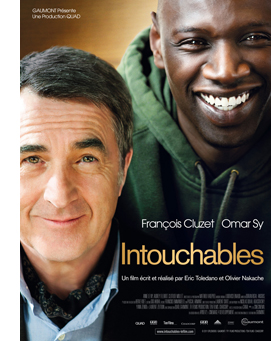 At first glance, the plot of Chocolat resembles that of Zouzou (Marc Allégret, 1934), another all-too-rare French film featuring a black protagonist. In Zouzou, Josephine Baker plays a laundress who becomes queen of the music-hall, but loses the man she loves (Jean Gabin) to her blonde best friend. Chocolat is more self-conscious about its racial politics and, in a way, can be seen as a riposte to the controversy around Sy’s earlier hit, Intouchables (Olivier Nakache and Eric Toledano, 2011). In Intouchables, a wealthy, white, disabled man (François Cluzet) hires as his aid a young, black man (Sy) from the banlieue; friendship, humor, and mutual respect ensue. Intouchables was phenomenally successful at the box office, nearly overtaking the top-grossing French film of all time, Bienvenue chez les Ch’tis (2008). But it had a complicated critical reception. (See the codicil.)
Mainstream French critics saw Intouchables as a fun buddy film, but others denigrated the film for its “televisual” look and its simplistic class politics. But after a Variety critic denounced the film for its “Uncle Tom-ism,” the French rallied around the film, presenting a more unified stance in favor of Intouchables as a welcome step in the move toward racial equality on the screen. Chocolat, for its part, underscores more overtly the racism Padilla experiences. The plot invents an episode in which he is arrested and tortured for not having his identity papers, and it shows his mortification at the sight of Africans performing their exoticism for the pleasure of Parisians at the Colonial Exhibition. Chocolat is well worth seeing for its lively portrait of Belle Époque popular entertainment and for its role in the ongoing debates about French cinema’s representation of race and its place in the blockbuster economy.
Simple, strongest
The Son of Joseph might be the only comedy made this year that pays homage to Bresson, Caravaggio, and the nativity story. In this austere yet witty film, brooding teenager Vincent (Victor Ezenfis) seeks the identity of his father. His single mother Marie (Natacha Régnier), a compassionate nurse, has kept this knowledge from him, and with good reason. Oscar (Mathieu Almaric) is a philandering and pretentious publisher who cannot even remember the names of his three legitimate children, much less acknowledge Vincent.
At a book launch party (in which Parisian intellectual pretension is deliciously skewered), Vincent spies on Oscar. Later, Vincent is hiding under a divan when the louche publisher beds his secretary. Vincent eventually finds a surrogate father in Oscar’s kindly brother Joseph, played by a Fabrizio Rongione, a favorite of Eugène Green and co-producers Jean-Pierre and Luc Dardenne. Like many of the adolescents in the Dardenne universe, Vincent is an angry kid: he shoplifts, watches as other boys prepare to torture a caged rat, and shuts out his mother. But he returns the tool he stole, rejects animal abuse, and reconnects with his mother.
American-born French director Eugène Green, director of La Sapienza (2014) and The Portuguese Nun (2009), brings to The Son of Joseph his characteristic compositional precision, an appreciation for Baroque art and music, and a distinctive way of filming conversations.
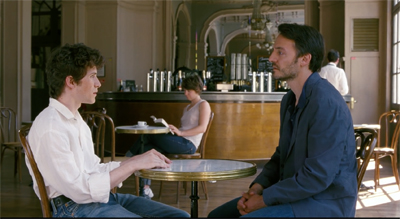
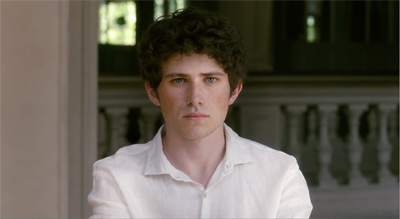
Green is clearly not interested in standard psychological realism or the mumbling delivery and the improvisation we see in some American indie films. Instead, he strives for the understated and precise acting we see in the work of Bresson or Akerman. Green’s actors deliver dialogue, whether arch or sincere, with perfect diction, often while looking directly into the camera. Green also opts for sparse, often symmetrical, compositions, and he usually dispenses with camera movement. Each shot renders the character’s line of dialogue in toto. “Simple things are, for me, strongest,” he said in 2015.
The static shots and direct address are never boring. One never tires of Green’s actors and Paris looks stunning here. Interiors are sparsely decorated and beautifully lit; exteriors typically consist of characters strolling through the Palais Royale or the Luxembourg Gardens. Moreover, Green insists upon the power of art: Caravaggio’s Sacrifice of Isaac and Georges de la Tour’s Joseph the Carpenter figure prominently here, as does an extraordinary singing performance in a church.
The film’s rigorous design does not prevent it from exuding hope and a touching sincerity. The concluding scene on the beach in Normandy retains the film’s minimalist design and rewards viewers who remember Au hasard, Balthazar, but also suggests the formation of a new family and the redeeming power of love.
Upcoming U.S. releases: Sony Pictures Classics has slated Elle for 11 November. Kino Lorber will release The Son of Joseph on 12 January, while Personal Shopper (IFC Films) is scheduled for 10 March. Chocolat does not yet have a U.S. distributor.
Charlie Michael traces the critical response to Intouchables in “Interpreting Intouchables: Competing Transnationalisms in Contemporary French Cinema,” SubStance 133, Vol. 43, no. 1 (2014), 123-137.
Eugène Green’s remarks about simple things comes from his Film Comment interview on La Sapienza. David has written entries on Green’s compass-point editing here and here.
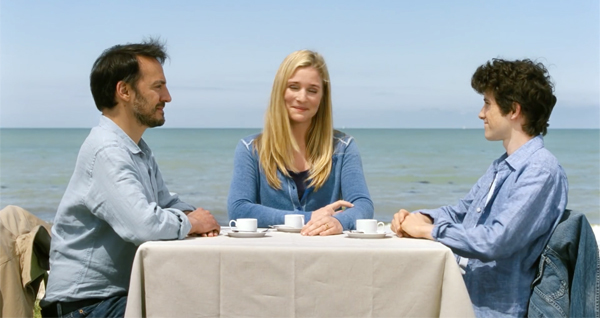
The Son of Joseph (Eugène Green, 2016).