






Archive for the 'Film comments' Category
Is there a blog in this class? 2019
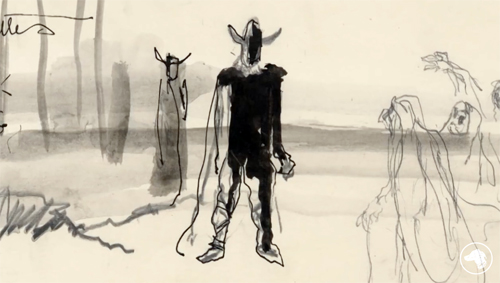
Kristin here:
David and I started this blog way back in 2006 largely as a way to offer teachers who use Film Art: An Introduction supplementary material that might tie in with the book. It immediately became something more informal, as we wrote about topics that interested us and events in our lives, like campus visits by filmmakers and festivals we attended. Few of the entries cite Film Art, but most of them are relevant.
Every year shortly before the autumn semester begins, we offer this list of suggestions of posts that might be useful in classes, either as assignments or recommendations. Readers who aren’t teaching or being taught might find the following round-up a handy way of catching up with entries they might have missed. After all, we have posted well over 900 entries, and despite our excellent search engine and many categories of tags, a little guidance through this flood of texts and images might be useful.
This list starts after last August’s post. For past lists, see 2007, 2008, 2009, 2010, 2011, 2012, 2013, 2014, 2015, 2016, 2017 and 2018.
Last year for the first time I included recommendations for potentially useful videos in our series “Observations on Film Art” (a sort of extension of this blog) on the FilmStruck streaming service. Every month Jeff Smith (also our collaborator on Film Art), David, and I had contributed a visual essay that applied concepts from Film Art: An Introduction to a film (or films) streaming on FilmStruck, which began in November of 2016 and ended in November of 2018.
Fortunately in April, 2019, that platform was replaced by The Criterion Channel, which had been a major attraction as part of FilmStruck. The essays that we had contributed to FilmStruck have all been reposted on the new service, and we have continued to contribute monthly essays. As of now there are 29 essays online. See last year’s “Is there a blog in this class? 2018” for the earlier videos. (For information on the changeover of services, see here.)
Chapter 1 Film as Art: Creativity, Technology, and Business

I’ve written an occasional series on the progress of 3D in modern cinema. In an entry concentrating on exhibition rather than the technology or the movies, I talk about the decline in the number of 3D screenings as they lose popularity: “3D in 2019: RealDivided?”
In Chapter 1 we briefly deal with the concept of the author or auteur of a film. David provides an example of how one characterizes an auteur’s work in “Terence Davies: sunset songs.” Is Michael Curtiz as clearly an auteur as Orson Welles is? This entry considers some evidence.
No year on the blog is complete, it seems, without something on Hitchcock. This time David considered Notorious, preparing the way for a video essay for the Criterion release of this masterpiece.
At greater length, our updated e-book on Christopher Nolan is a study of him as an auteur with a “formal project.” David discusses the changes in “Christopher Nolan: Back into the Labyrinth.” A later entry considers (unconvincing) critical attacks on Nolan’s work.
Chapter 3 Narrative Form
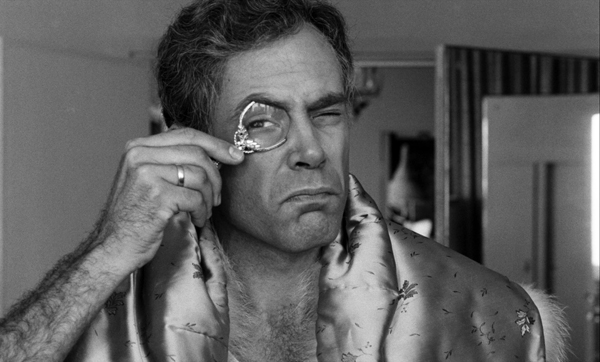
In The Criterion Channel video essay, #25, “Lydia and the power of flashbacks,” David discusses the somewhat experimental ways in which flashbacks are used in Julien Duvivier’s 1941 romance. He extends his analysis in “Lovelorn LYDIA: A new installment on The Criterion Channel.”
I analyze one aspect of narrative form in The Favourite: “Balancing three protagonists in THE FAVOURITE.”
Narrative options both old (the 1940s) and new (Happy Death Day 2U) are considered in an entry on how incidents can be repeated and varied, within a film and from film to film.
This chapter of Film Art discusses narration in terms of depth, how much of characters’ knowledge and thoughts are revealed to us. In “Observations on Film Art” #26 on The Criterion Channel, Jeff examines technique that allow us access to the protagonist’s mind in “Memories of Underdevelopment.” He expands on that analysis in “Politics and Subjectivity: MEMORIES OF UNDERDEVELOPMENT on The Criterion Channel.”
Can the tools of narrative analysis shed light on The Narrative of contemporary US politics? David tries in the entry “Reliable narrators? Telling tales on Trump.”
Chapter 4 The Shot: Mise-en-scene
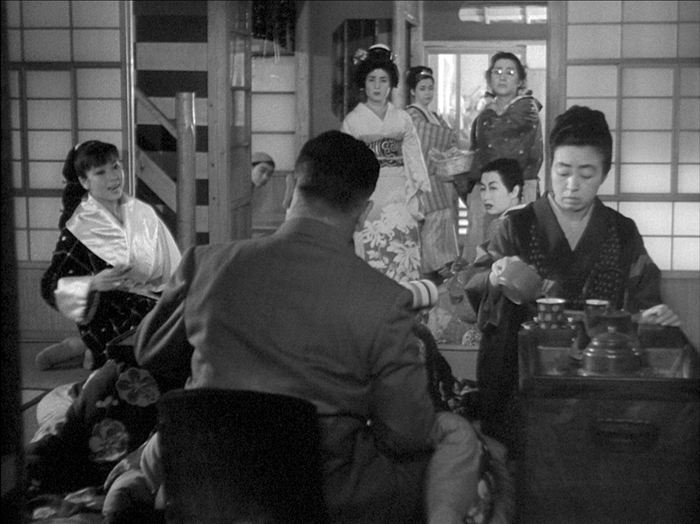
#27 in our “Observations on Film Art” on The Criterion Channel, David examines the intricate mise-en-scene of Kenji Mizoguchi: “Games of Vision in STREET OF SHAME.” He elaborates on the blog with “How to hypnotize the viewer: Mizoguchi’s STREET OF SHAME on The Criterion Channel.”
David analyzes the staging of a scene in Augusto Genina’s Il Maschera e il Voto (The Mask and the Face, 1919) in “Sometimes an actor’s back …” Those of you teaching Film History: An Introduction might find this entry useful in relation to the discussion of tableau staging in Chapter 2.
Chapter 5 The Shot: Cinemagraphy
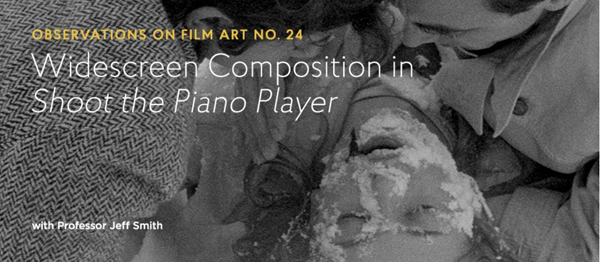
In The Criterion Channel’s #24 in the “Observations on Film Art” series, Jeff Smith analyzes “Widescreen Composition in Shoot the Piano Player.” He offers additional commentary on the subject in a blog entry, “On The Criterion Channel: Jeff Smith on SHOOT THE PIANO PLAYER.”
Chapter 6 The Relationship of Shot to Shot: Editing
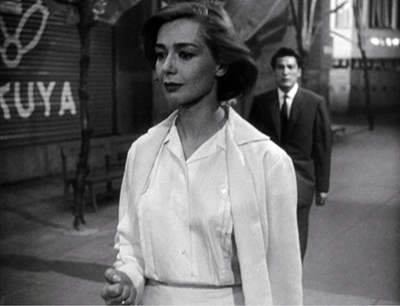
In The Criterion Channel’s #23 video, “Mutations of Memory–Editing in Hiroshima Mon Amour,” David discusses the film’s complex, innovative use of editing to create flashbacks. He expands on that analysis in the blog entry, “On The Criterion Channel: Five reasons why HIROSHIMA MON AMOUR still matters.”
Dissolves provide a way to join shot to shot. They’re usually used sparingly and in conventional ways (flashbacks, ellipses). In “Observations on Film Art” #22 on The Criterion Channel, “Dissolves in The Long Days Closes,” I discuss how dissolves become a prominent formal device in Terence Davies’ film.
Chapter 7 Sound in the Cinema
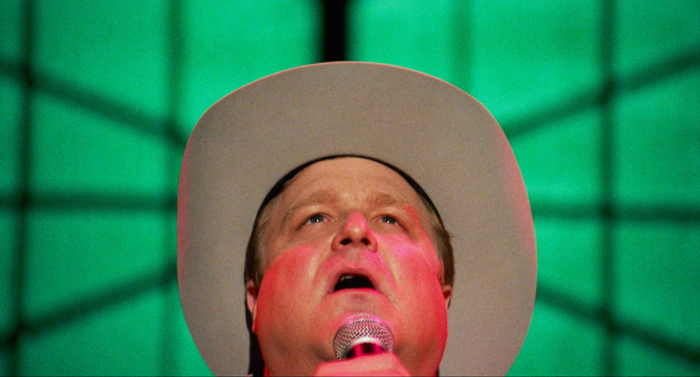
Guest blogger Jeff Smith analyzes the music in True Stories: “From transistors to transmedia: Talking Heads tell TRUE STORIES.”
Jeff takes an informative look at the five songs from 2018 films nominated for Oscars in “Oscar’s siren song: The return: a guest post by Jeff Smith.”
Chapter 8 Summary: Style and Film Form
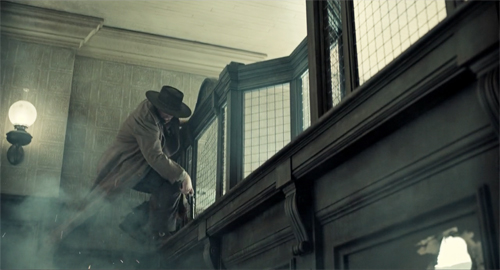
David analyzes cutting and framing in one scene in the Coen Brothers’ The Ballad of Buster Scruggs in “The spectacle of skill: BUSTER SCRUGGS as master-class.”
The great critic André Bazin decisively shaped our sense of how to understand film form and style. David explores some of his ideas in “André Bazin, man of the cinema” and an essay, “Lessons with Bazin.”
Chapter 9 Film Genres
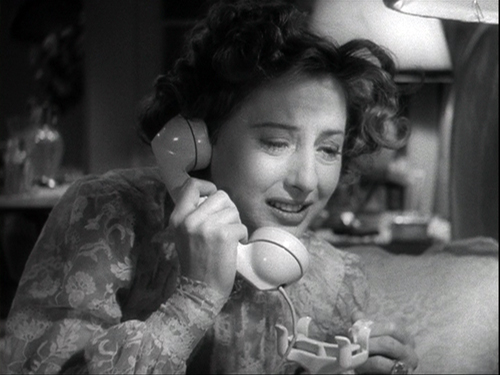
David on film noir: “REINVENTING HOLLYWOOD in paperback: much ado about noir things.”
Chapter 10 Documentary, Experimental, and Animated Films
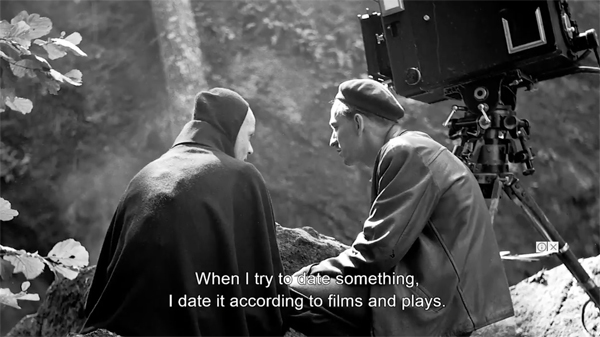
Reporting from the Vancouver festival, David discusses two documentaries that might be useful to show if you program films by either of these directors for your class: The Eyes of Orson Welles and Bergman: A Year in the Life. See his “Vancouver 2018: Two takes on two directors.”
David on three documentaries shown at our hometown film festival this year, in “Wisconsin Film Festival: Not docudramas but docus as dramas.”
Chapter 11 Film Criticism: Sample Analyses
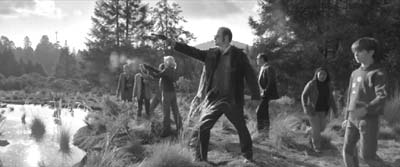
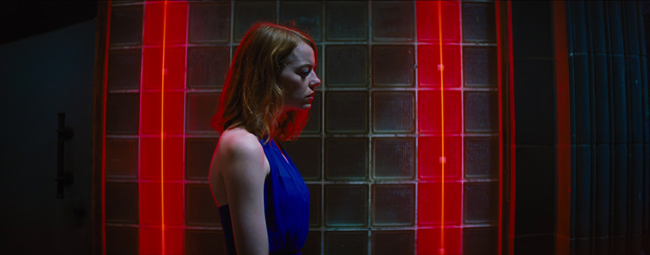
We were lucky enough to return to the Venice International Film Festival last year, again offering analyses of some of the films we saw. These are much shorter than the ones in Chapter 11, but they show how even a brief report (of the type students might be assigned to write) can go beyond description and quick evaluation.
The first entry deals with the world premiere of Damien Chazelle’s First Man and is based on a single viewing. The second discussed Alfonso Cuarón’s Roma and Mike Leigh’s Peterloo.The third offered David’s thoughts on the posthumous release version of Orson Welles’s The Other Side of the Wind. In a fourth, I dealt with five films from the Middle East, including Amos Gitai’s A Tramway in Jerusalem. David considers variants of wrong-doing in films from around the world, including Zhang Yimou’s Shadow and Erroll Morris’ American Dharma. Sixth and last was my longer analysis of László Nemes’s brilliant but challenging second feature, Sunset. We plan to carry on this tradition of comments on new films when we attend the Venice International Film Festival next month.
Our annual visit to the Vancouver International Film Festival yielded more brief analyses of new films. In “Vancouver 2018: Landscapes, real and imagined,” David looks at some recent Asian films, including Kore-edge Hirozaku’s Shoplifters. In “Vancouver 2018: A panorama of the rest of the world,” I comment on three films by important international directors: Nuri Bilge Ceylon’s Turkish The Wild Pear Tree, Benedikt Erlingsson’s Icelandic Woman at War, and Pavel Pavlikowski’s Polish Cold War.
I followed up with more international films in “Vancouver 2018: Panorama of the rest of the world, the sequel“: Matteo Garrone’s Italian Dogman, Nina Paley’s American Sedar-Masochism, Wolfgang Fischer’s Austrian Styx, and Christian Petzold’s German Transit. David wrote about crime films (and a TV show) in “Vancouver 2018: Crime waves.” These notably included Lee Chang-dong’s Burning. Our wrap-up, “Vancouver 2018: A few final films,” again had an international flavor, commenting on Jafar Panahi’s Iranian 3 Faces (his defiant fourth feature since the government banned him from filmmaking for twenty years), Nadine Labaki’s Lebanese Capernaum, and Ciro Guerra and Cristina Gallego’s Colombian Birds of Passage.
Looking back on these two festivals makes it clear that 2018 was an extraordinary year for the cinema!
David analyzes True Stories on the occasion of its release on Blu-ray: “Pockets of Utopia: TRUE STORIES.”
Chapter 12 Historical Changes in Film Art: Conventions and Choices, Tradition and Trends
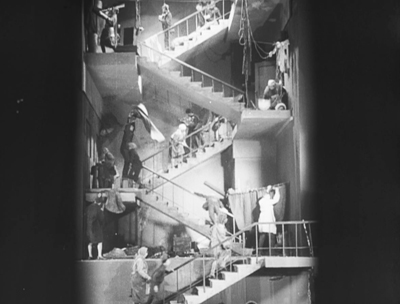
Teaching film history? My annual choice of the ten best films from 90 years ago offers some familiar and not-so-familiar titles: “The ten best films of … 1928.” I also consider two releases of major German silent films.
Many of our entries from Il Cinema Ritrovato in Bologna consider older films, especially those from 1919 in “German and Scandinavian classics.” I discuss some major African films in “Who put the pan in Pan-African cinema?”
I discussed a Blu-ray release of two rare films by Mary Pickford in “Pickford times two.”
A more recent trend in film history, that of the improvised independent American film, is considered in our review of J. J. Murphy’s book Rewriting Indie Cinema.
Finally, for Film Art: An Introduction users, an account of how Jeff Smith, David, and I revised our textbook for its twelfth edition.
After forty years, we’re still grateful to teachers and students who have found Film Art: An Introduction useful in their study of cinema.
Cine-Vienna
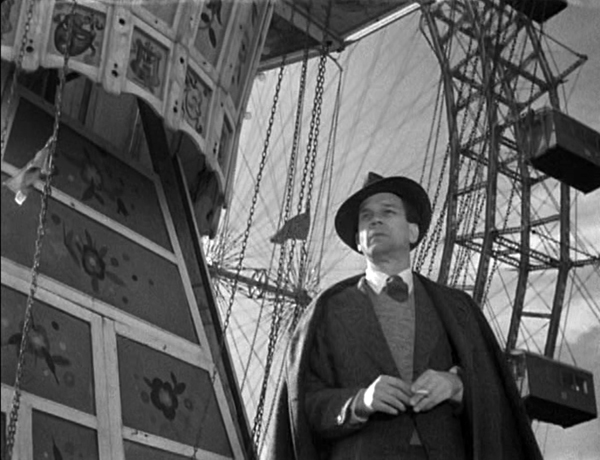
The Third Man (1949).
DB here:
En route to Bologna’s Cinema Ritrovato, Kristin and I paid a visit to this wonderful city. We wandered around, stomped through museums, ate tasty food, and saw a bit of the city’s film culture.
Visiting venues
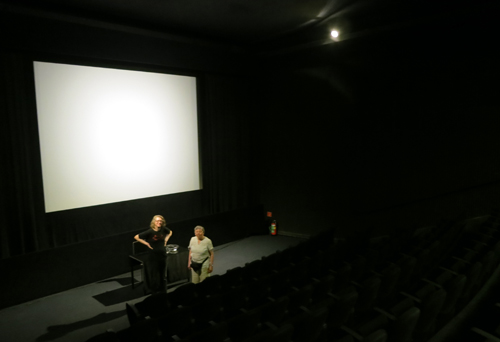
Our first stop was the Austrian Film Museum. Founded in 1964 by the avant-garde filmmaker Peter Kubelka, the Museum has built up a collection of over 30,000 films. It contains a fine film theatre with features of the “Invisible Cinema” (above) that Kubelka and Jonas Mekas set up in Anthology Film Archive many years ago.
The Museum has been a pioneer in producing outstanding books and DVD editions devoted to an eclectic array of filmmakers (James Benning, Hou Hsiao-hsien, Straub/Huillet, Joe Dante). Exceptional as well are the Museum’s online offerings of films, clips, images, and paper documents.
Our host was our old friend, the ebullient curator Christoph Huber. Here he is with his colleagues Alexandra Thiele and Jurij Meden.
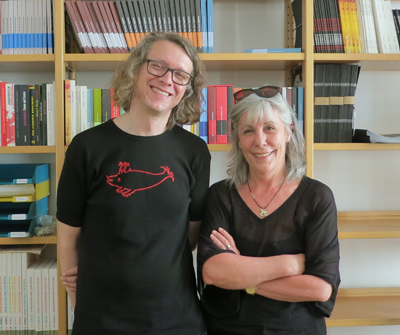
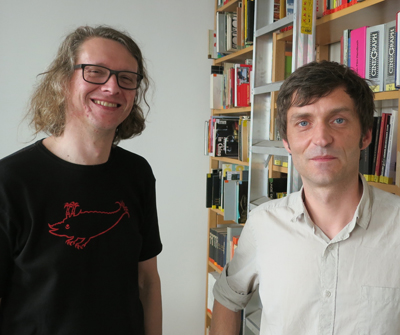
We didn’t have a chance to visit the classic Stadtkino in the same neighborhood, nor did we check out the highly esteemed Austrian Film Archive. But I did mosey down to the Gartenbaukino, a big, beautiful modernistic venue.
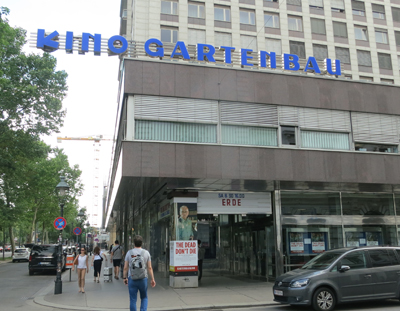
Built as a ballroom that occasionally screened films, the Gartenbau was made a permanent cinema in 1919. In 1960, after being redesigned by Robert Kotas, it opened as a showcase for widescreen motion pictures.
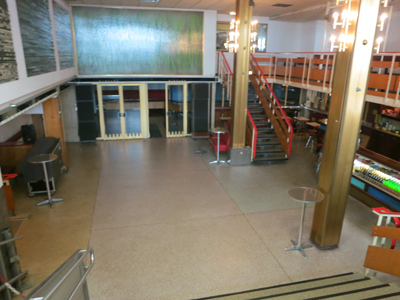
It’s now said to be the biggest theatre in Austria, with over 700 seats. Note the rising curtain, said to be a rarity these days.
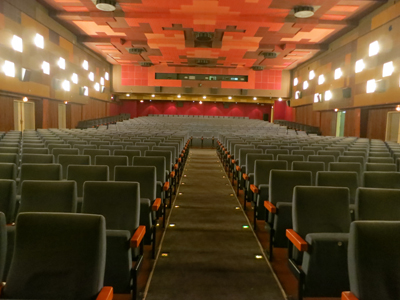
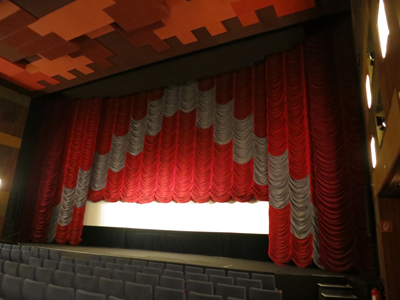
The Gartenbaukino is equipped to project not only digital and 35mm but also 70mm. Managing Director Norman Shetler notes that it was the first Austrian theatre to boast large-format projection (for Spartacus) and was adapted for Cinerama as well.
More recently, the Gartenbau reactivated its 70mm equipment to show The Hateful Eight. The Phillips DP70 projectors now screen wide-gauge classics like Lawrence of Arabia and The Sound of Music. Picture and sound were excellent for The Dead Don’t Die, so I bet 70mm shows here are fantastic. Like the Stadtkino, the Austrian Film Archive, and the Film Museum, the Gartenbau is a venue for the city’s annual film festival, the Viennale.
Prater, not so violet
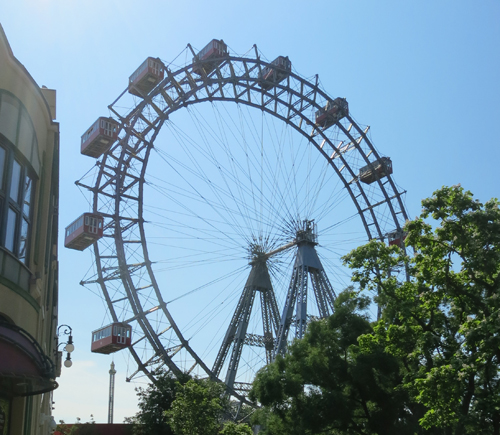
Plenty of movies have been set in Vienna, most notably The Joyless Street, Merry-Go-Round, Letter from an Unknown Women, and Amadeus. But for movie nerds the most flagrant example is The Third Man (1949). And Vienna hasn’t forgotten what this movie did for its local landscape, not least the amusement park set within the vast and beautiful park known as the Prater.
Said to be the oldest amusement park in the world, the Prater ‘s entertainment sector contains attractions that are shiny and enjoyable old-school rides: roller coaster, loop-the-loop, tilt-a-whirl, haunted house. There are shooting galleries, ice-cream stands, and even a Madame Tussaud’s.
But of course the looming attraction is the great Ferris wheel that Holly Martins (Joseph Cotten) and Harry Lime (Orson Welles) share during their ominous reunion. I’m sure I’m not the only viewer who always expects Harry to try to throw his old friend out of the cabin.
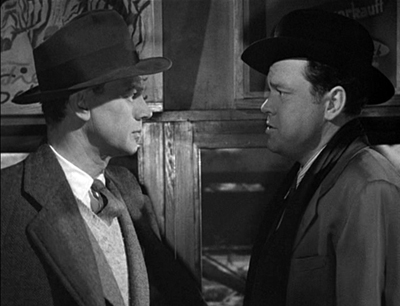
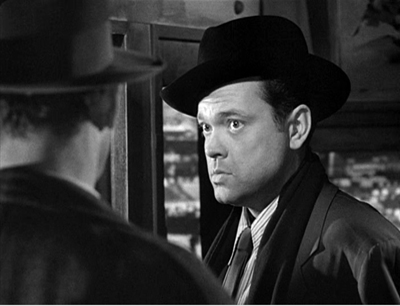
The big wheel has been declared a site of European film culture and decorated with a more or less accurate image of the coy Lime.

My ride in the wagon was gentle and elating. I tried to replicate Harry’s POV on the “ants” below, whose lives, he says, can’t matter much.

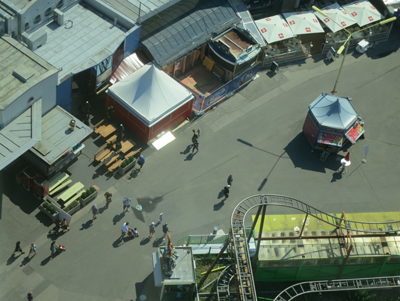
A studio-based version of the Prater featured in the now mostly lost Josef von Sternberg film, The Case of Lena Smith (1929).
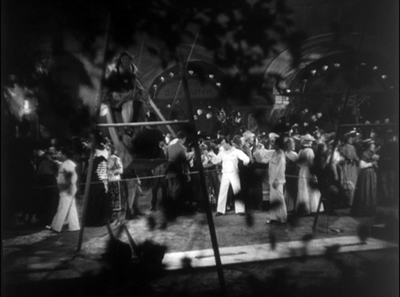
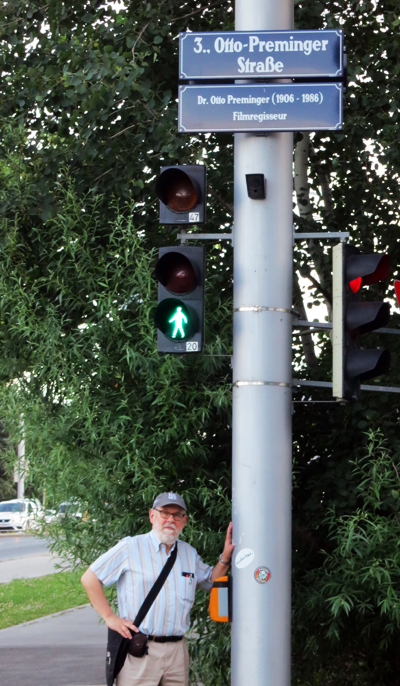
Oh, yeah–we also paid a visit to a street named for one of my favorite auteurs. See below.
Next up: Bologna’s Cinema Ritrovato!
For information about Viennese film culture, thanks to Christoph Huber, his colleagues, and the indefatigable Ted Fendt. Thanks as well to Norman Shetler and two staff members at the Gartenbau cinema. Christoph, by the way, is an exceptional critic. You’ll learn from reading his essays in Cinema Scope.
Cognitive film studies: The Hamburg Variations
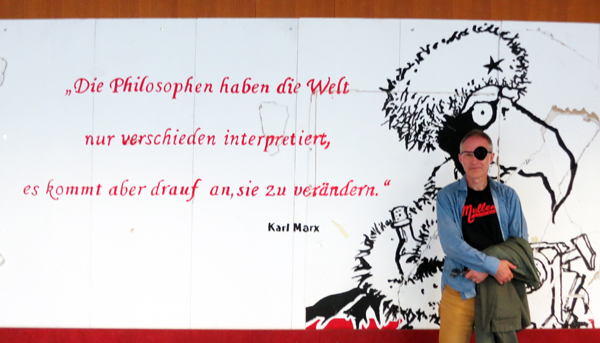
Lobby, Von-Melle-Park 9, Universität Hamburg, with Murray Smith.
DB here:
How many universities in the US would post a big quotation from Karl Marx in the lobby of a classroom building? (Answer: None.) But a cartoonish rendition of Marx’s killer app–the task of philosophy being not only to understand the world but also to change it–greeted the one hundred or so scholars attending the latest conference of the Society for Cognitive Studies of the Moving Image last week at the Universität Hamburg.
How much we’ll change the world remains to be seen. What is clear now is that thanks to the superb organization of Kathrin Fahlenbach, Maike S. Reinerth, and their team, the SCSMI had a lively four days of papers, discussions, and excursions–as well as a screening of a strong film by a skillful director previously unknown to me. In all, every good reason to go to a conference.
Big questions, candidate answers
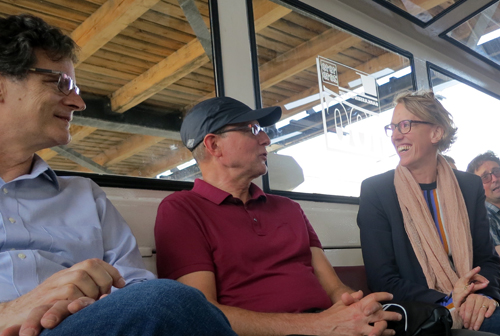
Carl Plantinga, Dirk Eitzen, and Kathrin Fahlenbach on the Hamburg Harbor cruise.
The range was huge, as usual, because this is a very diverse group. Our community, as I’ve mentioned in earlier reports, hosts film scholars, scholars of other media (television, games, internet), psychologists, and philosophers. Recurring questions include: How do viewers comprehend media presentations? What is the role of morality in film and television? How do practitioners conceive their craft? How do media present and trigger emotions? What appeals are specific to certain genres or historical periods? Not least: How may we construct good theories to answer such questions?
Three sessions ran simultaneously at each time slot, so I missed many good presentations. Kristin and I occasionally doubled up. Many of the talks will eventually become published papers, several in the Society’s journal Projections, so let me just highlight a few strands.
For those of us interested in how style interacts with narrative, there were several significant presentations. James Cutting, who has pioneered the use of Big Data techniques in scanning large batches of films, provided a compact account of how “sequences” (as opposed to scenes) displayed patterns of coherence and grouping. Karen Pearlman discussed her films, and James examined them to reveal fractal patterns in their rhythms–patterns that match the dynamics of footsteps, heartbeats, and breathing.
Two papers added to our understanding of the Kuleshov effect, much discussed on this site. Marta Calbi and her collaborators conducted EEG testing on spectators exposed to a Kuleshovian film scene, while Anna Kolesnikov, another member of the team, traced the contradictory versions of the “experiments” that Kuleshov and his students purportedly constructed. Both were exciting contributions to our understanding of Kuleshov’s legacy, which as the years go by looks more complex than we had thought.
Other papers on visual style included Barbara Flückiger’s tour of the staggering resource she and her colleagues have devoted to the history of color in film–a database of images from 400 films illustrating a range of technologies, periods, and genres. She has also mounted a magnificent array of tools for detailed analysis of color. (Significantly, she has taken the images from film prints, not video copies.) Here’s one of several stunning images she has taken from Helmut Käutner’s Grosse Freiheit Nr. 7 (1944, Agfa nitrate).
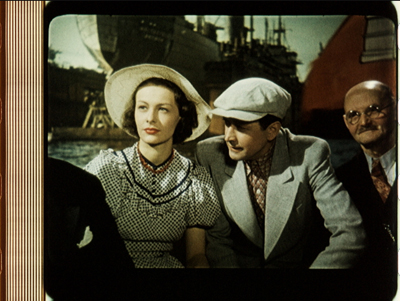
Stephen Prince, whose book Digital Cinema has just been published, surveyed the emergence of “deep fakes,” manipulated images that have no basis in reality but which are indiscernible from an accurate image. Steve was once skeptical that digital images would ever cut us off entirely from photographic reality, but now machine learning has managed to do it. Sped up by social media, the rise of unverifiable “records” creates what he called “an attack on an information system we call society.”
Hitchcock, everybody’s idea of a shrewd filmmaker (when will cognitivists discover Lang?), came in for his usual close treatment. Todd Berliner proposed five ways in which story information can be set up and paid off in a narrative, and he used Psycho as an instance of at least four of those methods. Maria Belodubrovskaya countered Hitchcock’s constant claim that he relied on suspense and not surprise. She showed that both single sequences and overall plots (e.g., Suspicion, Psycho) were heavily dependent on surprise effects.
In the first day, the range of the “humanistic” side of SCSMI was on vivid display. Malcolm Turvey asked whether the give and take of philosophers’ arguments converged on a consensus about truth, the way that much of science progresses. To illustrate the process, he considered the return of an “illusion” theory of images put forth by Robert Hopkins. Later that day, Jeff Smith used the cognitive theory of confirmation bias to show how characters in Spike Lee’s Clockers systematically misunderstand the story situation. The result, enhanced by genre conventions and a violation of some traditions of the detective story, enmeshes the viewer in the same error.
On the other end of the spectrum, there were papers mobilizing empirical research. Timothy Justus drew upon Lisa Feldman’s work in How Emotions Are Made to suggest that a biocultural account of facial expression should not rely too strongly on Paul Ekman’s classic argument about universal, basic expressions. More room, Justus proposed, should be given to cultural forces that build “emotion concepts” that filmmakers and viewers draw on.
A more hands-on empirical project was that coming from a team at Aarhus university. Jens Kjeldgaard-Christiansen posed the question: What if sympathy for a film’s villain varies with the personality of the spectator? As he put it, “If you are like a villain, will you like a villain?” So via Amazon’s Mechanical Turk the team ran questionnaires testing how personality types matched tastes in villains. Not to spoil their public announcement, I’ll just say that the results seem to confirm the belief that the most dangerous creatures on earth are young human males.
There was a lot more here than I can report, including provocative keynote addresses from Professors Anne Bartsch and Cornelia Müller (presenting work done with Hermann Kappelhoff). There was also a moving tribute to Torben Grodal, a central force in SCSMI and a leading-edge theorist applying evolutionary psychology and embodiment theory to traditional genre studies.
And, since SCSMI wants to understand how creators create, there was a film and its maker.
Without bullshit
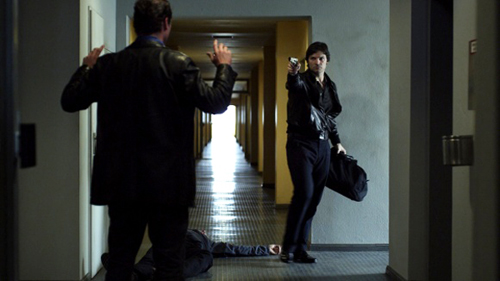
In the past, our conferences have featured Lars von Trier and Béla Tarr, talking with us about their work. This time the guest was Thomas Arslan, a prominent “Berlin-school” director, who brought his 2010 film In the Shadows (Im Schatten) to the lovely Cinema Metropolis.
The film is a dry, hard-edged crime exercise. Trojan, fresh out of prison, comes to his boss to claim his share of the loot. In a tense confrontation he manages to get some of what he’s owed, but he’s now a target for elimination. He searches for a new robbery scheme and settles on the heist of an armored car. As usual, things don’t go as planned, particularly due to the intervention of a crooked cop.
Shot in a laconic style, In the Shadows took advantage of the Red One camera to produce remarkable depth in dark surroundings. (We saw it as a print because in 2010 theatres weren’t quite ready to show digital files. The print looked fine.) The drab locations complemented the anti-psychological impact of the story. Characters barely speak, the music is spare and almost subliminal, and the framing doesn’t accentuate the action expressively. In his post-film discussion, Arslan explained that the style grew out of the small budget and the rapid schedule. The result was a sort of modern B-film, avoiding the excess of CinemaScope and explosive chase sequences.
Arslan refuses to glamorize his gangsters, but he summons up sympathy for Trojan by minimal means. The protagonist is a solid, efficient professional, and he’s loyal to his boss until he realizes he’ll be betrayed. And as Hollywood screenwriters would remind us, you can sympathize with someone who’s been treated unfairly. I liked the unfussy handling of the story; it was a bit reminiscent of Rudolf Thome’s bare-bones Detective (1968). Arslan would be a good director to shoot a Richard Stark noir. “He does it without bullshit,” Arslan said of his thieving protagonist. It’s a good description of Arslan’s own technique.
SCSMI continues its tradition of merging humanistic inquiry with findings from empirical science. We can fruitfully ask questions that cut across traditional boundaries if we ground those questions in clear concepts and solid evidence. Our gathering next year moves back to the States–Grand Rapids, no less. More fun on the way.
Go here for earlier years’ coverage of SCSMI conferences.
On Richard Stark noir novels, see here and here. In the Shadows would fit nicely into my discussion of conventions of the heist film.
My own SCSMI contributions were two: a tribute to Torben Grodal and a little talk on contemporary women’s domestic thrillers (Gone Girl, The Girl on the Train, etc.). I may post the latter as a video lecture later this summer.
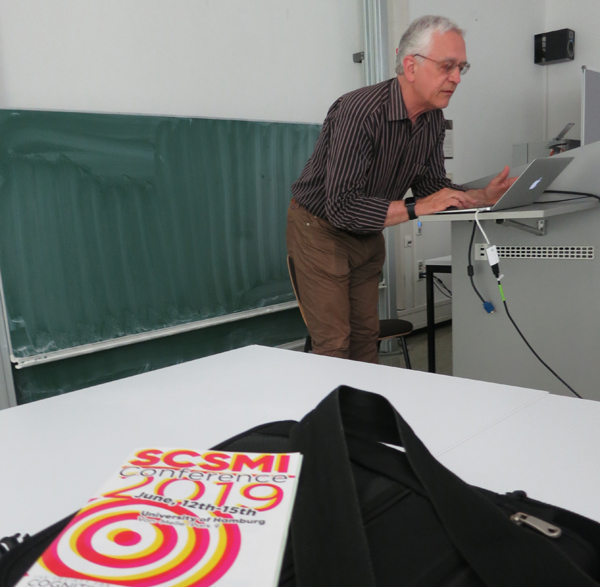
James Cutting lecturing at the SCSMI conference.
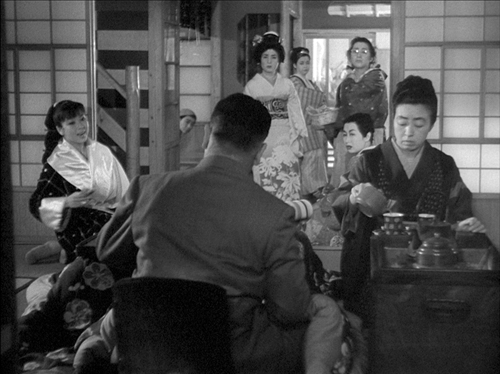
How to hypnotize the viewer: Mizoguchi’s STREET OF SHAME on the Criterion Channel
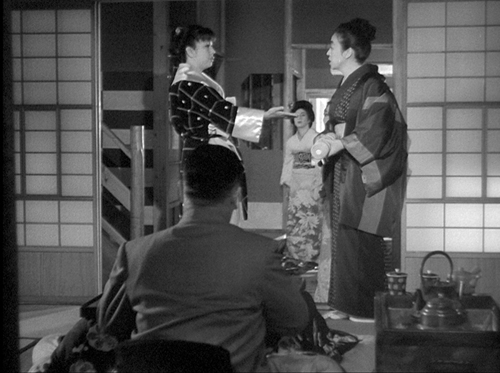
Street of Shame (1956).
Filmmakers must study the film image and its potential for expression. This is our primary responsibility.
Kenji Mizoguchi
DB here:
So much of contemporary film and TV takes pictorial space for granted. Yes, The Avengers: Endgame stuffs its frame with, well, stuff, but you’re seldom given time to see everything. Even in films not so dominated by CGI, if the the actors’ faces and gestures come across and you can hear the line readings, that’s pretty much enough. Most of the rest is there to fill out the very wide frame.
“Wait,” I hear someone saying. “Thanks to Steadicam, directors use camera movements to sweep through space all the time.” Yeah, that’s just my point: They sweep through. We’re following characters’ backs or fronts, not exploring space as such. Very seldom do we get a chance to probe what’s revealed, except in carefully wrought movies like Sunset (which tease you into trying to discern what’s not even in focus).
Moreover, today the pace of the editing is so fast, even in an “intimate” movie like Booksmart, that the actors’ faces dominate everything. For fifty years many directors have been “shooting for the box,” shoving their actors into close-ups that will read on TV, now on computers and smartphones. Like the endlessly moving camera, the big heads and the quick cuts refresh the image often enough to hold our interest in a distracting environment.
Granted, most filmmakers now supplement their fast-cut, rapid-pan close-ups with an occasional landscape shot that can look pretty, in a calendar-image sort of way. Overhead shots, now facilitated by drones, swoop us through the towering corridors of The City or across a swath of forest in a way that is undeniably impressive. This convention doesn’t count, for me, as pictorial intelligence unless somebody like Tony Scott does something, however nutty, with it.
I’m not against these stylistic choices per se; every style is valid if it’s pursued with imagination, rigor, and delicacy. Nor am I suggesting that the other extreme, so-called slow cinema, is inherently more virtuous. Long unmoving takes can be paralyzingly dull. Ozu made fast cutting just as “contemplative” as Hou or Tarr, because he knew how to design pictures.
It’s just that the norms of intensified continuity and the “free camera” have overwhelmingly dominated current practice. It’s worth remembering other ways moving pictures can be. One way to do that is to revisit film history, and the work of Mizoguchi Kenji is an ideal place to start.
His Street of Shame (1956) is the subject of this month’s Observations entry on the Criterion Channel. In it, I invite you to join me in attending a master class in staging.
The theme is Mizoguchi’s perennial one, that of the ways in which women succumb to or resist their oppression in a patriarchal society. We’re in the Dreamland brothel, where five–eventually, six–women are working at the very moment the government debates eliminating prostitution. Mizoguchi shows how they both cooperate and compete, trying to quit, deploying different strategies for managing their clients, and just getting by. It’s all done through what Mizoguchi called the “hypnotic power” of carefully choreographed images.
A personal note
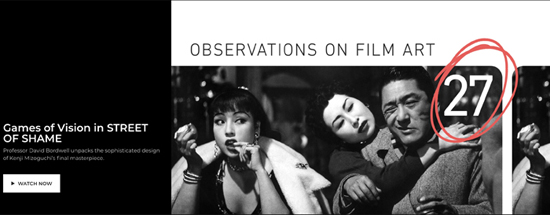
In a way, Mizoguchi made me a film teacher.
During the week of 25 September 1969, what could you have have seen in Manhattan? I Am Curious: Yellow, La Chinoise, Closely Watched Trains, Miracle in Milan, Hell’s Angels ’69, Who’s That Knocking at My Door, Midnight Cowboy, The Killing of Sister George, De Sade, Butch Cassidy and the Sundance Kid, One Second in Montreal, <—->, Take the Money and Run, Alice’s Restaurant, Medium Cool, In the Year of the Pig, Easy Rider, Putney Swope, and programs of Kubelka and Jack Smith movies. There were many double bills on offer: The Wild Bunch and Ride the High Country, Yellow Submarine and The Gold Rush, King Kong and The Lady Vanishes, Seven Samurai and The Men Who Tread on the Tiger’s Tail, Monterey Pop and Don’t Look Back, The Deadly Affair and Funeral in Berlin, Little Sister and Alice in Acidland, Lonesome Cowboys and Flesh.
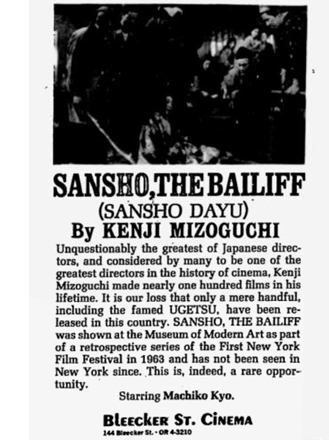 Yeah, those were the days before cable TV, home video, and streaming.
In the city for only a few hours, I didn’t go to any of those shows. There was yet another double bill at the Bleecker but I could catch only one title: not Lola Montès (I would see that in Paris a year later), but Mizoguchi’s Sansho the Bailiff.
As a teenager I had read books about cinema (Welles, Hitchcock) and in college I’d written movie reviews and participated in a film club. Now, newly graduated, I was teaching high school. The only Japanese films I’d seen were the Kurosawa standards our club programmed. Despite planning for a career in high-school teaching, I thought about film most of the time. In the pages of Film Culture and Movie I had read about Mizoguchi.
I came out of Sansho with tears streaming down my cheeks. I heard two young men in the lobby talking about the film. Did they go to NYU or Columbia or some such place? All I know was that they loved Mizoguchi’s long takes, as I did. Somehow, those takes had to be connected to the way the movie hit me. I thought something like: I’d like to study this sort of thing.
I returned to my apartment and began figuring out how to apply to graduate school.
Mizoguchi was still largely unknown, certainly unappreciated. The New York Times didn’t get around to reviewing Sansho until it resurfaced in a later run. Roger Greenspun made up for the neglect with a a gracious note.
“The Bailiff” is a film of breathtaking visual beauty, but the conditions of that beauty also change–from the etheral delicacy of its beginning (before the kidnapping), through the dark masses of the Bailiff’s compound, to the ordered perspectives of Kyoto and the governor’s palace, and finally to the spare symbolic horizons at the end.
In effect, it moves from easy poetry to difficult poetry. Its impulses, which are profound but not transcendental, follow an esthetic program that is also a moral progression, and that emerges, with supreme lucidity, only from the greatest art.
People talked that way then, with good reason.
Choreography all the way down
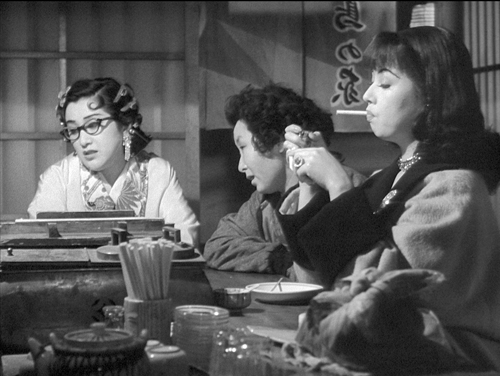
I didn’t see much Mizoguchi in the years following. There wasn’t much available. (And Ozu was unknown to us.) I did see Ugetsu and Street of Shame, though they didn’t grab me as fast as Sansho had. Fairly soon, though, New Yorker Films and Audio-Brandon made prints of other Mizoguchi titles available. I started using Mizoguchi films in my teaching, and the more I studied them the more I admired them. I was also inspired by critics Robin Wood and Noël Burch, who sought to explain the emotional and cinematic force of this filmmaker.
I began studying Mizoguchi’s films, traveling to Europe to see them all and make frames from prints. Eventually that work would inform my chapter on his staging in Figures Traced in Light. Although there he bested me two falls out of three, I think that discussion made some headway in analyzing his unique visual strategies. I tried to develop those ideas further in an online supplement to that chapter and in the blog entries “Secrets of the Exquisite Image” and “Sleeves.”
More skilfully and subtly than nearly anybody else, Mizoguchi arranges bodies in space to create powerful pictures. Yet his gorgeous shots aren’t just decoration. He never lets the images, elegant as they are, distract from the dramatic issues arising among the characters. The result, I argue, achieves the sort of “hypnotic power” that Mizoguchi claimed to seek.
In Mizoguchi, I suggest, a fairly dense image “becomes a story” as its elements start to mingle and separate out, letting our eye discover (with guidance) a drama as it emerges. A situation precipitates out of a rich mass of material, and the result is an accumulating tension that’s at once dramatic and pictorial. He evidently learned a lot from von Sternberg, but I think this thickening-and-release dynamic of story and style is reminiscent of Hitchcock or Lang as well.
The students were right: Mizoguchi is a master of the long take. The long take, he said, “allows me to work all the spectator’s perceptual capacities to the utmost.”
But we shouldn’t think of this technique in the sort of marathon-competition terms people apply to long takes nowadays. (The current example is Bi Gan’s Long Day’s Journey into Night.) Today’s long takes are often virtuoso traveling shots. While Mizo made wonderful use of camera movement, he knew the power of stillness. He showed that you can just clamp the camera on the tripod (or the crane) and sculpt the action in front of it.
Among Mizoguchians, there are some who find his later films stylistically compromised. Genroku Chushingura (1941-1942; below) and Loves of the Actress Sumako (1947), with their far-off figures and impeccable, “all-over” compositions, merge austerity and density in ways almost inconceivable today.
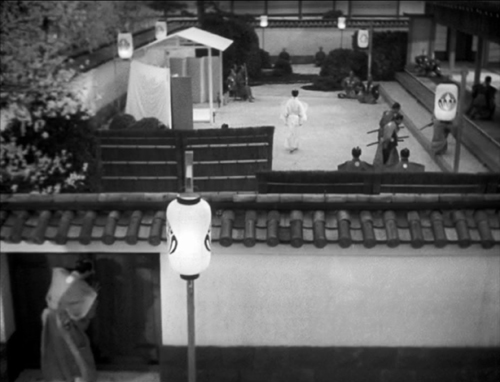
Given this radical approach, his greater reliance on closer views in the 1950s work can seem a step backward.
But Mizoguchi was a pluralistic director from his earliest days forward. As I try to show in Figures, he fitted his visual design to the needs of a scene, and even the most severe films draw on diverse techniques. Street of Shame shows his endless resourcefulness in enriching three-shots and two-shots and singles. He found choreographic possibilities at every shot scale, with small gestures and glances becoming as important as characters shifting around the set. In the last shot of the last film he made, a single darting eye commands the image and carries the drama.
Given the sustained shot, Mizoguchi fills it and drains it, re-fills it and thins it out and channels it to a climax, all with a graceful, unobtrusive choreography always driven by the emotions pulsing through the scene. I go back constantly to Philippe Demonsablon: “He emits a note so pure that the slightest variation becomes expressive.”
Mizoguchi works in melodrama. Some directors, such as Sirk, take intense situations and amp them up. But Mizoguchi, like Stahl and Preminger, is always banking the fires. His style presents hot emotions in a cool way, betting that detachment and restraint give the emotions a sort of stark purity. If more filmmakers studied his work, who knows what kind of cinema we might have? I hope you have a chance to check in on this entry.
We’re grateful as usual to Peter Becker, Kim Hendrickson, Grant Delin, and the whole fine Criterion team, and to Erik Gunneson of the UW Department of Communication Arts.
Street of Shame is also available on a generous Criterion Eclipse DVD set. Some years back Masters of Cinema series gave us beautiful Blu-ray transfers of many Mizoguchi films. The Street of Shame edition has a fine feature-length audio commentary by Tony Rayns. Alas, the set including the film has apparently gone out of print.
Robin Wood’s influential essay on Mizoguchi is “The Ghost Princess and the Seaweed Gatherer,” in Personal Views: Explorations in Film (Gordon Fraser, 1976), 224-248. Noël Burch’s revisionist account of Japanese cinema is To the Distant Observer: Form and Meaning in Japanese Cinema (Berkeley: University of California Press, 1979), where chapter 20 is devoted to Mizoguchi. (The book is available online here.) Roger Greenspun’s review, “‘Bailiff’ Returns,” appeared in the New York Times (17 December 1969), 61.
For more on the place of Japanese directors in film culture, you can try this entry on Kurosawa and this one on Shimizu.
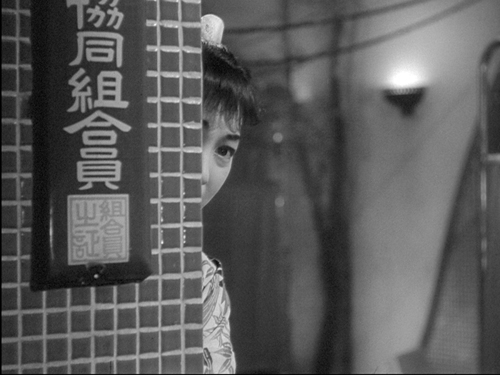
Street of Shame (1956). The sign reads “Cooperative Association Members” and “Confidential Membership.” Thanks to Steve Ridgely for the translation.