






Archive for the 'Film comments' Category
The trim, tight movie: Three variants at Vancouver
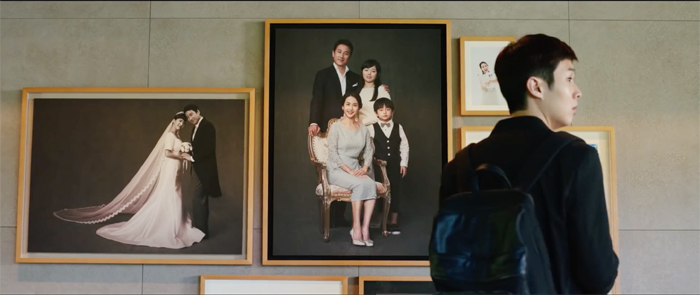
Parasite (2019).
DB here:
As a student of storytelling, I recognize that we can enjoy loose, episodic plots. But I also admire the shrewd craft of constructing a movie that develops a situation in precise, logical, yet surprising ways. Things may be resolved neatly, or not, but the satisfaction comes from the way that characters pursuing goals create conflicts, overcome obstacles, and change (or not) in the course of the action. American studio cinema developed its own version of this in what Kristin and I have called “classical Hollywood” plotting. Other countries have borrowed that model, adapting it to new needs but still keeping the storytelling trim and tight.
Three films on display at this year’s Vancouver International Film Festival illustrate some options. All have won acclaim at other festivals and constitute A-productions in their local industries. I enjoyed all of them, and I liked learning how broad principles of narrative construction can be treated in significantly different ways.
Storming the basilica
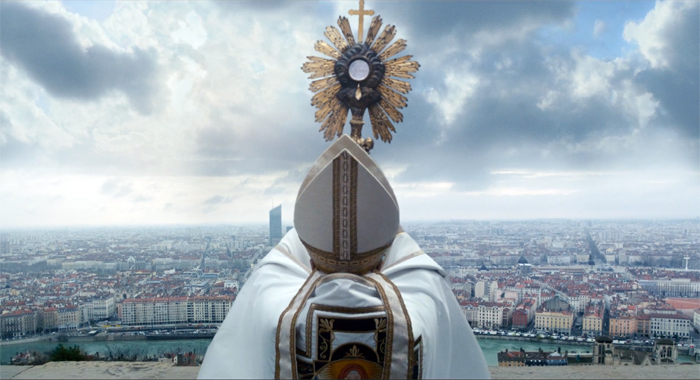
François Ozon’s By the Grace of God, a prizewinner at Berlin this year, turns Spotlight (2015) inside out. The American film follows the investigation of a news team bringing priestly pedophilia to light; it’s a detective story, with the victims serving as witnesses to the crime. By the Grace of God concentrates on the victims’ search for justice, and finds an unusual structure to give each one due weight.
The film is based on a real case in Lyon. The film starts with businessman Alexandre Guérin accusing Father Preynat of abusing him as a child. Surprisingly, Preynat admits he did the deed, so there’s no mystery to be solved. With the statute of limitations expired, the Church authorities decline to punish Preynat. He’s kept in service, and his duties still associate him with children. The only thing that worries Cardinal Barbarin is that Preynat didn’t apologize when Alexandre confronted him.
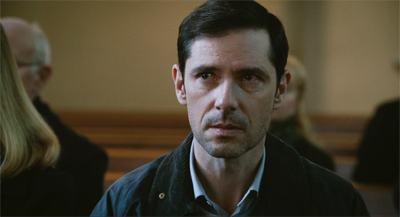
A pious Catholic, Alexandre trusts that if he appeals high enough in the Church hierarchy (even up to the Pope), some action will be taken. He is rudely awakened to the cynical willingness of Barbarin to stall and cast a smokescreen over the case. Alexandre decides to file a legal complaint and to find other victims to join him.
At this point, Ozon’s script takes an intriguing turn. The plot drops Alexandre and introduces us to another victim, François Debord, who is a fairly militant atheist. Investigating Alexandre’s charges, the police call on François’s parents. He told them of the abuse at the time, but they pressured him to stay quiet. Now he embarks on a crusade to find other victims to speak out. For some of them, the statute of limitations may not have expired.
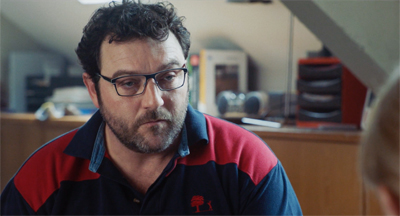
Alexandre becomes a minor player in this stretch of the film, meeting François occasionally to plan strategy, but François is the motor of the action. His zeal leads him to yet another victim, Emmanuel Thomassin. We now follow him and learn how his life has been damaged quite severely by Preynat’s abuse.
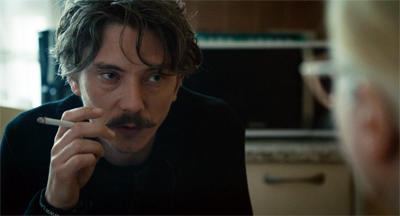
Eventually the three men find more victims willing to go public, and by cooperating they confront the Church’s coverup.
With three sections each lasting 45-50 minutes, Ozon has mounted a block-construction plot (although without explicit chaptering). He has compared it to a relay race, with the story impulse passed like a baton from one character to another. And each phase of the action raises the stakes: growing proof of the Church’s malfeasance, a broader survey of the consequences of the crimes.
Ozon has also said that he tried to distinguish each of his three protagonists’ sections stylistically. Alexandre’s phase of action has highly economical narration, using the exchange of letters and emails (read in voice-over) to move the action swiftly, forcing us to keep up at every moment. When the action shifts to the flamboyant, web-savvy François, the emphasis falls on building online support for an organization. Emmanuel’s painful story is treated with more intimacy and empathy; the other men have overcome their childhood traumas and have buoyant families, but Emmanuel is adrift.
By the Grace of God has the carpentered solidity of Ozon’s Frantz (2016). If we can say that the French “Tradition of Quality” of the 1940s and 1950s persists today, it’s surely here in this taut, elegant piece of storytelling.
City on fire

Stylistically, Les Misérables doesn’t look as sleek and controlled as Ozon’s film. It’s shot in the free-camera style that’s now common throughout the world: handheld shots, fast cutting, tight framing on faces, lots of panning to follow the action. When cops brace three women on the street we get a rapid-fire exchange in the manner of Homicide: Life on the Streets.
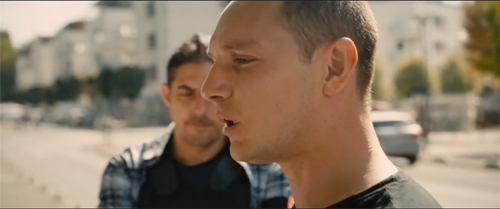
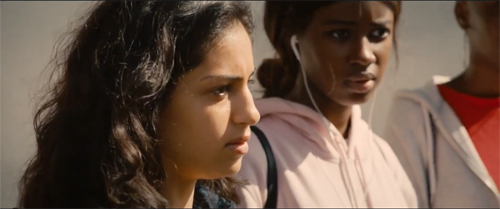
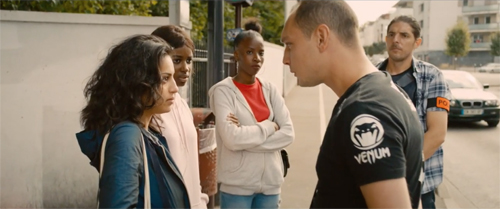
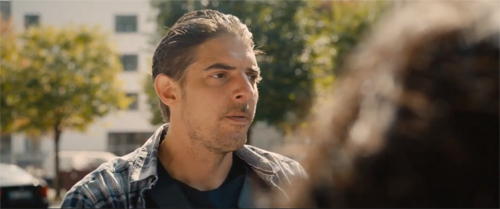
Although we’re basically on one side of the confrontation, the cutting is somewhat freer than in classic continuity, as the above shot of Stéphane indicates. To emphasize the quasi-sexual gesture of Chris checking the young woman’s fingers for the smell of pot, the editing jumps the line before returning to the main setup.
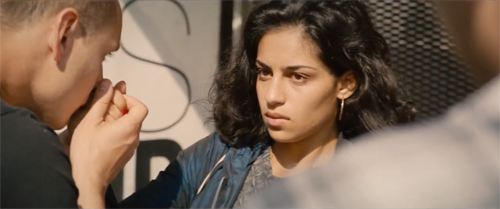
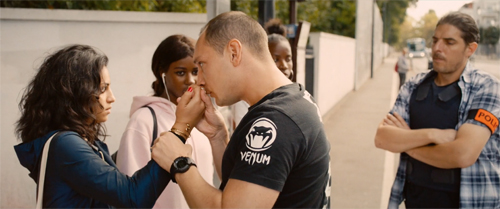
Les Misérables, directed by Ladj Ly, is not quite as pure an example of the free-camera approach as Young Ahmed, (also shown at VIFF) because it affords a greater degree of “camera ubiquity.” It crosscuts among lines of action, and it relies on reaction shots that the Dardennes avoid. Still, the purpose is to immerse us, smashmouth fashion, in each scene’s conflict.
And there’s plenty of conflict. Stéphane Ruiz has joined a team of tough cops patrolling an impoverished Parisian suburb teeming with immigrants. To keep things under control Chris, the team leader, has formed alliances with drug gangs and the boss of the territory. Gwada, a Muslim cop, backs Chris loyally.
The main action, which consumes around 24 hours, shows Stéphane trying to bring a measure of humanity to the confrontations between his unit and the local residents. A petty crime escalates into a burst of police brutality, captured on video by a boy’s drone. The second half of the film puts the cops in conflict with one another and an increasingly outraged community ready to take on both the police and the gang leaders.
Ly has made short films and web videos, and while growing up in the banlieue projects he documented police actions.
For five years I filmed everything that went on in my neighborhood, particularly the cops. The minute they’d turn up, I’d grab my camera and film them, until the day I filmed a real police blunder.
Ly filmed the 2005 riots as well (365 Days in Montfermell), as part of the filmmaking collective Kourtrajmé. Les Misérables is called that partly because this is the district where Hugo wrote his masterpiece. “I wanted to show the incredible diversity of these neighborhoods. I still live there: it’s my life and I love filming there. It’s my set!” In 2018 Ly established a filmmaking school in Montfermell.
Although Ly comes from the world of documentary, he has a shrewd sense of fictional plotting. A prologue shows little Issa among thousands of Parisians celebrating France’s World Cup victory (above). It’s an image of diversity within national unity, but also a bit of narrative priming that makes us sympathetic to the boy. The rising tension of the action, from a childish prank through increasingly horrific scenes (one in a lion’s cage had me trembling) to a final cataclysm, is carefully constructed out of a series of misunderstandings, brutal decisions, overreactions, and desperate survival maneuvers.
There’s solid motivation and foreshadowing. The drone is established early as the all-seeing eye of the projects, steered by the withdrawn boy Buzz. Stéphane has reluctantly transferred to the Parisian police from the provinces because he wants to be near his son, in the custody of his ex-wife. This information prepares us for his sympathetic gestures toward the children of the projects. And just before the climax, Ly’s script gives us a pressurized nighttime pause, a sequence that cuts among all the adults we’ve seen trying to adjust to the day’s turmoil. Next day all hell will break loose.
Les Misérables shared the Jury Prize at Cannes last May with another VIFF entry, Bacunau. (Comments on this coming soon.) In the US it will be distributed, who knows how, by Amazon.
Class struggles

Viewers of Memories of Murder (2003), The Host (2006), and Mother (2009; also here) know that Bong Joon-ho has a fine hand with mystery, suspense, and abrupt plot twists. His skill is on full display in Parasite, Palme d’or winner in Cannes and already considered one of the most striking films of 2019.
As suits the Age of Inequality, the action centers on two families. The Kims live in a crammed basement and struggle to get by. When the son Ki-woo gets a job tutoring the daughter of the rich Park family, he schemes to insert all his family members into the household. (This recalls the stratagems of the play and film Kind Lady.) The Kims’ adroit manipulation of the Parks, especially the insecure helicopter mom, provides mordant comedy. But in a long central scene, the Kims’ scam starts to unravel. They’re shocked to discover what actually goes on in the splendid mansion they’ve taken over.
Bong’s skill in shooting, staging, and composition seems effortless. Neither as academic as Ozon or as nervous as Ly, his deliberate style makes every sequence build to a neat point. The contrast between the Park house, perched high on a hill, and the Kims’ basement apartment, is echoed in vertical camera movements that carry us up and down through locales. (Here, in more instances than one, the poor live underground.) Parasite‘s opening camera setup, a view of the street through the Kims’ window, recurs at various points to mark stages of the action. Here nighttime violence erupts in the street outside.
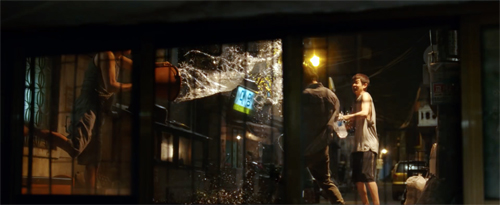
The Kims’ barred view contrasts with the spacious picture window at the Park mansion. Fussy as ever, Bong places a comparable shot of the Kim window at the very end.
Bong plants significant motifs through the film. He forgets nothing. Cub scouts, Morse code, peach allergies, and the smell of poverty pay off in comedy while supplying thematic resonance. The parallels between the married couples are enhanced by the introduction of another husband and wife who have launched their own desperate scheme. The climax, an orgy of rich folks’ complacency, brings all together in a shocking but not ultimately surprising confrontation.
I had almost called this entry “The well-made movie,” indicating not only my praise for the films but also their kinship with the dramatic tradition of the “well-made play” (pièce bien faite). That was one powerful set of principles for plot-building. If you construe that form narrowly (as the Wikipedia entry does), these films don’t completely fit it. I think that Ibsen, Shaw, and those who followed owe more to that form than is generally admitted.
In any case, the impulse toward tight construction, full motivation of characters’ actions (usually guided by a goal), and a rising arc of conflict leading to a decisive climax–these design features, so manifest in the well-made play, have carried over to the cinema since the rise of the feature film in the 1910s.
Today’s films have a look and feel that seem of our moment, but their underlying “engineering” principles are surprisingly indebted to a long-running tradition. Those principles can be deployed, revised, and reversed in a great many ways–as these three films show.
We thank Alan Franey, PoChu Auyeung, Jenny Lee Craig, Mikaela Joy Asfour, and their colleagues at VIFF for all their kind assistance. Thanks as well to Bob Davis, Shelly Kraicer, Maggie Lee, and Tom Charity for invigorating conversations about movies.
For more on the general principles of “classical” construction, see this entry on The Wolf of Wall Street. In our book The Classical Hollywood Cinema Kristin traces some literary and dramatic sources of the format.
On the “free-camera” shooting style, see our blog entry on Toni Erdmann (viewed at VIFF back in 2016). We discuss the emergence of the technique in Chapter 25 of the fourth edition of Film History: An Introduction.
By the Grace of God (2019).
Vancouver 2019: Happy endings, art-film style

Tehran: City of Love (2018).
Kristin here:
The Vancouver International Film Festival has several strong threads running through it: world art cinema, documentaries, Canadian cinema, and films about art and artists. Sticking to any one or two of these would make for a rich viewing experience. I gravitate toward the “Panorama” program of mostly fiction films from around the world.
At one of these films, Tehran: City of Love, the Iranian director, Ali Jaberansari, and scriptwriter, Maryam Najafi, were present for a Q&A session. Clearly the audience has been charmed by their tale of three remotely connected characters all seeking love. One questioner asked what the pair’s next project was, which must always be cheering to the filmmakers. Another audience member simply thanked them for the film, saying that after seeing several grim movies, it was a pleasant experience to find one so funny and entertaining.
[Spoilers to come]
Certainly Tehran: City of Love is an entertaining film, but its ending is bittersweet at best. All three protagonists, after brushes with romance, end up alone. All may have learned something along the way, but they are all saddened by their failures. This year I have seen a couple of other films where the happy ending consists mainly of the central character letting go of bitterness and becoming reconciled to his fate. It seems as though grim storylines with unhappy endings are a staple of the festival film, and even comedies often avoid sending their audiences out on an entirely cheery note. Perhaps there is an assumption that an art film that is too entertaining risks not being taken seriously by festival programmers. Luckily, these three were included in the VIFF program.
Tehran: City of Love (2018)

Tehran: City of Love presents three central characters who are looking for love. Each has a problem to overcome. Mina is an overweight receptionist who, apparently resigned to her single status, targets attractive men who visit the cosmetic surgeon. She calls each, speaking seductively and arranging a date. She shows up for the date but does not identify herself, instead watching the man from a nearby restaurant table until he gives up in annoyance and leaves. At a class on the “geometry” of love, she meets a pudgy man who begins a courtship
Hessam is a body-builder with three championship titles in his past, now working as a trainer. He receives a part in a dubious film project and at the same time begins training an attractive young man who aspires to a championship. Hessam’s attraction to his trainee is subtly conveyed (above), and the young man seems friendly and seems possibly to reciprocate Hessam’s feelings.
Vahid, a talented mosque singer specializing in funerals, is dumped by his fiancée. A friend counsels him to become more lively and cheerful by singing at weddings. Vahid quickly makes the transition, which seems to improve his mood. He becomes friends with Niloufar, a female wedding photographer, who likes him but–as we know and Vahid doesn’t–she is awaiting a visa to allow her to emigrate to Australia.
Disappointments result. Mina’s beau is a married man in the lengthy process of divorcing his wife. The young man notices Hessam’s interest in him and switches to a new trainer. Niloufar reveals her imminent departure from Iran.
Tehran: City of Love is an impressive film for a second feature. The script by Jaberansari and Najafi weave the three stories together skillfully, keeping each story and the thematic connections among them perfectly clear. One might expect the three protagonists’ plotlines to come together. Hessam does at once point come to Mina’s office to get Botox treatments (presumably motivated by the film he is supposed to act in or to make himself more attractive to the young trainee), but nothing comes of that. Mina is close friends with Niloufar, but although the two talk about Vahid casually, Mina never meets him. The three characters are by chance in the same space by the final shot, but they remain unaware of each other. The title, unless we take it to be ironic, suggests that each may try again to find a partner, but the ending only hints that each has at least gained something from his or her brush with love.
It is also beautifully shot in widescreen, often employing what David has termed the planimetric shot, with the camera axis perpendicular to the background (see above and top). During the Q&A Jaberansari mentioned some of his film influences. (He was trained abroad in Vancouver and in London, where he now lives.) These included Roy Andersson, Elia Sulieman, Jim Jarmusch, Aki Kaurismäki, Jacques Tati, Fassbender, and Buster Keaton. Although Tehran: City of Love does not resemble any of these directors’ films closely–there are few long-take scenes or physical comedy played out in long shots–the list makes sense, mostly in the tone of the film.
Jaberansari and Najafi provided some helpful cultural context. They shot the film with official permission and also have permission to release the film in Iran, though no date for that has yet been determined. Despite the implied homosexuality of one character, only two minutes of cuts were required for the domestic distribution permit.
The emphasis on body-building, both in the gym and the scenes of men exercising in a mosque, reflects the fact that without bars, night-clubs, and other forbidden gathering-places, gyms and body-building are one milieu in which men can come together, including gay men.
At one point Vahid is arrested while singing at a “private” wedding. The phrase seems harmless enough, but private weddings often include men and women mixing in ways forbidden in the public weddings at which Vahid had previously performed.
Australia, they note, is the new destination of choice for Iranians seeking to move abroad, replacing Canada to some extent.
Sometimes Always Never (2018)
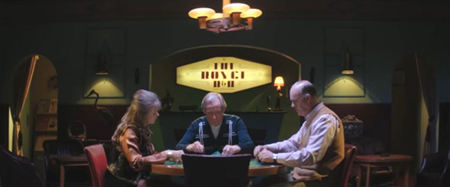
This film is largely a vehicle for Bill Nighy, contributing a mix of comically self-centeredness and pathos as Alan, a retired tailor. Years before his elder son Michael walked out of the house during a game of Scrabble and has never been heard from again. Alan has since been looking for him, neglecting his younger son, Peter, as well as his daughter-in-law and grandson.
Scrabble looms large in the plot. In one extended series of scenes, Alan and Peter show up in a small town to view the body of a young man who might be the missing son. During an evening in a bed-and-breakfast, Alan hustles the husband of a couple staying there, pretending to be an ordinary Scrabble player and winning £200 off the henpecked husband (above). Only later is it revealed that they, too, are there to examine the same corpse. Alan goes first emerges tactlessly and cheerily saying that the body is not Michael, despite the fact that the couple is about to perform the same grim task.
First-time feature director Carl Hunter adopts a playful style which at times resembles that of Wes Anderson. As with Tehran: City of Love, there are the planimetric shots(on a beach in Crosby otherwise populated by Anthony Gomley’s life-size statues, at bottom, and above, in the bed-and-breakfast Scrabble game). The characters drive in cars with blatantly obvious back-projected motion, and there are black-and-white inserts and brief animations. All these stylistic touches help lighten the tone of the underlying misery of the characters, though they also stand apart from the fairly straightforward presentation of most of the scenes.
The growing closeness between Alan and his shy grandson helps add a positive side to Alan and prepares the way for the inevitable outcome, as he learns to value the son he has over the one who clearly will never return.
A White, White Day (2019)
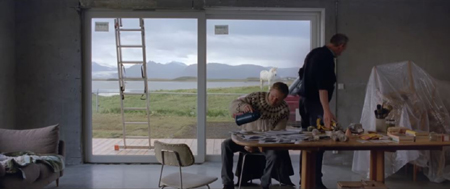
Most small producing countries have managed throughout the history of cinema to make films, and Iceland has been no exception. It was not until the 1990s that its films started attracting attention on the festival and awards circuit, but only now and then. Even today the local feature production hovers around only four a year. Still, we have learned to consider Icelandic films must-sees when they show up on festival programs.
Benedikt Erlingsson’s films have shown here in Vancouver, and we reported on Of Horses and Men in 2014 and Woman at War last year.
This year the contribution from Iceland is Hlynur Pálmason’s A White, White Day, his second feature. (His previous feature, Winter Brothers, played at our 2018 Wisconsin Film Festival, but we were in the process of buying a new house and missed it.)
“A white, white day” is a local phrase describing weather conditions that cause land and sky to become indistinguishable. It’s a perfect metaphor for confusion, for loss of bearings. We see it both literally and figuratively in the film. The protagonist, Igimundur, is a middle-aged policeman on leave for depression following a car accident that killed his wife. The film opens with the accident, although we don’t yet know who the driver is, occurring on a white, white day.
There follows a mesmerizing series of shots from the same vantagepoint, showing a lengthy series of shots of a pair of small buildings in a rural landscape, including these two.
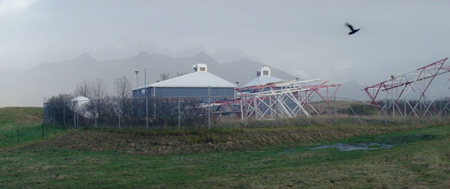
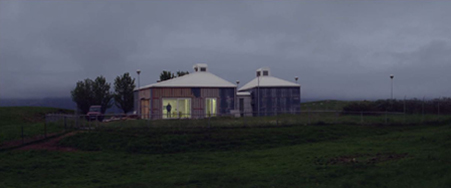
All atmospheres and times of day area shown, from the light fog of the top shot to the heavier fog of the lower one, from bright sunny days to dark nights. Horses wander through in some, cars drive up in others, and gradually the ramshackle yard and structures become a home. We first glimpse Igimundur in the lower shot, though we don’t yet know who he is. The renovation of the buildings to make a home for his daughter and son-in-law, along with his beloved granddaughter Salka. Where Igimundur will go once they move in is never mentioned. Clearly the project is his way of coping with his grief, while he increasingly scorns the lack of help he receives from his psychologist.
Soon, however, he comes to believe that his wife had been having an affair, and he becomes increasingly abusive and violent, even toward his police colleagues and in front of Salka. The happy ending, which seems a trifle abrupt, sees him finally reconciling himself to the past and regaining his loving memories of his wife.
A White, White Day depends less on humor than the other two films, despite its occasional comic touches. Instead it is an absorbing family melodrama that most audiences would find entertaining.
For a useful brief history of Icelandic cinema, see here. So far it doesn’t include Palmason, but I expect he will soon be added.
We thank Alan Franey, PoChu Auyeung, Jenny Lee Craig, Mikaela Joy Asfour, and their colleagues at VIFF for all their kind assistance. Thanks as well to Bob Davis, Shelly Kraicer, Maggie Lee, and Tom Charity for invigorating conversations about movies.
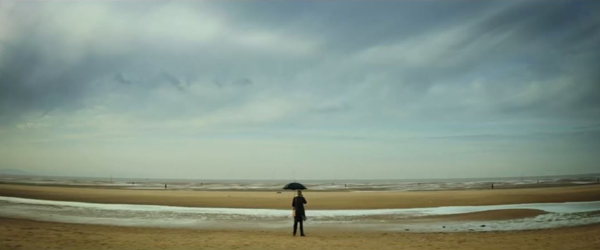
Sometimes Always Never (2018).
Attachment anxieties at the Vancouver International Film Festival
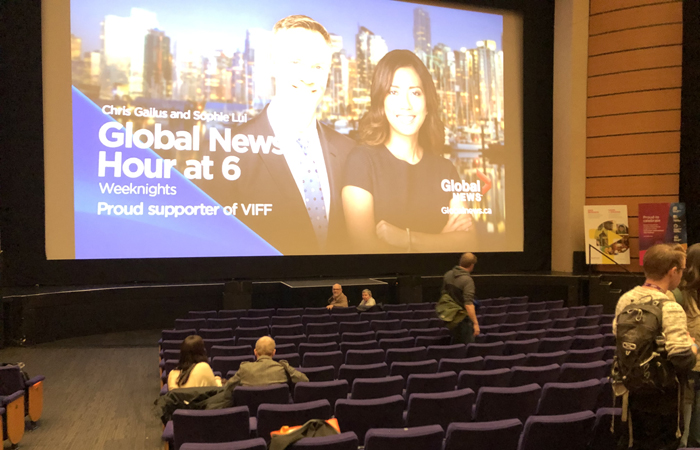
DB and KT, front row center, at the screening of The Lighthouse. Photo by Shelly “Sales Agent Cinema” Kraicer.
DB here:
Storytelling cinema depends on characters, and our relations to them. At the level of individual scenes, we can be more or less restricted to what they experience; we can know as much as they do, or more, or less. Across a film, the filmmaker can attach us consistently to one or two characters, or instead roam freely among many viewpoints. And within a scene, the filmmaker’s choice of camera placement can put us “with” one character or another.
In other words, narrative cinema 101. But it’s worth remembering that these are forced choices. As a filmmaker, you can have restricted or unrestricted access to characters, but at every moment you have to choose one or the other. How objective or subjective will you make your presentation? Will you limit your camera setups or go for ubiquity–that tendency to give us shots divorced from the immediate situation? Examples are a drone-delivered image above a city, or that sudden high or low angle that calls our attention to a detail the characters may have missed.
Three films at the Vancouver Film Festival presented a nice menu of attachment options–ways in which we can be tied to our protagonist. All are well worth your attention, so without getting too much into spoilers, I’ll use them as an occasion to study how these forced choices are handled creatively.
The party’s over
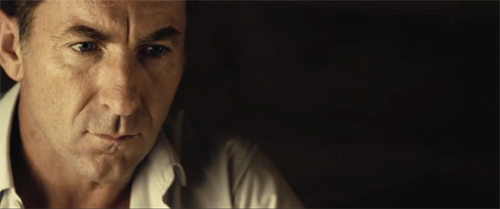
Take as a midrange example The Realm (El Reino, 2018), a Spanish political thriller directed by Rodrigo Sorogoyen. Manuel López Vidal is a brisk, no-nonsense functionary enjoying the good life thanks to the corruption of his party. He and his colleagues, the Amadeus Group, meet regularly over expensive meals to plan their schemes of influence-peddling and money laundering. They tease their fastidious accountant about his meticulous ledgers, but those records will become important to Manuel when one colleague leaks incriminating audio tapes of Manuel’s dealmaking. There’s an orgy of document shredding, damage control among the party’s top brass, and the growing likelihood that Manuel will go to jail.
The screenplay restricts nearly all the action to Manuel. This method is established at the start, when a long tracking shot follows him from the beach as he strides into an Amadeus lunch. Thereafter, we’re with him as he learns of the danger he’s in and mounts one tactic after another to save himself. At a couple of moments the camera lingers on his colleagues’ reactions after he’s left the scene, but on the whole we’re firmly attached to him. Some virtuoso long takes, including a ten-minute shot that follows Manuel’s frantic search for the ledgers, virtually fetishize our adhesion to the protagonist.
By and large, the presentation doesn’t delve into his mind. The throbbing techno score conveys his growing panic as he strides from one confrontation to another, but we get no voice-overs, or flashbacks, or mental imagery. And we don’t see Manuel confide his plans to others (although he seems to have told his wife some of them offscreen). This degree of objectivity allows more suspense, as his schemes to save himself unfold in the moment. We must figure out why he’s bracing one colleague, or bursting into a friend’s home in the course of a teenage party. His manic resourcefulness is all the more impressive when he keeps dodging new problems, often revising his plan on the fly.
It’s no easy feat to maintain tension across two hours, especially when we’re asked to invest our sympathy in a corrupt politician, but The Realm manages it. It’s achieved partly through the trim, crisp performance of Antonio de la Torre but also through plot and style: the refusal of omniscient narration (say, showing us the police or party officials tracking him) and a mild degree of camera ubiquity that accentuates the character’s plight, whether in a meeting or all alone.
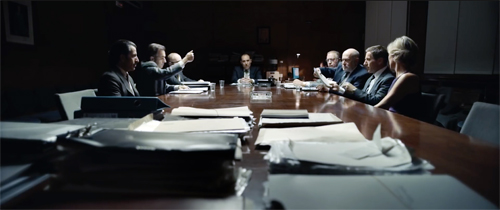
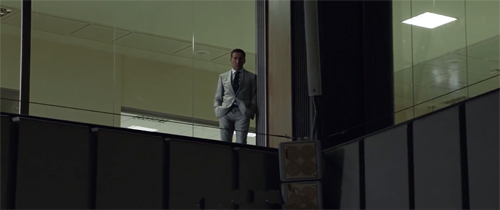
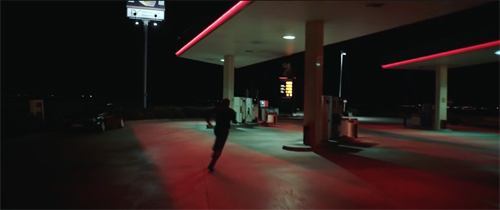
The Realm is a good example of how manipulating character attachment can strongly engage the audience. We know just enough to understand Manuel’s crisis, but without access to his mind, each scene can yield a surprise when he comes up with a new survival stratagem.
A lot from a little
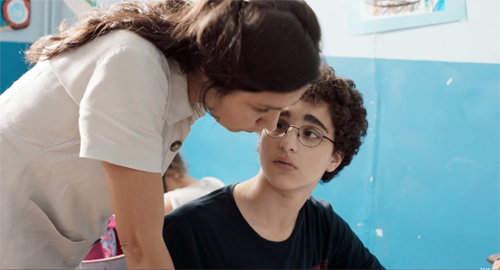
I hadn’t really considered the Dardennes brothers “minimalist” filmmakers, but seeing Young Ahmed brought home to me how strictly they’ve limited their cinematic palette. Given their emphasis on actors and faces, you might think they rely on the sort of “intensified continuity” on display in modern film and television. Yet they’re far more purist than that, and they take objective presentation further than does Sorogoyen.
They seldom use long shots, let alone establishing shots: a scene starts in medias res with character action, shot from quite close. Filming in handheld long takes, they avoid shot/reverse-shot cutting, either panning between participants in a dialogue or simply framing them in tight two-shots.
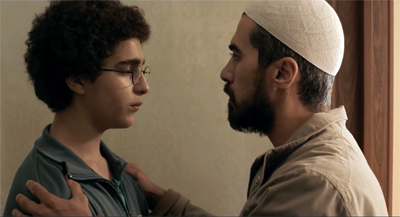
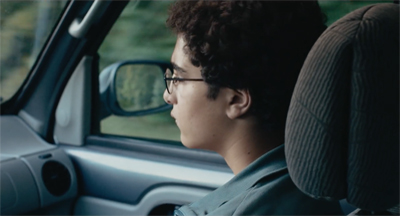
The Dardennes minimize camera ubiquity. Not for them the picturesque, distant shots that The Realm sometimes provides. In a car carrying two passengers, the camera isn’t lashed to the hood or filming alongside; it’s in the back seat.
True, cutting yields some ubiquity. When Ahmed’s teacher pursues him through a classroom, she runs ahead of us but then, in the next shot, she catches up with him as he’s about to leave the building.
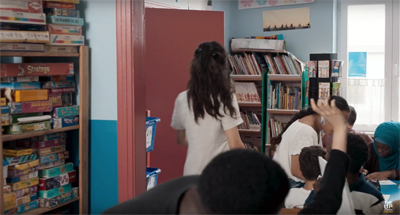
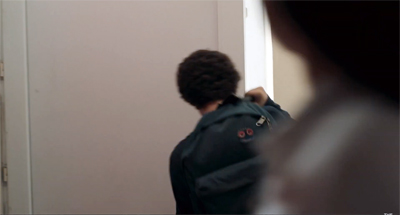
Like most cuts, it’s an instantaneous change of position that a real observer couldn’t execute. Still, this frame-edge cut creates simple continuity, driven by dramatic necessity and barely noticeable. The cut is softened by a staging that neatly settles into a standard over-the-shoulder setup.
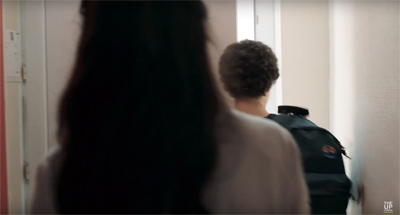
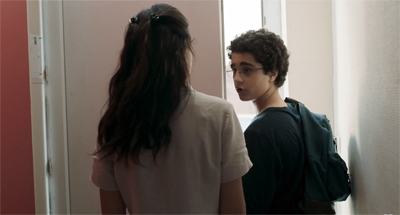
Apparently uninterested in pictorial composition, these filmmakers simply center their subjects in undistinguished framings. No shot becomes strikingly lit or framed. There’s no nondiegetic music, and the soundtrack is subdued; of all modern filmmakers, they benefit least from surround channels.
As in The Realm, the Dardennes’ minimalist approach works well in tying us to the protagonist, while also denying us direct access to his mind. Ahmed, an adolescent in Liège, has given up video games for fundamentalist Islam. Convinced by his imam that his classroom teacher has become an apostate, he decides to take action against her.
His plans emerge wholly through his actions. Without benefits of voice-over, subjective sequences, or flashbacks, we must infer how he will respond to the demands of the Qu’ran as he has been taught to understand it.
The Dardennes’ objectivity doesn’t make the plot hard to follow. A dozen minutes into the film, the premises are clear, the main characters (Ahmed’s mother, his imam, his teacher) are delineated, and Ahmed’s motivation is established. At the half-hour point, his mission is launched. Apart from the ellipsis I mentioned, everything that follows stems from the dramatic premises. And however horrifying Amed’s plans may be, the wistful, pursed-mouth young actor Idir Ben Addi is mesmerically angelic. His glasses make him look adorable.
The style also keeps everything clear. The texture is close to that of documentary filmmaking, but of course the Dardennes’ films are scripted and staged. There’s a high degree of artifice in their apparently artless method. As in the more flamboyant Birdman, their long takes catch every reaction and gesture with great precision.
We always see what we need to see at just the right moment. When something is suppressed–here, the result of a violent knife attack–it’s not an accident (as if the camera were in the wrong spot) but rather the result of our attachment to Ahmed and a clever narrative ellipsis. We could have had a cut like the one in the school, but we remain with Ahmed, and in fact know a bit less than he does about the result of the violence.
All of which is not to deny the originality of Young Ahmed. All the Dardennes films seem modest, but they are, within their limits, quite ambitious in using dramatic psychology to probe social problems. Throughout, I think, we are asked to reflect on how firmly Ahmed believes in his version of Islam. Is it a transitory teen obsession or is he on his way to becoming a dogmatic martyr? We watch his behavior, his encounters with farm life and a young girl, for any signs that his lonely, taciturn demeanor will crack. In other words, this is a suspense film–one based less on the threat of violence (which is there, to be sure) than on how a boy who hasn’t fully formed his character will define himself.
Not such light housekeeping
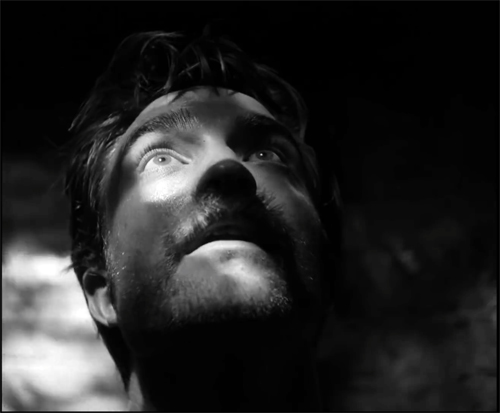
Both The Realm and Young Ahmed are, to varying degrees, objective in their presentation. We must judge characters by what they do and say. Something very different is going on in Robert Eggers’ The Lighthouse. It too adheres largely to one character, but a battery of cinematic techniques, including camera ubiquity, works to plunge us into the man’s mind.
Although the film is a two-hander, it doesn’t balance viewpoints. Thomas Wake, an experienced lighthouse supervisor, arrives at his post with the novice Ephraim Winslow. Almost immediately we are attached to Winslow, who’s assigned grimy menial duties while Wake tends the beacon. Wake tells Winslow that his previous assistant went mad from the weeks of isolation, and very quickly Winslow struggles against the bleak, craggy island they’re on.
We’re prepared for an assault on your senses by the opening, when a ship roars out of the fog toward us. Thereafter, Wake subjects Winslow to a punishing routine of cleaning the cistern, heaving coal into the boiler, and scrubbing floors, while nightly meals with the nattering old salt are just as hard to bear. Winslow’s misery is rendered in vivid, expressionist terms. The deafening fog horns, thunderclaps, and boiler blasts are reinforced by stark, ominous black-and-white imagery. (The film was shot on 35mm film.) Winslow seems trapped in a world of raging elements and gigantic machines.
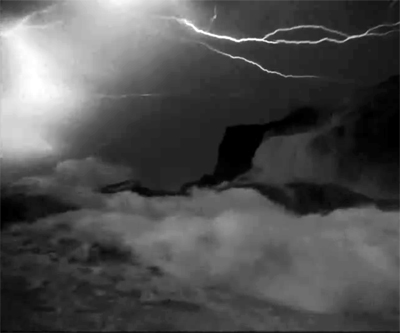
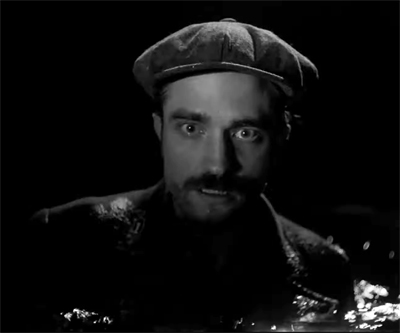
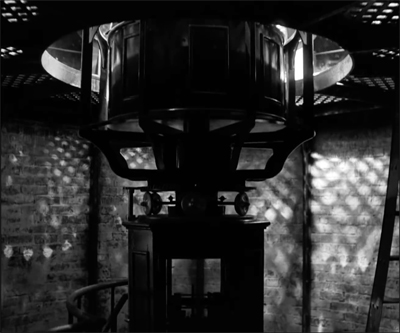
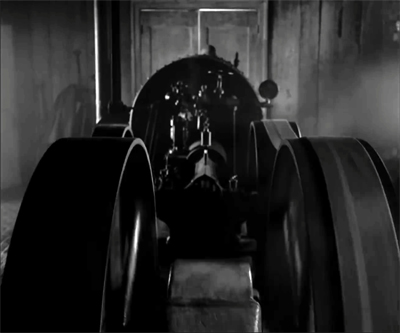
Eggers builds our affinity with Winslow through classic techniques. He watches Wake at the beacon from a distance; we get optical point-of-view shots of discoveries (real? imagined?) that start to unhinge him.
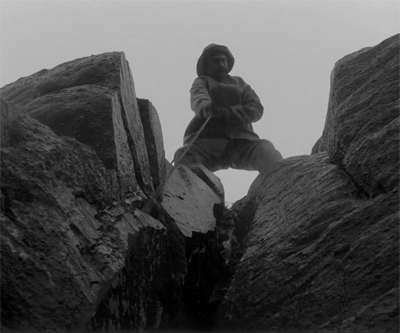
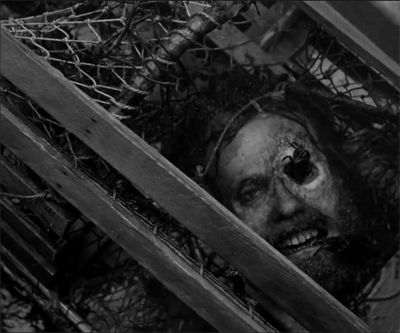
All the drudgery and pain, punctuated by Wake’s continual harangues and farts, lead Winslow into fantasies and hallucinations. His deterioration is rendered in shock cuts and distended compositions reminiscent of Welles’ Mr. Arkadin or German’s Hard to Be a God. Some will compare the film’s over-the-top climax to that of Aronofsky’s Mother!, but The Lighthouse, with its rapid montage and Gothic chiaroscuro, harks back to silent cinema. The fact that it’s shot in the 1:1.17 ratio favored by early sound film gives it an archaic feel as well. The dialogue, a late title informs us, is drawn from nineteenth-century sources, including Melville and Sarah Orne Jewett.
The Lighthouse has a cadence typical of modern horror films, but Kristin points out that it’s an expressionistic Kammerspiel too–a subjectively tinted drama setting very few characters in a constrained locale. Eggers shows that you can renew a genre’s appeals by reviving imagery from a classic period of film history. When you do it, you’ll still have to make fundamental choices about viewpoint and camera placement. They come with the territory.
We thank Alan Franey, PoChu Auyeung, Jenny Lee Craig, Mikaela Joy Asfour, and their colleagues at VIFF for all their kind assistance. Thanks as well to Bob Davis and Shelly Kraicer for invigorating conversations about movies.
For more on classic Kammerspiel films go here and here.
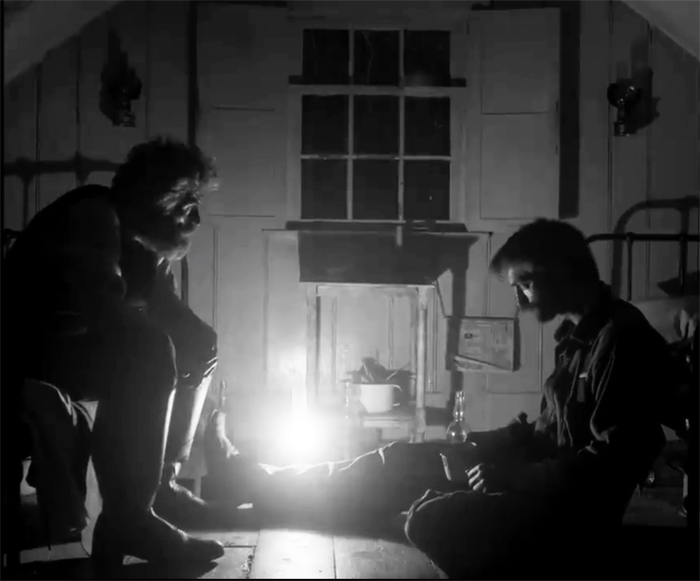
The Lighthouse (2019).
Telling the big story: Network narratives at Venice 2019

The Laundromat (2019).
DB here:
Every now and then I wonder whether network narratives, to revert to the term I coined a while back, have faded from the scene. Although there are some examples earlier in film history, that storytelling model had a sustained burst after Altman popularized it in Nashville (1975). Other filmmakers took it up, especially in the 1990s (Before the Rain, Exotica, Go, Pulp Fiction, etc.) and the 2000s (Babel, Dog Days, Love Actually). I don’t seem to see so many nowadays, and the almost universal loathing greeting Life Itself (2018) might seem to indicate that a tale relying on remote connections and unexpected convergences had run its course.
Surprising, then, to see three items at Venice that rely to a degree on the network narrative format. Each is based on a nonfiction book aiming to reveal the dynamics of a large-scale process. In each film, process becomes a framework for personal stories and converging fates.
Wasps in the Caribbean
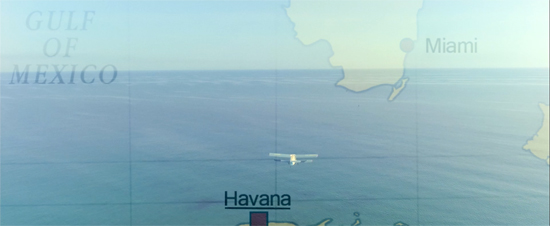
Olivier Assayas’s Wasp Network isn’t as far-reaching as the title implies. It concentrates on two couples and one individual caught up in 1990s spying. When René Gonzales, a pilot, defects to Florida, he seems to be seeking freedom and a new life working with Cuban exiles to destabilize Castro’s regime. Branded a traitor, he leaves behind a wife and daughter who must bear social opprobrium. Actually, he is a Cuban agent, part of the “Wasp Network” that will infiltrate the anti-Castro forces.
Another exile, Juan Pablo Roque, works with the Network, but he is also leading a double life–one quite different from René’s. Just as René’s sacrifice wrecks his relation with his family, the headstrong Juan Pablo jeopardizes his relation to his lover Ana Margarita. Both men are linked to Gerardo Hernandez, who coordinates the Network.
As in most spy stories, we’re led to discover double agents and surprise alliances, as well as the conventional emphasis on the personal cost of espionage. As the film goes along, that emphasis becomes stronger; scenes tracing the tactics of the anti-Castro forces (such as invading Cuban airspace to drop leaflets) give way to long confrontations between couples and the efforts of Rene’s wife Olga to unite with him in the US.
Because network plots need to fan out across many characters, filmmakers often break up the linearity of time. In Wasp Network, the reunion of the two major defectors, Juan Pablo and René, is followed by a passionate scene of Olga being defeated by Cuban bureaucracy. Abruptly the plot skips back four years to introduce Gerardo, and his career as a double agent is summarized. A montage, complete with a narrator’s voice-over, links the three men in the years 1990-1992. Then, back in the present, Gerardo meets with Olga to reveal that René is a patriot, not a traitor.
Visually, the film is surprisingly ordinary, I thought, sort of standard TV. If you like over-the-shoulder shot/reverse shot, there’s plenty here for you.
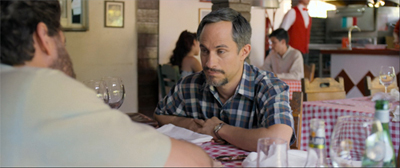
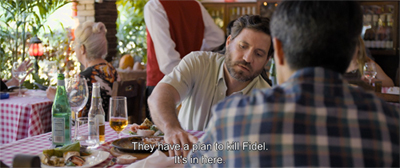
Assayas garnishes his reverse angles with alternating push-ins, a technique that has become a bit hackneyed since John McTiernan’s skillful use of it.
The film compels some interest by virtue of its origins. Based on the FBI case against the “Cuban Five” and the book The Last Soldiers of the Cold War, it employs vintage broadcast news coverage cut in for expository purposes. I had known almost nothing of this historical episode, and thanks to the cooperation of Cuban authorities Assayas benefits from showing a story we Americans seldom see. Still, by concentrating on only a few characters and having them played by Édgar Ramírez, Penélope Cruz, and Gael García Bernal, whose presence demands extensive scenes, the larger dynamic of the Wasp Network fades into the background. Despite its title, maybe it’s only a borderline case of a network narrative.
Coke ZeroZeroZero
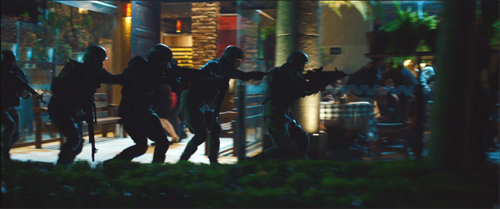
ZeroZeroZero is also based on journalistic reportage, in this case Roberto Saviano’s book of the same title. (An earlier Saviano true-crime investigation is the source of the 2008 film Gomorrah, another network narrative.) The subtitle of his book–Look at Cocaine and All You See Is Powder. Look Through Cocaine and You See the World–suggests the vast ambition of his project. From the book Sky, CanalPlus, and Amazon Prime have developed an eight-part series to be broadcast and streamed in 2020.
Since I’m not the world’s biggest TV consumer, I wasn’t interested until I read the presskit, which promises something sweeping.
The series follows the journey of a cocaine shipment from the moment a powerful cartel of Italian criminals decides to buy it until the cargo is delivered and paid for. Through its characters’ stories, the series explains the mechanisms by which the illegal economy becomes part of the legal economy and how both are linked to a ruthless logic of power and control affecting people’s lives and relationships.
The prospect of following a coke-packed container as it passes through various hands appealed to me. I enjoy circulating-object plots like Winchester 73 and The Red Violin, as well as those 1920s Soviet Constructivist “biographies of things” (such as Ilya Ehrenberg’s Life of the Automobile).
ZeroZeroZero, though, isn’t quite that sort of thing. Judging by the first and second episodes, the only ones screened at Venice, this will be more conventional. The plot shifts among dramas within groups of stakeholders in the shipment. We see the power struggle in an Italian crime family, with a son aiming to usurp his grandfather. There’s another family drama in New Orleans, where a ruthless shipping-company owner insists, against his son’s and daughter’s resistance, on booking the cargo. In Mexico, a corrupt special forces sergeant works behind the scenes to assure that the shipment will not be disturbed.
The narration cuts among these storylines until, at the end of episode 2, the cargo embarks on the seas. Doubtless the remaining episodes will ramify into other story lines, but I’d expect at least the Italian and American ones to be on tap throughout–if only to maintain the interest of streamers’ European and US audiences.
The film was directed and co-written by Stefano Sollima, who has done several TV dramas as well as the feature film Sicario–Day of the Soldado. ZeroZeroZero certainly had a higher-gloss look than Wasp Network, with dramatic lighting and elaborate action scenes. One of these, a police attack on the big meeting of the stakeholders, is replayed from different character viewpoints in the two episodes. Like Wasp Network, ZeroZeroZero amplifies its expanding network through time-shifting, and this attack is revealed to be a node, a point of convergence among the three main groups of characters. Given current TV’s fascination with scrambled time schemes, I’d expect other nodes and replays to emerge in the course of the series.
Capitals of capital
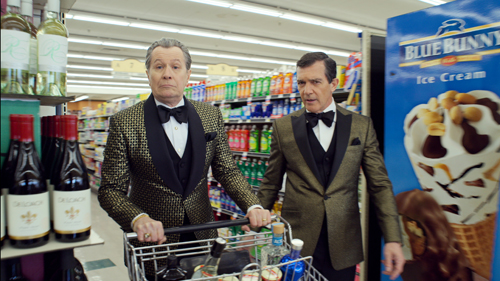
Eisenstein planned to make a film of Marx’s Capital. He would have used his montage editing methods to survey an economic system–without benefit of individualized protagonists. In The Laundromat Stephen Soderbergh has tried to do something akin to this, but like most filmmakers he’s obliged to personalize his drama (as he did in Traffic and Contagion). Soderbergh has compared the film to Dr. Strangelove, largely because of the need to make a devastating situation entertaining. But I think his film recalls Strangelove as well in its emphasis on villains who get caught up in the insanely complicated system they create.
Mossack Fonseca was a law firm in Panama that specialized in tax evasion. It registered over 300,000 companies, many of which were shell entities that enabled money laundering and fraud. The firm had subsidiaries in the Bahamas, Hong Kong, Switzerland, and other countries. In 2016, German investigative journalists published 11.5 million internal documents known as the Panama Papers, mostly centering on Mossack Fonseca. As the journalists explain:
Clients can buy an anonymous company for as little as USD 1,000. However, at this price it is just an empty shell. For an extra fee, Mossack Fonseca provides a sham director and, if desired, conceals the company’s true shareholder. The result is an offshore company whose true purpose and ownership structure is indecipherable from the outside.
Despite its vast scale, the firm represented at most ten percent of the global market of offshore finagling.
Tax havens and shell companies are more or less legal. What brought down the company was the breach of confidentiality. In addition, the possibility of fraud hovered over the big names revealed as beneficiaries. Politicians throughout Europe and China were named, as were filmmakers Jackie Chan and Pedro Almodóvar. International villains associated with Bashar al-Assad and Vladimir Putin moved money through Mossack Fonseca; a Russian cellist had holdings of $2 billion. After the leaks, the rich couldn’t trust Mossack Fonseca to keep their secrets.
Building on Jake Bernstein’s book Secrecy World, Soderbergh and screenwriter Scott Z. Burns have concocted a sweeping tale of how the rich are very, very, very different from you and me. But in scale, the network they’re surveying dwarfs the Wasps and the voyage of a coke shipment. How do you convey the vastness of an alternative financial system?
The film’s pop-Brechtian mode of presentation will earn comparisons to The Big Short, but here instead of one-off celebrity tutors (Margot Robbie, Anthony Bourdain) we get the chattering rogues themselves, Jürgen Mossack (Gary Oldman) and Ramón Fonseca (Antonio Banderas). Their to-camera accounts of “fairy tales that actually happened” settle into a block construction, five chapters “based on actual secrets.”
The first chapter title, “The Meek Are Screwed,” provides an emblematic case of how the little people are connected with this network of virtual money. Chief among those Meek is Ellen Martin (Meryl Streep), whose husband Joe is drowned when a tour boat capsizes.
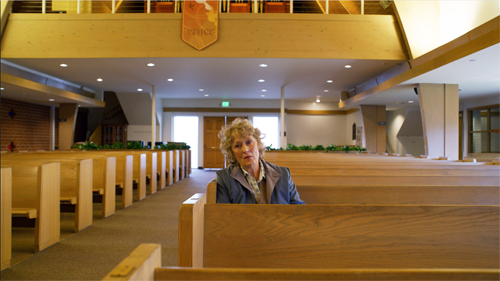
Hoping to have her grief assuaged by an insurance settlement, she learns that one isn’t forthcoming because the boat company bought a worthless policy from a shell company. The film’s first two chapters follow her efforts to find someone responsible. She finally tracks down a fraudster named Boncamper, a Mossack Fonseca figurehead who has grown rich (and accumulated two families) simply by signing thousands of documents.
Having shown how the shell-company shuffle affects ordinary folks, the film moves on to the high and mighty. One chapter traces the backstory of the company, another shows how an extraordinarily rich family uses the system to one-up each other, and a final chapter depicts murder among the Chinese plutocracy. The fourth block, illustrating the lesson of “Bribery 101,” is especially juicy in showing a father using bearer bonds to force his daughter to keep silent about his extramarital affair. As Marx and Eisenstein would expect, economic relations seep into personal ones. Bribery is all in the family.
The Laundromat’s breezy, self-righteous impresarios cast a comic tone over everything. Even the murder doesn’t seem awful, considering the victim’s own corruption. Only at the end does indignation emerge in a twist. Ellen, almost forgotten for the last half-hour, reappears in a new guise and takes over the narration from the villains. An agitprop ending reminds us that the capital of money laundering may well be the US, where Nevada, Wyoming, and above all Delaware play a role comparable to the Caribbean. Soderbergh and Burns (who confess to having offshore stashes themselves) end by firmly snagging their American audience in the colossal spiderwebs of global capital.
Nearly every narrative involves a social network of some size, even if it’s only a family. The most thoroughgoing network plots provide us roughly equal attachments to many viewpoints. The film demotes individual protagonists, in favor of revealing x degrees of separation among several individuals. Wasp Network, ZeroZeroZero, and The Laundromat don’t have the complexity of the network narratives of earlier years, but they serve to remind us that the network schema can be tweaked to suit the needs of particular creative projects.
Thanks to Paolo Baratta and Alberto Barbera for another fine festival, and to Peter Cowie for his invitation to participate in the College Cinema program. We also appreciate the kind assistance of Michela Lazzarin and Jasna Zoranovich for helping us before and during our stay.
For more on network narratives, see Chapter 7, “Mutual Friends and Chronologies of Chance,” in Poetics of Cinema. Jeff Smith considers Once Upon a Time . . . in Hollywood as a network narrative, and earlier entries (such as here and here) develop the idea as well.
To go beyond our Venice 2019 blogs, check out our Instagram page.
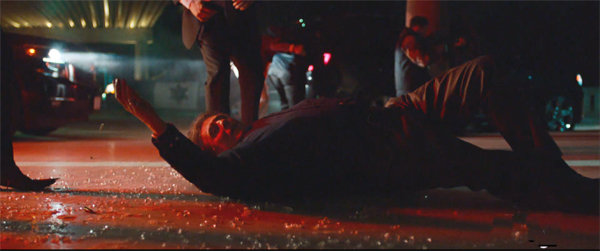
ZeroZeroZero (2020).