






Archive for the 'Film comments' Category
THE DEPARTED: No departure
David here:
I’m usually a terrible prophet. But when I first saw Infernal Affairs (2002), I decided that Hong Kong filmmakers had finally made a Hollywood film. Comprehensible exposition, intricate plotting, and well-earned twists have never been strong points of local cinema. I tried to show in Planet Hong Kong that this filmmaking tradition favored episodic construction and virtuoso staging and strictly organized visceral arousal. But in IA Andrew Lau Wai-keung and Alan Mak Siu-fai produced a tit-for-tat crime movie with ingenious intrigue and a density of characterization.
Filled with both top-line stars and powerful character actors, it proved a box-office sensation across Asia, triggering an ambitious prequel/sequel and a strange third installment that is much more like the scattershot Hong Kong movie a lot of us have come to love. Now IA has become the first local film to be remade overseas. Nice as it is to see Media Asia highlighted, the credits of The Departed offer only a stingy mention of the source.
The Departed has been hailed as a big comeback for Scorsese, a filmmaker who has had as many comebacks as Woody Allen, usually to as little effect. The critics are going nuts. “A new American crime classic,” declares Rolling Stone. Newsweek‘s reviewer grants that the Hong Kong original is “terrific” but in the next sentence declares that “Screenwriter William Monahan has done a terrific job transposing the story to ethnically fraught Boston.” Terrific reviewing too: No wonder people turn to the Internet to get less packaged commentary.
Even though IA leaned toward Hollywood, the differences are instructive. (Spoilers in this and the next paragraph.) Structurally, The Departed swerves from the original in a way that softens its impact. In IA, the final twist leaves the Triad mole in the police alive and victorious. In a local context, this ending gains a powerfully bleak effect. A Hong Kong movie hero needn’t survive the final confrontation (he even gains in stature from dying grandly), but the villain is seldom left standing.
In most respects Monahan’s script adheres to the original beat by beat, or rather bleep by cellphone bleep. But the American ending is oddly more faithful to the Hong Kong mainstream. Now our hero doesn’t die in vain. The bad dude is paid back, thanks to a contrived in-case-of-my-death message sent to the shrink-girlfriend whom the two protagonists share. Ironically, Monahan’s ending is akin to the obligatory punishment on display in the version of Infernal Affairs reshot to placate Mainland China’s censors. Maybe American and Chinese tastes align more than we think.
Most reviews have warmly welcomed the return of the tone of GoodFellas and Mean Streets, but I’m more hesitant. We’ve seen a lot of this before. Again guys cuss a lot and make sexist jokes. (The first ten minutes have three references to menstruation, none complimentary.) Again confrontations and whackings are underscored by boomer rock tunes. And again the camera swaggers. Scorsese’s visual bravado was always a bit overhyped; did he bequeath us the idea that every scene had to have “energy”? This time out the tricks seem to me forced; I didn’t think we needed so many cut-off pans and swiveling camera moves.
Apparently Scorsese originally wanted something a bit fresher, as we learn from the October American Cinematographer (eventually to be online here). He asked Director of Photography Michael Ballhaus to study not only master cinematographer John Alton’s movies for Anthony Mann (T-Men, Raw Deal) but also hard-edged Korean neo-noir like Oldboy (Park Chan-wook, 2003) and Bad Guy (Kim Ki-duk, 2001).
By asking me to watch those wild Asian movies, I think Marty was pushing me to try something different. I tried to do that, but after a couple of days on the shoot I realized that although the styles of those movies were great for the particular stories they were telling, we were doing an American movie with American stars. In the end, I had to pull back a bit from those wilder styles; I couldn’t go that far with this movie (p. 38).
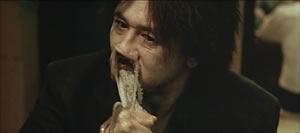
Maybe that’s the problem. Wild films don’t get nominated for Academy Awards. True, wild performances do, but even satanic Jack probably wouldn’t eat a big live squid (as does the hero of Oldboy, right). Long ago Taxi Driver inspired Hong Kong filmmakers to push harder, but instead of replying in kind, Scorsese/Ballhouse leave it to B entertainments like Crank, Torque, Running Scared, and Domino to nudge Hollywood toward Asian extroversion.
Even more eagerly than The Aviator, The Departed embraces what I’ve called “intensified continuity.” (See Film Art Chapter 6 and The Way Hollywood Tells It, Part 2) In this style, conversation scenes feature very little movement of actors around the set. Performers sit or stand and deliver their lines in isolated shots (singles) or over-the-shoulder (OTS) setups. The visual stasis is compensated for by lots of cutting, camera movements, and tight close-ups.
The Departed has calmed Scorsese’s urge to track a bit, but that’s balanced by its over 3200 cuts. The result is an average shot length (ASL) of about 2.7 seconds. Not unusual for an action picture nowadays, but consider where Scorsese started by conning these ASLs:
Mean Streets 7.7 seconds
Alice Doesn’t Live Here Anymore 8.0 seconds
Taxi Driver 7.3 seconds
King of Comedy 7.7 seconds
Gangs of New York 6.7 seconds
The Aviator 3.6 seconds
Like his contemporaries, Scorsese has succumbed to the fast-cut, hyper-close style that has made our movies so pictorially routine, however well-suited they may be for display on TV monitors and computer screens and iPods. In 1990 he seems to have realized that he needed to pick up the pace. Of GoodFellas (ASL 6.7 seconds) he remarked: “I guess the main thing that’s happened in the past ten years is that the scenes [shots] have to be quicker and shorter. [GoodFellas] is sort of my version of MTV. . . but even that’s old-fashioned” (The Way Hollywood Tells It, p. 152). (For more on measuring ASLs, see the Cinemetrics site here.)
Speaking of editing: It’s blasphemy, but I’ve been long convinced that Scorsese’s films aren’t particularly well-edited. Look at any conversation scene, particularly the OTS passages, and you’ll see blatant mismatches of position, eyeline, and gesture. Spoons, hands, and cigarettes jump around spasmodically. In The Departed, Alec Baldwin somehow loses his beer can in a reverse shot, and in the swanky restaurant, it’s hard to determine if there are one or two of those towering chocolate desserts on the table.
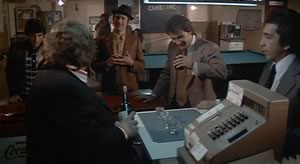
This may seem picky, but craft competence is not for nothing. Current reliance on tightly framed faces tends to sacrifice any sense of the specifics of a place. In most scenes, actors are so overcloseupped that little space is left for geography, even the mundane layout of a police station. Choppy cutting also subtly jars our sense of a smooth performance. Why can’t our directors sustain a fixed two-shot of the principals and let the actors carry the scene–not just with the lines they say but with the way they hold their bodies and move their hands and employ props? Scorsese, though always a heavy shot/reverse-shot user, held full shots to greater effect in earlier movies.
Space on a larger scale matters too. The atmosphere of Hong Kong was conveyed far more vividly in the original IA than the landscape of Boston is here. The most concrete locale seems to be a Chinatown porn theatre (filmed at New York’s Cinema Village). There’s also a gilded State House dome that is distressing in its lumpy symbolism. For more textured renderings of a parallel milieu, I’d recommend the comparatively overlooked State of Grace (1990) and The Yards (2000).
I’d love to join the applause that welcomes Scorsese back, but for these and other reasons I have to sit on my hands. For me, the inventiveness of the Asian tradition still reigns supreme in the crime genre. I grant that Infernal Affairs accepts the energy-aesthetic, with its swooping camera moves and its 3.2 second ASL. But the camera gives its actors room to breathe, and it spares some time to define a scene’s locale.
On a higher level of accomplishment stand Johnnie To’s The Mission, PTU, A Hero Never Dies, and half a dozen other films–very likely including the most recent, Exiled–along with the dazzling works of Kitano Takeshi and several other Asian directors. These are truly terrific.
P.S. 20 Oct 2006: This post on Scorsese’s Departed started a passionate and pretty discerning discussion over on Jim Emerson’s Scanners blog. You can read the thread, including my horrendously long comment, here.
More on THE HOST
From David:
While I was at Vancouver, I didn’t see Screen International for Sept 15, but I’ve caught up since I got back. SI reports extensively on Bong Joon-ho’s The Host. Budgeted at $11 million, it has become the top-grossing Korean film of all time (in unadjusted dollars). It was released in July, and 38 days later it had 12.37 million admissions in its domestic market, beating The King and the Clown. The subsequent Asian rollout has yielded a total gross of $77.8 million as of 15 Sept. The Host will open in Europe in November, and in the US, distributed by Magnolia, in late January 2007.
Mr Bong was kind enough to give me a CD of the soundtrack, and it’s a lively and varied score. I recommend it. When we first met in 1995, he told me that Film Art was widely pirated in Korea, so at Vancouver I gave him a copy of The Way Hollywood Tells It. This is the source of his comments in the inscription: “To David Bordwell! Thanks for your amazing book! (My legal version copy!) Good luck!” Maybe some of his luck with The Host will rub off on me….
Vancouver envoi
A late night Thursday, and a snoozy day of traveling on Friday, kept me from posting ASAP. And now on Saturday morning—I can’t get on to my own blogsite! Apparently others can. So while our web czarina Meg fixes things, I try to wrap things up on my visit to the Vancouver International Film Festival.
Le Petit Lieutenant: A policeman’s lot is never a happy one. From Ed McBain’s 87th Precinct to Ian Rankin’s Rebus series, modern crime novels give an emotional resonance to police procedure by showing the psychological costs of being exposed to cruelty, chicanery, and death. American cop movies have gradually let more of this quality come through (Prince of the City, Heat, Dark Blue), and of course TV, from Hill Street Blues to The Wire, has turned the police procedural into urban melodrama. But the French got here first. For decades, their cop movies have been world-weary psychological dramas shot through with bitter realism. Think of Corneau’s Police Python 357, Pialat’s Police, Tavernier’s L.627, or any of Melville’s policiers.
Le Petit Lieutenant, which I saw on my last day, falls into that sturdy tradition. The premise—a string of attempted murders of bums and passersby—is played out with the usual clue-by-clue plotting, but we also witness the strained lives cops lead. Our two protagonists are the overeager recruit Antoine (Jalil Lespert) and his recovering alcoholic supervisor Carolina (Nathalie Baye in an utterly deglamorized performance). Xavier Beauvoi’s narration shuttles skillfully between their points of view, leading to a good deal of sympathy and suspense and a grim but plausible climax. One of several nice touches: the cops keep movie posters over their desks, and if I’m not mistaken, in some cases the posters serve as hints to the cops’ personalities. The ending leaves you as bereft of certainty as the protagonist.
Do Over (Taiwan): For a finale, I caught this extraordinarily ambitious movie by the twenty-eight-year-old Cheng Yu-chieh. Shot in anamorphic widescreen (very rare in Taiwan over the last twenty years), it belongs to the trend I’ve called “network narratives.” Across New Year’s Eve and New Year’s Day, the lives of several people converge and diverge in the fashion of Short Cuts and Magnolia. Each character’s strand evokes a different genre: gangster movie, romantic drama, twentysomething “relationship” comedy, and the movie about moviemaking. Each strand is also set off by a distinctive photographic style, from misty blue to grainy, blown-out noir.
A network plot often exhibits an interesting mix of realism (in life, strangers’ lives do become tangled) and artifice (chaptering, repeated scenes, and other overt narrational devices). The artifice becomes flagrant at the film’s end, when Do Over‘s title gets literalized and the plot lines are revised to yield alternative endings. The cleverness doesn’t get the upper hand, however, and this remarkable debut leaves you both satisfied and looking forward to Cheng’s next film.
After two trips to Vancouver’s festival, I have yet to go to any tourist destination. I’ve lived within a few square blocks, dashing among hotel, DVD stores, and the Granville Multiplex, with forays to the Pacific Cinematheque and the Vancity Theatre and sushi restaurants and crepe cafes. I’ve lived a film-wonk holiday across eight days and dozens of movies. Thanks to Alan Franey, the Festival Director, for inviting me and extending me so much courtesy. I’m grateful to all the help of his colleagues PoChu Au-yeung, Mark Peranson, Eunhee Cha, Steve Martindale, and Jack Vermee. I wish we’d had more time to talk! Over the last two visits, I’ve made new friends from all over the world, and I’ve enjoyed just sitting among exuberant audiences.
Tony Rayns has been programming Asian films at Vancouver since 1988, and I have to note the melancholy news that he’s stepping down as coordinator of the Dragons and Tigers competition. I’m unhappy as well that I can’t be at Vancouver tonight (Saturday) to see the results of the competition and participate in what will surely be a string of tributes to Tony. So here’s a weak substitute—my own appreciation online.
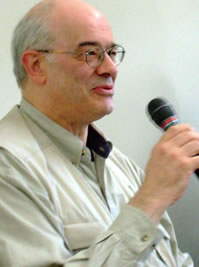
Tony Rayns at VIFF, 2006
In Tony Rayns deep expertise is joined to an unmatched passion and curiosity. His Vancouver programming was crucial in introducing directors like Kitano and Hou to West. He has also made films happen: Without the acclaim of Vancouver audiences and the prestige of the Dragons and Tigers prize, how many distributors would have backed later work by young directors over the last twenty years?Most critics prefer to stroll into screenings to watch films that miraculously appear, thanks to the work of dozens laboring behind the scenes. From the start Tony got his hands dirty. Apart from writing discerning and literate film criticism, he worked for film festivals, wrote presskits and program notes, translated subtitles, and pushed for offbeat films to be available on video and cable. Above all, he programmed films, backing his tastes with an expanding network of allies in the film industry. He helped create a climate of opinion that welcomed the burst of creative accomplishment that Asian film has offered over the last three decades.
Tony’s been a friend since the mid-1970s, and his influence on my tastes and thinking has been immense. I wouldn’t know a lot of what I know without his tireless proselytizing for once-obscure films and filmmakers. He’s sensitive to all a film’s dimensions—its social and artistic implications, its relation to the director’s personality and life experience. A late-night conversation with him, preferably over Asian food, is like being in the liveliest seminar you ever took.
Many of Tony’s contemporaries—I know plenty—have given up on contemporary cinema. Who can blame them, after a trip to a multiplex? Too often, cinema seems over. But this has only made Tony dig deeper, watch more widely, and remind us that this art form is still frisky, unpredictable, and occasionally rapturous. The French have a word for it: animateur, the person who sends a jolt of energy into a culture. Like André Bazin and Henri Langlois, Tony is one of the animateurs of world cinema, and everyone who loves film is in his debt.
Mostly Asian, and why not?
David here:
A correspondent asks: Why am I spending so much time at the Vancouver Film Festival watching Asian movies?
Well, I have dabbled in other regions. Most recently, I enjoyed Eugène Greene’s short Signs, a metronome-and-protractor movie that nonetheless harbors a sharp sting of emotion. More straightforwardly entertaining was Aki Kaurismaki’s Lights in the Dusk. You’ve seen the story’s premise before, both in film noir (femme fatale dooms hero) and in other Kaurismaki films (loser comes stubbornly back for more trouble, and gets it). But it’s as usual filmed in a laconic, Bressonian way, and we get another Kaurismaki protagonist who is blank-faced, obstinate, more than a bit thick, and, despite everything, quixotic.
Still, Asian films have come first for me, as for many others here. Why? The evidence is clear: Since the 1980s, movies from Hong Kong, Taiwan, Japan, Mainland China, South Korea, and more recently Thailand, Malaysia, and the Philippines have offered an almost unrivaled range of accomplishment. (Want names? Tsui Hark, John Woo, Wong Kar-wai, Kitano Takeshi, Kore-eda Hirokazu, Hou Hsiao-hsien, Edward Yang, Jia Zhang-ke, and on and on.) The energy hasn’t flagged, and Vancouver has been in the forefront of supporting this tidal wave of talent. Tony Rayns’ brilliant programming has set an international standard, and the festival’s Dragons and Tigers competition for first features have brought many young filmmakers to world attention.
So herewith some more outstanding Asian revelations from my final Vancouver days:
Hana: Kore-eda keeps surprising us; each film is quite different from the one before. In a downtrodden neighborhood of Edo (the old name for Tokyo), people live in mud and dung, struggling to get by. Some of the loyal 47 ronin wait impatiently to avenge their executed lord, while a young man hangs around trying to find his father’s killer. But the fact that the youth is a fairly inept warrior tips you off to the essentially comic vision underlying this warm movie. Add in a bully who isn’t actually a bad guy and a gallery of low-life neighborhood types, who pass the time rehearsing a play that unwittingly satirizes the samurai ethos. The result is a film that probes the righteousness of vengeance with tact and vulgar humor. Everybody I know wanted to see this again, right away.
My Scary Girl (Korea): The Trouble with Harry meets The Forty-Year-Old Virgin. Dae-Woo has never had a date, but he decides to start with his cute neighbor. He doesn’t know that she’s a Woman with a Past, not to mention a fairly worrisome Present and an ominous Future. Romantic comedy shifts to black comedy, and bowling pins mix with lopped-off fingers. It’s a crowd-pleaser, and Hollywood will probably rush to remake it. But will an American director have the guts to keep the very logical but not wholly happy ending?
I Don’t Want to Sleep Alone: Taiwanese director Tsai Ming-liang has provocative ideas and burnished imagery, but sometimes I’ve thought he’s too clever by half. This movie, his first in his native Malaysia, won me over because it seems to play to all his strengths. Four people intersect around, under, and on a mattress, with an extra character as a kind of comatose sentinel. Tsai’s gorgeous imagery isn’t just pretty for its own sake. Like Tati, he can design compositions which are actually funny, and his long takes give us time to probe the textures and crannies of staircases, a building site, and ordinary streets. The film’s last shot is alone worth the price of admission.
No Mercy for the Rude (Korea): This time the hitman is a mute (or is he?) vowing to kill only the really bad people, and hoping to accumulate enough pay to afford an operation on his “short tongue.” He falls in with a street kid and a hooker, and as the seriocimic plot unfolds we get the very Asian insistence that childhood innocence can be recovered even in the midst of carnage. The film indulges in some flights of fancy—a hitman’s picnic, a hitman who’s a ballet dancer—before coming to its satisfying end in, of all places, a bullring.
Faceless Things: Warnings about gay sadomasochism to the contrary, this doesn’t offer much you can’t see in Warhol or Waters. What it does provide is three shots. The first, nearly 45 minutes long, provides virtually a one-act play about a motel tryst between a businessman and his teenage lover. The second shot shifts us to an anonymous sexual encounter that is admittedly fairly off-putting, but handled with the mix of casual framing and off-kilter suspense we find in, again, Warhol. The very last shot is very brief and puts the other two into a new context. Director Kim Kyong-Mook is only in his early twenties, but his ambition and daring make him a filmmaker to watch.
My last night has come all too soon. So just to make sure that the Europeans are still at work, I’ll check on the French cop movie Le Petit Lieutenant. I’ll end with another Dragons and Tigers entry, the Taiwanese movie Do Over.
Maybe a Chinese dinner afterward. Film isn’t the only thing that Asians do well.