






Archive for the 'Film comments' Category
Independent film: How different?
From DB:
Recently a representative from Fox Searchlight visited my campus. He talked to my colleagues Erik Gunneson and Meg Hamel, as well as to me, asking our ideas on independent film. The scattered remarks I shot from the hip led me to ask: What did I really think about indie moviemaking? Here are some notes, drawing on arguments made at greater length in The Way Hollywood Tells It .
1.) Independent filmmaking goes back to the early years of film history.
A working definition of American “independent film” is film production (also perhaps distribution) that occurs outside the center of control in the industry. In the early 1900s, that center was occupied by the Motion Picture Patents Company, a trust run under the auspices of Thomas Edison. Then little companies like Famous Players and IMP were “independents.” The small firms moved west, organized themselves, and defeated the Patents Company. Within a few years they formed several of the studios that we all know today–Paramount, Universal, MGM, Fox–and they were now what economists like Doug Gomery call a mature oligopoly. They were in control.
From the 1920s through the 1950s, independent films were still being made. Some catered to ethnic minorities or particular tastes (especially erotica). Other independent films were prestige productions undertaken by well-placed industry figures like David O. Selznick, Charlie Chaplin, and Walter Wanger and distributed by the studios.
During the 1950s, the studios relied much more on independent producers for their releases. Around 1960, regional independents arose, particularly in New York (John Cassavetes) but also in Los Angeles (Roger Corman). During the 1970s, Billy Jack, black-themed films, and other independent work got access to screens. In the late 1980s what we now consider independent cinema came into being, crystallizing around Stranger than Paradise, She’s Gotta Have It, and other films aimed at college students and hip baby boomers. (You can find more on these trends in Film History: An Introduction.)
2.) Calling a film independent says nothing about its aesthetic commitments.
The press has exaggerated the distinctiveness of indie films. People are always looking for novelty, but the fact that something is noticeable doesn’t mean that a seismic change has hit.
A low-budget indie can be completely conventional, as The Brothers McMullen and My Big Fat Greek Wedding are. Many of the most celebrated crossover entries are in familiar genres, like mystery and crime, romantic comedy, melodrama (You Can Count on Me, In the Bedroom) and the social problem film (Boys Don’t Cry, Monster). In indie films, even the most purportedly character-driven ones, the plots tend to follow the three-act/ four-part scheme and cohere around consistent point-of-view patterns, appointments, deadlines, motifs, and other traditional narrative devices.
Even the more unconventional indie films aren’t that unconventional. The Usual Suspects and Donnie Darko rely heavily on our knowledge of traditional Hollywood genres. Moreover, the films are often constructed to balance their novel elements with familiar ones, to help us accept and understand the novelty. For example, Memento seems at first blush very daring in telling its main story backward. But I argue in The Way that this strategy has several precedents, the film obeys some long-standing structural formulas, and the narration and structure provide a lot of redundancy to help us follow it.
This isn’t to say that some independent films don’t push the envelope quite far. My favorite example is Primer. It won acclaim at Sundance, got a distributor, played theatres, and went to DVD. But I think most viewers would agree much of it is just mystifying. The conventions of the time-travel movie, which it obliquely relies on, don’t help us all that much. I don’t even know how to pronounce the title. The fact that it played a maximum of 31 screens and grossed less than half a million dollars suggests that the film hit the limits of how incomprehensible an independent film can be.
My friend J. J. Murphy suggests that Harmony Korine’s Gummo and Julian Donkey-boy are also examples of an indie film putting severe demands on the audience. J. J. has studied this problem closely, and his book Me and You and Memento and Fargo (Continuum, due out spring 2007) talks quite a bit about what counts as an independent film.
3.) Indie film develops its own traditions of stories, stars, and genres.
Pulp Fiction is probably the most influential indie film of the 1990s. It made the clever and self-conscious crime film the best candidate for a crossover hit. It revived the sort of time-juggling that had been explored in film noir (1940s and 1950s) and in British and American cinema of the late 1960s-early 1970s. It highlighted the sort of “network narrative” (A’s story brushes against B’s story which intersects with C’s story) that would become a prominent strategy in the indie realm. Pulp Fiction also brought to the forefront the prospect that big-name stars would perform for less than their top salary in a high-profile niche picture.
Interestingly, some of the strategies reinforce one another. It’s easier to get a big star, for example, if you have an ensemble cast, if only because he or she doesn’t have to be on the set that much. Moreover, independent cinema has built a parallel star system own around the likes of Steve Buscemi, Martin Donovan, Lili Taylor. Julianne Moore is virtually the Greta Garbo of Indiewood. Some of these actors, like Moore, become mainstream stars.
The result is that the person who likes indie films develops skills in following their familiar features. Stars generate a following, and help sell new projects, while people come to understand the conventions of unconventional storytelling. Viewers steeped in Short Cuts, Pulp Fiction, and Magnolia can quickly come to grips with Crash or Happy Endings or Me and You and Everyone We Know. Once savvy audiences like this exist, a major company like Paramount can see the benefits of distributing Babel.
4.) Indie film is an integral part of the US entertainment economy.
To be strictly accurate, Babel will be distributed by Paramount Vantage, the indie branch of Paramount. This suggests a final point. Now companies believe that every niche is worth mining and that consumer tastes in popular culture follow the long tail.
The studios have set up their own classics and indie subsidiaries, and today they’re zeroing in on ever-narrower demographics. Focus, the indie division of Universal, established its Rogue unit for genre films (Assault on Precinct 13, Unleashed). Fox has Searchlight, Fox Atomic (for ‘tween pictures), and a “faith-based” unit for Christian audiences. At the thinnest part of the tail are the films handled by the hundred or so independent distributors, who still have to negotiate with powerful exhibitors and DVD distributors.
In short, movies can come from a studio’s core unit and aim at the mainstream market. Or they can come from a studio’s boutique division. Or from an independent distributor. All these outlets participate in the same economic system. It’s like buying a pot for a plant. You can get your pot at Target, or Pottery Barn, or at the cart set up in the mall concourse, but you’re still shopping at the mall.
One more on THE DEPARTED
I forgot to mention in yesterday’s entry that the same issue of American Cinematographer (October 2006) reports that Scorsese and Michael Ballhaus worked a cross motif into the architecture, lighting, and set design of The Departed. “These crosses, which the crew dubbed the ‘X motif,’ appear whenever a character is in mortal danger,” explains the article’s author Stephen Pizzello. He quotes gaffer Andy Day: “We even had grips and electricians saying, ‘Hey, we could put an X here!’ Michael was always very excited if someone found another place to put an X. He and Marty did it partly as a homage to the great noir films, and also to create a sense of imminent doom” (p. 47).
Two comments: (a) I noticed it a couple of times; I wonder if viewers catch it explicitly or sense it intuitively? (b) Ballhaus says that it refers to a motif in T-Men, which I confess I never noticed. But the same motif was used in Howard Hawks’ Scarface (1932), as Hawks himself explained in interviews. It’s quite heavily stressed in that film, most memorably during a sequence in a bowling alley, when a pencilled X records a strike just before a crook is gunned down on the lane!
DB
Speaking of Asian film….
Did you know that South Korea represents the fifth largest theatrical box office in the world? (More than Germany.) Or that Korean films and TV shows are sweeping Asia, with middle-aged ladies in Japan and the PRC swooning over SK pop stars? Or that Hong Kong star Andy Lau Tak-wah (Infernal Affairs, As Tears Go By, Running Out of Time) has been in 130-plus movies?
Variety for October 9-15 has a nice supplement pegged to the Puchan Film Festival detailing what’s on there. Kristin and I went once, and we had a great time (despite my coming down with pneumonia). It’s fall’s most important Asian film festival, with Hong Kong playing a parallel role in the spring. Online you can go to VARIETY or SCREEN INTERNATIONAL.
This year’s outing gives the award for Asian Filmmaker of the Year to Andy. He is of course a major pop idol–singer, TV star, film star, and model for fashion, shoes, watches, cameras, and God knows what else. After twenty-five years in the business, he still has charisma; I’ve seen a stadium full of teenage girls burst into a frenzy, screaming, “Tak-wah!”
Andy’s used his clout to benefit local and regional cinema. His production company Focus has supported a lot of recent work, notably Crazy Stone, and his First Cuts program underwrote such films as Patrick Tam’s After This Our Exile and Ou Yuhang’s Rain Dogs. (On the last, see my Vancouver blogs). And Andy is only 45 (though he looks about 30, dammit).
DB
THE DEPARTED: No departure
David here:
I’m usually a terrible prophet. But when I first saw Infernal Affairs (2002), I decided that Hong Kong filmmakers had finally made a Hollywood film. Comprehensible exposition, intricate plotting, and well-earned twists have never been strong points of local cinema. I tried to show in Planet Hong Kong that this filmmaking tradition favored episodic construction and virtuoso staging and strictly organized visceral arousal. But in IA Andrew Lau Wai-keung and Alan Mak Siu-fai produced a tit-for-tat crime movie with ingenious intrigue and a density of characterization.
Filled with both top-line stars and powerful character actors, it proved a box-office sensation across Asia, triggering an ambitious prequel/sequel and a strange third installment that is much more like the scattershot Hong Kong movie a lot of us have come to love. Now IA has become the first local film to be remade overseas. Nice as it is to see Media Asia highlighted, the credits of The Departed offer only a stingy mention of the source.
The Departed has been hailed as a big comeback for Scorsese, a filmmaker who has had as many comebacks as Woody Allen, usually to as little effect. The critics are going nuts. “A new American crime classic,” declares Rolling Stone. Newsweek‘s reviewer grants that the Hong Kong original is “terrific” but in the next sentence declares that “Screenwriter William Monahan has done a terrific job transposing the story to ethnically fraught Boston.” Terrific reviewing too: No wonder people turn to the Internet to get less packaged commentary.
Even though IA leaned toward Hollywood, the differences are instructive. (Spoilers in this and the next paragraph.) Structurally, The Departed swerves from the original in a way that softens its impact. In IA, the final twist leaves the Triad mole in the police alive and victorious. In a local context, this ending gains a powerfully bleak effect. A Hong Kong movie hero needn’t survive the final confrontation (he even gains in stature from dying grandly), but the villain is seldom left standing.
In most respects Monahan’s script adheres to the original beat by beat, or rather bleep by cellphone bleep. But the American ending is oddly more faithful to the Hong Kong mainstream. Now our hero doesn’t die in vain. The bad dude is paid back, thanks to a contrived in-case-of-my-death message sent to the shrink-girlfriend whom the two protagonists share. Ironically, Monahan’s ending is akin to the obligatory punishment on display in the version of Infernal Affairs reshot to placate Mainland China’s censors. Maybe American and Chinese tastes align more than we think.
Most reviews have warmly welcomed the return of the tone of GoodFellas and Mean Streets, but I’m more hesitant. We’ve seen a lot of this before. Again guys cuss a lot and make sexist jokes. (The first ten minutes have three references to menstruation, none complimentary.) Again confrontations and whackings are underscored by boomer rock tunes. And again the camera swaggers. Scorsese’s visual bravado was always a bit overhyped; did he bequeath us the idea that every scene had to have “energy”? This time out the tricks seem to me forced; I didn’t think we needed so many cut-off pans and swiveling camera moves.
Apparently Scorsese originally wanted something a bit fresher, as we learn from the October American Cinematographer (eventually to be online here). He asked Director of Photography Michael Ballhaus to study not only master cinematographer John Alton’s movies for Anthony Mann (T-Men, Raw Deal) but also hard-edged Korean neo-noir like Oldboy (Park Chan-wook, 2003) and Bad Guy (Kim Ki-duk, 2001).
By asking me to watch those wild Asian movies, I think Marty was pushing me to try something different. I tried to do that, but after a couple of days on the shoot I realized that although the styles of those movies were great for the particular stories they were telling, we were doing an American movie with American stars. In the end, I had to pull back a bit from those wilder styles; I couldn’t go that far with this movie (p. 38).
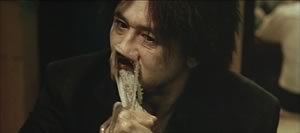
Maybe that’s the problem. Wild films don’t get nominated for Academy Awards. True, wild performances do, but even satanic Jack probably wouldn’t eat a big live squid (as does the hero of Oldboy, right). Long ago Taxi Driver inspired Hong Kong filmmakers to push harder, but instead of replying in kind, Scorsese/Ballhouse leave it to B entertainments like Crank, Torque, Running Scared, and Domino to nudge Hollywood toward Asian extroversion.
Even more eagerly than The Aviator, The Departed embraces what I’ve called “intensified continuity.” (See Film Art Chapter 6 and The Way Hollywood Tells It, Part 2) In this style, conversation scenes feature very little movement of actors around the set. Performers sit or stand and deliver their lines in isolated shots (singles) or over-the-shoulder (OTS) setups. The visual stasis is compensated for by lots of cutting, camera movements, and tight close-ups.
The Departed has calmed Scorsese’s urge to track a bit, but that’s balanced by its over 3200 cuts. The result is an average shot length (ASL) of about 2.7 seconds. Not unusual for an action picture nowadays, but consider where Scorsese started by conning these ASLs:
Mean Streets 7.7 seconds
Alice Doesn’t Live Here Anymore 8.0 seconds
Taxi Driver 7.3 seconds
King of Comedy 7.7 seconds
Gangs of New York 6.7 seconds
The Aviator 3.6 seconds
Like his contemporaries, Scorsese has succumbed to the fast-cut, hyper-close style that has made our movies so pictorially routine, however well-suited they may be for display on TV monitors and computer screens and iPods. In 1990 he seems to have realized that he needed to pick up the pace. Of GoodFellas (ASL 6.7 seconds) he remarked: “I guess the main thing that’s happened in the past ten years is that the scenes [shots] have to be quicker and shorter. [GoodFellas] is sort of my version of MTV. . . but even that’s old-fashioned” (The Way Hollywood Tells It, p. 152). (For more on measuring ASLs, see the Cinemetrics site here.)
Speaking of editing: It’s blasphemy, but I’ve been long convinced that Scorsese’s films aren’t particularly well-edited. Look at any conversation scene, particularly the OTS passages, and you’ll see blatant mismatches of position, eyeline, and gesture. Spoons, hands, and cigarettes jump around spasmodically. In The Departed, Alec Baldwin somehow loses his beer can in a reverse shot, and in the swanky restaurant, it’s hard to determine if there are one or two of those towering chocolate desserts on the table.
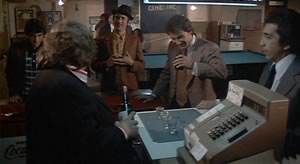
This may seem picky, but craft competence is not for nothing. Current reliance on tightly framed faces tends to sacrifice any sense of the specifics of a place. In most scenes, actors are so overcloseupped that little space is left for geography, even the mundane layout of a police station. Choppy cutting also subtly jars our sense of a smooth performance. Why can’t our directors sustain a fixed two-shot of the principals and let the actors carry the scene–not just with the lines they say but with the way they hold their bodies and move their hands and employ props? Scorsese, though always a heavy shot/reverse-shot user, held full shots to greater effect in earlier movies.
Space on a larger scale matters too. The atmosphere of Hong Kong was conveyed far more vividly in the original IA than the landscape of Boston is here. The most concrete locale seems to be a Chinatown porn theatre (filmed at New York’s Cinema Village). There’s also a gilded State House dome that is distressing in its lumpy symbolism. For more textured renderings of a parallel milieu, I’d recommend the comparatively overlooked State of Grace (1990) and The Yards (2000).
I’d love to join the applause that welcomes Scorsese back, but for these and other reasons I have to sit on my hands. For me, the inventiveness of the Asian tradition still reigns supreme in the crime genre. I grant that Infernal Affairs accepts the energy-aesthetic, with its swooping camera moves and its 3.2 second ASL. But the camera gives its actors room to breathe, and it spares some time to define a scene’s locale.
On a higher level of accomplishment stand Johnnie To’s The Mission, PTU, A Hero Never Dies, and half a dozen other films–very likely including the most recent, Exiled–along with the dazzling works of Kitano Takeshi and several other Asian directors. These are truly terrific.
P.S. 20 Oct 2006: This post on Scorsese’s Departed started a passionate and pretty discerning discussion over on Jim Emerson’s Scanners blog. You can read the thread, including my horrendously long comment, here.



