





Archive for the 'Film comments' Category
Two more to TANGO
The passionate Tarrians (Tarrophiles?) Gabrielle Claes and Jonathan Rosenbaum have written me after my note on SATANTANGO. Gabrielle points out that the film won the L’age d’or prize, an award given during the Belgian Cinemathèque’s annual Cinedécouvertes festival. In the spirit of Bunuel’s classic, the award is given to films that challenge and disturb accepted notions of cinema. The festival, held the first two weeks of every July, is wonderful as a whole, too. It was here that I saw my first films by Kitano, Kiarostami, Hou, and many other directors I’ve come to love.
Jonathan points out that his essay on Satantango, which I mentioned was published in his book Essential Cinema, is also available online from the Chicago Reader site. This piece contains a lot of ideas and information, including background on the source novel.
TANGO marathon
David here:
How often do you get four chances to see a seven-hour-plus movie? In the late 1990s I went to two film festivals that were showing Béla Tarr’s Sátántangó (1994), and I missed it both times. Not that I don’t like long, slow movies, or that I wasn’t curious about a movie so many critics were praising, but at both events I needed to see other films, like old Hong Kong classics, that were scheduled opposite Sátántangó.
My third chance to see it was a variant of this situation. I was in Brussels at the Cinémathèque Royale watching Mizoguchi Kenji movies in preparation for what became Chapter 3 of Figures Traced in Light. I had the rarest Mizo of all, Aienkyo (The Straits of Love and Hate, 1937) on an editing table for a single day, and I knew that I would be watching it very slowly. (Normally a five-reel film takes me five to six hours.) But on the same day the archive was running Sátántangó.
What to do? I compromised and watched the first installment of Tarr’s film.
The first shot, now famous, was a stunner. Cows wander through the churned mud of a village square, amble slowly to the camera and then drift to the left, the camera sliding along with them. Eventually they shamble into the distance. All the while, hollow, bell-like chords throb on. Great cow ensemble performance and a dawdling, slightly ominous introduction to a strange world: I was ready.
What followed was nearly as impressive, with a deliberate pacing and attention to detail that overwhelmed the minimal story action. Light sifted through lace curtains, and grimy people in moth-eaten sweaters talked about a mysterious deal. In a remarkable sequence, running many minutes, the obese village doctor noted down his neighbors’ comings and goings. One shot had me gaping: the camera moves from studying a mangy dog through the window, then slips down to the doctor’s sketch pad and then follows him around the cramped bedroom with perfect fluency before returning to the window and revealing, in the distance, the repetition of an early action outdoors.
I had to leave.
I spent the rest of the day and a good part of the night in front of Aienkyo. Mizoguchi’s film hasn’t survived well, and the source material was as rainy with scratches as some scenes of Sátántangó are drenched in showers.
No regrets; the Mizoguchi was superb. But still….
Other chances came up: My friend András Bálint Kovács had sent me two VHS tapes of Sátántangó, and I bought a no-name DVD that turned out to be pulled from the same VHS source. But the lustrous black and white of the print I saw in Brussels made me feel vaguely dirty about watching the rest of the movie on video dubs.
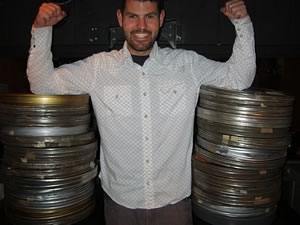
Intrepid projectionist Jared Lewis before screening the 26 reels of Sátántangó.
Photo by Tom Yoshikami So it was yesterday that I finally had my fourth chance to see Sátántangó, and Kristin and I grabbed it. Tom Yoshikami, our fine UW Cinematheque programmer, had wanted to bring it for years, but deals had fallen through until last spring, when a small Tarr package began to tour.
It would be presumptuous to talk with assurance about the film after only one pass (okay, 1-1/3 passes). I hope to read and think about it more. There’s a lot for me to assimilate, both in print and on the Internet. So far, I’ve benefited from Jonathan Rosenbaum’s influential discussion (and his early review reprinted in Essential Cinema, apparently not available online), Peter Hanes’ enlightening career survey of Tarr, some helpful Vancouver program notes, a thoughtful discussion at moviemartyr.com, and the anthology Béla Tarr (published by Filmunio Hungary in 2001 and already hard to find*).
A DVD from Facets is scheduled for release next month, and doubtless this will trigger many critical studies. In the meantime, here are some tentative comments and questions.
1. Although the villagers in Sátántangó are united within a common project (apparently) involving the sale of cattle, other characters only tangentially connected–the doctor, a little daughter of a local prostitute–are given a lot of screen time. So the film becomes a “network narrative,” in which various characters separated by various degrees thread their way through the tale. Oblique as it is, the film obeys the conventions of this form, often set in a town or neighborhood in which people know one another. Later the characters migrate elsewhere, but the script maintains the sense of tenuous connections among the characters, like the motif of the spiderweb that circulates through the second installment.
2. The overall structure of the film, split into twelve parts, apparently derives from Laszlo Krasznahorkai’s novel, as yet untranslated into English. Each section adheres roughly to one or two characters’ range of knowledge, and as a result several events during the first couple of days of the action get replayed, fitted together as we come to understand them somewhat more fully. (The exposition is pretty stingy, nonetheless.)
It’s interesting that the film was completed in 1994, the same year as network stories became prominent with Short Cuts, Chungking Express, and 71 Fragments of a Chronology of Chance, and that the replay-retrofitting tactic is seen as well in another 1994 release, Pulp Fiction.
3. The film’s pacing, very consistent in its solemnity, is accentuated by a soundtrack that is maniacally repetitive. The nondiegetic underscoring consists of drifts and whiffs of themes floating in the manner of ambient music, but more teeth-grinding is the clanging of a bell clapper in the third installment. Even cheerful music, like the accordion melodies played in the shabby tavern, rasp your nerves by being mindlessly reiterated. The endless dance in the pub, a spectacle of unimaginative drunken mirth, starts out amusing, becomes disturbing, and ends by being annoying. Maybe this is how they dance in hell.
As a minimalist film, Sátántangó seems to exploit what Minimalist composers like Philip Glass and Steve Reich have found: by pushing repetition to a limit, you can negate the sense of momentum and suggest that the action is hovering in a kind of pulsating stasis.
4. Did I say minimalism? The film consists, by my on-the-fly count, of 172 shots (including the chapter titles), across 434 minutes (not counting the final credits). That creates an Average Shot Length of about two and a half minutes. Quite a comparison with contemporary American cinema! Still, people who’ve actually seen the film probably expect the average to be much longer. (Angelopoulos’ The Hunters averages well over three minutes per shot.) Some shots of course run for many minutes, but others are fairly brief.
What sheer numbers don’t capture is the surprise of a relatively fast-cut scene coming quite early. In the second chapter, “Rise from the Dead,” Iremias and Petrina are interrogated by the Captain. This sequence of more or less orthodox shot/ reverse-shot comes as almost startling after several oblique, elliptical long-take sequences. The tight facial framings as the Captain enunciates his doctrine of freedom and order emphasize a central thematic issue. At the same time, Iremias’s deceptive air of innocence prepares us for the charisma he’ll project in relentless close-up as he delivers his quiet harangue over the dead body. He is, after all, named Jeremiah.
5. Tarr’s long takes, like the one in the doctor’s study which so captivated me years ago, are often virtuoso. What’s striking, though, is that the effects are achieved more through camera movement than through staging. Whereas Mizoguchi, Hou, Angelopoulos, Sokurov, and some others often move their actors around before a static camera, Tarr usually plants his people in one spot and lets the camera spiral around and over them. The camera probes a static space rather than records a shifting one.
True, the characters may advance or retreat from us, but I didn’t notice any of the delicate crossing of character trajectories, or the almost unnoticeable blocking and revealing of figures, that we get in the masters of ensemble staging. The most obvious movement comes when the characters set off down those endless roads or across the bleak plain, and then if the camera doesn’t hang reticently back (signaling the end of a shot or scene) it will retreat from their advance or follow patiently behind as the wind and rain lash them.
These shots are surprisingly open-ended. They could go on forever. They don’t anticipate a process of development and completion, as other directors’ long takes do, and they don’t climax in the sort of visual epiphanies beloved of Angelopoulos and Tsai Ming-liang. These directors like to build the take in stages, paying it off with a monumental spectacle (Angelopoulos) or a pictorial joke (Tsai). Tarr just charges ahead, without hinting how, when, or if, the shot will end.
Miklós Jancsó put the intricate choreography of actors and camera on Hungary’s film agenda, and his films, some consisting of fewer than thirty shots, become dizzying displays of panning, tracking, and zooming. Tarr, like many successors in any tradition, may be accepting certain premises of his elders (here the long take) but refusing others. He avoids Jancsó’s “maximalist” spectacle and turns toward something more spare, discomfiting, and attuned toward details.
6. One of the great accomplishments of the film is its tactility. Not only do you feel the blasting wind and constant drizzle, but you get to scrutinize the human face with an intensity that recalls La Passion de Jeanne d’Arc and Persona. If it did nothing else, Sátántangó restores the specific gravity of faces to a cinema that often forgets the weight of mottled skin, graying stubble, matted hair, and baggy eyelids.
And not just faces. Light streams through bottles and dingy glasses, reveals the smudges on an appliance switch, and traces the texture of torn sweaters and cracked buttons. Flies sweep into the shot and crawl over lapels. Objects reclaim their right to exist, refusing to cooperate with characters. When the conductor tries to lift a box onto his cart, it resists his first push and he tips it awkwardly into place. I’m reminded of film theorist André Bazin’s remark that Italian neorealism discovered a storytelling form that restored the concreteness and uniqueness of things in the phenomenal world, their obstinate refusal to fit willful human impulse.
One of Tarr’s most memorable shots coasts slowly along the body of the doctor, fallen to the floor in a stupor. We move from his face to his bloated middle, held in place by a shabby sweater, and then to his legs, finishing on the heels of his boots. As the shot ends we see a straw embedded in a clot of mud. No other boots in the world look like these.
The respect for trembling surfaces recalls not only Dreyer but Tarkovsky, supreme filmmaker of water and moist earth, and the Sokurov of The Second Circle and Whispering Pages. I’m reminded, more unexpectedly, of Aki Kaurismaki, who grants his paunchy, greasy-haired losers the integrity of living in tangible, unidealized bodies. At moments, the film’s grimly comic baring of human greed and gullibility recalls Kaurismaki, although he retains a certain optimism that I don’t find in Tarr.
7. The historian in me wants to know where this comes from. Few commentators mention that Tarr is part of a broader trend that includes György Fehér, who evidently makes rather similar films. His Passion (1998), screened for the 2001 session of the Society for the Cognitive Study of the Moving Image, is rather similar stylistically. It sets the situation of The Postman Always Rings Twice in a milieu as grubby and melancholy as that of Sátántangó, and its long-held takes (45 shots in about two hours) are less elegant, and carry some of the clumsiness of Feher’s overcoated, big-booted characters. At the same conference, Laszlo Tarnay of the University of Pecs also showed us a clip from Twilight (1990), which was to me even more impressive. Fehér was a producer on Sátántangó and worked with Tarr on other projects.
More broadly, it may be that Tarr, Feher, Alexei Guerman, and other post-Communist filmmakers have founded a new tradition of bleak, fine-grained realism that blends with challenging formal artifice in both image and sound.
8. There is so much to enjoy here that I hesitate to venture a qualm. I’m not yet convinced that the film needs to be so long! Some of the scenes, especially that showing the officers rewriting Iremias’s informing letter, seemed on my first look to be prolonged for the sake of filling out the pace. I’m also not sure that we need to see everybody walk into the remote distance. Moreover, I think the film (like, again, the work of Bergman, Sokurov, Tarkovsky, and so on) sometimes wobbles toward pretentiousness.
But these are very preliminary notes from a screening that was on the whole an exuberant experience. Not at all grueling!
Kristin and I went home, where I watched Inter-Pol 009, a 1967 Hong Kong James Bond imitation in lush color, with fast-cut gunplay.
It’s all cinema.
PS: Tarr has apparently resumed shooting an English-language feature with Tilda Swinton, The Man from London.
*But try the publisher: MONTAZS, Harsfa Útca 40, 1074 BUDAPEST; Tel: +36 1 461 0844; Fax: +36 1 461 0845.
Two talks
For over twenty years, our Film Studies program here at the University of Wisconsin–Madison has held weekly colloquia. Faculty, grad students, and anyone else who’s interested gather on Thursday afternoon to hear lectures or participate in panel discussions or sometimes just watch a film together.
The colloquium speakers are often guests. They might be scholars from other campuses; Rick Altman from Iowa kicked off this semester with a fine talk on sound in the silent era. Sometimes we get visiting filmmakers with new work, or archivists showing a restoration. Mike Pogorzelski of the Academy and Schawn Belston of Fox are frequent visitors, bringing some of their wonderful discoveries. Often as well grad students present a talk based on a seminar paper or their dissertation work, and sometimes faculty try out a new paper. My ‘transitions’ talk last week was a colloq presentation.
This week our colleague Jeff Smith gave a very intriguing paper on new ways of thinking about movie soundtracks. Jeff is the author of a major study of film music in the 1960s, and how it relates to the record industry of the time.
Jeff talked about how film theorists of the 1910s and 1920s had tried to draw analogies between a film and a musical piece. For these thinkers, cinema was less tied to theatre and literature than to music. This allowed them to repudiate the photographic realism that seemed to limit the camera to reproducing what was put before it. Theorists like Germaine Dulac, Jean Epstein, and Dziga Vertov wanted to push film beyond realism and so looked to the abstract art of music.
Jeff suggested that this analogy failed because the theorists’ conception of music was too limited to art music and nineteenth-century models. He proposed that a better analogy would be the more expansive conception of music that many musicologists hold now. Music now commonly includes spoken language, sound effects, electronically generated material, and purely ambient passages….all of which are much closer to the sort of mixtures we get in a film soundtrack.
He played examples from Brian Eno, Stevie Wonder, and other artists to back up the idea, and he also suggested that now a lot of musical composition was becoming more and more like a movie track. (John Zorn and Steve Reich come to mind.) It was a provocative idea and stimulated a good discussion, including comments from PhD students in music theory. Then we went to our bar, the Red Shed, for more fun.
Following a quick dinner, Jeff and I attended a packed lecture given by Philip Kitcher, the distinguished philosopher of science. The talk was called “Science, Religion, and the Difficulties of Democracy.” It was a thorough and careful treatment of larger issues behind the evolution vs. creationism conflict.
Kitcher distinguished three sorts of religious belief (providentialism, supernaturalism, and spiritualism) and traced out the extent to which scientific inquiry challenged each one. He argued that if scientific inquiry was to become the gold standard for reasoning–a belief he holds–then democracies are faced with the possibility of narrowing the freedom that they traditionally grant to unscientific systems of belief. That is, if the theory of evolution meets the highest standards of scientific accuracy, as it does, then a local community doesn’t really have full power to curtail its teaching in the classroom.
It was a compelling lecture, but the question period was even more riveting. Kitcher is a master of thinking on his feet, and he gave courteous, clear, and subtle responses to objections from the floor.
Days like this make me glad, and proud, to be part of a university. Eloquent and smart speakers addressing alert audiences are an irreplaceable part of higher education. Now that I spend more time in front of a computer monitor, it’s good to be reminded that colloquia and public lectures yield a unique pleasure: People meeting face to face to think together.
Great Danes in the morning
This morning I received my author’s copies of a superb book published by the Danish Film Institute, 100 Years of Nordisk Film. Nordisk was one of the world’s top producing and distributing companies in the 1900s and 1910s, and it continues today. This volume, edited by Lispeth Richter Larsen and Dan Nissen, is now the fullest account in English of this extraordinary firm.
There are essays by top scholars like Isak Thorsen, Marguerite Engberg, Stephan Michael Schroder, Niels Jorgen Dinnesen, Edvin Kau, Thomas Christensen, Casper Tybjerg, Ib Bondebjerg, and Peter Schelpern, and the illustrations are eye-popping. I contribute an essay on the aesthetics of Nordisk’s 1910s films, and my stills came out beautifully.
Many of the silent films discussed are available on DVD from the Institute, and they are extraordinary. If you want a sample, try the Asta Nielsen or Benjamin Christensen collection. These are amazing movies, and the Christensens offer remarkably inventive uses of cutting, lighting, and camera movement–very unusual for their day.
I don’t yet find a source for ordering the book online, but it will probably be available soon from the Institute’s bookstore. Danish cinema is one of the most exciting national cinemas in Europe right now; for coverage, have a look at their new homepage.
Addendum to an earlier post: Industry sage and entertaining skeptic David Poland of The Hot Button calls foul on Gladwell’s New Yorker piece on the Epagogix software–you know, the one purporting to predict hit movies. Thanks to Sean Weitner of Flak Magazine (itself highly recommended).