






Archive for the 'Film comments' Category
Who the devil wrote it? (Apologies to Peter Bogdanovich)
From DB:
Every so often we’re told that the real “author” of a film is the screenwriter. What do we make of this?
I think I first heard this idea in 1966. It was already old then. Publishers had for some time brought out books of screenplays, treating them as literature (e.g., the James Agee scripts) or as the ur-form of the film in the days before home video (John Gassner’s Twenty Best Film Plays). Responding to Andrew Sarris’ auteur theory, Richard Corliss wrote The Hollywood Screenwriters in 1972. The book was organized in a fashion parallel to Sarris’ trailblazing The American Cinema, ranking screenwriters and suggesting their recurring thematic concerns. But it had nothing like the impact of Sarris’s account of directorial differences. Once Corliss became a critic for Time, he did what everybody else did: attributed the goodness or badness of a film primarily to the director and barely mentioned the screenwriter.
Ever since then, the notion has resurfaced periodically, usually with an air of thunderous discovery. David Kipen subtitled his book The Schreiber Theory boldly, too boldly: A Radical Rewrite of American Film History. The idea is recycled in Joe Eszterhas’s new book The Devil’s Guide to Hollywood: The Screenwriter as God! (St. Martin’s Press). Beyond the scurrilous gossip and thumbnail advice he offers, Eszterhas claims that the screenwriter is the key creative individual in movie making. He denounces the auteur theory, which assigns artistic control primarily to the director, and he constantly asserts that no great movie was ever made without a great screenplay.
Eszterhas does grant that when a director writes the script him- or herself, that justifies the auteur theory. But when the director works from a script by another hand, the prime mover isn’t in doubt.
You’re the storyteller, not the director. . . . If anybody in your presence refers to the director as a “storyteller,” deck him (or her).
In musical terms, you are the composer; the director conducts the orchestra.
This idea poses a lot of problems.
Many films need no script. Consider Ballet Mécanique, Oskar Fischinger’s work, Tony Conrad’s Flicker, Ernie Gehr’s Serene Velocity, Andy Warhol’s Haircut, Lewis Klahr’s Two Minutes to Zero Trilogy, and many, many others in the avant-garde or experimental filmmaking tradition. Eszterhas’s claim would apply only to fictional mass market cinema—that is, the movies at the multiplex. But even then there are difficulties.
First, in principle we could have a mainstream movie that was completely unscripted. Maybe the directors and actors and crew cooked up, day by day, a series of scenes in which the dialogue was improvised. Maybe they shot at a 100:1 ratio and carved out of the footage a recognizable, ordinary film. We’d then have something that we’d accept as a passable movie without there ever having been a script.
Granted, this is very unlikely to happen, and it’s probably even more unlikely to result in a good movie. Perhaps the closest existing example is the working method of Wong Kar-wai, who writes his scenes day by day and shoots them more or less off the cuff. Gradually, he compiles enough material to assemble a film. The practice can cause anxieties for his collaborators, and there’s certainly a lot of wasted time and footage, but the results certainly pass muster. Even if you don’t buy the example, it remains possible in principle to make an acceptable mass-market film without a script.
There are more complicated theoretical issues too.
If we all agree that a movie consists of images and sounds, not words on a page, then Eszterhas’ analogy with music fails. In the Western concert tradition, the score captures key features of the identity of a piece. A musical score is written in a more stringent notational system than the language of screenplays. There isn’t a one-to-one relationship between what’s written in the script and what shows up on the screen. The sounds and moving images aren’t specified by the screenplay to the degree that performances of Sibelius’ Fifth Symphony are specified by the score.
The screenwriter writes: “An office.” But the director and the cinematographer and many others must specify how that office looks, the style of the furniture, the way light strikes the surfaces, the position from which the camera sees the action, and hundreds of other factors that shape the image. No one could write all these details into a screenplay. Even if he or she tried, any item could always be construed in a different way when the image is created. Is the desk the shade of brown that the screenwriter envisioned? Are the lampshades the same size?
No prose description of any chunk of reality can uniquely specify the layout of objects and all the patterns of light, color, and shape. By the same logic, no screenplay can exhaustively pre-plan the movie image.
What about dialogue? Much the same holds true as for the image. Even if an actor says the writer’s line word for word as written, it can be delivered in many different ways. And of course facial expression, stance, gesture, and all the other physical components of performance are visual, and can’t be singularly specified any more than our office setting.
Here’s a thought experiment. Give four directors the same script. I think that we intuitively believe that the result would be four substantially different movies, even if all scenes were retained, no new ones were added, and not a line of dialogue was altered. Consider as a rough but intriguing example Michael Mann’s TV movie LA Takedown (1989) redone as Heat (1995). There are enough similarities to allow us to see how different two realizations of a scripted scene can be, even in the hands of the same director.
So the words on the page may be transmuted into images and sounds in an indefinite number of ways. Mass-market film production is a process of constant revision: the shooting transforms the script, and then editing and sound work transform the footage.
Someone could reply that the film script is more like the script for a theatre piece. A play can be realized in many different versions, or productions, but we consider the playwright the true author. And we do call a script a screenplay, a play for the screen. So forget the analogy to music. Maybe the film director is like the stage director, and the screenwriter is the true author. We talk of Shakespeare’s Macbeth in, say, Jonathan Miller’s production, so why don’t we speak of Joe Eszterhas’s Showgirls in Paul Verhoeven’s production?
Again, though, we don’t need a script to put on a theatre piece. There are improvised plays, standup comedy routines that grew organically without ever being committed to paper, and commedia dell’arte performances that rely on tradition, not playscripts. Further, for many traditions, the unique identity of a play rests in its text, which must be followed more or less strictly. You can stage Macbeth on the flying trapeze or underwater, and it’s still Macbeth. But if you rewrite the dialogue or add scenes and characters, you’re not doing Shakespeare’s Macbeth any more. Staging a play doesn’t revise the script, as filmmaking does, but rather embodies it.
A movie script can’t uniquely identify what image or noise or passage of music should be presented on the screen. A play script can’t determine every detail of production either, but in many theatrical traditions the script has become the sine qua non of the production. What is inviolate is the text, the speeches; the director has some leeway in handling the stage directions.
A screenplay isn’t a blueprint or road map, let alone something like a musical score. It’s not even as integral as a play text. At best it’s an approximation, a set of suggestions. To borrow from Pirates of the Caribbean: It’s more in the nature of guidelines, really.
Making a film in the mass-market cinema is a series of constant revisions and rethinkings. One script may be revised by another screenwriter, and the result of that may be revised by a team of other writers. By the time The Script reaches the shooting phase of production, it’s often already a collective product. The revision process continues right to the end. Anything in the shooting script may be tossed out if something more fitting is discovered in the course of shooting, editing, and sound design.
In many cases the person supervising such discoveries is the director. This isn’t to deny writers an important role in the creation of a film. All participants contribute something, and scriptwriters contribute a lot. But it seems that in movies made the Hollywood way, the role of the director is in principle the crucial one in coordinating all the inputs and creating something coherent.
In practice, of course, the role may be filled by many individuals. For any particular case, the director may not have the ability or authority to fill the role, and other individuals can assume it. In such cases, we could say that the producer took over when the director left the project, or the star grabbed control of the scene from the director, and so on.
In fact, we do tend to say such things. Which suggests that deep down, there’s a little bit of auteurist in all of us.
Area Man Lives in Fear that Attractive Woman Will Ask What’s on His iPod
DB here:
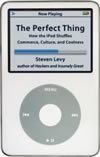
I’ve enjoyed Steven Levy’s technology books since Insanely Great, his (highly favorable) history of Apple. His newest one, The Perfect Thing: How the iPod Shuffles Commerce, Culture, and Coolness is a smooth ride, letting us in on the creation of the gadget, the rising power of iTunes, and the mesmerizing mystery of iPodolatry. I learn from Levy that people dress up their iPods, mourn their passing when the batteries die, and use them to meet strangers.
I was dimly aware of this last winter. I was sitting in my office and saw a young guy in the hall outside waiting for a class to start. He was watching a video on his pod and two young women came up to him. “Oooh, is that a fifth-generation iPod?” He showed it to them, and soon going out for coffee with them took precedence over going to class.
iPods invaded our house in two waves. Kristin goes to an Egyptian dig site in Amarna every year, mostly to work on registering statuary fragments, and as soon as she learned of Steve Jobs’ latest brain child, she wanted one. Now she could listen to her favorite music while standing for hours at a work table. I gave her a first-gen iPod for Christmas, and our computer assistant Brad Schauer helped her load it up with Handel, Mozart, and Vivaldi, mostly operas. She’s taken it over with her on every trip since.
I had no interest in listening to music as I moved through the world. I had tried a DiscMan long ago, but I didn’t like feeling insulated from the sounds around me. During travel, especially plane trips, I read. But when the video iPod came along, I thought that it had possibilities, so last winter I got one, the big mama with lots of GB.
By having Brad load Kristin’s baby, I now realize, I missed part of the fun: picking out what you’ll put on and arranging items into playlists. I also met with frustration. I hadn’t realized the dominance of pop music as a paradigm for all music until I bumped into iTunes. Of course it had no trouble with my boomer tracks (Burt Bacharach, the Drifters, Sam Cooke, etc.). But the program didn’t like art music. It chopped up operas so that little gaps appeared between tracks that should flow seamlessly, and it couldn’t read my old and obscure CDs. At one point, iTunes decided that all my Sibelius symphonies should be arranged by movement, so it grouped together seven first movements, seven second movements, and so on.
Reinstalling and upgrading the program, as well as setting up playlists, eventually solved these problems. Now my Mahler plays seamlessly and my Björk has the right pauses between songs. I still listen more seldom than most podders; not when walking around the world, mostly just in airports or in hotel rooms. More enticing has been the video function.
I’m a purist about moving images. I like movies on big screens, and grudgingly accept watching them on a tv monitor for convenience. I don’t much care for the look of images in home theatres; a lot of people, having invested so much in these behemoths, seem unable to see how mushy and artifact-ridden their systems are. (When I complained to a friend, he responded: “I like video artifacts the way you like grain.”) I often use a TV or computer monitor to study a film, but I very seldom watch a movie for the first time on a computer or other tiny display.
But my video iPod…well, I don’t love it or worship it, but I do admire and respect it and like to hang around with it.
Part of the attraction is, as Levy talks about at length, is the cool mystique of it. It is a good object. Its subtle heft and operating ease make it a pleasure to fondle. Then too, the very idea of it is entrancing. How can something so small store so many things that matter so much to us? But there’s another factor at work in the video iteration. I think that iPods also make the film viewing experience intimate in a way that other media don’t.
Levy talks about how Sony erred when it built two earphone jacks into the first Walkman. Morita believed that people would want to share the music with a friend. Wrong. Levy points out that it was all about privacy, about enclosing you in a bubble cut off from social interaction. Likewise, nobody can really watch your video iPod with you. It’s a little world addressed to you alone.
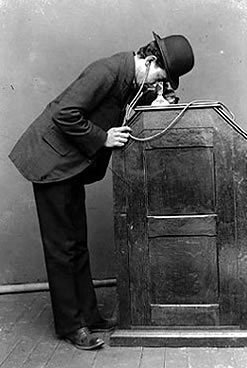
iPod version 0.0
In some ways we’re going through a period in which our audio-visual media are looking back to earlier forms. With multiplexes and Imax, big screens and 3-D presentations have returned in force; you’d think it was 1953 again. Similarly, the iPod rediscovers the Kinetoscope, Edison’s early peephole film system. Most were silent, but some were equipped with sync sound. You plugged in earphones, peered through a slot, and cranked a long film loop through. It was an arcade attraction without much of a future; large-scale success came to the system that projected images for a crowd. Now, however, we can have a portable Kinetoscope, and the fact that it’s at our command (stop, go back, skip over, shuffle) probably makes it all the more mesmerizing.
For the most part, I don’t watch fiction films on my iPod. I watch documentaries, most repetitively Adam Curtis’s The Power of Nightmares, one of the great docs of recent years. I don’t watch TV at home, but I catch up with shows like The Shield and The Wire via my iPod. I watch some YouTube clips, especially the Two Chinese Students (aka Back Dorm Boys), which always give me a lift.
But I confess I’ve also put on films that work, for me, like favorite music. These are films I know well and love to look at in idle moments. I play the reconstruction of Eisenstein’s Bezhin Lug, with stirring Prokofiev audio extracts; Les demoiselles de Rochefort; Feuillade’s Fantomas; Akerman’s Golden 80s; Lang’s Spies; episodes of Twin Peaks. Except for the Demy, all fit nicely in the 3×4 window. All lift my spirits.
Cooler people download Lost or store their pictures or swap playlists with others, but my needs are more prosaic. This digital version of peephole cinema supplies me with comfort food.
ArtTalk brewing in Milwaukee
David here:
At a yard sale you find a really nifty yellow ray gun. You had one just like it when you were six. You loved that ray gun. Your hand tingles as you heft this one. It evokes memories of you and your pals playing in the schoolyard.
It’s only $2.50. You buy it.
When you get home, you examine it closely and find that it’s a brand-new replica, made by a company that specializes in retro toys. Suddenly you don’t like it so much.
But why? It’s identical to the ray gun you owned. It’s made from the same plastic and in the same colors. It’s definitely in better condition than an original would be. So why do you feel dissatisfied?
This is the sort of question philosophers of art ponder, though they usually put it more abstractly. Art, we might say, is about appearances–the way something looks (or sounds). People enjoy Leonardo’s Mona Lisa because of the way it looks. If an artist today could make a perfect copy of the Mona Lisa, right down to the individual brush strokes, then that copy should be as enjoyable as the original. Yet a lot of people have the gut feeling that today’s copy somehow can’t offer the same experience as the original.
So aestheticians ask whether there is more to the enjoyment of art than just the appearance of the work. Maybe part of our experience of art involves our sense of the history of art works, an appreciation of where they came from and what they’ve been through. Such a sense isn’t just background information but an integral part of the properly aesthetic experience we have.
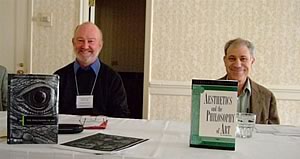
The authors and their books.This was one of the themes that surfaced regularly in my stay at the annual convention of the American Society for Aesthetics. (My first blog on this event is here.) There was a tribute to Arthur Danto, who formulated this problem twenty-five years ago in his trailblazing book The Transfiguration of the Commonplace. (He coined the term “indiscernibles” in his discussion of Andy Warhol’s Brillo boxes.) The day after the Danto session, a panel discussion of two new introductory textbooks, Stephen Davies’ Philosophy of Art and Robert Stecker’s Aesthetics and the Philosophy of Art, raised issues that intersected with this concern.
Both Davies and Stecker discuss how recent conversations in the field move toward the idea that our experience of a picture or poem or play brings into play assumptions about the work’s historical existence. As I understand it, this is one of the differences between traditional aesthetics, concerned with apprehension of beauty as something immediately apparent, and philosophy of art, which asks about all the factors that go into our understanding and enjoying art.
By the way, this panel was punctuated by hilarious comments throughout. Philosophers definitely have a sense of humor. One of the panelists, Ted Cohen, has even written a philosophical study of jokes.
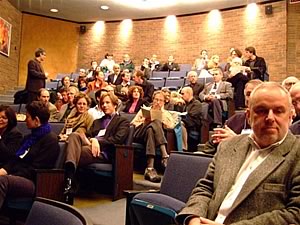
Part of the crowd for Carolyn Korsmeyer’s ASA presidential address.
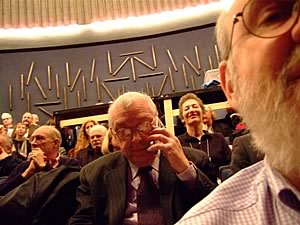
Curtis Carter, Director of the Haggerty Museum, with Professor Stephanie Ross behind. The theme of indiscernibles was central to the fascinating talk by ASA President Carolyn Korsmeyer of SUNY–Buffalo. She argued that genuineness isn’t just a property we add on to artworks that beguile us. Central to the experience of many artworks is the sense of what she called age value, a “palpable contact with the past.” Her examples ranged from historic “reconstructions” of public spaces (e.g., the Erie Canal terminus in Buffalo) to recipes that include non-synthetic ingredients.
How far can we get from the original? Professor Korsmeyer plotted out a continuum, starting with a worn original through stages of repair (using glue from the same period, say, to patch up a cathedral window), restoration, rebuilding, and replication (making a copy in a comparable substance) to end in multiple reproduction (a photo of the Mona Lisa). As we go along the continuum, the age value decreases and what we can appreciate narrows ever more to surface qualities. We move, she suggests, toward “aesthetic deception,” where we risk losing the original altogether. That’s what happened at the yard sale with your ray gun.
The talk set me thinking about how cinephiles appreciate the various versions of films we encounter. Would you rather watch a 1941 35mm print of How Green Was My Valley, a recent 35mm print from the negative, a version taken from the restored negative, or a DVD reproduction? An original, which Kristin and I have seen, can be unbelievably beautiful. Shot on nitrate stock, it has a luster and a fine grain that isn’t captured on safety stock, which came into use after World War II. (Projectionists accustomed to the sharpness of nitrate claimed that safety film was soft and hard to focus.) So there were definite aspects of sheer appearance that contributed to our enjoyment of the film.
But the print of How Green that we saw was a bit worn, with scratches and missing frames. Can we argue that these added age value? Did our knowledge that this was a print that might have been watched by a 1941 audience deepen our sense of the film’s worth? Likewise, even if a sparkling, cleaned-up DVD could adequately capture the look of the nitrate original (it can’t), does its distance from the original take away some of the film’s appeal?
I’m tempted to answer yes, but it’s hard to generalize. Who’d prefer an original, faded-to-pink print of a 1950s Eastmancolor movie to a DVD copy with the colors more or less restored? The pink puts us all too palpably in contact with the past, but what it adds in age value overrides what it takes away in surface qualities.
And sometimes cases are just mixed, I think. For some years I had access to an original Technicolor release print of The Godfather. I loved watching it because the color was never approximated in any other versions I’d seen: the dreadful rereleases, the laserdiscs, even the different DVD versions. Kay’s Republican topcoat lost its ripe light burgundy color in all the video versions.
But at the same time, I was perpetually shocked by how grainy the original Tech print looked. Gordon Willis’s famous enveloping blackness was teeming with grain. (He really pushed the film stock, it’s evident.) The newer prints and the anamorphic DVD versions yield a smoother texture. The film’s harsh graininess is part of age value, but even if the restoration seems guided by contemporary tastes (in this case, our fondness for crisp digital imagery), you could argue that purging the grain enhances the film’s visibility, and hence its sensuous appeal.
The issue is about to crop up again. I learned from the film cadre at ASA that we’re about to get yet another version of Blade Runner, some final director’s cut, in both theatrical and DVD release. Again, I had access to a 35mm print of the original theatrical version, complete with voice-over and enigmatic origami unicorn. That print was monophonic and fading. But the original theatrical version was evidently never released on video or re-released theatrically,so the print has purely documentary value.
There’s more, however. Call it fetishism or nostalgia, but watching that crummy print made me feel I was in contact with Blade Runner as a historical entity, the thing that people (too few) saw back in June 1982. So I think there’s something intuitively right about the philosophers’ idea. Maybe André Bazin anticipated this argument when he argued that when we look at photographs, our knowledge of their origins is an inescapable part of their beauty.
Professor Korsmeyer’s talk took place on the Marquette University campus, and was followed by a reception at the lovely Haggerty Museum there. The museum was hosting a screening (on video) of Hockey Seen, a multimedia dance piece by philosopher Nelson Goodman, and several artists, including the composer then known as John C. Adams. The fact that a philosopher collaborated with several artists on the work seems a good emblem for the goal of the American Society for Aesthetics. These philosophers stay in close touch with the subjects they ponder–art, artists, and audiences.
Seen in a Milwaukee T-shirt shop:
Guns don’t shoot people.
Dick Cheney shoots people.
Milwaukee: Philosophers turn arty
Today the Virginia senatorial campaign seems to revolve around whether you reveal yourself to be a bad person if you write a novel with disturbing or naughty scenes. It’s the sort of question routinely considered, more dispassionately, by the members of the American Society for Aesthetics. The Society consists mostly of professors, mostly of philosophy, who try to understand the most basic principles of how art works. I’ve been at their annual conference in Milwaukee since Wednesday night.

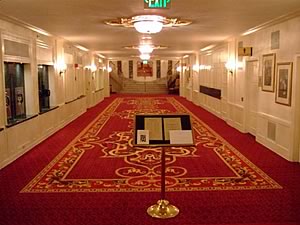

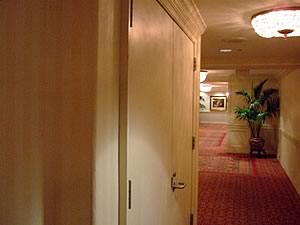
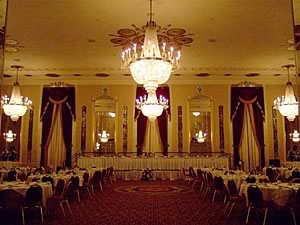
The Milwaukee Hilton Hotel
The event is held in the Hilton, an opulent building finished in 1928 (that is, just before opulence went away for quite a while). It’s an overpowering, somewhat eerie place, a little like the hotel in The Shining. Chandeliers hang from high ceilings. Corridors stretch on forever, silent and empty. Around any corner you may find a painting, a throne, or a signpost pointing you in several directions. You don’t exactly get lost, but the sheer size of the place, along with the occasional touch of Midwestern kitsch, suggests Last Year at Marienbad redecorated to suit the Amberson family. The same aesthetic principles, blown out to a more humungous scale, gave us The House On The Rock, one of Wisconsin’s great contributions to grassroots Dada.
In my first day here, there were intriguing papers and discussions. I couldn’t go to all of them, but I did visit a session on artistic genius. Peter Kivy’s paper, “Mozart’s Skull,” argued that an artist we acclaim as a genius raises some problems for ordinary mortals. Genius disturbs us, especially genius in very young people, like the prodigy Mozart. Genius is also very mysterious; we don’t know how someone like Mozart could produce so much music of such high quality—indeed of perhaps the highest quality in the Western art-music tradition.
Kivy believes, as I understood it, that genius is a real quality that we can’t explain by trends in taste or strategies of careerism. He castigated what he called “political deconstructionists” who want to deny that genius exists. In his account, they try to show that praise for gifted artists is actually PR: the reputation is constructed by historical circumstances and has nothing actual at the center. Kivy insisted that, regardless of how his career was promoted, Mozart was truly gifted by orders of magnitude beyond nearly all composers. So how to explain those gifts?
Kivy suggests that genius is a mystery that we may never be able to solve. He compares his argument to one floated by philosopher Colin McGinn, who suggests that consciousness is the sort of problem that we may never resolve, because it’s just not in the cards for creatures like us. That’s not to say that the explanation would be supernatural, as if, say, Mozart was truly kissed by God. (The play and movie, Amadeus, use his middle name to play with this possibility.) Maybe there are non-supernatural factors that create a genius; but we might not ever be able to detect them.
The questions raised in the discussion period were fascinating, with a couple of people saying that one could study how Mozart’s reputation was constructed through social institutions of the time without denying that the basis of the reputation was the genuine excellence of the music. Another listener pointed out that Mozart’s reputation is something of a special case. He was praised and understood instantly, but the music of the late Beethoven puzzled people who had acclaimed his earlier work; it took later generations to see the “genius” embodied in the Ninth Symphony and the late string quartets. Maybe the standard of genius does indeed change with time.
I began to muse over whether we cinephiles ever talk about great filmmakers as true geniuses. Even the directors that are most admired across film history—Renoir, Ozu, Welles, Hitchcock, Dreyer, Eisenstein, Hitchcock, etc.—don’t usually get called “geniuses.” Perhaps this way of talking about artists is part of a classical-art tradition that film never joined…or came too late to join.
A longer session was devoted to comments on my old friend Paisley Livingston’s book Art and Intention. I’ve mentioned this book elsewhere on this site, and it seems to me a remarkable attempt to show how an idea of intentional action can help explain creative processes in art. For students of film, his ideas about collective artistic creation—several people pooling efforts to make a film or some other work—are particularly interesting. In this panel, several other distinguished philosopher of art analyzed, praised, and criticized the views expressed in the book.
That night, after my own talk on early CinemaScope, we went to a reception at the lovely Milwaukee Institute of Art and Design. (Animator Bill Plympton will be visiting it soon.) Across the evening, I met several people keenly interested in cinema–actually, who isn’t? Our talk about movies went on for a long time, continuing in a pub in the hotel. There was a reunion of former Madison philosophy students, all protégées of Noel Carroll, and it was fun to talk movies with them. I don’t think I convinced them that Tom Cruise and Keanu Reeves are excellent screen actors, though they were more sympathetic to my case for Sandra Bullock.
Next day I skipped the ASA sessions to go book-hunting with Paisley. Among other stops, we visited the Renaissance Bookstore, another Wisconsin monument. Several stories high, the collection of old books and magazines is monumentally daunting. This is where all books go to die, in dust. Still, I found mysteries by my new passion, George V. Higgins. Earlier that day, I picked up Scott McCloud’s Making Comics, which looks like a worthy successor to his superb Understanding Comics and his followup, Reinventing Comics. Film scholars can learn a lot from comic art (graphic novels, comic strips, etc.), and McCloud is the best guide to the aesthetics of comics I know. Come to think of it, he should be invited to the next ASA convention. . . .