






Archive for the 'Film comments' Category
Unsteadicam chronicles
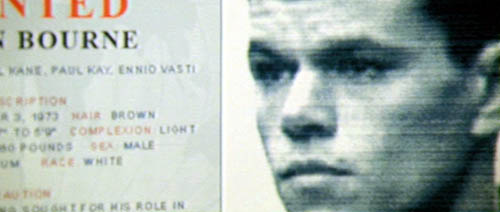
DB again:
A spectre is haunting contemporary cinema: the shaky shot.
Viewers have been protesting for some years now. I recall friends asking me why the images were so bumpy in Woody Allen’s Husbands and Wives and Lars von Trier’s Dancer in the Dark. The Bourne Ultimatum, this summer’s wildest excursion into Unsteadicam, has put the matter back on the agenda.
If you drop in at Roger Ebert’s website, you’ll find many annoyed comments from readers about what one calls the Queasicam. The writers make shrewd points about the purpose and effects of director Paul Greengrass’s technique. I’ll try to add some historical perspective and a little analysis.
From whose Bourne no traveling shot returneth
First, what exactly are we talking about? Some viewers and critics think the jarring quality of the movie proceeds from rapid editing. The cutting in Bourne Ultimatum is indeed very fast; there are about 3200 shots in 105 minutes, yielding an average of about 2 seconds per shot. But there are other fast-cut films that don’t yield the same dizzy effects, such as Sky Captain and the World of Tomorrow (1.6 seconds average), Batman Begins (1.9 seconds), Idiocracy (1.9 seconds), and the Transporter movies (less than 2 seconds).
As for the series itself, The Bourne Identity, directed by Doug Liman, was edited a tad slower, averaging 3 seconds per shot. The second entry, The Bourne Supremacy, also signed by Greengrass, was as fast-cut as this, coming in at 1.9 seconds. People noticed the rough texture of the second one, but it didn’t arouse the protests that this last installment does. Something else is up.
Partly, it’s not the pace of the editing but the spasmodic quality of it. Cuts here seem abrasive because they interrupt actions and camera movements. Pans, zooms, and movements of the actors are seldom allowed to come to rest before the shot changes. This creates a strong sense of jerkiness and visual imbalance.
Still, a lot of the film’s effect has to be laid at the handheld camera. The technique in itself, however, shouldn’t shock us. The handheld aesthetic has been with us a long time. There were silent-era experiments with the technique by E. A. Dupont (Variety, 1925) and Abel Gance (Napoleon, 1927). It recurred sporadically after that, but in mainstream cinema handheld shooting became common in 1960s films as different as The Miracle Worker, Seven Days in May, Dr. Strangelove, and the dramas of John Cassavetes. Today, many films from Asia and Europe as well as the US rely on the device all the way through. The Danes call it the “free camera,” and I write about it here. The trend is so widespread that it’s been satirized: In the Danish comedy Clash of Egos (2006), when an ordinary workman gets a chance to direct a movie, he insists that the camera be put on a tripod, and the cinematographer complains that he hasn’t done this since film school. Directors nowadays tell us that they are in search of energy, a moment-by-moment spiking of audience interest. You can get it through fast cutting, arcing camera movements, sudden frame entrances, the nervousness of the handheld shot, or all of the above.
Roughhouse
I think the upsetting qualities of the visuals in The Bourne Ultimatum derive principally from the particular way the handheld camera is used. Several of Ebert’s writers complain that the camerawork made them nauseated, and there seems little doubt that the shots are bouncier and jerkier than in much handheld work. Adding to the effect is the fact that Greengrass often doesn’t try to center or contain the main action. Sometimes, as in a fight scene, the camera is just too close to the action to show everything, so it tries to grab what it can. At other times Greengrass pans away from the subject, or shoves it to the edge of the 2.40:1 frame. In the standard technique of over-the-shoulder reverse angles, we see one character’s shoulders in the foreground and the primary character’s face clearly. Greengrass likes to let a neck or shoulder overwhelm the composition as a dark mass, so that only a bit of the face, perhaps even just a single eye, is tucked into a corner of the shot. This visual idea was already on offer in The Bourne Supremacy.

In The Way Hollywood Tells It, I described contemporary films as employing “intensified continuity,” an amplification and exaggeration of tradition methods of staging, shooting, and cutting. (I explain a little about it in this blog entry.) What Greengrass has done is to roughen up intensified continuity, making its conventions a little less easy to take in. Normally, for instance, rack-focus smoothly guides our attention from one plane to another. But in The Bourne Ultimatum, when Jason bursts into a corridor close to the camera, the camera tries but fails to rack focus on his pursuer darting off in the distance. The man never comes into sharp focus. Likewise, most directors fill their scenes with close-ups, and so does Greengrass, but he lets the main figure bounce around the frame or go blurry or slip briefly out of view.
Essentially, intensified continuity is about using brief shots to maintain the audience’s interest but also making each shot yield a single point, a bit of information. Got it? On to the next shot. Greengrass’s camera technique makes the shot’s point a little harder to get at first sight. Instead of a glance, he gives us a glimpse.
Although this strategy is more aggressive in this third Bourne installment, we can find it as well in Supremacy. An agent pulls a document out of a carryon bag, and for an instant we can see the government seal. In the next shot the agent bobs in and out of the frame, as if the camera can’t anticipate his next move.


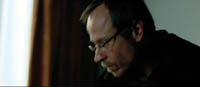
Later in Supremacy, the camera jerks across a computer display and suddenly focuses itself, evoking the jumpy saccadic flicks with which we scan our world.


Greengrass claims that his creative choices were influenced by the cinema-vérité documentary school and cites as well The Battle of Algiers, which helped popularize the handheld look in the 1960s. At other times he says that the style is subjective: “Your p.o.v. is limited to the eye of the character, instead of the camera being a godlike instrument choreographed to be in the right place at the right time.” But our point of view isn’t confined to what Bourne or anybody else sees and knows. The whole movie relies on crosscutting to create an omniscient awareness of various CIA maneuvers to trap him. And if Bourne saw his enemies in the flashes we get, he couldn’t wreck them so thoroughly.
The Bourne Ultimatum belongs to a trend of rough-edged stylization sometimes called run-and-gun. The film has been described as bare-bones but it’s actually quite flashy. All the crashing zooms (accompanied by whams on the soundtrack), jittery shots, drifting framings, uncompleted pans, freeze-frame flashbacks, and other extroverted devices call attention to themselves. You can find earlier instances in Oliver Stone’s Natural Born Killers and U-Turn, along with stretches in Michael Mann’s latest films. In milder form you find the style on display in TV crime shows, as well as in the notorious docudrama The Road to 9/11.
The most extreme practitioner of this style is probably Tony Scott. From Spy Game through Man on Fire, Domino, and Déjà vu, he has taken this aesthetic in delirious directions. His framing is often restless, as if groping for the right composition. In this shot from Domino, the camera starts a bit too far to the right, shifts left to frame Frances a little better, zooms back hesitantly, then finally stabilizes itself as he grins at the Motor Vehicles worker.

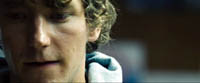

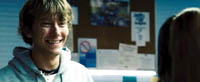
A single shot may give us not only changes of focus but jumps in exposure, lighting, and color; sometimes it’s hard to say whether we have one shot or several. The result is a series of visual jolts, as in Man on Fire.




Scott, trained as a painter, pushes toward a mannered, decorative abstraction, aided by long-lens compositions and a burning, high-contrast palette. For Supremacy, Greengrass adopted a toned-down version of Scott’s approach, while in Ultimatum, he favors drab surroundings and steely colors. Still, both men’s approaches to run-and-gun are frankly artificial, and both remain within the premises of intensified continuity. Of the Waterloo Station sequence Greengrass says: “It has got a sense of energy.”
The Bourne coverup
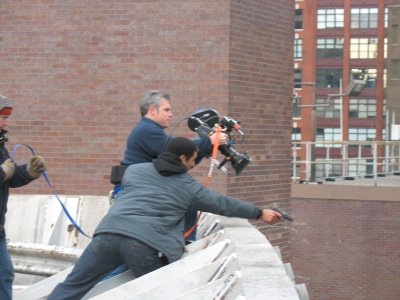
There’s one more function of Bourne’s style I want to consider. In an earlier post, I quoted Hong Kong cinematographers’ saying about the shaky camera. The handheld camera covers three mistakes: Bad acting, bad set design, and bad directing. It’s worth considering, as some of Ebert’s correspondents do, what Greengrass’s style may serve to camouflage. One suggests that because the cutting doesn’t let the viewer reconstruct the fights blow by blow, anybody can seem to be a superhero if the filming is flurried enough.
Just as important, the director who is just (apparently) snatching shots doesn’t have to worry about building up performances slowly; s/he can simply give us the most minimal, stereotyped signals in facial close-ups. Lengthier shots let the actor develop the character’s reactions in detail, and force us to follow them. Classic studio cinema, with its more distant framings and longer takes, lets you follow the evolution of a feeling or idea through the actor’s blocking and behavior. The villain in the average Charlie Chan movie displays more psychological continuity than the nasty agents in Bourne Ultimatum.
Moreover, run-and-gun technique doesn’t demand that you develop an ongoing sense of the figures within a spatial whole. The bodies, fragmented and smeared across the frame, don’t dwell within these locales. They exist in an architectural vacuum. In United 93, the technique could work because we’re all minimally familiar with the geography of a passenger jet. But in The Bourne Ultimatum, could anybody reconstruct any of these stations, streets, or apartment blocks on the strength of what we see? Of course, some will say, that’s the point. Jason himself is dizzyingly preoccupied by the immediacy of the action, and so are we. Yet Jason must know the layout in detail, if he’s able to pursue others and escape so efficiently. Moreover, we can justify any fuzziness in any piece of storytelling as reflecting a confused protagonist. This rationale puts us close to Poe’s suggestion that we shouldn’t confuse obscurity of expression with the expression of obscurity.
The run-and-gun style is indeed visceral, but let’s be aware of how it achieves its impact. I’ve argued in Planet Hong Kong that the clean, hard-edged technique of classic Hong Kong films allows extravagant action to affect us viscerally; by following the action effortlessly, we can feel its bodily impact. We’re shown bodies in sleek, efficient movement that gets amplified by cogent framing and smooth matches on action. But in the fancy run-and-gun style, cinematography and sound do most of the work. Instead of arousing us through kinetic figures, the film makes bouncy and blurry movement do the job. Rather than exciting us by what we see, Greengrass tries to arouse us by how he shows it. The resulting visual texture is so of a piece, so persistently hammering, that to give it flow and high points, Greengrass must rely on sound effects and music. As a friend points out, we understand that Bourne is wielding a razor at one point chiefly because we hear its whoosh.
What else does the handheld style conceal? Since the 1980s, in many action pictures the cutting has become so fast, and often capricious, that we can’t clearly see the physical action that’s being executed. That complaint is justified in Bourne Ultimatum, certainly, but here the style also seeks to make the stunts seem less preposterous. Instead of showing cars crashing and flipping balletically, Greengrass barely lets us see the crash. All the conventions of the action film are smudged in Bourne Identity, as if a sketchy rendering made them seem less outlandish. In a Hong Kong film, Bourne in striding flight, grabbing objects to use as weapons without missing a beat, would be presented crisply, showing him executing feats of resourceful grace. But many viewers seem to find this sort of choreography outlandish or cartoony. So when Bourne plucks up pieces of laundry and wraps them around his hands to protect them when he vaults a glass-strewn wall, Greengrass’s shot-snatching conceals the flamboyance of the stunt.
Finally, I’d argue that the style camouflages something else: plot problems. I’m not talking about the hero’s indestructibility, which is a given in this genre. John McClane in Die Hard 4.0 survives about as much mayhem as does Jason Bourne. But there are some howlers here that, because of the rapid pace and the just-barely-visible action, are somewhat muffled. By whisking the action past us and forcing us to keep up, the film doesn’t allow us to dwell on its holes and thin patches.
The plot, praised by so many, is actually a very simple one: Find Guy A, but when he’s killed, locate the clues that will lead you to Guy B, etc. until you get to Mr. Big. The mechanics of how the clues are pursued remain obscure. (Skip ahead to the next paragraph if you haven’t seen the movie.) Why would an all-powerful CIA operation house its key players in offices that can easily be watched from a neighboring building? How does Bourne get into Noah Vosen’s office, past all the security? Is the revelation of Bourne’s identity and his training regimen really much of a surprise? The wrapup, showing the bad guys exposed by the press and punished by government investigation, seemed risible, not only because of the current inability of either press or congress to right any wrongs, but because I had no idea to whom Pamela Landy has faxed the incriminating documents. “You can’t make stuff like this up,” remarks one sinister agency boss, but many, many films have done so.
I’m not against handheld styles as such, and even Late Tony Scott Rococo can have its virtues. Yet I find the style as practiced by Greengrass to be pretty incoherent and nowhere near as engaging as most critics claim. It just seems too easy. But then, I think that certain standards of filmmaking craftsmanship have pretty much vanished, and the run-and-gun trend is one more symptom of that. Given the praise heaped on The Bourne Ultimatum, however, things are unlikely to change. Next time you head to the movies, you might want to bring your Dramamine.
Thanks to Vance Kepley and Jeff Smith for engaging discussion about The Bourne Ultimatum.
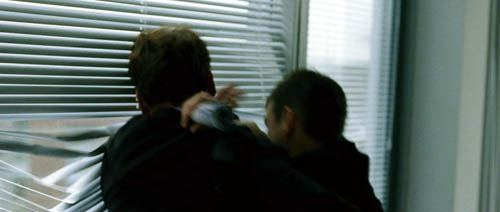
The Bourne Supremacy.
PS: I’ve done a followup entry on the Bourne series, elaborating on these points and adding some new ones.
PPS: One more, I hope final, cluster of comments on Ultimatum, this time on the plotting.
PPPS 5 January 2008: Spielberg weighs in on the Bourne style; thanks to Fred Holliday and Brad Schauer for calling my attention to this.
PPPPS 22 September 2008: This blog post and its mates have stimulated critical discussion in Spain. Manuel Garin has a lengthy piece on the Unsteadicam style in Contrapicado.
Bergman, Antonioni, and the stubborn stylists
DB here:
Jonathan Rosenbaum has created quite a stir. His New York Times Op-Ed piece, “Scenes from an Overrated Career,” offers a fairly harsh judgment on the films of Ingmar Bergman. In one sense the timing was awkward; the poor man had just died. But the article wouldn’t have attracted much attention if Rosenbaum had waited a few months, so if creating a cause célèbre was his goal, he chose the right moment.
Timing aside, there wasn’t much in the piece that hasn’t been said by certain cadres of cinephiles for decades. Back in the 1960s, people called Bergman “theatrical,” “uncinematic,” pretentious, and intellectually shallow. He was even accused of hypocrisy. His spiritual, philosophical films always seemed to depend on a surprising number of couplings, killings, rapes, and gorgeous ladies, often naked. Rosenbaum contrasts Bergman with Bresson and Dreyer, more austere religious filmmakers as well as great formal innovators, and this gambit too is familiar from late-night film-society disputes. Jonathan’s case is news in the good, grey Times, but it’s an old story among his (my) generation.
I think that this generational antipathy has many sources. While Bergman had considerable academic cachet, this may have hurt him with smart-alecks like us. Cinephile priests and professors told us that Bergman was a great mind, but we suspected them of snobbery, for they often disdained even foreign filmmakers who dabbled in popular genres. Kurosawa was admired for Rashomon and I Live in Fear rather than for Seven Samurai and Yojimbo. And many of Bergman’s intellectual fans despised the classic tradition of American studio film. Hitchcock had not yet convinced literature profs of his excellence, and Ford was a gnarled geezer who made Westerns. Bergman and his acolytes seemed just too square. Our money was on Godard, especially after Susan Sontag’s magisterial essay on him.
Furthermore, some critics were on our side. Pauline Kael, with her nose for elitism, mocked ambitious European experiments like Marienbad. Andrew Sarris, who had a huge influence on our generation, initially registered respect for the arthouse kings. They proved that an artist could put a personal vision on film, thus buttressing the auteur approach to criticism. But Sarris retreated fairly fast. He was more unflaggingly enthusiastic about American popular cinema, and by contrast he often characterized the new Europeans as gloomy, middlebrow, and narcissistic. (He did, after all, coin the phrase “Antonionennui.”) Sarris made it possible for us to argue that, say, Meet Me in St. Louis was a better film than L’Eclisse or Winter Light. (1)
Of course I’m generalizing; no Boomer’s experience was identical with any other’s. Speaking just for myself, I didn’t have a deep love for Bergman, and I still don’t. I was drawn to his early idylls (Monika, Summer Interlude) and impressed but chilled by the official classics (Smiles of a Summer Night, The Seventh Seal, The Virgin Spring). Persona, I admit, was a punch in the face. Seeing it in its New York opening, I felt that all of modern cinema was condensed into a mere eighty minutes. But no Bergman film afterward measured up to that for me, and after The Serpent’s Egg I just lost interest, catching up with Cries and Whispers, Scenes from a Marriage, Fanny and Alexander, and a very few others over the later decades.
We can talk tastes forever. Maybe you think Bergman is great, or the greatest, or obscenely overrated. I think that there’s something more general and intriguing going on beyond our tastes. What makes this hard to see is that the venues of popular journalism don’t allow us to explore some of the ideas and questions raised by our value judgments.
Critical semaphore
Take some of Rosenbaum’s criticisms, which Roger Ebert has persuasively answered. I’d add that Jonathan is sometimes applying criteria to Bergman that he wouldn’t apply to directors he admires. Bergman isn’t taught frequently in film courses? So what? Neither is Straub/Huillet or Rivette or Bela Tarr. Bergman is theatrical? So too are Rivette and Dreyer, both of whom Rosenbaum has written about sympathetically.
More importantly, Jonathan’s critique is so glancing and elliptical that we can scarcely judge it as right or wrong. A few instances:
*Bergman’s movies aren’t “filmic expressions.” There’s no opportunity in an Op-Ed piece for Jonathan to explain what his conception of filmic expression is. Is he reviving the old idea of cinematic specificity—a kind of essence of cinema that good movies manifest? As opposed to theatrical cinema? I’ve argued elsewhere on this site that we should probably be pluralistic about all the possibilities of the medium.
*Bergman was reluctant to challenge “conventional film-going habits.” Why is that bad? Why is challenging them good? No time to explain, must move on….
*Bergman didn’t follow Dreyer in experimenting with space, or Bresson in experimenting with performance. Not more than .0001 % of Times readers have the faintest idea what Jonathan is talking about here. He would need to explain what he takes to be Dreyer’s experiments with space and Bresson’s experiments with performance.
In his reply to Roger Ebert, Jonathan has kindly referenced a book of mine, where I make the case that Dreyer experimented with cinematic space (and time). Right: I wrote a book. It takes a book to make such a case. It would take a book to explain and back up in an intellectually satisfying way the charges that Jonathan makes.
Popular journalism doesn’t allow you to cite sources, counterpose arguments, develop subtle cases. No time! No space! No room for specialized explanations that might mystify ordinary readers! So when the critic proposes a controversial idea, he has to be brief, blunt, and absolute. If pressed, and still under the pressure of time and column inches, he will wave us toward other writers, appeal to intuition and authority, say that a broadside is really just aimed to get us thinking and talking. But what have we gained by sprays of soundbites? Provocations are always welcome, but if they really aim to change our thinking, somebody has to work them through.
I’ve suggested elsewhere that too much film writing, on paper and on the Net, favors opinion over information and ideas. Opinions, which can be stated in a clever turn of phrase, suit the constraints of publication. Amassing facts and exploring ideas in a responsible way—making distinctions, checking counterexamples, anticipating objections, nuancing broad statements—takes more time. Academics are sometimes mocked for their show-all-your-work tendencies, and I grant that this can be tedious. But we’re just trying to get it right, and that can’t be done quickly.
Now you know why our blog entries are so damn long.
This one is no exception.
Too often film talk slides from being film comment to film chat to film chatter. Even our best critics, among whom Rosenbaum must be counted, make use of a kind of rapid semaphore, signaling to the already converted. Evidently his ideal reader agrees that good cinema is challenging and experimental, directing actresses is a minor talent, and being admired by upscale Manhattanites is a sign of a sellout. Readers will self-select; those who have congruent tastes will pick up the signals. But these beliefs aren’t really knowledge. They’re just, when you get right down to it, attitudes.
I’ll try to explore just one of the issues Jonathan raises but can’t pursue: the question of how stylistically innovative Bergman was. Of course, I can’t write a book here either. I offer what follows as simply the start of what could be an interesting research project.
One stylistic arc
The rise of European arthouse auteurs in film culture of the 1950s and 1960s put the question of personal style on the agenda, but back then we didn’t have many tools for analyzing stylistic differences among directors. We didn’t know much about the local histories of those imported films; as Sarris recently pointed out, L’Avventura was Antonioni’s sixth feature but was his first film released in the US. Moreover, we didn’t know much about the norms of ordinary commercial filmmaking, in the US or elsewhere. (2) Today we’re in a better position to characterize what went on. (3)
In most countries, quality cinema of the late 1940s relied on variations of the Hollywood approach to staging, shooting, and cutting that had emerged in the silent era. Directors moved their performers around the set fairly fluidly and used editing to enlarge and stress aspects of the action. You can see a straightforward example of this approach on an earlier entry on this blogsite.
Many directors of the period built upon this default by creating deep space in staging and framing. Using wide-angle lenses, directors could allow actors to come quite close to the camera, sometimes with their heads looming in the foreground, while other figures could be placed far in the distance. Several planes of action could be more or less in focus. Here’s a straightforward example from William Wyler’s The Little Foxes.
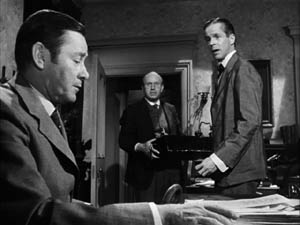
We find directors exploiting this approach not only in the United States but in Eastern and Western Europe, Scandinavia, the Soviet Union, Japan, Mexico, and South America. Here’s an instance from the French film Justice est faite (1950).
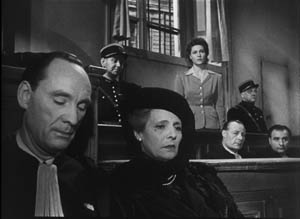
Why did this approach emerge in so many countries at the same time? We don’t really know. It wasn’t simply the influence of Citizen Kane, as we might think. The Stalinist cinema had developed deep-space shooting in the 1930s, and we can find it elsewhere. Probably Hollywood’s 1940s films helped spread the style, but there are likely to be local causes in various countries too.
In any event, during the 1950s two technological changes posed problems for this style. One was the greater use of color filming, which renders depth of field much more difficult. The other innovation was anamorphic widescreen, a technology seen in CinemaScope and Panavision. These systems also had trouble maintaining focus in many planes when the foreground was close to the camera. The flagrant depth compositions we find in black-and-white ‘flat’ films were quite difficult to replicate in color and anamorphic widescreen.
Through the 1960s, the deep-focus style became a minor option and directors found other alternatives to presenting character interactions. The most basic one was simply to station the camera at a middle distance and create a more porous and open staging, with fewer planes of action and simple panning movements to follow characters.
One new approach relied not on wide-angle lenses but on lenses of long focal length. Instead of staging scenes in depth, putting the camera close to a foreground figure, filmmakers began keeping the camera back a fair distance and using long lenses to enlarge the action. This accompanied a trend toward greater location shooting; it’s easier to follow actors on a street or highway if the camera shoots with a telephoto lens. The long lens also reduces the volumes of each plane, so that figures tend to look like cutouts (4). This lens facilitated the development of those perpendicular images I’ve called, in some writing and on this blog, planimetric shots.
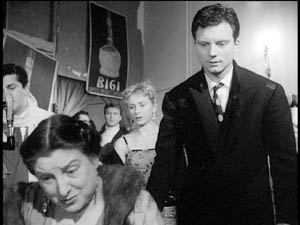
What fascinates me about this general pattern of stylistic change in the US is how many of the Euro auteurs go along with it. Take Fellini, who shifts from the bold depth compositions of I Vitelloni to the fresco-like flatness of Satyricon.
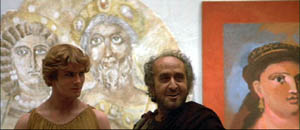
Likewise, Luchino Visconti’s early black-and-white work affords textbook examples of deep-focus cinematography, but in the 1960s he embraced the telephoto look, heightened by what we can call the pan-and-zoom tactic. In Death in Venice, the camera often scans a scene, searching out one player to follow then zooming back to reframe the figure in relation to others. One shot starts with the boy Tadzio, pans right across the hotel salon, to end on von Aschenbach, staring at the boy, and then zooming back to take in the larger scene.
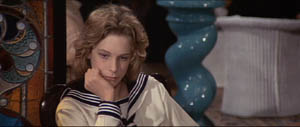
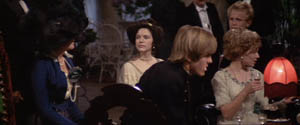
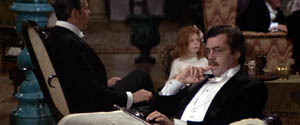
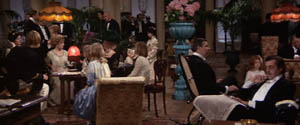
Probably Rossellini’s 1960s films, such as Viva l’Italia! and Rise to Power of Louis XIV, were key influences on this look.
Leaving Europe, there’s Kurosawa, who was the first major director I know of to build zoom and telephoto lenses into his style. Satayajit Ray followed much the same trajectory from the Apu trilogy’s flamboyant depth to the pan-and-zoom close-ups of The Home and the World. Not every filmmaker took the long-lens option, but as it became commonplace in the 1960s, many major directors tried it.
What about Bergman? It seems that in most respects he went along with the general trends. We find deeply piled-up bodies early in his career (e.g., Port of Call, below) and through the 1950s and early 1960s (The Face, below).
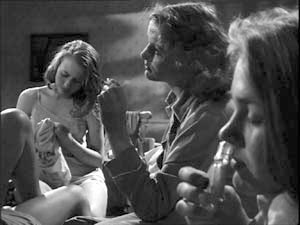
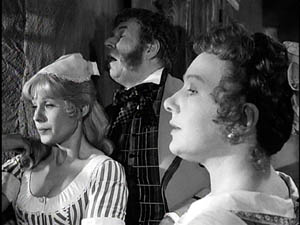
Like his peers, with color and widescreen he shifted toward more open staging, long lenses, and zooms. For example, one telephoto shot of Cries and Whispers zooms back as the little girl emerges, zig-zagging, from behind the lace curtain.
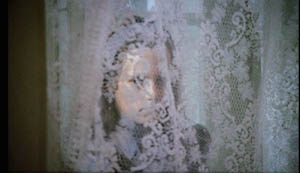
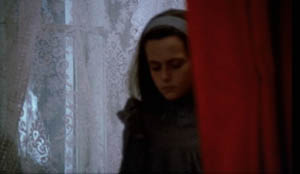
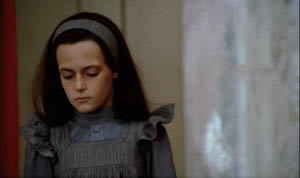
We might conclude that Bergman mostly worked with the received forms of his day. At the level of shot design, The Face might have been shot by the Sidney Lumet of Fail-Safe. But Bergman did innovate somewhat, I think. Most obviously, he sometimes had recourse to the suffocating frontal close-up, as in a childbirth scene from Brink of Life.
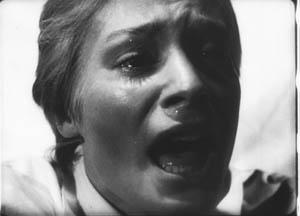
He develops this visual idea by creating heads floating unanchored in both foreground and background. Here’s a famous image from Persona.
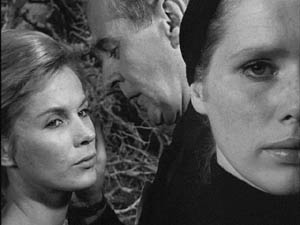
Pace Rosenbaum, I’d say that this sequence, with Elisabeth Vogler apparently quite oblivious to her husband’s mating with Alma, definitely “challenges conventional film-going habits”—or at least conventional ways we read a scene. It seems to combine the deep-space, big-foreground scheme of the 1940s with the tight close-ups of Bergman’s early work, and instead of specifying space it undermines it. We have to ask if what happens in the background is Elisabeth’s hallucination.
My case is very schematic, and we would need to study Bergman film by film and scene by scene to confirm that he stuck to the broad norms of his time. The norms themselves also deserve deeper probing than I’ve given them. (5)
But let’s push a bit further and examine Antonioni, that perpetual foil to Bergman. Broadly speaking, he passed through the same arc, from deep-focus compositions in the 1950s and early 1960s to telephoto flatness in his color work. Yet there are some important differences.
In the 1950s, unlike Bergman, Antonioni employed quite intricate staging, sustained by long takes. He usually didn’t opt for big foregrounds, favoring more distant framings and sidelong camera movements. The most famous instance is the startling 360-degree long take on the bridge in his first feature, Story of a Love Affair, but Le Amiche is also full of intricate staging in mid-ground depth. One scene shows fashion models bustling around after a successful show, congratulating the shop’s owner Clelia. She opens a card from her lover, is distracted by the arrival of her friends coming to congratulate her, and goes off with them. One model darts diagonally forward to investigate the message. All of this is handled in a single graceful take.
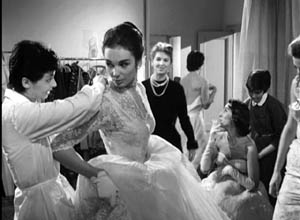
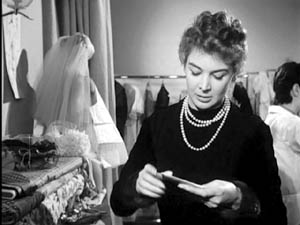
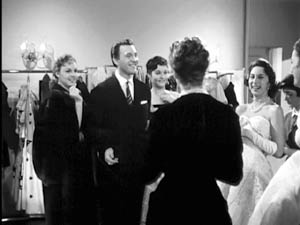
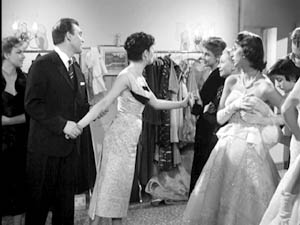
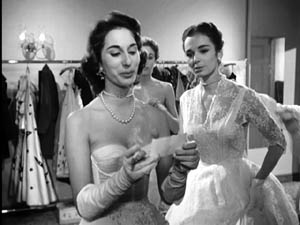
Antonioni relies on the fluid staging techniques developed in the early sound era and taken in diverse directions by Renoir, Ophuls, Preminger, Mizoguchi, and other directors of the 1930s and 1940s. Often, however, Antonioni’s characters move rather slowly and hold themselves in place, and as a result the overall spatial dynamic unfolds in marked phases. (6)
In the trilogy starting with L’Avventura, Antonioni relies on shorter takes and less florid camera movement. Now he emphasizes landscape and architecture so as to diminish the characters. If the expressionist side of Bergman plays up the psychological implications of the drama, the more austere Antonioni plays things down, “dedramatizing” his scenes by keeping the camera back, turning the figures away from us, and reminding us of the milieu. (You see the Antonioni influence on similar strategies in the work of Edward Yang, as I discussed recently on this blog.)
Once color came along, Antonioni changed his style, moving toward less dense staging and at times almost casual framing (as in The Passenger). He also had recourse to the telephoto technique, but I’d argue he brought something new to it. With Red Desert he accepted the abstraction inherent in the long lens and combined that with color design to create a pure pictorialism.
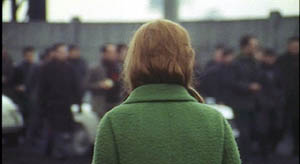
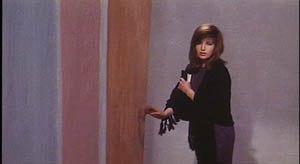
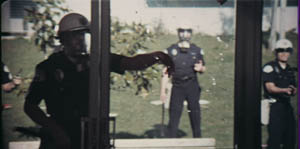
Ironically, Red Desert may have made Antonioni another sort of ‘expressionist’ than Bergman. The stylized palette of the film encourages us to ask if the industrial landscape is really so smeared and bleached out, or if we’re seeing it as Giuliana does. The same sort of painterly abstraction can be found in Zabriskie Point. In one scene, a pan over the travel decals on a family’s car window treats the boy inside as no more than another thin slice of space. Other scenes turn campus policemen into figures in grids.
You might even argue that the pan-and-zoom style gets a kind of meta-treatment in the climactic shot of The Passenger. There in a grandiose technical gesture Antonioni’s concern for architecture, his refusal to underscore a melodramatic plot twist, and his love of camera movement blend with the technology of the zoom. At the time, several of us (maybe Jonathan too) saw this shot as a response to Michael Snow’s Wavelength, relayed through the sensibility of Passenger screenwriter and avant-garde filmmaker Peter Wollen. Now it looks to me like a natural response of a very self-conscious artist to a stylistic trend of the moment.
A bestiary of stylists
To get crude and peremptory: Let’s say that once a director has reached maturity and become a confident artisan, several choices offer themselves. The filmmaker can be a flexible stylist, a stubborn stylist, or a polystylist (sorry for the awkward term).
A flexible stylist adapts to reigning norms. Bergman could be an aggressive-deep-focus director, then a pan-and-zoom director. Both approaches to staging and shooting preserved the expressive dimensions that mattered most to him: performance (chiefly face and voice), Ibsenesque bourgeois tragedy, Strindbergian play with dream and dissolution of the ego, and other elements.
Most of the major 1960s arthouse directors, from Truffaut and Wajda to Pasolini and Demy, were flexible stylists in this sense. So were a great many Hollywood and Japanese directors, such as Lubitsch and Kinoshita. Perhaps Ousmane Sembene, who also died recently, would be another instance. Buñuel becomes a fascinating case: He adopts the blandest, calmest version of each trend, creating a neutral technique, the better to shock us with what he shows.
A stubborn stylist pursues a signature style across the vagaries of fashion and technology. Dreyer from Vampyr onward does this; I argue in the book Jonathan cites that he seeks to “theatricalize” cinema in a way that goes beyond the norms of his moment. Perhaps Hitchcock and von Sternberg (at least in the 1920s and 1930s) fit in here as well. Bresson, Tati, and supremely Ozu were stubborn stylists. Give them a western or a porno to shoot, and they’d handle each the same way. (7)
This isn’t to argue that stubborn stylists never change or always do the same thing. Mizoguchi has a signature style and yet remains fairly pluralistic, at least at a scene-by-scene level. I think that the test comes in seeing how stubborn stylists persistently explore the constrained conditions they’ve set for themselves.
Signature styles help a filmmaker in the festival market, so we don’t lack for current examples of stubborn creators: Godard, Theo Angelopoulos, Hou Hsiao-hsien, Kitano Takeshi, Tsai Ming-liang, and Jia Zhang-ke. Granted, some of these may be rethinking their commitment to their stylistic premises.
A polystylist tries out different styles without much concern for what the reigning norms demand. Polystylistics holds a high place in modernist aesthetics. After the great triumvirate of Picasso, Joyce, and Stravinsky, with their bewildering arrays of periods and pastiches, the idea of the modernist as a virtuoso steeped in several styles became a powerful option. What’s been called postmodernism is no less favorable to polystylism; if you mix styles, you’ve presumably mastered them.
In cinema, some polystylists are just eclectic. Steven Soderbergh can give us the portentous pictorialism of The Underneath or Solaris, the grab-and-go look of Traffic, and the trim polish of Ocean’s 11. More deeply, there are directors like R. W. Fassbinder, Raoul Ruiz, and Oshima Nagisa who seem to pursue polystylistics on principle. It’s as if, rejecting the very idea of a signature style, they set themselves fresh, severe conditions for each project.
After The Boss of It All, we may want to count von Trier as a polystylist, not merely a director who changed his style from one phase of his career to another. Perhaps the best current example is Aleksandr Sokurov; who would dare predict what his next film will look like?
This whole entry is pretty sketchy, I grant you. The categories need further refining. I’ve ignored sound, which is very important. I’ve emphasized visual style, and just shooting and staging within that. (Nothing about lighting, cutting, etc.) So this is tentative—notes perhaps for a book-length argument. But I’ve made my point if you see that some ideas and some historical information can put intuitions about originality into a firmer framework.
And I’ve left the value judgments suspended. If you think originality trumps other criteria, then Bergman doesn’t probably come up as strong as Antonioni, let alone Bresson or Ozu or Dreyer. But if you can entertain the possibility that a great filmmaker can accept certain norms of his time, making those serve other channels of expression, then Bergman can’t automatically be faulted. At least thinking about him and his peers in the context of the history of film art gives us some data to ground our arguments. The world is more interesting and unpredictable than our opinions, especially those we formulated forty years ago.
(1) I actually hold this opinion.
(2) I assume that the arthouse auteurs were no less commercial filmmakers than their Hollywood counterparts. They were sustained by national film industries and supported by the international film trade. Eventually many were funded by Hollywood companies.
My friend and colleague Tino Balio is at work on a book tracing the role of overseas imports in the American film market of the 1940s-1960s, and it should be a real eye-opener to those who persist in counterposing art cinema and commercial production.
(3) Some of what follows is discussed in Part Four of Film History: An Introduction.
(4) I talk about both the deep-focus and long-lens tendencies in Chapter 6 of On the History of Film Style and Chapter 5 of Figures Traced in Light.
(5) For a wide-ranging account of art-cinema norms, see András Bálint Kovács’ forthcoming book, Screening Modernism: European Art Cinema, 1950-1980.
(6) I analyze this tendency, using other scenes from Le Amiche, in On the History of Film Style (pp. 235-236) and Figures Traced in Light (pp. 151-152).
(7) Suo Masayuki’s My Brother’s Wife: The Crazy Family is a softcore film made in a pastiche of Ozu’s style.
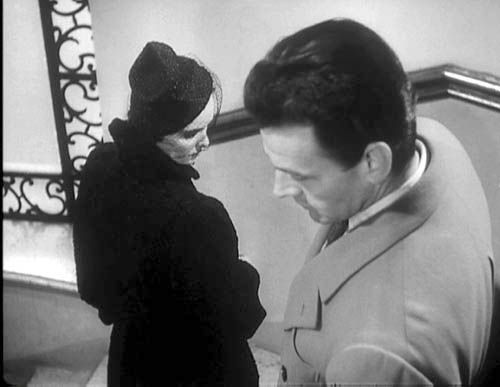
Story of a Love Affair (Cronaca di un amore).
PS, Sunday 12 August: Only a day later, new thoughts about something else I should have said about generational tastes. In the light of the Woody Allen eulogy that appears in the New York Times today, I think there’s more of a sub-generational split than I’d initially suspected. So here’s another gesture toward the sort of history of taste that Jonathan mentions.
Allen is in his seventies, a decade older than Jonathan Rosenbaum and me. He came of age in the affluent decade after the war. Allen saw Bergman films in the mid- to late 1950s, probably against the backdrop of Neorealism, British comedy, and French Cinema of Quality. In that context, Bergman’s movies looked pretty revolutionary.
But Jonathan and I came to maturity, if that’s the right word, in the mid-1960s. When I got to college in 1965, French directors (notably Resnais, Godard, Truffaut) and the Czechs, Hungarians, and others were getting established in US film culture. Bergman, Fellini, and Antonioni were already senior directors and soon they were starting to make what many of us perceived as career mistakes (Juliet of the Spirits, The Passion of Anna, even Blow-Up). Also, of course, concerns about their political alignments came more to the fore as the decade wore on. Many of my friends thought that The Battle of Algiers left all other films in the shade. These factors may have made the Boomers suspicious of “arty” foreign imports, of which Bergman’s work was a central instance. Interestingly, The Dove, a parody of The Seventh Seal and a film-society staple, came out in 1968, when Bergman may have been wearing out his welcome.
[Speaking of parodies, the SCTV skit, “Scenes from an Idiot’s Marriage”, in which Jerry Lewis (Martin Short) suffers the indignities of a cuckolded Bergman hero, is well worth checking out. The SCTV Fellini/ Antonioni parody, “Rome Italian Style,” is also pretty good, especially for its excellently awkward dubbing.]
Interestingly, Scorsese in age falls midway between Allen and us Boomers, and he contributes a Times tribute to Antonioni today. Maybe I have to split the generations even more: Bergman for 1955-1960, Antonioni for 1961-1965, Godard for 1965-1970? (Just kidding.) What strikes me are the differences in the essays. While Allen ranges widely, reports conversations, and praises Bergman in general terms, Scorsese’s piece evokes the texture of L’Avventura, suggesting how disturbing and demanding it was to watch. Maybe he inadvertently backs Jonathan’s claim that Bergman didn’t challenge his audience as much as he might have?
 I’m grateful as well to readers responding to my arguments. Michael Kerpan kindly spread the word about my post on imdb and the Criterion Forum. Kent Jones wrote to point out that any argument about Bergman’s influence has to take into account the high regard in which he’s been held in France, among both critics and filmmakers. Kent itemizes not only Godard, Truffaut, and Rivette but Assayas, Téchiné, and Desplechin. It’s a fair point. Antoine de Baecque anchors much of his magisterial history of Cahiers du Cinéma around the mesmerizing power of that busty still of Harriet Anderson, flaunted on a 1958 Cahiers cover and swiped by Antoine in The 400 Blows. In 2003, my old friend Jacques Aumont published a large critical study on Bergman. Cahiers’ next issue will be devoted to the director.
Speaking of French critics and directors, on imdb above Bertrand Tavernier points out that my memory failed. I did see Scenes from a Marriage and Cries and Whispers before The Serpent’s Egg, not after, as my post suggests.
My late Bergman viewing remains gappy. I still haven’t seen the long version of Fanny and Alexander, which everyone assures me is a masterpiece. Last spring, my friend and Bergman scholar Paisley Livingston showed me portions of the TV film The Last Gasp (1995). It’s about Georg af Klercker, the fine Swedish director of the 1910s. It was intriguing, but I was put off by Bergman’s inadequate pastiches of af Klercker’s remarkably poised and complex shots. Now that’s fussy taste, I admit.
Gandalf speaks! More thoughts-and news-on the Hobbit project
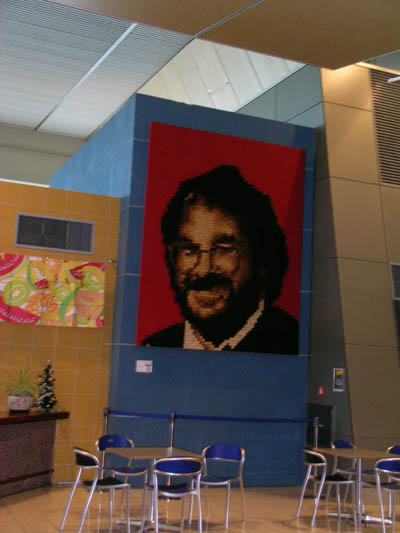
Local hero: Peter Jackson portrayed in toast, Wellington Airport, July 2004
Kristin here—
While the new “Frodo Franchise” website is under construction, I offer here a new set of speculations on the Hobbit project.
In my July 20 entry, I cited a statement by Ian McKellen concerning possible progress in the ongoing legal dispute between Peter Jackson and New Line Cinema. The dispute is the reason given by the studio’s president, Bob Shaye, for Jackson’s not being asked to direct the film adaptation of The Hobbit. There Sir Ian said, “I detect that there is movement and it’s movement in the right direction.” That interview went online July 19.
The Royal Shakespeare Company’s tour then moved on to Australia, and on July 26 an Australian Broadcasting Corporation television interview with McKellen brought up the question again. Here the response is somewhat more specific:
KERRY O’BRIEN: What’s happening with The Hobbit?
SIR IAN MCKELLEN: I talked to one of the Hollywood producers who is in a position to know, who said there seemed to be a little bit of movement and he is a circumspect man so I took that to mean something quite positive and I’ll be seeing Peter Jackson in a couple of weeks when we’re taking The Seagull to Wellington and Auckland.
KERRY O’BRIEN: It would be tragic if it happened without Peter Jackson?
SIR IAN MCKELLEN: It couldn’t happen really, could it? In the way that it ought.
McKellen is currently playing King Lear and, in repertoire, Sorin in The Seagull. The schedule began at Stratford on 24 March and by November will have visited Newcastle-upon-Tyne, Singapore, Melbourne, Wellington, Auckland, New York, Minneapolis, Los Angeles, and London. Currently he is in Wellington, where the engagement that he mentions, including both King Lear and The Seagull, runs August 11 to 13.
This new interview seems to add a little to the one in Singapore that I quoted previously. I don’t want to read too much into McKellen’s statement. Still, I can infer (as usual with the proviso that I have no inside information) a couple of things.
In Singapore, McKellen referred to “detecting” movement in the Hobbit front, but he doesn’t hint as to his source. Here he says he heard this from a producer. Perhaps such a communication would involve said producer sounding him out about the circumstances under which he would be willing to reprise his role as Gandalf. McKellen has made it clear on his website and in interviews, including this new one, that he feels Jackson should direct and has strongly implied that he would not play the wizard under a different director. He has not, however, made a firm public statement to that effect. The fact that in this context he mentions meeting with Jackson, however, suggests that he may have some reason to believe that they could work together on the film.
(Subsequent interviews with McKellen have been published in Australia and New Zealand, but none adds any new information.)
I had the pleasure of interviewing McKellen in early 2005 as part of my research on The Frodo Franchise. He made it perfectly clear that he, like virtually all the cast and crew members that worked on The Lord of the Rings, is intensely loyal to Jackson. I would be very surprised to hear that he had agreed to play Gandalf if someone other than Jackson were at the helm.
Second, these two interviews, one done in Singapore and one in Melbourne, were posted on the internet a week apart. There is no hint that anyone asked McKellen not to say anything more about the Hobbit negotiations. Given the intense interest in this subject, even brief, very general statements like the ones I have quoted can give rise to considerable speculation and discussion—in which I am obviously participating.
As anyone who has read interviews with McKellen knows, he is a very outspoken man. Still, I can’t believe that he would go on making statements about the situation with the Hobbit film if asked not to by the parties involved.
Now I’d like to turn to an issue unrelated to the McKellen interview. One subject that comes up in fan discussions of the Hobbit project on the internet is that of design. Fans point out that if Weta Ltd. does not create the props, costumes, sets, special effects (both digital and physical) and make-up, as they did for The Lord of the Rings, the look of Middle-earth might be noticeably different. Other fans seem to believe that Jackson’s companies own the props, costumes, and sets.
Technically I believe that New Line owns virtually all of the objects made for Rings. Some were given as gifts to the filmmakers, including the full-size Bag End interior which Jackson now has at his country home as a guest house. Some of the actors received their swords, McKellen asked for and got the lizard-shaped door-handles from the Orthanc set, and so on. That’s not a major factor, and the existing objects, which are presumably still in storage in New Zealand, could be re-used for a film of The Hobbit.
Nevertheless, design and execution would remain a big concern. If Weta’s two halves, Weta Digital and Weta Workshop, refused to work on The Hobbit without Jackson directing, New Line and co-producer MGM would have to look elsewhere. (Jackson owns one third of Weta, and the other two-thirds are owned by his long-time friends and colleagues Richard Taylor and Jamie Selkirk.) There are a few CGI facilities in the world that could deliver digital effects on the level of those in Rings—though it’s hard to imagine a Gollum without Andy Serkis’ acting, particularly his voice. But I doubt that there is any company or cluster of companies that could render the physical components of Middle-earth as well as Weta Workshop did for Rings. Tolkien illustrators Alan Lee and John Howe helped give the film’s mise en scene its unified look, and they, too, might not wish to work for a different director.
This is all speculation, and time might prove me to have been completely wrong. Perhaps New Line could successfully assemble a fully new team—director, cast, crew and group of support companies—and start virtually from scratch. Perhaps there is not the solidarity behind Jackson that I have posited here, and some people who worked on Rings might be willing to return for The Hobbit under such circumstances. Perhaps fan opposition would gradually erode once the film went into production.
Unlikely as it may seem now, there was a storm of outrage when Jackson was first announced as directing Rings. Most people had never heard of him. People who knew his comic splatter films were convinced that he would trash Tolkien’s novel. Perhaps a new director could win fans over, as Jackson did so effectively, and make them change their opinions. I have to believe, though, that any new director would face a much harder uphill battle to capture the fans’ hearts and minds.
A recent poll on TheOneRing.net asked whether fans would be likely to go to a film directed by anyone but Jackson. The group saying that they were “very likely” and “likely” not to go was 76.6 %. Those who were “very likely” and “likely” to go totaled 12.9%. Those who said they would wait until they found out who the director would be comprised 10.3%. Many among that 76.6% group would probably grit their teeth and go to the film.
Perhaps the result would be a hit and we shall look back upon the current period as a tempest in a teapot. If so, perhaps the lawsuit will eventually come to court and we’ll get some indications as to the real cost of this dispute.
By the way, Keith Stern, McKellen’s webmaster, has kindly put The Frodo Franchise on the news page of McKellen.com, right next to the announcement of Sir Ian’s nomination for an Emmy for his hilarious guest turn on the British series Extras. I seldom get a chance to think of myself as cool, but that is definitely cool!
IMPORTANT NEWS: Just after posting this entry, I discovered (via the excellent site The Hobbit Movie) a Los Angeles Times story on New Line Cinema. There studio officials finally announce that they are indeed negotiating with Peter Jackson concerning the Hobbit film project:
“Eager to move ahead with ‘The Hobbit,’ New Line has quietly been trying to mend fences with ‘Rings’ filmmaker Peter Jackson, who has sued the company over his share of profits from the first ‘Rings’ films. When asked if it was true that company insiders had been in talks with Jackson’s reps, Shaye replied, “Yes, that’s a fair statement. Notwishstanding our personal quarrels, I really respect and admire Peter and would love for him to be creatively involved in some way in ‘The Hobbit.'”
“Moving ahead with ‘The Hobbit’ would tie in to another pivotal New Line issue: In an era when Hollywood is deluged with equity money, will Shaye and Lynne make a run at buying back New Line from Time Warner? Shaye’s reponse was worthy of a U. N. diplomat: ‘We have not expressed that point of view publicly. And if we ever do, [Time Warner chiefs Dick Parsons and Jeff would be the first to know about it.'”
I don’t know why the Hobbit film is tied to that issue, but it presumably has something to do with the fact that investors would be falling over themselves to help finance such a project. The Lord of the Rings may have strengthened New Line enough that it would be better off being once again a fully independent firm–as it was before being acquired by Turner Broadcasting System in 1993. (TBS was in turn acquired by Time Warner in 1996.)
This announcement confirms that my most general speculation in past entries is correct: New Line has been negotiating with Jackson. Whether the proposition is for Jackson to produce and direct or simply to produce (“creatively involved in some way”) remains to be seen.
[Added on August 10:
In response to the LA Times story, Peter Jackson and Fran Walsh have issued a statement: “Peter and Fran have always wanted to do The Hobbit but whether that happens is yet to be decided.”]
Updates: Len Lye, Frodo Franchise, blockbusters, and news from/about Hong Kong
Kristin here—
More on Len Lye
After my recent post on Len Lye, I heard from both Roger Horrocks, Lye’s biographer, and Tyler Cann, Curator of the Len Lye Collecton of the Govett-Brewster Art Gallery in New Plymouth, New Zealand. (Neither with corrections, I am happy to say!) They have filled me in on some activities that should make Lye’s film work more accessible.
First, a DVD of Lye’s films is being prepared. Unfortunately factors like the process of assembling the best surviving prints means that the finished product will not be available in the near future.
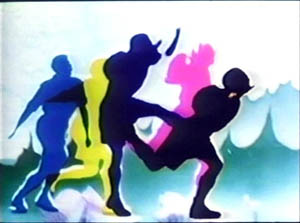
Second, the near future will bring a touring program of Lye’s films to North America. Called “Free Radical: The Films of Len Lye,” it has been organized by The New Zealand Film Archive, the Len Lye Foundation, and Anthology Film Archives. (The name was inspired by Lye’s scratched-on-film animated short, Free Radicals, 1958.) Here are the venues and dates:
 Oct 12 Anthology Film Archives, New York
Oct 18 NASCAD (Nova Scotia College of Art and Design) Halifax, Nova Scotia
Oct 23 Pacific Film Archive, Berkeley
Oct. 28 Film Forum, Los Angeles
Oct 30th CALARTS, Los Angeles
Nov 2nd University of Notre Dame, Indiana
Nov. 7th George Eastman House, Rochester
Nov. 26th Harvard Film Archive, Cambridge
Dec 8th Chicago Filmmakers, Chicago
Dec. 15th International House, Philadelphia
Roger tells me that he intends to write a book on Lye’s theory and practice of what he called “the art of motion.” This reminds me that I forgot to mention that there is a collection of Lye’s writings, Figures of Motion: Len Lye Selected Writings, co-published in 1984 by Auckland University Press and Oxford University Press. It was co-edited by Roger and Wystan Curnow and is, alas, long out of print. Another thing to look for in your local library.
The Frodo Franchise
I am happy to report that The Frodo Franchise is now in the process of being rolled out. The University of California Press has been shipping copies for weeks, and it should soon appear on bookstore shelves—and may have already in some places. The copy we pre-ordered from Amazon back in April arrived on July 30.
I have bowed to the inevitable and am in the process of constructing a separate website, “Frodo Franchise,” to deal with matters relating to the book and the films. (That is, Meg, our web czarina, is constructing it.) I don’t want information about the book, comments on the Hobbit film situation, and similar items to overbalance our blog, which they threaten to do. I’ll post a notice when the site is up and running.
In the meantime, Pieter Collins of the Tolkien Library, an excellent reference and news site dedicated to the novels, has interviewed me about my book. You can read the result here. Henry Jenkins has done the same, through his site, Confessions of an Aca-Fan, is more oriented toward popular media and fandom. The interview is in three parts here, here, and here.
Hollywood Blockbusters Doing Pretty Well
On February 28 I posted an entry, “World rejects Hollywood blockbusters?” There I argued against claims in an article by Nathan Gardels, editor of NPQ and Global Viewpoint, and Michael Medavoy, CEO of Phoenix Pictures and producer of, among many others, Miss Potter. They claimed that there were many signs that Hollywood’s big-budget films are being rejected at the box office: “Audience trends for American blockbusters are beginning to show a decline as well, both at home and abroad.”
Since then, of course, Hollywood blockbusters have been cleaning up at home and abroad. We’re all familiar by now with the series of huge international openings, with many blockbusters being released day and date in most major markets. As one example, take Harry Potter and the Order of the Phoenix, which so far has grossed $774,070,000 worldwide. The US and Canada claimed only about one-third ($264 million) of that total (Box Office Mojo, August 4). Overseas, Phoenix has scored $510 million, for 65.9% of its global haul. The Three Threes, Shrek, Pirates, and Spider-man, all cleaned up internationally, as did Transformers. (The fourth Three film, The Bourne Ultimatum, looks set to do the same.) The Simpsons Movie has recently begun its climb to box-office glory.
Leonard Klady, an excellent writer on the international film industry, summed up the situation for 2007 in the 22 June print edition of Screen International: “Worldwide predictions that 2007 would break recent box-office records look to be well founded. The international box office generated $4.5bn in the first four months of 2007. Combined with revenues from the domestic North American marketplace, the global gross for the period was $7.2bn. International theatrical [i.e., markets outside the U.S. and Canada] accounted for 61.6% of the worldwide box office on gross figures that exceeded domestic ticket sales by 60.6%. Based on current viewing trends, global box office could finish the year at a record-breaking $24.6bn.”
Klady points out that much of the rise comes from the factor I discussed in my earlier entry: the expansion of the international market. According to him, “The international market has become increasingly significant in the past decade.” A decade ago, foreign income averaged 45% of Hollywood films’ takings. By 2006 it was around two-thirds.
These facts also bear on Neil Gabler’s February article, “The movie magic is gone,” where he lamented the purported decline in theatrical films’ importance. That there was such a decline, he claimed, was evidenced by the fact that box-office revenues are down, both domestically and abroad. I refuted Gabler’s claims at some length in this March 11 post, and the successful summer that Hollywood is now enjoying adds further evidence to show that his argument was based on false assumptions.
DB here–
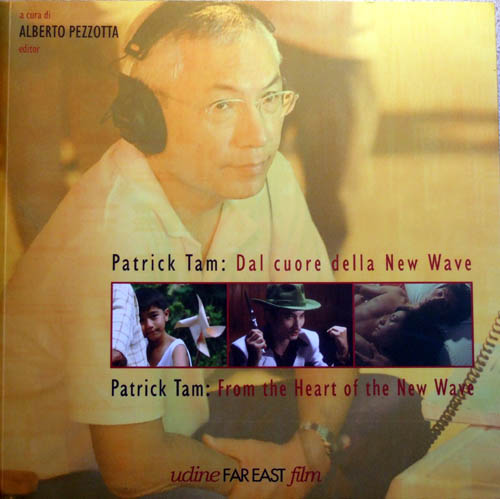
The Udine Far East Film Festival had a tremendous program this year, and just the YouTube promo made you want to book a ticket. But I couldn’t go! Still, the organizers kindly sent me their excellent catalogue Nickelodeon and the real topper, the festival’s thick volume dedicated to Patrick Tam Kar-ming. Editor Alberto Pezzotta, indefatigable researcher into Hong Kong film, organized a vast retrospective of Tam’s key New Wave films, such as Nomad and The Sword, as well as his less-known television work. The book includes critical essays, a detailed filmography, and a long, informative interview. Tam brought a cosmopolitan sensibility to Hong Kong film, thanks to his sensitivity to European directors like Godard and Antonioni. His latest film, the widely acclaimed After This, Our Exile, signals a new phase in his career.
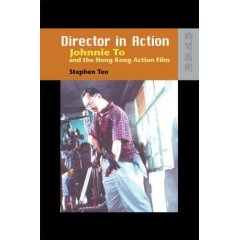 When I was writing Planet Hong Kong between 1997 and 1999, I was often frustrated by a lack of solid information and in-depth critical writing. Tony Rayns’ superb essays and the annual catalogues published by the Hong Kong International Film Festival were about all I could rely on. That situation has improved in recent years, with many well-researched books on Hong Kong film appearing. Outstanding here is Stephen Teo, who has given us two books this year alone: King Hu’s A Touch of Zen and the just-out Director in Action: Johnnie To and the Hong Kong Action Film. This efflorescence of writing comes just when local cinema is in its deepest slump. You won’t find me quoting Hegel often, but in this instance it does seem that the owl of Minerva is flying at dusk.