



Archive for the 'Film comments' Category
Beyond praise 2: More DVD supplements that really tell you something
Kristin here-
In September of 2007 I posted the first “Beyond praise” entry, the idea being that I would recommends DVD supplements that didn’t just contain a lot of participants in the filmmaking process gushing about how wonderful their colleagues were. Such supplements would reveal something about the filmmaking process, and perhaps something about the publicizing and exhibition as well.
I intended to make this a regular feature of the blog, so it’s high time to post a follow-up entry. These comments don’t necessarily deal with very recent releases. Some are a few years old by now. Still, I’ve just caught up with them, and they haven’t lost their interest for film buffs, teachers, and students.
Collateral (“Two-disc Special Edition,” DreamWorks Video)
The making-of, “City of Night: The Making of Collateral,” is short by current standards, at about 39 minutes. It’s dense with information, though. Indeed, David and I were inspired by it, along with the account of the film’s making in American Cinematographer, to add a case study on the film’s production to Film Art. The 9th edition, coming in December, will start with this case study and how the aesthetic decisions made by the filmmakers affected the final film. (One of the book’s users suggested this idea, and we think the result improves the opening chapter.)
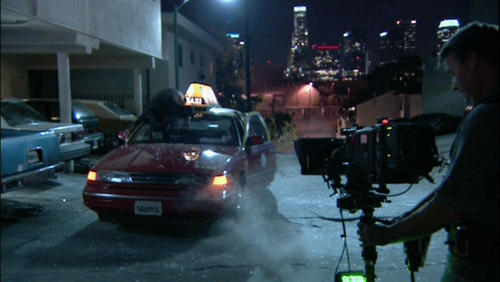
Michael Mann wanted to capture the unique glow of Los Angeles at night, caused by the bright lights of its flat grid being reflected by the atmosphere over the city. To do so, he employed digital cameras for most scenes. The documentary shows how the cameras allowed filming almost entirely with ambient light. (See illustration below.) Fill light was added subtly by innovative flexible panels Velcro-ed onto the interior of the cab that forms a major setting for the action. One suspenseful scene near the end was filmed in a darkened office, with the actors becoming completely black silhouettes against the lights of the city outside the windows. For those who may not be familiar with professional-level digital filming, this making-of offers a succinct introduction. Collateral remains one of the best films shot primarily with digital cameras, and it makes a good case for the new technology for those who may doubt that it can ever be as effective as 35mm film.
“City of Night” also has the best demonstration I’ve seen of the use of multiple cameras to shoot a big action scene, detailing how the spectacular taxi crash was planned and executed. (But see also the 3:10 to Yuma description below.) There’s an interesting segment on the music, where composer James Newton Howard talks about composing the music for the extended climactic chase in “three movements.”
There’re also some rehearsal footage and other minor supplements, but the main documentary is far and away the most informative. It could be quite useful for teaching cinematography.
Hellboy (“2-Disc Special Edition,” Columbia Tristar Home Entertainment) and Hellboy II: The Golden Army (“3-Disc Special Edition,” Universal Studios Home Entertainment)
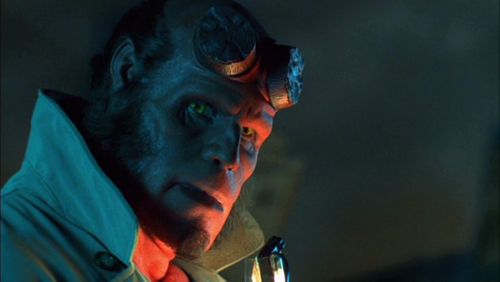
Guillermo del Toro being the geeky fanboy that he is, the supplements for the two Hellboy films are lengthy and full of solid information. The first film was made on a smaller budget, as was its main making-of, “Hellboy: The Seeds of Creation.” Essentially it alternates candid footage captured on working sets, which is really more decorative than informative, with interviews and segments on specific topics. There’s a little of everything one would expect for an effects-heavy film: bits on maquettes, set models, testing of stunts, animatronic figures, and so on. Cinematographer Guillermo Navarro talks briefly about lighting tests for Hellboy, accompanied by such beautiful images as the one above, imitating the vivid, high-contrast look of the original comic.
The making-of contains nice little segments that superimpose a digital double on raw footage (at about 29:30 minutes), a good illustration of building a CG figure by adding musculature to a wire-frame base (70 min.), and a more detailed treatment of ADR than most supplements offer.
The making-of for the sequel, “Hellboy: In Service of the Demon,” is more extensive and was evidently planned 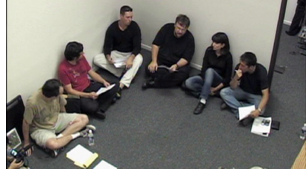 more thoroughly. One early scene has del Toro seated on the floor having a decidedly informal meeting with his design staff. It’s clearly a real, working meeting, not one staged for the camera. The director has some intelligent things to say about the monsters he wants from his team (“No aliens!”), and his voice continues over shots of the designs that the people sitting with him came up with. There’s a great deal of material on the design and construction of the famously large number of demons, 32 in all, as well as on-set demonstrations of how the elaborate costumes are worked by the actors inside them and by remote control.
Highlights: a good explanation of how points of control are added to CGI creatures and function to create the final image; another on how motion-control is used for special effects; a view of a video-assist playback. Particularly impressive is the lengthy scene in which we watch the make-up for the Angel of Death being designed and applied while actor Doug Jones talks intelligently about the make-up and the character.
The supplement is long, about two and a half hours, but I think I’d choose it, or at least big portions of it, if I wanted to teach about special effects to an introductory class. Like Peter Jackson, GDT is a big advocate of using practical effects whenever possible and resorting to CGI only when they aren’t possible. As a result, this making-of demonstrates an unusually wide range of kinds of effects. It’s also entertaining, clear, and has interviews with most of the principals involved in each kind of task.
3:10 to Yuma (Lionsgate)
The supplements for James Mangold’s Western (the sound mixing of which David blogged about here) are less lavish but still of interest. There’s a section on how the four major sets were constructed on location rather than in sound stages. One detailed segment shows a camera rig for moving with a stagecoach and the practical special effects used for the scene in which the coach is 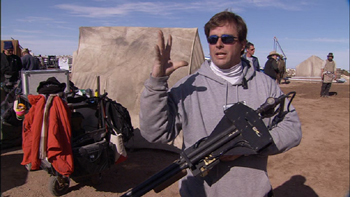 flipped over. I learned, for example, that “crash cam” is the name for the metal cylinder used for the camera most likely to get hit by the flipping vehicle-a device also on view in the Collateral supplements. The crash scene is particularly well done, showing the shooting with multiple cameras and then immediately the crash as edited.
There are bits of out-of-the-way but fascinating information here. For example, there are companies that rent old trains for film production. There are also guns that shoot dust capsules (left) into the set to simulate bullet impacts and other bits of flying debris. Apart from the main documentary, there’s a six-minute segment, “An Epic Explored,” where Mangold talks about making a Western in a period when the genre is out of fashion, and a brief history of “Outlaws, Gangs and Posses” that could be useful for background information on Westerns in general.
The Golden Compass (“New Line 2-Disc Platinum Series,” New Line Home Entertainment)
I was interested in The Golden Compass from its inception, since it was New Line’s intended replacement for The Lord of the Rings as the studio’s prestige franchise. That didn’t work, of course. (I wrote about how New Line copied its Rings strategies in promoting The Golden Compass here and about why the film succeeded abroad but not in the U.S. here.)
As an admirer of Philip Pullman’s His Dark Materials trilogy, I was also curious about how well the lengthy, complicated first novel could be adapted for the screen. My impression upon seeing the film was that the first half raced along, presenting essentially a brief summary of each scene and trying to cram in exposition about the huge number of characters and plot points retained from the novel. The second half calmed down and was more successful in its rendering of events.
The Golden Compass was a failure from New Line’s point of view-and that of parent company Time Warner, which used that failure as an excuse to fold the semi-independent studio into Warner Bros. It made about $372 million internationally, but the overseas take was $302 million of that total. That money stayed with the foreign distributors, who had helped finance the film through pre-sales of rights. That and its reported $180 million budget meant that New Line lost a bundle.
The DVD supplements reflect nothing of these problems. They’re distinctly better than the lackluster titles of the individual segments suggest. There’s a nice section on the novel, with Pullman saying some interesting things. “The Adaptation” mostly depends on interviews with director Chris Weitz and producer Mark Ordesky. Throughout the supplements, Weitz, who was relatively inexperienced when he took on the epic production, is not only modest but downright self-deprecating-sort of the opposite of too much praise. (“The fact of the matter is that there have been hundreds of people working on this just as hard as I have, and this is not the kind of film that really fits in with a kind of an auteur theory of filmmaking.”) Perhaps the director will feel more confident on his next project, the sequel to Twilight.
The makers of the supplements chose an effective tactic of choosing one major item in each category to concentrate on, rather than trying to cover every aspect of casting, design, and so on.
“Finding Lyra Belaqua” seemed to promise the usual uninformative gushing about how wonderful Dakota Blue Richards was in the lead role. In fact it’s quite an interesting account of how open casting calls work. The casting team have calls in multiple towns, where enthusiastic little girls in the queues explain their fascination with the project. The casting of Richards must have become pretty likely at some point, since the documentarists followed the young actress and her mother through a string of call-backs and the tense process of whittling the short-list down.
The “Daemons” section spends minimal time on explaining the concepts and instead concentrates on the design, the creation of maquettes for CGI work, and the necessary but rather silly use of stuffed animals on the set to stand in for the daemons. The section on how Freddie Highmore had to dub in Pantalaimon’s dialogue in ADR while watching unrendered computer images of his character is particularly interesting.
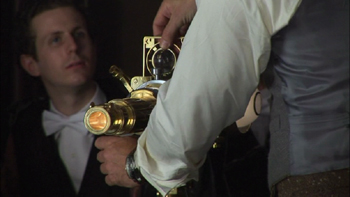
Again, a fairly lengthy session devoted to the design and making of “The Alethiometer” (15 minutes on a single prop) is not simply devoted to explaining what it is. Instead, it gives a real sense of the elaborate process of seeking real-world models, finding experts create for each type of part needed, and making the prototype. The section on production design focuses on the use of conflicting shapes as motifs throughout the film: circles for Oxford, Lyra, and the Alethiometer, ovals for Mrs. Coulter and the Magisterium. These show up in vehicles, sets, and props:
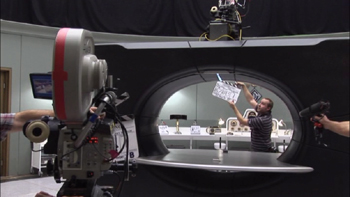
Other segments are similarly clever and informative: on how costumes affected the way the actors had to walk; on the steps used to create the entirely CGI-based armored-bear battle; on the music’s use of exotic instruments to characterize the various imaginary ethnic groups. There’s even a segment on the Cannes press-junket launch, with a brief interview with a junket producer-something I certainly haven’t seen in a supplement before.
I had hoped to be able to recommend the supplements for Across the Universe. Julie Taymor’s musical is so imaginative and appealing that one would expect some clever and original making-ofs as well. Unfortunately most of the five brief documentaries fall into the mutual-praise trap (“Everyone wants to work with her!”). “Stars of Tomorrow” is 27 minutes of guff about how the young actors were cast and how wonderfully they fit their roles. “Moving across the Universe,” on the choreography, is pretty good-but only 9 minutes long. The best things in the supplements are the clips from the film. Watch it, skip the extras.
Niceties: how classical filmmaking can be at once simple and precise
DB here:
A film academic once complained that I was too preoccupied with “formalistic niceties.” So here I go again. But read no further if you haven’t seen Christopher Nolan’s The Prestige.
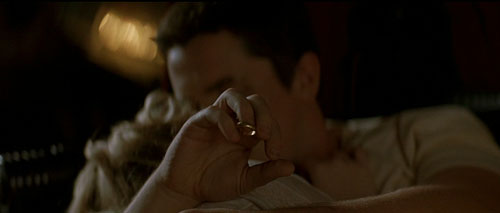
Dueling magicians: The film’s premise might be considered high-concept. In turn-of-the-century London, two young conjurers launch their careers with different attitudes toward their craft. Robert Angier favors audacious showmanship, while Alfred Borden is committed to finding a trick that will baffle the experts. Their rivalry is ignited when Alfred accidentally kills Angier’s wife during a dangerous underwater stunt. Their struggle peaks around each one’s supreme trick: transporting himself from one point to another instantaneously.
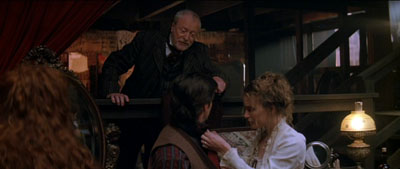
The item that attracts my attention today is established in the film’s opening sequence. As the voice of Cutter (Michael Caine) explains a magic trick’s three acts, we see a climactic confrontation between the competitors. Hoping to discover Robert’s secret, Alfred watches the Real Transported Man performance from the audience.
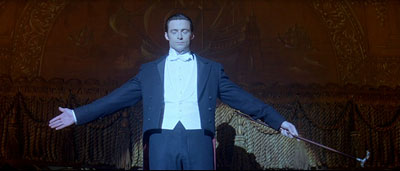
As Cutter’s narration mentions “a man,” the camera picks out Alfred in the crowd. Cut to Robert onstage, a shift that establishes the two as our protagonists.
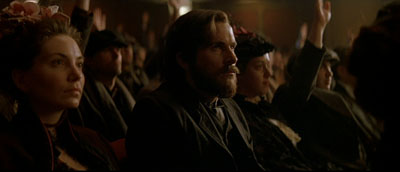
What interests me is the view of the bearded Alfred: a medium-shot framing him nearly in profile facing right. This framing will be repeated, but varied, when Alfred’s voice-over diary entry introduces both him and Robert as apprentices, working as audience shills for another magician:
We were two young men at the start of a great career—two young men devoted to an illusion, who never intended to hurt anyone.
The new shot parallels the introduction of Alfred in the first scene, but varies it. Again we see Alfred in the audience, but now without a beard, and the camera tracks rightward to show Robert in another row.
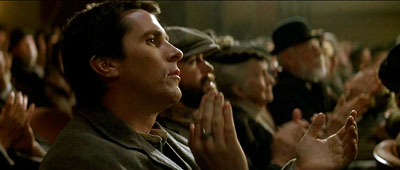
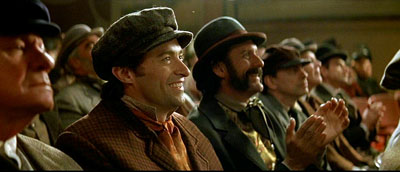
In this sequence, our protagonists are connected by a camera movement rather than the cut employed in the opening. The two men’s reactions—Robert grinning (his wife is onstage), Alfred more pensive—add to the characterizations that we will see played out.
This simple camera motif gets varied further in the course of the film. The disastrous immersion illusion that drowns Robert’s wife is initiated by another tracking shot of the two men in the audience, a variation of the earlier shot.
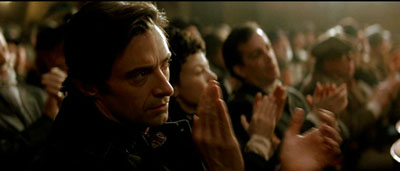
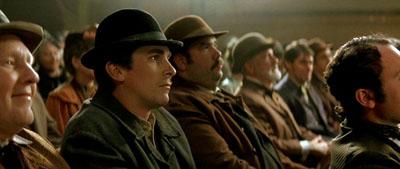
The new combination starts with Robert and ends on Alfred. At this point, not only are the two men linked but they replace one another. If you want to push your luck, you could say that this variant quietly affirms the film’s overall dynamic of substitution (doubles, twins, clones).
Earlier, a contrasting way of showing the men in an audience is given us when they attend a performance of the wizard Chung Ling Soo. Cutter provides a dialogue hook, warning Robert that “the blokes at the ends of row three and four” can see him kissing his wife’s leg.
Cut to our protagonists, sitting at the end of a row watching the Chinese magician.
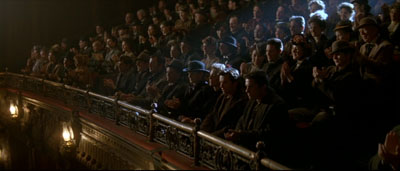
A nicety: Now the men are sitting side by side and facing left rather than right. Just through camera placement and character position, we know we’re in a different performance, one in which our apprentices play no role.
As they study the trick, Nolan gives us another characterizing shot: Robert is amazed, but Alfred grins: He’s worked out Chung’s secret.
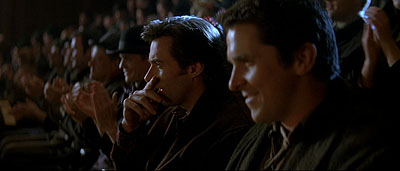
What would have happened if Nolan had framed the men sitting apart and/or facing to the right? For an instant we might have thought we were back in the act they shill for. Simple but reiterated differences assure immediate comprehension: medium shot/ long shot, looking rightward/ looking leftward, men in different rows/ men in the same row. Just as the repeated framings of their own act clarify the situation, so do these little polarities. Call it redundancy, if you like, but it’s also precision and economy.
With Julia’s death, the men become enemies. But each will still slip into the audience of the other’s performances. From now on, the magician is always on the right, the onlooker on the left. Nolan and company could have handled their rivalry in camera setups that exactly mimic the early ones. Instead, a new pattern of parallels comes into play, building on the earlier ones but different enough to heighten the symmetries.
The new pattern is set up by restricting our range of knowledge. First, we are attached to Alfred when he performs his bullet catch in a barroom theatre. Robert, seeking vengeance for Julia’s drowning, steps up to spoil the trick, but we don’t know he’s there until Alfred does, and then it’s too late.
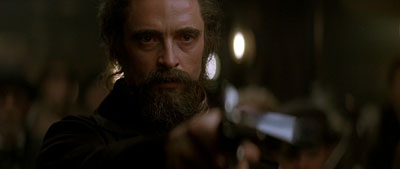
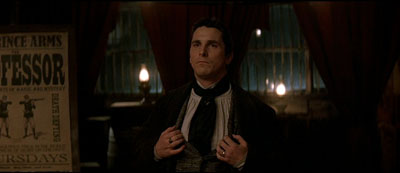
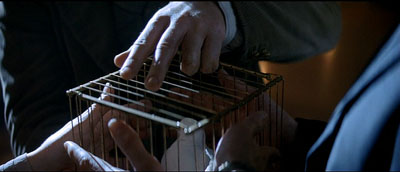
Similarly, we’re restricted to Robert’s range of knowledge when he tries to execute his disappearing dove trick. Only when Alfred is about to trigger the collapsing cage—killing the dove and wounding a lady from the audience—does Robert realize that his adversary has struck back.
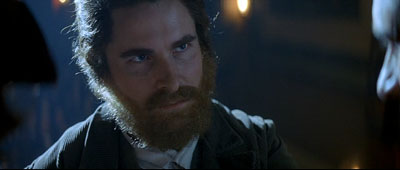
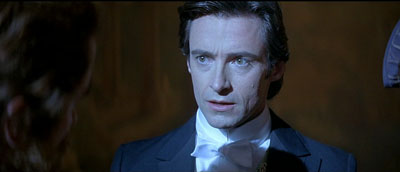
Another nicety: The two shots of each man in similar disguises, seen in 3/4 view, reset the stylistic parameters. But the image of the bearded Alfred is given extra punch through a tilt up from his missing fingers–the result of the parallel, bullet-catch scene before.
The whole pattern shifts yet again when Robert sneaks in to watch Alfred’s Transported Man illusion. We get a shot of him (in a beard again) that fuses two of the cues from the earlier scenes: He’s in the audience, as in the early sequences, but he’s shown from an angle congruent with that of the earlier beard shots.
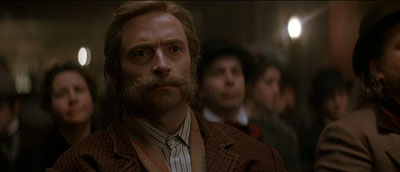
And perhaps we can take the shot of Robert at home, telling of his amazement at Alfred’s illusion, as an echo of the initial prototype: A magician staring intently rightward at a dazzling trick played out offscreen, but now in memory.
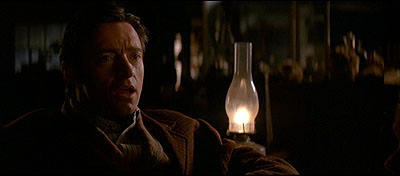
Robert returns from Colorado with the Tesla-designed “Real Transported Man,” and Alfred’s visit to watch the stunt reworks the givens of this pattern yet again. Alfred is seated, minimally disguised, in the standard audience spot looking right, but he is not in profile and the camera position is much closer than before. The answering shot of Robert onstage recalls the gesture we saw at the film’s outset and anticipates what we will see when that opening scene is replayed, with the wicked Alfred climbing onstage.
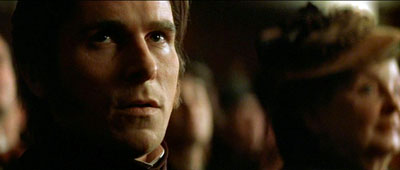
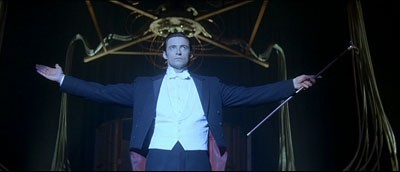
At the close of the trick, yet one more variant: Robert appears in the rear balcony and the crowd all turns to watch him off left.
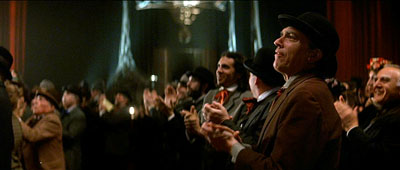
After a glance back, Alfred turns away, looking right–the first time any character has flinched from the performance. His puzzlement is mixed with anger (at last a trick he can’t see through), a less charitable response than we saw in Robert’s stunned fireside recollection of Alfred’s Transported Man.
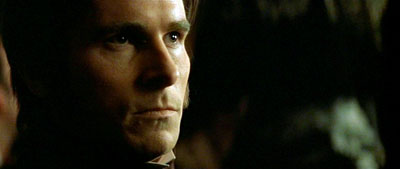
The things held constant, such as camera placement and position in the locale, set off the differences in characters’ disguises and reactions, while this shot carries faint echoes of our very first view of Alfred during Cutter’s voice-over monologue. That view, and its answering shot of Robert in the spotlight, will recur when Robert’s pseudo-death is replayed.
Nolan’s audacious film is built out of more marked parallels than these, but I wanted merely to highlight the ups and downs of one small pattern. Many films work varied repetitions like these into their shot-by-shot texture. Back in the 1930s, Eisenstein saw this possibility clearly, as I try to show in my book on his work. In the 1960s and 1970s, Raymond Bellour called our attention to such patterns in films by Hitchcock, Hawks, and Minnelli. His collection of essays The Analysis of Film includes pioneering studies of how fine-grained such things can become.
I wouldn’t go as far as Bellour does in seeing varied repetition as the motor force of classical filmmaking, but it surely plays an important role. What he takes as a manifestation of pure textual difference I’m inclined to psychologize: these differences help the audience understand, usually without awareness, the ongoing narrative dynamic and have the extra payoff of creating tacit narrative parallels. But from either perspective, object-centered or response-centered, studying such microforms is enlightening. It’s a way to understand films as wholes, dynamic constructions that shift their shapes across the time of their unfolding. Moreover, by examining things this closely, we can try to understand not only how this or that film works, but how this or that film relies on principles distinctive of a filmmaking tradition. Consider this another plug for poetics.
I’d add that such principles neatly fuse two pressures: toward narrative coherence and comprehension on the one hand, and toward production efficiency on the other. It’s cheaper and easier to repeat camera setups if you can. Artistic economy and financial economy can work together, nicely.
Speaking of repetitions….
Showing what can’t be filmed
DB, again:
People tend to think that documentary films are typified by two conditions. First, the events we see are unstaged, or at least unstaged by the filmmaker. If you mount a parade, the way that Coppola staged the Corpus Christi procession in The Godfather Part II, then you aren’t making a documentary. But if you go to a town that is holding such a procession and shoot it, you are making a doc—even though the parade was organized to some extent by others. Fiction films stage their events for the camera, but documentaries, we tend to think, capture spontaneous happenings.
Secondly, in a documentary the camera is seizing those events photographically. The great film theorist André Bazin saw cinema’s defining characteristic as its capacity to record the actual unfolding of events with little human intervention. All the other arts rely on human creation at a basic level: the novelist selects words, the painter chooses colors. But the photographer or filmmaker employs a machine that impassively records what is happening in front of it. “All the arts are based on the presence of man,” Bazin writes; “only photography derives an advantage from his absence.” This isn’t to say that cinema can’t be artful, only that it offers a different sort of creativity than we find in the traditional arts. The filmmaker works not with pure imaginings but obstinate chunks of actual time and space.
Given these two intuitions, unstaged events and direct recording of them, it would seem impossible to consider an animated film as a documentary. Animated films consist of almost completely staged tableaus—drawings, miniatures, clay, even food or wood shavings (in the works of Jan Svankmajer). And animated movies offer no recording in Bazin’s sense of capturing the flow of real time and space. These films are made a frame at a time, and the movement we see onscreen doesn’t derive from movement that occurred in reality. And of course you can make an animated film without a camera, for instance by painting directly on film or assembling computer-generated imagery.
Recently, however, we’ve been faced with animated films that claim documentary validity. How is this possible? Maybe we need to rethink our assumptions about what documentary is.
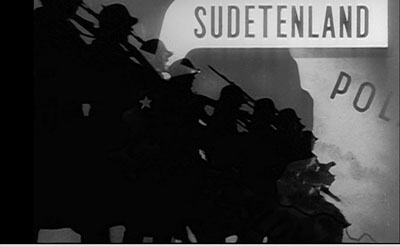
In certain types of documentaries, especially those in the Direct Cinema or cinéma vérité traditions, the assumption that we’re seeing spontaneously occurring events holds good. But a documentary can consist wholly of staged footage. Think back to those grade-school educational shorts showing a tour of a nuclear power plant. Every awkward passage of dialogue recited by the hard-hatted, white-coated supervisor was scripted. The whole show was planned and rehearsed, but that doesn’t detract from the factual content of the film.
Go further. Recall those attack maps that are shown in war films, tracing the progress of an army through enemy terrain. Now imagine an entire film made of those animated maps. The maps might even be enhanced with a few cartoon images, as in the above shot from one of the Why We Fight films. The film would be entirely designed, presenting no spontaneous reality being captured by the camera. Yet it would plainly be a documentary, telling us that, say, the Germans marched into the Sudetenland in 1938 and proceeded on to Poland. So we don’t need photographic recording of actual events to count a film as a documentary either. Both the staging and the recording conditions don’t have to be present for a film to count as a documentary.
I’m not saying that the claims advanced in my nuclear-power film or my attack-map movie would necessarily be accurate. They might be erroneous or inconclusive or false. But that possibility looms for any documentary. The point is that the films, presented and labeled as documentaries, are thereby asserting that the claims and conclusions are true.
Film theorist Noël Carroll defines documentary as the film of “purported fact.” Carl Plantinga makes a similar point in saying that documentaries take “an assertive stance.” Both these writers argue that we take it for granted that a documentary is claiming something to be true about the world. The persons and actions are to be taken as representing states of affairs that exist, or once existed. This is not something that is presumed by The Gold Rush, Magnificent Obsession, or Speed Racer. These films come to us labeled as fictional, and they do not assert that their events and agents ever existed.
This isn’t just a case of a professor stating something obvious in a fancy way. Once we see documentary films as tacitly asserting a state of affairs to be factual, we can see that no particular sort of images guarantees a film to be a doc.
Take the remarkable documentaries made by Adam Curtis. These are in a way very old-fashioned. Blessed with a voice whose authoritative urgency makes you think that at last the veils are being ripped away, Curtis mounts detailed arguments framed as historical narratives. Freudian theory shaped the emergence of public relations, which was in turn exploited not just by business but by government (Century of the Self). Islamic fundamentalism grew up intertwined with US Neoconservatism, both being reactions to perceptions that the West was becoming heartlessly materialistic (The Power of Nightmares). Mathematical game theory came to form politicians’ dominant conception of human behavior and civic community (The Trap). The almost uninterrupted flow of Curtis’s voice-over commentary could be transcribed and published as a piece of nonfiction. True, there are some interpolated talking heads, but those experts’ statements could be printed as inset quotations.
What’s particularly interesting is that Curtis’ rapid-fire declamation accompanies images that often seem not to illustrate it, or at least not very firmly. Like the found footage in the preacher’s sermon “Puzzling Evidence” in True Stories, Curtis’ images are enigmatic, tangential, or metaphorical.
Here are a few seconds from the start of The Power of Nightmares. Eyes are staring upward, as if possessed.
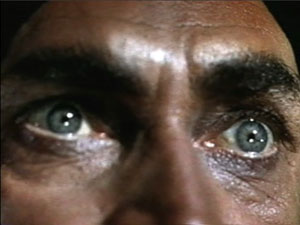
We hear: [Our politicians] say that they will rescue us from dreadful . . .
The eyes are replaced by a shot of a man wearing a cowl, and as this image zooms back the commentary continues.
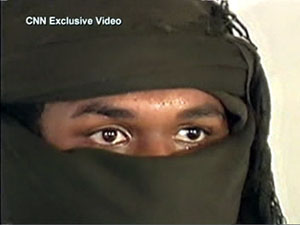
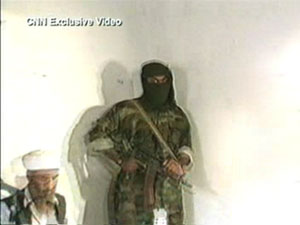
. . . dangers that we cannot see and do not . . .
Cut to a magician or mime demanding silence.
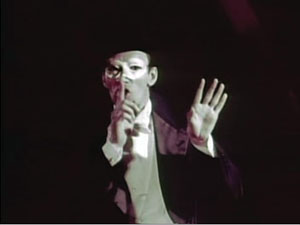
. . . understand.
Cut to rockets being fired.
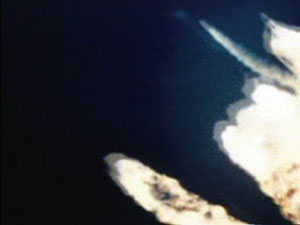
And the greatest danger . . .
Cut to a procession of cars, seen from above, rounding a corner into a government compound at night.
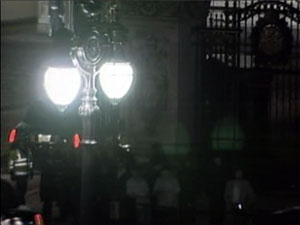
. . . of all is international terrorism.
Cut to shot of security agent staring at us.
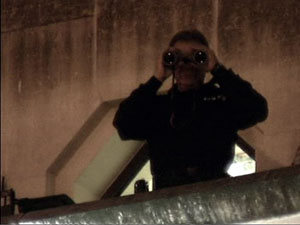
The ominous, not to say paranoid, tenor of the sequence is aided by the unexpected juxtapositions. For instance, you’d think that the shot of the iconic terrorist (anonymous, with automatic weapon) would be synchronized with the final line of the commentary, referring to “international terrorism.” Instead the commentary links the mention of terrorism to an image of government deliberation, and then to an image of surveillance (aimed at us, but also perhaps suggesting the previous high-angle shot was the spy’s POV). The wild-eyed close-up might belong to a terrorist, but is accompanied by claims about rescuing us from fearsome threats, so the eyes could also belong to someone panicked–especially since they contrast immediately with the sober eyes of the gunman in the cowl. Perhaps the first shot represents the fearful public ready to be led by the politicians playing on fear. And the insert shot of the mime becomes sinister but also comic, perhaps debunking the official position that our dangers are unseen and unknowable. In all, the sequence bubbles with associations that are less fixed and more ambiguous than we’re likely to find in a more orthodox documentary, like Jarecki’s Why We Fight.
My point isn’t to analyze the image/ sound relations in Curtis’s work, a task that probably demands a whole book. (This sequence takes a mere eleven seconds.) I simply want to propose that regardless of what pictures Curtis shows, his films are documentaries in virtue of a soundtrack constructed as a discursive argument that makes truth claims. The picture track often works on us less as supporting evidence than as a stream of associations, the way metaphors or analogies give thrust to a persuasive speech.
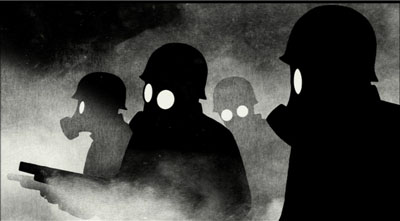
Just as we could have an account of Germany’s 1938 invasion of Czechoslovakia presented in cartoon form, we could imagine The Power of Nightmares illustrated with political cartoons. Once we’ve pried the image track loose from the assertions on the soundtrack, anything goes.
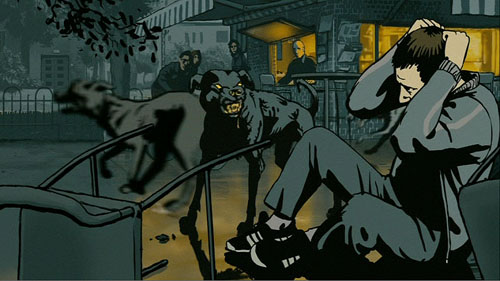
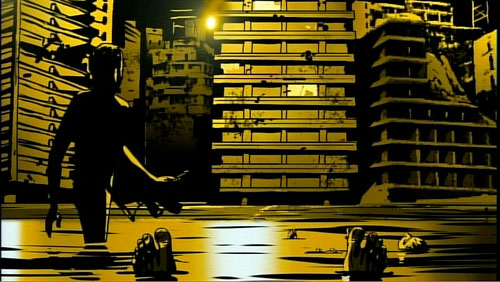
One example much on our minds now is Waltz with Bashir. Ari Folman interviews former Israeli soldiers. But instead of using film footage of their conversations and, say, still photos of the events in Lebanon they took part in, he provides (until the final sequence) drawings a bit in the Eurocomics mold of Tardi or Marc-Antoine Mathieu. The result takes the form of a memoir, admittedly. But in both literature and cinema, memoir is a nonfiction genre.
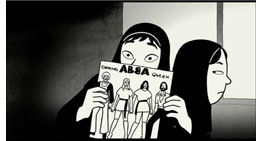 Another memoir supports the point. Marjane Satrapi’s autobiographical graphic novels, Persepolis and Persepolis 2, assert factual claims about her life. The claims are presented as drawings and texts rather than simply as texts, but that doesn’t change the fact that she presents agents and actions purported to have existed. True, on film the people whom she remembers are represented through voice actors speaking lines she wrote. But as with written memoirs (especially those that claim to remember conversations taking place fifty years ago), we can always be skeptical about whether the events presented actually took place.
Turning Satrapi’s published memoir into an animated film did not change its status as a documentary. If we had contrary evidence, we could charge her with fibbing about her family life, her rebelliousness, or her life in Europe. But we’d be questioning the presumptive assertions the film makes, not the fact that it is drawn and dubbed rather than photographed from life.
We’re tempted to see the animation in these films as adding a level of distance from reality. We’re so used to fly-on-the-wall documentaries that we may be suspicious of the cobra-like caricatures of the female teachers in Persepolis or the hallucinatory dawn bombardment in Bashir. Yet animation can show things, like the Israeli veterans’ dreams, that lie outside the reach of photography. And the artificiality doesn’t dilute the claims about what the witnesses say happened any more than does purple prose in an autobiography. In fact, the stylization that animation bestows can intensify our perception of the events, as metaphors and vivid imagery in a written memoir do.
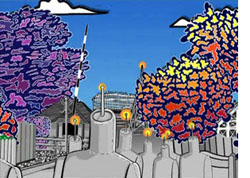 I realize I’m pointing toward a slippery slope here. Strip off the image track from Aardman‘s Creature Comforts and you have impromptu recordings of ordinary people talking about their lives. Those monologues could have been accompanied by documentary-style talking heads. Does that make Creature Comforts a documentary? I’d say not because the film doesn’t come to us labeled that way; it’s presented as comic animation using found soundtracks (like the movie based on the Lenny Bruce routine Thank You Mask Man). Then there are Bob Sabiston‘s rotoscoped films like Waking Life and The Even More Fun Trip, recently released on Wholphin no. 7. The latter (left) takes another documentary form, the home movie, as the basis for its animation. This seems to me an instance where the documentary category has the edge, but it’s a surely a borderline case.
Animated documentaries are likely to remain pretty far from our prototype of the mode. Still, we should be grateful that even imagery that seems to be wholly fictional—animated creatures—can present things that really happen in our world. This mode of filmmaking can bear vibrant witness to things that cameras might not, or could not, or perhaps should not, record on the spot.
André Bazin’s arguments for the documentary basis of cinema are set out in “The Ontology of the Photographic Image,” in What Is Cinema? ed. and trans. Hugh Gray (Berkeley: University of California Press, 1967), 9-16. Noël Carroll’s argument that documentaries are framed as presenting “purported fact” can be found in Theorizing the Moving Image (Cambridge: Cambridge University Press, 1996), 224-259. On the “assertive stance” of documentaries, see Carl Plantinga, Rhetoric and Representation in Nonfiction Film (Cambridge: Cambridge University Press, 1997), 15-25. Errol Morris interviews Adam Curtis here. Thanks to Mike King for pointing me toward The Even More Fun Trip.
PS 10 March: Harvey Deneroff writes:
Very much enjoyed your post on animated documentaries, a topic of some interest to and often discussed in the animation studies community. There was a panel on it during last year’s Society for Animation Studies conference and there will also be one at this year’s as well.
Two recent Oscar recipients for Best Animated Short Subject are also documentaries: Chris Landreth’s wonderful computer animated Ryan (produced by the NFB about animator Ryan Larkin, and features a lot of talking heads) and John Canemaker’s The Moon and the Son: An Imagined Conversation, which is about Canemaker’s father and mixes animation with home movies and photographs.
At least two winners in the Oscar Documentary Short Subject category were largely animated: Chuck Jones’ So Much for So Little (WB, 1949, which I believe was made for the US Public Health Service) and Norman McLaren’s Neighbours. The Story of Time, a 1951 British documentary which featured stop motion animation was nominated in the same category.
Also, the International Leipzig Festival for Documentary and Animated Film includes a section for animated documentary films.
Thanks to Harvey for this. I’m not sure I’d categorize Neighbours as a doc, but it’s a long time since I’ve seen it. On Harvey’s site he also has a note quoting Ari Folman on the difficulty of funding animated docs. And thanks to Ryan Kelly and Pete Porter for reminding me of Winsor McCay’s Sinking of the Lusitania from 1918.
An old-fashioned, sentimental avant-garde film
Kristin here–
A great many silent films that were almost impossible to see when David and I were in graduate school are now available on DVD. And it’s not just a matter of titles becoming available. In those days we might be able to see a classic film, but it was likely to be a shortened, fuzzy version made from a worn distribution print. Now government support for film archives and revenues from home video have promoted many more restorations. There are still companies releasing poor-quality DVDs of silent films, but beautiful prints, complete with tinting, toning, hand-coloring, and specially composed musical tracks, as well as supplementary material, are becoming more common.
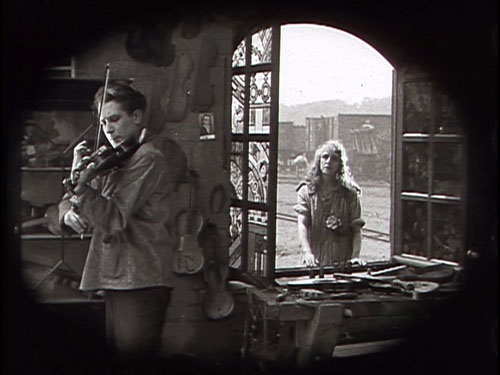
A case in point is the new DVD version of Abel Gance’s 1922 epic, La roue (“The Wheel”), which the enterprising company Flicker Alley released last year. In its short existence since 2002, Flicker Alley has done exciting work. Its recent “A Modern Musketeer” collection finally makes a selection of Douglas Fairbanks’ pre-swashbuckler comedies and dramas available. I personally prefer these lively, witty, imaginative films to Fairbanks’ 1920s costume pictures. Flicker Alley’s George Méliès set is one of the great achievements of DVD production and deservedly won last year’s prize for the best silent DVD set at Il Cinema Ritrovato. Other highlights include F. W. Murnau’s rare psychological drama Phantom (1922) and Louis Feuillade’s serial, Judex (1917). I wrote about Flicker Alley’s release of Discovering Cinema, on early sound and color.
David and I first saw La roue in 1973, in a 16mm print at George Eastman House. It lasted around two hours projected at sound speed. We had another chance to see it at a 1979 screening of a 35mm nitrate print at the Museum of Modern Art. Again, it was a truncated version. In short, you had to see La roue at an archive.
The restoration
The original 32-reel version would have run between seven and eight hours. That doesn’t survive, but versions longer than the ones we had seen survived in various collections. A more common release version made in the 1920s reduced the film to 12 reels, or about three hours. Other still shorter versions also circulated.
Flicker Alley’s version is none of these. The liner notes say that it’s 20 reels, and it runs about 260 minutes. (The total time given on the box is 270 minutes, which I assume includes an eight-minute making-of supplement.) So what we have here is not an approximation of one of the release prints, but an attempt to reassemble as much footage as possible.
Here’s what Flicker Alley’s press release said about the restoration:
La Roue was originally shown in France over three days, in 32 reels, with a running time of almost eight hours, but was soon shortened to 12 reels, the maximum length for a typical feature film at the time. This new restoration, produced by Eric Lange, David Shepard and Jeff Masino with invaluable support from Turner Classic Movies, began with a 35mm master positive of this 12-reel version, a Russian print of an 8-reel version, two incomplete tinted nitrate prints of a longer French version, and finally, for two short but critical scenes, a 4-reel abridged version released by Pathe on 9.5mm for home movie screening. Conflating all of this material, the Lobster Film Studios restoration team headed by Eric Lange was able to prepare and digitally restore a 20-reel version, by far the most complete edition of La Roue seen anywhere since 1923. This release possesses exceptional pictorial quality and English titles that use the type font and moving photographic backgrounds of the original film.
The notes call this restoration “the fullest presentation of La Roue to reach the public since 1923,” which may or may not be true. I have seen a print of La roue of roughly the same length which has a significant number of scenes that aren’t present in the Flicker Alley release-and lacks several of the scenes included here. That was at the Royal Film Archive of Belgium, though they don’t hold the original material on it; that’s in a French archive. That version runs 287 minutes at 18 frames per second; I can’t find an indication of projection speed on the DVD, though I would guess that it’s comparable.
I definitely don’t want to suggest that the Flicker Alley DVD is not worth buying or viewing. Quite the contrary, it’s a valuable release of an extremely influential and important film. Perhaps a longer version will eventually be assembled, but I doubt that will happen any time soon. Those who have been waiting for years to see La roue should pounce on this, and it’s ideal for instructors who want to show clips of highly influential sequences in classes.
The visual quality of the print is mostly excellent, apart from a few passages where the restorers had to use a 9.5 mm print to fill in a few scenes–and even those look pretty good. Blue tinting is used in the night scenes, and the film is accompanied by Robert Israel’s effective score.
Gance’s innovations
[SPOILER ALERT]
Gance has many ardent admirers, to judge by the effusive reviews of the DVD on Amazon. But I find his major silent features a maddening blend of exciting stylistic innovation and old-fashioned, maudlin storytelling. La roue was, as far as we know, the first film to use rapid, rhythmic editing, at times going down to single-frame images. It’s also full of the subjective camera techniques typical of French Impressionist filmmaking: out-of-focus shots, white masks, superimpositions, and so on.
The plot, however, is simple and melodramatic; it centers on Sisif, a train engineer, and his secret adopting of a little girl who survives a train wreck in the opening scene. Norma grows up assuming herself to be his daughter, and Sisif’s son Elie, a sensitive violin-maker, believes her to be his sister. Sisif falls in love with her but stifles his feelings, giving her in marriage to a rich man whom she doesn’t love. When Elie learns the truth, he comes to love her as well but also hides his secret. A great deal of suffering ensues, over which Gance lingers lovingly with many shots of agonized faces.
Most famous are three scenes. The film’s action begins dramatically with the train crash, vividly rendered in many fairly quick shots. In the second, Sisif decides to crash the train in which Norma is traveling to her marriage. Even faster, accelerating editing conveys both Sisif’s anguish and Norma’s growing alarm. It’s a bold and suspenseful scene, and required viewing for anyone interested in silent cinema and the history of film style. The second passage comes after a fight between Elie and Norma’s husband that ends with Elie dangling from a tree root over a cliff. As he hears Norma approaching in an attempt to save him, their life 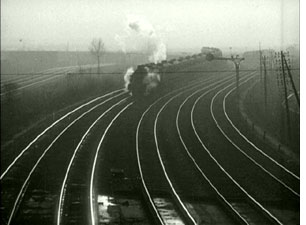 together literally flashes before his eyes in a series of shorter and shorter shots that end with a flurry of single-frame images that end with his fall.
Much of the imagery is also beautiful, in particular the shots of trains passing sinuously along rails, a motif that punctuates the film.
These innovative scenes and other flashy techniques tended to be retained as distributors cut out more and more footage. What got trimmed seems to have been details of the quadruple romance plot. Scenes in the Belgian print that aren’t on the DVD include two brief ones indicating that the husband’s fortunes are declining. This sets up for the moment when Norma is revealed to have been left destitute after his death, a development that comes abruptly in the DVD version. The Belgian print also contains a rather silly scene in which Sisif talks to his train engine and imagines it replying to him.
Modern viewers may find it a bit disconcerting that the interior scenes of Sisif’s small house, built between the rails in a real train-yard, are lit with bright sunlight. Immediately after World War I the French film industry was short on studios and lighting equipment. Using open-air sets and full sunlight was not uncommon there or in countries with small film industries.
A brief but valuable bonus
Most films of this era did not have making-of documentaries. In this case, though, poet Blaise Cendrars, a great cinema enthusiast, filmed some scenes of Gance and his team at work and put together a fascinating short. A couple of shots show the camera used to film the tavern scene mounted on a dolly.
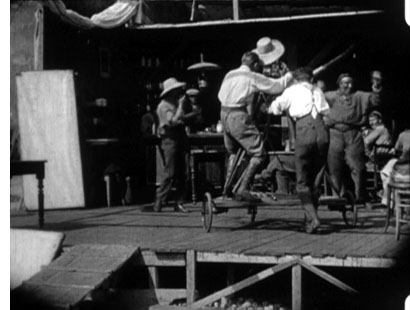
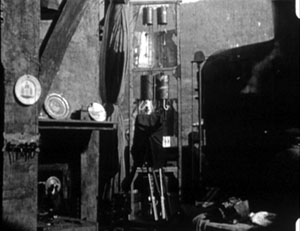
One view reveals just how close to the rails the sets for Sisif’s house were built. Trains passed so close to them that someone had to be stationed nearby to warn the crew of oncoming trains. Cendrars also recorded a visit Charles Pathé paid to the location, and there’s a heroic view of the director in the cab of a moving locomotive. This film has hitherto been très rare, so we are lucky to have it now.
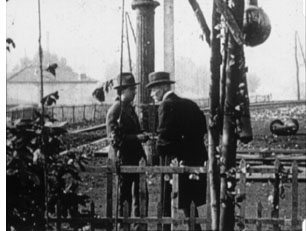
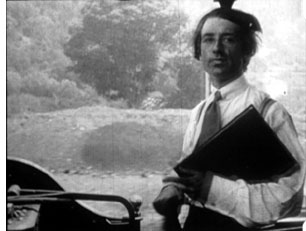
The booklet accompanying the discs has an excellent essay on the history of the production by William M. Drew and notes by Israel on his score.
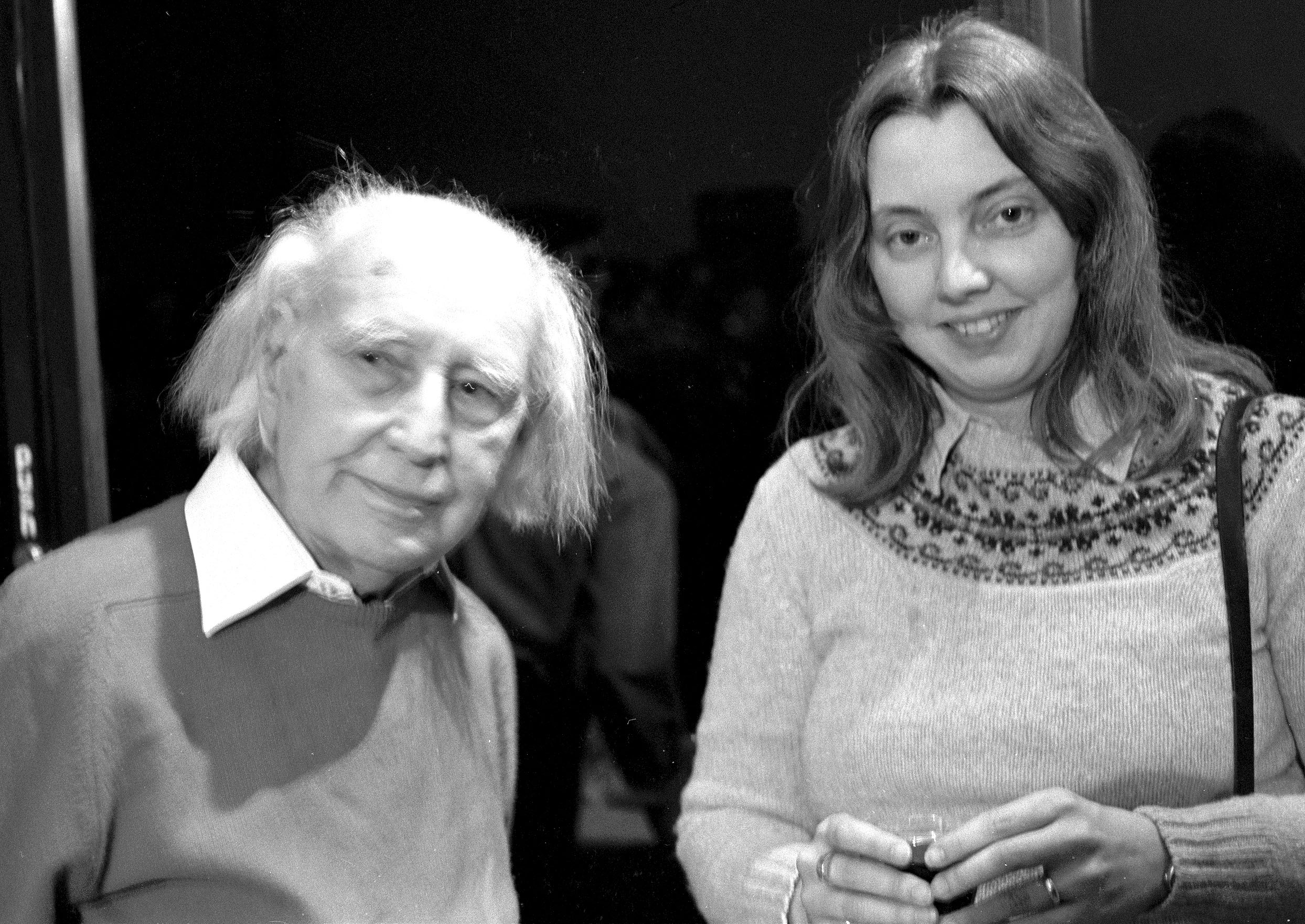
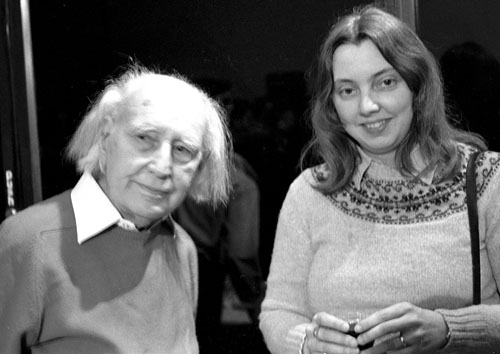
David insisted on having the photo at the bottom included among the illustrations. Gance appeared at the Walker Art Center in Minneapolis when he was 91 years old, which means that must have been in 1980. He had come to introduce a screening of Bonaparte and the Revolution, an early attempt to restore Napoléon vu par Abel Gance. At a reception afterwards, M. Gance was gracious enough to inscribe a photo and our copy of a book he had published in the 1920s, purchased back in the days when one could still find such things fairly readily in Parisian used bookshops. He also let David take a picture of him and me. He died the following year.
Note: Filmmaker and blogger Kevin Lee has created two more of his “Shooting Down Pictures” video analyses, with me speaking about La roue (five minutes) and Variety (six minutes) to clips Kevin has edited.