



Archive for the 'Festivals' Category
Cinema bolognese
Cinema Ritrovato, a festival of rediscovered and restored films, is now in its twenty-first year. We visited its two previous installments, and we found it one of the most hugely enjoyable festivals on the calendar. Where else can you see films from 1907, Richard Fleischer’s Violent Saturday (1955), and a tribute to Ben Gazzara in a single week? Then there are the nightly screenings on the Piazza Maggiore, which attract hundreds of locals. The city plays host magnificently, with plenty of fine restaurants and perpetually cheerful people.
Mounting hundreds of screenings and panels is an enormous effort, but Gianluca Farinelli, Guy Borlée, Peter von Bagh, and all their colleagues have made it look easy. (The word sprezzatura comes to mind.) Here are our impressions from the first half of the event.
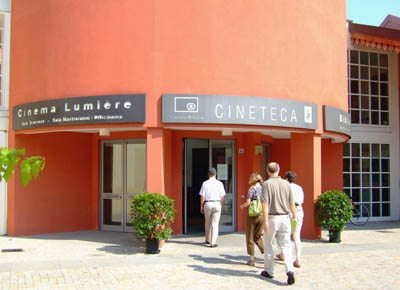
The home base is the Cineteca di Bologna, the local film archive. It’s located in a wide, quiet courtyard. It houses a large library and meeting rooms, along with two cinemas. During the festival, the Lumiere 1 auditorium specializes in silent screenings with piano accompaniment, while Lumiere 2 presents sound films. Widescreen titles and big events are reserved for the Arlecchino, a big, comfortable commercial theatre built in the era of roadshows and CinemaScope.
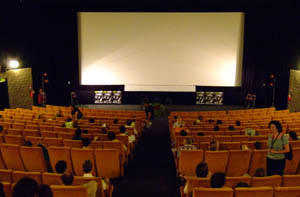
Organizing such a mixed program is more difficult in certain ways than presenting an event involving contemporary films, which are moving through the festival circuit already. Ritrovato must find good prints of titles that fit the year’s themes and also coordinate the ongoing efforts of archives that are restoring films.
A good example is a remarkable project overseen by Alexander Horwath of the Austrian Film Museum. One of the most famous lost films in US history is Josef von Sternberg’s 1929 movie The Case of Lena Smith. In 2003, Japanese scholar Komatsu Hiroshi found a fragment, in very good condition, in China. On the basis of this, Horwath and his collaborators created a wonderful book that reconstructs the film. It includes a detailed shot breakdown (based on one published in Japan during the film’s release), along with gorgeous stills, script extracts, summaries of critical reception in various countries, and essays about the film’s place in history.
The fragment, previously screened at the Giornate del Cinema Muto last fall, was tantalizing. Lena and her friend Pepi are in the Prater, Vienna’s dazzling amusement park, and they are eyed by two young officers. The women watch some of the sideshow entertainments before darting away, the officers in pursuit. Several of the shots evoke the heady atmosphere of the park, with prismatic, superimposed images of the sideshow attractions and—typical von Sternberg—a spinning ride providing pulsating visions of the crowd.
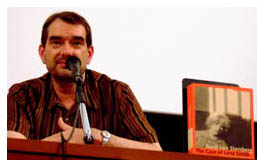 In his panel presentation, Horwath stressed that the book couldn’t have been done without the cooperation of researchers around the world. The multilingual volume is to be made available in the UK and the US in 2008. It is a splendid example of what archives and scholars can accomplish working together, with festivals like Cinema Ritrovato providing a forum for rediscoveries. The book is available already at the archive’s website and will be distributed later this year by Wallflower in the UK and Columbia University Press in North America. (DB)
One of the threads of this year’s festival is the early US career of Michael Curtiz. The Strange Love of Molly Louvain (1932) is an energetic Warners crook melodrama. Starring Ann Dvorak and the ever-annoying Lee Tracy, the film displays Curtiz’s characteristically staccato direction. The scenes with hard-bitten reporters use overlapping dialogue in a manner that prefigures His Girl Friday. Rarer was The Third Degree (1926), an early instance of Europe’s “International Style” infiltrating Hollywood. For his first Warners project, Curtiz fills an implausible mother-daughter melodrama with cloudy superimpositions, canted angles, florid tracking shots, oddball angles, extreme close-ups, and frantic montages played with prismatic lenses. Richard Koszarski gave an amusing and helpful introduction. (DB)
One attractive constant of the Ritrovato is a series of short films from 100 years ago. Thus when we first attended in 2005, there were groups of shorts from 1905. As we progress through the early years of the current century, we go in parallel through the early years of the previous one. Each day one or two small groups of 1907 films have been shown, grouped by country or genre. These included some familiar items, like the poignant Le Bagne des gosses (“Children’s Prison,” Pathé) and the amusing British chase film, That Fatal Sneeze (directed by Lewis Fitzhamon). I have run across references to early Westerns made in Europe but had not seen any from this early period. Les Apaches du Far-West (produced by Pathé) is as unauthentic as one might predict, with the cowboys riding on English-style saddles and the shoot-outs with the Apaches taking place in bucolic fields and woods that are clearly in France, not the West. (KT)
A major new initiative for international film preservation was announced in May at the Cannes Film Festival. The World Cinema Foundation was founded by Martin Scorsese, and its advisory board contains such major filmmakers as Abbas Kiarostami, Elia Suleiman, Walter Salles, and Wim Wenders. The goal is to restore films made in nations that lack the archival facilities to do so locally.
The Moroccan Transes (El Hal, 1981), directed by Ahmed El Maanouni, is the new foundation’s first restoration, and it was introduced by the director and by its producer, Izza Genini. The titles crediting Giorgio Armani, Cartier, and Qatar Airlines as sponsors raised some surprised laughter in the audience, but if Scorsese and his colleagues can draw funding from such sources into film restoration, all the better. Transes is partly a concert film and partly a history of a band that became popular in the 1970s by expressing young people’s frustrations and rebelliousness. The big concert that begins and ends the film is exhilarating in its depiction of the crowd’s enthusiasm—but chilling as well as soldiers patrol the audience and occasionally suppress the more demonstrative spectators. (KT)
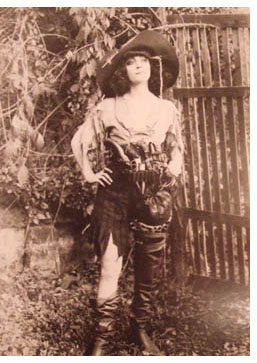 Another major theme is the ever-popular star Asta Nielsen. Again, items familiar from other retrospectives are mixed with new discoveries. Karola Gramann has curated the series and plans to restore other Nielsen films, either new discoveries or better prints of familiar films. Zapatas Bande (1913-14), for example, existed before, but now a color print has been made based on tinting notations on an existing black-and-white copy. It’s a slight item, a casual tale of filmmakers getting into trouble while shooting an adventure movie, but it allows Nielsen to get away from her usual melodramas and display her range as a comic actor. (KT)
Our first visit to Italy for a film festival was in 1986, when Le Gionate del Cinema Muto, in Pordenone, presented a vast retrospective of Scandinavian cinema from the pre-1919 era. One of the major revelations was that alongside Mauritz Stiller and Victor Sjöström, there was a third great Swedish director during the silent era, Georg af Klerker. The event also brought home to the audience one of the great tragedies of cinema history, the loss of many of Stiller’s and Sjöström’s films in an archive fire in the 1940s.
Every now and then, another film by one of these masters surfaces. This year the Ritrovato festival showed Madame de Thèbes, a 1915 Stiller film. As too often happens, the surviving copy, a French release print discovered by Lobster Films, was incomplete. The Svenska Filminstitutet has filled it out by inserting still shots created from copyright frames deposited at the Library of Congress and by replicating the original Swedish intertitles and letters. The result, full of sumptuous decor and extravagant plot twists, gives as good an approximation of the original as is now possible. It’s one more indication that the 1910s Swedish cinema was one of the glories of the silent era. (KT)
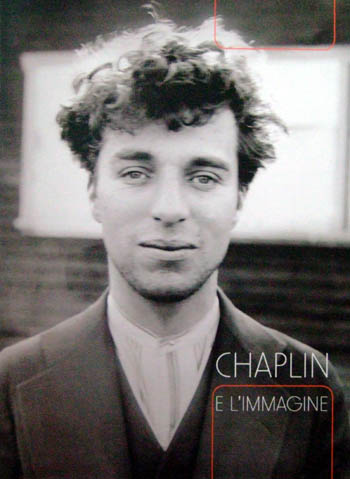
The festival has a close relation with the Charlie Chaplin estate; this is the place to come for the latest in Chaplin restorations and scholarship. Every year the festival mounts a tribute, including a superbly designed book on some aspect of Chaplin’s career. This year’s volume is a collection of rarely seen pictures, and its cover carries one of the most melancholy and haunting portraits of Charlie I’ve ever seen (up top).
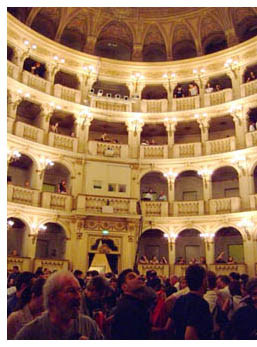 The first big event of the festival was a screening in the city’s Teatro Communale, an overpowering opera house. It was a fitting venue for The Idle Class (1921) and The Kid (1921), accompanied by orchestra. The prints were pristine, shown in a nearly square ratio. The version of The Kid was based on Chaplin’s 1971 rerelease, since that represents his final thoughts, but the Bologna gang generously tacked on the material that Chaplin chopped out—all scenes with Edna Purviance, playing the unwed mother who abandons her baby. These scenes include her uneasy meeting her old lover years after she’s achieved success. The plot turn and the regretful tone seemed to me to look forward to A Woman of Paris. This version, along with the deleted scenes, is available on the MK2 DVD release.
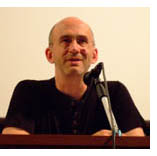 The score was by Timothy Brock, who also conducted. On the following day Brock gave an enlightening seminar on how he based his scores on original themes that Chaplin came up with. Chaplin was in the habit of working and reworking tunes at the piano, and many of his efforts were recorded. The recordings came to light three years ago, and Brock was able to integrate the tunes into his scores—sometimes linking five or six in a single passage. (DB)
A cloud was cast over our visit by the news of the death of Edward Yang (Yang Dechang). We admired his films and discussed them in Film History: An Introduction and my Figures Traced in Light. Edward was a likeable, tough-minded fellow. His films explored the effects of urbanization and politics on everyday life in Taiwan. He made his breakthrough to a broad international audience with Yi Yi (2000), but his other films, particularly Taipei Story (1985), The Terrorizers (1986), and A Brighter Summer Day (1991) are to me even more important. It’s a great loss that these aren’t easily available on DVD. When I get back to Madison and have access to pictures from my encounter with Edward in Kyoto in 1997, I hope to write a more adequate tribute. (DB)
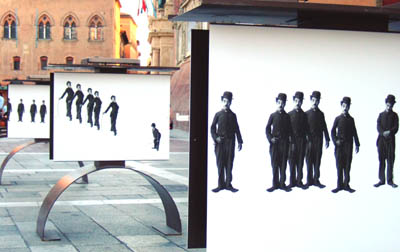
Can you spot all the auteurs in this picture?
DB here:
Some movies consist of several distinct episodes, each directed by a different filmmaker and all focused on a single theme. I’ve heard them called anthology films, omnibus films, and portmanteau films.
The earliest one I know is If I Had a Million (1932); later, Hollywood offered us Ziegfeld Follies (1946) and O. Henry’s Full House (1952). The Brits gave us the horror anthology Dead of Night (1945). Still, I think we associate the form chiefly with European cinema of the 1950s and 1960s. We got Love in the City (1953), Amori di mezzo secolo (1954), The Seven Deadly Sins (1962), RoGoPaG (1963), Les plus belles escroqueries du monde (1964), Paris vu par . . . (1965), Three Faces of Woman (1965), The World’s Oldest Trade (1967), and Amore e rabbia (1969).
Why the emergence of omnibus movies at this point in history? Some causes are surely financial. Most high-budget European films of the period had to be cross-national coproductions. Bringing in directors from several different countries could help guarantee funding under EU auspices and participating nations’ subsidy schemes. Just as important, the anthology format appeared when the festival scene was starting to become a vast clearing house for international film trade.
Although you can argue that many people seeing If I Had a Million would recognize the Lubitsch episode, Hollywood’s use of the form didn’t stress directorial differences. But as the Euro auteur was becoming a marketable commodity in the postwar era, a collection of short films could sell if they were signed by big-name filmmakers. “Paris As Seen by…” signals the importance of the different directorial approaches, and the very title of RoGoPaG invokes Rossellini, Godard, and Pasolini as brand-name labels. (Granted, the final G, Hugo Gregoretti, didn’t add much to the deal.)
For full enjoyment, the 1960s portmanteau film requires a degree of specialized film knowledge. At one level, we enjoy varied treatments of a theme, but at another we’re supposed to recognize each director’s personal vision, as we know it from other films. Even political-commentary portmanteau films like Far from Vietnam (1967), Lucía (1968), and Germany in Autumn (1978) gathered international attention because of the name recognition of the filmmakers who participated. The same branding operates in New York Stories (1989) and, more openly, in the documentary 12 registri per 12 città (“12 Directors for 12 Cities,” 1989).
The format has returned recently. We’ve had 11’09”01—Sept. 11 (2002), Eros (2004), Tickets (2005), and Paris, je t’aime (2006), the last virtually a rebooting of Paris vu par . . . . As we’d expect, such films continue to highlight the personal signatures of festival familiars. But we can spot some new twists too.
For one thing, the unifying idea may be formal as well as thematic. The episodes of 11’09”01 were all obliged to be the same length, eleven minutes, nine seconds, and one frame. Lumière et cie (1995) not only celebrated the centenary of film but obliged the directors to make their entries with a Lumière camera, to shoot without sync sound, to shoot no more than three takes, and to restrict the length to 52 seconds, the approximate running time of the earliest films. The Lumière homage also introduces the key themes of cinema and cinephilia, an angle that doesn’t seem prominent in the 1960s omnibus movies.
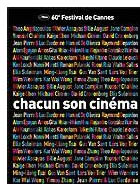 The most prominent portmanteau film so far this year fits snugly into current trends. As Anthony Kaufman writes, “Chacun son cinéma. . . showcases a range of filmmaking aesthetics, and for the most part, the program is a dazzling and memorable array of current auteur cinema.” As in other eras, we get a stylistic buffet; as in recent years, we find formal constraints and the theme of cinephilia. Commissioned for Cannes’ sixtieth anniversary by festival head Giles Jacob, the project restricts filmmakers to three minutes per episode and dictates the subject: “their state of mind of the moment as inspired by the motion picture theater.” The result was 33 short films about the joys and sorrows of film viewing and, to some degree, an extended commercial promoting the cultural value of the Cannes event.
A half-dozen things strike me while watching the French DVD version (which has English subtitles but is unaccountably lacking the Coens’ entry). Most notable, I suppose, is the way that many of the shorts replay tendencies that are characteristic of art cinema generally (1).
1. Cinema invokes eroticism . . . We get a dreamy Wong Kar-wai scene of a man watching, or recalling, heavy petting in the theatre. Polanski’s episode plays amusingly on the similarity of orgasmic moans and painful groans. Gus van Sant’s First Kiss reinvents Sherlock Jr., while the Dardenne brothers give us a tight tale of hands in the dark. Olivier Assayas’ episode, a crisp piece of filmmaking, reveals its l’amour fou at the very end. Angelopoulos makes clever use of the Kuleshov effect to create a touching exchange between Jeanne Moreau and the lamented Mastroianni.
2. . . . and childhood, especially for the Chinese directors, who haven’t exactly risen to the occasion here. The international art film has long traded on the appeal of kids, but the treatment of them in these episodes is remarkably banal. Tsai Ming-liang, who already passed his benediction for classic cinema in Goodbye, Dragon Inn, gives us a dream of a family reunited at the pictures. Chen Kaige shows children watching—hold on now—a silent Chaplin film. Hou Hsiao-hsien provides a sepia-toned flashback to going to the movies in Taiwan, while Zhang Yimou takes us to movie night in a Mainland village. At least the Hou episode opens on a lengthy shot that nicely decenters areas of interest in a busy street scene.
3. The cinema is on the decline . . . . One way to interpret Kitano Takeshi’s cryptic sequence is that films, even his own Kids’ Return, are little more than an anachronism today. More explicitly, David Cronenberg’s single-take close-up, captured by a surveillance camera shows himself as the world’s last surviving Jew, on the threshold of suicide in a movie house.
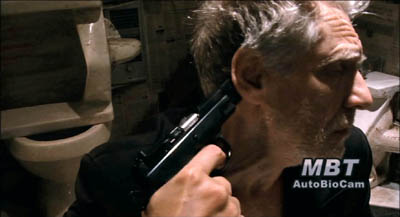
4. . . . yet it holds us in a magical spell. Some directors celebrate the simple folk at the movies. Claude Lelouch’s parents watch Top Hat and fall in love. Raymond Depardon takes us to a rooftop cinema in Alexandria, and Wenders shows a Congolese village running Black Hawk Down on video (more kids, but this time to disturb us). Kaurismaki seems to be poking fun at this arthouse commonplace by showing foundry workers blankly watching a rather different image of workers at the end of the day. The cinema, Ruiz and González Iñárritu suggest, mesmerizes even blind people.
Walter Salles provides a charming, deflating musical dialogue (below) that might be called Far from Cannes, showing that this festival casts a quasi-religious spell felt across the world. In my favorite section, Kiarostami gives us shots of women responding to Zeffirelli’s Romeo and Juliet. The image/sound pairing hints at their own thwarted loves, while certain lines, such as “Where be these enemies?,” seem addressed to Westerners who try to dehumanize the people of Iran.
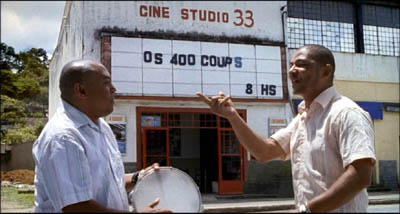
5. Film can be silly. Von Trier, decked out in a tux, silences a businessman through extreme means, and the rest of the audience hardly notices. Jane Campion, in an awkward episode, reveals a bug living in a theatre speaker. Probably the funniest contribution shows a mute Elia Suleiman preparing for a Q & A session after a screening. There are more gags in this three minutes than in all the other episodes put together.
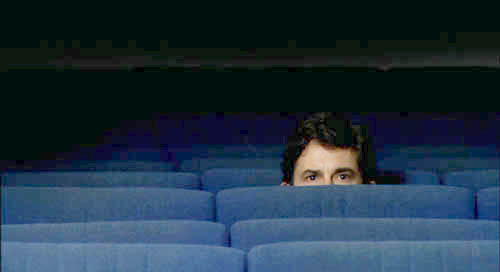
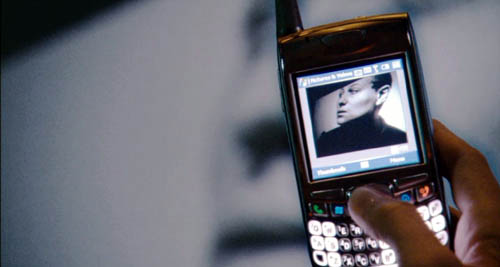
5. Lest we forget . . . This couldn’t help but be a nostalgia exercise, encouraging filmmakers to muse on their lives in cinema. This theme recalls Cinema Paradiso, Scola’s Splendor, and all the other films soaked in the melancholy sweetness of movie memories. Moretti (top image above), gives us an anecdotal monologue, while Youssef Chahine unashamedly thanks Cannes for giving him an award ten years ago. The most formally ingenious entry here is Atom Egoyan’s tale of a couple sitting in different screenings while texting each other. Eventually one grabs an image from La Passion de Jeanne d’Arc and passes it along, creating a parallel to what’s happening in the other film (Egoyan’s The Adjuster).
In particular, there’s nostalgia for the golden age of auteurs, the very period when the anthology film gained its purchase. Chacun son cinéma is dedicated to Fellini, and Konchalovsky’s episode centers on 8 ½. Bresson and Godard are the most frequently referenced directors. (More generally, in our new century Bresson seems to have become the prototype of the serious filmmaker.) Other icons of the 1960s, such as Mastroianni and Anna Karina, keep popping up.
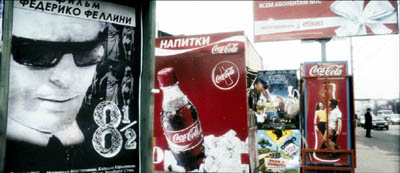
6. Spot the auteur. Most episodes don’t reveal the director’s name until the end, so the cinephilia takes on a suspenseful dimension, forcing you to guess who filmed the bit you’re watching. You also have to identify movies within the movies on the basis of clips and soundtracks. It’s a great game for arthouse aficionados, but it also highlights festival cinema’s reliance on the cult of the director and the organic unity of his/her body of work.
Suppose that all these films omitted the director’s name and replaced the recognizable players with nobodies. Would any of these episodes have been accepted for Cannes’ short film programs? Probably not, but we shouldn’t be cynical about this. Clearly artworks can gain in interest by virtue of their place in history or an artist’s career. Renoir’s Sur un air de Charleston (1927), Bresson’s Les affaires publiques (1934), Dreyer’s They Caught the Ferry (1948), and Fassinder’s episode in Germany in Autumn are not masterpieces, but these shorts show fresh sides of great filmmakers, and our understanding of their accomplishment is enriched by having them.
So we’re right to recognize the director’s career as a meaningful whole. But we should also recognize that today such careers continue thanks to a distinct system of marketing. At the Cannes site, Rauol Ruiz says: “It’s a delight to be a preferred filmmaker and especially a favored filmmaker of Gilles Jacob.” The system depends on reciprocity. “Without the auteurs,” says Jacob, “there wouldn’t be a festival.” (2) In turn, auteurs are obligated to festival gatekeepers and tastemakers, the powerful critics, programmers, and impresarios. The filmmaker knows the drill. You showed my film last year, so yes, I’ll sit on a jury or offer a master class or show up on the red carpet this year.
We’re told by Anne Thompson that a more complete DVD edition, including the David Lynch entry, will be available before Christmas. That gesture makes the disc I bought the equivalent of the plain-vanilla DVD of a blockbuster that will be followed at the right moment by the Deluxe Edition. Who says the art cinema operates above pressures of business and the market?
(1) I discuss the idea of art cinema in a 1979 article, “The Art Cinema as a Mode of Film Practice,” revised in the forthcoming Poetics of Cinema.
(2) Nancy Tartaglione-Vialatte, “‘Without the auteurs there wouldn’t be a festival,'” Screen International (May 18-31, 2007), p. 15. See also the accompanying article by Nick Roddick, “The bucks start here,” pp. 14-15. These are available online to subscribers.
PS: Speaking of Cannes and the art cinema, I wrote an essay about camerawork in contemporary Danish film for the festival issue of the Danish Film Institute magazine. It’s now online here (pp 22-26). And speaking of Danish filmmakers. . . .
Atom Egoyan, Artaud Double Bill.
Cannes: Behind the art, hype, and politics
Kristin here–
The Festival de Cannes has been around since 1946, so a sixtieth birthday party this year might seem a bit belated. The festival got off to a rocky start, however, and lack of funds forced its cancellation in 1948 and 1950.
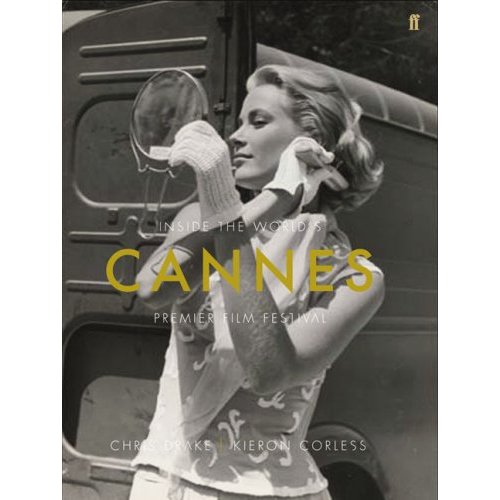
There have been many forms of celebration, but one that is likely to endure is Kieron Corless and Chris Darke’s new history, Cannes: Inside the World’s Premier Film Festival. We picked up a copy in Auckland. The book, published by Faber and Faber this year, is not currently available in the U.S. but is on offer from Amazon’s U.K. branch.
As the authors themselves note, “This is not one of those anecdotal and slightly self-indulgent Cannes memoirs, of which there are several available in English and French” (p. 3). Instead, they avoid the gossipy approach, trying “to redress the balance and probe beneath the surface by telling another story—a counter-history of Cannes, if you will” (p. 2). This is not to say that Cannes is a dry, pedantic look at the event. I found it an absorbing read during the long plane trip from Auckland to Los Angeles. Who wouldn’t enjoy a book whose first chapter begins, “It is tempting to imagine the first Cannes film festival as a Jacques Tati film”? And I wouldn’t call it a counter-history. It’s a solid historical study, well-researched and just the sort of study that any major festival warrants.
The approach is not chronological, though the authors segment the festival’s history into three phases. The first, stretching from 1946 to early 1968, saw Cannes as a platform for international politics, beginning with the Cold War and stretching into the “start of sixties libertarianism.” This period saw the rise of the great auteurs, such as Bergman, Fellini, and Buñuel, whose international reputations owed much to their exposure at the festival.
The second phase begins with the 1968 festival, where the political upheaval in France was enough to close the event down in midstream. In the years that followed, the festival’s organizers strove to become more inclusive, opening up to Third World films and inaugurating the Quinzaine des Réalisateurs to provide a venue for younger, more innovative filmmakers.
Corless and Darke see this phase as ending in 1983, when the opening of the new Palais des Festivals. That event ushered in an era of greater commercialism, more courting of the media, and the introduction of a film market alongside the festival. This third era continues today with the Hollywood studios’ increasing use of Cannes as an opportunity to launch blockbusters shortly before their summer releases.
Although the overall trajectory of the book follows these three phases, the chapters are organized primarily around thematic topics. For example, “Sacred Monsters” examines the increasingly provocative nature of some of the films shown at Cannes in the late 1950s and especially the 1960s. Fellini’s La Dolce Vita and Rivette’s La Religieuse created scandals, and the authors use these to show how Catholic censorship affected the festival and how the titillation of more daring subject matter became a means of promoting European films in the U.S.
There is no shortage of anecdotes and discussion of the splashy, glamorous aspects of Cannes. Brigitte Bardot’s 1953 appearance, clad in a bikini and frolicking on the beach, is assessed partly in terms of its impact on her (and Roger Vadim’s) career. But the authors also show how in general starlets manipulated their interactions with more established stars (Kirk Douglas in Bardot’s case) to boost their own publicity value.
One major strand running through the book is the political pressures that frequently underlie the programming at Cannes. A festival launched in the immediate post-World War II years inevitably became a platform where the various countries jockeying for power could display themselves internationally by means of their films. The inclusion of Soviet Russian and later Eastern European movies became a delicate balancing act. The long love-hate relationship between France and the U.S. is traced. Determined to preserve its own culture in the face of competition from the dominant Hollywood product, the French also loved American films and desired the glamour they brought to the festival.
The authors also stress how Cannes’s organizers had to be forced to recognize filmmaking outside the U.S. and Europe by the traumatic shutdown of the 1968 festival. In 1969, Glauber Rocha won the Best Director prize for Antonio das Mortes, Fernando Solanas showed Hour of the Furnaces in the Critics Week program, and Tarkovsky’s Andrei Rublev—not the official Soviet entry—won the International Critics prize. In 1972, the system of allowing countries to choose their own films for competition was abolished in favor of selection by festival programmers.
A parallel strand considers how conservative Cannes has been through much of its history, both artistically and politically. In early decades, competition programming was done by allotting countries, primarily the U.S. and European nations, a certain number of slots. The countries then chose which titles they would send to fill those slots. Hollywood may have gained a surprisingly prominent place among Cannes’s screenings in recent years, but its films were a major part of the program in the early era as well. Multiple awards were given out in 1946, and honorees included Disney’s The Music Box and Wilder’s Lost Weekend. Wyler’s Friendly Persuasion, of all things, won the Palme d’Or in 1957.
Another sign of conservatism was the fact that major auteurs like Fellini and Bergman did not figure significantly at Cannes until they had already established their reputations. Only in the 1970s, with the post-war generation of filmmakers dying or retiring did the emphasis shift in part to discovering and launching young, unknown directors. Even then, though the book does not mention it, Cannes programmers largely overlooked the emerging 1990s East Asian cinema with China’s Fifth Generation, the New Taiwanese Cinema, and such current Cannes darlings as Wong Kar Wai.
Corless and Darke cannot cover every major event in a complicated history, but they are adept at choosing their case studies to provide a broad overview of the most important trends. Their concluding chapter deals with the immense growth in the number of film festivals and the consequent development of an alternative distribution market apart from theatres. They zero in on Abbas Kiarostami, arguably one of the greatest filmmakers working today but also the perfect exemplar of the “festival film-maker” (pp. 216-227).
The authors have an immense respect for the artistic value of Kiarostami’s work, but they also are clear-eyed in tracing the director’s dependence on Cannes and other festivals. Festivals have allowed him to keep directing in a country where his films have had little local acceptance, either from the government or from audiences. This section also offers an excellent summary of how the vibrant new Iranian filmmaking was brought to the world’s attention through Cannes and how other filmmakers, like Samira Makhmalbaf, have followed in Kiarostami’s wake.
This final chapter goes on to a case study that deals with how dependent on recent American independent cinema Cannes has become. Naturally the authors single out the Weinstein brothers and Miramax, which had their first big hit when sex, lies, and videotape won the Palme d’Or at Cannes in 1989. As the authors say, “‘Miramax’ also denotes a particular savvy commercial exploitation of independent or art cinema, whose cultural legitimacy and stamp of quality is conferred to a large extent by marketing exploitation of awards scooped at Cannes, which became hugely important to the Weinsteins” (p. 228).
The authors are film journalists and critics of a particularly serious bent. Corless is the deputy editor of Sight & Sound and writes for a variety of English magazines. Darke writes for such outlets as Film Comment, Sight & Sound, and Cahiers du cinéma. Given the drift toward pop entertainment coverage evident in those journals in recent years, the pair are to be congratulated on presenting substantive historical material in such a clear and readable fashion.
Apart from researching the written and filmed record on Cannes, the authors conducted interviews with a wide variety of Cannes organizers, attendees, and commentators. These range from Kiarostami to Tony Rayns to Gilles Jacob (general administrator from 1978 and president from 2000) to Rita Tushingham. (Mike Leigh’s comments are particularly trenchant and revealing, as when he describes Arnold Schwartzenegger’s stealing the spotlight by sweeping up the red carpet at the Cannes screening of Naked—and then disappearing through a side door before the film began.)
The only complaints I have about the book are some lapses in proofreading and a paucity of illustrations. Given the complaints about physical appearance of the 1983 Palais des Festival (nicknamed “the bunker”), it would be helpful to have a photo of it. That could easily have replaced the cluster of director portraits that ends the meager picture gallery.
Film festivals have become crucially important to both the art and business of the cinema, so Corless and Darke’s insights into how Cannes operates are most welcome.
1525 big thumbs up
Kristin here—
 David and I just got back from Roger Ebert’s Overlooked Film Festival. It’s been held under the auspices of the University of Illinois, Roger’s alma mater, in late April for nine years now. This year the event was front-page news because our irrepressible host attended the event while recovering from surgery for salivary-gland cancer and complications last summer.
Roger’s features have changed somewhat and he faces further surgery and rehabilitation. Yet the man’s enthusiasm for movies and movie people has not waned. Most of the audience for Ebertfest (as it will officially be called starting next year) are regulars, and the standing ovations that greeted Roger and his wife Chaz show that the enthusiasm and affection are mutual. For more coverage, go here and here. For the official photoblog, with lots of neat pictures, go here.
If anything, Ebertfest audiences seemed even more cheerful and energetic than usual, happy that Roger has been so determined to avoid canceling this year’s event.
David and I have fond memories of Roger’s last visit to the Wisconsin Film Festival in 2006. There he introduced a restored print of Laura, held a signing at a local bookstore, and appeared at other screenings. People passing him on the street called out, “Hi, Roger,” as if he were an old friend. He graciously allowed me to interview him on the subject of press junkets for my chapter on marketing in The Frodo Franchise. There’s no way just to look up the history of junkets. No one has written one. But Roger is a primary document, having been attending them on and off since the 1960s. I learned a lot from our talk.
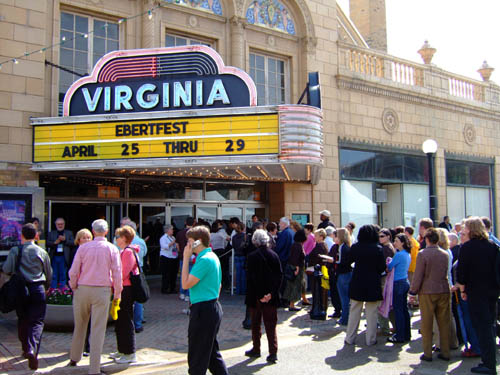
We drove down from Madison to Urbana-Champaign on Wednesday, David attending for the fourth year and I for the third. The opening film that evening was Gattaca (1997). With tepid reviews and box-office on its original release, Gattaca definitely counts as an overlooked film. Shown in an excellent print on the giant screen of the vintage Virginia movie palace, the cinematography was stunning and the story absorbing. Not an utter masterpiece, perhaps, but a very good film that deserved revival. As usual, people came from all over America to pack into the restored 1525-seat venue.
Now we’re back…and doing a summary blog. We had little time at the festival, and during our last day the web service at our lodgings conked out, so this stands as a fill-in.
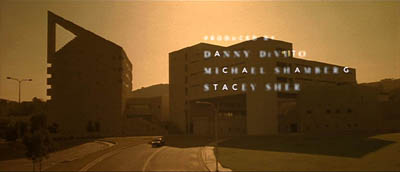
Gattaca.
David’s two bits:
I saw ten films across three days and four nights.
The Virginia theatre did special justice to Gattaca. Writer-director Andrew Niccol used the anamorphic format imaginatively, a bit in the chilly manner of THX-1138, and the framings appeared to full effect on the 56-by-23-foot screen. This time I noticed how much the credit sequence, with only the G-A-T-C letters appearing first, owes to Godard. Like Alphaville, Gattaca uses not artificial sets but actual buildings to evoke the near future.
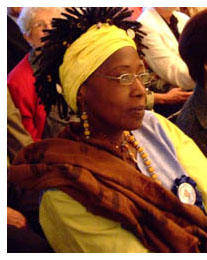 I thought that Moolade held up well on my second viewing, and the post-film discussion with the main performer Fatoumata Coulibaly (right) and Professor Samba Gadjigo was informative. The film’s call for an end to female genital mutilation is typical of Osmane Sembene’s use of controversial material; Professor Gadjigo recalled that Sembene calls his cinema a “night school” for Africa. Ms. Coulibaly said that in production “Papa Sembene” wouldn’t make eye contact with her, but before filming a painful sex scene he told her that she was “doing the scene for future generations.”
Sadie Thompson was still fine, I thought, with Walsh’s skill in cutting and staging exemplifying what Hollywood could do so easily in 1928. Swanson of course is tremendous in the role, using her whole body to tell the story of a woman who’s not as hard-edged as she makes out. The score by Joseph Turrin, conducted by Steve Larsen, was discreet and compelling.
La Dolce Vita seemed to me not to wear so well. I hadn’t seen it in at least twenty years, and its pacing and dramatic point-making appearing at once heavy and unfocused. Still, the film has that patented Fellini verve, and its daring fresco-like structure makes it a remarkable experiment in panoramic storytelling. It’s historically an enormously important film, and Jackie Reich illuminated it in our onstage discussion afterward. She has just published a book on Mastroianni’s career, Beyond the Latin Lover.
Of the items that were new to me:
The Weather Man took me by surprise, not only for its glum tone and antiheroic protagonist but also for its refusal of a tidy happy ending. Of Steve Conrad’s screenplay, Gil Bellows remarked that “one of the things that he can do is make you cringe for a character.” To his credit, Gore Verbinski, of Pirates of the Caribbean fame, found this uneasy domestic drama/ comedy a congenial project.
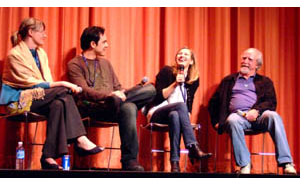 Come Early Morning by Joey Lauren Adams was a clear-eyed character study of an intelligent, flawed woman. Lacking villains and almost lacking heroes, it captures the rhythms of life in a small Arkansas town. Our protagonist, quietly efficient in her job, is caught in family and romance problems as she moves from man to man in a beery stupor. It was tactfully directed by Adams and graced by the underappreciated Ashley Judd. The Weather Man concludes with our hero facing us in close-up, but Come Early Morning ends with the protagonist turned away; in each case, the image feels right. On the left, Lisa Rosman, Eric Byler (Charlotte Sometimes), Joey Lauren Adams, and Scott Wilson (who plays the protagonist’s father).
I must be the last person in North America to see Holes. Its tight plot, clever humor, and easygoing handling of racial matters endeared it to me. As in old Disney fare, familiar actors (Jon Voigt, Sigourney Weaver, Robin Wright Penn, Tim Blake Nelson) are willing to ham it up for the kids, with enjoyable results. And I was startled by the intricate flashback structure on offer; are kids now being trained to follow movies like 21 Grams? Given the interracial love story at the movie’s center, I had a new angle on what Walden Media might be contributing to modern Hollywood, something valuable that escapes cliches about “family-friendly” and “faith-based” entertainment.
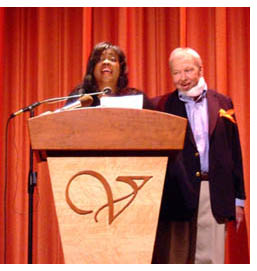
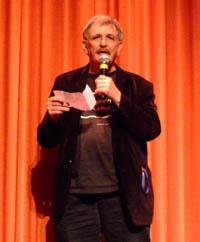
Man of Flowers was a crowd-pleaser. I admired Paul Cox’s visuals, though the grainy print probably didn’t do justice to the range of dark tones in the original. An exercise in portraying a wealthy man’s obsessions and their sources in childhood, it moved toward Buñuel’s Archibaldo del Cruz, but it wasn’t prepared to be as lurid or delirious. A bit too dry and tasteful, perhaps. Still, I admire patient, unshowy long takes, and Man of Flowers is full of them. The photo above shows Paul reading a heartfelt tribute to Roger.
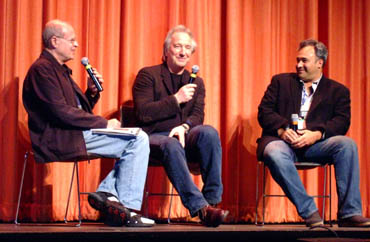
Perfume: The Story of a Murderer was much liked by the audience, and the presence of Alan Rickman made it all the more pungent. I wanted to like it more than I did. Despite my admiration for Tom Tykwer’s other films, particularly Winter Sleepers, The Princess and the Warrior, and Heaven, this one struck me as an overproduced Euro effort at a Big Movie. I thought it overdid the camera tricks (slow-mo, ramping) and the insistence on stuffing every shot with details (e.g., fish, cobwebbed glassware, glistening golden liquids). Above, you see the great actor with Festival Director Nate Kohn and entertainment analyst David Poland.
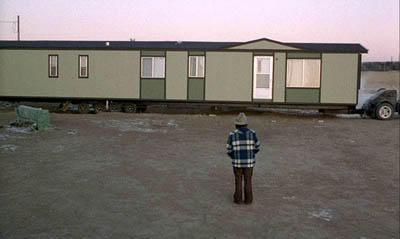
The simple and modest Stroszek was, for me, better at evoking smells—for instance, the stale smoke of the Himmel bar that our hero frequents. The print was faded and weatherbeaten, but the mysterious simplicity of this modern classic came through. The Wisconsin scenes, shot in Plainfield thirty years ago, wouldn’t need much changing today. As usual, I enjoyed the porous, unpredictable plot and Herzog’s willingness to dwell on unfathomable moments like a premature baby with powerful fingers (sleeping, he looks like a wrinkled alien) and the warped imagery of people passing a prison, seen through a hanging water bottle. The dancing chicken became one of the top screen icons of the 1970s.
Now for some quotes I like.
*Gattaca producer Michael Shamberg: “In the pilot scenes of Top Gun, Tom Cruise doesn’t wear his oxygen mask.” Ebertfest blogger Lisa Rosman: “It’s Scientology.”
*“None of the people I write about have friends.” Steven Conrad, screenwriter.
*“The US and Europe are my market. Africa is my public.” Osmane Sembene, quoted by Samba Gadjigo.
*Werner Herzog gave Roger Ebert an early alert about the importance of Anna Nicole Smith in American culture: “The poet must not avert his eyes.”
*“When I pray, I pray to Jesus.” Joey Lauren Adams.
*“Ambiguity in everyday life isn’t exactly celebrated in most movies. . . . It’s great when a big movie celebrates unnameable things.” Alan Rickman on Perfume.
*“Alan, be more subtle—do more.” Ang Lee to Alan Rickman, directing Sense and Sensibility.
*Why did Michael Wiese move to Penzance? “I was in a Witness Protec—oops.”
*“I’ve learned more about directing by working with bad directors than with good ones. And I’ve worked with a lot of bad directors.” Joey Lauren Adams.
*“Sometimes I think I’d like to join another species. . . . They seem to live a more sensible life.” Paul Cox.
*“Our technological civilization is not sustainable on this planet. Nature is going to regulate us very quickly. . . .We’ll be the next ones [to go extinct]. But that’s okay. Let’s enjoy movies and friendship and beer.” Werner Herzog.
*“I saw perhaps three or four films last year. I love cinema, but I’m not a cinephile.” Werner Herzog.
And some portraits of Ebertfest regulars:

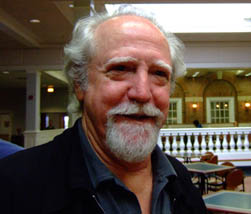
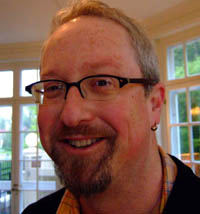
First: Michael Wiese, filmmaker (Hardware Wars, The Sacred Sites of the Dalai Lamas) and publisher of outstanding books on the art and craft of film. Next, actor Scott Wilson (In Cold Blood, Junebug, The Host, and many more). Finally, Jim Emerson, who runs Roger’s website and writes fine film criticism at Scanners.
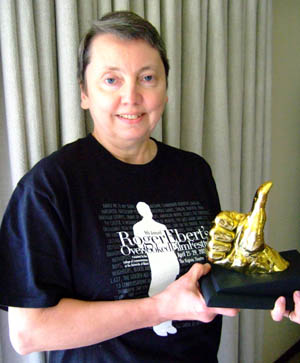
Each year, several guests receive an Ebert Thumb. This year, Kristin was one of the lucky ones.
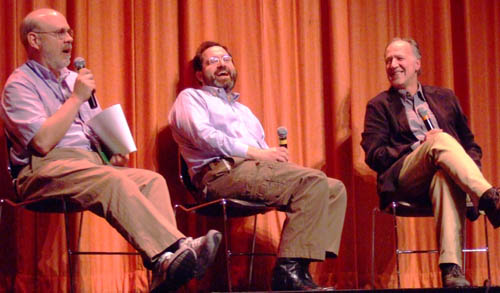
Finally, here I am with Michael Barker, co-president of Sony Pictures Classics, and Werner Herzog. All I said was that I was from Wisconsin….
I plan to blog again soon about Roger and his contributions to filmmaking and film culture. For now, let me just echo Kristin’s opening point that his passion for film is exceeded only by his enjoyment of other people. This weekend’s gathering of top-rank filmmakers, young and old, and the enthusiastic audiences showed that he is probably the most deeply loved film critic whom we have ever had.