The Film Art of animation: A review
Monday | August 24, 2026 open printable version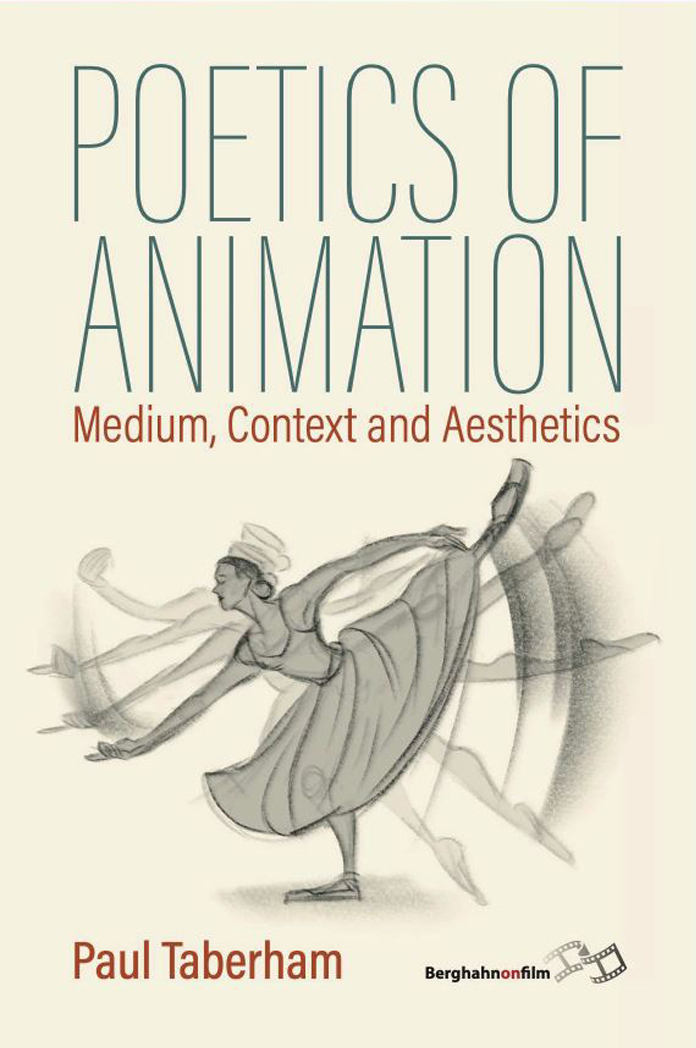
Paul Taberham’s impressive study of film animation was released earlier this month. The title brings to mind a major concern of David Bordwell in studying cinema, poetics as an aesthetic approach. Taberham has indeed been influenced by David’s writings and indeed mine, as he state in his introduction:
Live-action cinema and television have received sustained critical attention within the field of poetics (see Bordwell 2007; Cavendish 2013; Mittell 2015; Çağlayan 2018), but animation has, by contrast, only been addressed peripherally. While animation and live-action filmmaking share a common formal language through shot composition, editing, colour, sound design and the like, important distinctions between the two remain underexplored. This book seeks to address that gap, positioning itself as an animation-focused counterpart to David Bordwell and Kristin Thompson’s Film Art: An Introduction (first published in 1979 and now in its fourteenth edition), a pedagogical distillation of their broader project: offering a systematic analysis of film construction with particular emphasis on form, style, and narrative technique. Like Film Art, this volume offers a structured approach, while attending specifically to the affinities and divergences between animation and live-action media. [p. 5]
Taberham has accomplished his goal admirably, as the Table of Contents suggests:
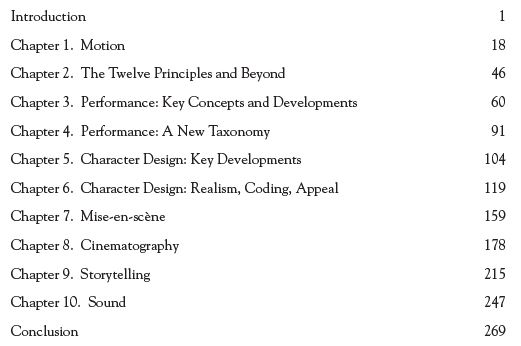
Rather than an imitation of the organization of Film Art, the “affinities and divergences” are clear. Two chapters are devoted to character design, a technique that does not apply to live-action moving images. One is devoted to cinematography, which is a very different process in animation.
Another considerable difference from Film Art, one which I think works very well, is that each chapter goes through the history of its subject in the field of animation, with relevant examples. The techniques of animation have changed over time at intervals that do not always coincide with the technical changes in live-action cinema, and it helps the reader understand those techniques better by following their modifications. Moreover, the approach allows for a great many brief examples from a vast range of films and television series. I am in awe of the number of examples referred to. (Having young kids, as Taberham does, obviously helps.)
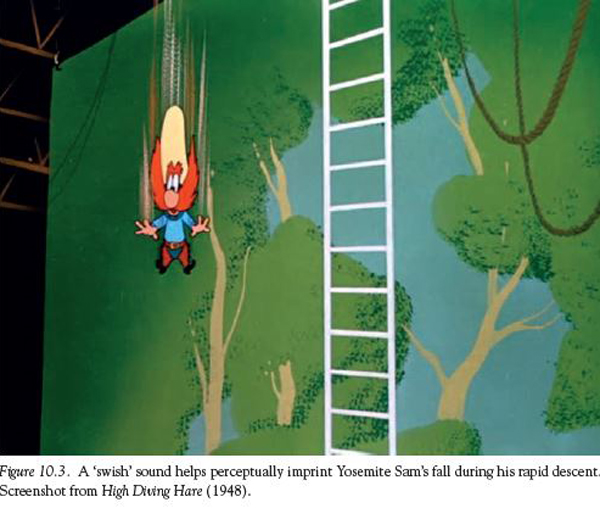
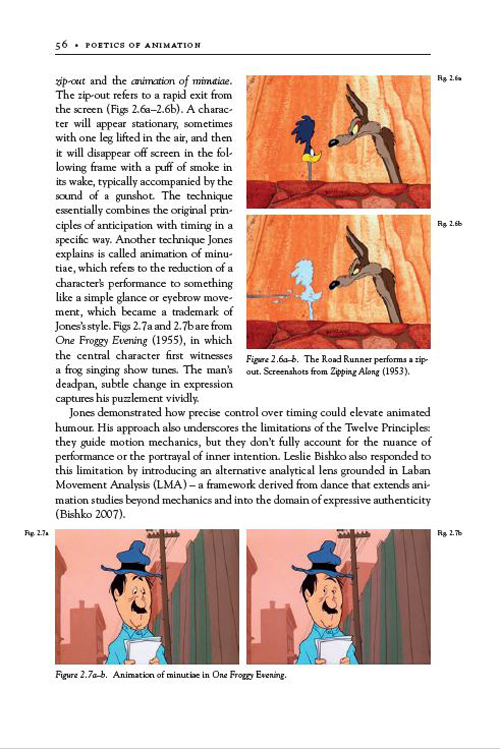
Of these examples, 134 are illustrated–though that number is misleadingly low, since many include multiple frames, as on the page below. I’m sure Taberham could have illustrated far more, but publishers tend not to like that sort of thing, especially with most in color. Speaking of color, the reproduction of the illustrations is superb. (I am judging by the e-book that I read.) See also the frame at the bottom, from the sound chapter.
The result is a justification for the application of poetics to animation. I’ll let Taberham explain why. After an excellent summary of poetics from Aristotle to Bordwell and Thompson (excellent company to be in), he writes:
This approach is especially apt for animation because the shaping hand of the artist is present in every detail. Movement, design, performance, lighting and sound are never incidental; they are authored parameters at every stage of the pipeline. That visibility turns animation into a clear laboratory for poetics: we can watch how constraints become style, how tools invite certain solutions, how studios stabilise house looks and how artists negotiate, refine or overturn those norms. [p. 40]
This book does all this admirably.
Poetics of Animation is clearly aimed both at those at those who simply want to read about the subject and those who use it as a textbook in the increasing number of courses not on making animated films but studying them as art. It should be said that because Taberham discusses the tools of animation, there are quite a few technical terms and brand names that were unfamiliar to me. Students would need a little help with these terms, but the main point is to understand how their introduction affected the making of animated films.
The book can be ordered from Amazon, of course, with the e-book at the list price, $27.95. Ordering the e-book from Berghahn directly is temporarily more advantageous, as they are having a half-price summer sale on e-books, with this one available for a mere $13.97.