
Wednesday | September 4, 2019
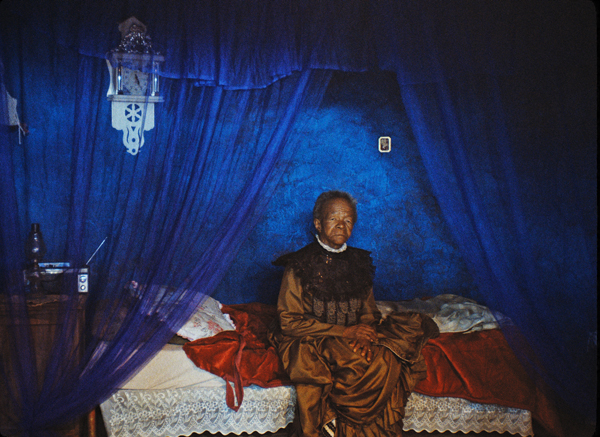
This Is Not a Burial, It’s a Resurrection (Lemagang Jeremiah Mosese, 2019).
DB here:
For the third year I participated in the Mostra’s College Cinema, a wonderful program that funds and guides three features by up-and-coming directors and producers. (Details are here.) I’ve reported on the earlier sessions here and here.
This year my developing reaction to the trio of features was governed by what Kristin and I did the day before our panel. We saw two superb classics: Bertolucci’s The Spider’s Stratagem (1970) and István Gaál’s Current (1964). They reminded me of what ambitious filmmaking was like before the arrival of screenplay manuals dictating character arcs and first-act turning points.
In those days, a filmmaker was likely to find a distinct, even unique form for a story. The filmmaker would design the film organically, creating a large-scale shape that would let technique and dramatic structure build in relation to each other, not in accord with standard formulas.
Coupling via monitor

A good example is The End of Love, directed by Karen Ben Rafael. The Israeli Yuval and the French woman Julie have a child. He waits in Israel for a new visa, while Julie must manage child care under the pressures of her job in an architecture firm. Each begins to suspect the other of infidelity, and their families in each country add to the tension.
So much for a traditional “relationship” movie, whose ups and downs could have been presented in a standard way. But Rafael and her co-screenwriter Elise Benroubi hit upon a fresh way to trace the couple’s conflicts. Yuval and Julie are keeping in touch via a Skype-like video service, and we are completely confined to their exchanges in this medium. We see only what they see, in a series of to-camera shot/reverse-shots.
Some recent genre films have been “monitor movies,” like Paranormal Activity 4 (2012), Chronicle (2012), Unfriended (2014), and Searching (2018). But these exploit the device for suspense and horror. The End of Love lets the conditions of video communication structure the ongoing drama. A teasing opening suggests that the camera is lying in bed between the couple as they caress themselves; the next scene–a remarkable shot in itself (above)–reveals that video is their channel of communication.
As the film goes along, tensions between Yuval and Julie are presented as much through the mechanics of video exchanges as through the actors’ (very persuasive) performances. Unanswered calls signal a growing indifference. A mysterious shot wobbling through a dance club suggests either a phone accidentally turned on or a loud, defiant assault on the other person. I was especially taken by the moments when we get slight change of eyelines as characters look from the camera to study the display image of the other person.
The End of Love triggers a lot of ideas about how modern couples are led to expect that technology can overcome family problems. Being always online, always “in touch,” doesn’t mean that you’re engaging authentically with someone else. For all its power, the video hookup in the film creates an illusory intimacy, and its glitches stand for the aggravations, little and big, that come with physical separation. This thematic implication grows organically out of the creative decision to confine our viewpoint to what the camera can see and hear, but not heal.
Social drama into community myth
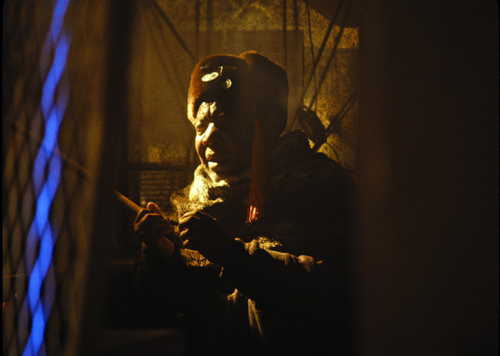
Another vigorous example of letting the material summon up the film’s form is This Is Not a Burial, It’s a Resurrection. Directed, written, and edited by Lemogang Jeremiah Mosese, it’s a poetic work that develops its imagery out of a dramatic situation.
The eighty-year-old Mantoa learns that her only surviving relation, her grandson, has died in a mining accident. After being consoled by her priest and the local choir, Mantoa tries to restabilize her life. But when she learns that her village is to be flooded for a dam project, she vows to save the bodies in the local cemetery–and to prepare her own grave.
This tale, set in Lesotho, is framed by a narrator telling us about her and her community. He sits in a blast of yellow light adjacent to a pool hall, and at intervals the story action pauses for his comments. The film takes its time–about 300 shots in two hours–to dwell on the details of her daily routine, such as the portable radio hanging from the wall, or Mantoa’s changing outfits.
But there are also more surreal images, such as Mantoa on a burned-out bedspring being slowly surrounded by sheep. The community that eventually supports her is presented as an almost abstract force, as are the out-of-focus government workers slowly hacking away at the perimeter of the village. The climax of the film makes powerful use of those figures as Mantoa confronts them in her boldest provocation of all.
Again a familiar situation–a tenacious elder tries to halt the destruction of a community (think Wild River)–is given fresh life through formal elaboration. Out of a primal conflict, Mosese generates a work of mythic dimensions. He does it through lustrous visuals, an evocative soundtrack, and a character who creates a legend that will live for generations.
Town and country
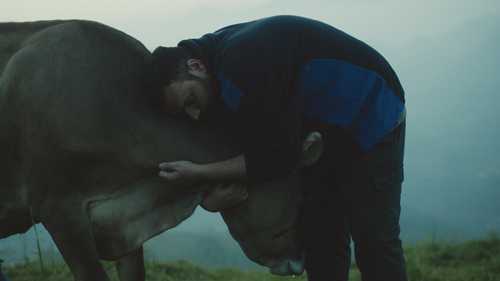
If The End of Love traces a jagged decline in a relationship, and This Is Not a Burial lifts a social conflict into spirituality, Lessons of Love finds another structure, this one aiming to express the inarticulate feelings of a man stuck in a situation. It’s a circle.
Yuri toils on his father’s farm, while his younger brother and sister try to avoid their responsibilities. Stolid, silent, and glum, Yuri harbors a good deal of anger, occasionally expressed in road rage. He relates to the world almost completely through physical contact.
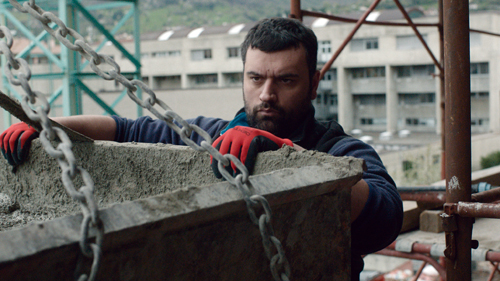
Director Chiara Compara and her co-screenwriter Lorenzo Faggi start from a classic pattern: the migration of an innocent from the countryside to the city. This pattern is refreshed through a strategy going back to Neorealism: the insistence on the physicality of daily routines. A prolonged moment of Yuri tuning a radio recalls the famous scene of the maid’s morning ritual in Umberto D.
The early stretches of Lessons of Love stress the demands of farm work. The first shot is of a milk can, and soon we see logging, veterinary inspections, the purchase of a cow, and the dull evening meal. But we also get a sense of Yuri’s longing when he soberly eats during a TV love scene, and soon enough he’s visiting a strip club, watching as impassively as he did the TV show.
Through a tissue of routines, Yuri’s vague thoughts about escape emerge, and soon he is considering buying cowboy boots, dating Agata, and getting a construction job in town. That’s when the circular structure gets initiated, and new routines replace the old ones. Again, the details of hard labor aren’t stinted, and Yuri is challenged to break out of his smoldering solitude. Can a man who punches and embraces his favorite cow, and who furiously whacks a driver-side mirror, ever learn to talk to a woman who’s kind to him? The last shot of the film, discreetly echoing the first, provides the answer.
A fraught love affair, a defiant elder speaking up for a community’s heritage, and a lonely, locked-in man are familiar enough points of departure for a film. But these three College features offer fresh, rigorous treatment of their stories. Three acts and vulnerable-but-relatable heroes and heroines? Not necessary! There are other ways to go, as young filmmakers can show us.
Thanks as usual to Peter Cowie for inviting me to join the College Cinema panel, and to Savina Neirotti, the Head of the program. Thanks as well to other participants for lively conversation: Chaz Ebert, Glenn Kenny, Mick LaSalle, Michael Phillips, and Stephanie Zacharek. As ever, we appreciate the kind assistance of Michela Lazzarin and Jasna Zoranovich for helping us before and during our stay.
Glenn has a fine appreciation of the College films on rogerebert.com. He too was reminded of Wild River, but no surprise as we’re both nerds in this (and other) respects.
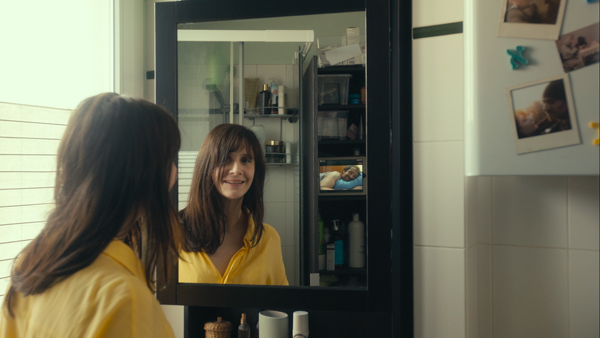
The End of Love (Karen Ben Rafael, 2019).
Posted in Festivals: Venice, Film comments, National cinemas: Africa, National cinemas: France, National cinemas: Israel, National cinemas: Italy |  open printable version
| Comments Off on Finding a form: The College Cinema at the Venice International Film Festival open printable version
| Comments Off on Finding a form: The College Cinema at the Venice International Film Festival
Monday | September 2, 2019
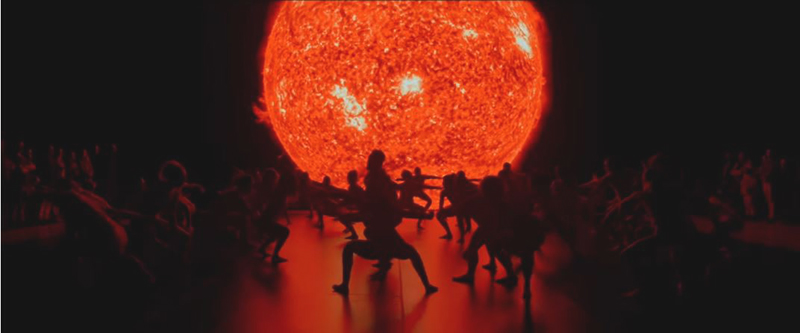
Ema (2019).
KT here:
Since David’s brief initial post on the festival, we have been watching films and dining with friends. Ordinarily we blog from the press room, but there seems to be a larger number of journalists here this year than in the past, and it has not been possible to find a seat. So we are behind in our reports on the films we’ve seen, but we’re trying to hurry and catch up.
Here some of the films in the main competition and an extra.
J’Accuse
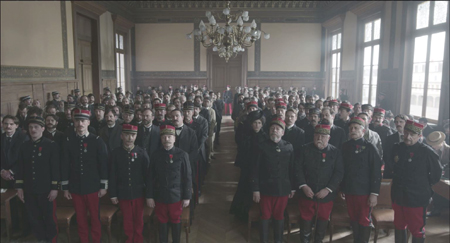
Roman Polanski’s latest feature is a handsome, solemn account of the false accusations of spying that led to the conviction of Alfred Dreyfus. As the film begins, in early 1895, an enormous gathering of soldiers and officers witness the degrading of Dreyfus in a public square, with the military buttons and other regalia stripped from his uniform. Anti-Semitism is commonplace through most of French society, and onlookers revel in the convicted man’s disgrace as he is hustled off to solitary imprisonment on Devil’s Island.
Among the onlookers is Georges Picquart, who joins in the general delight at Dreyfus’s punishment. He is soon, however, elevated to run the military counter-intelligence office which had convicted Dreyfus. Documents he examines cast doubt on the original guilty verdict, and in spite of admitting to being prejudiced against Jews, he insists that he can be objective in investigating the case. The film remains largely with Picquart as he doggedly searches for evidence despite considerable opposition from all sides. Occasional brief scenes show Dreyfus in his exile, but this is a not of the wrongly convicted but of the righter of wrongs.
Everyone knows that ultimately Dreyfus was exonerated and the real spy identified. There was a second trial, however, at which he was again found guilty. Picquart suffered the consequences of his efforts to save Dreyfus by being himself wrongly convicted of forging evidence and forced to resign from the army. This is far less known, at least in many countries, and the film makes it clear just how long justice took to achieve. In 1906, both men were cleared and were able rejoin the military.
J’Accuse is a good, old-fashioned Hollywood-style film, carefully and skillfully shot–in contrast to many current mainstream films. The main acting duties are carried through convincingly by Jean Dujardin (best known in the US as the Oscar-winning star of The Artist) as Picquart.
The film is directed with an unostentatious skill, with the framing, editing, design, and lighting all excellent. The period detail is impeccable. One wonders if Polanski had a chance to see some of the 1899 documentary footage of Dreyfus and military personnel leaving the court after his second trial, which was shown at Il Cinema Ritrovato this year. Some of the shots bear a resemblance to those early images. The staging and cinematography bring to mind films of the era, and one scene, in which a fanatic attacks Picquart in the street briefly looks like a chase film of the early 1900s (see bottom).
So far there is no indication that the film is to be released in the US.
Ema
I have admired the work of Chilean director Pablo Larraín, primarily No (2012), Neruda (2016), Jackie (2016), and to a lesser extent his early feature, Tony Manero (2008). Given that his three major films were all based on historical events and personages, I was expecting something of the same sort with Ema. I, along with many other reviewers, were quite taken aback and perplexed by it.
I still am not sure what to think of it. While watching it, I could not discern much of a plot or even a coherent character study. Ema is a pyromaniac, bisexual dancer living in Valparaiso with her choreographer husband, Pablo. The couple had adopted a young orphan, Polo, but apparently he had taken on some of Ema’s wildness, burning a house and leaving Pablo’s sister badly scarred. They had then surrendered him to be adopted by some other couple.
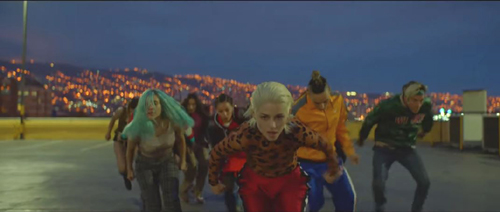
Most of the film involves performances of Pablo’s critically acclaimed dance piece, involving numerous performers in front of a giant projected image of the surface of the sun (see top). On her own, Ema performs wild Reggaeton dance moves with her friends (above), seemingly not for an audience (except for chance passersby) but simply to burn off her anger. She claims to want to retrieve Polo, yet her actions hardly suggest that she is any more fit to be a mother than she had been before–especially when she indulges in her delight with a flamethrower she had managed to acquire.
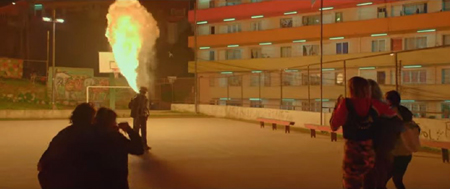
For what seems at first to be a sort of a musical, the film presents us with only a tantalizing shot or two of each of Ema’s energetic, colorful dances. We do get more of her sexual encounters with many other women and the occasional man, mostly in a lengthy, erotic montage sequence that suggests her almost desperate promiscuity.
My initial reaction to most of the film was disappointment and to some extent annoyance over the seeming lack of plot or of purpose to all this, since none of the motifs set up seemed to be progressing toward anything. In the final minutes of the film, however, the whole plot suddenly resolved in a perfectly logical, if disturbing and unexpected, fashion. The rest of the film in retrospect made sense, but it is very peculiar to have a film essentially goad and intrigue and even annoy you while delaying its revelation for so long.
The final shot suggests that Ema has not given up her old ways, and that although she has become part of a family of sorts, similar problems are likely to recur.
Larraín’s brief comment on the film in the festival catalogue suggests that the seeming formlessness of the film is intentional: “A meditation on the human body, dance and motherhood.” There is a definite hint of irony here.
I think Owen Gleiberman’s Variety review captures this “prickly art object, one that refuses to invite the viewer in.” I don’t agree with his point about Ema forming a defiant sisterhood aligned against men. After all, Polo ends up not with two mommies but with two mommies and two daddies. But I buy Gleiberman’s conclusion that “The whole film, let’s be honest, is kind of a stunt. Yet it’s a stunt that stays in your head.”
I would like to see it again … I think.
The Perfect Candidate

Haiffa Al Mansour (as she is credited here, though her previous films have Al-Mansour) first came to the world’s attention in 2012 through Wadjda, claimed to be both the first feature film shot entirely within Saudi Arabia and the first feature film directed by a Saudi woman. Its engaging story of a girl who enters a contest for memorizing the Koran because she wants the prize money to buy a bicycle–an object traditionally forbidden to females–charmed western audience achieved numerous nominations and wins for prizes around the world.
After two features made for western companies, Al Mansour returns to Saudi Arabia for The Perfect Candidate, a more grown-up tale of female empowerment.
Dr. Maryam, a young woman doctor who works in a provincial hospital reached by an unpaved, muddy road, ends up almost by accident signing up to run for the local city council. (She, by the way, drives her car along this muddy road as we meet her, a reference to the new 2018 law allowing women to drive.) In her work she confronts prejudice on all sides. An old man injured in a car accident refuses to let her even touch him, despite her being conservatively dressed, including a niqab on her head (above)–and the only doctor on duty. The supervisor turns the recalcitrant patient over to male nurses who botch his treatment.
Despite such obstacles, Maryam takes her candidacy seriously, getting her sisters and female friends to hold a fashion shot/party and managing to get her message across to a condescending TV interviewer–whose talk show is immediately canceled for having her as a guest.
The plot is fairly conventional and predictable, but Al-Mansour does not entirely sugarcoat her heroine’s ambitions and achievements. The ending is one that shows her winning the battle but losing the war. Though the film is mostly upbeat, its message is ultimately more one of hope for the future than of triumph in the present.
The Perfect Candidate is one of the two films by women directors in the main competition at Venice. The other, Rita Kainejais’ Babyteeth, will be shown on Wednesday, September 4.
Scarecrows
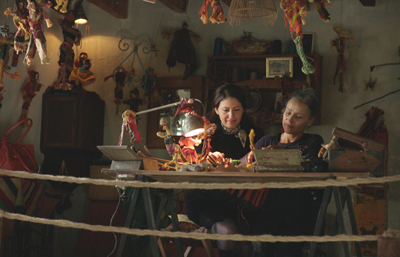
This is not a film in the main competition, but I wanted to include it briefly here because it also deals with women’s obstacles in a Muslim country, Tunisia. Its profound pessimism is the mirror-opposite of The Perfect Candidate‘s relative cheerfulness. In this case the director is a man, veteran Nouri Bouzid. One would not know this from watching the film, which centers almost entirely around women, with the men who appear briefly being threatening figures.
The subject is the plight of women who had been kidnapped and forcibly married to Islamic militant extremists. When they return to their hometowns, they face ongoing torment–harassment in the streets, pimps pressuring them to become prostitutes, threats of gang rape, and honor-killings by male relatives. The two returned women are Zina, a slightly older woman who was separated from her child when kidnapped, and Djo, a younger woman who vainly tries to live a normal live outside her house but finds herself constantly in danger.
The only sympathetic man is a young homosexual who, despite being threatened himself, tries to protect Djo from violence. A female lawyer tries to support the two women and is herself harrassed. Djo’s mother provides a safe home that her daughter finds stifling. To pass the time, the mother makes little rag dolls to decorate local homes and shops. These are clearly the “scarecrows” of the title, symbols of the damaged, wasted lives that the film suggests are beyond saving, despite the women having returned to their homes after untold horrors.
The film is grim indeed, and provides a fascinating insight into the culture of Tunisia, which has often been put forward as the most successful of the north African and Middle Eastern countries that went through the so-called Arab Spring nearly a decade ago.
Venice may still not have many women directors in the competition, but when you’re here on the spot, it’s evident that quite a few films center around women in sympathetic and positive ways.
Thanks to Paolo Baratta and Alberto Barbera for another fine festival, and to Peter Cowie for his invitation to participate in the College Cinema program. We also appreciate the kind assistance of Michela Lazzarin and Jasna Zoranovich for helping us before and during our stay.
To go beyond our Venice 2019 blogs, check out our Instagram page.
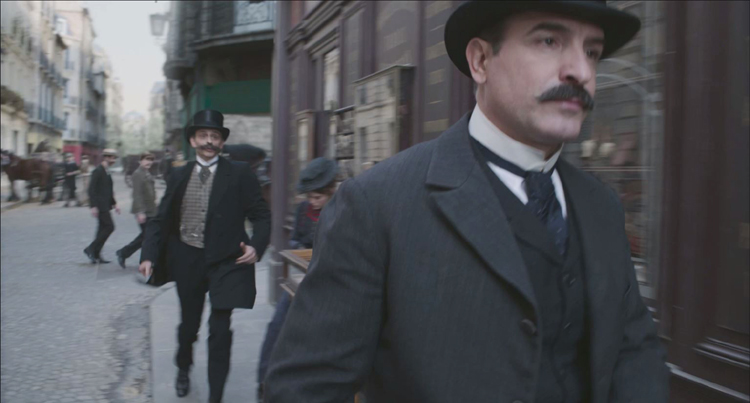
J’Accuse.
Posted in Film comments | open printable version
| Comments Off on Venice 2019: In competition (and out)
Saturday | August 31, 2019
DB here:
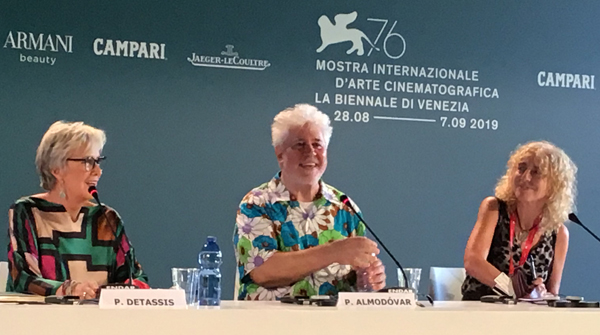
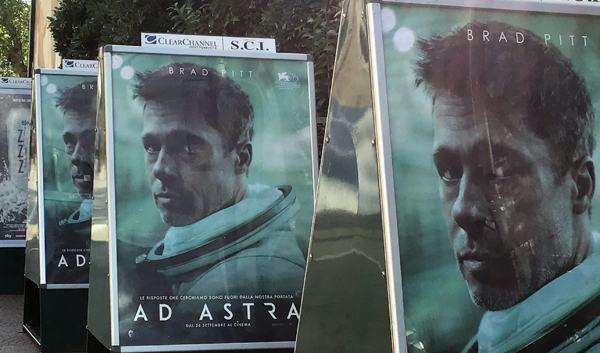
We’re a bit rushed right now to post, but suffice it to say that we’e already seen Kore-eda’s La Verité, Gray’s Ad Astra, Al-Mansour’s The Perfect Candidate, Sandoval’s Lingua Franca, the restored Oliveira masterpiece Francisca, Larraín’s Ema, and Polanski’s J’Accuse . . . and others. We’ll brief you on these, but I did want to register what fun it was to see a radiant Pedro Almodóvar at his press conference, on the occasion of his receiving the Golden Lion Career Award. A RAI video is here.
We’ll soon be putting up more pictures on our Instagram page.
Posted in Film comments | open printable version
| Comments Off on Venice 2019: First glimpses
Sunday | August 25, 2019
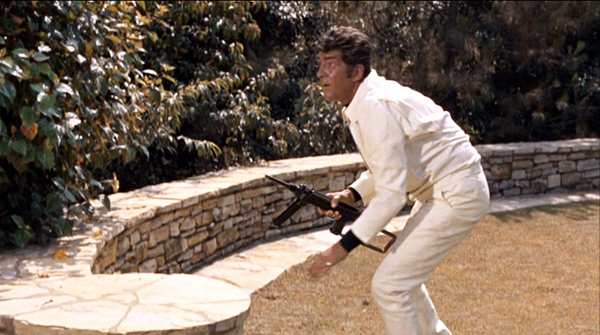
The Wrecking Crew (1969).
Jeff Smith’s blog entry on Once Upon a Time . . . in Hollywood has been our most popular offering this year. In the wake of that, he offers a few more observations. (DB)
The film’s commercial success confirms the value of original intellectual property, up to a point. Four weeks after its release, Once Upon a Time in…Hollywood’s current box office total is just over a $120 million for the domestic market. It’s also earned about $117 million in foreign markets. It seems likely to be the only film this summer to surpass $200 million globally that is neither a remake, a sequel, nor a franchise film.
Still, I agree with the general sentiment that there are no blue-sky lessons to be learned here. Tarantino is one of those rare talents who offers viewers a unique personal vision that has appeal beyond the arthouse. (Others would include Alfonso Cuarón, Damien Chazelle, and, of course, Christopher Nolan.) Current projections put Once Upon a Time . . .’s cumulative box office total around $385 million. That figure would fall short of Django Unchained’s $425 million, but would be considerably better than Inglourious Basterds’ $321 million. Not quite Inception or Gravity money, but not chump change either.
Tarantino’s film also gives Sony Pictures something to promote this Oscar season, along with Tom Hanks as Fred Rogers in A Beautiful Day in the Neighborhood and Greta Gerwig’s take on Little Women. Once Upon a Time…in Hollywood seems likely to snag several nominations in major categories. I would be very surprised if it didn’t score nods for Best Picture, Best Director, Best Original Screenplay, Best Actor, Best Supporting Actress, and Best Cinematography.
I also have a few stray observations that didn’t make it into my earlier post. One is another element of counterfactual history.
One evening Cliff and Rick watch “All the Streets Are Silent,” the episode of The F.B.I. that Tarantino has recreated. They want to see the Rick’s guest spot as Michael Murtaugh, alongside James Farentino and Norman Fell. But who actually played Murtaugh in that episode? None other than the late, great Burt Reynolds, whom Tarantino had originally cast in the role of George Spahn.
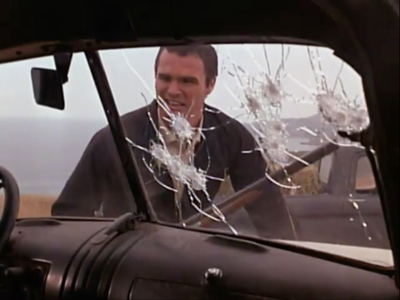
Reynolds is among a trio of sixties stars who served as role models for Rick Dalton. Steve McQueen is perhaps the most notable, both as a character who appears in the scene at the Playboy Mansion and as the star of The Great Escape, a part Rick had hoped to get. McQueen also came to movies from the small screen. From 1958 to 1961, he was the star of Wanted: Dead or Alive, a show that was an inspiration for Bounty Law.
The second model for Rick is, of course, Clint Eastwood. Eastwood made his mark as the star of TV’s Rawhide before achieving international fame in spaghetti westerns playing Sergio Leone’s Man with No Name. This trajectory is echoed in Rick’s late-career arc, although his westerns don’t achieve the renown of Eastwood’s.
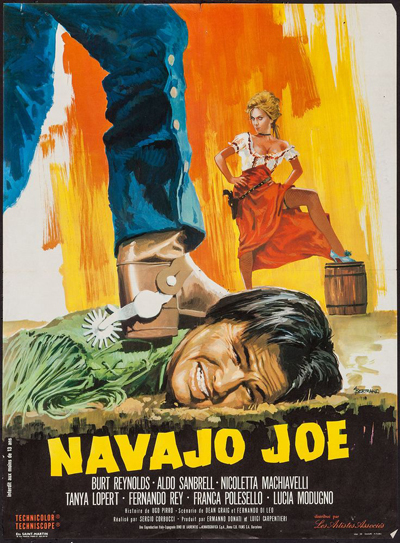
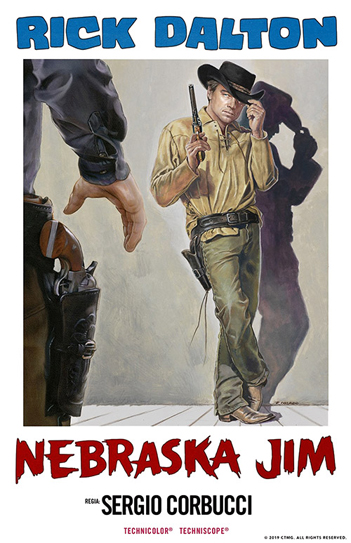
Burt Reynolds’ path to stardom was somewhat different from McQueen’s and Eastwood’s. Reynolds played only a supporting role on CBS’s Gunsmoke from 1962 to 1965 before he went to Italy to star in Sergio Corbucci’s Navajo Joe. Again, Rick follows this pattern, as we see when he moves from supporting TV parts to starring in the fictional Corbucci title Tarantino devised, Nebraska Jim.
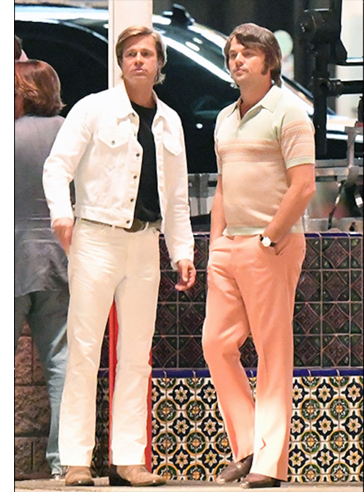
What most differentiates Reynolds from the other two stars, however, was his close relationship with stuntman Hal Needham. Needham did stunt work in more than 300 films and 4500 television episodes, often acting as Reynolds’ stunt double. He also did uncredited stunt work on a handful of films and shows referenced in Once Upon a Time . . . in Hollywood, such as Mannix, C.C. & Company, and The Life and Times of Judge Roy Bean. Needham would later direct Reynolds in several box office smashes, like Smokey and the Bandit and The Cannonball Run. In Once Upon a Time . . . in Hollywood, Rick’s rapport with Cliff was inspired by Reynolds’ and Needham’s long friendship, a professional association which spanned almost forty years.
 Lastly, a sharp-eyed reader of the blog, Karl Wallin, also pointed out another connection between Once Upon a Time . . . in Hollywood and The Wrecking Crew. (Karl is an old chum and the only person I know even more obsessed with Tarantino’s film than I am.) Karl noted that the white denim suit that Cliff wears in the blood-soaked climax matches the white suit Matt Helm wears during the last twenty minutes of The Wrecking Crew. (See top still.) Lastly, a sharp-eyed reader of the blog, Karl Wallin, also pointed out another connection between Once Upon a Time . . . in Hollywood and The Wrecking Crew. (Karl is an old chum and the only person I know even more obsessed with Tarantino’s film than I am.) Karl noted that the white denim suit that Cliff wears in the blood-soaked climax matches the white suit Matt Helm wears during the last twenty minutes of The Wrecking Crew. (See top still.)
Karl pointed out another serendipitous connection between different aspects of the Manson case. As I mentioned in the earlier post, Manson met a couple of times with record producer Terry Melcher about the prospect of signing a contract. Melcher ultimately soured on the deal, which led Manson to target the producer’s former residence as the site of the first murders. On some of the albums Melcher produced, he worked with a loose collection of extremely talented session musicians that were the Los Angeles equivalent of Motown’s The Funk Brothers. The group included several notable instrumentalists, such as guitarists Glen Campbell and Tommy Tedesco, pianists Leon Russell and Dr. John, bassist Carol Kaye, and drummer Hal Blaine. The name of this loose collective? The Wrecking Crew!
This is, of course, the title of the Matt Helm film that featured the real Sharon Tate as Dean Martin’s co-star. In Once Upon a Time . . . in Hollywood, the fictional Sharon Tate watches the real Sharon Tate perform in The Wrecking Crew at the Bruin Theater in Westwood.
The fact that the film and the group of session musicians shared the same name is really just a coincidence. Long before Dean Martin played a knockoff James Bond, author Donald Hamilton featured the character in a series of novels that aimed to rival the success of Ian Fleming’s books. Tate’s The Wrecking Crew takes its name from Hamilton’s 1960 novel.
In contrast, Hal Blaine popularized the name, the Wrecking Crew, in his memoir about the group. Other members, though, have reported that the collective went by other names, such as the Clique and the First Call Gang. Since the group was known by different names, it is hard to know how widely circulated “The Wrecking Crew” was as a particular moniker, even as late as 1969.
So it might be just happenstance that Sharon Tate not only lived in the same house as Melcher, but that their reputations within the entertainment depended upon their association with “wrecking crews.” Still, given the prominent role The Wrecking Crew plays in Tarantino’s film, I find it hard to believe that he wasn’t aware of this connection. Indeed, I suspect he really relished its irony.
The buzz surrounding Once Upon a Time . . . in Hollywood has not subsided much after its release. (Consider the items listed above as a little more fodder for those water cooler conversations.) As Tarantino’s most personal film, it remains a love letter both to the city of Los Angeles and to the popular culture of his youth.
It’s also a portrait of an industry in the midst of change and so offers an interesting perspective on our current historical moment. As several major studios prepare to launch their own streaming services, Tarantino’s fondness for 35mm projection and “appointment” television may look even more nostalgic just a few years from now. Yet even as the contemporary film and television industries gear up for further change, Once Upon a Time . . . in Hollywood is a vivid demonstration of the power of popular storytelling. It reminds us that Hollywood is much more than a place. It’s a state of mind.
A recent analysis of Once Upon a Time . . . in Hollywood’s box office prospects can be found here.
The opening of The FBI episode, “All the Streets are Silent,” can be found here. A video essay discusses Burt Reynolds and Hal Needham’s long professional association – and its influence on Tarantino. For those who want to see Dean Martin in action while wearing that white suit, check this excerpt from The Wrecking Crew. Hal Blaine’s memoir on his years with the Wrecking Crew can be found here.

Once Upon a Time . . . in Hollywood (2019).
Posted in Directors: Tarantino, Film comments, Film music, Hollywood: Artistic traditions | open printable version
| Comments Off on Twice upon a time . . . in Hollywood: Jeff Smith revisits Tarantino’s retro opus
|


















