Wednesday | October 2, 2019
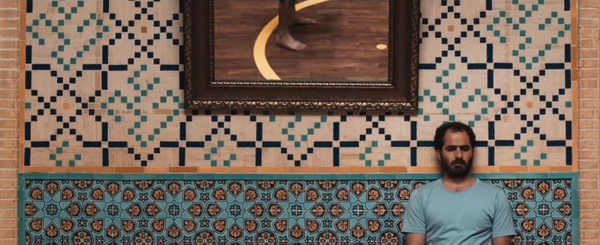
Tehran: City of Love (2018).
Kristin here:
The Vancouver International Film Festival has several strong threads running through it: world art cinema, documentaries, Canadian cinema, and films about art and artists. Sticking to any one or two of these would make for a rich viewing experience. I gravitate toward the “Panorama” program of mostly fiction films from around the world.
At one of these films, Tehran: City of Love, the Iranian director, Ali Jaberansari, and scriptwriter, Maryam Najafi, were present for a Q&A session. Clearly the audience has been charmed by their tale of three remotely connected characters all seeking love. One questioner asked what the pair’s next project was, which must always be cheering to the filmmakers. Another audience member simply thanked them for the film, saying that after seeing several grim movies, it was a pleasant experience to find one so funny and entertaining.
[Spoilers to come]
Certainly Tehran: City of Love is an entertaining film, but its ending is bittersweet at best. All three protagonists, after brushes with romance, end up alone. All may have learned something along the way, but they are all saddened by their failures. This year I have seen a couple of other films where the happy ending consists mainly of the central character letting go of bitterness and becoming reconciled to his fate. It seems as though grim storylines with unhappy endings are a staple of the festival film, and even comedies often avoid sending their audiences out on an entirely cheery note. Perhaps there is an assumption that an art film that is too entertaining risks not being taken seriously by festival programmers. Luckily, these three were included in the VIFF program.
Tehran: City of Love (2018)

Tehran: City of Love presents three central characters who are looking for love. Each has a problem to overcome. Mina is an overweight receptionist who, apparently resigned to her single status, targets attractive men who visit the cosmetic surgeon. She calls each, speaking seductively and arranging a date. She shows up for the date but does not identify herself, instead watching the man from a nearby restaurant table until he gives up in annoyance and leaves. At a class on the “geometry” of love, she meets a pudgy man who begins a courtship
Hessam is a body-builder with three championship titles in his past, now working as a trainer. He receives a part in a dubious film project and at the same time begins training an attractive young man who aspires to a championship. Hessam’s attraction to his trainee is subtly conveyed (above), and the young man seems friendly and seems possibly to reciprocate Hessam’s feelings.
Vahid, a talented mosque singer specializing in funerals, is dumped by his fiancée. A friend counsels him to become more lively and cheerful by singing at weddings. Vahid quickly makes the transition, which seems to improve his mood. He becomes friends with Niloufar, a female wedding photographer, who likes him but–as we know and Vahid doesn’t–she is awaiting a visa to allow her to emigrate to Australia.
Disappointments result. Mina’s beau is a married man in the lengthy process of divorcing his wife. The young man notices Hessam’s interest in him and switches to a new trainer. Niloufar reveals her imminent departure from Iran.
Tehran: City of Love is an impressive film for a second feature. The script by Jaberansari and Najafi weave the three stories together skillfully, keeping each story and the thematic connections among them perfectly clear. One might expect the three protagonists’ plotlines to come together. Hessam does at once point come to Mina’s office to get Botox treatments (presumably motivated by the film he is supposed to act in or to make himself more attractive to the young trainee), but nothing comes of that. Mina is close friends with Niloufar, but although the two talk about Vahid casually, Mina never meets him. The three characters are by chance in the same space by the final shot, but they remain unaware of each other. The title, unless we take it to be ironic, suggests that each may try again to find a partner, but the ending only hints that each has at least gained something from his or her brush with love.
It is also beautifully shot in widescreen, often employing what David has termed the planimetric shot, with the camera axis perpendicular to the background (see above and top). During the Q&A Jaberansari mentioned some of his film influences. (He was trained abroad in Vancouver and in London, where he now lives.) These included Roy Andersson, Elia Sulieman, Jim Jarmusch, Aki Kaurismäki, Jacques Tati, Fassbender, and Buster Keaton. Although Tehran: City of Love does not resemble any of these directors’ films closely–there are few long-take scenes or physical comedy played out in long shots–the list makes sense, mostly in the tone of the film.
Jaberansari and Najafi provided some helpful cultural context. They shot the film with official permission and also have permission to release the film in Iran, though no date for that has yet been determined. Despite the implied homosexuality of one character, only two minutes of cuts were required for the domestic distribution permit.
The emphasis on body-building, both in the gym and the scenes of men exercising in a mosque, reflects the fact that without bars, night-clubs, and other forbidden gathering-places, gyms and body-building are one milieu in which men can come together, including gay men.
At one point Vahid is arrested while singing at a “private” wedding. The phrase seems harmless enough, but private weddings often include men and women mixing in ways forbidden in the public weddings at which Vahid had previously performed.
Australia, they note, is the new destination of choice for Iranians seeking to move abroad, replacing Canada to some extent.
Sometimes Always Never (2018)
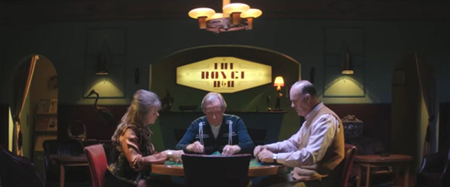
This film is largely a vehicle for Bill Nighy, contributing a mix of comically self-centeredness and pathos as Alan, a retired tailor. Years before his elder son Michael walked out of the house during a game of Scrabble and has never been heard from again. Alan has since been looking for him, neglecting his younger son, Peter, as well as his daughter-in-law and grandson.
Scrabble looms large in the plot. In one extended series of scenes, Alan and Peter show up in a small town to view the body of a young man who might be the missing son. During an evening in a bed-and-breakfast, Alan hustles the husband of a couple staying there, pretending to be an ordinary Scrabble player and winning £200 off the henpecked husband (above). Only later is it revealed that they, too, are there to examine the same corpse. Alan goes first emerges tactlessly and cheerily saying that the body is not Michael, despite the fact that the couple is about to perform the same grim task.
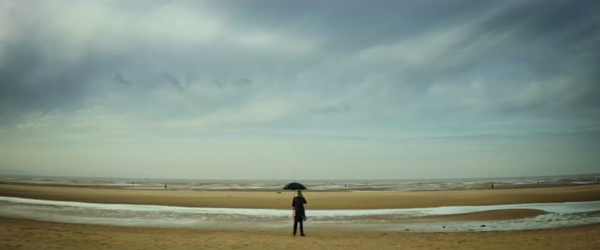
First-time feature director Carl Hunter adopts a playful style which at times resembles that of Wes Anderson. As with Tehran: City of Love, there are the planimetric shots(on a beach in Crosby otherwise populated by Anthony Gomley’s life-size statues, at bottom, and above, in the bed-and-breakfast Scrabble game). The characters drive in cars with blatantly obvious back-projected motion, and there are black-and-white inserts and brief animations. All these stylistic touches help lighten the tone of the underlying misery of the characters, though they also stand apart from the fairly straightforward presentation of most of the scenes.
The growing closeness between Alan and his shy grandson helps add a positive side to Alan and prepares the way for the inevitable outcome, as he learns to value the son he has over the one who clearly will never return.
A White, White Day (2019)
Most small producing countries have managed throughout the history of cinema to make films, and Iceland has been no exception. It was not until the 1990s that its films started attracting attention on the festival and awards circuit, but only now and then. Even today the local feature production hovers around only four a year. Still, we have learned to consider Icelandic films must-sees when they show up on festival programs.
Benedikt Erlingsson’s films have shown here in Vancouver, and we reported on Of Horses and Men in 2014 and Woman at War last year.
This year the contribution from Iceland is Hlynur Pálmason’s A White, White Day, his second feature. (His previous feature, Winter Brothers, played at our 2018 Wisconsin Film Festival, but we were in the process of buying a new house and missed it.)
“A white, white day” is a local phrase describing weather conditions that cause land and sky to become indistinguishable. It’s a perfect metaphor for confusion, for loss of bearings. We see it both literally and figuratively in the film. The protagonist, Igimundur, is a middle-aged policeman on leave for depression following a car accident that killed his wife. The film opens with the accident, although we don’t yet know who the driver is, occurring on a white, white day.
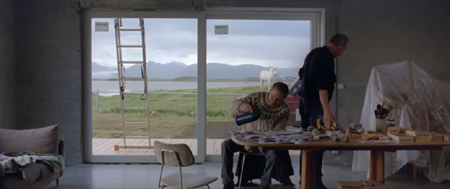
There follows a mesmerizing series of shots from the same vantagepoint, showing a lengthy series of shots of a pair of small buildings in a rural landscape, including these two.
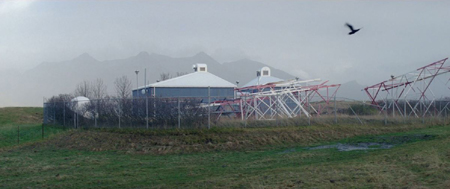
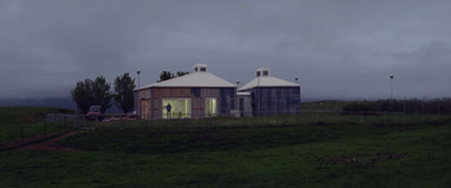
All atmospheres and times of day area shown, from the light fog of the top shot to the heavier fog of the lower one, from bright sunny days to dark nights. Horses wander through in some, cars drive up in others, and gradually the ramshackle yard and structures become a home. We first glimpse Igimundur in the lower shot, though we don’t yet know who he is. The renovation of the buildings to make a home for his daughter and son-in-law, along with his beloved granddaughter Salka. Where Igimundur will go once they move in is never mentioned. Clearly the project is his way of coping with his grief, while he increasingly scorns the lack of help he receives from his psychologist.
Soon, however, he comes to believe that his wife had been having an affair, and he becomes increasingly abusive and violent, even toward his police colleagues and in front of Salka. The happy ending, which seems a trifle abrupt, sees him finally reconciling himself to the past and regaining his loving memories of his wife.
A White, White Day depends less on humor than the other two films, despite its occasional comic touches. Instead it is an absorbing family melodrama that most audiences would find entertaining.
For a useful brief history of Icelandic cinema, see here. So far it doesn’t include Palmason, but I expect he will soon be added.
We thank Alan Franey, PoChu Auyeung, Jenny Lee Craig, Mikaela Joy Asfour, and their colleagues at VIFF for all their kind assistance. Thanks as well to Bob Davis, Shelly Kraicer, Maggie Lee, and Tom Charity for invigorating conversations about movies.
Sometimes Always Never (2018).
Posted in Festivals: Vancouver, Film comments, National cinemas: Iceland, National cinemas: Iran, National cinemas: UK |  open printable version
| Comments Off on Vancouver 2019: Happy endings, art-film style open printable version
| Comments Off on Vancouver 2019: Happy endings, art-film style
Sunday | September 29, 2019
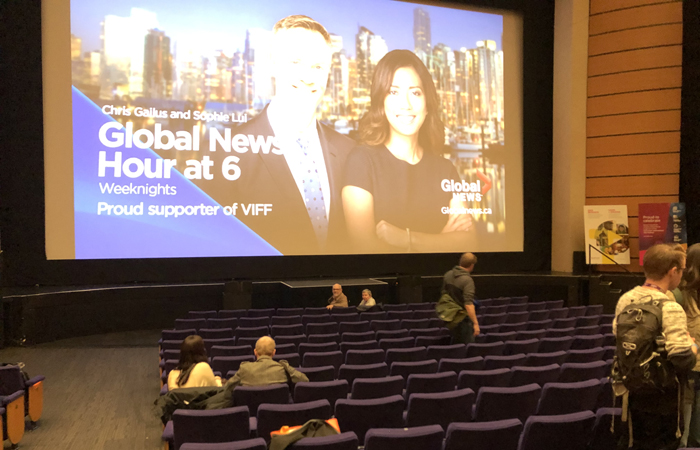
DB and KT, front row center, at the screening of The Lighthouse. Photo by Shelly “Sales Agent Cinema” Kraicer.
DB here:
Storytelling cinema depends on characters, and our relations to them. At the level of individual scenes, we can be more or less restricted to what they experience; we can know as much as they do, or more, or less. Across a film, the filmmaker can attach us consistently to one or two characters, or instead roam freely among many viewpoints. And within a scene, the filmmaker’s choice of camera placement can put us “with” one character or another.
In other words, narrative cinema 101. But it’s worth remembering that these are forced choices. As a filmmaker, you can have restricted or unrestricted access to characters, but at every moment you have to choose one or the other. How objective or subjective will you make your presentation? Will you limit your camera setups or go for ubiquity–that tendency to give us shots divorced from the immediate situation? Examples are a drone-delivered image above a city, or that sudden high or low angle that calls our attention to a detail the characters may have missed.
Three films at the Vancouver Film Festival presented a nice menu of attachment options–ways in which we can be tied to our protagonist. All are well worth your attention, so without getting too much into spoilers, I’ll use them as an occasion to study how these forced choices are handled creatively.
The party’s over
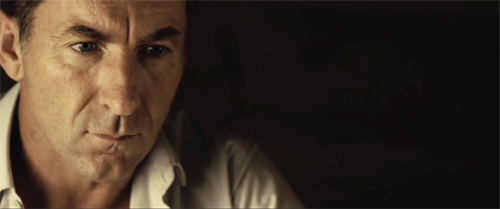
Take as a midrange example The Realm (El Reino, 2018), a Spanish political thriller directed by Rodrigo Sorogoyen. Manuel López Vidal is a brisk, no-nonsense functionary enjoying the good life thanks to the corruption of his party. He and his colleagues, the Amadeus Group, meet regularly over expensive meals to plan their schemes of influence-peddling and money laundering. They tease their fastidious accountant about his meticulous ledgers, but those records will become important to Manuel when one colleague leaks incriminating audio tapes of Manuel’s dealmaking. There’s an orgy of document shredding, damage control among the party’s top brass, and the growing likelihood that Manuel will go to jail.
The screenplay restricts nearly all the action to Manuel. This method is established at the start, when a long tracking shot follows him from the beach as he strides into an Amadeus lunch. Thereafter, we’re with him as he learns of the danger he’s in and mounts one tactic after another to save himself. At a couple of moments the camera lingers on his colleagues’ reactions after he’s left the scene, but on the whole we’re firmly attached to him. Some virtuoso long takes, including a ten-minute shot that follows Manuel’s frantic search for the ledgers, virtually fetishize our adhesion to the protagonist.
By and large, the presentation doesn’t delve into his mind. The throbbing techno score conveys his growing panic as he strides from one confrontation to another, but we get no voice-overs, or flashbacks, or mental imagery. And we don’t see Manuel confide his plans to others (although he seems to have told his wife some of them offscreen). This degree of objectivity allows more suspense, as his schemes to save himself unfold in the moment. We must figure out why he’s bracing one colleague, or bursting into a friend’s home in the course of a teenage party. His manic resourcefulness is all the more impressive when he keeps dodging new problems, often revising his plan on the fly.
It’s no easy feat to maintain tension across two hours, especially when we’re asked to invest our sympathy in a corrupt politician, but The Realm manages it. It’s achieved partly through the trim, crisp performance of Antonio de la Torre but also through plot and style: the refusal of omniscient narration (say, showing us the police or party officials tracking him) and a mild degree of camera ubiquity that accentuates the character’s plight, whether in a meeting or all alone.
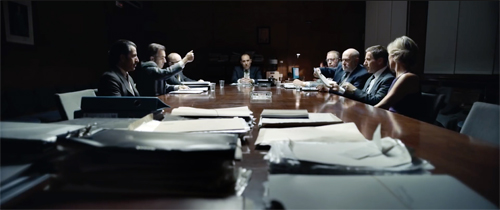
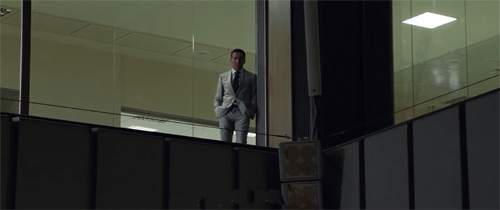
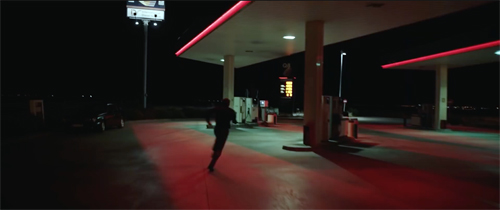
The Realm is a good example of how manipulating character attachment can strongly engage the audience. We know just enough to understand Manuel’s crisis, but without access to his mind, each scene can yield a surprise when he comes up with a new survival stratagem.
A lot from a little
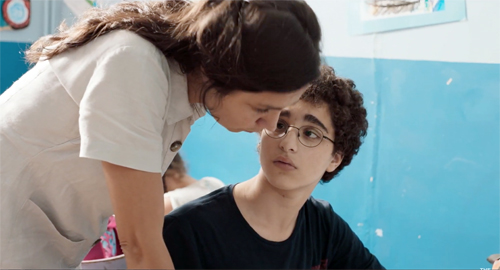
I hadn’t really considered the Dardennes brothers “minimalist” filmmakers, but seeing Young Ahmed brought home to me how strictly they’ve limited their cinematic palette. Given their emphasis on actors and faces, you might think they rely on the sort of “intensified continuity” on display in modern film and television. Yet they’re far more purist than that, and they take objective presentation further than does Sorogoyen.
They seldom use long shots, let alone establishing shots: a scene starts in medias res with character action, shot from quite close. Filming in handheld long takes, they avoid shot/reverse-shot cutting, either panning between participants in a dialogue or simply framing them in tight two-shots.
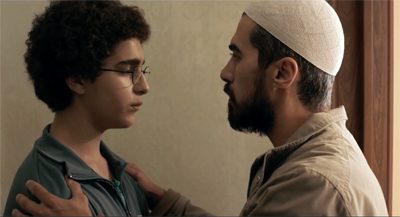
The Dardennes minimize camera ubiquity. Not for them the picturesque, distant shots that The Realm sometimes provides. In a car carrying two passengers, the camera isn’t lashed to the hood or filming alongside; it’s in the back seat.
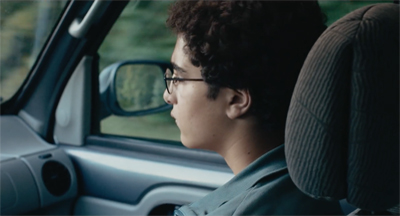
True, cutting yields some ubiquity. When Ahmed’s teacher pursues him through a classroom, she runs ahead of us but then, in the next shot, she catches up with him as he’s about to leave the building.
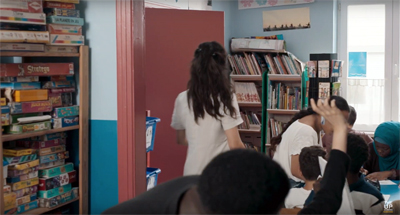 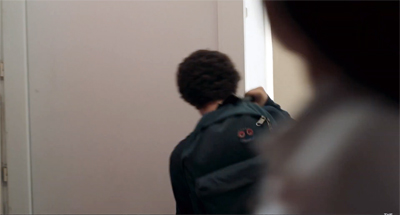
Like most cuts, it’s an instantaneous change of position that a real observer couldn’t execute. Still, this frame-edge cut creates simple continuity, driven by dramatic necessity and barely noticeable. The cut is softened by a staging that neatly settles into a standard over-the-shoulder setup.
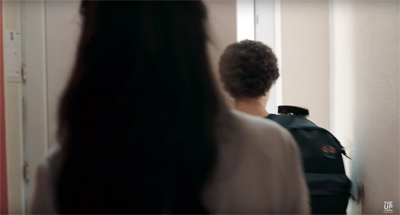 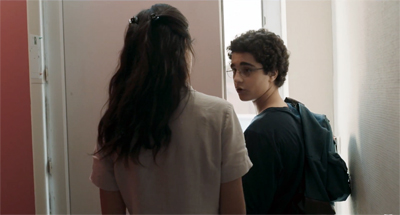
Apparently uninterested in pictorial composition, these filmmakers simply center their subjects in undistinguished framings. No shot becomes strikingly lit or framed. There’s no nondiegetic music, and the soundtrack is subdued; of all modern filmmakers, they benefit least from surround channels.
As in The Realm, the Dardennes’ minimalist approach works well in tying us to the protagonist, while also denying us direct access to his mind. Ahmed, an adolescent in Liège, has given up video games for fundamentalist Islam. Convinced by his imam that his classroom teacher has become an apostate, he decides to take action against her.
His plans emerge wholly through his actions. Without benefits of voice-over, subjective sequences, or flashbacks, we must infer how he will respond to the demands of the Qu’ran as he has been taught to understand it.
The Dardennes’ objectivity doesn’t make the plot hard to follow. A dozen minutes into the film, the premises are clear, the main characters (Ahmed’s mother, his imam, his teacher) are delineated, and Ahmed’s motivation is established. At the half-hour point, his mission is launched. Apart from the ellipsis I mentioned, everything that follows stems from the dramatic premises. And however horrifying Amed’s plans may be, the wistful, pursed-mouth young actor Idir Ben Addi is mesmerically angelic. His glasses make him look adorable.
The style also keeps everything clear. The texture is close to that of documentary filmmaking, but of course the Dardennes’ films are scripted and staged. There’s a high degree of artifice in their apparently artless method. As in the more flamboyant Birdman, their long takes catch every reaction and gesture with great precision.
We always see what we need to see at just the right moment. When something is suppressed–here, the result of a violent knife attack–it’s not an accident (as if the camera were in the wrong spot) but rather the result of our attachment to Ahmed and a clever narrative ellipsis. We could have had a cut like the one in the school, but we remain with Ahmed, and in fact know a bit less than he does about the result of the violence.
All of which is not to deny the originality of Young Ahmed. All the Dardennes films seem modest, but they are, within their limits, quite ambitious in using dramatic psychology to probe social problems. Throughout, I think, we are asked to reflect on how firmly Ahmed believes in his version of Islam. Is it a transitory teen obsession or is he on his way to becoming a dogmatic martyr? We watch his behavior, his encounters with farm life and a young girl, for any signs that his lonely, taciturn demeanor will crack. In other words, this is a suspense film–one based less on the threat of violence (which is there, to be sure) than on how a boy who hasn’t fully formed his character will define himself.
Not such light housekeeping
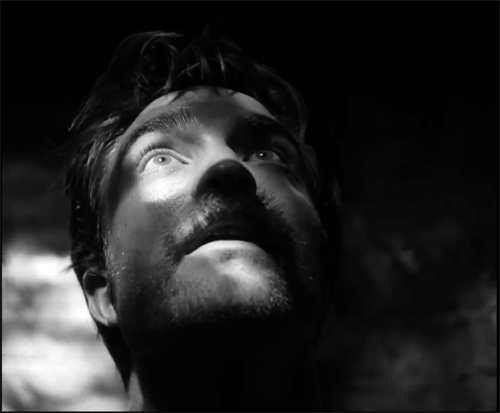
Both The Realm and Young Ahmed are, to varying degrees, objective in their presentation. We must judge characters by what they do and say. Something very different is going on in Robert Eggers’ The Lighthouse. It too adheres largely to one character, but a battery of cinematic techniques, including camera ubiquity, works to plunge us into the man’s mind.
Although the film is a two-hander, it doesn’t balance viewpoints. Thomas Wake, an experienced lighthouse supervisor, arrives at his post with the novice Ephraim Winslow. Almost immediately we are attached to Winslow, who’s assigned grimy menial duties while Wake tends the beacon. Wake tells Winslow that his previous assistant went mad from the weeks of isolation, and very quickly Winslow struggles against the bleak, craggy island they’re on.
We’re prepared for an assault on your senses by the opening, when a ship roars out of the fog toward us. Thereafter, Wake subjects Winslow to a punishing routine of cleaning the cistern, heaving coal into the boiler, and scrubbing floors, while nightly meals with the nattering old salt are just as hard to bear. Winslow’s misery is rendered in vivid, expressionist terms. The deafening fog horns, thunderclaps, and boiler blasts are reinforced by stark, ominous black-and-white imagery. (The film was shot on 35mm film.) Winslow seems trapped in a world of raging elements and gigantic machines.
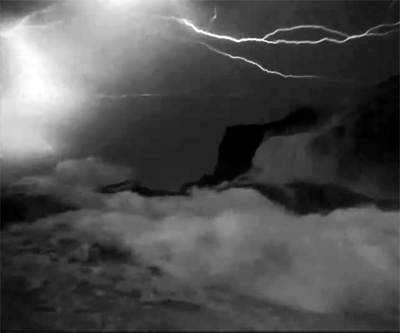 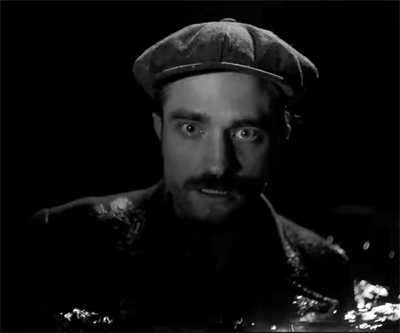
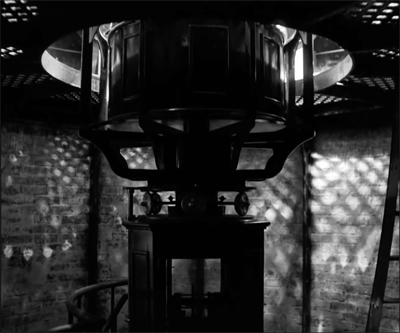 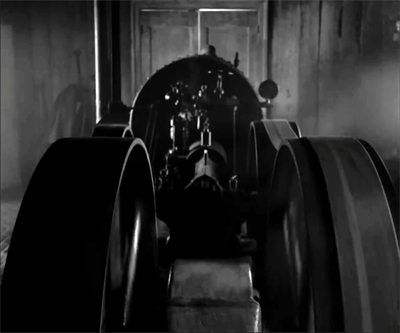
Eggers builds our affinity with Winslow through classic techniques. He watches Wake at the beacon from a distance; we get optical point-of-view shots of discoveries (real? imagined?) that start to unhinge him.
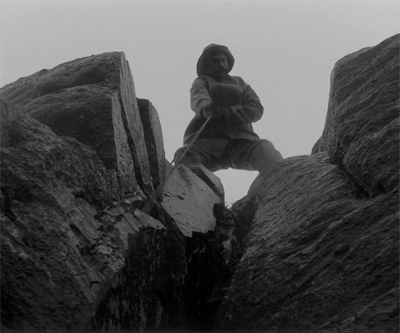 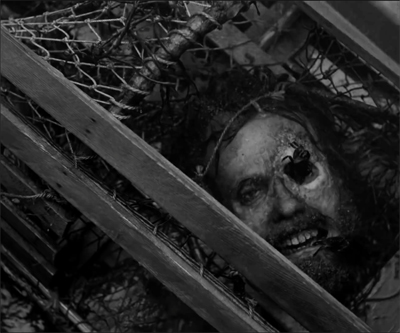
All the drudgery and pain, punctuated by Wake’s continual harangues and farts, lead Winslow into fantasies and hallucinations. His deterioration is rendered in shock cuts and distended compositions reminiscent of Welles’ Mr. Arkadin or German’s Hard to Be a God. Some will compare the film’s over-the-top climax to that of Aronofsky’s Mother!, but The Lighthouse, with its rapid montage and Gothic chiaroscuro, harks back to silent cinema. The fact that it’s shot in the 1:1.17 ratio favored by early sound film gives it an archaic feel as well. The dialogue, a late title informs us, is drawn from nineteenth-century sources, including Melville and Sarah Orne Jewett.
The Lighthouse has a cadence typical of modern horror films, but Kristin points out that it’s an expressionistic Kammerspiel too–a subjectively tinted drama setting very few characters in a constrained locale. Eggers shows that you can renew a genre’s appeals by reviving imagery from a classic period of film history. When you do it, you’ll still have to make fundamental choices about viewpoint and camera placement. They come with the territory.
We thank Alan Franey, PoChu Auyeung, Jenny Lee Craig, Mikaela Joy Asfour, and their colleagues at VIFF for all their kind assistance. Thanks as well to Bob Davis and Shelly Kraicer for invigorating conversations about movies.
For more on classic Kammerspiel films go here and here.
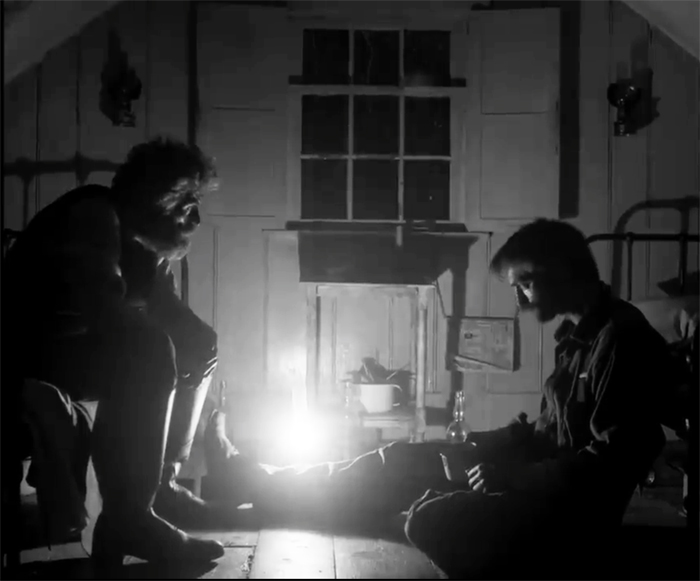
The Lighthouse (2019).
Posted in Directors: Dardennes, Festivals: Vancouver, Film comments, Narrative strategies, National cinemas: Spain and Portugal | open printable version
| Comments Off on Attachment anxieties at the Vancouver International Film Festival
Sunday | September 22, 2019
DB here:
Another bountiful disc release from Criterion: Ozu’s 1952 classic in a 4K digital restoration, with newly translated subtitles. It comes with an enlightening essay by Junji Yoshida and Daniel Raim’s ingratiating documentary on Ozu’s collaboration with his screenwriter Kogo Noda. I contributed a video essay on the film. The most wonderful bonus is Ozu’s 1937 feature What Did the Lady Forget?, which has fascinating affinities with the later movie.
What did which lady forget?
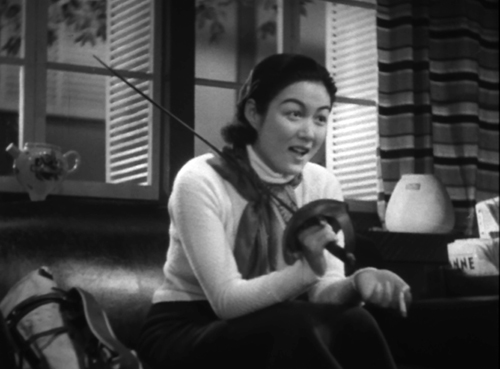
I’ve long been a fan of What Did the Lady Forget? It’s a quasi-screwball comedy treating the clash of the sexes and the generations. As is typical for Ozu, it starts light, abetted by a languid guitar-and-banjo soundtrack, before sidling into graver moments.
In my commentary I touch on its social satire. As the Shochiku studio began making more films about prosperous families, Ozu moved away from the working-class and salaryman milieus he had explored in many masterpieces of the 1930s. I argue in Ozu and the Poetics of Cinema that this film’s comic treatment of the professional class looks forward to what he’ll offer in Equinox Flower (1958) and other postwar films.
A married couple hosts a visit from their sashaying, cigarette-smoking niece, a moga (modern girl) who turns out to be not quite as tough as she thinks. While exploring the city’s nightlife (and occasionally brandishing a fencing foil), Setsuko exposes the tensions in the apparently easygoing marriage. The comedy drifts into moments of Ozuian pathos and melancholy–a chastened Setsuko has to leave Tokyo–but the film ends on a light note.
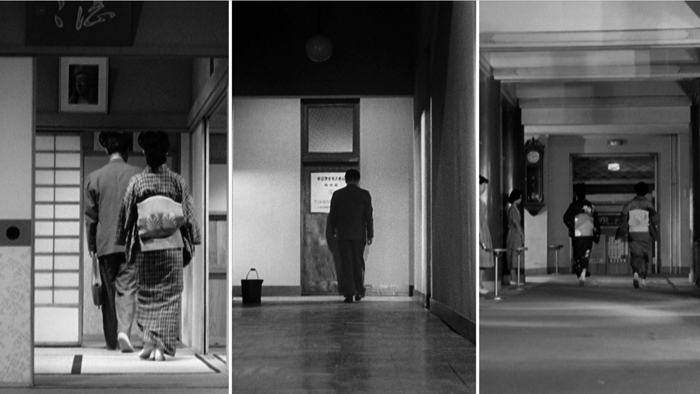
Stylistic finesse is on display throughout. The framings are dazzlingly inventive, the perspectives are steep, and we’re given those quietly permutational “establishing shots” that introduce scenes in Setsuko’s room.
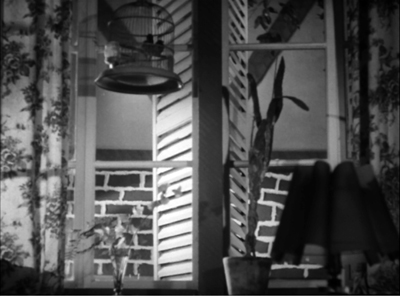 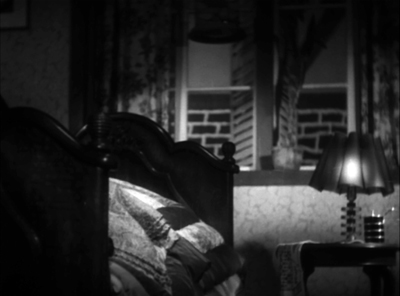 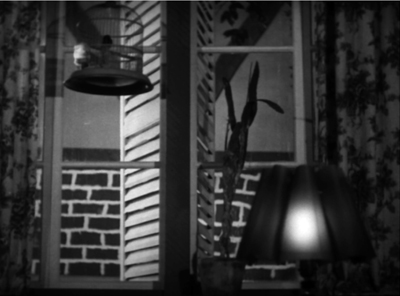 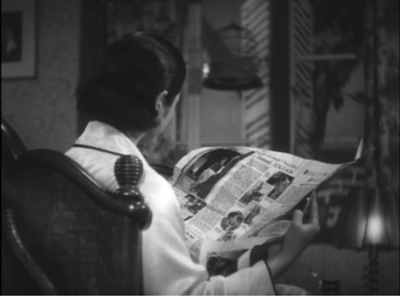
The weird graphic matches in the two boys’ “hit the spot” game could not have been devised by anybody else.
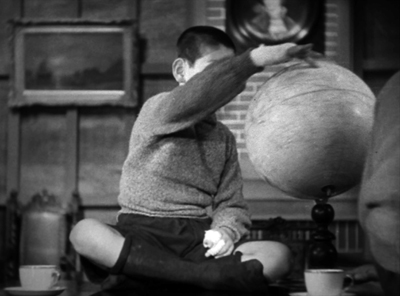 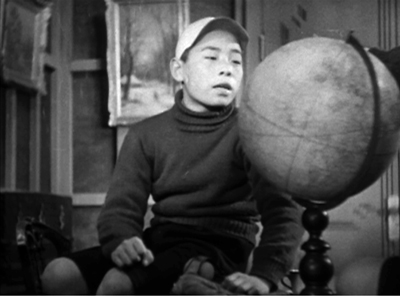
I just love this stuff. There’s so much here, how can this movie be only 70 minutes long?
What Did the Lady Forget? contains a disturbing burst of domestic violence. But the husband soon regrets it, and Ozu and his screenwriter Akira Fushimi develop the crisis in way that keeps shifting our judgment about what characters learn from the incident.
A distressed marriage
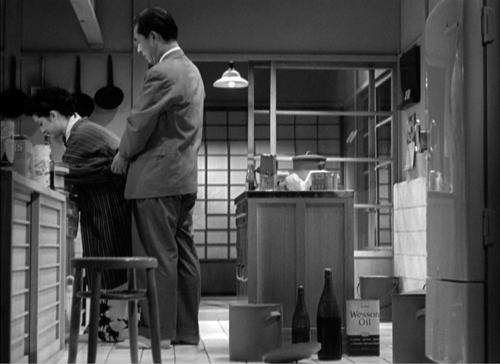
In a parallel situation in the “remake,” The Flavor of Green Tea over Rice, the husband remains calm in the face of his wife’s criticism. Mokichi is far from a paragon (he’s a phlegmatic workaholic, he’s out of touch with young folks and urban culture), but at home he’s quiet and apologetic. When Taeko complains about his table manners, he tries gently to explain why he slurps his rice.
Daniel Raim’s short on the Ozu-Noda collaboration concentrates on the planning of An Autumn Afternoon (1962), well-documented in Donald Richie’s Ozu. But we also have some records of their work routine on Green Tea. Ozu kept no fewer than five notebooks that year, sometimes recording the same event in two or more.
On 20 January, he notes that he and Noda are “bringing back a problematic script.” That’s because the original Flavor of Green Tea over Rice was refused by censors in 1940. In early 1952 Ozu was in the process of moving to Kamakura, so the two men’s collaboration took place in inns, Noda’s home, and the studio. One notebook logs Ozu’s production schedule, while others are more personal.
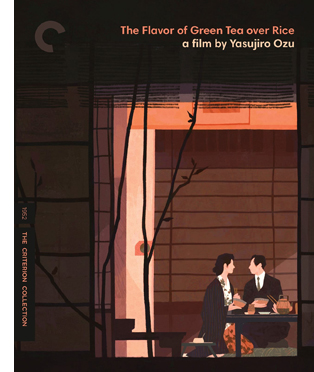
Ozu’s films from the 1950s on were typically planned in the winter, shot in spring and summer, and premiered in the fall, as if he were determined to document each year’s good weather. Ozu and Noda began writing Green Tea on 29 February and finished on 1 April, sometimes preparing three scenes a day. After consulting with Shiro Kido, the studio head, they revised the script. Ozu’s efficiency in planning every scene and sketching every shot allowed production to proceed fast. The crew began shooting on 7 June, in an office set. They finished on 13 July (“Finally, rest!”) and The Flavor of Green Tea Over Rice premiered on 1 October.
Pretty intensive work. But you wouldn’t know it from the companion notebooks. Among chronicles of naps, baths, social gatherings, changing weather, baseball games, and bar-hopping with friends, how did they get any work done? Above all there’s Ozu’s careful record of his alcohol intake (“drank until 2 AM”). A stomach ache makes him think he might have an ulcer. “I must resolve not to drink too much. And stick to it!” Today we would call him a high-functioning alcoholic. “With the whisky I drank this morning and the shumai I brought back from Tokoen, I wasn’t at all hungry tonight.”
As in his films, the everyday and the unusual get equal treatment. While staying at one inn, he calmly observes the arrival of a woman’s baseball team. And he remained a cinephile. He’s happy to interrupt an evening of dining and drinking to go see William Dieterle’s September Affair (1950).
The film that resulted, I suggest in the supplement, modulates between satire and a generous comedy that gives the main characters, no matter their failings, moments of warmth and dignity. With a light hand Ozu summons up narrative parallels, and he spotlights the split between men’s culture and women’s culture. A troubled marriage is given due weight, but it’s saved by graciousness, as when (above) Mokichi rescues Taeko’s sleeve from the water in the sink.
Ozu carries the humor down to the fine grain of technique, teaching us to play a private cinematic game in which the characters participate all unawares. The Criterion creative team has ingeniously used split screens to help me show the evolution of stylistic patterns across the film. Shedding my Mr. Rogers sweater for a sport coat, I try to crack the mystery of those eerie tracking shots. Like the situations and the dialogue, these barely moving images ought to make you smile.
Thanks to producer Elizabeth Pauker and her colleagues at Criterion, especially Peter Becker and Kim Hendrickson. Thanks as well to Erik Gunneson and James Runde here at UW–Madison.
Ozu’s diaries of shooting The Flavor of Green Tea over Rice are available, with helpful annotations, in Yasujiro Ozu: Carnets 1933-1963, trans. Josiane Pinon-Kawataké (Editions ALIVE, 1996), 267-318.
My book, Ozu and the Poetics of Cinema, is available for free here. Color pictures and everything! But be patient; it’s big and takes a while to download. There are many entries on Ozu and Donald Richie elsewhere on this site.
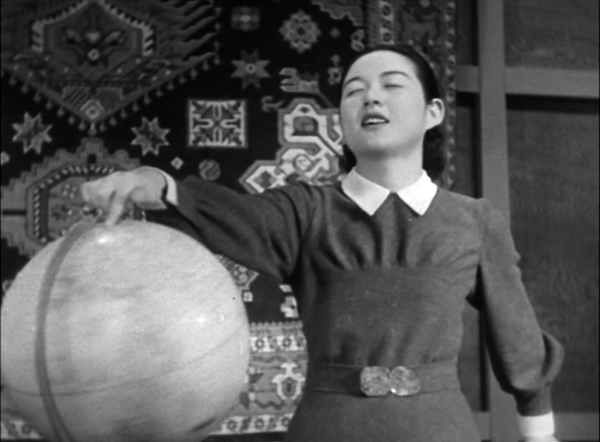
What Did the Lady Forget? (1937).
Posted in Directors: Ozu Yasujiro, Film technique, National cinemas: Japan | open printable version
| Comments Off on Ozu the compassionate satirist: THE FLAVOR OF GREEN TEA OVER RICE on Criterion Blu-ray
Monday | September 16, 2019
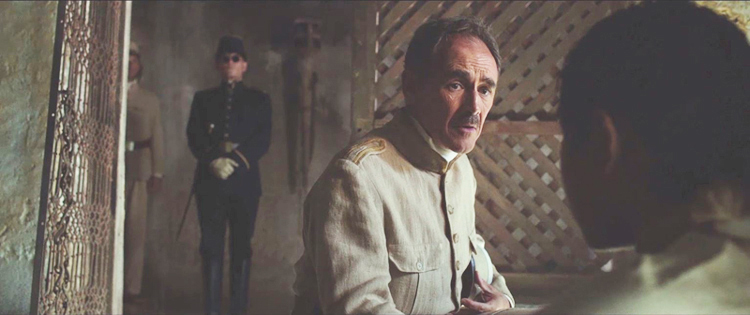
Waiting for the Barbarians (2019).
Kristin here:
The 76th Venice International Film Festival is over, but I have two films yet to blog about. This will be our final entry. Soon we’re both off to the other VIFF, the Vancouver International Film Festival, from which we will of course be blogging.
Waiting for the Barbarians
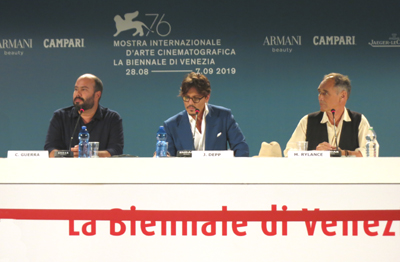
I was particularly looking forward to this film, since I admire Ciro Guerra’s two previous features, Embrace of the Serpent (2015) and Birds of Passage (2018). It was rather surprising that Guerra should have a new film premiering only a year after Birds of Passage, especially since both are in their own ways epics in relation to most other art films. The fact that it stars the great stage and screen actor Mark Rylance was another factor in its favor.
Oddly enough, the morning press screenings and evening red-carpet screening of Waiting for the Barbarians were relegated to the penultimate day of the festival, Friday, September 6. It was the last of the films in competition to be shown, with The Burnt Orange Heresy (in the festival’s Fuori Concorso thread) the closing film on Saturday. By that point, quite a few of the foreign-press members had departed for Toronto or elsewhere. The Friday afternoon press conference, despite including Johnny Depp on the panel (above), was SRO, but there was no immense queue to get and and very few standing at the sides or sitting on the central stairs, as usually happens when big stars are present.
Overall the film has received lukewarm reviews, with a few more praising pieces mixed in. Both David and I, however, found it riveting. It deals with the unnamed Magistrate (Rylance), who rules a fort community on the border of a desert landscape inhabited by nomadic tribes. The Magistrate controls the place with a loose rein, meting out mild punishments for what he perceives as minor infractions by the local population. He seems content, excavating for ancient wooden rods inscribed with undeciphered texts and apparently has a relationship with a sympathetic local prostitute. He seems friendly with the people under his care and has taken the trouble to learn their language.
The countries which this border area separate are never identified and are clearly fictional places serving to portray the horrors of colonial domination by western nations. Clearly the white officials and soldiers in the film are not intended to be British. The flags on display bear no resemblance to the Union Jack and the costumes are not British. The local nomads speak Mongolian, and the main female character, referred to only as “the Girl,” is played by Gana Bayarsaiknan, a Mongolian performer.
The conflict is set moving by the arrival of Colonel Joll, an ominous figure in black, sporting bizarre dark glasses with frames of twisted wire (in the background of the frame at the top). His suggestion that he will use “pressure” to force the locals to confess their crimes turns out to be a considerable understatement. Joll ventures a little way into the the territory of those he calls “the barbarians.” He claims to turn up evidence that the local people are plotting to attack the colonial forces along the border. He has discovered this evidence though torture.
Much more description would provide too many spoilers. In general, the Magistrate tries to reason Joll and his confederates out of their plans. He also frees prisoners and nurses the native girl, who has also been tortured, back to a semblance of health. Eventually he finds himself driven to rebellion.
The film, with exteriors shot in Morocco, creates a vivid sense of a fortress community isolated from the world, and the cinematography as the Magistrate leads a small group to try and return the Girl to her people is austerely beautiful.
So far all the release dates for Waiting for the Barbarians are for festivals, including the London Film Festival. Whether it will be released in the US, as Guerra’s two previous films were, is unknown. I would suggest giving it a chance, despite some lackluster reviews. It’s another film that would lose much of its effect when streamed on a small screen.
Adults in the Room
Each year a small number of celebrities receive special awards, essentially salutes to long and fruitful careers. This year the main honors went to Pedro Almodóvar, Julie Andrews, and Costa-Gavras. We didn’t catch the awards ceremonies themselves, and the Amodóvar and Andrews ceremonies were followed by classic films of their past (Women on the Verge of a Nervous Breakdown and Victor Victoria respectively). Costa-Gavras’ career started as an assistant director to René Clair, René Clément, Henri Verneuil, Jacques Demy, Marcel Ophüls, Jean Giono, and Jean Becker before beginning to direct on his own. Apart from his numerous features, perhaps most notably Z (1969), he has been president of the Cinémathèque Française since 2007.
Now, at age 86, he brought with him a new feature, Adults in the Room, a dramatization of the tensions and strategies of the politicians and diplomats struggling to find a solution to the Greek financial crisis.
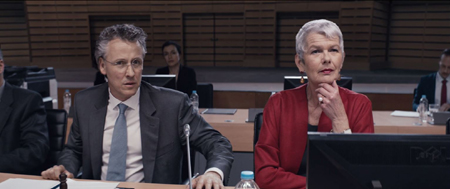
As in most such films, the actors have been chosen for their resemblance to the historical figures. In the upper of the two images below, for example, Josiane Pinson plays Christine Lagarde, head of the IMF, and Daan Schuurmans is Jeroen Dijsselbloemm, president of the Eurogroup.
The film begins with the unlikely election of a leftist government in Greece (the Coalition of the Radical Left, or Syriza) in January of 2015. The film sticks largely to the point of view of Yanis Varaufakis, the fiercely dogged Finance Minister. His memoirs of the struggle to refinance Greece’s overwhelming debt and to keep Greece from being expelled from the European Union were the basis for the script by Costa-Gavras.
Remarkably, Costa-Gavras follows the events through an almost unbroken series of conversation scenes. These center on clashes between Varaufakis and Greece’s Prime Minister, Alexis Tsipras, and on stormy meetings involving representatives of the Eurogroup and the infamous “Troika” (the European Commission, the European Central Bank, and the International Monetary Fund). The Troika faction, which had bailed out the Greeks and insisted on disastrous austerity measures, absolutely refuses Greece’s demand that the loans stop and that the debt be devalued to a viable level.
This does not begin to convey the complexity of the Greek crisis, but Costa-Gavras manages to create suspense, whether or not we can actually follow exactly what is going on. There are moments when Varaufakis’ negotiation strategies are withheld from us, and we are as puzzled as the officials watching them from across the room, as in this glance-POV cut:
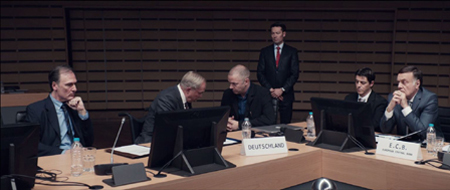
These meetings are linked primarily by shots establishing the various cities in which these complex and fruitless meetings take place. Often superimposed titles reveal the locations, as when the Greek Prime Minister arrives in Brussels for one such meeting (see bottom).
By the end we are not left with a thorough grasp of the intricacies of these events, which would hardly be possible for a crisis that started around 2009 and is still going on. Still, we gain a somewhat better understanding than we are likely to have on the basis of news stories stretched sporadically over over so many years. We are also left indignant at the determination of the Troika to persist in the very policies that drove Greece deeper and deeper into debt. Some have found the film tedious in its intense focus on meetings and strategies. Others I talked to after the press screenings found it fascinating. Certainly the film and its source book have chosen the brief period of the crisis (about six months) that shows most clearly and dramatically what Greece faced from the rest of the EU and why its crisis still has not ended.
For one final time this year, thanks to Paolo Baratta and Alberto Barbera for another fine festival, and to Peter Cowie for his invitation to participate in the College Cinema program. We also appreciate the kind assistance of Michela Lazzarin and Jasna Zoranovich for helping us before and during our stay.
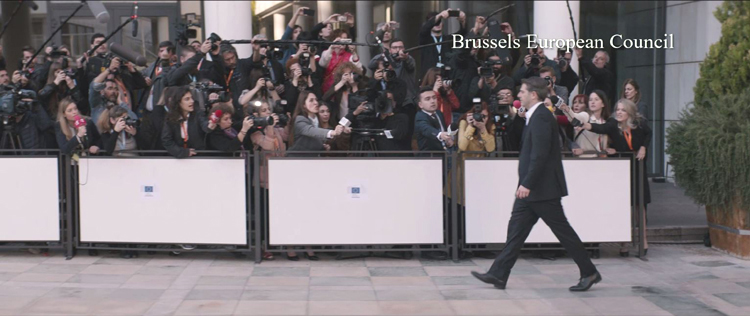
Adults in the Room (2019).
Posted in Festivals: Venice, National cinemas: Greece, National cinemas: Italy | open printable version
| Comments Off on Venice 2019: Political dramas, allegorical and real-life
|