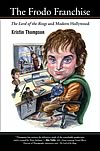
by Kristin Thompson. Berkeley: University of California
Press, 2007.
400 pages, 6 × 9 inches, 12 color illustrations;
36 b/w illustrations.
[go
to Amazon | go to The Frodo Franchise blog]
In the November 6 issue of Newsweek (also online), Devin Gordon comments on the recent trend in franchise series to throw in a prequel covering an earlier period in the main character’s life. “So-called origin stories—how fill-in-the-blank became fill-in-the-blank.”
At first David and I wondered whether Gordon, like so many film journalists, would go for the easy answer. There are at least two easy answers in the context of popular films, and especially blockbuster franchise films. One, their stories reflect something about the current psyche of the nation. Alternatively, they are symptoms of Hollywood running out of creativity and backbone and going for the tried and true.
The public psyche theory may sound profound at first, but it’s basically a quick way to write a story without knowing much of anything about film history or how the film industry works. There may be all sorts of reasons why a given kind of movie is made at a certain time. We all know about genre cycles. But society is vast and multi-faceted, and it isn’t hard to make any given film seem to “reflect” some aspect of it. Might the vogue for origins stories mirror a widespread desire to return to a more innocent era before 9/11? Bingo, you’re got your hook and can make your deadline. (Don’t get me started on the fact that most big films these days are negotiated, greenlit, planned, and in production for years before they appear, thus presumably reflecting not our own Zeitgeist but one that has come and gone.)
As to Hollywood running out of creativity, there are plenty of people in Tinseltown with great scripts and the desire to make them. We’re living in an age, though, when the big studios are owned by conglomerates. More than ever, the studio decision makers and the investors who buy their stocks keep an eye on the bottom line. Variety’s October 23 front-page story, “Less Dream, More Factory,” is on the layoffs and other cost-cutting measures that the big studios face. (By the way, we aren’t putting links to stories in Variety.com, since it’s a subscription-only site.) So the tactics of producers now must be to focus on exploiting the most popular characters and story premises for their tentpole projects.
Gordon recognizes this and puts his finger on a major reason for the vogue for “origin stories.” The studios have to prolong their most lucrative franchises, which are essentially their owners’ big brands. Yet those franchises can grow formulaic. One way to renew their energy can be to leap back in time.
Gordon opines, too, that “Ironically, playing it safe financially also provides studios with the cover to take creative chances.” He points to the fact that Peter Webber, who is directing Young Hannibal, has only the indie hit Girl with a Pearl Earring to his credit. Similarly, art-house darling Christopher Nolan gave one big franchise a new respectability and audience with Batman Begins and will try to continue to do so with The Dark Knight.
Linking origin stories to the hiring of such filmmakers is perhaps a bit of a stretch. The new Bond film, Casino Royale, the earliest in the order of Ian Fleming’s original novels, shows a younger agent. Much of the flashier high-tech props of recent entries in the series are apparently gone, with a grittier feel to the film. Yet it was directed by Martin Campbell, who also had made an earlier entry, GoldenEye, as well as both the Zorro films.
It’s true that recently Hollywood studios have shown a strange propensity to hire independent or foreign directors to helm entries in franchises. In the wake of his hit Once Were Warriors, New Zealand’s Lee Tamahori was imported and made Die Another Day and xXx: State of the Union. Warner Bros. brought in Mexican director Alfonso Cuarón (Y tu mamá también) to make the third Harry Potter film, presumably because many critics had dubbed the first two, by Chris Colombus, too bland. Perhaps the studios simply see franchises as needing shaking up at intervals. Yet this is part of a larger trend of indie directors suddenly boosted to blockbuster assignments, as when Doug Liman went from Go to The Bourne Identity and Mr. and Mrs. Smith.
An “origin story” in the sense that Gordon is using the phrase is a type of prequel that jumps back far enough to show the protagonist distinctly younger and different from the way he is in the original film or series. It then explains how he changed into that protagonist.
Hong Kong filmmakers are adept at prequels of this sort. God of Gamblers: The Early Years, shows us the source of the protagonist’s lucky ring and his taste for gold-wrapped chocolate, both of which are major motifs in the original God of Gamblers. The case of A Better Tomorrow is more complicated. John Woo and Tsui Hark had intended it to be a stand-alone film, and they made the mistake of killing off the most charismatic character. The film was such a hit, largely on the basis of Chow Yun Fat’s performance as Mark, that A Better Tomorrow II gave Mark a twin brother, Ken, and put Chow back in action. That film’s success led to a prequel to the first film. A Better Tomorrow III traces how the Mark character acquired his fighting skills and his signature costume and habits.
Origin stories are not entirely new to Hollywood, either. As far back as 1974, The Godfather Part II wove in flashbacks to a time well before the first film’s action, tracing Don Corleone’s rise. In 1979, there was Butch and Sundance: The Early Days.
Origin stories can be thought of as expansions of a basic convention of mainstream storytelling: the flashback to crucial formative moments in a character’s life. In that sense, perhaps the quintessential origin story is Citizen Kane. Today, when everything is potentially franchisable, such an early-days sequence can create a series. The prologue of Indiana Jones and the Last Crusade shows young Jones launching upon an adventure that prefigures the man he will become. (In what surely is an inside joke, River Phoenix even acquires Harrison Ford’s chin scar.) That sequence in turn spawned The Chronicles of Young Indiana Jones TV series (“Before the world discovered Indiana, Indiana discovered the world”) and four cable movies.
As a term, “origin stories” was coined by students of mythology, who use it to refer to various ethnic groups’ accounts of the origin of the world. In that case, it didn’t have anything to do with what we now call prequels.
Then the term got taken up in discussions of comic books to identify the sort of thing that Gordon is talking about. Before television, comic books were the ultimate franchise form of the twentieth century. In comic franchises, particularly those centering on superheroes, a book or short series of books might be devoted to an origin story. (Dave Carter’s blog has a lengthy entry on comic-book origin stories, giving examples.) It’s not surprising that one of the main origin films, Batman Begins, came from the comics.
Gordon does not mention another reason why studios might want to continue a franchise by jumping back to the hero’s origins: actors can age too much to continue a role. It’s been over 14 years since The Silence of the Lambs, and Anthony Hopkins could probably not be convincing in another turn as Lecter. Possibly we’ll get a chance to see whether a 60-something (or 70-something at the rate things are going) Harrison Ford can bring audiences in for the on-again-off-again Indiana Jones continuation. Or actors may exit the franchise, as Jody Foster did before Hannibal. Or grow up too quickly, as the Harry Potter kids are doing before our eyes. Or die, as Richard Harris did in the same series, forcing Warners to substitute Michael Gambon as Dumbledore.
But origin stories don’t have these problems. Just get new actors. One thing tentpole franchise films have taught us is that, as strongly identified with a character as a star may become, if the character and premises are even stronger, a new actor will be accepted. It’s happened with Batman, Superman, Bond, and almost did—and could yet–with Spider-Man.
Such stories, however, have their dangers as well. If the audience is devoted to the character as he (and it’s mostly he so far) is, will they care about seeing him as a very different person? If Hannibal Lecter is the middle-aged psychopath we love to hate, do we want to learn that he was once a vulnerable, suffering youth?
How many screens are showing movies theatrically across the world? What is the global box-office take? How many people go to the movies? What do movie tickets cost in various countries of the world? In what nations do people go the movies most often? Least often?
Comprehensive and reliable information on these matters is hard to come by. Fortunately, there are media research companies that track such information….for a price.
We pay the price, because the information is central to our research. But there’s no reason to keep you in the dark, so herewith some factoids from 2005.
Global box office receipts: $23.6 billion.
This is down from 2004 ($24 billion), but still the second highest ever recorded. Europe and US slumped a bit, but in Asia and the Far East, receipts were up. Markets outside North America yielded about 59% of world box office.
Global admissions: 7.5 billion.
India provides 3.8 billion of that alone! China is relatively thin in theatrical admissions, with only 157 million. Western Europe yields about 850 million, as compared with the USA, with admissions of 1.4 billion.
The big news is that admissions have declined significantly in most countries, often ranging from 5-20 %. Even the USA has seen nearly a 10% drop in admissions. The overall box-office slump isn’t as severe because the dwindling attendance has been offset by a rise in ticket prices and a boost in some countries’ admissions, most notably South Korea (up about 7 %) and China (up nearly 15%).
Global screen count: 149,083.
Nearly 40,000 of these are in China (but many are temporary or occasional venues). The USA has nearly as many screens, at 39,000. But China has 1.3 billion people, while the US has only 300 million. At the other extreme, poor little Tunisia, with 10 million people, has only 22 movie screens.
Screens per million population: Iceland is the leader (about 160 screens per million), followed by Sweden and the US, each with about 130 screens per million head.
The lowest proportions are in Vietnam, Tunisia (no surprise), and Ukraine, with about 1-2 screens per million population.
Average global ticket price (in US dollars): $3.14.
Most expensive ticket: Switzerland ($11.55). Lowest: India, at $.32. US: $6.41.
Visiting the cinema
Most visits per capita: Iceland (4.77 times per year), USA (4.73), Singapore (4.16).
Others: France and Spain (2.9), Belgium (2.1), Japan (1.26), Russia (.55).
Fewest visits per capita: Cuba (.17), Romania (.13), China (.12).
The data aren’t complete for some countries, chiefly those in Africa. Still, the figures are intriguing. Here are a couple of inferences.
North America, chiefly the US and Canada, yields a disproportionate chunk of box office receipts: a whopping 41 %. Why? These countries are at once populous and prosperous. Elsewhere, the most populous countries (e.g., India, China) aren’t as wealthy, and so ticket prices are low. The most prosperous countries, where people can afford high ticket prices, tend to be small ones, like Western European and Scandinavian nations. The US and Canada have the best of both worlds.
Another inference: Some countries are densely screened, with the US being a prime instance. It’s a strategy driven by the idea that each weekend includes must-see movies. So there need to be a lot of screens to accommodate demand for the same films over the same three days. But that’s just the weekend; outside the biggest cities, theatres are virtually empty the rest of the week.
It’s too soon to say if the drop in attendance is temporary or part of a long, slow decline. These patterns tend to fluctuate over several years. In 1995, worldwide attendance was 6.8 billion, so recent years have seen a healthy growth.
There’s a lot else to speculate on here, but let’s not neglect one conclusion. Icelanders really, really like movies.
PS: Send me a photo of an Iceland movie theatre, preferably full of Icelanders, and we’ll add it to this entry.
Thanks to the good people at Screen Digest, and particularly David Hancock’s department. The information above is culled from SD‘s annual profile “Global Cinema Exhibition Trends,” published in October 2006.
Variety today announces the splendid news that Black Sheephas been picked up for distribution in the U.S. by The Weinstein Company. At last!
It’s not the latest masterpiece from Iran or a new Oscar-bait documentary. It’s a comic horror film from New Zealand. I have no idea whether it’s any good, but it’s got a great tagline: “There are 40 million sheep in New Zealand … and they’re pissed off!” Naturally Black Sheep revolves around one of those genetic experiments that go terribly wrong. It’s the first feature by writer/director Jonathan King.
I’ve known about Black Sheep for quite some time, since one part of The Frodo Franchise deals with the impact that The Lord of the Rings had on the Kiwi film industry. Of course Rings helped draw other blockbuster productions to New Zealand, but for a while there was a fear that the small-budget local films would suffer—costs driven up, competition for talent, and so on. Fortunately, Rings turned out to be good for New Zealand’s own filmmakers.
Before Rings, it was rare for Kiwi films to draw international attention, and they tended not to do well at home, either. For a while Whale Rider (2002) looked like it might just be one of those occasional exceptions. Most directors were working abroad. The main support for most domestic films was, and is, the New Zealand Film Commission. I had the pleasure of interviewing the Commission’s head, Dr. Ruth Harley, twice during my research. The first time was in October, 2003, when it was not yet clear whether Rings would swamp local filmmaking and be a one-time bonanza for New Zealand. The second time was at the American Film Market about a year ago, when filmmaking in the country was bustling and Harley declared that the industry was having its best year ever. The momentum seems to be holding steady, if not increasing.
Naturally I’ve tried to see the new Kiwi films as they appeared. I enjoyed watching In My Father’s Den (2004) in the Empire Theatre in Wellington (where The Return of the King had had its world premiere the year before). I very much liked The World’s Fastest Indian (2005), with an engaging performance by Anthony Hopkins, but unfortunately it was not well publicized during its American release. Even River Queen (2005), with all the tales of its troubled production, turned out to be an impressive epic. It’s a pity that the charming comedy about gay adolescents in rural New Zealand, 50 Ways of Saying Fabulous (2005), has not gotten wider distribution.
More films are on the way, and several expat directors have returned home to work. Variety reviewed Sionne’s Wedding (retitled Samoan Wedding for distribution abroad) at the Montreal World Film Festival last month, declaring it “an instantly exportable comedy that will play gangbusters in all situations.” It was a huge hit in New Zealand, where audiences have become interested in the local product in the wake of Rings. More recently Variety praised Out of the Blue, a thriller starring Karl Urban It’s only the second feature directed by Robert Sarkies, whose Scarfies (1999) was critically and popularly well-received. These and others in the pipeline suggest that Kiwi filmmaking is on a healthy footing.
Black Sheep has been intriguing to me for a more specific reason. It’s the first small New Zealand film to have its special effects done by Weta Workshop, which had previously stuck to epics like Rings, Master and Commander, and The Lion, the Witch and the Wardrobe. Peter Jackson and his partners in the various filmmaking facilities in “Wellywood” provide services to other films than their own, and they particularly want to encourage local filmmaking. Black Sheep is a step in that direction. Early publicity for the film quoted Weta head Richard Taylor as saying, “We’re looking forward to turning some beautiful little sheep into crazed killers.” The publicity photo from Variety certainly gives that lamb a slightly Gollumesque look.
King is already at work on his second feature, The Tattooist, and the NZ Film Commission’s slate of projects makes it look as though the beautiful little country will continue the small but steady production that had long been its filmmakers’ goal.
Every so often we’re told that the real “author” of a film is the screenwriter. What do we make of this?
I think I first heard this idea in 1966. It was already old then. Publishers had for some time brought out books of screenplays, treating them as literature (e.g., the James Agee scripts) or as the ur-form of the film in the days before home video (John Gassner’s Twenty Best Film Plays). Responding to Andrew Sarris’ auteur theory, Richard Corliss wrote The Hollywood Screenwriters in 1972. The book was organized in a fashion parallel to Sarris’ trailblazing The American Cinema, ranking screenwriters and suggesting their recurring thematic concerns. But it had nothing like the impact of Sarris’s account of directorial differences. Once Corliss became a critic for Time, he did what everybody else did: attributed the goodness or badness of a film primarily to the director and barely mentioned the screenwriter.
Ever since then, the notion has resurfaced periodically, usually with an air of thunderous discovery. David Kipen subtitled his book The Schreiber Theory boldly, too boldly: A Radical Rewrite of American Film History. The idea is recycled in Joe Eszterhas’s new book The Devil’s Guide to Hollywood: The Screenwriter as God! (St. Martin’s Press). Beyond the scurrilous gossip and thumbnail advice he offers, Eszterhas claims that the screenwriter is the key creative individual in movie making. He denounces the auteur theory, which assigns artistic control primarily to the director, and he constantly asserts that no great movie was ever made without a great screenplay.
Eszterhas does grant that when a director writes the script him- or herself, that justifies the auteur theory. But when the director works from a script by another hand, the prime mover isn’t in doubt.
You’re the storyteller, not the director. . . . If anybody in your presence refers to the director as a “storyteller,” deck him (or her).
In musical terms, you are the composer; the director conducts the orchestra.
This idea poses a lot of problems.
Many films need no script. Consider Ballet Mécanique, Oskar Fischinger’s work, Tony Conrad’s Flicker, Ernie Gehr’s Serene Velocity, Andy Warhol’s Haircut, Lewis Klahr’s Two Minutes to Zero Trilogy, and many, many others in the avant-garde or experimental filmmaking tradition. Eszterhas’s claim would apply only to fictional mass market cinema—that is, the movies at the multiplex. But even then there are difficulties.
First, in principle we could have a mainstream movie that was completely unscripted. Maybe the directors and actors and crew cooked up, day by day, a series of scenes in which the dialogue was improvised. Maybe they shot at a 100:1 ratio and carved out of the footage a recognizable, ordinary film. We’d then have something that we’d accept as a passable movie without there ever having been a script.
Granted, this is very unlikely to happen, and it’s probably even more unlikely to result in a good movie. Perhaps the closest existing example is the working method of Wong Kar-wai, who writes his scenes day by day and shoots them more or less off the cuff. Gradually, he compiles enough material to assemble a film. The practice can cause anxieties for his collaborators, and there’s certainly a lot of wasted time and footage, but the results certainly pass muster. Even if you don’t buy the example, it remains possible in principle to make an acceptable mass-market film without a script.
There are more complicated theoretical issues too.
If we all agree that a movie consists of images and sounds, not words on a page, then Eszterhas’ analogy with music fails. In the Western concert tradition, the score captures key features of the identity of a piece. A musical score is written in a more stringent notational system than the language of screenplays. There isn’t a one-to-one relationship between what’s written in the script and what shows up on the screen. The sounds and moving images aren’t specified by the screenplay to the degree that performances of Sibelius’ Fifth Symphony are specified by the score.
The screenwriter writes: “An office.” But the director and the cinematographer and many others must specify how that office looks, the style of the furniture, the way light strikes the surfaces, the position from which the camera sees the action, and hundreds of other factors that shape the image. No one could write all these details into a screenplay. Even if he or she tried, any item could always be construed in a different way when the image is created. Is the desk the shade of brown that the screenwriter envisioned? Are the lampshades the same size?
No prose description of any chunk of reality can uniquely specify the layout of objects and all the patterns of light, color, and shape. By the same logic, no screenplay can exhaustively pre-plan the movie image.
What about dialogue? Much the same holds true as for the image. Even if an actor says the writer’s line word for word as written, it can be delivered in many different ways. And of course facial expression, stance, gesture, and all the other physical components of performance are visual, and can’t be singularly specified any more than our office setting.
Here’s a thought experiment. Give four directors the same script. I think that we intuitively believe that the result would be four substantially different movies, even if all scenes were retained, no new ones were added, and not a line of dialogue was altered. Consider as a rough but intriguing example Michael Mann’s TV movie LA Takedown (1989) redone as Heat (1995). There are enough similarities to allow us to see how different two realizations of a scripted scene can be, even in the hands of the same director.
So the words on the page may be transmuted into images and sounds in an indefinite number of ways. Mass-market film production is a process of constant revision: the shooting transforms the script, and then editing and sound work transform the footage.
Someone could reply that the film script is more like the script for a theatre piece. A play can be realized in many different versions, or productions, but we consider the playwright the true author. And we do call a script a screenplay, a play for the screen. So forget the analogy to music. Maybe the film director is like the stage director, and the screenwriter is the true author. We talk of Shakespeare’s Macbeth in, say, Jonathan Miller’s production, so why don’t we speak of Joe Eszterhas’s Showgirls in Paul Verhoeven’s production?
Again, though, we don’t need a script to put on a theatre piece. There are improvised plays, standup comedy routines that grew organically without ever being committed to paper, and commedia dell’arte performances that rely on tradition, not playscripts. Further, for many traditions, the unique identity of a play rests in its text, which must be followed more or less strictly. You can stage Macbeth on the flying trapeze or underwater, and it’s still Macbeth. But if you rewrite the dialogue or add scenes and characters, you’re not doing Shakespeare’s Macbeth any more. Staging a play doesn’t revise the script, as filmmaking does, but rather embodies it.
A movie script can’t uniquely identify what image or noise or passage of music should be presented on the screen. A play script can’t determine every detail of production either, but in many theatrical traditions the script has become the sine qua non of the production. What is inviolate is the text, the speeches; the director has some leeway in handling the stage directions.
A screenplay isn’t a blueprint or road map, let alone something like a musical score. It’s not even as integral as a play text. At best it’s an approximation, a set of suggestions. To borrow from Pirates of the Caribbean: It’s more in the nature of guidelines, really.
Making a film in the mass-market cinema is a series of constant revisions and rethinkings. One script may be revised by another screenwriter, and the result of that may be revised by a team of other writers. By the time The Script reaches the shooting phase of production, it’s often already a collective product. The revision process continues right to the end. Anything in the shooting script may be tossed out if something more fitting is discovered in the course of shooting, editing, and sound design.
In many cases the person supervising such discoveries is the director. This isn’t to deny writers an important role in the creation of a film. All participants contribute something, and scriptwriters contribute a lot. But it seems that in movies made the Hollywood way, the role of the director is in principle the crucial one in coordinating all the inputs and creating something coherent.
In practice, of course, the role may be filled by many individuals. For any particular case, the director may not have the ability or authority to fill the role, and other individuals can assume it. In such cases, we could say that the producer took over when the director left the project, or the star grabbed control of the scene from the director, and so on.
In fact, we do tend to say such things. Which suggests that deep down, there’s a little bit of auteurist in all of us.






 Workshop, which had previously stuck to epics like Rings, Master and Commander, and The Lion, the Witch and the Wardrobe. Peter Jackson and his partners in the various filmmaking facilities in “Wellywood” provide services to other films than their own, and they particularly want to encourage local filmmaking. Black Sheep is a step in that direction. Early publicity for the film quoted Weta head Richard Taylor as saying, “We’re looking forward to turning some beautiful little sheep into crazed killers.” The publicity photo from Variety certainly gives that lamb a slightly Gollumesque look.