Saturday | September 6, 2008
Kristin here—
One year ago today, I wrote the first “Is There a Blog in This Class?” entry. The idea was to point Film Art: An Introduction users toward past entries that might prove useful in relation to various topics in the textbook. The beginning of the autumn semester seemed a good time to survey what has been posted here. We plan to make such surveys an annual feature of the blog. [For the 2009 entry, go here.] After all, there are over 200 items by now, and that number increases by about one per week. We also use the “Film Art: The Book” tag for entries that we think might be pedagogically useful, so you can always check there for updates.
From its first appearance in 1979, Film Art has offered a large and broad selection of examples illustrated by frame enlargements. Space considerations, however, always limit us to a few images from all but our most important examples. One enormous advantage of the blog is that we can use as many illustrations as we need. Some of the entries listed below can be useful as supplementary examples that go into more precise detail than we can in the textbook.
Some general entries
DVD supplements can be very useful for teaching, but many of them are lightweight fare, with actors and major crew members talking about how wonderful their colleagues are. Film Art suggests some more substantive supplements. More recent recommendations appear in “Beyond praise: DVD supplements that really tell you something.”
These days students are likely to encounter filmmakers talking about their own work, whether on talk shows, in DVD supplements, or in scholarly collections of interviews. In studying films, we need to examine their statements, which sometimes can be misleading. David ponders the question, “Do filmmakers deserve the last word?”
Chapter 1 Film as Art: Creativity, Technology, and Business
If you have aspiring filmmakers in your class, you might want to direct them to David’s “The magic number 30, give or take 4,” on the age at which most directors get started.
Chapter 2 The Significance of Film Form
During the spring of 2008, there was a lot of talk concerning the supposed decline of film criticism. In response, “In critical condition” elaborates on the four activities laid out in Chapter 2: Description, analysis, interpretation, and evaluation.
Chapter 3 Narrative as a Formal System
“A behemoth from the Dead Zone,” on the monster movie Cloverfield, discusses the concept of restricted narration in detail, touching on other Hollywood examples as well.
Virtually all the films used in Film Art are good examples of whatever technique or formal property we’re discussing. For Indiana Jones and the Kingdom of the Crystal Skull, we pick apart the problems with motivation, progression, and character. We end with some comments on Steven Spielberg’s directorial style.
Two essays on David’s website deal with narrative issues. “The Hook: Scene Transitions in Classical Cinema” examines how classical Hollywood films use small-scale patterns to guide the spectator from one scene to the next. “Anatomy of the Action Film” analyzes the plot structure in Mission: Impossible: III using a number of concepts discussed in Film Art.
Chapter 4 The Shot: Mise-en-Scene
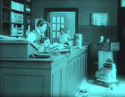
In “Hands (and faces) across the table,” analyses of three long takes from films made decades apart—Paul Thomas Anderson’s There Will Be Blood (2007), Akira Kurosawa’s The Most Beautiful (1944), and Cecil B. De Mille’s Kindling (1915)—demonstrate the use of staging to subtly direct the viewer’s attention within the frame. This entry could be equally useful in exploring the long take in Chapter 5.
Chapter 5 The Shot: Cinematography
Aspect ratios may seem a narrow, esoteric subject—especially to students! But “Godard comes in many shapes and sizes” uses many pretty pictures to demonstrate just how important framings are and how they can be distorted in DVDs. Students may be less resistant to letter-boxing after reading this.
Our discussion of 3D technology in Beowulf, “Bwana Beowulf,” also considers film style and how filmmakers so far have failed to find new ways of adjusting classical Hollywood style to 3D. People tend to have strong feelings one way or the other on the introduction of 3D, so this issue would probably generate a lively discussion.
The “Sleeves” entry compares framing techniques in William Wyler’s The Little Foxes and Kenji Mizoguchi’s A Woman of Rumor (an analysis which could be equally useful in discussing editing).
Chapter 6 The Relation of Shot to Shot: Editing
While at the Hong Kong Film Festival in April, 2008, David interviewed Johnny To’s editor, Tina Baz, on dealing with the complexities of shifting point-of-view in Mad Detective. Unfortunately at this point the film hasn’t been released in the U.S., either theatrically or on DVD; it is, however, available in the U.K. The interview contains massive spoilers that students shouldn’t encounter before they’ve seen the film. If Mad Detective does become available, however, it would be a challenging film to show in a unit on editing. If you’re teaching an upper-level analysis course or an introductory one to film majors, this one will get them talking. It also provides vivid examples of rapid shifts in point of view.
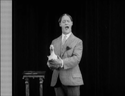
In “Some cuts I have known and loved,” David analyzes brief segments from five films, each centering on a particularly ingenious, striking, or flagrant cut. These are not the familiar examples usually summoned to demonstrate editing.
Chapter 7 Sound in the Cinema
My “What does a Water Horse sound like?” covers a session of final sound mixing for Walden Films’ The Water Horse, with flashbacks to watching sound sessions for The Return of the King. David got another insight into the complexities of sound mixing in an interview with Martin Chappell, sound editor of several Johnny To films and Tsui Hark’s Time and Tide. He wrote it up as “The boy in the Black Hole.”
Chapter 9 Film Genres
In “Your trash, my treasure,” David reflects on the children’s action genre as revived by the National Treasure films.
Chapter 10 Documentary, Experimental, and Animated Films
“Manhattan: Symphony of a great city” analyses Amos Poe’s epic, mesmeric Empire II, a structural film based on a complex rendering of imagery recorded from a single window. The gorgeous frames will make both you and your students (at least the curious, perceptive ones among them) want to see the film. At three hours, it’s difficult to squeeze into a class screening, but even a generous excerpt would convey something of its fascination.
“Lines of sight and light” describes some recent experimental films, including Ken Jacobs’ Capitalism: Child Labor (2006).
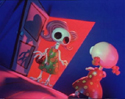
In “Tracking Aardman creatures,” we presented a brief history and chronology of the great Bristol-based animation firm, responsible for Creature Comforts and the Wallace and Gromit series. If you’re showing an Aardman film in class, this will give you plenty of information on the company and on DVD availability as of January, 2008.
If you’re showing your students Warner Bros. cartoons, “Pausing and chortling: A tribute to Bob Clampett” might be useful. It gives some additional information about animation techniques and incidentally points to a teaching technique you might want to use in class.
Pixar consistently creates some of the best films (not just animated films, but films) coming out of Hollywood. It’s good news that the company is increasing its rate of release. By next spring, WALL-E, Bolt, and Up will have appeared in less than a twelve-month period. We got a fascinating glimpse behind the scenes when Bill Kinder, Director of Editorial and Post-Production, visited Madison. Some of what he said is summarized in “A glimpse into the Pixar kitchen.”
Chapter 11 Film Criticism: Critical Analyses
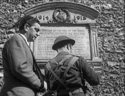
Few of our entries offer in-depth analyses of single films, but “Cavalcanti + Ealing = a little-known gem” examines the narrative of Went the Day Well? and puts it into historical context. “Cronenberg’s Violent Reversals” compares the narrative structures of A History of Violence and Eastern Promises, while “Three Nights of a Dreamer” goes shot by shot through a sequence from In the City of Sylvia.
Chapter 12 Film Art and Film History
Film Art’s final chapter includes a section “The Development of the Classical Hollywood Cinema (1908-1927),” which outlines the early formulation of continuity editing. In “Happy birthday, classical cinema!,” posted December 28, 2007, we celebrating the 90th anniversary of the crucial year, 1917, when classical editing patterns crystallized into a system that has endured, with variations, ever since. We discuss some of the subtleties of the continuity guidelines of the time, with plenty of examples.
A related entry, “Rio Jim, in discrete fragments,” examines shifts in technique during the development of continuity editing, concentrating on several William S. Hart westerns of the mid-1910s. Another entry, “Lucky ‘13,” discusses the transitional year 1913 through two masterpieces that represent quite different styles.
“All singing! All dancing! All teaching!” is aimed primarily at teachers using Film History: An Introduction, who would be likely to devote a lecture and screening to the subject. Still, Film Art users might find it useful, either in relation to Chapter 9 or for the brief section on the coming of sound in Chapter 12. It assesses several documentaries on the coming of sound that had recently come out on DVD. Even for those who don’t want to show them in class, they yield considerable information. (One of the DVDs also deals with color technology up to the introduction of three-strip Technicolor in the 1930s.)
“Superheroes for sale” deals with recent trends in the American film industry.
Other entries
Although most of our entries could be read by an undergraduate, we don’t make a point of writing them for students. “Observations on Film Art and film art” has a wide readership, including other cinephiles, journalists, industry people, bloggers, filmmakers, and scholars in the other arts. A few of our entries go beyond the level of an introductory class. If you teach graduate students or have bright and enthusiastic undergraduates looking to learn more, you might, for example, steer them to this item: “Minding movies,” a brief summary of cognitive film theory, with lots of links for those who want to go further in this direction.
When we go to film festivals, we post reports on the movies we see, the old friends we re-connect with, and the new ones we meet. On a regular basis, we visit the Hong Kong, Vancouver, and Wisconsin festivals, as well as Roger Ebert’s “Ebertfest.” These entries are chatty and sometimes specific to films that students may never get a chance to see. They would be difficult to link up with Film Art. Still, they give a sense of one major aspect of film culture and show part what their textbook authors do when they’re not preparing new editions. We haven’t listed those entries here, but you can find them by clicking here or on the Festivals category on the blog. If you’re interested in a particular film or filmmaker, try a search. Perhaps we’ve said something on the subject.
When we launched “Observations on Film Art and film art,” we tended to post every few days. This year we have tried to settle into a steady, once-a-week rhythm, with new entries typically going online between Thursday and Saturday. For those teachers who might want to assign their students to read the blog regularly, we hope this schedule makes that easier.
Posted in FILM ART (the book) |  open printable version
| Comments Off on Is there a blog in this class? 2008 open printable version
| Comments Off on Is there a blog in this class? 2008
Friday | August 29, 2008
The Mysterious X (1913).
Each film is interlocked with so many other films. You can’t get away. Whatever you do now that you think is new was already done in 1913.
Martin Scorsese, quoted in Scorsese by Ebert (University of Chicago Press, 2008), 219.
DB here:
Most historical events don’t abide by clocks and calendars. Seldom does a trend begin neatly on one date and end, full stop, on another. Changes have vague origins and diffuse destinies. When Kristin and I, along with others, argued for 1917 as the best point to date the consolidation of the Hollywood style of storytelling, we realized that it’s a useful approximation but not as exact as a Tokyo subway timetable.
It’s just as hard to argue that a year constitutes a meaningful unit in itself. Who expects anything but tax laws to change drastically at midnight on 31 December? Yet evidently our minds need benchmarks. Film historians, while being aware that trends are slippery and dating is approximate, have long spotlighted certain years as particularly significant.
Take 1939, which has become a sort of emblem of the peak achievements of Hollywood’s Golden Age. We had Gone with the Wind, The Wizard of Oz, Only Angels Have Wings, Stagecoach, Gunga Din, Wuthering Heights, Dark Victory, Young Mr. Lincoln, Beau Geste, Mr. Smith Goes to Washington, Ninotchka, The Roaring ‘20s, and Destry Rides Again. I’d watch any of those, except Gone with the Wind, right now—something I find it hard to say about most Hollywood movies I’ve seen in 2008.
Another strong year is 1960, with La Dolce Vita, L’Avventura, Rocco and His Brothers, The Apartment, Elmer Gantry, Spartacus, Psycho, Exodus, The Magnificent Seven, Shadows, Late Autumn (Ozu), and The Bad Sleep Well (Kurosawa). Arguably, 1960 was owned by the French, who gave us Breathless, Shoot the Piano Player, Paris nous appartient, Les Bonnes femmes, Le Trou (Becker), Moi un noir (Rouch), and Letter from Siberia (Marker). (See Postscript.)
Let’s go back still further. Researchers sometimes split the silent-film period in two, with the first stretch, usually called “early cinema,” running up to 1915 or so. (1) The second phase then runs roughly from 1915 to 1928. (2) So for many historians the year 1915 functions as a tacit pivot-point, and it is remembered not only for The Birth of a Nation but also for Regeneration, The Tramp, Kindling, The Cheat, Les Vampires, Daydreams (Yevgenii Bauer), and several William S. Hart films. But another year holds a special place in the minds of silent film aficionados.
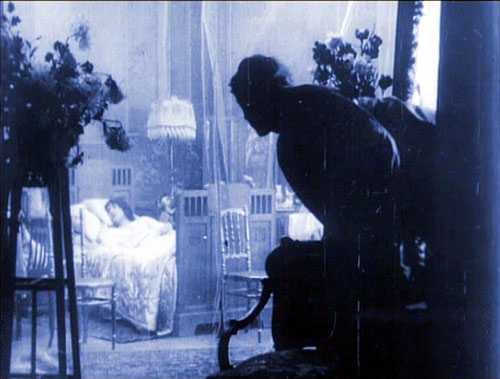
Over a decade ago, the annual Days of the Silent Cinema festival (Il Giornate del cinema muto), took 1913 as its focus. (3) It was an extraordinary year. Denmark produced Atlantis (August Blom) and The Mysterious X (Benjamin Christensen). From France we had L’Enfant de Paris (Leonce Perret), Germinal (Albert Capellani), and Louis Feuillade’s Fantomas series. Germany gave us Urban Gad’s Engelein and Filmprimadonna and Franz Hofer’s obsessively symmetrical The Black Ball. The staggering set of Italy’s Love Everlasting (Ma l’amor mio non muore!, Mario Caserini) was matched by the breadth of Enrico Guazzoni’s Quo vadis? In Russia Bauer released Twilight of a Woman’s Soul. American audiences saw Traffic in Souls (George Loane Tucker) and Death’s Marathon and The Mothering Heart, from a guy named Griffith. Several historians would argue that 1913 marked the first major achievements of film as an artform.
Two outstanding films of that annus mirabilis have recently been issued on US DVD. One is a striking accomplishment, the other a flat-out masterpiece. Both discs belong in the collections of everyone who’s serious about cinema.
Your call is important to us
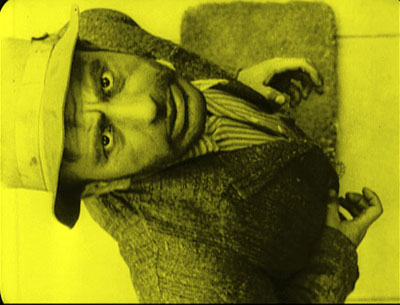
A wife and her baby are alone in an isolated house when a tramp breaks in. As the wife tries to keep the invader at bay, her husband happens to telephone and learn what’s happening. He scrambles to return home. He steals an idle car, and its owner, accompanied by police, race after him. We cut rapidly between the besieged mother and the husband’s frantic drive, as he is in turn pursued. Just as the tramp is about to attack the wife, the husband bursts in, followed by the police. The family is saved.
This is the story of the 1913 one-reel film, Suspense, co-directed by Lois Weber and Phillips Smalley. If the plot sounds familiar, it’s probably because you know that one of D. W. Griffith’s most famous films, The Lonely Villa (1909) tells the same basic tale.There are still earlier versions, including one, The Physician of the Castle (Le Médécin du chateau, 1908), which may have inspired Griffith. The ultimate source seems to be a 1902 play by André de Lord, Au téléphone (translated here).
So Weber and Smalley are reviving an old idea. Their task is to make it fresh. How they do so has been studied in depth by Charlie Keil in his book Early American Cinema in Transition: Story, Style, and Filmmaking, 1907-1913.I can’t match Keil’s subtlety, and it’s better that you see the film first, so I’ll drop only some hints, pointers, and comments.
We’re inclined to say that The Lonely Villa influenced Suspense. But maybe we can capture the situation in a more illuminating way. The art historian E. H. Gombrich has suggested that we can often trace the relationship between artworks in terms of schema and revision. (4) A schema is a pattern that we find in an artwork, one that a later artist can borrow. Most often, later artists copy the schema straightforwardly. This is the usual way we think of influence. But instead of replicating the schema, the next artist can revise it. She can elaborate on it, strip it to its essence, drop parts and add others, whatever—in order to achieve new purposes or evoke fresh responses.
In The Lonely Villa, Griffith uses crosscutting to build suspense. He cuts among the thuggish vagrants trying to break in, the wife and daughters trying to hold them off, and the father learning by phone of the situation and then plunging after them with a policeman. The obvious pattern here is the principle of alternation between different lines of action, all taking place at the same time and converging in a last-minute rescue.
So Smalley and Weber inherit the crosscutting schema, but they go beyond simply copying it. They find ways to revise it, some quite surprising. These revisions aim to create more tension and to dynamize the situation.
The obvious option, at least to us today, would be to use more shots than Griffith does; we think that increasing the cutting pace builds up excitement. Interestingly, however, Suspense uses only a couple of more shots than The Lonely Villa within a comparable running time. (5) We usually expect that American films become more rapidly cut as the 1910s go on, but this isn’t the case here. Shortly, I’ll suggest why.
Smalley and Weber recast Griffith’s parallel editing in several ways. For instance, The Lonely Villa prolongs the phone conversation between husband and wife, building suspense through the husband’s instruction to use his revolver on the thugs. Suspense, by contrast, doesn’t dwell on the telephone conversation but devotes more time (and shots) to the chase along the highway. That’s because Weber and Smalley have complicated the chase by having the husband pursued by the irate motorist and the police, something that doesn’t happen in the Griffith film.
Just as important, Smalley and Weber revise the crosscutting schema through framings that are quite bold for 1913. For example, Griffith’s tramps break into the house in long shot, and they move laterally across the frame.
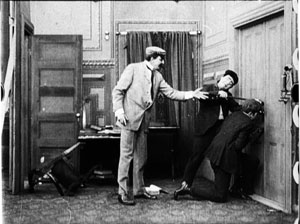
But Weber and Smalley’s tramp sneaks steadily up the stairs, into a menacing extreme close-up.
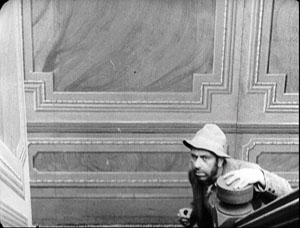 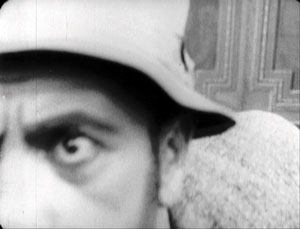
Elsewhere, Suspense gives us close views of the wife and of the door as the tramp breaks in. There are oblique angles on the back door of the house, and virtually Hitchcockian point-of-view shots when the wife sees the tramp breaking in and he looks straight up at her.
What struck me most forcibly on watching the film again was the way in which Weber and Smalley’s daring framings serve as equivalents for parallel editing. In effect, they revise the crosscutting schema by putting several actions into a single frame. The most evident, and the most famous, instances are the triangulated split-screen shots. They cram together three lines of action: the wife on the phone, the husband on the phone, and the tramp’s efforts to break into the house (here, finding the key under the mat). (6)
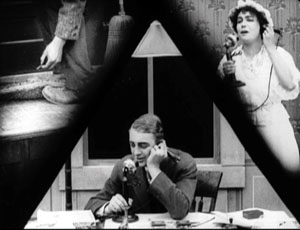
Split-screen effects like this were common enough in early cinema, especially for rendering telephone conversations. Eileen Bowser points out that the three-frame division was one variant, with a landscape separating the two callers. (7) Her example is from College Chums (1907).
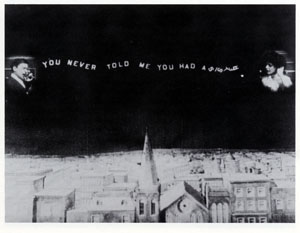
But my sense is that in early cinema the split-screen effect was used principally for exposition or comedy, not for suspense. Smalley and Weber have made this framing substitute for crosscutting: instead of giving us three shots, we get one, showing the plot advancing along different lines of action. These splintered frames function much like Brian De Palma’s multiple-frame imagery in Sisters, Blow-Out, and other films. There’s also the nice touch of the conical lampshade over the husband’s head, providing a fulcrum for the composition.
Earlier in the film, instead of crosscutting between the tramp outside and the wife indoors, Suspense gives us both in the same shot, with the tramp peeking in behind her.
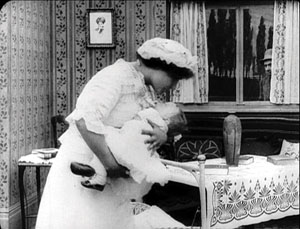
A more ingenious revision of the crosscutting schema comes during the shots on the road. Instead of cutting between the father in the stolen car and the police pursuing him, Suspense packs them into the same frame. This is done not only in long shot but also in striking depth compositions.
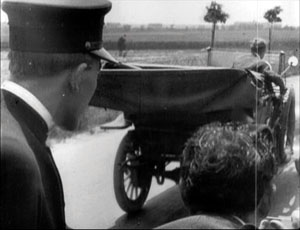
Flashiest of all are the shots showing the pursuers reflected in the rear-view mirror of the father’s car as he races ahead of them.
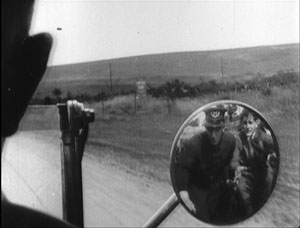
Again, a single framing has done duty for two shots, one of the father looking back and another showing the cops coming closer to him. By compressing several lines of action into a single frame, our 1913 film doesn’t need to use significantly more shots than the 1909 one.
These are just a few of the imaginative ways in which Weber and Smalley have recast their standard situation. I could have considered as well the unobtrusive use of the knife as a multi-purpose prop, the echoed shots of mirrors, and the shrewd employment of repetitions in the intertitles.
It would take an early-cinema specialist like Keil to trace out all the connections between Suspense and other films of its era. One among many would be the fact that Griffith wasn’t exactly standing still between 1909, the year of The Lonely Villa, and 1913. For instance, his Battle at Elderbush Gulch, made about the same time as Suspense (though released in 1914), displays far more rapid cutting than Weber and Smalley attempt. Griffith also employed a swelling advance to the foreground, like that of the tramp shot I showed above, in The Musketeers of Pig Alley (1912).
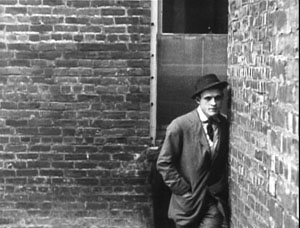 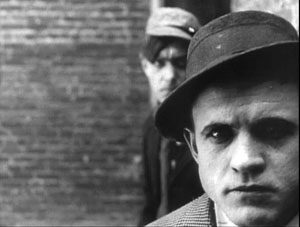
Here, Smalley and Weber seem to have replicated a schema that was believed to ratchet up tension, the so-called looming effect.
The very title of the film exhibits self-consciousness about its artistic purpose. By 1913, it seems, American filmmakers were confident enough in their skills to announce their aims. We want, the title seems to say, to arouse you, to make you wait, hanging there, for the resolution. We know how to tell a twelve-minute story cinematically. The film seems uncannily to anticipate all those one-word titles that Hitchcock invoked to unsettle us–Suspicion, Spellbound, Psycho, Frenzy. As in a Hitchcock movie, the fact that we are pretty certain how Suspense will turn out doesn’t seem to dissipate our anxiety. (For more on this paradox of suspense, see this entry.)
Tunnel vision
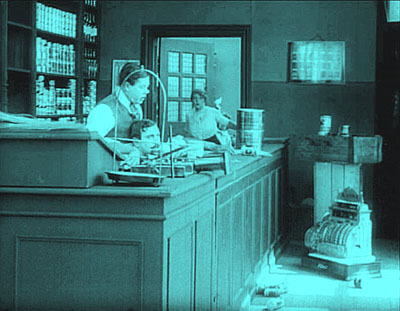
It was during the Pordenone 1913 season that the full brilliance of Victor Sjöström’s Ingeborg Holm hit me. I had seen the film a couple of times before and found it deeply moving in its restrained treatment of a poignant situation. The film traces the dissolution of a family. Sven Holm is doing a brisk retail business, but his health problems, along with a thieving clerk, plunge the family into poverty. When Holm dies, his wife Ingeborg must take the children into the poorhouse, and from there they are boarded out to foster families. Her plight worsens over the years, and its sorrowful depths are revealed when her son, now grown, returns to visit her.
Ingeborg Holm has long been recognized as a milestone in European film, not least for its effect on improving Sweden’s treatment of the poor. (8) The acting style is muted and delicate, with no mugging or arm-waving. For long periods, the main actors turn from the audience. (9) Just as impressive are the poised compositions, sustained in unhurried long takes. These give what is essentially a bourgeois tragedy a kind of majestic relentlessness. Watching, I remembered what Dreyer had admired in Sjöström’s Ingmar’s Sons (1918):
The film people here at home shook their heads because Sjöström had really a boldness to let his farmers walk heavily and soberly as farmers do. Yes, they used up an eternity to come from one end of the room to the other. (10)
But sitting in the Cinema Verdi in 1993, I spotted yet another level of artistry. Knowing the story of Ingeborg Holm, I was able to watch the shots unfold. I could study how Sjöström was unobtrusively moving characters so that they became shifting centers of interest. Although he didn’t cut in to close-ups, he harmonized his actors’ movements so that at one point you noticed Ingeborg, at another her husband. Performers spread themselves across the frame, arrayed themselves in depth, turned from or toward the camera. Most subtly of all, one actor might mask another one, driving our attention to other parts of the frame. Sjöström could sustain this intricate play of blocking and revealing for minutes on end.
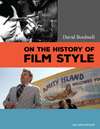
My favorite example of this tactic is the three-minute passage showing Ingeborg’s daughter and son taken away by new mothers. You can read the whole discussion on pp. 191-195 in On the History of Film Style (1997), but here is an excerpt, with stills intercalated. (These stills, grabbed from the DVD, lack a little on the left. The film has been printed and reprinted so many times, and now fitted to the TV monitor, that it has lost some information along that edge.)
Ingeborg’s entry with her children from the rear doorway establishes the trajectory that will be followed during the scene, as foster mothers come in and take away the children. (Again, the scene is built around movements toward and away from the camera.) In a brilliant stroke, Sjöström immediately plants the young son in the foreground, back to us. The boy will stand there immobile for this first phase of the scene, occasionally serving to block the superintendent.
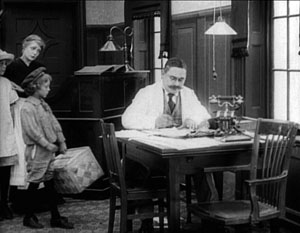 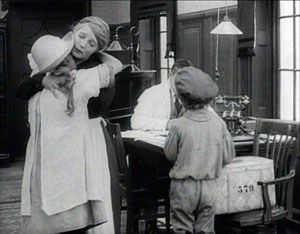
Ingeborg buries her face in her daughter’s shoulder at the precise moment the foster mother enters from the rear left. She passes behind Ingeborg, and as she is momentarily blocked, the superintendent twitches into visibility, handing the woman a document to sign.
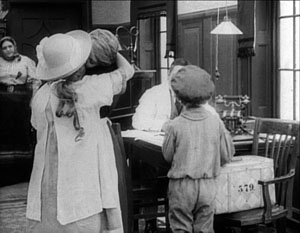 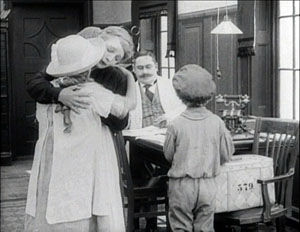
During the signing, when the woman is briefly obscured, the superintendent shifts position again and Ingeborg lifts her face once more. Then Ingeborg and her daughter move slightly leftward as the foster mother comes forward.
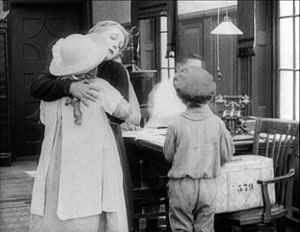 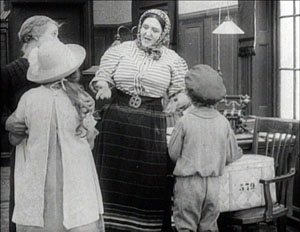
This phase of the scene concludes with the departure of the daughter and the embrace of Ingeborg and her son in the foreground, once more concealing the superintendent.
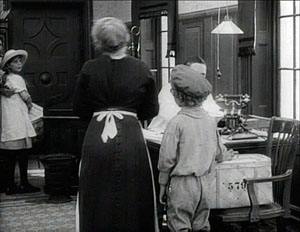 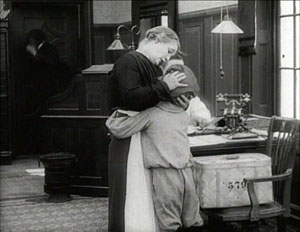
Granted, I picked one of the film’s most exactingly staged scenes, but there are several other examples. Consider the climax, when the adult son comes to visit Ingeborg: the camera position and staging ask us to recall the scene I’ve just mentioned. Or take a look at the handling of the space behind the counter in the various scenes in the Holms’ shop. One instance surmounts this section.
This choreography is hard to catch on the fly: by the time you notice a change, what prepared for it has gone. To understand the overall dynamic, we must reverse-engineer the effects, moving backward from the result to the conditions. As I studied the film, it became clear that creating shifting centers of interest was basic to the scenes’ effects. All the finesse of acting, both solo and ensemble, would come to little if we weren’t primed to watch the most important area of the shot. Directors of the 1910s became supremely skilful in guiding our eye from one major story point to another within the fixed frame.
Some of the tactics of guiding our attention could be borrowed from other arts. Painting and theatre supplied certain schemas, like placing an item in the center of the picture format and turning faces toward the viewer. But some tactics for directing our eye relied on capacities that were as “specifically cinematic” as cutting was argued to be. Theatre is staged for many sightlines, but cinema is staged for a single one, that of the camera lens. That fact allowed directors to organize the unfolding action in depth, prompting the viewer to notice things at many distances from the camera.
It also allowed a precise blocking and revealing of information that would not work on the stage. In a live theatre performance, the slight shifts we detect in the Ingeborg Holm scene would be apparent to only very few viewers; people sitting in other vantage points wouldn’t see them. For another example of this phenomenon, go elsewhere on this blogsite.
There’s a more basic explanation of what’s going on. Cinematic space is a result of optical perspective, like the space of classic painting. The actors may seem to be standing in a cubical space, but in fact they move within a tipped-over pyramid, with the tip resting at the camera lens. They work inside a ground area that’s the shape of a slice of pie. Here’s a reminder from The Black Ball.
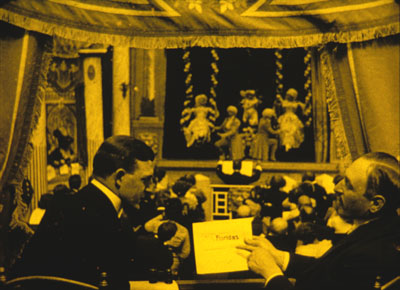
When there are figures close to the camera, as here, they fill up more of the frame, indicating that the field of view has narrowed. Filmmakers of the 1910s had discussed this property of their “cinematic stage,” so as researchers we can confirm that the control of position and timing we observe on screen results from the firm intentions of the makers. They might have echoed Uccello, the Renaissance artist who bent over his drawings late at night and exclaimed: “How sweet a thing is this perspective!”
Suddenly the tableau tradition made sense to me. Directors had to organize both the two-dimensional composition and the tapering three-dimensional playing space in front of the camera. The purpose was to create ever-changing centers of interest, laterally and in depth, flowing along with the key moments in the unfolding action.
By studying the same tactics in Feuillade, Bauer, and others, I found that these principles offered a fruitful way to understand much of what was happening in the films of the tableau era. The dynamic of schema and repetition/revision was at work as well, since I found earlier, more rudimentary uses of these principles; these were then refined during the 1910s. Moreover, the idea helped me generalize beyond that era and analyze later directors, including Mizoguchi Kenji and Hou Hsiao-hsien, who also used staging to shape the viewer’s experience. The results can be found in On the History of Film Style and Figures Traced in Light. Those books largely owe their existence to that flash of awareness kindled by Ingeborg Holm. (11)
We can’t reconstruct Sjöström’s stylistic development with much confidence. (12) His first directed film, The Gardener (Trädgärdsmästaren, 1912) survives, but I saw it before I knew how to watch 1910s movies in this way, so I can’t comment on it. Of the twenty-six films he made from 1912 to 1917, nearly all have been lost. Apart from Ingeborg, I have managed to see Havsagamar (The Sea Vultures, 1916). This retains aspects of the tableau tradition, but virtually no scenes display the intricate staging of his 1913 masterpiece.
In the late 1910s, judging by the films we have, Sjöström seems to have moved quickly toward continuity editing in the American vein. (13) The Girl from Stormycroft (Tösen frän Stormyrtorpet, 1917) contains extended passages of analytical editing, and the scenes display a freedom of camera setup one seldom sees in European cinema of the period. Sjöström clearly understands the principles of continuity down to the smallest detail. For instance, he not only uses the frame-edge cut (the cut that lets a character exit one shot and enter another, as the body crosses the frameline); he accelerates it. Our heroine leaves the kitchen, and in the shot’s final frame she hits the right edge. Another director would have had her exit the frame entirely and held the kitchen shot a little longer, to give her time to get to the next room. But Sjöström simply cuts to her already in another room, completing her trajectory.
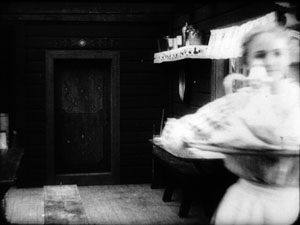 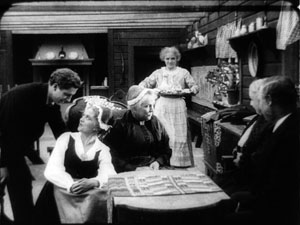
Sjöström presumes that the constant pace of her approach and the vector of her movement will smooth the shot-change. It does, but few directors of that day would had such confidence that our mind would create continuity of motion.
During this summer’s archive viewing, I spent some time studying Sjöström’s cutting in The Girl from Stormycroft and subsequent films. I may offer some more thoughts later. For now I’ll just say that in these early years we seldom encounter such a versatile director, one who mastered the tableau tradition and then moved, with apparently little effort, to nuanced continuity editing. More generally, examining his technique isn’t a dry exercise. We never lose by studying craftsmanship. Sjöström’s films succeed because his style carefully guides our moment-by-moment apprehension of the heart-rending stories he has chosen to tell.
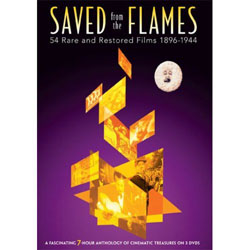
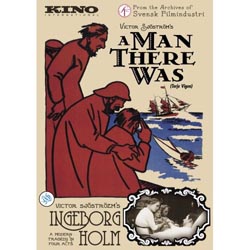
Have I convinced you to surrender your credit-card number? Suspense is available in a dazzling Flicker Alley collection, Saved from the Flames, compiled from the French series Retour de flame. Ingeborg Holm comes with a tinted print of the estimable Terje Vigen (A Man There Was) on a DVD from Kino. The latter disc includes vibrant scores from Donald Sosin and David Drazin.
(1) For the purposes of the outstanding Encyclopedia of Early Cinema (New York: Routledge, 2005), the editor Richard Abel considers that the early cinema constitutes the period from film’s invention ca. 1894 to the mid-1910s.
(2) Silent films were still made into the 1930s, notably in Russia and Japan—a situation that shows the rough-and-ready quality of period divisions.
(3) For an informative series of articles around the 1913 theme, see Griffithiana no. 50 (May 1994).
(4) Gombrich proposes these ideas at various points in Art and Illusion: A Study in the Psychology of Pictorial Representation, new ed. (Princeton: Princeton University Press, 2000). The book is a milestone in twentieth-century humanistic inquiry.
(5) The Lonely Villa (1909) has, in the version I’ve seen, 54 shots in a 750-foot reel (that is, about twelve and a half minutes at 16 frames per second). Suspense has nearly the same number of shots, 56, in about the same running time.
(6) Sharp-eyed readers will recognize one of these shots as Fig. 5.82 in Film Art: An Introduction, 8th ed. (New York: McGraw-Hill, 2008), 187.
(7) Eileen Bowser, The Transformation of Cinema 1907-1915, vol. 2 of History of the American Cinema (New York: Scribners, 1990), 65.
(8) For more background on the film, see Jan Olsson, “‘Classical’ vs. ‘Pre-Classical’: Ingeborg Holm and Swedish Cinema in 1913,” Griffithiana no. 50 (May 1994), 113-123.
(9) Kristin wrote about this technique in “The International Exploration of Cinematic Expressivity,” in Film and the First World War, ed. Karel Dibbets and Bert Hogenkamp (Amsterdam: Amsterdam University Press, 1995), 65-85. She also discusses it in our Film History: An Introduction, 2d ed. (New York: McGraw-Hill, 2002), 67.
(10) Carl Dreyer, “A Little on Film Style,” Dreyer in Double Reflection, ed. and trans. Donald Skoller (New York: Dutton, 1973), 133.
(11) I was probably primed for this by lectures presented by Yuri Tsivian, who has long been studying mirrors in 1910s cinema and calculating how they revealed offscreen space.
(12) Detailed information on Sjöström’s relation to the film industry in these years can be found in John Fullerton’s epic Ph. D. thesis, The Development of a System of Representation in Swedish Film, 1912-1920 (University of East Anglia, 1994). See also Fullerton, “Contextualising the Innovation of Deep Staging in Swedish Film,” Film and the First World War, ed. Dibbets and Hogenkamp, 86-96.
(13) Several people have analyzed Sjöström’s editing. Ben Brewster and Lea Jacobs’ Theatre to Cinema: Stage Pictorialism and the Early Feature Film (Oxford: Oxford University Press, 1997), 133-136 shows how cutting supports the acting in a crucial scene of Ingmar’s Sons. Tom Gunning’s essay “‘A Dangerous Pledge’: Victor Sjöström’s Unknown Masterpiece, Mästerman,” in John Fullerton and Jan Olsson’s anthology Nordic Explorations: Film before 1930(Sydney: John Libbey, 1999), 204-231, argues that Sjöström’s cutting gives his characters a degree of psychological opacity. Most recently, in an unpublished paper Jonah Horwitz discusses patterns of performance, composition, and editing in Terje Vigen (1917).
Twilight of a Woman’s Soul (1913).
PS 31 August: Some corrections. David Cairns writes to point out that the triangle at the top of the frame in the Suspense split-screen isn’t a lamp but simply the shade behind the father’s head, cropped by the masking. Wishful thinking on my part, I’m afraid. By the way, David has an intriguing movie giveaway going on his site.
Roland-François Lack corrects dates on two of my Greatest French Hits from 1960: “The great Marker from that year is Description d’un combat, not Lettre de Sibérie (1958), and likewise Rouch’s Moi un noir is from 1958.” Thanks to him and David. To my original list, I should probably have added Cocteau’s Testament d’Orphée, released in 1960.
Posted in 1910s cinema, Directors: Bauer, Directors: Griffith, Directors: Sjöström, Directors: Weber, FILM ART (the book), Film history, Film scholarship, Film technique, Film technique: Editing, Film technique: Staging, Tableau staging | open printable version
| No Comments »
Saturday | August 23, 2008
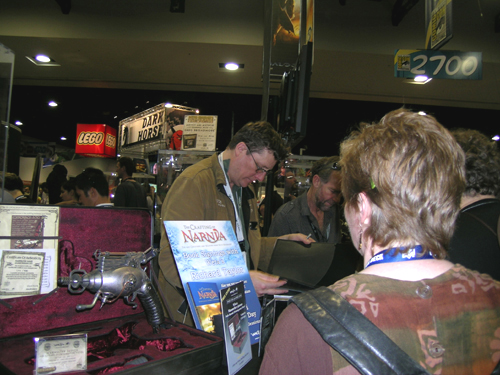
Autographs are big: Richard Taylor signing books about the designs for The Chronicles of Narnia
Kristin here–
Back in the early days of this blog, I posted an entry on our friend Henry Jenkins and his concept of the “aca/fan,” a scholar who studies fandoms while being a fan him- or herself. At that time his book Convergence Culture: Where Old and New Media Collide, had recently come out, and I highly recommended it. Fortunately the book has had a well-deserved success. On October 1 it will be coming out in paperback.
In that entry, I described Henry and our long friendship with him:
Henry doesn’t study fans to find out what makes them tick. He knows that. He’s one of them, a participant in fan cons, a player of video games, an explorer of the multimedia sagas like those of Star Trek and The Matrix that have grown up in the age of franchise culture. He received his doctorate here at the University of Wisconsin-Madison, where David was his dissertation advisor, and we have followed his career, as they say, with great interest. Straight out of the gate he was hired by MIT, where he is now the Director of the MIT Comparative Media Studies Program and the Peter de Florez Professor of Humanities.
(You can find Henry’s blog, “Confessions of an Aca/Fan,” here. He interviewed me when The Frodo Franchise was published; you can find that in three parts, here, here, and here.)
The Frodo Franchise dealt with fan culture as well in Chapter 6, on fan-originated websites. Convergence Culture deals to a considerable extent with modern transmedia franchises. Yet neither of us had ever been to that Mecca of fandoms, Comic-Con. Of course, this year, when I got invited to participate on TheOneRing.net’s panel on the Hobbit project, I accepted. I emailed Henry just in case he happened to be going as well. It turns out he was, being on a long driving vacation through the west with his wife and son.
At first I thought maybe we could meet up early in the Con and then get together afterwards and share our impressions. (We bloggers look for material anywhere we can find it, and this seemed like a golden opportunity.) In fact we didn’t meet early on. There was so much going on, and we never glimpsed each other in the course of the entire event—not surprising, really, when you consider its size. But I made cell-phone contact on Sunday, and we sat down in my hotel lobby and spoke our thoughts into a microphone. Here are some excerpts.
(We talk about what we went to—him to the TV previews, me to artists’ presentation.)
On Different Tracks
We started off by talking about what we had each concentrated on.
HJ: It’s very clear that it’s like six or seven different conventions I could have gone to in the course of the weekend, and it would be a totally different experience depending on which one you went to.
KT: Yeah, I had that impression that there were probably people here mainly to buy stuff, some people here mainly to see celebrities and get autographs and so on.
HJ: And even on that there was a split between the film and the TV people. And there’s a whole comics track. Under other circumstances I would have just been spending my entire time at comics panels, because they’re the strongest comics sessions anywhere in the country.
Coming Alone vs. Having Something Specific To Do
KT: I was happy that I had something to anchor myself, though. I don’t think I’d like to come here, at least for the first time, alone and not having anything specific to do.
HJ: Luckily Henry and Cynthia were along, but it was overwhelming a bit, trying to negotiate and keep up with three people in a space that congested. So that was its own kind of challenge. Sometimes I was thinking it would be great just to be a single person navigating through the space and not have to have large-scale logistics! The scale of it just blows you away. I’ve been on the floor at E3, which is supposed to be one of the largest entertainment trade shows. I’ve done South by Southwest. But neither of them are anywhere near the scale of Comic-Con.
The Scale of the Event
KT: They always say 125,000, because that’s the number of tickets they sell, but then you’ve got all the exhibitors and the people who are presenting on panels. It must be another few tens of thousands packed into that building.
HJ: Yeah, at least.
KT: I was kind of amazed that it worked as well as it did
HJ: Yeah, they did a remarkable job in just managing crowd control. Getting people in and out of things with some degree of order. Some more bullying guards than others, but it was probably necessary to keep the peace.
KT: Yeah, there were a LOT of guards and guides and so on, but people seemed really to be polite, on the whole. I was taking the shuttle bus from a hotel down the street [from my hotel] every day and then coming back by shuttle bus. This morning the bus was quite late compared to other days. It was supposed to come every ten minutes, and we were there maybe twenty. And people who were arriving made this very neat horse-shoe shaped line on the sidewalk. It was very orderly.
HJ: Almost no signs of anyone breaking in line, despite the intensity of some people’s desire to get into things. Someone commented behind me about ‘honor among geeks,’ and that’s probably a good description. There’s a strong honor code.
KT: The venue seems to be up to having that many people in it. I hardly had to wait for rest rooms at all.
HJ: No, the facilities are good.
We ended up doing a fair amount of what they call here “camping,” which is sitting in several panels in a row because there was something we really wanted to see. But you end up trapped in a space with no access to food. Hall H at least has rest-room facilities in the space.
KT: I didn’t try that myself, that is, camping. But I was going to this action-figure panel because it involved Toy Biz, which did the action figures for Lord of the Rings. I heard from people in line that a lot of them were there for the next panel, which was on Sanctuary, which I know from nothing, but they were very devoted and were saying, “They shouldn’t have put this in such a small room.”
HJ: There is a certain sense that you vote with your body at Comic-Con. One of my newest fandoms is Middleman, which is a new ABC family show, and it was in a small room, but we packed it. There was a sense of accomplishment. The producer looked out and said, “This may be the whole audience for the show,” because it hasn’t gotten much publicity yet. There was a sense that just being there was show of support for things.
KT: I wonder how many of the companies have people at those panels—in the audience. I hadn’t realized it, but there was somebody from New Line—who’s probably not from New Line anymore—and then some Warner Bros. people, supposedly, sitting out in the audience for the Hobbit one. That kind of surprised me. Why bother?
HJ: At the larger sessions it seemed they had blocked off four or five rows of space just for the studio people. Rarely were they occupied to anywhere near that extent, so it was maybe overkill. But there were a few sessions where there were a significant number of people. The Battlestar Gallactica, for example. There was a large studio contingent there for that. Suits and friends and family and other writers, because that was a kind of last hurrah for that production. They just wrapped shooting the last episode two weeks ago, so this would have been a major last gathering of a lot of those people. They said they really hadn’t had a chance to have a wrap party yet, so in a sense it probably was.
The Hall H Experience
KT: Did you have the Hall H experience at all?
HJ: We went to see Heroes one morning, which was the first time, they said, a TV show had made it into Hall H. We managed to be there for Watchmen and a few of the other movies that followed it.
KT: I kind of avoided it for a while because I kept hearing that there would be incredibly long lines, and I pictured just sitting there for hours and hours and hours reading and possibly not getting into what I wanted to see anyway. So I avoided it until yesterday [Saturday], and I went to the Terminator Salvation one. I wanted really to go to the Pixar one, so I went to get in line very early, and ended up getting in on time for Terminator Salvation.
HJ: Well, for Heroes we waited for about an hour outside and then got in. Then there was a fairly long wait to get started, but then we knew that there were several things after that that we wanted to see as well.
KT: And was it full?
HJ: It was packed. But Heroes has been a kind of success story of Comic-Con. They showed the pilot there before it debuted, and Heroes is pretty desperate at this point to rekindle fan enthusiasm. Last season is largely seen as a bust. Hence their decision not to come back from the strike. They did a partial season and put it off to the fall, because the ratings were plummeting and they were getting bad buzz from fans. So they wanted to come back this year with a killer. They showed the entire opening episode, which was definitely a fan-pleaser. They had figured out what had gone wrong the first season and had put together something that was going to please. So there was lots of extended applause at key moments. It’s kind of fascinating to watch an episode of a TV show with 6500 other people.
The Exhibition Hall
KT: I only discovered the comics section today, as I was about ready to leave, because I hadn’t really been aware of which sections were devoted … I sort of thought it was all random, but obviously they do devote one big section to all the people who are selling old comic books. I suppose you could just stay in one part of the hall and never see the rest of it.
HJ: I felt I barely made a dent in the hall. The first day I didn’t quite realize how big it was, so I was just going up every aisle, and the second and third day I was going on targeted missions. But it still was just so immense that there’s no way you could see it all.
KT: And it’s SO congested.
HJ: Especially if you get to the studio side of things.
Autographs and Planning
KT: I could not figure out what was going on at the Warner Bros. exhibit, but they were constantly surrounded by lines and lines and lines of people who were obstructing the aisles around them. I guess they had people from their TV shows signing.
HJ: They seemed to. I kept stumbling into people. You wander around one corner and there’s Peter Mayhew of Chewbacca fame sitting there, and Will Frakes suddenly would pop up at another table. Neither particularly advertised. Then there were all the advertised autographed stuff. There were a lot of people there that you would know in another context.
KT: I don’t know how you would find out about all of those things in advance. I don’t think Lynda Barry was listed in the program as doing autographs, but she was at the Drawn and Quarterly booth at certain times. I missed her entirely. I got her autograph because I was sitting in the audience before her presentation and she sat down beside me.
HJ: They seemed to have a certain number of people who were there to do autographs, but then there were all these other people randomly. I guess you had to follow a particular company and maybe they posted on the Web.
KT: Yes, I was doing autographs at certain times for my book, and it was just on TheOneRing.net and The Frodo Franchise [websites]. You have to really investigate, go in with a plan.
HJ: It seems to be the case: The more you plan, the more you can get out of the experience.
KT: We were selling copies of my book at this very small booth, and I was there for an hour at different times of day on three days. I think almost everyone, if not everyone, who bought a copy came to the booth specifically to buy it. There were no impulse purchases. I don’t think people buy books at Comic-Con.
HJ: I looked at comics while I was there, but I would buy them from my dealer back in Boston or online at Amazon or My Line Comics [?]. Why I would weigh my suitcase down with comics in the age when it’s so easy to buy stuff digitally?
KT: Not new ones.
HJ: Not new ones. Collectibles, sure.
KT: Unless you have them signed.
Fan Culture hangs on at Comic-Con
HJ: Usually the cons I go to are small-scale, very intimate, you know a high number of the people who are coming. It’s fan-driven and fan-focused. This was like Creation Con on steroids!
KT: Though technically speaking, it is run by fans; there’s a committee.
HJ: It is, and they had a really bad art room with lots of cat pictures and dragon pictures and wolf pictures, which gave it a sense of fan authenticity, because they hadn’t closed out the really bad fan art, even in the midst of all the commercial takeover.
KT: Well, I missed that one.
HJ: You didn’t miss anything, other than the reaffirmation that this was still a con. There were still places and niches and corners where the fan stuff still ruled. You wouldn’t see fanzines there, but then you wouldn’t see them at most fan-run cons these days, since everything’s moved to the Web.
KT: Well, there’s Artists’ Alley, which is way over in the corner. That seems to be fans who are aspiring to be pros but haven’t really made it yet.
HJ: Well, it was a mix. I mean, you’d see Paul Chadwick there [author of “Concrete” series, published by Dark Horse Comics] or Kim Deitch [author of graphic novels such as The Boulevard of Broken Dreams and Shadowland], who were independent and weren’t necessarily going to be there with a company, but yeah, it’s definitely a lot of wannabes in some of that space.
And then fans show themselves through costumes. For all the jokes about women in Princess Leia costumes—and I saw maybe a dozen Princess Leia slave-girl outfits—it was still a way in which fans asserted their presence. There were some quite remarkable pieces of fan performance going on there. There was someone doing Cocteau’s Beauty and the Beast, which had quite a spectacular Beast costume—a little more arty than one expects at a fan con.
Genre
[I mentioned having seen Focus Features’ Hamlet 2 preview.]
HJ: The role of comedy here interests me a lot. I’m always intrigued: What’re the borders of what a fan text is and what isn’t a fan text? Here comedy seems to creep into fandom in a more definitive way than I’ve seen elsewhere. So there was the focus on Hamlet 2, there was Harold and Kumar, The Big Bang Theory [TV series, 2007-08], but then just a bunch of panels on writing for sit-coms. So it’s probably just the industry’s priorities, but it’s interesting that it doesn’t extend to drama. You can imagine a lot of people there being into The Wire or The Shield or some equivalent, and it didn’t cross over in that direction.
KT: I suppose it’s what the studios think the fans want. It’s true there were a lot of comedies, and martial arts, war.
HJ: I think martial arts probably has crept into fandom pretty definitively over time. But it’s interesting to see where the boundaries are. We stumbled across one booth that had just a porn star signing her pictures, and it sort of outraged my son. Pornography isn’t fandom in his world view, but he thought nothing of going up to get wrestlers to sign autographs. Probably in any other fan con, the strong presence of wrestling performers would be out of keeping with fandom.
The Economics of It
KT: I was struck by how cheap it is, basically. How much was it for a single day pass?
HJ: Twenty-five dollars for a single day pass. It’s not bad at all for the scale of what you get. [Four-day passes are $75.]
KT: Some of the smaller tables were something like $380 for the full period, which I thought was kind of cheap. But obviously they NEED both sides of it. They need the exhibitors to attract the people and they need the people to attract the exhibitors, so keeping the cost down makes perfect sense.
HJ: The scale at which companies brought in people was also truly remarkable. I certainly have been to cons where they might have two or three performers from a show, but they brought the entire regulars of Heroes down, as well as the entire writing team. And Heroes is a large, large cast. They scarcely had time for anyone to say anything, but all lined up there on a panel, it was a pretty spectacular display. And Watchmen did pretty much the same thing. All the main characters in Watchmen were there with the director.
KT: That reminds me of the coverage that the film events and I suppose the television events, too, get in the trade press. I’m sure you read some of these articles about how, “Oh, it’s all becoming SO much Hollywood. The big media companies are coming in and taking over,” and so on. It struck me that Hall H is really kind of a world unto itself.
HJ: It is.
KT: It’s separate. You have to go out of the building and get in this line, and then you have to go out of the building when you exit. It’s quite a hike to get there if you’re around D or C in the exhibition hall. I think probably they don’t see much of the rest of the con.
HJ: It does seem largely cut off. That’s the sort of classic place where people camp. And so there’s almost an interesting tactical advantage in being one of the filler programs between the main events, if you can really maneuver into that. It’s like being right after a hit TV show or between two hit TV shows. You’re going to get exposure to people who wouldn’t otherwise. Yesterday Chuck was between Battlestar Gallactica and the Fringe panel. I’ve never see Chuck, but I wanted to see Battlestar and I wanted to see J. J. Abrams [executive producer of Lost and one episode of The Fringe], so we stuck through it. And we’ll probably give it a shot come fall as a result of being exposed to it in that way. There’s lots of things that get sandwiched in that probably get a boost off of this. Or they could hurt themselves.
KT: Bring the wrong scenes or whatever.
HJ: Wrong scenes or just the people are inarticulate. There’s certainly a range of comfort level up there.
In terms of the press coverage, the fact that Entertainment Weekly put Watchmen on its cover this week a year before the film comes out, purely on the basis of it playing at Comic-Con, says something about the publicity value of this thing.
KT: Oh, yeah, for the films there’s no doubt about its publicity value. I just think that if the big entertainment journalists plant themselves in Hall H and don’t pay a lot of attention, then you get this coverage that makes it sound as though the movies are just taking over everything.
HJ: It’s odd. It’s certainly every bit as spectacular a place to do TV as it is to do film. And comics. I couldn’t believe the betrayal I was committing in not seeing the full writers of Mad magazine in the 1960s or seeing Forrest J. Ackerman and his staff—things that were really significant to me as a kid or now. But they were competing with other things that I valued even more. So there are things that you would have killed to get to in any other context that you pass up because there’s so much going on at once. You can’t get to it all.
KT: I just get the feeling that if you at Hall H you’re at one con, and if you’re at the rest of it, you’re in a completely different world. The trades just never talk about that other stuff because it’s not really high-powered.
HJ: The question is, to what degree does that other stuff provide the context that explains what goes on in Hall H? Geek culture is integrated. Probably there are lots of people who travel between Hall H and other things, but if the reporters stay at Hall H, they won’t see the full layering of this.
The Gender Composition of the Attendees and the Industry
HJ: One of the things that struck me was the gender composition here was much—well, certainly there were more guys than girls, but compared to, say, E3 or many other cons I’ve gone to, the gender balance was surprisingly solid. There were an awful lot of women there.
KT: Yeah, they remarked on that on the Harry Potter panel this morning, saying that, unlike those cons, there were probably more women than men in that particular room.
HJ: That makes sense.
KT: When I went to the One Ring Celebration, the ORC, for my book, as I said there, it was maybe 95% women. I suspect it’s partly a factor of whether a con has gaming facilities. Gamers will come, and they’re mostly going to be guys, although probably not as much as it used to be.
HJ: Historically, if you go to Creation cons, which are more star-centered, men turn out much more, whereas if you go to a fan-driven con, which is fanzine oriented, women turn out much more. But because this combines everything, you’ve got just such a spread of people.
I’ve seen people argue that Comic-Con is becoming powerful and it’s exaggerating the power of fan men at the expense of fan women, that the fan-boy mafia is taking over the entertainment industry. Certainly you see it on the producers’ side, that an awful lot of the guys onstage would have been in the audience a decade before—and they’re mostly guys. But what’s interesting is to see the audiences that they’re trying to respond to and engage with has a large female component, and that’s got to have an impact over time on what plays here and what doesn’t.
KT: One of the people on the “Masters of the Web” panel on Thursday morning was making the point that now the younger studio executives are either people who had their own Websites a few years ago or they were in college when the big Websites were being formed. Now they’ve grown up into adulthood reading that stuff, and they’re now in position of power and will continue to be in the industry.
HJ: It was fascinating just to watch the producers, writers, stars, to see which ones were really comfortable in the space and which ones weren’t. Someone like Joss Whedon just grew up in that space. That’s his world. He was totally in his element, and he would understand what questions were being asked and how to respond to them and could use in-joke references to the culture, whereas someone like Alan Ball (executive producer), who no doubt in another context would be totally articulate and interesting, really felt strongly uncomfortable. Moving from Six Feet Under to True Blood, he doesn’t yet know how to “speak fan.” Where Zack Snyder (director of 300) has got to be the most totally inarticulate person I’ve seen on a stage in a long time. Watchmen is going to be his second movie, and he totally works with images, but his ability to use words did not seem to be his strong suit. Some of them who have done multiple fan shows seem really comfortable, and others just looked in shell-shock up there.
 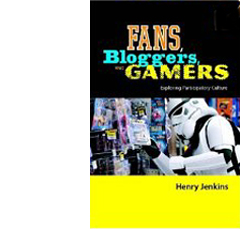
Henry and his other new book, Fans, Bloggers, and Gamers
Posted in Fans and fandom, Festivals, Film and other media, People we like | open printable version
| No Comments »
Saturday | August 16, 2008
DB here:
After a day at the movies, maybe I am living in a parallel universe. I go to see two films praised by people whose tastes I respect. I find myself bored and depressed. I’m also asking questions.
Over the twenty years since Batman (1989), and especially in the last decade or so, some tentpole pictures, and many movies at lower budget levels, have featured superheroes from the Golden and Silver age of comic books. By my count, since 2002, there have been between three and seven comic-book superhero movies released every year. (I’m not counting other movies derived from comic books or characters, like Richie Rich or Ghost World.)
Until quite recently, superheroes haven’t been the biggest money-spinners. Only eleven of the top 100 films on Box Office Mojo’s current worldwide-grosser list are derived from comics, and none ranks in the top ten titles. But things are changing. For nearly every year since 2000, at least one title has made it into the list of top twenty worldwide grossers. For most years two titles have cracked this list, and in 2007 there were three. This year three films have already arrived in the global top twenty: The Dark Knight, Iron Man, and The Incredible Hulk (four, if you count Wanted as a superhero movie).
This 2008 successes have vindicated Marvel’s long-term strategy to invest directly in movies and have spurred Warners to slate more comic-book titles. David S. Cohen analyses this new market here. So we are clearly in the midst of a Trend. My trip to the multiplex got me asking: What has enabled superhero comic-book movies to blast into a central spot in today’s blockbuster economy?
Enter the comic-book guys
It’s clearly not due to a boom in comic-book reading. Superhero books have not commanded a wide audience for a long time. Statistics on comic-book readership are closely guarded, but the expert commentator John Jackson Miller reports that back in 1959, at least 26 million comic books were sold every month. In the highest month of 2006, comic shops ordered, by Miller’s estimate, about 8 million books (and this total includes not only periodical comics but graphic novels, independent comics, and non-superhero titles). There have been upticks and downturns over the decades, but the overall pattern is a steep slump.
Try to buy an old-fashioned comic book, with staples and floppy covers, and you’ll have to look hard. You can get albums and graphic novels at the chain stores like Borders, but not the monthly periodicals. For those you have to go to a comics shop, and Hank Luttrell, one of my local purveyors of comics, estimates there aren’t more than 1000 of them in the U. S.
Moreover, there’s still a stigma attached to reading superhero comics. Even kitsch novels have long had a slightly higher cultural standing than comic books. Admitting you had read The Devil Wears Prada would be less embarrassing than admitting you read Daredevil.
For such reasons and others, the audience for superhero comics is far smaller than the audience for superhero movies. The movies seem to float pretty free of their origins; you can imagine a young Spider-Man fan who loved the series but never knew the books. What’s going on?
Men in tights, and iron pants
The films that disappointed me on that moviegoing day were Iron Man and The Dark Knight. The first seemed to me an ordinary comic-book movie endowed with verve by Robert Downey Jr.’s performance. While he’s thought of as a versatile actor, Downey also has a star persona—the guy who’s wound a few turns too tight, putting up a good front with rapid-fire patter (see Home for the Holidays, Wonder Boys, Kiss Kiss Bang Bang, Zodiac). Downey’s cynical chatterbox makes Iron Man watchable. When he’s not onscreen we get excelsior.
Christopher Nolan showed himself a clever director in Memento and a promising one in The Prestige. So how did he manage to make The Dark Knight such a portentously hollow movie? Apart from enjoying seeing Hong Kong in Imax, I was struck by the repetition of gimmicky situations–disguises, hostage-taking, ticking bombs, characters dangling over a skyscraper abyss, who’s dead really once and for all? The fights and chases were as unintelligible as most such sequences are nowadays, and the usual roaming-camera formulas were applied without much variety. Shoot lots of singles, track slowly in on everybody who’s speaking, spin a circle around characters now and then, and transition to a new scene with a quick airborne shot of a cityscape. Like Jim Emerson, I thought that everything hurtled along at the same aggressive pace. If I want an arch-criminal caper aiming for shock, emotional distress, and political comment, I’ll take Benny Chan’s New Police Story.
Then there are the mouths. This is a movie about mouths. I couldn’t stop staring at them. Given Batman’s cowl and his husky whisper, you practically have to lip-read his lines. Harvey Dent’s vagrant facial parts are especially engaging around the jaws, and of course the Joker’s double rictus dominates his face. Gradually I found Maggie Gyllenhaal’s spoonbill lips starting to look peculiar.
The expository scenes were played with a somber knowingness I found stifling. Quoting lame dialogue is one of the handiest weapons in a critic’s arsenal and I usually don’t resort to it; many very good movies are weak on this front. Still, I can’t resist feeling that some weighty lines were doing duty for extended dramatic development, trying to convince me that enormous issues were churning underneath all the heists, fights, and chases. Know your limits, Master Wayne. Or: Some men just want to watch the world burn. Or: In their last moments people show you who they really are. Or: The night is darkest before the dawn.
I want to ask: Why so serious?
Odds are you think better of Iron Man and The Dark Knight than I do. That debate will go on for years. My purpose here is to explore a historical question: Why comic-book superhero movies now?
Z as in Zeitgeist
More superhero movies after 2002, you say? Obviously 9/11 so traumatized us that we feel a yearning for superheroes to protect us. Our old friend the zeitgeist furnishes an explanation. Every popular movie can be read as taking the pulse of the public mood or the national unconscious.
I’ve argued against zeitgeist readings in Poetics of Cinema, so I’ll just mention some problems with them:
*A zeitgeist is hard to pin down. There’s no reason to think that the millions of people who go to the movies share the same values, attitudes, moods, or opinions. In fact, all the measures we have of these things show that people differ greatly along all these dimensions. I suspect that the main reason we think there’s a zeitgeist is that we can find it in popular culture. But we would need to find it independently, in our everyday lives, to show that popular culture reflects it.
*So many different movies are popular at any moment that we’d have to posit a pretty fragmented national psyche. Right now, it seems, we affirm heroic achievement (Indiana Jones and the Kingdom of the Crystal Skull, Kung Fu Panda, Prince Caspian) except when we don’t (Get Smart, The Dark Knight). So maybe the zeitgeist is somehow split? That leads to vacuity, since that answer can accommodate an indefinitely large number of movies. (We’d have to add fractions of our psyche that are solicited by Sex and the City and Horton Hears a Who!)
*The movie audience isn’t a good cross-section of the general public. The demographic profile tilts very young and moderately affluent. Movies are largely a middle-class teenage and twentysomething form. When a producer says her movie is trying to catch the zeitgeist, she’s not tracking retired guys in Arizona wearing white belts; she’s thinking mostly of the tastes of kids in baseball caps and draggy jeans.
* Just because a movie is popular doesn’t mean that people have found the same meanings in it that critics do. Interpretation is a matter of constructing meaning out of what a movie puts before us, not finding the buried treasure, and there’s no guarantee that the critic’s construal conforms to any audience member’s.
*Critics tend to think that if a movie is popular, it reflects the populace. But a ticket is not a vote for the movie’s values. I may like or dislike it, and I may do either for reasons that have nothing to do with its projection of my hidden anxieties.
*Many Hollywood films are popular abroad, in nations presumably possessing a different zeitgeist or national unconscious. How can that work? Or do audiences on different continents share the same zeitgeist?
Wait, somebody will reply, The Dark Knight is a special case! Nolan and his collaborators have strewn the film with references to post-9/11 policies about torture and surveillance. What, though, is the film saying about those policies? The blogosphere is already ablaze with discussions of whether the film supports or criticizes Bush’s White House. And the Editorial Board of the good, gray Times has noticed:
It does not take a lot of imagination to see the new Batman movie that is setting box office records, The Dark Knight, as something of a commentary on the war on terror.
You said it! Takes no imagination at all. But what is the commentary? The Board decides that the water is murky, that some elements of the movie line up on one side, some on the other. The result: “Societies get the heroes they deserve,” which is virtually a line from the movie.
I remember walking out of Patton (1970) with a hippie friend who loved it. He claimed that it showed how vicious the military was, by portraying a hero as an egotistical nutcase. That wasn’t the reading offered by a veteran I once talked to, who considered the film a tribute to a great warrior.
It was then I began to suspect that Hollywood movies are usually strategically ambiguous about politics. You can read them in a lot of different ways, and that ambivalence is more or less deliberate.
A Hollywood film tends to pose sharp moral polarities and then fuzz or fudge or rush past settling them. For instance, take The Bourne Ultimatum: Yes, the espionage system is corrupt, but there is one honorable agent who will leak the information, and the press will expose it all, and the malefactors will be jailed. This tactic hasn’t had a great track record in real life.
The constitutive ambiguity of Hollywood movies helpfully disarms criticisms from interest groups (“Look at the positive points we put in”). It also gives the film an air of moral seriousness (“See, things aren’t simple; there are gray areas”). That’s the bait the Times writers took.
I’m not saying that films can’t carry an intentional message. Bryan Singer and Ian McKellen claim the X-Men series criticizes prejudice against gays and minorities. Nor am I saying that an ambivalent film comes from its makers delicately implanting counterbalancing clues. Sometimes they probably do. More often, I think, filmmakers pluck out bits of cultural flotsam opportunistically, stirring it all together and offering it up to see if we like the taste. It’s in filmmakers’ interests to push a lot of our buttons without worrying whether what comes out is a coherent intellectual position. Patton grabbed people and got them talking, and that was enough to create a cultural event. Ditto The Dark Knight.
Back to basics
If the zeitgeist doesn’t explain the flourishing of the superhero movie in the last few years, what does? I offer some suggestions. They’re based on my hunch that the genre has brought together several trends in contemporary Hollywood film. These trends, which can commingle, were around before 2000, but they seem to be developing in a way that has created a niche for the superhero film.
The changing hierarchy of genres. Not all genres are created equal, and they rise or fall in status. As the Western and the musical fell in the 1970s, the urban crime film, horror, and science-fiction rose. For a long time, it would be unthinkable for an A-list director to do a horror or science-fiction movie, but that changed after Polanski, Kubrick, Ridley Scott, et al. gave those genres a fresh luster just by their participation. More recently, I argue in The Way Hollywood Tells It, the fantasy film arrived as a respectable genre, as measured by box-office receipts, critical respect, and awards. It seems that the sword-and-sorcery movie reached its full rehabilitation when The Lord of the Rings: The Return of the King scored its eleven Academy Awards.
The comic-book movie has had a longer slog from the B- and sub-B-regions. Superman, Flash Gordon, and Dick Tracy were all fodder for serials and low-budget fare. Prince Valiant (1954) was the only comics-derived movie of any standing in the 1950s, as I recall, and you can argue that it fitted into a cycle of widescreen costume pictures. (Though it looks like a pretty camp undertaking today.) Much later came revivals of the two most popular superheroes, Superman (1978) and Batman (1989).
The success of the Batman film, which was carefully orchestrated by Warners and its DC comics subsidiary, can be seen as preparing the grounds for today’s superhero franchises. The idea was to avoid simply reiterating a series, as the Superman movie did, or mocking it, as the Batman TV show did. The purpose was to “reimagine” the series, to “reboot” it as we now say, the way Frank Miller’s The Dark Knight Returns re-launched the Batman comic. Rebooting modernizes the mythos by reinterpreting it in a thematically serious and graphically daring way.
During the 1990s, less famous superheroes filled in as the Batman franchise tailed off. Examples were The Rocketeer (1991), Timecop (1994), The Crow (1994) and The Crow: City of Angels (1996), Judge Dredd (1995), Men in Black (1997), Spawn (1997), Blade (1998), and Mystery Men (1999). Most of these managed to fuse their appeals with those of another parvenu genre, the kinetic action-adventure movie.
Significantly, these were typically medium-budget films from semi-independent companies. Although some failed, a few were huge and many earned well, especially once home video was reckoned in. Moreover, the growing number of titles, sometimes featuring name actors, fueled a sense that this genre was becoming important. As often happens, marginal companies developed the market more nimbly than the big ones, who tend to move in once the market has matured.
I’d also suggest that The Matrix (1999) helped legitimize the cycle. (Neo isn’t a superhero? In the final scene he can fly.) The pseudophilosophical aura this movie radiated, as well as its easy familiarity with comics, videogames, and the Web, made it irrevocably cool. Now ambitious young directors like Nolan, Singer, and Brett Ratner could sign such projects with no sense they were going downmarket.
The importance of special effects. Arguably there were no fundamental breakthroughs in special-effects technology from the 1940s to the 1960s. But with motion-control cinematography, showcased in the first Star Wars installment (1977) filmmakers could create a new level of realism in the use of miniatures. Later developments in matte work, blue- and green-screen techniques, and digital imagery were suited to, and driven by, the other genres that were on the rise—horror, science-fiction, and fantasy—but comic-book movies benefited as well. The tagline for Superman was “You’ll believe a man can fly.”
Special effects thereby became one of a film’s attractions. Instead of hiding the technique, films flaunted it as a mark of big budgets and technological sophistication. The fantastic powers of superheroes cried out for CGI, and it may be that convincing movies in the genre weren’t really ready until the software matured.
The rise of franchises. Studios have always sought predictability, and the classic studio system relied on stars and genres to encourage the audience to return for more of what it liked. But as film attendance waned, producers looked for other models. One that was successful was the branded series, epitomized in the James Bond films. With the rise of the summer blockbuster, producers searched for properties that could be exploited in a string of movies. A memorable character could tie the installments together, and so filmmakers turned to pop literature (e.g., the Harry Potter books) and comic books. Today, Marvel Enterprises is less concerned with publishing comics than with creating film vehicles for its 5000 characters. Indeed, to get bank financing it put up ten of its characters as collateral!
Yet a single character might not sustain a robust franchise. Henry Jenkins has written about how popular culture is gravitating to multi-character “worlds” that allow different media texts to be carved out of them. Now that periodical sales of comics have flagged, the tail is wagging the dog. The 5000 characters in the Marvel Universe furnish endless franchise opportunities. If you stayed for the credit cookie at the end of Iron Man, you saw the setup for a sequel that will pair the hero with at least one more Marvel protagonist.
Merchandising and corporate synergy. It’s too obvious to dwell on, but superhero movies fit neatly into the demand that franchises should spawn books, TV shows, soundtracks, toys, apparel, and so on. Time Warner’s acquisition of DC Comics was crucial to the cross-platform marketing of the first Batman. Moreover, most comics readers are relatively affluent (a big change from my boyhood), so they have the income to buy action figures and other pricy collectibles, like a Batbed.
The shift from an auteur cinema to a genre cinema. The classic studio system maintained a fruitful, sometimes tense, balance between directorial expression and genre demands. Somewhere in recent decades that balance has split into polarities. We now have big-budget genre films that made by directors of no discernible individuality, and small “personal” films that showcase the director’s sensibility. There have always been impersonal craftsmen in Hollywood, but the most distinctive directors could often bring their own sensibilities to projects big or small.
David Lynch could make Dune (1984) part of his own oeuvre, but since then we have many big-budget genre pictures that bear no signs of directorial individuality. In particular, science-fiction, fantasy, and superhero movies demand so much high-tech input, so much preparation, so many logistical tasks in shooting, and such intensive postproduction, that economy of effort favors a standardized look and feel. Hence perhaps the recourse to well-established techniques of shooting and cutting; intensified continuity provides a line of least resistance. A comic-book movie can succeed if it doesn’t stray from the fanbase’s expectations and swiftly initiates the newbies. Not much directorial finesse is needed, as 300 (2007) shows.
The development of the megapicture may have led the more talented directors to the “one for them, one for me” motto. Think of the difference between Burton’s Planet of the Apes or even Sweeney Todd and, say, Ed Wood or Big Fish. Or think of the moments of elegance in Memento and The Prestige, as opposed to the blunt handling of Batman Begins and The Dark Knight.
 Shock and awe in presentation. The rise of the multiplex meant not only an upgrade in comfort (my back appreciates the tilting seats) but also a demand for big pictures and big sound. Smaller, more intimate movies look woeful on your megascreen, and what’s the point of Dolby surround channels if you’re watching a Woody Allen picture? Like science-fiction and fantasy, the adventures of a superhero in yawning landscapes fill the demand for immersion in a punchy, visceral entertainment. Scaling the film for Imax, as Superman Returns and The Dark Knight have, is the next step in this escalation. Shock and awe in presentation. The rise of the multiplex meant not only an upgrade in comfort (my back appreciates the tilting seats) but also a demand for big pictures and big sound. Smaller, more intimate movies look woeful on your megascreen, and what’s the point of Dolby surround channels if you’re watching a Woody Allen picture? Like science-fiction and fantasy, the adventures of a superhero in yawning landscapes fill the demand for immersion in a punchy, visceral entertainment. Scaling the film for Imax, as Superman Returns and The Dark Knight have, is the next step in this escalation.
Too much is never enough. Since the 1980s, mass-audience pictures have gravitated toward ever more exaggerated presentation of momentary effects. In a comedy, if a car is about to crash, everyone inside must stare at the camera and shriek in concert. Extreme wide-angle shooting makes faces funny in themselves (or so Barry Sonnenfeld thinks). Action movies shift from slo-mo to fast-mo to reverse-mo, all stitched together by ramping, because somebody thinks these devices make for eye candy. Steep high and low angles, familiar in 1940s noir films, were picked up in comics, which in turn re-influenced movies.
Movies now love to make everything airborne, even the penny in Ghost. Things fly out at us, and thanks to surround channels we can hear them after they pass. It’s not enough simply to fire an arrow or bullet; the camera has to ride the projectile to its destination—or, in Wanted, from its target back to its source. In 21 of earlier this year, blackjack is given a monumentality more appropriate to buildings slated for demolition: giant playing cards whoosh like Stealth fighters or topple like brick walls.
I’m not against such one-off bursts of imagery. There’s an undoubted wow factor in seeing spent bullet casings shower into our face in The Matrix.

I just ask: What do such images remind us of? My answer: Comic book panels, those graphically dynamic compositions that keep us turning the pages. In fact, we call such effects “cartoonish.” Here’s an example from Watchmen, where the slow-motion effect of the Smiley pin floating down toward us is sustained by a series of lines of dialogue from the funeral service.
With comic-book imagery showing up in non-comic-book movies, one source may be greater reliance on storyboards and animatics. Spfx demand intensive planning, so detailed storyboarding was a necessity. Once you’re planning shot by shot, why not create very fancy compositions in previsualization? Spielberg seems to me the live-action master of “storyboard cinema.” And of course storyboards look like comic-book pages.
The hambone factor. In the studio era, star acting ruled. A star carried her or his persona (literally, mask) from project to project. Parker Tyler once compared Hollywood star acting to a charade; we always recognized the person underneath the mime.
This is not to say that the stars were mannequins or dead meat. Rather, like a sculptor who reshapes a piece of wood, a star remolded the persona to the project. Cary Grant was always Cary Grant, with that implausible accent, but the Cary Grant of Only Angels Have Wings is not that of His Girl Friday or Suspicion or Notorious or Arsenic and Old Lace. Or compare Barbara Stanwyck in The Lady Eve, Double Indemnity, and Meet John Doe. Young Mr. Lincoln is not the same character as Mr. Roberts, but both are recognizably Henry Fonda.
Dress them up as you like, but their bearing and especially their voices would always betray them. As Mr. Kralik in The Shop around the Corner, James Stewart talks like Mr. Smith on his way to Washington. In The Little Foxes, Herbert Marshall and Bette Davis sound about as southern as I do.
Star acting persisted into the 1960s, with Fonda, Stewart, Wayne, Crawford, and other granitic survivors of the studio era finishing out their careers. Star acting continues in what scholar Steve Seidman has called “comedian comedy,” from Jerry Lewis to Adam Sandler and Jack Black. Their characters are usually the same guy, again. Arguably some women, like Sandra Bullock and Ashlee Judd, also continued the tradition.
 On the whole, though, the most highly regarded acting has moved closer to impersonation. Today your serious actors shape-shift for every project—acquiring accents, burying their faces in makeup, gaining or losing weight. We might be inclined to blame the Method, but classical actors went through the same discipline. Olivier, with his false noses and endless vocal range, might be the impersonators’ patron saint. His followers include Streep, Our Lady of Accents, and the self-flagellating young De Niro. Ironically, although today’s performance-as-impersonation aims at greater naturalness, it projects a flamboyance that advertises its mechanics. It can even look hammy. Thus, as so often, does realism breed artifice. On the whole, though, the most highly regarded acting has moved closer to impersonation. Today your serious actors shape-shift for every project—acquiring accents, burying their faces in makeup, gaining or losing weight. We might be inclined to blame the Method, but classical actors went through the same discipline. Olivier, with his false noses and endless vocal range, might be the impersonators’ patron saint. His followers include Streep, Our Lady of Accents, and the self-flagellating young De Niro. Ironically, although today’s performance-as-impersonation aims at greater naturalness, it projects a flamboyance that advertises its mechanics. It can even look hammy. Thus, as so often, does realism breed artifice.
Horror and comic-book movies offer ripe opportunities for this sort of masquerade. In a straight drama, confined by realism, you usually can’t go over the top, but given the role of Hannibal Lector, there is no top. The awesome villain is a playground for the virtuoso, or the virtuoso in training. You can overplay, underplay, or over-underplay. You can also shift registers with no warning, as when hambone supreme Orson Welles would switch from a whisper to a bellow. More often now we get the flip from menace to gargoylish humor. Jack Nicholson’s “Heeere’s Johnny” in The Shining is iconic in this respect. In classic Hollywood, humor was used to strengthen sentiment, but now it’s used to dilute violence.
Such is the range we find in The Dark Knight. True, some players turn in fairly low-key work. Morgan Freeman plays Morgan Freeman, Michael Caine does his usual punctilious job, and Gary Oldman seems to have stumbled in from an ordinary crime film. Maggie Gylenhaal and Aaron Eckhart provide a degree of normality by only slightly overplaying; even after Harvey Dent’s fiery makeover Eckhart treats the role as no occasion for theatrics.
All else is Guignol. The Joker’s darting eyes, waggling brows, chortles, and restless licking of his lips send every bit of dialogue Special Delivery. Ledger’s performance has been much praised, but what would count as a bad line reading here? The part seems designed for scenery-chewing. By contrast, poor Bale has little to work with. As Bruce Wayne, he must be stiff as a plank, kissing Rachel while keeping one hand suavely tucked in his pocket, GQ style. In his Bat-cowl, he’s missing as much acreage of his face as Dent is, so all Bale has is the voice, over-underplayed as a hoarse bark.
In sum, our principals are sweating through their scenes. You get no strokes for making it look easy, but if you work really hard you might get an Oscar.
 A taste for the grotesque. Horror films have always played on bodily distortions and decay, but The Exorcist (1973) raised the bar for what sorts of enticing deformities could be shown to mainstream audiences. Thanks to new special effects, movies like Total Recall (1990) were giving us cartoonish exaggerations of heads and appendages. A taste for the grotesque. Horror films have always played on bodily distortions and decay, but The Exorcist (1973) raised the bar for what sorts of enticing deformities could be shown to mainstream audiences. Thanks to new special effects, movies like Total Recall (1990) were giving us cartoonish exaggerations of heads and appendages.
But of course the caricaturists got here first, from Hogarth and Daumier onward. Most memorably, Chester Gould’s Dick Tracy strip offered a parade of mutilated villains like Flattop, the Brow, the Mole, and the Blank, a gentleman who was literally defaced. The Batman comics followed Gould in giving the protagonist an array of adversaries who would even raise an eyebrow in a Manhattan subway car.
Eisenstein once argued that horrific grotesquerie was unstable and hard to sustain. He thought that it teetered between the comic-grotesque and the pathetic-grotesque. That’s the difference, I suppose, between Beetlejuice and Edward Scissorhands, or between the Joker and Harvey Dent. In any case, in all its guises the grotesque is available to our comic-book pictures, and it plays nicely into the oversize acting style that’s coming into favor.
You’re thinking that I’ve gone on way too long, and you’re right. Yet I can’t withhold two more quickies:
The global recognition of anime and Hong Kong swordplay films. During the climactic battle between Iron Man 2.0 and 3.0, so reminiscent of Transformers, I thought: “The mecha look has won.”
Learning to love the dark. That is, filmmakers’ current belief that “dark” themes, carried by monochrome cinematography, somehow carry more prestige than light ones in a wide palette. This parallels comics’ urge for legitimacy by treating serious subjects in somber hues, especially in graphic novels.
Time to stop! This is, after all, just a list of causes and conditions that occurred to me after my day in the multiplex. I’m sure we can find others. Still, factors like these seem to me more precise and proximate causes for the surge in comic-book films than a vague sense that we need these heroes now. These heroes have been around for fifty years, so in some sense they’ve always been needed, and somebody may still need them. The major media companies, for sure. Gazillions of fans, apparently. Me, not so much. But after Hellboy II: The Golden Army I live in hope.
Thanks to Hank Luttrell for information about the history of the comics market.
The superhero rankings I mentioned are: Spider-Man 3 (no. 12), Spider-Man (no. 17), Spider-Man 2 (no. 23), The Dark Knight (currently at no. 29, but that will change), Men in Black (no. 42), Iron Man (no. 45), X-Men: The Last Stand (no. 75), 300 (no. 80), Men in Black II (no. 85), Batman (no. 95), and X2: X-Men United (no. 98). The usual caveat applies: This list is based on unadjusted grosses and so favors recent titles, because of inflation and the increased ticket prices. If you adjust for these factors, the list of 100 all-time top grossers includes seven comics titles, with the highest-ranking one being Spider-Man, at no. 33.
For a thoughtful essay written just as the trend was starting, see Ken Tucker’s 2000 Entertainment Weekly piece, “Caped Fears.” It’s incompletely available here.
Comics aficionados may object that I am obviously against comics as a whole. True, I have little interest in superhero comic books. As a boy I read the DC titles, but I preferred Mad, Archie, Uncle Scrooge, and Little Lulu. In high school and college I missed the whole Marvel revolution and never caught up. Like everybody else in the 1980s I read The Dark Knight Returns, but I preferred Watchmen (and I look forward to the movie). I like the Hellboy movies too. But I’m not gripped by many of the newest trends in comics. Sin City strikes me as a fastidious piece of draftsmanship exercised on formulaic material, as if Mickey Spillane were rewritten by Nicholson Baker. Since the 80s my tastes have run to Ware, Clowes, a few manga, and especially Eurocomics derived from the clear-line tradition (Chaland, Floc’h, Swarte, etc.). I believe that McCay and Herriman are major twentieth-century artists, with Chester Gould and Cliff Sterrett worth considering for the honor too.
You can argue that Oliver Stone’s films create ambivalence inadvertently. JFK seems to have a clear-cut message, but the plotting is diverted by so many conspiracy scenarios that the viewer might get confused about what exactly Stone is claiming really happened.
On the ways that worldmaking replaces character-centered media storytelling, the crucial discussion is in Henry Jenkins, Convergence Culture: Where Old and New Media Collide (New York University Press, 2007), 113-122.
On franchise-building, see the detailed account in detail in Eileen R. Meehan, “‘Holy Commodity Fetish, Batman!’: The Political Economy of a Commercial Intertext,” in The Many Lives of the Batman, ed. Roberta E. Pearson and William Uricchio (Routledge, 1991), 47-65. Other essays in this collection offer information on the strategies of franchise-building.
Just as Star Wars helped legitimate itself by including Alec Guinness in its cast (surely he wouldn’t be in a potboiler), several superhero movies have a proclivity for including a touch of British class: McKellan and Stewart in X-Men, Caine in the Batman series. These old reliables like to keep busy and earn a spot of cash.
PS: 21 August 2008: This post has gotten some intriguing responses, both on the Internets and in correspondence with me, so I’m adding a few here.
Jim Emerson elaborated on the zeitgeist motif in an entry at Scanners. At Crooked Timber, John Holbo examines how much the film’s dark cast owes to the 1990s reincarnation of Batman. Peter Coogan writes to tell me that he makes a narrower version of the zeitgeist argument in relation to superheroes in Chapter 10 of his book, Superhero: The Secret Origin of a Genre, to be reprinted next year. Even the more moderate form he proposes doesn’t convince me, I’m afraid, but the book ought to be of value to readers interested in the genre.
From Stew Fyfe comes a letter offering some corrections and qualifications.
*Stew points out that chain stores like Borders do sell some periodical comics titles, though not always regularly.
*Comics publishing, while not at the circulation levels seen in the golden era, is undergoing something of a resurgence now, possibly because of the success of the franchise movies. Watchmen sales alone will be a big bump in anticipation of the movie.
*As for my claim that film is driving the publishing side, Stew suggests that the relations between the media are more complicated. The idea that the tail wags the dog might apply to DC, but Marvel has made efforts to diversify the relations between the books and the films.
They’ve done things like replacing the Hulk with a red, articulate version of the character just before the movie came out (which is odd because if there’s one thing that the general public knows about the character is that he’s green and he grunts). They’ve also handed the Hulk’s main title over to a minor character, Hercules. They’ve spent a year turning Iron Man, in the main continuity, into something of a techno-fascist (if lately a repentant one) who locks up other superheroes.
Stew speculates that Marvel is trying to multiply its audiences. It relies on its main “continuity books” to serve the fanbase who patronizes the shops, and the films sustain each title’s proprietary look and feel. In addition, some of the books offer fresh material for anyone who might want to buy the comic after seeing the film; this tactic includes reprinted material and rebooted continuity lines in the Ultimate series. Marvel has also brought in film and TV creators as writers (Joss Whedon, Kevin Smith), while occasionally comics artists work in TV shows like Heroes, Lost, and Battlestar Galactica. So the connections are more complex than I was indicating.
Thanks to all these readers for their comments.
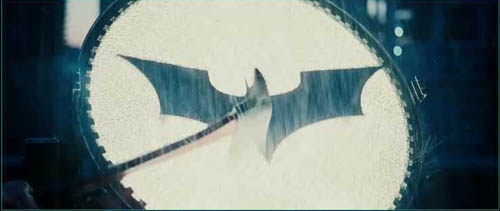
Posted in Comic strips and cartoons, Directors: Nolan, Film comments, Film criticism, Film genres, Film history, Film industry, Film technique, Film technique: Performance, Film theory, Global film industry, Hollywood: Artistic traditions, Hollywood: The business, Readers' Favorite Entries, Special effects and CGI | open printable version
| No Comments »
|