by Kristin Thompson. Berkeley: University of California
Press, 2007.
400 pages, 6 × 9 inches, 12 color illustrations;
36 b/w illustrations.
[go
to Amazon | go to The Frodo Franchise blog]
Today, I offer more on cognitive film studies, the activities of the Society for Cognitive Studies of the Moving Image, and why both matter. For background, visit the previous post and here and here. Throughout, I’ll harken back to the issue of convergent audience responses: How can viewers from different cultures grasp certain appeals that films provide?
This research tradition seeks to answer questions about moving-image media, especially questions of an artistic nature. The researchers examine filmmaking with the assistance of findings and theoretical frameworks that have emerged in the cognitive sciences of psychology, anthropology, and other disciplines. Some specifics:
Cognitive film studies emphasizes explanations over interpretations. Explanations can be causal (what made this happen) or functional (pointing out the purposes that something fulfills). When human action is part of what we’re studying, the explanations tend to involve goals and motives, means and ends. By contrast, a lot of humanistic media study emphasizes interpreting films but leaves causal and functional processes unexamined.
This research tradition is mentalistic. In explaining viewers’ responses, it looks first to features of the human mind. This doesn’t mean that researchers study minds cut off from society; rather, the emphasis is on the mental activities tied to all sorts of experience, including social action and interaction.
This tradition is naturalistic. The explanations it mounts try to fit in with current understanding of human capacities as analyzed by the social sciences. That entails that psychoanalysis, another mentalistic theory of human action, has not on the whole proven a source of reliable explanations. Some cognitively inclined researchers would add that psychoanalytic inquiry has been fruitful for pointing to areas of behavior that answer to naturalistic investigation.
The line of argument, accordingly, is that of rational inquiry, induction and deduction. It stands in contrast to much current film theory, which consists of more or less free association and the rote citation of major thinkers. Cognitive film theory tries to formulate clear-cut questions and to seek answers that have empirical grounding and conceptual coherence.
The tradition has a strong tendency to look for cross-cultural regularities among artworks and viewer experiences. The sources of these regularities need not be innate in any strong sense. Critics sometimes claim that cognitivists believe that everything is “hard-wired,” but virtually no cognitivists say or believe that. For one thing, our “wiring” changes at certain critical periods, especially two months, nine months, and four years of age. Moreover, the regularities in behavior we notice occurring across cultures or social milieus may have come into existence for many contingent reasons. That doesn’t make them any less interesting as explanatory factors.
For example, no culture is without fibers to bind things, but we shouldn’t expect to find a “string” gene or neuron. In this case, and many others, humans equipped with some common faculties and faced with common demands have found common solutions. We can study shared strategic behaviors without committing ourselves to biological determinism.
People who believe in the cultural construction of nearly everything appeal to learning as the means by which cultural processes shape individual action. Yet cultural constructivists have on the whole been unable to specify how learning is possible. Since an utterly vacant mind could never actively pursue or acquire or organize knowledge, we’re obliged to consider that some innate propensities are in place before humans make contact with the manifold of experience. No one needs to teach a newborn to pick out moving objects or synchronize lip movements with sound patterns.
Moreover, if you rest your case on the metaphor of construction, you need to specify the materials out of which action is built. Up to a point you can say that there are cultural constructions out of other constructions and so on. But the system has to get started somewhere. You have to be able to see color before you can learn that stoplights and stop signs are red. Ingrained capacities and tendencies are the best candidates for being the stuff out of which various cultural conventions are constructed.
Most cognitivists hold to the post-Chomskyan view of learning as the unfolding and refinement of innate predispositions and mental structures. In order to learn something, you need to know something else. In fact, a lot else. It now seems overwhelmingly evident that humans come into the world with many predispositions, some broad and vague, some quite concrete. Some of these are primed in the womb, as with a newborn’s preference for mother’s smell. Other predispositions require only a few confirming encounters to be locked in. A baby is sensitive to a certain range of phonological and prosodic patterns, and so she is ready to fasten on those characteristic of a specific language. Babies seem as well to have an intuitive physics; they are surprised when objects disappear or turn into something else. Babies also are sensitive to eye contact and smiling, both crucial to social interaction and reading others’ intentions.
In sum, the most plausible learning model is that of predispositions, often sometimes quite narrowly constrained, that are confirmed and fine-tuned by the environment (often within a critical period of exposure). We need active engagement with the environment, both physical and social, to let our intrinsic capacities develop to their full strength. Nature via nurture, as Matt Ridley likes to say.
One implication for film is that humans would be likely to recognize film images without extensive training or even a lot of exposure. (Sermin Ildirar found this in the village study mentioned in my previous post). Some understanding of the actions and emotions we see onscreen may have quite specific neural sources, with “mirror neurons” as currently good candidates for grounding recognition and empathy. Other patterns of storytelling and style could be quickly learned, as they piggyback on our understanding of real-world knowledge of social interactions.
Having a battery of predispositions would make sense in evolutionary terms. We gain survival advantage by coming into the world ready to have our biases fine-tuned by experience. Increasingly, for some researchers, the puzzles of cinematic convergence and divergence find their ultimate explanations in human biological and cultural evolution.
Booked
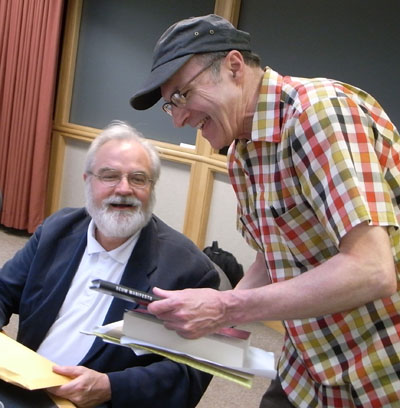
Noël Carroll and JJ Murphy, SCSMI convention June 2008.
I try never to take the present moment as a culmination or turning point in anything. Yet I can’t help noticing that the tenets of cognitive film studies chime in with three wider trends in our current intellectual life.
First, there is a burst of interest in the psychology of informal reasoning. A host of books talks about the shortcuts, heuristics, and predictable errors we make in everyday actions. Examples would be Carol Tavris and Elliot Aronson’s Mistakes Were Made, Ori and Rom Brafman’s Sway, Gary Marcus’s Kluge, Jonah Lehrer’s How We Decide, Joseph T. Hallinan’s Why We Make Mistakes, and Dan Zariely’s Predictably Irrational. The flourishing area of behavioral economics, typified by Akerlof and Shiller’s Animal Spirits, is an outgrowth of this line of inquiry. Most of these books explore the cognitive biases that were brought to light by psychologists some time ago, but now emotion is seen as playing a central role.
A second thread in the cultural conversation involves neurology. Now that brain scanning has yielded more precise ways of tracking mental activity, our common-sense actions are seen to have surprising and tangled roots. Many of the books just mentioned draw upon neuroscience to identify the sources of cognitive biases. A rich survey of the neurological territory as currently mapped can be found in Human: The Science Behind What Makes Us Unique, by Michael Gazzaniga.
Then there’s the hottest topic of all, a renewed interest in evolutionary biology. A host of books is rolling out explaining and debating Darwinism. (By the way, Charles, happy centenary.) A good recent example is Jerry Coyne’s Why Evolution Is True. But the interest in evolution has given a new salience to evolutionary psychology, that area of inquiry that investigates how our minds have been shaped and constrained by adaptation and other evolutionary processes.
Evolutionary psychology came to prominence in the social sciences with the 1992 breakthrough book The Adapted Mind: Evolutionary Psychology and the Generation of Culture. There Jerome H. Barkow, Leda Cosmides, and John Tooby flung down a challenge to traditional social science. Most researchers assumed that the mind was plastic and variable to a very large extent, both between cultures and within an individual’s lifetime. Culture held an irresistible sway over mental life. The essays collected in The Adapted Mind, particularly Tooby and Cosmides’ introductory manifesto, suggested that psychologists needed to consider evolution as a powerful source of explanations for mental activity. Steven Pinker’s The Blank Slate (2002) brought this line of thinking to a much broader public.
Although many humanists are proud of owing nothing to science, it’s curious that they often share traditional social sciences’ belief in a more or less blank slate. Virtually everything is culturally constructed; any biological givens are written off as nonexistent, unimportant, or uninteresting. But some humanistic scholars are starting to show that such factors possess both interest and explanatory value.
Studies linking art and literature to biological and cultural evolution are enjoying great prominence this year. Denis Dutton’s The Art Instinct and Brian Boyd’s On the Origins of Stories have sparked a wide discussion of how the play instinct, mate selection, and other adaptations might shed light on narrative, music, and the visual arts.
Now, when cognitive and evolutionary models are the latest thing in literary studies, to be applauded or denounced by the MLA rank and file, it’s worth remembering that film studies has been plowing this field for quite some time. Some people would say that my Narration in the Fiction Film (1985) opened up this wing of film studies, but although that book drew on current developments in cognitive psychology, it didn’t outline a broad research program.
More far-reaching was Noël Carroll’s “The Power of Movies,” also published in 1985. Carroll’s seminal essay laid out a concise explanation of cultural convergence through cinema, or as he put it, how “movies have engaged the widespread, intense response of untutored audiences throughout the century.” Carroll’s critique of then-current film theory, Mystifying Movies (1985 again), developed the essay’s idea as a counterweight to psychoanalytic and neo-Marxist explanations for the power of popular cinema. The importance of attention, the role of visual techniques in shaping uptake, and the possibility of evolutionary sources for cinema’s appeals—these and other themes of today’s cognitive film research can be found in Carroll’s work of twenty-five years ago. I suppose that “The Power of Movies” is the cognitivist’s equivalent to Mulvey’s “Visual Pleasure and Narrative Cinema.”
A turning point?
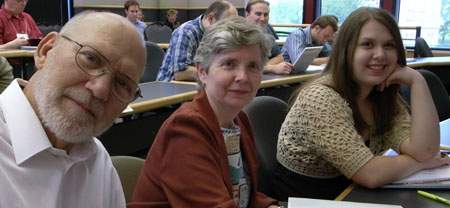
Joe, Barb, and Amy Anderson; SCSMI convention, June 2008.
Grand Theory in the humanities has prided itself on being cutting edge, yet it has ignored virtually all of the major developments in the human sciences, from Chomskyan linguistics through cognitive science and now evolutionary and neurological research. That ignoral can seem almost wilful. The 1990s saw a flourishing of cognitive film theory, such as Ed Tan’s study of emotion in cinema and Murray Smith’s study of characterization. Yet in 2006, when I was invited to London to give a paper surveying the perspective, I seemed to be speaking Martian. Two of the most distinguished senior film scholars in the UK said they couldn’t really comment adequately. The approach was all so new and unfamiliar!
If I had been haughty enough to offer two veterans of Screen some reading tips, I could have referred them to two compelling overviews. Paul Messaris’s Visual Literacy: Image, Mind, and Reality (1994) synthesized psychological and anthropological research on how people responded to media and concluded that there wasn’t yet any evidence that images and their normal combination were radically coded. Joseph Anderson’s Reality of Illusion (1998) showed how key questions of cinematic perception and comprehension have been addressed by empirical research in the social sciences. Joe and his wife Barbara were also pioneers in bringing evolutionary explanations to bear on cinematic problems, thanks to James J. Gibson’s “ecological” frame of reference.
In just the last year, three of the people deeply involved with SCSMI have published books that push the conversation in fresh directions. Assume that widely distributed propensities, either innate or converging through cross-cultural regularities, get fine-tuned by the specifics of cultural experience. How do these convergences and divergences emerge in films?
The most wide-ranging book comes from Torben Grodal. His first book, Moving Pictures (1999), was part of the last decade’s surge of cognitivist work. In Embodied Visions: Evolution, Emotion, Culture, and Film (Oxford), Grodal continues to explain our experience of film with the help of what we know about how brain areas are activated. At the center is the process that Torben calls PECMA (for Perception-Emotion- Cognition-Motor-Action). In this model, activation begins in brain areas dedicated to perception and flows on to associational and emotional centers, and then to areas providing cognitive appraisal. Here Grodal agrees with current thinking on the central role of emotion in processing information. Along with this “inner” account of cinematic response, Torben proposes an evolutionary account of enduring cinematic attractions. Romantic love, horror, and adventurous exploration all have evolutionary rationales.
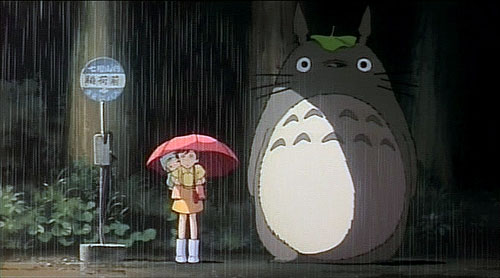
On both fronts, the book tries to balance the convergence/ divergence tendencies. Take My Neighbor Totoro.
The film is clearly influenced by its Japanese origin, from the use of Shinto gods to the rice fields and sliding doors. But the fact that children all over the world are fascinated by the film is only loosely related to those cultural specificities. . . . Miyazaki uses a series of devices that tap into innate and universal mental mechanisms and emotions. Central, of course, is the fascination with the soft, organic counterintuitive agent Totoro, who provides attachment security and empowerment for the little girl, Mei, in the absence of the parents.
Torben goes on to discuss how Miyazaki exploits our interest in “counterintuitive” phenomena, like ghosts and gods, in the figure of a cat who is also a bus.
While Embodied Visions offers a very broad theoretical framework, Carl Plantinga’s Moving Viewers: American Film and the Spectator’s Experience (University of California Press) focuses on Hollywood cinema and how it arouses emotions. Plantinga, who also contributed to the 1990s discussions, surveys the literature on emotion and explores varieties of emotions in film viewing. He makes fruitful distinctions between “long-range” emotions, like suspense, and those brief and intense feelings, like surprise and disgust.
Perhaps more interesting, Carl suggests that while sympathetic narratives evoke compassion and pity, distanced narratives evoke cooler feelings, like respect or disdain. This distinction allows him to deny that the common claim that the aesthetic distance we find in Antonioni or Angelopoulos is unemotional; these artists simply deal in different emotions. The distinction also enables him to puncture the belief that Hollywood offers only sentimental hogwash.
It might be thought that sympathetic narratives are the norm in Hollywood. Yet distanced narrative is pervasive in Hollywood, as it is in the “art” cinema. The distanced mode rejects the evocation of strong sympathy for characters—sympathies that are sometimes dismissed as sentimentality—in favor of a more distanced, critical, sometimes humorous, and occasionally cynical perspective.
Plantinga’s examples are action films like The Hunt for Red October, which evokes admiration for gallant stoicism, ironic comedies like Raising Arizona, and puzzle films like House of Games and The Usual Suspects.
One of Carl’s key points is that sympathetic narratives must evoke some negative emotions, when their characters are hit by misfortune. So melodrama is the sympathetic narrative par excellence. Moving Viewers closes with a sensitive discussion of how a film can orchestrate negative emotions in complicated ways, focusing on disgust as it is evoked in films as different as Mask and Polyester.
A comparable concern for how culture can fine-tune cross-cultural tendencies is set forth by Patrick Colm Hogan in Understanding Indian Movies: Culture, Cognition, and Cinematic Imagination (University of Texas). Hogan is an expert on Indian literature and aesthetics; I called him in to help me understand Slumdog Millionaire in an earlier entry. Hogan is also a major narrative theorist. His The Mind and Its Stories is a powerful study of cross-cultural narrative structures and their relation to prototypical emotions.
Understanding Indian Movies shows how those universal plot structures gain richness and emotional force through their encounter with Indian traditions and current social conditions. For example, the sacrificial plot found in all cultures is particularized in Santosh Sivan’s The Terrorist. The film transforms the standard plot for the sake of ideological point and emotional force, modeling its suicide-bomber tale on the assassination of Rajiv Gandhi. “The contemporary history depicted by the film was already emplotted in a prototypical narrative form by the people who made that history.”
Hogan’s book is not as localized in its concerns as the title might imply. It’s not only about how to watch Indian movies but also about how to do cognitive studies of media. For instance, Patrick often pauses to criticize over-simplified evolutionary explanations, and he urges that such explanations be used cautiously. But he nonetheless defends the overall convergence/ divergence perspective.
On the one hand there is particularity—not merely the particularity of national cultures, but the particularity of regions, religions, castes, classes, philosophies, ages, and so forth, all the way down to individuals. On the other hand, there is the common genetic heritage of the human brain, the common principles of childhood development (beyond genetics), the recurring practices that arise from group dynamics—a whole series of universal principles that we all share. . . . Whether we are European, Chinese, African, or Indian, Christian, Jewish, Hindu, or Muslim, it is these universals that make it possible for us to understand Indian movies and to appreciate them, rather than merely drawing abstract inferences about them, as if they were part of some inscrutable puzzle.
The differences among these books are considerable. Grodal wants explanations at the level of neurology. Plantinga, of a philosophical temper, wants to clarify the concepts we use to talk about emotions in our experience of films. Hogan is constantly looking for the political implications of artistic choices. But such a range of emphasis matches the variety of the papers assembled for our next meeting.
The Society for Cognitive Studies of the Moving Image meets next week in Copenhagen. Patrick Hogan, alas, will not be joining us. But Torben Grodal is speaking on “Crime Fiction from a Biocultural Pespective,” and Carl Plantinga is giving a talk called “Models of Real and Hypothetical Spectators.” Once more, a complete list of papers can be downloaded here.
In sum, evidence is mounting that the SCSMI is now the gathering point for a very robust, accessible, and exhilarating approach to thinking about how films work and work upon us—all of us.
Noël Carroll’s essay “The Power of Movies” can be found in his Theorizing the Moving Image (Cambridge: Cambridge University Press, 1996), 78-93. He revisited these ideas in the 1996 essay “Film, Attention, and Communication: A Naturalistic Perspective,” available in Engaging the Moving Image (New Haven: Yale University Press, 2003), 10-58. Some SCSMI members will be represented in the forthcoming Evolutionary Approaches to Literature and Film: A Reader in Science and Art (Columbia University Press), edited by Brian Boyd, Joseph Carroll, and Jon Gottschall. Evolutionary Psychology, by Robin Dunbar, Louise Barrett, and John Lycett provides an excellent survey of several of the ideas I gestured toward today.
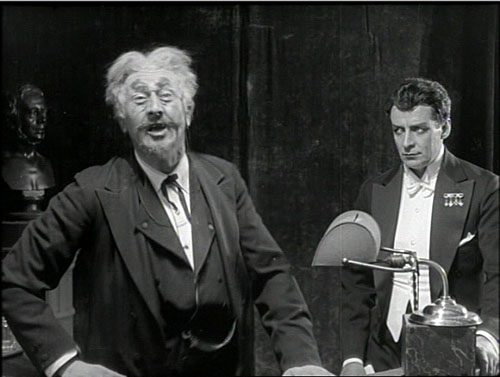
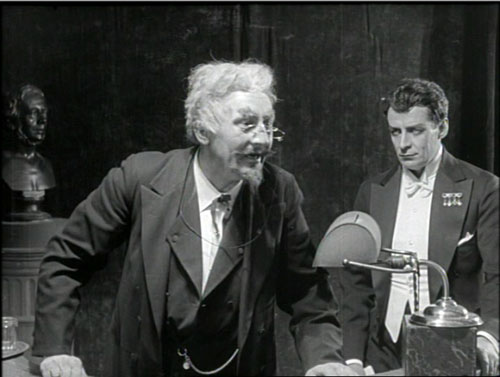
Himmelskibet (The Space Ship, aka A Trip to Mars, 1918).
What gives movies the power to arouse emotions in audiences? How is it that films can convey abstract meanings, or trigger visceral responses? How is it that viewers can follow even fairly complex stories on the screen?
General questions like this fall into the domain of film theory. It’s an area of inquiry that divides people. Some filmmakers consider it beside the point, or simply an intellectual game, or a destructive urge to dissect what is best left mysterious. Many readers consider it academic bluffing, another proof of Shaw’s aphorism that all professions are conspiracies against the laity.
These complaints aren’t quite fair. Early film theorists like Hugo Münsterberg, Rudolf Arnheim, André Bazin, and Lev Kuleshov wrote clearly and often gracefully. Even Sergei Eisenstein, probably the most obscure of the major pre-1960 theorists, can be read with comparative ease. Moreover, generations of filmmakers have been influenced by these theorists; indeed, some of these writers, like Kuleshov and Eisenstein, were filmmakers themselves.
But those day are gone, someone may say. Does contemporary film theory, bred in the hothouse of universities and fertilized by High Theory in the humanities, have any relevance to filmmakers and ordinary viewers? I think that at least one theoretical trend does, if readers are willing to follow an argument pitched beyond comments on this or that movie.
That is, film theory isn’t film criticism. Its major aim is more general and systematic. A theoretical book or essay tries to answer a question about the nature, functions, and uses of cinema—perhaps not all cinema, but at least a large stretch of it, say documentary or mainstream fiction or animation or a national film output. Particular films come into the argument as examples or bodies of evidence for more general points.
The sort of theorizing we’ll do, for all its variety, is in my view the most exciting and promising on the horizon just now. It’s also understandable by anyone interested in puzzles of cinematic expression, and it has powerful implications for creative media practice.
We’ll also be in Copenhagen for Midsummer Night, which is always pleasant. Go here for the lovely song that thousands of Danes will try to sing, despite terminal drunkenness. No real witches burned, however.
Concordance and convergence
But back to topic: Puzzles of cinematic expression, I said. What puzzles? Well, films are understood. Remarkably often, they achieve effects that their creators aimed for. Michael Moore gets his message across; Judd Apatow makes us laugh; a Hitchcock thriller keeps us in suspense. What enables movies to reliably achieve such regularity of response?
It’s not enough to say: Moore hammers home his points, Apatow creates funny situations, Hitchcock puts the woman in danger. Any useful explanation subsumes a single case to a more general law or tendency. So a worthwhile explanation for these cinematic experiences would appeal to more basic features of artworks, cultural activities, or our minds. We can pick up on Moore’s message because we know how to make inferences within certain contexts. We can laugh at a joke because we understand the tacit rules of humor. We recognize a suspenseful situation because… well, there are several suggestions.
This sort of question is largely overlooked by theorists of Cultural Studies, another area of contemporary media studies. They typically emphasize difference and divergence, highlighting the varying, even conflicting ways that audiences or critics interpret a film.
Studying how viewers appropriate a film differently is an important enterprise, but so is studying convergence. Arguably, studying convergence has priority, since the splits and variations often emerge against a background of common reactions. A libertarian can interpret Die Hard as a paean to individual initiative, while a neo-Marxist can interpret it as a skirmish in the class war, but both agree that John and Holly love each other, that her coworker is a weasel, and that in the end John McClane’s defeat of Hans Gruber counts as worthwhile. Both viewers may feel a surge of satisfaction when McClane, told by a terrorist he should have shot sooner, blasts the man and adds, “Thanks for the advice.” What enables two ideologically opposed viewers to agree on so much?
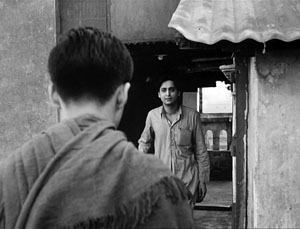
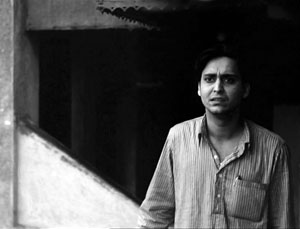
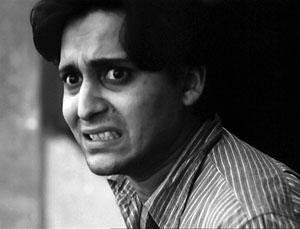
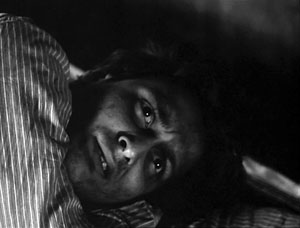
Films aren’t just understood in common; they arouse remarkably similar emotions across cultures. This is a truism, but it’s been too often sidestepped by post-1960 film theory. Who, watching The World of Apu, doesn’t feel sympathy and pity for the hero when he learns of the sudden death of his beloved wife? Perhaps we even register a measure of his despair in the face of this brutal turn of events.
We can follow a suite of emotions flitting across Apu’s face. I doubt that words are adequate to capture them.
Are these facial expressions signs that we read, like the instructions printed on a prescription bottle? Surely something deeper is involved in responding to them—for want of a better word, fellow-feeling. Indians’ marriage customs and attitudes toward death may be quite different from those of viewers in other countries, but that fact doesn’t suppress a burst of spontaneous sympathy toward the film’s hero. We are different, but we also share a lot.
The puzzle of convergence was put on the agenda quite explicitly by theorists of semiotics. Back in the 1960s, they argued that film consisted of more or less arbitrary signs and codes. Christian Metz, the most prominent semiotician, was partly concerned with how codes are “read” in concert by many viewers. Today, I suppose, most proponents of Cultural Studies subscribe to some version of the codes idea, but now the concept is used to emphasize incompatibilities. So many codes are in play, each one inflected by aspects of identity (gender, race, class, ethnicity, etc.), that commonality of response is rare or not worth examining.
A complete theoretical account, if we ever have one, would presumably have to reckon with both differences and regularities. The dynamic of convergence and divergence is a central part of one arena of film studies that has, for better or worse, been called cognitivism.
Sampling
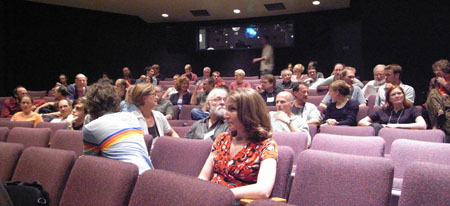
Gathering for Uri Hasson‘s keynote lecture, SCSMI 2008.
The cognitive approach to media remains a pretty broad one, and the Society for Cognitive Studies of the Moving Image hosts a plurality of approaches at its annual meetings. SCSMI has become home to media aesthetes, empirical researchers, and philosophers in the analytic tradition who are interested in interrogating the concepts used by the other two groups. Last year’s gathering, at our campus here in Madison, created a lively dialogue among these interests.
For instance, some of us Film Studies geeks wonder why people so consistently ignore mismatched cuts. Dan Levin’s ingenious experiments on “change blindness” provide a hilarious rejoinder. In one study conducted with Dan Simons, a stooge asks directions of an innocent passerby. As they’re talking, a pair of bravos carry a plank between them, and another confederate is substituted for the first one.
You guessed it. Most subjects don’t notice that the person they’re talking to has changed into somebody else! So how can we worry about mismatched details in cuts? Actually, Dan’s research isn’t just deflationary. It helps spell out particular conditions under which change blindness can occur.
Another stimulating talk was offered by Jason Mittell. He asked how long-running prime-time TV serials can solve the problem of memory. In this week’s episode what strategies are available to recall the most relevant action of earlier episodes? How can previous action be presented without boring faithful fans? Jason, who has a new book on American TV and culture out this spring, went beyond describing the strategies. He suggested how they can become a new source of formal innovation, as in the Death of the Week in Six Feet Under.
Sermin Ildirar of Istanbul University presented the results of a study on adults living in a village in South Turkey. These viewers were older, ca. 50-75, and—here’s the interesting part—had never seen films or TV shows. To what extent would they understand “film grammar,” the conventions of continuity editing and point-of-view, that people with greater media experience grasp intuitively? To facilitate comprehension, the researchers made film clips featuring familiar surroundings.
The results were intriguingly mixed. Some techniques, such as shots that overlapped space, were understood as presenting coherent locales. But most viewers didn’t grasp shot/ reverse-shot combinations as a social exchange. They simply saw the person in each shot as an isolated figure.
The discussion, as you may expect, was lively, concerning the extent to which a story situation had been present, the need to cue a conversation, and the like. I found it a sharp, provocative piece of research. Stephan Schwan, who worked with Sermin and Markus Huff, has become a central figure studying how the basic conventions of cutting and framing might be built up on the basis of real-world knowledge, and both he and Sermin are back at SCSMI this year.
Stephan Schwan, Thomas Schick, Markus Huff, and Sermin Ildirar, with Johannes Riis in the background; SCSMI 2008.
There were plenty of other stimulating papers: Tim Smith’s usual enlightening work on points of attention within the frame, Johannes Riis on agency and characterization, Paisley Livingston on what can count as fictional in a film, Patrick Keating on implications for emotion of alternative theories of screenplay structure, Margarethe Bruun Vaage on fiction and empathy, and on and on.
One of the best things about this gathering was that the ideas were sharply defined and presented in vivid, concrete prose. I can’t imagine that ordinary film fans wouldn’t have found something to enjoy, and of course many of these matters lie at the heart of what filmmakers are trying to achieve. Indeed, some filmmakers regularly give papers at our conventions. The much-sought link between theory and practice is being made, again and again, in the arena of the SCSMI.
Last year I came to believe that this research program was hitting its stride. My hunch is confirmed by this year’s gathering in Copenhagen. The department of media studies there has long been a leader in this realm. You can download a Word version of the schedule here.
Lest you think that the conference participants don’t talk much about particular movies, I should add that there’s one film we’ll definitely be talking about this time around. Our Copenhagen hosts have arranged for a screening of von Trier’s Antichrist.
Next time: Going deeper into cognitivism, and three recent explorations.
Malcolm Turvey makes a point to Trevor Ponech and Richard Allen, SCSMI 2008.
Kristin and I have talked about pictorial universals elsewhere on this site. See her blog entry on eyeline matching in ancient Egyptian art, and my comments on “representational relativism” here.
Images at the top of this entry are taken from the Danish film Himmelskibet (The Space Ship, aka A Trip to Mars, 1918).
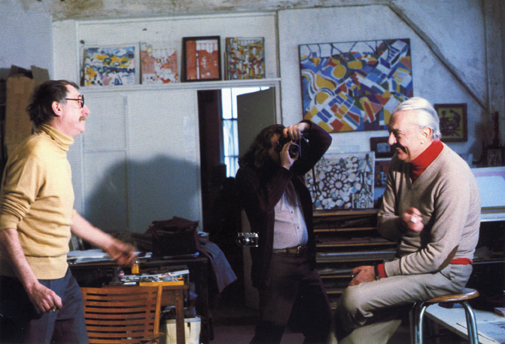
Jacques Lagrange and Jacques Tati, with artworks by the former in the background
Kristin here–
David and I have occasionally mentioned the listserve of students and faculty, past and present, of the film studies area here at the University of Wisconsin-Madison. Apart from job listings and inquiries for information about obscure films, the listserve offers a chance to discuss information and ideas-some of which have inspired blog entries for us.
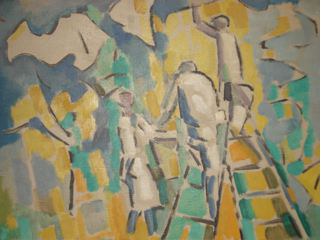
Back in March, dissertator Charles Michael informed us that he had inherited a 1953 French painting by Jacques Lagrange (Les jardiniers, below). Seeking more information, he discovered that Lagrange had been a close friend and collaborator of Jacques Tati, working on all his films from Les Vacances de Monsieur Hulot onward. Naturally, as big Tati fans (the first essay I ever wrote for publication was on Les Vacances), we were intrigued.
Lagrange’s work with Tati
Lagrange (1917-1995) is best known as a painter and designer of tapestries, though he did a few theatrical sets. (The fullest online biographical sketch, in tortuous English, is available here.) He met Tati in 1947. The two hit it off, and they would spend afternoons or evenings bouncing ideas off each other. The film credits read “Avec la collaboration artistique de Jacques Lagrange,” a general phrase that reflects how the artist contributed at several stages of filmmaking. He worked on all the scripts as well as sketching settings and gags. He described their working method: “With Tati, the script usually started from a general idea. His second film grew out of the idea of a vacation, with the railway station, suitcases, trunks, trains. MON ONCLE is a more ‘social’ film. At Pecq, Alexandre Dumas’ villa has been carefully preserved, but in Saint-Germain, everything has been demolished. Like me, Tati favored the preservation of our heritage, as well as alluring modern buildings . . . . In writing a script, he started with sketches, not fully worked-out designs. Tati had trouble explaining what he wanted, so I had to interpret. I did thousands of sketches on restaurant napkins.”
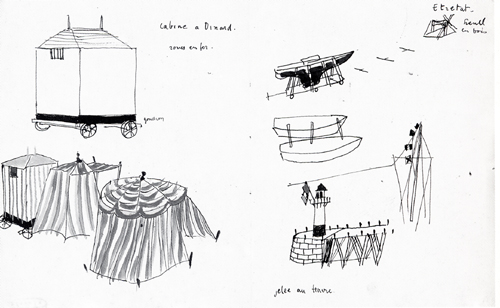
Here’s his drawing of the bathing cabines that lead to M. Hulot being mistaken for a peeping tom, as well as the boat being painted that slides into the sea. Whether it was made on a napkin, I don’t know, but I doubt it:
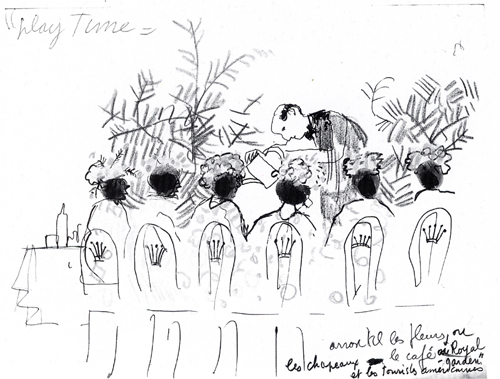
And the gag of the waiter “watering” the ladies’ hats in Play Time. At this early stage the idea was evidently that the waiter would use a watering can for the plants in the background. In the final gag, he appears to pour champagne onto the flowery hats (a funny framing that David illustrated here):
This sketch, by the way, provides pretty strong evidence supporting my claim that Tati intended the film’s title to be written as two separate words.
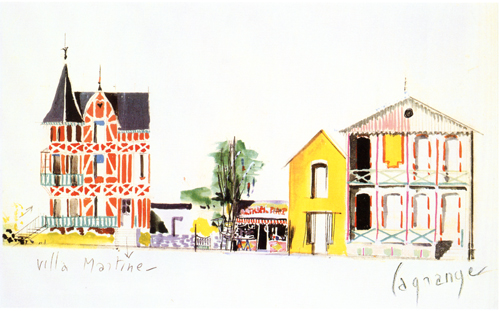
Lagrange went beyond such rough gag sketches. He also worked on the sets of Tati’s films, as this elegant painting for the “Hôtel de la Plage” and the guest-house where Martine stays in Les Vacances:
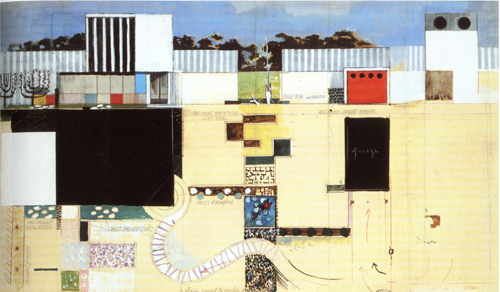
He designed the famous modern house in Mon oncle, including this combination bird’s-eye and profile view of the entire yard:
Tracking down Lagrange
Obviously Lagrange was a crucial collaborator of Tati’s, and yet he seems to be virtually unknown in the U.S. He has received more attention in Europe. In 2005, a slim coffee-table volume, Jacques Lagrange: Les couleurs de la vie: Peinture et tapisserie, by Robert Guinot, was published. It does not reproduce any of Lagrange’s work for Tati, but a four-page chronology (pp. 77-80) gives the best summary of Lagrange’s friendship and work with Tati that I have found.
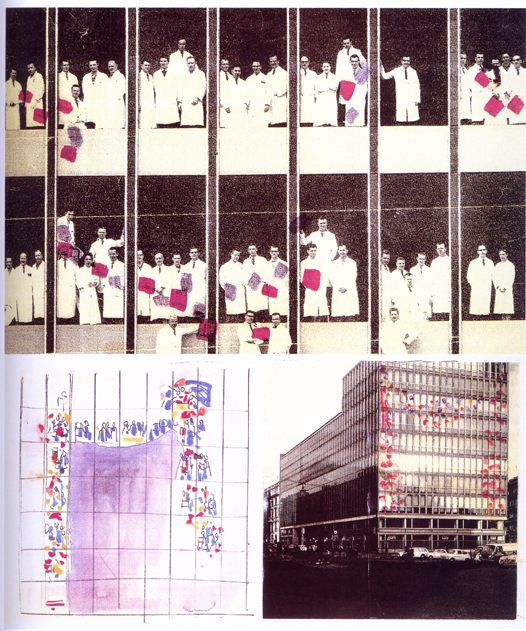
French books on Tati make reference to Lagrange. François Ede and Stephane Goudet’s book, Play Time (Cahiers du cinéma, 2002), quotes him on the construction of the film’s sets (p. 42) and includes some sketches for gags: the crown-topped chairs that leave impressions on the clothes and backs of those who sit in them (p. 57) and the scene of waiters carrying a placard shaped like a chef past diners who seem to be reminded of a corpse (p. 128). There’s also quite an intriguing graphic experiment with an unused gag for the film. Apparently somehow colored objects (folders?) held by people inside one of the glass-sided buildings would have formed a shape as seen from outside:
Marc Dondey’s Tati (Ramsey, 2002) reproduces some drawings for Les Vacances, including the beach scenes above, on pages 90-91, as well as the hat-watering sketch and the quotation above. (A book published in April under the same name, by the same author, but with a different cover is presumably a re-edition of this sumptuous volume; the number of pages is identical.)
Within the past several years there have been a few exhibitions devoted to Tati. One, La ville en Tatirama/La Città di Monsieur Hulot, was held at the University of Bologna. Devoted to three of Tati’s films, Les Vacances, Mon oncle, and Play Time, it produced a marvelous catalogue of the same name (Mazzotta, 2003) with a series of essays in French and Italian. This catalogue includes what may be the largest number of Lagrange’s Tati designs yet published, juxtaposing each with a selection of production photos from the relevant scene. The color painting of the Les Vacances buildings and the plan of the Mon oncle set are from this volume. Unfortunately the catalogue is now out of print and hard to find.
I say “perhaps” because I haven’t had a chance to see the catalogue for the Cinémathèque française’s current major exhibition, “Jacques Tati: Deux temps, trois mouvements,” running in Paris until August 8. David and I may get a chance to see it during our upcoming European travels. If so, we’ll report back. One Lagrange painting is visible in the photos on the Cinémathèque’s website, and no doubt there are other items by him as well.
(Books and exhibitions that include Lagrange’s work all credit the collection of Hyacinthe Moreau-Lalande, about whom I have been unable to find any information.)
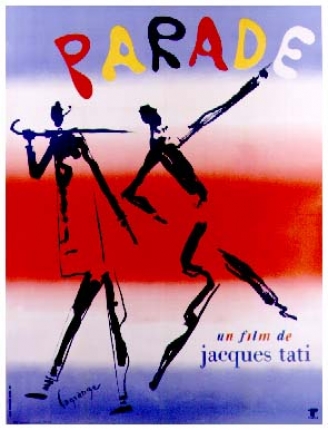
Despite the length of Lagrange’s collaboration with Tati, he designed a poster for only one of the films, the last one Tati completed:
A word on Pierre Étaix
As I was looking around at Amazon France for Lagrange material, I ran across a beautiful, fairly recent art book on the work of another Tati collaborator, Pierre Étaix. The book is Étaix dessine Tati(ACR Édition, 2007), by Francis Ramirez and Christian Rolot.
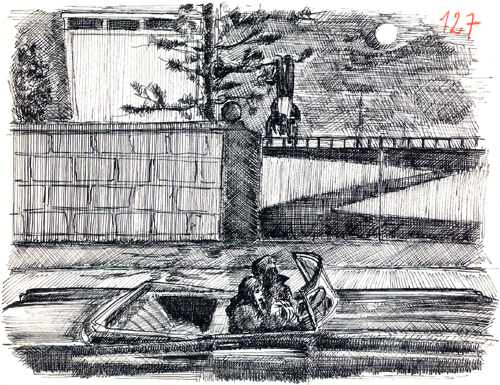
Étaix’s relationship with Tati’s differed considerably from Lagrange’s. It lasted only from 1954 to 1958, the period of the production of Mon oncle. An aspiring actor and filmmaker, Étaix was credited as an assistant director, though he also worked as a gagman. He produced thousands of drawings, collages, and paintings. Some, like those of Lagrange, were ideas for gags. This one involved Hulot getting himself into a fix where he is hanging upside down in a tree as two young lovers in a car pull up and stop underneath:
The gag ended up not being used, though Tati fans will recognize it as having appeared considerably later in Traffic. It’s amusing here to see it being played out by the gate of the Arpel household.
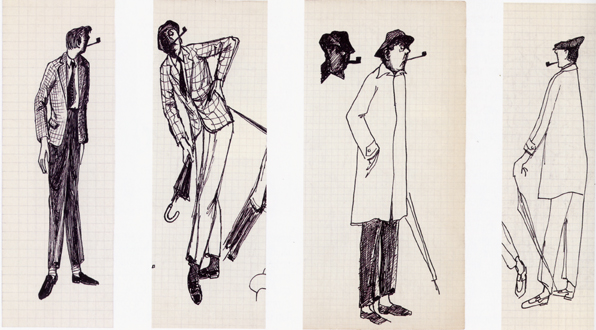
A fascinating set of drawings resulted from an assignment that Tati handed Étaix: to sketch visualizations of Hulot. Of course, M. Hulot had appeared in Les Vacances already, but only in his vacation clothing. His familiar short trenchcoat, umbrella, skull-fitting hat, and suede shoes hadn’t figured in that film. Only the pipe was already iconic of the character. Today it seems odd that there was some consideration of making Hulot distinctly more fashionable than he ended up being:
Tati’s influence is quite evident in the short films and the features that Étaix directed and starred in during the 1960s. He had some success with these, including an Oscar for his 1962 short, Happy Anniversary. He has continued to work as an actor, mostly in small roles (including in his friend Jerry Lewis’ still unreleased The Day the Clown Cried). Unfortunately legal problems have kept his 1960s films entirely out of circulation, as is explained on his official website.
David and I saw a couple of them in the early 1970s. I recall them as being charming comedies, definitely worth seeing. As of now, though, Étaix’s main presence on the screen is as one of Michel’s silent, sinister accomplices in Bresson’s Pickpocket.
The work of both Lagrange and Étaix reveals a great deal about Tati’s artistic methods. Perhaps the new burst of publishing that continues in the wake of the centenary of his birth (1907) will bring more such revelations.
Thanks to various Filmies: Charlie Michael, Colin Burnett, Tim Youngs, and Ben Brewster.
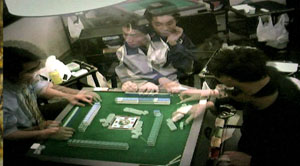
Snow blankets a terrace and the furniture on it. A bottle jerks back and forth on a pavement. Christmas lights blink on and off. Everything looks desolate. What people we see scuttle across washed-out landscapes, play mahjongg in stammering gestures, and toil in computer labs under glaring fluorescent lights. What planet are we on?
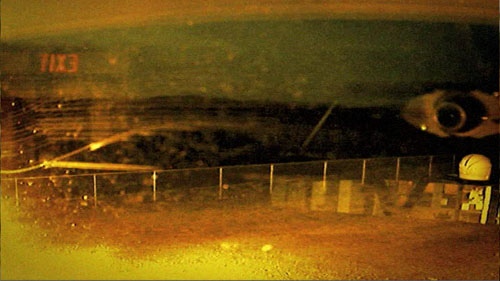
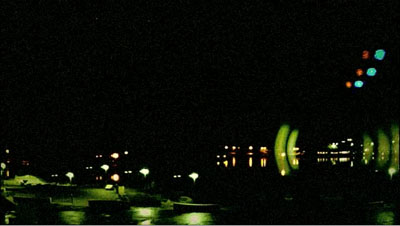
These images are available to any of us. For two years Dariusz Kowalski trawled through sites like www.opentopia.com for surveillance-camera footage. He chose only material from hidden cameras. He added nothing except some slow motion (“otherwise it would be too fast”) and a voice-over commentary from artist Stephen Mathewson reading passages from a year’s diary. The result was a fifty-five minute assemblage film called Optical Vacuum (2008), which I saw and admired in Hong Kong back in April.
Sometimes the diary account intersects with what we see: Mathewson talks of washing his laundry/ shots of a Laundromat. More often, the voice drifts off on its own. Optical Vacuum isn’t an effort to make a film essay or to create a complex audiovisual dynamic. Mathewson’s diary provides an intimacy that the footage lacks, but I think the film would stand up strongly without it.
As a flow of impersonal views, usually from a distant perch, the footage creates a bleak beauty.
Occasionally a human operator has commanded the camera to focus on something, usually a woman.
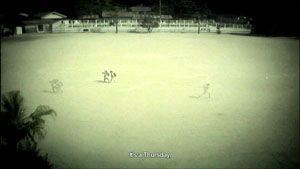
But most often the camera is just mindlessly recording.
In the process, the surveillance camera reinvents avant-garde film—not just the barely inflected fields of Structural cinema, but also the time compression and melting glimpses, the reflections and superimpositions, the transient ghosts and brutal geometry we find in silent experimental work by Richter, Vertov, and others. These stupid cameras can’t help turning reality into something else. They don’t know any better.
Optical Vacuum, along with other pieces by Kowalski, can be found on a PAL uncoded DVD from the extraordinary Austrian collective sixpack. The handsomely mounted Index release is available here, and elsewhere on the Net.
Dragons and tigers in the Udine sun
Italian festivals of specialized cinema are mounted with incomparable flair–lots of screenings, panels, interviews, book sales, and of course outstanding food. Most famous are Pordenone’s festival of silent cinema and Bologna’s Cinema Ritrovato. But for admirers of Asian cinema, just as important is the Udine Far East Film event, which completed its eleventh installment on 2 May.
Alas, I’ve never been. In its earliest years it overlapped with the Hong Kong film festival; more recently, my commitments elsewhere, such as Ebertfest, have kept me away. But I have followed this celebration of Asian cinema at a distance through its remarkable publications.
The Udine event concentrates on popular cinema, mostly recent releases that are unlikely to come to US theatres or video stores. You can see films from Japan, Korea, and China but also from Thailand, Malaysia, and the Philippines. This year’s highlights include regional hits like Cape no. 7, Beast Stalker, Departures, and Ip Man as well as obscure and delirious items like Love Exposure and The Forbidden Legend: Sex and Chopsticks. Many screenings are European premieres.
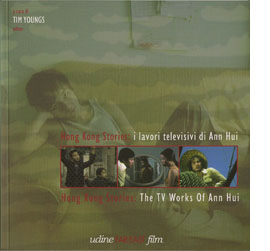
The programmers also mount adventurous retrospectives of rare items. One year it was a survey of the work of Patrick Tam, still too little known among Asian aficionados. This year the retrospective was devoted to Ann Hui’s TV films, which are among her best work. These films, shot in 16mm and broadcast in the 1970s, were strong meat for a culture unused to social criticism in its popular media. Hui’s dramas showed police corruption, the sex trade, abandoned children, and drug addiction. The episodes were researched and scripted under great time pressure, and Hui was allotted two weeks for shooting and post-production. “We were experts at shooting in the streets on the sly.” The stories’ concern for ordinary people and their problems has resurfaced again in The Way We Are (2008) and Night and Fog (2009).
The Hui volume is a model of the profuse documentation the Far East festival provides. Several concise essays, all in both English and Italian, enhance appreciation of the films. Contributors Law Kar, Shu Kei, and editor Tim Youngs do a fine job of situating Hui’s TV work in its context, and a lengthy interview with the director explores her working methods and intentions. There’s also valuable filmographic information about the episodes (four of them available on DVD).
As if this weren’t enough, the Udine event publishes a mammoth catalogue called Nickelodeon. Each year it’s a treasure chest of enthusiastically presented information. This time around, surveys of 2008 developments in all the major countries are accompanied by Roger Garcia‘s special section on the history of Thai action cinema. A vast section of reviews of the films to be shown rounds out this gift to the Asian cinephile. (A little of this material is available at the Udine site.) There is no coordinated effort to sell the books to the public, but if you want to purchase them, try writing to the festival directors at cec@cecudine.org.
So a tip of the hat to the dedicated Udine team, headed by Sabrina Baracetti, and a signal to you that if you have the time and the money to go, you would surely have a hell of a week. (Note that professors and students are offered lodging for some nights.) Who knows? A director might show up to put the audience in a movie, as Johnnie To once did. Even if you can’t make the trip, the quality of the publications makes them indispensible for research and enjoyable reading.
Rabbits from a hat
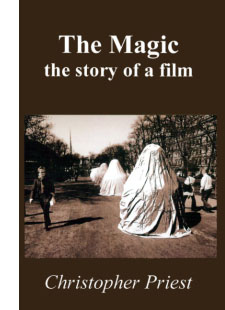
It’s tiresome to hear novelists kvetching that film adaptations mangle their work. So it’s a pleasure to read Christopher Priest’s brisk account of how his novel The Prestige became a film. In The Magic: The Story of a Film Priest takes us through the whole process, but this isn’t the usual behind-the-scenes tour. He never visited the set or met the principals. Instead we get the viewpoint of a writer living in East Sussex, following the production through agents’ correspondence and the gossip frothing up on Google Alerts.
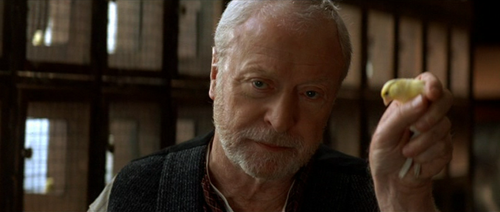
Priest is a lively writer, and he is frank about the ups and downs of the process. Initially he is happy that Nolan acquired the rights because the novel, a cunningly designed piece of misdirection, seems ideal for the director of Memento. But he confesses disappointment when the Prestige project is sidetracked by Batman Begins (“overlong, simplistic, and dull”). When the production gets under way, there are more swerves in the road. Given an early script, Priest admires the craftsmanship of Jonathan Nolan. But then he’s baffled that Christopher Nolan is saying two inconsistent things: that the film is completely different from the book, and that reading the book will spoil the film. Then again, during a press preview in Leicester Square, Priest succumbs to the film’s intricacies. “It has one of the most complicated and sophisticated narrative structures ever seen in an entertainment film.”
The story of the production ends here, but Priest goes on for about fifty pages to analyze the film in considerable detail. He dwells on the opening, which has no equivalent in his novel, and praises it for its fluent shifts among different points in story time. He appraises various aspects of the film, and he doesn’t stint criticisms. He notes that the Nolans stripped off his contemporary story, crucially altered the roles of the women, and turned his elusive mysteries into plot-driven secrets. Yet he concludes:
There is hardly a line of dialogue or moment of action in the film that can be traced back word-for-word, yet the whole thing is faithful to the novel in spirit, in story and in effect. I have differences with the screenplay in places, but none of those detracts from my general impression that it is a classic film adaptation of an existing novel, one which intending screenwriters would do well to study alongside the novel. (157).
Priest is a former movie critic (for the sturdy old British Film Institute publication Film) and an astute observer of what happens in a shot and on a soundtrack. He contacted me after my March blog entry discussing micro-repetitions in The Prestige and told me of The Magic. I ordered a copy pronto, and I’m glad I did. If you want to give your mail carrier a bit more job security, go to this page and click on GrimGrin Studio.







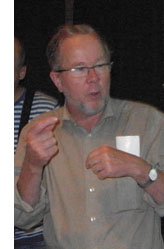 The most wide-ranging book comes from Torben Grodal. His first book, Moving Pictures (1999), was part of the last decade’s surge of cognitivist work. In Embodied Visions: Evolution, Emotion, Culture, and Film (Oxford), Grodal continues to explain our experience of film with the help of what we know about how brain areas are activated. At the center is the process that Torben calls PECMA (for Perception-Emotion- Cognition-Motor-Action). In this model, activation begins in brain areas dedicated to perception and flows on to associational and emotional centers, and then to areas providing cognitive appraisal. Here Grodal agrees with current thinking on the central role of emotion in processing information. Along with this “inner” account of cinematic response, Torben proposes an evolutionary account of enduring cinematic attractions. Romantic love, horror, and adventurous exploration all have evolutionary rationales.
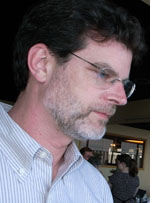 While Embodied Visions offers a very broad theoretical framework, Carl Plantinga’s Moving Viewers: American Film and the Spectator’s Experience (University of California Press) focuses on Hollywood cinema and how it arouses emotions. Plantinga, who also contributed to the 1990s discussions, surveys the literature on emotion and explores varieties of emotions in film viewing. He makes fruitful distinctions between “long-range” emotions, like suspense, and those brief and intense feelings, like surprise and disgust.
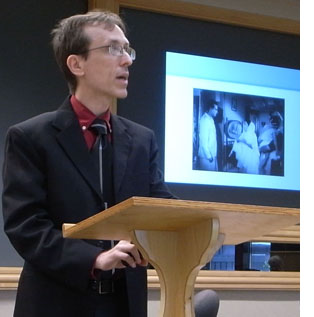 A comparable concern for how culture can fine-tune cross-cultural tendencies is set forth by Patrick Colm Hogan in Understanding Indian Movies: Culture, Cognition, and Cinematic Imagination (University of Texas). Hogan is an expert on Indian literature and aesthetics; I called him in to help me understand Slumdog Millionaire in an earlier entry. Hogan is also a major narrative theorist. His The Mind and Its Stories is a powerful study of cross-cultural narrative structures and their relation to prototypical emotions.