by Kristin Thompson. Berkeley: University of California
Press, 2007.
400 pages, 6 × 9 inches, 12 color illustrations;
36 b/w illustrations.
[go
to Amazon | go to The Frodo Franchise blog]
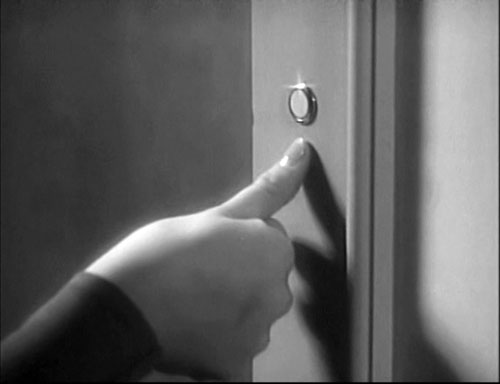
If you wanted a prototype of some unique visual pleasures of 1930s cinema, you could do worse than pick this innocuous image. It’s perfunctory in narrative terms, merely telling us that Sylvia Day is calling on Bill Smith. Beyond its plot function, though, it’s fun to see. We can enjoy the unfussy modern edge of the doorjamb, the curve of the manicured thumb, and soft highlights bringing out the hand and knuckles.
Above all, there is that starry gleam at the top of the doorbell. Who needs it? It’s just a doorbell. Why take so much trouble lighting a throwaway shot?
Add to this that Parole Girl (1933) is a program picture, and from Columbia, no less—the Poverty Row studio that had yet to break through with It Happened One Night (1934). We learn from Bernard F. Dick’s deeply-researched book on Harry Cohn that the budget for Parole Girl would have been about $250,000, when MGM B’s were running about $400,000. Why spend money on a shot like this?
Because that was the standard of good-looking moviemaking at the time. Most problems of converting to talkies had been solved, so films were regaining not only the fluent narration but the sparkling imagery of 1920s cinema. Under Cohn’s leadership, Columbia was trying to compete with the bigger studios’ movies, and looking classy was one way to do it. Recently I spent a day or so watching four titles, and I was reminded how pictorially sophisticated and refreshing low-end Hollywood can be. These movies also offer us an unusual window into what was already characteristic storytelling strategies of classical Hollywood. But there will be spoilers ahead too.
Welcome to 1933
As so often, I have TCM to thank. Since their Jean Arthur tribute of 2007, they have been running a generous number of Columbia titles (all restored by the master hand of Grover Crisp). By including less-known 1930s items along with classics like The Awful Truth and the Capra titles, they continue their mission of serving American film culture every hour.
Lea Jacobs has convinced me that it’s useful to think of studio releases in those days as filling a season running from Labor Day to Memorial Day rather than a calendar year. Studio heads planned budgets and production schedules according to that time frame, like network TV broadcasters now. Unlike today, summer was not a big release period, maybe because of the competition of other leisure activities, maybe because with air-conditioned movie houses people would come watch anything thrown on the screen. In any case, the big pictures were saved for fall, winter, and spring.
So my frame of reference is the 1932-33 season. Columbia ushered in the new year with its best-remembered film of the season, Capra’s Bitter Tea of General Yen (6 January). The studio probably considered Washington Merry-Go-Round (15 October), Virtue (25 October), and No More Orchids (15 November) to be A projects, but the large output of Westerns, the absence of historical pictures, and the relative dearth of stars in this output confirm the studio’s status as a Poverty Row company.
My movies come from the winter and spring of 1933. Each was shot in two to three weeks and each runs about seventy minutes.
Air Hostess (15 January, directed by Albert Rogell) tells of the daughter of a WWI ace who marries a reckless young pilot. Trying to build a new type of plane, he shops his business plans to a rich woman investor, who tries to seduce him.
In Child of Manhattan (4 February, directed by Edward Buzzell), a wealthy widower falls for a taxi dancer and takes her as his mistress. When she becomes pregnant, he marries her. But the baby dies soon after birth and the wife flees to Mexico for a divorce while the husband tries to track her down.
In Parole Girl (4 March, directed by Edward Cline), a department store executive sends a woman con artist to prison. She vows revenge. When she gets out, she seduces the executive, although he’s unaware of who she is.
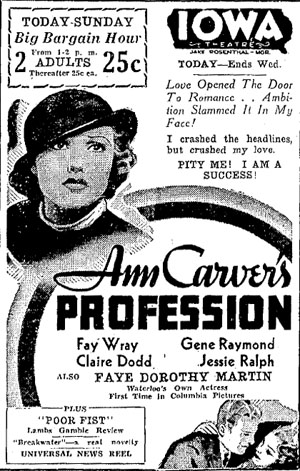
Ann Carver’s Profession (26 May 1933, directed by Buzzell) centers on a couple torn by career rivalry. After being a gridiron hero in college, the husband is failing as an architect. Meanwhile, his wife is becoming a celebrated trial lawyer. Eventually the husband leaves the household and takes up with a floozie, who winds up strangled. His wife must defend him against the murder charge.
For connoisseurs of naughty pre-Code movies, there are the usual attractions of double beds, extramarital sex, peekaboo negligees, and risqué dialogue. Child of Manhattan goes the farthest, perhaps because it’s an adaptation of a Preston Sturges play. “You’re a fascinating little witch,” says the millionaire. “Did you say witch?” the dancer asks. This is the same girl, played by perky Nancy Carroll, who thinks the man is trying to feel her up when he slips a thousand-dollar bill into her garter. Later she recalls her mother’s advice: “Never, ever walk upstairs in front of a gentleman.” And when she confesses to her Texan admirer in her mangled pronunciation, “I’m a courtesian,” he pauses and replies, “Well, religion doesn’t make any difference with me.”
Despite such pleasant moments, and two screenplays credited to Robert Riskin and Norman Krasna, these movies won’t win prizes for imaginative scripting. The tone is often uncertain, with comic banter clashing with scenes of melodramatic sacrifice. The long arm of coincidence becomes elastic. In Parole Girl, the heroine happens to meet the offending executive’s first wife in prison. During the taxi dancer’s stay in Mexico, she runs into the cowpoke who had wooed her aggressively in Manhattan. In Ann Carver’s Profession, the husband’s girlfriend accidentally strangles herself. Yes, you read that correctly.
Still, you have to give points for speed. Only Parole Girl has unusually quick cutting, at an average of 6.6 seconds per shot, but the overall pace of most of the plots is pretty rapid. (The exception is Child of Manhattan, whose lumbering dramatic rhythm is echoed in an average shot length of sixteen seconds.) Playing far-fetched action fast makes it less noticeable and more forgivable. Today any movie that can tell a moderately interesting story in a little more than an hour feels like a triumph. You can watch two of my pictures in the time it takes to groan your way through Funny People. And in these movies, the opening credits flash by in less than fifty seconds. Those were the days when crafts people under contract didn’t have to be acknowledged, and there were no executive producers.
Apart from Capra, whom do we remember as a Columbia director? Probably not my three guys. Albert Rogell, director of Air Hostess, began directing in the early 20s and worked for Columbia, Tiffany, Monogram, RKO, Universal, and Paramount. A prototypical B filmmaker, he signed over a hundred films in twenty-five years. Edward Buzzell was somewhat more prominent. After Ann Carver’s Profession, he left Columbia for Universal and eventually moved to MGM, where he directed (as if that were possible) the Marx Brothers in At the Circus (1939) and Go West (1940), as well as helming Song of the Thin Man (1947). Like Rogell, Edward Cline (Parole Girl) skipped among studios; like Buzzell, he landed on his feet with comedian comedy, steering W. C. Fields through You Can’t Cheat an Honest Man (1939), My Little Chickadee (1940), and other vehicles. In all, studio artisans, yes; auteurs, no.
Two Joes and a Ted
Parole Girl
If you’re interested in how Hollywood tells its tales, there’s a fair amount to chew on in these modest releases. The scripts tend to obey Kristin’s four-part model, adapted to very short running times, with the key turning point taking place midway through the film. Despite the coincidences, the characters’ goals and changes of heart tend to be planted early. In Ann Carver’s Profession, Ann’s intense ambition and Bill’s swaggering overconfidence prepare us for the crisis in their marriage, when each is unwilling to compromise.
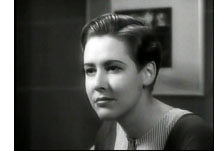
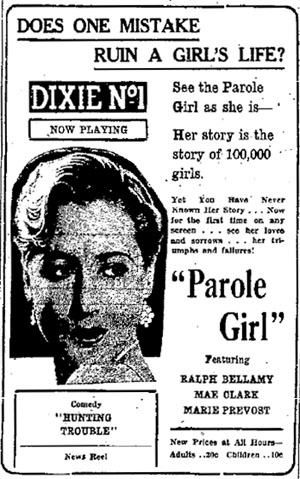
As for performances, perhaps the very speed of production forced actors to play naturally. True, Fay Wray is a bit arch as Ann Carver, but Gene Raymond as her husband moves convincingly from boisterousness to self-doubt. In Child of Manhattan, John Boles, trying to mingle with the little people, can be stiff, but Nancy Carroll has pep, and Buck Jones as her cowboy swain adds a welcome dose of naive gallantry. All three show how important distinct voices had already become: Boles mellifluous, Carroll up and down the scale, Jones slow and sincere. Reliable Columbia regular Ralph Bellamy shows up in Parole Girl, but more memorable is the performance, or rather presence, of Mae Clark. When she comes back from prison bent on vengeance, she’s a glowering figure in her stylishly chopped hairdo.
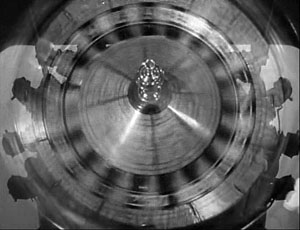
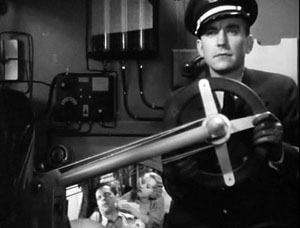
The films make fluent use of storytelling devices that predate the 1930s but are forever associated with that decade. Sequences are linked through headline montages and wipes, recently made possible by the optical printer. There are more elaborate techniques too, particular the visual or auditory hook connecting scenes. We’re not surprised to see commonplace instances, as when a note pad listing an apartment number dissolves to that number on the door. In Air Hostess, however, a spinning propeller gives way to a roulette wheel, and this association does a little more work, linking Ted Hunter’s reckless flying to his gambling and his general tendency to take risks.
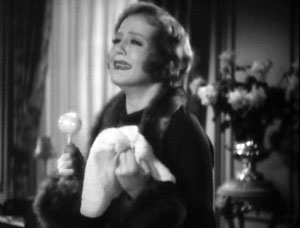
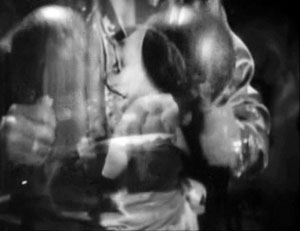
In Child of Manhattan, as Madeleine resolves to leave her husband after the death of her child, she tearfully shakes a baby rattle, and this dissolves to marimbas in a nightclub, swiftly turning her pathos into her effort to start a new life with a Mexican divorce.
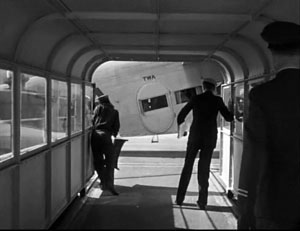
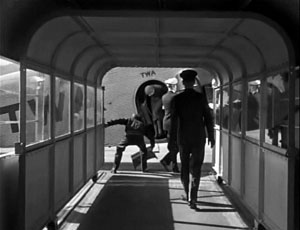
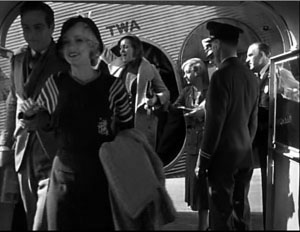
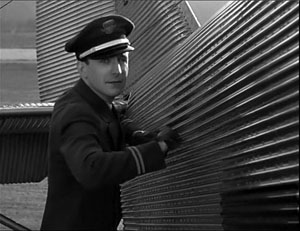
But what is perhaps most striking about these films is their photography. Ten minutes into Air Hostess, the first one I watched, we get a lovely sustained track into a sunny airfield, our view guided by the walkway wheeled up to a plane door as passengers step out.
The relaxed play of light and shadow in this geometrical shot yields one of those fugitive visual delights that classic cinema so often supplies.
What’s it doing in a Columbia programmer? This Poverty Row studio realized that they could give their pinched budgets an upscale look with polished cinematography. Accordingly, you can argue that the biggest talents on the Columbia lot were the directors of photography. Our four films were shot by ace DP’s.
Joe August (Parole Girl) was the grand old man. He filmed some of the best-looking hits of the 1910s, including Ince’s Civilization (1916) and a great many William S. Hart movies (including Hell’s Hinges, 1916). In the 1920s and up to 1932 he worked at Fox on films by Ford, Hawks, and Milestone. At Columbia August would shoot Borzage projects like Man’s Castle (1933) before moving to RKO for Sylvia Scarlett (1936), Dance, Girl, Dance (1940), and the flamboyant All That Money Can Buy (aka The Devil and Daniel Webster, 1940).
Another Joe, somewhat younger, was no less gifted. Joseph Walker, the DP of Air Hostess came to Columbia early and soon teamed with Capra; he would shoot twenty movies with the director, including the splendid American Madness (1932), a particular favorite of mine. Walker stayed loyal to Columbia, shooting Only Angels Have Wings (1939), His Girl Friday (1940), Penny Serenade (1941), and on and on—returning to Capra for the independent production It’s a Wonderful Life (1947). Walker also patented an original zoom-lens design.
Ted, sometimes known as Teddy, Tetzlaff was another Columbia loyalist, and he certainly cranked them out. Hawks’ The Criminal Code was one of eleven movies Tetzlaff was credited with in calendar 1931. But by the spring of 1933 he seems already to have become a free lance, eventually working at Paramount on a string of classics (Easy Living, Remember the Night, Road to Zanzibar), then RKO (The Enchanted Cottage, Notorious), and occasional jobs back at Columbia. Tetzlaff became a director as well, remembered chiefly for the cult classic The Window (1949).
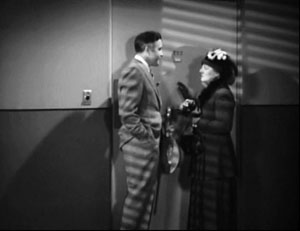
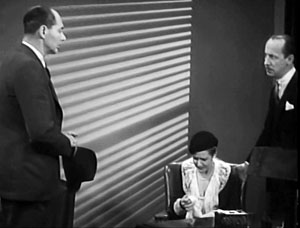
No wonder my four films dazzle, even on TV. According to Bob Thomas’s biography King Cohn, Columbia took special care to create a phosphorescent look through careful processing that enhanced the DPs’ efforts. Hence not only the sparkle on a door buzzer but glowing applications of then-standard edge lighting. Hence as well the use of striped shadows to suggest venetian blinds, a convention we associate with the forties but here in precise array (Child of Manhattan, Parole Girl).
Trust Joe Walker to provide a little of that striped texture with a fuselage.
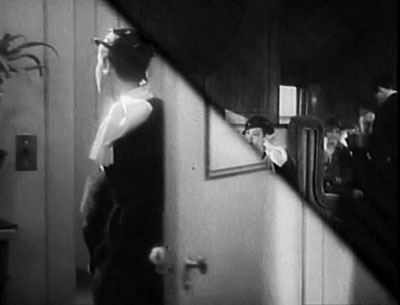
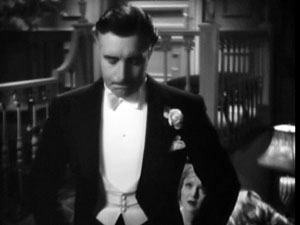
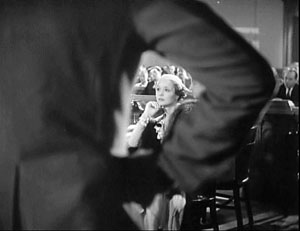
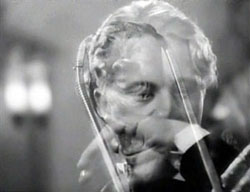
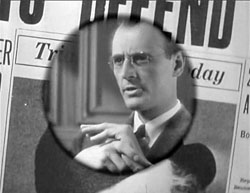
Tetzlaff, first in Child of Manhattan and then Ann Carver’s Profession, seems to be fooling around with faces and elbows.
Probably the most visually and narratively complex of my films from spring 1933 is Ann Carver’s Profession. It’s possible that it was Columbia’s equivalent of an A production: Gene Raymond was a mid-range star known for a few Paramount and MGM pictures, and Fay Wray’s King Kong had premiered a week before filming started. Whatever the cause, Ann Carver has more complex plotting and more consistently inventive visuals than the three other titles.
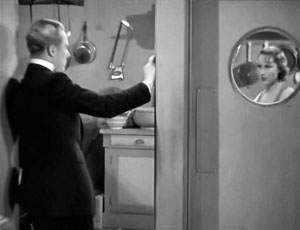
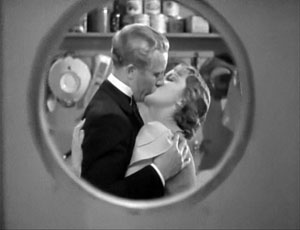
From the very start, when gridiron hero Bill promises to provide for Ann the waitress, we get the sort of offhand flash that I like in 1930s movies. As Bill follows Ann into the kitchen, she’s framed in a swinging door and the camera moves closer to pick up their clinch.
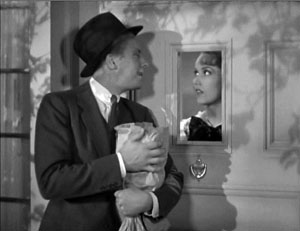
Once they’re married, the circle has become a rectangle, and trouble is on the way.
There are fancy mirror shots, pov constructions that lead characters to the wrong inferences, and examples of the big-foreground compositions that would come to prominence in the 1940s.
The trial recesses; crane up to the clock; spin the hands to cover a couple of hours; crane back to the trial resuming. Or start with Bill’s girlfriend, passed out and garroted by the necklace that has snagged on a leering chair carving. Dissolve to Bill’s night on the town, before ending that fuzzy montage with a dissolve back to the chair carving.
Bill didn’t kill her, but the pictorial logic makes him almost magically responsible, with the carving mocking him for what’s to come.
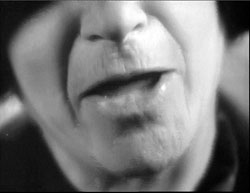
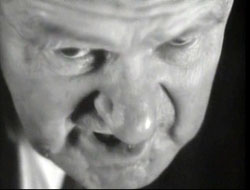
Above all there is one of the most laconic (and cheaply filmed) courtroom montages I’ve ever seen. A string of witnesses testifies, and after a newspaper pops out the first one, we get a fusillade of extreme close-ups, cut very quickly.
Just as striking is the coordinated sound montage, which reduces the testimony to clipped sentences, then phrases (“”Four-thirty!” “Quarter to five!” “Both of ‘em!”), then single words (“Drunk!” “Drunk!” “Strangulation!”), all damning Bill. Why take us through all the rigamarole—people sworn in and questioned at length—when you can give the essence of it in twenty-eight shots and twenty-five seconds?
My 1933 quartet contains no great film; perhaps none is worth more than one viewing. But what I learned from watching ordinary movies for our Classical Hollywood Cinema book is borne out by my soundings here. We can enjoy seeing a well-honed system steering us through a story, especially when gifted people like Teddy and the two Joes are shifting the gears. We can appreciate the opportunities for grace notes in what some call formula filmmaking. And we can see that this lowly studio, making films ignored in traditional histories, has something to teach filmmakers today: proud modesty. A film can radiate pride in being concise, in exercising a craft, and in telling a story that hurtles forward while shedding moments of casual beauty.
Most critical writing on early 1930s Columbia pictures focuses on Frank Capra, but there is good general background in Bernard F. Dick, The Merchant Prince of Poverty Row: Harry Cohn of Columbia Pictures (Lexington: University Press of Kentucky, 2009). My mention of budget levels comes from his discussion on pp. 119-120. An older, citation-free but still helpful biography is Bob Thomas, King Cohn (Beverly Hills: New Millennium, 2000). In-depth information on Joseph Walker as a Columbia cinematographer is available in Joseph McBride’s excellent biographyFrank Capra: The Catastrophe of Success (New York: Simon and Schuster, 1992), 189-215. Walker’s engaging autobiography supplies nothing specific to these films, but he sprinkles technical information among its anecdotes. See Joseph Walker and Juanita Walker, The Light on Her Face(Los Angeles: ASC Press, 1984).
On 1934 as the end of naughtiness, see Tom Doherty’s Pre-Code Hollywood. For a skeptical account of the idea of Hollywood “before the Code,” see Richard Maltby, “More Sinned Against than Sinning [2003],” in Senses of Cinemahere, and essays in “Rethinking the Production Code,” a special issue of The Quarterly Review of Film and Video 15, 4 (1995), ed. Lea Jacobs and Richard Maltby.
If you’re interested in more complicated narrative strategies in films of this period, try our entry “Grandmaster Flashback.” For another take on low-budget 1930s films, there’s our entry on Mr. Moto and Charlie Chan.
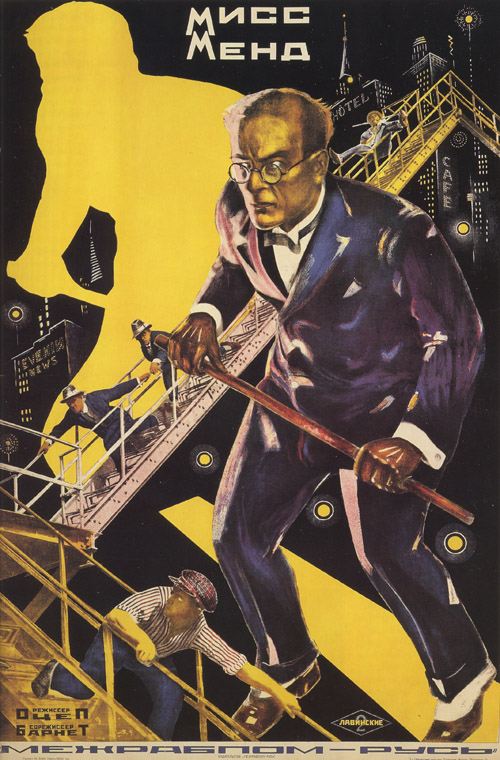
One of several posters the Stenberg brothers designed for Miss Mend.
We’ve been quite busy in the tail end of October. David sweated over a Bresson essay, started on his online version of Planet Hong Kong, and continued to help out in Lea Jacobs’ seminar on film stylistics. Kristin has started organizing a book about the statuary from the site in Egypt where she works for three weeks each year. And both of us have been steering the ninth edition of Film Art: An Introduction through the final phase of production. So instead of a blog essay this week, we offer some items from recent months that we think deserve wider notice and in some cases a pat on the back.
In our second report from the Vancouver film festival, Kristin wrote about a Chilean film, The Maid. She suggested that it was entertaining enough to be remade in English as a vehicle for an actress willing to play middle-aged and curmudgeonly. On October 16, the film was released theatrically. Starting in one theater, then going to six, and now 13 in its third week, it’s doing pretty well judging by per-theater averages. It’s not likely to get beyond big-city arthouses, but at least a release means that it should come out on DVD.
Speaking of DVDs, German silent cinema continues to be well-served with two new releases from British firm Eureka! F. W. Murnau’s 1922 film Phantom was already available in the US on the 2006 disc from Flicker Alley. The new Eureka! set includes both Phantom and Die Finanzen des Grossherzogs (1924). We saw the latter years ago at the National Film Theatre in London. It’s a comedy, and it struck us that Murnau was a bit ill at ease in that genre. Still, any Murnau film is worth a look. The set contains commentary on Die Finanzen by David Kalat, and there’s an essay on both films by Janet Bergstrom.
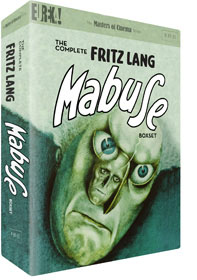
One of the best arguments that sequels and series, even those about super-villains out to rule the world, aren’t necessarily bad is Fritz Lang’s Dr. Mabuse films. They span almost the length of his directorial career, from the two-part serial Dr. Mabuse der Spieler in 1922 through Das Testament des Dr. Mabuse in 1933, up to his last but definitely not least film, Die 1000 Augen des Dr. Mabuse (1960), which David included in his Belgian summer course. For those who can’t get enough of this arch-fiend and his followers, Eureka! has packaged all three in a new boxed set. There are numerous extras, which you can read about here. For those who have only seen The 1000 Eyes of Dr. Mabuse dubbed in English, this set gives the option of German with subtitles or dubbed. (The films are not available from Eureka! separately.)
The films of Lev Kuleshov pupil Boris Barnet are only gradually being discovered outside Russia. One of the hits of this year’s “Il Giornate del Cinema Muto” was his 1928 comedy, The House on Trubnaya. Yes, there were Soviet Montage comedies, and this is one of the funniest. Let’s hope an enterprising company brings it out on DVD.* In the meantime, Flicker Alley is doing its bit to make Barnett known by releasing his 1926 three-part serial, Miss Mend. We saw it years ago without subtitles, so we look forward to finally finding out exactly what this fast-paced thriller is about. Something anti-capitalist involving the “Rocfeller and Co.” factory.
Soviet film was much on our minds this semester because our Cinematheque was running a series of films by Grigori Alexandrov. Probably best known for collaborating on Eisenstein’s silent films, Alexandrov came into his own in the 1930s with a series of lumpy but ingratiating musicals. They run the gamut from slapstick to mild satire (of familiar targets like bureaucrats). He likes silly gags, direct address to the audience, and a sort of relentless jollity that seems designed to prove Stalin’s claim in those years of privation that “Life has become gayer, comrades, life has become more joyous.”
Jolly Fellows (aka Jazz Comedy, 1934) is a somewhat labored effort in Marx Brothers absurdity, while Bright Path (1940) gives us a Stakhanovite Cinderella. It’s full of special-effects trickery used for comic effect, as when a poster coyly comes to life.
Although Alexandrov helped bring Hollywood production values to Soviet cinema, his 1936 Circus is a pointed critique of American racial bigotry.
Alexandrov’s best known film is Volga Volga (1938), reportedly Stalin’s favorite movie. It’s a meandering tale enacting the battle of highbrow music and popular tastes, including a clever scene (perhaps derived from the “Isn’t It Romantic?” number of Love Me Tonight) in which the movie’s principal tune jumps from boat to boat down the river, until it has become an unofficial national anthem. The films star Alexandrov’s wife, Lyubov Orlova, whose bullheaded energy swamps all resistance. The series is from a touring program, Red Hollywood, and you can read the background here.
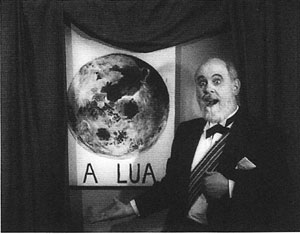
Wisconsin Bioscope silent films went south in August–specifically, to São Paulo’s third Brazilian Days of the Silent Cinema. Here at the University of Wisconsin–Madison, Dan Fuller, a photographer and historian of photography, teaches students to use classic cameras and devise their own 1910s movies. Of the two Bioscope films chosen for the São Paolo festival, A Expedição brasieira de 1916 (2006) depicts the first earthlings’ arrival on the moon. It features a stirring performance by a novice actor (above) whose film career was tragically cut short when he decided to become a professor.
Cinema in yet another land is the subject of Research Guide to Japanese Film Studies by Abé Mark Nornes and Aaron Gerow. At its center is a robust bibliography, including journals as well as books, but there’s much more: a survey of archival collections of films and documents, a list of film distributors, a gathering of online resources, and even a list of bookstores specializing in Japanese cinema. Donald Richie calls it “a reference work which both illuminates and defines this field, clearing a formerly obscured terrain for future scholarship.” Markus and Aaron are strong participants in a tide of younger scholars, both Asian and Western, who are rethinking this very important national cinema.
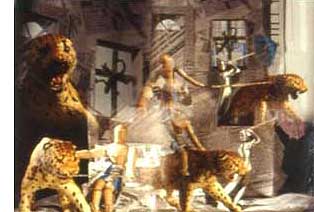
Images, not moving, come at you in another package. Remember Viewmasters? Vladimir, a projectionist at the Northwest Film Center in Portland, makes handsome viewmaster-style discs presenting strange tales culled from Kafka, Calvino, and less-known sources. The images are still-lifes incorporating toys and props, and it’s up to you to figure out the narrative. Concept sometimes outruns execution, but the shots suggest a childhood world turned sinister. You can even get your own viewer–called, naturally, a Vladmaster.
At Parallax View, Sean Axmaker is building an online archive of the complete run of the legendary magazine Movietone News. Richard T. Jamesonand Kathleen Murphy are leading voices in American film criticism, but I suspect that the younger generation isn’t as aware of them as it should be. In Movietone News and elsewhere they provide a body of criticism that nicely balances judgment, information, and ideas. Hats off to Jim Emerson for using Halloween as an occasion to point up Richard’s astute observations on modern shot design.
On Sunday night we went along with Jeff Smith to a campus lecture by Steven Pinker. The talk was a condensation of Pinker’s book The Stuff of Thought, a fascinating effort to show how various dimensions of language, chiefly semantics and pragmatics, reflect basic concepts of space, time, causality, and social relations. Language, Pinker says, furnishes a window into human nature. In a virtuoso turn, the book wraps up two trilogies at once: it caps a pair on cognitive and evolutionary theory (How the Mind Works and The Blank Slate) and a pair on grammar and semantics (The Language Instinct and Words and Rules).
David first heard Pinker speak at an at extraordinary conference in Santa Barbara in August 1999. Coordinated by Leda Cosmides and John Tooby, “Imagination and the Adapted Mind” was an effort to explore how the arts could be illuminated by contemporary psychology, particularly one informed by an evolutionary perspective. This event–featuring not only Pinker but also Mark Turner, Eleanor Rosch, Ellen Dissayanake, Don Browne, and other luminaries–was a major moment in bringing “evolutionary aesthetics” to the table, although it’s taken about a decade for most humanists to catch up. (Several of the papers are available in a double issue of SubStance.) It was at that event that Pinker made his notorious suggestion that art was a byproduct of the brain’s evolution, a sort of “mental cheesecake” designed as a compact “superstimulus” appealing to our senses, mind, and emotions.
David had read The Stuff of Thought when it came out and had viewed the talk online. Sunday’s lecture remained a compelling performance, packing a remarkable number of ideas, data, and vivid examples into an entertaining seventy-five minutes. Pinker has been called the Dawkins of linguistics and cognitive psychology, but his sense of humor is rowdier. His straightfaced analysis of swearing is lively enough on the page, but it’s uproarious live.
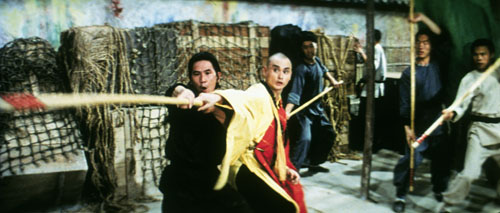
Finally: Ever notice how many classic kung-fu movies are in widescreen? David has posted a new online essay tracing how Shaw Brothers popularized the anamorphic format in Hong Kong. The essay also considers how the widescreen format led Hong Kong filmmakers toward a distinctive approach to composition, cinematography, and dynamic movement. . . . of which the image below is a fair instance.
*[Nov 5: Thanks to James Steffen for alerting us to the fact that Edition Filmmuseum is bringing out The House on Trubnaya, along with Barnett’s other silent comedy of the same period, The Girl with the Hat Box, soon. There’s an impressive list of films in preparation, including the rare Expressionist classic Von morgens bis Mitternacht (1920), by Karl Heinz Martin. Comedy lovers should key an eye open for the release of a collection of Max Davidson’s hilarious silent comic shorts, including, we presume, the immortal Pass the Gravy.
Variety also has announced that Sundance is going national. On January 28, 2010, eight filmmakers will present their films and hold Q&As in eight theaters across the U.S.A. Madison, with one of only two Sundance multiplexes in the country, will be one of the host cities.]
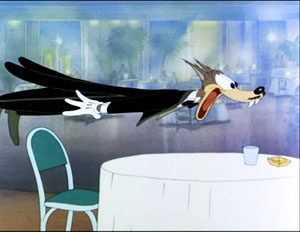
I grant you that there are some films that deliberately evoke the love wand: Tex Avery cartoons, Frank Tashlin and Jerry Lewis movies. Surely the Wolf in Avery’s Red Hot Riding Hood (1943) has more than a Platonic interest in Red’s stage show.
But some critics/ academics look way too hard. For them, as a literature professor of mine put it back in the mid-1960s, phallic symbols are everywhere in art. And I learned fast that he meant everywhere, from the Odyssey to Emily Dickinson. I changed sections.
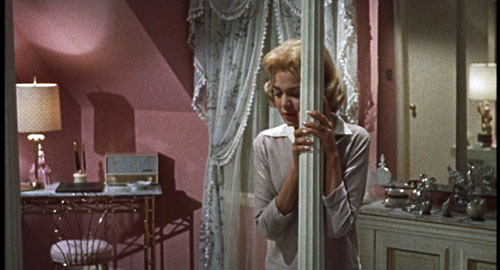
Films, of course, are full of images that encourage the hunt for avatars of the skin flute. So for forty years, I’ve argued against interpretations of a scene that depend on reading you-know-what into anything that resembles a pole, post, or pylon—any vaguely tubular shape, slender or squat, organic or mechanical. It is a duffer’s mistake to think that film shots including swords, logs, telephone poles, pine trees, skyscrapers, Greek columns, fountain pens, picket fences, shovels, rocket ships, and Pontiac fins always pay homage to the trouser snake.
Except, I must admit, bedposts.
I don’t think I’ve ever slept in a bed with bedposts, not even in those cozy B & Bs that smother you with affection and sugar-sprinkled muffins. But the American cinema likes bedposts. Red-blooded American women in classic movies often have beds braced or decorated with bedposts.
Sometimes those bedposts do some alarming things.
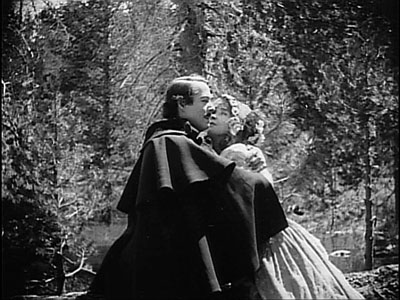
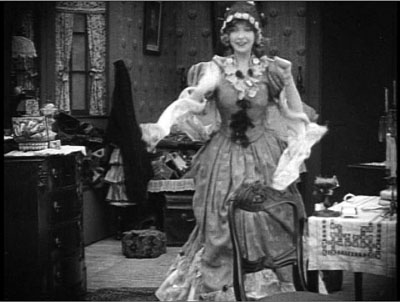
Exhibit A: Start, as we often do (but probably shouldn’t), with D. W. Griffith. In The Birth of a Nation, Elsie Stoneman has just spent a romantic afternoon with Ben Cameron, aka The Little Colonel.
She races into her bedroom, obviously smitten.
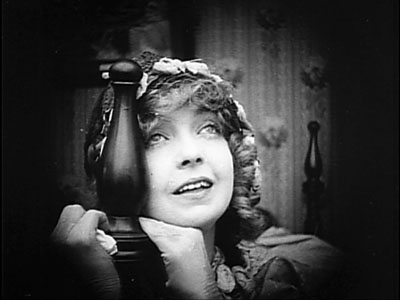
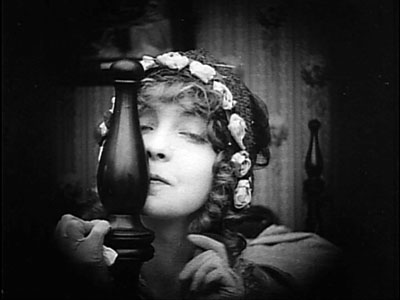
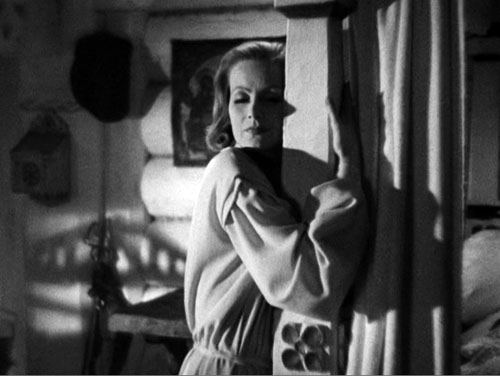
What does she do? She hops to the bed and leans dreamily against the fancy tapering bedpost. Now Griffith gives us the closest image of her that we’ve seen so far in the movie.
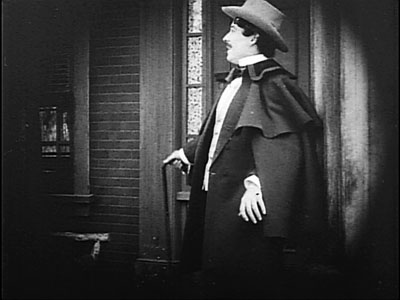
And since Griffith never passes up a chance to crosscut between anything and anything else, we get another shot of Ben, perhaps looking off toward Elsie’s house. (We have to say perhaps because Griffith is not terribly concerned with consistent eyelines.) It operates as a typical Griffith signal that one character is thinking about another.
And as if aware that Ben is thinking of her, Elsie rewards her bedpost accordingly.
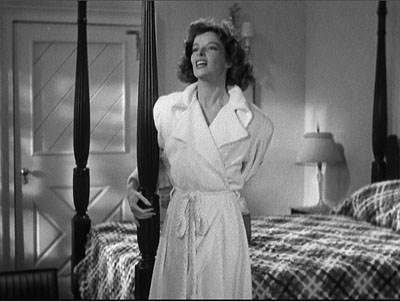
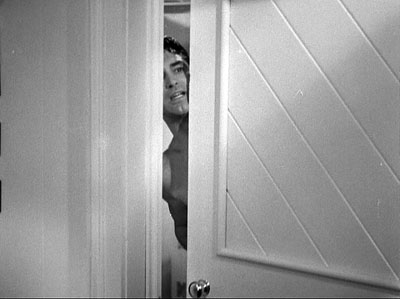
Should you doubt that these bedpost calisthenics are connected with the thought of a guy, I submit Exhibit B. In Bringing Up Baby, Susan Vance (Katharine Hepburn) is taken with David Huxley (Cary Grant). While he showers, she wraps herself around the only thing in the room taller than she is.
One can easily see why a glimpse of Cary Grant stepping out of the shower could make somebody clutch a support , but wouldn’t a chair have done as well?
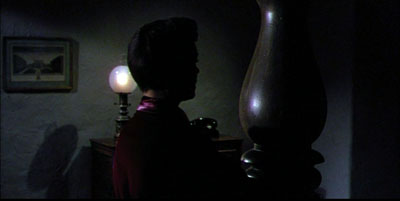
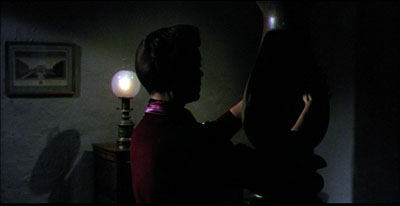
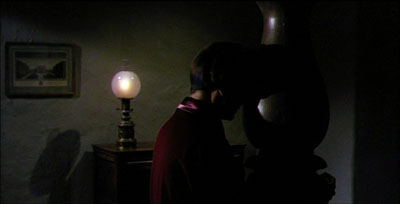
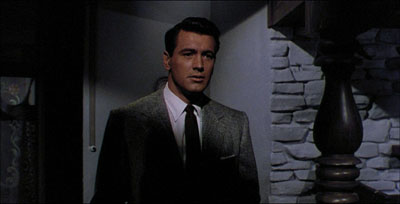
Exhibit C: Douglas Sirk has done interesting bedpost work in Imitiation of Life (surmounting this entry), but surely his triumph is Magnificent Obsession (1954). A blind Helen Phillips (Jane Wyman) has just learned that no operation is likely to recover her sight. Helen rises from her chair, and we hear a wordless choir along with a piano theme evocative of Rob (Rock Hudson), the mysterious man in her life. As if drawn by magnetism, she makes her way through the darkness to a totemic mass, sort of Elsie Stoneman’s bedpost on Viagra. She moves with the solemnity of a priestess paying homage to an angry god.
Actually, this thing isn’t exactly a bedpost; it’s a strange thrusting protrusion from a love seat that functions as a room divider. But it’s clearly in the bedpost tradition—as we see when, like Elsie, Helen embraces it and leans her head against it.
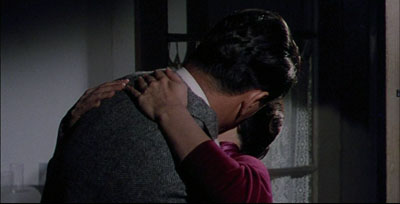
Soon Rob enters, framed by the post, and in no time the couple are in a clinch.
If forced to interpret these items, I’d probably say that Griffith may have included The Bedpost in a moment of frank eroticism, Hawks knew the cliché and exploited it for an actor’s bit of business, and Sirk, sophisticated Euro émigré, used it ironically. But of course these interpretations are open to dispute. I expect someone to start a dissertation on the matter immediately.
I don’t know of comparable scenes in which men, thinking of women, hug bedposts or crawl into big cavities. Bedpost worship can obviously be interpreted as another sign of Hollywood’s bias toward patriarchal values. But its blatancy and more or less witting silliness also respond to that quality that delighted Parker Tyler about Hollywood movies—the way that flagrant symbolism is flung onto the screen but toyed with, to tease us. For Tyler, the “only indubitable reading of a given movie” was
its value as a charade, a fluid guessing game where the only “winning answer” was not the right one but any amusingly relevant and suggestive one: an answer which led to interesting speculations about society, about mankind’s perennial, profuse, and typically serio-comic ability to deceive itself.
Sometimes, then, a bedpost is just a bedpost. But probably not in the movies.
The quotation comes from Parker Tyler’s Three Faces of the Film, rev. ed. (South Brunswick, NJ: Barnes, 1967), 11.
My frame enlargements from a 16mm print of Magnificent Obsession aren’t good enough in the scene I mentioned, so I’ve been obliged to draw my images from the Criterion DVD. That version crops the frame to 2.0:1, which has seemed too radical for many observers, me included. Should it instead be 1.66 or 1.85? The aspect-ratio debate has played out in extensive detail here and here.
Thanks to Lea Jacobs and Jeff Smith for some DVD loans. Jeff also encouraged me to keep this discussion in good taste.
Promoting Pirates of the Caribbean in Japan (By tralala.online)
Kristin here:
When was the last time you heard someone complaining about the high cost of the latest Toyota prototype? Probably not recently, since car manufacturers don’t tend to boast about how much it costs them to design a new model. In fact, I couldn’t find any information on how much the development of automobile prototypes costs. Some new models catch on, some don’t. Presumably some don’t make a profit for their makers. The same tends to be true for other big-ticket items.
In a way, a film’s negative is like a prototype. It costs a lot for a mainstream commercial film to be made, tens or hundreds of millions of dollars in many cases, before the first distribution print is struck and the first ticket sold. Yet once that prototype exists, any number of distribution prints can be struck, and a film may make back many times its negative cost.
[Added October 28: A friend of mine privy to information about car manufacturing informs me that an ordinary prototype runs $50 to 250 million. A radically new product like an electric car could run over a billion. And car companies do keep those figures secret, so it’s no wonder I couldn’t find them.
Coincidentally, $50 to 250 million is pretty much the range of budgets for mainstream commercial Hollywood features these days.
My friend told me other things about car manufacturing that make it sound as though the comparison between the two industries is a pretty reasonable one. For example, car companies can save money by releasing new, slightly modified versions of a popular model, such as the Honda Civic, rather than designing a new model from the ground up. Sort of like sequels in the film industry. More surprisingly, when car manufacturers (and some companies in other industries) make their products by outsourcing some of the components, they call it the “Hollywood model.”]
For some reason, the cost of making that negative is often public knowledge. To some extent, at least, since we all know that the budget as acknowledged by a studio may be considerably less than the actual costs. The notion that a movie set its company back by $200 million is to some extent a selling point. I’m sure that back in 1922 Universal wasn’t happy that Erich von Stroheim’s Foolish Wives ended up costing more than a million dollars. Still, they turned it to their advantage by advertising it as the first million-dollar movie, and studios have been using the same tactic ever since.
The producers and makers of other kinds of artworks don’t tend to make such information public. How much does it cost to put on a symphonic concert or publish a book? We may hear about big advances paid to an author, but that’s basically a lump-sum against future royalties, and the author doesn’t get any more until–if ever–the advance is paid off. But how much do editorial supervision, printing, and binding set a publisher back? What kind of money goes into the creation of a large stone sculpture?
Journalists looking for a hook for an article about movies find a sturdy one in the idea that today’s film budgets are bloated. They point to classic movies of decades past that cost only a few million to make and then compare these to the loud, overblown summer tentpoles of today, with their multi-hundred-million-dollar costs. Of course this overlooks the inflation of the dollar over the years. In the 1950s the average family income was about $5000 and an average house cost under $20,000. A penny bought a gumball and could be used in parking meters. Just about everything costs a lot more now.
To be sure, other factors have raised the budgets of films well beyond what they would be through inflation alone. The key factors have been star salaries and computer-generated special effects. The latter can account for half the cost of an effects-heavy film. Beyond the negative cost, typical budgets for prints and advertising have skyrocketed.
Some people seem to see an innate immorality in today’s biggest budgets, as well as an almost inevitable lack of quality in the films that result. Here’s one of the first results of a search on “big budget movies,” from Dmitry Sheynin on suite101.com. He even makes the car comparison:
The film industry has had a good summer this year – action sequences were bigger than ever, and expensive displays of pyrotechnics and CGI showcased new and exciting ways to destroy cinematic credibility.
With the economic crisis forcing many companies to scale down or even discontinue some of their more opulent product lines (think GM), it’s comforting to know Hollywood studios are still spending inordinate sums of money producing bad movies.
I think that’s fairly typical of the grousing you find on the internet and in print. No doubt Hollywood produces many bad movies. But actually, it is comforting to know that Hollywood is still spending great sums of money, ordinate or in-, if you think of the welfare of the country as a whole.
Every now and then I’ve pondered the possibility that American movies must be one of the products, if not the product, that has the most favorable balance of trade. While the US doesn’t have quite the stranglehold on world film markets that it used to, most significant Hollywood films get exported to numerous countries. Conversely, very few films from abroad are imported, and those that come in, especially the foreign-language ones, play in far fewer theaters and sell far fewer tickets than do domestic films. In 2006, according to US census figures, foreign films took in $216 million in the U.S., while domestic films sold $7.1 billion worth of tickets. So that’s 3% of the U.S. market for imported films, which is the figure I’ve heard pretty consistently for decades.
(In passing, I note from the same report that theaters made 66% of their income on tickets, meaning that we moviegoers spend about a third of our cash on all that stuff in the lobby.)
Turns out my ponderings have been correct. On the Motion Picture Association of America’s “Research & Statistics” page, there appears the claim, “We are the only American industry to run a positive balance of trade in every country in which we do business.” (“The industry” includes both film and television.) In April the MPAA put out its latest annual report, “The Economic Impact of the Motion Picture & Television Industry on the United States.” The combined trade surplus in the moving-picture industry for 2007 was $13.6 billion, or 10% of the US trade surplus in private sector services. According to the report, “The motion picture and television surplus was larger than the combined surplus of the telecommunications, management and consulting, legal, and medical services sectors, and larger than sectors like computer and information services and insurance services.”
Lest anyone think these figures are mere industry propaganda, the MPAA’s information, though made public, is gathered for the benefit of the film studios, which collectively own the association. Screen Digest, a highly respected trade publication, summarized some of the report’s material in its September issue (“Film and TV Are Key to US Economy,” p. 265).
For better or worse, most films that are really successful abroad are big-budget items, with lots of expensive special effects and (usually) top stars. Back in 1997 people were aghast at the first $200 million movie, Titanic—until it brought in nearly $2 billion around the world. Here, in unadjusted dollars, are the top foreign earners for the past nine years (not including domestic box-office):
2008 Indiana Jones and the Kingdom of the Crystal Skull $469,534,914
2007 Pirates of the Caribbean: At World’s End $651,576,067
2006 Pirates of the Caribbean: Dead Man’s Chest $642,863,913
2005 Harry Potter and the Goblet of Fire $605,908,000
2004 Harry Potter and the Prisoner of Azkaban $546,093,000
2003 The Lord of the Rings: The Return of the King $742,083,616
2002 Harry Potter and the Chamber of Secrets $616,655,000
2001 Harry Potter and the Sorcerer’s Stone $657,158,000
2000 Mission: Impossible II $330,978,216
Add in the DVDs and ancillary products, and the balance of trade gets even more favorable.
Yes, it may sound absurd that it requires $200 million to make a movie, especially one that gets mediocre reviews from critics and fans. Still, from a business point of view, it makes sense and it’s good for the country. It’s especially important in a period of financial crisis, when the movie industry’s income seems considerably less affected than many others. Our overall trade deficit is falling, since Americans are saving more and buying less from abroad. This year the film and television industry’s share of the surplus will presumably grow.
Apart from the balance of trade, according to the MPAA report, in 2007 the moving-image industry also employed 2.5 million people, paid $41.1 billion in wages, spent $38.2 billion at vendors and suppliers, and handed over $13 billion in federal and local taxes.
If you think the trade deficit doesn’t affect you, think again the next time you travel abroad and curse the exchange rate with the euro or the yen.
No doubt there’s a great deal of waste and slippery dealing involved in those huge budgets, but there are definite advantages that don’t get considered often enough.
I do see a lot of foreign cars on the roads.
[October 23: Coincidentally, two days ago Steven Saito posted a story on how foreign-language films that have achieved blockbuster status in the rest of the world don’t stand much of a chance of getting into the American market. He mentions the “Christmas Vacation” series that I referred to in an earlier post.]








 As for performances, perhaps the very speed of production forced actors to play naturally. True, Fay Wray is a bit arch as Ann Carver, but Gene Raymond as her husband moves convincingly from boisterousness to self-doubt. In Child of Manhattan, John Boles, trying to mingle with the little people, can be stiff, but Nancy Carroll has pep, and Buck Jones as her cowboy swain adds a welcome dose of naive gallantry. All three show how important distinct voices had already become: Boles mellifluous, Carroll up and down the scale, Jones slow and sincere. Reliable Columbia regular Ralph Bellamy shows up in Parole Girl, but more memorable is the performance, or rather presence, of Mae Clark. When she comes back from prison bent on vengeance, she’s a glowering figure in her stylishly chopped hairdo.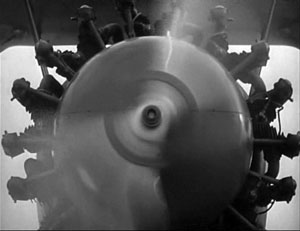
 Speaking of DVDs, German silent cinema continues to be well-served with two new releases from British firm Eureka! F. W. Murnau’s 1922 film Phantom was already available in the US on the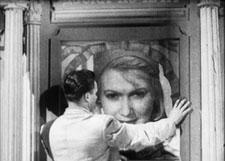
 Images, not moving, come at you in another package. Remember
  On Sunday night we went along with Jeff Smith to a campus lecture by Steven Pinker. The talk was a condensation of Pinker’s book