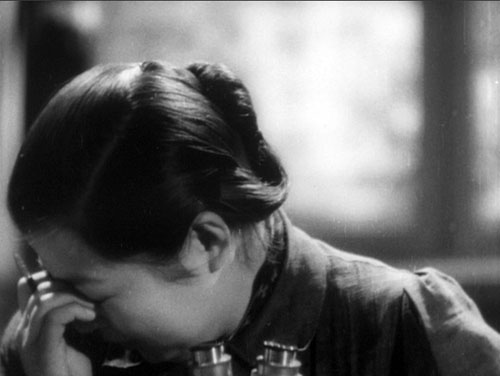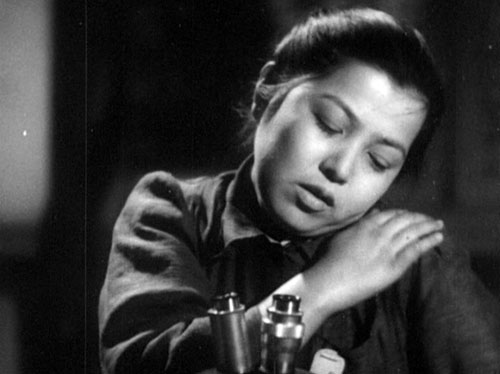
The Most Beautiful (1944).
For Donald Richie
DB here:
Cinephile communities aren’t free of peer pressure. Sometimes you must choose or be thought a waffler. In postwar France, the debate within the Cahiers du cinéma camp often came down to big dualities. Ford or Wyler? German Lang or American Lang? British Hitchcock or American Hitchcock? In the America of the 1960s and 1970s, we had our own forced choices, most notably Chaplin or Keaton?
This maneuver assumed that a simple pair of alternatives could profile your entire range of tastes. If you liked Chaplin, you probably favored sentiment, extroverted performance, and direction that was straightforward (“theatrical,” even crude). If you liked Keaton, you favored athleticism, the subordination of figure to landscape, cool detachment, and geometrically elegant compositions. One director risked bathos, the other coldness. The question wasn’t framed neutrally. My generation prided itself on having “discovered” the enigmatic Keaton, in the process demoting that self-congratulatory Tramp. Keaton never begged for our love.
Of course it was unfair. The forced duality ignored other important figures—Harold Lloyd most notably—and it asked for an unnatural rectitude of taste. Surely, a sensible soul would say, one can admire both, or all. But we weren’t sensible souls. Drawing up lists, defining in-groups and out-groups, expressing disdain for those who could not see: it was all a game cinephiles played, and it put personal taste squarely at the center of film conversation.
In the 1950s another big duality slipped into Paris-influenced film talk. Virtually nobody knew about Ozu, Shimizu, Gosho, Naruse, Shimazu, Yamanaka, et al., so two filmmakers had to stand in for the whole of Japanese cinema. Mizoguchi or Kurosawa?
A problematic auteur
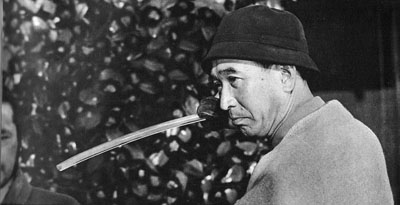
For Cahiers the choice was clear. Mizoguchi was master of subtly shaping drama through the body’s relation to space, thanks to quiet depth compositions and modulations of the long take. In Japan, land of exquisite nuance, the dream of infinitely expressive mise-en-scene seemed to have come true.
There seemed to be nothing nuanced about Kurosawa, whose brash technique, overripe performances, and propulsive stories seemed disconcertingly “Western.” Sold, like Satyajit Ray, as a humanist from an exotic culture, he played into critics’ eternal admiration for significance. This director wanted to make profound statements about the bomb (I Live in Fear), the relativity of truth (Rashomon), the impersonality of modern society (Ikiru), and the complacency of power (High and Low, The Bad Sleep Well). Even his swordplay movies seemed moralizing, with the last line of Seven Samurai (“The victory belongs to these peasants. Not to us.”) summoning up a cheer for the little people. Kurosawa could thus be assigned to Sarris’s category of Strained Seriousness. “He’s the Japanese Huston,” said a friend at the time.
But there was no overlooking his cinematic gusto. He made “movie movies.” He flaunted deep-focus compositions, cunningly choppy editing, sinuous tracking shots (through forests, no less), dappled lighting, and abrupt addresses to the viewer, by a voice-over narrator or even a character in the story. He exploited long lenses and multiple-camera shooting at a period when such techniques were very rare, and he may have been the first director to use slow-motion for action scenes. Bergman, Fellini, and other international festival filmmakers of the 1950s didn’t display such delight in telling a story visually. If you liked this side of his work, you overlooked the weak philosophy. On the other hand, if you found the style too aggressive, it could seem mere calculation on the part of a man with something Important to say.
The case for the defense was made harder by the fact that he was a controversial figure at home as well. Japanese critics I met over the years expressed puzzlement about Western admiration for the director’s style. I was once on a panel in which an esteemed critic blamed Kurosawa for influencing Western directors like Leone and Peckinpah. His violence and showy slow-motion had helped turn modern cinema into a blunt spectacle. No wonder Lucas, Spielberg, Coppola, and Walter Hill have loved this macho filmmaker.
Today passions seem to have cooled, but I should confess that my own tastes remain rooted in my salad days (1960s-1970s). I could live happily on a desert island with only the films of Ozu and Mizoguchi. I’d argue forever that Japanese cinema of the 1920s through the 1960s is rivaled for sheer excellence only by the parallel output of the US and France. (For more on this matter, see my blog entry on Shimizu.) On Kurosawa, however, my feelings are mixed. I still find most of his official classics overbearing, and the last films seem to me flabby exercises. But there are remarkable moments in every movie. Overall, I’ve responded best to his swordplay adventures; Seven Samurai was the first film that showed me the power of the Asian action aesthetic. I think as well that his earliest work up through No Regrets for Our Youth (1946), along with the later High and Low and Red Beard, are extraordinary films. And, like Hitchcock and Welles, he is wonderfully teachable.
We don’t live on desert islands, and gradually we’re gaining easy access to the range of Japanese filmmaking of its great era. We can start to see beyond the fortified battlements set up by generations of critics. With so many points of entry into Japanese cinema, mighty opposites lose their starkness; polarities dissolve into the long tail. Nevertheless, personal tastes take you only so far, and objectively Kurosawa still looms large. Whatever your preferences, it’s important to study his place in film history and film art.
Gauging that place involves thinking outside some traditional conceptions of how films work. Like most ambitious Japanese directors, Kurosawa provides bursts of cinematic swagger. This six-shot passage from Rashomon revels in its own strangeness.
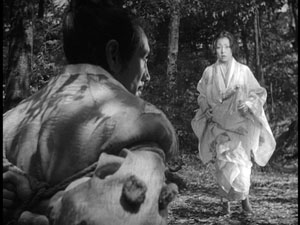
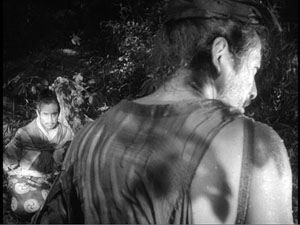
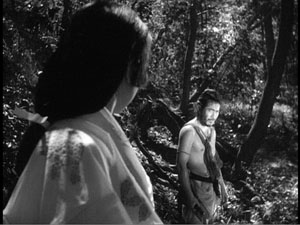
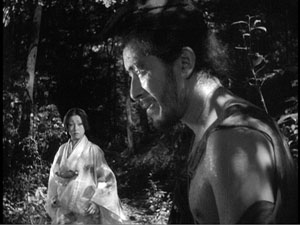
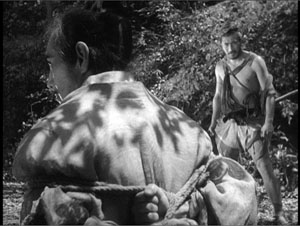
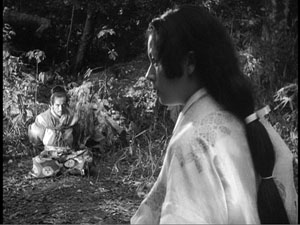
Here traditional over-the-shoulder shots submit to a brazen geometry. Out of an ABC film-school technique Kurosawa creates a cascade of visual rhymes and staccato swiveled glances. Yes, an ingenious critic could thematize this bravura passage. (“The symmetries put the central characters, each of whom asserts a different version of what happened, on the same visual and moral plane.”) Instead I’m inclined to think that the shots constitute a little thrust of “pure cinema,” a brusque cadenza that keeps our eyes, if not our hearts or minds, locked to the screen. From this angle, Kurosawa claims some attention as an inventor of, or at least tinkerer with, the disjunctive possibilities of film form.
His centenary arrives in 2010, and the occasion is celebrated by Criterion with a set of twenty-five DVDs. Most of these titles have already been available singly, and the discs lack all the bonus features we have come to admire from the company. Yet the crimson and jet-black box, the discreet rainbow array of slip cases, and the subtly varied design of the menus add up to a good object, like the latest iPod—something you want even if it means re-buying things you already have. There’s also a handsome picture book with notes by Stephen Prince on each film.
To viewers who need the assurance of cultural importance, this behemoth announces: You must know Kurosawa to be filmically literate. And that’s more or less true. Just as important, the inclusion of four rarities from his early years gives the collection a claim on every film enthusiast’s attention. One hopes that those titles will eventually appear separately, perhaps in an Eclipse edition. [See 15 May 2010 update at the end.] For now these copies of the wartime features are far better than the imports I’ve seen.
The Big Box makes it tempting to mount a career retrospective on this site, but that’s far beyond my capacity. Future blog entries may talk more of this complicated filmmaker, but for now I’ll confine my remarks to these early works. They offer plenty for us to enjoy.
Audacious propaganda
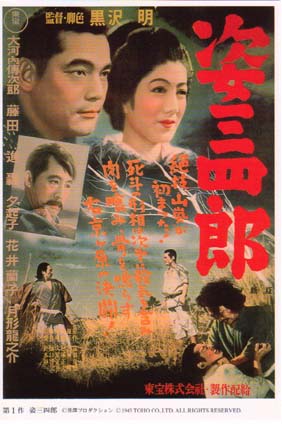
Although Kurosawa was only seven years younger than Ozu, he belongs to a distinctly different generation. Ozu directed his first film in 1927, at the ripe age of twenty-four. He grew up with the silent cinema and made masterful films in the early 1930s, during the long twilight of Japanese silent filmmaking. Kurosawa became an assistant director in the late 1930s. Although he evidently directed large stretches of Yamamoto Kajiro’s Horse (1941), he didn’t sign a feature as director until he was thirty-three. His closest contemporary, and a director whom some Japanese critics consider his superior, is Kinoshita Keisuke. Kinoshita was born in 1912 and his first feature, The Blossoming Port, was released in the same year as Kurosawa’s debut.
Kurosawa and Kinoshita began their careers making wartime propaganda. Their task was to display Japanese self-sacrifice and spiritual purity in stories of both the past and the present. In the Sanshiro Sugata films (1943, 1945), Kurosawa presents judo as an integral part of Japanese tradition and a path to enlightenment. Much of the external conflict is devoted to uniting martial arts (ju-jitsu, karate) under the rubric of the less aggressive but more powerful judo, and to showing how it can defeat American-style boxing. But the internal dimension is also important. Judo is a means of tempering character and accepting one’s proper place. Humble, unflagging devotion to one’s vocation becomes heroic.
The same quality can be found in The Most Beautiful (1944), a story of teenage girls working in a factory manufacturing lenses for binoculars and gunsights. Vignettes from the girls’ lives dramatize the need for cooperation and sacrifice, even as wartime demands for output threaten the girls’ health.
A more detached conception of the Japanese spirit underlies The Men Who Tread on the Tiger’s Tail (1945). This adaptation of a plot from Noh and Kabuki theatre shows officers escorting a general through enemy territory. Disguised as monks, the bodyguards are forced to bluff their way through a checkpoint. The situation is one of hieratic suspense, made more tonally complex by Kurosawa’s addition of the movie comedian Enoken. Enoken plays a dimwitted porter reacting to the charade played out by his betters. By dramatizing one of the most famous episodes in Japanese literature, Kurosawa was reasserting the tradition of devotion to duty and honor. The Men Who Tread on the Tiger’s Tail was released the same month that the atomic bomb fell on Hiroshima.
During earlier decades, Japanese cinema had created a complex tradition. In part, it conducted a sustained dialogue with Western cinema. Tokyo had access to a wide range of Hollywood movies, and directors studied American technique closely. Just as Ozu would not be Ozu without his early fondness for Lubitsch and Harold Lloyd, Mizoguchi learned a good deal from von Sternberg. Between 1938 and 1942, alongside German imports Tokyo theatres screened Fury, Only Angels Have Wings, The Sea Hawk, The Awful Truth, Angels with Dirty Faces, Boys Town, Young Tom Edison, Only Angels Have Wings, and many French titles. In 1942, with Hollywood films now banned, one could still see René Clair’s Le Million and À Nous la liberté—films that had been circulating in Japan since the early 1930s and could have served as models of flashy sound technique. It’s misleading to talk of Ozu as “purely Japanese” and Kurosawa as “Western”: All Japanese directors of the 1920s and 1930s were deeply acquainted with Western cinema, and American cinema in particular furnished a foundation for most local filmmaking.
Yet there are crucial differences. Japanese cinema welcomed extremes of stylistic experimentation that would have been rare in Western cinema. The 1920s swordplay films (chambara) pioneered rapid editing, handheld camerawork, and abstract pictorial design. (I supply some examples here.) Directors working in the contemporary-life mode (the gendai-geki) experimented similarly, often achieving remarkable visual effects and bold stylization. Mizoguchi and Ozu have become our emblems of this creative rigor and richness, but they are the peaks of what was a collective approach to filmic expression. Not every film was an experiment—indeed, most behave like Hollywood or European productions—but many ordinary movies, signed by unheralded directors, exhibit flashes of unpredictable imagination. This was the tradition of permanent innovation that directors of the Kurosawa-Kinoshita generation inherited.
As the war dragged on, however, Japanese studio productions lost much of their audacity. Production fell from over 400 films in 1939 to fewer than 100 in 1943. Censorship may have made filmmakers cautious about style as well as subject and theme. Most of the fifty-plus films I’ve been able to see from the period 1940-1945 are quite conservative aesthetically. Several of these seem to me quite good, but they rely on fairly standard Hollywood technique sprinkled with touches that had become markers of Japanese cinema (sustaining scenes in rather distant shots, using cuts rather than dissolves to shift scenes, and so on). Swordplay films become more severe and monumental. Even Mizoguchi’s Genroku Chushingura (1941-42) and Ozu’s There Was a Father (1942), superb as they are, are more elevated in tone than the directors’ earlier works.
Against this backdrop, Kurosawa’s films stand out; they are the most extroverted works I know in this period. Their innovations remain vivid; Sanshiro Sugata, for one, with its hierarchy of competitors, its rivalry among schools, and its visceral technique, may have invented the modern martial arts film. But we should also realize that these early films build upon the traditions already firmly established in Japanese cinema.
Playing with the passing moment
Consider transitions. Kurosawa is famous for his elaborate links between sequences, from the hard-edged wipes to swift imagistic associations. But we should recall that transitional passages offer moments of flashy style in American and European cinema of the 1920s and 1930s, and indeed right up to this day. (For examples, go here and here.) In the same year as Sanshiro, Kinoshita gave us this moment in Blossoming Port. A con artist is trying to bilk money from a town. He bows, leaving an empty frame.
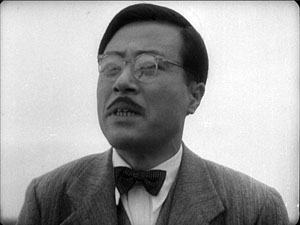
Without a discernible cut, heads pop into the empty frame, rocking to and fro.
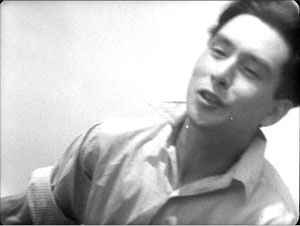
Another cut reveals that the people we see are in a boat tossing on the waves, and the conman’s partner is enjoying an outing with the locals. Kurosawa’s scene-changes—sites of what Stephen Prince has called “formal excess”—can be seen as prolonged, imaginative reworkings of this tricky-transition convention.
Japanese filmmakers were more willing to play with the expressive and “decorative” side of filmmaking than most of their Western peers. Directors created not only flashy transitions but moments of stylistic playfulness within scenes. Sometimes this just adds to the overall tone of comedy, as in this pretty passage in Heiroku’s Dream Story, another 1943 release. The hero, played by Enoken, is squatting and talking to a charming girl (Takamine Hideko). She twirls her parasol between them, and we get a straight-on cut that creates a moment of abstraction as the parasol glides across the frame in contrary directions. (The vertical pair of frames shows the cut.)
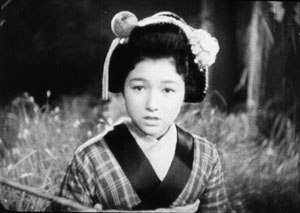
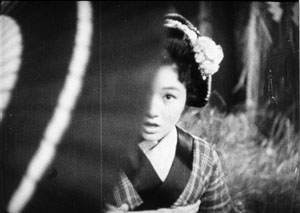
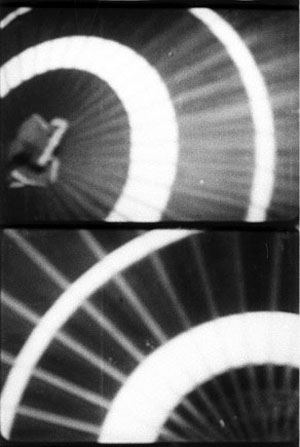
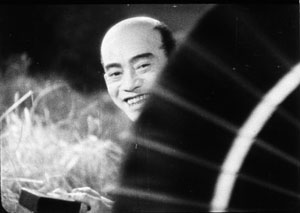
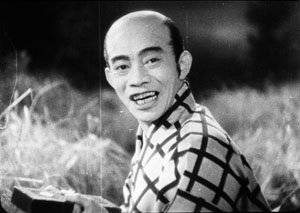
This decorative symmetry would be rare in Hollywood outside a Busby Berkeley number, but it enlivens the characters’ exchange in a way similar to the more dramatic Rashomon sequence. To borrow a phrase that Kepler applied to nature’s way with snowflakes, a filmmaker may seek to ornament a scene by “playing with the passing moment.”
Likewise, in The Blossoming Port, as an older woman recalls a romance of her youth, the natural sound fades out and the back-projection behind the carriage shifts from the seaside to urban imagery of the period she’s remembering.
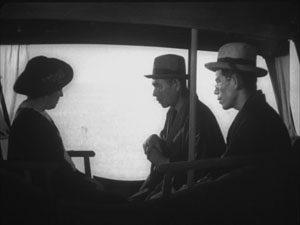
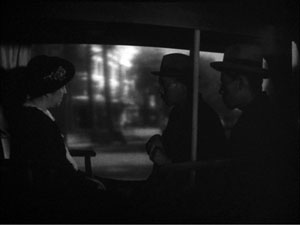
The frank artifice of this shot shows that Japanese filmmakers were eager to let us enjoy the forms with which they were working.
A similar explicitness about style can be seen in one of Kurosawa’s signature devices, the axial cut. This technique shifts the framings toward or away from the subject along the lens axis. If the shots are short enough, we sense a bump at the abrupt change of shot scale.
Kurosawa often uses this cutting to stress a momentary gesture or to prolong a moment of stasis. But it can structure a simple dialogue scene as well. In Sanshiro Sugata, the hero’s first conversation with Sayo takes place as they descend a stair toward a gateway. Kurosawa uses axial cuts to keep up with them as they move away from us down the steps. Illustrated with stills, this technique looks like a forward camera movement, but in fact these images come from separate shots.
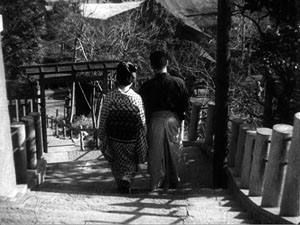
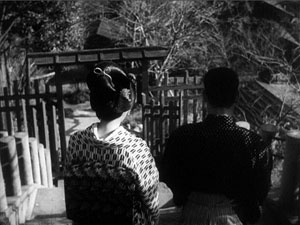
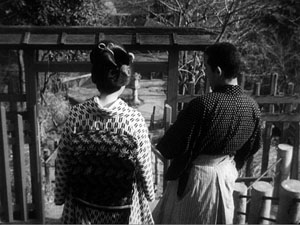
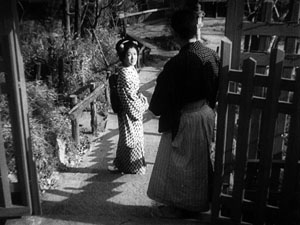
The crux of the scene is Sayo’s revelation that the man Sanshiro must fight is her father, and instead of big close-ups to underscore his reaction, Kurosawa simply lets his hero halt while Sayo continues down the steps. The steady pattern of cut-ins to the characters’ backs makes Sayo’s sudden turn to the camera more vivid, and Sanshiro’s reaction is underplayed by not giving us direct access to his face.
An earlier entry traces theaxial cut back to silent film, when its jolting possibilities were exploited in Soviet montage cinema. Japanese directors also used the device often. Yamanaka Sadao, one of the most-praised directors of the 1930s, used axial cuts prominently in an early dialogue scene of Humanity and Paper Balloons (1937). The cuts are accentuated by low-height compositions that maintain the steep perspective of the street.
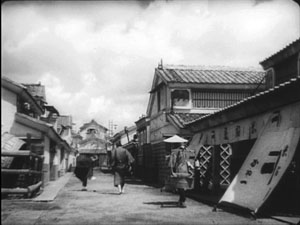
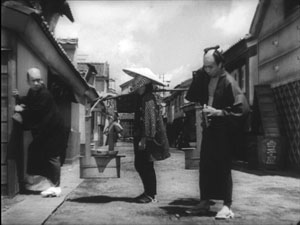
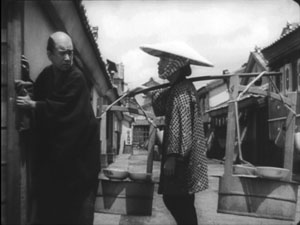
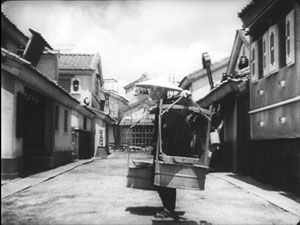
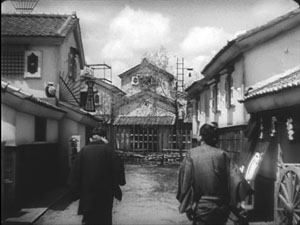
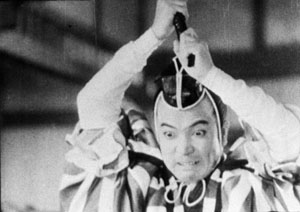
The technique gains more punch in Japanese swordplay films. Here is a percussive instance from Faithful Servant Naosuke (1939), four short shots yanking us inward in a way that Kurosawa would make his own.
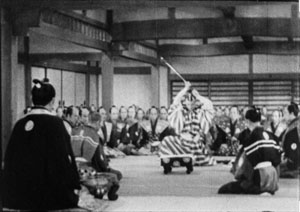
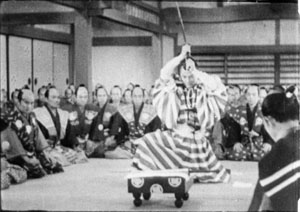
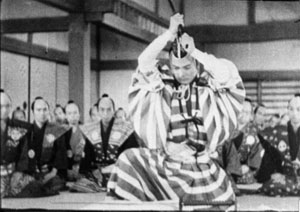
Tom Paulus reminds me that Capra films sometimes make use of this technique, as in this string of concentration cuts from Mr. Smith Goes to Washington (1939).
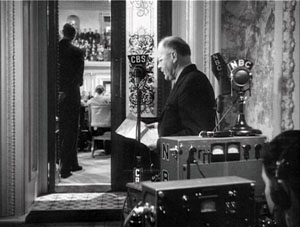
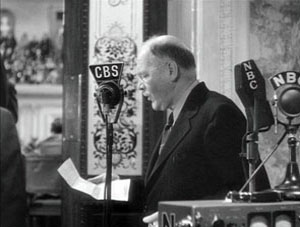
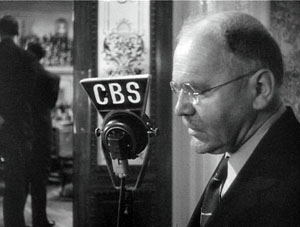
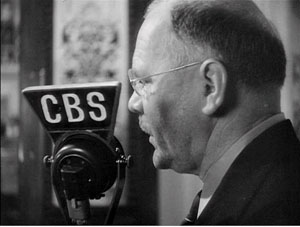
Interestingly, Mr. Smith ran on several Tokyo screens in October 1941; it may have been the last Hollywood feature to receive theatrical distribution before the attack on Pearl Harbor.
To say that Kurosawa adapts traditional devices doesn’t take away from his accomplishment. No artist starts from zero, and in commercial cinema, filmmakers commonly revise schemas already in circulation. So Kurosawa puts his own spin on the axial cut, not only by using it frequently, but also by varying it in the course of a film. Sanshiro Sugata 2 makes the axial shot-change a sort of internal norm, but then varies it: inward or outward, cuts or dissolves, how great a variation of scale? When Sanshiro leaves Sayo, the three phases of his departure are marked by simple repetition: each time he halts and looks back, she responds by bowing.
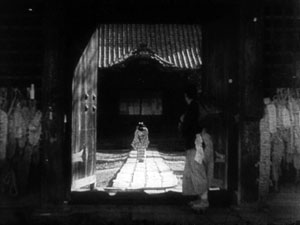
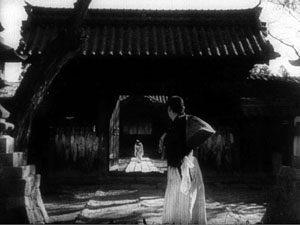
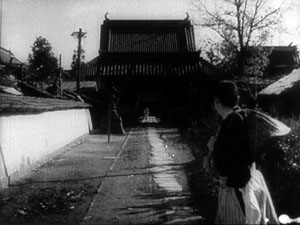
Like the Rashomon sequence, this shows Kurosawa’s fondness for permuting simple patterns. But there’s an expressive payoff too. The framings that make Sayo dwindle to a speck give the axial cuts the forlorn, lingering quality we usually associate with dissolves. In addition, for viewers who know Sanshiro 1, the scene calls to mind the staircase passage we’ve already seen. Their first extended encounter is paralleled by their last one.
Axial cuts are easier to handle when the subject is unmoving, or moving straight toward or away from the camera. What about other vectors of motion? In The Men Who Tread on the Tiger’s Tail, as the general’s bodyguards file out of the compound, they pass a line of soldiers in the foreground. Kurosawa combines concentration cuts with lateral cutting, so our men stalk leftward through the frame once, then again, then again, each time both closer to us and further along the row of soldiers.
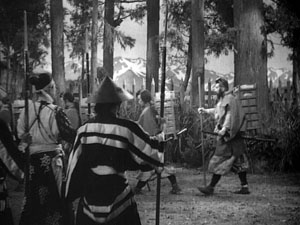
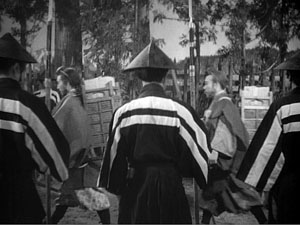
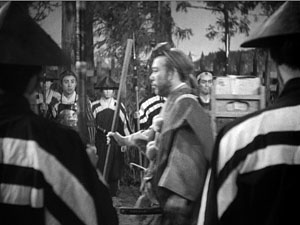
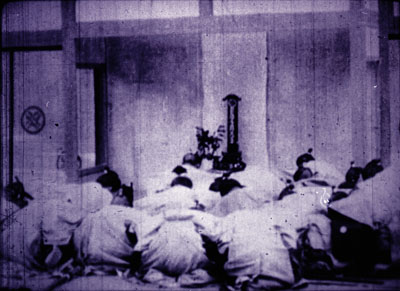
Kurosawa revises other traditional techniques. You can find moments of extended stasis in swordplay films of earlier decades, and the technique surely owes something to the prolonged mie poses in Kabuki. But Kurosawa’s early films turn long pauses into living freeze-frames. Instead of using an optical effect, he simply asks his actors not to move! One combat in Sanshiro shows the audience caught in absolute stillness, staring at the result of Sanshiro’s throw. In Sanshiro 2, our hero and the boxer stand like statues in the prizefight ring until the American collapses. And in The Men Who Tread on the Tiger’s Tail, the groups gathered at the checkpoint are absolutely unmoving for nearly fifty seconds as Benkei leads them in prayer.
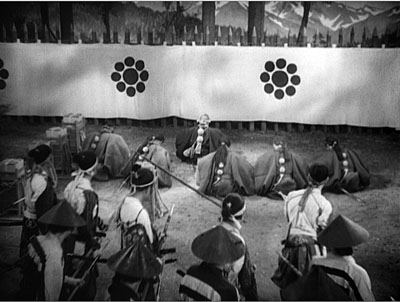
This shot’s tactful, reverential composition echoes a fairly standard image for showing loyal retainers; here’s an example from a 1910s version of Chushingura.
In sum, I think that for his “manly movies” Kurosawa sifted through the Japanese film tradition and pulled out the most vigorous techniques he could find, all the while recognizing that rapid pacing needs the foil of extreme immobility. He compiled a digest of many arresting visual schemas available to him, and then pushed them in fresh directions. He realized as well that he could apply this sharp-edged style to genres dealing with modern life.
A most stubborn young woman
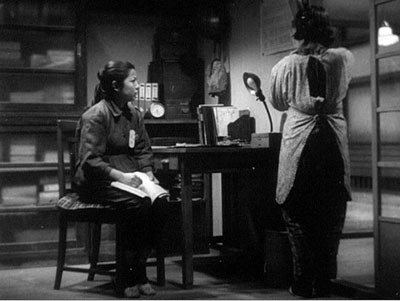
Although we think of Kurosawa as a “masculine” director, two of his finest films center on women. The Most Beautiful and No Regrets for Our Youth can be thought of as propaganda, but this label shouldn’t put us off. Propaganda works partly because it taps deep-seated emotions, and I’d argue that the formulaic nature of a “social command” can allow filmmakers a chance at emotional and formal richness. Because the message can be taken for granted or read off the surface, an ambitious director can go to town—nuancing the presentation, complicating its implications, taking the clichéd message as an occasion for pushing formal experiment. (Which is one aspect of what the Soviet montage filmmakers did.)
The Most Beautiful, probably the best movie ever made about child labor, starts off as a doctrinaire effort. Before even the Toho logo fades in, a title declares: “Attack and Destroy the Enemy.” The first fifteen minutes are filled with pledges to help the war effort, work to meet an emergency quota, obey orders, display filial devotion, build noble character, and think constantly of how making flawless lenses saves soldiers’ lives. The rest of the movie focuses on the pain of doing all this. This story of patriotic affirmation is steeped in tears.
The film’s structure looks forward to the ensemble-based, threaded plotlines employed in Red Beard and Dodes’kaden. We follow various stories, if only briefly, as the teenage girls push themselves beyond the limits proposed by their overseers. The factory directors and the dormitory mother are barely characterized, so that the focus falls on the girls who have left their homes to serve their country. One looks out the window when a train passes; another walks sobbing across a garden made of heaps of earth from each girl’s native village. When one girl falls from a roof, she promises to keep working on crutches. Another hides the fact that she has a fever. In this movie, workers cry out “Mother!” in their sleep.
Sanshiro Sugata pulses with the exuberance of a young man’s body itching for constant movement. Kurosawa’s second film applies his muscular techniques to a static situation: Girls bent over machines. True, there are interludes of a marching and volleyball, the latter calling forth a standardized stretch of montage, but the director’s central task is to dynamize conversations. He finds a remarkable array of options. We get good old axial cutting, but there are also jump cuts (as if the action were too urgent to wait for dissolves), resourcefully simple staging (see this entry), abrupt close-ups, quick flashbacks, and judicious long takes jammed with actors.
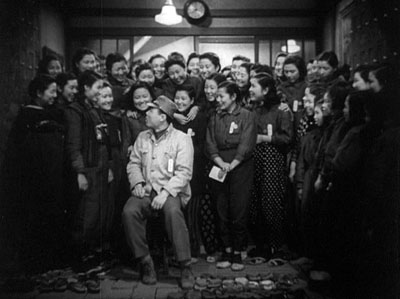
Off on the right stand two tall girls frowning and looking down; their quarrel will burst out in a later scene.
The virtuosity here is quieter than in Sanshiro, largely because of the insistent threat of shame. A Hollywood film of the period might play up the triumphant achievement of the quota, but here this goal fades away. Instead, the plot is driven by a nearly desperate fear of failure. The men in charge offer bluff reassurance, but in a reprise of high-school nerves, the girls fret constantly about doing less than their mates. Their anxiety is translated into gesture-based performance—not through Western hysteria but through gestures of lowering the eyes, bowing the head, turning one’s back. The Most Beautiful has some of the greatest back-to-the-camera scenes in film history, and Kurosawa doesn’t hesitate to insert some of these moments in wide shots, creating a delicate emotional counterpoint. At one moment the girls are distracted by a passing airplane but their leader is sunk in thought; at another moment the girls challenge the leader while her accuser can’t face her.
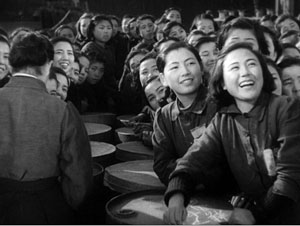
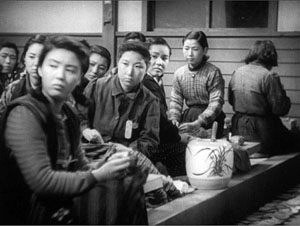
The girls’ stories are woven around Watanabe, the section leader. Somewhat older than the others and nowhere near as spontaneous or joyous, she’s the emblem of unremitting self-sacrifice. If Sanshiro matures in the course of his films, learning the humbling responsibilities of becoming a supreme fighter, she comes to her more mundane task already grown up. Noël Burch has pointed out that Kurosawa’s protagonists are notably stubborn, and Watanabe offers a prime instance.
At the climax she has to search through thousands of lenses for a flawed one that she accidentally let through. Kurosawa forces us to watch her, exhausted from hours of work, hunched over her microscope and keeping awake by singing a patriotic song. One shot holds on her groggy efforts for over ninety seconds, so we register both the enormity of her task and her obstinate refusal to quit. This shot will be paralleled by the film’s final one, which lasts almost exactly as long, when she returns to her workbench. Now her concentration is broken, again and again, by quiet weeping. Kurosawa claims that when he made the film he knew Japan would lose the war.
The ending of The Most Beautiful calls to mind a moment in another Kinoshita film, again one released in the same year as Kurosawa’s. Army (1944) ends on a similarly ambivalent note, with a frantic mother pushing through a crowd cheering recruits marching off to war. Through cries of “Banzai!” she stumbles along to get a last glimpse of him, but soon her trembling figure is lost in the excitement. It isn’t exactly an exalted note on which to close a patriotic film.
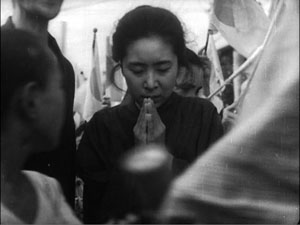
A mother is central to Watanabe’s sacrifice in The Most Beautiful as well, and her plight reminds me of historian John Dower’s telling me that Japanese soldiers may have charged into battle shouting the name of the emperor, but many died murmuring, “Mother.”
Like other filmmakers, Kurosawa had to execute an about-face when the Americans came to occupy Japan. Along with Mizoguchi, Kinoshita, and most others, he began to make films that condemned the “feudal” forces that had led Japan to war and affirmed the need for liberalizing the society, not least with respect to women’s roles. Kurosawa’s contribution was No Regrets for Our Youth (1946), a survey of the 1930s and 1940s through the experience of a daughter of the middle class. At first she’s oblivious to the authoritarian threat and then, awakened to her social mission, she plunges into what we would now call the politics of everyday life. With the same verve that Kurosawa dramatized sacrifice for the motherland, he quickens a liberal fable of emerging political consciousness. Again, he finds ways of making propaganda deeply moving, while leaving his unique stamp on the project.
I hope to write about No Regrets and other Kurosawa titles in the future. But one implication should already be clear. Kurosawa remains on our agenda through his commitment to a mode of storytelling that pursues vigor without lapsing into the diffuse busyness of today’s spectacles. He stretches our senses through staccato action, yet he drills into other moments so implacably that we are forced to see deeper. He lifts certain Japanese and imported traditions to a new pitch, in the process often creating something indelible and enduring.
The point of departure for all things Kurosawa is Donald Richie’s Films of Akira Kurosawa, first published in 1965 and updated since. It was a trailblazing auteur study, written from deep knowledge of the films and many encounters with the director. Another indispensible source is Kurosawa’s Something Like an Autobiography (Knopf, 1982). Although it stops after the success of Rashomon, the book offers fascinating information about Kurosawa’s early life and first films. (“The Most Beautiful is not a major picture, but it is the one dearest to me.”) Information on the later films is collected in Bert Cardullo, Akira Kurosawa: Interviews (University Press of Mississippi, 2008). A biographical overview, with details on each film’s production, is provided in Stuart Galbraith IV, The Emperor and the Wolf (Faber, 2001).
For background on Japan’s wartime cinema, the central work is Peter B. High’s The Imperial Screen (University of Wisconsin Press, 2003). See also John Dower’s magnificent surveys of the war and the postwar period, War without Mercy (Pantheon, 1987) and Embracing Defeat (Norton, 2000).
Noël Burch argues that Kurosawa is best understood as working within a tradition of indigenous Japanese art; his pioneering To the Distant Observer (University of California Press, 1979) is available online here. Linking formal preoccupations to changing subjects and themes, Stephen Prince’s The Warrior’s Camera (Princeton University Press, 1999) argues that Kurosawa was forging heroic figures appropriate to developments in Japanese society. In Kurosawa: Film Studies and Japanese Cinema (Duke University Press, 2000), Mitsuhiro Yoshimoto puts the films in political contexts, while also considering how Kurosawa has been understood within the Western academy.
Critics have long recognized that Kurosawa’s formal inventiveness came with an impulse toward large statement. Brad Darrach reconciled the two tendencies in an overheated specimen of Timespeak:
Not since Sergei Eisenstein has a moviemaker set loose such a bedlam of elemental energies. He works with three cameras at once, makes telling use of telescopic lenses that drill deep into a scene, suck up all the action in sight and then spew it violently into the viewer’s face. But Kurosawa is far more than a master of movement. He is an ironist who knows how to pity. He is a moralist with a sense of humor. He is a realist who curses the darkness—and then lights a blowtorch.
This comes from “A Religion of Film,” a remarkable primer on the art cinema in its American spring. It was published in Time of 20 September 1963 and is available here. The same antinomy of stylist vs. moralist persists, with less complimentary results, in Tony Rayns’ obituary in Sight and Sound (October 1998), p. 3 and in Dave Kehr’s recent review of the Criterion boxed set.
I wrote about Kurosawa’s work in our textbook Film History: An Introduction (third edition, McGraw-Hill, 2009), pp. 234-235 and 388-390. My larger arguments about classic Japanese film can be found in Ozu and the Poetics of Cinema (online here) and in two articles in Poetics of Cinema (Routledge, 2008), “A Cinema of Flourishes: Decorative Style in 1920s and 1930s Japanese Film” and “Visual Style in Japanese Cinema, 1925-1945,” which analyzes some of the films I’ve considered here. I talk a little more about editing in Seven Samurai in this entry. In another I discuss how Kurosawa’s “humanism” fits into one 1950s ideological framework.
Yamanaka’s Humanity and Paper Balloons is available on DVD in the Eureka! series. For a cinematic homage to early Kurosawa, see Johnnie To’s Throw Down.
Thanks to Komatsu Hiroshi for supplying the date of Faithful Servant Naosuke. And as a PS, thanks to Luo Jin for pointing out a “slip of the finger”: the original post had Kurosawa older than Ozu!
PPS: 9 December: The Criterion site has just posted a reminiscence of Kurosawa by Donald Richie.
PPPS: 15 May 2010: Criterion has just announced that the four films discussed in this entry will be released as a separate collection on the Eclipse label.